

Sex differences and hormonal effects on gut microbiota composition in mice
Open accessThe DOI matches its Crossref record; 35 of the 35 references it cites were found in a registry or an index.
Abstract
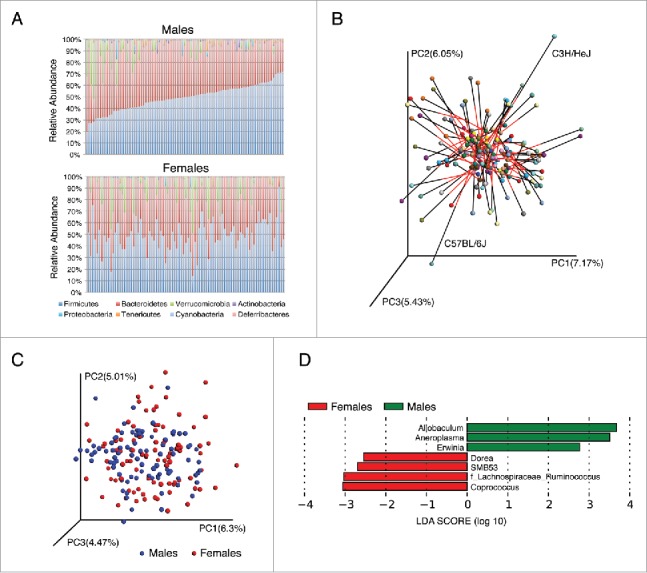
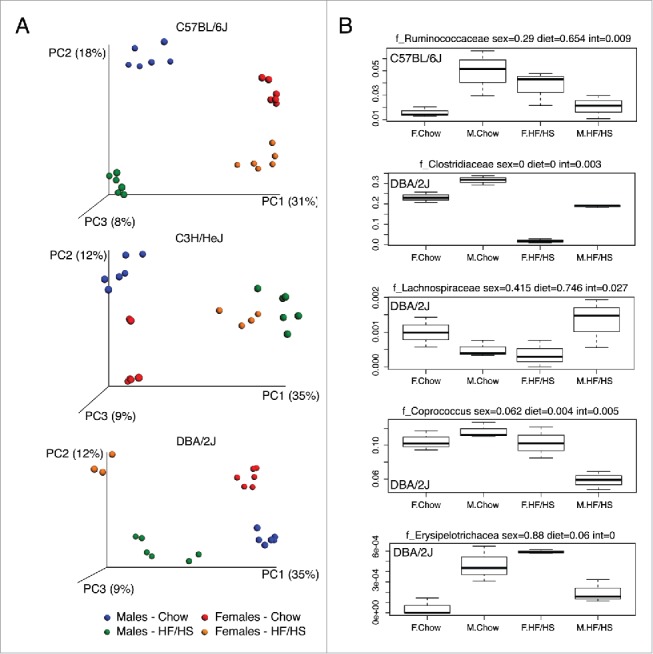
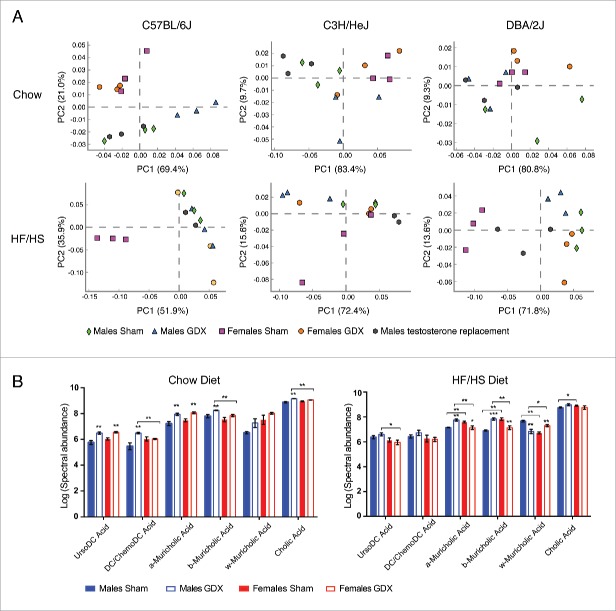
We previously reported quantitation of gut microbiota in a panel of 89 different inbred strains of mice, and we now examine the question of sex differences in microbiota composition. When the total population of 689 mice was examined together, several taxa exhibited significant differences in abundance between sexes but a larger number of differences were observed at the single strain level, suggesting that sex differences can be obscured by host genetics and environmental factors. We also examined a subset of mice on chow and high fat diets and observed sex-by-diet interactions. We further investigated the sex differences using gonadectomized and hormone treated mice from 3 different inbred strains. Principal coordinate analysis with unweighted UniFrac distances revealed very clear effects of gonadectomy and hormone replacement on microbiota composition in all 3 strains. Moreover, bile acid analyses showed gender-specific differences as well as effects of gonodectomy, providing one possible mechanism mediating sex differences in microbiota composition.
Overview
The claims and statistics of this paper haven’t been checked yet.
Free: it reads the open-access text and checks the first 5 claims that cite a source we can check. Create a free account to check every claim.
Integrity signals
Registry
Cites
Statistics
Figures
Verification
Claims the paper makes
The claims and statistics of this paper haven’t been checked yet.
Free: it reads the open-access text and checks the first 5 claims that cite a source we can check. Create a free account to check every claim.
Claims other papers make about this one
Each is checked against this paper’s own text: does it say what the citing paper says it does?
The cited source says what the claim attributes to it.
In the citing paper
“Significant differences in microbial diversity between males and females are first observed following puberty which can be reversed following male castration (6).”
From Association Between Sex Hormone Levels and Gut Microbiota Composition and Diversity—A Systematic Review (2022) · cites this paper as [6]
In the citing paper
“Another study observed a substantial effect of gonadectomy and hormone replacement on the composition of microbial species (6).”
From Association Between Sex Hormone Levels and Gut Microbiota Composition and Diversity—A Systematic Review (2022) · cites this paper as [6]
Self-check
Percentages, sums and reported differences re-computed from the paper’s own numbers.
The self-check needs the paper’s full text.
Citations
Cites
QIIME allows analysis of high-throughput community sequencing data
Caporaso, J. G., Kuczynski, J., Stombaugh, J., Bittinger, K., Bushman, F. D., Costello, E. K., Fierer, N., Peña, A. G., Goodrich, J. K., Gordon, J. I., et al. (2010) · Nature Methods · doi:10.1038/nmeth.f.303 · Cited by 34,887 · cited 1×
“0.(29,30) The total number of sequencing reads was 15,010,979 (an average of 19,571 reads per sample) with an average length of 153 base pair reads.”
BackgroundMetagenomic biomarker discovery and explanation
Segata, N., Izard, J., Waldron, L., Gevers, D., Miropolsky, L., Garrett, W. S., & Huttenhower, C. (2011) · Genome Biology · doi:10.1186/gb-2011-12-6-r60 · Cited by 16,192 · cited 1×
“LEfSe first performs the Kruskall-Wallis test (testing whether the values in different classes are differentially distributed), then a nonparametric Wilcoxon sum-rank test (testing whether all pairwise comparisons between subclasses within different classes significantly agreed with the class level trend) and then fol…”
MethodStructure, function and diversity of the healthy human microbiome
The Human Microbiome Project Consortium (2012) · Nature · doi:10.1038/nature11234 · Cited by 11,726
A human gut microbial gene catalogue established by metagenomic sequencing
MetaHIT Consortium, Qin, J., Li, R., Raes, J., Arumugam, M., Burgdorf, K. S., Manichanh, C., Nielsen, T., Pons, N., Levenez, F., et al. (2010) · Nature · doi:10.1038/nature08821 · Cited by 11,624
Diet rapidly and reproducibly alters the human gut microbiome
David, L. A., Maurice, C. F., Carmody, R. N., Gootenberg, D. B., Button, J. E., Wolfe, B. E., Ling, A. V., Devlin, A. S., Varma, Y., Fischbach, M. A., et al. (2014) · Nature · doi:10.1038/nature12820 · Cited by 10,100
Linking long-term dietary patterns with gut microbial enterotypes
Wu, G. D., Chen, J., Hoffmann, C., Bittinger, K., Chen, Y.-Y., Keilbaugh, S. A., Bewtra, M., Knights, D., Walters, W. A., Knight, R., et al. (2011) · Science · doi:10.1126/science.1208344 · Cited by 6,513
McDonald, D., Price, M. N., Goodrich, J., Nawrocki, E. P., DeSantis, T. Z., Probst, A., Andersen, G. L., Knight, R., & Hugenholtz, P. (2012) · The ISME Journal · doi:10.1038/ismej.2011.139 · Cited by 5,064 · cited 1×
“Sequences were binned into OTUs based on 97% identity using UCLUST(31) against the Greengenes reference database.(32) Each sample’s sequences were rarefied to 17826 reads per strain to reduce the effect of sequencing depth.”
MethodQuality-filtering vastly improves diversity estimates from Illumina amplicon sequencing
Bokulich, N. A., Subramanian, S., Faith, J. J., Gevers, D., Gordon, J. I., Knight, R., Mills, D. A., & Caporaso, J. G. (2013) · Nature Methods · doi:10.1038/nmeth.2276 · Cited by 4,401 · cited 1×
“0.(29,30) The total number of sequencing reads was 15,010,979 (an average of 19,571 reads per sample) with an average length of 153 base pair reads.”
BackgroundSTAMP: statistical analysis of taxonomic and functional profiles
Parks, D. H., Tyson, G. W., Hugenholtz, P., & Beiko, R. G. (2014) · Bioinformatics · doi:10.1093/bioinformatics/btu494 · Cited by 4,191
Bacterial Community Variation in Human Body Habitats Across Space and Time
Costello, E. K., Lauber, C. L., Hamady, M., Fierer, N., Gordon, J. I., & Knight, R. (2009) · Science · doi:10.1126/science.1177486 · Cited by 3,231
Cited by
Items 701–800 of 835
Let's be adaptable: Tissue T cell adaptation in homeostasis and inflammation
Lutter, L. (2022) · Utrecht University Repository (Utrecht University) · doi:10.33540/1160
Vahidi, G., Moody, M., Welhaven, H. D., Davidson, L., Walk, S. T., Martin, S., June, R. K., & Heveran, C. M. (2022) · bioRxiv (Cold Spring Harbor Laboratory) · doi:10.1101/2022.11.07.515521
Cintra, L. (2022) · Digital Library of Theses and Dissertations (Universidade de São Paulo) · doi:10.11606/t.10.2022.tde-30112022-085150
Ortega, R. C. M. H., Tabugo, S. R. M., Martinez, J. G., Padasas-Adalla, C. S., & Balcázar, J. L. (2023) · Biologia · doi:10.1007/s11756-023-01423-5
“Our study was supported by the findings of Org et al. (2016), who studied gut microbiota in mice and showed that hor - monal effects may be a reason for the differences in micro - biota between genders.”
ResultFactors Affecting the Diversity and Density of the Microbiomes
Saar, R., & Dodd, S. A. S. (2023) · Wiley eBooks · doi:10.1002/9781119862611.ch4
Epicertin: preclinical development of a novel mucosal healing agent for ulcerative colitis.
Reeves, M. A. (2023) · ThinkIR: The University of Louisville's Institutional Repository (University of Louisville) · doi:10.18297/etd/4099
Luo, Y., Anwar, A., Pan, C., Shi, H., Mustafa, S. B., Chen, Y., Zhang, Z., Li, J., Zhu, J., & Zhao, W. (2024) · bioRxiv (Cold Spring Harbor Laboratory) · doi:10.1101/2024.01.10.575136
Chen, D., Zhou, Y., Lu, Y.-X., Xie, J., Qiu, Y.-Q., Wang, L., Zou, X., Dai, S., & Zhu, C.-D. (2024) · Research Square · doi:10.21203/rs.3.rs-4053430/v1
方, 正. (2024) · Advances in Clinical Medicine · doi:10.12677/acm.2024.1472010
Microbiome variations induced by delta9-tetrahydrocannabinol predict weight reduction in obese mice
Kaye, A. G., Rusling, M., Dhopeshwarkar, A., Kumar, P., Wagment-Points, L., Mackie, K., & Yuan, L. (2024) · Frontiers in Microbiomes · doi:10.3389/frmbi.2024.1412468
“It is established that sex hormones have differential effects on gut microbiome composition (Org et al., 2016; McGee and Huttenhower, 2021) including a bi-directional estrogen-microbiome axis (Baker et al., 2017).”
dong, Q., dong, Q., Liu, Z., Shi, W., Pu, S., Xu, S., Li, D.-Q., Zhou, Z., & Wu, Q. (2025) · SSRN Electronic Journal · doi:10.2139/ssrn.5105034
Sex hormones, microbiota, and metabolic diseases
Roggiani, S., Bernardi, A., & Brigidi, P. (2024) · Cardiologia Ambulatoriale · doi:10.17473/1971-6818-2024-4-9
Abdel-Sater, K. A. (2025) · The Russian Archives of Internal Medicine · doi:10.20514/2226-6704-2025-15-3-165-177
Sex-specific postmortem microbiome dynamics in mice: implications for death definitions
Xue, Y., Huang, M., Zhang, J., Navin, S., Tao, Y., & Zeng, G. (2025) · FEMS Microbiology Letters · doi:10.1093/femsle/fnaf070
Yağcı, T., & Ayseçkin, G. (2025) · Journal of Anatolian Environmental and Animal Sciences · doi:10.35229/jaes.1661557
The role of sex and age in some pathobiological and pathophysiological processes
Caruso, C., Carreca, A. P., Mineo, M. I., Vasto, S., & Arnaldi, G. (2025) · Elsevier eBooks · doi:10.1016/b978-0-443-27398-8.00016-2
Kolobaric, A., Ladouceur, C. D., Morris, A., Methé, B. A., Jašarević, E., & Bylsma, L. M. (2025) · bioRxiv (Cold Spring Harbor Laboratory) · doi:10.1101/2025.08.07.669149
“Microbial communities go through several stages of assembly early in life, but clear sex-specific patterns only appear during puberty (Jašarevi et al., 2016; Org et al., 2016; Yuan et al., 2020a).”
The Correlation Study of Gut Microbiota and Its Metabolites with ART Pregnancy Outcomes
任, 士. (2025) · Medical Diagnosis · doi:10.12677/md.2025.154054
Sex-dependent modulation of PCB-mediated toxicity from a proteomic and microbiome perspective
Singhal, R. A., Qaissi, Z., Zheng, H., Hua, Y., Hardesty, J., Rouchka, E. C., Merchant, M. L., Kong, M., & Wahlang, B. (2025) · Scientific Reports · doi:10.1038/s41598-025-23603-w
“While these findings reaffirmed previous reports on sex differences in gut microbiota in experimental models 62,63 , they also supported evidence of sex differences in human gut microbiome studies wherein female participants displayed lower Bacteroidetes abundance 64 .”
MeLSI: Metric Learning for Statistical Inference in microbiome community composition analysis
Bresette, N., Ericsson, A. C., Woods, C., & Lin, A. (2026) · mSystems · doi:10.1128/msystems.00407-26
“For the Atlas1006 data set, the learned metric assigned highest weights to genera in the families Bacteroidaceae, Lachnospiraceae, and Ruminococcaceae, taxonomic groups previously associated with sex differences in gut microbiome composition (30, 31).”
Auclair, L., Garant, D., Bergeron, P., Schulte‐Hostedde, A. I., Kembel, S. W., & Réale, D. J. F. (2025) · Authorea · doi:10.22541/au.176536811.19457920/v1
Kouete, M. T., Bletz, M. C., LaBumbard, B. C., Woodhams, D. C., & Blackburn, D. C. (2024) · Figshare · doi:10.6084/m9.figshare.26589546
Amato-Menker, C. J., Hopen, Q., Pettit, A., Gandhi, J., Hu, G., Schafer, R., & Franko, J. (2024) · Figshare · doi:10.6084/m9.figshare.26693230
Amato-Menker, C. J., Hopen, Q., Pettit, A., Gandhi, J., Hu, G., Schafer, R., & Franko, J. (2024) · Figshare · doi:10.6084/m9.figshare.26693236
Kouete, M. T., Bletz, M. C., LaBumbard, B. C., Woodhams, D. C., & Blackburn, D. C. (2024) · Figshare · doi:10.6084/m9.figshare.26589552
Kouete, M. T., Bletz, M. C., LaBumbard, B. C., Woodhams, D. C., & Blackburn, D. C. (2024) · Figshare · doi:10.6084/m9.figshare.26589558
Kouete, M. T., Bletz, M. C., LaBumbard, B. C., Woodhams, D. C., & Blackburn, D. C. (2024) · Figshare · doi:10.6084/m9.figshare.26589549
Amato-Menker, C. J., Hopen, Q., Pettit, A., Gandhi, J., Hu, G., Schafer, R., & Franko, J. (2024) · Figshare · doi:10.6084/m9.figshare.26693248
The role of the gut microbiome on socio-sexual behaviours in mice
Salia, S. (2021) · Memorial University Research Repository (Memorial University) · doi:10.48336/1ve5-e645
Amato-Menker, C. J., Hopen, Q., Pettit, A., Gandhi, J., Hu, G., Schafer, R., & Franko, J. (2024) · Figshare · doi:10.6084/m9.figshare.25414905
Additional file 1 of Sexual dimorphism of gut microbiota at different pubertal status
Yuan, X., Chen, R., Zhang, Y., Lin, X., & Yang, X. (2020) · Figshare · doi:10.6084/m9.figshare.12731394
Kouete, M. T., Bletz, M. C., LaBumbard, B. C., Woodhams, D. C., & Blackburn, D. C. (2024) · Figshare · doi:10.6084/m9.figshare.26589555
Koleva, P. T., He, J., Dunsmore, G., Bozorgmehr, N., Lu, J., Huynh, M., Tollenaar, S. L., Huang, V., Walter, J., Way, S. S., et al. (2024) · Figshare · doi:10.6084/m9.figshare.26755759
Kouete, M. T., Bletz, M. C., LaBumbard, B. C., Woodhams, D. C., & Blackburn, D. C. (2024) · Figshare · doi:10.6084/m9.figshare.26589537
Mazumder, M. H. H., Gandhi, J., Majumder, N., Wang, L., Cumming, R. I., Stradtman, S. C., Velayutham, M., Hathaway, Q. A., Shannahan, J. H., Hu, G., et al. (2023) · Figshare · doi:10.6084/m9.figshare.22678389
Koleva, P. T., He, J., Dunsmore, G., Bozorgmehr, N., Lu, J., Huynh, M., Tollenaar, S. L., Huang, V., Walter, J., Way, S. S., et al. (2024) · Figshare · doi:10.6084/m9.figshare.26755756
Zhang, Q., Chen, B., Zhang, J., Dong, J., Ma, J., Zhang, Y., Jin, K., & Lu, J. (2023) · Figshare · doi:10.6084/m9.figshare.23606947
Amato-Menker, C. J., Hopen, Q., Pettit, A., Gandhi, J., Hu, G., Schafer, R., & Franko, J. (2024) · Figshare · doi:10.6084/m9.figshare.26693239
Ganci, M., Suleyman, E., Butt, H., & Ball, M. (2022) · Figshare · doi:10.6084/m9.figshare.19696022
Mayneris‐Perxachs, J., Arnoriaga‐Rodríguez, M., Luque-Córdoba, D., Priego‐Capote, F., Pérez-Brocal, V., Moya, A., Burokas, A., Maldonado, R. J., & Fernández-Real, J.-M. (2020) · Figshare · doi:10.6084/m9.figshare.12981212
Koleva, P. T., He, J., Dunsmore, G., Bozorgmehr, N., Lu, J., Huynh, M., Tollenaar, S. L., Huang, V., Walter, J., Way, S. S., et al. (2024) · Figshare · doi:10.6084/m9.figshare.26755753
Amato-Menker, C. J., Hopen, Q., Pettit, A., Gandhi, J., Hu, G., Schafer, R., & Franko, J. (2024) · Figshare · doi:10.6084/m9.figshare.26693245
Yao, Z., Khan, A., Xu, Y., Pan, K., & Zhang, M. (2024) · Figshare · doi:10.6084/m9.figshare.26753497
Amato-Menker, C. J., Hopen, Q., Pettit, A., Gandhi, J., Hu, G., Schafer, R., & Franko, J. (2024) · Figshare · doi:10.6084/m9.figshare.26693233
Amato-Menker, C. J., Hopen, Q., Pettit, A., Gandhi, J., Hu, G., Schafer, R., & Franko, J. (2024) · Figshare · doi:10.6084/m9.figshare.26693242
Liu, M., Zhang, J., Zhou, Y., Xiong, S., Zhou, M., Wu, L., Liu, Q., Chen, Z., Jiang, H., Yang, J., et al. (2024) · Figshare · doi:10.6084/m9.figshare.26656609
Mayneris‐Perxachs, J., Arnoriaga‐Rodríguez, M., Luque-Córdoba, D., Priego‐Capote, F., Pérez-Brocal, V., Moya, A., Burokas, A., Maldonado, R. J., & Fernández-Real, J.-M. (2020) · Figshare · doi:10.6084/m9.figshare.12981224
Evariste, L., Lamas, B., Ellero‐Simatos, S., Khoury, L., Cartier, C., Gaultier, E., Chassaing, B., Feltin, N., Devoille, L., Favre, G., et al. (2023) · Figshare · doi:10.6084/m9.figshare.23682294
Amato-Menker, C. J., Hopen, Q., Pettit, A., Gandhi, J., Hu, G., Schafer, R., & Franko, J. (2024) · Figshare · doi:10.6084/m9.figshare.25414981
Kouete, M. T., Bletz, M. C., LaBumbard, B. C., Woodhams, D. C., & Blackburn, D. C. (2024) · Figshare · doi:10.6084/m9.figshare.26589540
Kouete, M. T., Bletz, M. C., LaBumbard, B. C., Woodhams, D. C., & Blackburn, D. C. (2024) · Figshare · doi:10.6084/m9.figshare.26589543
Kouete, M. T., Bletz, M. C., LaBumbard, B. C., Woodhams, D. C., & Blackburn, D. C. (2024) · Figshare · doi:10.6084/m9.figshare.26589534
Liu, M., Zhang, J., Zhou, Y., Xiong, S., Zhou, M., Wu, L., Liu, Q., Chen, Z., Jiang, H., Yang, J., et al. (2024) · Figshare · doi:10.6084/m9.figshare.26656606
Effect of long-term dietary fat quality on metabolic health with a special focus on dairy fat
Unger, A. L. (2021) · ScholarWorks -A service of University of Vermont Libraries (University of Vermont)
Factors Influencing Microbiota Diversity and Composition During Early Postnatal Development
Francella, C. (2019) · MacSphere (McMaster University) · doi:10.71548/17455
Brauner, A. (2020) · University Library Linz repository (Johannes Kepler Universitat Linz)
Korf, J. M. (2025) · Digital Commons-TMC (Texas Medical Center)
Gut Microbiome-Targeted Interventions for Improving Age-Related Arterial Dysfunction
Longtine, A. G. (2023) · CU Scholar (University of Colorado Boulder)
Dietary Strategies for Gut Health Improvement in Dogs
Montserrat-Malagarriga, M. (2024) · Tesis Doctorals en Xarxa (Consorci de Serveis Universitaris de Catalunya)
López-Martínez, J. M. (2020) · El Repositorio Academico Digital de la UANL (Universidad Autónoma de Nuevo León)
The bidirectional relationship between gut bacteria and intravenous fentanyl self-administration
Ren, M. (2023) · eScholarship (California Digital Library) · Cited by 1
Lee, S. (2024) · DSpace repository (University of Tartu)
Lu, S., Gao, M., Kuttappan, D. A., & Amalaradjou, M. A. R. (2025) · Foods · doi:10.3390/foods15010066
“Sex hormones are known to influence both microbial composition and metabolic responses to dietary interventions, potentially confounding data interpretation when both sexes are included [60,61].”
Efeitos sexo-específicos da restrição calórica crônica sobre a regulação comportamental e cognitiva.
Cassimiro, L. H. D. O. (2025) · LA Referencia (Red Federada de Repositorios Institucionales de Publicaciones Científicas)
Pope, C., Jones, R. M., RASHIED, A. A., Nagy, T., & Hanson, W. H. (2026) · Journal of the American Association for Laboratory Animal Science · doi:10.30802/aalas-jaalas-25-139
Gore, S., Akmel, A., Jackson, S., Ryan, A., Warren, H., Robinson, C. J., & Richardson, K. A. (2026) · bioRxiv (Cold Spring Harbor Laboratory) · doi:10.64898/2026.02.12.705550
“Sex-based differences in gut microbiota have been hypothesized to arise, at least in part, from hormonal influences (53 – 56).”
Napoli, S. D., Moretta, T., Ravenda, S., Mancabelli, L., Turroni, F., Sgoifo, A., Ventura, M., & Carnevali, L. (2026) · Stress and Health · doi:10.1002/smi.70152
“In animal models, sex differences in the composition of gut microbiota disappear after gonadectomy and are restored following treatment with sex hormones (Org et al. 2016; Organski et al. 2025).”
Matsufuji, I., Kitagawa, Y., Ohkura, S., & Morita, Y. (2026) · Scientific Reports · doi:10.1038/s41598-026-40455-0
“Previous studies have demonstrated that pubertal hormones, particularly testosterone, modulate gut microbial composition, and that reductions in androgen levels can promote reorganization of the gut microbiota toward SCFA-producing lineages 37,38 .”
Sex Differences in Stroke Dysbiosis in Rodent Models of Focal Cortical Ischemia
Daniele, E. (2022) · TSpace (University of Toronto)
Li, Y.-D., Sakamoto, S., Smith, M. D., Hasegawa, Y., Huang, M., Li, N., Dhaliwal, M. K., Schauermann, T., Xiong, F., Luo, B., et al. (2026) · Brain Behavior and Immunity · doi:10.1016/j.bbi.2026.106536
“Sex hormones are one potential driver, as estrogens modulate the gut microbiome and can promote fungal growth through immune regulation (Kumwenda et al., 2022; Org et al., 2016; Peters et al., 2024).”
Huang, J., Fu, Z., Zhou, S., Hu, J., Yu, G., Qin, C., & Ma, Z. (2026) · Comparative Biochemistry and Physiology Part D Genomics and Proteomics · doi:10.1016/j.cbd.2026.101810
Diverse High-Fat Diets Drive Multi-Omic Reprogramming that Persists after Dietary ReversalPreprint
Camp, A. G. V., Park, J., Ozcelik, E., Eskiocak, O., Ozler, K., Papciak, K., Subhash, S., Alwaseem, H., Ergin, I., Chung, C., et al. (2026) · SSRN Electronic Journal · doi:10.2139/ssrn.6690547
Pede, E. D. (2025) · TSpace (University of Toronto)
Galmiche, M. C. (2019) · theses.fr (ABES) · doi:10.70675/86478abdzfb8bz4442z8e08z65e991beb2b0 · Cited by 1
Dréan, M. E. L. (2023) · theses.fr (ABES) · doi:10.70675/082c2ee8zd636z417ez9619z667a81475fb9
THE ROLE OF GUT MICROBIOTA IN THE PATHOGENESIS OF POLYCYSTIC OVARY SYNDROME
Stępień, A., Podleśna, M., Bączek, K., Chromiak, K., Curzytek, K., Bluczak, K., Czechowicz, K., Radziwiłko, J. M., Pastuszak, A., & Kozińska, A. (2026) · International Journal of Innovative Technologies in Social Science · doi:10.31435/ijitss.1(49).2026.4524
Shan, Y., Chen, W., & Li, Y. J. (2026) · Frontiers in Immunology · doi:10.3389/fimmu.2026.1799199
Sex-Specific Differences in Fecal Microbiome in Sprague Dawley Rats
Whitlow, A. M. (2026) · CU Scholar (University of Colorado Boulder)
GUT MICROBIOTA IN CARDIOVASCULAR DISEASES. FROM MECHANISTIC INSIGHTS TO THERAPEUTIC PERSPECTIVES
Majda, A., Sitko, N., Makowska, P., Gontarczyk, J., Laske, A., Sowa, M., Pająk, J., Kucharski, K., Kamosińska, A., Kowal, A., et al. (2026) · International Journal of Innovative Technologies in Social Science · doi:10.31435/ijitss.1(49).2026.5403
Petty, C. J., Isaman, M., Perez, L. P., Millard, S., ortiz, M., & Freeman, L. R. (2026) · Biology of Sex Differences · doi:10.1186/s13293-026-00970-1
Kawashima, M., Aoki, T., Hamada, H., Watanabe, C., Oyanagi, E., Kono, T., Yamagata, T., West, N. P., & Yano, H. (2026) · PLoS ONE · doi:10.1371/journal.pone.0349286
Bilal, H., Khan, I., Yaseen, A., Zhang, X., Liu, X., Zhao, J., Li, J., Rehman, A. U., Sun, L., & Yu, X. (2026) · Current Issues in Molecular Biology · doi:10.3390/cimb48050501
Self-citationTang, M., Deng, X., Liu, S., Wang, H., Yang, Y., Xing, L., & Zhu, Y. (2026) · Reproductive BioMedicine Online · doi:10.1016/j.rbmo.2026.105795
Sex-Dependent Determinants of Uremic Toxicity in Chronic Kidney Disease
Nobus, O., Carlier, A., Mihaila, S. M., & Dubois, V. (2026) · Toxins · doi:10.3390/toxins18060242 · Cited by 2
“Animal studies further support this, showing that ovariectomy induces microbial dysbiosis, whereas in humans it is associated with an increased abundance of a specific taxa, including https://doi.org/10.3390/toxins18060242 Clostridium bolteae [160–162].”
InfluentialJi, C., Jiang, D., Wu, Y., Huang, J., Qi, Y., Wang, X., Zhang, W., Li, S. H., Lu, L., Li, M., et al. (2026) · Nutrients · doi:10.3390/nu18121874
“Furthermore, Org et al. used gonadectomy to demonstrate that sex hormones significantly influence the composition of the gut microbiota, and have observed higher microbial diversity in individuals with elevated serum E2 levels [84].”
Maior, R., Finta, H., Besler, H. T., Mardale, E., Simona, T. F., & Bacârea, V. (2026) · Life · doi:10.3390/life16060969
“Low fermented dairy consumption (36.8% at the recommended frequency) is relevant to gut–brain axis frameworks, since regular intake at this level has been associated with enrichment of Lactobacillus and Bifidobacterium genera and improved barrier function markers [39,40].”
InfluentialScott, J. S., Munir, S., Lynn, M. A., Duggan, J., Castro, J., Harrington, A. M., Brierley, S. M., Schober, G., Cash, K., Gutschmidt, B., et al. (2026) · Journal of Neuroinflammation · doi:10.1186/s12974-026-03909-w
“While the use of male mice is consistent with a high proportion of existing bortezomib-and chemotherapy-induced peripheral neuropathy studies performed in rodents, pain responses, neuroimmune signalling and gut microbiota composition can differ between male and female mice [109–111].”
Li, M. M., Wu, N., Yu, W., Wang, X., Zhao, Y., Ge, X., Zhao, Z., Wang, X., & Guo, J. (2026) · Frontiers in Neurology · doi:10.3389/fneur.2026.1854107
“Because hormonal fluctuations can introduce substantial variance in behavioral and neuroinflammatory outcomes, this design provided a standardized baseline to isolate the intrinsic effects of the Blautia interventions (17, 18).”
Estrogen receptors and the NRF2 pathway: bridging hormonal regulation and stress response in the gut
Kopacz, A., Tomaszewska, Z., & Piechota-Polańczyk, A. (2026) · Frontiers in Endocrinology · doi:10.3389/fendo.2026.1861565
He, H. M., Liu, L.-Z., Duan, H.-F., Fan, L.-L., Feng, Y., Liang, X., & Peng, Z.-W. (2026) · Progress in Neuro-Psychopharmacology and Biological Psychiatry · doi:10.1016/j.pnpbp.2026.111803
Links between gut microbiome and senescence in birds: patterns, mechanisms and future directionsPreprint
Ruuskanen, S., Davies, C. S., Mari, L., Reichert, S., & Worsley, S. F. (2026) · Authorea · doi:10.22541/authorea.15005469/v1
Kim, D., Bang, W. Y., Jung, Y. H., Yang, J., Moon, J. S., Shin, J., & Shin, M. (2026) · Scientific Reports · doi:10.1038/s41598-026-58507-w · Cited by 1
“Younger age is generally associated with distinct microbial community structures 98 , while sex hormones, particularly estrogen, have been shown to influence the abundance of specific taxa including Bacteroides and Lactobacillus species 99 .”
Ding, X., Eguchi, A., Murayama, R., Cai, Y., Yue, Y., Yang, J.-J., & Hashimoto, K. (2026) · European Archives of Psychiatry and Clinical Neuroscience · doi:10.1007/s00406-026-02318-7 · Cited by 1
Neurological impairment in long COVID: implications for neurodegenerative disease
Sasso, E. M., Eaton-Fitch, N., Thapaliya, K., & Marshall‐Gradisnik, S. (2026) · Journal of Translational Medicine · doi:10.1186/s12967-026-08607-y · Cited by 1
“…hypotheses are related to increased susceptibility of women to an autoimmunity response to COVID-19 spike protein antigen, microbiome difference between genders, potential overexpression of the angiotensin-converting enzyme 2 (ACE2) gene located on X chromosome, and sex hormone differences [41–44].”
Metadata
- Authors
- Org, E., Mehrabian, M., Parks, B. W., Shipkova, P., Liu, X., Drake, T. A., & Lusis, A. J.
- Affiliations
- University of California, Los Angeles (US)
- University of Wisconsin System (US)
- Bristol-Myers Squibb (United States) (US)
- Corresponding author
- Lusis, Aldons J.
- Venue
- Gut Microbes
- Publisher
- Informa UK Limited
- Published
- 2016-06-29
- Volume
- 7
- Issue
- 4
- Pages
- 313-322
- ISSN
- 1949-0976 (ISSN-L)
- 1949-0984
- PMC
- PMC4988450
- OpenAlex
- W2473762402
- Cited by
- 796
- References
- 35
- Citations by year
- 2026: 75 · 2025: 87 · 2024: 109 · 2023: 85 · 2022: 114 · 2021: 98 · 2020: 81 · 2019: 73 · 2018: 52 · 2017: 18 · 2016: 3
- FWCI
- 25.30
- Type
- journal article
- Language
- en
- Open access
- gold
- doi.org
- Licence
- Locations
- Gut Microbes (publishedVersion, cc-by-nc)
- PubMed Central (publishedVersion, cc-by-nc)
- PubMed (publishedVersion)
- Funders
- European Commission (330381)
- National Institutes of Health (HL‐28481, HL30568, T32-HD07228, HD07228)
- European Regional Development Fund (2014-2020’, 2014-2020.4.01.15-0012, (Project No. 2014-2020.4.01.15-0012), No. 2014-2020.4.01.15-0012)
- National Heart, Lung, and Blood Institute (P01HL030568, R00HL123021)
- National Institute of Diabetes and Digestive and Kidney Diseases (DP3DK094311)
- Eunice Kennedy Shriver National Institute of Child Health and Human Development (T32HD007228)
- Clinical and Translational Science Institute, University of California, Los Angeles
- Topics
- Life Sciences › Biochemistry, Genetics and Molecular Biology › Molecular Biology › Gut microbiota and health
- Health Sciences › Dentistry › Periodontics › Oral microbiology and periodontitis research
- Life Sciences › Agricultural and Biological Sciences › Animal Science and Zoology › Animal Nutrition and Physiology
- Keywords
- gut microbiota composition, sex differences, gonadectomy, hormone replacement therapy, inbred mouse strains, high-fat diet, bile acids, host genetics
- MeSH terms
- Gastrointestinal Microbiome, Animals, Bile Acids and Salts, Feeding Behavior, Female, Hormones, Male, Sex Factors, Gastrointestinal Tract, Mice
About these checks
Registry, retraction, Cites and statistics results are computed, not judged, with one exception: a printed reference that no index lists is read once by a model before it counts as a citation error. Claims are extracted by a model and kept only when their quote appears verbatim in the text; each cited source is then checked, with a model’s help, for whether it says what the claim relies on. Those verdicts can be wrong — read the claim’s quote and the cited source before relying on one.
Statistics and arithmetic are recomputed, not judged.
Confidence bands are shown only for fields calibrated on our annotated test set. None is calibrated yet, so no band is shown.
What counts as a claim ›How we measure confidence ›How we check this ›
Are you an author, or do you see a problem with this page? Request a review
Data sources
Bibliographic data: Semantic Scholar, OpenAlex, Crossref.
Contains information from the Semantic Scholar Academic Graph Datasets, made available under the ODC Attribution License (ODC-BY 1.0).
Semantic Scholar’s data is described in: Kinney, R., et al. (2023). The Semantic Scholar Open Data Platform. arXiv:2301.10140.
