

Sex differences and hormonal effects on gut microbiota composition in mice
Open accessThe DOI matches its Crossref record; 35 of the 35 references it cites were found in a registry or an index.
Abstract
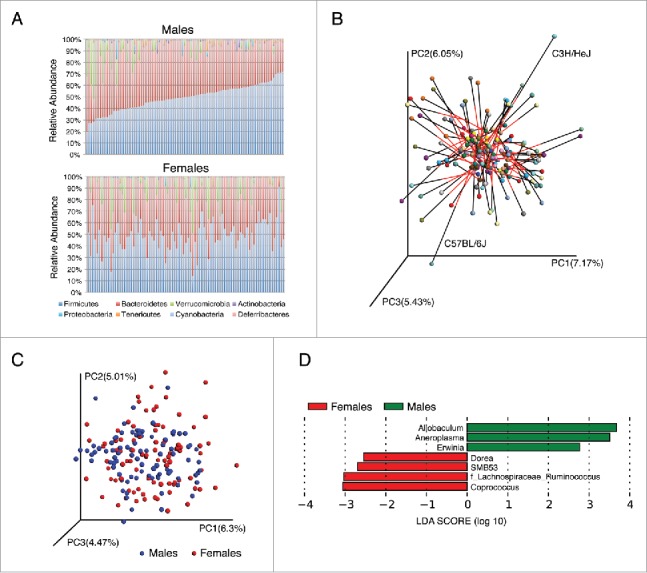
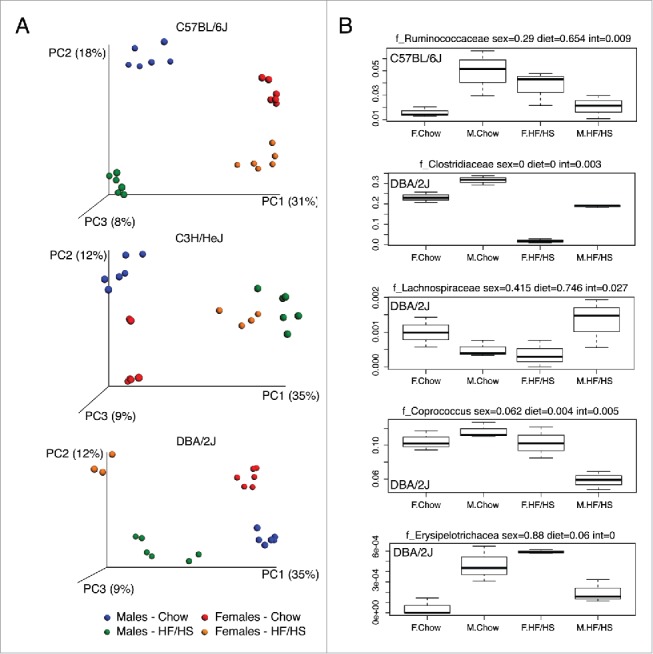
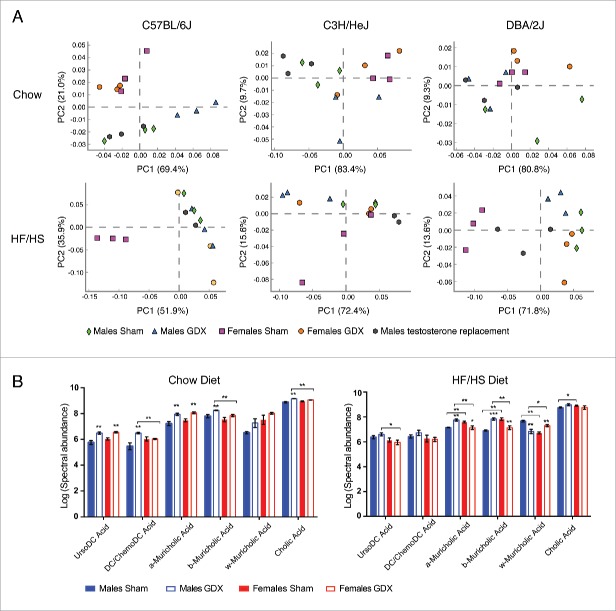
We previously reported quantitation of gut microbiota in a panel of 89 different inbred strains of mice, and we now examine the question of sex differences in microbiota composition. When the total population of 689 mice was examined together, several taxa exhibited significant differences in abundance between sexes but a larger number of differences were observed at the single strain level, suggesting that sex differences can be obscured by host genetics and environmental factors. We also examined a subset of mice on chow and high fat diets and observed sex-by-diet interactions. We further investigated the sex differences using gonadectomized and hormone treated mice from 3 different inbred strains. Principal coordinate analysis with unweighted UniFrac distances revealed very clear effects of gonadectomy and hormone replacement on microbiota composition in all 3 strains. Moreover, bile acid analyses showed gender-specific differences as well as effects of gonodectomy, providing one possible mechanism mediating sex differences in microbiota composition.
Overview
The claims and statistics of this paper haven’t been checked yet.
Free: it reads the open-access text and checks the first 5 claims that cite a source we can check. Create a free account to check every claim.
Integrity signals
Registry
Cites
Statistics
Figures
Verification
Claims the paper makes
The claims and statistics of this paper haven’t been checked yet.
Free: it reads the open-access text and checks the first 5 claims that cite a source we can check. Create a free account to check every claim.
Claims other papers make about this one
Each is checked against this paper’s own text: does it say what the citing paper says it does?
The cited source says what the claim attributes to it.
In the citing paper
“Significant differences in microbial diversity between males and females are first observed following puberty which can be reversed following male castration (6).”
From Association Between Sex Hormone Levels and Gut Microbiota Composition and Diversity—A Systematic Review (2022) · cites this paper as [6]
In the citing paper
“Another study observed a substantial effect of gonadectomy and hormone replacement on the composition of microbial species (6).”
From Association Between Sex Hormone Levels and Gut Microbiota Composition and Diversity—A Systematic Review (2022) · cites this paper as [6]
Self-check
Percentages, sums and reported differences re-computed from the paper’s own numbers.
The self-check needs the paper’s full text.
Citations
Cites
QIIME allows analysis of high-throughput community sequencing data
Caporaso, J. G., Kuczynski, J., Stombaugh, J., Bittinger, K., Bushman, F. D., Costello, E. K., Fierer, N., Peña, A. G., Goodrich, J. K., Gordon, J. I., et al. (2010) · Nature Methods · doi:10.1038/nmeth.f.303 · Cited by 34,887 · cited 1×
“0.(29,30) The total number of sequencing reads was 15,010,979 (an average of 19,571 reads per sample) with an average length of 153 base pair reads.”
BackgroundMetagenomic biomarker discovery and explanation
Segata, N., Izard, J., Waldron, L., Gevers, D., Miropolsky, L., Garrett, W. S., & Huttenhower, C. (2011) · Genome Biology · doi:10.1186/gb-2011-12-6-r60 · Cited by 16,192 · cited 1×
“LEfSe first performs the Kruskall-Wallis test (testing whether the values in different classes are differentially distributed), then a nonparametric Wilcoxon sum-rank test (testing whether all pairwise comparisons between subclasses within different classes significantly agreed with the class level trend) and then fol…”
MethodStructure, function and diversity of the healthy human microbiome
The Human Microbiome Project Consortium (2012) · Nature · doi:10.1038/nature11234 · Cited by 11,726
A human gut microbial gene catalogue established by metagenomic sequencing
MetaHIT Consortium, Qin, J., Li, R., Raes, J., Arumugam, M., Burgdorf, K. S., Manichanh, C., Nielsen, T., Pons, N., Levenez, F., et al. (2010) · Nature · doi:10.1038/nature08821 · Cited by 11,624
Diet rapidly and reproducibly alters the human gut microbiome
David, L. A., Maurice, C. F., Carmody, R. N., Gootenberg, D. B., Button, J. E., Wolfe, B. E., Ling, A. V., Devlin, A. S., Varma, Y., Fischbach, M. A., et al. (2014) · Nature · doi:10.1038/nature12820 · Cited by 10,100
Linking long-term dietary patterns with gut microbial enterotypes
Wu, G. D., Chen, J., Hoffmann, C., Bittinger, K., Chen, Y.-Y., Keilbaugh, S. A., Bewtra, M., Knights, D., Walters, W. A., Knight, R., et al. (2011) · Science · doi:10.1126/science.1208344 · Cited by 6,513
McDonald, D., Price, M. N., Goodrich, J., Nawrocki, E. P., DeSantis, T. Z., Probst, A., Andersen, G. L., Knight, R., & Hugenholtz, P. (2012) · The ISME Journal · doi:10.1038/ismej.2011.139 · Cited by 5,064 · cited 1×
“Sequences were binned into OTUs based on 97% identity using UCLUST(31) against the Greengenes reference database.(32) Each sample’s sequences were rarefied to 17826 reads per strain to reduce the effect of sequencing depth.”
MethodQuality-filtering vastly improves diversity estimates from Illumina amplicon sequencing
Bokulich, N. A., Subramanian, S., Faith, J. J., Gevers, D., Gordon, J. I., Knight, R., Mills, D. A., & Caporaso, J. G. (2013) · Nature Methods · doi:10.1038/nmeth.2276 · Cited by 4,401 · cited 1×
“0.(29,30) The total number of sequencing reads was 15,010,979 (an average of 19,571 reads per sample) with an average length of 153 base pair reads.”
BackgroundSTAMP: statistical analysis of taxonomic and functional profiles
Parks, D. H., Tyson, G. W., Hugenholtz, P., & Beiko, R. G. (2014) · Bioinformatics · doi:10.1093/bioinformatics/btu494 · Cited by 4,191
Bacterial Community Variation in Human Body Habitats Across Space and Time
Costello, E. K., Lauber, C. L., Hamady, M., Fierer, N., Gordon, J. I., & Knight, R. (2009) · Science · doi:10.1126/science.1177486 · Cited by 3,231
Cited by
Cancer immunotherapy efficacy and patients' sex: a systematic review and meta-analysis
Conforti, F., Pala, L., Bagnardi, V., De Pas, T., Martinetti, M., Viale, G., Gelber, R. D., & Goldhirsch, A. (2018) · The Lancet Oncology · doi:10.1016/s1470-2045(18)30261-4 · Cited by 973
Homeostasis of the gut barrier and potential biomarkers
Wells, J. M., Brummer, R. J., Derrien, M., MacDonald, T. T., Troost, F., Cani, P. D., Theodorou, V., Dekker, J., Méheust, A., de Vos, W. M., et al. (2017) · American Journal of Physiology-Gastrointestinal and Liver Physiology · doi:10.1152/ajpgi.00048.2015 · Cited by 620
Sex differences in gut microbiota
Kim, Y. S., Unno, T., Kim, B.-Y., & Park, M.-S. (2020) · The World Journal of Men s Health · doi:10.5534/wjmh.190009 · Cited by 610
“Furthermore, testosterone treatment after gonadectomy prevented the significant changes in the gut microbiota composition that were observed in the untreated males [8].”
BackgroundResultInfluentialHost and Environmental Factors Affecting the Intestinal Microbiota in Chickens
Kers, J. G., Velkers, F. C., Fischer, E. A. J., Hermes, G. D. A., Stegeman, J. A., & Smidt, H. (2018) · Frontiers in Microbiology · doi:10.3389/fmicb.2018.00235 · Cited by 516
“Near the end of the rearing period and the first part of the laying period, development of the reproductive organs and the start of egg production may affect GIT microbiota composition, as shown in mice (Org et al., 2016).”
BackgroundLi, F., Li, C., Chen, Y., Liu, J., Zhang, C., Irving, B., Fitzsimmons, C., Plastow, G., & Guan, L. L. (2019) · Microbiome · doi:10.1186/s40168-019-0699-1 · Cited by 530
“Firstly, although sex has been suggested as one of the factors affecting the composition of gut microbiota in humans and mice [45, 46], our current study is the first to evaluate the sex effect on the rumen microbiota.”
BackgroundSex and Gender Differences in the Outcomes of Vaccination over the Life Course
Flanagan, K. L., Fink, A. L., Plebanski, M., & Klein, S. L. (2017) · Annual Review of Cell and Developmental Biology · doi:10.1146/annurev-cellbio-100616-060718 · Cited by 508
Age- and Sex-Dependent Patterns of Gut Microbial Diversity in Human Adults
de la Cuesta-Zuluaga, J., Kelley, S. T., Chen, Y., Escobar, J. S., Mueller, N. T., Ley, R. E., McDonald, D., Huang, S., Swafford, A. D., Knight, R., et al. (2019) · mSystems · doi:10.1128/msystems.00261-19 · Cited by 387
“…to be associated with a sex bias in the incidence of specific diseases, such as type 1 diabetes (Markle et al., 2013; Yurkovetskiy et al., 2013), rheumatoid arthritis (Gomez et al., 2012), and anxiety (Bridgewater et al., 2017); sex-by-diet interactions have also been reported (Org et al., 2016).”
BackgroundMechanisms of sex differences in Alzheimer’s disease
Lopez-Lee, C., Torres, E. R. S., Carling, G., & Gan, L. (2024) · Neuron · doi:10.1016/j.neuron.2024.01.024 · Cited by 376
“139 The influence of gonadal hormones on the gut micro-biome and peripheral diseases has been reviewed.”
Org, E., Blum, Y., Kasela, S., Mehrabian, M., Kuusisto, J., Kangas, A. J., Soininen, P., Wang, Z., Ala-Korpela, M., Hazen, S. L., et al. (2017) · Genome Biology · doi:10.1186/s13059-017-1194-2 · Cited by 331
Self-citationSerum level of sex steroid hormone is associated with diversity and profiles of human gut microbiome
Shin, J.-H., Park, Y.-H., Sim, M., Kim, S.-A., Joung, H., & Shin, D.-M. (2019) · Research in Microbiology · doi:10.1016/j.resmic.2019.03.003 · Cited by 334
“Another study revealed the strong impact of gonadectomy and hormone replacement on the composition of microbiota in mice [14].”
BackgroundConnecting the immune system, systemic chronic inflammation and the gut microbiome: the role of sex
Rizzetto, L., Fava, F., Tuohy, K. M., & Selmi, C. (2018) · Journal of Autoimmunity · doi:10.1016/j.jaut.2018.05.008 · Cited by 331
Roles of Sex Hormones and Gender in the Gut Microbiota
Yoon, K., & Kim, N. (2021) · Journal of Neurogastroenterology and Motility · doi:10.5056/jnm20208 · Cited by 299
Takagi, T., Naito, Y., Inoue, R., Kashiwagi, S., Uchiyama, K., Mizushima, K., Tsuchiya, S., Dohi, O., Yoshida, N., Kamada, K., et al. (2019) · Journal of Gastroenterology · doi:10.1007/s00535-018-1488-5 · Cited by 314
Gut microbiota and the polycystic ovary syndrome: influence of sex, sex hormones, and obesity
Insenser, M., Murri, M., del Campo, R., Martínez-García, M. Á., Fernández-Durán, E., & Escobar-Morreale, H. F. (2018) · The Journal of Clinical Endocrinology & Metabolism · doi:10.1210/jc.2017-02799 · Cited by 312
Genetic Basis for Sex Differences in Obesity and Lipid Metabolism
Link, J. C., & Reue, K. (2017) · Annual Review of Nutrition · doi:10.1146/annurev-nutr-071816-064827 · Cited by 292
“To determine how nutritional excess affected these sex differences, the authors (89) examined male and female C57BL/6J, C3H/HeJ, and DBA/2J mice on a high-fat/high-sucrose diet for 8 weeks.”
BackgroundHe, F.-F., & Li, Y.-M. (2020) · Journal of Ovarian Research · doi:10.1186/s13048-020-00670-3 · Cited by 289
“Similar to ovariectomy, analysis of the microbiome of castrated mice using quantitative PCR assay showed a reduction in both Bacteroides and Ruminnococcaceae compared with the control group [46, 86].”
MethodShah, S. C., Khalili, H., Gower-Rousseau, C., Olen, O., Benchimol, E. I., Lynge, E., Nielsen, K. R., Brassard, P., Vutcovici, M., Bitton, A., et al. (2018) · Gastroenterology · doi:10.1053/j.gastro.2018.06.043 · Cited by 286
How biological sex of the host shapes its gut microbiota
Valeri, F., & Endres, K. (2021) · Frontiers in Neuroendocrinology · doi:10.1016/j.yfrne.2021.100912 · Cited by 264
“This is supported by the fact that administration of testosterone in three different mouse strains subjected to gonadectomy (GDX) prevented the significant changes in gut microbiota composition that were observed in untreated GDX males (Org et al., 2016).”
BackgroundInfluentialXX sex chromosome complement promotes atherosclerosis in mice
AlSiraj, Y., Chen, X., Thatcher, S. E., Temel, R. E., Cai, L., Blalock, E., Katz, W., Ali, H. M., Petriello, M., Deng, P., et al. (2019) · Nature Communications · doi:10.1038/s41467-019-10462-z · Cited by 268
Self-citationZhang, X., Zhong, H., Li, Y., Shi, Z., Ren, H., Zhang, Z., Zhou, X., Tang, S., Han, X., Lin, Y., et al. (2021) · Nature Aging · doi:10.1038/s43587-020-00014-2 · Cited by 250
“The public adult datasets included: (1) 876 metagenomic samples from Chinese adults (aged 19–86 years) from five published studies (Supplementary Table 15)13–17 in which samples from patients with diseases known to exhibit severe dysbiosis of the gut microbiota (liver cirrhosis and extreme obesity with BMI > 30 kg/m2)…”
BackgroundMethodInfluentialGut microbiota changes in the extreme decades of human life: a focus on centenarians
Santoro, A., Ostan, R., Candela, M., Biagi, E., Brigidi, P., Capri, M., & Franceschi, C. (2018) · Cellular and Molecular Life Sciences · doi:10.1007/s00018-017-2674-y · Cited by 250
“A number of different taxa have been found between male and female mice, while the sex differences in GM composition depend in part on genetic background [172].”
BackgroundImpact of Fecal Microbiota Transplantation on Obesity and Metabolic Syndrome—A Systematic Review
Zhang, Z., Mocanu, V., Cai, C., Dang, J., Slater, L., Deehan, E. C., Walter, J., & Madsen, K. L. (2019) · Nutrients · doi:10.3390/nu11102291 · Cited by 232
Intestinal microbiota enhances pancreatic carcinogenesis in preclinical models
Thomas, R. M., Gharaibeh, R. Z., Gauthier, J., Beveridge, M., Pope, J. L., Guijarro, M. V., Yu, Q., He, Z., Ohland, C., Newsome, R., et al. (2018) · Carcinogenesis · doi:10.1093/carcin/bgy073 · Cited by 222
“Sex-specific mice were chosen secondary to data that exist that show the murine gut microbiota can be influenced by sex hormones (22).”
BackgroundHypertension: Do Inflammation and Immunity Hold the Key to Solving this Epidemic?
Madhur, M. S., Elijovich, F., Alexander, M. R., Pitzer, A., Ishimwe, J., Van Beusecum, J. P., Patrick, D. M., Smart, C. D., Kleyman, T. R., Kingery, J., et al. (2021) · Circulation Research · doi:10.1161/circresaha.121.318052 · Cited by 211
Microbiome profiling reveals gut dysbiosis in a transgenic mouse model of Huntington's disease
Kong, G., Cao, K.-A. L., Judd, L. M., Li, S., Renoir, T., & Hannan, A. J. (2020) · Neurobiology of Disease · doi:10.1016/j.nbd.2018.09.001 · Cited by 212
Analysis of 1135 gut metagenomes identifies sex-specific resistome profiles
Sinha, T., Vich Vila, A., Garmaeva, S., Jankipersadsing, S. A., Imhann, F., Collij, V., Bonder, M. J., Jiang, X., Gurry, T., Alm, E. J., et al. (2019) · Gut Microbes · doi:10.1080/19490976.2018.1528822 · Cited by 208
“This is also supported by mouse studies where bilateral ovariectomy has been revealed to cause microbial dysbiosis.(8,35) In the univariable model, menstruation status (having regular menstruations) was associated with higher abundances of Turicibacter sanguinis and Leuconostoc mesenteroides.”
ResultSex- and Gender-Based Pharmacological Response to Drugs
Mauvais-Jarvis, F., Berthold, H. K., Campesi, I., Carrero, J.-J., Dhakal, S., Franconi, F., Gouni-Berthold, I., Heiman, M. L., Kautzky-Willer, A., Klein, S. L., et al. (2021) · Pharmacological Reviews · doi:10.1124/pharmrev.120.000206 · Cited by 192
“Additionally, PD of an oral drug, which is at least partially dependent on drugmicrobiome interactions, may be confounded by modulations of the gut microbiome because of diet (David et al., 2014), sex hormones (Markle et al., 2013; Org et al., 2016), and sex-by-diet interactions (Org et al., 2016).”
BackgroundSantos-Marcos, J. A., Mora-Ortiz, M., Tena-Sempere, M., Lopez-Miranda, J., & Camargo, A. (2023) · Biology of Sex Differences · doi:10.1186/s13293-023-00490-2 · Cited by 176
Sex, microbes, and polycystic ovary syndrome
Thackray, V. G. (2019) · Trends in Endocrinology & Metabolism · doi:10.1016/j.tem.2018.11.001 · Cited by 203
“For instance, one study found that, at the phyla level, the relative abundances of Actinobacteria and Tenericutes were higher in male mice than in females [43].”
BackgroundResultInfluentialBody Mass Index Differences in the Gut Microbiota Are Gender Specific
Gao, X., Zhang, M., Xue, J., Huang, J., Zhuang, R., Zhou, X., Zhang, H., Fu, Q., & Hao, Y. (2018) · Frontiers in Microbiology · doi:10.3389/fmicb.2018.01250 · Cited by 195
Sexual Dimorphism in Colon Cancer
Abancens, M., Bustos, V., Harvey, H., McBryan, J., & Harvey, B. J. (2020) · Frontiers in Oncology · doi:10.3389/fonc.2020.607909 · Cited by 176
“However, this response coupled with mitchondrial dysfunction and high oxidative stress in CRC cells requires further analysis to Frontiers in Oncology | www.frontiersin.org 16 understand the role of CFTR in metabolic perturbations associated with CRC development.”
BackgroundYou’ve got male: Sex and the microbiota-gut-brain axis across the lifespan
Jaggar, M., Rea, K., Spichak, S., Dinan, T. G., & Cryan, J. F. (2020) · Frontiers in Neuroendocrinology · doi:10.1016/j.yfrne.2019.100815 · Cited by 200
Jardon, K. M., Canfora, E. E., Goossens, G. H., & Blaak, E. E. (2022) · Gut · doi:10.1136/gutjnl-2020-323715 · Cited by 181
Steroids, stress and the gut microbiome-brain axis
Tetel, M. J., de Vries, G. J., Melcangi, R. C., Panzica, G., & O'Mahony, S. M. (2018) · Journal of Neuroendocrinology · doi:10.1111/jne.12548 · Cited by 187
“replacement on gut bacteria in rodents (19-21).”
The Gut Microbiome and Sex Hormone-Related Diseases
He, S., Li, H., Yu, Z., Zhang, F., Liang, S., Liu, H., Chen, H., & Lü, M. (2021) · Frontiers in Microbiology · doi:10.3389/fmicb.2021.711137 · Cited by 169
Sex Differences in Cancer Immunotherapy Efficacy, Biomarkers, and Therapeutic Strategy
Wang, S., Cowley, L. A., & Liu, X.-S. (2019) · Molecules · doi:10.3390/molecules24183214 · Cited by 180
Self-citationSex-based differences in inflammatory bowel diseases: a review
Rustgi, S. D., Kayal, M., & Shah, S. C. (2020) · Therapeutic Advances in Gastroenterology · doi:10.1177/1756284820915043 · Cited by 158
Ma, J., Hong, Y., Zheng, N., Xie, G., Lyu, Y., Gu, Y., Xi, C., Chen, L., Wu, G., Li, Y., et al. (2020) · Gut Microbes · doi:10.1080/19490976.2020.1763770 · Cited by 171
“Gut microbiota plays essential roles in regulating host metabolism and inflammation, while its composition changes throughout the life span and is known to be associated with host sex.(51,52) In the present study, among the top 10 differential genera during aging, four genera had opposite changes in two sexes.”
BackgroundIntersection of the Gut Microbiome and Circadian Rhythms in Metabolism
Frazier, K., & Chang, E. B. (2020) · Trends in Endocrinology & Metabolism · doi:10.1016/j.tem.2019.08.013 · Cited by 173
“Microbiome profiles in mice differ significantly by sex, and gonadectomy of both males and females depend upon dietary content[56].”
BackgroundMayneris-Perxachs, J., Arnoriaga-Rodríguez, M., Luque-Córdoba, D., Priego-Capote, F., Pérez-Brocal, V., Moya, A., Burokas, A., Maldonado, R., & Fernández-Real, J.-M. (2020) · Microbiome · doi:10.1186/s40168-020-00913-x · Cited by 159
“Gonadectomy along with a high fat diet was associated with increased genera of Ruminococcaceae family in male mice of three different strains and reduced Akkermansia genus in female mice [49].”
BackgroundWang, T., Sha, L., Li, Y., Zhu, L., Wang, Z., Li, K., Lu, H., Bao, T., Guo, L., Zhang, X., et al. (2020) · Frontiers in Endocrinology · doi:10.3389/fendo.2020.00284 · Cited by 162
“Liu et al. found a Frontiers in Endocrinology | www.frontiersin.org 16 May 2020 | Volume 11 | Article 284 decrease in Ruminococcaceae and an increase in gram-negative bacteria, including Bacteroides and Desulfovibrio, in women with PCOS, which was consistent with our research (20).”
ResultGut Microbiota and Its Mysteries
Pushpanathan, P., Mathew, G. S., Selvarajan, S., Seshadri, K., & Srikanth, P. (2019) · Indian Journal of Medical Microbiology · doi:10.4103/ijmm.ijmm_19_373 · Cited by 168
Sex and strain dependent differences in mucosal immunology and microbiota composition in mice
Elderman, M., Hugenholtz, F., Belzer, C., Boekschoten, M., van Beek, A., de Haan, B., Savelkoul, H., de Vos, P., & Faas, M. (2018) · Biology of Sex Differences · doi:10.1186/s13293-018-0186-6 · Cited by 151
“As various factors, such as the reproductive condition, genetic background, and diet, can interfere with the sex effects [25, 28, 29], we compared male and female mice from two different strains (C57B1/6OlaHsd (B6) and Balb/cOlaHsd (BALB/c)) with two difference genetic backgrounds under exactly the same reproductive a…”
BackgroundInfluentialSex, gut microbiome, and cardiovascular disease risk
Razavi, A. C., Potts, K. S., Kelly, T. N., & Bazzano, L. (2019) · Biology of Sex Differences · doi:10.1186/s13293-019-0240-z · Cited by 168
“Estrogens can reduce inflammation [121–124], and this activity has been linked to sex differences in the gut microbiome of mice [125].”
BackgroundGheorghe, C. E., Ritz, N. L., Martin, J. A., Wardill, H. R., Cryan, J. F., & Clarke, G. (2021) · Gut Microbes · doi:10.1080/19490976.2021.1941711 · Cited by 148
“Therefore, sex-specific differences need to be considered while designing an FMT experiment to ensure valid conclusions for both genders: it is preferable that donors and recipients be of the same sex.(129)”
BackgroundSex differences in metabolism and cardiometabolic disorders
Krishnan, K. C., Mehrabian, M., & Lusis, A. J. (2018) · Current Opinion in Lipidology · doi:10.1097/mol.0000000000000536 · Cited by 163
Self-citationMicrobiota‐gut‐brain axis as a regulator of reward processes
García‐Cabrerizo, R., Carbia, C., O´Riordan, K. J., Schellekens, H., & Cryan, J. F. (2021) · Journal of Neurochemistry · doi:10.1111/jnc.15284 · Cited by 144
“One of the major differences between males and females is the different balance of sexual hormones (i.e. androgens, oestrogens, oxytocin and vasopressin), which may be responsible for the sexual dimorphism of the gut microbiome (Org et al., 2016; Yurkovetskiy et al., 2013).”
BackgroundBody Mass Index and Sex Affect Diverse Microbial Niches within the Gut
Borgo, F., Garbossa, S., Riva, A., Severgnini, M., Luigiano, C., Benetti, A., Pontiroli, A. E., Morace, G., & Borghi, E. (2018) · Frontiers in Microbiology · doi:10.3389/fmicb.2018.00213 · Cited by 144
“Org et al. (2016) demonstrated a relationship between sex hormones and gut microbiota.”
BackgroundThe microbiome and breast cancer: a review
Chen, J. H., Douglass, J., Prasath, V., Neace, M., Atrchian, S., Manjili, M. H., Shokouhi, S., & Habibi, M. (2019) · Breast Cancer Research and Treatment · doi:10.1007/s10549-019-05407-5 · Cited by 156
Ibrahim, A., Hugerth, L. W., Hases, L., Saxena, A., Seifert, M., Thomas, Q., Gustafsson, J., Engstrand, L., & Williams, C. (2019) · International Journal of Cancer · doi:10.1002/ijc.32037 · Cited by 138
Dietary vitamin K is remodeled by gut microbiota and influences community composition
Ellis, J. L., Karl, J. P., Oliverio, A., Fu, X., Soares, J. W., Wolfe, B. E., Hernandez, C. J., Mason, J. B., & Booth, S. L. (2021) · Gut Microbes · doi:10.1080/19490976.2021.1887721 · Cited by 148
“The inclusion of both male and female mice here is also a strength which revealed differences in microbial community composition by sex, consistent with previous reports of sex differences in C57BL6 mice.(33,34) Interestingly, sex differences were observed in the murine gut microbiota response to dietary vitamin K, wi…”
ResultTang, B., Tang, L., Li, S., Liu, S., He, J., Li, P., Wang, S., Yang, M. J., Zhang, L., Lei, Y., et al. (2023) · Nature Communications · doi:10.1038/s41467-023-36981-4 · Cited by 152
d’Afflitto, M., Upadhyaya, A., Green, A., & Peiris, M. (2022) · Journal of Clinical Gastroenterology · doi:10.1097/mcg.0000000000001676 · Cited by 142
It's the fiber, not the fat: significant effects of dietary challenge on the gut microbiome
Morrison, K. E., Jašarević, E., Howard, C. D., & Bale, T. L. (2020) · Microbiome · doi:10.1186/s40168-020-0791-6 · Cited by 133
Duarte, S. M. B., Stefano, J. T., Miele, L., Ponziani, F. R., de Souza-Basqueira, M., Okada, L. S. R. R., Costa, F., Toda, K., Mazo, D. F. D. C., Sabino, É. C., et al. (2017) · Nutrition Metabolism and Cardiovascular Diseases · doi:10.1016/j.numecd.2017.10.014 · Cited by 143
Sex differences in lipid metabolism are affected by presence of the gut microbiota
Baars, A., Oosting, A., Lohuis, M. A. M., Koehorst, M., Aidy, S. E., Hugenholtz, F., Smidt, H., Mischke, M., Boekschoten, M. V., Verkade, H. J., et al. (2018) · Scientific Reports · doi:10.1038/s41598-018-31695-w · Cited by 142
Deoxynivalenol, gut microbiota and immunotoxicity: A potential approach?
Liao, Y., Peng, Z., Chen, L., Nussler, A. K., Liu, L., & Yang, W. Q. (2018) · Food and Chemical Toxicology · doi:10.1016/j.fct.2018.01.013 · Cited by 143
Sex Hormones and Anticancer Immunity
Özdemir, B. C., & Dotto, G.-P. (2019) · Clinical Cancer Research · doi:10.1158/1078-0432.ccr-19-0137 · Cited by 132
“Studies in mice and human have shown that the gut microbiome is affected by various factors including sex, age, diet, and obesity and itself also contributes substantially to sex differences in immunity (63, 64).”
BackgroundSex-specific association between gut microbiome and fat distribution
Min, Y., Ma, X., Sankaran, K., Ru, Y., Chen, L., Baiocchi, M., & Zhu, S. (2019) · Nature Communications · doi:10.1038/s41467-019-10440-5 · Cited by 133
The avian gut microbiota: Diversity, influencing factors, and future directions
Sun, F., Chen, J., Liu, K., Tang, M., & Yang, Y. (2022) · Frontiers in Microbiology · doi:10.3389/fmicb.2022.934272 · Cited by 150
“Age and sex The age of the host also influences the gut microbiota, contributing to significant differences among individuals (Bibbo et al., 2016; Org et al., 2016).”
BackgroundGut microbiota dysbiosis in male patients with chronic traumatic complete spinal cord injury
Zhang, C., Zhang, W., Zhang, J., Jing, Y., Yang, M., Du, L., Gao, F., Gong, H., Chen, L., Li, J., et al. (2018) · Journal of Translational Medicine · doi:10.1186/s12967-018-1735-9 · Cited by 138
The role of the gut-brain axis in depression: endocrine, neural, and immune pathways
Makris, A. P., Karianaki, M., Tsamis, K. I., & Paschou, S. Α. (2020) · HORMONES · doi:10.1007/s42000-020-00236-4 · Cited by 148
Fan, P. F., Bian, B., Teng, L., Nelson, C. D., Driver, J., Elzo, M. A., & Jeong, K. C. (2019) · The ISME Journal · doi:10.1038/s41396-019-0529-2 · Cited by 142
Gut microbiota and bone metabolism
Lu, L., Chen, X., Liu, Y., & Yu, X. (2021) · The FASEB Journal · doi:10.1096/fj.202100451r · Cited by 115
Fan, P. F., Nelson, C. D., Driver, J., Elzo, M. A., Peñagaricano, F., & Jeong, K. C. (2021) · The ISME Journal · doi:10.1038/s41396-021-00925-x · Cited by 139
Gut Microbiota Differences According to Ultra-Processed Food Consumption in a Spanish Population
Cuevas‐Sierra, A., Milagro, F. I., Aranaz, P., Martínez, J. A., & Riezu‐Boj, J. I. (2021) · Nutrients · doi:10.3390/nu13082710 · Cited by 130
Ortega, M. A., Fraile-Martínez, O., Naya, I., García-Honduvilla, N., Álvarez-Mon, M., Buján, J., Asúnsolo, Á., & de la Torre, B. (2020) · Nutrients · doi:10.3390/nu12092749 · Cited by 115
The gut microbiota in osteoarthritis: where do we stand and what can we do?
Hao, X., Shang, X., Liu, J., Chi, R., Zhang, J., & Xu, T. (2021) · Arthritis Research & Therapy · doi:10.1186/s13075-021-02427-9 · Cited by 130
Sexual dimorphism in glucose metabolism is shaped by androgen-driven gut microbiome
Gao, A., Su, J., Liu, R., Zhao, S., Wen, L., Xu, X., Li, D., Shi, J., Gu, B., Zhang, J., et al. (2021) · Nature Communications · doi:10.1038/s41467-021-27187-7 · Cited by 131
Sex differences in autoimmune disorders of the central nervous system
Gold, S. M., Willing, A., Leypoldt, F., Paul, F., & Friese, M. A. (2018) · Seminars in Immunopathology · doi:10.1007/s00281-018-0723-8 · Cited by 138
Recent advances in modulation of cardiovascular diseases by the gut microbiota
Masenga, S. K., Hamooya, B., Hangoma, J., Hayumbu, V., Ertuglu, L. A., Ishimwe, J., Rahman, S., Saleem, M., Laffer, C. L., Elijovich, F., et al. (2022) · Journal of Human Hypertension · doi:10.1038/s41371-022-00698-6 · Cited by 121
“Similarly, analysis of 89 different mice strains revealed significant differences in microbial composition between the sexes, although the direction of the change in each strain varied, suggesting that the influence of sex on microbiota may depend on the animal overall genotype [54].”
BackgroundGut microbiota–driven brain Aβ amyloidosis in mice requires microglia
Dodiya, H. B., Lutz, H. L., Weigle, I. Q., Patel, P., Michalkiewicz, J., Roman-Santiago, C. J., Zhang, C. M., Liang, Y., Srinath, A., Zhang, X., et al. (2022) · Journal of Experimental Medicine · doi:10.1084/jem.20200895 · Cited by 120
Effect of prebiotics, probiotics, synbiotics on depression: results from a meta-analysis
Zhang, Q., Chen, B., Zhang, J., Dong, J., Ma, J., Zhang, Y., Jin, K., & Lü, J. (2023) · BMC Psychiatry · doi:10.1186/s12888-023-04963-x · Cited by 126
Williams, A. R., Krych, Ł., Ahmad, H. F., Nejsum, P. L., Skovgaard, K., Nielsen, D. S., & Thamsborg, S. M. (2017) · PLoS ONE · doi:10.1371/journal.pone.0186546 · Cited by 118
“In addition, it may also be of interest to determine whether there exist differences between sexes in the response to GP-supplementation, as our study used castrates rather than entire males, and sex may influence diet-induced changes in microbiota composition and immune function [54].”
BackgroundThe Gut Microbiome and Female Health
Siddiqui, R., Makhlouf, Z., Alharbi, A. M., Alfahemi, H. H., & Khan, N. A. (2022) · Biology · doi:10.3390/biology11111683 · Cited by 130
Bile acids as key modulators of the brain-Gut-Microbiota axis in alzheimer’s disease
Mulak, A. (2021) · Journal of Alzheimer s Disease · doi:10.3233/jad-210608 · Cited by 114
Shobeiri, P., Kalantari, A., Teixeira, A. L., & Rezaei, N. (2022) · Biology of Sex Differences · doi:10.1186/s13293-022-00422-6 · Cited by 124
“Animal studies on mice show significant differences in gut microbiota composition according to sex [55, 56].”
BackgroundImpact of Individual Traits, Saturated Fat, and Protein Source on the Gut Microbiome
Lang, J. M., Pan, C., Cantor, R. M., Tang, W. H. W., Garcia-Garcia, J. C., Kurtz, I., Hazen, S. L., Bergeron, N., Krauss, R. M., & Lusis, A. J. (2018) · mBio · doi:10.1128/mbio.01604-18 · Cited by 109
“Moreover, interindividual differences increase the complexity and uniqueness of the microbiome with factors such as sex (13, 14), age (15, 16), genetics (17), ethnicity (18,”
BackgroundSelf-citationO’Connor, G., Jeffrey, E., Madorma, D., Marcillo, A. E., Abreu, M. T., Deo, S. K., Dietrich, W. D., & Daunert, S. (2018) · Journal of Neurotrauma · doi:10.1089/neu.2017.5349 · Cited by 117
“sex hormones, which have been implicated in aiding recovery post-SCI in humans and mice.(44,45) Additionally, microbiota variability within each group (Fig.”
BackgroundGene-by-Sex Interactions in Mitochondrial Functions and Cardio-Metabolic Traits
Norheim, F., Hasin-Brumshtein, Y., Vergnes, L., Chella Krishnan, K., Pan, C., Seldin, M. M., Hui, S. T., Mehrabian, M., Zhou, Z., Gupta, S., et al. (2019) · Cell Metabolism · doi:10.1016/j.cmet.2018.12.013 · Cited by 111
“Sex differences have also recently been identified for the gut microbiome (Fields et al., 2017; Org et al., 2016).”
BackgroundSelf-citationSilva, C. C. D., Monteil, M., & Davis, E. M. (2020) · Childhood Obesity · doi:10.1089/chi.2019.0280 · Cited by 117
“Org et al., 34 found that members of the family Lachnospiraceae were more abundant in female mice, but the significance of this finding remains obscure.”
Hussain, T., Murtaza, G., Kalhoro, D. H., Kalhoro, M. S., Metwally, E., Chughtai, M. I., Mazhar, M. U., & Khan, S. A. (2021) · Animal Nutrition · doi:10.1016/j.aninu.2020.11.005 · Cited by 110
“Further, evidence unveiled the prominent influence of gonadectomy and hormone replacement on the composition of microbiota in mice (Org et al., 2016).”
BackgroundThe Gut Microbiota Regulates Endocrine Vitamin D Metabolism through Fibroblast Growth Factor 23
Bora, S. A., Kennett, M. J., Smith, P. B. W., Patterson, A. D., & Cantorna, M. T. (2018) · Frontiers in Immunology · doi:10.3389/fimmu.2018.00408 · Cited by 110
The Use of Defined Microbial Communities To Model Host-Microbe Interactions in the Human Gut
Elzinga, J., John van der, O. O. S. T., de Vos, W. M., & Smidt, H. (2019) · Microbiology and Molecular Biology Reviews · doi:10.1128/mmbr.00054-18 · Cited by 111
Rice, M. W., Pandya, J. D., & Shear, D. A. (2019) · Frontiers in Neurology · doi:10.3389/fneur.2019.00875 · Cited by 113
At the Interface of Lifestyle, Behavior, and Circadian Rhythms: Metabolic Implications
Bae, S.-A., Fang, M., Rustgi, V. K., Zarbl, H., & Androulakis, I. P. (2019) · Frontiers in Nutrition · doi:10.3389/fnut.2019.00132 · Cited by 110
“The sex hormones appear to have an influence on the microbiome of the host, as evidenced by male and female mice exhibiting differences in microbiome composition (171).”
BackgroundInfluentialNatural killer T cells in atherosclerosis
Getz, G. S., & Reardon, C. A. (2017) · Nature Reviews Cardiology · doi:10.1038/nrcardio.2017.2 · Cited by 107
Wankhade, U. D., Zhong, Y., Kang, P., Alfaro, M., Chintapalli, S. V., Piccolo, B. D., Mercer, K. E., Andres, A., Thakali, K. M., & Shankar, K. (2018) · Scientific Reports · doi:10.1038/s41598-018-34453-0 · Cited by 108
Post-finasteride syndrome: An emerging clinical problem
Diviccaro, S., Melcangi, R. C., & Giatti, S. (2019) · Neurobiology of Stress · doi:10.1016/j.ynstr.2019.100209 · Cited by 108
“Indeed, gonadectomy and hormone replacement have a clear effect on gut bacteria in rodents (Fields et al., 2017; Harada et al., 2016; Jasarevic et al., 2016; Moreno-Indias et al., 2016; Org et al., 2016; Tetel et al., 2018; Yurkovetskiy et al., 2013).”
Gut microbiota develop towards an adult profile in a sex-specific manner during puberty
Korpela, K., Kallio, S., Salonen, A., Hero, M. T., Kukkonen, A. K., Miettinen, P. J., Savilahti, E., Kohva, E., Kariola, L., Suutela, M., et al. (2021) · Scientific Reports · doi:10.1038/s41598-021-02375-z · Cited by 111
The NLR Protein NLRP6 Does Not Impact Gut Microbiota Composition
Lemire, P., Robertson, S. J., Maughan, H., Tattoli, I., Streutker, C. J., Platnich, J. M., Muruve, D. A., Philpott, D. J., & Girardin, S. E. (2017) · Cell Reports · doi:10.1016/j.celrep.2017.12.026 · Cited by 98
Shah, S. C., Khalili, H., Chen, C., Ahn, H. S., Ng, S. C., Burisch, J. M., & Colombel, J. (2019) · Alimentary Pharmacology & Therapeutics · doi:10.1111/apt.15178 · Cited by 105
“and the gut microbiota in turn affects hormonal levels and also innate and adaptive immunity.(47,48) Exogenous oestrogens or synthetic oestrogen‐like compounds that are found in foods, pesticides, industrial chemicals and other agents to which males and females might, broadly speaking, have different exposures, might…”
BackgroundSex hormones influence the intestinal microbiota composition in mice
Wu, Y., Peng, X., Li, X., Li, D., Tan, Z., & Yu, R. (2022) · Frontiers in Microbiology · doi:10.3389/fmicb.2022.964847 · Cited by 100
“Related studies (Org et al., 2016) showed that bile acid metabolism changes significantly with hormonal changes, especially in high-fat and high-sugar diets.”
BackgroundHallmarks of sex bias in immuno-oncology: mechanisms and therapeutic implications
Xiao, T., Lee, J., Gauntner, T. D., Velegraki, M., Lathia, J. D., & Li, Z. (2024) · Nature reviews. Cancer · doi:10.1038/s41568-024-00680-z · Cited by 99
“Gonadectomy and hormone replacement-induced alterations in microbiota composition 251,252 suggest that sex hormones influence the gut microbiome.”
Holder, M. K., Peters, N. V., Whylings, J., Fields, C. T., Gewirtz, A. T., Chassaing, B., & de Vries, G. J. (2019) · Scientific Reports · doi:10.1038/s41598-018-36890-3 · Cited by 85
Cheema, M. U., & Pluznick, J. L. (2019) · Hypertension · doi:10.1161/hypertensionaha.119.13155 · Cited by 97
“40 Similarly, immune differences in males and females are known to be important in the Ang II model of hypertension, 41 and gut microbiome is also known to play a role in immune system education and maintenance.”
The gut microbiome of laboratory mice: considerations and best practices for translational research
Ericsson, A. C., & Franklin, C. L. (2021) · Mammalian Genome · doi:10.1007/s00335-021-09863-7 · Cited by 98
“However, given the significant sex × diet interactions in the influence of high-fat diets on the GM of inbred mice (Org et al. 2016; Bolnick et al. 2014), it is possible that strains other than those reported in the literature (FVB and outbred CD-1) may react differently to a change in commercial source of comparable…”
BackgroundThe role of the gut microbiome and diet in the pathogenesis of non-alcoholic fatty liver disease
Jennison, E., & Byrne, C. D. (2021) · Clinical and Molecular Hepatology · doi:10.3350/cmh.2020.0129 · Cited by 88
“Sex hormones strongly affect BA profiles and significant genderspecific differences become more prominent in response to a high-fat high-sugar diet.(174) Jena et al.”
BackgroundConforti, F., Pala, L., Pagan, E., Corti, C., Bagnardi, V., Queirolo, P., Catania, C., Pas, T. M. D., & Giaccone, G. (2021) · ESMO Open · doi:10.1016/j.esmoop.2021.100251 · Cited by 97
Gut Microbiota of Ruminants and Monogastric Livestock: An Overview
Tardiolo, G., Fauci, D. L., Riggio, V., Daghio, M., Salvo, E. D., Zumbo, A., & Sutera, A. M. (2025) · Animals · doi:10.3390/ani15050758 · Cited by 105
“It has been found that mice undergo significant shifts in their gut bacteria composition after gonad removal [199,200], and when hormone therapy was administered afterwards, it notably impacted the composition of their microbiota [200,201].”
Metadata
- Authors
- Org, E., Mehrabian, M., Parks, B. W., Shipkova, P., Liu, X., Drake, T. A., & Lusis, A. J.
- Affiliations
- University of California, Los Angeles (US)
- University of Wisconsin System (US)
- Bristol-Myers Squibb (United States) (US)
- Corresponding author
- Lusis, Aldons J.
- Venue
- Gut Microbes
- Publisher
- Informa UK Limited
- Published
- 2016-06-29
- Volume
- 7
- Issue
- 4
- Pages
- 313-322
- ISSN
- 1949-0976 (ISSN-L)
- 1949-0984
- PMC
- PMC4988450
- OpenAlex
- W2473762402
- Cited by
- 796
- References
- 35
- Citations by year
- 2026: 75 · 2025: 87 · 2024: 109 · 2023: 85 · 2022: 114 · 2021: 98 · 2020: 81 · 2019: 73 · 2018: 52 · 2017: 18 · 2016: 3
- FWCI
- 25.30
- Type
- journal article
- Language
- en
- Open access
- gold
- doi.org
- Licence
- Locations
- Gut Microbes (publishedVersion, cc-by-nc)
- PubMed Central (publishedVersion, cc-by-nc)
- PubMed (publishedVersion)
- Funders
- European Commission (330381)
- National Institutes of Health (HL‐28481, HL30568, T32-HD07228, HD07228)
- European Regional Development Fund (2014-2020’, 2014-2020.4.01.15-0012, (Project No. 2014-2020.4.01.15-0012), No. 2014-2020.4.01.15-0012)
- National Heart, Lung, and Blood Institute (P01HL030568, R00HL123021)
- National Institute of Diabetes and Digestive and Kidney Diseases (DP3DK094311)
- Eunice Kennedy Shriver National Institute of Child Health and Human Development (T32HD007228)
- Clinical and Translational Science Institute, University of California, Los Angeles
- Topics
- Life Sciences › Biochemistry, Genetics and Molecular Biology › Molecular Biology › Gut microbiota and health
- Health Sciences › Dentistry › Periodontics › Oral microbiology and periodontitis research
- Life Sciences › Agricultural and Biological Sciences › Animal Science and Zoology › Animal Nutrition and Physiology
- Keywords
- gut microbiota composition, sex differences, gonadectomy, hormone replacement therapy, inbred mouse strains, high-fat diet, bile acids, host genetics
- MeSH terms
- Gastrointestinal Microbiome, Animals, Bile Acids and Salts, Feeding Behavior, Female, Hormones, Male, Sex Factors, Gastrointestinal Tract, Mice
About these checks
Registry, retraction, Cites and statistics results are computed, not judged, with one exception: a printed reference that no index lists is read once by a model before it counts as a citation error. Claims are extracted by a model and kept only when their quote appears verbatim in the text; each cited source is then checked, with a model’s help, for whether it says what the claim relies on. Those verdicts can be wrong — read the claim’s quote and the cited source before relying on one.
Statistics and arithmetic are recomputed, not judged.
Confidence bands are shown only for fields calibrated on our annotated test set. None is calibrated yet, so no band is shown.
What counts as a claim ›How we measure confidence ›How we check this ›
Are you an author, or do you see a problem with this page? Request a review
Data sources
Bibliographic data: Semantic Scholar, OpenAlex, Crossref.
Contains information from the Semantic Scholar Academic Graph Datasets, made available under the ODC Attribution License (ODC-BY 1.0).
Semantic Scholar’s data is described in: Kinney, R., et al. (2023). The Semantic Scholar Open Data Platform. arXiv:2301.10140.
