

Sex differences and hormonal effects on gut microbiota composition in mice
Open accessThe DOI matches its Crossref record; 35 of the 35 references it cites were found in a registry or an index.
Abstract
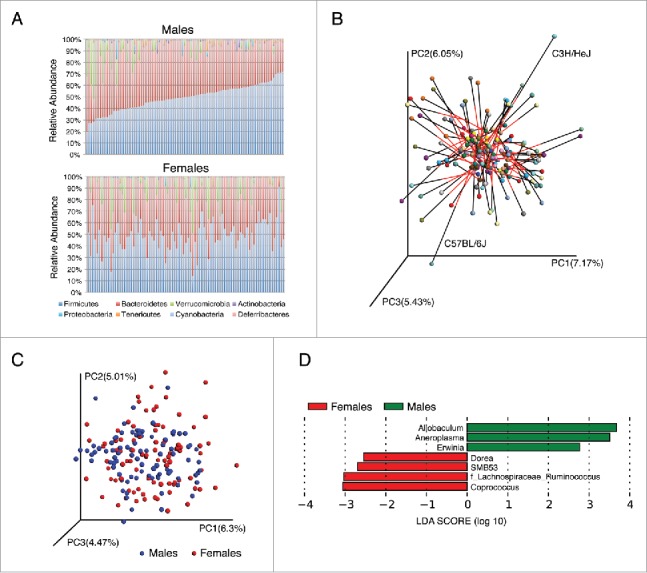
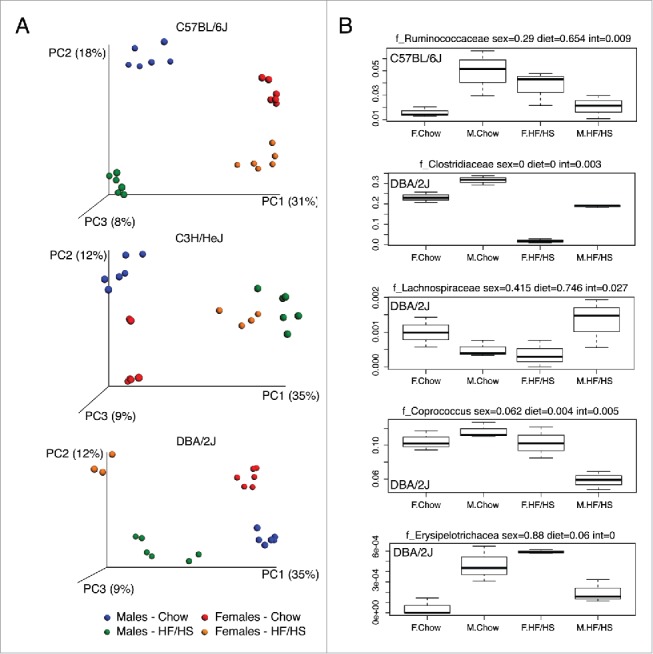
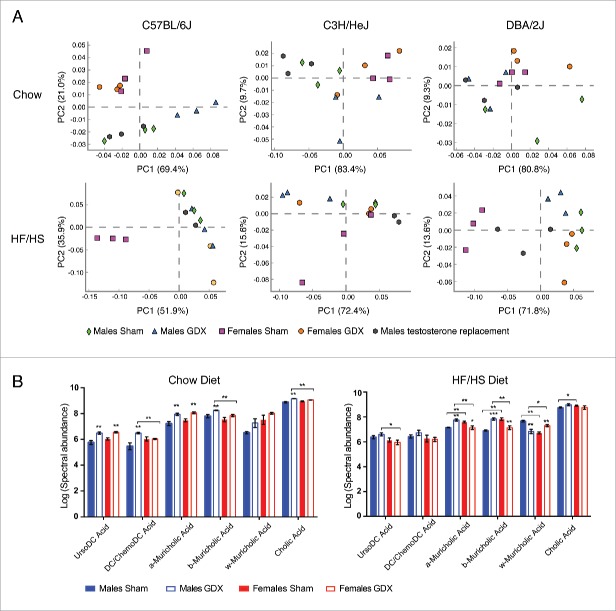
We previously reported quantitation of gut microbiota in a panel of 89 different inbred strains of mice, and we now examine the question of sex differences in microbiota composition. When the total population of 689 mice was examined together, several taxa exhibited significant differences in abundance between sexes but a larger number of differences were observed at the single strain level, suggesting that sex differences can be obscured by host genetics and environmental factors. We also examined a subset of mice on chow and high fat diets and observed sex-by-diet interactions. We further investigated the sex differences using gonadectomized and hormone treated mice from 3 different inbred strains. Principal coordinate analysis with unweighted UniFrac distances revealed very clear effects of gonadectomy and hormone replacement on microbiota composition in all 3 strains. Moreover, bile acid analyses showed gender-specific differences as well as effects of gonodectomy, providing one possible mechanism mediating sex differences in microbiota composition.
Overview
The claims and statistics of this paper haven’t been checked yet.
Free: it reads the open-access text and checks the first 5 claims that cite a source we can check. Create a free account to check every claim.
Integrity signals
Registry
Cites
Statistics
Figures
Verification
Claims the paper makes
The claims and statistics of this paper haven’t been checked yet.
Free: it reads the open-access text and checks the first 5 claims that cite a source we can check. Create a free account to check every claim.
Claims other papers make about this one
Each is checked against this paper’s own text: does it say what the citing paper says it does?
The cited source says what the claim attributes to it.
In the citing paper
“Significant differences in microbial diversity between males and females are first observed following puberty which can be reversed following male castration (6).”
From Association Between Sex Hormone Levels and Gut Microbiota Composition and Diversity—A Systematic Review (2022) · cites this paper as [6]
In the citing paper
“Another study observed a substantial effect of gonadectomy and hormone replacement on the composition of microbial species (6).”
From Association Between Sex Hormone Levels and Gut Microbiota Composition and Diversity—A Systematic Review (2022) · cites this paper as [6]
Self-check
Percentages, sums and reported differences re-computed from the paper’s own numbers.
The self-check needs the paper’s full text.
Citations
Cites
QIIME allows analysis of high-throughput community sequencing data
Caporaso, J. G., Kuczynski, J., Stombaugh, J., Bittinger, K., Bushman, F. D., Costello, E. K., Fierer, N., Peña, A. G., Goodrich, J. K., Gordon, J. I., et al. (2010) · Nature Methods · doi:10.1038/nmeth.f.303 · Cited by 34,887 · cited 1×
“0.(29,30) The total number of sequencing reads was 15,010,979 (an average of 19,571 reads per sample) with an average length of 153 base pair reads.”
BackgroundMetagenomic biomarker discovery and explanation
Segata, N., Izard, J., Waldron, L., Gevers, D., Miropolsky, L., Garrett, W. S., & Huttenhower, C. (2011) · Genome Biology · doi:10.1186/gb-2011-12-6-r60 · Cited by 16,192 · cited 1×
“LEfSe first performs the Kruskall-Wallis test (testing whether the values in different classes are differentially distributed), then a nonparametric Wilcoxon sum-rank test (testing whether all pairwise comparisons between subclasses within different classes significantly agreed with the class level trend) and then fol…”
MethodStructure, function and diversity of the healthy human microbiome
The Human Microbiome Project Consortium (2012) · Nature · doi:10.1038/nature11234 · Cited by 11,726
A human gut microbial gene catalogue established by metagenomic sequencing
MetaHIT Consortium, Qin, J., Li, R., Raes, J., Arumugam, M., Burgdorf, K. S., Manichanh, C., Nielsen, T., Pons, N., Levenez, F., et al. (2010) · Nature · doi:10.1038/nature08821 · Cited by 11,624
Diet rapidly and reproducibly alters the human gut microbiome
David, L. A., Maurice, C. F., Carmody, R. N., Gootenberg, D. B., Button, J. E., Wolfe, B. E., Ling, A. V., Devlin, A. S., Varma, Y., Fischbach, M. A., et al. (2014) · Nature · doi:10.1038/nature12820 · Cited by 10,100
Linking long-term dietary patterns with gut microbial enterotypes
Wu, G. D., Chen, J., Hoffmann, C., Bittinger, K., Chen, Y.-Y., Keilbaugh, S. A., Bewtra, M., Knights, D., Walters, W. A., Knight, R., et al. (2011) · Science · doi:10.1126/science.1208344 · Cited by 6,513
McDonald, D., Price, M. N., Goodrich, J., Nawrocki, E. P., DeSantis, T. Z., Probst, A., Andersen, G. L., Knight, R., & Hugenholtz, P. (2012) · The ISME Journal · doi:10.1038/ismej.2011.139 · Cited by 5,064 · cited 1×
“Sequences were binned into OTUs based on 97% identity using UCLUST(31) against the Greengenes reference database.(32) Each sample’s sequences were rarefied to 17826 reads per strain to reduce the effect of sequencing depth.”
MethodQuality-filtering vastly improves diversity estimates from Illumina amplicon sequencing
Bokulich, N. A., Subramanian, S., Faith, J. J., Gevers, D., Gordon, J. I., Knight, R., Mills, D. A., & Caporaso, J. G. (2013) · Nature Methods · doi:10.1038/nmeth.2276 · Cited by 4,401 · cited 1×
“0.(29,30) The total number of sequencing reads was 15,010,979 (an average of 19,571 reads per sample) with an average length of 153 base pair reads.”
BackgroundSTAMP: statistical analysis of taxonomic and functional profiles
Parks, D. H., Tyson, G. W., Hugenholtz, P., & Beiko, R. G. (2014) · Bioinformatics · doi:10.1093/bioinformatics/btu494 · Cited by 4,191
Bacterial Community Variation in Human Body Habitats Across Space and Time
Costello, E. K., Lauber, C. L., Hamady, M., Fierer, N., Gordon, J. I., & Knight, R. (2009) · Science · doi:10.1126/science.1177486 · Cited by 3,231
Cited by
Items 101–200 of 835
Kreisinger, J., Schmiedová, L., Petrželková, A., Adámková, M., Tomášek, O., Martin, J., Michálková, R., & Albrecht, T. (2017) · Frontiers in Microbiology · doi:10.3389/fmicb.2017.00050 · Cited by 99
“Aside from the effect of transient bacteria, within-individual variation could theoretically be explained by a wide range of factors, including temporal changes in hormonal profiles or immune parameters (Koren et al., 2012; Org et al., 2016).”
BackgroundVasques‐Monteiro, I. M. L., Silva-Veiga, F. M., Miranda, C. S., Gonçalves, É. C. B. D. A., Daleprane, J. B., & Souza‐Mello, V. (2021) · Nutrition Research · doi:10.1016/j.nutres.2021.04.008 · Cited by 95
Cross, T.-W., Simpson, A. M. R., Lin, C.-Y., Hottmann, N. M., Bhatt, A. P., Pellock, S. J., Nelson, E. R., Loman, B. R., Wallig, M. A., Vivas, E. I., et al. (2023) · Gut Microbes · doi:10.1080/19490976.2023.2295429 · Cited by 96
“Ovariectomy, a commonly used rodent model of human menopause to investigate metabolic dysregulation, has been associated with changes in the composition of the gut microbiome in some studies, 16,17 while others did not observed differences.”
BackgroundResultInfluentialRole of Microbiota in Sexually Dimorphic Immunity
Elderman, M. E., de Vos, P., & Faas, M. M. (2018) · Frontiers in Immunology · doi:10.3389/fimmu.2018.01018 · Cited by 93
“, who investigated sex differences in gut microbiota composition in 89 different inbred strains of mice and when analyzing the strains separately, strainspecific sex differences in microbiota composition were found (5).”
BackgroundInfluentialSexual dimorphism of gut microbiota at different pubertal status
Yuan, X., Chen, R., Zhang, Y., Lin, X., & Yang, X. (2020) · Microbial Cell Factories · doi:10.1186/s12934-020-01412-2 · Cited by 90
Sexual dimorphism of cardiometabolic dysfunction: Gut microbiome in the play?
Cross, T.-W. L., Kasahara, K., & Rey, F. E. (2018) · Molecular Metabolism · doi:10.1016/j.molmet.2018.05.016 · Cited by 87
“For example, female BXD79/ RwwJ mice have greater relative abundance of Roseburia than male, but the same taxon is more abundant in the gut microbial community of male BXD85/Rww mice than females, suggesting that host genetics could mask the sex differences on the gut microbial community [54,93,140].”
BackgroundInfluentialPeng, C., Xu, X., Li, Y., Li, X., Yang, X., Chen, H., Zhu, Y., Lü, N., & He, C. (2020) · Biology of Sex Differences · doi:10.1186/s13293-020-0281-3 · Cited by 96
Targeting chronic inflammation as a potential adjuvant therapy for osteoporosis
Livshits, G., & Kalinkovich, A. (2022) · Life Sciences · doi:10.1016/j.lfs.2022.120847 · Cited by 89
Perrino, C., Ferdinandy, P., Bøtker, H. E., Brundel, B. J. J. M., Collins, P., Davidson, S. M., den Ruijter, H. M., Engel, F. B., Gerdts, E., Girão, H., et al. (2020) · Cardiovascular Research · doi:10.1093/cvr/cvaa155 · Cited by 92
Precocious puberty and microbiota: The role of the sex hormone–gut microbiome axis
Calcaterra, V., Rossi, V., Massini, G., Regalbuto, C., Hruby, C., Panelli, S., Bandi, C., & Zuccotti, G. (2022) · Frontiers in Endocrinology · doi:10.3389/fendo.2022.1000919 · Cited by 91
“(53) further demonstrated the effect of androgens on microbiota composition, particularly by assessing the effects arising from gonadectomy and hormone supplementation (53).”
BackgroundEdwards, M. R., Dai, R., & Ahmed, S. A. (2018) · Frontiers in Immunology · doi:10.3389/fimmu.2018.00478 · Cited by 94
“Gonadectomy with or without hormone replacement revealed further evidence of hormone effects on sex differences in mouse gut microbiota (164).”
BackgroundMokkala, K., Houttu, N., Cansev, T., & Laitinen, K. (2019) · Clinical Nutrition · doi:10.1016/j.clnu.2019.05.003 · Cited by 89
Brettle, H., Tran, V., Drummond, G. R., Franks, A. E., Petrovski, S., Vinh, A., & Jelinic, M. (2022) · Frontiers in Immunology · doi:10.3389/fimmu.2022.971048 · Cited by 89
“The gut microbiota has also been shown to directly influence sex hormone levels in animal studies using microbial transplants between germ-free mice and mice of opposite sex (7, 10, 122).”
BackgroundAudet, M.-C. (2019) · Frontiers in Neuroendocrinology · doi:10.1016/j.yfrne.2019.100772 · Cited by 76
The Interplay of Sex Steroids, the Immune Response, and the Intestinal Microbiota
de Pace, F., & Watnick, P. I. (2020) · Trends in Microbiology · doi:10.1016/j.tim.2020.11.001 · Cited by 86
Circadian Clocks and Metabolism: Implications for Microbiome and Aging
Paschos, G. K., & FitzGerald, G. A. (2017) · Trends in Genetics · doi:10.1016/j.tig.2017.07.010 · Cited by 77
“Male and female mice show significant differences in gut microbiota composition and sex hormones can mediate change in the microbiota [66].”
BackgroundTesei, D., Jewczynko, A., Lynch, A., & Urbaniak, C. (2022) · Life · doi:10.3390/life12040495 · Cited by 88
Systematic review of gut microbiota and attention-deficit hyperactivity disorder (ADHD)
Sukmajaya, A. C., Lusida, M. I., Soetjipto, & Setiawati, Y. (2021) · Annals of General Psychiatry · doi:10.1186/s12991-021-00330-w · Cited by 74
“In mice model study, it is found that Allobaculum, Anaeroplasma, and Erwinia genera are more abundant in male mice, while SMB53 genus from Clostridiaceae family and Dorea, Coprococcus, and Ruminococcus genera are more abundant in female mice [16].”
BackgroundVerschuren, L., Calus, M. P. L., Jansman, A. J. M., Bergsma, R., Knol, E. F., Gilbert, H., & Zemb, O. (2018) · Journal of Animal Science · doi:10.1093/jas/sky060 · Cited by 78
Odendaal, M.-L., Piters, W. A. A. D. S., Franz, E., Chu, M. L. J. N., Groot, J. A., van Logchem, E. M., Hasrat, R., Kuiling, S., Pijnacker, R., Mariman, R., et al. (2024) · Cell · doi:10.1016/j.cell.2024.07.008 · Cited by 84
“26 In addition, we hypothesize that microbiota development across age groups may be (reciprocally) linked to age-driven immune development, 27 epithelial changes, 28 anatomical development, 29 and differences in environmental exposures across the lifespan.”
Huda, M. N., Ahmad, S. M., Kalanetra, K. M., Taft, D. H., Alam, M. J., Khanam, A., Raqib, R., Underwood, M. A., Mills, D. A., & Stephensen, C. B. (2019) · The Journal of Nutrition · doi:10.1093/jn/nxz034 · Cited by 75
“Observational data in humans support a sex-specific effect of diet on intestinal microbiota (44), and such differences are also seen in mice and have been attributed to the effects of sex hormones through experiments involving ovariectomy and gonadectomy (45).”
BackgroundThe emerging role of the gut microbiome in posttraumatic stress disorder
Ke, S., Hartmann, J., Ressler, K. J., Liu, Y., & Koenen, K. C. (2023) · Brain Behavior and Immunity · doi:10.1016/j.bbi.2023.09.005 · Cited by 79
“Sex is also one of the important host factors affecting the human microbiome (Dominianni et al., 2015; Kim et al., 2020) and animal microbiome (Elderman et al., 2018; Org et al., 2016).”
Effects of oral florfenicol and azithromycin on gut microbiota and adipogenesis in mice
Li, R., Wang, H., Shi, Q., Wang, N., Zhang, Z., Xiong, C., Liu, J., Chen, Y., Jiang, L., & Jiang, Q. (2017) · PLoS ONE · doi:10.1371/journal.pone.0181690 · Cited by 85
Estradiol and high fat diet associate with changes in gut microbiota in female ob/ob mice
Acharya, K. D., Gao, X., Bless, E. P., Chen, J., & Tetel, M. J. (2019) · Scientific Reports · doi:10.1038/s41598-019-56723-1 · Cited by 74
The role of the gut microbiome in sex differences in arterial pressure
Beale, A. L., Kaye, D. M., & Marques, F. Z. (2019) · Biology of Sex Differences · doi:10.1186/s13293-019-0236-8 · Cited by 78
Gao, H., Shu, Q., Chen, J., Fan, K., Xu, P., Zhou, Q., Li, C., & Zheng, H. (2019) · mSystems · doi:10.1128/msystems.00048-19 · Cited by 66
Goertz, S., de Menezes, A. B., Birtles, R. J., Fenn, J., Lowe, A., MacColl, A. D. C., Poulin, B., Young, S., Bradley, J. E., & Taylor, C. H. (2019) · PLoS ONE · doi:10.1371/journal.pone.0222501 · Cited by 81
“Another possible explanation for compositional differences between the sexes would be hormone driven changes leading to differences in the microbiota [21,63].”
BackgroundInfluentialAguilera, J., Gálvez-Ontiveros, Y., & Rivas, A. (2020) · Frontiers in Microbiology · doi:10.3389/fmicb.2020.578007 · Cited by 74
“Frontiers in M icrobiology |w w w .frontiersin.org 16 N ovem ber 2020 |Volum e 11 |A rticle 578007 fmicb-11-578007 November 24, 2020 Time: 16:20 # 17 Aguilera et al. Endobolome, Microbiota, and Endocrine Pathogenesis”
BackgroundSex differences in growth performance are related to cecal microbiota in chicken
Cui, L., Zhang, X., Cheng, R., Ansari, A. R., Elokil, A., Hu, Y., Chen, Y., Nafady, A. A., & Liu, H. (2020) · Microbial Pathogenesis · doi:10.1016/j.micpath.2020.104710 · Cited by 78
Yahfoufi, N., Matar, C., & Ismail, N. (2020) · The Journals of Gerontology: Series A · doi:10.1093/gerona/glaa006 · Cited by 68
“For example, Actinobacteria and Tenericutes phyla and Allobaculum, Anaeroplasma, and Erwinia genera are more abundant in male than in female mice, whereas SMB 53 from the Clostridiaceae family and three members of family Lachnospiraceae are more abundant in female than in male mice (58,59).”
BackgroundContribution of Gut Microbiota to Immunological Changes in Alzheimer’s Disease
van Olst, L., Roks, S. J. M., Kamermans, A., Verhaar, B. J. H., van der Geest, A. M., Muller, M., van der Flier, W. M., & de Vries, H. E. (2021) · Frontiers in Immunology · doi:10.3389/fimmu.2021.683068 · Cited by 74
“First, because microbiota composition in male and female mice is under the influence of sex-specific hormones (56, 57) and second, because AD pathology manifest itself differently between sexes.”
BackgroundThe role of animal hosts in shaping gut microbiome variation
Maritan, E., Quagliariello, A., Frago, E., Patarnello, T., & Martino, M. E. (2024) · Philosophical Transactions of the Royal Society B Biological Sciences · doi:10.1098/rstb.2023.0071 · Cited by 75
“However, the noise introduced by confounding factors such as diet, age and host genetic background has obscured sex differences in many different model systems [105].”
BackgroundZamora‐Ros, R., Cayssials, V., Jenab, M., Rothwell, J. A., Fedirko, V., Aleksandrova, K., Tjønneland, A. M., Kyrø, C., Overvad, K., Boutron‐Ruault, M., et al. (2018) · European Journal of Epidemiology · doi:10.1007/s10654-018-0408-6 · Cited by 70
“Gut microbiota composition slightly varies between sexes [38], and especially, depend on the interaction between sex and diet [39].”
Playing to the Positives: Using Synergies to Enhance Kelp Forest Restoration
Eger, A. M., Marzinelli, E. M., Gribben, P. E., Johnson, C. R., Layton, C., Steinberg, P. D., Wood, G. V., Silliman, B. R., & Vergés, A. (2020) · Frontiers in Marine Science · doi:10.3389/fmars.2020.00544 · Cited by 78
Song, C., Kim, N., Nam, R. H., Choi, S. I., Lee, H., & Surh, Y. (2020) · Scientific Reports · doi:10.1038/s41598-020-69112-w · Cited by 77
Boronat, A., Rodríguez-Morató, J., Serreli, G., Fitó, M., Tyndale, R. F., Deiana, M., & de la Torre, R. (2021) · Advances in Nutrition · doi:10.1093/advances/nmab085 · Cited by 71
Hypogonadism alters cecal and fecal microbiota in male mice
Harada, N., Hanaoka, R., Hanada, K., Izawa, T., Inui, H., & Yamaji, R. (2016) · Gut Microbes · doi:10.1080/19490976.2016.1239680 · Cited by 69
Protection of Alzheimer’s disease progression by a human-origin probiotics cocktail
Prajapati, S. K., Wang, S., Mishra, S. P., Jain, S., & Yadav, H. (2025) · Scientific Reports · doi:10.1038/s41598-024-84780-8 · Cited by 69
Miyoshi, J., Leone, V., Nobutani, K., Musch, M. W., Martinez, K., Wang, Y., Miyoshi, S., Bobe, A. M., Eren, A. M., & Chang, E. B. (2018) · PeerJ · doi:10.7717/peerj.5166 · Cited by 68
Synergistic effects of APOE and sex on the gut microbiome of young EFAD transgenic mice
Maldonado Weng, J., Parikh, I., Naqib, A., York, J., Green, S. J., Estus, S., & LaDu, M. J. (2019) · Molecular Neurodegeneration · doi:10.1186/s13024-019-0352-2 · Cited by 64
Diviccaro, S., Giatti, S., Borgo, F., Barcella, M., Borghi, E., Trejo, J. L., García‐Segura, L. M., & Melcangi, R. C. (2018) · Psychoneuroendocrinology · doi:10.1016/j.psyneuen.2018.09.021 · Cited by 66
Sex Differences in Pulmonary Responses to Ozone in Mice. Role of the Microbiome
Cho, Y., Abu-Ali, G., Tashiro, H., Brown, T. A., Osgood, R. S., Kasahara, D. I., Huttenhower, C., & Shore, S. A. (2019) · American Journal of Respiratory Cell and Molecular Biology · doi:10.1165/rcmb.2018-0099oc · Cited by 64
Schulfer, A. F., Schlüter, J., Zhang, Y., Brown, Q., Pathmasiri, W., McRitchie, S., Sumner, S., Li, H., Xavier, J. B., & Blaser, M. J. (2019) · The ISME Journal · doi:10.1038/s41396-019-0349-4 · Cited by 65
Carissimi, C., Laudadio, I., Palone, F., Fulci, V., Cesi, V., Cardona, F., Alfonsi, C., Cucchiara, S., Isoldi, S., & Stronati, L. (2019) · Digestive and Liver Disease · doi:10.1016/j.dld.2019.06.006 · Cited by 61
Silamiķele, L., Silamiķelis, I., Ustinova, M., Kalniņa, Z., Elbere, I., Petrovska, R., Kalniņa, I., & Kloviņš, J. (2021) · Frontiers in Endocrinology · doi:10.3389/fendo.2021.626359 · Cited by 68
Sex-specific genetic regulation of adipose mitochondria and metabolic syndrome by Ndufv2
Krishnan, K. C., Vergnes, L., Acín‐Pérez, R., Stiles, L., Shum, M., Ma, L., Mouisel, É., Pan, C., Moore, T. M., Péterfy, M., et al. (2021) · Nature Metabolism · doi:10.1038/s42255-021-00481-w · Cited by 66
Self-citationGut microbiota and calcium balance
Wang, J., Wu, S., Zhang, Y., Jiao, Y., & Hu, Z. (2022) · Frontiers in Microbiology · doi:10.3389/fmicb.2022.1033933 · Cited by 68
Huang, Z., Boekhorst, J., Fogliano, V., Capuano, E., & Wells, J. M. (2023) · Journal of Agricultural and Food Chemistry · doi:10.1021/acs.jafc.2c08953 · Cited by 65
Sex differences in a mouse model of diet-induced obesity: the role of the gut microbiome
Stapleton, S., Welch, G., DiBerardo, L., & Freeman, L. R. (2024) · Biology of Sex Differences · doi:10.1186/s13293-023-00580-1 · Cited by 66
“This study [10] and others have implicated sex hormones as one of the factors that shape sex differences in the gut microbiota [10–12].”
BackgroundDing, Y., Song, Z., Li, H., Chang, L., Pan, T., Gu, X., He, X., & Fan, Z. (2019) · Frontiers in Immunology · doi:10.3389/fimmu.2019.02800 · Cited by 68
“Studies also found that Oscillospira’s abundance was closely related to sex (42) and that there were sex-based differences in the changes in abundance caused by HFD, which, like Akkermansia, might be related to bile acid and sex hormone secretion (43).”
BackgroundHuang, J., Zhao, Q., Dai, M., Xiao, X.-R., Zhang, T., Zhu, W., & Li, F. (2020) · Pharmacological Research · doi:10.1016/j.phrs.2020.104752 · Cited by 65
Cowan, C. S. M., & Richardson, R. (2019) · Developmental Psychobiology · doi:10.1002/dev.21765 · Cited by 62
Probiotics and Prebiotics: Any Role in Menopause-Related Diseases?
Barrea, L., Verde, L., Auriemma, R. S., Vetrani, C., Cataldi, M., Frías-Toral, E., Pugliese, G., Camajani, E., Savastano, S., Colao, A., et al. (2023) · Current Nutrition Reports · doi:10.1007/s13668-023-00462-3 · Cited by 74
Lee, G. A., Lin, Y., Lai, J.-H., Lo, Y., Yang, Y. S. H., Ye, S.-Y., Lee, C., Wang, C., Chiang, Y. H., & Tseng, S. (2021) · Brain Sciences · doi:10.3390/brainsci11081085 · Cited by 65
“For example, Coprococcus was less present in the microbiota profile of male mice compared to female mice [49].”
BackgroundQiu, X., Qin, X., Chen, L., Chen, Z., Hao, R., Zhang, S., Yang, S., Wang, L., Cui, Y., Li, Y., et al. (2022) · Microorganisms · doi:10.3390/microorganisms10020323 · Cited by 67
“For instance, postpubescent mice had more sexual differences in gut microbiota than prepubescent mice, and gonadectomized male mice eliminated the sexual differences [33,34]; testosterone treatment prevented the trends of male mice after gonadectomy [34].”
BackgroundAbuaish, S., Al-Otaibi, N. M., Abujamel, T. S., Alzahrani, S. A., Alotaibi, S. M., Alshawakir, Y. A., Aabed, K., & El-Ansary, A. K. (2021) · Brain Sciences · doi:10.3390/brainsci11081038 · Cited by 63
“Studies have shown that the gut microbiota of rodents changes after puberty and that sex hormones mediate that change in the microbiota [79,80].”
BackgroundDeBofsky, A., Xie, Y., Grimard, C., Alcaraz, A. J., Brinkmann, M., Hecker, M., & Giesy, J. P. (2020) · Chemosphere · doi:10.1016/j.chemosphere.2020.126461 · Cited by 64
“Differences in microbiomes of mice have been observed (Org et al., 2016; Yurkovetskiy et al., 2013), where microbiota in guts of female mice also have a greater alpha diversity value than do male mice.”
BackgroundSex as a Biological Variable in Nutrition Research: From Human Studies to Animal Models
Chen, Y., Kim, M., Paye, S. M., & Benayoun, B. A. (2022) · Annual Review of Nutrition · doi:10.1146/annurev-nutr-062220-105852 · Cited by 62
Interactions between Gut Microbiota, Host Circadian Rhythms, and Metabolic Diseases
Zhang, M., Zhou, C., Li, X., Li, H., Han, Q., Chen, Z., Tang, W., & Yin, J. (2025) · Advances in Nutrition · doi:10.1016/j.advnut.2025.100416 · Cited by 65
“For example, male and female mice in a controlled environment show signi fi cant differences in gut microbiota compositions [31].”
Sex-specific metabolic functions of adipose Lipocalin-2
Krishnan, K. C., Sabir, S., Shum, M., Meng, Y., Acín‐Pérez, R., Lang, J. M., Floyd, R. R., Vergnes, L., Seldin, M. M., Fuqua, B. K., et al. (2019) · Molecular Metabolism · doi:10.1016/j.molmet.2019.09.009 · Cited by 60
“These animals were fed a diet containing high fat and high sucrose (HF/HS) for eight-weeks to study obesity [25], insulin resistance [26,27], gut microbial composition [28,29], and non-alcoholic fatty liver disease [30e33].”
MethodSelf-citationEyüpoğlu, D., Ergünay, K., Açıkgöz, A., Akyön, Y., Yılmaz, E., & Yıldız, B. O. (2020) · The Journal of Clinical Endocrinology & Metabolism · doi:10.1210/clinem/dgaa600 · Cited by 66
The Oscillating Gut Microbiome and Its Effects on Host Circadian Biology
Litichevskiy, L., & Thaiss, C. A. (2022) · Annual Review of Nutrition · doi:10.1146/annurev-nutr-062320-111321 · Cited by 60
Huang, Z., Boekhorst, J., Fogliano, V., Capuano, E., & Wells, J. M. (2022) · Food Chemistry · doi:10.1016/j.foodchem.2022.133801 · Cited by 62
Matz‐Soja, M., Berg, T., & Kietzmann, T. (2025) · Journal of Hepatology · doi:10.1016/j.jhep.2025.08.007 · Cited by 62
Ault-Seay, T. B., Clemmons, B. A., Reese, S. T., Dantas, F. G., Franco, G. A., Smith, T. P. L., Edwards, J. L., Myer, P. R., & Pohler, K. G. (2019) · Journal of Animal Science · doi:10.1093/jas/skz212 · Cited by 63
Wang, J., Hu, W., Yang, H., Chen, F., Shu, Y., Zhang, G., Liu, J., Liu, Y., Li, H., & Guo, L. (2020) · Environment International · doi:10.1016/j.envint.2020.105600 · Cited by 61
Targeting nonalcoholic fatty liver disease via gut microbiome-centered therapies
Koning, M., Herrema, H., Nieuwdorp, M., & Meijnikman, A. S. (2023) · Gut Microbes · doi:10.1080/19490976.2023.2226922 · Cited by 56
The gut microbiome as a biomarker of differential susceptibility to SARS-CoV-2
Sarkar, A., Harty, S., Moeller, A. H., Klein, S. L., Erdman, S. E., Friston, K. J., & Carmody, R. N. (2021) · Trends in Molecular Medicine · doi:10.1016/j.molmed.2021.09.009 · Cited by 59
He, M., Gao, J., Wu, J., Zhou, Y., Fu, H., Ke, S., Yang, H., Chen, C., & Huang, L. (2019) · Frontiers in Microbiology · doi:10.3389/fmicb.2019.01359 · Cited by 66
High-fat diet and estrogen modulate the gut microbiota in a sex-dependent manner in mice
Hases, L., Stepanauskaitė, L., Birgersson, M., Brusselaers, N., Schuppe‐Koistinen, I., Archer, A., Engstrand, L. G., & Williams, C. (2023) · Communications Biology · doi:10.1038/s42003-022-04406-5 · Cited by 62
Can we modulate the breastfed infant gut microbiota through maternal diet?
Sindi, A. S., Geddes, D. T., Wlodek, M. E., Mühlhäusler, B. S., Payne, M. S., & Stinson, L. F. (2021) · FEMS Microbiology Reviews · doi:10.1093/femsre/fuab011 · Cited by 58
Sex, puberty, and the gut microbiome
Sisk-Hackworth, L., Kelley, S. T., & Thackray, V. G. (2023) · Reproduction · doi:10.1530/rep-22-0303 · Cited by 61
Inorganic nanoparticles and the microbiome
Qiu, K., Durham, P. G., & Anselmo, A. C. (2018) · Nano Research · doi:10.1007/s12274-018-2137-2 · Cited by 55
Caslin, B., Maguire, C. P., Karmakar, A., Mohler, K., Wylie, D., & Melamed, E. (2019) · Proceedings of the National Academy of Sciences · doi:10.1073/pnas.1912359116 · Cited by 56
“Interestingly, the majority of the taxa in this module are from the Firmicutes phylum, which has been previously noted to contribute to a latent sex difference in the microbiome (23, 26).”
BackgroundArnone, A. A., & Cook, K. L. (2022) · Endocrinology · doi:10.1210/endocr/bqac177 · Cited by 55
Gender Disparities in Neurological Symptoms of Long COVID: A Systematic Review and Meta-Analysis
Gorenshtein, A., Leibovitch, L., Liba, T., Stern, S., & Stern, Y. (2024) · Neuroepidemiology · doi:10.1159/000540919 · Cited by 57
“Additionally, distinct microbiome compositions between sexes may play a role, with females harboring a greater abundance of bacteria that modulate immune function [34].”
The Gut–Heart Axis: Molecular Perspectives and Implications for Myocardial Infarction
Rivera, K., González, L., Bravo, L., Manjarres, L., & Andía, M. E. (2024) · International Journal of Molecular Sciences · doi:10.3390/ijms252212465 · Cited by 58
“In humans, women generally have lower levels of the Bacteroidetes phylum, while castration in male mice shifts their microbiota profiles to resemble those of females, a change reversible with testosterone supplementation [112,115,116].”
Ecological Balance of Oral Microbiota Is Required to Maintain Oral Mesenchymal Stem Cell Homeostasis
Su, Y., Chen, C., Guo, L., Du, J., Li, X., & Liu, Y. F. (2018) · Stem Cells · doi:10.1002/stem.2762 · Cited by 54
Effects of oral milk extracellular vesicles on the gut microbiome and serum metabolome in mice
Du, C., Quan, S., Nan, X., Zhao, Y., Shi, F., Luo, Q., & Xiong, B. (2021) · Food & Function · doi:10.1039/d1fo02255e · Cited by 54
The effects of microbiota on reproductive health: A review
Wang, N., Chen, L., Yi, K., Zhang, B., Li, C., & Zhou, X. (2022) · Critical Reviews in Food Science and Nutrition · doi:10.1080/10408398.2022.2117784 · Cited by 57
“Sex-related changes in hormone levels also influence bile acid metabolism; differences in bile acid metabolism profiles may lead to differences in microbiota (Org et al. 2016).”
BackgroundHonarpisheh, M. M., Desai, J., Marschner, J. A., Weidenbusch, M. J., Lech, M., Vielhauer, V., Anders, H., & Mulay, S. R. (2016) · Bioscience Reports · doi:10.1042/bsr20160336 · Cited by 53
Gut microbiota regulates cardiac ischemic tolerance and aortic stiffness in obesity
Battson, M. L., Lee, D. M., Puma, L. C. L., Ecton, K. E., Thomas, K. N., Febvre, H. P., Chicco, A. J., Weir, T. L., & Gentile, C. L. (2019) · American Journal of Physiology-Heart and Circulatory Physiology · doi:10.1152/ajpheart.00346.2019 · Cited by 57
The Role and Mechanism of Intestinal Flora in Blood Pressure Regulation and Hypertension Development
Li, J., Yang, X., Zhou, X., & Cai, J. (2020) · Antioxidants and Redox Signaling · doi:10.1089/ars.2020.8104 · Cited by 56
“Although distinct GM has been widely recognized in women and men (9, 85, 91, 116), the evidence directly linking GM and sex differences in BP is quite scarce, and the role of GM in sex-dependent HTN is still a hypothesis.”
Vornhagen, J., Bassis, C. M., Ramakrishnan, S., Hein, R., Mason, S., Bergman, Y., Sunshine, N., Fan, Y., Holmes, C. L., Timp, W., et al. (2021) · PLoS Pathogens · doi:10.1371/journal.ppat.1009537 · Cited by 68
Tuck, C. J., De Palma, G., Takami, K., Brant, B., Caminero, A., Reed, D. E., Muir, J. G., Gibson, P. R., Winterborn, A., Verdu, E. F., et al. (2020) · Scientific Reports · doi:10.1038/s41598-020-74460-8 · Cited by 52
Canale, M. P., Noce, A., Lauro, M. D., Marrone, G., Cantelmo, M., Cardillo, C., Federici, M., Daniele, N. D., & Tesauro, M. (2021) · Nutrients · doi:10.3390/nu13041162 · Cited by 53
“In male rats, it was shown that sex hormones have a high impact on the microbiome regardless of diet, while in female rats this impact was evident only following a high‐fat diet [135].”
BackgroundExploring the Impact of the Obesity Paradox on Lung Cancer and Other Malignancies
Nitsche, L., Mukherjee, S., Cheruvu, K., Krabak, C., Rachala, R., Ratnakaram, K., Sharma, P., Singh, M., & Yendamuri, S. (2022) · Cancers · doi:10.3390/cancers14061440 · Cited by 53
“Another potential explanation for these differences could be the sex-associated differences in the gut microbiota composition [175].”
BackgroundSomers, S. E., Davidson, G. L., Johnson, C. N., Reichert, M. S., Crane, J. M. S., Ross, R. P., Stanton, C., & Quinn, J. L. (2023) · Molecular Ecology · doi:10.1111/mec.16919 · Cited by 54
Zandifar, A., Badrfam, R., Mohammaditabar, M., Kargar, B., Goodarzi, S., Hajialigol, A., Ketabforoush, S., Heidari, A., Fathi, H., Shafiee, A., et al. (2025) · Brain and Behavior · doi:10.1002/brb3.70401 · Cited by 53
“Research has demonstrated that removing the ovaries in mice can lead to an imbalance in gut microbes (Sinha et al. 2019; Org et al. 2016).”
Rapid modulation of gut microbiota composition by hypothalamic circuits in mice
Toledo, M., Martínez-Martínez, S., Hul, M. V., Laudo, B., Eyre, E., Pelicaen, R., Puel, A., Altirriba, J., Gómez-Valadés, A. G., Inderhees, J., et al. (2025) · Nature Metabolism · doi:10.1038/s42255-025-01280-3 · Cited by 51
Lee, S. M., Kim, N., Yoon, H., Nam, R. H., & Lee, D. H. (2018) · Frontiers in Microbiology · doi:10.3389/fmicb.2018.02236 · Cited by 60
Abais‐Battad, J. M., Saravia, F. L., Lund, H., Dasinger, J. H., Fehrenbach, D. J., Alsheikh, A. J., Zemaj, J., Kirby, J. R., & Mattson, D. L. (2021) · Acta Physiologica · doi:10.1111/apha.13662 · Cited by 52
Freitas, D. A., Rocha‐Vieira, E., Sousa, R. A. L. D., Soares, B. A., Rocha‐Gomes, A., Garcia, B. C. C., Cassilhas, R. C., Mendonça, V. A., Camargos, A. C. R., Gregorio, J. A. M. D., et al. (2019) · Behavioural Brain Research · doi:10.1016/j.bbr.2019.112181 · Cited by 51
Estrous cycle and ovariectomy-induced changes in visceral pain are microbiota-dependent
Tramullas, M., Collins, J. M., Fitzgerald, P., Dinan, T. G., O’Mahony, S. M., & Cryan, J. F. (2021) · iScience · doi:10.1016/j.isci.2021.102850 · Cited by 51
Trautvetter, U., Camarinha-Silva, A., Jahreis, G., Lorkowski, S., & Glei, M. (2018) · Nutrition Journal · doi:10.1186/s12937-018-0331-4 · Cited by 47
Sex-Specific Changes in Gut Microbiome Composition following Blueberry Consumption in C57BL/6J Mice
Wankhade, U. D., Zhong, Y., Lazarenko, O. P., Chintapalli, S. V., Piccolo, B. D., Chen, J., & Shankar, K. (2019) · Nutrients · doi:10.3390/nu11020313 · Cited by 51
“com/journal/nutrients for the specific influence of diet, as well as sex hormones, on gut microbiota composition [18,42,43].”
BackgroundSex-Specific Effects of Dietary Methionine Restriction on the Intestinal Microbiome
Wallis, K., Melnyk, S. B., & Miousse, I. R. (2020) · Nutrients · doi:10.3390/nu12030781 · Cited by 52
“Sex differences in microbiome composition have been well established both in human and in mice [28,29].”
BackgroundChleilat, F., Klančič, T., Ma, K., Schick, A., Nettleton, J. E., & Reimer, R. A. (2020) · Nutrients · doi:10.3390/nu12051532 · Cited by 50
“There is also growing evidence showing that sex is an important factor to consider when examining interactions between gut microbiota and environmental factors such as diet, and not stratifying by sex can obscure important sex-by-diet interactions [55].”
BackgroundBello-Medina, P. C., Hernández-Quiroz, F., Pérez-Morales, M., González-Franco, D. A., Cruz-Pauseno, G., García-Mena, J., Díaz-Cintra, S. Y., & Pacheco‐López, G. (2021) · Frontiers in Neuroscience · doi:10.3389/fnins.2021.595583 · Cited by 51
Of mice and men and women: Sexual dimorphism of the gut microbiome
McGee, J. S., & Huttenhower, C. (2021) · International Journal of Women’s Dermatology · doi:10.1016/j.ijwd.2021.10.007 · Cited by 50
Metadata
- Authors
- Org, E., Mehrabian, M., Parks, B. W., Shipkova, P., Liu, X., Drake, T. A., & Lusis, A. J.
- Affiliations
- University of California, Los Angeles (US)
- University of Wisconsin System (US)
- Bristol-Myers Squibb (United States) (US)
- Corresponding author
- Lusis, Aldons J.
- Venue
- Gut Microbes
- Publisher
- Informa UK Limited
- Published
- 2016-06-29
- Volume
- 7
- Issue
- 4
- Pages
- 313-322
- ISSN
- 1949-0976 (ISSN-L)
- 1949-0984
- PMC
- PMC4988450
- OpenAlex
- W2473762402
- Cited by
- 796
- References
- 35
- Citations by year
- 2026: 75 · 2025: 87 · 2024: 109 · 2023: 85 · 2022: 114 · 2021: 98 · 2020: 81 · 2019: 73 · 2018: 52 · 2017: 18 · 2016: 3
- FWCI
- 25.30
- Type
- journal article
- Language
- en
- Open access
- gold
- doi.org
- Licence
- Locations
- Gut Microbes (publishedVersion, cc-by-nc)
- PubMed Central (publishedVersion, cc-by-nc)
- PubMed (publishedVersion)
- Funders
- European Commission (330381)
- National Institutes of Health (HL‐28481, HL30568, T32-HD07228, HD07228)
- European Regional Development Fund (2014-2020’, 2014-2020.4.01.15-0012, (Project No. 2014-2020.4.01.15-0012), No. 2014-2020.4.01.15-0012)
- National Heart, Lung, and Blood Institute (P01HL030568, R00HL123021)
- National Institute of Diabetes and Digestive and Kidney Diseases (DP3DK094311)
- Eunice Kennedy Shriver National Institute of Child Health and Human Development (T32HD007228)
- Clinical and Translational Science Institute, University of California, Los Angeles
- Topics
- Life Sciences › Biochemistry, Genetics and Molecular Biology › Molecular Biology › Gut microbiota and health
- Health Sciences › Dentistry › Periodontics › Oral microbiology and periodontitis research
- Life Sciences › Agricultural and Biological Sciences › Animal Science and Zoology › Animal Nutrition and Physiology
- Keywords
- gut microbiota composition, sex differences, gonadectomy, hormone replacement therapy, inbred mouse strains, high-fat diet, bile acids, host genetics
- MeSH terms
- Gastrointestinal Microbiome, Animals, Bile Acids and Salts, Feeding Behavior, Female, Hormones, Male, Sex Factors, Gastrointestinal Tract, Mice
About these checks
Registry, retraction, Cites and statistics results are computed, not judged, with one exception: a printed reference that no index lists is read once by a model before it counts as a citation error. Claims are extracted by a model and kept only when their quote appears verbatim in the text; each cited source is then checked, with a model’s help, for whether it says what the claim relies on. Those verdicts can be wrong — read the claim’s quote and the cited source before relying on one.
Statistics and arithmetic are recomputed, not judged.
Confidence bands are shown only for fields calibrated on our annotated test set. None is calibrated yet, so no band is shown.
What counts as a claim ›How we measure confidence ›How we check this ›
Are you an author, or do you see a problem with this page? Request a review
Data sources
Bibliographic data: Semantic Scholar, OpenAlex, Crossref.
Contains information from the Semantic Scholar Academic Graph Datasets, made available under the ODC Attribution License (ODC-BY 1.0).
Semantic Scholar’s data is described in: Kinney, R., et al. (2023). The Semantic Scholar Open Data Platform. arXiv:2301.10140.
