

The DOI matches its Crossref record; 23 of the 23 references it cites were found in a registry or an index.
USP7 counteracts SCFβTrCP- but not APCCdh1-mediated proteolysis of Claspin
Open accessAbstract
Claspin is an adaptor protein that facilitates the ataxia telangiectasia and Rad3-related (ATR)-mediated phosphorylation and activation of Chk1, a key effector kinase in the DNA damage response. Efficient termination of Chk1 signaling in mitosis and during checkpoint recovery requires SCFβTrCP-dependent destruction of Claspin. Here, we identify the deubiquitylating enzyme ubiquitin-specific protease 7 (USP7) as a novel regulator of Claspin stability. Claspin and USP7 interact in vivo, and USP7 is required to maintain steady-state levels of Claspin. Furthermore, USP7-mediated deubiquitylation markedly prolongs the half-life of Claspin, which in turn increases the magnitude and duration of Chk1 phosphorylation in response to genotoxic stress. Finally, we find that in addition to the M phase–specific, SCFβTrCP-mediated degradation, Claspin is destabilized by the anaphase-promoting complex (APC) and thus remains unstable in G1. Importantly, we demonstrate that USP7 specifically opposes the SCFβTrCP- but not APCCdh1-mediated degradation of Claspin. Thus, Claspin turnover is controlled by multiple ubiquitylation and deubiquitylation activities, which together provide a flexible means to regulate the ATR–Chk1 pathway.
Overview
The claims and statistics of this paper haven’t been checked yet.
Run the check — free, no account needed. It reads the open-access text and checks the sources it cites.
Integrity signals
Registry
Cites
Statistics
Figures
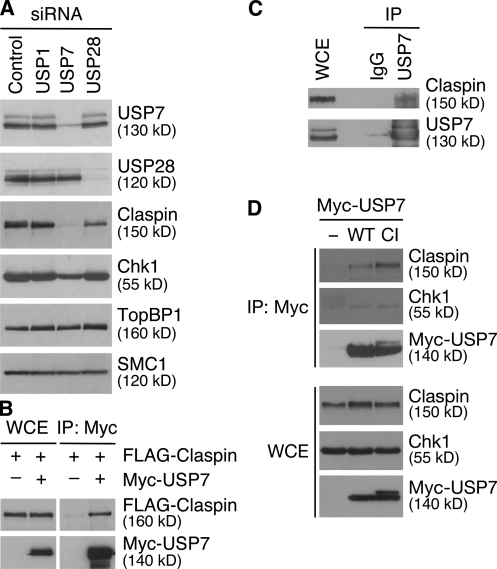
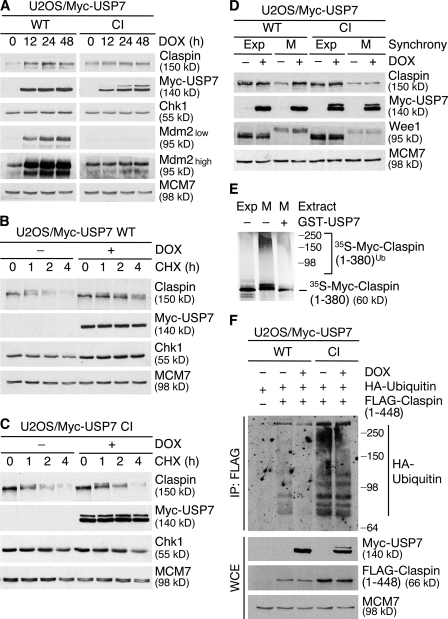
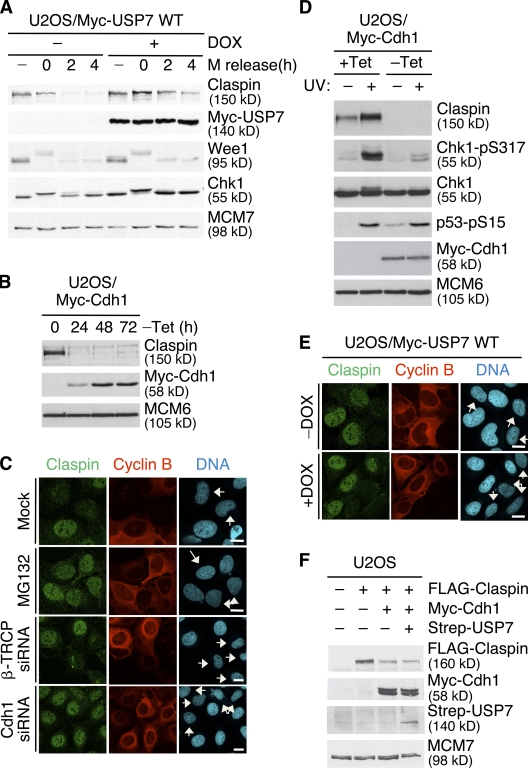
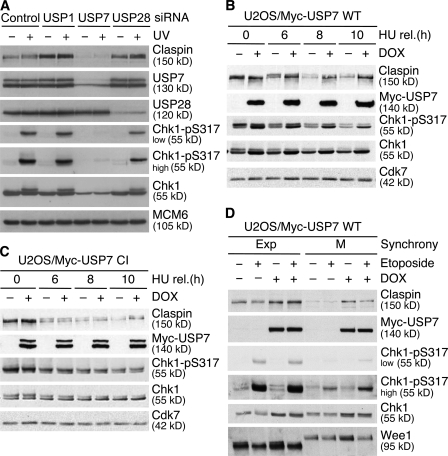
Verification
Claims the paper makes
The claims and statistics of this paper haven’t been checked yet.
Run the check — free, no account needed. It reads the open-access text and checks the sources it cites.
Claims other papers make about this one
Each is checked against this paper’s own text: does it say what the citing paper says it does?
In the citing paper
“USP7 also influences DSB repair by regulating checkpoint kinase 1 (Chk1) (Faustrup et al., 2009; Alonso-de Vega et al., 2014; Zhang P. et al., 2014).”
From USP7 Is a Master Regulator of Genome Stability (2020) · cites this paper as Faustrup et al., 2009
In the citing paper
“USP7 controls Chk1 signaling by deubiquitinating and stabilizing both Chk1 and its activator protein, Claspin (Faustrup et al., 2009; Alonso-de Vega et al., 2014; Zhang P. et al., 2014).”
From USP7 Is a Master Regulator of Genome Stability (2020) · cites this paper as Faustrup et al., 2009
Self-check
Percentages, sums and reported differences re-computed from the paper’s own numbers.
The self-check needs the paper’s full text.
Citations
Cites
The DNA damage response: putting checkpoints in perspective
Zhou, B.-B. S., & Elledge, S. J. (2000) · Nature · doi:10.1038/35044005 · Cited by 3,213
A genomic and functional inventory of deubiquitinating enzymes.
Nijman, S. M. B., Luna-Vargas, M. P. A., Velds, A., Brummelkamp, T. R., Dirac, A. M. G., Sixma, T. K., & Bernards, R. (2005) · Cell · doi:10.1016/j.cell.2005.11.007 · Cited by 1,854
The anaphase promoting complex/cyclosome: a machine designed to destroy
Peters, J.-M. (2006) · Nature Reviews Molecular Cell Biology · doi:10.1038/nrm1988 · Cited by 1,315
RNF8 Ubiquitylates Histones at DNA Double-Strand Breaks and Promotes Assembly of Repair Proteins
Mailand, N., Bekker‐Jensen, S., Kildegaard, H. F., Melander, F., Bártek, J., Lukas, C., & Lukas, J. (2007) · Cell · doi:10.1016/j.cell.2007.09.040 · Cited by 1,193
Self-citationRapid Destruction of Human Cdc25A in Response to DNA Damage
Mailand, N., Falck, J., Lukas, C., Syljuåsen, R. G., Welcker, M., Bartek, J., & Lukas, J. (2000) · Science · doi:10.1126/science.288.5470.1425 · Cited by 787
Self-citationDNA damage checkpoints: from initiation to recovery or adaptation
Bartek, J., & Lukas, J. (2007) · Current Opinion in Cell Biology · doi:10.1016/j.ceb.2007.02.009 · Cited by 784
Self-citationA dynamic role of HAUSP in the p53-Mdm2 pathway
Li, M., Brooks, C. L., Kon, N., & Gu, W. (2004) · Molecular Cell · doi:10.1016/s1097-2765(04)00157-1 · Cited by 679
Spatial organization of the mammalian genome surveillance machinery in response to DNA strand breaks
Bekker‐Jensen, S., Lukas, C., Kitagawa, R., Melander, F., Kastan, M. B., Bártek, J., & Lukas, J. (2006) · The Journal of Cell Biology · doi:10.1083/jcb.200510130 · Cited by 647
Self-citationThe Deubiquitinating Enzyme USP1 Regulates the Fanconi Anemia Pathway
Nijman, S. M. B., Huang, T. T., Dirac, A. M. G., Brummelkamp, T. R., Kerkhoven, R. M., D’Andrea, A. D., & Bernards, R. (2005) · Molecular Cell · doi:10.1016/j.molcel.2005.01.008 · Cited by 601
Regulation of monoubiquitinated PCNA by DUB autocleavage
Huang, T. T., Nijman, S. M. B., Mirchandani, K. D., Galardy, P. J., Cohn, M. A., Haas, W., Gygi, S. P., Ploegh, H. L., Bernards, R., & D’Andrea, A. D. (2006) · Nature Cell Biology · doi:10.1038/ncb1378 · Cited by 597
Research works printed but not linked: 2
- 2006, Nat. Cell Biol., 8, 339
- 2006, Nat. Rev. Mol. Cell Biol., 7, 644
Cited by
Sorted by citations
Breaking the chains: deubiquitylating enzyme specificity begets function
Clague, M. J., Urbé, S., & Komander, D. (2019) · Nature Reviews Molecular Cell Biology · doi:10.1038/s41580-019-0099-1 · Cited by 878
ATM-mediated stabilization of ZEB1 promotes DNA damage response and radioresistance through CHK1
Zhang, P., Wei, Y., Wang, L., Debeb, B. G., Yuan, Y., Zhang, J., Yuan, J., Wang, M., Chen, D., Sun, Y., et al. (2014) · Nature Cell Biology · doi:10.1038/ncb3013 · Cited by 462
Ubiquitylation in apoptosis: a post-translational modification at the edge of life and death
Vucic, D., Dixit, V. M., & Wertz, I. E. (2011) · Nature Reviews Molecular Cell Biology · doi:10.1038/nrm3143 · Cited by 468
Activity-Based Chemical Proteomics Accelerates Inhibitor Development for Deubiquitylating Enzymes
Altun, M., Kramer, H., Willems, L. I., McDermott, J. L., Leach, C. A., Goldenberg, S. J., Kumar, S., Konietzny, R., Fischer, R., Kogan, E., et al. (2011) · Chemistry & Biology · doi:10.1016/j.chembiol.2011.08.018 · Cited by 415
Du, Z., Song, J. K., Wang, Y., Zhao, Y., Guda, K., Yang, S., Kao, H., Xu, Y., Willis, J. E., Markowitz, S. D., et al. (2010) · Science Signaling · doi:10.1126/scisignal.2001462 · Cited by 348
Dewson, G., Eichhorn, P. J. A., & Komander, D. (2023) · Nature reviews. Cancer · doi:10.1038/s41568-023-00633-y · Cited by 353
UV-sensitive syndrome protein UVSSA recruits USP7 to regulate transcription-coupled repair
Schwertman, P., Lagarou, A., Dekkers, D. H. W., Raams, A., van der Hoek, A. C., Laffeber, C., Hoeijmakers, J. H. J., Demmers, J. A. A., Fousteri, M., Vermeulen, W., et al. (2012) · Nature Genetics · doi:10.1038/ng.2230 · Cited by 279
Discovery of specific inhibitors of human USP7/HAUSP deubiquitinating enzyme.
Reverdy, C., Conrath, S., Lopez, R., Planquette, C., Atmanene, C., Collura, V., Harpon, J., Battaglia, V., Vivat, V., Sippl, W., et al. (2012) · Chemistry & Biology · doi:10.1016/j.chembiol.2012.02.007 · Cited by 270
The Multifaceted Roles of USP7: New Therapeutic Opportunities
Nicholson, B., & Kumar, S. (2011) · Cell Biochemistry and Biophysics · doi:10.1007/s12013-011-9185-5 · Cited by 249
The ubiquitous role of ubiquitin in the DNA damage response
Al-Hakim, A., Escribano‐Diaz, C., Landry, M.-C., O’Donnell, L., Panier, S., Szilard, R. K., & Durocher, D. (2010) · DNA repair · doi:10.1016/j.dnarep.2010.09.011 · Cited by 240
Regulation of proteolysis by human deubiquitinating enzymes
Eletr, Z. M., & Wilkinson, K. D. (2013) · Biochimica et Biophysica Acta (BBA) - Molecular Cell Research · doi:10.1016/j.bbamcr.2013.06.027 · Cited by 191
USP7: Structure, substrate specificity, and inhibition
Pozhidaeva, A., & Bezsonova, I. (2019) · DNA Repair · doi:10.1016/j.dnarep.2019.02.005 · Cited by 178
Emerging insights into HAUSP (USP7) in physiology, cancer and other diseases.
Bhattacharya, S., Chakraborty, D., Basu, M., & Ghosh, M. K. (2018) · Signal Transduction and Targeted Therapy · doi:10.1038/s41392-018-0012-y · Cited by 162
Modulation of NF-κB Signaling as a Therapeutic Target in Autoimmunity
Herrington, F., Carmody, R. J., & Goodyear, C. S. (2015) · SLAS DISCOVERY · doi:10.1177/1087057115617456 · Cited by 156
USP7 is a SUMO deubiquitinase essential for DNA replication.
Lecona, E., Rodriguez-Acebes, S., Specks, J., Lopez-Contreras, A. J., Ruppen, I., Murga, M., Muñoz, J., Mendez, J., & Fernandez-Capetillo, O. (2016) · Nature Structural & Molecular Biology · doi:10.1038/nsmb.3185 · Cited by 148
Deubiquitinases and the new therapeutic opportunities offered to cancer
Pfoh, R., Lacdao, I. K., & Saridakis, V. (2015) · Endocrine Related Cancer · doi:10.1530/erc-14-0516 · Cited by 144
USP7: Novel Drug Target in Cancer Therapy
Wang, Z., Kang, W.-T., You, Y., Pang, J., Ren, H., Suo, Z., Liu, H., & Zheng, Y. (2019) · Frontiers in Pharmacology · doi:10.3389/fphar.2019.00427 · Cited by 131
Selective USP7 inhibition elicits cancer cell killing through a p53-dependent mechanism.
Schauer, N. J., Liu, X., Magin, R. S., Doherty, L. M., Chan, W. C., Ficarro, S. B., Hu, W., Roberts, R. M., Iacob, R. E., Stolte, B., et al. (2020) · Scientific Reports · doi:10.1038/s41598-020-62076-x · Cited by 125
USP7 Is a Master Regulator of Genome Stability
Valles, G. J., Bezsonova, I., Woodgate, R., & Ashton, N. W. (2020) · Frontiers in Cell and Developmental Biology · doi:10.3389/fcell.2020.00717 · Cited by 114
“USP7 also influences DSB repair by regulating checkpoint kinase 1 (Chk1) (Faustrup et al., 2009; Alonso-de Vega et al., 2014; Zhang P. et al., 2014).”
BackgroundUbiquitin-specific protease 7 sustains DNA damage response and promotes cervical carcinogenesis
Su, D., Ma, S., Shan, L., Wang, Y., Wang, Y., Cao, C., Liu, B., Yang, C., Wang, L., Tian, S., et al. (2018) · Journal of Clinical Investigation · doi:10.1172/jci120518 · Cited by 118
DNA damage control: regulation and functions of checkpoint kinase 1
Smits, V. A. J., & Gillespie, D. A. (2015) · FEBS Journal · doi:10.1111/febs.13387 · Cited by 120
Ma, H., Chen, H., Guo, X., Wang, Z., Sowa, M. E., Zheng, L., Hu, S., Zeng, P.-Y., Guo, R., Diao, J., et al. (2012) · Proceedings of the National Academy of Sciences · doi:10.1073/pnas.1116349109 · Cited by 117
The emerging role of deubiquitinating enzymes in genomic integrity, diseases, and therapeutics
He, M., Zhou, Z., Shah, A. A., Zou, H., Tao, J., Chen, Q., & Wan, Y. (2016) · Cell & Bioscience · doi:10.1186/s13578-016-0127-1 · Cited by 110
USP7 - a crucial regulator of cancer hallmarks
Saha, G., Roy, S., Basu, M., & Ghosh, M. K. (2023) · Biochimica et Biophysica Acta (BBA) - Reviews on Cancer · doi:10.1016/j.bbcan.2023.188903 · Cited by 109
Spardy, N. A., Covella, K., Cha, E., Hoskins, E. E., Wells, S. I., Duensing, A. U., & Duensing, S. M. (2009) · Cancer Research · doi:10.1158/0008-5472.can-09-0925 · Cited by 104
Edelmann, M. J., Nicholson, B., & Kessler, B. M. (2011) · Expert Reviews in Molecular Medicine · doi:10.1017/s1462399411002031 · Cited by 97
Claspin – checkpoint adaptor and DNA replication factor
Smits, V. A. J., Cabrera, E., Freire, R., & Gillespie, D. A. (2018) · FEBS Journal · doi:10.1111/febs.14594 · Cited by 104
USP7 controls Chk1 protein stability by direct deubiquitination.
Alonso-de Vega, I., Martín, Y., & Smits, V. A. (2014) · Cell Cycle · doi:10.4161/15384101.2014.973324 · Cited by 92
Deubiquitylating Enzymes and DNA Damage Response Pathways
Jacq, X., Kemp, M. I., Martin, N. M. B., & Jackson, S. P. (2013) · Cell Biochemistry and Biophysics · doi:10.1007/s12013-013-9635-3 · Cited by 90
Deubiquitination of Tip60 by USP7 determines the activity of the p53-dependent apoptotic pathway.
Dar, A., Shibata, E., & Dutta, A. (2013) · Molecular and Cellular Biology · doi:10.1128/mcb.00358-13 · Cited by 83
Cyclin A/Cdk2 regulates Cdh1 and claspin during late S/G2 phase of the cell cycle
Oakes, V., Wang, W., Harrington, B. S., Lee, W. J., Beamish, H., Chia, K. M., Pinder, A., Goto, H., Inagaki, M., Pavey, S. J., et al. (2014) · Cell Cycle · doi:10.4161/15384101.2014.949111 · Cited by 78
USP29 controls the stability of checkpoint adaptor Claspin by deubiquitination
Martín, Y., Cabrera, E., Amoedo, H., Hernández-Pérez, S., Domínguez-Kelly, R., & Freire, R. (2014) · Oncogene · doi:10.1038/onc.2014.38 · Cited by 79
Pinto-Fernández, A., & Kessler, B. M. (2016) · Frontiers in Genetics · doi:10.3389/fgene.2016.00133 · Cited by 73
HERC2/USP20 coordinates CHK1 activation by modulating CLASPIN stability
Zhu, M., Zhao, H., Liao, J., & Xu, X. (2014) · Nucleic Acids Research · doi:10.1093/nar/gku978 · Cited by 66
USP1 deubiquitinase maintains phosphorylated CHK1 by limiting its DDB1-dependent degradation
Guervilly, J.-H., Renaud, E., Takata, M., & Rosselli, F. (2011) · Human Molecular Genetics · doi:10.1093/hmg/ddr103 · Cited by 74
The role of UBL domains in ubiquitin-specific proteases
Faesen, A. C., Luna‐Vargas, M. P. A., & Sixma, T. K. (2012) · Biochemical Society Transactions · doi:10.1042/bst20120004 · Cited by 66
Tu, Y., Chen, Z., Zhao, P., Sun, G., Bao, Z., Chao, H., Fan, L., Li, C., You, Y., Qu, Y., et al. (2020) · Clinical Cancer Research · doi:10.1158/1078-0432.ccr-19-1515 · Cited by 65
Gao, Y., Koppen, A., Rakhshandehroo, M., Taşdelen, I., van de Graaf, S. F. J., van Loosdregt, J., van Beekum, O., Hamers, N., van Leenen, D., Berkers, C. R., et al. (2013) · Nature Communications · doi:10.1038/ncomms3656 · Cited by 65
Expression of HAUSP in gliomas correlates with disease progression and survival of patients
Cheng, C., Niu, C., Yang, Y., Wang, Y., & Lu, M. (2013) · Oncology Reports · doi:10.3892/or.2013.2342 · Cited by 63
Hernández-Pérez, S., Cabrera, E., Salido, E., Lim, M., Reid, L., Lakhani, S. R., Khanna, K. K., Saunus, J. M., & Freire, R. (2017) · Oncogene · doi:10.1038/onc.2017.21 · Cited by 61
USP7 modulates UV-induced PCNA monoubiquitination by regulating DNA polymerase eta stability.
Qian, J., Pentz, K., Zhu, Q., Wang, Q., He, J., Srivastava, A. K., & Wani, A. A. (2015) · Oncogene · doi:10.1038/onc.2014.394 · Cited by 61
Replication Checkpoint: Tuning and Coordination of Replication Forks in S Phase
Hustedt, N., Gasser, S. M., & Shimada, K. (2013) · Genes · doi:10.3390/genes4030388 · Cited by 62
Dual-utility NLS drives RNF169-dependent DNA damage responses
An, L., Jiang, Y., Ng, H. H. W., Man, E. P. S., Chen, J., Khoo, U., Gong, Q., & Huen, M. S. Y. (2017) · Proceedings of the National Academy of Sciences · doi:10.1073/pnas.1616602114 · Cited by 61
Role of RAD51AP1 in homologous recombination DNA repair and carcinogenesis
Pires, E., Sung, P., & Wiese, C. (2017) · DNA repair · doi:10.1016/j.dnarep.2017.09.008 · Cited by 58
TRIM21 suppresses CHK1 activation by preferentially targeting CLASPIN for K63-linked ubiquitination
Zhu, X., Xue, J., Jiang, X. Y., Gong, Y., Gao, C., Cao, T., Li, Q., Bai, L., Li, Y., Xu, G., et al. (2022) · Nucleic Acids Research · doi:10.1093/nar/gkac011 · Cited by 55
Kim, R. Q., van Dijk, W. J., & Sixma, T. K. (2016) · Journal of Structural Biology · doi:10.1016/j.jsb.2016.05.005 · Cited by 61
The Deubiquitinating Enzyme USP24 Is a Regulator of the UV Damage Response
Zhang, L., Nemzow, L., Chen, H., Lubin, A., Rong, X., Sun, Z., Harris, T. K., & Gong, F. (2015) · Cell Reports · doi:10.1016/j.celrep.2014.12.024 · Cited by 53
McGarry, E., Gaboriau, D. C. A., Rainey, M. D., Restuccia, U., Bachi, A., & Santocanale, C. (2016) · Cancer Research · doi:10.1158/0008-5472.can-15-2890 · Cited by 54
Tang, Y., Lv, L., Li, W., Zhang, X., Jiang, Y., Ge, W., & Zhou, Y. (2017) · Stem Cell Research & Therapy · doi:10.1186/s13287-017-0637-8 · Cited by 56
Wang, F., Wang, L., Wu, J., Sokirniy, I., Nguyen, P., Bregnard, T. A., Weinstock, J., Mattern, M. R., Bezsonova, I., Hancock, W. W., et al. (2017) · PLoS ONE · doi:10.1371/journal.pone.0189744 · Cited by 52
Decision for cell fate: deubiquitinating enzymes in cell cycle checkpoint
Lim, K., Song, M.-H., & Baek, K. (2016) · Cellular and Molecular Life Sciences · doi:10.1007/s00018-015-2129-2 · Cited by 52
UVSSA and USP7, a new couple in transcription-coupled DNA repair
Schwertman, P., Vermeulen, W., & Marteijn, J. A. (2013) · Chromosoma · doi:10.1007/s00412-013-0420-2 · Cited by 49
Aressy, B., Jullien, D., Cazalès, M., Marcellin, M., Bugler, B., Burlet‐Schiltz, O., & Ducommun, B. (2010) · Cell Cycle · doi:10.4161/cc.9.18.13133 · Cited by 48
Ubiquitin-specific Protease 7 Is a Regulator of Ubiquitin-conjugating Enzyme UbE2E1
Sarkari, F., Wheaton, K., Delfa, A. L., Mohamed, M., Shaikh, F., Khatun, R., Arrowsmith, C. H., Frappier, L., Saridakis, V., & Sheng, Y. (2013) · Journal of Biological Chemistry · doi:10.1074/jbc.m113.469262 · Cited by 48
Jing, B., Liu, M., Yang, L. C., Cai, H., Chen, J., Li, Z.-X., Kou, X., Wu, Y., Qin, D., Zhou, L., et al. (2017) · Acta Pharmacologica Sinica · doi:10.1038/aps.2017.119 · Cited by 45
Toward understanding ubiquitin-modifying enzymes: from pharmacological targeting to proteomics
Lill, J. R., & Wertz, I. E. (2014) · Trends in Pharmacological Sciences · doi:10.1016/j.tips.2014.01.005 · Cited by 47
Claspin functions in cell homeostasis—A link to cancer?
Azenha, D., Lopes, M. C., & Martins, T. (2017) · DNA repair · doi:10.1016/j.dnarep.2017.09.002 · Cited by 43
Qiu, G., Sun, W., Jin, M., Lin, J., Lu, P., & Jin, W. (2016) · Pharmacology & Therapeutics · doi:10.1016/j.pharmthera.2016.12.003 · Cited by 40
Cell Death and Deubiquitinases: Perspectives in Cancer
Bhattacharya, S., & Ghosh, M. K. (2014) · BioMed Research International · doi:10.1155/2014/435197 · Cited by 38
ATR inhibition rewires cellular signaling networks induced by replication stress
Wagner, S., Oehler, H., Voigt, A., Dalic, D., Freiwald, A., Serve, H. L., & Beli, P. (2015) · PROTEOMICS · doi:10.1002/pmic.201500172 · Cited by 40
Targeting ubiquitin specific protease 7 in cancer: A deubiquitinase with great prospects
Khusbu, F. Y., Chen, F., & Chen, H. (2018) · Cell Biochemistry and Function · doi:10.1002/cbf.3336 · Cited by 36
USP7 Regulates Cytokinesis through FBXO38 and KIF20B
Georges, A. A., Coyaud, É., Marcon, E., Greenblatt, J. F., Raught, B., & Frappier, L. (2019) · Scientific Reports · doi:10.1038/s41598-019-39368-y · Cited by 42
Roles of Ubiquitination and SUMOylation in DNA Damage Response
Su, S., Zhang, Y., & Liu, P. (2019) · Current Issues in Molecular Biology · doi:10.21775/cimb.035.059 · Cited by 37
USP7 regulates the stability and function of HLTF through deubiquitination.
Qing, P., Han, L., Bin, L., Yan, L., & Ping, W. X. (2011) · Journal of Cellular Biochemistry · doi:10.1002/jcb.23317 · Cited by 35
Current and future directions of USP7 interactome in cancer study
Park, H., & Baek, K. (2023) · Biochimica et Biophysica Acta (BBA) - Reviews on Cancer · doi:10.1016/j.bbcan.2023.188992 · Cited by 35
Dissecting the role of ubiquitylation in the DNA damage response checkpoint in G2
Bassermann, F. C., & Pagano, M. (2009) · Cell Death and Differentiation · doi:10.1038/cdd.2009.104 · Cited by 35
USP7 protects genomic stability by regulating Bub3.
Giovinazzi, S., Sirleto, P., Aksenova, V., Morozov, V. M., Zori, R., Reinhold, W. C., & Ishov, A. M. (2014) · Oncotarget · doi:10.18632/oncotarget.1989 · Cited by 34
USP7 manipulation by viral proteins
Bojagora, A., & Saridakis, V. (2020) · Virus Research · doi:10.1016/j.virusres.2020.198076 · Cited by 37
Shi, Y., Wang, Y., Niu, K., Zhang, W., Lv, Q., & Zhang, Y. (2024) · Computers in Biology and Medicine · doi:10.1016/j.compbiomed.2024.108260 · Cited by 37
Targeting Deubiquitinating Enzymes in Glioblastoma Multiforme: Expectations and Challenges
Jin, W., Mao, X., & Qiu, G. (2016) · Medicinal Research Reviews · doi:10.1002/med.21421 · Cited by 32
Ito, F., Yoshimoto, C., Yamada, Y., Sudo, T., & Kobayashi, H. (2018) · Oncotarget · doi:10.18632/oncotarget.24776 · Cited by 32
Targeting the Ubiquitin Proteasome System: Beyond Proteasome Inhibition
Xolalpa, W., Pérez‐Galán, P., Rodríguez, M. S., & Roué, G. (2013) · Current Pharmaceutical Design · doi:10.2174/1381612811319220014 · Cited by 30
Termination of DNA replication forks: “Breaking up is hard to do”
Bailey, R., Moreno, S. P., & Gambus, A. (2015) · Nucleus · doi:10.1080/19491034.2015.1035843 · Cited by 26
The Ubiquitin-Proteasome System (UPS) as a Cancer Drug Target: Emerging Mechanisms and Therapeutics
Mata-Cantero, L., Lobato-Gil, S., Aillet, F., Lang, V., & Rodríguez, M. S. (2014) · Springer eBooks · doi:10.1007/978-94-017-9421-3_11 · Cited by 25
Zhou, L., Ouyang, T., Li, M., Hong, T., Alriashy, M. H. S., Meng, W., & Zhang, N. (2021) · Frontiers in Oncology · doi:10.3389/fonc.2021.784672 · Cited by 24
Song, Y., Ren, X., Xiong, J., Wang, W., Zhao, Q., Chang, J., & Yu, B. (2025) · Journal of Medicinal Chemistry · doi:10.1021/acs.jmedchem.5c00102 · Cited by 22
Hsiao, H.-W., Yang, C.-C., & Masai, H. (2021) · Genome Instability & Disease · doi:10.1007/s42764-021-00049-8 · Cited by 22
Stromberg, B. R., Singh, M. K., Torres, A. E., Burrows, A. C., Pal, D., Insinna, C., Rhee, Y., Dickson, A. S., Westlake, C. J., & Summers, M. K. (2021) · Journal of Biological Chemistry · doi:10.1016/j.jbc.2021.101184 · Cited by 19
Deubiquitinating Enzymes: A Critical Regulator of Mitosis
Park, J., Cho, J., Kim, E. E., & Song, E. J. (2019) · International Journal of Molecular Sciences · doi:10.3390/ijms20235997 · Cited by 19
USP7/HAUSP: A SUMO deubiquitinase at the heart of DNA replication
Smits, V. A. J., & Freire, R. (2016) · BioEssays · doi:10.1002/bies.201600096 · Cited by 20
Recovery from the DNA Replication Checkpoint
Chaudhury, I., & Koepp, D. M. (2016) · Genes · doi:10.3390/genes7110094 · Cited by 22
Deubiquitinating Enzyme-Mediated Signaling Networks in Cancer Stem Cells
Kaushal, K., & Ramakrishna, S. (2020) · Cancers · doi:10.3390/cancers12113253 · Cited by 18
Lee, T.-H., Choi, J. Y., Park, J., & Kang, T. (2020) · Oncogene · doi:10.1038/s41388-020-1220-9 · Cited by 16
Pal, D., Torres, A. E., Stromberg, B. R., Messina, A. L., Dickson, A. S., De, K., Willard, B. B., Venere, M., & Summers, M. K. (2020) · Cell Death and Disease · doi:10.1038/s41419-020-2493-1 · Cited by 14
Han, J. J. W., Ho, D. V., Kim, H. M., Lee, J. Y., Jeon, Y. S., & Chan, J. Y. (2021) · Journal of Biological Chemistry · doi:10.1016/j.jbc.2021.100732 · Cited by 12
Regulation of ATR–CHK1 signaling by ubiquitination of CLASPIN
Zhu, X., Zheng, X., Gong, P., & Xu, X. (2022) · Biochemical Society Transactions · doi:10.1042/bst20220729 · Cited by 10
Discovery of Therapeutic Deubiquitylase Effector Molecules: Current Perspectives
Nicholson, B., Kumar, S., Agarwal, S., Eddins, M. J., Marblestone, J. G., Wu, J., Kodrasov, M. P., LaRocque, J. P., Sterner, D. E., & Mattern, M. R. (2014) · SLAS DISCOVERY · doi:10.1177/1087057114527312 · Cited by 10
Coordinating DNA Replication and Mitosis through Ubiquitin/SUMO and CDK1
Galarreta, A., Valledor, P., Fernández-Capetillo, Ó., & Lecona, E. (2021) · International Journal of Molecular Sciences · doi:10.3390/ijms22168796 · Cited by 10
Boddin, J., Ip, W.-H., Wilkens, B., von Stromberg, K., Ching, W., Koyuncu, E., Bertzbach, L. D., & Dobner, T. (2022) · mBio · doi:10.1128/mbio.00144-22 · Cited by 10
Zhu, Y., Zhang, Q., Yan, X., Liu, L., Zhai, C., Wang, Q., Chai, L., & Li, M. (2021) · Pulmonary Circulation · doi:10.1177/20458940211046131 · Cited by 9
TAOK1 promotes filament formation in HR repair through phosphorylating USP7
Zhu, T.-C., He, Z., Li, S.-T., Zheng, L., Zheng, X.-Y., Lan, X., Qu, C., Nie, R., Gu, C., Huang, L.-N., et al. (2025) · Proceedings of the National Academy of Sciences · doi:10.1073/pnas.2422262122 · Cited by 6
Wu, Y., Gu, H., Bao, Y., Lin, T., Wang, Z., Gu, D., Shen, H., Xian, H., Fan, Y., & Mao, R. (2022) · Cell Biochemistry and Function · doi:10.1002/cbf.3702 · Cited by 6
GSK3-β Stimulates Claspin Degradation via β-TrCP Ubiquitin Ligase and Alters Cancer Cell Survival
Cabrera, E., Raninga, P. V., Khanna, K. K., & Freire, R. (2019) · Cancers · doi:10.3390/cancers11081073 · Cited by 6
Pawlak, A., Bajzert, J., Bugiel-Stabla, K., Suárez, B. H., Kutkowska, J., Rapak, A., Hildebrand, W., Obmińska‐Mrukowicz, B., Freire, R., & Smits, V. A. J. (2021) · Journal of Veterinary Internal Medicine · doi:10.1111/jvim.16082 · Cited by 6
The post translational modification of key regulators of ATR signaling in DNA replication
Chen, Y., & Yuan, J. (2021) · Genome Instability & Disease · doi:10.1007/s42764-021-00036-z · Cited by 6
Sahay, O., Barik, G. K., Sharma, T., Pillai, A. D., Rapole, S., & Santra, M. K. (2021) · DNA repair · doi:10.1016/j.dnarep.2021.103261 · Cited by 4
Targeting the Ubiquitin Proteasome System in Cancer
Kumari, N., Lee, K. K., & Jha, S. (2018) · InTech eBooks · doi:10.5772/intechopen.76705 · Cited by 5
Huang, Z., Zhai, K., Wu, Q., Fang, X., Huang, Q., Tao, W., Lathia, J. D., Yu, J. S., Rich, J. N., & Bao, S. (2021) · bioRxiv (Cold Spring Harbor Laboratory) · doi:10.1101/2021.06.09.447550 · Cited by 3
Claspin and Cancer: Where Are We Now?
Azenha, D., & Martins, T. (2025) · International Journal of Molecular Sciences · doi:10.3390/ijms26188828 · Cited by 2
Recent Progress of Ubiquitin-Specific-Processing Protease 7 Inhibitors
Chi, L., Wang, H., Yu, F., Gao, C., Dai, H., Si, X., Liu, L., Wang, Z., Zheng, J.-H., Ke, Y., et al. (2023) · Russian Journal of Bioorganic Chemistry · doi:10.1134/s1068162023020073 · Cited by 2
Metadata
- Authors
- Faustrup, H., Bekker-Jensen, S., Bartek, J., Lukas, J., & Mailand, N.
- Affiliations
- Institute of Cancer Biology and Centre for Genotoxic Stress Research, Danish Cancer Society, DK-2100 Copenhagen, Denmark
- Danish Cancer Society (DK)
- ORCID
- Mailand, Niels
- Venue
- The Journal of Cell Biology
- Publisher
- Rockefeller University Press
- Published
- 2009-01-05
- Volume
- 184
- Issue
- 1
- Pages
- 13-19
- ISSN
- 0021-9525 (ISSN-L)
- 1540-8140
- PMC
- PMC2615094
- OpenAlex
- W2087983227
- Cited by
- 113
- References
- 23
- Citations by year
- 2026: 3 · 2025: 3 · 2024: 1 · 2023: 4 · 2022: 5 · 2021: 10 · 2020: 7 · 2019: 8 · 2018: 9 · 2017: 7 · 2016: 12 · 2015: 6 · 2014: 11 · 2013: 9 · 2012: 5
- FWCI
- 2.41
- Type
- journal article
- Language
- en
- Open access
- hybrid
- doi.org
- Licence
- cc-by-nc-sa
- Locations
- The Journal of Cell Biology (publishedVersion, cc-by-nc-sa)
- PubMed Central (publishedVersion, cc-by-nc-sa)
- PubMed (publishedVersion)
- Funders
- National Center for Chronic Disease Prevention and Health Promotion (U58 DP006009)
- Topics
- Life Sciences › Biochemistry, Genetics and Molecular Biology › Molecular Biology › Ubiquitin and proteasome pathways
- Life Sciences › Biochemistry, Genetics and Molecular Biology › Molecular Biology › DNA Repair Mechanisms
- Life Sciences › Biochemistry, Genetics and Molecular Biology › Cell Biology › Microtubule and mitosis dynamics
- Keywords
- Claspin, USP7, deubiquitination, anaphase-promoting complex, CDH1, protein stability, Chk1 phosphorylation, ATR-Chk1 pathway, DNA damage response, spindle assembly checkpoint, ubiquitination, genotoxic stress
- MeSH terms
- Checkpoint Kinase 1, Ubiquitin-Specific Peptidase 7, Cell Line, DNA Damage, Humans, Phosphorylation, Protein Kinases, Substrate Specificity, G1 Phase, Ubiquitin Thiolesterase, Ubiquitin-Protein Ligase Complexes, SKP Cullin F-Box Protein Ligases, Adaptor Proteins, Signal Transducing, Ubiquitination, Anaphase-Promoting Complex-Cyclosome
About these checks
Registry, retraction, Cites and statistics results are computed, not judged, with one exception: a printed reference that no index lists is read once by a model before it counts as a citation error. Claims are extracted by a model and kept only when their quote appears verbatim in the text; each cited source is then checked, with a model’s help, for whether it says what the claim relies on. Those verdicts can be wrong — read the claim’s quote and the cited source before relying on one.
Statistics and arithmetic are recomputed, not judged.
Confidence bands are shown only for fields calibrated on our annotated test set. None is calibrated yet, so no band is shown.
What counts as a claim ›How we measure confidence ›How we check this ›
Are you an author, or do you see a problem with this page? Request a review
