

The Mark of a Criminal Record
The DOI matches its Crossref record; 50 of the 50 references it cites were found in a registry or an index; 4 of the 57 sources its claims cite were checked for support.
Abstract
With over 2 million individuals currently incarcerated, and over half a million prisoners released each year, the large and growing number of men being processed through the criminal justice system raises important questions about the consequences of this massive institutional intervention. This article focuses on the consequences of incarceration for the employment outcomes of black and white job seekers. The present study adopts an experimental audit approach—in which matched pairs of individuals applied for real entry-level jobs—to formally test the degree to which a criminal record affects subsequent employment opportunities. The findings of this study reveal an important, and much underrecognized, mechanism of stratification. A criminal record presents a major barrier to employment, with important implications for racial disparities.
Overview
CoChat Summary
TL;DR
Using an experimental audit of real entry-level job applications in Milwaukee, Pager finds that a criminal record sharply reduces employer callbacks and that race independently compounds this disadvantage. The study provides direct causal evidence that a criminal record operates as a “negative credential” in hiring, with especially severe consequences for black applicants.
Key findings
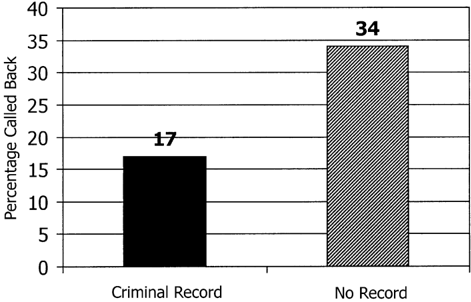
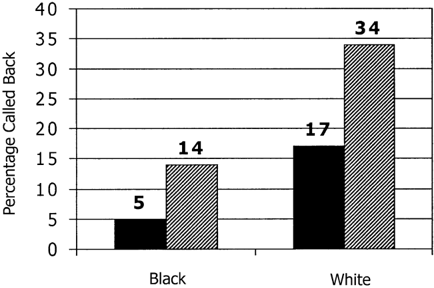
- Among white testers, 34% of noncriminal applicants received callbacks versus 17% of those with criminal records, a 50% reduction; the effect is statistically significant (*P* < .01).
- Among black testers, only 14% of noncriminal applicants received callbacks, compared with 34% of white noncriminal applicants; whites with criminal records (17%) still received more callbacks than blacks without records (14%).
- The criminal-record effect was larger for blacks than whites: the nonoffender-to-ex-offender callback ratio was 2:1 for whites and nearly 3:1 for blacks, making the effect 40% larger for blacks, though the interaction was not statistically significant in the full sample.
- Logistic models show a criminal record coefficient of −.99 (*SE* = .24, *P* < .001), a black coefficient of −1.25 (*SE* = .28, *P* < .001), and a criminal record × black interaction of −.29 (*SE* = .38, not significant).
Methods
- Experimental audit study using four male testers—two black and two white, paired by race—who applied in person for real entry-level jobs in Milwaukee between June and December 2001.
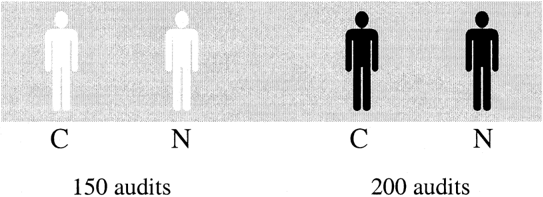
- A total of 350 employers were audited: 150 by the white pair and 200 by the black pair; jobs were drawn from the *Milwaukee Journal Sentinel* Sunday classifieds and *Jobnet*, requiring no previous experience and no education beyond high school.
- Within each race pair, one tester was randomly assigned a criminal record—a felony drug conviction for possession with intent to distribute cocaine and 18 months served in prison—and the pair rotated this condition across weeks; the main outcome was employer callback.
Limitations
- The paper states that findings are specific to Milwaukee, a highly segregated city with high black incarceration rates, and to the moderately strong economic conditions of 2001; results may not generalize to other metropolitan areas or recessionary periods.
- The paper notes sample restrictions excluding health care, public-sector, child/elder-care, security-clearance, and employment-agency jobs, meaning the audit captures only part of the total effect of a criminal record.
- The paper acknowledges that testers were bright, articulate college students with favorable work histories, that some employers did not solicit criminal-history information, and that experimenter effects or tester self-presentation could influence results; it argues several of these features likely make the estimates conservative.
Model-written summary. Check it against the paper before relying on it.
Integrity signals
Registry
Cites
Statistics
Figures

Verification
Claims the paper makes
3 Valid · 7 Not valid · 34 Not checked · 110 Own results and interpretations
The cited sources support only part of this claim — read each source’s verdict below.
In the paper
“Each of these studies reports the similar finding that, all else equal, contact with the criminal justice system leads to worse employment opportunities.”
What the sources say
- Not checked — no full text of the sourcecites Finn and Fontaine 1985 matched to “The Association between Selected Characteristics and Perceived Employability of Offenders” (1985) source
- Partly supportedcites Cohen and Nisbett 1997 matched to “Field Experiments Examining the Culture of Honor: The Role of Institutions in Perpetuating Norms about Violence” (1997) sourceExperimental — accuracy not yet measured
Study 1 (p. 3) is a correspondence-style employment test, and the Discussion (p. 10) recounts an employer saying he could not hire the applicant because of legal issues. But both applicant letters described a criminal conviction, so the study did not compare applicants with and without criminal-justice contact or establish the claimed general effect on employment opportunities. The Results (p. 5) also say the job-availability contrast was not significant. (LLM, conf=0.82)
- Not checked — no full text of the sourcecites Boshier and Johnson 1974 matched to “DOES CONVICTION AFFECT EMPLOYMENT OPPORTUNITIES?” (1974) source
plainstates a cause- Asserted: passes — The authors put it forward as true.
- Checkable: passes — It can be checked against evidence.
- Load-bearing: passes — The paper’s conclusions depend on it.
- Based: passes — The paper gives a reason why it holds.
The cited sources support only part of this claim — read each source’s verdict below.
In the paper
“The Achilles heel of the survey methodology is its inability to escape from the glaring problems of selection that plague research in this field (see Winship and Morgan 1999; Rubin 1990; Heckman et al. 1998).”
What the sources say
- Partly supportedcites Winship and Morgan 1999 matched to “THE ESTIMATION OF CAUSAL EFFECTS FROM OBSERVATIONAL DATA” (1999) sourceExperimental — accuracy not yet measured
The Abstract says surveys are a form of observational data and that usually nonrandom assignment makes causal estimation difficult. The Selection Models section explains how selection can bias standard regression estimates. But the Treatment Assignment Model section discusses methods for addressing selection bias, so the source does not support an absolute inability to overcome it. Page numbers are unavailable in our copy. (LLM, conf=0.83)
- Not checked — no full text of the sourcecites Rubin 1990 matched to “Formal mode of statistical inference for causal effects” (1990) source
- Not checked — no full text of the sourcecites Heckman et al. 1998 matched to “Characterizing Selection Bias Using Experimental Data” (1998) source
boosted- Asserted: passes — The authors put it forward as true.
- Checkable: unclear — It is unclear whether it could be checked against evidence.
- Load-bearing: passes — The paper’s conclusions depend on it.
- Based: passes — The paper gives a reason why it holds.
- Partly supported
The cited sources that could be checked couldn’t confirm or dispute this claim.
In the paper
“It has been well-documented in previous research that the level of employment discrimination corresponds closely with the tightness of the labor market (Freeman and Rodgers 1999).”
What the sources say
- Could not verifycites Freeman and Rodgers 1999 matched to “Area Economic Conditions and the Labor Market Outcomes of Young Men in the 1990s Expansion” (1999) sourceExperimental — accuracy not yet measured
The Unemployment and Earnings and Employment section links tighter labor markets to improved employment for young men, but does not establish a relationship between labor-market tightness and the level of employment discrimination. An endnote in Additional information mentions possible statistical discrimination against people with criminal records, without relating it to market tightness. I searched for discrimination and its connection to tight labor markets; no passage in our copy states the attributed claim. (LLM, conf=0.76)
boostedstates an association- Asserted: passes — The authors put it forward as true.
- Checkable: passes — It can be checked against evidence.
- Load-bearing: passes — The paper’s conclusions depend on it.
- Based: passes — The paper gives a reason why it holds.
- Could not verify
A result the paper reports from its own data — it cites no other source for it, so there is none to check. The quote shows it is in the paper.
In the paper
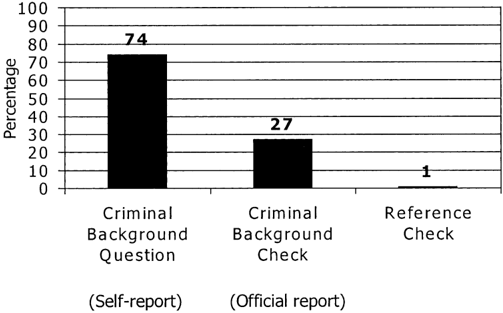
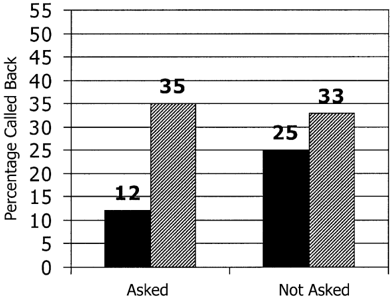
“As is clear from this graph, employers who did not solicit information about criminal histories were much less likely to use the information in their hiring decisions.”
boostedstates an association- Asserted: passes — The authors put it forward as true.
- Checkable: passes — It can be checked against evidence.
- Load-bearing: passes — The paper’s conclusions depend on it.
- Based: passes — The paper gives a reason why it holds.
A result the paper reports from its own data — it cites no other source for it, so there is none to check. The quote shows it is in the paper.
In the paper
“In fact, even whites with criminal records received more favorable treatment (17%) than blacks without criminal records (14%).”
plainstates an association- Asserted: passes — The authors put it forward as true.
- Checkable: passes — It can be checked against evidence.
- Load-bearing: passes — The paper’s conclusions depend on it.
- Based: passes — The paper gives a reason why it holds.
94 more claims
Create a free account to see all 154 claims and to verify the 3 references still open.
- Probably not a substantial claim. 30
- It may state two separate claims as one. 29
- The quote only partly states this claim. 2
Claims other papers make about this one
Each is checked against this paper’s own text: does it say what the citing paper says it does?
The source backs part of the claim, not all of it — or backs it for a different population, condition or comparison.
In the citing paper
“Also of concern, they may translate into an increased risk of substance use and abuse, recidivism, and reincarceration (Iguchi et al., 2002, 2005; Kalt, 2003; Pager, 2003).”
From A call to dismantle systemic racism in criminal legal systems. (2022) · cites this paper as Pager, 2003
Experimental — accuracy not yet measuredThe source backs part of the claim, not all of it — or backs it for a different population, condition or comparison.
In the citing paper
“It is also important to recognize that a criminal record diminishes the ability of people of color to secure employment even more than it does for White people (Pager, 2003).”
From A call to dismantle systemic racism in criminal legal systems. (2022) · cites this paper as Pager, 2003
Experimental — accuracy not yet measuredThe source backs part of the claim, not all of it — or backs it for a different population, condition or comparison.
In the citing paper
“Pager (2003), Pager et al. (2009), and Wells (2013) also find an intensifying interaction of race and criminal background: Callback rates among Black respondents with criminal backgrounds were particularly low.”
From Comparative Perspectives on Racial Discrimination in Hiring: The Rise of Field Experiments (2021) · cites this paper as Pager (2003)
Experimental — accuracy not yet measuredThe cited source says what the claim attributes to it.
In the citing paper
“Pager found that a black applicant with no criminal background experiences job prospects similar to those of a white felon.”
From Discrimination in a Low-Wage Labor Market: A Field Experiment (2009) · cites this paper as Pager 2003
The cited source says what the claim attributes to it.
In the citing paper
“Replicating earlier results from Milwaukee (Pager 2003), these findings suggest that New York employers view minority applicants as essentially equivalent to whites just out of prison.”
From Discrimination in a Low-Wage Labor Market: A Field Experiment (2009) · cites this paper as Pager 2003
1 more claim about this paper
Create a free account to see every claim other papers make about this one.
Self-check
Percentages, sums and reported differences re-computed from the paper’s own numbers.
Each contradiction between two passages listed here was confirmed by an independent check.
Rated minor: it would not touch a result — a value no result rests on, a p-value that stays on the same side of the significance level, or a conflict that is clerical, resolved elsewhere in the paper, or outside its own findings.
In the paper
§ STUDY CONTEXT AND DESCRIPTIVES · p. 15
“unemployment rates ranging from a high of 5.2% in June to a low of 4% in September.”
§ STUDY CONTEXT AND DESCRIPTIVES · p. 16
“Specifically: June (5.4%), July (5.2%), August (4.8%), September (4.4%), October (4.7%), November (4.9%), December (4.5%).”
Citations
Cites
Human Capital: A Theoretical and Empirical Analysis, with Special Reference to Education
Becker, G. S. (1993) · doi:10.7208/chicago/9780226041223.001.0001 · Cited by 4,509
Bertrand, M., & Mullainathan, S. (2004) · American Economic Review · doi:10.1257/0002828042002561 · Cited by 4,504
Crime in the Making: Pathways and Turning Points Through Life
SAMPSON, R. J., & LAUB, J. H. (1993) · Crime & Delinquency · doi:10.1177/0011128793039003010 · Cited by 2,793
Characterizing Selection Bias Using Experimental Data
Heckman, J., Ichimura, H., Smith, J., & Todd, P. (1998) · Econometrica · doi:10.2307/2999630 · Cited by 2,286 · cited 2×
“…heel of the survey methodology is its inability to escape from the glaring problems of selection that plague research in this field (see Winship and Morgan 1999; Rubin 1990; Heckman et al. 1998).5 A second, related limitation of survey research is its inability to formally identify mechanisms.”
The Role of Premarket Factors in Black-White Wage Differences
Neal, D. A., & Johnson, W. R. (1996) · Journal of Political Economy · doi:10.1086/262045 · Cited by 1,340
Deadly Symbiosis: When Ghetto and Prison Meet and Mesh
WACQUANT, L. (2001) · Punishment & Society · doi:10.1177/14624740122228276 · Cited by 1,215
A hypothesis-confirming bias in labeling effects
Darley, J. M., & Gross, P. H. (1983) · Journal of Personality and Social Psychology · doi:10.1037/0022-3514.44.1.20 · Cited by 1,173
Uggen, C. (2000) · American Sociological Review · doi:10.1177/000312240006500403 · Cited by 1,079
THE ESTIMATION OF CAUSAL EFFECTS FROM OBSERVATIONAL DATA
Winship, C., & Morgan, S. L. (1999) · Annual Review of Sociology · doi:10.1146/annurev.soc.25.1.659 · Cited by 890 · cited 1×
“The Achilles heel of the survey methodology is its inability to escape from the glaring problems of selection that plague research in this field (see Winship and Morgan 1999; Rubin 1990; Heckman et al. 1998).5 A second, related limitation of survey research is its inability to formally identify…”
Are Racial Stereotypes Really Fading? The Princeton Trilogy Revisited
Devine, P. G., & Elliot, A. J. (1995) · Personality and Social Psychology Bulletin · doi:10.1177/01461672952111002 · Cited by 859
Research works printed but not linked: 43
- Barclay, Gordon, Cynthia Tavares, and Arsalaan Siddique. 2001. 'International Comparisons of Criminal Justice Statistics, 1999.' U.K. Home Office for Statistical Research. London.
- Bendick, Marc, Jr. 1999. 'Adding Testing to the Nation's Portfolio of Information on Employment Testing.' Pp. 47-68 in A National Report Card on Discimrination in America: The Role of Testing , edited by Michael Fix and Margery Turner. Washington, D.C.: Urban Institute.
- Bureau of Justice Statistics. 1994. Comparing Federal and State Prison Inmates 1991, by Caroline Harlow. Washington, D.C.: NCJ-145864.
- Bureau of Justice Statistics. 1994., 1994, Prisoners
- ---. 2000. Bulletin. Key Facts at a Glance: Number of Persons in Custody of State Correctional Authorities by Most Serious Offense 1980-99. Washington, D.C.: Government Printing Office.
- ---. 2001. Prisoners in 2000, by Allen J. Beck and Paige M. Harrison. August. Bulletin. Washington, D.C.: NCJ 188207.
- ---. 2002 b . Bulletin. Prison and Jail Inmates at Midyear 2001, by Allen J. Beck and Paige M. Harrison. August. Washington, D.C.: NCJ 191702.
- Bushway, Shawn D. 1997. 'Labor Market Effects of Permitting Employer Access to Criminal History Records.' Working paper. University of Maryland, Department of Criminology.
- COWS (Center on Wisconsin Strategy). 1996. 'Milwaukee Area Regional Economic Analysis.' Unpublished report. University of Wisconsin-Madison.
- Cross, Harry, Genevieve Kenney, Jane Mell, and Wendy Zimmerman. 1989. Differential Treatment of Hispanic and Anglo Job Seekers: Hiring Practices in Two Cities. Washington, D.C.: Urban Institute Press.
- Cross Harry, Employer Hiring Practices: Differential Treatment of Hispanic and Anglo Job Seekers
- Culp, Jerome, and Bruce Dunson. 1986. 'Brothers of a Different Color: A Preliminary Look at Employer Treatment of White and Black Youth.' Pp. 233-60 in The Black Youth Employment Crisis , edited by Freeman, Richard B., and Harry J. Holzer. Chicago: University of Chicago Press for National Bureau of Economic Research.
- D'Souza, Dinesh. 1995. The End of Racism: Principles for a Multiracial Society. New York: Free Press.
- Fiske, Susan, and Steven Neuberg. 1990. 'A Continuum of Impression Formation, from Category-Based to Individuating Processes.' Pp. 1-63 in Advances in Experimental Social Psychology , vol. 23. Edited by Mark Zanna. New York: Academic Press.
- Fix, Michael, and Raymond J. Struyk, eds. 1993. Clear and Convincing Evidence: Measurement of Discrimination in America . Washington, D.C.: Urban Institute Press.
- ---. 1991. 'Crime and the Employment Problems of Disadvantaged Youths.' NBER Working Paper no. 3875. Cambridge, Mass.: National Bureau of Economic Research.
- ---. 1994. 'Crime and the Job Market.' NBER Working Paper no. 4910. Cambridge, Mass.: National Bureau of Economic Research.
- Gainsborough, Jenni, and Marc Mauer. 2000. Diminishing Returns: Crime and Incarceration in the 1990s. Washington, D.C.: The Sentencing Project.
- Heckman, James, and Peter Seligman. 1993. 'The Urban Institute Audit Studies: Their Methods and Findings.' Pp. 187-258 in Clear and Convincing Evidence: Measurement of Discrimination in America , edited by Michael Fix and Raymond J. Struyk. Washington, D.C.: Urban Institute Press.
- Henson, Kevin D. 1996. Just a Temp . Philadelphia: Temple University Press.
- ---. 1996. What Employers Want: Job Prospects for Less-Educated Workers. New York: Russell Sage Foundation.
- Holzer, Harry, Steven Raphael, and Michael Stoll. 2001. 'Perceived Criminality, Criminal Background Checks and the Racial Hiring Practices of Employers.' Discussion Paper no. 1254-02. University of Wisconsin-Madison, Institute for Research on Poverty.
- Holzer Harry, Association of Public Policy and Management Conference, Dallas.
- Holzer, Harry, and Michael Stoll. 2001. Employers and Welfare Recipients: The Effects of Welfare Reform in the Workplace . San Francisco: Public Policy Institute of California.
- Kling, Jeffrey. 1999. 'The Effect of Prison Sentence Length on the Subsequent Employment and Earnings of Criminal Defendants.' Discussion Paper no. 208. Princeton University, Woodrow Wilson School.
- Kluegel, James, and Lawrence Bobo. 2001. 'Perceived Group Discrimination and Policy Attitudes: The Sources and Consequences of the Race and Gender Gaps.' Pp. 163-216 in Urban Inequality: Evidence from Four Cities , edited by Alice O'Connor, Chris Tilly, and Lawrence D. Bobo. New York: Russell Sage Foundation.
- Loury, Glenn C. 1977. 'A Dynamic Theory of Racial Income Differences.' Pp. 153-86 in Women, Minorities, and Employment Discrimination , edited by P. A. Wallace and A. M. La Mond. Lexington, Mass.: Heath.
- Mauer, Marc. 1999. Race to Incarcerate . New York: New Press.
- Nelson, Marta, Perry Deess, and Charlotte Allen. 1999. The First Month Out: PostIncarceration Experiences in New York City. New York: Vera Institute of Justice.
- Pager, Devah. 2001. 'Criminal Careers: The Consequences of Incarceration for Occupational Attainment.' Paper presented at the annual meetings of the American Sociological Association, Anaheim, August.
- ---. 2002. 'The Mark of a Criminal Record.' Doctoral dissertation. Department of Sociology, University of Wisconsin-Madison.
- Parenti, Christian. 1999. Lockdown America: Police and Prisons in the Age of Crisis. New York: Verso.
- Pawasarat, John, and Lois M. Quinn. 2000. 'Survey of Job Openings in the Milwaukee Metropolitan Area: Week of May 15, 2000.' University of Wisconsin-Milwaukee, Employment and Training Institute, University Outreach.
- Pettit, Becky, and Bruce Western. 2001. 'Inequality in Lifetime Risks of Imprisonment.' Paper presented at the annual meetings of the American Sociological Association. Anaheim, August.
- Shover, Neil. 1996. Great Pretenders: Pursuits and Careers of Presistent Thieves. Boulder, Colo.: Westview.
- Smith, Tom W. 1991. What Americans Say about Jews . New York: American Jewish Committee.
- Steele, Shelby. 1991. The Content of Our Character: A New Vision of Race in America. New York: Harper Perennial.
- Turner, Margery, Michael Fix, and Raymond Struyk. 1991. Opportunities Denied, Opportunities Diminished: Racial Discrimination in Hiring. Washington, D.C.: Urban Institute Press.
- Uggen, Christopher, Melissa Thompson, and Jeff Manza. 2000. 'Crime, Class, and Reintegration: The Socioeconomic, Familial, and Civic Lives of Offenders.' Paper presented at the American Society of Criminology meetings, San Francisco, November 18.
- Western, Bruce, and Becky Pettit. 1999. 'Black-White Earnings Inquality, Employment Rates, and Incarceration.' Working Paper no. 150. New York: Russell Sage Foundation.
- Wienk, Ronald E., Clifford E. Reid, John C. Simonson, and Frederick J. Eggers. 1979. Measuring Discrimination in American Housing Markets: The Housing Market Practices Survey. Washington, D.C.: U.S. Department of Housing and Urban Development.
- Wilson, William Julius. 1987. The Truly Disadvantaged: The Inner City, the Underclass, and Public Policy. Chicago: University of Chicago Press.
- ---. 1997. When Work Disappears: The World of the New Urban Poor. New York: Vintage Books.
Cited by
Items 901–1,000 of 2,847
Employment and ex-offenders in the United States: Effects of legal and extra legal factors
Kethineni, S. R., & Falcone, D. N. (2007) · Probation Journal · doi:10.1177/0264550507073325 · Cited by 28
Neighborhood Incarceration Rate and Asthma Prevalence in New York City: A Multilevel Approach
Frank, J. W., Hong, C. S., Subramanian, S. V., & Wang, E. A. (2013) · American Journal of Public Health · doi:10.2105/ajph.2013.301255 · Cited by 25
Dirkzwager, A., Nieuwbeerta, P., & BLOKLAND, A. A. J. (2011) · Journal of Research in Crime and Delinquency · doi:10.1177/0022427811415534 · Cited by 32
Returning to a Former Employer: A Potentially Successful Pathway to Ex-prisoner Re-employment
Ramakers, A. A. T., van Wilsem, J., Nieuwbeerta, P., & Dirkzwager, A. (2015) · The British Journal of Criminology · doi:10.1093/bjc/azv063 · Cited by 33
Felony Collateral Sanctions Effects on Recidivism: A Literature Review
Whittle, T. N. (2016) · Criminal Justice Policy Review · doi:10.1177/0887403415623328 · Cited by 32
Ortiz, N. R., Decker, S. H., & Spohn, C. (2012) · Cited by 27
Custodial Parole Sanctions and Earnings after Release from Prison
Harding, D. J., Siegel, J. A., & Morenoff, J. D. (2017) · Social Forces · doi:10.1093/sf/sox047 · Cited by 26
Link, T. C., & Oser, C. B. (2017) · Criminal Justice and Behavior · doi:10.1177/0093854817736083 · Cited by 30
Food acquisition methods and correlates of food insecurity in adults on probation in Rhode Island
Dong, K. R., Tang, A., Stopka, T. J., Beckwith, C. G., & Must, A. (2018) · PLoS ONE · doi:10.1371/journal.pone.0198598 · Cited by 28
The Endogeneity of Race: Black Racial Identification and Men’s Earnings in Mexico
Villarreal, A., & Bailey, S. R. (2019) · Social Forces · doi:10.1093/sf/soz096 · Cited by 26
On the Conceptualization of Criminal Capital
Nguyen, H. (2019) · Journal of Research in Crime and Delinquency · doi:10.1177/0022427819869422 · Cited by 25
Public Opinion on Criminal Records and Employment: A Test of Competing Theoretical Models
Lehmann, P. S., Pickett, J. T., & Denver, M. (2019) · Crime & Delinquency · doi:10.1177/0011128719875699 · Cited by 29
Sykes, B. L., Ballard, M. M., Giuffre, A., Goodsell, R., Kaiser, D. E., Mata, V. C., & Sola, J. L. (2022) · RSF The Russell Sage Foundation Journal of the Social Sciences · doi:10.7758/rsf.2022.8.1.07 · Cited by 28
Sociological Conceptualisations of ‘Career’: A Review and Reorientation
Cuzzocrea, V., & Lyon, D. (2011) · Sociology Compass · doi:10.1111/j.1751-9020.2011.00429.x · Cited by 41
Beyond Absenteeism: Father Incarceration and its Effects on Children's DevelopmentPreprint
Geller, A., Cooper, C. E., Garfinkel, I., Schwartz‐Soicher, O., & Mincy, R. B. (2009) · RePEc: Research Papers in Economics · Cited by 24
A test ofPreprint
Kawamoto, T., & Hatano, N. (2011) · arXiv (Cornell University) · Cited by 25
Down Before They Go In: A Study On Pre-Prison Labour Market Attachment
Ramakers, A. A. T., van Wilsem, J., Nieuwbeerta, P., & Dirkzwager, A. (2014) · European Journal on Criminal Policy and Research · doi:10.1007/s10610-014-9234-x · Cited by 35
Coercive mobility and the impact of prison-cycling on communities
Frost, N. A., & Gross, L. A. (2012) · Crime Law and Social Change · doi:10.1007/s10611-012-9373-2 · Cited by 28
Beyond disenfranchisement: collateral consequences and equal citizenship
McGinnis, B. L. (2017) · Politics Groups and Identities · doi:10.1080/21565503.2017.1318759 · Cited by 24
Punishment, crime, and poverty
Wheelock, D., & Uggen, C. (2008) · Cited by 26
Precarious Entrepreneurship: Day Laborers in the U.S. Southwest
Valdez, Z., Plankey-Videla, N., Murga, A. L., Menchaca, A. C., & Barahona, C. (2018) · American Behavioral Scientist · doi:10.1177/0002764218794232 · Cited by 26
Computation and the Sociological Imagination
Evans, J. A., & Foster, J. G. (2019) · Contexts · doi:10.1177/1536504219883850 · Cited by 27
Incarceration and family instability: Considering relationship churning
Turney, K., & Halpern‐Meekin, S. (2021) · Journal of Marriage and the Family · doi:10.1111/jomf.12794 · Cited by 26
The Political Economies of Red States
Grumbach, J. M., Hacker, J. S., & Pierson, P. (2021) · Cambridge University Press eBooks · doi:10.1017/9781009029841.008 · Cited by 47
Haden, P. (2019) · Cambridge University Press eBooks · doi:10.1017/9781108654555.006 · Cited by 36
Thornhill, T. (2015) · Sociology Compass · doi:10.1111/soc4.12287 · Cited by 29
Racial differences in sentiments: Exploring variant cultures
Sewell, A. A., & Heise, D. R. (2010) · International Journal of Intercultural Relations · doi:10.1016/j.ijintrel.2010.03.001 · Cited by 24
Estimating the Benefits of a Faith-Based Correctional Program
Duwe, G., & Johnson, B. R. (2013) · International Journal of Criminology and Sociology · doi:10.6000/1929-4409.2013.02.22 · Cited by 29
Social Networks and Delinquency in Adolescence: Implications for Life-Course Criminology
Young, J. T. N., & Rees, C. (2012) · Springer eBooks · doi:10.1007/978-1-4614-5113-6_10 · Cited by 26
Securing private housing with a criminal record
Leasure, P. (2019) · Journal of Offender Rehabilitation · doi:10.1080/10509674.2018.1549182 · Cited by 23
Introduction: Why Apply Vocational Psychology to Criminal Justice Populations?
Varghese, F. P., & Cummings, D. L. (2012) · The Counseling Psychologist · doi:10.1177/0011000012459363 · Cited by 29
The Impact of Incarceration on Employment, Earnings, and Tax FilingPreprint
Garin, A., Koustas, D., McPherson, C., Norris, S., Pecenco, M., Rose, E. K., Shem-Tov, Y., & Weaver, J. (2023) · SSRN Electronic Journal · doi:10.2139/ssrn.4536659 · Cited by 30
DeFina, R., & Hannon, L. (2010) · Social Science Research · doi:10.1016/j.ssresearch.2010.08.001 · Cited by 22
Direct incentives may increase employment of people with criminal records
Bushway, S. D., & Pickett, J. T. (2024) · Criminology & Public Policy · doi:10.1111/1745-9133.12681 · Cited by 28
Criminal Justice Contact Across Generations: Assessing the Intergenerational Labeling Hypothesis
Augustyn, M. B., Ward, J. T., Krohn, M. D., & Dong, B. (2019) · Journal of Developmental and Life-Course Criminology · doi:10.1007/s40865-019-00118-3 · Cited by 26
The Gang Member Stands Out: Stigma as a Residual Consequence of Gang Involvement
Lee, S., & Bubolz, B. F. (2019) · Criminal Justice Review · doi:10.1177/0734016819867385 · Cited by 28
Jaynes, C. M. (2020) · Journal of Research in Crime and Delinquency · doi:10.1177/0022427820918899 · Cited by 25
Hackworth, J. (2020) · Tijdschrift voor Economische en Sociale Geografie · doi:10.1111/tesg.12419 · Cited by 24
Collateral Consequences of School Suspension: Examining the ‘Knifing off’ Hypothesis
Novak, A. S., & Krohn, M. D. (2020) · American Journal of Criminal Justice · doi:10.1007/s12103-020-09579-5 · Cited by 26
Eason, J. M. (2015) · Social Sciences · doi:10.3390/socsci6010007 · Cited by 26
Arrested Friendships? Justice Involvement and Interpersonal Exclusion among Rural Youth
Jacobsen, W. C., Ragan, D. T., Yang, M. H., Nadel, E. L., & Feinberg, M. E. (2021) · Journal of Research in Crime and Delinquency · doi:10.1177/00224278211048942 · Cited by 24
Digital networks: Elements of a theoretical framework
Lewis, K. (2021) · Social Networks · doi:10.1016/j.socnet.2021.12.002 · Cited by 30
Social Class, Diagnoses of Attention-Deficit/Hyperactivity Disorder, and Child Well-Being
Owens, J. (2020) · Journal of Health and Social Behavior · doi:10.1177/0022146520924810 · Cited by 31
Ethno-Racial Attitudes and Social Inequality
Samson, F. L., & Bobo, L. D. (2014) · Handbooks of sociology and social research · doi:10.1007/978-94-017-9002-4_21 · Cited by 31
Dubourg, É., & Gautron, V. (2014) · Champ pénal · doi:10.4000/champpenal.8947 · Cited by 34
The hidden subsidies of rural prisons: Race, space and the politics of cumulative disadvantage
Walker, H. L., Thorpe, R. U., Christensen, E. K., & Anderson, J. (2017) · Punishment & Society · doi:10.1177/1462474516660694 · Cited by 17
The Effect of Incarceration on Residential Mobility between Poor and Nonpoor Neighborhoods
Warner, C. (2016) · City and Community · doi:10.1111/cico.12207 · Cited by 25
Differential Access to Capital from Financial Institutions by Minority Entrepreneurs
Palia, D. N. (2016) · Journal of Empirical Legal Studies · doi:10.1111/jels.12132 · Cited by 31
INTERROGATING RACE, CRIME, AND JUSTICE IN A TIME OF UNEASE AND RACIAL TENSION
Peterson, R. D. (2017) · Criminology · doi:10.1111/1745-9125.12140 · Cited by 27
Green, K. M., Doherty, E. E., Sifat, M. S., & Ensminger, M. E. (2018) · Drug and Alcohol Dependence · doi:10.1016/j.drugalcdep.2018.09.033 · Cited by 26
Low-Quality Employment Concentration and Crime: An Examination of Metropolitan Labor Markets
Weiss, H. E., & Reid, L. W. (2005) · Sociological Perspectives · doi:10.1525/sop.2005.48.2.213 · Cited by 22
Invited Commentary: Discrimination--An Emerging Target for Reducing Risk of Cardiovascular Disease?
Albert, M. A., & Williams, D. R. (2011) · American Journal of Epidemiology · doi:10.1093/aje/kwq514 · Cited by 23
Center for Demography and Ecology
Velyvis, K. A., Thompson‐Colón, T., & Winsborough, H. H. (2006) · Cited by 22
Is Recreational Marijuana a Gateway to Harder Drug Use and Crime?Preprint
Sabia, J. J., Dave, D., Alotaibi, F. M., & Rees, D. I. (2021) · SSRN Electronic Journal · doi:10.3386/w29038 · Cited by 30
A call to dismantle systemic racism in criminal legal systems.
Najdowski, C. J., & Stevenson, M. C. (2022) · Law and Human Behavior · doi:10.1037/lhb0000510 · Cited by 21
“It is also important to recognize that a criminal record diminishes the ability for people of color to secure employment even more than it does for White people (Pager, 2003).”
BackgroundWelfare myths: The transmission of values and work among TANF families
Lee, M. A., Singelmann, J., & Yom‐Tov, A. (2007) · Social Science Research · doi:10.1016/j.ssresearch.2007.09.005 · Cited by 21
Immigrants and Problem-Solving Courts
Das, A. (2008) · Criminal Justice Review · doi:10.1177/0734016808321523 · Cited by 22
Trajectories of neighborhood attainment after prison
Lee, K., Harding, D. J., & Morenoff, J. D. (2016) · Social Science Research · doi:10.1016/j.ssresearch.2016.12.004 · Cited by 24
Fader, J. J. (2018) · Journal of Drug Issues · doi:10.1177/0022042618803057 · Cited by 26
Individual and Structural Interventions
Madva, A. (2020) · Routledge eBooks · doi:10.4324/9781315107615-12 · Cited by 23
Being watched and being seen: Negotiating visibility in the NYC ride-hail circuit
Mosseri, S. (2020) · New Media & Society · doi:10.1177/1461444820966752 · Cited by 24
Schaubroeck, J. M., Demirtaş, Ö., Peng, A. C., & Pei, D. (2021) · Academy of Management Journal · doi:10.5465/amj.2020.0033 · Cited by 32
Lantz, B., Wenger, M. R., & Craig, C. J. (2021) · Social Problems · doi:10.1093/socpro/spab043 · Cited by 25
Kreisberg, A. N. (2022) · Social Forces · doi:10.1093/sf/soac055 · Cited by 26
Finlay, K., Mueller‐Smith, M., & Street, B. (2023) · The Quarterly Journal of Economics · doi:10.1093/qje/qjad021 · Cited by 33
A Sociological Overview of Cortisol as a Biomarker of Response to the Social Environment
Taylor, C. J. (2012) · Sociology Compass · doi:10.1111/j.1751-9020.2012.00468.x · Cited by 24
Dirks, D., Heldman, C., & Zack, E. (2015) · Contemporary Justice Review · doi:10.1080/10282580.2015.1025626 · Cited by 25
Reentry Programming for High-Risk Offenders: Insights From Participants
Bender, K. A., Cobbina, J., & McGarrell, E. F. (2016) · International Journal of Offender Therapy and Comparative Criminology · doi:10.1177/0306624x15578204 · Cited by 44
Becoming a Drug Dealer: Local Interaction Orders and Criminal Careers
Duck, W. (2016) · Critical Sociology · doi:10.1177/0896920514552534 · Cited by 28
Lanning, J. A. (2013) · The B E Journal of Economic Analysis & Policy · doi:10.1515/bejeap-2012-0055 · Cited by 34
Vocabularies of motive among employers conducting criminal background checks
Backman, C. (2011) · Acta Sociologica · doi:10.1177/0001699310392601 · Cited by 21
Theory-based models enhancing the understanding of four types of elder maltreatment
Jackson, S. L., & Hafemeister, T. L. (2016) · International Review of Victimology · doi:10.1177/0269758016630887 · Cited by 28
Chamberlain, A. W. (2016) · Crime & Delinquency · doi:10.1177/0011128716678194 · Cited by 26
Duck, W. (2017) · The Annals of the American Academy of Political and Social Science · doi:10.1177/0002716217726065 · Cited by 28
Limoncelli, K. E., Mellow, J., & Na, C. (2019) · International Criminal Justice Review · doi:10.1177/1057567719830530 · Cited by 25
Persistent Bias Among Local Election Officials
Hughes, D. A., Gell-Redman, M., Crabtree, C. D., Krishnaswami, N., Rodenberger, D., & Monge, G. (2019) · Journal of Experimental Political Science · doi:10.1017/xps.2019.23 · Cited by 21
Incarceration and Black–White inequality in Homeownership: A state-level analysis
Schneider, D., & Turney, K. (2015) · Social Science Research · doi:10.1016/j.ssresearch.2015.06.007 · Cited by 23
Nakamura, K., & Bucklen, K. B. (2014) · Sociology Compass · doi:10.1111/soc4.12150 · Cited by 32
Fiske, S. T., & Borgida, E. (2008) · Annual Review of Law and Social Science · doi:10.1146/annurev.lawsocsci.4.110707.172350 · Cited by 24
Redefining Possible: Re-Visioning the Prison-to-College Pipeline
Halkovic, A. D. (2014) · Equity & Excellence in Education · doi:10.1080/10665684.2014.959284 · Cited by 29
Squires, G. D. (2006) · The Annals of the American Academy of Political and Social Science · doi:10.1177/0002716206294953 · Cited by 30
A Qualitative Examination of Stigma Among Formerly Incarcerated Adults Living With HIV
Swan, H. (2016) · SAGE Open · doi:10.1177/2158244016629524 · Cited by 25
Gender Ideology and Motherhood: The Consequences of Race on Earnings
Christie‐Mizell, C. A., Keil, J. M., Kimura, A., & Blount, S. A. (2007) · Sex Roles · doi:10.1007/s11199-007-9292-3 · Cited by 21
Confounded Coefficients: Accurately Comparing Logit and Probit Coefficients across GroupsPreprint
Hoetker, G. (2004) · RePEc: Research Papers in Economics · Cited by 17
Lageson, S., & Stewart, R. (2024) · Criminology · doi:10.1111/1745-9125.12359 · Cited by 20
“Criminal records are openly and routinely used to justify discriminatory hiring and employment practices (Kurlychek et al., 2019; Lindsay, 2022; Pager, 2003).”
The next Pandora’s Box of criminal background checks
Rovira, M. (2020) · European Journal of Criminology · doi:10.1177/1477370820977880 · Cited by 20
Smedley, B. D., & Myers, H. F. (2014) · Journal of Social Issues · doi:10.1111/josi.12065 · Cited by 27
They Say It’s in the Genes: Decoding Racial Ideology in Genomics
Williams, J. (2011) · Journal of Contemporary Ethnography · doi:10.1177/0891241611412779 · Cited by 24
Understanding Drivers of Crime in East Baltimore: Resident Perceptions of Why Crime Persists
Cantora, A., Iyer, S., & Restivo, L. (2015) · American Journal of Criminal Justice · doi:10.1007/s12103-015-9314-6 · Cited by 21
Flores, E. O., & Cossyleon, J. E. (2016) · Journal for the Scientific Study of Religion · doi:10.1111/jssr.12294 · Cited by 28
The Role of Fathers in Reducing Socioeconomic Inequalities in Adolescent Behavioral Outcomes
Nepomnyaschy, L., Miller, D. P., Waller, M. R., & Emory, A. D. (2020) · Social Service Review · doi:10.1086/710546 · Cited by 25
The Age-Graded Consequences of Justice System Involvement for Mental Health
Powell, K. (2021) · Journal of Research in Crime and Delinquency · doi:10.1177/00224278211023988 · Cited by 24
Felon history and change in U.S. employment rates
Larson, R., Shannon, S., Sojourner, A., & Uggen, C. (2021) · Social Science Research · doi:10.1016/j.ssresearch.2021.102649 · Cited by 26
Williams, J. B., & Cox, J. M. (2022) · Sociology of Race and Ethnicity · doi:10.1177/23326492221078293 · Cited by 23
Crime, Employment and Social Welfare: An Individual-Level Study on Disadvantaged Males
Mesters, G., GEEST, V. R. V. D., & Bijleveld, C. C. J. H. (2015) · Journal of Quantitative Criminology · doi:10.1007/s10940-015-9258-5 · Cited by 31
The Incapacitation Effect of First-Time Imprisonment: A Matched Samples Comparison
Wermink, H. T., Apel, R. J., Nieuwbeerta, P., & BLOKLAND, A. A. J. (2012) · Journal of Quantitative Criminology · doi:10.1007/s10940-012-9189-3 · Cited by 26
Dickerson, N. T. (2010) · City and Community · doi:10.1111/j.1540-6040.2010.01332.x · Cited by 28
Families, Prisoner Reentry, and Reintegration
Harding, D. J., Morenoff, J. D., Dobson, C. C., Lane, E. B., Opatovsky, K., Williams, E. G., & Wyse, J. J. B. (2016) · National symposium on family issues · doi:10.1007/978-3-319-43847-4_8 · Cited by 26
Besbris, M., Faber, J. W., & Sharkey, P. T. (2019) · City and Community · doi:10.1111/cico.12394 · Cited by 23
Work matters: formerly incarcerated men’s resiliency in reentry
Palmer, C., & Christian, J. (2019) · Equality Diversity and Inclusion An International Journal · doi:10.1108/edi-10-2018-0177 · Cited by 27
Metadata
- Authors
- Pager, D.
- Affiliations
- Northwestern University (US)
- Corresponding author
- Pager, Devah
- Venue
- American Journal of Sociology
- Publisher
- University of Chicago Press
- Published
- 2003-03
- Volume
- 108
- Issue
- 5
- Pages
- 937-975
- ISSN
- 0002-9602 (ISSN-L)
- 1537-5390
- OpenAlex
- W1585385491
- Semantic Scholar
- 54dcd72960c16809bd614002c7dc85622cb3bfe6
- Cited by
- 2,840
- References
- 37
- Citations by year
- 2026: 126 · 2025: 185 · 2024: 119 · 2023: 173 · 2022: 154 · 2021: 180 · 2020: 165 · 2019: 263 · 2018: 159 · 2017: 152 · 2016: 154 · 2015: 149 · 2014: 147 · 2013: 114 · 2012: 106
- FWCI
- 122.54
- Type
- journal article
- Language
- en
- Open access
- closed
- Locations
- American Journal of Sociology (publishedVersion)
- Routledge eBooks (publishedVersion)
- RePEc: Research Papers in Economics (submittedVersion)
- Natural Field Experiments (submittedVersion)
- Topics
- Social Sciences › Sociology and Political Science › Criminal Justice and Corrections Analysis
- Social Sciences › Sociology and Political Science › Names, Identity, and Discrimination Research
- Social Sciences › Economics, Econometrics and Finance › Economics and Econometrics › Labor market dynamics and wage inequality
- Keywords
- criminal records, employment discrimination, incarceration, racial disparities, labor market stratification, audit experiment, post-release employment
About these checks
Registry, retraction, Cites and statistics results are computed, not judged, with one exception: a printed reference that no index lists is read once by a model before it counts as a citation error. Claims are extracted by a model and kept only when their quote appears verbatim in the text; each cited source is then checked, with a model’s help, for whether it says what the claim relies on. Those verdicts can be wrong — read the claim’s quote and the cited source before relying on one.
The claim verdicts this report counts are experimental: their accuracy is not yet measured.
A language model drew the claims from the paper on 2026-10-27, under version 3 of the claim definition (model deepseek-v4.1-flash, prompt extract-v3).
A second model labelled each claim on 2026-10-27 (model jev-1.13-20260917, definition revision gold-guideline-v0.2).
Cited sources are checked with a language model’s help (gpt-6-sol).
Statistics and arithmetic are recomputed, not judged.
Confidence bands are shown only for fields calibrated on our annotated test set. None is calibrated yet, so no band is shown.
What counts as a claim ›How we measure confidence ›How we check this ›
Are you an author, or do you see a problem with this page? Request a review
Data sources
Bibliographic data: Semantic Scholar, OpenAlex, Crossref.
Contains information from the Semantic Scholar Academic Graph Datasets, made available under the ODC Attribution License (ODC-BY 1.0).
Semantic Scholar’s data is described in: Kinney, R., et al. (2023). The Semantic Scholar Open Data Platform. arXiv:2301.10140.
