

The Mark of a Criminal Record
The DOI matches its Crossref record; 50 of the 50 references it cites were found in a registry or an index; 4 of the 57 sources its claims cite were checked for support.
Abstract
With over 2 million individuals currently incarcerated, and over half a million prisoners released each year, the large and growing number of men being processed through the criminal justice system raises important questions about the consequences of this massive institutional intervention. This article focuses on the consequences of incarceration for the employment outcomes of black and white job seekers. The present study adopts an experimental audit approach—in which matched pairs of individuals applied for real entry-level jobs—to formally test the degree to which a criminal record affects subsequent employment opportunities. The findings of this study reveal an important, and much underrecognized, mechanism of stratification. A criminal record presents a major barrier to employment, with important implications for racial disparities.
Overview
CoChat Summary
TL;DR
Using an experimental audit of real entry-level job applications in Milwaukee, Pager finds that a criminal record sharply reduces employer callbacks and that race independently compounds this disadvantage. The study provides direct causal evidence that a criminal record operates as a “negative credential” in hiring, with especially severe consequences for black applicants.
Key findings
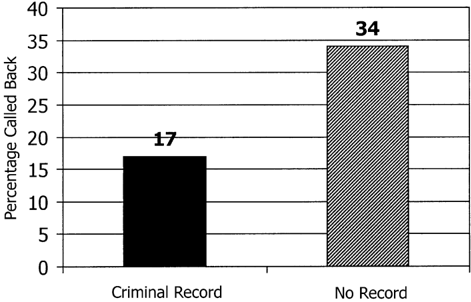
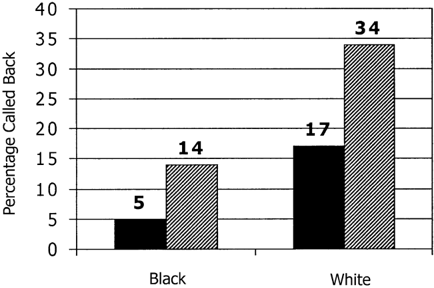
- Among white testers, 34% of noncriminal applicants received callbacks versus 17% of those with criminal records, a 50% reduction; the effect is statistically significant (*P* < .01).
- Among black testers, only 14% of noncriminal applicants received callbacks, compared with 34% of white noncriminal applicants; whites with criminal records (17%) still received more callbacks than blacks without records (14%).
- The criminal-record effect was larger for blacks than whites: the nonoffender-to-ex-offender callback ratio was 2:1 for whites and nearly 3:1 for blacks, making the effect 40% larger for blacks, though the interaction was not statistically significant in the full sample.
- Logistic models show a criminal record coefficient of −.99 (*SE* = .24, *P* < .001), a black coefficient of −1.25 (*SE* = .28, *P* < .001), and a criminal record × black interaction of −.29 (*SE* = .38, not significant).
Methods
- Experimental audit study using four male testers—two black and two white, paired by race—who applied in person for real entry-level jobs in Milwaukee between June and December 2001.
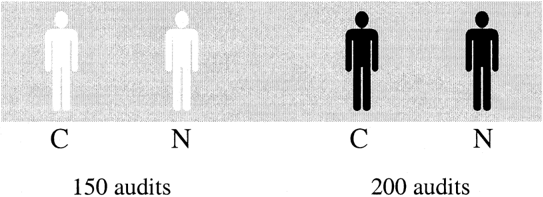
- A total of 350 employers were audited: 150 by the white pair and 200 by the black pair; jobs were drawn from the *Milwaukee Journal Sentinel* Sunday classifieds and *Jobnet*, requiring no previous experience and no education beyond high school.
- Within each race pair, one tester was randomly assigned a criminal record—a felony drug conviction for possession with intent to distribute cocaine and 18 months served in prison—and the pair rotated this condition across weeks; the main outcome was employer callback.
Limitations
- The paper states that findings are specific to Milwaukee, a highly segregated city with high black incarceration rates, and to the moderately strong economic conditions of 2001; results may not generalize to other metropolitan areas or recessionary periods.
- The paper notes sample restrictions excluding health care, public-sector, child/elder-care, security-clearance, and employment-agency jobs, meaning the audit captures only part of the total effect of a criminal record.
- The paper acknowledges that testers were bright, articulate college students with favorable work histories, that some employers did not solicit criminal-history information, and that experimenter effects or tester self-presentation could influence results; it argues several of these features likely make the estimates conservative.
Model-written summary. Check it against the paper before relying on it.
Integrity signals
Registry
Cites
Statistics
Figures

Verification
Claims the paper makes
3 Valid · 7 Not valid · 34 Not checked · 110 Own results and interpretations
The cited sources support only part of this claim — read each source’s verdict below.
In the paper
“Each of these studies reports the similar finding that, all else equal, contact with the criminal justice system leads to worse employment opportunities.”
What the sources say
- Not checked — no full text of the sourcecites Finn and Fontaine 1985 matched to “The Association between Selected Characteristics and Perceived Employability of Offenders” (1985) source
- Partly supportedcites Cohen and Nisbett 1997 matched to “Field Experiments Examining the Culture of Honor: The Role of Institutions in Perpetuating Norms about Violence” (1997) sourceExperimental — accuracy not yet measured
Study 1 (p. 3) is a correspondence-style employment test, and the Discussion (p. 10) recounts an employer saying he could not hire the applicant because of legal issues. But both applicant letters described a criminal conviction, so the study did not compare applicants with and without criminal-justice contact or establish the claimed general effect on employment opportunities. The Results (p. 5) also say the job-availability contrast was not significant. (LLM, conf=0.82)
- Not checked — no full text of the sourcecites Boshier and Johnson 1974 matched to “DOES CONVICTION AFFECT EMPLOYMENT OPPORTUNITIES?” (1974) source
plainstates a cause- Asserted: passes — The authors put it forward as true.
- Checkable: passes — It can be checked against evidence.
- Load-bearing: passes — The paper’s conclusions depend on it.
- Based: passes — The paper gives a reason why it holds.
The cited sources support only part of this claim — read each source’s verdict below.
In the paper
“The Achilles heel of the survey methodology is its inability to escape from the glaring problems of selection that plague research in this field (see Winship and Morgan 1999; Rubin 1990; Heckman et al. 1998).”
What the sources say
- Partly supportedcites Winship and Morgan 1999 matched to “THE ESTIMATION OF CAUSAL EFFECTS FROM OBSERVATIONAL DATA” (1999) sourceExperimental — accuracy not yet measured
The Abstract says surveys are a form of observational data and that usually nonrandom assignment makes causal estimation difficult. The Selection Models section explains how selection can bias standard regression estimates. But the Treatment Assignment Model section discusses methods for addressing selection bias, so the source does not support an absolute inability to overcome it. Page numbers are unavailable in our copy. (LLM, conf=0.83)
- Not checked — no full text of the sourcecites Rubin 1990 matched to “Formal mode of statistical inference for causal effects” (1990) source
- Not checked — no full text of the sourcecites Heckman et al. 1998 matched to “Characterizing Selection Bias Using Experimental Data” (1998) source
boosted- Asserted: passes — The authors put it forward as true.
- Checkable: unclear — It is unclear whether it could be checked against evidence.
- Load-bearing: passes — The paper’s conclusions depend on it.
- Based: passes — The paper gives a reason why it holds.
- Partly supported
The cited sources that could be checked couldn’t confirm or dispute this claim.
In the paper
“It has been well-documented in previous research that the level of employment discrimination corresponds closely with the tightness of the labor market (Freeman and Rodgers 1999).”
What the sources say
- Could not verifycites Freeman and Rodgers 1999 matched to “Area Economic Conditions and the Labor Market Outcomes of Young Men in the 1990s Expansion” (1999) sourceExperimental — accuracy not yet measured
The Unemployment and Earnings and Employment section links tighter labor markets to improved employment for young men, but does not establish a relationship between labor-market tightness and the level of employment discrimination. An endnote in Additional information mentions possible statistical discrimination against people with criminal records, without relating it to market tightness. I searched for discrimination and its connection to tight labor markets; no passage in our copy states the attributed claim. (LLM, conf=0.76)
boostedstates an association- Asserted: passes — The authors put it forward as true.
- Checkable: passes — It can be checked against evidence.
- Load-bearing: passes — The paper’s conclusions depend on it.
- Based: passes — The paper gives a reason why it holds.
- Could not verify
A result the paper reports from its own data — it cites no other source for it, so there is none to check. The quote shows it is in the paper.
In the paper
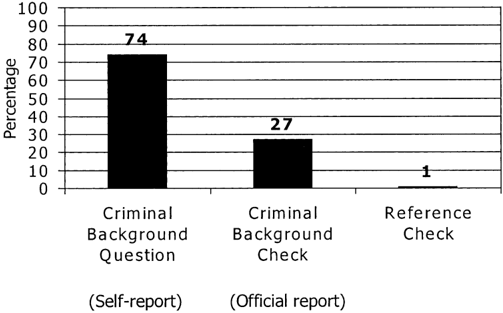
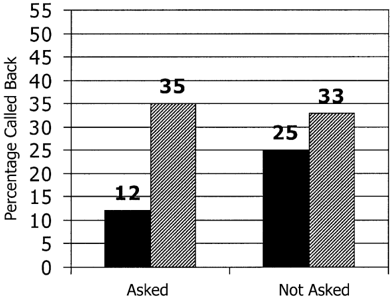
“As is clear from this graph, employers who did not solicit information about criminal histories were much less likely to use the information in their hiring decisions.”
boostedstates an association- Asserted: passes — The authors put it forward as true.
- Checkable: passes — It can be checked against evidence.
- Load-bearing: passes — The paper’s conclusions depend on it.
- Based: passes — The paper gives a reason why it holds.
A result the paper reports from its own data — it cites no other source for it, so there is none to check. The quote shows it is in the paper.
In the paper
“In fact, even whites with criminal records received more favorable treatment (17%) than blacks without criminal records (14%).”
plainstates an association- Asserted: passes — The authors put it forward as true.
- Checkable: passes — It can be checked against evidence.
- Load-bearing: passes — The paper’s conclusions depend on it.
- Based: passes — The paper gives a reason why it holds.
94 more claims
Create a free account to see all 154 claims and to verify the 3 references still open.
- Probably not a substantial claim. 30
- It may state two separate claims as one. 29
- The quote only partly states this claim. 2
Claims other papers make about this one
Each is checked against this paper’s own text: does it say what the citing paper says it does?
The source backs part of the claim, not all of it — or backs it for a different population, condition or comparison.
In the citing paper
“Also of concern, they may translate into an increased risk of substance use and abuse, recidivism, and reincarceration (Iguchi et al., 2002, 2005; Kalt, 2003; Pager, 2003).”
From A call to dismantle systemic racism in criminal legal systems. (2022) · cites this paper as Pager, 2003
Experimental — accuracy not yet measuredThe source backs part of the claim, not all of it — or backs it for a different population, condition or comparison.
In the citing paper
“It is also important to recognize that a criminal record diminishes the ability of people of color to secure employment even more than it does for White people (Pager, 2003).”
From A call to dismantle systemic racism in criminal legal systems. (2022) · cites this paper as Pager, 2003
Experimental — accuracy not yet measuredThe source backs part of the claim, not all of it — or backs it for a different population, condition or comparison.
In the citing paper
“Pager (2003), Pager et al. (2009), and Wells (2013) also find an intensifying interaction of race and criminal background: Callback rates among Black respondents with criminal backgrounds were particularly low.”
From Comparative Perspectives on Racial Discrimination in Hiring: The Rise of Field Experiments (2021) · cites this paper as Pager (2003)
Experimental — accuracy not yet measuredThe cited source says what the claim attributes to it.
In the citing paper
“Pager found that a black applicant with no criminal background experiences job prospects similar to those of a white felon.”
From Discrimination in a Low-Wage Labor Market: A Field Experiment (2009) · cites this paper as Pager 2003
The cited source says what the claim attributes to it.
In the citing paper
“Replicating earlier results from Milwaukee (Pager 2003), these findings suggest that New York employers view minority applicants as essentially equivalent to whites just out of prison.”
From Discrimination in a Low-Wage Labor Market: A Field Experiment (2009) · cites this paper as Pager 2003
1 more claim about this paper
Create a free account to see every claim other papers make about this one.
Self-check
Percentages, sums and reported differences re-computed from the paper’s own numbers.
Each contradiction between two passages listed here was confirmed by an independent check.
Rated minor: it would not touch a result — a value no result rests on, a p-value that stays on the same side of the significance level, or a conflict that is clerical, resolved elsewhere in the paper, or outside its own findings.
In the paper
§ STUDY CONTEXT AND DESCRIPTIVES · p. 15
“unemployment rates ranging from a high of 5.2% in June to a low of 4% in September.”
§ STUDY CONTEXT AND DESCRIPTIVES · p. 16
“Specifically: June (5.4%), July (5.2%), August (4.8%), September (4.4%), October (4.7%), November (4.9%), December (4.5%).”
Citations
Cites
Human Capital: A Theoretical and Empirical Analysis, with Special Reference to Education
Becker, G. S. (1993) · doi:10.7208/chicago/9780226041223.001.0001 · Cited by 4,509
Bertrand, M., & Mullainathan, S. (2004) · American Economic Review · doi:10.1257/0002828042002561 · Cited by 4,504
Crime in the Making: Pathways and Turning Points Through Life
SAMPSON, R. J., & LAUB, J. H. (1993) · Crime & Delinquency · doi:10.1177/0011128793039003010 · Cited by 2,793
Characterizing Selection Bias Using Experimental Data
Heckman, J., Ichimura, H., Smith, J., & Todd, P. (1998) · Econometrica · doi:10.2307/2999630 · Cited by 2,286 · cited 2×
“…heel of the survey methodology is its inability to escape from the glaring problems of selection that plague research in this field (see Winship and Morgan 1999; Rubin 1990; Heckman et al. 1998).5 A second, related limitation of survey research is its inability to formally identify mechanisms.”
The Role of Premarket Factors in Black-White Wage Differences
Neal, D. A., & Johnson, W. R. (1996) · Journal of Political Economy · doi:10.1086/262045 · Cited by 1,340
Deadly Symbiosis: When Ghetto and Prison Meet and Mesh
WACQUANT, L. (2001) · Punishment & Society · doi:10.1177/14624740122228276 · Cited by 1,215
A hypothesis-confirming bias in labeling effects
Darley, J. M., & Gross, P. H. (1983) · Journal of Personality and Social Psychology · doi:10.1037/0022-3514.44.1.20 · Cited by 1,173
Uggen, C. (2000) · American Sociological Review · doi:10.1177/000312240006500403 · Cited by 1,079
THE ESTIMATION OF CAUSAL EFFECTS FROM OBSERVATIONAL DATA
Winship, C., & Morgan, S. L. (1999) · Annual Review of Sociology · doi:10.1146/annurev.soc.25.1.659 · Cited by 890 · cited 1×
“The Achilles heel of the survey methodology is its inability to escape from the glaring problems of selection that plague research in this field (see Winship and Morgan 1999; Rubin 1990; Heckman et al. 1998).5 A second, related limitation of survey research is its inability to formally identify…”
Are Racial Stereotypes Really Fading? The Princeton Trilogy Revisited
Devine, P. G., & Elliot, A. J. (1995) · Personality and Social Psychology Bulletin · doi:10.1177/01461672952111002 · Cited by 859
Research works printed but not linked: 43
- Barclay, Gordon, Cynthia Tavares, and Arsalaan Siddique. 2001. 'International Comparisons of Criminal Justice Statistics, 1999.' U.K. Home Office for Statistical Research. London.
- Bendick, Marc, Jr. 1999. 'Adding Testing to the Nation's Portfolio of Information on Employment Testing.' Pp. 47-68 in A National Report Card on Discimrination in America: The Role of Testing , edited by Michael Fix and Margery Turner. Washington, D.C.: Urban Institute.
- Bureau of Justice Statistics. 1994. Comparing Federal and State Prison Inmates 1991, by Caroline Harlow. Washington, D.C.: NCJ-145864.
- Bureau of Justice Statistics. 1994., 1994, Prisoners
- ---. 2000. Bulletin. Key Facts at a Glance: Number of Persons in Custody of State Correctional Authorities by Most Serious Offense 1980-99. Washington, D.C.: Government Printing Office.
- ---. 2001. Prisoners in 2000, by Allen J. Beck and Paige M. Harrison. August. Bulletin. Washington, D.C.: NCJ 188207.
- ---. 2002 b . Bulletin. Prison and Jail Inmates at Midyear 2001, by Allen J. Beck and Paige M. Harrison. August. Washington, D.C.: NCJ 191702.
- Bushway, Shawn D. 1997. 'Labor Market Effects of Permitting Employer Access to Criminal History Records.' Working paper. University of Maryland, Department of Criminology.
- COWS (Center on Wisconsin Strategy). 1996. 'Milwaukee Area Regional Economic Analysis.' Unpublished report. University of Wisconsin-Madison.
- Cross, Harry, Genevieve Kenney, Jane Mell, and Wendy Zimmerman. 1989. Differential Treatment of Hispanic and Anglo Job Seekers: Hiring Practices in Two Cities. Washington, D.C.: Urban Institute Press.
- Cross Harry, Employer Hiring Practices: Differential Treatment of Hispanic and Anglo Job Seekers
- Culp, Jerome, and Bruce Dunson. 1986. 'Brothers of a Different Color: A Preliminary Look at Employer Treatment of White and Black Youth.' Pp. 233-60 in The Black Youth Employment Crisis , edited by Freeman, Richard B., and Harry J. Holzer. Chicago: University of Chicago Press for National Bureau of Economic Research.
- D'Souza, Dinesh. 1995. The End of Racism: Principles for a Multiracial Society. New York: Free Press.
- Fiske, Susan, and Steven Neuberg. 1990. 'A Continuum of Impression Formation, from Category-Based to Individuating Processes.' Pp. 1-63 in Advances in Experimental Social Psychology , vol. 23. Edited by Mark Zanna. New York: Academic Press.
- Fix, Michael, and Raymond J. Struyk, eds. 1993. Clear and Convincing Evidence: Measurement of Discrimination in America . Washington, D.C.: Urban Institute Press.
- ---. 1991. 'Crime and the Employment Problems of Disadvantaged Youths.' NBER Working Paper no. 3875. Cambridge, Mass.: National Bureau of Economic Research.
- ---. 1994. 'Crime and the Job Market.' NBER Working Paper no. 4910. Cambridge, Mass.: National Bureau of Economic Research.
- Gainsborough, Jenni, and Marc Mauer. 2000. Diminishing Returns: Crime and Incarceration in the 1990s. Washington, D.C.: The Sentencing Project.
- Heckman, James, and Peter Seligman. 1993. 'The Urban Institute Audit Studies: Their Methods and Findings.' Pp. 187-258 in Clear and Convincing Evidence: Measurement of Discrimination in America , edited by Michael Fix and Raymond J. Struyk. Washington, D.C.: Urban Institute Press.
- Henson, Kevin D. 1996. Just a Temp . Philadelphia: Temple University Press.
- ---. 1996. What Employers Want: Job Prospects for Less-Educated Workers. New York: Russell Sage Foundation.
- Holzer, Harry, Steven Raphael, and Michael Stoll. 2001. 'Perceived Criminality, Criminal Background Checks and the Racial Hiring Practices of Employers.' Discussion Paper no. 1254-02. University of Wisconsin-Madison, Institute for Research on Poverty.
- Holzer Harry, Association of Public Policy and Management Conference, Dallas.
- Holzer, Harry, and Michael Stoll. 2001. Employers and Welfare Recipients: The Effects of Welfare Reform in the Workplace . San Francisco: Public Policy Institute of California.
- Kling, Jeffrey. 1999. 'The Effect of Prison Sentence Length on the Subsequent Employment and Earnings of Criminal Defendants.' Discussion Paper no. 208. Princeton University, Woodrow Wilson School.
- Kluegel, James, and Lawrence Bobo. 2001. 'Perceived Group Discrimination and Policy Attitudes: The Sources and Consequences of the Race and Gender Gaps.' Pp. 163-216 in Urban Inequality: Evidence from Four Cities , edited by Alice O'Connor, Chris Tilly, and Lawrence D. Bobo. New York: Russell Sage Foundation.
- Loury, Glenn C. 1977. 'A Dynamic Theory of Racial Income Differences.' Pp. 153-86 in Women, Minorities, and Employment Discrimination , edited by P. A. Wallace and A. M. La Mond. Lexington, Mass.: Heath.
- Mauer, Marc. 1999. Race to Incarcerate . New York: New Press.
- Nelson, Marta, Perry Deess, and Charlotte Allen. 1999. The First Month Out: PostIncarceration Experiences in New York City. New York: Vera Institute of Justice.
- Pager, Devah. 2001. 'Criminal Careers: The Consequences of Incarceration for Occupational Attainment.' Paper presented at the annual meetings of the American Sociological Association, Anaheim, August.
- ---. 2002. 'The Mark of a Criminal Record.' Doctoral dissertation. Department of Sociology, University of Wisconsin-Madison.
- Parenti, Christian. 1999. Lockdown America: Police and Prisons in the Age of Crisis. New York: Verso.
- Pawasarat, John, and Lois M. Quinn. 2000. 'Survey of Job Openings in the Milwaukee Metropolitan Area: Week of May 15, 2000.' University of Wisconsin-Milwaukee, Employment and Training Institute, University Outreach.
- Pettit, Becky, and Bruce Western. 2001. 'Inequality in Lifetime Risks of Imprisonment.' Paper presented at the annual meetings of the American Sociological Association. Anaheim, August.
- Shover, Neil. 1996. Great Pretenders: Pursuits and Careers of Presistent Thieves. Boulder, Colo.: Westview.
- Smith, Tom W. 1991. What Americans Say about Jews . New York: American Jewish Committee.
- Steele, Shelby. 1991. The Content of Our Character: A New Vision of Race in America. New York: Harper Perennial.
- Turner, Margery, Michael Fix, and Raymond Struyk. 1991. Opportunities Denied, Opportunities Diminished: Racial Discrimination in Hiring. Washington, D.C.: Urban Institute Press.
- Uggen, Christopher, Melissa Thompson, and Jeff Manza. 2000. 'Crime, Class, and Reintegration: The Socioeconomic, Familial, and Civic Lives of Offenders.' Paper presented at the American Society of Criminology meetings, San Francisco, November 18.
- Western, Bruce, and Becky Pettit. 1999. 'Black-White Earnings Inquality, Employment Rates, and Incarceration.' Working Paper no. 150. New York: Russell Sage Foundation.
- Wienk, Ronald E., Clifford E. Reid, John C. Simonson, and Frederick J. Eggers. 1979. Measuring Discrimination in American Housing Markets: The Housing Market Practices Survey. Washington, D.C.: U.S. Department of Housing and Urban Development.
- Wilson, William Julius. 1987. The Truly Disadvantaged: The Inner City, the Underclass, and Public Policy. Chicago: University of Chicago Press.
- ---. 1997. When Work Disappears: The World of the New Urban Poor. New York: Vintage Books.
Cited by
Items 1,201–1,300 of 2,847
Grosholz, J. M., Thomas, D. M., Stone, S. S., Fogel, S. J., & Porcelli, T. N. (2024) · Journal of Offender Rehabilitation · doi:10.1080/10509674.2024.2370291 · Cited by 17
Narrative Construction of a Ruptured Self: Stories of Transability on Transabled.org
Davis, J. L. (2012) · Sociological Perspectives · doi:10.1525/sop.2012.55.2.319 · Cited by 24
Goulette, N. W., Reitler, A. K., Frank, J., Flesher, W., & Travis, L. F. (2014) · Criminal Justice Review · doi:10.1177/0734016814526752 · Cited by 18
Paternal Incarceration and Early Sexual Onset Among Adolescents
Turney, K., & Goldberg, R. (2018) · Population Research and Policy Review · doi:10.1007/s11113-018-9502-4 · Cited by 17
Yemane, R. (2020) · Research in Social Stratification and Mobility · doi:10.1016/j.rssm.2020.100552 · Cited by 18
Hunter, B. A., & Jason, L. A. (2021) · Journal of Prevention & Intervention in the Community · doi:10.1080/10852352.2021.1940756 · Cited by 16
Kakupa, P., & Mulenga, K. M. (2021) · International Journal of Educational Research Open · doi:10.1016/j.ijedro.2021.100090 · Cited by 30
Beyond the Penal Code: The Legal Capacity of Monetary Sanctions in the Corpus of California Law
Verma, A., & Sykes, B. L. (2022) · RSF The Russell Sage Foundation Journal of the Social Sciences · doi:10.7758/rsf.2022.8.1.02 · Cited by 14
Race, work history, and the employment recidivism relationship
Kolbeck, S. G., Bellair, P. E., & Lopez, S. H. (2022) · Criminology · doi:10.1111/1745-9125.12317 · Cited by 21
Hwang, K. J. (2022) · The Annals of the American Academy of Political and Social Science · doi:10.1177/00027162221115378 · Cited by 20
Parental incarceration and parent–youth closeness
Turney, K. (2023) · Journal of Marriage and the Family · doi:10.1111/jomf.12919 · Cited by 20
An Evaluation of Sex Offender Residency Restrictions in Michigan and Missouri
Huebner, B. M., Bynum, T. S., Rydberg, J., Kras, K. R., Grommon, E., & Pleggenkuhle, B. (2013) · IUScholarWorks (Indiana University) · Cited by 14
Racial Differences in Public Confidence in Education: 1974–2002*
Klugman, J., & Xu, J. (2008) · Social Science Quarterly · doi:10.1111/j.1540-6237.2008.00526.x · Cited by 13
Burton, V. S., Fisher, C. M., Jonson, C. L., & Cullen, F. T. (2014) · Journal of Forensic Social Work · doi:10.1080/1936928x.2014.940565 · Cited by 18
Rose, C. S., & Bielby, W. T. (2010) · Social Science Research · doi:10.1016/j.ssresearch.2010.10.007 · Cited by 19
Sykes, B. L., Gioviano, J. P., & Piquero, A. R. (2014) · Race and Justice · doi:10.1177/2153368714542656 · Cited by 19
Shanahan, M., Gerard, K., & Ritter, A. J. (2014) · International Journal of Drug Policy · doi:10.1016/j.drugpo.2014.03.005 · Cited by 16
Post-Release Success among Paroled Lifers
Liem, M. C. A., & Garcin, J. (2014) · Laws · doi:10.3390/laws3040798 · Cited by 18
Haskins, R. (2008) · The Annals of the American Academy of Political and Social Science · doi:10.1177/0002716208324793 · Cited by 14
A critical strong program: Cultural power and racialized civil exclusion
Ostertag, S. F., & Dìaz, L. (2016) · American Journal of Cultural Sociology · doi:10.1057/s41290-016-0005-7 · Cited by 16
Intersectionopoly: A Simulation of the Wage Gap
Paino, M., May, M., Burrington, L. A., & Becker, J. H. (2016) · Teaching Sociology · doi:10.1177/0092055x16673417 · Cited by 25
Kopak, A. M., & Frost, G. A. (2017) · American Journal of Criminal Justice · doi:10.1007/s12103-017-9390-x · Cited by 21
Leveraging the Integrated Development Environment for Learning Analytics
Carter, A. S., Hundhausen, C. D., & Olivares, D. M. (2019) · Cambridge University Press eBooks · doi:10.1017/9781108654555.024 · Cited by 20
Hoggard, L. S., Powell, W., Upton, R. D., Seaton, E. K., & Neblett, E. W. (2019) · Cultural diversity & ethnic minority psychology · doi:10.1037/cdp0000264 · Cited by 15
Ryan, N. R., Ackerman, J., Ready, J. T., et al. (2020) · The British Journal of Criminology · doi:10.1093/bjc/azaa009 · Cited by 13
Mantha, S., Nolan, M. L., Harocopos, A., & Paone, D. (2021) · Drug and Alcohol Dependence · doi:10.1016/j.drugalcdep.2021.108867 · Cited by 13
Employment Restrictions for Individuals with Felon Status and Racial Inequality in the Labor Market
Wheelock, D., Uggen, C., & Hlavka, H. R. (2011) · e-Publications@Marquette (Marquette University) · Cited by 21
The Effect of Incarceration on Urban Fathers’ Health
Curtis, M. A. (2010) · American Journal of Men s Health · doi:10.1177/1557988310385104 · Cited by 13
Conviction, Incarceration, and Policy Effects in the Criminal Justice SystemPreprint
Kamat, V., Norris, S., & Pecenco, M. (2024) · SSRN Electronic Journal · doi:10.2139/ssrn.4777635 · Cited by 19
Vuolo, M., Uggen, C., & Lageson, S. (2017) · Emerging Conceptions of Work, Management and the Labor Market · doi:10.1108/s0277-283320170000030007 · Cited by 12
Punishing the Non-convicted Through Disclosure of Police Records
Maurutto, P., Hannah-Moffat, K., & Quirouette, M. (2023) · The British Journal of Criminology · doi:10.1093/bjc/azac092 · Cited by 12
Rovira, M. (2023) · The British Journal of Criminology · doi:10.1093/bjc/azad063 · Cited by 20
Smith, S., Mays, G. P., Collins, T. C., & Ramaswamy, M. (2019) · Health & Justice · doi:10.1186/s40352-019-0092-y · Cited by 20
Bustamante, P., Jashnani, G., & Stoudt, B. G. (2019) · Analyses of Social Issues and Public Policy · doi:10.1111/asap.12187 · Cited by 16
Sanctions, short‐term mindsets, and delinquency: Reverse causality in a sample of high school youth
van Gelder, J., Averdijk, M., Ribeaud, D., & Eisner, M. (2020) · Legal and Criminological Psychology · doi:10.1111/lcrp.12170 · Cited by 12
Accidental environmentalist or ethical elite? The moral dimensions of environmental impact
Kennedy, E. H., & Horne, C. (2020) · Poetics · doi:10.1016/j.poetic.2020.101448 · Cited by 22
Evans, D. N., Blount‐Hill, K., & Hoyos-Torres, S. (2020) · Critical Criminology · doi:10.1007/s10612-020-09534-0 · Cited by 16
Weir, K., & Wu, S. (2013) · Journal of Sports Economics · doi:10.1177/1527002513487739 · Cited by 12
Graber, J., & Zitek, E. M. (2021) · Psychology Crime and Law · doi:10.1080/1068316x.2021.1909018 · Cited by 15
Father Involvement in the First Year After Prison: Considerations for Social Work
Charles, P., Frankham, E., Garthe, R. C., Visher, C. A., & Kay, A. L. (2021) · Research on Social Work Practice · doi:10.1177/10497315211022806 · Cited by 15
The status and stigma consequences of mental illness labels, deviant behavior, and fear
Manago, B. N., & Mize, T. D. (2021) · Social Science Research · doi:10.1016/j.ssresearch.2021.102690 · Cited by 13
Dual Debtors: Child Support and Criminal Legal Financial Obligations
Horowitz, V. L., Spencer-Suarez, K. N., Larson, R., Stewart, R., Edwards, F., Obara, E. E., & Uggen, C. (2022) · Social Service Review · doi:10.1086/720016 · Cited by 16
Neighbourhood Gangs, Crime Spillovers and Teenage Motherhood
Dustmann, C., Mertz, M., & Okatenko, A. (2023) · The Economic Journal · doi:10.1093/ej/uead009 · Cited by 18
Trivedi, C., & Ray, S. M. (2024) · New Horizons in Adult Education and Human Resource Development · doi:10.1177/19394225231223388 · Cited by 20
Educational Attainment, Population Increase and the Progress of African Americans
Kaba, A. J. (2010) · The Journal of Pan-African Studies · Cited by 12
Effect of Framing of Reentry Program on Perceptions of Ex-Offenders
Snider, J. S., & Reysen, S. (2014) · World Journal of Social Science Research · doi:10.22158/wjssr.v1n1p68 · Cited by 15
The Cost of Incarceration in Texas: Estimating the Benefits of Reducing the Prison Population
Orrick, E. A., & Vieraitis, L. M. (2014) · American Journal of Criminal Justice · doi:10.1007/s12103-014-9265-3 · Cited by 21
Re-membering Black Greeks: Racial Memory and Identity in Stomp the Yard
Hughey, M. W. (2010) · Critical Sociology · doi:10.1177/0896920510378771 · Cited by 17
Burawoy, M. (2007) · Sociologia · doi:10.2383/24188 · Cited by 18
Wagmiller, R. L., & Lee, K. S. (2014) · Social Problems · doi:10.1525/sp.2014.12133 · Cited by 16
Locked Up and Locked Out? the Impact of Imprisonment on Labour Market Attachment
Bäckman, O., Estrada, F., & Nilsson, A. (2017) · The British Journal of Criminology · doi:10.1093/bjc/azx071 · Cited by 16
Opportunities and Challenges in Designing and Conducting a Labor Market Resume Study
Carbonaro, W. J., & Schwarz, J. D. (2018) · Springer eBooks · doi:10.1007/978-3-319-71153-9_7 · Cited by 14
Binnall, J. M. (2018) · Psychology Crime and Law · doi:10.1080/1068316x.2018.1528359 · Cited by 18
Recruitment: an undertheorized mechanism for workplace control
Halpin, B. W., & Smith, V. (2019) · Theory and Society · doi:10.1007/s11186-019-09362-4 · Cited by 22
The Effect of Incarceration on Midlife Health: A Life-Course Approach
Kim, Y. (2015) · Population Research and Policy Review · doi:10.1007/s11113-015-9365-x · Cited by 14
Sowing the seeds: how adult incarceration promotes juvenile delinquency
Hannon, L., & DeFina, R. H. (2012) · Crime Law and Social Change · doi:10.1007/s10611-012-9374-1 · Cited by 16
Race and Unemployment Amidst the New Diversity: More Evidence of a Black/Non-Black Divide
Emeka, A. (2009) · Race and Social Problems · doi:10.1007/s12552-009-9012-4 · Cited by 16
Morality Work among the Transabled
Davis, J. L. (2014) · Deviant Behavior · doi:10.1080/01639625.2014.855103 · Cited by 15
Ramaswamy, M., & Freudenberg, N. (2012) · Journal of Poverty · doi:10.1080/10875549.2011.639862 · Cited by 16
Hunter, B. H., & Daly, A. (2012) · Journal of Population Research · doi:10.1007/s12546-012-9100-y · Cited by 15
Varghese, F. P., Hardin, E. E., & Bauer, R. L. (2009) · Race and Social Problems · doi:10.1007/s12552-009-9014-2 · Cited by 17
Household incarceration in early adolescence and risk of premarital first birth
Gottlieb, A. (2015) · Children and Youth Services Review · doi:10.1016/j.childyouth.2015.12.020 · Cited by 14
Glidden, M. D., & Brown, T. C. (2017) · American Journal of Criminal Justice · doi:10.1007/s12103-016-9377-z · Cited by 12
Teacher Knowledge for Inclusive Computing Learning
Goode, J., & Ryoo, J. J. (2019) · Cambridge University Press eBooks · doi:10.1017/9781108654555.025 · Cited by 15
Williams, D. T., Simon, L. E., & Cardwell, M. M. (2019) · Journal of African American Studies · doi:10.1007/s12111-019-09420-2 · Cited by 12
Is Crime Bad for Your Health? The Link Between Delinquent Offending and Cardiometabolic Risk
Schwartz, J. A., Savolainen, J., Granger, D. A., & Calvi, J. L. (2020) · Crime & Delinquency · doi:10.1177/0011128720903048 · Cited by 16
Re-entry and Reintegration After Incarceration
Visher, C. A. (2015) · Elsevier eBooks · doi:10.1016/b978-0-08-097086-8.45096-8 · Cited by 18
Gaddis, S. M., & Ghoshal, R. (2019) · SSRN Electronic Journal · doi:10.2139/ssrn.3022208 · Cited by 13
Jang, H., & Kim, J. (2025) · Social Science & Medicine · doi:10.1016/j.socscimed.2025.118514 · Cited by 16
More Talent, More Leeway: Do Violence Against Women Arrests Really Hurt NFL Player Careers?
Sailofsky, D. (2022) · Violence Against Women · doi:10.1177/10778012221092477 · Cited by 13
Fekjær, S. B., Øverbye, E., & Terum, L. I. (2023) · Acta Sociologica · doi:10.1177/00016993231156486 · Cited by 14
Revisiting the economic theory of crime A state-level analysis in India
Raj, P., & Rahman, M. M. (2023) · Cogent Social Sciences · doi:10.1080/23311886.2023.2170021 · Cited by 16
McChesney, J. E., & Thompson, L. F. (2023) · Journal of Business and Psychology · doi:10.1007/s10869-023-09907-6 · Cited by 15
Criminal background checks and recidivism: Bounding the causal impact
Siwach, G. (2017) · International Review of Law and Economics · doi:10.1016/j.irle.2017.08.002 · Cited by 14
A Jury of One's “Peers”: The Racial Impact of Felon Jury Exclusion in Georgia
Wheelock, D. (2013) · Justice System Journal · doi:10.1080/0098261x.2011.10767996 · Cited by 12
“Who’s Gonna Take My Baby?”: Narratives of Creating Placement Plans Among Formerly Pregnant Inmates
Carey, R. R. (2019) · Women & Criminal Justice · doi:10.1080/08974454.2019.1593919 · Cited by 12
Employment opportunities for ex-offenders
van den Berg, C. J. W., Blommaert, L., Bijleveld, C. C. J. H., & Ruiter, S. (2020) · Research in Social Stratification and Mobility · doi:10.1016/j.rssm.2020.100476 · Cited by 11
The Link Between Prior Criminal Record and Violent Political Extremism in the United States
Jensen, M. A., Safer-Lichtenstein, A., James, P. A., & Lafree, G. D. (2020) · Springer eBooks · doi:10.1007/978-3-030-36639-1_6 · Cited by 16
The Impact of a Reentry and Aftercare Program on Recidivism
Cannonier, C., Burke, M. G., & Mitchell, E. (2020) · The Review of Black Political Economy · doi:10.1177/0034644620973931 · Cited by 21
Undoing resilience: immigrant status and poor health following incarceration
Kuper, J. L., & Turanovic, J. J. (2021) · Health & Justice · doi:10.1186/s40352-021-00129-7 · Cited by 11
Quinn-Hogan, A. N. (2021) · Scholarship@Western (Western University) · Cited by 11
Perceived discrimination in the workplace and mental health from early adulthood to midlife
Han, X., Mortimer, J. T., & VanHeuvelen, T. (2022) · Longitudinal and Life Course Studies · doi:10.1332/175795921x16615892091105 · Cited by 15
No Escape: Mass Incarceration and the Social Ecology of Intimate Partner Violence Against Women
McKay, T. E. (2023) · Violence Against Women · doi:10.1177/10778012231158110 · Cited by 14
Criminal Recidivism: A Conceptual Analysis of Social Exclusion
Musa, A. A., & Ahmad, M. D. A. H. B. (2015) · Journal of Culture, Society and Development · Cited by 12
Shanahan, M., & Ritter, A. J. (2013) · Journal of Experimental Criminology · doi:10.1007/s11292-013-9176-1 · Cited by 11
Stigma, Ex-convicts and Labour Markets
Alvarez, R. D., & Loureiro, M. L. (2012) · German Economic Review · doi:10.1111/j.1468-0475.2012.00580.x · Cited by 22
Characteristics of Transgender Residents of Massachusetts Cities With High HIV Prevalence
Hughto, J. M. W., Reisner, S. L., & Mimiaga, M. J. (2015) · American Journal of Public Health · doi:10.2105/ajph.2015.302877 · Cited by 12
Situating the Experience of Maternal Incarceration: Childhood and Young Adult Context
Zhang, X., & Emory, A. D. (2015) · Emerald Group Publishing Limited eBooks · doi:10.1108/s1530-353520150000009011 · Cited by 12
Welsh, M. (2015) · The Journal of Sociology & Social Welfare · doi:10.15453/0191-5096.3904 · Cited by 14
Criminal Record Questions, Statistical Discrimination, and Equity in a “Ban the Box” Era
Sugie, N. F. (2017) · Criminology & Public Policy · doi:10.1111/1745-9133.12265 · Cited by 15
Complex Sentences: Searching for the Purpose of Education Inside a Massachusetts State Prison
Smith, C. E. (2017) · Harvard Educational Review · doi:10.17763/1943-5045-87.1.81 · Cited by 11
Emerging Conceptions of Work, Management and the Labor Market
Vallas, S. (2017) · Emerald Group Publishing Limited eBooks · doi:10.1108/s0277-2833201730 · Cited by 12
Gueta, K., & Chen, G. (2017) · Feminist Criminology · doi:10.1177/1557085117724510 · Cited by 11
THE RACE AGAINST TIME: Lived time, Time Loss, and Black Health Opportunity
Kwate, N. O. A. (2017) · Du Bois Review Social Science Research on Race · doi:10.1017/s1742058x17000145 · Cited by 18
Goldman, B. M., Cooper, D. A., & Kugler, T. (2018) · International Journal of Conflict Management · doi:10.1108/ijcma-04-2018-0055 · Cited by 16
Digital Vulnerability: The Unequal Risk of E-Contact with the Criminal Justice System
Vargas, Preito-Hodge, K., & Christofferson (2019) · RSF The Russell Sage Foundation Journal of the Social Sciences · doi:10.7758/rsf.2019.5.1.04 · Cited by 16
“CHANGE” FRAMES AND THE MOBILIZATION OF SOCIAL CAPITAL FOR FORMERLY INCARCERATED JOB SEEKERS
Smith, S. S. (2018) · Du Bois Review Social Science Research on Race · doi:10.1017/s1742058x18000280 · Cited by 14
On the Job or in the Joint: Criminal Justice Contact and Employment Outcomes
Fernandes, A. D. (2020) · Crime & Delinquency · doi:10.1177/0011128719901112 · Cited by 15
Leiber, M. J., Fox, B., Escue, M., Krupa, J. M., & Cochran, J. K. (2020) · Justice Quarterly · doi:10.1080/07418825.2020.1781232 · Cited by 12
Early-Career Discrimination: Spiralling or Self-Correcting?
Bardhi, A., Guo, Y., & Strulovici, B. H. (2026) · The Review of Economic Studies · doi:10.1093/restud/rdag092 · Cited by 12
Metadata
- Authors
- Pager, D.
- Affiliations
- Northwestern University (US)
- Corresponding author
- Pager, Devah
- Venue
- American Journal of Sociology
- Publisher
- University of Chicago Press
- Published
- 2003-03
- Volume
- 108
- Issue
- 5
- Pages
- 937-975
- ISSN
- 0002-9602 (ISSN-L)
- 1537-5390
- OpenAlex
- W1585385491
- Semantic Scholar
- 54dcd72960c16809bd614002c7dc85622cb3bfe6
- Cited by
- 2,840
- References
- 37
- Citations by year
- 2026: 126 · 2025: 185 · 2024: 119 · 2023: 173 · 2022: 154 · 2021: 180 · 2020: 165 · 2019: 263 · 2018: 159 · 2017: 152 · 2016: 154 · 2015: 149 · 2014: 147 · 2013: 114 · 2012: 106
- FWCI
- 122.54
- Type
- journal article
- Language
- en
- Open access
- closed
- Locations
- American Journal of Sociology (publishedVersion)
- Routledge eBooks (publishedVersion)
- RePEc: Research Papers in Economics (submittedVersion)
- Natural Field Experiments (submittedVersion)
- Topics
- Social Sciences › Sociology and Political Science › Criminal Justice and Corrections Analysis
- Social Sciences › Sociology and Political Science › Names, Identity, and Discrimination Research
- Social Sciences › Economics, Econometrics and Finance › Economics and Econometrics › Labor market dynamics and wage inequality
- Keywords
- criminal records, employment discrimination, incarceration, racial disparities, labor market stratification, audit experiment, post-release employment
About these checks
Registry, retraction, Cites and statistics results are computed, not judged, with one exception: a printed reference that no index lists is read once by a model before it counts as a citation error. Claims are extracted by a model and kept only when their quote appears verbatim in the text; each cited source is then checked, with a model’s help, for whether it says what the claim relies on. Those verdicts can be wrong — read the claim’s quote and the cited source before relying on one.
The claim verdicts this report counts are experimental: their accuracy is not yet measured.
A language model drew the claims from the paper on 2026-10-27, under version 3 of the claim definition (model deepseek-v4.1-flash, prompt extract-v3).
A second model labelled each claim on 2026-10-27 (model jev-1.13-20260917, definition revision gold-guideline-v0.2).
Cited sources are checked with a language model’s help (gpt-6-sol).
Statistics and arithmetic are recomputed, not judged.
Confidence bands are shown only for fields calibrated on our annotated test set. None is calibrated yet, so no band is shown.
What counts as a claim ›How we measure confidence ›How we check this ›
Are you an author, or do you see a problem with this page? Request a review
Data sources
Bibliographic data: Semantic Scholar, OpenAlex, Crossref.
Contains information from the Semantic Scholar Academic Graph Datasets, made available under the ODC Attribution License (ODC-BY 1.0).
Semantic Scholar’s data is described in: Kinney, R., et al. (2023). The Semantic Scholar Open Data Platform. arXiv:2301.10140.
