

High-density peripheral nerve cuffs restore natural sensation to individuals with lower-limb amputations
Open accessThe DOI matches its Crossref record; 56 of the 56 references it cites were found in a registry or an index.
Abstract
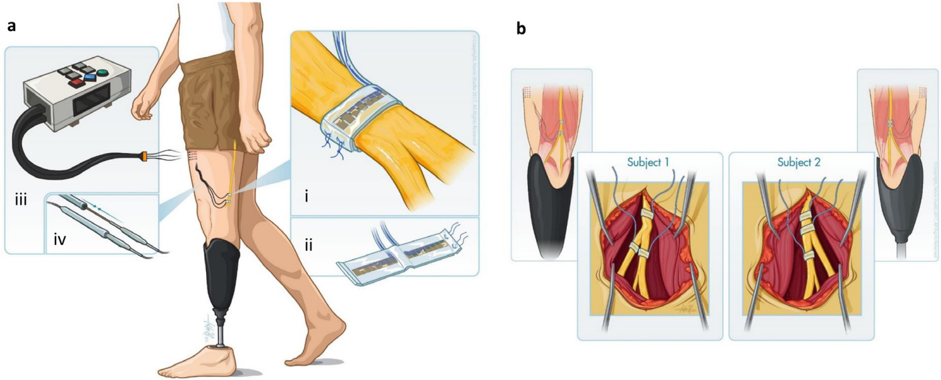
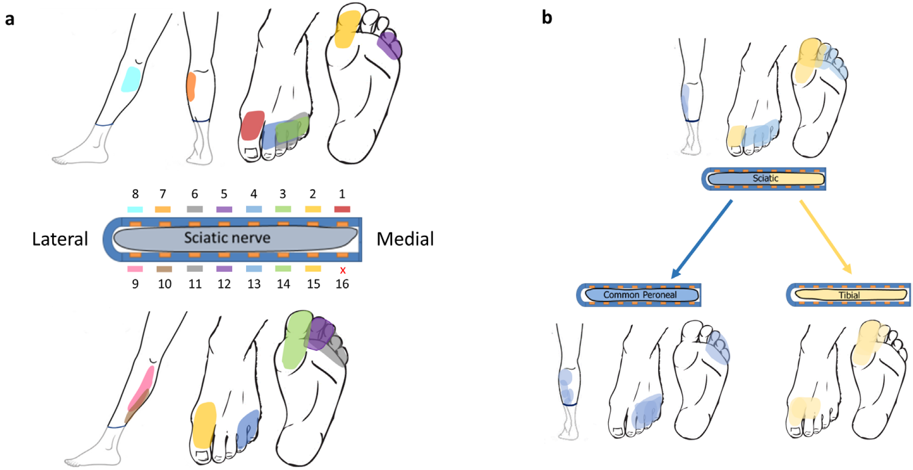
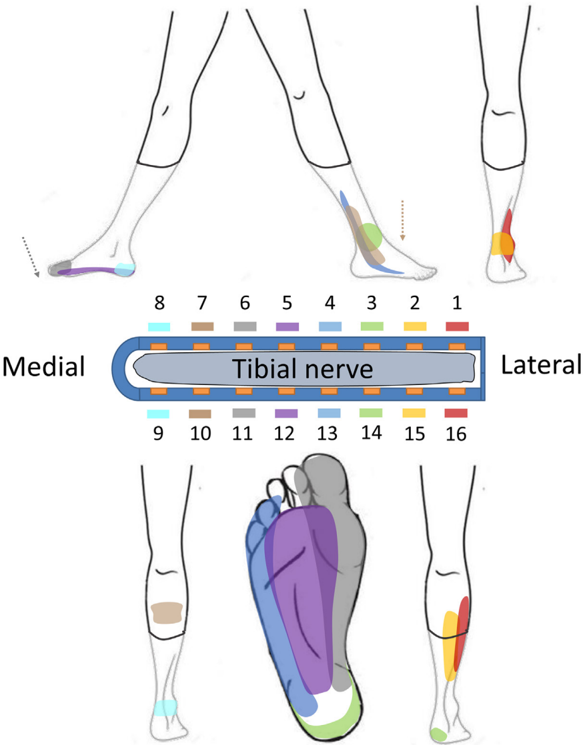
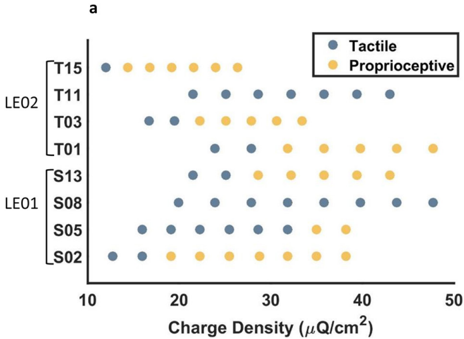
Objective . Sensory input in lower-limb amputees is critically important to maintaining balance, preventing falls, negotiating uneven terrain, responding to unexpected perturbations, and developing the confidence required for societal participation and public interactions in unfamiliar environments. Despite noteworthy advances in robotic prostheses for lower-limb amputees, such as microprocessor knees and powered ankles, natural somatosensory feedback from the lost limb has not yet been incorporated in current prosthetic technologies. Approach . In this work, we report eliciting somatic sensation with neural stimulation delivered by chronically-implanted, non-penetrating nerve cuff electrodes in two transtibial amputees. High-density, flexible, 16-contact nerve cuff electrodes were surgically implanted for the selective activation of sensory fascicles in the nerves of the posterior thigh above the knee. Electrical pulses at safe levels were delivered to the nerves by an external stimulator via percutaneous leads attached to the cuff electrodes. Main results . The neural stimulation was perceived by participants as sensation originating from the missing limb. We quantitatively and qualitatively ascertained the intensity, modality as well as the location and stability of the perceived sensations. Stimulation through individual contacts within the nerve cuffs evoked repeatable sensations of various modalities and at discrete locations projected to the missing toes, foot and ankle, as well as in the residual limb. In addition, we observed a high overlap in reported locations between distal versus proximal cuffs suggesting that the same sensory responses could be elicited from more proximal points on the nerve. Significance . Based on these findings, the high-density cuff technology is suitable for restoring natural sensation to lower-limb amputees and could be utilized in developing a neuroprosthesis with natural sensory feedback. The overlap in reported locations between proximal and distal cuffs indicates that our approach might be applicable to transfemoral amputees where distal muscles and branches of sciatic nerve are not available.
Overview
The claims and statistics of this paper haven’t been checked yet.
Free: it reads the open-access text and checks the first 5 claims that cite a source we can check. Create a free account to check every claim.
Integrity signals
Registry
Cites
Statistics
Figures
Verification
Claims the paper makes
The claims and statistics of this paper haven’t been checked yet.
Free: it reads the open-access text and checks the first 5 claims that cite a source we can check. Create a free account to check every claim.
Claims other papers make about this one
Each is checked against this paper’s own text: does it say what the citing paper says it does?
The cited source says what the claim attributes to it.
In the citing paper
“The C-FINE was found successful in restoring sensation in individuals with a lower limb amputation [75].”
From Interfaces with the peripheral nervous system for the control of a neuroprosthetic limb: a review (2020) · cites this paper as [75]
The cited source says what the claim attributes to it.
In the citing paper
“Additionally, the effects of stimulation can be difficult to predict; both the location and quality of sensations evoked by stimulation of implanted electrode arrays can change significantly [14,15].”
From Fascicle specific targeting for selective peripheral nerve stimulation (2019) · cites this paper as [14]
Self-check
Percentages, sums and reported differences re-computed from the paper’s own numbers.
The self-check needs the paper’s full text.
Citations
Cites
Electrical stimulation of excitable tissue: design of efficacious and safe protocols
Merrill, D. R., Bikson, M., & Jefferys, J. G. R. (2005) · Journal of Neuroscience Methods · doi:10.1016/j.jneumeth.2004.10.020 · Cited by 2,078 · cited 1×
“7 is considered safe for pulse trains with inter-pulse frequency of 50 Hz and up to 7 h continuous stimulation [33, 34].”
BackgroundRestoring natural sensory feedback in real-time bidirectional hand prostheses
Raspopovic, S., Capogrosso, M., Petrini, F. M., Bonizzato, M., Rigosa, J., Di Pino, G., Carpaneto, J., Controzzi, M., Boretius, T., Fernandez, E., et al. (2014) · Science Translational Medicine · doi:10.1126/scitranslmed.3006820 · Cited by 1,001
A neural interface provides long-term stable natural touch perception
Tan, D. W., Schiefer, M. A., Keith, M. W., Anderson, J. R., Tyler, J., & Tyler, D. J. (2014) · Science Translational Medicine · doi:10.1126/scitranslmed.3008669 · Cited by 751
Self-citationCharge density and charge per phase as cofactors in neural injury induced by electrical stimulation
McCreery, D. B., Agnew, W. F., Yuen, T. G. H., & Bullara, L. (1990) · IEEE Transactions on Biomedical Engineering · doi:10.1109/10.102812 · Cited by 708 · cited 1×
“7 is considered safe for pulse trains with inter-pulse frequency of 50 Hz and up to 7 h continuous stimulation [33, 34].”
BackgroundIntracortical microstimulation of human somatosensory cortex
Flesher, S. N., Collinger, J. L., Foldes, S. T., Weiss, J. M., Downey, J. E., Tyler-Kabara, E. C., Bensmaia, S. J., Schwartz, A. B., Boninger, M. L., & Gaunt, R. A. (2016) · Science Translational Medicine · doi:10.1126/scitranslmed.aaf8083 · Cited by 704 · cited 1×
“Our results from intensity discrimination experiments corroborate previously reported observations in sensory restoration in the upper limb [35, 52].”
ResultThe prevalence and risk factors of falling and fear of falling among lower extremity amputees
Miller, W. C., Speechley, M., & Deathe, B. (2001) · Archives of Physical Medicine and Rehabilitation · doi:10.1053/apmr.2001.24295 · Cited by 642 · cited 1×
“from sensory restoration as their fall risk [40, 41], reliance on”
BackgroundA model of safe levels for electrical stimulation
Shannon, R. V. (1992) · IEEE Transactions on Biomedical Engineering · doi:10.1109/10.126616 · Cited by 526 · cited 1×
“where QD is the charge density per phase (μC cm−2) and Q is charge per phase (μC) [32].”
BackgroundPowered Ankle--Foot Prosthesis Improves Walking Metabolic Economy
Au, S. K., Weber, J., & Herr, H. (2009) · IEEE Transactions on Robotics · doi:10.1109/tro.2008.2008747 · Cited by 487 · cited 1×
“Design iterations of prostheses have focused on improving confidence in walking [3], reducing reliance on the intact limb [4, 5], and lowering metabolic energy expenditure during level-ground walking [6, 7] mainly by taking advantage of integrated robotic systems [8] and employing versatile control strategies [9].”
BackgroundFoot sole and ankle muscle inputs contribute jointly to human erect posture regulation
Kavounoudias, A., Roll, R., & Roll, J. (2001) · The Journal of Physiology · doi:10.1111/j.1469-7793.2001.0869e.x · Cited by 479 · cited 1×
“In neurologically intact individuals, foot sole tactile afferents contribute to body posture awareness [11], erect stance maintenance [12], and sensing the direction of ankle movement [13].”
BackgroundMore than skin deep: Body representation beyond primary somatosensory cortex
Longo, M. R., Azañón, E., & Haggard, P. (2010) · Neuropsychologia · doi:10.1016/j.neuropsychologia.2009.08.022 · Cited by 479 · cited 1×
“These changes in the mental image of the limb align with previous work suggesting that conscious body image arises from several sources of input, including tactile afferents (for review, see [51]).”
Background
Research works printed but not linked: 1
- 46. Lundy-Ekman L 2013 Neuroscience-E-Book: Fundamentals for Rehabilitation (Amsterdam: Elsevier)
Cited by
George, J. A., Kluger, D. T., Davis, T. S., Wendelken, S. M., Okorokova, E. V., He, Q., Duncan, C. C., Hutchinson, D. T., Thumser, Z. C., Beckler, D. T., et al. (2019) · Science Robotics · doi:10.1126/scirobotics.aax2352 · Cited by 388
Self-citationSensory feedback for limb prostheses in amputees
Raspopovic, S., Valle, G., & Petrini, F. M. (2021) · Nature Materials · doi:10.1038/s41563-021-00966-9 · Cited by 308
Sensory feedback restoration in leg amputees improves walking speed, metabolic cost and phantom pain
Petrini, F. M., Bumbasirevic, M., Valle, G., Ilic, V., Mijović, P., Čvančara, P., Barberi, F., Katic, N., Bortolotti, D., Andreu, D., et al. (2019) · Nature Medicine · doi:10.1038/s41591-019-0567-3 · Cited by 269
Enhancing functional abilities and cognitive integration of the lower limb prosthesis
Petrini, F. M., Valle, G., Bumbasirevic, M., Barberi, F., Bortolotti, D., Cvancara, P., Hiairrassary, A., Mijovic, P., Sverrisson, A. Ö., Pedrocchi, A., et al. (2019) · Science Translational Medicine · doi:10.1126/scitranslmed.aav8939 · Cited by 265
“The map of elicited sensations in transtibial amputees implanted with flat interface nerve electrodes has been reported (16), however, without prosthesis connection or functional assessment.”
BackgroundFleming, A., Stafford, N., Huang, S., Hu, X., Ferris, D. P., & Huang, H. (. (2021) · Journal of Neural Engineering · doi:10.1088/1741-2552/ac1176 · Cited by 216
Metadata
- Authors
- Charkhkar, H., Shell, C. E., Marasco, P. D., Pinault, G. J., Tyler, D. J., & Triolo, R. J.
- Affiliations
- Louis Stokes Cleveland VA Medical Center (US)
- Cleveland Clinic (US)
- Corresponding author
- Charkhkar, Hamid
- Venue
- Journal of Neural Engineering
- Publisher
- IOP Publishing
- Published
- 2018-07-02
- Volume
- 15
- Issue
- 5
- Pages
- 056002
- ISSN
- 1741-2552 (ISSN-L)
- 1741-2560
- OpenAlex
- W2806169161
- Semantic Scholar
- 719c9f12682c4cd9064d7ea2d45e2af7cfbb4daa
- Cited by
- 131
- References
- 56
- Citations by year
- 2026: 10 · 2025: 22 · 2024: 12 · 2023: 22 · 2022: 15 · 2021: 21 · 2020: 8 · 2019: 20 · 2018: 1
- FWCI
- 5.71
- Type
- journal article
- Language
- en
- Open access
- hybrid
- doi.org
- Licence
- cc-by
- creativecommons.org/licenses/by/3.0/ (vor)
- iopscience.iop.org/info/page/text-and-data-mining (tdm)
- Locations
- Journal of Neural Engineering (publishedVersion, cc-by)
- PubMed (publishedVersion)
- Funders
- Defense Advanced Research Projects Agency (N66001-15-C-4038)
- Topics
- Life Sciences › Neuroscience › Cellular and Molecular Neuroscience › Neuroscience and Neural Engineering
- Health Sciences › Medicine › Anesthesiology and Pain Medicine › Pain Management and Treatment
- Physical Sciences › Engineering › Biomedical Engineering › Prosthetics and Rehabilitation Robotics
- Keywords
- lower limb amputation, transtibial amputees, sensory feedback, neurostimulation, somatosensory feedback, neural prostheses, sciatic nerve, percutaneous leads, sensory perception
- MeSH terms
- Aged, Amputation, Traumatic, Amputees, Artificial Limbs, Electric Stimulation, Electrodes, Humans, Male, Middle Aged, Peripheral Nerves, Phantom Limb, Prosthesis Design, Sensation Disorders, Sensory Thresholds, Lower Extremity, Neural Prostheses
About these checks
Registry, retraction, Cites and statistics results are computed, not judged, with one exception: a printed reference that no index lists is read once by a model before it counts as a citation error. Claims are extracted by a model and kept only when their quote appears verbatim in the text; each cited source is then checked, with a model’s help, for whether it says what the claim relies on. Those verdicts can be wrong — read the claim’s quote and the cited source before relying on one.
Statistics and arithmetic are recomputed, not judged.
Confidence bands are shown only for fields calibrated on our annotated test set. None is calibrated yet, so no band is shown.
What counts as a claim ›How we measure confidence ›How we check this ›
Are you an author, or do you see a problem with this page? Request a review
Data sources
Bibliographic data: Semantic Scholar, OpenAlex, Crossref.
Contains information from the Semantic Scholar Academic Graph Datasets, made available under the ODC Attribution License (ODC-BY 1.0).
Semantic Scholar’s data is described in: Kinney, R., et al. (2023). The Semantic Scholar Open Data Platform. arXiv:2301.10140.
