

High-density peripheral nerve cuffs restore natural sensation to individuals with lower-limb amputations
Open accessThe DOI matches its Crossref record; 56 of the 56 references it cites were found in a registry or an index.
Abstract
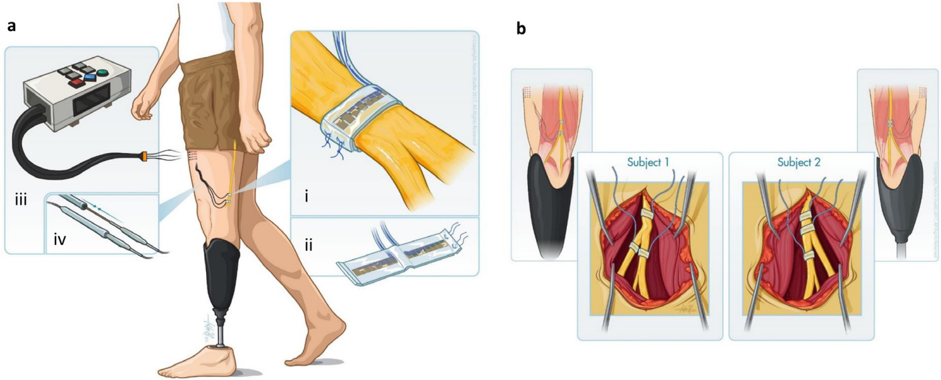
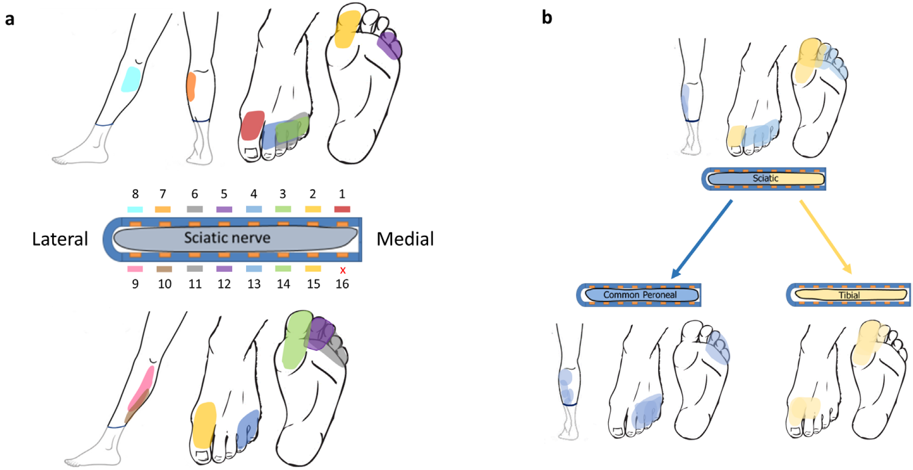
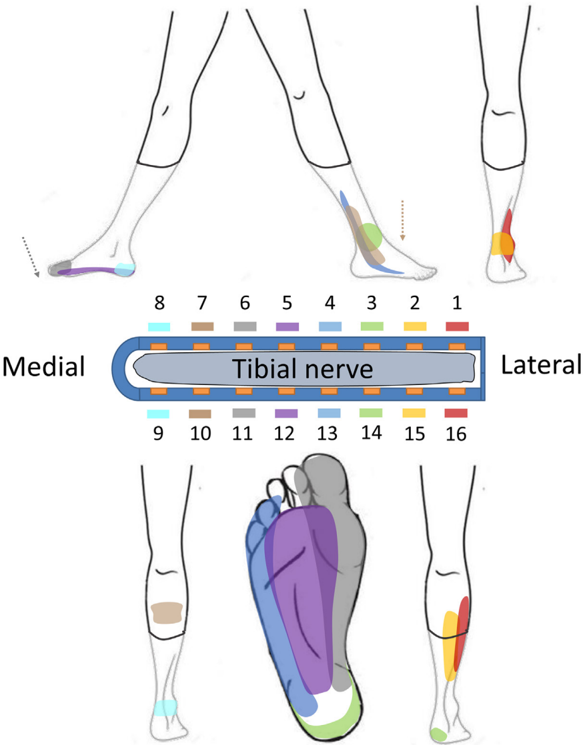
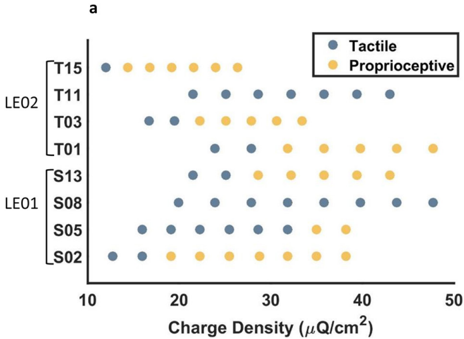
Objective . Sensory input in lower-limb amputees is critically important to maintaining balance, preventing falls, negotiating uneven terrain, responding to unexpected perturbations, and developing the confidence required for societal participation and public interactions in unfamiliar environments. Despite noteworthy advances in robotic prostheses for lower-limb amputees, such as microprocessor knees and powered ankles, natural somatosensory feedback from the lost limb has not yet been incorporated in current prosthetic technologies. Approach . In this work, we report eliciting somatic sensation with neural stimulation delivered by chronically-implanted, non-penetrating nerve cuff electrodes in two transtibial amputees. High-density, flexible, 16-contact nerve cuff electrodes were surgically implanted for the selective activation of sensory fascicles in the nerves of the posterior thigh above the knee. Electrical pulses at safe levels were delivered to the nerves by an external stimulator via percutaneous leads attached to the cuff electrodes. Main results . The neural stimulation was perceived by participants as sensation originating from the missing limb. We quantitatively and qualitatively ascertained the intensity, modality as well as the location and stability of the perceived sensations. Stimulation through individual contacts within the nerve cuffs evoked repeatable sensations of various modalities and at discrete locations projected to the missing toes, foot and ankle, as well as in the residual limb. In addition, we observed a high overlap in reported locations between distal versus proximal cuffs suggesting that the same sensory responses could be elicited from more proximal points on the nerve. Significance . Based on these findings, the high-density cuff technology is suitable for restoring natural sensation to lower-limb amputees and could be utilized in developing a neuroprosthesis with natural sensory feedback. The overlap in reported locations between proximal and distal cuffs indicates that our approach might be applicable to transfemoral amputees where distal muscles and branches of sciatic nerve are not available.
Overview
The claims and statistics of this paper haven’t been checked yet.
Free: it reads the open-access text and checks the first 5 claims that cite a source we can check. Create a free account to check every claim.
Integrity signals
Registry
Cites
Statistics
Figures
Verification
Claims the paper makes
The claims and statistics of this paper haven’t been checked yet.
Free: it reads the open-access text and checks the first 5 claims that cite a source we can check. Create a free account to check every claim.
Claims other papers make about this one
Each is checked against this paper’s own text: does it say what the citing paper says it does?
The cited source says what the claim attributes to it.
In the citing paper
“The C-FINE was found successful in restoring sensation in individuals with a lower limb amputation [75].”
From Interfaces with the peripheral nervous system for the control of a neuroprosthetic limb: a review (2020) · cites this paper as [75]
The cited source says what the claim attributes to it.
In the citing paper
“Additionally, the effects of stimulation can be difficult to predict; both the location and quality of sensations evoked by stimulation of implanted electrode arrays can change significantly [14,15].”
From Fascicle specific targeting for selective peripheral nerve stimulation (2019) · cites this paper as [14]
Self-check
Percentages, sums and reported differences re-computed from the paper’s own numbers.
The self-check needs the paper’s full text.
Citations
Cites
Electrical stimulation of excitable tissue: design of efficacious and safe protocols
Merrill, D. R., Bikson, M., & Jefferys, J. G. R. (2005) · Journal of Neuroscience Methods · doi:10.1016/j.jneumeth.2004.10.020 · Cited by 2,078 · cited 1×
“7 is considered safe for pulse trains with inter-pulse frequency of 50 Hz and up to 7 h continuous stimulation [33, 34].”
BackgroundRestoring natural sensory feedback in real-time bidirectional hand prostheses
Raspopovic, S., Capogrosso, M., Petrini, F. M., Bonizzato, M., Rigosa, J., Di Pino, G., Carpaneto, J., Controzzi, M., Boretius, T., Fernandez, E., et al. (2014) · Science Translational Medicine · doi:10.1126/scitranslmed.3006820 · Cited by 1,001
A neural interface provides long-term stable natural touch perception
Tan, D. W., Schiefer, M. A., Keith, M. W., Anderson, J. R., Tyler, J., & Tyler, D. J. (2014) · Science Translational Medicine · doi:10.1126/scitranslmed.3008669 · Cited by 751
Self-citationCharge density and charge per phase as cofactors in neural injury induced by electrical stimulation
McCreery, D. B., Agnew, W. F., Yuen, T. G. H., & Bullara, L. (1990) · IEEE Transactions on Biomedical Engineering · doi:10.1109/10.102812 · Cited by 708 · cited 1×
“7 is considered safe for pulse trains with inter-pulse frequency of 50 Hz and up to 7 h continuous stimulation [33, 34].”
BackgroundIntracortical microstimulation of human somatosensory cortex
Flesher, S. N., Collinger, J. L., Foldes, S. T., Weiss, J. M., Downey, J. E., Tyler-Kabara, E. C., Bensmaia, S. J., Schwartz, A. B., Boninger, M. L., & Gaunt, R. A. (2016) · Science Translational Medicine · doi:10.1126/scitranslmed.aaf8083 · Cited by 704 · cited 1×
“Our results from intensity discrimination experiments corroborate previously reported observations in sensory restoration in the upper limb [35, 52].”
ResultThe prevalence and risk factors of falling and fear of falling among lower extremity amputees
Miller, W. C., Speechley, M., & Deathe, B. (2001) · Archives of Physical Medicine and Rehabilitation · doi:10.1053/apmr.2001.24295 · Cited by 642 · cited 1×
“from sensory restoration as their fall risk [40, 41], reliance on”
BackgroundA model of safe levels for electrical stimulation
Shannon, R. V. (1992) · IEEE Transactions on Biomedical Engineering · doi:10.1109/10.126616 · Cited by 526 · cited 1×
“where QD is the charge density per phase (μC cm−2) and Q is charge per phase (μC) [32].”
BackgroundPowered Ankle--Foot Prosthesis Improves Walking Metabolic Economy
Au, S. K., Weber, J., & Herr, H. (2009) · IEEE Transactions on Robotics · doi:10.1109/tro.2008.2008747 · Cited by 487 · cited 1×
“Design iterations of prostheses have focused on improving confidence in walking [3], reducing reliance on the intact limb [4, 5], and lowering metabolic energy expenditure during level-ground walking [6, 7] mainly by taking advantage of integrated robotic systems [8] and employing versatile control strategies [9].”
BackgroundFoot sole and ankle muscle inputs contribute jointly to human erect posture regulation
Kavounoudias, A., Roll, R., & Roll, J. (2001) · The Journal of Physiology · doi:10.1111/j.1469-7793.2001.0869e.x · Cited by 479 · cited 1×
“In neurologically intact individuals, foot sole tactile afferents contribute to body posture awareness [11], erect stance maintenance [12], and sensing the direction of ankle movement [13].”
BackgroundMore than skin deep: Body representation beyond primary somatosensory cortex
Longo, M. R., Azañón, E., & Haggard, P. (2010) · Neuropsychologia · doi:10.1016/j.neuropsychologia.2009.08.022 · Cited by 479 · cited 1×
“These changes in the mental image of the limb align with previous work suggesting that conscious body image arises from several sources of input, including tactile afferents (for review, see [51]).”
Background
Research works printed but not linked: 1
- 46. Lundy-Ekman L 2013 Neuroscience-E-Book: Fundamentals for Rehabilitation (Amsterdam: Elsevier)
Cited by
George, J. A., Kluger, D. T., Davis, T. S., Wendelken, S. M., Okorokova, E. V., He, Q., Duncan, C. C., Hutchinson, D. T., Thumser, Z. C., Beckler, D. T., et al. (2019) · Science Robotics · doi:10.1126/scirobotics.aax2352 · Cited by 388
Self-citationSensory feedback for limb prostheses in amputees
Raspopovic, S., Valle, G., & Petrini, F. M. (2021) · Nature Materials · doi:10.1038/s41563-021-00966-9 · Cited by 308
Sensory feedback restoration in leg amputees improves walking speed, metabolic cost and phantom pain
Petrini, F. M., Bumbasirevic, M., Valle, G., Ilic, V., Mijović, P., Čvančara, P., Barberi, F., Katic, N., Bortolotti, D., Andreu, D., et al. (2019) · Nature Medicine · doi:10.1038/s41591-019-0567-3 · Cited by 269
Enhancing functional abilities and cognitive integration of the lower limb prosthesis
Petrini, F. M., Valle, G., Bumbasirevic, M., Barberi, F., Bortolotti, D., Cvancara, P., Hiairrassary, A., Mijovic, P., Sverrisson, A. Ö., Pedrocchi, A., et al. (2019) · Science Translational Medicine · doi:10.1126/scitranslmed.aav8939 · Cited by 265
“The map of elicited sensations in transtibial amputees implanted with flat interface nerve electrodes has been reported (16), however, without prosthesis connection or functional assessment.”
BackgroundFleming, A., Stafford, N., Huang, S., Hu, X., Ferris, D. P., & Huang, H. (. (2021) · Journal of Neural Engineering · doi:10.1088/1741-2552/ac1176 · Cited by 216
A review for the peripheral nerve interface designer
Larson, C. E., & Meng, E. (2020) · Journal of Neuroscience Methods · doi:10.1016/j.jneumeth.2019.108523 · Cited by 133
Sensory restoration by epidural stimulation of the lateral spinal cord in upper-limb amputees
Chandrasekaran, S., Nanivadekar, A. C., McKernan, G., Helm, E. R., Boninger, M. L., Collinger, J. L., Gaunt, R. A., & Fisher, L. E. (2020) · eLife · doi:10.7554/elife.54349 · Cited by 116
Interfaces with the peripheral nervous system for the control of a neuroprosthetic limb: a review
Yildiz, K. A., Shin, A. Y., & Kaufman, K. R. (2020) · Journal of NeuroEngineering and Rehabilitation · doi:10.1186/s12984-020-00667-5 · Cited by 113
Neuromorphic hardware for somatosensory neuroprostheses
Donati, E., & Valle, G. D. (2024) · Nature Communications · doi:10.1038/s41467-024-44723-3 · Cited by 132
Neuroprosthetics: from sensorimotor to cognitive disorders
Gupta, A., Vardalakis, N., & Wagner, F. B. (2023) · Communications Biology · doi:10.1038/s42003-022-04390-w · Cited by 121
Mechanisms of neuro-robotic prosthesis operation in leg amputees
Valle, G., Saliji, A., Fogle, E., Cimolato, A., Petrini, F. M., & Raspopovic, S. (2021) · Science Advances · doi:10.1126/sciadv.abd8354 · Cited by 89
Continuous neural control of a bionic limb restores biomimetic gait after amputation
Song, H., Hsieh, T., Yeon, S. H., Shu, T., Nawrot, M., Landis, C., Friedman, G. N., Israel, E. A., Gutierrez-Arango, S., Carty, M. J., et al. (2024) · Nature Medicine · doi:10.1038/s41591-024-02994-9 · Cited by 98
Peripheral nerve bionic interface: a review of electrodes
Russell, C., Roche, A. D., & Chakrabarty, S. (2019) · International Journal of Intelligent Robotics and Applications · doi:10.1007/s41315-019-00086-3 · Cited by 67
Charkhkar, H., Christie, B. P., & Triolo, R. J. (2020) · Scientific Reports · doi:10.1038/s41598-020-63936-2 · Cited by 78
Self-citationNanivadekar, A. C., Bose, R., Petersen, B. A., Okorokova, E. V., Sarma, D., Madonna, T. J., Barra, B., Farooqui, J., Dalrymple, A. N., Levy, I., et al. (2023) · Nature Biomedical Engineering · doi:10.1038/s41551-023-01153-8 · Cited by 78
A computational model to design neural interfaces for lower-limb sensory neuroprostheses
Zelechowski, M., Valle, G., & Raspopovic, S. (2020) · Journal of NeuroEngineering and Rehabilitation · doi:10.1186/s12984-020-00657-7 · Cited by 63
Compliant peripheral nerve interfaces.
Paggi, V., Akouissi, O., Micera, S., & Lacour, S. P. (2021) · Journal of Neural Engineering · doi:10.1088/1741-2552/abcdbe · Cited by 60
“[230] Charkhkar H, Shell C E, Marasco P D, Pinault G J, Tyler D J”
BackgroundČvančara, P., Boretius, T., López-Álvarez, V. M., Maciejasz, P., Andreu, D., Raspopovic, S., Petrini, F., Micera, S., Granata, G., Fernandez, E., et al. (2020) · Journal of Neural Engineering · doi:10.1088/1741-2552/ab9a9a · Cited by 58
Fascicle specific targeting for selective peripheral nerve stimulation
Overstreet, C. K., Cheng, J., & Keefer, E. W. (2019) · Journal of Neural Engineering · doi:10.1088/1741-2552/ab4370 · Cited by 44
Multifaceted understanding of human nerve implants to design optimized electrodes for bioelectronics
Valle, G. D., Aiello, G., Ciotti, F., Čvančara, P., Martinović, T., Kravic‐Stevovic, T., Navarro, X., Stieglitz, T., Bumbaširević, M., & Raspopović, S. (2022) · Biomaterials · doi:10.1016/j.biomaterials.2022.121874 · Cited by 44
“On the other hand, higher over--time stability was reported with the use of FINE and cuff electrodes implanted in animals [41,42] also in both upper and lower-limb am-putees [12,43], due to the less invasiveness of the implants (extraneural interface).”
Basla, C., Chee, L., Valle, G., & Raspopović, S. (2021) · Journal of Neural Engineering · doi:10.1088/1741-2552/ac43f8 · Cited by 50
“Most balance and walking problems related to lowerlimb amputation (LLA) are caused by the absence of proprioceptive and tactile sensations from the missing extremity [1, 2].”
BackgroundMethodAdvanced technologies for intuitive control and sensation of prosthetics
Wolf, E. J., Cruz, T. H., Emondi, A. A., Langhals, N. B., Naufel, S. N., Peng, G. C. Y., Schulz, B. W., & Wolfson, M. B. (2019) · Biomedical Engineering Letters · doi:10.1007/s13534-019-00127-7 · Cited by 42
Ortiz-Catalan, M., Wessberg, J., Mastinu, E., Naber, A., & Brånemark, R. (2019) · IEEE Transactions on Medical Robotics and Bionics · doi:10.1109/tmrb.2019.2931758 · Cited by 41
“Such tactile quality has been reported in direct nerve stimulation at perception thresholds [6].”
BackgroundCognitive benefits of using non-invasive compared to implantable neural feedback
Chee, L., Valle, G., Preatoni, G., Basla, C., Marazzi, M., & Raspopović, S. (2022) · Scientific Reports · doi:10.1038/s41598-022-21057-y · Cited by 40
Ambulatory searching task reveals importance of somatosensation for lower-limb amputees
Christie, B. P., Charkhkar, H., Shell, C. E., Burant, C. J., Tyler, D. J., & Triolo, R. J. (2020) · Scientific Reports · doi:10.1038/s41598-020-67032-3 · Cited by 37
Self-citationLiu, Z., Chen, J., Jo, M., Vogel, V., Chen, J., Rogers, J. A., & Li, S. (2026) · Nature Reviews Bioengineering · doi:10.1038/s44222-025-00391-6 · Cited by 54
A modular strategy for next-generation upper-limb sensory-motor neuroprostheses
Shokur, S., Mazzoni, A., Schiavone, G., Weber, D. J., & Micera, S. (2021) · Med · doi:10.1016/j.medj.2021.05.002 · Cited by 37
Overcoming failure: improving acceptance and success of implanted neural interfaces
Dalrymple, A. N., Jones, S. T., Fallon, J. B., Shepherd, R. K., & Weber, D. J. (2025) · Bioelectronic Medicine · doi:10.1186/s42234-025-00168-7 · Cited by 44
“…et al. 2020); Dorsal root ganglion stimulation: (Deer et al. 2019; Liem et al. 2013; Sverrisdottir et al. 2020); Peripheral nerve stimulation: (Charkhkar et al. 2018; Gan et al. 2012; George et al. 2019; Goree et al. 2024; Raspopovic et al. 2014; Tan et al. 2014); Functional electrical…”
Visuotactile synchrony of stimulation-induced sensation and natural somatosensation
Christie, B. P., Graczyk, E. L., Charkhkar, H., Tyler, D. J., & Triolo, R. J. (2019) · Journal of Neural Engineering · doi:10.1088/1741-2552/ab154c · Cited by 39
“The two participants with lower-limb amputations (LLA) had 16-contact composite flat interface nerve electrodes (C-FINEs) [34] installed around their sciatic, tibial and/or common peroneal nerves (figure 1(b)) [31].”
BackgroundSelf-citationDARPA investment in peripheral nerve interfaces for prosthetics, prescriptions, and plasticity
Naufel, S. N., Knaack, G. L., Miranda, R. A., Best, T. K., Fitzpatrick, K., Emondi, A. A., Gieson, E. J. V., & McClure‐Begley, T. D. (2019) · Journal of Neuroscience Methods · doi:10.1016/j.jneumeth.2019.108539 · Cited by 30
“, 2014) and non-penetrating (e.g., Graczyk et al., 2019; Charkhkar et al., 2018) nerve electrode-based systems that provide high temporal resolution, but that vary with respect to spatial selectivity.”
Cimolato, A., Ciotti, F., Kljajić, J., Valle, G., & Raspopović, S. (2023) · iScience · doi:10.1016/j.isci.2023.106248 · Cited by 29
“In this direction, recent studies have shown that realistic artificial sensations (such as vibration, tingling, or touch) can be elicited by direct electrical stimulation of residual peripheral nerves using neural interfaces.(5,16,20,30,31) However, restoration of natural proprioceptive sensations has never been relia…”
BackgroundPan, L., Vargas, L., Fleming, A., Hu, X., Zhu, Y., & Huang, H. (2020) · Journal of Neural Engineering · doi:10.1088/1741-2552/ab8e8d · Cited by 31
“The stimulation amplitude used in invasive electric stimulation of sciatic nerve of lower limb amputee subjects was less than 3 mA [52] or even less than 1mA [53].”
BackgroundInfluentialMultiparametric non-linear TENS modulation to integrate intuitive sensory feedback
Bucciarelli, V., Gozzi, N., Katic, N., Aiello, G., Razzoli, M., Valle, G. D., & Raspopović, S. (2023) · Journal of Neural Engineering · doi:10.1088/1741-2552/acd4e8 · Cited by 36
“touching an object with the intact limb, walking on the floor with the intact limb)[11, 12, 19, 40, 42, 72].”
BackgroundNeural engineering: the process, applications, and its role in the future of medicine
Ereifej, E. S., Shell, C. E., Schofield, J. S., Charkhkar, H., Cuberovic, I., Dorval, A. D., Graczyk, E. L., Kozai, T. D. Y., Otto, K. J., Tyler, D. J., et al. (2019) · Journal of Neural Engineering · doi:10.1088/1741-2552/ab4869 · Cited by 30
Self-citationAchieving Neural Compatibility With Human Sensorimotor Control in Prosthetic and Therapeutic Devices
Lan, N., Niu, C. M., Hao, M., Chou, C.-H., & Dai, C. (2019) · IEEE Transactions on Medical Robotics and Bionics · doi:10.1109/tmrb.2019.2930356 · Cited by 28
“gies have emerged as promising means to communicate sensory information to the brain of amputees and patients with spinal cord injury [104]–[106].”
BackgroundToward the Development of User-Centered Neurointegrated Lower Limb Prostheses
Barberi, F., Anselmino, E., Mazzoni, A., Goldfarb, M. T., & Micera, S. (2023) · IEEE Reviews in Biomedical Engineering · doi:10.1109/rbme.2023.3309328 · Cited by 32
“The evoked sensation through intraneural stimulation results to be not only homologous (i.e., they match the quality of external stimulus [147], [150]) but also somatotopically coherent (i.e., they match the location on the phantom limb [147], [150], [170], Fig.”
BackgroundIntelligent Knee Prostheses: A Systematic Review of Control Strategies
Li, L., Wang, X., Meng, Q., Chen, C., Sun, J., & Yu, H. (2022) · Journal of Bionic Engineering · doi:10.1007/s42235-022-00169-1 · Cited by 24
Automated calibration of somatosensory stimulation using reinforcement learning
Borda, L., Gozzi, N., Preatoni, G., Valle, G., & Raspopović, S. (2023) · Journal of NeuroEngineering and Rehabilitation · doi:10.1186/s12984-023-01246-0 · Cited by 22
Plantar somatosensory restoration enhances gait, speed perception, and motor adaptation
Kim, D., Triolo, R. J., & Charkhkar, H. (2023) · Science Robotics · doi:10.1126/scirobotics.adf8997 · Cited by 27
“The full description of the mapping between the sensor and the stimulation output was given by Charkhkar et al. ( 18 ) and consisted of completely unloading the foot for baseline and full body weight on the region of interest (heel, midfoot, and toe) for maximal values to calibrate the interactive…”
MethodSelf-citationChristie, B. P., Charkhkar, H., Shell, C. E., Marasco, P. D., Tyler, D. J., & Triolo, R. J. (2019) · Scientific Reports · doi:10.1038/s41598-019-47867-1 · Cited by 22
Self-citationCharkhkar, H., Christie, B. P., Pinault, G. J., Tyler, D. J., & Triolo, R. J. (2019) · Journal of Neuroscience Methods · doi:10.1016/j.jneumeth.2019.108414 · Cited by 19
Self-citationSchmitt, M. S., Wright, J. D., Triolo, R. J., Charkhkar, H., & Graczyk, E. L. (2023) · Frontiers in Human Neuroscience · doi:10.3389/fnhum.2022.1074033 · Cited by 21
“Peripheral nerve stimulation to restore sensation has been tested in both upper and lower limb amputees (Clark et al., 2014; Ortiz-Catalan et al., 2014; Raspopovic et al., 2014; Tan et al., 2014; Charkhkar et al., 2018; Petrini et al., 2019), and it has been shown to produce sensation perceived as originating from the…”
BackgroundSelf-citationSelectivity of afferent microstimulation at the DRG using epineural and penetrating electrode arrays
Nanivadekar, A. C., Ayers, C. A., Gaunt, R. A., Weber, D. J., & Fisher, L. E. (2019) · Journal of Neural Engineering · doi:10.1088/1741-2552/ab4a24 · Cited by 21
Current Stimulation of the Midbrain Nucleus in Pigeons for Avian Flight Control
Jang, J., Baek, C., Kim, S., Lee, T.-K., Choi, G.-J., Shim, S., Yun, S., Jung, Y., Lee, C. E., Ko, S., et al. (2021) · Micromachines · doi:10.3390/mi12070788 · Cited by 21
Artificial referred sensation in upper and lower limb prosthesis users: a systematic review
Gonzalez, M. A., Bismuth, A., Lee, C., Chestek, C. A., & Gates, D. H. (2022) · Journal of Neural Engineering · doi:10.1088/1741-2552/ac8c38 · Cited by 27
“However, only a small number of studies conducted this kind of assessment [64, 77], likely due to the time and mental energy it requires from participants.”
InfluentialTissue-like Bioelectronic Material Strategies for Personalized Closed-Loop Neuroprostheses
Kim, Y., Lee, H., Lee, J., Shin, M., & Son, D. (2025) · ACS Nano · doi:10.1021/acsnano.5c07150 · Cited by 21
Sadeghi, A., Afshari, E., Hashemi, M., Kaplan, D. L., & Mozafari, M. (2022) · Current Opinion in Biomedical Engineering · doi:10.1016/j.cobme.2022.100420 · Cited by 21
Clinical Applications and Future Translation of Somatosensory Neuroprostheses
Graczyk, E. L., Hutchison, B. C., Valle, G. D., Bjånes, D. A., Gates, D. H., Raspopović, S., & Gaunt, R. A. (2024) · Journal of Neuroscience · doi:10.1523/jneurosci.1237-24.2024 · Cited by 20
Lower-Limb Amputees Adjust Quiet Stance in Response to Manipulations of Plantar Sensation
Shell, C. E., Christie, B. P., Marasco, P. D., Charkhkar, H., & Triolo, R. J. (2021) · Frontiers in Neuroscience · doi:10.3389/fnins.2021.611926 · Cited by 18
Self-citationWhat’s New in Peripheral Nerve Stimulation
Fogel, H. P., & Winfree, C. J. (2022) · Neurosurgery Clinics of North America · doi:10.1016/j.nec.2022.02.009 · Cited by 14
Earley, E. J., Johnson, R. E., Sensinger, J. W., & Hargrove, L. J. (2021) · Scientific Reports · doi:10.1038/s41598-021-84795-5 · Cited by 13
Peripheral neurostimulation for encoding artificial somatosensations
Valle, G. D. (2022) · European Journal of Neuroscience · doi:10.1111/ejn.15822 · Cited by 18
“…previously innervating the missing limb eliciting multiple sensation locations referred directly on the phantom limb (i.e., somatotopic sensations) (Charkhkar et al., 2018; Davis et al., 2016; Dhillon & Horch, 2005; Overstreet et al., 2019; Petrini, Valle, Bumbasirevic, et al., 2019; Strauss et…”
BackgroundKarczewski, A. M., Dingle, A. M., & Poore, S. O. (2021) · Frontiers in Neurorobotics · doi:10.3389/fnbot.2021.711028 · Cited by 13
The Next Frontier in Neuroprosthetics: Integration of Biomimetic Somatosensory Feedback
Tian, Y., Valle, G. D., Cederna, P. S., & Kemp, S. W. P. (2025) · Biomimetics · doi:10.3390/biomimetics10030130 · Cited by 18
Katic, N., Balaguer, J.-M., Gorskii, O., Pavlova, N., Liang, L., Ho, J. C., Grigsby, E. M., Gerszten, P. C., Карал-оглы, Д. Д., Bulgin, D. V., et al. (2024) · Cell Reports · doi:10.1016/j.celrep.2024.113695 · Cited by 16
“1,2,4,6,9 48 For example, epidural spinal cord stimulation has been applied for both motor recovery and, more recently, restoration of sensory feedback.”
Dalrymple, A. N., Fisher, L. E., & Weber, D. J. (2024) · Journal of Neural Engineering · doi:10.1088/1741-2552/ad6a8d · Cited by 16
“…using electrical stimulation of the peripheral nerves, (Anani and Körner 1979, Clippinger et al 1982, Raspopovic et al 2014, D’Anna et al 2017, Charkhkar et al 2018), spinal cord (Chandrasekaran et al 2020, Nanivadekar et al 2022, 2023), and thalamus (Davis et al 1998), as well as magnetic…”
Cady, S. R., Lambrecht, J. M., Dsouza, K. T., Dunning, J. L., Anderson, J. R., Malone, K. J., Chepla, K. J., Graczyk, E. L., & Tyler, D. J. (2025) · Journal of NeuroEngineering and Rehabilitation · doi:10.1186/s12984-025-01613-z · Cited by 13
“Interestingly, S02’s median nerve shifting location percepts from the residual limb to the hand across time mirrored similar trends reported from both upper and lower limb sensory restoration systems [32, 64].”
Self-citationLiu, J., Grayden, D. B., Keast, J. R., & John, S. E. (2022) · Journal of Neural Engineering · doi:10.1088/1741-2552/aca69e · Cited by 12
Li, S., Triolo, R. J., & Charkhkar, H. (2025) · Scientific Reports · doi:10.1038/s41598-025-85788-4 · Cited by 12
Self-citationDRG microstimulation evokes postural responses in awake, standing felines
King, K., Cusack, W. F., Nanivadekar, A. C., Ayers, C. A., Urbin, M. A., Gaunt, R. A., Fisher, L. E., & Weber, D. J. (2019) · Journal of Neural Engineering · doi:10.1088/1741-2552/ab50f4 · Cited by 12
Manoharan, S., & Park, H. (2023) · Biomedical Engineering Letters · doi:10.1007/s13534-023-00308-5 · Cited by 15
Restoring Somatotopic Sensory Feedback in Lower Limb Amputees through Noninvasive Nerve Stimulation
Demofonti, A., Germanotta, M., Zingaro, A., Bailo, G., Insalaco, S., Cordella, F., Aprile, I. G., & Zollo, L. (2025) · Cyborg and Bionic Systems · doi:10.34133/cbsystems.0243 · Cited by 12
Taghlabi, K. M., Cruz-Garza, J. G., Hassan, T., Potnis, O., Bhenderu, L. S. S., Guerrero, J. R., Whitehead, R. E., Wu, Y. C., Luan, L., Xie, C., et al. (2024) · Journal of Neural Engineering · doi:10.1088/1741-2552/ad200f · Cited by 9
“Split cylinder cuff electrodes are tubular structures with a longitudinal cut that can be sutured or left without suturing around the nerve [17, However, C-FINE electrodes differ by incorporating soft compression, reshaping the nerve from a cylindrical to an elongated oval structure [45, 47].”
BackgroundMethodInfluentialSammut, S., Koh, R. G. L., & Zariffa, J. (2021) · Sensors · doi:10.3390/s21020506 · Cited by 9
In vivo closed-loop control of a locust’s leg using nerve stimulation
Zurita, F., Duca, F. D., Teshima, T., Hiendlmeier, L., Gebhardt, M., Luksch, H., & Wolfrum, B. L. (2022) · Scientific Reports · doi:10.1038/s41598-022-13679-z · Cited by 10
Lower Extremity Osseointegration Postoperative Rehabilitation Protocols: A Scoping Review
Grunfeld, M., Reif, T. J., Rozbruch, S. R., & Hoellwarth, J. S. (2024) · Physical Therapy · doi:10.1093/ptj/pzae139 · Cited by 10
“65 Recognition of the specific need for physical therapy following osseointegration may also be lacking.”
Artificial sensory feedback for bionic hands
Downey, J. E., Brooks, J., & Bensmaïa, S. J. (2019) · Elsevier eBooks · doi:10.1016/b978-0-12-814942-3.00008-8 · Cited by 7
Prosthesis Embodiment in Lower Extremity Limb Loss: A Narrative Review
Nguyen, T. T., Wang, B., Alas, H., Jones, Q., Clark, C. C. T., Lazar, S. V., Malik, S., Graham, J., Talaat, Y., Shin, C., et al. (2025) · Applied Sciences · doi:10.3390/app15094952 · Cited by 11
Somatosensory restoration and neural control strategies in lower-limb prostheses
Mariscal, D. M., Driscoll, B., Huang, H., & Fisher, L. E. (2025) · npj Biomedical Innovations. · doi:10.1038/s44385-025-00050-w · Cited by 7
“…restore somatosensory feedback from the amputated hand 48 , and multiple recent studies have demonstrated that C-FINEs wrapped around the sciatic nerve and its branches can elicit tactile and proprioceptive sensations on the missing foot and leg in people with transtibial amputation 49 .”
Design trends in actuated lower-limb prosthetic systems: a narrative review
Sun, H., He, C., & Vujaklija, I. (2023) · Expert Review of Medical Devices · doi:10.1080/17434440.2023.2279999 · Cited by 7
Petros, E., Miller, M., Dunning, J. L., Pinault, G. C. J., Tyler, D. J., Triolo, R. J., & Charkhkar, H. (2025) · Journal of Neural Engineering · doi:10.1088/1741-2552/ada829 · Cited by 8
“This approach offers a more seamless and consistent method of providing somatosensory feedback to the user [16–19], thus avoiding the need to associate unrelated sensations to foot-floor interactions [20].”
InfluentialSelf-citationConnecting residual nervous system and prosthetic legs for sensorimotor and cognitive rehabilitation
Valle, G. D., Preatoni, G., & Raspopović, S. (2021) · Elsevier eBooks · doi:10.1016/b978-0-12-822828-9.00007-1 · Cited by 8
Park, H., Klishko, A. N., Oh, K., Zhang, C., Grenga, G., Herrin, K. R., Dalton, J. F., Kistenberg, R. S., Lemay, M. A., Pitkin, M. R., et al. (2022) · Motor Control · doi:10.1123/mc.2022-0096 · Cited by 6
Li, S., Triolo, R. J., & Charkhkar, H. (2023) · Frontiers in Neuroscience · doi:10.3389/fnins.2023.1276308 · Cited by 6
“The details of the neural interface technology and the surgical procedure are described elsewhere (Charkhkar et al., 2018).”
BackgroundMethodSelf-citationUrbin, M. A., Liu, M., Bottorff, E. C., Gaunt, R. A., Fisher, L. E., & Weber, D. J. (2019) · Journal of Neural Engineering · doi:10.1088/1741-2552/ab4c6c · Cited by 6
Nanivadekar, A. C., Bose, R., Petersen, B. A., Okorokova, E. V., Sarma, D., Farooqui, J., Dalrymple, A. N., Levy, I., Helm, E. R., Mièle, V., et al. (2022) · medRxiv · doi:10.1101/2022.09.15.22279956 · Cited by 8
Hutchison, B. C., Bose, R., Spilker, B. J., Bhat, P., Memberg, W. D., Ketting-Olivier, A., Herring, E., Sweet, J. A., Miller, J. P., Kirsch, R. F., et al. (2025) · medRxiv · doi:10.1101/2025.08.20.25334094 · Cited by 5
Hussain, R. S., Razak, N. A. A., Alfatafta, M., Khuen, C. C., Qaroot, B. A., & Ramousse, T. (2026) · Frontiers in Bioengineering and Biotechnology · doi:10.3389/fbioe.2025.1722817 · Cited by 5
Neuromorphic Tactile Sensing and Encoding
Kumar, D., Silva, A. N., & Thakor, N. V. (2023) · Handbook of Neuroengineering · doi:10.1007/978-981-16-5540-1_117 · Cited by 6
Guerra-Farfán, E., Núñez, J. H., Sánchez‐Raya, J., Crespo-Fresno, A., Anglés, F., & Minguell, J. (2018) · Current Trauma Reports · doi:10.1007/s40719-018-0149-8 · Cited by 5
A Computer-Brain Interface that Restores Lost Extremities’ Touch and Movement Sensations
Valle, G., Petrini, F. M., Mijović, P., Mijović, B., & Raspopović, S. (2021) · Springer briefs in electrical and computer engineering · doi:10.1007/978-3-030-79287-9_7 · Cited by 5
Pan, L., Ren, Z., Zhu, K., & Li, J. (2023) · Medical & Biological Engineering & Computing · doi:10.1007/s11517-023-02923-x · Cited by 4
Neural Implants Without Electronics: A Proof-of-Concept Study on a Human Skin Model
Kiele, P., Braig, D., Weis, J., Baslan, Y., Pasluosta, C. F., & Stieglitz, T. (2020) · IEEE Open Journal of Engineering in Medicine and Biology · doi:10.1109/ojemb.2020.2981254 · Cited by 5
“Studies on sensorimotor stimulation of the sciatic nerve showed that this curve is highly specific [21], meaning that some degree of crosstalk is still acceptable.”
BackgroundMethodThomas, N., Osborn, L. E., Moran, C. W., Fifer, M. S., & Christie, B. P. (2024) · Frontiers in Neuroscience · doi:10.3389/fnins.2024.1490828 · Cited by 5
Manoharan, S., Oh, S., Jiang, B., Patton, J. L., & Park, H. (2022) · Annual International Conference of the IEEE Engineering in Medicine and Biology Society (EMBC) · doi:10.1109/embc48229.2022.9871592 · Cited by 3
Restoring the sense of touch with electrical stimulation of the nerve and brain
Callier, T., & Bensmaïa, S. J. (2021) · Elsevier eBooks · doi:10.1016/b978-0-12-822828-9.00010-1 · Cited by 3
Katic, N., Valle, G. D., & Raspopović, S. (2022) · Handbook of Neuroengineering · doi:10.1007/978-981-15-2848-4_100-1 · Cited by 3
Computational Modeling of an Endovascular Peripheral Nerve Interface
Liu, J., Grayden, D. B., Keast, J. R., & John, S. E. (2021) · Annual International Conference of the IEEE Engineering in Medicine and Biology Society (EMBC) · doi:10.1109/embc46164.2021.9630085 · Cited by 3
“Most existing peripheral nerve electrical stimulation devices use extra-neural electrodes that are positioned in direct contact with the target nerve, such as cuff electrodes [2], flatinterface electrodes [3], and book electrodes [4].”
BackgroundTactile localization of the breast, areola, and nipple
Long, K. H., Fitzgerald, E. E., Berger-Wolf, E. I., Fawaz, A., Lindau, S. T., Bensmaïa, S. J., & Greenspon, C. M. (2026) · eLife · doi:10.1101/2022.09.14.507974 · Cited by 4
Somatosensory Neuromodulation with a Focus Towards Clinical Systems
Graczyk, E. L., & Tyler, D. J. (2022) · Handbook of Neuroengineering · doi:10.1007/978-981-15-2848-4_92-1 · Cited by 2
Self-citationValle, G. D., Carpaneto, J., & Micera, S. (2023) · Handbook of Neuroengineering · doi:10.1007/978-981-16-5540-1_27 · Cited by 5
1-D Manual Tracing Based on a High Density Haptic Stimulation Grid - a Pilot Effort
Driscoll, B., Liu, M., & Huang, H. (2023) · IEEE World Haptics Conference (WHC) · doi:10.1109/whc56415.2023.10224505 · Cited by 3
“Although direct neural stimulation aims to reconnect the broken neural pathways and are expected to generate natural sensations, the existing approaches have limited control on what type of sensations can be generated and relies on intensive trial and error to locate the point of sensation on the missing limb [5].”
BackgroundBailey, Z., Nairac, Z., Cuttaz, E. A., M’Rad, I. B., Chapman, C. A. R., Rapeaux, A., Goding, J. A., Roche, A. D., Constandinou, T. G., & Green, R. A. (2026) · Journal of Neural Engineering · doi:10.1088/1741-2552/ae44d0 · Cited by 2
“These approaches have sought to either penetrate the epineurium and/or the perineurium or mechanically compress the nerve into a flattened shape [6].”
Probing peripheral neural pathways in electrically stimulation induced sensation
Cheng, K., Charkhkar, H., Yu, J. T., Makowski, N. S., & Triolo, R. J. (2019) · International IEEE/EMBS Conference on Neural Engineering · doi:10.1109/ner.2019.8717028 · Cited by 3
Self-citationSensory Percepts Elicited by Chronic Macro-Sieve Electrode Stimulation of the Rat Sciatic Nerve
Chandra, N. S., McCarron, W. M., Yan, Y., Ruiz, L. C., Sallinger, E. G., Birenbaum, N. K., Burton, H., Green, L., Moran, D. W., Ray, W. Z., et al. (2021) · Frontiers in Neuroscience · doi:10.3389/fnins.2021.758427 · Cited by 2
Disruption of Proprioceptive Information During Electrical Stimulation of the Cutaneous AfferentsPreprint
Katic, N., Balaguer, J.-M., Gorskii, O., Pavlova, N., Карал-оглы, Д. Д., Bulgin, D. V., Orlov, S., Евгеньевич, М. П., Raspopović, S., & Capogrosso, M. (2021) · Research Square · doi:10.21203/rs.3.rs-1104392/v1 · Cited by 2
Kim, D., Triolo, R. J., & Charkhkar, H. (2023) · medRxiv · doi:10.1101/2023.05.30.23290267 · Cited by 2
Self-citationJabbari, K., Orfahli, L. M., & Iorio, M. L. (2025) · Artificial Intelligence Surgery · doi:10.20517/ais.2024.77 · Cited by 1
Driscoll, B., Prabhu, N., Lee, I., Liu, M., & Huang, H. (2025) · IEEE Transactions on Haptics · doi:10.1109/toh.2025.3568705 · Cited by 2
“For example, when individuals with limb loss interact with the external environment through their prosthesis, haptic sensation to the missing limb can be restored by stimulating peripheral nerves [5], [6] or by stimulation of dorsal root ganglia via epidural spinal cord stimulator [7].”
Szabo, B., Helmerich, J., Schaechtle, T., Rey, A. B. A., Rupitsch, S. J., & Stieglitz, T. (2025) · Advanced Intelligent Systems · doi:10.1002/aisy.202500121 · Cited by 4
Metadata
- Authors
- Charkhkar, H., Shell, C. E., Marasco, P. D., Pinault, G. J., Tyler, D. J., & Triolo, R. J.
- Affiliations
- Louis Stokes Cleveland VA Medical Center (US)
- Cleveland Clinic (US)
- Corresponding author
- Charkhkar, Hamid
- Venue
- Journal of Neural Engineering
- Publisher
- IOP Publishing
- Published
- 2018-07-02
- Volume
- 15
- Issue
- 5
- Pages
- 056002
- ISSN
- 1741-2552 (ISSN-L)
- 1741-2560
- OpenAlex
- W2806169161
- Semantic Scholar
- 719c9f12682c4cd9064d7ea2d45e2af7cfbb4daa
- Cited by
- 131
- References
- 56
- Citations by year
- 2026: 10 · 2025: 22 · 2024: 12 · 2023: 22 · 2022: 15 · 2021: 21 · 2020: 8 · 2019: 20 · 2018: 1
- FWCI
- 5.71
- Type
- journal article
- Language
- en
- Open access
- hybrid
- doi.org
- Licence
- cc-by
- creativecommons.org/licenses/by/3.0/ (vor)
- iopscience.iop.org/info/page/text-and-data-mining (tdm)
- Locations
- Journal of Neural Engineering (publishedVersion, cc-by)
- PubMed (publishedVersion)
- Funders
- Defense Advanced Research Projects Agency (N66001-15-C-4038)
- Topics
- Life Sciences › Neuroscience › Cellular and Molecular Neuroscience › Neuroscience and Neural Engineering
- Health Sciences › Medicine › Anesthesiology and Pain Medicine › Pain Management and Treatment
- Physical Sciences › Engineering › Biomedical Engineering › Prosthetics and Rehabilitation Robotics
- Keywords
- lower limb amputation, transtibial amputees, sensory feedback, neurostimulation, somatosensory feedback, neural prostheses, sciatic nerve, percutaneous leads, sensory perception
- MeSH terms
- Aged, Amputation, Traumatic, Amputees, Artificial Limbs, Electric Stimulation, Electrodes, Humans, Male, Middle Aged, Peripheral Nerves, Phantom Limb, Prosthesis Design, Sensation Disorders, Sensory Thresholds, Lower Extremity, Neural Prostheses
About these checks
Registry, retraction, Cites and statistics results are computed, not judged, with one exception: a printed reference that no index lists is read once by a model before it counts as a citation error. Claims are extracted by a model and kept only when their quote appears verbatim in the text; each cited source is then checked, with a model’s help, for whether it says what the claim relies on. Those verdicts can be wrong — read the claim’s quote and the cited source before relying on one.
Statistics and arithmetic are recomputed, not judged.
Confidence bands are shown only for fields calibrated on our annotated test set. None is calibrated yet, so no band is shown.
What counts as a claim ›How we measure confidence ›How we check this ›
Are you an author, or do you see a problem with this page? Request a review
Data sources
Bibliographic data: Semantic Scholar, OpenAlex, Crossref.
Contains information from the Semantic Scholar Academic Graph Datasets, made available under the ODC Attribution License (ODC-BY 1.0).
Semantic Scholar’s data is described in: Kinney, R., et al. (2023). The Semantic Scholar Open Data Platform. arXiv:2301.10140.
