

The DOI matches its Crossref record; 10 of the 10 references it cites were found in a registry or an index.
Testing Black-White Disparities in Biological Aging Among Older Adults in the United States: Analysis of DNA-Methylation and Blood-Chemistry Methods
Published version of a preprint
Abstract
Biological aging is a proposed mechanism through which social determinants drive health disparities. We conducted proof-of-concept testing of 8 DNA-methylation (DNAm) and blood-chemistry quantifications of biological aging as mediators of disparities in healthspan between Black and White participants in the 2016 wave of the Health and Retirement Study (n = 9,005). We quantified biological aging from 4 DNAm “clocks” (Horvath, Hannum, PhenoAge, and GrimAge clock), a DNAm pace-of-aging measure (DunedinPoAm), and 3 blood-chemistry measures (PhenoAge, Klemera-Doubal method biological age, and homeostatic dysregulation). We quantified Black-White disparities in healthspan from cross-sectional and longitudinal data on physical performance tests, self-reported limitations in activities of daily living, and physician-diagnosed chronic diseases, self-rated health, and survival. DNAm and blood-chemistry quantifications of biological aging were moderately correlated (Pearson’s r = 0.1–0.4). The GrimAge clock, DunedinPoAm, and all 3 blood-chemistry measures were associated with healthspan characteristics (e.g., mortality effect-size hazard ratios were 1.71–2.32 per standard deviation of biological aging) and showed evidence of more advanced/faster biological aging in Black participants than in White participants (Cohen’s d = 0.4–0.5). These measures accounted for 13%–95% of Black-White differences in healthspan-related characteristics. Findings suggest that reducing disparities in biological aging can contribute to building health equity.
Overview
The claims and statistics of this paper haven’t been checked yet.
Run the check — free, no account needed. It reads the open-access text and checks the sources it cites.
Integrity signals
Registry
Cites
Statistics
Figures
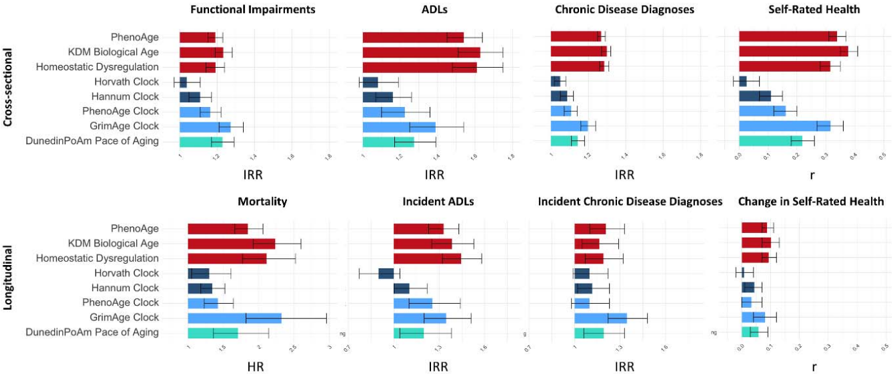
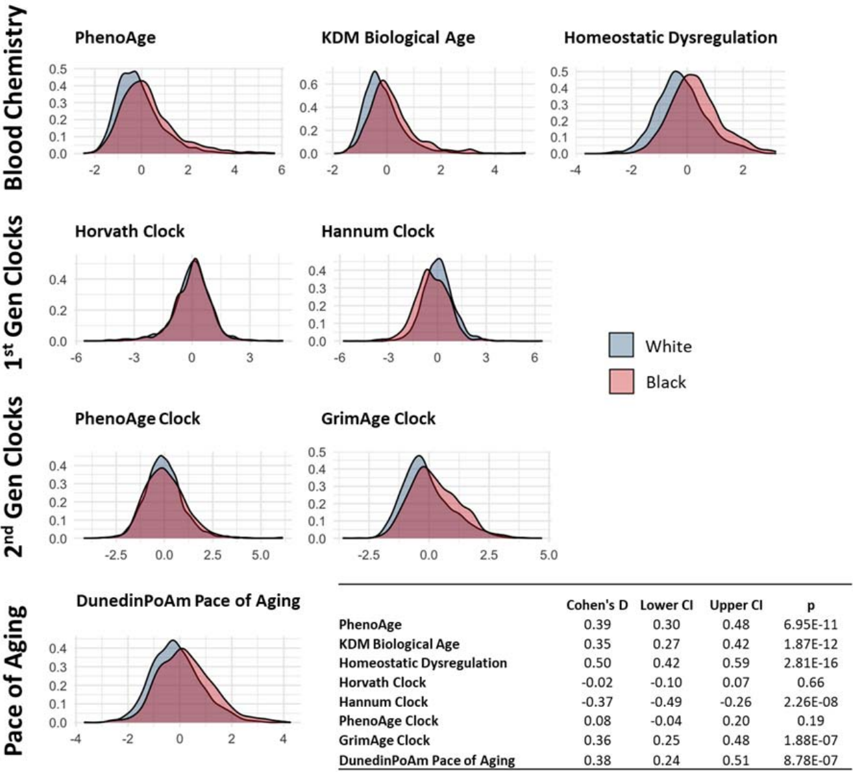
Verification
Claims the paper makes
The claims and statistics of this paper haven’t been checked yet.
Run the check — free, no account needed. It reads the open-access text and checks the sources it cites.
Claims other papers make about this one
Each is checked against this paper’s own text: does it say what the citing paper says it does?
The source backs part of the claim, not all of it — or backs it for a different population, condition or comparison.
In the citing paper
“While many composite biomarkers of aging have shown some evidence of comparable predictive accuracy across genetic ancestry populations 24 70 71, establishing diverse cohorts with non-European ancestries to validate new composite biomarkers of aging remains a priority.”
From Validation of biomarkers of aging (2024) · cites this paper as [71]
Experimental — accuracy not yet measured
Self-check
Percentages, sums and reported differences re-computed from the paper’s own numbers.
The self-check needs the paper’s full text.
Citations
Cites
DNA methylation age of human tissues and cell types
Horvath, S. (2013) · Genome Biology · doi:10.1186/gb-2013-14-10-r115 · Cited by 7,075
Geroscience: Linking Aging to Chronic Disease
Kennedy, B. K., Berger, S. L., Brunet, A., Campisi, J., Cuervo, A. M., Epel, E. S., Franceschi, C., Lithgow, G. J., Morimoto, R. I., Pessin, J. E., et al. (2014) · Cell · doi:10.1016/j.cell.2014.10.039 · Cited by 2,764
DNA methylation GrimAge strongly predicts lifespan and healthspan
Lu, A. T., Quach, A., Wilson, J. G., Reiner, A. P., Aviv, A., Raj, K., Hou, L., Baccarelli, A. A., Li, Y., Stewart, J. D., et al. (2019) · Aging · doi:10.18632/aging.101684 · Cited by 2,540
U.S. Disparities in Health: Descriptions, Causes, and Mechanisms
Adler, N. E., & Rehkopf, D. H. (2008) · Annual Review of Public Health · doi:10.1146/annurev.publhealth.29.020907.090852 · Cited by 1,212
Racial health disparities and covid-19 - caution and context
Chowkwanyun, M., & Reed, A. L. (2020) · New England Journal of Medicine · doi:10.1056/nejmp2012910 · Cited by 706
Health Disparities Beginning in Childhood: A Life-Course Perspective
Braveman, P., & Barclay, C. (2009) · Pediatrics · doi:10.1542/peds.2009-1100d · Cited by 653
Structural interventions to reduce and eliminate health disparities
Brown, A. F., Ma, G. X., Miranda, J., Eng, E., Castille, D., Brockie, T., Jones, P., Airhihenbuwa, C. O., Farhat, T., Zhu, L., et al. (2019) · American Journal of Public Health · doi:10.2105/ajph.2018.304844 · Cited by 465
Socioeconomic position, lifestyle habits and biomarkers of epigenetic aging: a multi-cohort analysis
Fiorito, G., the BIOS Consortium, the Lifepath consortium, McCrory, C., Robinson, O., Carmeli, C., Rosales, C. O., Zhang, Y., Colicino, E., Dugué, P.-A., et al. (2019) · Aging · doi:10.18632/aging.101900 · Cited by 219
Belsky, D. W., Caspi, A., Cohen, H. J., Kraus, W. E., Ramrakha, S., Poulton, R., & Moffitt, T. E. (2017) · Aging Cell · doi:10.1111/acel.12591 · Cited by 114
Self-citationBagby, S. P., Martin, D., Chung, S. T., & Rajapakse, N. (2019) · American Journal of Public Health · doi:10.2105/ajph.2018.304864 · Cited by 79
Research works printed but not linked: 48
- Mehra, 2019, Racial and ethnic disparities in adverse birth outcomes: differences by racial residential segregation, SSM Popul Health, 8
- Jones, 2019, Life course approaches to the causes of health disparities, Am J Public Health, 109, S48, 10.2105/AJPH.2018.304738 · DOI
- Phelan, 2010, Social conditions as fundamental causes of health inequalities: theory, evidence, and policy implications, J Health Soc Behav, 51, S28, 10.1177/0022146510383498 · DOI · Paper page
- Anderson, 2018, Promoting health equity and eliminating disparities through performance measurement and payment, Health Aff (Millwood), 37, 371, 10.1377/hlthaff.2017.1301 · DOI
- Paskett, 2016, Multilevel interventions to address health disparities show promise in improving population health, Health Aff (Millwood), 35, 1429, 10.1377/hlthaff.2015.1360 · DOI
- Butler, 2016, Improving Cultural Competence to Reduce Health Disparities
- Agurs-Collins, 2019, Designing and assessing multilevel interventions to improve minority health and reduce health disparities, Am J Public Health, 109, S86, 10.2105/AJPH.2018.304730 · DOI
- Thornton, 2016, Evaluating strategies for reducing health disparities by addressing the social determinants of health, Health Aff (Millwood), 35, 1416, 10.1377/hlthaff.2015.1357 · DOI · Paper page
- Moffitt, 2017, The longitudinal study of aging in human young adults: knowledge gaps and research agenda, J Gerontol A Biol Sci Med Sci, 72, 210, 10.1093/gerona/glw191 · DOI · Paper page
- Kirkwood, 2005, Understanding the odd science of aging, Cell, 120, 437, 10.1016/j.cell.2005.01.027 · DOI · Paper page
- Barzilai, 2018, Aging as a biological target for prevention and therapy, JAMA, 320, 1321, 10.1001/jama.2018.9562 · DOI
- Bellantuono, 2018, Find drugs that delay many diseases of old age, Nature, 554, 293, 10.1038/d41586-018-01668-0 · DOI
- Geronimus, 2006, “Weathering” and age patterns of allostatic load scores among blacks and whites in the United States, Am J Public Health, 96, 826, 10.2105/AJPH.2004.060749 · DOI · Paper page
- Geronimus, 1992, The weathering hypothesis and the health of African-American women and infants: evidence and speculations, Ethn Dis, 2, 207
- Levine, 2014, Evidence of accelerated aging among African Americans and its implications for mortality, Soc Sci Med, 118, 27, 10.1016/j.socscimed.2014.07.022 · DOI
- Parker, 2020, Association of blood chemistry quantifications of biological aging with disability and mortality in older adults, J Gerontol A Biol Sci Med Sci, 75, 1671, 10.1093/gerona/glz219 · DOI
- Liu, 2019, The role of epigenetic aging in education and racial/ethnic mortality disparities among older US women, Psychoneuroendocrinology, 104, 18, 10.1016/j.psyneuen.2019.01.028 · DOI
- Ferrucci, 2020, Measuring biological aging in humans: a quest, Aging Cell, 19, 10.1111/acel.13080 · DOI · Paper page
- Jylhävä, 2017, Biological age predictors, EBioMedicine, 21, 29, 10.1016/j.ebiom.2017.03.046 · DOI · Paper page
- Belsky, 2018, Eleven telomere, epigenetic clock, and biomarker-composite quantifications of biological aging: do they measure the same thing?, Am J Epidemiol, 187, 1220
- Jansen, 2021, An integrative study of five biological clocks in somatic and mental health, Elife, 10, 10.7554/eLife.59479 · DOI · Paper page
- Li, 2020, Longitudinal trajectories, correlations and mortality associations of nine biological ages across 20-years follow-up, Elife, 9
- Liu, 2019, Associations of genetics, behaviors, and life course circumstances with a novel aging and healthspan measure: evidence from the Health and Retirement Study, PLoS Med, 16, 10.1371/journal.pmed.1002827 · DOI
- Crimmins, 2021, Associations of age, sex, race/ethnicity and education with 13 epigenetic clocks in a nationally representative us sample: the Health and Retirement Study, J Gerontol A Biol Sci Med Sci, 76, 1117, 10.1093/gerona/glab016 · DOI · Paper page
- Horvath, 2016, An epigenetic clock analysis of race/ethnicity, sex, and coronary heart disease, Genome Biol, 17, 171, 10.1186/s13059-016-1030-0 · DOI
- HRS Staff, 2017, Sample Sizes and Response Rates
- Health and Retirement Study, 2021, RAND HRS Longitudinal File 2018 (V1)
- Crimmins, 2017, Venous Blood Collection and Assay Protocol in the 2016 Health and Retirement Study
- Kwon, 2021, A toolkit for quantification of biological age from blood-chemistry and organ-function-test data: BioAge, Geroscience, 43, 2795, 10.1007/s11357-021-00480-5 · DOI · Paper page
- Belsky, 2020, Quantification of the pace of biological aging in humans through a blood test, the DunedinPoAm DNA methylation algorithm, Elife, 9, 10.7554/eLife.54870 · DOI · Paper page
- Valeri, 2013, Mediation analysis allowing for exposure–mediator interactions and causal interpretation: theoretical assumptions and implementation with SAS and SPSS macros, Psychol Methods, 18, 137, 10.1037/a0031034 · DOI · Paper page
- Shi, 2021, CMAverse: a suite of functions for reproducible causal mediation analyses, Epidemiology, 32, e20, 10.1097/EDE.0000000000001378 · DOI · Paper page
- Valeri, 2014, Mediation analysis when a continuous mediator is measured with error and the outcome follows a generalized linear model, Stat Med, 33, 4875, 10.1002/sim.6295 · DOI
- Ward, 2019, How do we assess a racial disparity in health? Distribution, interaction, and interpretation in epidemiological studies, Ann Epidemiol, 29, 1, 10.1016/j.annepidem.2018.09.007 · DOI
- Justice, 2018, A framework for selection of blood-based biomarkers for geroscience-guided clinical trials: report from the TAME Biomarkers Workgroup, Geroscience, 40, 419, 10.1007/s11357-018-0042-y · DOI · Paper page
- Justice, 2020, Aging and geroscience: putting epigenetic biomarkers to the test for clinical trials, Elife, 9, 10.7554/eLife.58592 · DOI · Paper page
- Kritchevsky, 2020, Testing the geroscience hypothesis: early days, J Gerontol A Biol Sci Med Sci, 75, 99, 10.1093/gerona/glz267 · DOI · Paper page
- Levine, 2020, Assessment of epigenetic clocks as biomarkers of aging in basic and population research, J Gerontol A Biol Sci Med Sci, 75, 463, 10.1093/gerona/glaa021 · DOI · Paper page
- Cohen, 2020, Lack of consensus on an aging biology paradigm? A global survey reveals an agreement to disagree, and the need for an interdisciplinary framework, Mech Ageing Dev, 191, 10.1016/j.mad.2020.111316 · DOI
- Mill, 2013, From promises to practical strategies in epigenetic epidemiology, Nat Rev Genet, 14, 585, 10.1038/nrg3405 · DOI
- E, 2019, United States life tables, 2016, Natl Vital Stat Rep, 68, 1
- Virnig, 2009, A matter of race: early-versus late-stage cancer diagnosis, Health Aff (Millwood), 28, 160, 10.1377/hlthaff.28.1.160 · DOI
- Geiger, 2003, Unequal Treatment: Confronting Racial and Ethnic Disparities in Health Care, 417
- Belsky, 2017, Change in the rate of biological aging in response to caloric restriction: CALERIE biobank analysis, J Gerontol A Biol Sci Med Sci, 73, 4, 10.1093/gerona/glx096 · DOI · Paper page
- Levine, 2018, An epigenetic biomarker of aging for lifespan and healthspan, Aging (Albany NY), 10, 573, 10.18632/aging.101414 · DOI · Paper page
- Klemera, 2006, A new approach to the concept and computation of biological age, Mech Ageing Dev, 127, 240, 10.1016/j.mad.2005.10.004 · DOI
- Cohen, 2013, A novel statistical approach shows evidence for multi-system physiological dysregulation during aging, Mech Ageing Dev, 134, 110, 10.1016/j.mad.2013.01.004 · DOI
- Hannum, 2013, Genome-wide methylation profiles reveal quantitative views of human aging rates, Mol Cell, 49, 359, 10.1016/j.molcel.2012.10.016 · DOI · Paper page
Cited by
Sorted by citations
Kwon, D., & Belsky, D. W. (2021) · GeroScience · doi:10.1007/s11357-021-00480-5 · Cited by 410
Self-citationValidation of biomarkers of aging
Moqri, M., Herzog, C., Poganik, J. R., Ying, K., Justice, J. N., Belsky, D. W., Higgins-Chen, A. T., Chen, B. H., Cohen, A. A., Fuellen, G., et al. (2024) · Nature Medicine · doi:10.1038/s41591-023-02784-9 · Cited by 361
Self-citationGao, X., Geng, T., Jiang, M., Huang, N., Zheng, Y., Belsky, D. W., & Huang, T. (2023) · Nature Communications · doi:10.1038/s41467-023-38013-7 · Cited by 306
Self-citationFamilial Loss of a Loved One and Biological Aging: NIMHD Social Epigenomics Program
Aiello, A. E., Mishra, A. A., Martin, C. L., Levitt, B., Gaydosh, L., Belsky, D. W., Hummer, R. A., Umberson, D. J., & Harris, K. M. (2024) · JAMA Network Open · doi:10.1001/jamanetworkopen.2024.21869 · Cited by 35
Self-citation
Metadata
- Authors
- Graf, G. H., Crowe, C. L., Kothari, M., Kwon, D., Manly, J. J., Turney, I. C., Valeri, L., & Belsky, D. W.
- Venue
- American Journal of Epidemiology
- Publisher
- Oxford University Press (OUP)
- Published
- 2021-12-01
- Volume
- 191
- Issue
- 4
- Pages
- 613-625
- ISSN
- 0002-9262
- 1476-6256
- Cited by
- 150
- References
- 10
- Language
- en
- Licence
- academic.oup.com/journals/pages/open_access/funder_policies/chorus/standard_publication_model (vor)
- Funders
- National Institute on Aging (R01AG061378, R01AG066887)
- Russell Sage Foundation (1810-08987)
- National Institute of Mental Health (5T32MH013043)
About these checks
Registry, retraction, Cites and statistics results are computed, not judged, with one exception: a printed reference that no index lists is read once by a model before it counts as a citation error. Claims are extracted by a model and kept only when their quote appears verbatim in the text; each cited source is then checked, with a model’s help, for whether it says what the claim relies on. Those verdicts can be wrong — read the claim’s quote and the cited source before relying on one.
Statistics and arithmetic are recomputed, not judged.
Confidence bands are shown only for fields calibrated on our annotated test set. None is calibrated yet, so no band is shown.
What counts as a claim ›How we measure confidence ›How we check this ›
Are you an author, or do you see a problem with this page? Request a review
