

Bending the Curve of Global Freshwater Biodiversity Loss: An Emergency Recovery Plan
Open accessThe DOI matches its Crossref record; 86 of the 94 references it cites were found in a registry or an index; 5 of the 63 sources its claims cite were checked for support.
Abstract
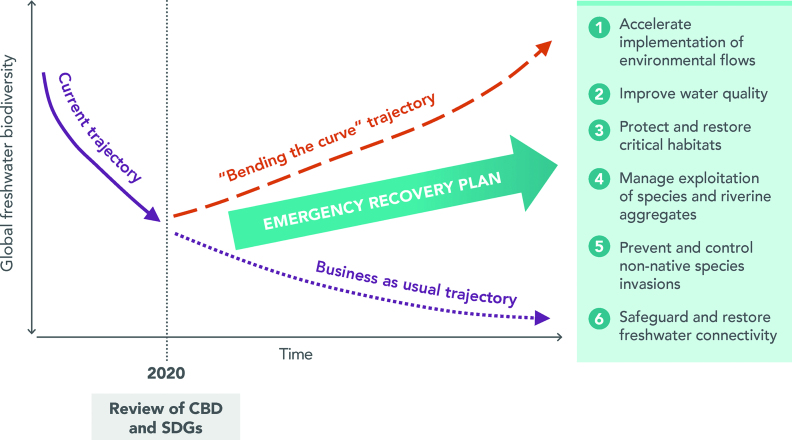
Despite their limited spatial extent, freshwater ecosystems host remarkable biodiversity, including one-third of all vertebrate species. This biodiversity is declining dramatically: Globally, wetlands are vanishing three times faster than forests, and freshwater vertebrate populations have fallen more than twice as steeply as terrestrial or marine populations. Threats to freshwater biodiversity are well documented but coordinated action to reverse the decline is lacking. We present an Emergency Recovery Plan to bend the curve of freshwater biodiversity loss. Priority actions include accelerating implementation of environmental flows; improving water quality; protecting and restoring critical habitats; managing the exploitation of freshwater ecosystem resources, especially species and riverine aggregates; preventing and controlling nonnative species invasions; and safeguarding and restoring river connectivity. We recommend adjustments to targets and indicators for the Convention on Biological Diversity and the Sustainable Development Goals and roles for national and international state and nonstate actors.
Overview
CoChat Summary
TL;DR
The paper presents an Emergency Recovery Plan to reverse global freshwater biodiversity loss through six priority actions: environmental flows, water quality, habitat protection and restoration, sustainable exploitation, invasive species control, and connectivity restoration. It recommends embedding these actions in post-2020 Convention on Biological Diversity and Sustainable Development Goal targets and indicators.
Key findings
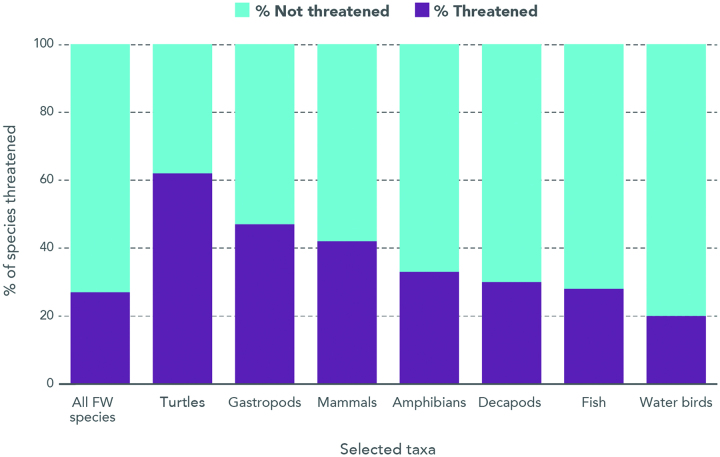
Freshwater ecosystems cover less than 1% of Earth’s surface but host approximately one-third of vertebrate species and 10% of all species; wetlands are vanishing three times faster than forests, and freshwater vertebrate populations have fallen more than twice as steeply as terrestrial or marine populations. Of 29,500 freshwater-dependent species assessed for the IUCN Red List, 27% are threatened with extinction, including an estimated 62% of turtle species, 47% of gastropods, 42% of mammals, 33% of amphibians, 30% of decapod crustaceans, 28% of fishes, and 20% of birds. Freshwater megafauna populations declined by 88% from 1970 to 2012, with the highest declines in Indomalaya (−99%) and Palearctic (−97%) realms. An estimated 30% of natural freshwater ecosystems have disappeared since 1970 and 87% of inland wetlands since 1700; only one-third of the world’s very long rivers remain free flowing, and approximately 3,700 new hydropower dams were identified worldwide at varying planning stages.
Methods
This is a policy and synthesis article, not a primary empirical study; it is structured around six priority actions derived from major causes of freshwater biodiversity loss: flow alteration, pollution, habitat degradation and loss, overexploitation, invasive nonnative species, and connectivity loss. The evidence base consists of cited global assessments, peer-reviewed literature, and implementation case studies from multiple regions, with no new field sample or primary data collection. The main analysis is a narrative review and policy-alignment exercise; Tables 1a and 1b map 13 existing or potential CBD and SDG targets and indicators to the six priority actions.
Limitations
Stated in the paper: implementation examples are “currently isolated successes”; human water demands and transboundary characteristics complicate implementation; data and science-based management are lacking for freshwater fisheries and riverine aggregate extraction; large-scale implementation of nature-based solutions is “in its infancy”; and substantial data gaps remain, including approximately 30% of freshwater mollusk species and 40% of decapod crustaceans classified as data deficient. Evident from the text: the plan is not empirically tested as a whole, relying instead on illustrative case studies and expert synthesis; the paper also notes that offsetting is controversial and open to misapplication.
Model-written summary. Check it against the paper before relying on it.
Integrity signals
Registry
Cites
Statistics
Figures
Verification
Claims the paper makes
5 Valid · 12 Not valid · 50 Not checked · 28 Own results and interpretations
Every source the paper cites for this claim was checked and supports it.
In the paper
“of the fish species assessed for the freshwater ecoregions of the world, over half were confined to a single ecoregion (Abell et al. 2008).”
§ Bending the Curve of Global Freshwater Biodiversity Loss: An Emergency Recovery Plan > Abstract
What the sources say
- Supportedcites Abell et al. 2008 matched to “Freshwater Ecoregions of the World: A New Map of Biogeographic Units for Freshwater Biodiversity Conservation” (2008) source
The “Freshwater ecoregional map and species results” section reports that more than 13,400 freshwater fish species were assigned to ecoregions and more than 6,900 to single ecoregions—over half of those assigned. No page number is supplied in the excerpt. (LLM, conf=0.94)
plain- Asserted: passes — The authors put it forward as true.
- Checkable: passes — It can be checked against evidence.
- Load-bearing: passes — The paper’s conclusions depend on it.
- Based: passes — The paper gives a reason why it holds.
- Supported
The cited sources support only part of this claim — read each source’s verdict below.
In the paper
“Recommendations to address immediate threats to and underlying drivers of global biodiversity loss have focused mainly on terrestrial ecosystems, such as forests and grasslands (e.g., Kok et al. 2018)”
§ Bending the Curve of Global Freshwater Biodiversity Loss: An Emergency Recovery Plan > Abstract
What the sources say
- Partly supportedcites Kok et al. 2018 matched to “Pathways for agriculture and forestry to contribute to terrestrial biodiversity conservation: A global scenario-study” (2018) sourceExperimental — accuracy not yet measured
Our copy supports only the exemplifying part of the attribution: Kok et al. (2018) is itself a terrestrial-scoped recommendations study — the Introduction (p. 1) states it 'evaluates the impacts on biodiversity of different response strategies in the agriculture and forestry sectors', and the Abstract and Sections 2.3/3.1–3.2 build pathways around forests, cropland and grazing land and terrestrial MSA. But no passage makes the comparative claim attributed here, namely that recommendations for global biodiversity loss have focused 'mainly' on terrestrial ecosystems; the closest statement (Introduction) is that societal responses have increased yet remain insufficient, and it credits that to Leadley et al. (2014), CBD (2014) and Tittensor et al. (2014). Aquatic biodiversity is not dismissed as neglected but explicitly handled in a separate companion analysis (Boelee et al., 2017, Introduction), so the 'mainly terrestrial' characterisation and the threats-versus-drivers distinction are not supported by this source. (LLM, conf=0.65)
plain- Asserted: passes — The authors put it forward as true.
- Checkable: passes — It can be checked against evidence.
- Load-bearing: passes — The paper’s conclusions depend on it.
- Based: passes — The paper gives a reason why it holds.
- Partly supported
In the paper
“with the highest declines in the Indomalaya and Palearctic realms (−99% and −97%, respectively; He et al. 2019).”
§ Bending the Curve of Global Freshwater Biodiversity Loss: An Emergency Recovery Plan > Abstract
What the sources say
- Not checked yetcites He et al. 2019
plain- Asserted: passes — The authors put it forward as true.
- Checkable: passes — It can be checked against evidence.
- Load-bearing: unclear — It is unclear whether the paper’s conclusions depend on it.
- Based: passes — The paper gives a reason why it holds.
In the paper
“Populations of freshwater megafauna, defined as animals that reach a body mass of 30 kilograms, declined by 88% from 1970 to 2012”
§ Bending the Curve of Global Freshwater Biodiversity Loss: An Emergency Recovery Plan > Abstract
What the sources say
- Not checked yetcites He et al. 2019
plain- Asserted: passes — The authors put it forward as true.
- Checkable: passes — It can be checked against evidence.
- Load-bearing: passes — The paper’s conclusions depend on it.
- Based: passes — The paper gives a reason why it holds.
In the paper
“Human demands for water will increase in some regions, making implementation more challenging (Palazzo et al. 2019).”
§ Bending the Curve of Global Freshwater Biodiversity Loss: An Emergency Recovery Plan > The Emergency Recovery Plan: Priorities for action > Action 1: Accelerate implementation of environmental flows
What the sources say
- Not checked yetcites Palazzo et al. 2019 matched to “Investment Needs for Irrigation Infrastructure along Different Socioeconomic Pathways” (2019) source
plainstates a cause- Asserted: passes — The authors put it forward as true.
- Checkable: passes — It can be checked against evidence.
- Load-bearing: unclear — It is unclear whether the paper’s conclusions depend on it.
- Based: passes — The paper gives a reason why it holds.
40 more claims
Create a free account to see all 95 claims and to verify the 58 references still open.
- It may state two separate claims as one. 29
- Probably not a substantial claim. 30
Claims other papers make about this one
Each is checked against this paper’s own text: does it say what the citing paper says it does?
The check wasn’t confident either way, so it gives no verdict — never disputed.
In the citing paper
“Hunting at Parker River National Wildlife Refuge represents both a traditional recreational use and serves as an important wildlife management tool.185”
From Protecting and restoring habitats to benefit freshwater biodiversity (2024) · cites this paper as [185]
Experimental — accuracy not yet measured
Citations
Cites
Freshwater biodiversity: importance, threats, status and conservation challenges
Dudgeon, D., Arthington, A. H., Gessner, M. O., Kawabata, Z., Knowler, D. J., Lévêque, C., Naiman, R. J., Prieur‐Richard, A., Soto, D., Stiassny, M. L. J., et al. (2006) · Biological Reviews · doi:10.1017/s1464793105006950 · Cited by 8,489
Self-citationPoff, N. L., Allan, J. D., Bain, M. B., Karr, J. R., Prestegaard, K. L., Richter, B. D., Sparks, R. E., & Stromberg, J. C. (1997) · BioScience · doi:10.2307/1313099 · Cited by 6,500
Pimentel, D., Zuniga, R., & Morrison, D. (2005) · Ecological Economics · doi:10.1016/j.ecolecon.2004.10.002 · Cited by 4,771
Emerging threats and persistent conservation challenges for freshwater biodiversity
Reid, A. J., Carlson, A. K., Creed, I. F., Eliason, E. J., Gell, P. A., Johnson, P. T. J., Kidd, K. A., MacCormack, T. J., Olden, J. D., Ormerod, S. J., et al. (2019) · Biological Reviews · doi:10.1111/brv.12480 · Cited by 3,645
Self-citationBasic Principles and Ecological Consequences of Altered Flow Regimes for Aquatic Biodiversity
BUNN, S. E., & ARTHINGTON, A. H. (2002) · Environmental Management · doi:10.1007/s00267-002-2737-0 · Cited by 3,379
Self-citationCeballos, G., Ehrlich, P. R., & Dirzo, R. (2017) · Proceedings of the National Academy of Sciences · doi:10.1073/pnas.1704949114 · Cited by 2,663
Mapping the world’s free-flowing rivers
Grill, G., Lehner, B., Thieme, M., Geenen, B., Tickner, D., Antonelli, F., Babu, S., Borrelli, P., Cheng, L., Crochetiere, H., et al. (2019) · Nature · doi:10.1038/s41586-019-1111-9 · Cited by 2,473
Self-citationA global boom in hydropower dam construction
Zarfl, C., Lumsdon, A. E., Berlekamp, J., Tydecks, L., & Tockner, K. (2015) · Aquatic Sciences · doi:10.1007/s00027-014-0377-0 · Cited by 2,181
Self-citationHow much wetland has the world lost? Long-term and recent trends in global wetland area
Davidson, N. C. (2014) · Marine and Freshwater Research · doi:10.1071/mf14173 · Cited by 2,177
Abell, R., Thieme, M. L., Revenga, C., Bryer, M., Kottelat, M., Bogutskaya, N., Coad, B., Mandrak, N., Balderas, S. C., Bussing, W., et al. (2008) · BioScience · doi:10.1641/b580507 · Cited by 2,045
Self-citation
Research works printed but not linked: 14
- Döll P, Bunn SE. 2014 Cross-chapter box on the impact of climate change on freshwater ecosystems due to altered river flow regimes. Pages 143– 146 in Field CB et al., eds. Climate Change Impacts, Adaptation, and Vulnerability. Part A: Global and Sectoral Aspects. Contribution of Working Group II to the Fifth Assessment Report of the Intergovernmental Panel on Climate Change. Cambridge University Press.
- Fricke R, Eschmeyer W, van der Laan R 2019 Catalog of fishes: Genera, species, references. California Academy of Sciences. http://researcharchive.calacademy.org/research/ichthyology/catalog/SpeciesByFamily.asp.
- Funge-Smith S. 2018 Review of the State of the World Fishery Resources: Inland Fisheries. Food and Agriculture Organization of the United Nations Fisheries and Aquaculture Circular.
- Harwood A, Johnson S, Richter B, Locke A, Yu X, Tickner D 2017 Listen to the River: Lessons from a Global Review of Environmental Flow Success Stories. World Wildlife Fund.
- [IUCN] International Union for Conservation of Nature 2019 The IUCN Red List of Threatened Species, version 2019-1. IUCN www.iucnredlist.org.
- Koehnken L, Rintoul M. 2018 Impacts of Sand Mining on Ecosystem Structure, Process and Biodiversity in Rivers. World Wildlife Fund International.
- Koning AA. 2018 Riverine Reserves: The Conservation Benefits of Spatial Protection for Rivers in the Context of Environmental Change. University of Wisconsin–Madison.
- Le Quesne T, Kendy E, Weston D 2010 The Implementation Challenge: Taking Stock of Government Policies to Protect and Restore Environmental flows. WWF and The Nature Conservancy.
- Moir K, Thieme M, Opperman J 2016 Securing a Future that Flows: Case Studies of Protection Mechanisms for Rivers. World Wildlife Fund and The Nature Conservancy.
- NBI (Nile Basin Initiative) 2016 Strategy for Management of Environmental Flows in the Nile Basin. Nile Basin Initiative Secretariat. 17p.
- Opperman J et al. 2019a Connected and Flowing: A Renewable Future for Rivers, Climate, and People. WWF and The Nature Conservancy.
- Speed R, Tickner D, Naiman R, Gang L, Sayers P, Yu W, Yuanyuan L, Houjian H, Jianting C, Lili Y 2016 River Restoration: A Strategic Approach to Planning and Management. UNESCO.
- [UNEP] United Nations Environment Programme 2016 Snapshot of the World's Water Quality: Towards a Global Assessment. UNEP.
- UN Environment 2017 A Framework for Freshwater Ecosystem Management, vol. 2: Technical Guide for Classification and Target-Setting. United Nations.
Cited by
Items 101–200 of 1,243
Riparian land use and in-channel stressors drive fish community structure in the Yangtze River
Xiong, F., Olden, J. D., Lü, Y., Liu, H., Qu, X., Xia, W., Guo, C., Wu, X., Infante, D. M., Wang, L., et al. (2021) · Landscape Ecology · doi:10.1007/s10980-021-01278-8 · Cited by 45
Self-citation(2021) · doi:10.1101/2021.05.08.443274 · Cited by 42
Birnie‐Gauvin, K., Lynch, A. J., Franklin, P. A., Reid, A. J., Landsman, S. J., Tickner, D., Dalton, J., Aarestrup, K., & Cooke, S. J. (2023) · Conservation Science and Practice · doi:10.1111/csp2.12911 · Cited by 64
“There are already examples where these priority actions have been implemented, and freshwater habitats improved (see Tickner et al., 2020).”
BackgroundMethodInfluentialSelf-citationSuccesses and failures of conservation actions to halt global river biodiversity loss
Haase, P., Cortés‐Guzmán, D., He, F., Jupke, J. F., Mangadze, T., Pelicice, F. M., Palmer, M. A., Rolls, R. J., Schäfer, R. B., Welti, E. A. R., et al. (2025) · Nature Reviews Biodiversity · doi:10.1038/s44358-024-00012-x · Cited by 60
“Conservation actions to implement environmental flows include managing water abstraction 5,42 , limiting alterations to the natural flow regime to protect biodiversity and ecosystem condition, or simulating a natural flow regime to support ecosystem functions and services in the context of multiple…”
Stein, E. D., Zimmerman, J. K. H., Yarnell, S. M., Stanford, B., Lane, B., Taniguchi‐Quan, K. T., Obester, A., Grantham, T. E., Lusardi, R. A., & Sandoval-Solís, S. (2021) · Frontiers in Environmental Science · doi:10.3389/fenvs.2021.769943 · Cited by 50
“As a result, only a small fraction of the world’s rivers has formal protections of environmental flows (Smakhtin et al., 2004; Tickner et al., 2020).”
BackgroundInfluentialGlobally widespread and increasing violations of environmental flow envelopes
Virkki, V., Alanärä, E., Porkka, M., Ahopelto, L., Gleeson, T., Mohan, C., Wang-Erlandsson, L., Flörke, M., Gerten, D., Gosling, S. N., et al. (2022) · Hydrology and Earth System Sciences · doi:10.5194/hess-26-3315-2022 · Cited by 52
A boost for freshwater conservation
Abell, R., & Harrison, I. J. (2020) · Science · doi:10.1126/science.abe3887 · Cited by 48
Self-citationMolecular diversity of Uzbekistan’s fishes assessed with DNA barcoding
Sheraliev, B., & Peng, Z. (2021) · Scientific Reports · doi:10.1038/s41598-021-96487-1 · Cited by 42
Future-proofing the emergency recovery plan for freshwater biodiversity
Lynch, A. J., Hyman, A. A., Cooke, S. J., Capon, S. J., Franklin, P. A., Jähnig, S. C., McCartney, M., Hòa, N. P., Owuor, M. A., Pittock, J., et al. (2024) · Environmental Reviews · doi:10.1139/er-2022-0116 · Cited by 41
Self-citationInvasive crayfish alter the long‐term functional biodiversity of lotic macroinvertebrate communities
Mathers, K. L., White, J. C., Guareschi, S., Hill, M. J., Heino, J., & Chadd, R. P. (2020) · Functional Ecology · doi:10.1111/1365-2435.13644 · Cited by 48
“Freshwater ecosystems represent some of the most threatened habitats world-wide, with biodiversity losses far exceeding marine and terrestrial environments (Reid et al., 2019; Tickner et al., 2020).”
BackgroundBerger, E., Bossenbroek, L., Beermann, A. J., Schäfer, R. B., Znari, M., Riethmüller, S., Sidhu, N., Kaczmarek, N., Benaissa, H., Ghamizi, M., et al. (2021) · The Science of The Total Environment · doi:10.1016/j.scitotenv.2020.144492 · Cited by 46
Time for decisive actions to protect freshwater ecosystems from global changes
Oberdorff, T. (2022) · Knowledge and Management of Aquatic Ecosystems · doi:10.1051/kmae/2022017 · Cited by 54
“Some few examples of potential solutions focusing on improving water quality, restoring freshwater connectivity and protecting freshwater systemsglobally are givenbelow (see, e.g. Tickner et al., 2020 and Harper et al., 2021 for a more extensive list of solutions).”
BackgroundCooke, S. J., Harrison, I. J., Thieme, M. L., Landsman, S. J., Birnie‐Gauvin, K., Raghavan, R., Creed, I. F., Pritchard, G. A., Ricciardi, A. P., & Hanna, D. E. L. (2023) · PLOS Sustainability and Transformation · doi:10.1371/journal.pstr.0000065 · Cited by 48
Self-citationA horizon scan exercise for aquatic invasive alien species in Iberian inland waters
Oficialdegui, F. J., Zamora‐Marín, J. M., Guareschi, S., Anastácio, P., Murillo, P. G., Ribeiro, F., Miranda, R., Cobo, F., Gallardo, B., García‐Berthou, E., et al. (2023) · The Science of The Total Environment · doi:10.1016/j.scitotenv.2023.161798 · Cited by 50
Rytwinski, T., Kelly, L. A., Donaldson, L., Taylor, J. J., Smith, A., Drake, D. A. R., Martel, A. L., Geist, J. P., Morris, T. J., George, A. L., et al. (2021) · Canadian Journal of Fisheries and Aquatic Sciences · doi:10.1139/cjfas-2020-0331 · Cited by 51
Self-citationQu, Y., Keller, V. D. J., Bachiller‐Jareno, N., Eastman, M., Edwards, F., Jürgens, M. D., Sumpter, J. P., & Johnson, A. C. (2023) · The Science of The Total Environment · doi:10.1016/j.scitotenv.2023.167144 · Cited by 47
Freshwater biodiversity at different habitats: Research hotspots with persistent and emerging themes
Faghihinia, M., Xu, Y., Liu, D., & Wu, N. (2021) · Ecological Indicators · doi:10.1016/j.ecolind.2021.107926 · Cited by 50
Cooke, S. J., Piczak, M. L., Nyboer, E. A., Michalski, F., Bennett, A., Koning, A. A., Hughes, K. A., Chen, Y., Wu, J., Cowx, I. G., et al. (2024) · Environmental Reviews · doi:10.1139/er-2022-0118 · Cited by 38
Self-citationOuellet, V., Collins, M. J., Kocik, J. F., Saunders, R., Sheehan, T. F., Ogburn, M. B., & Lake, T. R. T. (2022) · Frontiers in Ecology and Evolution · doi:10.3389/fevo.2022.1007599 · Cited by 41
Aquatic connectivity: challenges and solutions in a changing climate
Franklin, P. A., Bašić, T., Davison, P. I., Dunkley, K., Ellis, J., Gangal, M., González-Ferreras, A. M., Roberts, C. G., Hunt, G. L., Joyce, D. A., et al. (2024) · Journal of Fish Biology · doi:10.1111/jfb.15727 · Cited by 46
“Protecting and restoring aquatic connectivity is recognized as a vital action for enhancing species ’ resilience and reversing declines in aquatic biodiversity (Beger et al., 2022; Thieme et al., 2023; Tickner et al., 2020; Virtanen et al., 2020).”
BackgroundNational water shortage for low to high environmental flow protection
Vanham, D., Alfieri, L., & Feyen, L. (2022) · Scientific Reports · doi:10.1038/s41598-022-06978-y · Cited by 47
Lubanga, H. L., Manyala, J. O., Sitati, A., Yegon, M. J., & Masese, F. O. (2021) · Ecohydrology & Hydrobiology · doi:10.1016/j.ecohyd.2021.03.001 · Cited by 41
O’Mara, K., Venarsky, M. P., Stewart‐Koster, B., McGregor, G. B., Schulz, C., Kainz, M. J., Marshall, J. C., & Bunn, S. E. (2021) · The Science of The Total Environment · doi:10.1016/j.scitotenv.2021.147785 · Cited by 39
Self-citationTapkir, S. D., Boukal, D. S., Kalous, L., Bartoň, D., de Souza, A. T., Kolář, V., Soukalová, K., Duchet, C., Gottwald, M., & Šmejkal, M. (2022) · Aquatic Conservation Marine and Freshwater Ecosystems · doi:10.1002/aqc.3894 · Cited by 46
Global Analysis of Durable Policies for Free-Flowing River Protections
Perry, D., Harrison, I., Fernandes, S., Burnham, S., & Nichols, A. (2021) · Sustainability · doi:10.3390/su13042347 · Cited by 37
“With less than one-third of the world’s rivers remaining free-flowing, durable protections that safeguard rivers from dam development are imperative to protect the riverine ecosystems and their services [7,27].”
BackgroundSelf-citationHydropower Dam Development and Fish Biodiversity in the Mekong River Basin: A Review
Baird, I. G., & Hogan, Z. S. (2023) · Water · doi:10.3390/w15071352 · Cited by 47
Bergman, J. N., Beaudoin, C., Mistry, I., Turcotte, A., Vis, C., Minelga, V., Neigel, K. L., Lin, H., Bennett, J., Young, N., et al. (2021) · Environmental Reviews · doi:10.1139/er-2021-0026 · Cited by 39
“Boaters visiting from other water systems can also facilitate invasive species transmission (e.g., zebra mussels can attach to the hulls or motors of boats and be transported to newwaters; Timar 2008).”
BackgroundSelf-citationMaznikova, V. N., Ormerod, S. J., & Gómez‐Serrano, M. Á. (2023) · Ecological Indicators · doi:10.1016/j.ecolind.2023.111366 · Cited by 49
“Understanding and diagnosing their effects is an important aspect of modern management responses aimed at slowing or reversing biodiversity decline – for example by addressing climate change, flow modification and habitat impairment (Tickner et al., 2020).”
BackgroundSelf-citationGetting the ‘most out of the hotspot’ for practical conservation of groundwater biodiversity
Iannella, M., Fiasca, B., Lorenzo, T. D., Cicco, M. D., Biondi, M., Mammola, S., & Galassi, D. M. P. (2021) · Global Ecology and Conservation · doi:10.1016/j.gecco.2021.e01844 · Cited by 40
Cooke, S. J., Fulton, E. A., Sauer, W., Lynch, A. J., Link, J. S., Koning, A. A., Jena, J., Silva, L. G. M., King, A. J., Kelly, R., et al. (2023) · Reviews in Fish Biology and Fisheries · doi:10.1007/s11160-023-09765-8 · Cited by 54
“2019) has been an important development, but we have yet to successfully reverse that trend (Harrison et al. 2018; Tickner et al. 2020).”
BackgroundSelf-citationDourado, G. F., Rallings, A. M., & Viers, J. H. (2023) · Environmental Research Letters · doi:10.1088/1748-9326/acc196 · Cited by 42
100 key questions to guide hydropeaking research and policy
Hayes, D. S., Bruno, M. C., Alp, M., Boavida, I., Batalla, R. J., Bejarano, M. D., Noack, M., Vanzo, D., Casas‐Mulet, R., Vericat, D., et al. (2023) · Renewable and Sustainable Energy Reviews · doi:10.1016/j.rser.2023.113729 · Cited by 41
Short-term effects of macrophyte removal on aquatic biodiversity in rivers and lakes
Misteli, B., Pannard, A., Aasland, E., Harpenslager, S. F., Motitsoe, S. N., Thiemer, K., Llopis, S., Coetzee, J. A., Hilt, S., Köhler, J., et al. (2022) · Journal of Environmental Management · doi:10.1016/j.jenvman.2022.116442 · Cited by 57
Multi-scale threat assessment of riverine ecosystems in the Colorado River Basin
Comte, L., Olden, J. D., Lischka, S. A., & Dickson, B. G. (2022) · Ecological Indicators · doi:10.1016/j.ecolind.2022.108840 · Cited by 42
Self-citationLong-term data show alarming decline of majority of fish species in a Lower Mekong basin fishery
Chevalier, M., Ngor, P. B., Pin, K., Touch, B., Lek, S., Grenouillet, G., & Hogan, Z. S. (2023) · The Science of The Total Environment · doi:10.1016/j.scitotenv.2023.164624 · Cited by 41
“…sheries and biodiversity include environmental fl ows, improving water quality, protecting essential habitats, regulating resource extraction (e.g. fi sheries, timber extraction, sand mining), and safeguarding ecological connectivity (Tickner et al., 2020; Twardek et al., 2022; Twardek et al., 2021).”
BackgroundAssessing ambitious nature conservation strategies in a below 2-degree and food-secure world
Kok, M., Meijer, J. R., van Zeist, W., Hilbers, J. P., Immovilli, M., Janse, J. H., Stehfest, E., Bakkenes, M., Tabeau, A., Schipper, A. M., et al. (2023) · Biological Conservation · doi:10.1016/j.biocon.2023.110068 · Cited by 71
Ros, A. F. H., Schmidt‐Posthaus, H., & Brinker, A. (2022) · Journal of Fish Diseases · doi:10.1111/jfd.13585 · Cited by 37
H2O ≠ CO2: framing and responding to the global water crisis
Vollmer, D., & Harrison, I. J. (2020) · Environmental Research Letters · doi:10.1088/1748-9326/abd6aa · Cited by 36
“Meanwhile freshwater biodiversity is declining twice as rapidly as its terrestrial and marine counterparts (Tickner et al 2020).”
BackgroundSelf-citationAn accessible optimisation method for barrier removal planning in stream networks
Hermoso, V., Clavero, M., & Filipe, A. F. (2020) · The Science of The Total Environment · doi:10.1016/j.scitotenv.2020.141943 · Cited by 33
Śmigaj, M., Hackney, C., Diem, P. K., Trí, V. P. Đ., Ngoc, N. T., Bui, D. D., Darby, S. E., & Leyland, J. (2022) · The Science of The Total Environment · doi:10.1016/j.scitotenv.2022.160363 · Cited by 35
“…provision, transport and commerce, the provision of development materials (Bendixen et al., 2021), their role in driving delta-wide changes in salinity and fl ood risk (Vasilopoulos et al., 2021), and potential in reversing recent trends in freshwater biodiversity declines (Tickner et al., 2020).”
Warkentin, L., Parken, C. K., Bailey, R. E., & Moore, J. W. (2022) · Ecological Solutions and Evidence · doi:10.1002/2688-8319.12124 · Cited by 47
Franklin, P. A., Sykes, J., Robbins, J., Booker, D. J., Bowie, S., Gee, E. M., & Baker, C. F. (2022) · Ecological Informatics · doi:10.1016/j.ecoinf.2022.101831 · Cited by 36
De, K., & Dwivedi, A. K. (2023) · Ecohydrology & Hydrobiology · doi:10.1016/j.ecohyd.2023.06.013 · Cited by 40
Climate change and the biodiversity of alpine ponds: Challenges and perspectives
Lamouille‐Hébert, M., Arthaud, F., & Datry, T. (2024) · Ecology and Evolution · doi:10.1002/ece3.10883 · Cited by 36
“In addition to containing ~ 13% of all described species while representing less than 2% of the globe surface, they provide key ecosystem services to people and society, including provision of drinking water, regulation of climate, and food production (Reid et al., 2019; Tickner et al., 2020).”
BackgroundEditorial: Freshwater biodiversity crisis: Multidisciplinary approaches as tools for conservation
Ottoni, F. P., South, J., Azevedo-Santos, V. M., Henschel, E., & Bragança, P. H. N. (2023) · Frontiers in Environmental Science · doi:10.3389/fenvs.2023.1155608 · Cited by 45
McManamay, R. A., George, R., Morrison, R. R., & Ruddell, B. L. (2022) · Scientific Data · doi:10.1038/s41597-022-01566-1 · Cited by 43
Causes and consequences of recent degradation of the Magdalena River basin, Colombia
Salgado, J., Shurin, J. B., Velez, M. I., Link, A., Congote, L. L., González, C., Jaramillo, F., Åhlén, I., & de Luna, G. (2022) · Limnology and Oceanography Letters · doi:10.1002/lol2.10272 · Cited by 36
“This information deficit hinders the development of strategic activities from reducing stresses and restoring ecosystem integrity, biodiversity, and ecosystem services (Tickner et al. 2020).”
BackgroundMobilizing practitioners to support the Emergency Recovery Plan for freshwater biodiversity
Twardek, W. M., Nyboer, E. A., Tickner, D., O’Connor, C. M., Lapointe, N. W. R., Taylor, M. K., Gregory‐Eaves, I., Smol, J. P., Reid, A. J., Creed, I. F., et al. (2021) · Conservation Science and Practice · doi:10.1111/csp2.467 · Cited by 37
“An Emergency Recovery Plan for Freshwater Biodiversity (henceforth, ERP) was recently published by a team of freshwater conservation experts and is a major step toward prioritizing actions to reverse declines in freshwater biodiversity (Tickner et al., 2020).”
BackgroundInfluentialSelf-citationA freshwater perspective on the United Nations decade for ecosystem restoration
Cooke, S. J., Frempong‐Manso, A., Piczak, M. L., Karathanou, E., Clavijo, C., Ajagbe, S. O., Akeredolu, E., Strauch, A. M., & Piccolo, J. (2022) · Conservation Science and Practice · doi:10.1111/csp2.12787 · Cited by 42
Self-citationPotential for Mycorrhizae-Assisted Phytoremediation of Phosphorus for Improved Water Quality
Rubin, J. A., & Görres, J. H. (2020) · International Journal of Environmental Research and Public Health · doi:10.3390/ijerph18010007 · Cited by 35
“Drinking water and recreational resources are contaminated by emissions from non-point sources with various management practices [1,3,4,6].”
BackgroundBlackman, R. C., Carraro, L., Keck, F., & Altermatt, F. (2024) · Philosophical Transactions of the Royal Society B Biological Sciences · doi:10.1098/rstb.2023.0121 · Cited by 33
Mor, J., Muñoz, I., Sabater, S., Zamora, L., & Ruhí, A. (2021) · Ecology · doi:10.1002/ecy.3587 · Cited by 33
Porras-Rivera, G., Górski, K., & Colin, N. (2024) · Environmental Research · doi:10.1016/j.envres.2024.119607 · Cited by 39
Wineland, S. M., Fovargue, R. E., York, B., Lynch, A. J., Paukert, C. P., & Neeson, T. M. (2020) · Journal of Environmental Management · doi:10.1016/j.jenvman.2020.111694 · Cited by 30
Self-citationKong, R., Yang, C., Huang, K. J., Han, G., Sun, Q. Y., Zhang, Y., Zhang, H., Letcher, R. J., & Liu, C. (2022) · Water Research · doi:10.1016/j.watres.2022.119040 · Cited by 31
A new flow path: eDNA connecting hydrology and biology
URycki, D. R., Kirtane, A. A., Aronoff, R., Avila, C. C., Blackman, R. C., Carraro, L., Evrard, O., Good, S. P., Jaramillo, D. C. H., López‐Rodríguez, N., et al. (2024) · Wiley Interdisciplinary Reviews Water · doi:10.1002/wat2.1749 · Cited by 41
“…change, challenges to conservation of water resources involve all compartments of the hydrological cycle (de Jong, 2015; Griebler & Avramov, 2015; van Tiel et al., 2023), while freshwater biodiversity decline is higher than in most other ecosystems (Brosse et al., 2022; Tickner et al., 2020).”
BackgroundEffects of small hydropower dams on macroinvertebrate and fish assemblages in southern Brazil
Couto, T. B. A., Rezende, R. D. S., de Aquino, P. D. P. U., Costa‐Pereira, R., de Campos, G. L., Occhi, T. V., Vitule, J. R. S., Espírito‐Santo, H. M. V., Soares, Y. F. F., & Olden, J. D. (2023) · Freshwater Biology · doi:10.1111/fwb.14078 · Cited by 35
Self-citationLankia, T., Venesjärvi, R., & Pouta, E. (2022) · Fisheries Research · doi:10.1016/j.fishres.2022.106425 · Cited by 37
Pompeu, C. R., Peñas, F. J., Goldenberg‐Vilar, A., Álvarez‐Cabria, M., & Barquín, J. (2022) · Ecological Indicators · doi:10.1016/j.ecolind.2022.109662 · Cited by 36
Onojeghuo, A. O., Onojeghuo, A. R., Cotton, M., Potter, J., & Jones, B. (2021) · GIScience & Remote Sensing · doi:10.1080/15481603.2021.1952541 · Cited by 34
Ten key issues from the Global Wetland Outlook for decision makers
Finlayson, C. M., & Gardner, R. C. (2020) · Marine and Freshwater Research · doi:10.1071/mf20079 · Cited by 31
Ecological and potential socioeconomic impacts of two globally-invasive crayfish
Madzivanzira, T. C., Weyl, O. L. F., & South, J. (2022) · NeoBiota · doi:10.3897/neobiota.72.71868 · Cited by 32
“Invasive alien species (IAS) are widely recognised as drivers of change; thus, impetus is on predicting, quantifying and mitigating impacts across sectors whether they be positive or negative, to provide evidence for legislators (Ricciardi et al. 2013; Blackburn et al. 2014; Tickner et al. 2020; Vimercati et al. 2020).”
BackgroundErős, T., Hermoso, V., & Langhans, S. D. (2023) · Wiley Interdisciplinary Reviews Water · doi:10.1002/wat2.1645 · Cited by 40
He, F., Arora, R., & Mansour, I. (2023) · Wiley Interdisciplinary Reviews Water · doi:10.1002/wat2.1641 · Cited by 37
“Our window to galvanize conservation and restoration actions to bend the biodiversity curve in freshwaters to recovery is small (Tickner et al., 2020).”
BackgroundExtinction risks and threats facing the freshwater fishes of Britain
Nunn, A. D., Ainsworth, R. F., Walton, S., Bean, C. W., Hatton‐Ellis, T., Brown, A., Evans, R., Atterborne, A., Ottewell, D., & Noble, R. (2023) · Aquatic Conservation Marine and Freshwater Ecosystems · doi:10.1002/aqc.4014 · Cited by 28
Climate change, water and future cooperation and development in the Euphrates-Tigris basin
Mueller, A., Detges, A., Pohl, B., Reuter, M. H., Rochowski, L., Volkholz, J., & Woertz, E. (2021) · doi:10.55317/casc017 · Cited by 44
“Environmental flows are one of the most critical measures to sustain the integrity of freshwater ecosystems (Tickner et al., 2020), and the need to implement them at the basin scale is widely recommended, especially for safeguarding the Mesopotamian Marshes (see for example Gleick et al., 2020).”
BackgroundCheng, S., Yang, X., Yang, G., et al. (2024) · International Journal of Applied Earth Observation and Geoinformation · doi:10.1016/j.jag.2024.103716 · Cited by 29
Houart, C., Hoogesteger, J., & Boelens, R. (2024) · Environmental Politics · doi:10.1080/09644016.2024.2345561 · Cited by 43
“Alongside lakes and wetlands, rivers cover less than 1% of the Earth’s surface but host approximately 10% of all species, illustrating the fact that they are amongst the most biodiverse ecosystems on the planet (Tickner et al .”
Larsen, S., Majone, B., Zulian, P., Stella, E., Bellin, A., Bruno, M. C., & Zolezzi, G. (2021) · Water Resources Research · doi:10.1029/2020wr028496 · Cited by 28
“However, this highlights how defining a baseline flow-ecology relationship under natural conditions might become increasingly difficult as river catchments are modified globally (Tickner et al., 2020).”
BackgroundGlobal Patterns and Drivers of Freshwater Fish Extinctions: Can We Learn From Our Losses?
Vardakas, L., Perdikaris, C., Freyhof, J., Zimmerman, B., Ford, M., Vlachopoulos, K., Koutsikos, N., Karaouzas, I., Chamoglou, M., & Kalogianni, E. (2025) · Global Change Biology · doi:10.1111/gcb.70244 · Cited by 43
“This comprehensive restoration effort may be one of the few viable paths to reversing the trend of global freshwater biodiversity loss and “bending the curve” of extinction (Tickner et al. 2020; Dudgeon and Strayer 2025).”
Combined effects of life‐history traits and human impact on extinction risk of freshwater megafauna
He, F., Langhans, S. D., Zarfl, C., Wanke, R., Tockner, K., & Jähnig, S. C. (2020) · Conservation Biology · doi:10.1111/cobi.13590 · Cited by 29
“Freshwaters are among the most threatened ecosystem globally (Reid et al. 2019; Tickner et al. 2020).”
BackgroundSelf-citationMacaulay, S. J., Jeppesen, E., Riebesell, U., Nejstgaard, J. C., Berger, S. A., Lewandowska, A. M., Rico, A., Kefford, B. J., Vad, C. F., Costello, D. M., et al. (2025) · Oikos · doi:10.1111/oik.11020 · Cited by 39
“This is particularly relevant in solution-oriented research due to 1) restoration efforts often targeting habitat-or catchment-scale processes, and 2) the importance of connectivity in ecological recovery (Tickner et al. 2020).”
Resilient rivers and connected marine systems: a review of mutual sustainability opportunities
Hansen, H. H., Bergman, E., Cowx, I. G., Lind, L. A., Pauna, V. H., & Willis, K. A. (2022) · Global Sustainability · doi:10.1017/sus.2022.19 · Cited by 34
“Dams have broad socioecological impacts upstream and downstream of their reservoir (Richter et al., 2010), and this issue persists well after the lifespan of the dam has surpassed and restoration is needed (Bellmore et al., 2019; Hansen et al., 2019; Perera et al., 2021; Tullos et al., 2016).”
BackgroundIndictors of Wetland Health Improve Following Small-Scale Ecological Restoration on Private Land
Bentley, S. B., Tomscha, S. A., & Deslippe, J. R. (2021) · The Science of The Total Environment · doi:10.1016/j.scitotenv.2022.155760 · Cited by 31
Salinas‐Rodríguez, S. A., Macías, E. B., Mata, D. M. I., Nava-López, M. Z., Neri-Flores, I., Varela, R. D., & Mora, I. D. G. (2021) · Sustainability · doi:10.3390/su13031240 · Cited by 34
Kusworo, T. D., Kumoro, A. C., Puspa, M. B., et al. (2024) · Journal of Environmental Chemical Engineering · doi:10.1016/j.jece.2024.112216 · Cited by 28
Impacts of Dams on Freshwater Turtles: A Global Review to Identify Conservation Solutions
Bárcenas-García, A., Michalski, F., Morgan, W. H., Smith, R. K., Sutherland, W. J., Gibbs, J. P., & Norris, D. (2022) · Tropical Conservation Science · doi:10.1177/19400829221103709 · Cited by 28
“Despite the known impacts, there is little available evidence documenting dam mitigation interventions for aquatic fauna such as freshwater turtles (CEE, 2021; dos Santos et al., 2021; Sainsbury et al., 2021; Tickner et al., 2020).”
BackgroundInfluentialWhen the Eel Meets Dams: Larger Dams’ Long-Term Impacts on Anguilla anguilla (L., 1758)
Podda, C., Palmas, F., Pusceddu, A., & Sabatini, A. (2022) · Frontiers in Environmental Science · doi:10.3389/fenvs.2022.876369 · Cited by 28
Global mapping of river sediment bars
Carbonneau, P. E., & Bizzi, S. (2024) · Earth Surface Processes and Landforms · doi:10.1002/esp.5739 · Cited by 27
“…trajectories of the recent past (last decades/years) will determine our ability to detect freshwater biodiversity losses, associated ecosystem services availability, such as water resources for energy and food production, as well as flood mitigation strategies (Fryirs, 2017; Tickner et al., 2020).”
BackgroundMouton, T. L., Leprieur, F., Floury, M., Stephenson, F., Verburg, P., & Tonkin, J. D. (2022) · Ecography · doi:10.1111/ecog.06148 · Cited by 29
More exposure opportunities for promoting freshwater conservation
He, F., Jähnig, S. C., Wetzig, A., & Langhans, S. D. (2021) · Aquatic Conservation Marine and Freshwater Ecosystems · doi:10.1002/aqc.3725 · Cited by 32
Land and deep-sea mining: the challenges of comparing biodiversity impacts
Katona, S. K., Paulikas, D., Ali, S. H., Clarke, M., Ilves, E., Lovejoy, T. Ε., Madin, L. P., & Stone, G. S. (2023) · Biodiversity and Conservation · doi:10.1007/s10531-023-02558-2 · Cited by 32
Carvalho, F., Pascoal, C., Cássio, F., Teixeira, A., & Sousa, R. (2022) · Freshwater Biology · doi:10.1111/fwb.13884 · Cited by 37
Vegetation Dynamic in a Large Floodplain Wetland: The Effects of Hydroclimatic Regime
Lei, J., Zeng, Q., He, K., Liu, P., Fan, R., Lu, W., Lei, G., Cai, L., & Wen, L. (2023) · Remote Sensing · doi:10.3390/rs15102614 · Cited by 31
Impacts of ecological restoration on the genetic diversity of plant species: A global meta‐analysis
Wei, X., Xu, Y., Lyu, L., Xiao, Z., Wang, S., Yang, T., & Jiang, M. (2023) · Journal of Applied Ecology · doi:10.1111/1365-2664.14390 · Cited by 40
Buchanan, B. P., Sethi, S. A., Cuppett, S., Lung, M., Jackman, G., Zarri, L., Duvall, E., Dietrich, J., Sullivan, P., Dominitz, A., et al. (2022) · Journal of Environmental Management · doi:10.1016/j.jenvman.2021.113952 · Cited by 25
Sternhagen, E. C., Davis, M. A., Larson, E. R., et al. (2024) · Environmental DNA · doi:10.1002/edn3.525 · Cited by 27
Modeling Functional Flows in California’s Rivers
Grantham, T. E., Carlisle, D. M., Howard, J. K., Lane, B., Lusardi, R. A., Obester, A., Sandoval-Solís, S., Stanford, B., Stein, E. D., Taniguchi‐Quan, K. T., et al. (2022) · Frontiers in Environmental Science · doi:10.3389/fenvs.2022.787473 · Cited by 35
The future of global river health monitoring
Kuehne, L. M., Dickens, C. W. S., Tickner, D., Messager, M., Olden, J. D., O'Brien, G. C., Lehner, B., & Eriyagama, N. (2023) · PLOS Water · doi:10.1371/journal.pwat.0000101 · Cited by 35
Self-citationDing, C., Sun, J., Huang, M., Bond, N. R., Ding, L., & Tao, J. (2023) · Freshwater Biology · doi:10.1111/fwb.14105 · Cited by 31
Inland navigation and land use interact to impact European freshwater biodiversity
Sexton, A. N., Beisel, J.-N., Staentzel, C., Wolter, C., Tales, E., Belliard, J., Buijse, A. D., Martínez Fernández, V., Wantzen, K. M., Jähnig, S. C., et al. (2024) · Nature Ecology & Evolution · doi:10.1038/s41559-024-02414-8 · Cited by 26
“Efforts are being made to halt these declines as freshwater ecosystems harbour vital ecological, economic and cultural values 4 .”
Rheinheimer, D. E., Tarroja, B., Rallings, A. M., Willis, A. D., & Viers, J. H. (2023) · Environmental Research Infrastructure and Sustainability · doi:10.1088/2634-4505/acb6b0 · Cited by 29
Fungi in Freshwaters: Prioritising Aquatic Hyphomycetes in Conservation Goals
de Barros, J. S., & Seena, S. (2022) · Water · doi:10.3390/w14040605 · Cited by 30
50 Years on, w(h)ither the Ramsar convention? A case of institutional drift
Bridgewater, P. B., & Kim, R. E. (2021) · Biodiversity and Conservation · doi:10.1007/s10531-021-02281-w · Cited by 31
Munian, K., Ramli, F. F., Othman, N., Mahyudin, N. A. A., Sariyati, N. H., Abdullah‐Fauzi, N. A. F., Haris, H., ILHAM-NORHAKIM, M. L., & Abdul‐Latiff, M. A. B. (2024) · Molecular Ecology Resources · doi:10.1111/1755-0998.13936 · Cited by 34
Towards (better) fluvial meta-ecosystem ecology: a research perspective
Talluto, L., del Campo, R., Estévez, E., Altermatt, F., Datry, T., & Singer, G. A. (2024) · npj Biodiversity · doi:10.1038/s44185-023-00036-0 · Cited by 37
“Globally, freshwater ecosystems represent a small fraction of total land area, but support a disproportionately high fraction of total biodiversity and are increasingly under threat 86,87 .”
BackgroundHeino, J., & Koljonen, S. (2022) · Ecological Solutions and Evidence · doi:10.1002/2688-8319.12142 · Cited by 31
Salinas-Rodríguez, S. A., Sánchez-Navarro, R., & Barrios-Ordóñez, J. E. (2021) · Hydrological Sciences Journal · doi:10.1080/02626667.2020.1849705 · Cited by 25
van Rees, C. B., Waylen, K. A., Schmidt-Kloiber, A., Thackeray, S. J., Kalinkat, G., Martens, K., Domisch, S., Lillebø, A. I., Hermoso, V., Grossart, H.-P., et al. (2020) · doi:10.20944/preprints202001.0212.v1 · Cited by 192
da Silva, J. P., Gonçalves, D. V., Lopes‐Lima, M., Anastácio, P., Banha, F., Frimpong, E. A., Gama, M., Miranda, R., Reis, J., Filipe, A. F., et al. (2022) · Freshwater Biology · doi:10.1111/fwb.13885 · Cited by 33
Metadata
- Authors
- Tickner, D., Opperman, J. J., Abell, R., Acreman, M., Arthington, A. H., Bunn, S. E., Cooke, S. J., Dalton, J., Darwall, W., Edwards, G., Harrison, I., Hughes, K., Jones, T., Leclère, D., Lynch, A. J., Leonard, P., McClain, M. E., Muruven, D., Olden, J. D., Ormerod, S. J., Robinson, J., Tharme, R. E., Thieme, M., Tockner, K., Wright, M., & Young, L.
- Affiliations
- WWF-UK (GB)
- World Wildlife Fund (US)
- Conservation International (US)
- UK Centre for Ecology & Hydrology (GB)
- Griffith University (AU)
- Carleton University (CA)
- International Union for Conservation of Nature (CH)
- International Union for Conservation of Nature (United Kingdom) (GB)
- DJEnvironmental, Harpers Mill, United Kingdom
- International Institute for Applied Systems Analysis (AT)
- United States Geological Survey (US)
- IHE Delft Institute for Water Education (NL)
- Freshwater Practice of WWF International, Zeist, The Netherlands
- University of Washington (US)
- Cardiff University (GB)
- Wildfowl & Wetlands Trust (GB)
- Director of Riverfutures, Cressbrook, United Kingdom
- Leibniz Institute of Freshwater Ecology and Inland Fisheries (DE)
- Corresponding author
- Tickner, David
- ORCID
- Venue
- BioScience
- Publisher
- Oxford University Press (OUP)
- Published
- 2020-02-19
- Volume
- 70
- Issue
- 4
- Pages
- 330-342
- ISSN
- 0006-3568 (ISSN-L)
- 1525-3244
- PMC
- PMC7138689
- OpenAlex
- W2982687801
- Cited by
- 1,241
- References
- 94
- Citations by year
- 2026: 233 · 2025: 222 · 2024: 229 · 2023: 184 · 2022: 192 · 2021: 140 · 2020: 41
- FWCI
- 88.45
- Type
- journal article
- Language
- en
- Open access
- hybrid
- doi.org
- Licence
- Locations
- BioScience (publishedVersion, cc-by-nc)
- Europe PMC (PubMed Central) (publishedVersion, cc-by-nc)
- PubMed Central (publishedVersion, cc-by-nc)
- PubMed (publishedVersion)
- ORCA Online Research @Cardiff (Cardiff University) (acceptedVersion)
- NERC Open Research Archive (Natural Environment Research Council) (acceptedVersion)
- IIASA PURE (International Institute of Applied Systems Analysis) (acceptedVersion)
- Griffith Research Online (submittedVersion, cc-by-nc)
- Funders
- University of Washington
- Cardiff University
- Griffith University
- Technische Universiteit Delft
- WWF International
- Freie Universität Berlin
- U.S. Geological Survey
- School of Aquatic and Fishery Sciences
- Centre for Ecology and Hydrology
- Topics
- Physical Sciences › Environmental Science › Nature and Landscape Conservation › Fish Ecology and Management Studies
- Physical Sciences › Environmental Science › Ecology › Aquatic Ecosystems and Biodiversity
- Physical Sciences › Environmental Science › Ecology › Freshwater macroinvertebrate diversity and ecology
- Keywords
- freshwater biodiversity loss, biodiversity recovery, wetland loss, freshwater vertebrates, environmental flows, water quality, habitat restoration, freshwater management, river connectivity, Convention on Biological Diversity, Sustainable Development Goals
About these checks
Registry, retraction, Cites and statistics results are computed, not judged, with one exception: a printed reference that no index lists is read once by a model before it counts as a citation error. Claims are extracted by a model and kept only when their quote appears verbatim in the text; each cited source is then checked, with a model’s help, for whether it says what the claim relies on. Those verdicts can be wrong — read the claim’s quote and the cited source before relying on one.
The claim verdicts this report counts are experimental: their accuracy is not yet measured.
A language model drew the claims from the paper on 2026-10-05, under version 3 of the claim definition (model deepseek-v4.1-flash, prompt extract-v3).
A second model labelled each claim on 2026-10-05 (model jev-1.13-20260917, definition revision gold-guideline-v0.2).
Cited sources are checked with a language model’s help (gpt-6-sol and qwen3.8-omni-flash).
Statistics and arithmetic are recomputed, not judged.
Confidence bands are shown only for fields calibrated on our annotated test set. None is calibrated yet, so no band is shown.
What counts as a claim ›How we measure confidence ›How we check this ›
Are you an author, or do you see a problem with this page? Request a review
Data sources
Bibliographic data: Semantic Scholar, OpenAlex, Crossref.
Contains information from the Semantic Scholar Academic Graph Datasets, made available under the ODC Attribution License (ODC-BY 1.0).
Semantic Scholar’s data is described in: Kinney, R., et al. (2023). The Semantic Scholar Open Data Platform. arXiv:2301.10140.
