

Bending the Curve of Global Freshwater Biodiversity Loss: An Emergency Recovery Plan
Open accessThe DOI matches its Crossref record; 86 of the 94 references it cites were found in a registry or an index; 5 of the 63 sources its claims cite were checked for support.
Abstract
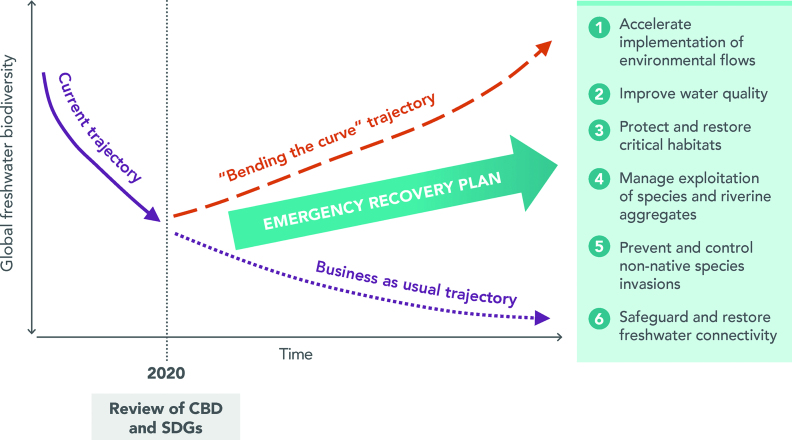
Despite their limited spatial extent, freshwater ecosystems host remarkable biodiversity, including one-third of all vertebrate species. This biodiversity is declining dramatically: Globally, wetlands are vanishing three times faster than forests, and freshwater vertebrate populations have fallen more than twice as steeply as terrestrial or marine populations. Threats to freshwater biodiversity are well documented but coordinated action to reverse the decline is lacking. We present an Emergency Recovery Plan to bend the curve of freshwater biodiversity loss. Priority actions include accelerating implementation of environmental flows; improving water quality; protecting and restoring critical habitats; managing the exploitation of freshwater ecosystem resources, especially species and riverine aggregates; preventing and controlling nonnative species invasions; and safeguarding and restoring river connectivity. We recommend adjustments to targets and indicators for the Convention on Biological Diversity and the Sustainable Development Goals and roles for national and international state and nonstate actors.
Overview
CoChat Summary
TL;DR
The paper presents an Emergency Recovery Plan to reverse global freshwater biodiversity loss through six priority actions: environmental flows, water quality, habitat protection and restoration, sustainable exploitation, invasive species control, and connectivity restoration. It recommends embedding these actions in post-2020 Convention on Biological Diversity and Sustainable Development Goal targets and indicators.
Key findings
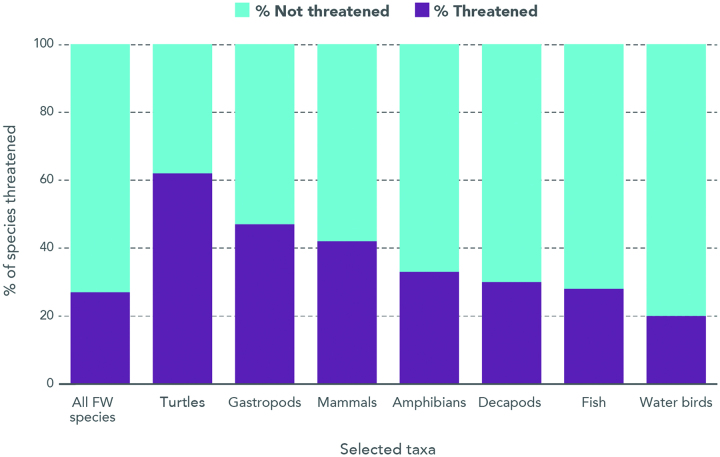
Freshwater ecosystems cover less than 1% of Earth’s surface but host approximately one-third of vertebrate species and 10% of all species; wetlands are vanishing three times faster than forests, and freshwater vertebrate populations have fallen more than twice as steeply as terrestrial or marine populations. Of 29,500 freshwater-dependent species assessed for the IUCN Red List, 27% are threatened with extinction, including an estimated 62% of turtle species, 47% of gastropods, 42% of mammals, 33% of amphibians, 30% of decapod crustaceans, 28% of fishes, and 20% of birds. Freshwater megafauna populations declined by 88% from 1970 to 2012, with the highest declines in Indomalaya (−99%) and Palearctic (−97%) realms. An estimated 30% of natural freshwater ecosystems have disappeared since 1970 and 87% of inland wetlands since 1700; only one-third of the world’s very long rivers remain free flowing, and approximately 3,700 new hydropower dams were identified worldwide at varying planning stages.
Methods
This is a policy and synthesis article, not a primary empirical study; it is structured around six priority actions derived from major causes of freshwater biodiversity loss: flow alteration, pollution, habitat degradation and loss, overexploitation, invasive nonnative species, and connectivity loss. The evidence base consists of cited global assessments, peer-reviewed literature, and implementation case studies from multiple regions, with no new field sample or primary data collection. The main analysis is a narrative review and policy-alignment exercise; Tables 1a and 1b map 13 existing or potential CBD and SDG targets and indicators to the six priority actions.
Limitations
Stated in the paper: implementation examples are “currently isolated successes”; human water demands and transboundary characteristics complicate implementation; data and science-based management are lacking for freshwater fisheries and riverine aggregate extraction; large-scale implementation of nature-based solutions is “in its infancy”; and substantial data gaps remain, including approximately 30% of freshwater mollusk species and 40% of decapod crustaceans classified as data deficient. Evident from the text: the plan is not empirically tested as a whole, relying instead on illustrative case studies and expert synthesis; the paper also notes that offsetting is controversial and open to misapplication.
Model-written summary. Check it against the paper before relying on it.
Integrity signals
Registry
Cites
Statistics
Figures
Verification
Claims the paper makes
5 Valid · 12 Not valid · 50 Not checked · 28 Own results and interpretations
Every source the paper cites for this claim was checked and supports it.
In the paper
“of the fish species assessed for the freshwater ecoregions of the world, over half were confined to a single ecoregion (Abell et al. 2008).”
§ Bending the Curve of Global Freshwater Biodiversity Loss: An Emergency Recovery Plan > Abstract
What the sources say
- Supportedcites Abell et al. 2008 matched to “Freshwater Ecoregions of the World: A New Map of Biogeographic Units for Freshwater Biodiversity Conservation” (2008) source
The “Freshwater ecoregional map and species results” section reports that more than 13,400 freshwater fish species were assigned to ecoregions and more than 6,900 to single ecoregions—over half of those assigned. No page number is supplied in the excerpt. (LLM, conf=0.94)
plain- Asserted: passes — The authors put it forward as true.
- Checkable: passes — It can be checked against evidence.
- Load-bearing: passes — The paper’s conclusions depend on it.
- Based: passes — The paper gives a reason why it holds.
- Supported
The cited sources support only part of this claim — read each source’s verdict below.
In the paper
“Recommendations to address immediate threats to and underlying drivers of global biodiversity loss have focused mainly on terrestrial ecosystems, such as forests and grasslands (e.g., Kok et al. 2018)”
§ Bending the Curve of Global Freshwater Biodiversity Loss: An Emergency Recovery Plan > Abstract
What the sources say
- Partly supportedcites Kok et al. 2018 matched to “Pathways for agriculture and forestry to contribute to terrestrial biodiversity conservation: A global scenario-study” (2018) sourceExperimental — accuracy not yet measured
Our copy supports only the exemplifying part of the attribution: Kok et al. (2018) is itself a terrestrial-scoped recommendations study — the Introduction (p. 1) states it 'evaluates the impacts on biodiversity of different response strategies in the agriculture and forestry sectors', and the Abstract and Sections 2.3/3.1–3.2 build pathways around forests, cropland and grazing land and terrestrial MSA. But no passage makes the comparative claim attributed here, namely that recommendations for global biodiversity loss have focused 'mainly' on terrestrial ecosystems; the closest statement (Introduction) is that societal responses have increased yet remain insufficient, and it credits that to Leadley et al. (2014), CBD (2014) and Tittensor et al. (2014). Aquatic biodiversity is not dismissed as neglected but explicitly handled in a separate companion analysis (Boelee et al., 2017, Introduction), so the 'mainly terrestrial' characterisation and the threats-versus-drivers distinction are not supported by this source. (LLM, conf=0.65)
plain- Asserted: passes — The authors put it forward as true.
- Checkable: passes — It can be checked against evidence.
- Load-bearing: passes — The paper’s conclusions depend on it.
- Based: passes — The paper gives a reason why it holds.
- Partly supported
In the paper
“with the highest declines in the Indomalaya and Palearctic realms (−99% and −97%, respectively; He et al. 2019).”
§ Bending the Curve of Global Freshwater Biodiversity Loss: An Emergency Recovery Plan > Abstract
What the sources say
- Not checked yetcites He et al. 2019
plain- Asserted: passes — The authors put it forward as true.
- Checkable: passes — It can be checked against evidence.
- Load-bearing: unclear — It is unclear whether the paper’s conclusions depend on it.
- Based: passes — The paper gives a reason why it holds.
In the paper
“Populations of freshwater megafauna, defined as animals that reach a body mass of 30 kilograms, declined by 88% from 1970 to 2012”
§ Bending the Curve of Global Freshwater Biodiversity Loss: An Emergency Recovery Plan > Abstract
What the sources say
- Not checked yetcites He et al. 2019
plain- Asserted: passes — The authors put it forward as true.
- Checkable: passes — It can be checked against evidence.
- Load-bearing: passes — The paper’s conclusions depend on it.
- Based: passes — The paper gives a reason why it holds.
In the paper
“Human demands for water will increase in some regions, making implementation more challenging (Palazzo et al. 2019).”
§ Bending the Curve of Global Freshwater Biodiversity Loss: An Emergency Recovery Plan > The Emergency Recovery Plan: Priorities for action > Action 1: Accelerate implementation of environmental flows
What the sources say
- Not checked yetcites Palazzo et al. 2019 matched to “Investment Needs for Irrigation Infrastructure along Different Socioeconomic Pathways” (2019) source
plainstates a cause- Asserted: passes — The authors put it forward as true.
- Checkable: passes — It can be checked against evidence.
- Load-bearing: unclear — It is unclear whether the paper’s conclusions depend on it.
- Based: passes — The paper gives a reason why it holds.
40 more claims
Create a free account to see all 95 claims and to verify the 58 references still open.
- It may state two separate claims as one. 29
- Probably not a substantial claim. 30
Claims other papers make about this one
Each is checked against this paper’s own text: does it say what the citing paper says it does?
The check wasn’t confident either way, so it gives no verdict — never disputed.
In the citing paper
“Hunting at Parker River National Wildlife Refuge represents both a traditional recreational use and serves as an important wildlife management tool.185”
From Protecting and restoring habitats to benefit freshwater biodiversity (2024) · cites this paper as [185]
Experimental — accuracy not yet measured
Citations
Cites
Freshwater biodiversity: importance, threats, status and conservation challenges
Dudgeon, D., Arthington, A. H., Gessner, M. O., Kawabata, Z., Knowler, D. J., Lévêque, C., Naiman, R. J., Prieur‐Richard, A., Soto, D., Stiassny, M. L. J., et al. (2006) · Biological Reviews · doi:10.1017/s1464793105006950 · Cited by 8,489
Self-citationPoff, N. L., Allan, J. D., Bain, M. B., Karr, J. R., Prestegaard, K. L., Richter, B. D., Sparks, R. E., & Stromberg, J. C. (1997) · BioScience · doi:10.2307/1313099 · Cited by 6,500
Pimentel, D., Zuniga, R., & Morrison, D. (2005) · Ecological Economics · doi:10.1016/j.ecolecon.2004.10.002 · Cited by 4,771
Emerging threats and persistent conservation challenges for freshwater biodiversity
Reid, A. J., Carlson, A. K., Creed, I. F., Eliason, E. J., Gell, P. A., Johnson, P. T. J., Kidd, K. A., MacCormack, T. J., Olden, J. D., Ormerod, S. J., et al. (2019) · Biological Reviews · doi:10.1111/brv.12480 · Cited by 3,645
Self-citationBasic Principles and Ecological Consequences of Altered Flow Regimes for Aquatic Biodiversity
BUNN, S. E., & ARTHINGTON, A. H. (2002) · Environmental Management · doi:10.1007/s00267-002-2737-0 · Cited by 3,379
Self-citationCeballos, G., Ehrlich, P. R., & Dirzo, R. (2017) · Proceedings of the National Academy of Sciences · doi:10.1073/pnas.1704949114 · Cited by 2,663
Mapping the world’s free-flowing rivers
Grill, G., Lehner, B., Thieme, M., Geenen, B., Tickner, D., Antonelli, F., Babu, S., Borrelli, P., Cheng, L., Crochetiere, H., et al. (2019) · Nature · doi:10.1038/s41586-019-1111-9 · Cited by 2,473
Self-citationA global boom in hydropower dam construction
Zarfl, C., Lumsdon, A. E., Berlekamp, J., Tydecks, L., & Tockner, K. (2015) · Aquatic Sciences · doi:10.1007/s00027-014-0377-0 · Cited by 2,181
Self-citationHow much wetland has the world lost? Long-term and recent trends in global wetland area
Davidson, N. C. (2014) · Marine and Freshwater Research · doi:10.1071/mf14173 · Cited by 2,177
Abell, R., Thieme, M. L., Revenga, C., Bryer, M., Kottelat, M., Bogutskaya, N., Coad, B., Mandrak, N., Balderas, S. C., Bussing, W., et al. (2008) · BioScience · doi:10.1641/b580507 · Cited by 2,045
Self-citation
Research works printed but not linked: 14
- Döll P, Bunn SE. 2014 Cross-chapter box on the impact of climate change on freshwater ecosystems due to altered river flow regimes. Pages 143– 146 in Field CB et al., eds. Climate Change Impacts, Adaptation, and Vulnerability. Part A: Global and Sectoral Aspects. Contribution of Working Group II to the Fifth Assessment Report of the Intergovernmental Panel on Climate Change. Cambridge University Press.
- Fricke R, Eschmeyer W, van der Laan R 2019 Catalog of fishes: Genera, species, references. California Academy of Sciences. http://researcharchive.calacademy.org/research/ichthyology/catalog/SpeciesByFamily.asp.
- Funge-Smith S. 2018 Review of the State of the World Fishery Resources: Inland Fisheries. Food and Agriculture Organization of the United Nations Fisheries and Aquaculture Circular.
- Harwood A, Johnson S, Richter B, Locke A, Yu X, Tickner D 2017 Listen to the River: Lessons from a Global Review of Environmental Flow Success Stories. World Wildlife Fund.
- [IUCN] International Union for Conservation of Nature 2019 The IUCN Red List of Threatened Species, version 2019-1. IUCN www.iucnredlist.org.
- Koehnken L, Rintoul M. 2018 Impacts of Sand Mining on Ecosystem Structure, Process and Biodiversity in Rivers. World Wildlife Fund International.
- Koning AA. 2018 Riverine Reserves: The Conservation Benefits of Spatial Protection for Rivers in the Context of Environmental Change. University of Wisconsin–Madison.
- Le Quesne T, Kendy E, Weston D 2010 The Implementation Challenge: Taking Stock of Government Policies to Protect and Restore Environmental flows. WWF and The Nature Conservancy.
- Moir K, Thieme M, Opperman J 2016 Securing a Future that Flows: Case Studies of Protection Mechanisms for Rivers. World Wildlife Fund and The Nature Conservancy.
- NBI (Nile Basin Initiative) 2016 Strategy for Management of Environmental Flows in the Nile Basin. Nile Basin Initiative Secretariat. 17p.
- Opperman J et al. 2019a Connected and Flowing: A Renewable Future for Rivers, Climate, and People. WWF and The Nature Conservancy.
- Speed R, Tickner D, Naiman R, Gang L, Sayers P, Yu W, Yuanyuan L, Houjian H, Jianting C, Lili Y 2016 River Restoration: A Strategic Approach to Planning and Management. UNESCO.
- [UNEP] United Nations Environment Programme 2016 Snapshot of the World's Water Quality: Towards a Global Assessment. UNEP.
- UN Environment 2017 A Framework for Freshwater Ecosystem Management, vol. 2: Technical Guide for Classification and Target-Setting. United Nations.
Cited by
Items 201–300 of 1,243
Bright spots for inland fish and fisheries to guide future hydropower development
Twardek, W. M., Cowx, I. G., Lapointe, N. W. R., Paukert, C. P., Beard, T. D., Bennett, E. M., Browne, D. R., Carlson, A. K., Clarke, K. D., Hogan, Z. S., et al. (2022) · Water Biology and Security · doi:10.1016/j.watbs.2022.100009 · Cited by 28
Self-citationZhang, Y., Daizhong, H., Jin, X., Li, L., Wang, C., Wang, Y., Pellissier, L., Johnson, A. C., Wu, F., & Zhang, X. (2024) · Communications Earth & Environment · doi:10.1038/s43247-024-01203-2 · Cited by 32
Yarnell, S. M., Willis, A. D., Obester, A., Peek, R. A., Lusardi, R. A., Zimmerman, J. K. H., Grantham, T. E., & Stein, E. D. (2022) · Frontiers in Environmental Science · doi:10.3389/fenvs.2021.788295 · Cited by 30
“Recent global biodiversity initiatives explicitly call for actions that restore freshwater ecosystem processes, improve water quality, accelerate environmental flow implementation, and protect critical habitats (Tickner et al., 2020a; van Rees et al., 2021).”
BackgroundPennock, C. A., Bruckerhoff, L. A., Gido, K. B., Barkalow, A. L., Breen, M. J., Budy, P. E., Macfarlane, W. W., & Propst, D. L. (2022) · Freshwater Biology · doi:10.1111/fwb.13966 · Cited by 30
Environmental Flow Releases for Wetland Biodiversity Conservation in the Amur River Basin
Nikitina, O. I., Георгиевна, Д. В., Bolgov, M. V., Parilov, M. P., & Parilova, T. A. (2020) · Water · doi:10.3390/w12102812 · Cited by 24
“Urgent measures should be adopted to address freshwater biodiversity loss [13].”
BackgroundHow to measure wetland destruction and risk: Wetland damage index
Huang, X.-J., Wu, Z., Zhang, Q., & Cao, Z. (2022) · Ecological Indicators · doi:10.1016/j.ecolind.2022.109126 · Cited by 26
Sun, J., Baldan, D., Lucas, M. C., Wang, J., Rodeles, A. A., Galib, S. M., Tao, J., Li, M., He, D., & Ding, C. (2025) · Communications Earth & Environment · doi:10.1038/s43247-025-02467-y · Cited by 23
“According to the Living Planet Index method, among 184 monitored freshwater migratory fi sh species globally, 81% exhibited a decreasing abundance trend between 1970 and 2020 47,48 .”
Assessing ambitious nature conservation strategies within a 2 degree warmer and food-secure worldPreprint
Kok, M., Meijer, J. R., van Zeist, W., Hilbers, J. P., Immovilli, M., Janse, J. H., Stehfest, E., Bakkenes, M., Tabeau, A., Schipper, A. M., et al. (2020) · bioRxiv (Cold Spring Harbor Laboratory) · doi:10.1101/2020.08.04.236489 · Cited by 21
“Recent papers have assessed what efforts are necessary to put nature on a path to recovery (Mace et al., 2018; Leclere et al., 2018, 2020 (accepted); Tickner et al., 2020), building on earlier work to halt the loss of biodiversity and meet the Aichi targets (van Vuuren et al., 2015; Kok et al.,…”
BackgroundDrummond, J. A., Larson, E. R., Li, Y., Lodge, D. M., Gantz, C. A., Pfrender, M. E., Renshaw, M. A., Correa, A. M. S., & Egan, S. P. (2021) · Frontiers in Environmental Science · doi:10.3389/fenvs.2021.617924 · Cited by 22
Fish size spectrum as a complementary biomonitoring approach of freshwater ecosystems
Marin, V., Arranz, I., Grenouillet, G., & Cucherousset, J. (2023) · Ecological Indicators · doi:10.1016/j.ecolind.2022.109833 · Cited by 37
Takács, P., Abonyi, A., Bánó, B., & Erős, T. (2021) · Biodiversity and Conservation · doi:10.1007/s10531-021-02207-6 · Cited by 23
Baruch, E. M., Yarnell, S. M., Grantham, T. E., Ayers, J. R., Rypel, A. L., & Lusardi, R. A. (2024) · Ecological Applications · doi:10.1002/eap.3013 · Cited by 31
Dam Construction Impacts Fish Biodiversity in a Subtropical River Network, China
Liu, X., Olden, J. D., Wu, R., Ouyang, S., & Wu, X. (2022) · Diversity · doi:10.3390/d14060476 · Cited by 26
Self-citationRos, A., Baer, J., Basen, T., et al. (2021) · Freshwater Biology · doi:10.1111/fwb.13709 · Cited by 22
A metasystem approach to designing environmental flows
Messager, M., Olden, J. D., Tonkin, J. D., Stubbington, R., Rogosch, J. S., Busch, M. H., Little, C. J., Walters, A. W., Atkinson, C. L., Shanafield, M. A., et al. (2023) · BioScience · doi:10.1093/biosci/biad067 · Cited by 26
Self-citationSoom, J., Pattanaik, V., Leier, M., & Tuhtan, J. A. (2022) · Ecological Informatics · doi:10.1016/j.ecoinf.2022.101817 · Cited by 27
Thompson, J. R., Laizé, C. L. R., Acreman, M. C., et al. (2021) · Hydrology Research · doi:10.2166/nh.2021.041 · Cited by 22
Self-citationThree major steps toward the conservation of freshwater and riparian biodiversity
Hoppenreijs, J. H. T., Marker, J., Maliao, R. J., Hansen, H. H., Juhász, E., Lõhmus, A., Altanov, V. Y., Horká, P., Larsen, A., Malm‐Renöfält, B., et al. (2024) · Conservation Biology · doi:10.1111/cobi.14226 · Cited by 27
“Fresh water is a vital resource for life, yet freshwater ecosystems are among the most highly threatened on Earth (Albert et al., 2021; Tickner et al., 2020).”
BackgroundSafeguarding Free-Flowing Rivers: The Global Extent of Free-Flowing Rivers in Protected Areas
Opperman, J. J., Shahbol, N., Maynard, J. A., Grill, G., HIGGINS, J. V., Tracey, D., & Thieme, M. L. (2021) · Sustainability · doi:10.3390/su13052805 · Cited by 28
“Due to these ongoing declines and future threats, there is a heightened call for investment and action to halt and reverse the freshwater biodiversity crisis, including through formal global targets for protection [6].”
BackgroundSelf-citationBruno, D., Hermoso, V., Sánchez‐Montoya, M. D. M., Belmar, Ó., Gutiérrez‐Cánovas, C., & Cañedo‐Argüelles, M. (2022) · Conservation Biology · doi:10.1111/cobi.13982 · Cited by 25
Márton, Z., Barta, B., Vad, C. F., Szabó, B., Hamer, A. J., Kardos, V., Laskai, C., Fierpasz, Á., & Horváth, Z. (2023) · doi:10.1101/2023.12.08.570789 · Cited by 22
Structural and functional development of twelve newly established floodplain pond mesocosms
Stehle, S., Manfrin, A., Feckler, A., Graf, T., Joschko, T. J., Jupke, J. F., Noß, C., Rösch, V., Schirmel, J., Schmidt, T., et al. (2022) · Ecology and Evolution · doi:10.1002/ece3.8674 · Cited by 24
Liu, H., Chen, Y., Gozlan, R. E., Qu, X., Xia, W., Cheng, F., Wang, L., Paukert, C. P., Olden, J. D., & Xie, S. (2022) · Water Biology and Security · doi:10.1016/j.watbs.2022.100055 · Cited by 23
Self-citationA Future for the Inland Fish and Fisheries Hidden Within the Sustainable Development Goals
Elliott, V. L., Lynch, A. J., Phang, S. C., Cooke, S. J., Cowx, I. G., Claussen, J. E., Dalton, J., Darwall, W. R. T., Harrison, I. J., Murchie, K. J., et al. (2022) · Frontiers in Environmental Science · doi:10.3389/fenvs.2022.756045 · Cited by 25
Self-citationFunctional diversity: a review on freshwater fish research
Gomes, L. C., Dias, R. M., Ruaro, R., & Benedito, E. (2023) · Neotropical Ichthyology · doi:10.1590/1982-0224-2023-0022 · Cited by 29
Extinction risk of the world's freshwater mammals
Sanders, E., Wassens, S. M., Michael, D., Nimmo, D. G., & Turner, J. M. (2023) · Conservation Biology · doi:10.1111/cobi.14168 · Cited by 29
Leone, M., Gentile, F., Porto, A. L., Ricci, G. F., Schürz, C., Strauch, M., Völk, M., & Girolamo, A. M. D. (2024) · Journal of Hydrology Regional Studies · doi:10.1016/j.ejrh.2024.101698 · Cited by 26
“The implementation of the E-Flow regime is considered one of the main actions in countering the degradation of river habitats (Tickner et al., 2020) and restoring, or maintaining, the good ecological status of rivers according to the provisions of the WFD.”
Goedkoop, W., Culp, J. M., Christensen, T., Christoffersen, K., Фефилова, Е. Б., Guðbergsson, G., Lárusson, K. F., Liljaniemi, P., Novichkova, A. А., Ólafsson, J. S., et al. (2021) · Freshwater Biology · doi:10.1111/fwb.13873 · Cited by 23
Kirsch, E., Colloff, M. J., & Pittock, J. (2021) · Marine and Freshwater Research · doi:10.1071/mf21036 · Cited by 22
“The conservation of freshwater biodiversity has become increasingly challenging due to multiple interacting stressors towhichwetlands are subjected (Green et al. 2017), and new and additional priority actions are considered necessary (Tickner et al. 2020).”
BackgroundLarsen, S., Joyce, F., Vaughan, I. P., Durance, I., Walter, J. A., & Ormerod, S. J. (2023) · Global Change Biology · doi:10.1111/gcb.17017 · Cited by 27
“Finally, along with many freshwater organisms, they are at risk from a range of habitat impairments (Haase et al., 2023; Tickner et al., 2020).”
BackgroundSelf-citationNative Fish Need A Natural Flow Regime
Pennock, C. A., Budy, P. E., Macfarlane, W. W., Breen, M. J., Jimenez, J., & Schmidt, J. C. (2022) · Fisheries · doi:10.1002/fsh.10703 · Cited by 26
de Koning, S., Boezeman, D., Kaufmann, M., & Visseren-Hamakers, I. J. (2022) · Biological Conservation · doi:10.1016/j.biocon.2022.109858 · Cited by 43
Marteau, B., Piégay, H., Chandesris, A., Michel, K., & Vaudor, L. (2022) · Earth Surface Processes and Landforms · doi:10.1002/esp.5372 · Cited by 29
“There is an ongoing impetus to ‘restore river connectivity’ via weir removal (Tickner et al., 2020) and further actions should be considered within a regional/catchment-scale strategy (Belletti et al., 2020).”
BackgroundCommunity assembly, functional traits, and phylogeny in Himalayan river birds
Sinha, A., Chatterjee, N., Krishnamurthy, R., & Ormerod, S. J. (2022) · Ecology and Evolution · doi:10.1002/ece3.9012 · Cited by 21
“…connectivity, and impair water quality, and across the world, these processes are contributing to the decline or elimination of specialist organisms and population reductions that are among the fastest of any global ecosystem (Bower & Winemiller, 2019; Evans et al., 2018; Tickner et al., 2020).”
BackgroundSelf-citationLintermans, M., Lutz, M. L., Whiterod, N. S., Gruber, B., Hammer, M. P., Kennard, M. J., Morgan, D. L., Raadik, T. A., Unmack, P. J., Brooks, S. G., et al. (2024) · Biological Conservation · doi:10.1016/j.biocon.2024.110843 · Cited by 27
Self-citationGao, W., Xiong, F., Lü, Y., Qu, X., Xin, W., & Chen, Y. (2023) · Ecological Processes · doi:10.1186/s13717-023-00456-7 · Cited by 21
“These factors in concert have shifted many large river ecosystems from “healthy and sustainable” to “unhealthy and unsustainable” in many areas of the world (Tickner et al. 2020).”
BackgroundCastañeda, R. A., Ackerman, J. D., Chapman, L. J., Cooke, S. J., Cuddington, K. M., Dextrase, A. J., Jackson, D. A., Koops, M. A., Krkošek, M., Loftus, K. K., et al. (2021) · Canadian Journal of Fisheries and Aquatic Sciences · doi:10.1139/cjfas-2020-0374 · Cited by 30
“Given the high levels of imperilment among freshwater organisms, there is an urgent need to identify effective strategies based on rigorous scientific research for reversing biodiversity loss and recovering populations (Tickner et al. 2020).”
BackgroundSelf-citationDifferential effects of two prevalent environmental pollutants on host-pathogen dynamics
Masud, N., Davies-Jones, A., Griffin, B., & Cable, J. (2022) · Chemosphere · doi:10.1016/j.chemosphere.2022.133879 · Cited by 23
Walsh, G., Pease, A. A., Woodford, D. J., Stiassny, M. L. J., Gaugris, J. Y., & South, J. (2022) · Frontiers in Environmental Science · doi:10.3389/fenvs.2022.981960 · Cited by 22
“The rapidly increasing impacts felt in the region and the paucity of freshwater research on Afrotropical biodiversity is a growing obstacle for freshwater conservation (Grill et al., 2019; Leclère et al., 2020; Tickner et al., 2020).”
BackgroundPrioritizing taxa for genetic reference database development to advance inland water conservation
Monchamp, M., Taranu, Z. E., Garner, R. E., Rehill, T., Morissette, O., Iversen, L., Fugère, V., Littlefair, J. E., da Costa, N. B., Desforges, J. E., et al. (2023) · Biological Conservation · doi:10.1016/j.biocon.2023.109963 · Cited by 20
“The highest rates of extinction and population decline among aquatic taxa are occurring in freshwater species (IPBES, 2019; Young et al., 2016) and global freshwater biodiversity loss has been characterized as a crisis (Harrison et al., 2018; Tickner et al., 2020).”
Self-citationCan the planetary health concept save freshwater biodiversity and ecosystems?
Cooke, S. J., Lynch, A. J., Tickner, D., Abell, R., Dalu, T., Fiorella, K. J., Raghavan, R., Harrison, I. J., Jähnig, S. C., Vollmer, D., et al. (2024) · The Lancet Planetary Health · doi:10.1016/s2542-5196(23)00275-9 · Cited by 28
Self-citationvan Rees, C. B., Geist, J. P., & Arthington, A. H. (2025) · Biological reviews/Biological reviews of the Cambridge Philosophical Society · doi:10.1111/brv.70030 · Cited by 29
“338) that could be transferred and applied to systems with similar combinations of stress.”
InfluentialSelf-citationEmerging issues for protected and conserved areas in Canada
Dietz, S., Beazley, K., Lemieux, C. J., Clair, C. C. S., Coristine, L. E., Higgs, E. S., Smith, R., Pellatt, M. G., Beaty, C., Cheskey, E. D., et al. (2021) · FACETS · doi:10.1139/facets-2021-0072 · Cited by 29
“39 o n 08 /0 8/ 22 Fo r pe rs on al u se o nl y. Integration of freshwater in planning for terrestrial protected and conserved areas Explicit consideration and incorporation of freshwater biodiversity is lacking in protected and conserved area planning (Tickner et al. 2020).”
BackgroundSelf-citationHaubrock, P. J., Soto, I., Kourantidou, M., Ahmed, D. A., Tarkan, A. S., Balzani, P., Bego, K., Kouba, A., Aksu, S., Briski, E., et al. (2024) · Oikos · doi:10.1111/oik.10283 · Cited by 21
Madzivanzira, T. C., South, J., Ellender, B. R., Chalmers, R., Chisule, G., Coppinger, C. R., Khaebeb, F. H., Jacobs, F. J., Chomba, M. J., Musando, B., et al. (2021) · Aquatic Conservation Marine and Freshwater Ecosystems · doi:10.1002/aqc.3703 · Cited by 22
Developing a national level evidence-based toolbox for addressing freshwater biodiversity threats
Reid, J. L., Bergman, J. N., Kadykalo, A. N., Taylor, J. J., Twardek, W. M., Rytwinski, T., Chhor, A. D., Frempong‐Manso, A., Martel, A. L., Lapointe, N. W. R., et al. (2022) · Biological Conservation · doi:10.1016/j.biocon.2022.109533 · Cited by 21
Self-citationThe global EPTO database: Worldwide occurrences of aquatic insects
Grigoropoulou, A., Hamid, S. A., Acosta, R., Akindele, E. O., Al‐Shami, S. A., Altermatt, F., Amatulli, G., Angeler, D. G., Arimoro, F. O., Aroviita, J., et al. (2023) · Global Ecology and Biogeography · doi:10.1111/geb.13648 · Cited by 27
“However, persistent and ever-increasing anthropogenic disturbance has placed them among the most endangered habitats in an ongoing global fresh-water biodiversity crisis (IPBES, 2019 ; Living Planet Report, 2022; Tickner et al., 2020 ).”
BackgroundKusworo, T. D., Kumoro, A. C., Buchori, L., Faturahman, F., Alfaridzi, J., Othman, M. H. D., Kurniawan, T. A., & Utomo, D. P. (2024) · Journal of Water Process Engineering · doi:10.1016/j.jwpe.2024.106760 · Cited by 18
Huang, J., Guo, F., Burford, M. A., Kainz, M. J., Li, F., Gao, W., Ouyang, X., & Zhang, Y. (2024) · Journal of Environmental Management · doi:10.1016/j.jenvman.2024.120501 · Cited by 23
Hajiesmaeili, M., Addo, L., Watz, J., Railsback, S. F., & Piccolo, J. (2022) · River Research and Applications · doi:10.1002/rra.4037 · Cited by 23
“and flow regulation is a leading driver of population declines in freshwater systems (Tickner et al., 2020; WWF, 2018).”
BackgroundThe decline of the ecosystem services generated by anadromous fish in the Iberian Peninsula
de Almeida, P. R., Mateus, C. S., Alexandre, C. M., Pedro, S., Boavida-Portugal, J., Belo, A. F., Pereira, E., Silva, S., Oliveira, I. C., & Quintella, B. R. (2023) · Hydrobiologia · doi:10.1007/s10750-023-05179-6 · Cited by 28
“In this sense, relevant actions for the conservation of anadromous species and ES maintenance and sustainability (Larinier, 2001; Tickner et al., 2020), such as dam removal, fish pass installation and habitat restoration were only implicitly considered.”
BackgroundAre environmental water requirements being met in the Murray–Darling Basin, Australia?
Sheldon, F., Rocheta, E., Steinfeld, C., Colloff, M. J., Moggridge, B. J., Carmody, E., Hillman, T., Kingsford, R. T., & Pittock, J. (2024) · Marine and Freshwater Research · doi:10.1071/mf23172 · Cited by 23
Fluvial protected areas as a strategy to preserve riverine ecosystems—a review
Valentim, H., Feio, M. J., & Almeida, S. F. P. (2024) · Biodiversity and Conservation · doi:10.1007/s10531-023-02774-w · Cited by 22
“Natural flows create channel features, maintain floodplain connectiv‑ ity, enable groundwater recharge, mitigate flooding (Tickner et al. 2020) and support pro‑ ductive fisheries and flood recession agriculture, which sustain millions of people (Moir et al. 2016).”
Our failure to protect the stream and its valley: A call to back off from riparian development
Cooke, S. J., Vermaire, J. C., Baulch, H. M., Birnie‐Gauvin, K., Twardek, W. M., & Richardson, J. S. (2022) · Freshwater Science · doi:10.1086/719958 · Cited by 23
Self-citationMÁRTON, Z., BARTA, B., VAD, C. F., SZABÓ, B., HAMER, A. J., KARDOS, V., LASKAI, C., FIERPASZ, Á., & HORVÁTH, Z. (2025) · Landscape and Urban Planning · doi:10.1016/j.landurbplan.2025.105299 · Cited by 22
Climate Change and Freshwater Ecosystem: Impacts and Future Prospective
Tabassum, I., Amin, A., Malik, M. M., Abubakr, A., Latief, F., Rather, S. A., & Prasad, G. S. (2024) · Springer eBooks · doi:10.1007/978-3-031-75830-0_24 · Cited by 20
Legal Protection Schemes for Free-Flowing Rivers in Europe: An Overview
Schäfer, T. (2021) · Sustainability · doi:10.3390/su13116423 · Cited by 25
“Next to an Emergency Recovery Plan to bend the curve of global freshwater biodiversity loss [68], priority topics and recommendations for freshwater biodiversity conservation have been assembled from European experience [69].”
BackgroundBárcenas‐García, A., Michalski, F., Gibbs, J. P., & Norris, D. (2022) · Aquatic Conservation: Marine and Freshwater Ecosystems · doi:10.1002/aqc.3775 · Cited by 18
Pesce, S., Mamy, L., Achard, A.-L., et al. (2021) · Environmental Science and Pollution Research · doi:10.1007/s11356-021-14863-w · Cited by 18
Biodiversity finance: Sovereign biodiversity loss drivers and financial stability
Mies, M. (2025) · Journal of Industrial Ecology · doi:10.1111/jiec.70017 · Cited by 22
“Freshwater ecosystems are home to a wealth of biological diversity, including one third of the species of vertebrates and 10% of all species in the world (Strayer & Dudgeon, 2010; Tickner et al., 2020).”
O’Mara, K., Venarsky, M., Stewart-Koster, B., McGregor, G. B., Schulz, C., Marshall, J., & Bunn, S. E. (2024) · Hydrobiologia · doi:10.1007/s10750-024-05676-2 · Cited by 18
“Freshwater ecosystems are already experiencing greater rates of biodiversity loss than terrestrial systems (Tickner et al., 2020) and face many current and future anthropogenic pressures globally, including water resource development and climate change (Reid et al., 2019).”
Self-citationReducing Nitrogen Inputs Can Rapidly Reverse Eutrophication in Shallow Phosphorus-Rich Lakes
Scott, J. T., Taylor, J. M., Andersen, I. M., Hoke, A. K., & Kelly, P. T. (2025) · Environmental Science & Technology · doi:10.1021/acs.est.5c05392 · Cited by 20
Donadi, S., Näslund, J., Sandin, L., Sers, B., Vasemägi, A., & Degerman, E. (2023) · Ecography · doi:10.1111/ecog.06522 · Cited by 19
Habitat suitability models reveal the spatial signal of environmental DNA in riverine networks
Brantschen, J., Fopp, F., Adde, A., Keck, F., Guisan, A., Pellissier, L., & Altermatt, F. (2024) · Ecography · doi:10.1111/ecog.07267 · Cited by 19
“Landscapes are undergoing significant changes from regional to global scales driven by anthropogenic activities, often triggering losses in biodiversity (Leclère et al. 2020, Tickner et al. 2020, Gonzalez et al. 2023).”
BackgroundArchdeacon, T. P., Dudley, R. K., Remshardt, W. J., et al. (2023) · Transactions of the American Fisheries Society · doi:10.1002/tafs.10398 · Cited by 18
Extreme flood disturbance effects on multiple dimensions of river invertebrate community stability
Eagle, L. J. B., Milner, A. M., Klaar, M. J., Carrivick, J. L., Wilkes, M., & Brown, L. E. (2021) · Journal of Animal Ecology · doi:10.1111/1365-2656.13576 · Cited by 21
Cheng, Y., Nijssen, B., Holtgrieve, G. W., & Olden, J. D. (2022) · Journal of Hydrology · doi:10.1016/j.jhydrol.2022.127591 · Cited by 21
Self-citationBárcenas-García, A., Michalski, F., Gibbs, J. P., & Norris, D. (2021) · doi:10.1101/2021.07.29.454366 · Cited by 18
Vythalingam, L. M., Raghavan, R., Hossain, M. A. M., & Bhassu, S. (2021) · Aquatic Conservation Marine and Freshwater Ecosystems · doi:10.1002/aqc.3729 · Cited by 19
Climate warming drives population trajectories of freshwater fish
Brown, T. R., O’Connor, J., & Genner, M. J. (2024) · Proceedings of the National Academy of Sciences · doi:10.1073/pnas.2410355121 · Cited by 31
Novitskyi, R. O., Hapich, H., Maksymenko, M., Kutishchev, P. S., & Gasso, V. Y. (2024) · Frontiers in Environmental Science · doi:10.3389/fenvs.2024.1301435 · Cited by 29
Haubrock, P. J., Stubbington, R., Fohrer, N., Hollert, H., Jähnig, S. C., Merz, B., Pahl‐Wostl, C., Schüttrumpf, H., Tetzlaff, D., Wesche, K., et al. (2025) · Wiley Interdisciplinary Reviews Water · doi:10.1002/wat2.70001 · Cited by 26
“…as well as wider climate change impacts, enhance habitat connectivity, support biodiversity (van Rees et al. 2021), meet protected area goals (Tickner et al. 2020; van Rees et al. 2023), increase environmental equity (Bremer et al. 2021) and contribute to ecosystem resilience (Benedict and…”
Self-citationResilient riverine social–ecological systems: A new paradigm to meet global conservation targets
Perry, D. M., Praskievicz, S. J., McManamay, R. A., Saxena, A., Grimm, K. E., Zégre, N., Bair, L. S., Ruddell, B. L., & Rushforth, R. R. (2024) · Wiley Interdisciplinary Reviews Water · doi:10.1002/wat2.1753 · Cited by 30
“In recent calls to action, expanding protected areas for critical habitat is highlighted as an important strategy in “ bending the curve ” to reverse freshwater biodiversity loss (Piczak et al., 2023; Tickner et al., 2020).”
Espinoza, T., Burke, C. L., Carpenter‐Bundhoo, L., Marshall, S. M., McDougall, A. J., Roberts, D. T., Campbell, H. A., & Kennard, M. J. (2021) · Journal of Environmental Management · doi:10.1016/j.jenvman.2021.113067 · Cited by 20
Data-Driven System Dynamics Model for Simulating Water Quantity and Quality in Peri-Urban Streams
Lemaire, G. G., Carnohan, S., Grand, S., Mazel, V., Bjerg, P. L., & McKnight, U. S. (2021) · Water · doi:10.3390/w13213002 · Cited by 20
Rewilding watersheds: using nature’s algorithms to fix our broken rivers
Rideout, N. K., Wegscheider, B., Kattilakoski, M., McGee, K. M., Monk, W. A., & Baird, D. J. (2021) · Marine and Freshwater Research · doi:10.1071/mf20335 · Cited by 17
Montero, J., Welearegay, T. G., Thyr, J., Stopfel, H., Dedova, T., Açik, I. O., & Österlund, L. (2021) · RSC Advances · doi:10.1039/d1ra00691f · Cited by 17
Rethinking energy planning to mitigate the impacts of African hydropower
Carlino, A., Schmitt, R., Clark, A., & Castelletti, A. F. (2024) · Nature Sustainability · doi:10.1038/s41893-024-01367-x · Cited by 23
“Consequently, species habitats might be negatively affected 11,12 , leading to biodiversity loss 13,14 .”
Brown, A. G., Rhodes, E. J., Davis, S., Zhang, Y., Pears, B., Whitehouse, N. J., Bradley, C., Bennett, J., Schwenninger, J.-L., Firth, A., et al. (2021) · Quaternary Science Reviews · doi:10.1016/j.quascirev.2021.106929 · Cited by 17
New insights into the food web of an Australian tropical river to inform water resource management
Beesley, L., Pusey, B. J., Douglas, M. M., Gwinn, D. C., Canham, C. A., Keogh, C. S., Pratt, O. P., Kennard, M. J., & Setterfield, S. A. (2020) · Scientific Reports · doi:10.1038/s41598-020-71331-0 · Cited by 21
The Freshwater Mollusks of Mexico: Can We Still Prevent Their Silent Extinction?
Czaja, A., Covich, A. P., Becerra-López, J. L., Cordero-Torres, D. G., & Estrada-Rodríguez, J. L. (2023) · Springer eBooks · doi:10.1007/978-3-031-17277-9_5 · Cited by 19
Muñoz, S. M., Schoelynck, J., Tetzlaff, D., Debbaut, R., Warter, M. M., & Staes, J. (2024) · Frontiers in Environmental Science · doi:10.3389/fenvs.2023.1304347 · Cited by 23
Emmons, S. C., Compson, Z. G., Malish, M. C., Busch, M. H., Saenz, V., Higgins, K. T., & Allen, D. C. (2023) · Environmental DNA · doi:10.1002/edn3.453 · Cited by 22
Blue sucker habitat use in a regulated Texas river: implications for conservation and restoration
Acre, M. R., Grabowski, T. B., Leavitt, D. J., Smith, N. G., Pease, A. A., & Pease, J. E. (2021) · Environmental Biology of Fishes · doi:10.1007/s10641-021-01093-9 · Cited by 21
Application of environmental DNA metabarcoding in a lake with extensive algal blooms
Wu, Q., Sakata, M. K., Wu, D., Yamanaka, H., & Minamoto, T. (2021) · Limnology · doi:10.1007/s10201-021-00663-1 · Cited by 18
Ożgo, M., Urbańska, M., Marzec, M., Kamocki, A., Andrzejewski, W., Golski, J., Lewandowski, K., & Geist, J. P. (2021) · The Science of The Total Environment · doi:10.1016/j.scitotenv.2021.145114 · Cited by 23
Emmons, S. C., Woods, T., Cashman, M. J., Devereux, O. H., Noe, G. B., Young, J. A., Stranko, S. A., Kilian, J. V., Hanna, K., & Maloney, K. O. (2024) · Journal of Environmental Management · doi:10.1016/j.jenvman.2024.121234 · Cited by 18
Keeping up with the status of freshwater fishes: A California ( USA ) perspective
Leidy, R. A., & Moyle, P. B. (2021) · Conservation Science and Practice · doi:10.1111/csp2.474 · Cited by 19
Boston, C. M., Larocque, S. M., Tang, R. W. K., et al. (2024) · Journal of Great Lakes Research · doi:10.1016/j.jglr.2023.102253 · Cited by 16
“Freshwater systems are particularly susceptible to non-native species introductions (Sala et al., 2000) and have been implicated in the decline of freshwater biodiversity (Gozlan et al., 2010; Tickner et al., 2020).”
Barbarossa, V., & Schmitt, R. (2024) · One Earth · doi:10.1016/j.oneear.2024.05.009 · Cited by 18
Healy, B. D., Budy, P. E., Conner, M. M., & Smith, E. C. O. (2022) · Ecological Applications · doi:10.1002/eap.2635 · Cited by 18
Stewardship and management of freshwater ecosystems: From Leopold's land ethic to a freshwater ethic
Cooke, S. J., Lynch, A. J., Piccolo, J., Olden, J. D., Reid, A. J., & Ormerod, S. J. (2021) · Aquatic Conservation Marine and Freshwater Ecosystems · doi:10.1002/aqc.3537 · Cited by 19
Self-citationCurrent protected areas provide limited benefits for European river biodiversity
Sinclair, J. S., Stubbington, R., Welti, E. A. R., Aroviita, J., Baker, N. J., Cañedo‐Argüelles, M., Csabai, Z., Cunillera‐Montcusí, D., Domisch, S., Ferréol, M., et al. (2025) · Nature Communications · doi:10.1038/s41467-025-67125-5 · Cited by 21
“This knowledge gap is particularly concerning given that freshwater ecosystems harbor a disproportionate amount of global biodiversity by area, and this bio-diversity is declining faster compared to terrestrial and marine ecosystems 11 – 13 .”
Using genetic data to advance stream fish reintroduction science: a case study in brook trout
White, S. L., Johnson, T. C., Rash, J. M., Lubinski, B. A., & Kazyak, D. C. (2022) · Restoration Ecology · doi:10.1111/rec.13662 · Cited by 18
Chhor, A. D., Glassman, D. M., Smol, J. P., Vermaire, J. C., & Cooke, S. J. (2020) · Aquatic Sciences · doi:10.1007/s00027-020-00740-0 · Cited by 20
Self-citationDownstream impacts of peatland drainage on headwater stream biodiversity and ecosystem functioning
Koivunen, I., Muotka, T., Jokikokko, M., Virtanen, R., & Jyväsjärvi, J. (2023) · Forest Ecology and Management · doi:10.1016/j.foreco.2023.121143 · Cited by 24
Colloff, M. J., Lyons, K., Pittock, J., den Belt, M. C.-V., Wheeler, S. A., Grafton, R. Q., Williams, J., Sheldon, F., Kingsford, R. T., Bino, G., et al. (2024) · Marine and Freshwater Research · doi:10.1071/mf24193 · Cited by 18
Huang, L., Xie, H., Sun, F., Zhan, A., Han, B., Wang, X., Xu, J. F., Johnson, A. C., Wu, F., & Jin, X. (2025) · Environmental Science & Technology · doi:10.1021/acs.est.5c03559 · Cited by 21
An open 3D CFD model for the investigation of flow environments experienced by freshwater fish
Khan, A. H., Ruiz-Hussmann, K., Powalla, D., Hoerner, S., Kruusmaa, M., & Tuhtan, J. A. (2022) · Ecological Informatics · doi:10.1016/j.ecoinf.2022.101652 · Cited by 18
Maliao, R. J., Cahilig, R. C., Cahilig, R. R., & Jaspe, B. T. (2023) · Environment Development and Sustainability · doi:10.1007/s10668-023-04096-x · Cited by 25
“…to multiple threats, such as overexploita-tion, pollution, habitat degradation, and invasive species, and their interacting impacts are magnified by global climate change (CC) (Rivaes et al., 2021; Su et al., 2021; Tickner et al., 2020; Dudgeon, 2019; Jha et al., 2019a, 2019b; Reid et al., 2019).”
Metadata
- Authors
- Tickner, D., Opperman, J. J., Abell, R., Acreman, M., Arthington, A. H., Bunn, S. E., Cooke, S. J., Dalton, J., Darwall, W., Edwards, G., Harrison, I., Hughes, K., Jones, T., Leclère, D., Lynch, A. J., Leonard, P., McClain, M. E., Muruven, D., Olden, J. D., Ormerod, S. J., Robinson, J., Tharme, R. E., Thieme, M., Tockner, K., Wright, M., & Young, L.
- Affiliations
- WWF-UK (GB)
- World Wildlife Fund (US)
- Conservation International (US)
- UK Centre for Ecology & Hydrology (GB)
- Griffith University (AU)
- Carleton University (CA)
- International Union for Conservation of Nature (CH)
- International Union for Conservation of Nature (United Kingdom) (GB)
- DJEnvironmental, Harpers Mill, United Kingdom
- International Institute for Applied Systems Analysis (AT)
- United States Geological Survey (US)
- IHE Delft Institute for Water Education (NL)
- Freshwater Practice of WWF International, Zeist, The Netherlands
- University of Washington (US)
- Cardiff University (GB)
- Wildfowl & Wetlands Trust (GB)
- Director of Riverfutures, Cressbrook, United Kingdom
- Leibniz Institute of Freshwater Ecology and Inland Fisheries (DE)
- Corresponding author
- Tickner, David
- ORCID
- Venue
- BioScience
- Publisher
- Oxford University Press (OUP)
- Published
- 2020-02-19
- Volume
- 70
- Issue
- 4
- Pages
- 330-342
- ISSN
- 0006-3568 (ISSN-L)
- 1525-3244
- PMC
- PMC7138689
- OpenAlex
- W2982687801
- Cited by
- 1,241
- References
- 94
- Citations by year
- 2026: 233 · 2025: 222 · 2024: 229 · 2023: 184 · 2022: 192 · 2021: 140 · 2020: 41
- FWCI
- 88.45
- Type
- journal article
- Language
- en
- Open access
- hybrid
- doi.org
- Licence
- Locations
- BioScience (publishedVersion, cc-by-nc)
- Europe PMC (PubMed Central) (publishedVersion, cc-by-nc)
- PubMed Central (publishedVersion, cc-by-nc)
- PubMed (publishedVersion)
- ORCA Online Research @Cardiff (Cardiff University) (acceptedVersion)
- NERC Open Research Archive (Natural Environment Research Council) (acceptedVersion)
- IIASA PURE (International Institute of Applied Systems Analysis) (acceptedVersion)
- Griffith Research Online (submittedVersion, cc-by-nc)
- Funders
- University of Washington
- Cardiff University
- Griffith University
- Technische Universiteit Delft
- WWF International
- Freie Universität Berlin
- U.S. Geological Survey
- School of Aquatic and Fishery Sciences
- Centre for Ecology and Hydrology
- Topics
- Physical Sciences › Environmental Science › Nature and Landscape Conservation › Fish Ecology and Management Studies
- Physical Sciences › Environmental Science › Ecology › Aquatic Ecosystems and Biodiversity
- Physical Sciences › Environmental Science › Ecology › Freshwater macroinvertebrate diversity and ecology
- Keywords
- freshwater biodiversity loss, biodiversity recovery, wetland loss, freshwater vertebrates, environmental flows, water quality, habitat restoration, freshwater management, river connectivity, Convention on Biological Diversity, Sustainable Development Goals
About these checks
Registry, retraction, Cites and statistics results are computed, not judged, with one exception: a printed reference that no index lists is read once by a model before it counts as a citation error. Claims are extracted by a model and kept only when their quote appears verbatim in the text; each cited source is then checked, with a model’s help, for whether it says what the claim relies on. Those verdicts can be wrong — read the claim’s quote and the cited source before relying on one.
The claim verdicts this report counts are experimental: their accuracy is not yet measured.
A language model drew the claims from the paper on 2026-10-05, under version 3 of the claim definition (model deepseek-v4.1-flash, prompt extract-v3).
A second model labelled each claim on 2026-10-05 (model jev-1.13-20260917, definition revision gold-guideline-v0.2).
Cited sources are checked with a language model’s help (gpt-6-sol and qwen3.8-omni-flash).
Statistics and arithmetic are recomputed, not judged.
Confidence bands are shown only for fields calibrated on our annotated test set. None is calibrated yet, so no band is shown.
What counts as a claim ›How we measure confidence ›How we check this ›
Are you an author, or do you see a problem with this page? Request a review
Data sources
Bibliographic data: Semantic Scholar, OpenAlex, Crossref.
Contains information from the Semantic Scholar Academic Graph Datasets, made available under the ODC Attribution License (ODC-BY 1.0).
Semantic Scholar’s data is described in: Kinney, R., et al. (2023). The Semantic Scholar Open Data Platform. arXiv:2301.10140.
