

The DOI matches its Crossref record; 57 of the 57 references it cites were found in a registry or an index.
Database for mRNA Half-Life of 19 977 Genes Obtained by DNA Microarray Analysis of Pluripotent and Differentiating Mouse Embryonic Stem Cells
Open accessAbstract
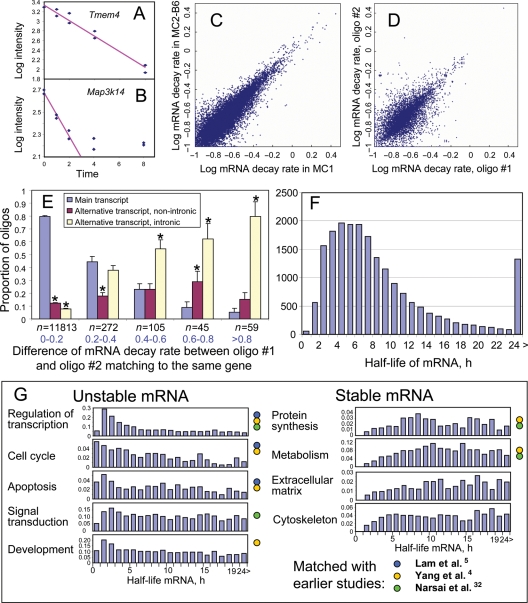
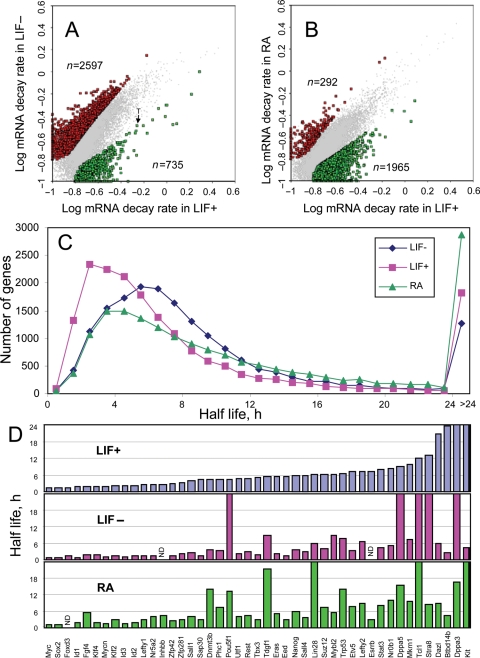
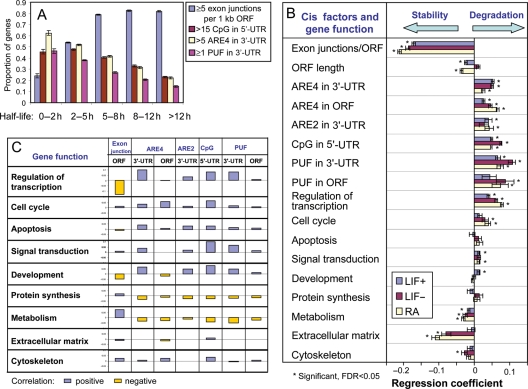
Degradation of mRNA is one of the key processes that control the steady-state level of gene expression. However, the rate of mRNA decay for the majority of genes is not known. We successfully obtained the rate of mRNA decay for 19 977 non-redundant genes by microarray analysis of RNA samples obtained from mouse embryonic stem (ES) cells. Median estimated half-life was 7.1 h and only <100 genes, including Prdm1, Myc, Gadd45 g, Foxa2, Hes5 and Trib1, showed half-life less than 1 h. In general, mRNA species with short half-life were enriched among genes with regulatory functions (transcription factors), whereas mRNA species with long half-life were enriched among genes related to metabolism and structure (extracellular matrix, cytoskeleton). The stability of mRNAs correlated more significantly with the structural features of genes than the function of genes: mRNA stability showed the most significant positive correlation with the number of exon junctions per open reading frame length, and negative correlation with the presence of PUF-binding motifs and AU-rich elements in 3'-untranslated region (UTR) and CpG di-nucleotides in the 5'-UTR. The mRNA decay rates presented in this report are the largest data set for mammals and the first for ES cells.
Overview
The claims and statistics of this paper haven’t been checked yet.
Run the check — free, no account needed. It reads the open-access text and checks the sources it cites.
Integrity signals
Registry
Cites
Statistics
Figures
Verification
Claims the paper makes
The claims and statistics of this paper haven’t been checked yet.
Run the check — free, no account needed. It reads the open-access text and checks the sources it cites.
Claims other papers make about this one
Each is checked against this paper’s own text: does it say what the citing paper says it does?
The source backs part of the claim, not all of it — or backs it for a different population, condition or comparison.
In the citing paper
“In silico analysis showed several ARE 1 (AUUUA) and ARE 4 (12-mer A/U, max.one mismatch) sites (33) as well as a potential miR-27a/b binding site.”
From MicroRNA-27b Contributes to Lipopolysaccharide-mediated Peroxisome Proliferator-activated Receptor γ (PPARγ) mRNA Destabilization (2010) · cites this paper as [33]
Experimental — accuracy not yet measuredIn the citing paper
“This result is in agreement with that previously observed in mESCs 54,55 , thus suggesting the bona fide of the experiment.”
From Intragenic DNA methylation prevents spurious transcription initiation (2017) · cites this paper as [54]
Self-check
Percentages, sums and reported differences re-computed from the paper’s own numbers.
The self-check needs the paper’s full text.
Citations
Cites
Controlling the False Discovery Rate: A Practical and Powerful Approach to Multiple Testing
Benjamini, Y., & Hochberg, Y. (1995) · Journal of the Royal Statistical Society Series B: Statistical Methodology · doi:10.1111/j.2517-6161.1995.tb02031.x · Cited by 109,482 · cited 1×
“FDR, which is necessary for multiple hypothesis testing, was estimated using the method of Benjamini and Hochberg.(35) In addition to FDR, we used the criterion of .”
MethodDatabase resources of the National Center for Biotechnology Information: update
Wheeler, D. L. (2003) · Nucleic Acids Research · doi:10.1093/nar/gkh073 · Cited by 10,695
Kinetics and kinematics for translational motions in microgravity during parabolic flight.
Stirling, L., Willcox, K., Ferguson, P., & Newman, D. (2009) · Aviation Space and Environmental Medicine · doi:10.3357/asem.2356.2009 · Cited by 5,455
Shaw, G. D., & Kamen, R. (1986) · Cell · doi:10.1016/0092-8674(86)90341-7 · Cited by 3,946
AU-rich elements: characterization and importance in mRNA degradation
Chen, C.-Y. A., & Shyu, A.-B. (1995) · Trends in Biochemical Sciences · doi:10.1016/s0968-0004(00)89102-1 · Cited by 1,948 · cited 1×
“multi-exon genes), which makes mRNA more stable;(44) and (ii) the presence of AREs in the 30UTR of genes, which makes mRNA less stable.(45,46) However, all the previous results have been obtained using single-factor analysis, which may easily lead to erroneous conclusions if factors are correlated.”
ResultXie, X., Lu, J., Kulbokas, E. J., Golub, T. R., Mootha, V., Lindblad-Toh, K., Lander, E. S., & Kellis, M. (2005) · Nature · doi:10.1038/nature03441 · Cited by 1,872 · cited 1×
“We used UGUANAUA as PUF consensus motifs.(29,48,49) CpG elements were added to the list after we unexpectedly found that they can affect mRNA stability.”
MethodThe Nonsense-Mediated Decay RNA Surveillance Pathway
Chang, Y.-F., Imam, J. S., & Wilkinson, M. (2007) · Annual Review of Biochemistry · doi:10.1146/annurev.biochem.76.050106.093909 · Cited by 1,326
The highways and byways of mRNA decay
Garneau, N. L., Wilusz, J., & Wilusz, C. J. (2007) · Nature Reviews Molecular Cell Biology · doi:10.1038/nrm2104 · Cited by 1,294 · cited 1×
“For example, ARE-binding proteins can recruit PARN or exosomes.(51) It is also known that the stability of mRNA can be modified by immune factors via AREs in 30-UTR.”
BackgroundA protein interaction network for pluripotency of embryonic stem cells
Wang, J., Rao, S., Chu, J., Shen, X., Levasseur, D. N., Theunissen, T. W., & Orkin, S. H. (2006) · Nature · doi:10.1038/nature05284 · Cited by 1,107
Database resources of the National Center for Biotechnology Information
Wheeler, D. L., Barrett, T., Benson, D. A., Bryant, S. H., Canese, K., Chetvernin, V., Church, D. M., DiCuccio, M., Edgar, R., Federhen, S., et al. (2007) · Nucleic Acids Research · doi:10.1093/nar/gkm1000 · Cited by 1,007
Research works printed but not linked: 3
- 2001, Genome biology, 2
- 2002, Molecular cell, 160, 951
- White, 2001, RNA, 7, 1855
Cited by
Sorted by citations
Items 201–300 of 608
Investigating transcriptional states at single-cell-resolution
Tischler, J., & Surani, M. A. (2012) · Current Opinion in Biotechnology · doi:10.1016/j.copbio.2012.09.013 · Cited by 33
The translational landscape of ground state pluripotency
Atlasi, Y., Jafarnejad, S. M., Gkogkas, C. G., Vermeulen, M., Sonenberg, N., & Stunnenberg, H. G. (2020) · Nature Communications · doi:10.1038/s41467-020-15449-9 · Cited by 34
Nonmodular oscillator and switch based on RNA decay drive regeneration of multimodal gene expression
Nordick, B., Yu, P. Y., Liao, G., & Hong, T. (2022) · Nucleic Acids Research · doi:10.1093/nar/gkac217 · Cited by 33
“Nonetheless, a wide range of periods for biological rhythms might be obtained by the model given the wide distribution of mRNA half-lives (Sharova et al., 2009).”
BackgroundInfluentialPost-transcriptional regulation of heparanase gene expression by a 3′ AU-rich element
Arvatz, G., Barash, U., Nativ, O., Ilan, N., & Vlodavsky, I. (2010) · The FASEB Journal · doi:10.1096/fj.10-156372 · Cited by 33
Kalwat, M. A., Huang, Z., Wichaidit, C., McGlynn, K., Earnest, S. A., Savoia, C., Dioum, E. M., Schneider, J. W., Hutchison, M. R., & Cobb, M. H. (2016) · ACS Chemical Biology · doi:10.1021/acschembio.5b00993 · Cited by 33
Nagiec, M. M., Skepner, A. P., Negri, J. M., Eichhorn, M., Kuperwasser, N., Comer, E., Muncipinto, G., Subramanian, A., Clish, C. B., Musunuru, K., et al. (2015) · PLoS ONE · doi:10.1371/journal.pone.0120295 · Cited by 31
Sengupta, P. K., Bouchie, M. P., Lazar, M. N., Yang, H.-Y., & Kukuruzinska, M. A. (2012) · Journal of Cell Science · doi:10.1242/jcs.113035 · Cited by 32
“4E, C), indicating that it belonged to a class of stable transcripts, typical of metabolic and structural genes (Sharova et al., 2009; Stefanovic et al., 2000).”
BackgroundGenome-Wide Analysis of Human MicroRNA Stability
Li, Y., Li, Z., Zhou, S., Wen, J., Geng, B., Yang, J., & Cui, Q. (2013) · BioMed Research International · doi:10.1155/2013/368975 · Cited by 32
On the role of extrinsic noise in microRNA-mediated bimodal gene expression
Giudice, M. D., Bo, S., Grigolon, S., & Bosia, C. (2018) · PLoS Computational Biology · doi:10.1371/journal.pcbi.1006063 · Cited by 32
Bachetti, T., Zanni, E. D., Ravazzolo, R., & Ceccherini, I. (2015) · Biochimica et Biophysica Acta (BBA) - Gene Regulatory Mechanisms · doi:10.1016/j.bbagrm.2015.06.008 · Cited by 31
Enhanced single RNA imaging reveals dynamic gene expression in live animals
Hu, Y., Xu, J., Gao, E., Fan, X., Wei, J., Ye, B., Xu, S., & Ma, W. (2023) · eLife · doi:10.7554/elife.82178 · Cited by 31
“To directly test whether mRNA stability was affected while imaging by MASS, we examined the stability of three mRNAs: MYC, HSPA1A, and KIF18B, which were reported as medium stable mRNAs (Vera et al., 2019; Sharova et al., 2009).”
BackgroundGene expression and protein abundance: Just how associated are these molecular traits?
Samih, A., Ferreira, M. A. D. M., & Nikoloski, Z. (2025) · Biotechnology Advances · doi:10.1016/j.biotechadv.2025.108720 · Cited by 35
Waks, Z., Weissbrod, O., Carmeli, B., Norel, R., Utro, F., & Goldschmidt, Y. (2016) · Scientific Reports · doi:10.1038/srep38988 · Cited by 31
“In contrast to humans, global mRNA stability data does exists for the majority of mouse genes in ES cells 72 .”
Alexander, M. R., Brice, A. M., van Vuren, P. J., Rootes, C. L., Tribolet, L., Cowled, C. J., Bean, A. G. D., & Stewart, C. R. (2021) · International Journal of Molecular Sciences · doi:10.3390/ijms22073392 · Cited by 32
“(A) Volcano plot showing global translation efficiency (Riborex engine) changes of 6,878 genes in SARS-CoV-2 infected Calu-3 cells with previously documented mRNA stability [22].”
BackgroundInfluentialTew, S. R., McDermott, B. T., Fentem, R. B., Peffers, M. J., & Clegg, P. (2014) · Arthritis & Rheumatology · doi:10.1002/art.38849 · Cited by 31
“Although this is a small change, it is consistent with findings in embryonic stem cells, which when allowed to differentiate, display relatively modest changes in mRNA decay rate profile (27).”
ResultTechnologies for Targeted RNA Degradation and Induced RNA Decay
Mikutis, S., & Bernardes, G. J. L. (2024) · Chemical Reviews · doi:10.1021/acs.chemrev.4c00472 · Cited by 36
The role of mRNA decay in p53-induced gene expression
Melanson, B. D., Bose, R., Hamill, J. D., Marcellus, K. A., Pan, E., & McKay, B. C. (2011) · RNA · doi:10.1261/rna.030122.111 · Cited by 30
“This includes the number of exon junctions per 2226 RNA, Vol. 17, No. 12 open reading frame (ORF) and a variety cis-acting determinants typically located in 39 UTRs (Barreau et al. 2005; Sharova et al. 2009; Lee et al. 2010).”
BackgroundMethodInfluentialGLI transcriptional repression is inert prior to Hedgehog pathway activation
Lex, R. K., Zhou, W., Ji, Z., Falkenstein, K. N., Schuler, K. E., Windsor, K. E., Kim, J. D., Ji, H., & Vokes, S. A. (2022) · Nature Communications · doi:10.1038/s41467-022-28485-4 · Cited by 30
“25 Gli3-/- upregulated genes, previously determined in differentiating embryonic stem cells (Sharova et al., 2009).”
BackgroundInfluentialKrämer, S. (2016) · Nucleic Acids Research · doi:10.1093/nar/gkw1245 · Cited by 30
“Transcripts of higher eukaryotes tend to be more stable: mammalian mRNAs have half-lives between 7 and 10 h (8,9).”
BackgroundIL-37 Causes Excessive Inflammation and Tissue Damage in Murine Pneumococcal Pneumonia
Schauer, A. E., Klassert, T. E., von Lachner, C., Riebold, D., Schneeweiß, A., Stock, M., Müller, M. M., Hammerschmidt, S., Bufler, P., Seifert, U., et al. (2017) · Journal of Innate Immunity · doi:10.1159/000469661 · Cited by 30
“Similarly, mRNAs are less stable than proteins, with an average half-life of 2.6–7 versus 46 h, respectively [36, 37] .”
BackgroundInfluentialMaizels, R. J., Snell, D. M., & Briscoe, J. (2024) · Cell Systems · doi:10.1016/j.cels.2024.04.004 · Cited by 36
Length-dependent translation initiation benefits the functional proteome of human cells
Guo, J., Lian, X., Zhong, J., Wang, T., & Zhang, G. (2014) · Molecular BioSystems · doi:10.1039/c4mb00462k · Cited by 28
“Data were obtained from literatures (Munchel et al., 2011; Narsai et al., 2007; Sharova et al., 2009; Tani et al., 2012).”
Temporal and spatial requirements for Hoxa3 in mouse embryonic development
Chojnowski, J. L., Trau, H. A., Masuda, K., & Manley, N. R. (2016) · Developmental Biology · doi:10.1016/j.ydbio.2016.05.010 · Cited by 29
“Allowing an additional six hours for any residual HOXA3 protein to degrade (Beslu et al., 2004; Sandoval et al., 2013; Sharova et al., 2009; Yang et al., 2003), and given the inherent variability in plug time and different fertilization times for different embryos within a litter, we concluded that for the purpose of…”
BackgroundHassan, M. A., Vasquez, J. J., Chew, G.-L., Meissner, M., & Siegel, T. N. (2017) · BMC Genomics · doi:10.1186/s12864-017-4362-6 · Cited by 28
“Furthermore, because most eukaryotic mRNAs can be detected in cells at least 2 h after expression [10], compared to de novo transcription, regulating the translation of the available mRNAs provides a mechanism to rapidly adjust cellular protein levels in response to drastic changes in the environment or developmental…”
BackgroundNiespolo, C., Johnston, J. M., Deshmukh, S., Satam, S., Shologu, Z., Villacañas, Ó., Sudbery, I. M., Wilson, H. L., & Kiss‐Toth, E. (2020) · Frontiers in Immunology · doi:10.3389/fimmu.2020.574046 · Cited by 29
“TRIB1 Is Post-Transcriptionally Regulated by miRNAs As TRIB1 mRNA has been reported to be highly unstable (12), we investigated its post-transcriptional regulation by miRNAs.”
BackgroundInfluentialRole of PUM RNA-Binding Proteins in Cancer
Smialek, M. J., Ilaslan, E., Sajek, M. P., & Jaruzelska, J. (2021) · Cancers · doi:10.3390/cancers13010129 · Cited by 29
Martinez-Corral, R., Park, M., Biette, K. M., Friedrich, D., Scholes, C., Khalil, A. S., Gunawardena, J., & DePace, A. H. (2023) · Cell Systems · doi:10.1016/j.cels.2023.02.003 · Cited by 29
“105,106 For a reaction at a rate of 0.7 s (cid:2) 1 ( (cid:6) 1 s half-life), normalizing by the mRNA degradation rates would result into a normalised range of 600–18000.”
InfluentialGriseri, P., Garrone, O., Sardo, A. L., Monteverde, M., Rusmini, M., Tonissi, F., Merlano, M. C., Bruzzi, P., Nigro, C. L., & Ceccherini, I. (2016) · Oncotarget · doi:10.18632/oncotarget.8417 · Cited by 29
“Given that the mean estimated half life of human transcripts is 3 hrs, and mRNA species with short half-life are enriched among genes with regulatory functions [52], we would have expected RET mRNA to be much more unstable and to start to decay earlier than 6-12 hrs.”
Wolfe, M. B., Schagat, T. L., Paulsen, M. T., Magnuson, B., Ljungman, M., Park, D., Zhang, C., Campbell, Z. T., Goldstrohm, A. C., & Freddolino, P. L. (2020) · RNA · doi:10.1261/rna.077362.120 · Cited by 22
Guo, Q., Deng, T., Du, Y., Yao, W., Tian, W., Liao, H., Wang, Y., Li, J., Yan, W., & Li, Y. (2024) · Ecotoxicology and Environmental Safety · doi:10.1016/j.ecoenv.2024.116679 · Cited by 28
Iqbal, S. M., Rosen, A. M., Edwards, D. K., Bolio, A., Larson, H. J., Servin, M., Rudowitz, M., Carfı́, A., & Ceddia, F. (2024) · Frontiers in Public Health · doi:10.3389/fpubh.2024.1429265 · Cited by 30
New Insights Into the Role of Cav2 Protein Family in Calcium Flux Deregulation in Fmr1-KO Neurons
Castagnola, S., Delhaye, S., Folci, A., Paquet, A. C., Brau, F., Duprat, F., Jarjat, M., Grossi, M., Béal, M., Martin, S., et al. (2018) · Frontiers in Molecular Neuroscience · doi:10.3389/fnmol.2018.00342 · Cited by 30
Nucleoside‐modified messenger RNA COVID‐19 vaccine platform
Roncati, L., & Corsi, L. (2021) · Journal of Medical Virology · doi:10.1002/jmv.26924 · Cited by 28
Length biases in single-cell RNA sequencing of pre-mRNA
Gorin, G., & Pachter, L. S. (2022) · Biophysical Reports · doi:10.1016/j.bpr.2022.100097 · Cited by 28
“Previous studies found little to no gene length effect on burst frequency [14] and no effect on the rate of mRNA degradation [15].”
BackgroundThe CCR4–NOT complex maintains liver homeostasis through mRNA deadenylation
Takahashi, A., Suzuki, T., Soeda, S., Takaoka, S., Kobori, S., Yamaguchi, T., Mohamed, H. M. A., Yanagiya, A., Abe, T., Shigeta, M., et al. (2020) · Life Science Alliance · doi:10.26508/lsa.201900494 · Cited by 28
“We compared the calculated mRNA half-lives in this study with previously reported data from chase experiments (Friedel et al, 2009; Sharova et al, 2009; Schwanhausser et al, 2011).”
Cell-to-cell variability in Myc dynamics drives transcriptional heterogeneity in cancer cells
Liu, C., Kudo, T., Ye, X., & Gascoigne, K. E. (2023) · Cell Reports · doi:10.1016/j.celrep.2023.112401 · Cited by 27
Repair of CRISPR-guided RNA breaks enables site-specific RNA excision in human cells
Nemudraia, A., Nemudryi, A. A., & Wiedenheft, B. (2024) · Science · doi:10.1126/science.adk5518 · Cited by 29
A Mammalian Circadian Clock Model Incorporating Daytime Expression Elements
Jolley, C. C., Ukai‐Tadenuma, M., Perrin, D., & Ueda, H. R. (2014) · Biophysical Journal · doi:10.1016/j.bpj.2014.07.022 · Cited by 26
“(30), who measured the decay rates of 1825 TF mRNAs in a mouse cell culture.”
Persistence of Hepatitis A Virus RNA in Water, on Non-porous Surfaces, and on Blueberries
Trudel-Ferland, M., Jubinville, É., & Jean, J. (2021) · Frontiers in Microbiology · doi:10.3389/fmicb.2021.618352 · Cited by 26
Feigelman, J. S., Ganscha, S., Hastreiter, S., Schwarzfischer, M., Filipczyk, A. A., Schroeder, T., Theis, F. J., Marr, C., & Claassen, M. (2016) · Cell Systems · doi:10.1016/j.cels.2016.11.001 · Cited by 27
The molecular mechanisms underpinning maternal mRNA dormancy
Lorenzo‐Orts, L., & Pauli, A. (2024) · Biochemical Society Transactions · doi:10.1042/bst20231122 · Cited by 28
Mathematical Modeling in Chronobiology
Bordyugov, G., Westermark, P. O., Korenčič, A., Bernard, S., & Herzel, H. (2013) · Handbook of experimental pharmacology · doi:10.1007/978-3-642-25950-0_14 · Cited by 24
Competition Between Transcription and Loop Extrusion Modulates Promoter and Enhancer DynamicsPreprint
Platania, A., Erb, C., Barbieri, M., Molcrette, B., Grandgirard, E., de Kort, M. A. C., Meaburn, K. J., Taylor, T., Shchuka, V. M., Kocanova, S., et al. (2023) · SSRN Electronic Journal · doi:10.1101/2023.04.25.538222 · Cited by 32
Trzaskoma, P., Jung, S., Pękowska, A., Bohrer, C. H., Wang, X., Naz, F., Dell’Orso, S., du Bois, W., Olivera, A., Vartak, S. V., et al. (2024) · Science Advances · doi:10.1126/sciadv.adl4893 · Cited by 24
“Prior work has revealed that housekeeping (HK) genes encode mRNA characterized by lower decay rates than mRNA of regulatory genes encoding TFs ( 42 ).”
BackgroundMethodPost-Transcriptional Regulation of DNA Damage-Responsive Gene Expression
McKay, B. C. (2013) · Antioxidants and Redox Signaling · doi:10.1089/ars.2013.5523 · Cited by 25
“Furthermore, stable transcripts are typically constitutively expressed, while short-lived mRNAs are inducible (46, 97, 126, 139, 165).”
CHO genome mining for synthetic promoter design
Johari, Y. B., Brown, A. J., Alves, C. S., Zhou, Y., Wright, C. M., Estes, S. D., Kshirsagar, R., & James, D. C. (2019) · Journal of Biotechnology · doi:10.1016/j.jbiotec.2019.01.015 · Cited by 24
“1) where kd is the mRNA decay rate constant (h-1), m is the mRNA transcript abundance (FPKM) and t1/2 is the mRNA half-life (h). kd and t1/2 values were derived from Schwanhäusser et al. (2011) and Sharova et al. (2009) (see below and Supplementary Figure S1).”
MethodRapid Delivery of Nanobodies/VHHs into Living Cells via Expressing In Vitro-Transcribed mRNA
Zhou, X., Hao, R., Chen, C., Su, Z., Zhao, L., Luo, Z., & Xie, W. (2020) · Molecular Therapy — Methods & Clinical Development · doi:10.1016/j.omtm.2020.01.008 · Cited by 22
“Recently, data on mRNA half lives and the corresponding UTR sequences have been published.(37,38)”
BackgroundDNA and RNA oxidative damage in the retina is associated with ganglion cell mitochondria
Gu, L., Kwong, J. M. K., Caprioli, J., & Piri, N. (2022) · Scientific Reports · doi:10.1038/s41598-022-12770-9 · Cited by 24
Nonclinical safety evaluation of a novel ionizable lipid for mRNA delivery
Broudic, K., Amberg, A., Schaefer, M. K., Spirkl, H.-P., Bernard, M., & Désert, P. (2022) · Toxicology and Applied Pharmacology · doi:10.1016/j.taap.2022.116143 · Cited by 25
TRIB1 Is Regulated Post-Transcriptionally by Proteasomal and Non-Proteasomal Pathways
Soubeyrand, S., Martinuk, A., Lau, P., & McPherson, R. (2016) · PLoS ONE · doi:10.1371/journal.pone.0152346 · Cited by 24
“8 h for TRIB1, 2 and 3 respectively [19].”
BackgroundSpangler, A., Su, E. Y., Craft, A. M., & Cahan, P. (2018) · Stem Cell Research · doi:10.1016/j.scr.2018.07.022 · Cited by 24
“GFP has a half-life around 26 h (Corish and Tyler-Smith, 1999), whereas an mRNA transcript has an average half-life around 7.1 h (Sharova et al., 2009).”
InfluentialNair, G. P., Abranches, E., Guedes, A. M. V., Henrique, D., & Raj, A. (2015) · Scientific Reports · doi:10.1038/srep13339 · Cited by 22
RNA-biology ruling cancer progression? Focus on 3′UTRs and splicing
Erson-Bensan, A. E. (2020) · Cancer and Metastasis Reviews · doi:10.1007/s10555-020-09884-9 · Cited by 23
Neural and Molecular Mechanisms of Biological Embedding of Social Interactions
Traniello, I. M., & Robinson, G. E. (2021) · Annual Review of Neuroscience · doi:10.1146/annurev-neuro-092820-012959 · Cited by 22
Grill, M., Syme, T. E., Noçon, A. L., Lu, A. Z. X., Hancock, D., Rose‐John, S., & Campbell, I. L. (2015) · Glia · doi:10.1002/glia.22841 · Cited by 25
“However, in general, most genes with mRNAs with very short half-lives were shown to encode for proteins with regu- latory functions (Sharova et al., 2009).”
BackgroundLee, J. T. Y., Cheung, E. M. C., & Leung, V. (2015) · Journal of Biological Methods · doi:10.14440/jbm.2015.40 · Cited by 23
“1 h and the half-life for mRNA for some genes (<100 genes) may be less than 1 h [9].”
BackgroundLee, J. T. Y., Cheung, K., & Leung, V. (2015) · Journal of Orthopaedic Research® · doi:10.1002/jor.22942 · Cited by 23
“1 h in mouse embryonic cells and the half life is longer for genes related to metabolism and structure such as extracellular matrix and cytoskeleton while genes with regulatory functions such as transcription factors may have half-life less than 1h.(19) Among our chosen markers, ACAN and COL2A1 are genes for extracell…”
BackgroundCaboux, É., Paciencia, M., Durand, G., Robinot, N. R., Wozniak, M. B., Galateau-Sallé, F., Byrnes, G. B., Hainaut, P. L., & Calvez‐Kelm, F. L. (2013) · PLoS ONE · doi:10.1371/journal.pone.0079826 · Cited by 23
“1 h and that only about 60 genes, including PRDM1, MYC, GADD45G, FOXA2, HES5 and TRIB1, had mRNA with half-lives less than 1 h [51].”
BackgroundTransient oscillatory dynamics of interferon beta signaling in macrophages
Pertsovskaya, I., Abad, E. M., Domedel-Puig, N., García‐Ojalvo, J., & Villoslada, P. (2013) · BMC Systems Biology · doi:10.1186/1752-0509-7-59 · Cited by 23
“23 hour half-life [40]”
Cunard, R. A. (2013) · Scientifica · doi:10.1155/2013/750871 · Cited by 23
Payne, T. L., Blackinton, J. G., Frisbee, A. L., Pickeral, J., Sawant, S. S., Vandergrift, N., Freel, S. A., Ferrari, G., Keene, J. D., & Tomaras, G. D. (2014) · Journal of Virology · doi:10.1128/jvi.00802-14 · Cited by 22
“publications and other global analyses (38, 39).”
Alterations of GABA B receptors in the APP/PS1 mouse model of Alzheimer's disease
Salazar, A., Osse, A. M. L., Ortiz, A. A., Murtishaw, A. S., & Kinney, J. W. (2020) · Neurobiology of Aging · doi:10.1016/j.neurobiolaging.2020.10.013 · Cited by 26
Zhao, B., Wu, C., Sammad, A., Ma, Z., Suo, L., Wu, Y., & Fu, X. (2022) · BMC Genomics · doi:10.1186/s12864-022-08422-x · Cited by 23
“Mammalian cells are shown to produce fewer copies of relatively unstable mRNA at a much lower rate than dozens of stable protein copies per mRNA [49, 50].”
BackgroundZhang, X., Dorlhiac, G., Landry, M. P., & Streets, A. (2022) · Scientific Reports · doi:10.1038/s41598-022-23054-7 · Cited by 22
BICC1 Expression is Elevated in Depressed Subjects and Contributes to Depressive Behavior in Rodents
Ota, K. T., Andres, W., Lewis, D. A., Stockmeier, C. A., & Duman, R. S. (2014) · Neuropsychopharmacology · doi:10.1038/npp.2014.227 · Cited by 22
“BICC1 mRNA has a half-life of 11 h (Sharova et al, 2009), suggesting that the rapid decrease that we observe (within 2 h in vivo and 20 min in vitro) in BICC1 mRNA following ketamine and KCl treatment requires active degradation, as opposed to passive decay.”
BackgroundZhuravskaya, A., Yap, K., Hamid, F., & Makeyev, E. V. (2024) · Genome biology · doi:10.1186/s13059-024-03305-8 · Cited by 20
“S13, we used published transcriptome-wide estimates for v sr (1.76 mRNA molecules per cell per hour; the median rate measured for mouse NIH 3T3 cells; [101]) and t 1 / 2 (7.08 h; the median half life for proliferating and differentiating mouse ESCs; [102]).”
MethodInfluentialNrf2 Regulates Basal Glutathione Production in Astrocytes
He, J., & Hewett, S. J. (2025) · International Journal of Molecular Sciences · doi:10.3390/ijms26020687 · Cited by 25
“Our lab previously reported the xCT mRNA half-life in astrocytes under basal conditions to be 4 ± 1.9 h [66], which is relatively shorter than the reported median mRNA half-life of 7.1 h calculated from nearly 20,000 different genes in mouse embryonic stem cells [67].”
InfluentialSukys, A., & Grima, R. (2025) · Nucleic Acids Research · doi:10.1093/nar/gkaf295 · Cited by 22
PPARγ stabilizes HO-1 mRNA in monocytes/macrophages which affects IFN-β expression
von Knethen, A., Neb, H., Morbitzer, V., Schmidt, M. V., Kühn, A., Kuchler, L., & Brüne, B. (2011) · Free Radical Biology and Medicine · doi:10.1016/j.freeradbiomed.2011.04.033 · Cited by 22
Beermann, M. L., Ardelt, M., Girgenrath, M., & Miller, J. B. (2010) · PLoS ONE · doi:10.1371/journal.pone.0009951 · Cited by 21
“Prdm1 mRNA is expected to have a short half-life [41].”
Efficient approximations of RNA kinetics landscape using non-redundant sampling
Michálik, J., Touzet, H., & Ponty, Y. (2017) · Bioinformatics · doi:10.1093/bioinformatics/btx269 · Cited by 21
Connections between 3′ end processing and DNA damage response: Ten years later
Murphy, M. R., & Kleiman, F. E. (2019) · Wiley Interdisciplinary Reviews - RNA · doi:10.1002/wrna.1571 · Cited by 21
“Additionally, the median mRNA half-life under steady-state conditions is over 7 hr (Sharova et al., 2009), which reduces for housekeeping genes upon stress introduction (Cevher et al., 2010).”
BackgroundPU.1 Regulates Positive Regulatory Domain I-Binding Factor 1/Blimp-1 Transcription in Lymphoma Cells
Desai, S., Bolick, S. C. E., Maurin, M. M., & Wright, K. L. (2009) · The Journal of Immunology · doi:10.4049/jimmunol.0901120 · Cited by 21
“This is consistent with the recent genome-wide analysis of mRNA decay rates in mouse embryonic stem cells in which PRDM1 was one of the rare transcripts with a 1-h half-life (32).”
Azpeitia, E., & Wagner, A. (2020) · Frontiers in Molecular Biosciences · doi:10.3389/fmolb.2020.00067 · Cited by 17
“For mRNA, experimentally measured half-lives usually lie in the range of seconds to hours (Sharova et al., 2009; Schwanhäusser et al., 2011; Laalami et al., 2014; Lugowski et al., 2018).”
BackgroundOkamura, M., Yamanaka, Y., Shigemoto, M., Kitadani, Y., Kobayashi, Y., Kambe, T., Nagao, M., Kobayashi, I., Okumura, K., & Masuda, S. (2018) · PLoS ONE · doi:10.1371/journal.pone.0197165 · Cited by 20
Cap-Independent Circular mRNA Translation Efficiency
Deviatkin, A. A., Simonov, R. A., Trutneva, K. A., Maznina, A. A., Soroka, A. B., Kogan, A. A., Feoktistova, S. G., Khavina, E. M., Mityaeva, O. N., & Volchkov, P. (2023) · Vaccines · doi:10.3390/vaccines11020238 · Cited by 21
“Secondly, the half-life of mRNA in the mammalian cell is estimated to be several minutes to several days, with a median value of 7 h [3].”
Dong, D., Zhong, W. H., Sun, Q., Zhang, W., Sun, X., & Zhou, Z. (2016) · Cytokine · doi:10.1016/j.cyto.2016.06.014 · Cited by 20
“Calculation of mRNA half-life was based on the method described elsewhere [24-26].”
MethodModeling circadian variability of core-clock and clock-controlled genes in four tissues of the rat
Mavroudis, P. D., DuBois, D. C., Almon, R. R., & Jusko, W. J. (2018) · PLoS ONE · doi:10.1371/journal.pone.0197534 · Cited by 20
Adibzadeh, S., Fardaei, M., Takhshid, M. A., Miri, M. R., Dehbidi, G. R., Farhadi, A., Ranjbaran, R., Alavi, P., Nikouyan, N., Seyyedi, N., et al. (2019) · Europe PMC (PubMed Central) · Cited by 20
Nitanda, Y., Matsui, T., Matta, T., Higami, A., Kohno, K., Nakahata, Y., & Bessho, Y. (2013) · FEBS Journal · doi:10.1111/febs.12582 · Cited by 20
Dendritic Glutamate Receptor mRNAs Show Contingent Local Hotspot-Dependent Translational Dynamics
Kim, T., Sul, J., Helmfors, H., Langel, Ü., Kim, J., & Eberwine, J. (2013) · Cell Reports · doi:10.1016/j.celrep.2013.08.029 · Cited by 16
“27 hr for GluR4), which enabled us tomore readily assess translational regulation (Mameli et al., 2007; Miyashiro et al., 1994; Sharova et al., 2009; Sutton et al., 2004).”
InfluentialSignaling pathways have an inherent need for noise to acquire information
Azpeitia, E., Balanzario, E. P., & Wagner, A. (2020) · BMC Bioinformatics · doi:10.1186/s12859-020-03778-x · Cited by 20
Sævik, Å. B., Wolff, A. B., Björnsdottir, S., Simunkova, K., Hynne, M. S., Dolan, D. W. P., Bratland, E., Knappskog, P. M., Methlie, P., Carlsen, S., et al. (2021) · Journal of the Endocrine Society · doi:10.1210/jendso/bvaa202 · Cited by 19
Control of immediate early gene expression by CPEB4-repressor complex-mediated mRNA degradation
Poetz, F., Lebedeva, S., Schott, J., Lindner, D., Ohler, U., & Stoecklin, G. (2022) · Genome biology · doi:10.1186/s13059-022-02760-5 · Cited by 19
Phase separation as a possible mechanism for dosage sensitivity
Yang, L., Lyu, J., Li, X., Guo, G., Zhou, X., Chen, T., Lin, Y., & Li, T. (2024) · Genome biology · doi:10.1186/s13059-023-03128-z · Cited by 19
Advances in non-viral mRNA delivery to the spleen
Narasipura, E. A., & Fenton, O. S. (2024) · Biomaterials Science · doi:10.1039/d4bm00038b · Cited by 20
Liang, K.-C., Tseng, J. T.-C., Tsai, S., & Sun, H. S. (2015) · Computational Biology and Chemistry · doi:10.1016/j.compbiolchem.2015.02.007 · Cited by 22
Haugg, E., Borner, J., Diedrich, V., & Herwig, A. (2021) · FEBS Open Bio · doi:10.1002/2211-5463.13350 · Cited by 17
Zhang, X., Eladawi, M. A., Ryan, W. G., Fan, X., Prevoznik, S., Devale, T., Ramnani, B., Malathi, K., Sibille, E. L., McCullumsmith, R. E., et al. (2023) · PNAS Nexus · doi:10.1093/pnasnexus/pgad299 · Cited by 21
“The average half-life of pseudogenes (10 to 17 h) (29) falls into the range of duration required for homeostatic scaling, further supporting the possible role of RP pseudogenes in mechanisms of homeostatic synaptic scaling.”
BackgroundOxidative Damage on RNA Nucleobases
Küpfer, P. A., & Leumann, C. J. (2014) · RNA technologies · doi:10.1007/978-3-642-54452-1_5 · Cited by 19
Feedforward regulation of mRNA stability by prolonged extracellular signal‐regulated kinase activity
Nagashima, T., Inoue, N., Yumoto, N., Saeki, Y., Magi, S., Volinsky, N., Sorkin, A. D., Kholodenko, B. Ν., & Okada, M. (2014) · FEBS Journal · doi:10.1111/febs.13172 · Cited by 18
Adamla, F., & Ignatova, Z. (2015) · Scientific Reports · doi:10.1038/srep10692 · Cited by 18
Enhancing potency of siRNA targeting fusion genes by optimization outside of target sequence
Gavrilov, K., Seo, Y.-E., Tietjen, G. T., Cui, J., Cheng, C. J., & Saltzman, W. M. (2015) · Proceedings of the National Academy of Sciences · doi:10.1073/pnas.1517039112 · Cited by 18
The Pseudokinase TRIB1 in Immune Cells and Associated Disorders
Danger, R., Feseha, Y., & Brouard, S. (2022) · Cancers · doi:10.3390/cancers14041011 · Cited by 17
“Altogether, these studies present TRIB1 as a highly regulated molecule, both at the RNA and protein levels, with notable co-expression with regulatory transcription factors [87], highlighting the functional role of TRIB1 in cooperation with transcription factors.”
BackgroundInfluentialOncogenic K-Ras suppresses global miRNA function
Shui, B., Beyett, T. S., Chen, Z., Li, X., Rocca, G. L., Gazlay, W., Eck, M. J., Lau, K. S., Ventura, A., & Haigis, K. M. (2023) · Molecular Cell · doi:10.1016/j.molcel.2023.06.008 · Cited by 17
Helfer, S., Schott, J., Stoecklin, G., & Förstemann, K. (2012) · PLoS ONE · doi:10.1371/journal.pone.0028907 · Cited by 21
“The output of a gene is determined by its rate of transcription, the post-transcriptional processing and stability of the mRNA, its translation rate and the post-translational control of protein activity and stability. Despite the fact that cellular mRNAs share a common set of important structural features like the 5′…”
BackgroundKumagai, Y., Vandenbon, A., Teraguchi, S., Akira, S., & Suzuki, Y. (2016) · BMC Genomics · doi:10.1186/s12864-016-3325-7 · Cited by 14
Aponte-Serrano, J. O., Weaver, J. J. A., Sego, T. J., Glazier, J. A., & Shoemaker, J. E. (2021) · PLoS Computational Biology · doi:10.1371/journal.pcbi.1008874 · Cited by 17
“75 hr Decay rate of IRF7 7 [37,51] kIRF7P,IRF7 0.”
BackgroundAn Exploration of Molecular Correlates Relevant to Radiation Combined Skin-Burn Trauma
Islam, A., Ghimbovschi, S. D., Zhai, M., & Swift, J. M. (2015) · PLoS ONE · doi:10.1371/journal.pone.0134827 · Cited by 17
“involved using mRNA expression, from isolated mononuclear cells, to predict the effects of radiation exposure; however, mRNA is known to be intrinsically unstable thus making this method unreliable [32].”
MethodSathirapongsasuti, J. F., Sathira, N. P., Suzuki, Y., Huttenhower, C., & Sugano, S. (2010) · Nucleic Acids Research · doi:10.1093/nar/gkq949 · Cited by 16
“Comparing the degradation rates and half-lives of UCS-containing mRNAs with those of 19 977 genes in mouse embryonic stem cells (54), we found that UCS-containing mRNAs tend to”
Method
Metadata
- Authors
- Sharova, L. V., Sharov, A. A., Nedorezov, T., Piao, Y., Shaik, N., & Ko, M. S. H.
- Affiliations
- National Institutes of Health (US)
- Corresponding author
- Ko, M. S.H.
- Venue
- DNA Research
- Publisher
- Oxford University Press (OUP)
- Published
- 2009-01-08
- Volume
- 16
- Issue
- 1
- Pages
- 45-58
- ISSN
- 1340-2838 (ISSN-L)
- 1756-1663
- PMC
- PMC2644350
- OpenAlex
- W2106014350
- Cited by
- 591
- References
- 57
- Citations by year
- 2026: 20 · 2025: 28 · 2024: 42 · 2023: 40 · 2022: 39 · 2021: 42 · 2020: 37 · 2019: 35 · 2018: 36 · 2017: 38 · 2016: 33 · 2015: 43 · 2014: 40 · 2013: 31 · 2012: 30
- FWCI
- 7.82
- Type
- journal article
- Language
- en
- Open access
- gold
- doi.org
- Locations
- DNA Research (publishedVersion)
- PubMed Central (publishedVersion)
- PubMed (publishedVersion)
- Funders
- National Institutes of Health
- National Institute on Aging (Z01AG000656)
- Topics
- Life Sciences › Biochemistry, Genetics and Molecular Biology › Molecular Biology › RNA Research and Splicing
- Life Sciences › Biochemistry, Genetics and Molecular Biology › Molecular Biology › Molecular Biology Techniques and Applications
- Life Sciences › Biochemistry, Genetics and Molecular Biology › Molecular Biology › RNA and protein synthesis mechanisms
- Keywords
- mRNA half-life, mRNA stability, mouse embryonic stem cells, pluripotency, cell differentiation, gene expression regulation, exon-exon junctions, AU-rich elements, 3' untranslated region, CpG, 5' untranslated region, transcription factors, steady-state mRNA levels
- MeSH terms
- Animals, Cell Differentiation, Cells, Cultured, Half-Life, Humans, Mice, Inbred C57BL, Mice, Inbred Strains, RNA, Messenger, Oligonucleotide Array Sequence Analysis, 3' Untranslated Regions, Gene Expression Profiling, RNA Stability, Databases, Genetic, Pluripotent Stem Cells, Mice, Embryonic Stem Cells
About these checks
Registry, retraction, Cites and statistics results are computed, not judged, with one exception: a printed reference that no index lists is read once by a model before it counts as a citation error. Claims are extracted by a model and kept only when their quote appears verbatim in the text; each cited source is then checked, with a model’s help, for whether it says what the claim relies on. Those verdicts can be wrong — read the claim’s quote and the cited source before relying on one.
Statistics and arithmetic are recomputed, not judged.
Confidence bands are shown only for fields calibrated on our annotated test set. None is calibrated yet, so no band is shown.
What counts as a claim ›How we measure confidence ›How we check this ›
Are you an author, or do you see a problem with this page? Request a review
