

The DOI matches its Crossref record; 57 of the 57 references it cites were found in a registry or an index.
Database for mRNA Half-Life of 19 977 Genes Obtained by DNA Microarray Analysis of Pluripotent and Differentiating Mouse Embryonic Stem Cells
Open accessAbstract
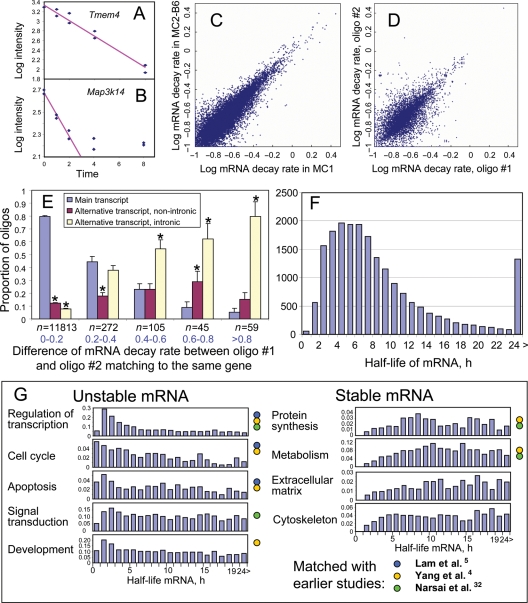
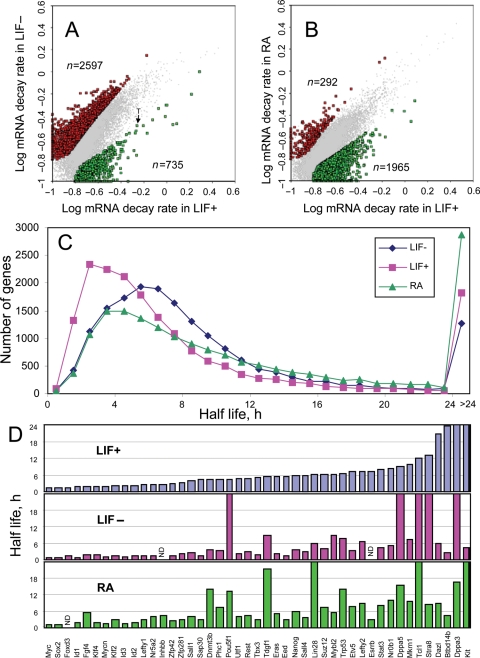
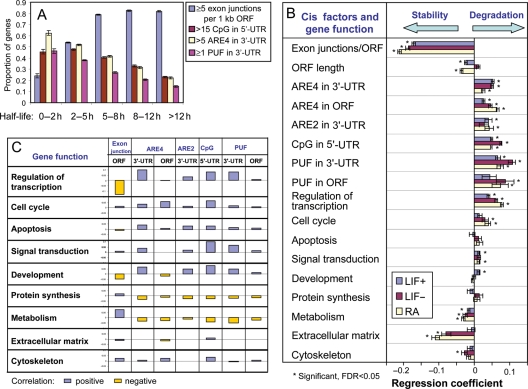
Degradation of mRNA is one of the key processes that control the steady-state level of gene expression. However, the rate of mRNA decay for the majority of genes is not known. We successfully obtained the rate of mRNA decay for 19 977 non-redundant genes by microarray analysis of RNA samples obtained from mouse embryonic stem (ES) cells. Median estimated half-life was 7.1 h and only <100 genes, including Prdm1, Myc, Gadd45 g, Foxa2, Hes5 and Trib1, showed half-life less than 1 h. In general, mRNA species with short half-life were enriched among genes with regulatory functions (transcription factors), whereas mRNA species with long half-life were enriched among genes related to metabolism and structure (extracellular matrix, cytoskeleton). The stability of mRNAs correlated more significantly with the structural features of genes than the function of genes: mRNA stability showed the most significant positive correlation with the number of exon junctions per open reading frame length, and negative correlation with the presence of PUF-binding motifs and AU-rich elements in 3'-untranslated region (UTR) and CpG di-nucleotides in the 5'-UTR. The mRNA decay rates presented in this report are the largest data set for mammals and the first for ES cells.
Overview
The claims and statistics of this paper haven’t been checked yet.
Run the check — free, no account needed. It reads the open-access text and checks the sources it cites.
Integrity signals
Registry
Cites
Statistics
Figures
Verification
Claims the paper makes
The claims and statistics of this paper haven’t been checked yet.
Run the check — free, no account needed. It reads the open-access text and checks the sources it cites.
Claims other papers make about this one
Each is checked against this paper’s own text: does it say what the citing paper says it does?
The source backs part of the claim, not all of it — or backs it for a different population, condition or comparison.
In the citing paper
“In silico analysis showed several ARE 1 (AUUUA) and ARE 4 (12-mer A/U, max.one mismatch) sites (33) as well as a potential miR-27a/b binding site.”
From MicroRNA-27b Contributes to Lipopolysaccharide-mediated Peroxisome Proliferator-activated Receptor γ (PPARγ) mRNA Destabilization (2010) · cites this paper as [33]
Experimental — accuracy not yet measuredIn the citing paper
“This result is in agreement with that previously observed in mESCs 54,55 , thus suggesting the bona fide of the experiment.”
From Intragenic DNA methylation prevents spurious transcription initiation (2017) · cites this paper as [54]
Self-check
Percentages, sums and reported differences re-computed from the paper’s own numbers.
The self-check needs the paper’s full text.
Citations
Cites
Controlling the False Discovery Rate: A Practical and Powerful Approach to Multiple Testing
Benjamini, Y., & Hochberg, Y. (1995) · Journal of the Royal Statistical Society Series B: Statistical Methodology · doi:10.1111/j.2517-6161.1995.tb02031.x · Cited by 109,482 · cited 1×
“FDR, which is necessary for multiple hypothesis testing, was estimated using the method of Benjamini and Hochberg.(35) In addition to FDR, we used the criterion of .”
MethodDatabase resources of the National Center for Biotechnology Information: update
Wheeler, D. L. (2003) · Nucleic Acids Research · doi:10.1093/nar/gkh073 · Cited by 10,695
Kinetics and kinematics for translational motions in microgravity during parabolic flight.
Stirling, L., Willcox, K., Ferguson, P., & Newman, D. (2009) · Aviation Space and Environmental Medicine · doi:10.3357/asem.2356.2009 · Cited by 5,455
Shaw, G. D., & Kamen, R. (1986) · Cell · doi:10.1016/0092-8674(86)90341-7 · Cited by 3,946
AU-rich elements: characterization and importance in mRNA degradation
Chen, C.-Y. A., & Shyu, A.-B. (1995) · Trends in Biochemical Sciences · doi:10.1016/s0968-0004(00)89102-1 · Cited by 1,948 · cited 1×
“multi-exon genes), which makes mRNA more stable;(44) and (ii) the presence of AREs in the 30UTR of genes, which makes mRNA less stable.(45,46) However, all the previous results have been obtained using single-factor analysis, which may easily lead to erroneous conclusions if factors are correlated.”
ResultXie, X., Lu, J., Kulbokas, E. J., Golub, T. R., Mootha, V., Lindblad-Toh, K., Lander, E. S., & Kellis, M. (2005) · Nature · doi:10.1038/nature03441 · Cited by 1,872 · cited 1×
“We used UGUANAUA as PUF consensus motifs.(29,48,49) CpG elements were added to the list after we unexpectedly found that they can affect mRNA stability.”
MethodThe Nonsense-Mediated Decay RNA Surveillance Pathway
Chang, Y.-F., Imam, J. S., & Wilkinson, M. (2007) · Annual Review of Biochemistry · doi:10.1146/annurev.biochem.76.050106.093909 · Cited by 1,326
The highways and byways of mRNA decay
Garneau, N. L., Wilusz, J., & Wilusz, C. J. (2007) · Nature Reviews Molecular Cell Biology · doi:10.1038/nrm2104 · Cited by 1,294 · cited 1×
“For example, ARE-binding proteins can recruit PARN or exosomes.(51) It is also known that the stability of mRNA can be modified by immune factors via AREs in 30-UTR.”
BackgroundA protein interaction network for pluripotency of embryonic stem cells
Wang, J., Rao, S., Chu, J., Shen, X., Levasseur, D. N., Theunissen, T. W., & Orkin, S. H. (2006) · Nature · doi:10.1038/nature05284 · Cited by 1,107
Database resources of the National Center for Biotechnology Information
Wheeler, D. L., Barrett, T., Benson, D. A., Bryant, S. H., Canese, K., Chetvernin, V., Church, D. M., DiCuccio, M., Edgar, R., Federhen, S., et al. (2007) · Nucleic Acids Research · doi:10.1093/nar/gkm1000 · Cited by 1,007
Research works printed but not linked: 3
- 2001, Genome biology, 2
- 2002, Molecular cell, 160, 951
- White, 2001, RNA, 7, 1855
Cited by
Sorted by citations
Items 101–200 of 608
Genome-Scale Oscillations in DNA Methylation during Exit from Pluripotency
Rulands, S., Lee, H. J., Clark, S. J., Angermueller, C., Smallwood, S. A., Krueger, F., Mohammed, H., Dean, W., Nichols, J., Rugg‐Gunn, P. J., et al. (2018) · Cell Systems · doi:10.1016/j.cels.2018.06.012 · Cited by 86
Worster, D. T., Schmelzle, T., Solimini, N. L., Lightcap, E. S., Millard, B. L., Mills, G. B., Brugge, J. S., & Albeck, J. G. (2012) · Science Signaling · doi:10.1126/scisignal.2001986 · Cited by 85
“These kinetics are consistent with the time scales of transcriptional induction by growth factor signaling pathways and mRNA turnover (29, 30).”
ResultA Blueprint for a Synthetic Genetic Feedback Controller to Reprogram Cell Fate
Vecchio, D. D., Abdallah, H. M., Qian, Y., & Collins, J. J. (2017) · Cell Systems · doi:10.1016/j.cels.2016.12.001 · Cited by 81
“From the half-lives of TFs’ mRNA, such as Nanog and Oct4, we can estimate di˛½0:09; 0:17 hr–1 (Sharova et al., 2009).”
BackgroundRNA: Nuclear Glue for Folding the Genome
Nozawa, R., & Gilbert, N. (2019) · Trends in Cell Biology · doi:10.1016/j.tcb.2018.12.003 · Cited by 82
Lee, J. W., Shin, Y.-J., Kim, H., Kim, H., Kim, J., Min, S.-A., Kim, P., Yu, S. D., & Park, K. (2018) · Journal of Hazardous Materials · doi:10.1016/j.jhazmat.2018.12.084 · Cited by 83
Aftab, M. N., Dinger, M. E., & Perera, R. J. (2014) · Archives of Biochemistry and Biophysics · doi:10.1016/j.abb.2014.07.022 · Cited by 79
Bernard, L., Toral, P. G., & Chilliard, Y. (2017) · Journal of Dairy Science · doi:10.3168/jds.2017-12789 · Cited by 79
“Moreover, under a given physiologic condition, mRNA can display a wide range of stability, with a half-life ranging from 10 to 15 min to several hours in mammalian cells (Chen et al., 2008) depending on their role (Sharova et al., 2009).”
Lan, J., Rajan, N., Bizet, M., Penning, A., Singh, N. K., Guallar, D., Calonne, E., Greci, A. L., Bonvin, E., Deplus, R., et al. (2020) · Nature Communications · doi:10.1038/s41467-020-18729-6 · Cited by 75
Nanoparticles as Adjuvants and Nanodelivery Systems for mRNA-Based Vaccines
Alfagih, I. M., Aldosari, B. N., AlQuadeib, B. T., Almurshedi, A. S., & Alfagih, M. M. (2020) · Pharmaceutics · doi:10.3390/pharmaceutics13010045 · Cited by 80
“However, it has only recently been demonstrated that lipid nanoparticles are efficient in vivo delivery systems for SAM RNA and mRNA [15].”
BackgroundInfluentialPoly(ADP-ribose) polymerase-13 and RNA regulation in immunity and cancer
Kwan, T. T., Bock, F. J., & Chang, P. (2015) · Trends in Molecular Medicine · doi:10.1016/j.molmed.2015.03.002 · Cited by 79
“Many stress response genes are actually constitutively transcribed, and their expression is suppressed through posttranscriptional mechanisms since expression in healthy cells would be harmful [16, 17].”
BRIC-seq: A genome-wide approach for determining RNA stability in mammalian cells
Imamachi, N., Tani, H., Onoguchi‐Mizutani, R., Imamura, K., Irie, T., Suzuki, Y., & Akimitsu, N. (2013) · Methods · doi:10.1016/j.ymeth.2013.07.014 · Cited by 82
Inhibiting transcription in cultured metazoan cells with actinomycin D to monitor mRNA turnover
Lai, W. S., Arvola, R. M., Goldstrohm, A. C., & Blackshear, P. J. (2019) · Methods · doi:10.1016/j.ymeth.2019.01.003 · Cited by 77
Ayupe, A. C., Tahira, A. C., Camargo, L., Beckedorff, F., Verjovski‐Almeida, S., & Reis, E. M. R. (2015) · RNA Biology · doi:10.1080/15476286.2015.1062960 · Cited by 81
“the misinterpretation of microarray measurements because small changes in intensity after transcription blocking may be artifactually considered as evidence of high stability.(26) We also normalized the data to correct for bias introduced by the apparent relative increases in the abundances of the most stable RNAs dur…”
MethodKar, G., Kim, J. K., Kolodziejczyk, A. A., Natarajan, K. N., Triglia, E. T., Mifsud, B., Elderkin, S., Marioni, J. C., Pombo, A., & Teichmann, S. A. (2017) · Nature Communications · doi:10.1038/s41467-017-00052-2 · Cited by 79
Freimer, J. W., Hu, T., & Blelloch, R. (2018) · eLife · doi:10.7554/elife.38014 · Cited by 69
Moon, S. L., Blackinton, J. G., Anderson, J. R., Dozier, M. K., Dodd, B. J. T., Keene, J. D., Wilusz, C. J., Bradrick, S. S., & Wilusz, J. (2015) · PLoS Pathogens · doi:10.1371/journal.ppat.1004708 · Cited by 75
The Interplay of cis-Regulatory Elements Rules Circadian Rhythms in Mouse Liver
Korenčič, A., Bordyugov, G., Košir, R., Rozman, D., Goličnik, M., & Herzel, H. (2012) · PLoS ONE · doi:10.1371/journal.pone.0046835 · Cited by 79
“We assume linear degradation kinetics and take half-lives from the literature [27,33,48].”
Cai, Y., López‐Ruiz, E., Wengel, J., Creemers, L. B., & Howard, K. A. (2017) · Journal of Controlled Release · doi:10.1016/j.jconrel.2017.03.004 · Cited by 73
mRNA vaccines: Past, present, future
Karam, M., & Daoud, G. (2022) · Asian Journal of Pharmaceutical Sciences · doi:10.1016/j.ajps.2022.05.003 · Cited by 76
Chen, Q., Jagannathan, S., Reid, D. W., Zheng, T., & Nicchitta, C. V. (2011) · Molecular Biology of the Cell · doi:10.1091/mbc.e11-03-0239 · Cited by 73
“The correlation between mRNA stability and KCl/EDTA-resistant binding to the ER membrane was examined using the mRNA stability database of Sharova et al. (2009).”
BackgroundMethodTranscriptome-wide Variability in Single Embryonic Development Cells
Piras, V., Tomita, M., & Selvarajoo, K. (2014) · Scientific Reports · doi:10.1038/srep07137 · Cited by 78
Walter, W., Alonso-Herranz, L., Trappetti, V., Crespo, I., Ibberson, M. R., Cedenilla, M., Karaszewska, A., Núñez, V., Xénarios, I., Arroyo, A. G., et al. (2018) · Cell Reports · doi:10.1016/j.celrep.2018.03.029 · Cited by 71
“This cluster was enriched for regulation of transcription (Table S2), which have been linked to unstable mRNAs (Sharova et al., 2009).”
BackgroundMethodMokrý, M., Hatzis, P., Schuijers, J., Lansu, N. R., Ruzius, F.-P., Clevers, H. C., & Cuppen, E. P. J. G. (2011) · Nucleic Acids Research · doi:10.1093/nar/gkr720 · Cited by 69
Recent advances in mRNA vaccine delivery
Tan, L., & Sun, X. (2018) · Nano Research · doi:10.1007/s12274-018-2091-z · Cited by 71
“The fact that mRNA does not replicate and is metabolically degraded within a few hours [9] means that the expression of mRNA is rapid and transient.”
BackgroundSirey, T., Roberts, K., Haerty, W., Bedoya-Reina, O. C., Rogatti, S., Tan, J. Y., Li, N., Heather, L. C., Carter, R. N., Cooper, S., et al. (2019) · eLife · doi:10.7554/elife.45051 · Cited by 70
“…2018; Schwanhäusser et al., 2011) (Figure 2—figure supplement 1G), and whose transcripts are stable (Schwanhäusser et al., 2011; Friedel et al., 2009; Sharova et al., 2009; Tani et al., 2012) (Fig- ure 2—figure supplement 1H) and also have very high copy numbers in the cell (Schwanhäusser et…”
BackgroundVaz, C. V., Marques, R., Alves, M. G., Oliveira, P. F., Cavaco, J. E. B., Maia, C. J., & Socorro, S. (2015) · Journal of Cancer Research and Clinical Oncology · doi:10.1007/s00432-015-1992-4 · Cited by 70
“At 12 h after the administration of transcription inhibitor actinomycin D (1 μg/ml), still considerable mRNA levels of these genes exist (data not shown), which is concordant with the fact that, in general, the mRNA species of genes related to metabolism have high stability (Sharova et al. 2009).”
T Cells Integrate Local and Global Cues to Discriminate between Structurally Similar Antigens
Voisinne, G., Nixon, B. G., Melbinger, A., Gasteiger, G., Vergassola, M., & Altan-Bonnet, G. Y. (2015) · Cell Reports · doi:10.1016/j.celrep.2015.04.051 · Cited by 68
Clayton, D. F., Anreiter, I., Aristizabal, M. J., Frankland, P. W., Binder, E. B., & Citri, A. (2019) · Proceedings of the National Academy of Sciences · doi:10.1073/pnas.1820837116 · Cited by 67
Niu, D., & Yang, Y.-F. (2011) · Biology Direct · doi:10.1186/1745-6150-6-24 · Cited by 68
“The median half-life of mouse mRNA is at least 274 min [42,43], i.”
BackgroundIetswaart, R., Smalec, B. M., Xu, A., Choquet, K., McShane, E., Jowhar, Z. M., Guegler, C. K., Baxter-Koenigs, A. R., West, E. R., Fu, B. X. H., et al. (2024) · Molecular Cell · doi:10.1016/j.molcel.2024.06.008 · Cited by 83
Kim, K. C., Yun, J., Son, D. J., Kim, J. Y., Jung, J., Choi, J. S., Kim, Y. R., Song, J. K., Kim, S. Y., Kang, S. K., et al. (2018) · Theranostics · doi:10.7150/thno.26467 · Cited by 68
“4 h [59]; however, the mean full-translation time of general genes was reportedly approximately 7 min, indicating that Chi3L1 mRNA could be fully translated during the maintenance of mRNA [60].”
Wang, J., Symul, L., Yeung, J., Gobet, C., Sobel, J., Lück, S., Westermark, P. O., Molina, N., & Naef, F. (2018) · Proceedings of the National Academy of Sciences · doi:10.1073/pnas.1715225115 · Cited by 66
“Of note, comparison of measured half-lives in NIH 3T3 and mouse embryonic stem cells (41) shows a similar dispersion (Fig.”
BackgroundCharacterizing RNA stability genome-wide through combined analysis of PRO-seq and RNA-seq data
Blumberg, A., Zhao, Y., Huang, Y.-F., Dukler, N., Rice, E. J., Chivu, A. G., Krumholz, K., Danko, C. G., & Siepel, A. C. (2021) · BMC Biology · doi:10.1186/s12915-021-00949-x · Cited by 70
Feng, H., Zhang, X., & Zhang, C. (2015) · Nature Communications · doi:10.1038/ncomms8816 · Cited by 63
“Intriguingly, our analysis revealed that transcript stability is associated with distinct functional groups and structural features, and that these observations agree well with previous cell-based studies of mRNA half-lives 34–36 .”
The RNA-binding protein ESRP1 promotes human colorectal cancer progression
Fagoonee, S., Picco, G., Orso, F., Arrigoni, A., Longo, D. L., Forni, M., Scarfò, I., Cassenti, A., Piva, R., Cassoni, P., et al. (2016) · Oncotarget · doi:10.18632/oncotarget.14318 · Cited by 63
“In the ESRP1-overexpressing cells, FGF7 mRNA (half-life: 140 mins) showed enhanced stability compared to other mRNAs analyzed (Supplementary Figure 5) [27].”
ResultPiechota, M., Korostyński, M., Sikora, M., Gołda, S., Dzbek, J., & Przewłocki, R. (2012) · Genes Brain & Behavior · doi:10.1111/j.1601-183x.2012.00777.x · Cited by 60
“In addition, these genes have a long mRNA half-life (Fkbp5, 11 h; Sult1a1, 18 h; and Hif3a, 21 h) (Sharova et al. 2009).”
BackgroundPatrício, P., Mateus-Pinheiro, A., Irmler, M., Alves, N. D., Machado-Santos, A. R., Morais, M., Correia, J. S., Korostynski, M., Piechota, M., Stoffel, R., et al. (2015) · Neuropsychopharmacology · doi:10.1038/npp.2014.176 · Cited by 57
Direct Cell Lysis for Single-Cell Gene Expression Profiling
Švec, D., Andersson, D., Pekny, M., Sjöback, R., Kubista, M., & Ståhlberg, A. (2013) · Frontiers in Oncology · doi:10.3389/fonc.2013.00274 · Cited by 60
“Another issue in RNA purification protocols is degradation by ribonucleases (RNases) (48, 49).”
BackgroundZhao, C., Mirando, A. C., Sové, R. J., Medeiros, T. X., Annex, B. H., & Popel, A. S. (2019) · PLoS Computational Biology · doi:10.1371/journal.pcbi.1007468 · Cited by 62
Basal-A Triple-Negative Breast Cancer Cells Selectively Rely on RNA Splicing for Survival
Chan, S., Sridhar, P., Kirchner, R., Lock, Y. J., Herbert, Z. T., Buonamici, S., Smith, P. G., Lieberman, J., & Petrocca, F. (2017) · Molecular Cancer Therapeutics · doi:10.1158/1535-7163.mct-17-0461 · Cited by 59
Metabolic tagging and purification of nascent RNA: implications for transcriptomics
Friedel, C. C., & Dölken, L. (2009) · Molecular BioSystems · doi:10.1039/b911233b · Cited by 57
Gene autoregulation via intronic microRNAs and its functions
Bosia, C., Osella, M., Baroudi, M. E., Corà, D., & Caselle, M. (2012) · BMC Systems Biology · doi:10.1186/1752-0509-6-131 · Cited by 57
“In mammals, the mRNA half-life can range from minutes to about 24 hours [60,61], with typical values in the range of 5 − 10 hours [62,63].”
BackgroundThe autophagy GABARAPL1 gene is epigenetically regulated in breast cancer models
Hervouet, É., Claude‐Taupin, A., Gauthier, T., Perez, V., Fraîchard, A., Adami, P., Despouy, G., Monnien, F., Algros, M., Jouvenot, M., et al. (2015) · BMC Cancer · doi:10.1186/s12885-015-1761-4 · Cited by 60
“[30, 31].”
Conley, A. B., Minciacchi, V. R., Lee, D. H., Knudsen, B. S., Karlan, B. Y., Citrigno, L., Viglietto, G., Tewari, M., Freeman, M. R., Demichelis, F., et al. (2016) · RNA Biology · doi:10.1080/15476286.2016.1259061 · Cited by 56
Ledo, A. M., Vining, K. H., Alonso, M. J., García-Fuentes, M., & Mooney, D. J. (2020) · Acta Biomaterialia · doi:10.1016/j.actbio.2020.04.027 · Cited by 60
Concentration-dependent splicing is enabled by Rbfox motifs of intermediate affinity
Begg, B. E., Jens, M., Wang, P. Y., Minor, C. M., & Burge, C. B. (2020) · Nature Structural & Molecular Biology · doi:10.1038/s41594-020-0475-8 · Cited by 60
Zaghlool, A., Niazi, A., Björklund, Å. K., Westholm, J. O., Ameur, A., & Feuk, L. (2021) · Scientific Reports · doi:10.1038/s41598-021-83541-1 · Cited by 56
Freedman, J. E., & Miano, J. M. (2016) · Arteriosclerosis Thrombosis and Vascular Biology · doi:10.1161/atvbaha.116.308513 · Cited by 55
“A database of mouse embryonic stem cell mRNA decay rates is available for comparison to lncRNA half-lives.(22) Another challenge with low abundant lncRNAs is their accurate detection and quantification in individual cells or tissues.”
BackgroundThe role of the 5′–3′ exoribonuclease XRNA in transcriptome-wide mRNA degradation
Manful, T., Fadda, A. A., & CLAYTON, C. E. (2011) · RNA · doi:10.1261/rna.2837311 · Cited by 53
“It is already clear, however, that this is not a universal rule, since relatively short mRNA half-lives were observed in a slowly dividing cyanobacterium (Steglich et al. 2010) and half-lives varied from 9.5–65 min during Plasmodium development (Shock et al. 2007).”
BackgroundInfluentialKraft, T., Montag, J., Radocaj, A., & Brenner, B. (2016) · Circulation Research · doi:10.1161/circresaha.116.309804 · Cited by 53
The RNA exosome contributes to gene expression regulation during stem cell differentiation
Lloret-Llinares, M., Karadoulama, E., Chen, Y., Wojenski, L., Villafano, G. J., Bornholdt, J., Andersson, R., Core, L. J., Sandelin, A., & Jensen, T. H. (2018) · Nucleic Acids Research · doi:10.1093/nar/gky817 · Cited by 53
“Indeed, estimated rates of mRNA decay in mouse ESCs (mESCs) and in human induced pluripotent stem cells (iPSCs) revealed marked changes when compared to their differentiated counterparts (18,19).”
Four-dimensional nuclear speckle phase separation dynamics regulate proteostasis
Dion, W. A., Ballance, H. I., Lee, J., Pan, Y., Irfan, S., Edwards, C., Sun, M., Zhang, J., Zhang, X., Liu, S., et al. (2022) · Science Advances · doi:10.1126/sciadv.abl4150 · Cited by 48
“We used mRNA degradation rate for mouse genes reported in (57), and for gene without reported mRNA degradation rate, we used the mean value of 0.”
MethodTransdermal delivery for gene therapy
Singh, P., Muhammad, I., Nelson, N. E., Tran, K. T. M., Vinikoor, T., Chorsi, M. T., D’Orio, E., & Nguyen, T. D. (2022) · Drug Delivery and Translational Research · doi:10.1007/s13346-022-01138-1 · Cited by 52
“The approximate plasma half-life of mRNA is 7 h, and the reported absorption is very low [135].”
BackgroundChromatin measurements reveal contributions of synthesis and decay to steady‐state mRNA levels
Tippmann, S. C., Ivánek, R., Gaidatzis, D., Schöler, A., Hoerner, L., van Nimwegen, E., Stadler, P. F., Stadler, M. B., & Schübeler, D. (2012) · Molecular Systems Biology · doi:10.1038/msb.2012.23 · Cited by 51
Jia, C., & Grima, R. (2021) · Physical Review X · doi:10.1103/physrevx.11.021032 · Cited by 51
Spangenberg, L., Shigunov, P., Abud, A. P. R., Cofré, A. H. R., Stimamiglio, M. A., Kuligovski, C., Zych, J., Schittini, A. V., Costa, A. D. T., Rebelatto, C. L. K., et al. (2013) · Stem Cell Research · doi:10.1016/j.scr.2013.06.002 · Cited by 53
“transcript from a first-order decay model, according to the equation, γ = β0 e1 + ε, where γ is the mean relative amount of mRNA at time t after the addition of Act D, β0 is the initial quantity, β1 is a decay parameter related to half-life (t1/2 = ±ln2 / β1) and ε is an error term (Sharova et al., 2009).”
BackgroundHopkins, K. C., Tartell, M. A., Herrmann, C., Hackett, B. A., Taschuk, F., Panda, D., Menghani, S. V., Sabin, L. R., & Cherry, S. R. (2015) · Proceedings of the National Academy of Sciences · doi:10.1073/pnas.1418805112 · Cited by 50
“Normally, ribosomal protein mRNAs are stable, with half-lives in the range of 12 h in mammals (28), which we hypothesized would be reduced upon infection.”
BackgroundEffect of chronic contractile activity on mRNA stability in skeletal muscle
Lai, R. Y. J., Ljubicic, V., D’Souza, D. M., & Hood, D. A. (2010) · American Journal of Physiology-Cell Physiology · doi:10.1152/ajpcell.00523.2009 · Cited by 47
“For example, mRNAs encoding transcription factors are short-lived compared with mRNAs of genes related to metabolism and cell structure (53).”
BackgroundBriffa, R., Um, I. H., Faratian, D., Zhou, Y. Y., Turnbull, A., Langdon, S. P., & Harrison, D. J. (2015) · PLoS ONE · doi:10.1371/journal.pone.0144708 · Cited by 51
“1 hours [96].”
Reiman, M., Laan, M., Rull, K., & Sõber, S. (2017) · The FASEB Journal · doi:10.1096/fj.201601031rr · Cited by 52
Ferizi, M., Aneja, M. K., Balmayor, E. R., Badieyan, Z. S., Mykhaylyk, O., Rudolph, C., & Plank, C. (2016) · Scientific Reports · doi:10.1038/srep39149 · Cited by 46
Li, Y., Liu, Y., Xu, H., Jiang, G., der Jeught, K. V., Fang, Y., Zhou, Z., Zhang, L., Frieden, M., Wang, L., et al. (2018) · Nature Communications · doi:10.1038/s41467-018-06811-z · Cited by 47
RetractedTransient Changes in Intercellular Protein Variability Identify Sources of Noise in Gene Expression
Singh, A. (2014) · Biophysical Journal · doi:10.1016/j.bpj.2014.09.017 · Cited by 40
“The method is easy to implement since drugs such as Actinomycin D are routinely used to rapidly and efficiently block transcription for measuring mRNA stability [34].”
Neff, A. T., Lee, J. Y., Wilusz, J., Tian, B., & Wilusz, C. J. (2012) · Genome Research · doi:10.1101/gr.134312.111 · Cited by 45
“a strong correlation between instability and number of CpG dinucleotides in the 59 UTR (Sharova et al. 2009).”
BackgroundResultInfluentialGlobal assessment of GU-rich regulatory content and function in the human transcriptome
Halees, A. S., Hitti, E., Al‐Saif, M., Mahmoud, L., Louis, I. V.-S., Beisang, D. J., Bohjanen, P. R., & Khabar, K. S. A. (2011) · RNA Biology · doi:10.4161/rna.8.4.16283 · Cited by 44
Gasser, C., Delazer, I., Neuner, E., Pascher, K., Brillet, K., Klotz, S., Trixl, L., Himmelstoß, M., Ennifar, E., Rieder, D., et al. (2020) · Angewandte Chemie International Edition · doi:10.1002/anie.201916272 · Cited by 44
Global Analysis of mRNA Half-Lives and de novo Transcription in a Dinoflagellate, Karenia brevis
Morey, J. S., & Dolah, F. M. V. (2013) · PLoS ONE · doi:10.1371/journal.pone.0066347 · Cited by 44
“Pulse-chase experiments can also be used to measure decay rates of individual RNAs following radiolabeling of RNA, but tend to be imprecise for medium- to long-lived messages [27].”
BackgroundInfluentialLow RNA stability signifies increased post-transcriptional regulation of cell identity genes
Li, Y., Yang, Y., Lv, J., Gao, X., Yu, Y., Babu, S. S., Bruno, I., Zhao, D., Xia, B., Peng, W., et al. (2023) · Nucleic Acids Research · doi:10.1093/nar/gkad300 · Cited by 43
Engineered mRNA Delivery Systems for Biomedical Applications
Wang, J., Zhu, H., Gan, J., Liang, G., Li, L., & Zhao, Y. (2023) · Advanced Materials · doi:10.1002/adma.202308029 · Cited by 46
Regulation of Proteins in Human Skeletal Muscle: The Role of Transcription
Makhnovskii, P. A., Zgoda, V. G., Bokov, R. O., Shagimardanova, E. I., Gazizova, G. R., Gusev, O., Lysenko, E. A., Kolpakov, F., Виноградова, О. Л., & Popov, D. V. (2020) · Scientific Reports · doi:10.1038/s41598-020-60578-2 · Cited by 47
Coppin, L., Vincent, A., Frénois, F., Duchêne, B., Lahdaoui, F., Stechly, L., Renaud, F., Villenet, C., SEUNINGEN, I. V., Leteurtre, E., et al. (2017) · Scientific Reports · doi:10.1038/srep43927 · Cited by 42
Stability analysis of chemically modified mRNA using micropattern-based single-cell arrays
Ferizi, M., Leonhardt, C., Meggle, C., Aneja, M. K., Rudolph, C., Plank, C., & Rädler, J. O. (2015) · Lab on a Chip · doi:10.1039/c5lc00749f · Cited by 41
Khaladkar, M., Buckley, P. T., Lee, M. T., Francis, C., Eghbal, M. M., Chuong, T., Suresh, S., Kühn, B., Eberwine, J. H., & Kim, J. (2013) · PLoS ONE · doi:10.1371/journal.pone.0076194 · Cited by 41
“We used a published database of mRNA decay rates in pluripotent and differentiating mouse embryonic stem cells [23] and did not find any difference in the decay rates of the intron-only transcripts as compared to the transcript with both exonic and intronic reads.”
MethodOrigins and Impacts of New Mammalian Exons
Merkin, J. J., Chen, P., Alexis, M. S., Hautaniemi, S., & Burge, C. B. (2015) · Cell Reports · doi:10.1016/j.celrep.2015.02.058 · Cited by 42
Sumitomo, Y., Higashitsuji, H., Higashitsuji, H., Liu, Y., Fujita, T., Sakurai, T., Candeias, M. M., Itoh, K., Chiba, T., & Fujita, J. (2012) · BMC Biotechnology · doi:10.1186/1472-6750-12-72 · Cited by 41
“normalized to that of Tubb3 having a long mRNA half-life [27], and”
BackgroundKorostyński, M., Piechota, M., Dzbek, J., Młynarski, W. F., Szklarczyk, K., Ziółkowska, B., & Przewłocki, R. (2013) · BMC Genomics · doi:10.1186/1471-2164-14-606 · Cited by 42
“Published databases [18,19,82] were used to check cell-type enrichment, mRNA half-life and to control for over-representation of TFBSs of genes [18,19,82].”
Tribbles-1 and -2 are tumour suppressors, down-regulated in human acute myeloid leukaemia
Gilby, D. C., Sung, H. Y., Winship, P. R., Goodeve, A. C., Reilly, J. T., & Kiss‐Toth, E. (2009) · Immunology Letters · doi:10.1016/j.imlet.2009.12.007 · Cited by 43
Posttranscriptional Suppression of Proto-Oncogene c-fms Expression by Vigilin in Breast Cancer
Woo, H.-H., Yi, X., Lamb, T., Menzl, I., Baker, T., Shapiro, D. J., & Chambers, S. K. (2010) · Molecular and Cellular Biology · doi:10.1128/mcb.01031-10 · Cited by 39
“While this relatively long half-life is atypical for an mRNA important in signal transduction (40), some mRNAs, such as estrogenstabilized Xenopus vitellogenin mRNA, have half-lives of many days (4).”
BackgroundSYNCRIP-Dependent Nox2 mRNA Destabilization Impairs ROS Formation in M2-Polarized Macrophages
Kuchler, L., Giegerich, A. K., Sha, L. K., Knape, T., Wong, M. S. K., Schröder, K., Brandes, R. P., Heide, H., Wittig, I., Brüne, B., et al. (2014) · Antioxidants and Redox Signaling · doi:10.1089/ars.2013.5760 · Cited by 40
CNOT3-Dependent mRNA Deadenylation Safeguards the Pluripotent State
Zheng, X., Yang, P., Lackford, B. L., Bennett, B. D., Wang, L., Li, H., Wang, Y., Miao, Y., Foley, J. F., Fargo, D. C., et al. (2016) · Stem Cell Reports · doi:10.1016/j.stemcr.2016.09.007 · Cited by 44
“For genes that passed the filtering, their half-lives were estimated as described in Sharova et al. (2009).”
MethodErsvær, E., Kildal, W., Vlatkovic, L., Cyll, K., Pradhan, M., Kleppe, A., Hveem, T. S., Askautrud, H. A., Novelli, M. R., Wæhre, H., et al. (2019) · Modern Pathology · doi:10.1038/s41379-019-0418-2 · Cited by 40
Quantifying the Effect of Ribosomal Density on mRNA Stability
Edri, S., & Tuller, T. (2014) · PLoS ONE · doi:10.1371/journal.pone.0102308 · Cited by 37
“NMD, which occurs in all the studied eukaryotes [7], eliminates mRNAs that prematurely terminate translation, examples of those degradation pathways are degradation of faulty mRNAs associated with stalled ribosomes and degradation of mRNAs lacking a stop codon or having a premature one [7,9,12–14].”
Translation efficiency is a determinant of the magnitude of miRNA-mediated repression
Cottrell, K. A., Szczęsny, P., & Djuranović, S. (2017) · Scientific Reports · doi:10.1038/s41598-017-13851-w · Cited by 40
micro RNA Detection in Blood, Urine, Semen, and Saliva Stains After Compromising Treatments
Layne, T. R., Green, R., Lewis, C. A., Nogales, F., Cruz, T. D., Zehner, Z. E., & Seashols‐Williams, S. J. (2019) · Journal of Forensic Sciences · doi:10.1111/1556-4029.14113 · Cited by 39
“Because of their small size, lack of a poly-A tail, and other biological factors, miRNAs are inherently less susceptible to degradation than mRNA (15,16).”
BackgroundPKR kinase directly regulates tau expression and Alzheimer's disease‐related tau phosphorylation
Reimer, L., Betzer, C., Kofoed, R. H., Volbracht, C., Fog, K., Kurhade, C., Nilsson, E., Överby, A. K., & Jensen, P. H. (2020) · Brain Pathology · doi:10.1111/bpa.12883 · Cited by 39
“We cannot exclude the possibility that PKR also plays a role in stabilization of tau mRNA, however given the rapid regulation observed in our experiments and the high stability of tau mRNA with a reported half-life of ≈24 h (61), we consider this hypothesis unlikely.”
BackgroundWang, J., Struebing, F. L., & Geisert, E. E. (2021) · Experimental Eye Research · doi:10.1016/j.exer.2021.108571 · Cited by 38
Multiplex Profiling of Cellular Invasion in 3D Cell Culture Models
Burgstaller, G., Oehrle, B., Koch, I., Lindner, M., & Eickelberg, O. (2013) · PLoS ONE · doi:10.1371/journal.pone.0063121 · Cited by 38
“7 hours [18] was found to be significantly (p = 0.”
BackgroundBenhalevy, D., McFarland, H. L., Sarshad, A. A., & Hafner, M. (2016) · Methods · doi:10.1016/j.ymeth.2016.11.009 · Cited by 38
Sanchez, G., Bondy‐Chorney, E., Laframboise, J., Paris, G., Didillon, A., Jasmin, B. J., & Côté, J. (2015) · Nucleic Acids Research · doi:10.1093/nar/gkv1334 · Cited by 39
Single-cell transcriptogenomics reveals transcriptional exclusion of ENU-mutated alleles
Li, W., Calder, R. B., Mar, J. C., & Vijg, J. (2015) · Mutation Research - Fundamental and Molecular Mechanisms of Mutagenesis · doi:10.1016/j.mrfmmm.2015.01.002 · Cited by 34
“Likewise, due to rapid mRNA decay [40], the observed variants in mRNAs are unlikely to be a consequence of residual ENU-lesions.”
BackgroundHoen, P. A. C. ’., Hirsch, M., de Meijer, E. J., de Menezes, R. X., van Ommen, G. J., & den Dunnen, J. T. (2010) · Nucleic Acids Research · doi:10.1093/nar/gkq790 · Cited by 36
“Recent studies in differentiating embryonic stem cells (7) and T-cells (6) demonstrated that mRNA stability may be affected by the cell’s biological state.”
BackgroundChanges in poly(A) tail length dynamics from the loss of the circadian deadenylase Nocturnin
Kojima, S., Gendreau, K. L., Sher-Chen, E. L., Gao, P., & Green, C. B. (2015) · Scientific Reports · doi:10.1038/srep17059 · Cited by 37
Demystifying mRNA vaccines: an emerging platform at the forefront of cryptic diseases
Rouf, N. Z., Biswas, S., Tarannum, N., Oishee, L. M., & Muna, M. M. (2022) · RNA Biology · doi:10.1080/15476286.2022.2055923 · Cited by 39
“Second, native mRNA is inherently unstable with a half-life of a few hours due to its high susceptibility to degradation by nucleases, and this necessitates structural modifications to mRNA to minimise degradation [37,38].”
BackgroundUrlep, Ž., Lorbek, G., Perše, M., Jeruc, J., Juvan, P., Matz‐Soja, M., Gebhardt, R., Björkhem, I., Hall, J. A., Bonneau, R., et al. (2017) · Scientific Reports · doi:10.1038/srep40775 · Cited by 33
“Based on the current available evidence LAN and DHL could not serve as RORC agonists since a marked increase in RORC activity was observed upon Cyp51 overexpression that metabolizes both sterols 11 .”
InfluentialYang, W., Li, B., Hu, Y. X., Zhang, L., & Wang, X. (2019) · Theriogenology · doi:10.1016/j.theriogenology.2019.09.031 · Cited by 35
Evaluating the Stability of mRNAs and Noncoding RNAs
Ayupe, A. C., & Reis, E. M. R. (2016) · Methods in molecular biology · doi:10.1007/978-1-4939-4035-6_11 · Cited by 34
Caprez, T. S., Menzel, U., Li, Z., Grad, S., Alini, M., & Peroglio, M. (2018) · JOR Spine · doi:10.1002/jsp2.1017 · Cited by 34
“Moreover, a long digestion process (>8 hours) might affect the expression of certain genes of interest.(21,22) In the predigestion and pulverization method, a short digestion (1 hour) is proposed, which will not affect the expression of most genes of interest.”
BackgroundThe RNA Epitranscriptome of DNA Viruses
Tan, B., & Gao, S. (2018) · Journal of Virology · doi:10.1128/jvi.00696-18 · Cited by 37
“With the half-life of mRNA being as short as 1 h, the cell needs to closely sense and regulate levels of mRNA to either replenish the existing pool of mRNA through transcription or remove mRNA through degradation (1).”
BackgroundGreenblatt, E. J., Obniski, R., Mical, C., & Spradling, A. C. (2019) · eLife · doi:10.7554/elife.49455 · Cited by 34
“Normally, an mRNA turns over in a matter of hours, not days (Sharova et al., 2009), and it remains unclear exactly how the functional capacity of mRNAs can be maintained for extended periods.”
BackgroundmRNA nuclear export: how mRNA identity features distinguish functional RNAs from junk transcripts
Palazzo, A. F., Qiu, Y., & Kang, Y. M. (2023) · RNA Biology · doi:10.1080/15476286.2023.2293339 · Cited by 32
“Besides its role in export, exon junction density (a measure of how many splicing events give rise to a particular mRNA) is known to be one of the most important contributors to mRNA stability as assessed in a number of transcriptome-wide analyses [87–90].”
Metadata
- Authors
- Sharova, L. V., Sharov, A. A., Nedorezov, T., Piao, Y., Shaik, N., & Ko, M. S. H.
- Affiliations
- National Institutes of Health (US)
- Corresponding author
- Ko, M. S.H.
- Venue
- DNA Research
- Publisher
- Oxford University Press (OUP)
- Published
- 2009-01-08
- Volume
- 16
- Issue
- 1
- Pages
- 45-58
- ISSN
- 1340-2838 (ISSN-L)
- 1756-1663
- PMC
- PMC2644350
- OpenAlex
- W2106014350
- Cited by
- 591
- References
- 57
- Citations by year
- 2026: 20 · 2025: 28 · 2024: 42 · 2023: 40 · 2022: 39 · 2021: 42 · 2020: 37 · 2019: 35 · 2018: 36 · 2017: 38 · 2016: 33 · 2015: 43 · 2014: 40 · 2013: 31 · 2012: 30
- FWCI
- 7.82
- Type
- journal article
- Language
- en
- Open access
- gold
- doi.org
- Locations
- DNA Research (publishedVersion)
- PubMed Central (publishedVersion)
- PubMed (publishedVersion)
- Funders
- National Institutes of Health
- National Institute on Aging (Z01AG000656)
- Topics
- Life Sciences › Biochemistry, Genetics and Molecular Biology › Molecular Biology › RNA Research and Splicing
- Life Sciences › Biochemistry, Genetics and Molecular Biology › Molecular Biology › Molecular Biology Techniques and Applications
- Life Sciences › Biochemistry, Genetics and Molecular Biology › Molecular Biology › RNA and protein synthesis mechanisms
- Keywords
- mRNA half-life, mRNA stability, mouse embryonic stem cells, pluripotency, cell differentiation, gene expression regulation, exon-exon junctions, AU-rich elements, 3' untranslated region, CpG, 5' untranslated region, transcription factors, steady-state mRNA levels
- MeSH terms
- Animals, Cell Differentiation, Cells, Cultured, Half-Life, Humans, Mice, Inbred C57BL, Mice, Inbred Strains, RNA, Messenger, Oligonucleotide Array Sequence Analysis, 3' Untranslated Regions, Gene Expression Profiling, RNA Stability, Databases, Genetic, Pluripotent Stem Cells, Mice, Embryonic Stem Cells
About these checks
Registry, retraction, Cites and statistics results are computed, not judged, with one exception: a printed reference that no index lists is read once by a model before it counts as a citation error. Claims are extracted by a model and kept only when their quote appears verbatim in the text; each cited source is then checked, with a model’s help, for whether it says what the claim relies on. Those verdicts can be wrong — read the claim’s quote and the cited source before relying on one.
Statistics and arithmetic are recomputed, not judged.
Confidence bands are shown only for fields calibrated on our annotated test set. None is calibrated yet, so no band is shown.
What counts as a claim ›How we measure confidence ›How we check this ›
Are you an author, or do you see a problem with this page? Request a review
