

The DOI matches its Crossref record; 34 of the 37 references it cites were found in a registry or an index; 31 of the 57 sources its claims cite were checked for support.
Lifelong endurance exercise and its relation with coronary atherosclerosis
Open accessAbstract
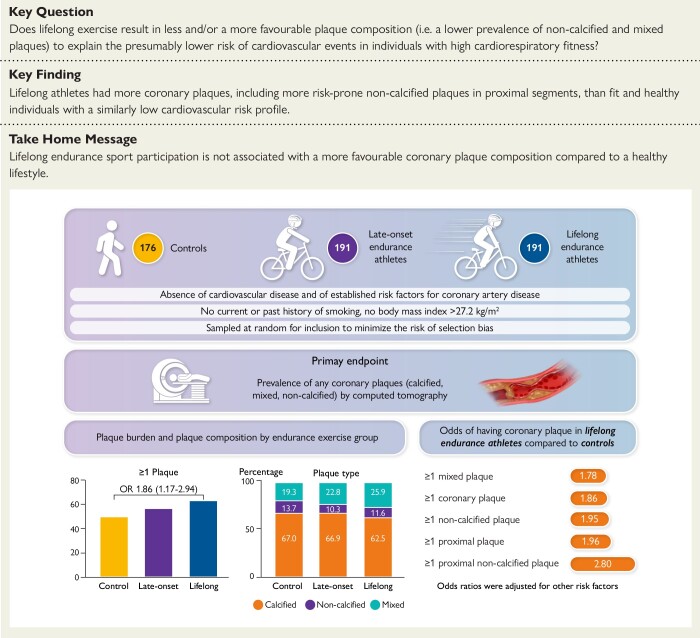
Aims: The impact of long-term endurance sport participation (on top of a healthy lifestyle) on coronary atherosclerosis and acute cardiac events remains controversial. Methods and results: The Master@Heart study is a well-balanced prospective observational cohort study. Overall, 191 lifelong master endurance athletes, 191 late-onset athletes (endurance sports initiation after 30 years of age), and 176 healthy non-athletes, all male with a low cardiovascular risk profile, were included. Peak oxygen uptake quantified fitness. The primary endpoint was the prevalence of coronary plaques (calcified, mixed, and non-calcified) on computed tomography coronary angiography. Analyses were corrected for multiple cardiovascular risk factors. The median age was 55 (50–60) years in all groups. Lifelong and late-onset athletes had higher peak oxygen uptake than non-athletes [159 (143–177) vs. 155 (138–169) vs. 122 (108–138) % predicted]. Lifelong endurance sports was associated with having ≥1 coronary plaque [odds ratio (OR) 1.86, 95% confidence interval (CI) 1.17–2.94], ≥ 1 proximal plaque (OR 1.96, 95% CI 1.24–3.11), ≥ 1 calcified plaques (OR 1.58, 95% CI 1.01–2.49), ≥ 1 calcified proximal plaque (OR 2.07, 95% CI 1.28–3.35), ≥ 1 non-calcified plaque (OR 1.95, 95% CI 1.12–3.40), ≥ 1 non-calcified proximal plaque (OR 2.80, 95% CI 1.39–5.65), and ≥1 mixed plaque (OR 1.78, 95% CI 1.06–2.99) as compared to a healthy non-athletic lifestyle. Conclusion: Lifelong endurance sport participation is not associated with a more favourable coronary plaque composition compared to a healthy lifestyle. Lifelong endurance athletes had more coronary plaques, including more non-calcified plaques in proximal segments, than fit and healthy individuals with a similarly low cardiovascular risk profile. Longitudinal research is needed to reconcile these findings with the risk of cardiovascular events at the higher end of the endurance exercise spectrum.
Overview
AI snapshot
Written from the paper’s full text.
TL;DR
In the Master@Heart prospective cohort of low-risk men, lifelong endurance athletes did not have a more favorable coronary plaque composition than healthy non-athletes; instead they had more coronary plaques, including non-calcified proximal plaques. The findings challenge the idea that benign plaque composition explains lower cardiovascular event risk in highly trained endurance athletes.
Key findings
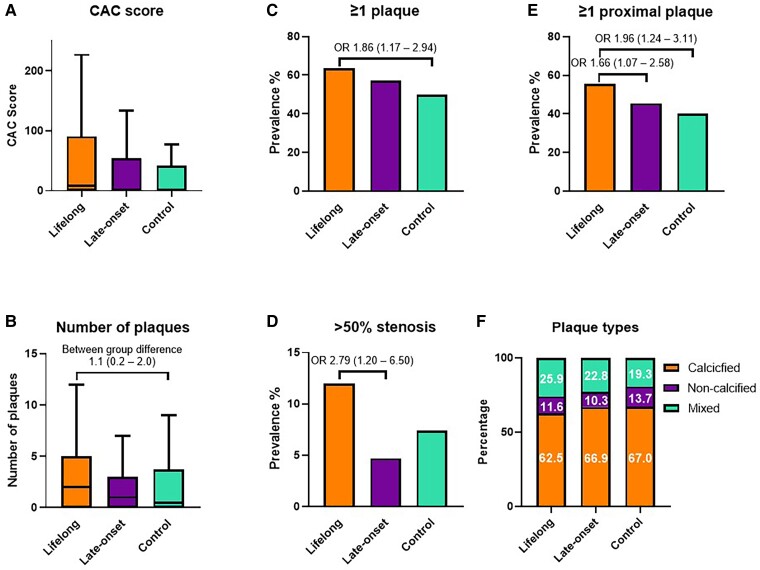
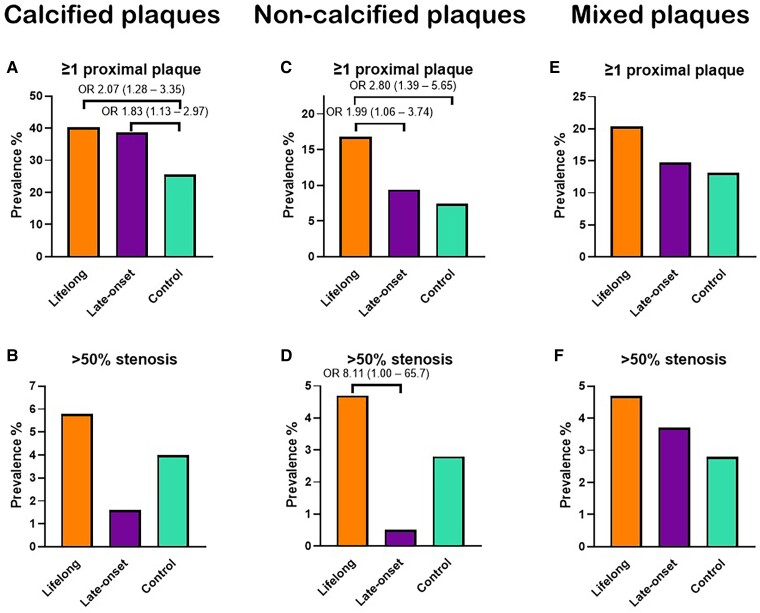
- Among 191 lifelong athletes, 191 late-onset athletes, and 176 non-athletes, lifelong endurance sport was associated with higher odds vs non-athletes of ≥1 coronary plaque (OR 1.86, 95% CI 1.17–2.94), ≥1 proximal plaque (OR 1.96, 1.24–3.11), ≥1 calcified plaque (OR 1.58, 1.01–2.49), ≥1 calcified proximal plaque (OR 2.07, 1.28–3.35), ≥1 non-calcified plaque (OR 1.95, 1.12–3.40), ≥1 non-calcified proximal plaque (OR 2.80, 1.39–5.65), and ≥1 mixed plaque (OR 1.78, 1.06–2.99).
- Lifelong athletes also had higher overall plaque burden than controls: SSS between-group difference 0.86 (95% CI 0.22–1.51) and SIS 0.65 (0.20–1.10); CAC percentile difference 9.6 (2.4–16.8). Compared with late-onset athletes, lifelong athletes had more ≥50% stenosis in any segment (OR 2.79, 1.20–6.50) and proximal segment (OR 5.92, 1.22–28.80).
- Plaque-type distribution was similar across groups (calcified 62.3% vs 68.4% vs 67%; non-calcified 11.8% vs 9.8% vs 13.7%; mixed 25.9% vs 21.8% vs 19.3%). Vulnerable plaques (≥2 high-risk features) were uncommon, and lifelong athletic lifestyle was associated with lower prevalence (OR 0.11, 95% CI 0.01–0.98).
Methods
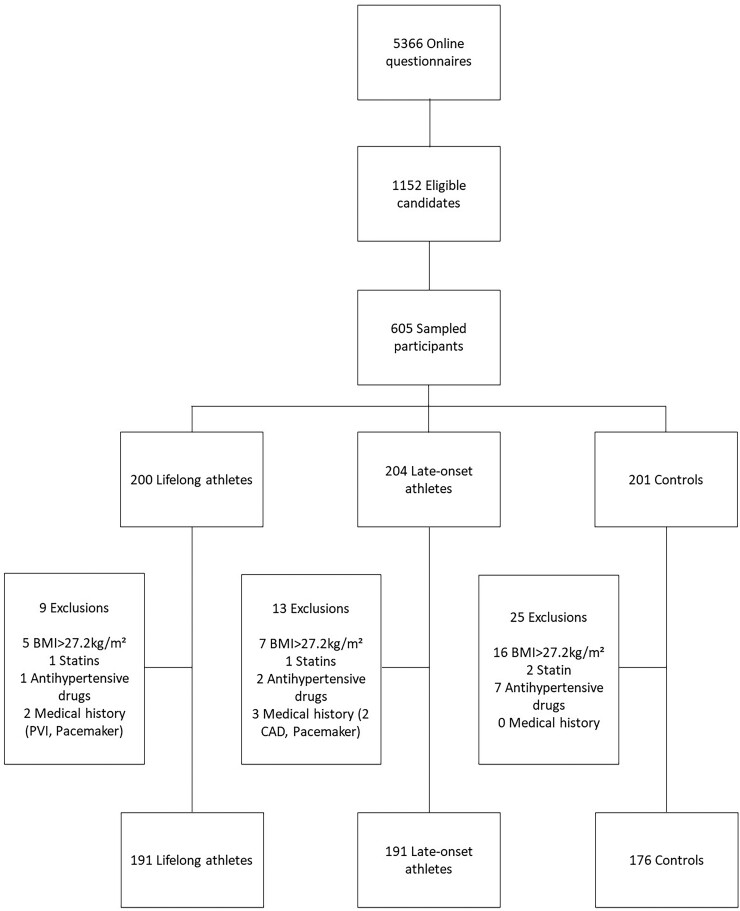
- Multicentre prospective observational cohort (Master@Heart; University Hospitals Leuven, University Hospital Antwerp, Jessa Hospital Hasselt), with primary endpoint analyzed cross-sectionally. 605 eligible subjects sampled; 558 analyzed: 191 lifelong athletes, 191 late-onset athletes, 176 non-athletes. All male, age 45–70, low cardiovascular risk; exclusions included CVD history, diabetes, hypercholesterolaemia, hypertension, smoking, BMI >27.2 kg/m², iodine contrast allergy.
- Athletes: cycling ≥8 h/week, running ≥6 h/week, or triathlon ≥8 h/week for ≥6 months; lifelong started <30 years, late-onset >30 years. Non-athletes: ≤3 h/week physical activity without prior regular endurance exercise. Fitness measured by peak oxygen uptake; coronary assessment by CTCA for plaque presence, location, composition (calcified, mixed, non-calcified), stenosis, CAC, SSS/SIS, vulnerable plaque features.
- Logistic and linear regression adjusted for age, BMI, systolic and diastolic BP, total cholesterol, LDL cholesterol, HbA1c, and family history of CAD. No missing data from population characteristics, exercise testing, and CTCA.
Limitations
- Stated: limited to male participants and White ethnicity, so findings may not apply to women or other ethnicities; cross-sectional design precludes definitive causal inference; no laboratory testing to exclude illicit performance-enhancing drugs; no blood sampling or BP monitoring before inclusion; multiple comparisons increase Type 1 error risk; lifetime training load assessed by questionnaire rather than continuous tracking, and temporary training interruptions cannot be excluded.
- Evident from the text: observational cohort with residual confounding possible despite adjustment; the primary endpoint is cross-sectional, and clinical event follow-up was planned/extended rather than reported here.
Model-written summary. Check it against the paper before relying on it.
Integrity signals
Registry
Cites
Statistics
Figures
Verification
Claims the paper makes
31 Own result · 23 Own method · 12 Partly supported · 7 Own interpretation · 6 Supported so far · 4 No full text of the sources · 3 Couldn’t confirm · 3 No basis given · 2 Not checked yet · 1 Supported · 1 Mixed support · accuracy not yet measured
The sources with a verdict support this claim; the rest weren’t checked yet, have no full text we could read, or their verdicts aren’t rated yet.
In the paper
“Smoking history was a non-negligible confounder in the papers by Molhenkamp et al. and Aengevaeren et al.2,4”
§ Lifelong endurance exercise and its relation with coronary atherosclerosis > Discussion
What the sources say
- Not checked — no full text of the sourcecites [2] Mohlenkamp, 2008, Running: the risk of coronary events: prevalence and prognostic relevance of coronary atherosclerosis in marathon runners, Eur Heart J source
- Supportedcites [4] Aengevaeren, 2017, Relationship between lifelong exercise volume and coronary atherosclerosis in athletes, Circulation source
The Data analysis section (p. 11) identifies smoking as a cardiovascular risk factor included a priori in adjusted analyses. The Results (p. 12) also report that athletes with coronary calcification were more often former smokers than those without it, supporting the characterization of smoking history as a relevant potential confounder in Aengevaeren et al. (LLM, conf=0.86)
plaincorrelational- Asserted: passes — The authors put it forward as true.
- Checkable: passes — It can be checked against evidence.
- Load-bearing: passes — The paper’s conclusions depend on it.
- Based: passes — The paper gives a reason why it holds.
The cited sources that could be checked couldn’t confirm or dispute this claim.
In the paper
“studies differed in cardiovascular risk profiles in both athletes and controls.”
§ Lifelong endurance exercise and its relation with coronary atherosclerosis > Discussion
What the sources say
- Not checked — no full text of the sourcecites [2] Mohlenkamp, 2008, Running: the risk of coronary events: prevalence and prognostic relevance of coronary atherosclerosis in marathon runners, Eur Heart J source
- Could not verifycites [4] Aengevaeren, 2017, Relationship between lifelong exercise volume and coronary atherosclerosis in athletes, Circulation sourceExperimental — accuracy not yet measured
The Results (p. 12) compare cardiovascular risk factors among athletes within this study, and the discussion (p. 15) mentions one earlier study that matched runners with controls. Neither passage establishes that cardiovascular risk profiles differed across studies in both athletes and controls. The Limitations (p. 19) also state that this study had no general-population control group. (LLM, conf=0.73)
plain- Asserted: passes — The authors put it forward as true.
- Checkable: passes — It can be checked against evidence.
- Load-bearing: passes — The paper’s conclusions depend on it.
- Based: passes — The paper gives a reason why it holds.
The cited sources support only part of this claim — read each source’s verdict below.
In the paper
“current evidence cannot relate an increased risk of ischaemic heart disease events in endurance athletes.23–26”
§ Lifelong endurance exercise and its relation with coronary atherosclerosis > Discussion
What the sources say
- Partly supportedcites [23] Gao, 2022, Associations of long-term physical activity trajectories with coronary artery calcium progression and cardiovascular disease events: results from the CARDIA study, Br J Sports Med sourceExperimental — accuracy not yet measured
The Abstract and Discussion report no detected increase in cardiovascular events with long-term high physical activity in the CARDIA cohort. However, the Limitations state that participants rarely reached endurance-athlete activity levels, and the paper reports cardiovascular events as a group rather than a separate result for ischaemic heart disease events in athletes. Page numbers are unavailable in our copy. (LLM, conf=0.86)
- Partly supportedcites [24] German, 2022, Physical activity, coronary artery calcium, and cardiovascular outcomes in the Multi-Ethnic Study of Atherosclerosis (MESA), Med Sci Sports Exerc sourceExperimental — accuracy not yet measured
The Results (Overall Relationship Between PA, CAC and Cardiovascular Outcomes; page not available) report no significant increase in incident cardiovascular disease among participants with high physical activity. However, the study examined a general MESA cohort, not endurance athletes, and its cardiovascular outcome was a composite rather than ischaemic heart disease events specifically. (LLM, conf=0.88)
- Partly supportedcites [25] DeFina, 2019, Association of all-cause and cardiovascular mortality with high levels of physical activity and concurrent coronary artery calcification, JAMA Cardiol sourceExperimental — accuracy not yet measured
The Discussion reports no greater mortality among highly active men with elevated coronary artery calcification, which supports the claim’s general direction. But the Mortality section measures all-cause and cardiovascular deaths, not ischaemic heart disease events specifically or nonfatal events; the Strengths and Limitations section also says the study cannot rule out some increased cardiovascular mortality risk. (LLM, conf=0.84)
plain- Asserted: passes — The authors put it forward as true.
- Checkable: passes — It can be checked against evidence.
- Load-bearing: passes — The paper’s conclusions depend on it.
- Based: passes — The paper gives a reason why it holds.
- Partly supported
The cited sources that could be checked couldn’t confirm or dispute this claim.
In the paper
“our results do not support the hypothesis that the observed lower risk of cardiovascular events amongst individuals with high cardiorespiratory fitness can be explained by a more benign (i.e. stable) plaque composition.22”
§ Lifelong endurance exercise and its relation with coronary atherosclerosis > Discussion
What the sources say
- Could not verifycites [22] Mozaffarian, 2008, Physical activity and incidence of atrial fibrillation in older adults: the cardiovascular health study, Circulation sourceExperimental — accuracy not yet measured
The Results and Discussion address physical activity and incident atrial fibrillation in older adults, not cardiorespiratory fitness, cardiovascular events, or plaque composition. Searches for stable plaque composition and plaque stability found no passage evaluating the proposed explanation. (LLM, conf=0.78)
plain- Asserted: passes — The authors put it forward as true.
- Checkable: passes — It can be checked against evidence.
- Load-bearing: passes — The paper’s conclusions depend on it.
- Based: passes — The paper gives a reason why it holds.
- Could not verify
The cited sources support only part of this claim — read each source’s verdict below.
In the paper
“a lower prevalence of cardiac risk factors with low physical activity levels is associated with reduced coronary atherosclerosis but unfavourable plaque characteristics.3,4”
§ Lifelong endurance exercise and its relation with coronary atherosclerosis > Discussion
What the sources say
- Not checked — no full text of the sourcecites [3] Merghani, 2017, Prevalence of subclinical coronary artery disease in masters endurance athletes with a low atherosclerotic risk profile, Circulation source
- Partly supportedcites [4] Aengevaeren, 2017, Relationship between lifelong exercise volume and coronary atherosclerosis in athletes, Circulation sourceExperimental — accuracy not yet measured
The Results (p. 13) report less coronary atherosclerosis in the least-active athletes, but more mixed plaques among those who had atherosclerosis; the Discussion (p. 14) describes the most-active group’s plaques as more benign. The cited passages do not establish that the least-active group had a lower prevalence of cardiac risk factors, so that part of the claim is unsupported. (LLM, conf=0.85)
plaincorrelational- Asserted: passes — The authors put it forward as true.
- Checkable: passes — It can be checked against evidence.
- Load-bearing: passes — The paper’s conclusions depend on it.
- Based: passes — The paper gives a reason why it holds.
The cited sources support only part of this claim — read each source’s verdict below.
In the paper
“some athletes and controls were on medical treatment in previous studies”
§ Lifelong endurance exercise and its relation with coronary atherosclerosis > Discussion
What the sources say
- Not checked — no full text of the sourcecites [2] Mohlenkamp, 2008, Running: the risk of coronary events: prevalence and prognostic relevance of coronary atherosclerosis in marathon runners, Eur Heart J source
- Partly supportedcites [4] Aengevaeren, 2017, Relationship between lifelong exercise volume and coronary atherosclerosis in athletes, Circulation sourceExperimental — accuracy not yet measured
The Results (p. 12) report that some athletes used statins, a medical treatment. But the Limitations (p. 19) state that this study had no general-population control group, and the passages do not establish that controls in previous studies were receiving treatment. (LLM, conf=0.84)
plain- Asserted: passes — The authors put it forward as true.
- Checkable: passes — It can be checked against evidence.
- Load-bearing: passes — The paper’s conclusions depend on it.
- Based: passes — The paper gives a reason why it holds.
Every source the paper cites for this claim was checked and supports it.
In the paper
“There is evidence to suggest that runners have a higher prevalence of coronary plaques than cyclists.29”
§ Lifelong endurance exercise and its relation with coronary atherosclerosis > Discussion
What the sources say
- Supportedcites [29] Aengevaeren, 2019, Coronary atherosclerosis in athletes: exploring the role of sporting discipline, JACC Cardiovasc Imaging source
In “Exploring the Role of Sporting Discipline,” the authors report that cyclists had a lower prevalence of atherosclerotic plaques than runners (adjusted odds ratio 0.41, 95% CI 0.19–0.87). This supports the citing sentence’s hedged comparison; the study population was middle-aged male athletes. (LLM, conf=0.94)
hedgedcorrelational- Asserted: passes — The authors put it forward as true.
- Checkable: passes — It can be checked against evidence.
- Load-bearing: passes — The paper’s conclusions depend on it.
- Based: passes — The paper gives a reason why it holds.
- Supported
The cited sources support only part of this claim — read each source’s verdict below.
In the paper
“These findings may in part explain why moderate and vigorous physical activity beyond a specific amount of time does not offer additional reduction in mortality risk, thereby exhibiting a nadir in the dose–response relationship.32,33”
§ Lifelong endurance exercise and its relation with coronary atherosclerosis > Discussion
What the sources say
- Partly supportedcites [32] Ahmadi, 2022, Vigorous physical activity, incident heart disease, and cancer: how little is enough?, Eur Heart J sourceExperimental — accuracy not yet measured
The Discussion reports a non-linear association between vigorous physical activity (VPA) and all-cause mortality, with the lowest risk below 75 minutes per week. But it also reports modest additional benefits with more VPA, rather than no further reduction, and does not establish the claimed time threshold for moderate activity. (LLM, conf=0.88)
- Supportedcites [33] Lee, 2022, Long-term leisure-time physical activity intensity and all-cause and cause-specific mortality: a prospective cohort of US adults, Circulation source
The Conclusion states that mortality reduction was nearly maximal at 150–300 min/week of long-term leisure-time vigorous activity or 300–600 min/week of moderate activity, with no clear additional association beyond those levels. This supports the cited point that the dose–response relationship levels off, although the paper describes associations rather than establishing a causal explanation. (LLM, conf=0.88)
hedgedconditional- Asserted: passes — The authors put it forward as true.
- Checkable: passes — It can be checked against evidence.
- Load-bearing: passes — The paper’s conclusions depend on it.
- Based: passes — The paper gives a reason why it holds.
- Partly supported
The sources with a verdict support this claim; the rest weren’t checked yet, have no full text we could read, or their verdicts aren’t rated yet.
In the paper
“the final sample size of the Master@Heart study remains twice as large as that of previous studies.2–4”
§ Lifelong endurance exercise and its relation with coronary atherosclerosis > Discussion
What the sources say
- Not checked — no full text of the sourcecites [2] Mohlenkamp, 2008, Running: the risk of coronary events: prevalence and prognostic relevance of coronary atherosclerosis in marathon runners, Eur Heart J source
- Not checked — no full text of the sourcecites [3] Merghani, 2017, Prevalence of subclinical coronary artery disease in masters endurance athletes with a low atherosclerotic risk profile, Circulation source
- Supportedcites [4] Aengevaeren, 2017, Relationship between lifelong exercise volume and coronary atherosclerosis in athletes, Circulation source
The Results (p. 12) report that this previous study included 284 participants. The citation supplies a prior-study sample size for the citing authors’ comparison; it is not offered as a source for Master@Heart’s own final sample size. (LLM, conf=0.88)
plain- Asserted: passes — The authors put it forward as true.
- Checkable: passes — It can be checked against evidence.
- Load-bearing: passes — The paper’s conclusions depend on it.
- Based: passes — The paper gives a reason why it holds.
The cited sources that could be checked couldn’t confirm or dispute this claim.
In the paper
“none of the study participants was taking antihypertensive drugs or statins.2,4”
§ Lifelong endurance exercise and its relation with coronary atherosclerosis > Discussion
What the sources say
- Not checked — no full text of the sourcecites [2] Mohlenkamp, 2008, Running: the risk of coronary events: prevalence and prognostic relevance of coronary atherosclerosis in marathon runners, Eur Heart J source
- Could not verifycites [4] Aengevaeren, 2017, Relationship between lifelong exercise volume and coronary atherosclerosis in athletes, Circulation sourceExperimental — accuracy not yet measured
The Study population section (pp. 7–8) identifies this paper’s participants as belonging to the MARC study, not Master@Heart. Its Exercise volume patterns table (p. 33) records statin use among MARC participants, but that does not establish whether any Master@Heart participants took statins or antihypertensive drugs. Our copy does not address medication use in Master@Heart. (LLM, conf=0.78)
plain- Asserted: passes — The authors put it forward as true.
- Checkable: passes — It can be checked against evidence.
- Load-bearing: passes — The paper’s conclusions depend on it.
- Based: passes — The paper gives a reason why it holds.
- It may state two separate claims as one. 32
- Probably not a substantial claim. 23
Some cited sources support this claim and some don’t — read each source’s verdict below.
In the paper
“Some studies have shown that endurance exercise reduces the risk for ischaemic events regardless of CAC score, and this reduction is greatest at the higher CAC scores.24,26”
§ Lifelong endurance exercise and its relation with coronary atherosclerosis > Discussion
What the sources say
- Disputedcites [24] German, 2022, Physical activity, coronary artery calcium, and cardiovascular outcomes in the Multi-Ethnic Study of Atherosclerosis (MESA), Med Sci Sports Exerc sourceExperimental — accuracy not yet measured
The Results (Overall Relationship Between PA, CAC and Cardiovascular Outcomes) report fewer incident CVD events with higher physical activity only for participants with CAC <100 AU; they state there was no significant association with CVD for participants with CAC ≥100 AU. The Discussion describes the largest risk differences at high CAC in another analysis, but those differences concerned mortality, not ischaemic events. (LLM, conf=0.88)
Checked by a reasoning model — may be wrong.
- Partly supportedcites [26] Radford, 2018, Cardiorespiratory fitness, coronary artery calcium, and cardiovascular disease events in a cohort of generally healthy middle-age men: results from the Cooper Center Longitudinal Study, Circulation sourceExperimental — accuracy not yet measured
The Abstract reports lower CVD event risk with higher cardiorespiratory fitness at all CAC levels, and the Discussion reports a stronger inverse association as CAC burden increased. But this observational study of generally healthy men did not test whether endurance exercise itself reduces ischaemic events; the Clinical Implications section explicitly says it did not examine the effect of changes in fitness on CVD risk. (LLM, conf=0.88)
hedgeddirect- Asserted: passes — The authors put it forward as true.
- Checkable: passes — It can be checked against evidence.
- Load-bearing: passes — The paper’s conclusions depend on it.
- Based: passes — The paper gives a reason why it holds.
It may state two separate claims as one.
- Disputed
The cited sources support only part of this claim — read each source’s verdict below.
In the paper
“Regular exercise improves blood pressure control and lipid profiles, reduces the incidence of diabetes and myocardial infarction, and increases life expectancy.6–9”
§ Lifelong endurance exercise and its relation with coronary atherosclerosis > Introduction
What the sources say
- Partly supportedcites [6] Cornelissen, 2005, Effects of endurance training on blood pressure, blood pressure-regulating mechanisms, and cardiovascular risk factors, Hypertension sourceExperimental — accuracy not yet measured
The Perspectives and Discussion sections report improved blood pressure and HDL cholesterol with endurance training; triglycerides tended to decrease. The Discussion also describes an association between physical activity and lower cardiovascular mortality, but the paper does not establish reduced diabetes or myocardial-infarction incidence or increased life expectancy. Page numbers are not available in our copy. (LLM, conf=0.88)
- Not checked — no full text of the sourcecites [7] Kelley, 2006, Aerobic exercise and lipids and lipoproteins in patients with cardiovascular disease: a meta-analysis of randomized controlled trials, J Cardiopulm Rehabil source
- Partly supportedcites [8] Thomas, 2006, Exercise for type 2 diabetes mellitus, Cochrane Database Syst Rev sourceExperimental — accuracy not yet measured
The Results (page unavailable) report that exercise lowered plasma triglycerides in people with type 2 diabetes, supporting only part of the lipid-profile claim; they found no significant improvement in cholesterol or blood pressure. The review did not assess diabetes incidence, myocardial infarction incidence, or mortality, so it cannot support the claimed reductions in incidence or increase in life expectancy. (LLM, conf=0.91)
- Not checked — no full text of the sourcecites [9] Koolhaas, 2016, Physical activity types and coronary heart disease risk in middle-aged and elderly persons: the Rotterdam study, Am J Epidemiol source
plaindirect- Asserted: passes — The authors put it forward as true.
- Checkable: passes — It can be checked against evidence.
- Load-bearing: fails — The paper’s conclusions may not depend on it.
- Based: passes — The paper gives a reason why it holds.
Probably not a substantial claim. The paper’s conclusions may not depend on it. It may state two separate claims as one.
- Partly supported
The sources with a verdict support this claim; the rest weren’t checked yet, have no full text we could read, or their verdicts aren’t rated yet.
In the paper
“meaning that the plaque-to-vessel ratio in athletes could be lower and thus lead to less significant stenosis.27,28”
§ Lifelong endurance exercise and its relation with coronary atherosclerosis > Discussion
What the sources say
- Not checked — no full text of the sourcecites [27] Parker, 1994, Effects of exercise training on regulation of tone in coronary arteries and arterioles, Med Sci Sports Exerc source
- Supportedcites [28] Haskell, 1993, Coronary artery size and dilating capacity in ultradistance runners, Circulation source
In “Coronary Artery Size Before Nitroglycerin” (page unavailable), the paper reports an autopsy finding that physically active Masai men had as much coronary atherosclerosis as US men but patent arterial lumens because their vessels were larger. That supports the citing sentence’s hedged suggestion that plaque could cause less consequential narrowing in athletes; the paper does not present it as a measured plaque-to-vessel ratio in its runners. (LLM, conf=0.84)
hedgedconditional- Asserted: passes — The authors put it forward as true.
- Checkable: passes — It can be checked against evidence.
- Load-bearing: passes — The paper’s conclusions depend on it.
- Based: passes — The paper gives a reason why it holds.
It may state two separate claims as one.
The cited sources support only part of this claim — read each source’s verdict below.
In the paper
“In 2017, two other studies added a relevant nuance that athletes presenting with coronary plaques were more likely to have calcified plaques, whereas non-athletes with plaques more frequently had mixed plaques.3,4”
§ Lifelong endurance exercise and its relation with coronary atherosclerosis > Discussion
What the sources say
- Not checked — no full text of the sourcecites [3] Merghani, 2017, Prevalence of subclinical coronary artery disease in masters endurance athletes with a low atherosclerotic risk profile, Circulation source
- Partly supportedcites [4] Aengevaeren, 2017, Relationship between lifelong exercise volume and coronary atherosclerosis in athletes, Circulation sourceExperimental — accuracy not yet measured
The Results (p. 13) report fewer mixed plaques and more exclusively calcified plaques among plaque-bearing athletes in the most active group than in the least active group. But the comparison was between groups of athletes, not between athletes and non-athletes; the Accelerated Coronary Artery Calcification section (p. 15) says even the least active group averaged about one hour of running per week. (LLM, conf=0.90)
hedgedcorrelational- Asserted: passes — The authors put it forward as true.
- Checkable: passes — It can be checked against evidence.
- Load-bearing: unclear — It is unclear whether the paper’s conclusions depend on it.
- Based: passes — The paper gives a reason why it holds.
It may state two separate claims as one.
The sources with a verdict support this claim; the rest weren’t checked yet, have no full text we could read, or their verdicts aren’t rated yet.
In the paper
“Increased cardiorespiratory fitness is associated with a progressive reduction of cardiovascular events, which would seem to be at odds with the aforementioned link between lifelong exercise load and increased coronary atherosclerosis.”
§ Lifelong endurance exercise and its relation with coronary atherosclerosis > Introduction
What the sources say
- Supportedcites [6] Cornelissen, 2005, Effects of endurance training on blood pressure, blood pressure-regulating mechanisms, and cardiovascular risk factors, Hypertension source
The Discussion (page unavailable) reports that prospective epidemiological studies find physical activity and fitness inversely related to cardiovascular disease incidence and mortality. That supports the claimed association between greater fitness and fewer cardiovascular events; the paper reports this as background evidence, not as an outcome measured in its training analysis. (LLM, conf=0.87)
- Not checked — no full text of the sourcecites [7] Kelley, 2006, Aerobic exercise and lipids and lipoproteins in patients with cardiovascular disease: a meta-analysis of randomized controlled trials, J Cardiopulm Rehabil source
- Could not verifycites [8] Thomas, 2006, Exercise for type 2 diabetes mellitus, Cochrane Database Syst Rev sourceExperimental — accuracy not yet measured
The Results (page unavailable) report fitness outcomes but say that no study included diabetic complications as an outcome; the Discussion (page unavailable) says the trials were too short to report significant long-term complications. Searches for cardiovascular events and fitness-related cardiovascular risk found no passage establishing a progressive reduction in events as fitness increases. (LLM, conf=0.76)
- Not checked — no full text of the sourcecites [9] Koolhaas, 2016, Physical activity types and coronary heart disease risk in middle-aged and elderly persons: the Rotterdam study, Am J Epidemiol source
hedgedcorrelational- Asserted: passes — The authors put it forward as true.
- Checkable: passes — It can be checked against evidence.
- Load-bearing: passes — The paper’s conclusions depend on it.
- Based: passes — The paper gives a reason why it holds.
Probably not a substantial claim.
- Supported
The cited sources support only part of this claim — read each source’s verdict below.
In the paper
“The SSS and SIS have demonstrated clinical validity in detecting major adverse cardiac events in multiple populations.15–19”
§ Lifelong endurance exercise and its relation with coronary atherosclerosis > Methods > Computed tomography coronary angiography
What the sources say
- Partly supportedcites [15] Al-Mallah, 2014, Does coronary CT angiography improve risk stratification over coronary calcium scoring in symptomatic patients with suspected coronary artery disease? Results from the prospective multicenter international CONFIRM registry, Eur Heart J Cardiovasc Imaging sourceExperimental — accuracy not yet measured
The Multivariable Cox models section reports that adding SSS or SIS improved prediction of death or myocardial infarction, and Table 3 shows improved C-statistics for both scores. The evidence comes from one multicenter cohort of symptomatic patients with suspected coronary artery disease, not multiple distinct populations; the measured endpoint was all-cause mortality or non-fatal MI. (LLM, conf=0.84)
- Not checked — no full text of the sourcecites [16] Tesche, 2016, Prognostic implications of coronary CT angiography-derived quantitative markers for the prediction of major adverse cardiac events, J Cardiovasc Comput Tomogr source
- Not checked — no full text of the sourcecites [17] Nadjiri, 2016, Prognostic value of coronary CT angiography in diabetic patients: a 5-year follow up study, Int J Cardiovasc Imaging source
- Partly supportedcites [18] Motwani, 2017, Machine learning for prediction of all-cause mortality in patients with suspected coronary artery disease: a 5-year multicentre prospective registry analysis, Eur Heart J sourceExperimental — accuracy not yet measured
The Prediction all-cause mortality section reports that both SSS and SIS predicted five-year all-cause mortality in patients with suspected coronary artery disease. It does not report their performance for major adverse cardiac events or establish validity across multiple populations; the Study limitations section says cardiac-specific endpoints were unavailable for all centres. (LLM, conf=0.88)
- Supportedcites [19] van den Hoogen, 2020, Coronary atherosclerosis scoring with semiquantitative CCTA risk scores for prediction of major adverse cardiac events: propensity score-based analysis of diabetic and non-diabetic patients, J Cardiovasc Comput Tomogr source
Section 3.3.1 reports that all semiquantitative CCTA risk scores, including SIS and SSS, independently predicted events in patients with and without diabetes. The Discussion identifies the endpoint as all-cause death and non-fatal myocardial infarction, supporting the claim across these two patient groups. (LLM, conf=0.91)
boosted- Asserted: passes — The authors put it forward as true.
- Checkable: passes — It can be checked against evidence.
- Load-bearing: fails — The paper’s conclusions may not depend on it.
- Based: passes — The paper gives a reason why it holds.
Probably not a substantial claim. The paper’s conclusions may not depend on it.
- Partly supported
The cited sources support only part of this claim — read each source’s verdict below.
In the paper
“Since calcified plaques are more stable and less prone to rupture than mixed and non-calcified plaques”
§ Lifelong endurance exercise and its relation with coronary atherosclerosis > Discussion
What the sources say
- Partly supportedcites [20] Hou, 2012, Prognostic value of coronary CT angiography and calcium score for major adverse cardiac events in outpatients, JACC Cardiovasc Imaging sourceExperimental — accuracy not yet measured
The Discussion (page unavailable) reports significantly higher three-year major adverse cardiac event rates for noncalcified and mixed plaques than for calcified plaques, and describes soft, lipid-filled plaques as more vulnerable. The study does not establish that calcified plaques are mechanically more stable or specifically less prone to rupture; it measured clinical events, not plaque rupture. (LLM, conf=0.86)
plaindirect- Asserted: passes — The authors put it forward as true.
- Checkable: passes — It can be checked against evidence.
- Load-bearing: passes — The paper’s conclusions depend on it.
- Based: passes — The paper gives a reason why it holds.
Probably not a substantial claim. It may state two separate claims as one.
- Partly supported
The cited sources support only part of this claim — read each source’s verdict below.
In the paper
“it is known that endurance athletes have larger coronary arteries and a greater vasodilatory potential”
§ Lifelong endurance exercise and its relation with coronary atherosclerosis > Discussion
What the sources say
- Not checked — no full text of the sourcecites [27] Parker, 1994, Effects of exercise training on regulation of tone in coronary arteries and arterioles, Med Sci Sports Exerc source
- Partly supportedcites [28] Haskell, 1993, Coronary artery size and dilating capacity in ultradistance runners, Circulation sourceExperimental — accuracy not yet measured
The Abstract reports greater coronary-artery dilation after nitroglycerin in the ultradistance runners. It also reports no significant difference in artery size before nitroglycerin, so the unqualified claim that endurance athletes have larger coronary arteries is not supported by this study's measurements. (LLM, conf=0.90)
boostedcorrelational- Asserted: passes — The authors put it forward as true.
- Checkable: passes — It can be checked against evidence.
- Load-bearing: passes — The paper’s conclusions depend on it.
- Based: passes — The paper gives a reason why it holds.
It may state two separate claims as one.
The sources with a verdict support this claim; the rest weren’t checked yet, have no full text we could read, or their verdicts aren’t rated yet.
In the paper
“these prior studies only looked at the relative distribution of plaque type in individuals with evidence of plaque, but differences in the absolute prevalence of calcified, mixed, and non-calcified plaques were not reported.”
§ Lifelong endurance exercise and its relation with coronary atherosclerosis > Discussion
What the sources say
- Not checked — no full text of the sourcecites [3] Merghani, 2017, Prevalence of subclinical coronary artery disease in masters endurance athletes with a low atherosclerotic risk profile, Circulation source
- Supportedcites [4] Aengevaeren, 2017, Relationship between lifelong exercise volume and coronary atherosclerosis in athletes, Circulation source
The Results (pp. 13–14) compare plaque types among participants who already had coronary atherosclerosis. The plaque-type percentages in Supplemental Table 1 (p. 46) likewise use participants with plaque as their denominator; the paper does not report differences in the absolute prevalence of each plaque type across all participants. (LLM, conf=0.87)
plain- Asserted: passes — The authors put it forward as true.
- Checkable: passes — It can be checked against evidence.
- Load-bearing: passes — The paper’s conclusions depend on it.
- Based: passes — The paper gives a reason why it holds.
It may state two separate claims as one.
The cited sources support only part of this claim — read each source’s verdict below.
In the paper
“All coronary lesions were interpreted following the 2016 SCCT guidelines for their location, stenosis grade, composition (calcified, mixed, and non-calcified) as well as their vulnerability (positive remodeling, low-attenuation plaque, spotty calcification, and the napkin-ring sign).12,13”
§ Lifelong endurance exercise and its relation with coronary atherosclerosis > Methods > Computed tomography coronary angiography
What the sources say
- Partly supportedcites [12] Cury, 2016, Coronary Artery Disease - Reporting and Data System (CAD-RADS): an expert consensus document of SCCT, ACR and NASCI: endorsed by the ACC, JACC Cardiovasc Imaging sourceExperimental — accuracy not yet measured
The CAD-RADS stenosis grading table gives stenosis categories, and Figure 2 identifies lesion locations and calcified plaque. The modifier V passage lists all four vulnerability features in the claim, but specifies that at least two are needed to designate a plaque high-risk. The passages do not establish the claimed three-part composition classification, particularly the mixed-plaque category. (LLM, conf=0.84)
- Not checked — no full text of the sourcecites [13] Hecht, 2017, 2016 SCCT/STR guidelines for coronary artery calcium scoring of noncontrast noncardiac chest CT scans: a report of the Society of Cardiovascular Computed Tomography and Society of Thoracic Radiology, J Cardiovasc Comput Tomogr source
plain- Asserted: passes — The authors put it forward as true.
- Checkable: passes — It can be checked against evidence.
- Load-bearing: passes — The paper’s conclusions depend on it.
- Based: passes — The paper gives a reason why it holds.
Probably not a substantial claim.
- Partly supported
The cited sources support only part of this claim — read each source’s verdict below.
In the paper
“The non-calcified/mixed characteristics, a stenosis grade of ≥50%, and the proximal location of coronary plaques are all established risk factors for ischaemic heart disease.14,21”
§ Lifelong endurance exercise and its relation with coronary atherosclerosis > Discussion
What the sources say
- Not checked — no full text of the sourcecites [14] Min, 2007, Prognostic value of multidetector coronary computed tomographic angiography for prediction of all-cause mortality, J Am Coll Cardiol source
- Partly supportedcites [21] Puchner, 2014, High-risk plaque detected on coronary CT angiography predicts acute coronary syndromes independent of significant stenosis in acute chest pain: results from the ROMICAT-II trial, J Am Coll Cardiol sourceExperimental — accuracy not yet measured
The Results and Discussion (page unavailable) support ≥50% stenosis as a predictor of acute coronary syndrome and associate specific high-risk plaque features, including low attenuation, with it. They do not establish non-calcified or mixed composition as such a risk factor, nor do they address proximal plaque location. The study’s finding in patients with acute chest pain is also narrower than a general claim about ischaemic heart disease. (LLM, conf=0.87)
boostedcorrelational- Asserted: passes — The authors put it forward as true.
- Checkable: passes — It can be checked against evidence.
- Load-bearing: passes — The paper’s conclusions depend on it.
- Based: passes — The paper gives a reason why it holds.
It may state two separate claims as one.
The cited sources support only part of this claim — read each source’s verdict below.
In the paper
“our non-athletes exhibited a higher level of fitness with a higher METmin/week than the controls by Aengevaeren et al. (888 vs. 669 METmin/week) and a greater average percentage predicted VO2peak of 122% compared to 96% reported by Merghani et al.3,4”
§ Lifelong endurance exercise and its relation with coronary atherosclerosis > Discussion
What the sources say
- Not checked — no full text of the sourcecites [3] Merghani, 2017, Prevalence of subclinical coronary artery disease in masters endurance athletes with a low atherosclerotic risk profile, Circulation source
- Partly supportedcites [4] Aengevaeren, 2017, Relationship between lifelong exercise volume and coronary atherosclerosis in athletes, Circulation sourceExperimental — accuracy not yet measured
The Exercise volume patterns table (p. 34) reports 669 [405–802] MET-min/week for Aengevaeren et al.’s lowest-exercise group, supporting the numerical comparison. But the Study population (p. 7) identifies participants as recreational or competitive athletes, and the Limitations (p. 19) explicitly say the study had no non-athlete control group. The VO2peak figure is attributed to Merghani et al., not this source. (LLM, conf=0.88)
plain- Asserted: passes — The authors put it forward as true.
- Checkable: passes — It can be checked against evidence.
- Load-bearing: passes — The paper’s conclusions depend on it.
- Based: passes — The paper gives a reason why it holds.
It may state two separate claims as one.
The sources with a verdict support this claim; the rest weren’t checked yet, have no full text we could read, or their verdicts aren’t rated yet.
In the paper
“In the paper by Merghani et al. and Molhenkamp et al., athletes were mostly engaged in running whilst the athletic population in the trial by Aengevaeren et al. was more diverse with 29% cyclists and 25% runners.2–4”
§ Lifelong endurance exercise and its relation with coronary atherosclerosis > Discussion
What the sources say
- Not checked — no full text of the sourcecites [2] Mohlenkamp, 2008, Running: the risk of coronary events: prevalence and prognostic relevance of coronary atherosclerosis in marathon runners, Eur Heart J source
- Not checked — no full text of the sourcecites [3] Merghani, 2017, Prevalence of subclinical coronary artery disease in masters endurance athletes with a low atherosclerotic risk profile, Circulation source
- Supportedcites [4] Aengevaeren, 2017, Relationship between lifelong exercise volume and coronary atherosclerosis in athletes, Circulation source
Supplemental Table 1 (pp. 40–41) lists a range of sports and reports cycling as the dominant sport for 81 participants (29%) and running for 72 (25%). These figures support the part of the sentence attributed to Aengevaeren et al.; they refer to dominant sport, not all participation in each sport. (LLM, conf=0.94)
plain- Asserted: passes — The authors put it forward as true.
- Checkable: passes — It can be checked against evidence.
- Load-bearing: passes — The paper’s conclusions depend on it.
- Based: passes — The paper gives a reason why it holds.
It may state two separate claims as one.
A result the paper reports from its own data — it cites no other source for it, so there is none to check. The quote shows it is in the paper.
In the paper
“vulnerable plaques, which carry the highest risk for events, were rare and not associated with an athletic lifestyle.”
§ Lifelong endurance exercise and its relation with coronary atherosclerosis > Discussion
plain- Asserted: passes — The authors put it forward as true.
- Checkable: passes — It can be checked against evidence.
- Load-bearing: passes — The paper’s conclusions depend on it.
- Based: passes — The paper gives a reason why it holds.
It may state two separate claims as one.
- Rests on an assumption: Vulnerable plaques carry the highest risk for events.
A result the paper reports from its own data — it cites no other source for it, so there is none to check. The quote shows it is in the paper.
In the paper
“There was no difference in the hours per week of endurance exercise between lifelong and late-onset athletes, but both athlete groups performed more hours than controls [11 h/week (10–14) vs. 10 h/week (8–12) vs. 1 h/week (0–3)].”
§ Lifelong endurance exercise and its relation with coronary atherosclerosis > Results > Study population and baseline characteristics
plain- Asserted: passes — The authors put it forward as true.
- Checkable: passes — It can be checked against evidence.
- Load-bearing: unclear — It is unclear whether the paper’s conclusions depend on it.
- Based: passes — The paper gives a reason why it holds.
It may state two separate claims as one.
A result the paper reports from its own data — it cites no other source for it, so there is none to check. The quote shows it is in the paper.
In the paper
“lifelong middle-aged athletes had more coronary plaques, including more unstable non-calcified plaques in proximal segments”
- Also stated in: § Conclusion · plain
“Lifelong middle-aged athletes had more coronary plaques, including more non-calcified and mixed plaques and plaques in proximal segments with significant luminal stenosis, than fit and healthy individuals with a similarly low cardiovascular risk profile.”
§ Lifelong endurance exercise and its relation with coronary atherosclerosis > Discussion
plaincorrelational- Asserted: passes — The authors put it forward as true.
- Checkable: passes — It can be checked against evidence.
- Load-bearing: passes — The paper’s conclusions depend on it.
- Based: passes — The paper gives a reason why it holds.
It may state two separate claims as one.
- Also stated in: § Conclusion · plain
A result the paper reports from its own data — it cites no other source for it, so there is none to check. The quote shows it is in the paper.
In the paper
“Controls had a higher body fat percentage than lifelong and late-onset athletes (19.4% vs. 13.9% vs. 15%).”
§ Lifelong endurance exercise and its relation with coronary atherosclerosis > Results > Study population and baseline characteristics
plain- Asserted: passes — The authors put it forward as true.
- Checkable: passes — It can be checked against evidence.
- Load-bearing: fails — The paper’s conclusions may not depend on it.
- Based: passes — The paper gives a reason why it holds.
Probably not a substantial claim. The paper’s conclusions may not depend on it.
A result the paper reports from its own data — it cites no other source for it, so there is none to check. The quote shows it is in the paper.
In the paper
“a greater proportion of lifelong athletes had proximal plaques and lesions with significant stenosis, as well as plaques of non-calcified and mixed morphology.”
§ Lifelong endurance exercise and its relation with coronary atherosclerosis > Discussion
plaincorrelational- Asserted: passes — The authors put it forward as true.
- Checkable: passes — It can be checked against evidence.
- Load-bearing: passes — The paper’s conclusions depend on it.
- Based: passes — The paper gives a reason why it holds.
It may state two separate claims as one.
A result the paper reports from its own data — it cites no other source for it, so there is none to check. The quote shows it is in the paper.
In the paper
“Lifelong and late-onset had a similar VO2peak which was significantly higher than in controls [VO2peak 48 mL/min/kg (43–53) vs. 46 mL/min/kg (41–51) vs. 37 mL/min/kg (32–42); % predicted VO2peak 159% (143–177) vs. 155% (138–169) vs. 122% (108–138)].”
- Also stated in: § Methods and results · plain
“Lifelong and late-onset athletes had higher peak oxygen uptake than non-athletes [159 (143–177) vs. 155 (138–169) vs. 122 (108–138) % predicted].”
§ Lifelong endurance exercise and its relation with coronary atherosclerosis > Results > Study population and baseline characteristics
plain- Asserted: passes — The authors put it forward as true.
- Checkable: passes — It can be checked against evidence.
- Load-bearing: unclear — It is unclear whether the paper’s conclusions depend on it.
- Based: passes — The paper gives a reason why it holds.
It may state two separate claims as one.
- Also stated in: § Methods and results · plain
A result the paper reports from its own data — it cites no other source for it, so there is none to check. The quote shows it is in the paper.
In the paper
“whilst we did observe an increased plaque burden in lifelong athletes (i.e. SSS >0–5 and SIS >0–3), this did not extend beyond an SSS >10 or SIS >6 meaning that the overall plaque burden remains low in athletes.”
§ Lifelong endurance exercise and its relation with coronary atherosclerosis > Discussion
plain- Asserted: passes — The authors put it forward as true.
- Checkable: passes — It can be checked against evidence.
- Load-bearing: passes — The paper’s conclusions depend on it.
- Based: passes — The paper gives a reason why it holds.
It may state two separate claims as one.
A result the paper reports from its own data — it cites no other source for it, so there is none to check. The quote shows it is in the paper.
In the paper
“controls had a higher body weight leading to a higher BMI than lifelong and late-onset athletes (24.0 vs. 23.2 vs. 23.5 kg/m²).”
§ Lifelong endurance exercise and its relation with coronary atherosclerosis > Results > Study population and baseline characteristics
plaindirect- Asserted: passes — The authors put it forward as true.
- Checkable: passes — It can be checked against evidence.
- Load-bearing: fails — The paper’s conclusions may not depend on it.
- Based: passes — The paper gives a reason why it holds.
Probably not a substantial claim. The paper’s conclusions may not depend on it.
The paper states this without a source or data behind it here, so there is nothing to check it against. The quote shows it is in the paper.
In the paper
“In the Master@Heart study, cyclists represented the largest group within the athlete population, whereas active controls were mostly engaged in running.”
§ Lifelong endurance exercise and its relation with coronary atherosclerosis > Discussion
plain- Asserted: passes — The authors put it forward as true.
- Checkable: passes — It can be checked against evidence.
- Load-bearing: passes — The paper’s conclusions depend on it.
- Based: passes — The paper gives a reason why it holds.
It may state two separate claims as one.
None of the sources cited for this claim have been checked yet.
In the paper
“Lifelong and late-onset athletes from the Master@Heart study performed more training hours per week and had a higher METmin/week with a higher VO2peak than in other studies.”
§ Lifelong endurance exercise and its relation with coronary atherosclerosis > Discussion
plaincorrelational- Asserted: passes — The authors put it forward as true.
- Checkable: passes — It can be checked against evidence.
- Load-bearing: unclear — It is unclear whether the paper’s conclusions depend on it.
- Based: passes — The paper gives a reason why it holds.
It may state two separate claims as one.
A result the paper reports from its own data — it cites no other source for it, so there is none to check. The quote shows it is in the paper.
In the paper
“lifetime intensive endurance training increases the overall coronary atherosclerotic burden with more plaques, including non-calcified and mixed plaques, plaques in proximal segments, and those with a significant degree of stenosis.”
§ Lifelong endurance exercise and its relation with coronary atherosclerosis > Discussion
plaindirect- Asserted: passes — The authors put it forward as true.
- Checkable: passes — It can be checked against evidence.
- Load-bearing: passes — The paper’s conclusions depend on it.
- Based: passes — The paper gives a reason why it holds.
It may state two separate claims as one.
What the paper did — it cites no source for this, so there is none to check. The quote shows it is in the paper.
In the paper
“Sampling was however stratified by current age (45–53, 54–62, and 63–70 years).”
§ Lifelong endurance exercise and its relation with coronary atherosclerosis > Methods > Study population
plain- Asserted: passes — The authors put it forward as true.
- Checkable: passes — It can be checked against evidence.
- Load-bearing: fails — The paper’s conclusions may not depend on it.
- Based: passes — The paper gives a reason why it holds.
Probably not a substantial claim. The paper’s conclusions may not depend on it.
A conclusion the paper draws from its own results — it cites no other source for it, so there is none to check. The quote shows it is in the paper.
In the paper
“Lifelong endurance athletes had more coronary plaques, including more non-calcified plaques in proximal segments, than fit and healthy individuals with a similarly low cardiovascular risk profile.”
§ Lifelong endurance exercise and its relation with coronary atherosclerosis > Abstract > Conclusion
plaincorrelational- Asserted: passes — The authors put it forward as true.
- Checkable: passes — It can be checked against evidence.
- Load-bearing: passes — The paper’s conclusions depend on it.
- Based: passes — The paper gives a reason why it holds.
It may state two separate claims as one.
What the paper did — it cites no source for this, so there is none to check. The quote shows it is in the paper.
In the paper
“carefully stratified for age and exercise exposure”
§ Lifelong endurance exercise and its relation with coronary atherosclerosis > Discussion
plain- Asserted: passes — The authors put it forward as true.
- Checkable: passes — It can be checked against evidence.
- Load-bearing: fails — The paper’s conclusions may not depend on it.
- Based: passes — The paper gives a reason why it holds.
Probably not a substantial claim. The paper’s conclusions may not depend on it.
What the paper did — it cites no source for this, so there is none to check. The quote shows it is in the paper.
In the paper
“The mean age of all participants was 56 ± 6 years and was similar amongst all groups.”
§ Lifelong endurance exercise and its relation with coronary atherosclerosis > Results > Study population and baseline characteristics
plain- Asserted: passes — The authors put it forward as true.
- Checkable: passes — It can be checked against evidence.
- Load-bearing: fails — The paper’s conclusions may not depend on it.
- Based: passes — The paper gives a reason why it holds.
Probably not a substantial claim. The paper’s conclusions may not depend on it. It may state two separate claims as one.
In the paper
“Previous studies have investigated the dose–response relationship between exercise and coronary artery disease and reported a higher CAC burden in healthy marathon runners compared to risk-factor matched non-athletes.2”
§ Lifelong endurance exercise and its relation with coronary atherosclerosis > Discussion
What the sources say
- Not checked — no full text of the sourcecites [2] Mohlenkamp, 2008, Running: the risk of coronary events: prevalence and prognostic relevance of coronary atherosclerosis in marathon runners, Eur Heart J source
plaincorrelational- Asserted: passes — The authors put it forward as true.
- Checkable: passes — It can be checked against evidence.
- Load-bearing: passes — The paper’s conclusions depend on it.
- Based: passes — The paper gives a reason why it holds.
Probably not a substantial claim.
What the paper did — it cites no source for this, so there is none to check. The quote shows it is in the paper.
In the paper
“The widths of CIs have not been adjusted for multiplicity, and therefore the intervals should not be used to infer definitive exercise effects on primary outcomes.”
§ Lifelong endurance exercise and its relation with coronary atherosclerosis > Methods > Statistical analysis
plain- Asserted: passes — The authors put it forward as true.
- Checkable: passes — It can be checked against evidence.
- Load-bearing: fails — The paper’s conclusions may not depend on it.
- Based: passes — The paper gives a reason why it holds.
Probably not a substantial claim. The paper’s conclusions may not depend on it. It may state two separate claims as one.
What the paper did — it cites no source for this, so there is none to check. The quote shows it is in the paper.
In the paper
“Systolic blood pressure, diastolic blood pressure, total cholesterol, LDL cholesterol, and HbA1c were similar in all groups.”
§ Lifelong endurance exercise and its relation with coronary atherosclerosis > Results > Study population and baseline characteristics
plain- Asserted: passes — The authors put it forward as true.
- Checkable: passes — It can be checked against evidence.
- Load-bearing: unclear — It is unclear whether the paper’s conclusions depend on it.
- Based: passes — The paper gives a reason why it holds.
It may state two separate claims as one.
What the paper did — it cites no source for this, so there is none to check. The quote shows it is in the paper.
In the paper
“multiple linear and logistic regression analysis that adjusted for age, body mass index (BMI), systolic and diastolic blood pressure, total cholesterol, low-density lipoprotein (LDL) cholesterol, glycated haemoglobin (HbA1c), and family history of coronary artery disease”
- Also stated in: § Methods and results · plain
“Analyses were corrected for multiple cardiovascular risk factors.”
§ Lifelong endurance exercise and its relation with coronary atherosclerosis > Methods > Statistical analysis
plain- Asserted: passes — The authors put it forward as true.
- Checkable: passes — It can be checked against evidence.
- Load-bearing: passes — The paper’s conclusions depend on it.
- Based: passes — The paper gives a reason why it holds.
Probably not a substantial claim.
- Also stated in: § Methods and results · plain
What the paper did — it cites no source for this, so there is none to check. The quote shows it is in the paper.
In the paper
“There were no missing data from population characteristics, exercise testing, and CTCA in any group.”
§ Lifelong endurance exercise and its relation with coronary atherosclerosis > Methods > Statistical analysis
plain- Asserted: passes — The authors put it forward as true.
- Checkable: passes — It can be checked against evidence.
- Load-bearing: fails — The paper’s conclusions may not depend on it.
- Based: passes — The paper gives a reason why it holds.
Probably not a substantial claim. The paper’s conclusions may not depend on it.
What the paper did — it cites no source for this, so there is none to check. The quote shows it is in the paper.
In the paper
“From all eligible subjects, 605 were sampled at random for inclusion to minimize the risk of selection bias.”
§ Lifelong endurance exercise and its relation with coronary atherosclerosis > Methods > Study population
plain- Asserted: passes — The authors put it forward as true.
- Checkable: passes — It can be checked against evidence.
- Load-bearing: fails — The paper’s conclusions may not depend on it.
- Based: passes — The paper gives a reason why it holds.
Probably not a substantial claim. The paper’s conclusions may not depend on it.
What the paper did — it cites no source for this, so there is none to check. The quote shows it is in the paper.
In the paper
“Computed tomography coronary angiography interpreters were blinded to the athletic background of the study participants and to the other study examinations.”
§ Lifelong endurance exercise and its relation with coronary atherosclerosis > Methods > Computed tomography coronary angiography
plain- Asserted: passes — The authors put it forward as true.
- Checkable: passes — It can be checked against evidence.
- Load-bearing: passes — The paper’s conclusions depend on it.
- Based: passes — The paper gives a reason why it holds.
Probably not a substantial claim.
What the paper did — it cites no source for this, so there is none to check. The quote shows it is in the paper.
In the paper
“The family incidence of coronary artery disease was 6.3% in lifelong athletes, 6.8% in late-onset athletes, and 6.3% in controls.”
§ Lifelong endurance exercise and its relation with coronary atherosclerosis > Results > Study population and baseline characteristics
plain- Asserted: passes — The authors put it forward as true.
- Checkable: passes — It can be checked against evidence.
- Load-bearing: fails — The paper’s conclusions may not depend on it.
- Based: passes — The paper gives a reason why it holds.
Probably not a substantial claim. The paper’s conclusions may not depend on it. It may state two separate claims as one.
What the paper did — it cites no source for this, so there is none to check. The quote shows it is in the paper.
In the paper
“All participants of the Master@Heart study were of White ethnicity, so our results may not be extrapolated to other ethnicities.”
§ Lifelong endurance exercise and its relation with coronary atherosclerosis > Discussion > Limitations
hedgedconditional- Asserted: passes — The authors put it forward as true.
- Checkable: passes — It can be checked against evidence.
- Load-bearing: unclear — It is unclear whether the paper’s conclusions depend on it.
- Based: passes — The paper gives a reason why it holds.
It may state two separate claims as one.
What the paper did — it cites no source for this, so there is none to check. The quote shows it is in the paper.
In the paper
“All athletes denied using illicit performance-enhancing drugs that might induce or accelerate coronary atherosclerosis. However, no laboratory tests were performed to exclude this possibility.”
§ Lifelong endurance exercise and its relation with coronary atherosclerosis > Discussion > Limitations
plain- Asserted: passes — The authors put it forward as true.
- Checkable: passes — It can be checked against evidence.
- Load-bearing: fails — The paper’s conclusions may not depend on it.
- Based: passes — The paper gives a reason why it holds.
Probably not a substantial claim. The paper’s conclusions may not depend on it. It may state two separate claims as one.
- Rests on an assumption: Athletes did not use illicit performance-enhancing drugs.
What the paper did — it cites no source for this, so there is none to check. The quote shows it is in the paper.
In the paper
“The Master@Heart study was limited to male individuals and did not provide insights on the exercise dose–response relationship in women.”
§ Lifelong endurance exercise and its relation with coronary atherosclerosis > Discussion > Limitations
plain- Asserted: passes — The authors put it forward as true.
- Checkable: passes — It can be checked against evidence.
- Load-bearing: passes — The paper’s conclusions depend on it.
- Based: passes — The paper gives a reason why it holds.
It may state two separate claims as one.
A conclusion the paper draws from its own results — it cites no other source for it, so there is none to check. The quote shows it is in the paper.
In the paper
“Our data demonstrate that a healthy lifestyle and above-average cardiorespiratory training and fitness prevents coronary atherosclerosis with a more favourable pattern of more calcified and less mixed or non-calcified plaques.”
§ Lifelong endurance exercise and its relation with coronary atherosclerosis > Discussion
boosteddirect- Asserted: passes — The authors put it forward as true.
- Checkable: passes — It can be checked against evidence.
- Load-bearing: passes — The paper’s conclusions depend on it.
- Based: passes — The paper gives a reason why it holds.
It may state two separate claims as one.
What the paper did — it cites no source for this, so there is none to check. The quote shows it is in the paper.
In the paper
“We cannot exclude that some athletes may have temporarily interrupted exercise training during their lifetime.”
§ Lifelong endurance exercise and its relation with coronary atherosclerosis > Discussion > Limitations
hedged- Asserted: passes — The authors put it forward as true.
- Checkable: passes — It can be checked against evidence.
- Load-bearing: fails — The paper’s conclusions may not depend on it.
- Based: passes — The paper gives a reason why it holds.
Probably not a substantial claim. The paper’s conclusions may not depend on it.
What the paper did — it cites no source for this, so there is none to check. The quote shows it is in the paper.
In the paper
“This stringent process enabled us to include study participants at random, thereby diminishing the possibility of including individuals who registered because of personal health concerns.”
§ Lifelong endurance exercise and its relation with coronary atherosclerosis > Discussion
plaindirect- Asserted: passes — The authors put it forward as true.
- Checkable: passes — It can be checked against evidence.
- Load-bearing: passes — The paper’s conclusions depend on it.
- Based: passes — The paper gives a reason why it holds.
It may state two separate claims as one.
What the paper did — it cites no source for this, so there is none to check. The quote shows it is in the paper.
In the paper
“lifetime training load was assessed using questionnaires rather than continuous tracking of training logs over time.”
§ Lifelong endurance exercise and its relation with coronary atherosclerosis > Discussion > Limitations
plain- Asserted: passes — The authors put it forward as true.
- Checkable: passes — It can be checked against evidence.
- Load-bearing: fails — The paper’s conclusions may not depend on it.
- Based: passes — The paper gives a reason why it holds.
Probably not a substantial claim. The paper’s conclusions may not depend on it.
- Rests on an assumption: Lifetime training load assessed by questionnaires accurately reflects actual lifetime training load.
In the paper
“a higher VO2peak is associated with a lower lipid volume, higher fibrous volume, and thicker fibrous cap in coronary plaques”
§ Lifelong endurance exercise and its relation with coronary atherosclerosis > Discussion
What the sources say
- Not checked — no full text of the sourcecites [30] Yoshikawa, 2013, Association of cardiorespiratory fitness with characteristics of coronary plaque: assessment using integrated backscatter intravascular ultrasound and optical coherence tomography, Int J Cardiol source
plaincorrelational- Asserted: passes — The authors put it forward as true.
- Checkable: passes — It can be checked against evidence.
- Load-bearing: passes — The paper’s conclusions depend on it.
- Based: passes — The paper gives a reason why it holds.
It may state two separate claims as one.
What the paper did — it cites no source for this, so there is none to check. The quote shows it is in the paper.
In the paper
“The primary endpoint from the Master@Heart study was investigated in a cross-sectional design. Therefore, a definitive causal relationship between endurance exercise and coronary artery disease cannot be made.”
§ Lifelong endurance exercise and its relation with coronary atherosclerosis > Discussion > Limitations
plain- Asserted: passes — The authors put it forward as true.
- Checkable: passes — It can be checked against evidence.
- Load-bearing: passes — The paper’s conclusions depend on it.
- Based: passes — The paper gives a reason why it holds.
It may state two separate claims as one.
A conclusion the paper draws from its own results — it cites no other source for it, so there is none to check. The quote shows it is in the paper.
In the paper
“superior aerobic capacity and lowest body fat percentage provide indirect evidence of superior training levels in the athletic population.”
§ Lifelong endurance exercise and its relation with coronary atherosclerosis > Discussion > Limitations
plaincorrelational- Asserted: passes — The authors put it forward as true.
- Checkable: passes — It can be checked against evidence.
- Load-bearing: fails — The paper’s conclusions may not depend on it.
- Based: passes — The paper gives a reason why it holds.
Probably not a substantial claim. The paper’s conclusions may not depend on it.
What the paper did — it cites no source for this, so there is none to check. The quote shows it is in the paper.
In the paper
“Multiple comparisons were performed between lifelong athletes, late-onset athletes, and controls which may increase the risk of Type 1 errors.”
§ Lifelong endurance exercise and its relation with coronary atherosclerosis > Discussion > Limitations
hedgedconditional- Asserted: passes — The authors put it forward as true.
- Checkable: passes — It can be checked against evidence.
- Load-bearing: fails — The paper’s conclusions may not depend on it.
- Based: passes — The paper gives a reason why it holds.
Probably not a substantial claim. The paper’s conclusions may not depend on it.
A conclusion the paper draws from its own results — it cites no other source for it, so there is none to check. The quote shows it is in the paper.
In the paper
“we do not believe that the higher prevalence of coronary plaques in athlete was influenced by occult arterial hypertension or dyslipidaemia as blood pressure was similar between groups and athletes had even more favourable lipid profiles than controls.”
§ Lifelong endurance exercise and its relation with coronary atherosclerosis > Discussion > Limitations
hedged- Asserted: passes — The authors put it forward as true.
- Checkable: passes — It can be checked against evidence.
- Load-bearing: passes — The paper’s conclusions depend on it.
- Based: unclear — It is unclear why the paper says it holds.
It may state two separate claims as one.
What the paper did — it cites no source for this, so there is none to check. The quote shows it is in the paper.
In the paper
“we did not perform blood sampling or blood pressure monitoring prior to study inclusion.”
§ Lifelong endurance exercise and its relation with coronary atherosclerosis > Discussion > Limitations
plain- Asserted: passes — The authors put it forward as true.
- Checkable: passes — It can be checked against evidence.
- Load-bearing: passes — The paper’s conclusions depend on it.
- Based: passes — The paper gives a reason why it holds.
Probably not a substantial claim.
The paper relies on this without support.
Data on the absolute prevalence of calcified and non-calcified coronary plaques in athletes as compared to non-athletes are lacking.
“However, data on the absolute prevalence of calcified and non-calcified coronary plaques in athletes as compared to non-athletes are lacking.”
The paper relies on this without support.
The impact of long-term endurance sport participation (on top of a healthy lifestyle) on coronary atherosclerosis and acute cardiac events remains controversial.
“The impact of long-term endurance sport participation (on top of a healthy lifestyle) on coronary atherosclerosis and acute cardiac events remains controversial.”
The paper relies on this without support.
Vulnerable plaques carry the highest risk for events.
“vulnerable plaques, which carry the highest risk for events, were rare and not associated with an athletic lifestyle.”
The paper relies on this without support.
A sedentary and unhealthy lifestyle carries the highest risk of ischaemic heart disease with a significant burden of high-risk plaques.
“A sedentary and unhealthy lifestyle carries the highest risk of ischaemic heart disease with a significant burden of high-risk plaques.”
The paper relies on this without support.
Athletes did not use illicit performance-enhancing drugs.
“All athletes denied using illicit performance-enhancing drugs that might induce or accelerate coronary atherosclerosis. However, no laboratory tests were performed to exclude this possibility.”
The paper relies on this without support.
Lifetime training load assessed by questionnaires accurately reflects actual lifetime training load.
“lifetime training load was assessed using questionnaires rather than continuous tracking of training logs over time.”
Claims other papers make about this one
Each is checked against this paper’s own text: does it say what the citing paper says it does?
The cited source says what the claim attributes to it.
In the citing paper
“The Master@Heart study confirmed this observation and, in contrast with earlier reports, also found a higher burden of less favorable plaque types, such as partially calcified and noncalcified plaques, in lifelong athletes.9”
The cited source says what the claim attributes to it.
In the citing paper
“Our analysis supports the hypothesis of a reversed J-shaped association between exercise dose and CAD as moderate physical activity offers cardiovascular protection, whereas excessive endurance training may increase atherosclerotic burden.6,7,9,12”
The cited source says what the claim attributes to it.
In the citing paper
“recent findings report that lifelong endurance athletes had more coronary plaques, including more non-calcified plaques, compared with fit and healthy individuals with a similarly low cardiovascular risk profile.23”
From Resting and exercise-induced occult hypertension and coronary atherosclerosis in male masters endurance athletes (2026) · cites this paper as [23]
Self-check
Percentages, sums and reported differences re-computed from the paper’s own numbers.
Each contradiction between two passages listed here was confirmed by an independent check.
Rated minor: it would not touch a result — a value no result rests on, a p-value that stays on the same side of the significance level, or a conflict that is clerical, resolved elsewhere in the paper, or outside its own findings.
In the paper
“| ≥ 1 non-calcified plaque – n(%) | 45 (23.6) | 33 (16.8) | 27 (15.3) |”
§ Lifelong endurance exercise and its relation with coronary atherosclerosis > Results > Coronary artery computed tomography
Reported 16.8 · recomputed 17.277487
Rated minor: it would not touch a result — a value no result rests on, a p-value that stays on the same side of the significance level, or a conflict that is clerical, resolved elsewhere in the paper, or outside its own findings.
In the paper
“| ≥ 1 mixed proximal plaque – n(%) | 37 (20.4) | 28 (14.7) | 23 (13.1) |”
§ Lifelong endurance exercise and its relation with coronary atherosclerosis > Results > Coronary artery computed tomography
Reported 20.4 · recomputed 19.371728
Rated minor: it would not touch a result — a value no result rests on, a p-value that stays on the same side of the significance level, or a conflict that is clerical, resolved elsewhere in the paper, or outside its own findings.
In the paper
§ Lifelong endurance exercise and its relation with coronary atherosclerosis > Discussion
“vulnerable plaques, which carry the highest risk for events, were rare and not associated with an athletic lifestyle.”
§ Lifelong endurance exercise and its relation with coronary atherosclerosis > Results > Coronary artery computed tomography
“Vulnerable plaques as defined by the presence of ≥2 high risk features were uncommon in all groups but a lifelong athletic lifestyle was associated with a lower prevalence (OR 0.11, 95% CI 0.01–0.98) (Table 2).”
Rated minor: it would not touch a result — a value no result rests on, a p-value that stays on the same side of the significance level, or a conflict that is clerical, resolved elsewhere in the paper, or outside its own findings.
In the paper
§ Lifelong endurance exercise and its relation with coronary atherosclerosis > Results > Coronary artery computed tomography
“The median number of plaques per individual [lifelong 2 (0–5) vs. late-onset 1 (0–3) vs. control 0 (0–4)] and the average CAC scores [8.5 (0–90.9) vs. 1.3 (0–54) vs. 0 (0–41.6)] (Figure 2) was similar between groups”
§ Lifelong endurance exercise and its relation with coronary atherosclerosis > Results > Coronary artery computed tomography
“| Number of plaques | 2 (0–5) | 1 (0–3) | 0 (0–4) | 1.1 (0.2–2.0) b | 0.4 (−0.4–1.3)b | 0.7 (−0.2 1.5)b |”
Rated minor: it would not touch a result — a value no result rests on, a p-value that stays on the same side of the significance level, or a conflict that is clerical, resolved elsewhere in the paper, or outside its own findings.
In the paper
“| Duathlon | 5 (2.7) | 0 (0) | 0 (0) | |”
§ Lifelong endurance exercise and its relation with coronary atherosclerosis > Results > Study population and baseline characteristics
Reported 2.7 · recomputed 2.617801
Citations
Cites
2011 Compendium of Physical Activities: A Second Update of Codes and MET Values
AINSWORTH, B. E., HASKELL, W. L., HERRMANN, S. D., MECKES, N., BASSETT, D. R., TUDOR-LOCKE, C., GREER, J. L., VEZINA, J., WHITT-GLOVER, M. C., & LEON, A. S. (2011) · Medicine & Science in Sports & Exercise · doi:10.1249/mss.0b013e31821ece12 · Cited by 6,317 · cited 1×
“The metabolic equivalent of task (MET) minutes per week was calculated as a measure of exercise volumes obtained by multiplying the MET score for the specific sport by the reported exercise volume (minutes/week).(11) Exclusion criteria were a medical history of cardiovascular disease, history of established risk facto…”
MethodMin, J. K., Shaw, L. J., Devereux, R. B., Okin, P. M., Weinsaft, J. W., Russo, D. J., Lippolis, N. J., Berman, D. S., & Callister, T. Q. (2007) · Journal of the American College of Cardiology · doi:10.1016/j.jacc.2007.03.067 · Cited by 1,055 · cited 3×
“The SIS was calculated as the sum of coronary segments with plaques irrespective of the degree of luminal stenosis (minimum = 0; maximum = 15).(14) The SSS and SIS have demonstrated clinical validity in detecting major adverse cardiac events in multiple populations.”
BackgroundMethodResultCornelissen, V. A., & Fagard, R. H. (2005) · Hypertension · doi:10.1161/01.hyp.0000184225.05629.51 · Cited by 1,005
Exercise for type 2 diabetes mellitus
Thomas, D., Elliott, E. J., & Naughton, G. A. (2006) · Cochrane Database of Systematic Reviews · doi:10.1002/14651858.cd002968.pub2 · Cited by 728
Motwani, M., Dey, D., Berman, D. S., Germano, G., Achenbach, S., Al-Mallah, M. H., Andreini, D., Budoff, M. J., Cademartiri, F., Callister, T. Q., et al. (2016) · European Heart Journal · doi:10.1093/eurheartj/ehw188 · Cited by 692
Puchner, S. B., Liu, T., Mayrhofer, T., Truong, Q. A., Lee, H., Fleg, J. L., Nagurney, J. T., Udelson, J. E., Hoffmann, U., & Ferencik, M. (2014) · Journal of the American College of Cardiology · doi:10.1016/j.jacc.2014.05.039 · Cited by 565 · cited 1×
“The noncalcified/mixed characteristics, a stenosis grade of ≥50%, and the proximal location of coronary plaques are all established risk factors for ischaemic heart disease.(14,21) Finally, the overall coronary plaque burden, which is associated with higher mortality risk, was greater in lifelong athletes.”
BackgroundHecht, H. S., Cronin, P., Blaha, M. J., Budoff, M. J., Kazerooni, E. A., Narula, J., Yankelevitz, D., & Abbara, S. (2017) · Journal of Cardiovascular Computed Tomography · doi:10.1016/j.jcct.2016.11.003 · Cited by 492 · cited 1×
“All coronary lesions were interpreted following the 2016 SCCT guidelines for their location, stenosis grade, composition (calcified, mixed, and non-calcified) as well as their vulnerability (positive remodeling, low-attenuation plaque, spotty calcification, and the napkin-ring sign).(12,13) A density of >130 HU define…”
MethodMohlenkamp, S., Lehmann, N., Breuckmann, F., Brocker-Preuss, M., Nassenstein, K., Halle, M., Budde, T., Mann, K., Barkhausen, J., Heusch, G., et al. (2008) · European Heart Journal · doi:10.1093/eurheartj/ehn163 · Cited by 487 · cited 6×
“and Aengevaeren et al.(2,4) Similarly, some athletes and controls were on medical treatment in previous studies, whereas the Master@Heart study excluded all individuals with a history of arterial hypertension, smoking, dyslipidaemia, or diabetes mellitus.”
ResultInfluentialMozaffarian, D., Furberg, C. D., Psaty, B. M., & Siscovick, D. (2008) · Circulation · doi:10.1161/circulationaha.108.785626 · Cited by 476 · cited 1×
“stable) plaque composition.(22) Importantly, current evidence cannot relate an increased risk of ischaemic heart disease events in endurance athletes.”
BackgroundMerghani, A., Maestrini, V., Rosmini, S., Cox, A. T., Dhutia, H., Bastiaenan, R., David, S., Yeo, T. J., Narain, R., Malhotra, A., et al. (2017) · Circulation · doi:10.1161/circulationaha.116.026964 · Cited by 398 · cited 4×
“In 2017, two other studies added a relevant nuance that athletes presenting with coronary plaques were more likely to have calcified plaques, whereas non-athletes with plaques more frequently had mixed plaques.(3,4) Since calcified plaques are more stable and less prone to rupture than mixed and non-calcified plaques,…”
BackgroundMethodResultInfluential
Cited by
Sorted by citations
Items 101–141 of 141
Wu, H., Yang, G., Zhang, S., et al. (2024) · International Journal of General Medicine · doi:10.2147/ijgm.s475008 · Cited by 1
Vilela, E., Almeida, M. C., Oliveira, C., Nogueira, T., Torres, S., Teixeira, M., Sampaio, F., Ribeiro, J., Oliveira, M., Bettencourt, N., et al. (2024) · Porto Biomedical Journal · doi:10.1097/j.pbj.0000000000000273 · Cited by 1
Taha, K., Bekhuis, Y., Bosscher, R. D., Dausin, C., ORLOWSKA, M., Youssef, A. S., Bézy, S., Cornelissen, V., Herbots, L., Willems, R., et al. (2024) · European Heart Journal - Imaging Methods and Practice · doi:10.1093/ehjimp/qyaf023 · Cited by 1
“22 Next, we performed bi-cycle exercise echocardiography on a programmable, electronically braked, semi-supine ergometer (ergoline GmbH, Bitz, Germany).”
InfluentialSelf-citationLiang, H., Xiao, L., Zheng, M., & Wang, S. (2025) · Journal of Cardiothoracic Surgery · doi:10.1186/s13019-025-03473-z · Cited by 1
Environmental factors in the development of Coronary Artery AtherosclerosisPreprint
Siddiqui, I., Ahmad, F., Khan, N. A., Naeem, A., Kumar, M., & Khalid, M. U. (2024) · Research Square · doi:10.21203/rs.3.rs-4644439/v1 · Cited by 1
Douard, H. (2023) · Archives des Maladies du Coeur et des Vaisseaux - Pratique · doi:10.1016/j.amcp.2023.12.005
Tracking Early Atherosclerosis by Audiometry; A Review of Studies in a High Risk Population
Greenwald, M., & Ball, J. (2023) · Medical Research Archives · doi:10.18103/mra.v12i1.4917
Activité physique – quelle dose est la bonne?
Dieterle, T. (2024) · Primary and hospital care médecine interne générale · doi:10.4414/phc-f.2024.1362487779
Exercise and sports revisited: Is too much exercise bad for your heart?
Rio, P., & Cardim, N. M. (2024) · Revista Portuguesa de Cardiologia · doi:10.1016/j.repc.2024.05.005
“…risk assessment strategies must be developed, because of a synergistic atherosclerotic effect between classic atherosclerotic risk factors oxidative 9 cardiovascular risk this association no longer exists, and higher volume training may even be protective of greater atherosclerotic burden .”
BackgroundEarly vascular disease of Olympian Paavo Nurmi despite a healthy lifestyle
Strandberg, T. E., Kovanen, P. T., & Kivimäki, M. (2024) · European Heart Journal · doi:10.1093/eurheartj/ehae645
First past the post: research on endurance exercise wins the Desmond Julian Award
Ozkan, J. (2024) · European Heart Journal · doi:10.1093/eurheartj/ehae750
Extreme Endurance Training and Coronary Artery Disease: A Systematic Review and a Meta-AnalysisPreprint
Guarnieri, G., Pozzi, F. E., Conte, E., et al. (2024) · SSRN Electronic Journal · doi:10.2139/ssrn.5055928
Größer, V., Weyh, C., Böttrich, T., Frech, T., Nolte, S., Sommer, N., Huber, M., Eder, K., von Au, L., Most, A. K., et al. (2025) · SSRN Electronic Journal · doi:10.2139/ssrn.5143628
Hecke, M. V., Favere, K., Eens, S., Bosman, M., Delputte, P., Guns, P., Roskams, T., & Heidbüchel, H. (2025) · Cardiovascular Pathology · doi:10.1016/j.carpath.2025.107734
Exercise-Induced Troponin Elevation and Coronary Atherosclerosis
McCarthy, C. P., & Wasfy, M. M. (2025) · Journal of the American College of Cardiology · doi:10.1016/j.jacc.2025.05.028
Brazdzionyte, R., Motiejūnaitė, K., Poderienė, K., et al. (2025) · Applied Sciences · doi:10.3390/app15136985
Knechtle, B., Đurić, S., Scheer, V., Nikolaidis, P. Τ., Chlíbková, D., Leite, L. B., Čuk, I., Forte, P. M., Wilhelm, M., Weiss, K., et al. (2025) · Sports Medicine and Health Science · doi:10.1016/j.smhs.2025.07.011
Leistungssport Ü35 – Herausforderungen bei älter werdenden Sportlern: Ausdauersport/Herz-Kreislauf
Lang, C. I., & Halle, M. (2025) · Sports Orthopaedics and Traumatology · doi:10.1016/j.orthtr.2025.07.005
Cardiovascular health in master athletes engaged in competitive sport
Rodriguez, T. M., Ansai, J. H., Serantola, J. D. C., Rossi, M. B., Sciamana, C., Milan‐Mattos, J. C., & Pantoni, C. B. F. (2025) · Fisioterapia em Movimento · doi:10.1590/fm.2025.38206
Refining risk in the power of zero era: The added value of cardiorespiratory fitness
Ahmed, A. I., & Al-Mallah, M. H. (2025) · Atherosclerosis · doi:10.1016/j.atherosclerosis.2025.120607
Riding, N. R., Adamuz, C., & Pieles, G. E. (2025) · Elsevier eBooks · doi:10.1016/b978-0-443-31638-8.00017-2
Goldstein, M. R., & Mascitelli, L. (2026) · Medical Hypotheses · doi:10.1016/j.mehy.2026.111901
Berry, J. D., Leonard, D. S., Levine, B. D., et al. (2026) · Circulation · doi:10.1161/circulationaha.125.077402
Coronary Atherosclerosis in Master Athletes: Current Knowledge and Future Challenges
Boutsikos, I., Gkraikou, T., Saad, R., Kasiakogias, A., Patrikios, I. S., Ntalianis, A., & Chatzis, D. (2026) · Journal of Personalized Medicine · doi:10.3390/jpm16030172 · Cited by 1
Arterial Stiffness and Physical Activity
Müller, P., Herzog, M. J., Königstein, K., et al. (2026) · German Journal of Sports Medicine · doi:10.5960/dzsm.2026.659
Schrama, T. J., & Aengevaeren, V. L. (2026) · Circulation · doi:10.1161/circulationaha.126.079462
Yang, N., Liu, J., Zhang, Q., Jiang, D., Zheng, M., Guo, Z., & Wang, Z. (2026) · Journal of Cardiothoracic Surgery · doi:10.1186/s13019-026-03979-0
“Coronary artery disease (CAD), a leading cause of global mortality, accounted for nearly 18 million deaths in 2017, with projections suggesting an increase to 23.4 million by 2030 [1].”
InfluentialO’Driscoll, J., Parry-Williams, G., Moser, J., Vlahos, I., Obaid, D., Basu, J., Finocchiaro, G., Fyyaz, S., MacLachlan, H., Marwaha, S., et al. (2026) · British Journal of Sports Medicine · doi:10.1136/bjsports-2025-111347
“23 Although cardiovascular fitness reduces the risk of ischaemic events regardless of CAC score, 24 there is emerging evidence that a high CAC is linked with an increased prevalence of adverse coronary events irrespective of fitness.”
Coronary Artery Disease in Masters Athletes: A Systematic Review
Gill, S., Singh, K., Malliaropoulos, N., & Kouidi, E. (2026) · Sports Medicine · doi:10.1007/s40279-026-02429-0 · Cited by 2
“VO 2 max was reported in five studies [34, 39, 45–47].”
InfluentialZhang, X., Li, S., Mai, Y., Chen, H., Wu, H., Li, C., Zhao, L., & Peng, J. (2026) · Frontiers in Cardiovascular Medicine · doi:10.3389/fcvm.2026.1847561
“The Master@Heart prospective study showed that lifelong male endurance athletes possessed greater coronary plaque burden, particularly more proximal non-calcified plaques, than healthy controls with similarly low cardiovascular risk (14).”
InfluentialEvidence of early subclinical atherosclerosis in women with exercise-induced hypothalamic amenorrhea
Luque‐Ramírez, M., de, S., Quintero-Tobar, A., Martínez-García, M. Á., Insenser, M. R., Nattero‐Chávez, L., Garriga-García, M., Fernández, A. C. M., & Escobar-Morreale, H. F. (2026) · Human Reproduction Open · doi:10.1093/hropen/hoag055
“…be counterintuitively associated with more coronary plaques, including more risk-prone non-calcified coronary plaques in proximal segments, according to evidence comparing lifelong endurance athletes with similarly fit and healthy individuals with a low CV risk profile (De Bosscher et al. , 2023).”
Maestrini, V., Gati, S., D’Ascenzi, F., Almeida, A. B. D., Börjesson, M., Castelletti, S., Cavarretta, E., Claessen, G., Conte, E., la Garza, M. S., et al. (2026) · European Journal of Preventive Cardiology · doi:10.1093/eurjpc/zwag241
Self-citationCoronary Artery Disease in Male Athletes—Is Sport Healthy in the Long Run?
Kampka, Z., & Wybraniec, M. T. (2026) · Journal of Clinical Medicine · doi:10.3390/jcm15145329
Pauwels, R., Dausin, C., Bosscher, R. D., Paepe, J. D., Bekhuis, Y., Delpire, B., Favere, K., Duchenne, J., Eijsvogels, T. M. H., Sinnaeve, P., et al. (2026) · American Journal of Preventive Cardiology · doi:10.1016/j.ajpc.2026.101771
Self-citationChen, K., Ma, J., & Peng, Y. (2026) · Ageing Research Reviews · doi:10.1016/j.arr.2026.103285
Athletes and the coronary calcium paradox
Khanna, S., Nerlekar, N., & Bhat, A. (2026) · British Journal of Sports Medicine · doi:10.1136/bjsports-2025-111309
Danielian, A., & Singh, S. (2026) · Current Treatment Options in Cardiovascular Medicine · doi:10.1007/s11936-026-01153-2
“…by demonstrating that lifelong endurance athletes may exhibit a greater overall burden of coronary plaque, including noncalcified and proximal plaque, suggesting that the relationship between lifelong exercise exposure and coronary atherosclerosis is more complex than previously appreciated [7 ].”
Dineen, E. H., Haigney, M. C., Levine, B. D., Ackerman, M. J., Baggish, A. L., Batts, T. C., Braverman, A. C., Chung, E. H., Cole, G. J., Cornwell, W. K., et al. (2026) · Circulation · doi:10.1161/cir.0000000000001476
Exercise, Atherosclerosis, and Cardiovascular Outcomes: Evidence and Challenges
Dehesh, M., Hosseini, R., Ali, R., Kaur, J., & Villines, T. C. (2026) · Journal of Cardiovascular Development and Disease · doi:10.3390/jcdd13100479
A 9-year longitudinal investigation into physiological aging in highly active older adults
Fathi, A., Francis, T., Milbourn, E., Newton, E., Siegel, L., Taylor, S., Duggal, N. A., Lord, J. M., Lazarus, N. R., Pollock, R. D., et al. (2026) · GeroScience · doi:10.1007/s11357-026-02483-6
Metadata
- Authors
- De Bosscher, R., Dausin, C., Claus, P., Bogaert, J., Dymarkowski, S., Goetschalckx, K., Ghekiere, O., Van De Heyning, C. M., Van Herck, P., Paelinck, B., Addouli, H. E., La Gerche, A., Herbots, L., Willems, R., Heidbuchel, H., & Claessen, G.
- Affiliations
- Department of Cardiovascular Sciences, KU Leuven , Herestraat 49, 3000 Leuven , Belgium
- KU Leuven (BE)
- Universitair Ziekenhuis Leuven (BE)
- Jessa Hospital (BE)
- Division of Cardiology, University Hospital Antwerp , Drie Eikenstraat 655, 2650 Edegem , Belgium
- University of Antwerp (BE)
- Department of Cardiology, Baker Heart and Diabetes Institute , 75 Commercial Road, Melbourne, Victoria 3004 , Australia
- Baker Heart and Diabetes Institute (AU)
- Corresponding author
- Claessen, Guido
- ORCID
- Venue
- European Heart Journal
- Publisher
- Oxford University Press (OUP)
- Published
- 2023-03-06
- Volume
- 44
- Issue
- 26
- Pages
- 2388-2399
- ISSN
- 0195-668X (ISSN-L)
- 1522-9645
- PMC
- PMC10327878
- OpenAlex
- W4323352189
- Semantic Scholar
- 93dbd0f11a75672778e7d97b77135d8687c7ec20
- Cited by
- 140
- References
- 37
- Citations by year
- 2026: 28 · 2025: 50 · 2024: 45 · 2023: 17
- FWCI
- 24.86
- Type
- journal article
- Language
- en
- Open access
- hybrid
- doi.org
- Licence
- Locations
- European Heart Journal (publishedVersion, cc-by-nc)
- PubMed (publishedVersion)
- Ghent University Academic Bibliography (Ghent University) (submittedVersion, cc-by-nc)
- Document Server@UHasselt (UHasselt) (submittedVersion, cc-by-nc)
- Lirias (KU Leuven) (submittedVersion, cc-by-nc)
- PubMed Central (submittedVersion, cc-by-nc)
- Funders
- Fund for Scientific Research Flanders
- Topics
- Health Sciences › Medicine › Cardiology and Cardiovascular Medicine › Cardiovascular Effects of Exercise
- Health Sciences › Medicine › Physiology (medical) › Cardiovascular and exercise physiology
- Health Sciences › Medicine › Public Health, Environmental and Occupational Health › Physical Activity and Health
- Keywords
- coronary artery disease, coronary plaque composition, non-calcified coronary plaque, peak oxygen uptake, cardiorespiratory fitness, coronary artery calcification, acute cardiac events, cardiovascular risk profile, middle-aged men, coronary CT angiography, mixed plaque
- MeSH terms
- Computed Tomography Angiography, Coronary Artery Disease, Humans, Male, Middle Aged, Oxygen, Prospective Studies, Risk Factors, Tomography, X-Ray Computed, Coronary Angiography, Plaque, Atherosclerotic
About these checks
Registry, retraction, Cites and statistics results are computed, not judged, with one exception: a printed reference that no index lists is read once by a model before it counts as a citation error. Claims are extracted by a model and kept only when their quote appears verbatim in the text; each cited source is then checked, with a model’s help, for whether it says what the claim relies on. Those verdicts can be wrong — read the claim’s quote and the cited source before relying on one.
A language model drew the claims from the paper on 2026-10-12, under version 3 of the claim definition (model deepseek-v4.1-flash, prompt extract-v3).
A second model labelled each claim on 2026-10-12 (model jev-1.13-20260917, definition revision gold-guideline-v0.2).
Cited sources are checked with a language model’s help (gpt-6-sol).
Statistics and arithmetic are recomputed, not judged.
Confidence bands are shown only for fields calibrated on our annotated test set. None is calibrated yet, so no band is shown.
What counts as a claim ›How we measure confidence ›How we check this ›
Are you an author, or do you see a problem with this page? Request a review
