

Mendelian randomization of blood lipids for coronary heart disease
Open accessThe DOI matches its Crossref record; 36 of the 36 references it cites were found in a registry or an index.
Abstract
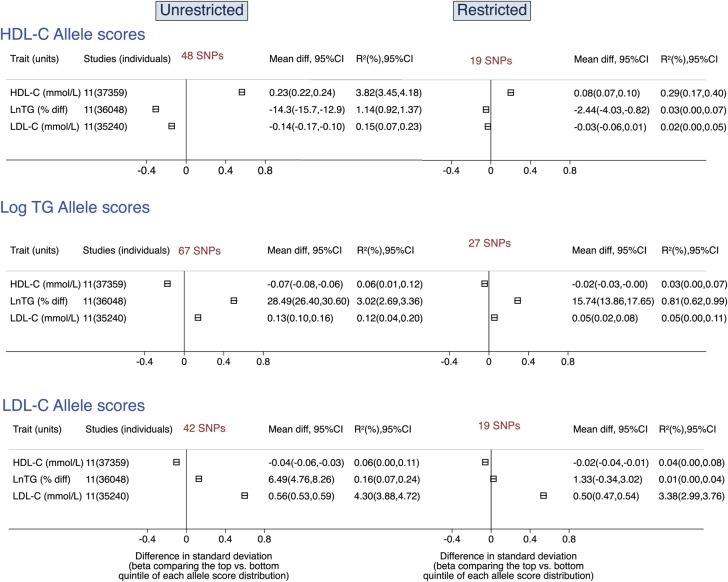
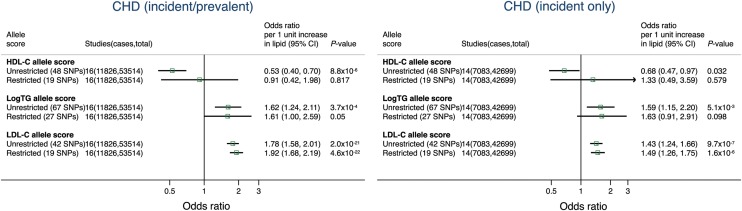
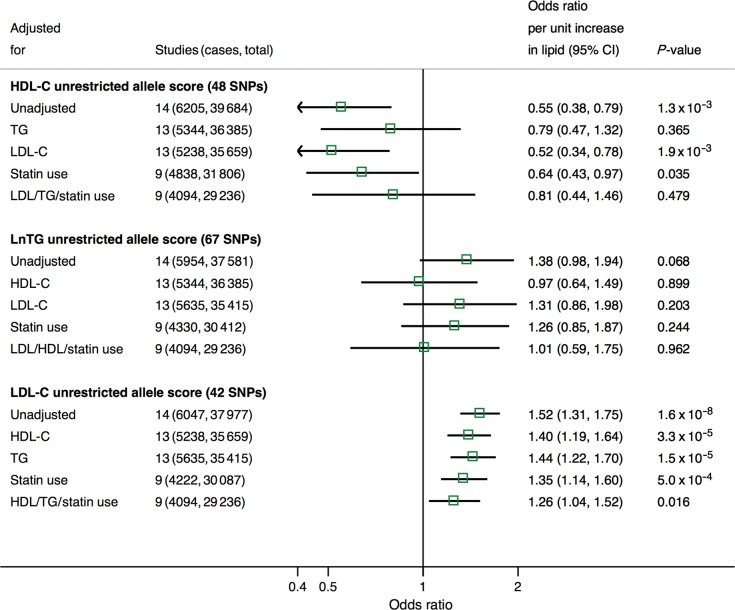
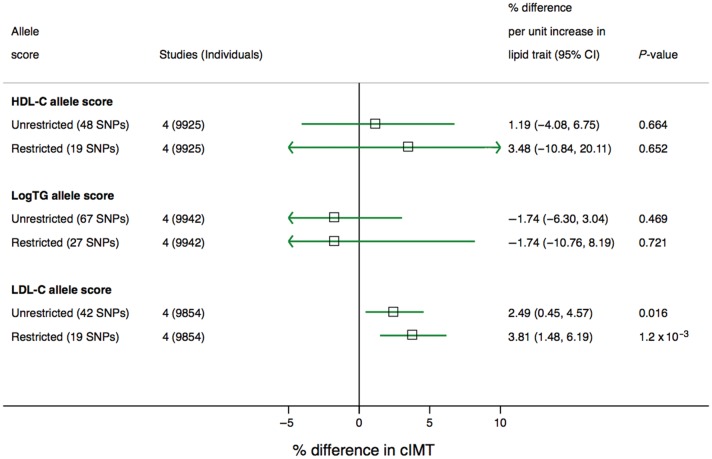
AIMS: To investigate the causal role of high-density lipoprotein cholesterol (HDL-C) and triglycerides in coronary heart disease (CHD) using multiple instrumental variables for Mendelian randomization. METHODS AND RESULTS: We developed weighted allele scores based on single nucleotide polymorphisms (SNPs) with established associations with HDL-C, triglycerides, and low-density lipoprotein cholesterol (LDL-C). For each trait, we constructed two scores. The first was unrestricted, including all independent SNPs associated with the lipid trait identified from a prior meta-analysis (threshold P < 2 × 10(-6)); and the second a restricted score, filtered to remove any SNPs also associated with either of the other two lipid traits at P ≤ 0.01. Mendelian randomization meta-analyses were conducted in 17 studies including 62,199 participants and 12,099 CHD events. Both the unrestricted and restricted allele scores for LDL-C (42 and 19 SNPs, respectively) associated with CHD. For HDL-C, the unrestricted allele score (48 SNPs) was associated with CHD (OR: 0.53; 95% CI: 0.40, 0.70), per 1 mmol/L higher HDL-C, but neither the restricted allele score (19 SNPs; OR: 0.91; 95% CI: 0.42, 1.98) nor the unrestricted HDL-C allele score adjusted for triglycerides, LDL-C, or statin use (OR: 0.81; 95% CI: 0.44, 1.46) showed a robust association. For triglycerides, the unrestricted allele score (67 SNPs) and the restricted allele score (27 SNPs) were both associated with CHD (OR: 1.62; 95% CI: 1.24, 2.11 and 1.61; 95% CI: 1.00, 2.59, respectively) per 1-log unit increment. However, the unrestricted triglyceride score adjusted for HDL-C, LDL-C, and statin use gave an OR for CHD of 1.01 (95% CI: 0.59, 1.75). CONCLUSION: The genetic findings support a causal effect of triglycerides on CHD risk, but a causal role for HDL-C, though possible, remains less certain.
Overview
The claims and statistics of this paper haven’t been checked yet.
Free: it reads the open-access text and checks the first 5 claims that cite a source we can check. Create a free account to check every claim.
Integrity signals
Registry
Cites
Statistics
Figures
Verification
Claims the paper makes
The claims and statistics of this paper haven’t been checked yet.
Free: it reads the open-access text and checks the first 5 claims that cite a source we can check. Create a free account to check every claim.
Claims other papers make about this one
Each is checked against this paper’s own text: does it say what the citing paper says it does?
The cited source doesn’t support the claim as written.
In the citing paper
“Furthermore, Mendelian randomization studies have demonstrated that long-term exposure to lower LDL-C levels is associated with a much lower risk of CV events as compared with shorter-term exposure to lower LDL-C (as achieved, for example, in randomized trials) [48,52].”
From 2019 ESC/EAS guidelines for the management of dyslipidaemias: lipid modification to reduce cardiovascular risk (2019) · cites this paper as [48]
Checked by a reasoning model — may be wrong.
Experimental — accuracy not yet measuredThe source backs part of the claim, not all of it — or backs it for a different population, condition or comparison.
In the citing paper
“Numerous epidemiological studies, Mendelian randomization studies, and RCTs have consistently demonstrated a log-linear relationship between the absolute changes in plasma LDL-C and the risk of ASCVD [34,45-50].”
From 2019 ESC/EAS guidelines for the management of dyslipidaemias: lipid modification to reduce cardiovascular risk (2019) · cites this paper as [48]
Experimental — accuracy not yet measuredThe source backs part of the claim, not all of it — or backs it for a different population, condition or comparison.
In the citing paper
“Non-HDL-C also includes the atherogenic TG-rich lipoproteins (VLDL, IDL and remnants), which is essential considering the recent information from genome-wide association studies (GWASs) and Mendelian randomization 76,86 - 89 supporting TGs and remnant particles as causative factors in atherogenesis.”
From 2016 ESC/EAS Guidelines for the Management of Dyslipidaemias (2016) · cites this paper as [89]
Experimental — accuracy not yet measuredThe source backs part of the claim, not all of it — or backs it for a different population, condition or comparison.
In the citing paper
“At a more extreme level, while both CETP inhibitors and HMGCR lower CHD through the pharmacological reductions of apolipoprotein B 22 , their metabolomic signatures differ wildly 68 .”
From Integrating genomics with biomarkers and therapeutic targets to invigorate cardiovascular drug development (2021) · cites this paper as [22]
Experimental — accuracy not yet measuredThe source backs part of the claim, not all of it — or backs it for a different population, condition or comparison.
In the citing paper
“The approach outlined here to obtaining a scaling estimate has generally held true for lipid-lowering therapies and risk of cardiovascular disease 22,23,40,92 but there are several potential reasons why the derivation of such a scaling for other therapeutic target-indication pairs may pose a challenge.”
From Integrating genomics with biomarkers and therapeutic targets to invigorate cardiovascular drug development (2021) · cites this paper as [22]
Experimental — accuracy not yet measured
4 more claims about this paper
Create a free account to see every claim other papers make about this one.
Self-check
Percentages, sums and reported differences re-computed from the paper’s own numbers.
The self-check needs the paper’s full text.
Citations
Cites
Mendelian randomization: Using genes as instruments for making causal inferences in epidemiology
Lawlor, D. A., Harbord, R. M., Sterne, J. A. C., Timpson, N., & Davey Smith, G. (2008) · Statistics in Medicine · doi:10.1002/sim.3034 · Cited by 4,618 · cited 3×
“Moreover, at a population level the randomized allocation of parental alleles at conception tends to balance confounding factors among groups of differing genotypes.(9,10) Where a polymorphism is”
Self-citationBiological, clinical and population relevance of 95 loci for blood lipids
Teslovich, T. M., Musunuru, K., Smith, A. V., Edmondson, A. C., Stylianou, I. M., Koseki, M., Pirruccello, J. P., Ripatti, S., Chasman, D. I., Willer, C. J., et al. (2010) · Nature · doi:10.1038/nature09270 · Cited by 3,487
Self-citationEffects of torcetrapib in patients at high risk for coronary events
Barter, P. J., Caulfield, M., Eriksson, M., Grundy, S. M., Kastelein, J. J. P., Komajda, M., Lopez-Sendon, J., Mosca, L., Tardif, J.-C., Waters, D. D., et al. (2007) · New England Journal of Medicine · doi:10.1056/nejmoa0706628 · Cited by 3,139 · cited 1×
“the negative findings from clinical trials may have arisen from inadequate selection of drug targets or drug molecules.(6,8) Given this uncertainty, it remains unclear whether elevating HDL-C or reducing”
Collaborators, C. T. T. (. (2012) · The Lancet · doi:10.1016/s0140-6736(12)60367-5 · Cited by 2,833 · cited 1×
“studies has been established as causal based on randomized trials of LDL-C-lowering drugs.(1,2) In contrast, uncertainty existson the causal relevance of high-density lipoprotein cholesterol (HDL-C) and trigly-”
Major lipids, apolipoproteins, and risk of vascular disease
The Emerging Risk Factors Collaboration* (2009) · JAMA · doi:10.1001/jama.2009.1619 · Cited by 2,731
Effects of dalcetrapib in patients with a recent acute coronary syndrome
Schwartz, G. G., Olsson, A. G., Abt, M., Ballantyne, C. M., Barter, P. J., Brumm, J., Chaitman, B. R., Holme, I. M., Kallend, D., Leiter, L. A., et al. (2012) · New England Journal of Medicine · doi:10.1056/nejmoa1206797 · Cited by 2,022
Using multiple genetic variants as instrumental variables for modifiable risk factors
Palmer, T. M., Lawlor, D. A., Harbord, R. M., Sheehan, N. A., Tobias, J. H., Timpson, N. J., Smith, G. D., & Sterne, J. A. (2012) · Statistical Methods in Medical Research · doi:10.1177/0962280210394459 · Cited by 1,289 · cited 2×
“This should increase power, because each additional SNP contributes incrementally to the explained variance in the lipid fraction of interest and reduces the lack of specificity often observed with single SNPs, because the effects on traits other than the lipid fraction of interest should be small, non-systematic, and…”
Self-citationRemnant Cholesterol as a Causal Risk Factor for Ischemic Heart Disease
Varbo, A., Benn, M., Tybjærg-Hansen, A., Jørgensen, A. B., Frikke-Schmidt, R., & Nordestgaard, B. G. (2013) · Journal of the American College of Cardiology · doi:10.1016/j.jacc.2012.08.1026 · Cited by 1,115
Cited by
Items 401–500 of 808
Grainger, A. T., Jones, M. B., Li, J., Chen, M., Manichaikul, A. W., & Shi, W. (2016) · Atherosclerosis · doi:10.1016/j.atherosclerosis.2016.10.011 · Cited by 15
Functionality of High-Density Lipoprotein as Antiatherosclerotic Therapeutic Target
Hoekstra, M., & van Berkel, T. J. C. (2016) · Arteriosclerosis Thrombosis and Vascular Biology · doi:10.1161/atvbaha.116.308262 · Cited by 15
Dou, J., Wu, D., Ding, L., Wang, K., Jiang, M., Chai, X., Reilly, D. F., Tai, E. S., Liu, J., Sim, X., et al. (2020) · Briefings in Bioinformatics · doi:10.1093/bib/bbaa084 · Cited by 15
Human genetic insights into lipoproteins and risk of cardiometabolic disease
Stitziel, N. O. (2017) · Current Opinion in Lipidology · doi:10.1097/mol.0000000000000389 · Cited by 14
So, J., Asztalos, B. F., Horvath, K. V., & Lamon‐Fava, S. (2022) · Journal of clinical lipidology · doi:10.1016/j.jacl.2022.10.002 · Cited by 14
Alcohol and mortality in Mexico: prospective study of 150 000 adults
Trichia, E., Alegre-Díaz, J., Aguilar-Ramirez, D. J., Ramírez-Reyes, R., Garcilazo‐Ávila, A., González-Carballo, C., Bragg, F., Gnatiuc, L., Herrington, W. G., Holland, L., et al. (2024) · The Lancet Public Health · doi:10.1016/s2468-2667(24)00228-7 · Cited by 14
“E u r op e P M C F und e r s A u t ho r M a nu s c r i p t s studies 30 suggest that such increases would not lead to a reduction in cardioembolic diseases.”
High-density lipoproteins. Part 2. Impact of disease states on functionality
Gluba-Brzózka, A., Olszewski, R., Franczyk, B., Młynarska, E., Rysz-Górzyńska, M., Rysz, J., Surma, S., Sheth, S., Banach, M., & Toth, P. P. (2025) · American Journal of Preventive Cardiology · doi:10.1016/j.ajpc.2025.101073 · Cited by 14
“Third, rigorous Mendelian randomization studies have failed to demonstrate a causal role for HDL particles in atherogenesis[9 – 11].”
A practical guide to the management of dyslipidaemia
Siegel, P. M., Katzmann, J. L., Weinmann‐Menke, J., Landmesser, U., Schunkert, H., Baldus, S. E., Böhm, M., Laufs, U., Lüscher, T. F., & Hilgendorf, I. (2026) · Clinical Research in Cardiology · doi:10.1007/s00392-025-02833-y · Cited by 15
“Moreover, there is a log-linear relation between the absolute plasma LDL-C changes and the risk of cardiovascular disease [12, 13].”
Glucagon-Like Peptide-1 Receptor Agonists in Psychiatry: A Pharmacoepidemiological Scoping Review
Volkow, N. D., & Xu, R. (2026) · Biological Psychiatry · doi:10.1016/j.biopsych.2026.03.1002 · Cited by 14
Genetic Risk Factors and Mendelian Randomization in Cardiovascular Disease
Swerdlow, D. I., Hingorani, A. D., & Humphries, S. E. (2015) · Current Cardiology Reports · doi:10.1007/s11886-015-0584-x · Cited by 14
Self-citationFuture Lipid-Altering Therapeutic Options Targeting Residual Cardiovascular Risk
Farnier, M. (2016) · Current Cardiology Reports · doi:10.1007/s11886-016-0743-8 · Cited by 14
Association between resting heart rate and incident diabetes risk: a Mendelian randomization study
Long, T., Wang, J., Han, X., Wang, F., Hu, H., Yu, C., Yuan, J., Yao, P., Wei, S., Wang, Y., et al. (2019) · Acta Diabetologica · doi:10.1007/s00592-019-01344-3 · Cited by 14
Preventing Diabetes and Atherosclerosis in the Cardiometabolic Syndrome
Ahmad, M. I., & Shapiro, M. D. (2021) · Current Atherosclerosis Reports · doi:10.1007/s11883-021-00913-8 · Cited by 15
The causal association between COVID-19 and herpes simplex virus: a Mendelian randomization study
Yan, M., Xiao, L.-Y., Gosau, M., Friedrich, R. E., Smeets, R., Fu, L.-L., Feng, H.-C., & Burg, S. (2023) · Frontiers in Immunology · doi:10.3389/fimmu.2023.1281292 · Cited by 14
Increasing HDL-C levels with medication: current perspectives
Smit, R. A. J., Jukema, J. W., & Trompet, S. (2017) · Current Opinion in Lipidology · doi:10.1097/mol.0000000000000426 · Cited by 14
The promise and reality of therapeutic discovery from large cohorts
Melamud, E., Taylor, D. L., Sethi, A., Cule, M., Baryshnikova, A., Saleheen, D., van Bruggen, N., & FitzGerald, G. A. (2020) · Journal of Clinical Investigation · doi:10.1172/jci129196 · Cited by 14
Zheng, R., & Lind, L. (2024) · Scientific Reports · doi:10.1038/s41598-024-61440-5 · Cited by 15
“Earlier MR studies suggested that genetic variants affecting HDL-cholesterol levels are not associated with CVD risk 16,42 and more recent MR studies also did not strongly support an independent role of HDL in CVD risk 17,19,43 .”
BackgroundMendelian Randomization Studies in Atherosclerotic Cardiovascular Diseases
Ko, D. S., & Kim, Y. H. (2024) · Journal of Lipid and Atherosclerosis · doi:10.12997/jla.2024.13.3.280 · Cited by 13
“28”
High-density lipoprotein: a biomarker and therapeutic target in sepsis
Li, M., Barros-Pinkelnig, M., Arbous, M. S., Christoffersen, C., Rensen, P. C. N., & Kooijman, S. (2025) · Critical Care · doi:10.1186/s13054-025-05702-2 · Cited by 13
“However, clinical trials generally failed to show protective effects of raising HDL-C on major adverse cardiovascular events, and Mendelian randomization studies did not provide evidence for a causal relationship between HDL-C levels and cardiovascular disease [47, 48].”
Butt, H., Shabana, S., & Hasnain, S. (2016) · Diabetology & Metabolic Syndrome · doi:10.1186/s13098-016-0183-z · Cited by 13
“Most of the SNPs in the genes regulating blood lipids are inherited independently and affect lipid levels quantitatively [30].”
An Overview of Methods and Exemplars of the Use of Mendelian Randomisation in Nutritional Research
Bennett, D., & Du, H. (2022) · Nutrients · doi:10.3390/nu14163408 · Cited by 14
“MR analyses are robust to this type of pleiotropy [29].”
BackgroundBeaney, K. E., Cooper, J. A., McLachlan, S., Wannamethee, S. G., Jefferis, B. J. M. H., Whincup, P. H., Ben‐Shlomo, Y., Price, J. F., Kumari, M., Wong, A., et al. (2016) · Cardiovascular Diabetology · doi:10.1186/s12933-016-0435-0 · Cited by 14
“The relationship between HDL-C and CHD remains unclear.”
BackgroundSelf-citationYamamoto, R., Sacks, F. M., Hu, F. B., ROSNER, B. A., Furtado, J. D., Aroner, S. A., Ferrannini, E., Baldi, S., Kozàkovà, M., Balkau, B., et al. (2018) · Atherosclerosis · doi:10.1016/j.atherosclerosis.2017.12.029 · Cited by 13
Precision Medicine and Cardiovascular Health: Insights from Mendelian Randomization Analyses
Spiller, W., Jung, K. J., Lee, J., & Jee, S. H. (2020) · Korean Circulation Journal · doi:10.4070/kcj.2019.0293 · Cited by 13
LDL, HDL, VLDL, and CVD Prevention: Lessons from Genetics?
Hewing, B., & Landmesser, U. (2015) · Current Cardiology Reports · doi:10.1007/s11886-015-0610-z · Cited by 13
Elevated high-density lipoprotein triglycerides increase atherosclerotic risk
Liu, W., Chen, S., Yang, C., Lei, F., Huang, X., Zhang, X., Sun, T., Lin, L., Wang, C., Cao, Y., et al. (2025) · Journal of Lipid Research · doi:10.1016/j.jlr.2025.100791 · Cited by 12
“Mendelian randomization (MR) studies have also provided inconclusive evidence for the causal protective effect of HDL-C on ASCVD (14, 15).”
Alotaibi, T. F., Thackray, A. E., Roberts, M. J., Alanazi, T. M., BISHOP, N. C., Wadley, A. J., King, J. A., O’Donnell, E., STEINER, M. C., Singh, S. J., et al. (2020) · Medicine & Science in Sports & Exercise · doi:10.1249/mss.0000000000002560 · Cited by 12
“The exercise-induced reduction in postprandial lipemia has also been shown to coincide with transient changes in other risk markers for CHD, including favorable reductions in postprandial insulin, interleukin 6 (IL-6), and resting blood pressure (21–23).”
BackgroundInfluentialThe Relation Between Adult Weight Gain, Adipocyte Volume, and the Metabolic Profile at Middle Age
Verkouter, I., Noordam, R., Loh, N. Y., van Dijk, K. W., Zock, P. L., Mook-Kanamori, D. O., le Cessie, S., Rosendaal, F. R., Karpe, F., Christodoulides, C., et al. (2021) · The Journal of Clinical Endocrinology & Metabolism · doi:10.1210/clinem/dgab477 · Cited by 13
“LDL particles are a causal risk factor for cardiovascular disease identified by randomized controlled trials and mendelian randomization studies (38).”
BackgroundMulti-Trait Genome-Wide Association Study of Atherosclerosis Detects Novel Pleiotropic Loci
Bellomo, T. R., Bone, W. P., Chen, B. Y., Gawronski, K. A. B., Zhang, D., Park, J., Levin, M. G., Tsao, N. L., Klarin, D. M., Lynch, J. A., et al. (2022) · Frontiers in Genetics · doi:10.3389/fgene.2021.787545 · Cited by 12
“Furthermore, correlated causal risk factors can also be included in these multi-trait GWAS analyses to provide insight on their shared genetic pathways (Holmes et al., 2015; Zhao et al., 2017; Riaz et al., 2018; Siewert and Voight, 2018; Larsson et al., 2020).”
BackgroundHDL as a Causal Factor in Atherosclerosis: Insights from Human Genetics
Brunham, L. R. (2016) · Current Atherosclerosis Reports · doi:10.1007/s11883-016-0623-0 · Cited by 12
Genética de la cardiopatía isquémica: del conocimiento actual a las implicaciones clínicas
Elosúa, R., & Sayols-Baixeras, S. (2017) · Revista Española de Cardiología · doi:10.1016/j.recesp.2017.02.033 · Cited by 12
Liu, H., Yao, X., Wang, L., Liu, J., Li, X., Fu, X., Liu, J., Dong, S., & Wang, Y. (2024) · Frontiers in Endocrinology · doi:10.3389/fendo.2024.1358358 · Cited by 11
Toth, P. P., Thanassoulis, G., Williams, K., Furberg, C. D., & Sniderman, A. D. (2014) · Journal of clinical lipidology · doi:10.1016/j.jacl.2014.08.004 · Cited by 11
Koohi, F., Khalili, D., Soori, H., Nazemipour, M., & Mansournia, M. A. (2022) · Global Epidemiology · doi:10.1016/j.gloepi.2022.100075 · Cited by 11
A systematic review and meta-analysis of the prevalence of dyslipidaemia among adults in Malaysia
Mohamed-Yassin, M.-S., Rosman, N., Kamaruddin, K. N., Miptah, H. N., Baharudin, N., Ramli, A. S., Abdul-Razak, S., Lai, N. M., & GLOBALDYS Study Investigators (2023) · Scientific Reports · doi:10.1038/s41598-023-38275-7 · Cited by 11
Unveiling Statins and Genetics in Age-Related Macular Degeneration: The Coimbra Eye Study—Report 9
Barreto, P. S. D., Farinha, C., Coimbra, R., Cachulo, M. L., Melo, J. B., Lechanteur, Y. T. E., Hoyng, C. B., Cunha-Vaz, J. G., & da Silva, R. M. (2024) · Investigative Ophthalmology & Visual Science · doi:10.1167/iovs.65.6.38 · Cited by 11
Hong, S., Kim, K., Han, K., & Park, C. (2024) · Cardiovascular Diabetology · doi:10.1186/s12933-024-02353-5 · Cited by 11
“…studies conducted recently, including observational studies, [20–22] a post hoc analysis of a trial, [23] and Mendelian randomization studies, [24–26] have reported a potential link between TG and ASCVD, the impact of therapies aimed at reducing TG levels on ASCVD incidence remains uncertain.”
ResultGeneroso, G., Benseñor, I. M., Santos, I. S., Santos, R. D., Goulart, A. C., Jones, S. R., Kulkarni, K. R., Blaha, M. J., Toth, P. P., Lotufo, P. A., et al. (2018) · Diabetes and Vascular Disease Research · doi:10.1177/1479164118788080 · Cited by 11
Regional Variation in Genetic Control of Atherosclerosis in Hyperlipidemic Mice
Jones, M. B., An, A., Shi, L. J., & Shi, W. (2020) · G3 Genes Genomes Genetics · doi:10.1534/g3.120.401856 · Cited by 11
“…mapped in B x H intercrosses (Wang et al. 2007), (Su et al. 2006a), the QTL at 46 cM on Chr12 overlaps with interacting locus Ath21 identified in a B6 · 129S1 cross (Ishimori et al. 2004), and the QTL at 48.46 cM on Chr19 replicates Ath16 mapped in a B6 x FVB/N cross (Dansky et al. 2002).”
BackgroundInfluentialYang, H. S., Jeong, H. J., Kim, H., Hwang, H. K., Hur, M., & Lee, S. (2022) · Annals of Laboratory Medicine · doi:10.3343/alm.2022.42.4.415 · Cited by 11
“Mendelian genetic randomization failed to prove causal effects, and several pharmacological trials to increase HDL-C levels failed to reduce the risk of ASCVD [26-29].”
BackgroundGenetics of early-onset coronary artery disease: from discovery to clinical translation
Lali, R., Cui, E., Ansarikaleibari, A., Pigeyre, M., & Paré, G. (2019) · Current Opinion in Cardiology · doi:10.1097/hco.0000000000000676 · Cited by 11
Colesterol-no HDL como objetivo terapéutico
Brea, Á., Hernández‐Mijares, A., Millán, J., Ascaso, J. F., Blasco, M., Rodríguez, Á. D., Mantilla, T., Pedro‐Botet, J., & Pintó, X. (2019) · Clínica e Investigación en Arteriosclerosis · doi:10.1016/j.arteri.2019.07.002 · Cited by 11
Comparison of Lipid Profile in Patients With and Without Acute Myocardial Infarction
Mal, K., Kumar, R., Ejaz, M., Fatima, K., & Shaukat, F. (2019) · Cureus · doi:10.7759/cureus.6467 · Cited by 11
“Some studies have established an inverse relationship between HDL level and cardiovascular disease [11], while Mendelian randomization argues against the causal relation between HDL and cardiovascular disease [12].”
BackgroundZhao, Q., Chen, Y., Wang, J., & Small, D. S. (2018) · arXiv (Cornell University) · doi:10.48550/arxiv.1804.07371 · Cited by 11
“To alleviate these concerns, most existing MR studies [13, 14, 23] select a handful of genomewide significant SNPs that are associated with the exposure and then seek to justify that the ER assumption is reasonable.”
Buchan, E., Rickard, J. J. S., Thomas, M. R., & Oppenheimer, P. G. (2025) · Advanced Healthcare Materials · doi:10.1002/adhm.202500122 · Cited by 10
Mind the gap: Characterizing bias due to population mismatch in two-sample Mendelian randomization
Li, J., & Morrison, J. (2026) · The American Journal of Human Genetics · doi:10.1016/j.ajhg.2026.02.002 · Cited by 11
Chen, H., Zhan, Y., Lou, Z., Mao, H. Z., Zhang, C., Li, X., Chen, G., Ouyang, H., Huang, Z., Wen, L., et al. (2022) · Journal of Stroke and Cerebrovascular Diseases · doi:10.1016/j.jstrokecerebrovasdis.2022.106448 · Cited by 10
The role of (pro)renin receptor and its soluble form in cardiovascular diseases
Wang, B., Jie, H., Wang, S., Dong, B., & Zou, Y. (2023) · Frontiers in Cardiovascular Medicine · doi:10.3389/fcvm.2023.1086603 · Cited by 10
“In particular, low-density lipoprotein (LDL), as the cholesterol carrier protein, is an independent factor for predicting the risk of cardiovascular disease (108, 109).”
BackgroundPhenome-wide Mendelian randomization study of plasma triglyceride levels and 2600 disease traits
Park, J. K., Bafna, S., Forrest, I. S., Duffy, Á., Márquez‐Luna, C., Petrazzini, B. O., Vy, H. M. T., Jordan, D. M., Verbanck, M., Narula, J., et al. (2023) · eLife · doi:10.7554/elife.80560 · Cited by 11
“…may consider the functional and qualitative attributes of TRL subtypes, and metabolomic data partitioning TRLs by size and composition may soon enable this to identify the specific component of a plasma TG measurement that drives disease risk in the detected associations ( Holmes et al., 2015 ).”
Bordelois, P., Koenen, K. C., Elkind, M. S. V., Suglia, S. F., & Keyes, K. M. (2023) · Journal of Affective Disorders · doi:10.1016/j.jad.2023.04.084 · Cited by 10
Sinning, D., Leistner, D. M., & Landmesser, U. (2016) · Herz · doi:10.1007/s00059-016-4430-8 · Cited by 11
“Einen weiteren Hinweis für den kausalen Zusammenhang zwischen LDL-CErhöhung und KHK bietet eine Vielzahl genetischer Untersuchungen [3, 18, 24, 25].”
BackgroundGarrett, N. E., III, Grainger, A. T., Li, J., Chen, M., & Shi, W. (2017) · Mammalian Genome · doi:10.1007/s00335-016-9677-0 · Cited by 10
Debele, G. R., Kefeni, B. T., Kanfe, S. G., Ayele, T. A., Wolde, H. F., Yenit, M. K., & Ahmed, M. H. (2021) · Risk Management and Healthcare Policy · doi:10.2147/rmhp.s307303 · Cited by 10
“Peripheral arterial occlusion was defined as an sudden onset arterial event with a duration of greater than 2 https://doi.org/10.2147/RMHP.S307303 DovePress Risk Management and Healthcare Policy 2021:14 1960 weeks, and resulted in symptomatic limb ischemia.23 In cases when a subject had experienced greater than one en…”
BackgroundInfluentialCrandell, J. R., Tartaglia, C., & Tartaglia, J. (2016) · Postgraduate Medicine · doi:10.1080/00325481.2016.1241129 · Cited by 10
Underperforming doctors in general practice: a survey of referrals to UK Deaneries.
Bahrami, J., & Evans, A. (2001) · Europe PMC (PubMed Central) · Cited by 10
Khounphinith, E., Yin, R., Cao, X., Huang, F., Wu, J., & Li, H. (2019) · International Journal of Medical Sciences · doi:10.7150/ijms.31729 · Cited by 10
Differences in HDL-related coronary heart disease risk between individuals with and without diabetes
Chen, J., Lu, Q., Geng, T., Wang, Y., Wang, Y., Li, R., Xia, P., Guo, K., Yang, K., Tong, W.-W., et al. (2024) · Atherosclerosis · doi:10.1016/j.atherosclerosis.2024.118553 · Cited by 9
Toplak, H., Bilitou, A., Alber, H. F., Auer, J., Clodi, M., Ebenbichler, C. F., Fließer-Görzer, E., Gelsinger, C., Hanusch, U., Ludvik, B. H., et al. (2023) · Wiener klinische Wochenschrift · doi:10.1007/s00508-023-02221-4 · Cited by 9
Alcohol – a scoping review for Nordic Nutrition Recommendations 2023
Thelle, D. S., & Grønbæk, M. (2024) · Food & Nutrition Research · doi:10.29219/fnr.v68.10540 · Cited by 9
“Holmes et al. concluded that there is a causal association between alcohol intake and triglyceride increase, whereas a direct effect on HDL cholesterol remains less certain (34).”
BackgroundLincomycin as a growth-promoting antibiotic induces metabolic and immune dysregulation in animals
Ni, H., Wu, H., Wang, J., Chan, B. K.-W., Chen, K., Chan, E. W., Li, F., & Chen, S. (2024) · The Science of The Total Environment · doi:10.1016/j.scitotenv.2024.177780 · Cited by 9
Alamer, S. A., Ilyas, Q. M., Ahmad, M., & Irfan, D. (2021) · International Journal of Cloud Applications and Computing · doi:10.4018/ijcac.2022010110 · Cited by 9
Zhang, Y., Luo, S., Gao, Y. Q., Tong, W., & Sun, S. (2023) · Angiology · doi:10.1177/00033197231157473 · Cited by 9
Experimental Biology for the Identification of Causal Pathways in Atherosclerosis
Guo, Y., Garcia-Barrio, M. T., Wang, L., & Chen, Y. (2016) · Cardiovascular Drugs and Therapy · doi:10.1007/s10557-016-6644-7 · Cited by 9
“Both Mendelian randomization studies and GWAS for CAD risks have indicated that LDL-C is a causal risk factor for AS-CVD [7, 11] .”
BackgroundAli, A., Varga, T. V., Stojkovic, I. A., Schulz, C., Hallmans, G., Barroso, I., Poveda, A., Renström, F., Orho‐Melander, M., & Franks, P. W. (2016) · Circulation Cardiovascular Genetics · doi:10.1161/circgenetics.115.001218 · Cited by 9
Stein, J. H. (2016) · Europe PMC (PubMed Central) · Cited by 9
Jarauta, E., Bea, A. M., Marco-Benedí, V., & Lamíquiz-Moneo, I. (2020) · Frontiers in Genetics · doi:10.3389/fgene.2020.554931 · Cited by 9
Mendelian randomization rules out the causal relationship between serum lipids and cholecystitis
Yang, H., Chen, L., Liu, K., Li, C., Li, H., Xiong, K., Li, Z., Lu, C., Chen, W., & Liu, Y. (2021) · BMC Medical Genomics · doi:10.1186/s12920-021-01082-y · Cited by 9
Common variants associated with blood lipid levels do not affect carotid plaque composition
Siemelink, M. A., van der Laan, S. W., van Setten, J., de Vries, J. P. P. M., de Borst, G. J., Moll, F. L., den Ruijter, H. M., Asselbergs, F. W., Pasterkamp, G., & de Bakker, P. I. W. (2015) · Atherosclerosis · doi:10.1016/j.atherosclerosis.2015.07.041 · Cited by 9
“The notable exception is a negative association between HDL-C levels and the occurrence of composite cardiovascular endpoints, which may represent a non-causal effect (e.g. due to reverse causation or uncorrected confounding), consistent with recent Mendelian randomization studies [2,4,5].”
Self-citationFerence, B. A. (2019) · Clinical Pharmacology & Therapeutics · doi:10.1002/cpt.1163 · Cited by 8
Legault, M., Hartford, J., Arsenault, B. J., Yang, A. Y., & Pineau, J. (2025) · The American Journal of Human Genetics · doi:10.1016/j.ajhg.2025.04.010 · Cited by 8
Cholesteryl Ester Transfer Protein Impairs Triglyceride Clearance via Androgen Receptor in Male Mice
Palmisano, B. T., Anozie, U., Yu, S., Neuman, J. C., Zhu, L., Edington, E. M., Luu, T. N., & Stafford, J. M. (2020) · Lipids · doi:10.1002/lipd.12271 · Cited by 8
Wang, Z., Lai, W., & Zhong, S. (2021) · PubMed · doi:10.12122/j.issn.1673-4254.2021.02.16 · Cited by 8
“[20]Holmes MV, Asselbergs FW, Palmer TM, et al.”
BackgroundSex differences in the non-linear association between BMI and LDL cholesterol in type 2 diabetes
Li, K., Cao, B., Wang, X., Chai, T., Ke, J., & Zhao, D. H. (2023) · Frontiers in Endocrinology · doi:10.3389/fendo.2023.1180012 · Cited by 8
“Recent mendelian randomization studies also show that LDL-C is a risk factor for CVD (9, 10).”
BackgroundInfluentialBlood Lipids and Type 2 Diabetes Risk: Can Genetics Help Untangle the Web?
Swerdlow, D. I., & Sattar, N. A. (2015) · Diabetes · doi:10.2337/db15-0458 · Cited by 8
“the combination of variants has a greater effect on lipid levels and has been used effectively to investigate causal links between lipid moieties and cardiovascular disease (11,12).”
BackgroundSelf-citationAssociation of Multiple Genetic Variants with the Extension and Severity of Coronary Artery Disease
Fischer, S. C. P. M., Pinto, S. P., Lins, L. C., Bianco, H. T., Monteiro, C. M. D. C., Pinheiro, L. F. M., Fonseca, F. A. H., & Izar, M. C. D. O. (2017) · Arquivos Brasileiros de Cardiologia · doi:10.5935/abc.20170177 · Cited by 8
Current concepts in atherosclerosis
Alkhalil, M., & Choudhury, R. P. (2018) · Indian Journal of Thoracic and Cardiovascular Surgery · doi:10.1007/s12055-018-0699-y · Cited by 9
“In addition, evidence from Mendelian randomisation revealed that alleles associated with LDL-c were associated with an increased risk of CVD [18].”
BackgroundInfluentialXu, J. Y., Hou, Y., Xu, M., Zhao, Z., Xuan, L., Wang, T., Li, M., Xu, Y., Lu, J., Bi, Y., et al. (2019) · Scientific Reports · doi:10.1038/s41598-019-41076-6 · Cited by 8
Hu, X., Yang, X., Li, X., Luo, D., Zhou, Y., & Dong, H. (2020) · Lipids in Health and Disease · doi:10.1186/s12944-020-01272-0 · Cited by 8
Coremans, C., Delporte, C., COTTON, F. J., van de Borne, P., Boudjeltia, K. Z., & Antwerpen, P. V. (2021) · Molecules · doi:10.3390/molecules26175264 · Cited by 8
“In contrast, there is no evidence that HDL-C is causally associated with the risk of ASCVD, or that therapeutically increasing plasma HDL-C reduces the risk of CV events [53,54].”
BackgroundPicard, F. A., & Steg, P. G. (2021) · Current Atherosclerosis Reports · doi:10.1007/s11883-021-00919-2 · Cited by 8
Statistical Methods for cis-Mendelian RandomizationPreprint
Gkatzionis, A., Burgess, S., & Newcombe, P. J. (2021) · arXiv (Cornell University) · Cited by 8
Managing of dyslipidaemia characterized by accumulation of triglyceride-rich lipoproteins
Visser, J., van Zwol, W., & Kuivenhoven, J. A. (2022) · Current Atherosclerosis Reports · doi:10.1007/s11883-022-00979-y · Cited by 7
“** * P ra di ga st at — Th e cl in ic al tr ia ls p ag es d o no t p ro vi de in fo rm at io n on th e ac tu al re as on fo r t er m in at io n 5 Current Atherosclerosis Reports (2022) 24:1–12”
BackgroundMiller, M. (2024) · Current Opinion in Cardiology · doi:10.1097/hco.0000000000001136 · Cited by 7
“…have customarily been viewed as a biomarker of CVD risk, notwithstanding Mendelian randomization studies that have suggested otherwise [4]. genes regulating triglyceride metabolism (e.g. apolipoprotein [apo] C3) and/or byproducts of triglyceride metabolism (i.e. cholesterol…”
BackgroundThe genetics of gout: translation into clinical practice
Merriman, T. R., Rosas-Chavez, F., & Stamp, L. K. (2025) · Therapeutic Advances in Musculoskeletal Disease · doi:10.1177/1759720x251366360 · Cited by 7
Current Understanding of Diabetic Dyslipidemia: A Review
Gupta, A., & Gupta, R. (2022) · Journal of the Indian Institute of Science · doi:10.1007/s41745-022-00346-5 · Cited by 7
Qureshi, N., Woods, B. S., Faria, R., Saramago, P., Cox, E., Leonardi‐Bee, J., Condon, L. A., Weng, S. F., Akyea, R. K., Iyen, B., et al. (2023) · Health Technology Assessment · doi:10.3310/ctmd0148 · Cited by 7
Self-citationVariation in VEGFA and risk of cardiovascular disease in the UK Biobank
Chen, H., Lv, X., Yang, J., Chen, Z., Qiao, W., Zhou, T. Y., & Zhang, Y. (2023) · Frontiers in Cardiovascular Medicine · doi:10.3389/fcvm.2023.1240288 · Cited by 7
“Furthermore, extant research underscores a causal relationship between lipid metabolism-related parameters and CVD (5, 6).”
BackgroundLiu, R., & Cheng, W. (2024) · Journal of Clinical Hypertension · doi:10.1111/jch.14754 · Cited by 7
“8,21,23,24 This may be related to the changes in hormone levels that occur following menopause.”
BackgroundA Two-Sample Mendelian Randomization Study of Neuroticism and Sleep Bruxism
Strausz, T., Strausz, S. J., Jones, S. E., Palotie, T., Lobbezoo, F., Ahlberg, J., & Ollila, H. M. (2024) · Journal of Dental Research · doi:10.1177/00220345241264749 · Cited by 7
Bleich, D., Biggs, M. L., Gardin, J. M., Lyles, M. F., Siscovick, D. S., & Mukamal, K. J. (2024) · American Journal of Preventive Cardiology · doi:10.1016/j.ajpc.2024.100725 · Cited by 7
“Moreover, Mendelian randomization studies of SNP ’ s involved in plasma triglyceride levels showed strong association for CVD with odds ratios ~1.6 [37].”
BackgroundInfluentialSelf-citationBea, A. M., González-Guerrero, A., Cenarro, A., Lamíquiz-Moneo, I., Climent, E., Jarauta, E., Gracia‐Rubio, I., Benaiges, D., Laclaustra, M., Tejedor, M. T., et al. (2024) · Atherosclerosis · doi:10.1016/j.atherosclerosis.2024.118617 · Cited by 7
Quo Vadis after AEGIS: New Opportunities for Therapies Targeted at Reverse Cholesterol Transport?
Lan, N. S. R., & Watts, G. F. (2025) · Current Atherosclerosis Reports · doi:10.1007/s11883-025-01281-3 · Cited by 7
Outlier Detection in Mendelian Randomization
Mandl, M. M., Boulesteix, A., Burgess, S., & Zuber, V. (2025) · Statistics in Medicine · doi:10.1002/sim.70143 · Cited by 7
Triglycerides and T Cells in Cardiovascular Risk
Reilly, N. A., Mulder, J. W. C. M., Dekkers, K. F., Kuipers, T. B., der Zee, L. C. V. V., Mulder, M. T., van Lennep, J. E. R., Jukema, J. W., & Heijmans, B. T. (2025) · JACC Basic to Translational Science · doi:10.1016/j.jacbts.2025.101359 · Cited by 7
Rosei, C. A., Paini, A., Buso, G., Maloberti, A., Giannattasio, C., Salvetti, M., Casiglia, E., Tikhonoff, V., Angeli, F., Barbagallo, C. M., et al. (2024) · Metabolites · doi:10.3390/metabo14060323 · Cited by 7
Verbeek, R., Oldoni, F., Surendran, R. P., Zwinderman, A. H., Khaw, K., Stroes, E. S. G., Wareham, N. J., Boekholdt, S. M., & Dallinga‐Thie, G. M. (2019) · Journal of clinical lipidology · doi:10.1016/j.jacl.2019.02.005 · Cited by 8
Yuan, S., Roos, P. M., & Larsson, S. C. (2020) · European Journal of Neurology · doi:10.1111/ene.14338 · Cited by 7
“In addition, the original GWAS for IL-1ra showed that the two SNPs, possibly representing coding SNPs, also influenced the levels of IL-1ra [4].”
Genetics-based risk scores for prediction of premature coronary artery disease
Gupta, R. (2023) · Indian Heart Journal · doi:10.1016/j.ihj.2023.08.003 · Cited by 7
“36 e 41 There are well-identi fi ed genes that modify these lipid fractions: LDL cholesterol by HMGCR, PCSK9, APOB, NPC1L1, etc.; HDL cholesterol by CETP; triglycerides by APOC3, ANGPTL3, ANGPTL4 and LPL; and lipoprotein(a) by LPA.”
BackgroundHodúlová, M., Šedová, L., Krenová, D., Liška, F., Krupková, M., Kazdová, L., Tremblay, J., Hamet, P., Křen, V., & Šeda, O. (2014) · PLoS ONE · doi:10.1371/journal.pone.0109983 · Cited by 7
“However, recent evidence somewhat undermined the prominent position of these relatively coarse measures [2–4].”
Application of Genome-Wide Association Studies in Coronary Artery Disease
Zheng, H., Zeng, Z., Wen, H., Wang, P., Huang, C., Huang, P., Chen, Q., Gong, D., & Qiu, X. (2019) · Current Pharmaceutical Design · doi:10.2174/1381612825666191105125148 · Cited by 7
Metadata
- Authors
- Holmes, M. V., Asselbergs, F. W., Palmer, T. M., Drenos, F., Lanktree, M. B., Nelson, C. P., Dale, C. E., Padmanabhan, S., Finan, C., Swerdlow, D. I., Tragante, V., van Iperen, E. P. A., Sivapalaratnam, S., Shah, S., Elbers, C. C., Shah, T., Engmann, J., Giambartolomei, C., White, J., Zabaneh, D., Sofat, R., McLachlan, S., on behalf of the UCLEB consortium, Doevendans, P. A., Balmforth, A. J., Hall, A. S., North, K. E., Almoguera, B., Hoogeveen, R. C., Cushman, M., Fornage, M., Patel, S. R., Redline, S., Siscovick, D. S., Tsai, M. Y., Karczewski, K. J., Hofker, M. H., Verschuren, W. M., Bots, M. L., van der Schouw, Y. T., Melander, O., Dominiczak, A. F., Morris, R., Ben-Shlomo, Y., Price, J., Kumari, M., Baumert, J., Peters, A., Thorand, B., Koenig, W., Gaunt, T. R., Humphries, S. E., Clarke, R., Watkins, H., Farrall, M., Wilson, J. G., Rich, S. S., de Bakker, P. I. W., Lange, L. A., Davey Smith, G., Reiner, A. P., Talmud, P. J., Kivimäki, M., Lawlor, D. A., Dudbridge, F., Samani, N. J., Keating, B. J., Hingorani, A. D., & Casas, J. P.
- Affiliations
- University College London (GB)
- University Medical Center Utrecht (NL)
- University of Warwick (GB)
- University of Bristol (GB)
- McMaster University (CA)
- University of Leicester (GB)
- London School of Hygiene & Tropical Medicine (GB)
- University of Glasgow (GB)
- Durrer Center for Cardiogenetic Research, ICIN-Netherlands Heart Institute, Utrecht, The Netherlands
- Amsterdam UMC Location University of Amsterdam (NL)
- Children's Hospital of Philadelphia (US)
- University of Edinburgh (GB)
- University of Leeds (GB)
- University of North Carolina at Chapel Hill (US)
- Baylor College of Medicine (US)
- University of Vermont (US)
- The University of Texas Health Science Center at Houston (US)
- Brigham and Women's Hospital (US)
- University of Washington (US)
- University of Minnesota (US)
- Stanford Medicine (US)
- University Medical Center Groningen (NL)
- National Institute for Public Health and the Environment (NL)
- Julius Center for Health Sciences and Primary Care, University Medical Center Utrecht, Utrecht, The Netherlands
- Lund University (SE)
- The Royal Free Hospital (GB)
- School of Social and Community Medicine, University of Bristol
- Genetic Epidemiology Group, Institute of Cardiovacular Science, Faculty of Population Healh Sciences, University College London, 1–19 Torrington Place, London WC1E 6BT, UK
- Helmholtz Munich (DE)
- Department of Internal Medicine II-Cardiology, University of Ulm Medical Center, Ulm, Germany
- University of Oxford (GB)
- University of Mississippi Medical Center (US)
- University of Virginia (US)
- Department of Medical Genetics, Division of Biomedical Genetics, University Medical Center Utrecht, Utrecht, The Netherlands
- MRC Integrative Epidemiology Unit, School of Social and Community Medicine, University of Bristol, Oakfield House, Oakfield Grove, Bristol BS8 2BN, UK
- Fred Hutch Cancer Center (US)
- Department of Epidemiology and Public Health, University College London, 1–19 Torrington Place, London WC1E 6BT, UK
- Corresponding author
- Holmes, Michael V.
- ORCID
- Holmes, Michael V.
- Asselbergs, Folkert W.
- Palmer, Tom M.
- Drenos, Fotios
- Lanktree, Matthew B.
- Nelson, Christopher P.
- Dale, Caroline E.
- Padmanabhan, Sandosh
- Finan, Chris
- Swerdlow, Daniel I.
- Tragante, Vinicius
- Sivapalaratnam, Suthesh
- Shah, Sonia
- Elbers, Clara C.
- Shah, Tina
- Engmann, Jorgen
- Giambartolomei, Claudia
- White, Jon
- Zabaneh, Delilah
- Sofat, Reecha
- McLachlan, Stela
- Doevendans, Pieter A.
- Hall, Alistair S.
- North, Kari E.
- Almoguera, Berta
- Hoogeveen, Ron C.
- Cushman, Mary
- Fornage, Myriam
- Patel, Sanjay R.
- Redline, Susan
- Siscovick, David S.
- Tsai, Michael Y.
- Karczewski, Konrad J.
- Verschuren, W. Monique
- Bots, Michiel L.
- Melander, Olle
- Dominiczak, Anna F.
- Morris, Richard
- Price, Jackie
- Baumert, Jens
- Peters, Annette
- Thorand, Barbara
- Gaunt, Tom R.
- Humphries, Steve E.
- Watkins, Hugh
- Farrall, Martin
- Wilson, James G.
- Rich, Stephen S.
- Lange, Leslie A.
- Reiner, Alex P.
- Talmud, Philippa J.
- Lawlor, Debbie A.
- Dudbridge, Frank
- Samani, Nilesh J.
- Keating, Brendan J.
- Hingorani, Aroon D.
- Casas, Juan P.
- Venue
- European Heart Journal
- Publisher
- Oxford University Press (OUP)
- Published
- 2014-01-28
- Volume
- 36
- Issue
- 9
- Pages
- 539-550
- ISSN
- 0195-668X (ISSN-L)
- 1522-9645
- PMC
- PMC4344957
- OpenAlex
- W2159738130
- Cited by
- 748
- References
- 36
- Citations by year
- 2026: 35 · 2025: 58 · 2024: 69 · 2023: 63 · 2022: 67 · 2021: 94 · 2020: 77 · 2019: 66 · 2018: 53 · 2017: 58 · 2016: 55 · 2015: 32 · 2014: 18
- FWCI
- 7.20
- Type
- journal article
- Language
- en
- Open access
- hybrid
- doi.org
- Licence
- other-oa
- Locations
- European Heart Journal (publishedVersion, other-oa)
- Europe PMC (PubMed Central) (publishedVersion, cc-by-nc)
- PubMed Central (publishedVersion, cc-by-nc)
- PubMed (publishedVersion)
- Pure Amsterdam UMC (publishedVersion, other-oa)
- Bristol Research (University of Bristol) (publishedVersion)
- ENLIGHTEN (Jurnal Bimbingan dan Konseling Islam) (acceptedVersion)
- UniSA Research Outputs Repository (University of South Australia) (acceptedVersion, cc-by-nc)
- Open Access at Essex (University of Essex) (acceptedVersion)
- LSHTM Research Online (London School of Hygiene and Tropical Medicine) (acceptedVersion)
- Carolina Digital Repository (University of North Carolina at Chapel Hill) (submittedVersion, other-oa)
- Data Archiving and Networked Services (DANS) (submittedVersion)
- Brunel University Research Archive (BURA) (Brunel University London) (submittedVersion)
- Adelaide Research & Scholarship (AR&S) (University of Adelaide) (submittedVersion, cc-by-nc)
- Utrecht University Repository (Utrecht University) (submittedVersion, other-oa)
- Lancaster EPrints (Lancaster University) (submittedVersion)
- UCL Discovery (University College London) (submittedVersion)
- Figshare (submittedVersion, cc-by)
- Leicester Research Archive (University of Leicester) (submittedVersion, other-oa)
- Lund University Publications (Lund University) (submittedVersion, other-oa)
- Site cant be reached (submittedVersion)
- Edinburgh Research Explorer (University of Edinburgh) (submittedVersion, cc-by-nc)
- University of Groningen research database (University of Groningen / Centre for Information Technology) (submittedVersion, cc-by-nc)
- Spiral (Imperial College London) (submittedVersion, other-oa)
- Utrecht University Repository (Utrecht University) (submittedVersion)
- UNC Libraries
- Funders
- U.S. Department of Health and Human Services (42129‐32, 42107-26, 32108‐9, 32118-32119, 32115, 32111‐13, 32100‐2, 44221, 32105‐6, 32122, 24152)
- AstraZeneca
- GlaxoSmithKline
- Queen Mary University of London
- London School of Hygiene and Tropical Medicine
- Wellcome Trust (090532, 090532/Z/09/Z, 090532/Z/09/)
- Government of the United Kingdom
- National Institute for Health and Care Research
- British Heart Foundation (LSHM-CT-2007-037273, G0802432, 090532/Z/09/Z, CH98001, RG/13/16/30528, PG/07/133/24260, RG/08/008/25291, BHF RG 08/008, PG/07/133/24260, RG/07/005, RG 08/008, RG/10/12/28456, RG/07/005/23633, PG/13/66/30442, RG/13/2/30098, PG/07/131/24254)
- Research Councils UK
- University College London
- European Commission (LSHM-CT-2007–037273)
- Rosetrees Trust
- University of Bristol
- European Foundation for the Study of Diabetes
- Deutsche Forschungsgemeinschaft (TH-784/2–2)
- ZonMw
- Academy of Finland
- Bundesministerium für Bildung und Forschung (01GS0834)
- Hjärt-Lungfonden (RG/10/12/28456)
- Karolinska Institutet
- Knut och Alice Wallenbergs Stiftelse
- Stockholms Läns Landsting (560183)
- Universitetet i Oslo
- Universität Ulm
- National Institutes of Health (n01wh32105-27-0-1, n01hc95164-17-0-1, n01wh32108-30-0-1, n01wh32100-28-0-1, n01hc55021-47-0-1, n01wh32118-27-0-1, 32122, n01hc95165-34-0-1, n01hc55020-39-0-0, 32111‐13, n01hc55016-37-0-0, n01hc055022-024, n01hc95161-24-0-1, 32108‐9, 42129‐32, n01hc095169-003, NHLBI 33014, n01wh44221-7-0-1, 42107–26, n01wh42129-23-0-1, n01hc65226-6-0-0, n01hc95166-21-0-1, n01wh32111-28-0-1, n01wh32115-26-0-1, N01 WH 44221, n01wh22110-38-0-0, N01-WH-3-2115, n01hc95162-31-0-1, N01WH24152, 32118-32119, n01hc55019-35-0-1, 44221, 32115, n01hc95168-27-0-1, 32100‐2, n01hc95160-18-0-1, n01hc095167-000, n01wh24152-12-0-0, n01hc55018-38-0-1, n01hc95163-22-0-1, n01wh32122-31-0-1, N01-WH-3-2122, n01wh42107-22-0-1, n01hc95159-40-0-1, 23633, 24152, N01WH42129-32, N01-WH-32108-9, N01WH 32111-13, N01 WH 32105-6, N01 WH022110, N01-WH-32100-2, N01-WH-42107-26, N01WH 32118-32119, n01hc55015-48-0-1, 32105-6)
- U.S. Public Health Service (HHSN268200960009C, 33014)
- Medical Research Council (MR/K013351/1, MR/K006584/1, RG/10/12/28456, MR/L01629X/1, MR/K006215/1, WC1E 6BT, G0802432)
- Economic and Social Research Council (ES/J023299/1)
- World Cancer Research Fund
- Agentschap NL (grant IGE05012, IGE05012)
- Sahlgrenska Akademin
- Münchner Zentrum für Gesundheitswissenschaften
- National Institute on Aging (R01 AG1764406 S1, RG/10/12/28456, R01AG017644)
- National Heart, Lung, and Blood Institute (33014, N01-HC55022, N01-HC-65226, N01 HC-95159, N01-HC-95160, N01 HC055016, N01-HC-55018, N01-HC095169, 32100‐2, N01 HC-95168, 32118‐32119, N01 HC95167, N01 HC 55020, (N01-HC-95163, 32118, N01 HC 55019, N01 HC-95161, N01 HC95165, N01HC95164, N01 HC055020, 42107‐26, N01-HC-095159, N01 HC055018, 32119, 24152, 32105–6, RG/10/12/28456, 32108‐9, N01-HC55016, 32111–13, 32115, N01 HC055022, N01 HC065226, 42129‐32, HL36310, N01 HC055019, N01‐HC‐95166, 32122, N01‐HC‐55015, N01 HC-95162, N01-HC55021, N01 HC055021, N01 HC055015, R01HL036310, 44221, N01 HC95169)
- National Center for Research Resources (UL1RR024156, RR024156)
- Topics
- Life Sciences › Biochemistry, Genetics and Molecular Biology › Genetics › Genetic Associations and Epidemiology
- Health Sciences › Medicine › Cardiology and Cardiovascular Medicine › Lipoproteins and Cardiovascular Health
- Life Sciences › Biochemistry, Genetics and Molecular Biology › Clinical Biochemistry › Paraoxonase enzyme and polymorphisms
- Keywords
- coronary artery disease, HDL cholesterol, triglycerides, LDL cholesterol, serum lipids, single nucleotide polymorphisms, instrumental variables, statin use, genetic risk factors, lipid-lowering therapy, cardiovascular risk prediction, triglyceride-lowering therapy, LDL-C lowering therapy
- MeSH terms
- Coronary Artery Disease, Female, Gene Frequency, Genotype, Humans, Cholesterol, HDL, Male, Middle Aged, Triglycerides, Case-Control Studies, Risk Assessment, Polymorphism, Single Nucleotide, Mendelian Randomization Analysis, Genotyping Techniques
About these checks
Registry, retraction, Cites and statistics results are computed, not judged, with one exception: a printed reference that no index lists is read once by a model before it counts as a citation error. Claims are extracted by a model and kept only when their quote appears verbatim in the text; each cited source is then checked, with a model’s help, for whether it says what the claim relies on. Those verdicts can be wrong — read the claim’s quote and the cited source before relying on one.
Statistics and arithmetic are recomputed, not judged.
Confidence bands are shown only for fields calibrated on our annotated test set. None is calibrated yet, so no band is shown.
What counts as a claim ›How we measure confidence ›How we check this ›
Are you an author, or do you see a problem with this page? Request a review
Data sources
Bibliographic data: Semantic Scholar, OpenAlex, Crossref.
Contains information from the Semantic Scholar Academic Graph Datasets, made available under the ODC Attribution License (ODC-BY 1.0).
Semantic Scholar’s data is described in: Kinney, R., et al. (2023). The Semantic Scholar Open Data Platform. arXiv:2301.10140.
