

The DOI matches its Crossref record; 25 of the 25 references it cites were found in a registry or an index; 22 of the 27 sources its claims cite were checked for support.
The Sirt1 activator SRT3025 provides atheroprotection in Apoe−/− mice by reducing hepatic Pcsk9 secretion and enhancing Ldlr expression
Open accessAbstract
AIMS: The deacetylase sirtuin 1 (Sirt1) exerts beneficial effects on lipid metabolism, but its roles in plasma LDL-cholesterol regulation and atherosclerosis are controversial. Thus, we applied the pharmacological Sirt1 activator SRT3025 in a mouse model of atherosclerosis and in hepatocyte culture. METHODS AND RESULTS: Apolipoprotein E-deficient (Apoe(-/-)) mice were fed a high-cholesterol diet (1.25% w/w) supplemented with SRT3025 (3.18 g kg(-1) diet) for 12 weeks. In vitro, the drug activated wild-type Sirt1 protein, but not the activation-resistant Sirt1 mutant; in vivo, it increased deacetylation of hepatic p65 and skeletal muscle Foxo1. SRT3025 treatment decreased plasma levels of LDL-cholesterol and total cholesterol and reduced atherosclerosis. Drug treatment did not change mRNA expression of hepatic LDL receptor (Ldlr) and proprotein convertase subtilisin/kexin type 9 (Pcsk9), but increased their protein expression indicating post-translational effects. Consistent with hepatocyte Ldlr and Pcsk9 accumulation, we found reduced plasma levels of Pcsk9 after pharmacological Sirt1 activation. In vitro administration of SRT3025 to cultured AML12 hepatocytes attenuated Pcsk9 secretion and its binding to Ldlr, thereby reducing Pcsk9-mediated Ldlr degradation and increasing Ldlr expression and LDL uptake. Co-administration of exogenous Pcsk9 with SRT3025 blunted these effects. Sirt1 activation with SRT3025 in Ldlr(-/-) mice reduced neither plasma Pcsk9, nor LDL-cholesterol levels, nor atherosclerosis. CONCLUSION: We identify reduction in Pcsk9 secretion as a novel effect of Sirt1 activity and uncover Ldlr as a prerequisite for Sirt1-mediated atheroprotection in mice. Pharmacological activation of Sirt1 appears promising to be tested in patients for its effects on plasma Pcsk9, LDL-cholesterol, and atherosclerosis.
Overview
AI snapshot
Written from the paper’s full text.
TL;DR
Pharmacological Sirt1 activation with SRT3025 in Apoe−/− mice reduced hepatic Pcsk9 secretion, increased hepatic Ldlr protein, lowered plasma LDL-cholesterol, and reduced atherosclerosis; these effects required Ldlr and were absent in Ldlr−/− mice. The study identifies reduced Pcsk9 secretion as a novel Sirt1 effect and supports testing Sirt1 activators for plasma Pcsk9, LDL-cholesterol, and atherosclerosis in patients.
Key findings
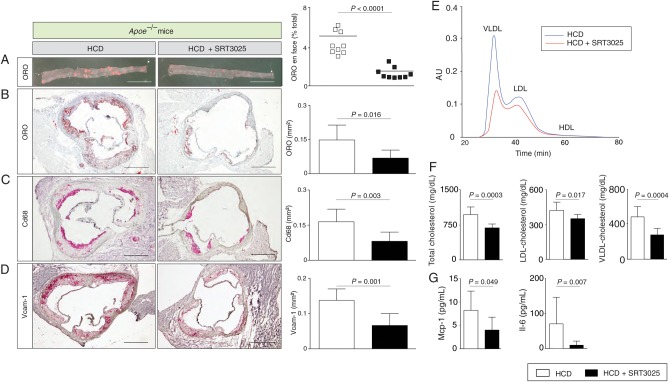
- In Apoe−/− mice fed a high-cholesterol diet, SRT3025 (3.18 g kg−1 diet for 12 weeks, n = 9 vs placebo n = 9) reduced plaque size in thoraco-abdominal aortae en face and aortic roots, reduced plaque Cd68-positive macrophages and Vcam-1 expression, and significantly lowered plasma total-, LDL-, and VLDL-cholesterol; triglycerides and HDL-cholesterol were unchanged. Plasma Mcp-1 and Il-6 were also reduced.
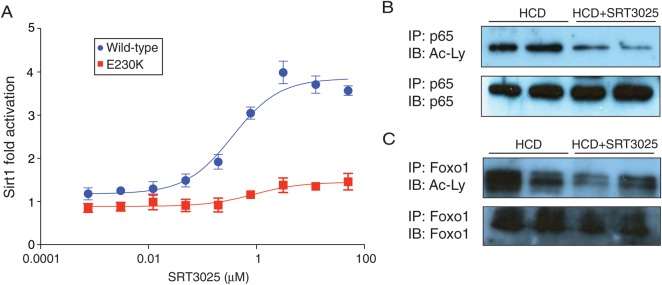
- SRT3025 concentration-dependently activated wild-type Sirt1 but not the activation-resistant Sirt1 mutant E230K in vitro, and increased deacetylation of hepatic p65 and skeletal muscle Foxo1 in vivo. It also prevented weight gain and epididymal white adipose tissue increase without affecting food intake.
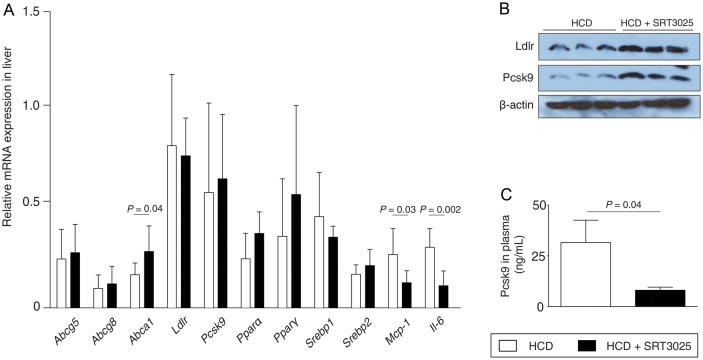
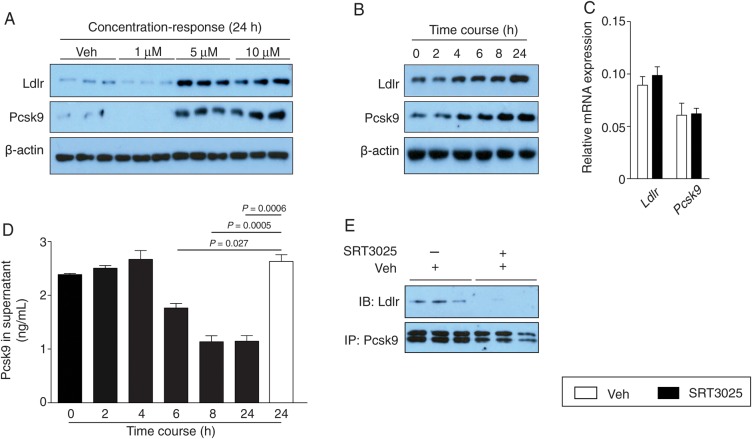
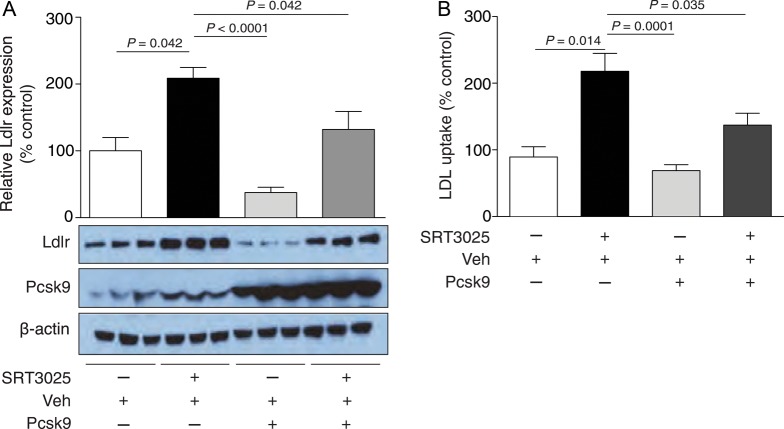
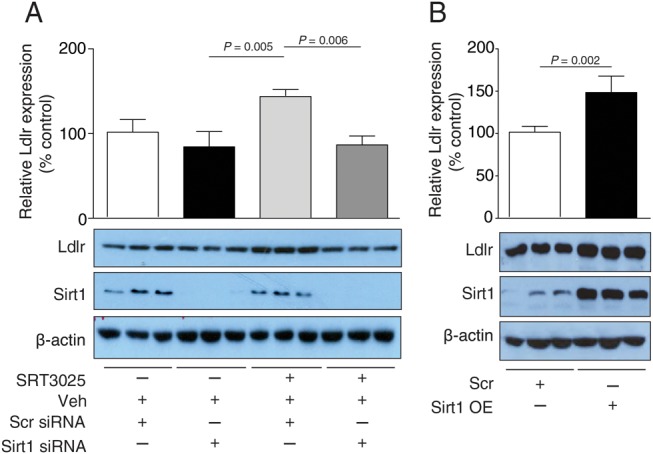
- In Apoe−/− liver, SRT3025 did not change Ldlr or Pcsk9 mRNA but increased both proteins, and reduced plasma Pcsk9. In AML12 hepatocytes, 10 μM SRT3025 increased Ldlr and Pcsk9 protein, decreased Pcsk9 secretion, impaired Pcsk9 binding to Ldlr, and increased LDL uptake; exogenous active Pcsk9 (3 ng ml−1) blunted the SRT3025-induced increase in Ldlr protein and LDL uptake. Sirt1 knockdown prevented and Sirt1 overexpression mimicked the Ldlr increase.
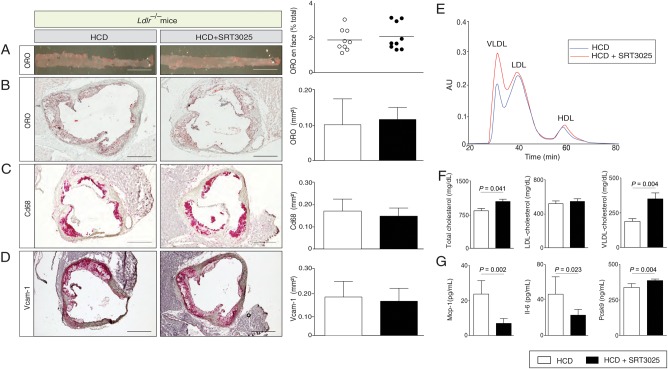
- In Ldlr−/− mice, SRT3025 did not reduce atherosclerosis, plasma Pcsk9, or LDL-cholesterol; total and VLDL-cholesterol increased. Baseline plasma Pcsk9 was about 20-fold higher in Ldlr−/− than Apoe−/− mice, and SRT3025 caused a minimal but significant increase in plasma Pcsk9 in Ldlr−/− mice, while inflammation was still reduced.
Methods
- Male Apoe−/− or Ldlr−/− mice on a pure C57BL/6J background were fed a high-cholesterol diet (1.25% w/w) supplemented with or without SRT3025 (3.18 g kg−1 diet) for 12 weeks starting at 8 weeks of age; n = 9 per group. Mice were sacrificed after overnight fasting, and EDTA blood and tissues were harvested.
- AML12 mouse hepatoma cells were cultured and treated with 10 μM SRT3025 in 1% DMSO where indicated. Experiments included Sirt1 knockdown and overexpression, co-immunoprecipitation of Pcsk9 and Ldlr, BODIPY-labelled LDL uptake, Western blots, and mRNA expression analyses.
- Atherosclerosis was assessed by en face thoraco-abdominal aortae and aortic root cross-sections stained with oil-red O or immunohistochemically for Cd68 or Vcam-1; plasma cholesterol distribution was measured by gel filtration chromatography. Statistics used means ± SD, Kolmogorov–Smirnov test, unpaired two-tailed Student’s t-test or Mann–Whitney test, and Kruskal–Wallis with Dunn’s post-hoc comparison; significance was P < 0.05, with at least three independent experiments in triplicates.
Limitations
- The paper states that the mechanisms by which Sirt1 affects Pcsk9 secretion remain to be investigated, and that future studies are needed to translate the effects of pharmacological Sirt1 activation to patients. It also notes that specific investigation of Pcsk9-dependent alterations on atherosclerosis may be hampered by reciprocal changes in Ldlr.
- Evident from the text: findings are limited to male mouse models on a high-cholesterol diet and to AML12 hepatoma cells in vitro, with no human clinical outcomes reported. SRT3025 was provided by Sirtris/GSK, and several authors report conflicts of interest, though this is not framed as a study limitation.
Model-written summary. Check it against the paper before relying on it.
Integrity signals
Registry
Cites
Statistics
Figures
Verification
Claims the paper makes
33 Own result · 16 Own interpretation · 7 Partly supported · 5 Supported · 3 Supported so far · 1 Not supported · 1 No full text of the sources · accuracy not yet measured
At least one cited source doesn’t support this claim or points to a different paper, and none confirmed it — see the verdicts below.
In the paper
“Thus, similar to previously described Sirt1 activators,15 SRT3025 acts by allosteric binding to Sirt1 at the lysine site 230, which is located at its catalytic core.”
§ The Sirt1 activator SRT3025 provides atheroprotection in Apoe−/− mice by reducing hepatic Pcsk9 secretion and enhancing Ldlr expression > Discussion
What the sources say
- Disputedcites [15] Hubbard, 2013, Evidence for a common mechanism of SIRT1 regulation by allosteric activators, Science sourceExperimental — accuracy not yet measured
The paper supports allosteric activation of SIRT1 by previously described activators, but it identifies residue 230 as glutamate (Glu230), not lysine, and places it immediately N-terminal to the catalytic core, not within it (Abstract section; page unavailable). It reports that replacing Glu230 with lysine attenuated activation. Our copy does not mention SRT3025, so it cannot establish that compound’s binding site. (LLM, conf=0.88)
Checked by a reasoning model — may be wrong.
plaindirect- Asserted: passes — The authors put it forward as true.
- Checkable: passes — It can be checked against evidence.
- Load-bearing: passes — The paper’s conclusions depend on it.
- Based: passes — The paper gives a reason why it holds.
- Disputed
Every source the paper cites for this claim was checked and supports it.
In the paper
“Ldlr was reported to be the main route of Pcsk9 clearance.22”
§ The Sirt1 activator SRT3025 provides atheroprotection in Apoe−/− mice by reducing hepatic Pcsk9 secretion and enhancing Ldlr expression > Discussion
What the sources say
- Supportedcites [22] Tavori, 2013, Serum proprotein convertase subtilisin/kexin type 9 and cell surface low-density lipoprotein receptor: evidence for a reciprocal regulation, Circulation source
The Discussion explicitly concludes that LDLR is the primary route for serum PCSK9 clearance. It supports this with a markedly longer PCSK9 half-life in LDLR-deficient mice than in wild-type mice. (LLM, conf=0.95)
plaindirect- Asserted: passes — The authors put it forward as true.
- Checkable: passes — It can be checked against evidence.
- Load-bearing: passes — The paper’s conclusions depend on it.
- Based: passes — The paper gives a reason why it holds.
- Supported
The sources with a verdict support this claim; the rest weren’t checked yet, have no full text we could read, or their verdicts aren’t rated yet.
In the paper
“Sirt1 has been shown to be atheroprotective in apolipoprotein E-deficient (Apoe−/−) mice2–4 whereas genetic overexpression of Sirt1 in LDL-receptor-deficient (Ldlr−/−) mice enhanced atherosclerosis.5”
§ The Sirt1 activator SRT3025 provides atheroprotection in Apoe−/− mice by reducing hepatic Pcsk9 secretion and enhancing Ldlr expression > Introduction
What the sources say
- Supportedcites [2] Zhang, 2008, Endothelium-specific overexpression of class III deacetylase SIRT1 decreases atherosclerosis in apolipoprotein E-deficient mice, Cardiovasc Res source
The Discussion reports that endothelium-specific SIRT1 overexpression reduced atherosclerosis in ApoE-deficient mice compared with controls. This supports the claim that SIRT1 has been shown to be atheroprotective in that mouse model. (LLM, conf=0.94)
- Supportedcites [3] Stein, 2010, SIRT1 decreases Lox-1-mediated foam cell formation in atherogenesis, Eur Heart J source
In Results, under “SIRT1 protects against atherosclerosis,” ApoE−/− mice with two SIRT1 alleles had fewer plaques than those with one. This supports the claim that SIRT1 is atheroprotective in ApoE−/− mice. (LLM, conf=0.94)
- Not checked — no full text of the sourcecites [4] Gorenne, 2013, Vascular smooth muscle cell sirtuin 1 protects against DNA damage and inhibits atherosclerosis, Circulation source
plaindirect- Asserted: passes — The authors put it forward as true.
- Checkable: passes — It can be checked against evidence.
- Load-bearing: passes — The paper’s conclusions depend on it.
- Based: passes — The paper gives a reason why it holds.
- Supported
The cited sources support only part of this claim — read each source’s verdict below.
In the paper
“Conversely, administration of a Sirt1 activating drug to elderly volunteers and cigarette smokers decreased plasma levels of total and LDL-cholesterol.8,9”
§ The Sirt1 activator SRT3025 provides atheroprotection in Apoe−/− mice by reducing hepatic Pcsk9 secretion and enhancing Ldlr expression > Introduction
What the sources say
- Partly supportedcites [8] Libri, 2012, A pilot randomized, placebo controlled, double blind phase I trial of the novel SIRT1 activator SRT2104 in elderly volunteers, PLoS One sourceExperimental — accuracy not yet measured
The Results (Exploratory Pharmacodynamic Measures; page unavailable) report decreased total and LDL cholesterol after SRT2104 treatment in elderly volunteers. The Methods (Study Participants, Design and Treatment; page unavailable) explicitly exclude users of tobacco or nicotine products, so this paper does not support the claim about cigarette smokers. (LLM, conf=0.90)
- Supportedcites [9] Venkatasubramanian, 2013, Cardiovascular effects of a novel SIRT1 activator, SRT2104, in otherwise healthy cigarette smokers, J Am Heart Assoc source
In the Discussion, this trial of otherwise healthy cigarette smokers reports mean reductions of 7% in total cholesterol and 11% in LDL cholesterol with SRT2104. This source supports the cigarette-smoker portion of the sentence’s two-citation claim. (LLM, conf=0.93)
plaindirect- Asserted: passes — The authors put it forward as true.
- Checkable: passes — It can be checked against evidence.
- Load-bearing: unclear — It is unclear whether the paper’s conclusions depend on it.
- Based: passes — The paper gives a reason why it holds.
- Partly supported
The sources with a verdict support this claim; the rest weren’t checked yet, have no full text we could read, or their verdicts aren’t rated yet.
In the paper
“Ldlr plays a critical role in the regulation of plasma LDL-cholesterol levels,10,11 a key determinant of atherogenesis.17”
§ The Sirt1 activator SRT3025 provides atheroprotection in Apoe−/− mice by reducing hepatic Pcsk9 secretion and enhancing Ldlr expression > Discussion
What the sources say
- Not checked — no full text of the sourcecites [10] Dietschy, 1984, Regulation of low density lipoprotein uptake and degradation in different animals species, Agents Actions Suppl source
- Supportedcites [11] Osono, 1995, Role of the low density lipoprotein receptor in the flux of cholesterol through the plasma and across the tissues of the mouse, J Clin Invest source
The paper states that changes in LDLR activity profoundly alter plasma LDL-cholesterol concentration. Its reported 14-fold increase in plasma LDL-cholesterol after LDLR deletion directly supports the attributed claim (study summary; page not provided). The separate atherogenesis phrase is attached to citation 17, not this source. (LLM, conf=0.94)
plaindirect- Asserted: passes — The authors put it forward as true.
- Checkable: passes — It can be checked against evidence.
- Load-bearing: passes — The paper’s conclusions depend on it.
- Based: passes — The paper gives a reason why it holds.
The cited sources support only part of this claim — read each source’s verdict below.
In the paper
“Hepatic deletion of Sirt1 in C57BL/6 mice fed a high-cholesterol diet induced mild hypercholesterolemia.7”
§ The Sirt1 activator SRT3025 provides atheroprotection in Apoe−/− mice by reducing hepatic Pcsk9 secretion and enhancing Ldlr expression > Introduction
What the sources say
- Partly supportedcites [7] Purushotham, 2009, Hepatocyte-specific deletion of SIRT1 alters fatty acid metabolism and results in hepatic steatosis and inflammation, Cell Metab sourceExperimental — accuracy not yet measured
The Animal experiments section describes liver-specific SIRT1 knockout mice on a C57BL/6 background, and the Results describe feeding them a western diet containing cholesterol. The Results and Discussion report increased cholesterol in the liver, but do not establish the claimed mild hypercholesterolemia (elevated blood cholesterol). No page numbers are available in our copy. (LLM, conf=0.84)
plaindirect- Asserted: passes — The authors put it forward as true.
- Checkable: passes — It can be checked against evidence.
- Load-bearing: unclear — It is unclear whether the paper’s conclusions depend on it.
- Based: passes — The paper gives a reason why it holds.
- Partly supported
The sources with a verdict support this claim; the rest weren’t checked yet, have no full text we could read, or their verdicts aren’t rated yet.
In the paper
“Hepatic Ldlr clears LDL-cholesterol from the blood stream.10,11”
§ The Sirt1 activator SRT3025 provides atheroprotection in Apoe−/− mice by reducing hepatic Pcsk9 secretion and enhancing Ldlr expression > Introduction
What the sources say
- Not checked — no full text of the sourcecites [10] Dietschy, 1984, Regulation of low density lipoprotein uptake and degradation in different animals species, Agents Actions Suppl source
- Supportedcites [11] Osono, 1995, Role of the low density lipoprotein receptor in the flux of cholesterol through the plasma and across the tissues of the mouse, J Clin Invest source
The paper’s summary (page not provided) reports that 79% of LDL-cholesterol degradation in normal mice occurred in the liver and that 91% of receptor-dependent transport was hepatic. It also states that most LDL-cholesterol returns directly to the liver, supporting the claim about hepatic LDLR-mediated clearance from blood. (LLM, conf=0.92)
plaindirect- Asserted: passes — The authors put it forward as true.
- Checkable: passes — It can be checked against evidence.
- Load-bearing: passes — The paper’s conclusions depend on it.
- Based: passes — The paper gives a reason why it holds.
Every source the paper cites for this claim was checked and supports it.
In the paper
“Transcription of Ldlr is controlled by the sterol-responsive element binding protein 2 (Srebp2),12 while its turnover depends on proprotein convertase subtilisin/kexin type 9 (Pcsk9), a serine protease.13”
§ The Sirt1 activator SRT3025 provides atheroprotection in Apoe−/− mice by reducing hepatic Pcsk9 secretion and enhancing Ldlr expression > Introduction
What the sources say
- Supportedcites [13] Attie, 2005, Dual regulation of the LDL receptor—some clarity and new questions, Cell Metab source
The Abstract states that PCSK9 apparently enhances degradation of the LDLR protein. This supports the claim that PCSK9 regulates LDLR turnover; the paper leaves the mechanism unresolved. (LLM, conf=0.90)
plaindirect- Asserted: passes — The authors put it forward as true.
- Checkable: passes — It can be checked against evidence.
- Load-bearing: passes — The paper’s conclusions depend on it.
- Based: passes — The paper gives a reason why it holds.
- Supported
Every source the paper cites for this claim was checked and supports it.
In the paper
“Sirt1 has been shown to be atheroprotective in apolipoprotein E-deficient (Apoe−/−) mice2–4 whereas genetic overexpression of Sirt1 in LDL-receptor-deficient (Ldlr−/−) mice enhanced atherosclerosis.5”
§ The Sirt1 activator SRT3025 provides atheroprotection in Apoe−/− mice by reducing hepatic Pcsk9 secretion and enhancing Ldlr expression > Introduction
What the sources say
- Supportedcites [5] Qiang, 2011, Proatherogenic abnormalities of lipid metabolism in SirT1 transgenic mice are mediated through Creb deacetylation, Cell Metab source
The Results section, “Increased dyslipidemia and atherosclerosis in SirBACO:Ldlr−/− mice,” reports that SirT1-overexpressing Ldlr−/− mice fed a Western-type diet had a 28% larger aortic-root atherosclerotic lesion area than Ldlr−/− controls (P<0.05). This directly supports the claim in the studied dietary condition. (LLM, conf=0.95)
plaindirect- Asserted: passes — The authors put it forward as true.
- Checkable: passes — It can be checked against evidence.
- Load-bearing: unclear — It is unclear whether the paper’s conclusions depend on it.
- Based: passes — The paper gives a reason why it holds.
- Supported
Every source the paper cites for this claim was checked and supports it.
In the paper
“Furthermore, constitutive Sirt1 overexpression in Ldlr−/− mice was associated with increased atherosclerosis.5”
§ The Sirt1 activator SRT3025 provides atheroprotection in Apoe−/− mice by reducing hepatic Pcsk9 secretion and enhancing Ldlr expression > Discussion
What the sources say
- Supportedcites [5] Qiang, 2011, Proatherogenic abnormalities of lipid metabolism in SirT1 transgenic mice are mediated through Creb deacetylation, Cell Metab source
The Results section (“Increased dyslipidemia and atherosclerosis in SirBACO:Ldlr−/− mice”) describes crossing SirT1-overexpressing mice with Ldlr−/− mice. After a Western-type diet, the double-mutant mice had a 28% greater aortic-root atherosclerotic lesion area than Ldlr−/− controls (P<0.05). (LLM, conf=0.94)
plaincorrelational- Asserted: passes — The authors put it forward as true.
- Checkable: passes — It can be checked against evidence.
- Load-bearing: unclear — It is unclear whether the paper’s conclusions depend on it.
- Based: passes — The paper gives a reason why it holds.
- Supported
- It may state two separate claims as one. 12
- Probably not a substantial claim. 4
- The quote only partly states this claim. 1
The cited sources support only part of this claim — read each source’s verdict below.
In the paper
“Secreted Pcsk9 targets hepatic Ldlr for lysosomal degradation and thus prevents recycling of internalized Ldlr to the cell surface.14”
§ The Sirt1 activator SRT3025 provides atheroprotection in Apoe−/− mice by reducing hepatic Pcsk9 secretion and enhancing Ldlr expression > Introduction
What the sources say
- Partly supportedcites [14] Zaid, 2008, Proprotein convertase subtilisin/kexin type 9 (PCSK9): hepatocyte-specific low-density lipoprotein receptor degradation and critical role in mouse liver regeneration, Hepatology sourceExperimental — accuracy not yet measured
The introductory passage says secreted PCSK9 binds LDLR and favors its targeting to endosomes/lysosomes for degradation; the Results also show that PCSK9 deficiency increases hepatocyte cell-surface LDLR. Our copy does not state that recycling of internalized LDLR is prevented. A title in the References says receptor recycling is decreased, which is narrower than the claim's 'prevents recycling.' (LLM, conf=0.84)
plaindirect- Asserted: passes — The authors put it forward as true.
- Checkable: passes — It can be checked against evidence.
- Load-bearing: passes — The paper’s conclusions depend on it.
- Based: passes — The paper gives a reason why it holds.
It may state two separate claims as one.
- Partly supported
Every source the paper cites for this claim was checked and supports it.
In the paper
“In line with our findings, clinical studies with another Sirt1 activator have shown a reduction in plasma total cholesterol and LDL-cholesterol.8,9”
§ The Sirt1 activator SRT3025 provides atheroprotection in Apoe−/− mice by reducing hepatic Pcsk9 secretion and enhancing Ldlr expression > Discussion
What the sources say
- Supportedcites [8] Libri, 2012, A pilot randomized, placebo controlled, double blind phase I trial of the novel SIRT1 activator SRT2104 in elderly volunteers, PLoS One source
The Results (Exploratory Pharmacodynamic Measures, Serum Lipid Profile) report that elderly volunteers receiving the SIRT1 activator SRT2104 had decreased total cholesterol and LDL cholesterol after 28 days, compared with placebo. The citation supports the claim as evidence from one clinical study. (LLM, conf=0.93)
- Supportedcites [9] Venkatasubramanian, 2013, Cardiovascular effects of a novel SIRT1 activator, SRT2104, in otherwise healthy cigarette smokers, J Am Heart Assoc source
The Results (Lipid Profile) report reductions in total and LDL cholesterol after treatment with the SIRT1 activator SRT2104. The Discussion quantifies the mean reductions as 7% and 11%, respectively, in otherwise healthy cigarette smokers. (LLM, conf=0.92)
plaindirect- Asserted: passes — The authors put it forward as true.
- Checkable: passes — It can be checked against evidence.
- Load-bearing: fails — The paper’s conclusions may not depend on it.
- Based: passes — The paper gives a reason why it holds.
Probably not a substantial claim. The paper’s conclusions may not depend on it.
- Supported
The cited sources support only part of this claim — read each source’s verdict below.
In the paper
“Antibody-induced inhibition of Pcsk9 binding to Ldlr is currently investigated as a very promising therapy to reduce plasma LDL-cholesterol and atherosclerosis in patients.24,25”
§ The Sirt1 activator SRT3025 provides atheroprotection in Apoe−/− mice by reducing hepatic Pcsk9 secretion and enhancing Ldlr expression > Discussion > Conclusions and perspectives
What the sources say
- Partly supportedcites [24] Chan, 2009, A proprotein convertase subtilisin/kexin type 9 neutralizing antibody reduces serum cholesterol in mice and nonhuman primates, Proc Natl Acad Sci USA sourceExperimental — accuracy not yet measured
The Abstract reports that the antibody blocks PCSK9–LDLR binding and lowers LDL cholesterol in monkeys; the Discussion describes its potential as a treatment for patients. The study did not test the antibody in patients or show that it reduces atherosclerosis, so those parts of the claim go beyond this source. (LLM, conf=0.87)
- Not checked — no full text of the sourcecites [25] Ling, 2012, Novel strategies for managing dyslipidemia: treatment beyond statins, Postgrad Med source
boosteddirect- Asserted: passes — The authors put it forward as true.
- Checkable: passes — It can be checked against evidence.
- Load-bearing: fails — The paper’s conclusions may not depend on it.
- Based: passes — The paper gives a reason why it holds.
Probably not a substantial claim. The paper’s conclusions may not depend on it.
- Partly supported
A result the paper reports from its own data — it cites no other source for it, so there is none to check. The quote shows it is in the paper.
In the paper
“Despite no changes in Ldlr and Pcsk9 mRNA expression, both were markedly increased at the protein level (Figure 3A and B).”
§ The Sirt1 activator SRT3025 provides atheroprotection in Apoe−/− mice by reducing hepatic Pcsk9 secretion and enhancing Ldlr expression > Results > SRT3025 increases hepatic Ldlr expression and Pcsk9 accumulation in Apoe−/− mice
plaindirectn = 9- Asserted: passes — The authors put it forward as true.
- Checkable: passes — It can be checked against evidence.
- Load-bearing: passes — The paper’s conclusions depend on it.
- Based: passes — The paper gives a reason why it holds.
It may state two separate claims as one.
A result the paper reports from its own data — it cites no other source for it, so there is none to check. The quote shows it is in the paper.
In the paper
“SRT3025 concentration-dependently activated wild-type Sirt1, but failed to activate the activation-resistant Sirt1 mutant E230K in vitro (Figure 2A).”
§ The Sirt1 activator SRT3025 provides atheroprotection in Apoe−/− mice by reducing hepatic Pcsk9 secretion and enhancing Ldlr expression > Results > SRT3025 mimics Sirt1 activity in vitro and in Apoe−/− mice
plaindirect- Asserted: passes — The authors put it forward as true.
- Checkable: passes — It can be checked against evidence.
- Load-bearing: passes — The paper’s conclusions depend on it.
- Based: passes — The paper gives a reason why it holds.
It may state two separate claims as one.
A result the paper reports from its own data — it cites no other source for it, so there is none to check. The quote shows it is in the paper.
In the paper
“Moreover, a marked reduction of Cd68-positive macrophages within the plaque and Vcam-1 expression in aortic roots was observed (Figure 1C and D).”
§ The Sirt1 activator SRT3025 provides atheroprotection in Apoe−/− mice by reducing hepatic Pcsk9 secretion and enhancing Ldlr expression > Results > SRT3025 reduces plasma cholesterol, inflammation, and atherosclerosis in Apoe−/− mice
plaindirect- Asserted: passes — The authors put it forward as true.
- Checkable: passes — It can be checked against evidence.
- Load-bearing: passes — The paper’s conclusions depend on it.
- Based: passes — The paper gives a reason why it holds.
It may state two separate claims as one.
A result the paper reports from its own data — it cites no other source for it, so there is none to check. The quote shows it is in the paper.
In the paper
“SRT3025 prevented an increase in weight gain and epididymal white adipose tissue without affecting food intake, thereby mimicking a caloric restriction phenotype (Supplementary material online, Figure S1B–D).”
§ The Sirt1 activator SRT3025 provides atheroprotection in Apoe−/− mice by reducing hepatic Pcsk9 secretion and enhancing Ldlr expression > Results > SRT3025 mimics Sirt1 activity in vitro and in Apoe−/− mice
plaindirect- Asserted: passes — The authors put it forward as true.
- Checkable: passes — It can be checked against evidence.
- Load-bearing: unclear — It is unclear whether the paper’s conclusions depend on it.
- Based: passes — The paper gives a reason why it holds.
It may state two separate claims as one.
A result the paper reports from its own data — it cites no other source for it, so there is none to check. The quote shows it is in the paper.
In the paper
“As in Apoe−/− mice, SRT3025 prevented an increase in weight gain and epididymal white adipose tissue without affecting food intake (Supplementary material online, Figure S2B–D), and lowered plasma levels of pro-inflammatory cytokines Mcp-1 and Il-6 (Figure 7G).”
§ The Sirt1 activator SRT3025 provides atheroprotection in Apoe−/− mice by reducing hepatic Pcsk9 secretion and enhancing Ldlr expression > Results > Genetic deletion of Ldlr abolishes atheroprotective effects of SRT3025 in vivo
plaindirect- Asserted: passes — The authors put it forward as true.
- Checkable: passes — It can be checked against evidence.
- Load-bearing: unclear — It is unclear whether the paper’s conclusions depend on it.
- Based: passes — The paper gives a reason why it holds.
It may state two separate claims as one.
A result the paper reports from its own data — it cites no other source for it, so there is none to check. The quote shows it is in the paper.
In the paper
“Triglycerides and HDL-cholesterol remained unchanged (Supplementary material online, Figure S1A).”
§ The Sirt1 activator SRT3025 provides atheroprotection in Apoe−/− mice by reducing hepatic Pcsk9 secretion and enhancing Ldlr expression > Results > SRT3025 reduces plasma cholesterol, inflammation, and atherosclerosis in Apoe−/− mice
plain- Asserted: passes — The authors put it forward as true.
- Checkable: passes — It can be checked against evidence.
- Load-bearing: unclear — It is unclear whether the paper’s conclusions depend on it.
- Based: passes — The paper gives a reason why it holds.
It may state two separate claims as one.
A result the paper reports from its own data — it cites no other source for it, so there is none to check. The quote shows it is in the paper.
In the paper
“Pharmacological Sirt1 activation decreased the expression of Pparα, but did not affect Abcg5, Abcg8, Abca1, Pcsk9, Pparγ, Srebp1, Srebp2, Mcp-1 and Il-6 (Supplementary material online, Figure S2E).”
§ The Sirt1 activator SRT3025 provides atheroprotection in Apoe−/− mice by reducing hepatic Pcsk9 secretion and enhancing Ldlr expression > Results > Genetic deletion of Ldlr abolishes atheroprotective effects of SRT3025 in vivo
plaindirect- Asserted: passes — The authors put it forward as true.
- Checkable: passes — It can be checked against evidence.
- Load-bearing: unclear — It is unclear whether the paper’s conclusions depend on it.
- Based: passes — The paper gives a reason why it holds.
It may state two separate claims as one. The quote only partly states this claim.
A result the paper reports from its own data — it cites no other source for it, so there is none to check. The quote shows it is in the paper.
In the paper
“Plasma protein levels of glutamic oxaloacetic transaminase, glutamic pyruvic transaminase, and alkaline phosphatase were not different between drug- and placebo-treated mice (Supplementary material online, Figure S1E).”
§ The Sirt1 activator SRT3025 provides atheroprotection in Apoe−/− mice by reducing hepatic Pcsk9 secretion and enhancing Ldlr expression > Results > SRT3025 mimics Sirt1 activity in vitro and in Apoe−/− mice
plain- Asserted: passes — The authors put it forward as true.
- Checkable: passes — It can be checked against evidence.
- Load-bearing: fails — The paper’s conclusions may not depend on it.
- Based: passes — The paper gives a reason why it holds.
Probably not a substantial claim. The paper’s conclusions may not depend on it.
A result the paper reports from its own data — it cites no other source for it, so there is none to check. The quote shows it is in the paper.
In the paper
“Furthermore, the number of plaque-resident macrophages (Cd68) and Vcam-1 expression in aortic roots did not differ between the groups (Figure 7C and D).”
§ The Sirt1 activator SRT3025 provides atheroprotection in Apoe−/− mice by reducing hepatic Pcsk9 secretion and enhancing Ldlr expression > Results > Genetic deletion of Ldlr abolishes atheroprotective effects of SRT3025 in vivo
plain- Asserted: passes — The authors put it forward as true.
- Checkable: passes — It can be checked against evidence.
- Load-bearing: passes — The paper’s conclusions depend on it.
- Based: passes — The paper gives a reason why it holds.
It may state two separate claims as one.
A conclusion the paper draws from its own results — it cites no other source for it, so there is none to check. The quote shows it is in the paper.
In the paper
“These events result in increased hepatic Ldlr expression and enhanced LDL-cholesterol plasma clearance.”
§ The Sirt1 activator SRT3025 provides atheroprotection in Apoe−/− mice by reducing hepatic Pcsk9 secretion and enhancing Ldlr expression > Results > SRT3025 impairs Pcsk9-dependent degradation of Ldlr in AML12 hepatocytes
plaindirect- Asserted: passes — The authors put it forward as true.
- Checkable: passes — It can be checked against evidence.
- Load-bearing: passes — The paper’s conclusions depend on it.
- Based: passes — The paper gives a reason why it holds.
It may state two separate claims as one.
A conclusion the paper draws from its own results — it cites no other source for it, so there is none to check. The quote shows it is in the paper.
In the paper
“We demonstrate that Sirt1 activation increases hepatic Ldlr protein expression through a reduction in Pcsk9-mediated Ldlr degradation leading to decreased plaque formation.”
§ The Sirt1 activator SRT3025 provides atheroprotection in Apoe−/− mice by reducing hepatic Pcsk9 secretion and enhancing Ldlr expression > Discussion > Conclusions and perspectives
boosteddirect- Asserted: passes — The authors put it forward as true.
- Checkable: passes — It can be checked against evidence.
- Load-bearing: passes — The paper’s conclusions depend on it.
- Based: passes — The paper gives a reason why it holds.
It may state two separate claims as one.
A conclusion the paper draws from its own results — it cites no other source for it, so there is none to check. The quote shows it is in the paper.
In the paper
“These findings indicate that SRT3025 administration to Apoe−/− mice provides atheroprotection and reduces plasma LDL-cholesterol and inflammation.”
§ The Sirt1 activator SRT3025 provides atheroprotection in Apoe−/− mice by reducing hepatic Pcsk9 secretion and enhancing Ldlr expression > Results > SRT3025 reduces plasma cholesterol, inflammation, and atherosclerosis in Apoe−/− mice
hedgeddirectn = 9- Asserted: passes — The authors put it forward as true.
- Checkable: passes — It can be checked against evidence.
- Load-bearing: passes — The paper’s conclusions depend on it.
- Based: passes — The paper gives a reason why it holds.
It may state two separate claims as one.
In the paper
“Transcription of Ldlr is controlled by the sterol-responsive element binding protein 2 (Srebp2),12 while its turnover depends on proprotein convertase subtilisin/kexin type 9 (Pcsk9), a serine protease.13”
§ The Sirt1 activator SRT3025 provides atheroprotection in Apoe−/− mice by reducing hepatic Pcsk9 secretion and enhancing Ldlr expression > Introduction
What the sources say
- Not checked — no full text of the sourcecites [12] Sudhof, 1987, 42 bp element from LDL receptor gene confers end-product repression by sterols when inserted into viral TK promoter, Cell source
plaindirect- Asserted: passes — The authors put it forward as true.
- Checkable: passes — It can be checked against evidence.
- Load-bearing: fails — The paper’s conclusions may not depend on it.
- Based: passes — The paper gives a reason why it holds.
Probably not a substantial claim. The paper’s conclusions may not depend on it.
The paper relies on this without support.
Plasma Pcsk9 levels reflect hepatic Pcsk9 secretion in mice.
“In agreement with this, we found reduced plasma Pcsk9 protein levels following pharmacological Sirt1 activation in Apoe−/− mice compared with placebo-treated controls (Figure 3C).”
The paper relies on this without support.
AML12 hepatocytes are a valid model of murine hepatocyte Pcsk9 and Ldlr regulation.
“To delineate the mechanisms by which SRT3025 affects Ldlr protein expression, we performed in vitro experiments administering SRT3025 to mouse hepatoma AML12 cells.”
Claims other papers make about this one
Each is checked against this paper’s own text: does it say what the citing paper says it does?
In the citing paper
“In our previous study,17 we provide evidence that pharmacological activation of intracellular Sirtuin-1 (SIRT1) in cultured hepatocytes enhanced hepatic LDLR levels by regulating PCSK9 in a post-translational manner.17”
From Sirtuin-1 directly binds and deacetylates hepatic PCSK9 thereby promoting the inhibition of LDL receptor degradation (2025) · cites this paper as [17]
In the citing paper
“Small molecule activators of intracellular SIRT1 reduced total cholesterol35 and especially plasma LDL-C levels.17”
From Sirtuin-1 directly binds and deacetylates hepatic PCSK9 thereby promoting the inhibition of LDL receptor degradation (2025) · cites this paper as [17]
Self-check
Percentages, sums and reported differences re-computed from the paper’s own numbers.
Each contradiction between two passages listed here was confirmed by an independent check.
Rated minor: it would not touch a result — a value no result rests on, a p-value that stays on the same side of the significance level, or a conflict that is clerical, resolved elsewhere in the paper, or outside its own findings.
In the paper
§ The Sirt1 activator SRT3025 provides atheroprotection in Apoe−/− mice by reducing hepatic Pcsk9 secretion and enhancing Ldlr expression > Discussion
“None of these variables were changed in Ldlr−/− mice despite a similar decrease in systemic inflammation.”
§ The Sirt1 activator SRT3025 provides atheroprotection in Apoe−/− mice by reducing hepatic Pcsk9 secretion and enhancing Ldlr expression > Results > Genetic deletion of Ldlr abolishes atheroprotective effects of SRT3025 in vivo
“SRT3025 induced a minimal but significant increase in plasma Pcsk9 levels in Ldlr−/− mice (Figure 7G).”
Citations
Cites
Recent progress in the biology and physiology of sirtuins
Finkel, T., Deng, C., & Mostoslavsky, R. (2009) · Nature · doi:10.1038/nature08197 · Cited by 1,506
Ishibashi, S., Brown, M. S., Goldstein, J. L., Gerard, R. D., Hammer, R. E., & Herz, J. (1993) · Journal of Clinical Investigation · doi:10.1172/jci116663 · Cited by 1,354
Seidah, N. G., Benjannet, S., Wickham, L., Marcinkiewicz, J., Jasmin, S. B., Stifani, S., Basak, A., Prat, A., & Chrétien, M. (2003) · Proceedings of the National Academy of Sciences · doi:10.1073/pnas.0335507100 · Cited by 1,191
Revollo, J. R., Grimm, A. A., & Imai, S.-I. (2004) · Journal of Biological Chemistry · doi:10.1074/jbc.m408388200 · Cited by 1,010
Purushotham, A., Schug, T. T., Xu, Q., Surapureddi, S., Guo, X., & Li, X. (2009) · Cell Metabolism · doi:10.1016/j.cmet.2009.02.006 · Cited by 1,003
Atherogenesis in perspective: Hypercholesterolemia and inflammation as partners in crime
Steinberg, D. H. (2002) · Nature Medicine · doi:10.1038/nm1102-1211 · Cited by 687
Secreted PCSK9 decreases the number of LDL receptors in hepatocytes and inlivers of parabiotic mice
Lagace, T. A., Curtis, D. E., Garuti, R., McNutt, M. C., Park, S. W., Prather, H. B., Anderson, N. N., Ho, Y. K., Hammer, R. E., & Horton, J. D. (2006) · Journal of Clinical Investigation · doi:10.1172/jci29383 · Cited by 681
Evidence for a common mechanism of SIRT1 regulation by allosteric activators
Hubbard, B. P., Gomes, A. P., Dai, H., Li, J., Case, A. W., Considine, T., Riera, T. V., Lee, J. E., E, S. Y., Lamming, D. W., et al. (2013) · Science · doi:10.1126/science.1231097 · Cited by 561
Self-citationZaid, A., Roubtsova, A., Essalmani, R., Marcinkiewicz, J., Chamberland, A., Hamelin, J., Tremblay, M., Jacques, H., Jin, W., Davignon, J., et al. (2008) · Hepatology · doi:10.1002/hep.22354 · Cited by 404
Chan, J. C. Y., Piper, D. E., Cao, Q., Liu, D., King, C., Wang, W., Tang, J., Liu, Q., Higbee, J., Xia, Z., et al. (2009) · Proceedings of the National Academy of Sciences · doi:10.1073/pnas.0903849106 · Cited by 371
Cited by
Sorted by citations
Slowing ageing by design: the rise of NAD+ and sirtuin-activating compounds
Bonkowski, M. S., & Sinclair, D. A. (2016) · Nature Reviews Molecular Cell Biology · doi:10.1038/nrm.2016.93 · Cited by 834
Self-citationThe Aging Cardiovascular System
Paneni, F., Diaz Cañestro, C., Libby, P., Lüscher, T. F., & Camici, G. G. (2017) · Journal of the American College of Cardiology · doi:10.1016/j.jacc.2017.01.064 · Cited by 618
Self-citationAnti-inflammatory therapies for cardiovascular disease
Ridker, P. M., & Lüscher, T. F. (2014) · European Heart Journal · doi:10.1093/eurheartj/ehu203 · Cited by 568
Self-citationSirtuins and NAD + in the Development and Treatment of Metabolic and Cardiovascular Diseases
Kane, A. E., & Sinclair, D. A. (2018) · Circulation Research · doi:10.1161/circresaha.118.312498 · Cited by 497
Self-citationProtective effects of sirtuins in cardiovascular diseases: from bench to bedside
Winnik, S., Auwerx, J., Sinclair, D. A., & Matter, C. M. (2015) · European Heart Journal · doi:10.1093/eurheartj/ehv290 · Cited by 422
Self-citation
Metadata
- Authors
- Miranda, M. X., van Tits, L. J., Lohmann, C., Arsiwala, T., Winnik, S., Tailleux, A., Stein, S., Gomes, A. P., Suri, V., Ellis, J. L., Lutz, T. A., Hottiger, M. O., Sinclair, D. A., Auwerx, J., Schoonjans, K., Staels, B., Lüscher, T. F., & Matter, C. M.
- Affiliations
- University of Zurich (CH)
- Inserm (FR)
- Harvard University (US)
- École Polytechnique Fédérale de Lausanne (CH)
- Corresponding author
- Matter, Christian M.
- ORCID
- Venue
- European Heart Journal
- Publisher
- Oxford University Press (OUP)
- Published
- 2014-03-06
- Volume
- 36
- Issue
- 1
- Pages
- 51-59
- ISSN
- 0195-668X (ISSN-L)
- 1522-9645
- PMC
- PMC4286317
- OpenAlex
- W2158618709
- Semantic Scholar
- b483cadffc141d6cb4c2d383bbeb4fb0b4321efb
- Cited by
- 153
- References
- 25
- Citations by year
- 2026: 7 · 2025: 10 · 2024: 11 · 2023: 12 · 2022: 14 · 2021: 20 · 2020: 16 · 2019: 7 · 2018: 15 · 2017: 10 · 2016: 10 · 2015: 17 · 2014: 4
- FWCI
- 5.82
- Type
- journal article
- Language
- en
- Open access
- green
- www.ncbi.nlm.nih.gov
- Licence
- cc-by-nc
- Locations
- European Heart Journal (publishedVersion)
- Europe PMC (PubMed Central) (publishedVersion, cc-by-nc)
- PubMed Central (publishedVersion, cc-by-nc)
- PubMed (publishedVersion)
- Zurich Open Repository and Archive (University of Zurich) (acceptedVersion, other-oa)
- reroDoc Digital Library (submittedVersion)
- Digital Access to Scholarship at Harvard (DASH) (Harvard University) (submittedVersion, cc-by)
- Infoscience (Ecole Polytechnique Fédérale de Lausanne) (submittedVersion)
- Infoscience (Ecole Polytechnique Fédérale de Lausanne) (submittedVersion, cc-by-nc-nd)
- Zurich Open Repository and Archive (University of Zurich) (submittedVersion, other-oa)
- Zurich Open Repository and Archive (University of Zurich)
- Funders
- National Institute on Aging (R37AG028730)
- Topics
- Life Sciences › Biochemistry, Genetics and Molecular Biology › Biochemistry › Cholesterol and Lipid Metabolism
- Health Sciences › Medicine › Geriatrics and Gerontology › Sirtuins and Resveratrol in Medicine
- Health Sciences › Medicine › Cardiology and Cardiovascular Medicine › Lipoproteins and Cardiovascular Health
- Keywords
- SIRT1, atherosclerosis, PCSK9, LDL receptor, LDL cholesterol, ApoE-deficient mice, high-cholesterol diet, hepatic lipid metabolism, FOXO1, LDL uptake, atheroprotection
- MeSH terms
- Proprotein Convertase 9, Anilides, Animals, Anticholesteremic Agents, Apolipoproteins E, Arteriosclerosis, Cells, Cultured, Enzyme Inhibitors, Cholesterol, LDL, Male, Mice, Inbred C57BL, Receptors, LDL, RNA, Messenger, Serine Endopeptidases, Thiazoles, Hepatocytes, Proprotein Convertases, Sirtuin 1, In Vitro Techniques
About these checks
Registry, retraction, Cites and statistics results are computed, not judged, with one exception: a printed reference that no index lists is read once by a model before it counts as a citation error. Claims are extracted by a model and kept only when their quote appears verbatim in the text; each cited source is then checked, with a model’s help, for whether it says what the claim relies on. Those verdicts can be wrong — read the claim’s quote and the cited source before relying on one.
A language model drew the claims from the paper on 2026-11-08, under version 3 of the claim definition (model deepseek-v4.1-flash, prompt extract-v3).
A second model labelled each claim on 2026-11-08 (model jev-1.13-20260917, definition revision gold-guideline-v0.2).
Cited sources are checked with a language model’s help (gpt-6-sol).
Statistics and arithmetic are recomputed, not judged.
Confidence bands are shown only for fields calibrated on our annotated test set. None is calibrated yet, so no band is shown.
What counts as a claim ›How we measure confidence ›How we check this ›
Are you an author, or do you see a problem with this page? Request a review
