

Improved Function With Enhanced Protein Intake per Meal: A Pilot Study of Weight Reduction in Frail, Obese Older Adults
Open accessThe DOI matches its Crossref record; 33 of the 33 references it cites were found in a registry or an index.
Abstract
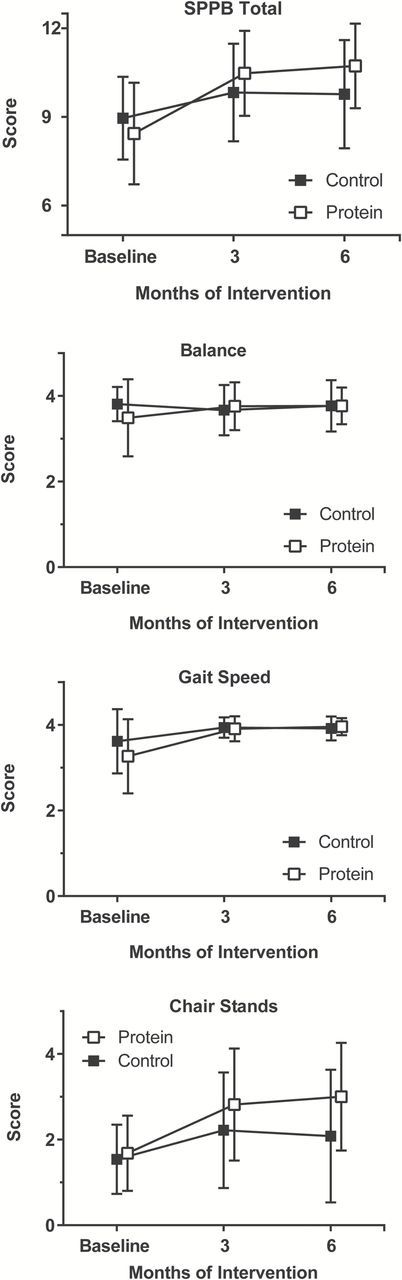
BACKGROUND: Obesity is a significant cause of functional limitations in older adults; yet, concerns that weight reduction could diminish muscle along with fat mass have impeded progress toward an intervention. Meal-based enhancement of protein intake could protect function and/or lean mass but has not been studied during geriatric obesity reduction. METHODS: In this 6-month randomized controlled trial, 67 obese (body mass index ≥30kg/m(2)) older (≥60 years) adults with a Short Physical Performance Battery score of 4-10 were randomly assigned to a traditional (Control) weight loss regimen or one with higher protein intake (>30g) at each meal (Protein). All participants were prescribed a hypo-caloric diet, and weighed and provided dietary guidance weekly. Physical function (Short Physical Performance Battery) and lean mass (BOD POD), along with secondary measures, were assessed at 0, 3, and 6 months. RESULTS: At the 6-month endpoint, there was significant (p < .001) weight loss in both the Control (-7.5±6.2kg) and Protein (-8.7±7.4kg) groups. Both groups also improved function but the increase in the Protein (+2.4±1.7 units; p < .001) was greater than in the Control (+0.9±1.7 units; p < .01) group (p = .02). CONCLUSION: Obese, functionally limited older adults undergoing a 6-month weight loss intervention with a meal-based enhancement of protein quantity and quality lost similar amounts of weight but had greater functional improvements relative to the Control group. If confirmed, this dietary approach could have important implications for improving the functional status of this vulnerable population (ClinicalTrials.gov identifier: NCT01715753).
Overview
The claims and statistics of this paper haven’t been checked yet.
Free: it reads the open-access text and checks the first 5 claims that cite a source we can check. Create a free account to check every claim.
Integrity signals
Registry
Cites
Statistics
Figures
Verification
Claims the paper makes
The claims and statistics of this paper haven’t been checked yet.
Free: it reads the open-access text and checks the first 5 claims that cite a source we can check. Create a free account to check every claim.
Claims other papers make about this one
Each is checked against this paper’s own text: does it say what the citing paper says it does?
The source backs part of the claim, not all of it — or backs it for a different population, condition or comparison.
In the citing paper
“weight loss improves global physical function, most likely because of reduced fat mass”
From Preserving Healthy Muscle during Weight Loss (2017) · cites this paper as [115]
Experimental — accuracy not yet measuredThe source backs part of the claim, not all of it — or backs it for a different population, condition or comparison.
In the citing paper
“Grip strength and global measures of physical function, such as balance, walking speed, or climbing stairs, improve after weight loss (52, 54-56, 93, 115, 127).”
From Preserving Healthy Muscle during Weight Loss (2017) · cites this paper as [115]
Experimental — accuracy not yet measuredThe cited source says what the claim attributes to it.
In the citing paper
“Early pilot studies demonstrate that meals enhanced with protein and coupled with a weight loss intervention improve physical function263.”
From Sarcopenic obesity in older adults: aetiology, epidemiology and treatment strategies (2018) · cites this paper as [263]
In the citing paper
“High-quality protein intake (1–1.2 g/kg/day), particularly those including sources of leucine, is generally recommended and can be employed concomitantly with a calorie restricted diet (71).”
From Sarcopenic obesity: epidemiology, pathophysiology, cardiovascular disease, mortality, and management (2023) · cites this paper as [71]
Self-check
Percentages, sums and reported differences re-computed from the paper’s own numbers.
The self-check needs the paper’s full text.
Citations
Cites
Guralnik, J. M., Simonsick, E. M., Ferrucci, L., Glynn, R. J., Berkman, L. F., Blazer, D. G., Scherr, P. A., & Wallace, R. B. (1994) · Journal of Gerontology · doi:10.1093/geronj/49.2.m85 · Cited by 9,792 · cited 13×
“Mean changes in SPPB total score, balance, gait speed, and chair stands by group at 3 and 6 months of intervention. rather than a 6-month intervention (4 to Protein, 7 to Control).”
MethodInfluentialPrevalence of Childhood and Adult Obesity in the United States, 2011-2012
Ogden, C. L., Carroll, M. D., Kit, B. K., & Flegal, K. M. (2014) · JAMA · doi:10.1001/jama.2014.732 · Cited by 8,072 · cited 1×
“The obesity epidemic is progressively threatening the health of many older adults (1); already, 35% or more of those older than 60 years are obese (body mass index ≥30 kg/m2) and this prevalence is expected to increase (2).”
BackgroundCHAMPS Physical Activity Questionnaire for Older Adults: outcomes for interventions
STEWART, A. L., MILLS, K. M., KING, A. C., HASKELL, W. L., GILLIS, D., & RITTER, P. L. (2001) · Medicine & Science in Sports & Exercise · doi:10.1097/00005768-200107000-00010 · Cited by 1,252 · cited 1×
“Duration of moderate–intensity activities was assessed using the Community Healthy Activities Model Program for Seniors (CHAMPS) questionnaire (24).”
MethodWeight loss, exercise, or both and physical function in obese older adults
Villareal, D. T., Chode, S., Parimi, N., Sinacore, D. R., Hilton, T., Armamento-Villareal, R., Napoli, N., Qualls, C., & Shah, K. (2011) · New England Journal of Medicine · doi:10.1056/nejmoa1008234 · Cited by 1,096 · cited 1×
“However, obesity reduction can provide remarkable benefits to inflammatory status, metabolic profiles, physical function, and quality of life in this population (1,9,10).”
BackgroundCermak, N. M., Res, P. T., de Groot, L. C., Saris, W. H., & van Loon, L. J. (2012) · The American Journal of Clinical Nutrition · doi:10.3945/ajcn.112.037556 · Cited by 827 · cited 1×
“This result could relate in part to resistance training, which is well known to additively enhance the effect of protein supplementation on anabolism (31).”
BackgroundDietary protein recommendations and the prevention of sarcopenia
Paddon-Jones, D., & Rasmussen, B. B. (2009) · Current Opinion in Clinical Nutrition & Metabolic Care · doi:10.1097/mco.0b013e32831cef8b · Cited by 823
Wycherley, T. P., Moran, L. J., Clifton, P. M., Noakes, M., & Brinkworth, G. D. (2012) · The American Journal of Clinical Nutrition · doi:10.3945/ajcn.112.044321 · Cited by 606 · cited 2×
“3 Gender Female (%) 20 (77) 33 (80) 53 (79) Male (%) 6 (23) 8 (20) 14 (21) Race Black (%) 4 (15) 13 (32) 17 (25) White (%) 21 (81) 26 (63) 47 (70) Education ≤ High school (%) 6 (23) 9 (22) 15 (22) > High school (%) 20 (77) 32 (78) 52 (78) Energy intake (kcal) 1,880 ± 416 1,985 ± 792 1,947 ± 680 Protein intake (g) 81.”
ResultKrieger, J. W., Sitren, H. S., Daniels, M. J., & Langkamp-Henken, B. (2006) · The American Journal of Clinical Nutrition · doi:10.1093/ajcn/83.2.260 · Cited by 466 · cited 1×
“This finding is in contrast to the impressive body of evidence supporting a benefit of higher protein intakes to LM retention in the general adult population (32,33) and it could be that the global BOD POD assessment of LM was insufficiently sensitive (eg, as compared with X-ray absorptiometry measurement) to detect g…”
ResultDietary protein distribution positively influences 24-h muscle protein synthesis in healthy adults
Mamerow, M. M., Mettler, J. A., English, K. L., Casperson, S. L., Arentson-Lantz, E., Sheffield-Moore, M., Layman, D. K., & Paddon-Jones, D. (2014) · The Journal of Nutrition · doi:10.3945/jn.113.185280 · Cited by 438
The danger of weight loss in the elderly
Miller, S. L., & Wolfe, R. R. (2008) · The Journal of nutrition, health and aging · doi:10.1007/bf02982710 · Cited by 384 · cited 1×
“Because of concerns about detrimental effects on muscle (6), bone (7), and/or mortality (8), weight loss has not been recommended for obese older adults.”
Background
Cited by
Sarcopenic obesity in older adults: aetiology, epidemiology and treatment strategies
Batsis, J. A., & Villareal, D. T. (2018) · Nature Reviews Endocrinology · doi:10.1038/s41574-018-0062-9 · Cited by 1,382
Caan, B. J., Cespedes Feliciano, E. M., Prado, C. M., Alexeeff, S., Kroenke, C. H., Bradshaw, P., Quesenberry, C. P., Weltzien, E. K., Castillo, A. L., Olobatuyi, T. A., et al. (2018) · JAMA Oncology · doi:10.1001/jamaoncol.2018.0137 · Cited by 565
Preserving Healthy Muscle during Weight Loss
Cava, E., Yeat, N. C., & Mittendorfer, B. (2017) · Advances in Nutrition · doi:10.3945/an.116.014506 · Cited by 452
“We are aware of only one study (115) that found a small, but nonetheless significantly greater, increase in physical function (assessed by using the Short Physical Performance Battery) in older obese adults who lost ;10% of their body weight and consumed 1.”
BackgroundMethodSarcopenic obesity: epidemiology, pathophysiology, cardiovascular disease, mortality, and management
Wei, S., Nguyen, T. T., Zhang, Y., Ryu, D., & Gariani, K. (2023) · Frontiers in Endocrinology · doi:10.3389/fendo.2023.1185221 · Cited by 291
Exercise and nutrition strategies to counteract sarcopenic obesity
Trouwborst, I., Verreijen, A., Memelink, R., Massanet, P., Boirie, Y., Weijs, P., & Tieland, M. (2018) · Nutrients · doi:10.3390/nu10050605 · Cited by 210
“Although this seems a promising result for the treatment of sarcopenic obesity, inconsistent results were found in the obese and physically limited older adults, where the effect of a high protein hypocaloric diet using meal-based protein foods over a 6 month period was evaluated [143].”
ResultAddressing obesity in aging patients
Batsis, J. A., & Zagaria, A. B. (2018) · Medical Clinics of North America · doi:10.1016/j.mcna.2017.08.007 · Cited by 167
Verreijen, A. M., Engberink, M. F., Memelink, R. G., van der Plas, S. E., Visser, M., & Weijs, P. J. M. (2017) · Nutrition Journal · doi:10.1186/s12937-017-0229-6 · Cited by 121
“[16] recently evaluated the effect of a high protein hypocaloric diet using meal-based protein foods in obese older adults over a 6month period.”
BackgroundA word of caution against excessive protein intake
Mittendorfer, B., Klein, S., & Fontana, L. (2019) · Nature Reviews Endocrinology · doi:10.1038/s41574-019-0274-7 · Cited by 141
Morante, J. J. H., Martínez, C. G., & Morillas-Ruiz, J. M. (2019) · Nutrients · doi:10.3390/nu11010102 · Cited by 134
Body weight and body composition in old age and their relationship with frailty
Reinders, I., Visser, M., & Schaap, L. S. (2016) · Current Opinion in Clinical Nutrition & Metabolic Care · doi:10.1097/mco.0000000000000332 · Cited by 113
Relationship between nutritional status and frailty in hospitalized older patients
Hong, X., Yan, J., Xu, L., Shen, S., Zeng, X., & Chen, L. (2019) · Clinical Interventions in Aging · doi:10.2147/cia.s189040 · Cited by 106
“It –31 Consistently, our study found that significantly higher serum levels of nutrition-related proteins were observed in the nonfrail patients compared to the prefrail and frail patients.”
Payne, M. E., Starr, K. N. P., Orenduff, M. C., Mulder, H. S., McDonald, S. R., Spira, A. P., Pieper, C. F., & Bales, C. W. (2018) · The journal of nutrition health & aging · doi:10.1007/s12603-018-1127-0 · Cited by 119
Self-citationTreatment of obesity in older persons—A systematic review
Haywood, C., & Sumithran, P. (2019) · Obesity Reviews · doi:10.1111/obr.12815 · Cited by 84
Prevention and treatment of sarcopenic obesity in women
Petroni, M. L., Caletti, M. T., Dalle Grave, R., Bazzocchi, A., Aparisi Gómez, M. P., & Marchesini, G. (2019) · Nutrients · doi:10.3390/nu11061302 · Cited by 82
Obesity Interventions for Older Adults: Diet as a Determinant of Physical Function
Bales, C. W., & Starr, K. N. P. (2018) · Advances in Nutrition · doi:10.1093/advances/nmx016 · Cited by 73
“Calorie restriction plus nutrient modification Porter Starr et al. (2016) (MEASUR-UP trial) (49) n = 67 BMI = 36.9 ± 6.3 Age = 68.3 ± 5.6 y Sex = 79% F Description: SPPB score 4–10 Arms: Control (NP Diet) HP Diet Duration: 6 mo Weight: Total body weight significantly decreased for both arms (P< 0.001).”
BackgroundInfluentialSelf-citationVogtschmidt, Y. D., Raben, A., Faber, I., de Wilde, C., Lovegrove, J. A., Givens, D. I., Pfeiffer, A. F. H., & Soedamah-Muthu, S. S. (2021) · Atherosclerosis · doi:10.1016/j.atherosclerosis.2021.05.011 · Cited by 54
Challenges in the Management of Geriatric Obesity in High Risk Populations
Porter Starr, K., McDonald, S., Weidner, J., & Bales, C. (2016) · Nutrients · doi:10.3390/nu8050262 · Cited by 53
“New evidence indicating the anabolic advantage of enhancing protein intakes (with or without resistance training) as a means of preserving lean muscle mass and improving physical function during weight reduction may hold promise for this population [28,29].”
BackgroundSelf-citationKokura, Y., Ueshima, J., Saino, Y., & Maeda, K. (2024) · Clinical Nutrition ESPEN · doi:10.1016/j.clnesp.2024.06.030 · Cited by 66
de Moraes, M. B., Avgerinou, C., Fukushima, F. B., & Vidal, E. I. D. O. (2020) · Nutrition Reviews · doi:10.1093/nutrit/nuaa101 · Cited by 54
“Only one of the included studies was restricted to older people with frailty and obesity (BMI ≥ 30 kg/m2).(65)”
BackgroundBeavers, K. M., Nesbit, B. A., Kiel, J. R., Sheedy, J. L., Arterburn, L. M., Collins, A. E., Ford, S. A., Henderson, R. M., Coleman, C. D., & Beavers, D. P. (2019) · The Journals of Gerontology: Series A · doi:10.1093/gerona/gly146 · Cited by 46
“Half of these studies report a beneficial protein effect, either on lean mass retention (23) or functional status (16), although in only two cases was the effect of high-protein weight loss examined independent of exercise (16,22).”
BackgroundHudson, J. L., Wang, Y., Bergia III, R. E., & Campbell, W. W. (2020) · Advances in Nutrition · doi:10.1093/advances/nmz106 · Cited by 41
“Two more utilized air displacement plethysmography (37, 41) and 2 used hydrostatic weighing (33, 38) to measure body composition.”
MethodInflammation and metabolism: the role of adiposity in sarcopenic obesity
Lynch, G. M., Murphy, C. H., Castro, E. D. M., & Roche, H. M. (2020) · Proceedings of the Nutrition Society · doi:10.1017/s0029665120007119 · Cited by 41
Silverii, G. A., Cosentino, C., Santagiuliana, F., Rotella, F., Benvenuti, F., Mannucci, E., & Cresci, B. (2022) · Diabetes, Obesity and Metabolism · doi:10.1111/dom.14709 · Cited by 40
Kang, Y., Kim, N. H., Choi, Y. J., Lee, Y., Yun, J., Park, S. J., Park, H. S., Chung, Y., & Park, Y. K. (2020) · Nutrients · doi:10.3390/nu12061816 · Cited by 44
Hruby, A., & Jacques, P. F. (2018) · Public Health Nutrition · doi:10.1017/s1368980018001854 · Cited by 42
Dietary protein and amino acid intakes for mitigating sarcopenia in humans
He, W., Connolly, E. D., Cross, H. R., & Wu, G. (2024) · Critical Reviews in Food Science and Nutrition · doi:10.1080/10408398.2024.2348549 · Cited by 42
“Furthermore, a higher protein intake from beef (30 g lean beef three times/day) improved physical strength and function in frail and obese older adults (Porter Starr et al. 2016).”
Starr, K. N. P., Orenduff, M. C., McDonald, S. R., Mulder, H. S., Sloane, R. J., Pieper, C. F., & Bales, C. W. (2019) · Journal of Nutrition in Gerontology and Geriatrics · doi:10.1080/21551197.2018.1564200 · Cited by 41
“Chronic activation of the innate immune system causes persistent low-grade inflammation in older adults with obesity, which leads to muscle depletion by enhancing protein breakdown and impairing myogenesis in parallel (7, 25).”
BackgroundMethodSelf-citationAssyov, Y. S., Nedeva, I., Spassov, B., Gerganova, A., Velikov, T., Kamenov, Z. A., & Velikova, T. V. (2024) · Nutrients · doi:10.3390/nu16152560 · Cited by 34
Long-Term Effects of Randomization to a Weight Loss Intervention in Older Adults: A Pilot Study
Houston, D. K., Miller, M. E., Kitzman, D. W., Rejeski, W. J., Messier, S. P., Lyles, M. F., Kritchevsky, S. B., & Nicklas, B. J. (2019) · Journal of Nutrition in Gerontology and Geriatrics · doi:10.1080/21551197.2019.1572570 · Cited by 30
Protein Intake and Human Health: Implications of Units of Protein Intake
Hruby, A., & Jacques, P. F. (2020) · Advances in Nutrition · doi:10.1093/advances/nmaa097 · Cited by 30
“To our knowledge, ≥1 weight-loss study has been specific in this regard (68).”
BackgroundVillani, A. M., Wright, H. H., Slater, G., & Buckley, J. D. (2018) · BMC Geriatrics · doi:10.1186/s12877-017-0700-4 · Cited by 35
“However, a subset of obese older adults are limited in their capacity to engage in physical activity due to excess adiposity, reduced muscle strength and functional impairment [17].”
BackgroundCORTES, T. M., Chae, K., Foy, C. M., Houston, D. K., & Beavers, K. M. (2025) · Obesity · doi:10.1002/oby.24229 · Cited by 27
“In the MEASUR-UP pilot trial, CR with a high-protein diet led to a similar loss of LBM compared to conventional CR over 6 months [68].”
Starr, K. N. P., Connelly, M. A., Orenduff, M. C., McDonald, S. R., Sloane, R. J., Huffman, K. M., Kraus, W. E., & Bales, C. W. (2019) · Journal of clinical lipidology · doi:10.1016/j.jacl.2019.09.012 · Cited by 33
Self-citationLau, C. S., Fulgoni, V., Elswyk, M. V. V., & McNeill, S. (2023) · Nutrients · doi:10.3390/nu15112475 · Cited by 26
Addressing Obesity to Promote Healthy Aging
Roderka, M. N., Puri, S., & Batsis, J. A. (2020) · Clinics in Geriatric Medicine · doi:10.1016/j.cger.2020.06.006 · Cited by 28
Lee, J., Park, H. M., & Lee, Y. (2021) · Nutrients · doi:10.3390/nu13114031 · Cited by 25
Kritchevsky, S. B. (2016) · The Journals of Gerontology Series A · doi:10.1093/gerona/glw165 · Cited by 43
“Porter Starr and coworkers randomized 67 obese adults at risk for mobility disability to a traditional weight loss regimen or a weight loss regimen with at least 30 g of protein provided at each meal (26).”
BackgroundBales, C. W., Porter Starr, K. N., Orenduff, M. C., McDonald, S. R., Molnar, K., Jarman, A. K., Onyenwoke, A., Mulder, H., Payne, M. E., & Pieper, C. F. (2017) · Current Developments in Nutrition · doi:10.3945/cdn.117.000703 · Cited by 23
“In the MEASUR-UP study, our first trial of 30 g protein/meal, there was a robust protein effect on function (22).”
MethodResultSelf-citationKirkham, A. A., Ford, K. L., Ramos Da Silva, B., Topolnyski, J., Prado, C. M., Joy, A. A., Paterson, D. I., Boulé, N., Pituskin, E., Haykowsky, M. J., et al. (2023) · Obesity · doi:10.1002/oby.23654 · Cited by 21
Effect of Incretin-Based and Nonpharmacologic Weight Loss on Body Composition: A Systematic Review
Batsis, J. A., Gavras, A., Gross, D. C., Cheever, C. R., da Silva, B. R., Filho, L. F. M., Jones, E. P., Batchek, D. J., Khandpekar, S. G., Patel, R., et al. (2026) · Annals of Internal Medicine · doi:10.7326/annals-25-00478 · Cited by 34
Novel approaches to sarcopenic obesity and weight management before and after kidney transplantation
Tantisattamo, E., Kalantar‐Zadeh, K., Halleck, F., Duettmann, W., Naik, M. G., & Budde, K. (2021) · Current Opinion in Nephrology & Hypertension · doi:10.1097/mnh.0000000000000673 · Cited by 21
“However, some other studies showed no benefits of a hypocaloric high-protein diet on preserving muscle mass or muscle strength [98,99].”
ResultThe weight-loss paradox in older adults: balancing fat loss with muscle preservation
Arslan, S., & Aydın, A. (2025) · Bulletin of the National Research Centre/Bulletin of the National Research Center · doi:10.1186/s42269-025-01374-8 · Cited by 25
“Recent trials have shown that interventions integrating resistance training with dietary changes rich in 1.0–1.5 g/ kg/day of high-quality protein significantly reduce muscle loss during calorie restriction in obese older populations (Porter Starr et al. 2016).”
InfluentialPeng, L., Yu, P.-C., Lee, H., Lin, M.-H., & Chen, L. (2021) · Archives of Gerontology and Geriatrics · doi:10.1016/j.archger.2021.104436 · Cited by 25
Englert, I., Bosy‐Westphal, A., Bischoff, S. C., & Kohlenberg-Müller, K. (2021) · Obesity Facts · doi:10.1159/000514427 · Cited by 23
Hawley, A. L., Liang, X., Børsheim, E., Wolfe, R. R., Salisbury, L., Hendy, E., Wu, H., Walker, S. E., Tacinelli, A. M., & Baum, J. (2022) · Meat Science · doi:10.1016/j.meatsci.2022.108830 · Cited by 23
Santangeli, E., Abbati, C., Chen, R., di Carlo, A., Leoni, S., Piscaglia, F., & Ferri, S. (2024) · Nutrients · doi:10.3390/nu16030427 · Cited by 25
“…treatment of sarcopenic obesity, especially in obese and physically limited older adults, where the results on muscle mass and performance are inconsistent, making the diagnosis and setting up of personalized dietary treatment even more urgent in frail patients at high risk of sarcopenia [191–193].”
BackgroundOptimal Protein Intake during Weight Loss Interventions in Older Adults with Obesity
Al-Nimr, R. I. (2019) · Journal of Nutrition in Gerontology and Geriatrics · doi:10.1080/21551197.2018.1544533 · Cited by 20
Nicoletti, C. F., Esteves, G. P., Genário, R., Santo, M. A., de Cleva, R., Gualano, B., & Roschel, H. (2020) · Obesity Surgery · doi:10.1007/s11695-020-05107-w · Cited by 17
“intake in postoperative bariatric surgery; however, there is evidence to suggest that a high per-meal protein intake (> 30 g/meal) is associated with better functional status in older obese adults engaged in a weight loss intervention [20].”
BackgroundWild, H., Baek, Y., Shah, S., Gašević, D., & Owen, A. J. (2022) · Nutrition Reviews · doi:10.1093/nutrit/nuac050 · Cited by 20
Diet and physical exercise in elderly people with obesity: The state of the art
Battista, F., Bettini, S., Verde, L., Busetto, L., Barrea, L., & Muscogiuri, G. (2024) · European Journal of Internal Medicine · doi:10.1016/j.ejim.2024.08.007 · Cited by 19
Ernst, I. G., Torbahn, G., Schwingshackl, L., Knüttel, H., Kob, R., KEMMLER, W. K., Sieber, C. C., Batsis, J. A., Villareal, D. T., Stroebele‐Benschop, N., et al. (2022) · Obesity Reviews · doi:10.1111/obr.13497 · Cited by 16
“Seven studies, all in individuals of the obesity phenotype, included a post-intervention follow-up period ranging from 5 to 19 months for at least some study outcomes.(45,57,63,64,70,76,81) The study's”
BackgroundRen, Y., Lu, A., Wang, B., & Wang, C. (2023) · Life · doi:10.3390/life14010070 · Cited by 20
Huang, S., Lee, Y.-H., Liao, C., Escorpizo, R. S., Liou, T., & Lin, H. (2024) · Scientific Reports · doi:10.1038/s41598-024-54102-z · Cited by 17
“Preliminary studies have suggested that combining a protein-rich diet with a weight loss program can enhance physical performance 25 .”
BackgroundHawley, A. L., & Baum, J. (2023) · Nutrition Reviews · doi:10.1093/nutrit/nuad061 · Cited by 12
Yang, J., Wang, Y., Shi, X., Liu, Y., Ge, S., Li, S., Wang, Y., Li, F., Suryawanshi, P., & Chen, W. (2024) · Nutrition in Clinical Practice · doi:10.1002/ncp.11214 · Cited by 13
Yin, Y., Liu, J. Y. W., Fan, T. M., Leung, K. M., Ng, M. W., Tsang, T. Y., Wong, K. P., & Valimaki, M. A. (2021) · Frontiers in Nutrition · doi:10.3389/fnut.2021.619903 · Cited by 10
Woo, E. C.-H., & Rodis, B. (2019) · Annals of the Academy of Medicine Singapore · doi:10.47102/annals-acadmedsg.v48n11p363 · Cited by 10
Exercise and Protein Effects on Strength and Function with Weight Loss in Older Women
Evans, E. M., Straight, C. R., Reed, R. A., Berg, A. C., Rowe, D. A., & Johnson, M. A. (2020) · Medicine & Science in Sports & Exercise · doi:10.1249/mss.0000000000002429 · Cited by 11
“(10) targeted >30 g of protein at each meal reached in part by supplying ≥420 g of protein per week in the form of cooked then frozen/chilled very lean beef.”
BackgroundTorbahn, G., Schoene, D., Schwingshackl, L., Rücker, G., Knüttel, H., KEMMLER, W. K., Sieber, C. C., Batsis, J. A., Villareal, D. T., Stroebele‐Benschop, N., et al. (2020) · BMJ Open · doi:10.1136/bmjopen-2020-038330 · Cited by 11
Dietary Patterns and Sarcopenia: A Systematic Review
Boushey, C. J., Ard, J. D., Bazzano, L., Heymsfield, S. B., Mayer‐Davis, E. J., Sabaté, J., Snetselaar, L., Horn, L. V., Schneeman, B. O., English, L., et al. (2020) · doi:10.52570/nesr.dgac2020.sr0107 · Cited by 12
Batsis, J. A., Gilbert‐Diamond, D., McClure, A. C., Weintraub, A. B., Sette, D., Mecchella, J. N., Rotenberg, S., Cook, S. B., & Rothstein, R. I. (2019) · Clinical Medicine Insights Arthritis and Musculoskeletal Disorders · doi:10.1177/1179544119862288 · Cited by 8
The Accuracy of Self-Perception of Obesity in a Rural Australian Population: A Cross-Sectional Study
Seth, N., Seal, A. N., Ruchin, P. E., & McGirr, J. (2022) · Journal of Primary Care & Community Health · doi:10.1177/21501319221115256 · Cited by 5
Miller, M. G., Starr, K. N. P., Rincker, J., Orenduff, M. C., McDonald, S. R., Pieper, C. F., Fruik, A., Lyles, K. W., & Bales, C. W. (2021) · Journal of Nutrition in Gerontology and Geriatrics · doi:10.1080/21551197.2021.1896615 · Cited by 3
“The number of participants and group allocations are based on our experience with similar interventions.(30,31)”
MethodSelf-citationNutritional Approaches for Attenuating Muscle Atrophy
Shimizu, M., & Sakuma, K. (2021) · IntechOpen eBooks · doi:10.5772/intechopen.94009 · Cited by 5
Multimodale Interventionen in der Therapie von Adipositas im Alter
Kiesswetter, E., Torbahn, G., & Schoene, D. (2025) · Adipositas - Ursachen Folgeerkrankungen Therapie · doi:10.1055/a-2496-1556 · Cited by 2
Englert, I., Egert, S., Hoffmann, L., & Kohlenberg-Müller, K. (2023) · Nutrients · doi:10.3390/nu15143250 · Cited by 2
Giacco, A., Silvestri, E., Senese, R., Cioffi, F., Cuomo, A., Lombardi, A., Moreno, M., Lanni, A., & de Lange, P. (2021) · Translational Medicine and Exercise Prescription · doi:10.53941/tmep.v1i1.31 · Cited by 2
Starr, K. N. P., Miller, M. G., Mitchell, N. S., & Bales, C. W. (2023) · Integrated science · doi:10.1007/978-3-031-17778-1_21 · Cited by 2
Self-citationStarr, K. N. P., McDonald, S. R., Jarman, A. K., Orenduff, M. C., Sloane, R. J., Pieper, C. F., & Bales, C. W. (2018) · Journal of Nutrition in Gerontology and Geriatrics · doi:10.1080/21551197.2018.1478696 · Cited by 4
“MEASUR-UP was a two-armed RCT with outcomes assessed at 0, 3, and 6months; detailed methods (28) and the primary outcomes of an intent-totreat analysis have been previously reported (29).”
MethodSelf-citationMitchell, N. S., North, R., Hung, A., Starr, K. N. P., Bales, C. W., & Coffman, C. J. (2025) · Contemporary Clinical Trials · doi:10.1016/j.cct.2025.107815 · Cited by 1
Self-citationNutrition for Older Adults: Perspectives on Dietary Guidance for Healthy Aging
Booth, S. L., Campbell, W. W., Volpi, E., Ferrucci, L., Starke-Reed, P. E., Bailey, R. L., Bales, C. W., Barbey, A. K., Choi, I., Houston, D. K., et al. (2026) · Current Developments in Nutrition · doi:10.1016/j.cdnut.2026.107658 · Cited by 7
“However, those randomly assigned to the higher protein diet group had greater improvements in physical performance [58].”
Self-citationFeraco, A., Camajani, E., Muscogiuri, G., Barrea, L., Colao, A., & Caprio, M. (2026) · Current Obesity Reports · doi:10.1007/s13679-026-00695-7 · Cited by 2
Major Lifestyles and Phenotypes in Aging and Disease
Dreher, M. L. (2018) · Springer eBooks · doi:10.1007/978-3-319-59180-3_1 · Cited by 1
“I Don’t Feel Like Myself”: Treating Frailty in the Elderly With Diet
Firnhaber, G. C., & Kolasa, K. M. (2016) · Nutrition Today · doi:10.1097/nt.0000000000000182
Dahl, W. J., Barad, A., & Ford, A. (2018) · EDIS · doi:10.32473/edis-fs308-2018
Personal computers: An operations planning catalyst
Schutt, K., & Jones, J. W. (1986) · OSTI OAI (U.S. Department of Energy Office of Scientific and Technical Information)
Ford, A., & Dahl, W. J. (2017) · EDIS · doi:10.32473/edis-fs290-2017
Sarkopene Adipositas im Alter: Ursachen, Folgen und Behandlungsansätze
Rippl, M., Drey, M., & Schluessel, S. (2025) · Adipositas - Ursachen Folgeerkrankungen Therapie · doi:10.1055/a-2492-9415
“Ebenso wird ein Fettverlust häufig von einem Muskel - verlust begleitet, wodurch die Entstehung einer Sarkopenie beför-dert wird [46, 47].”
Ceglia, L., Konieczynski, E. M., Danico, E., Trinquart, L., Koethe, B. C., Xiang, Q., Fielding, R. A., Evans, W. J., Shankaran, M., & Dawson-Hughes, B. F. (2026) · American Journal of Clinical Nutrition · doi:10.1016/j.ajcnut.2026.101257 · Cited by 1
Torbahn, G., Schoene, D., Ernst, I. G., Schwingshackl, L., Rücker, G., Knüttel, H., KEMMLER, W. K., Sieber, C. C., Batsis, J. A., Villareal, D. T., et al. (2026) · Obesity Reviews · doi:10.1111/obr.70123 · Cited by 3
“Twelve RCTs used objectively measured functional limitations as an inclusion criterion [58–60, 62, 73, 84–86, 94, 95, 99, 105].”
Plant Versus Animal-Based Foods for the Management of Obesity in Ageing
Naik, A. S., Santos-Hernández, M., & Lele, S. S. (2026) · Healthy ageing and longevity · doi:10.1007/978-3-032-24097-2_16
Bales, C. W., Miller, M. G., McDonald, S. R., Wallis, J. T., Yeager, L. A., Sloane, R. J., & Starr, K. N. P. (2026) · Current Developments in Nutrition · doi:10.1016/j.cdnut.2026.109460
Self-citationWasti, S. P., Ale, S., Pradhan, P., Gc, V. S., Vaidya, S., Ghimire, B., Bhattarai, K. K., & Pant, L. P. (2026) · Nutrition Reviews · doi:10.1093/nutrit/nuag122
Metadata
- Authors
- Porter Starr, K. N., Pieper, C. F., Orenduff, M. C., McDonald, S. R., McClure, L. B., Zhou, R., Payne, M. E., & Bales, C. W.
- Affiliations
- Duke University (US)
- Duke Medical Center (US)
- Venue
- The Journals of Gerontology Series A: Biological Sciences and Medical Sciences
- Publisher
- Oxford University Press (OUP)
- Published
- 2016-01-18
- Volume
- 71
- Issue
- 10
- Pages
- 1369-1375
- ISSN
- 1079-5006 (ISSN-L)
- 1758-535X
- PMC
- PMC5018561
- OpenAlex
- W2293873190
- Cited by
- 83
- References
- 33
- Citations by year
- 2026: 8 · 2025: 5 · 2024: 7 · 2023: 7 · 2022: 5 · 2021: 7 · 2020: 11 · 2019: 12 · 2018: 11 · 2017: 5 · 2016: 4
- FWCI
- 8.59
- Type
- journal article
- Language
- en
- Open access
- hybrid
- doi.org
- Licence
- cc-by
- Locations
- The Journals of Gerontology Series A (publishedVersion, cc-by)
- Europe PMC (PubMed Central) (publishedVersion, cc-by)
- PubMed Central (publishedVersion, cc-by)
- PubMed (publishedVersion)
- DukeSpace (Duke University) (submittedVersion, cc-by-nc-nd)
- HighWire Press Open Archive (submittedVersion)
- Funders
- National Institutes of Health (5T32 AG000029, BIRWCH K12 HD043446, 1P30 AG028716)
- Topics
- Health Sciences › Medicine › Physiology (medical) › Nutrition and Health in Aging
- Health Sciences › Nursing › Nutrition and Dietetics › Muscle metabolism and nutrition
- Health Sciences › Medicine › Geriatrics and Gerontology › Frailty in Older Adults
- Keywords
- obesity, older adults, frailty, weight loss, protein intake, physical function, lean body mass, Short Physical Performance Battery, functional limitations
- MeSH terms
- Aged, Diet, Reducing, Dietary Proteins, Female, Humans, Male, Obesity, Pilot Projects, Weight Loss, Geriatric Assessment, Body Mass Index, Frail Elderly, Treatment Outcome
About these checks
Registry, retraction, Cites and statistics results are computed, not judged, with one exception: a printed reference that no index lists is read once by a model before it counts as a citation error. Claims are extracted by a model and kept only when their quote appears verbatim in the text; each cited source is then checked, with a model’s help, for whether it says what the claim relies on. Those verdicts can be wrong — read the claim’s quote and the cited source before relying on one.
Statistics and arithmetic are recomputed, not judged.
Confidence bands are shown only for fields calibrated on our annotated test set. None is calibrated yet, so no band is shown.
What counts as a claim ›How we measure confidence ›How we check this ›
Are you an author, or do you see a problem with this page? Request a review
Data sources
Bibliographic data: Semantic Scholar, OpenAlex, Crossref.
Contains information from the Semantic Scholar Academic Graph Datasets, made available under the ODC Attribution License (ODC-BY 1.0).
Semantic Scholar’s data is described in: Kinney, R., et al. (2023). The Semantic Scholar Open Data Platform. arXiv:2301.10140.
