

Rank–rank hypergeometric overlap: identification of statistically significant overlap between gene-expression signatures
Open accessThe DOI matches its Crossref record; 54 of the 55 references it cites were found in a registry or an index.
Abstract
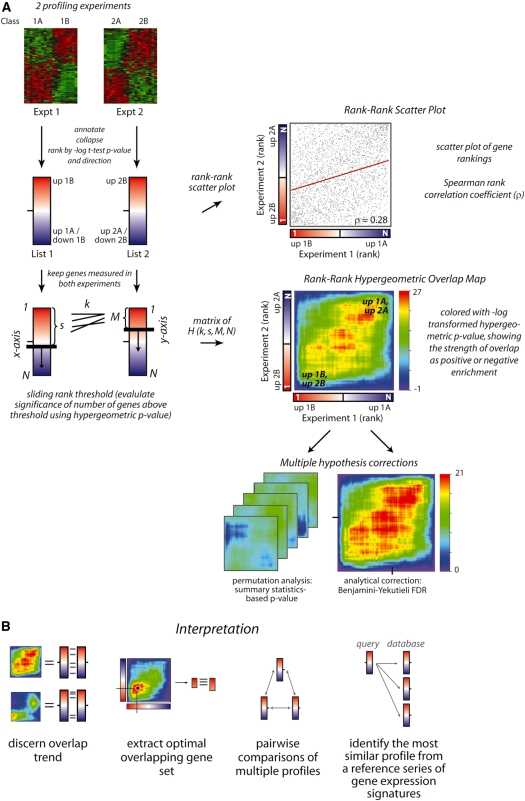
Comparing independent high-throughput gene-expression experiments can generate hypotheses about which gene-expression programs are shared between particular biological processes. Current techniques to compare expression profiles typically involve choosing a fixed differential expression threshold to summarize results, potentially reducing sensitivity to small but concordant changes. We present a threshold-free algorithm called Rank-rank Hypergeometric Overlap (RRHO). This algorithm steps through two gene lists ranked by the degree of differential expression observed in two profiling experiments, successively measuring the statistical significance of the number of overlapping genes. The output is a graphical map that shows the strength, pattern and bounds of correlation between two expression profiles. To demonstrate RRHO sensitivity and dynamic range, we identified shared expression networks in cancer microarray profiles driving tumor progression, stem cell properties and response to targeted kinase inhibition. We demonstrate how RRHO can be used to determine which model system or drug treatment best reflects a particular biological or disease response. The threshold-free and graphical aspects of RRHO complement other rank-based approaches such as Gene Set Enrichment Analysis (GSEA), for which RRHO is a 2D analog. Rank-rank overlap analysis is a sensitive, robust and web-accessible method for detecting and visualizing overlap trends between two complete, continuous gene-expression profiles. A web-based implementation of RRHO can be accessed at http://systems.crump.ucla.edu/rankrank/.
Overview
The claims and statistics of this paper haven’t been checked yet.
Free: it reads the open-access text and checks the first 5 claims that cite a source we can check. Create a free account to check every claim.
Integrity signals
Registry
Cites
Statistics
Figures
Verification
Claims the paper makes
The claims and statistics of this paper haven’t been checked yet.
Free: it reads the open-access text and checks the first 5 claims that cite a source we can check. Create a free account to check every claim.
Claims other papers make about this one
Each is checked against this paper’s own text: does it say what the citing paper says it does?
The source backs part of the claim, not all of it — or backs it for a different population, condition or comparison.
In the citing paper
“However, while these approaches are useful, they have conceptual limitations. Some lack a clear estimand (such as the running-sum GSEA statistic); some have ambiguous units (such as the energy distance); some are biased at finite sample size (such as the proportion of DE genes π in iDEA, see O’Connor et al11).”
From Transcriptome-wide analysis of differential expression in perturbation atlases (2025) · cites this paper as [9]
Experimental — accuracy not yet measuredIn the citing paper
“Consistently, rank-rank hypergeometric transcriptional overlap (RRHO) mapping between pre-natal and adult brain, and between iPSC-iNs and iNs, revealed a pronounced bias in the overlap of iNs with adult brain samples (Figure 7M; Plaisier et al., 2010).”
From Age-dependent instability of mature neuronal fate in induced neurons from Alzheimer’s patients (2021) · cites this paper as Plaisier et al., 2010
Self-check
Percentages, sums and reported differences re-computed from the paper’s own numbers.
The self-check needs the paper’s full text.
Citations
Cites
Subramanian, A., Tamayo, P., Mootha, V. K., Mukherjee, S., Ebert, B. L., Gillette, M. A., Paulovich, A., Pomeroy, S. L., Golub, T. R., Lander, E. S., et al. (2005) · Proceedings of the National Academy of Sciences · doi:10.1073/pnas.0506580102 · Cited by 53,625 · cited 3×
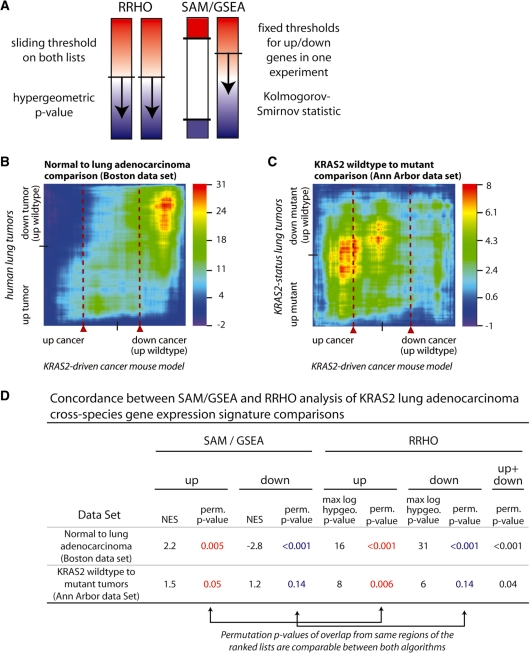
“In the SAM/GSEA approach, the output is a permutation P-value and a Kolmogorov–Smirnov mountain plot illustrating the overlap between a subset of high-ranking genes chosen to represent the mouse model profile (a fixed gene set) and the range of differential gene expression in the human data set (a continuous ranked li…”
MethodGene Expression Omnibus: NCBI gene expression and hybridization array data repository
Edgar, R. (2002) · Nucleic Acids Research · doi:10.1093/nar/30.1.207 · Cited by 13,288 · cited 2×
“Gene-expression information from microarray data repositories such as Gene-expression Omnibus (19) and ArrayExpress (53) as well as from more specialized resources such as the drug response profile database Cmap (10) can be readily converted to ranked list inputs for our program.”
BackgroundMethodThe control of the false discovery rate in multiple testing under dependency
Benjamini, Y., & Yekutieli, D. (2001) · The Annals of Statistics · doi:10.1214/aos/1013699998 · Cited by 10,490
Mootha, V. K., Lindgren, C. M., Eriksson, K.-F., Subramanian, A., Sihag, S., Lehar, J., Puigserver, P., Carlsson, E., Ridderstråle, M., Laurila, E., et al. (2003) · Nature Genetics · doi:10.1038/ng1180 · Cited by 10,197
DAVID: Database for Annotation, Visualization, and Integrated Discovery
Dennis, G., Sherman, B. T., Hosack, D. A., Yang, J., Gao, W., Lane, H. C., & Lempicki, R. A. (2003) · Genome Biology · doi:10.1186/gb-2003-4-5-p3 · Cited by 9,327
Lamb, J., Crawford, E. D., Peck, D., Modell, J. W., Blat, I. C., Wrobel, M. J., Lerner, J., Brunet, J.-P., Subramanian, A., Ross, K. N., et al. (2006) · Science · doi:10.1126/science.1132939 · Cited by 5,257 · cited 20×
“is the Cmap, a database of transcriptional responses to a panel of specific drug treatments (10).”
BackgroundMethodInfluentialGenes that mediate breast cancer metastasis to lung
Minn, A. J., Gupta, G. P., Siegel, P. M., Bos, P. D., Shu, W., Giri, D. D., Viale, A., Olshen, A. B., Gerald, W. L., & Massagué, J. (2005) · Nature · doi:10.1038/nature03799 · Cited by 2,922 · cited 1×
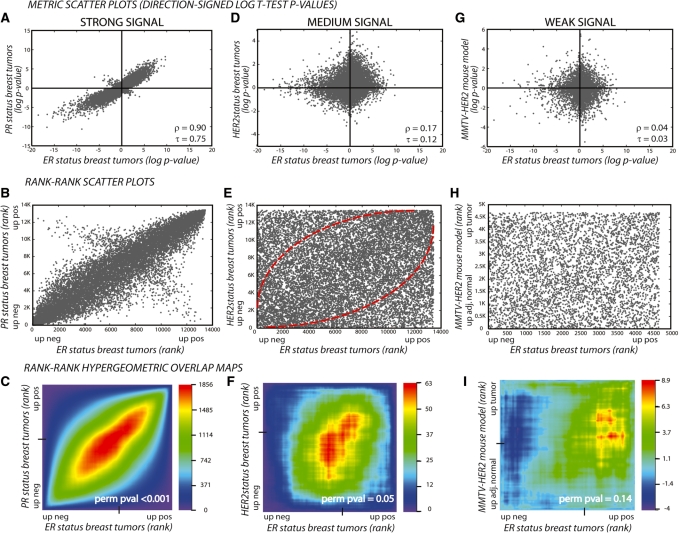
“The x-axis on all representations shows the difference between ER positive to ER negative human breast tumors (24); the y-axis shows gene-expression profiles based on other mutations or other profiles relevant to human breast cancer.”
BackgroundOncogenic pathway signatures in human cancers as a guide to targeted therapies
Bild, A. H., Yao, G., Chang, J. T., Wang, Q., Potti, A., Chasse, D., Joshi, M.-B., Harpole, D., Lancaster, J. M., Berchuck, A., et al. (2006) · Nature · doi:10.1038/nature04296 · Cited by 2,032 · cited 2×
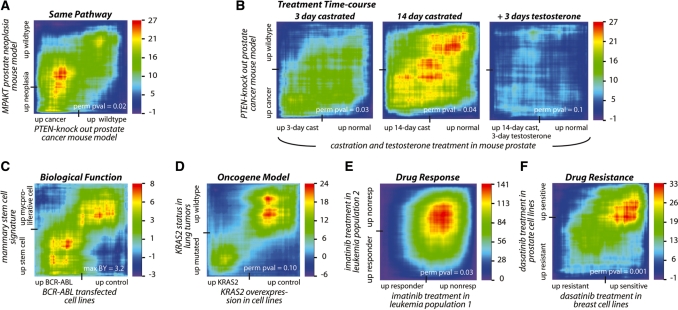
“High overlap between gene-expression changes driven by mutated KRAS2 oncogene in human lung tumors and by overexpression of KRAS2 in a cell line identify signaling events downstream of this oncogene that have in vivo relevance that can be studied effectively in vitro (Figure 3D) (35).”
BackgroundUsing GOstats to test gene lists for GO term association
Falcon, S., & Gentleman, R. (2007) · Bioinformatics · doi:10.1093/bioinformatics/btl567 · Cited by 2,015
Empirical Bayes analysis of a microarray experiment
Efron, B., Tibshirani, R., Storey, J. D., & Tusher, V. (2001) · Journal of the American Statistical Association · doi:10.1198/016214501753382129 · Cited by 1,733 · cited 7×
“Comparing the permutation P-values from the SAM/GSEA approach to those from the RRHO approach demonstrates that both methods have equivalent sensitivity and are able to detect the weak but statistically significant cross-species signal (Figure 4D).”
MethodInfluential
Cited by
Items 201–300 of 489
Integrating Transcriptomics, Genomics, and Imaging in Alzheimer's Disease: A Federated Model
Wu, J., Chen, Y., Wang, P., Caselli, R. J., Thompson, P. M., Wang, J., & Wang, Y. (2022) · Frontiers in Radiology · doi:10.3389/fradi.2021.777030 · Cited by 17
Kajitani, N., Okada‐Tsuchioka, M., Inoue, A., Miyano, K., Masuda, T., Boku, S., Iwamoto, K., Ohtsuki, S., Uezono, Y., Aoki, J., et al. (2023) · Neuropsychopharmacology · doi:10.1038/s41386-023-01727-9 · Cited by 17
Kwon, H., Lee, E. H., Choi, J., Park, J., Kim, Y., & Han, P. (2023) · Experimental Neurobiology · doi:10.5607/en23024 · Cited by 17
“2A, B) Using the Rank-Rank Hypergeo-metric Overlap (RRHO) method [36, 37].”
MethodFinding Genetic Overlaps Among Diseases Based on Ranked Gene Lists
Chen, Q., Zhou, X. J., & Sun, F. (2015) · Journal of Computational Biology · doi:10.1089/cmb.2014.0149 · Cited by 17
“Several other studies (Jurman et al., 2012; Subramanian et al., 2005; Fury et al., 2006; Yang et al., 2006; Roider et al., 2009; Plaisier et al., 2010; Ni and Vingron, 2012; Antosh et al., 2013) also addressed related topics of detecting overlap between ranked gene lists.”
Gui, J., & Patel, I. R. (2011) · Journal of Pathogens · doi:10.4061/2011/310135 · Cited by 20
The acute transcriptional response to resistance exercise: impact of age and contraction mode
Deane, C. S., Ames, R. M., Phillips, B. E., Weedon, M. N., Willis, C. R. G., Boereboom, C., Abdulla, H., Bukhari, S. S. I., Lund, J. N., Williams, J. P., et al. (2019) · Aging · doi:10.18632/aging.101904 · Cited by 18
High Risk α-HPV E6 Impairs Translesion Synthesis by Blocking POLη Induction
Wendel, S. O., Snow, J. A., Bastian, T., Brown, L. E., Hernandez, C., Burghardt, E., Kahn, A., Murthy, V., Neill, D., Smith, Z. C., et al. (2020) · Cancers · doi:10.3390/cancers13010028 · Cited by 17
“Fold-change and p-value data available for GEO data set GSE6791 was rank ordered using an established approach for gene ontology analysis [60] that was conducted using both the GOrilla online tool as well as Gene Set Enrichment Analysis software [61–64].”
MethodWang, X., Wen, Y., Zhang, J., Swanson, G., Guo, S., Cao, C., Krawetz, S. A., Zhang, Z., & Yuan, S. (2021) · Development · doi:10.1242/dev.196295 · Cited by 18
Lardone, R. D., Plaisier, S. B., Navarrete, M. S., Shamonki, J. M., Jalas, J. R., Sieling, P. A., & Lee, D. J. (2016) · Oncotarget · doi:10.18632/oncotarget.7361 · Cited by 17
“This problem can be resolved using rank-rank hypergeometric overlap (RRHO) analysis [14].”
MethodSelf-citationGui, S., Liu, Y., Pu, J., Song, X., Chen, X., Chen, W., Zhong, X., Wang, H., Liu, L., & Xie, P. (2021) · Journal of Affective Disorders · doi:10.1016/j.jad.2021.06.007 · Cited by 17
Single-Cell Transcriptomics Links Loss of Human Pancreatic β-Cell Identity to ER Stress
Gröen, N., Leenders, F., Mahfouz, A. E., García, A. M., Muraro, M. J., de Graaf, N., Rabelink, T. J., Hoeben, R. C., van Oudenaarden, A., Zaldumbide, A., et al. (2021) · Cells · doi:10.3390/cells10123585 · Cited by 18
“The rank-rank hypergeometric overlap (RRHO) algorithm was used to evaluate if β-cell responses are shared between dispersion and type 2 diabetes, reporting corrected p-values using the Benjamini and Yekutieli method [22].”
MethodGammie, S. C. (2022) · Scientific Reports · doi:10.1038/s41598-021-04020-1 · Cited by 16
Zhou, J., Xia, Y., Li, M., Chen, Y., Dai, R., Liu, C., & Chen, C. (2023) · Molecular Psychiatry · doi:10.1038/s41380-023-02243-4 · Cited by 16
“The rank-rank hypergeometric overlap (RRHO) test [41] was used to evaluate the overall consistency of differential DNAm in females and males with SCZ.”
Kakei, Y., & Shimada, Y. (2014) · Plant and Cell Physiology · doi:10.1093/pcp/pcu174 · Cited by 16
“For example, RRHO (rank–rank hypergeometric overlap; Plaisier et al. 2010) of GSEA helped to discover that a type I interferon suppresses a type II interferon (Teles et al.”
BackgroundNascimento, E. B. M., Hangelbroek, R., Hooiveld, G. J. E. J., Hoeks, J., Lichtenbelt, W. D. V. M., Hesselink, M. K. C., Schrauwen, P., & Kersten, S. (2020) · BMC Medical Genomics · doi:10.1186/s12920-020-00784-z · Cited by 16
Guo, T., Hu, S., Xu, W., Zhou, J., Chen, F., Gao, T., Qu, W., Chen, F., Lv, Z., & Lü, L. (2023) · iScience · doi:10.1016/j.isci.2023.106882 · Cited by 15
“28 (days of gathering the sample after birth) (2-33) (4-101) Enteral feeds 1.”
BackgroundHAMSAB diet ameliorates dysfunctional signaling in pancreatic islets in autoimmune diabetes
Vandenbempt, V., Eski, S. E., Brahma, M. K., Li, A., Negueruela, J., Bruggeman, Y., Demine, S., Xiao, P., Cardozo, A. K., Baeyens, N., et al. (2023) · iScience · doi:10.1016/j.isci.2023.108694 · Cited by 15
Miller, A. P., & Gizer, I. R. (2024) · Addiction Biology · doi:10.1111/adb.13365 · Cited by 15
Gestational exposure to air pollutants perturbs metabolic and placenta-fetal phenotype
Ganguly, A., Ghosh, S., Shin, B., Touma, M., Wadehra, M., & Devaskar, S. U. (2024) · Reproductive Toxicology · doi:10.1016/j.reprotox.2024.108657 · Cited by 15
Astrocytic CREB in Nucleus Accumbens Promotes Susceptibility to Chronic Stress
Holt, L. M., Gyles, T. M., Parise, E. M., Minier-Toribio, A. M., Rivera, M., Markovic, T., Yeh, S.-Y., & Nestler, E. J. (2024) · Biological Psychiatry · doi:10.1016/j.biopsych.2024.09.021 · Cited by 15
Transcriptomic analyses of humans and mice provide insights into depression
Li, H., 650223,中国, 中. 昆., Su, X., Zhang, L.-W., Zhang, C., Wang, L., Li, W., Yang, Y., Lv, L., Li, M., et al. (2020) · 动物学研究 · doi:10.24272/j.issn.2095-8137.2020.174 · Cited by 19
“26.0), as described previously (Bagot et al., 2016; Cahill et al., 2018; Plaisier et al., 2010; Seney et al., 2018; Stein et al., 2014).”
InfluentialMacaeva, E., Tabury, K., Michaux, A., Janssen, A., Averbeck, N., Moreels, M., Vos, W. H. D., Baatout, S., & Quintens, R. (2021) · Frontiers in Oncology · doi:10.3389/fonc.2021.768493 · Cited by 15
Peng, S., Zhou, Y., Xiong, L., & Wang, Q. (2023) · Scientific Reports · doi:10.1038/s41598-023-29101-1 · Cited by 16
Dwivedi, I., Caldwell, A. B., Zhou, D., Wu, W., Subramaniam, S., & Haddad, G. G. (2023) · Translational Psychiatry · doi:10.1038/s41398-023-02397-3 · Cited by 15
“Rank-rank hypergeometric overlap analysis (RRHO) and heatmap construction were done with the RRHO2 [52, 53] package in R.”
MethodSteffen, M., & Rehan, S. M. (2019) · Genes Brain & Behavior · doi:10.1111/gbb.12597 · Cited by 16
“In addition, it is becoming increasingly evident that evolution can occur more through modified gene regulation than by changes to DNA and protein sequences.(13,16-86) Therefore, subtle changes in regulatory units (transcription factors and binding motifs) can have profound effects on gene expression, resulting in dra…”
BackgroundAndrade, P. R., Mehta, M. D., Lu, J. N., Teles, R. M. B., Montoya, D. J., Scumpia, P. O., Sarno, E. N., Ochoa, M. T., Ma, F., Pellegrini, M. A., et al. (2019) · PLoS neglected tropical diseases · doi:10.1371/journal.pntd.0007589 · Cited by 15
Lipshutz, S. E., Hibbins, M. S., Bentz, A. B., Buechlein, A. M., Empson, T. A., George, E., Hauber, M. E., Rusch, D. B., Schelsky, W. M., Thomas, Q. K., et al. (2025) · Nature Ecology & Evolution · doi:10.1038/s41559-025-02675-x · Cited by 18
“To identify shared transcriptomic patterns in obligate cavity-nesting species across pairs of families, we used the R package RRHO (v.1.46.0) 76 (details in Supplementary Section 8).”
InfluentialEffects of pairing on color change and central gene expression in lined seahorses
Mederos, S. L., Duarte, R. C., Mastoras, M., Dennis, M. Y., Settles, M. L., Lau, A. R., Scott, A. M., Woodward, K., Johnson, C., Seelke, A. M. H., et al. (2022) · Genes Brain & Behavior · doi:10.1111/gbb.12812 · Cited by 14
“different regions and/or species.(16,63,64) The RRHO analysis identifies differentially expressed genes in a sample, ranks them in a list according to their log-fold change, and compares that ranked list to lists from another dataset with a similar experimental manipulation.”
BackgroundMethodGenetic factors influencing a neurobiological substrate for psychiatric disorders
Andlauer, T. F. M., Mühleisen, T. W., Hoffstaedter, F., Teumer, A., Wittfeld, K., Teuber, A., Reinbold, C. S., Grotegerd, D., Bülow, R., Caspers, S., et al. (2021) · Translational Psychiatry · doi:10.1038/s41398-021-01317-7 · Cited by 14
“We analyzed whether the order of SNPs ranked by their association strength was random between studies using rank-rank hypergeometric overlap (RRHO) tests (60).”
MethodTran, M. T. (2024) · Frontiers in Genetics · doi:10.3389/fgene.2024.1376123 · Cited by 13
“The three un fi ltered gene sets of CD, UC, and SI-NET from the Welch t -test were subjected to further downstream analysis with rank-rank hypergeometric overlap (RRHO), a threshold-free method that considers the global transcriptomes of each disease phenotype (Plaisier et al., 2010).”
MethodWen, H., He, Y., Tang, Y., Zhu, L., Tao, Q., Jin, B., Luo, T., Peng, Y., Wei, Y., Lei, J., et al. (2024) · Brain Pathology · doi:10.1111/bpa.13318 · Cited by 14
“The rank-rank hypergeometric overlap (RRHO) is a statistical method used to compare the degree of overlap between two ranked gene lists [37, 38], we utilized the RRHO2 R package in the study.”
Grzenda, A. L., Siddarth, P., Laird, K. T., Yeargin, J., & Lavretsky, H. (2020) · Molecular Psychiatry · doi:10.1038/s41380-020-0752-2 · Cited by 13
Increased hippocampal excitability in miR-324-null mice
Hayman, D. J., Modebadze, T., Charlton, S. H., Cheung, K., Soul, J., Lin, H., Yao, H., Miles, C. G., Tsompani, D., Jackson, R. M., et al. (2021) · Scientific Reports · doi:10.1038/s41598-021-89874-1 · Cited by 13
Yu, Z., Ueno, K., Funayama, R., Sakai, M., Nariai, N., Kojima, K., Kikuchi, Y., Li, X., Ono, C., Kanatani, J., et al. (2022) · Molecular Neurobiology · doi:10.1007/s12035-022-03109-6 · Cited by 14
Cheah, M., Cheng, Y., Petrova, V., Cimpean, A., Jendelová, P., Swarup, V., Woolf, C. J., Geschwind, D. H., & Fawcett, J. W. (2023) · Journal of Neuroscience · doi:10.1523/jneurosci.2076-22.2023 · Cited by 14
“Rank-Rank Hypergeometric Overlap (RRHO) We performed a rank-rank hypergeometric test as previously described (Plaisier et al., 2010).”
MethodLiu, K., Aierken, A., Liu, M., Parhat, N., Kong, W., Yin, X., Liu, G., Ding, Y. J., Hong, J., Ni, J., et al. (2024) · iScience · doi:10.1016/j.isci.2024.109281 · Cited by 13
Park, J. Y., Lee, E. H., Kim, J., Paeng, J.-W., Paeng, J.-C., Kim, T.-K., Kim, Y., & Han, P. (2025) · Experimental & Molecular Medicine · doi:10.1038/s12276-025-01429-w · Cited by 12
Gehlen-Breitbach, S., Schmid, T., Fröb, F., Rodrian, G., Weider, M., Wegner, M., & Gölz, L. (2023) · International Journal of Oral Science · doi:10.1038/s41368-023-00222-7 · Cited by 15
Wong, M. M. K., Kampen, R. A., Braden, R. O., Alagöz, G., Hildebrand, M. S., Dingemans, A. J. M., Corbally, J., den Hoed, J., Mendoza, E., Claassen, W. J. J., et al. (2025) · Nature Communications · doi:10.1038/s41467-025-64074-x · Cited by 12
“To identify overlap between gene-expression signatures of the different variant groups, we used rank – rank hypergeometric overlap (RRHO) analysis 40,41 .”
InfluentialMolecular features and vulnerabilities of recurrent chordomas
Seeling, C., Lechel, A., Svinarenko, M., Mӧller, P., Barth, T. F. E., & Mellert, K. (2021) · Journal of Experimental & Clinical Cancer Research · doi:10.1186/s13046-021-02037-y · Cited by 13
“The strength of enrichment is indicated as -log10 transformed hypergeometric p-value [27].”
BackgroundMethodInfluentialBux, A., Lindsey, M. L., Vasquez, H. G., Taegtmeyer, H., & Harmancey, R. (2016) · Physiological Genomics · doi:10.1152/physiolgenomics.00102.2016 · Cited by 13
A novel role for E2F3b in regulating cocaine action in the prefrontal cortex
Cates, H. M., Bagot, R. C., Heller, E. A., Purushothaman, I., Lardner, C. K., Walker, D. M., Peña, C. J., Neve, R. L., Shen, L., & Nestler, E. J. (2018) · Neuropsychopharmacology · doi:10.1038/s41386-018-0296-1 · Cited by 12
Epididymal glucocorticoid receptors promote intergenerational transmission of paternal stressPreprint
Chan, J. C., Nugent, B. M., Morrison, K. E., Jašarević, E., Bhanu, N. V., Garcia, B. A., & Bale, T. L. (2018) · bioRxiv (Cold Spring Harbor Laboratory) · doi:10.1101/321976 · Cited by 12
Gammie, S. C., Messing, A., Hill, M. A., Kelm‐Nelson, C. A., & Hagemann, T. L. (2024) · PLoS ONE · doi:10.1371/journal.pone.0291995 · Cited by 11
Jiang, J., Hiron, T. K., Chalisey, A., Malhotra, Y., Agbaedeng, T. A., & O’Callaghan, C. A. (2025) · Scientific Reports · doi:10.1038/s41598-025-07763-3 · Cited by 12
“The Rank-Rank Hypergeometric Overlap tested were conducted in R using the package RRHO 40 and genes were ranked by sign(log-fold-change) × log 10 (P).”
Weger, M., Weger, B. D., Schink, A., Takamiya, M., Stegmaier, J., Gobet, C., Parisi, A., Kobitski, A. Y., Mertes, J., Krone, N. P., et al. (2020) · eLife · doi:10.7554/elife.57068 · Cited by 12
Yi, X., de Souza, B. M., Sawatani, T., Szymczak, F., Marselli, L., Marchetti, P., Cnop, M., & Eizirik, D. L. (2022) · iScience · doi:10.1016/j.isci.2022.105376 · Cited by 11
Fitzgerald, E., Arcego, D. M., Shen, M., O’Toole, N., Wen, X., Nagy, C., Mostafavi, S., Craig, K., Silveira, P. P., Rayan, N. A., et al. (2023) · EBioMedicine · doi:10.1016/j.ebiom.2023.104749 · Cited by 12
Chongtham, A., Sharma, A., Nath, B., Murtha, K., Gorbachev, K., Ramakrishnan, A., Schmidt, E. F., Shen, L., & Pereira, A. C. (2024) · Experimental Neurology · doi:10.1016/j.expneurol.2024.114967 · Cited by 10
CORaL: Comparison of Ranked Lists for Analysis of Gene Expression Data
Antosh, M. P., Fox, D. J., Cooper, L. N., & Neretti, N. (2013) · Journal of Computational Biology · doi:10.1089/cmb.2013.0017 · Cited by 11
“We compared the results of our algorithm with the results of algorithms developed by Plaisier et al. (2010) and Yang et al. (2006).”
BackgroundMethodResultInfluentialDeckers, C., Karbalaei, R., Miles, N. A., Harder, E. V., Witt, E., Harris, E. P., Reissner, K. J., Wimmer, M. E., & Bangasser, D. A. (2024) · Neurobiology of Stress · doi:10.1016/j.ynstr.2024.100607 · Cited by 10
“Subsequently, a heatmap shows the strength and correlation pattern between the two expression profiles (Plaisier et al., 2010).”
Bernat, N., Campbell, R. R., Nam, H., Basu, M., Odesser, T., Elyasaf, G., Engeln, M., Chandra, R., Golden, S., Ament, S. A., et al. (2024) · Journal of Neuroscience · doi:10.1523/jneurosci.1469-23.2024 · Cited by 11
Manufacturing Uniform Cerebral Organoids for Neurological Disease Modeling and Drug Evaluation
Hong, H., Jun, Y., Yoon, S., Park, S., Lee, J., Jang, J. W., Nam, H. J., & Cho, H. (2024) · Biomaterials Research · doi:10.34133/bmr.0104 · Cited by 10
“We listed the DEGs from the UCOs and SA organoids, conducted normalization using the transcriptomes of the iPSCs, and ranked the DEGs according to their P values to perform a quantitative assay based on the rank–rank hypergeometric test [ 18 , 24 ].”
MethodAttwell, C. L., Maldonado-Lasunción, I., Eggers, R., Bijleveld, B., Ellenbroek, W. M., Siersema, N., Razenberg, L., Lamme, D., Fagoe, N. D., van Kesteren, R. E., et al. (2025) · Molecular Neurodegeneration · doi:10.1186/s13024-025-00805-4 · Cited by 11
“…using log fold-changes by standard hierarchical clustering by Euclidean distance for genes and group means, using base R. Rank-rank hypergeometric overlap analysis [58] was performed using R package RRHO [59], using signed log p -values from the differential expression analyses for ranking.”
Kraaijeveld, K., Oostra, V., Liefting, M., Wertheim, B., de Meijer, E., & Ellers, J. (2018) · BMC Genomics · doi:10.1186/s12864-018-5310-9 · Cited by 11
Identification of differentially expressed gene modules in heterogeneous diseases
Zolotareva, O. I., Khakabimamaghani, S., Isaeva, O. I., Chervontseva, Z. S., Savchik, A., & Ester, M. (2020) · Bioinformatics · doi:10.1093/bioinformatics/btaa1038 · Cited by 12
Metabolic heterogeneity in early-stage lung adenocarcinoma revealed by RNA-seq and scRNA-seq
Zhang, Y., Shi, J. T., Luo, J., Liu, C., & Zhu, L. (2023) · Clinical & Translational Oncology · doi:10.1007/s12094-023-03082-z · Cited by 10
“The principle of GSEA is to use a predefined gene set and then rank genes according to the degree of differential expression between two types of samples [20, 21].”
BackgroundYang, S., Yi, L., Xia, X., Chen, X., Hou, X., Zhang, L., Yang, F. Y., Liao, J., Han, Z., & Fu, Y. (2023) · Journal of Affective Disorders · doi:10.1016/j.jad.2023.04.074 · Cited by 10
Hong, Y., Hu, J., Zhang, S., Liu, J., Yan, F., Yang, H., & Hu, H. (2024) · Cell Reports · doi:10.1016/j.celrep.2024.114455 · Cited by 10
Gunn, P. J., Pramfalk, C., Millar, V., Cornfield, T., Hutchinson, M., Johnson, E. M., Nagarajan, S. R., Troncoso‐Rey, P., Mithen, R. F., Pinnick, K. E., et al. (2020) · Physiological Reports · doi:10.14814/phy2.14482 · Cited by 12
A multi-omic approach implicates novel protein dysregulation in post-traumatic stress disorder
Wang, J., Liu, Y., Li, H., Nguyen, T. P., Soto-Vargas, J. L., Wilson, R. S., Wang, W., Lam, T. T., Zhang, C., Chen, L., et al. (2025) · Genome Medicine · doi:10.1186/s13073-025-01473-1 · Cited by 14
Tripp, J. A., Feng, N. Y., & Bass, A. H. (2021) · Genes Brain & Behavior · doi:10.1111/gbb.12740 · Cited by 9
Murakami, S., White, S. M., McIntosh, A. T., Nguyen, C. D. K., & Yi, C. (2023) · Nature Communications · doi:10.1038/s41467-023-37147-y · Cited by 9
Jacott, C. N., Schoonbeek, H., Sidhu, G. S., Steuernagel, B., Kirby, R., Zheng, X., von Tiedermann, A., Macioszek, V. K., Kononowicz, A. K., Fell, H., et al. (2024) · Theoretical and Applied Genetics · doi:10.1007/s00122-024-04569-1 · Cited by 11
“…have similarities related to their infection, feeding strategies, and plant processes required for defense, we conducted overrepresentation analyses to compare the number of shared QDR GEMs between pathogens of the same lifestyle against what would be expected by chance (Plaisier et al. 2010).”
MethodSong, Y., Ren, S., Wu, S.-M., Liu, W., Hu, C., Feng, S., Chen, X., Tu, R., & Gao, F. (2024) · International Journal of Cancer · doi:10.1002/ijc.35285 · Cited by 9
Shelton, M. A., Horan, N. L., Xue, X., Maturin, L., Eacret, D., Michaud, J., Singh, N., Williams, B. R., Gamble, M. C., Seggio, J. A., et al. (2025) · Biological Psychiatry Global Open Science · doi:10.1016/j.bpsgos.2025.100476 · Cited by 11
“We also used rank-rank hypergeometric overlap (RRHO) to assess the overlap of differential expression patterns between humans and rodent models at each phase of opioid exposure using RRHO2 (20,21).”
Hamed, M., Gladbach, Y. S., Möller, S., Fischer, S., Ernst, M., Struckmann, S., Storch, A., & Fuellen, G. (2018) · Scientific Reports · doi:10.1038/s41598-018-25754-5 · Cited by 9
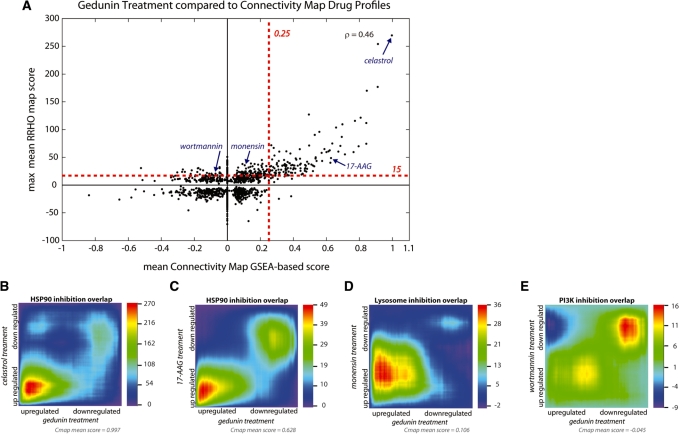
“For every pair of a PD profile and a CMap profile we computed a rank-rank hypergeometric overlap (RRHO) map 61 .”
MethodCombined Metallomics/Transcriptomics Profiling Reveals a Major Role for Metals in Wound Repair
Wilkinson, H. N., Guinn, B., & Hardman, M. J. (2021) · Frontiers in Cell and Developmental Biology · doi:10.3389/fcell.2021.788596 · Cited by 11
Gururajan, A., Bastiaanssen, T. F. S., Silva, A. P. V., Moloney, G. M., & Cryan, J. F. (2021) · European Journal of Neuroscience · doi:10.1111/ejn.15567 · Cited by 10
“Genes were ranked ( log10[p] * logFC) between resilient and control or between susceptible and control mice by calculating the significance of overlapping genes in different rank bins (Plaisier et al., 2010) using step sizes of 5.”
MethodHong, J., Eun, J. W., Baek, G. O., Cheong, J. Y., Park, S., Kim, S. S., Cho, H. J., & Lim, S. B. (2024) · Clinical and Molecular Hepatology · doi:10.3350/cmh.2024.0042 · Cited by 9
Liu, X., Wu, Y., Zhao, Y., Huang, Y., Xu, K., Wang, J., Pan, S., & Liang, J. (2021) · International Journal of Biological Macromolecules · doi:10.1016/j.ijbiomac.2021.02.145 · Cited by 9
Identification of a Proteomic Signature of Senescence in Primary Human Mammary Epithelial Cells
Delfarah, A., Hartel, N. G., Zheng, D., Yang, J., & Graham, N. A. (2021) · Journal of Proteome Research · doi:10.1021/acs.jproteome.1c00659 · Cited by 8
Kim, E. H., Kim, Y., Hong, S.-J., Kim, I. S., Lee, J.-H., Yoo, J.-Y., Kim, J., Yoo, K., Lee, H., Kim, J., et al. (2025) · Nature Communications · doi:10.1038/s41467-025-66440-1 · Cited by 12
Emerson, S. D., Chevée, M., Mews, P., & Calipari, E. S. (2023) · Molecular and Cellular Neuroscience · doi:10.1016/j.mcn.2023.103823 · Cited by 8
Morphine-Driven m6A Epitranscriptomic Neuroadaptations in Primary Cortical Cultures
Dabrowski, K. R., & Daws, S. E. (2024) · Molecular Neurobiology · doi:10.1007/s12035-024-04219-z · Cited by 9
“RRHO analysis is a statistical method used to compare two ranked gene lists to identify similarities between them and determine whether there are shared biological processes or pathways between the conditions that are being compared [38].”
Minto, M. S., Sotelo-Fonseca, J. E., Ramesh, V., & West, A. E. (2024) · BMC Biology · doi:10.1186/s12915-024-01989-9 · Cited by 12
Serra, F., Romualdi, C., & Fogolari, F. (2016) · Journal of Computational Biology · doi:10.1089/cmb.2015.0057 · Cited by 8
“In recent years, to overcome the limitations of global measures of similarity a number of approaches based on rank–rank correlation have been proposed (Yang et al., 2006; Plaisier et al., 2010; Antosh et al., 2011, 2013).”
Sex‐specific plasma metabolome signatures in major depressive disorder
Pu, J., Liu, X., Liu, Y., Gui, S., Zhong, X., Tian, L., Yang, L., Xu, S., Song, X., Chen, X., et al. (2019) · Psychiatry and Clinical Neurosciences · doi:10.1111/pcn.12925 · Cited by 8
“The overlapping metabolite trends of the shared modules were evaluated using the rank–rank hypergeometric overlap test.(6) Individual metabolites in the modules significantly associated with depression were uploaded to MetaboAnalyst 4.”
MethodKim, J. S., Chun, S. H., Park, S. S., Lee, S., Kim, S. E., Hong, J. H., Kang, K., Ko, Y. H., & Ahn, Y. (2020) · Cancers · doi:10.3390/cancers12071890 · Cited by 8
“Rank–rank h p rgeom tric overlap analysis [24] revealed that two expression profiles (miR-374a vs.”
BackgroundKim, Y. E., Kim, Y.-S., Lee, H.-E., So, K. H., Choe, Y., Suh, B., Kim, J., Park, S. K., Mathern, G. W., Gleeson, J. G., et al. (2022) · Cell Reports · doi:10.1016/j.celrep.2023.112003 · Cited by 9
Calkins, K. L., Thamotharan, S., Ghosh, S., Dai, Y., & Devaskar, S. U. (2020) · Journal of Nutrition · doi:10.1093/jn/nxaa001 · Cited by 9
The transcriptional landscape of atrial fibrillation: A systematic review and meta-analysis
Gómez‐Ochoa, S. A., Möhn, M., Malz, M., Ottenheijm, R., Lanzer, J. D., Wiedmann, F., Kraft, M., Muka, T., Schmidt, C., Freichel, M., et al. (2025) · PLoS ONE · doi:10.1371/journal.pone.0323534 · Cited by 7
“In this method, the genes are ordered based on the product of the negative logarithm (base 10) of the differential expression p-value and the effect size direction [24].”
How life events may confer vulnerability to addiction: the role of epigenetics
Liu, S. X., Harris, A. C., & Gewirtz, J. C. (2024) · Frontiers in Molecular Neuroscience · doi:10.3389/fnmol.2024.1462769 · Cited by 8
Thind, A. S., Tripathi, K. P., & Guarracino, M. R. (2019) · International Journal of Molecular Sciences · doi:10.3390/ijms20236098 · Cited by 8
“it) [10], parametric gene set enrichment analysis (PGSEA) [11], Gene Expression Signature [12], and RRHO [9].”
BackgroundMethodBrain Gene Expression of Foraging Behavior and Social Environment inCeratina calcarata
Huisken, J. L., & Rehan, S. M. (2023) · Genome Biology and Evolution · doi:10.1093/gbe/evad117 · Cited by 7
Polzin, B. J., Stevenson, S. A., Gammie, S. C., & Riters, L. V. (2023) · BMC Neuroscience · doi:10.1186/s12868-023-00813-4 · Cited by 8
“Following this, rank-rank hypergeometric overlap (RRHO) analysis [23] was performed to compare patterns of gene expression direction across sexes.”
MethodMakhani, K., Yang, X., Dierick, F., Subramaniam, N., Gagnon, N., Ebrahimian, T., Lehoux, S., Wu, H., Ding, J., & Mann, K. K. (2025) · Environmental Health Perspectives · doi:10.1289/ehp14285 · Cited by 8
Ni, M., Ye, F., Zhu, J., Li, Z., Yang, S., Yang, B., Han, L., Wu, Y., Chen, Y., Li, F., et al. (2014) · Bioinformatics · doi:10.1093/bioinformatics/btu560 · Cited by 7
Systematic discovery of signaling pathways linking immune activation to schizophrenia
Gao, Y., Li, Y., Li, S., Liang, X., Ren, Z., Yang, X., Zhang, B., Hu, Y., & Yang, X. (2021) · iScience · doi:10.1016/j.isci.2021.103209 · Cited by 8
Zeng, X., Zong, W., Lin, C., Fang, Z., Ma, T., Lewis, D. A., Enwright, J. F., & Tseng, G. C. (2020) · Genes · doi:10.3390/genes11060696 · Cited by 7
Rozov, S. V., Saarreharju, R., Khirug, S., Storvik, M., Rivera, C., & Rantamäki, T. (2024) · European Journal of Pharmacology · doi:10.1016/j.ejphar.2024.176426 · Cited by 6
Jia, X., Yin, Z., & Peng, Y. (2023) · Frontiers in Microbiology · doi:10.3389/fmicb.2023.1092143 · Cited by 6
“Rank-rank hyper geometric overlap (RRHO; Plaisier et al., 2010) uses unsupervised learning to sort the gene expression profile data of two samples of different categories, and uses hyper geometric distribution to iteratively calculate the p-values of all combinations to find the optimal overlap gene combination.”
BackgroundWaddell, N. J., Liu, Y., Chitaman, J. M., Kaplan, G. J., Wang, Z., & Feng, J. (2023) · Scientific Reports · doi:10.1038/s41598-023-37521-2 · Cited by 6
Koga, Y., Kajitani, N., Miyako, K., Takizawa, H., Boku, S., & Takebayashi, M. (2023) · Journal of Psychiatric Research · doi:10.1016/j.jpsychires.2024.01.007 · Cited by 7
Transcriptomic effects of paternal cocaine-seeking on the reward circuitry of male offspring
Huang, N., Cui, J., Fan, G., Pan, T., Han, K., Xu, K., Jiang, C., Liu, X., Wang, F., Ma, L., et al. (2024) · Translational Psychiatry · doi:10.1038/s41398-024-02839-6 · Cited by 6
Li, Z., Li, D., Hé, Y., Wang, K., Ma, X., & Chen, X. (2022) · Schizophrenia Bulletin · doi:10.1093/schbul/sbac019 · Cited by 6
Yin, M., Zhang, Y., Liu, S., Huang, J., & Li, X. (2022) · Frontiers in Immunology · doi:10.3389/fimmu.2022.891698 · Cited by 7
The molecular genetic landscape of human brain size variation
Seidlitz, J., Mallard, T. T., Vogel, J. W., Lee, Y. A., Warrier, V., Ball, G., Hansson, O., Hernandez, L. M., Mandal, A. S., Wagstyl, K., et al. (2023) · Cell Reports · doi:10.1016/j.celrep.2023.113439 · Cited by 6
Insights into ligand stimulation effects on gastro-intestinal stromal tumors signalling
Bahlawane, C., Schmitz, M., Letellier, E., Arumugam, K., Nicot, N., Nazarov, P. V., & Haan, S. (2016) · Cellular Signalling · doi:10.1016/j.cellsig.2016.10.009 · Cited by 7
“We first compared the overall gene expression signature of KIT mutant and KIT WT by means of a rank-rank hypergeometric overlap (RRHO) analysis [16] allowing a comparison without the application of any cutoff.”
InfluentialLoss of PABPC1 is compensated by elevated PABPC4 and correlates with transcriptome changesPreprint
Xie, J., Wei, X., & Chen, Y. (2021) · bioRxiv (Cold Spring Harbor Laboratory) · doi:10.1101/2021.02.07.430165 · Cited by 6
Metadata
- Authors
- Plaisier, S. B., Taschereau, R., Wong, J. A., & Graeber, T. G.
- Affiliations
- California NanoSystems Institute (US)
- Corresponding author
- Graeber, Thomas G.
- Venue
- Nucleic Acids Research
- Publisher
- Oxford University Press (OUP)
- Published
- 2010-07-21
- Volume
- 38
- Issue
- 17
- Pages
- e169-e169
- ISSN
- 0305-1048 (ISSN-L)
- 1362-4962
- PMC
- PMC2943622
- OpenAlex
- W2111065008
- Cited by
- 468
- References
- 55
- Citations by year
- 2026: 36 · 2025: 41 · 2024: 66 · 2023: 57 · 2022: 40 · 2021: 57 · 2020: 51 · 2019: 34 · 2018: 27 · 2017: 17 · 2016: 12 · 2015: 9 · 2014: 6 · 2013: 4 · 2012: 4
- FWCI
- 1.95
- Type
- journal article
- Language
- en
- Open access
- gold
- doi.org
- Licence
- Locations
- Nucleic Acids Research (publishedVersion, cc-by-nc)
- Europe PMC (PubMed Central) (publishedVersion, cc-by-nc)
- PubMed Central (publishedVersion, cc-by-nc)
- PubMed (publishedVersion)
- eScholarship (California Digital Library) (submittedVersion, other-oa)
- eScholarship (California Digital Library) (submittedVersion)
- HighWire Press Open Archive (submittedVersion)
- Funders
- U.S. Department of Health and Human Services
- Alfred P. Sloan Foundation
- National Cancer Institute (T32CA09056, T32CA009056)
- National Institute of General Medical Sciences (T32GM008652)
- Topics
- Life Sciences › Biochemistry, Genetics and Molecular Biology › Molecular Biology › Bioinformatics and Genomic Networks
- Life Sciences › Biochemistry, Genetics and Molecular Biology › Molecular Biology › Gene expression and cancer classification
- Life Sciences › Biochemistry, Genetics and Molecular Biology › Molecular Biology › Genomics and Phylogenetic Studies
- Keywords
- tumor progression, stem cell properties, web-based analysis tool
- MeSH terms
- Algorithms, Animals, Computer Graphics, Data Interpretation, Statistical, Humans, Neoplasms, Gene Expression Profiling, Databases, Genetic, Mice
About these checks
Registry, retraction, Cites and statistics results are computed, not judged, with one exception: a printed reference that no index lists is read once by a model before it counts as a citation error. Claims are extracted by a model and kept only when their quote appears verbatim in the text; each cited source is then checked, with a model’s help, for whether it says what the claim relies on. Those verdicts can be wrong — read the claim’s quote and the cited source before relying on one.
Statistics and arithmetic are recomputed, not judged.
Confidence bands are shown only for fields calibrated on our annotated test set. None is calibrated yet, so no band is shown.
What counts as a claim ›How we measure confidence ›How we check this ›
Are you an author, or do you see a problem with this page? Request a review
Data sources
Bibliographic data: Semantic Scholar, OpenAlex, Crossref.
Contains information from the Semantic Scholar Academic Graph Datasets, made available under the ODC Attribution License (ODC-BY 1.0).
Semantic Scholar’s data is described in: Kinney, R., et al. (2023). The Semantic Scholar Open Data Platform. arXiv:2301.10140.
