

Rank–rank hypergeometric overlap: identification of statistically significant overlap between gene-expression signatures
Open accessThe DOI matches its Crossref record; 54 of the 55 references it cites were found in a registry or an index.
Abstract
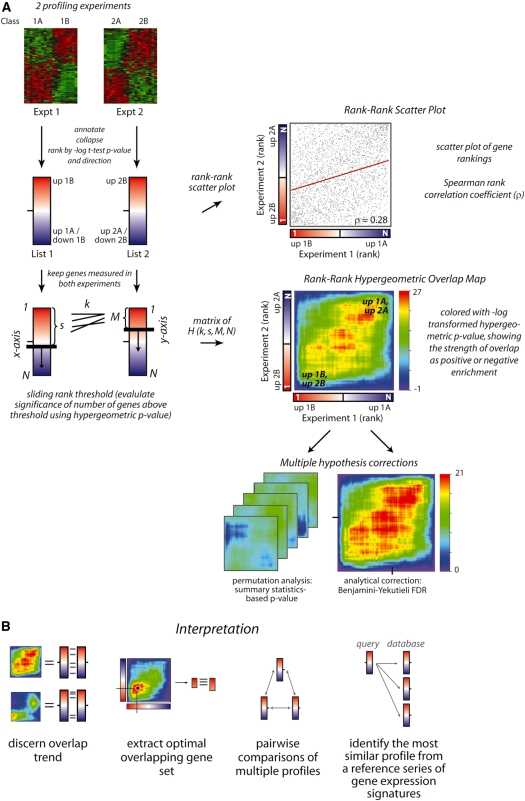
Comparing independent high-throughput gene-expression experiments can generate hypotheses about which gene-expression programs are shared between particular biological processes. Current techniques to compare expression profiles typically involve choosing a fixed differential expression threshold to summarize results, potentially reducing sensitivity to small but concordant changes. We present a threshold-free algorithm called Rank-rank Hypergeometric Overlap (RRHO). This algorithm steps through two gene lists ranked by the degree of differential expression observed in two profiling experiments, successively measuring the statistical significance of the number of overlapping genes. The output is a graphical map that shows the strength, pattern and bounds of correlation between two expression profiles. To demonstrate RRHO sensitivity and dynamic range, we identified shared expression networks in cancer microarray profiles driving tumor progression, stem cell properties and response to targeted kinase inhibition. We demonstrate how RRHO can be used to determine which model system or drug treatment best reflects a particular biological or disease response. The threshold-free and graphical aspects of RRHO complement other rank-based approaches such as Gene Set Enrichment Analysis (GSEA), for which RRHO is a 2D analog. Rank-rank overlap analysis is a sensitive, robust and web-accessible method for detecting and visualizing overlap trends between two complete, continuous gene-expression profiles. A web-based implementation of RRHO can be accessed at http://systems.crump.ucla.edu/rankrank/.
Overview
The claims and statistics of this paper haven’t been checked yet.
Free: it reads the open-access text and checks the first 5 claims that cite a source we can check. Create a free account to check every claim.
Integrity signals
Registry
Cites
Statistics
Figures
Verification
Claims the paper makes
The claims and statistics of this paper haven’t been checked yet.
Free: it reads the open-access text and checks the first 5 claims that cite a source we can check. Create a free account to check every claim.
Claims other papers make about this one
Each is checked against this paper’s own text: does it say what the citing paper says it does?
The source backs part of the claim, not all of it — or backs it for a different population, condition or comparison.
In the citing paper
“However, while these approaches are useful, they have conceptual limitations. Some lack a clear estimand (such as the running-sum GSEA statistic); some have ambiguous units (such as the energy distance); some are biased at finite sample size (such as the proportion of DE genes π in iDEA, see O’Connor et al11).”
From Transcriptome-wide analysis of differential expression in perturbation atlases (2025) · cites this paper as [9]
Experimental — accuracy not yet measuredIn the citing paper
“Consistently, rank-rank hypergeometric transcriptional overlap (RRHO) mapping between pre-natal and adult brain, and between iPSC-iNs and iNs, revealed a pronounced bias in the overlap of iNs with adult brain samples (Figure 7M; Plaisier et al., 2010).”
From Age-dependent instability of mature neuronal fate in induced neurons from Alzheimer’s patients (2021) · cites this paper as Plaisier et al., 2010
Self-check
Percentages, sums and reported differences re-computed from the paper’s own numbers.
The self-check needs the paper’s full text.
Citations
Cites
Subramanian, A., Tamayo, P., Mootha, V. K., Mukherjee, S., Ebert, B. L., Gillette, M. A., Paulovich, A., Pomeroy, S. L., Golub, T. R., Lander, E. S., et al. (2005) · Proceedings of the National Academy of Sciences · doi:10.1073/pnas.0506580102 · Cited by 53,625 · cited 3×
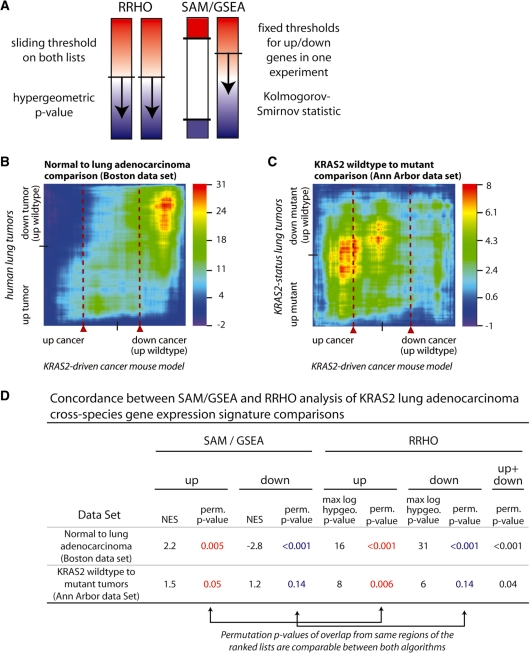
“In the SAM/GSEA approach, the output is a permutation P-value and a Kolmogorov–Smirnov mountain plot illustrating the overlap between a subset of high-ranking genes chosen to represent the mouse model profile (a fixed gene set) and the range of differential gene expression in the human data set (a continuous ranked li…”
MethodGene Expression Omnibus: NCBI gene expression and hybridization array data repository
Edgar, R. (2002) · Nucleic Acids Research · doi:10.1093/nar/30.1.207 · Cited by 13,288 · cited 2×
“Gene-expression information from microarray data repositories such as Gene-expression Omnibus (19) and ArrayExpress (53) as well as from more specialized resources such as the drug response profile database Cmap (10) can be readily converted to ranked list inputs for our program.”
BackgroundMethodThe control of the false discovery rate in multiple testing under dependency
Benjamini, Y., & Yekutieli, D. (2001) · The Annals of Statistics · doi:10.1214/aos/1013699998 · Cited by 10,490
Mootha, V. K., Lindgren, C. M., Eriksson, K.-F., Subramanian, A., Sihag, S., Lehar, J., Puigserver, P., Carlsson, E., Ridderstråle, M., Laurila, E., et al. (2003) · Nature Genetics · doi:10.1038/ng1180 · Cited by 10,197
DAVID: Database for Annotation, Visualization, and Integrated Discovery
Dennis, G., Sherman, B. T., Hosack, D. A., Yang, J., Gao, W., Lane, H. C., & Lempicki, R. A. (2003) · Genome Biology · doi:10.1186/gb-2003-4-5-p3 · Cited by 9,327
Lamb, J., Crawford, E. D., Peck, D., Modell, J. W., Blat, I. C., Wrobel, M. J., Lerner, J., Brunet, J.-P., Subramanian, A., Ross, K. N., et al. (2006) · Science · doi:10.1126/science.1132939 · Cited by 5,257 · cited 20×
“is the Cmap, a database of transcriptional responses to a panel of specific drug treatments (10).”
BackgroundMethodInfluentialGenes that mediate breast cancer metastasis to lung
Minn, A. J., Gupta, G. P., Siegel, P. M., Bos, P. D., Shu, W., Giri, D. D., Viale, A., Olshen, A. B., Gerald, W. L., & Massagué, J. (2005) · Nature · doi:10.1038/nature03799 · Cited by 2,922 · cited 1×
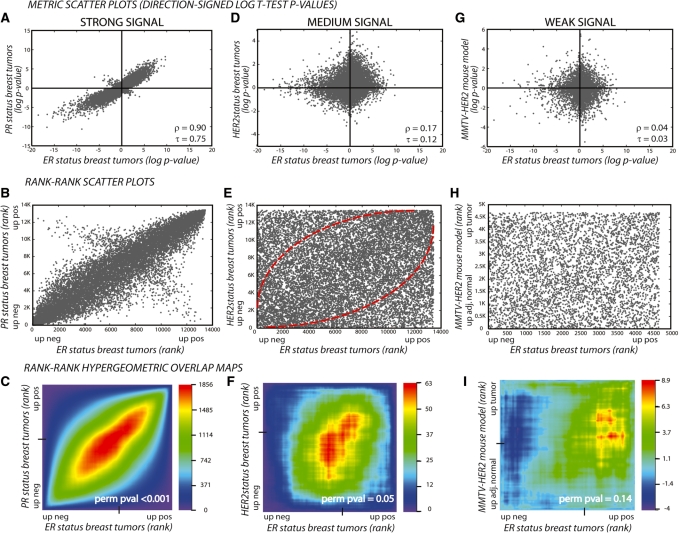
“The x-axis on all representations shows the difference between ER positive to ER negative human breast tumors (24); the y-axis shows gene-expression profiles based on other mutations or other profiles relevant to human breast cancer.”
BackgroundOncogenic pathway signatures in human cancers as a guide to targeted therapies
Bild, A. H., Yao, G., Chang, J. T., Wang, Q., Potti, A., Chasse, D., Joshi, M.-B., Harpole, D., Lancaster, J. M., Berchuck, A., et al. (2006) · Nature · doi:10.1038/nature04296 · Cited by 2,032 · cited 2×
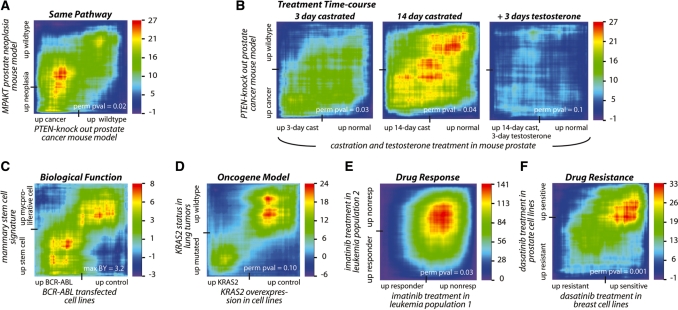
“High overlap between gene-expression changes driven by mutated KRAS2 oncogene in human lung tumors and by overexpression of KRAS2 in a cell line identify signaling events downstream of this oncogene that have in vivo relevance that can be studied effectively in vitro (Figure 3D) (35).”
BackgroundUsing GOstats to test gene lists for GO term association
Falcon, S., & Gentleman, R. (2007) · Bioinformatics · doi:10.1093/bioinformatics/btl567 · Cited by 2,015
Empirical Bayes analysis of a microarray experiment
Efron, B., Tibshirani, R., Storey, J. D., & Tusher, V. (2001) · Journal of the American Statistical Association · doi:10.1198/016214501753382129 · Cited by 1,733 · cited 7×
“Comparing the permutation P-values from the SAM/GSEA approach to those from the RRHO approach demonstrates that both methods have equivalent sensitivity and are able to detect the weak but statistically significant cross-species signal (Figure 4D).”
MethodInfluential
Cited by
Items 301–400 of 489
Lin, S.-H., & Chen, S. C.-C. (2022) · Cells · doi:10.3390/cells11071231 · Cited by 5
“We used the RRHO package [47] to measure overlaps in differentially edited genes across comparisons (F1–F3 and M1–M2).”
MethodA single-cell genomic atlas for the effects of chronic ethanol exposure in the mouse dorsal striatum
Wildermuth, E., Patton, M. S., Cortes-Gutierrez, M., Jinwala, Z., Grissom, B., Campbell, R. R., Kranzler, H. R., Lobo, M. K., Ament, S. A., & Mathur, B. N. (2025) · Molecular Psychiatry · doi:10.1038/s41380-025-03014-z · Cited by 5
“We applied a threshold-free approach, rank-rank hypergeo-metric overlap (RRHO) [51], to evaluate the reproducibility of differential expression patterns in speci fi c cell types.”
Pessoni, A. M., Arabe, L. B., Pancotti, L., Mansouri, S., D’Angelo, M., Huot, K., Marroquín-Rivera, A., Peralta, M. R., Zhao, C., Leboulleux, Q., et al. (2025) · Biological Psychiatry · doi:10.1016/j.biopsych.2025.10.001 · Cited by 6
Yi, X., Martín-Vázquez, E., Jawurek, S., Zimath, P. L., Oliveira, J. G., Costa-Júnior, J. M., Ilegems, E., Wesley, J. D., Title, A. C., Yesildag, B., et al. (2026) · Cell Death and Differentiation · doi:10.1038/s41418-026-01669-x · Cited by 5
“We applied an enhanced RRHO pipeline, RedRibbon [24], which offers improved speed and accuracy compared to the original RRHO method [25], enabling ef fi cient identi fi cation of shared up-or downregulated genes between two independent datasets [24].”
Predicting behavioral profiles of online extremists through linguistic use of social roles
Bruyn, P. C. D. (2020) · Behavioral Sciences of Terrorism and Political Aggression · doi:10.1080/19434472.2020.1775675 · Cited by 5
“The significance of overlap was calculated through a test of the hypothesis that ordering was arbitrary (Plaisier et al., 2010).”
MethodGrantham, E. K., Tiwari, G. R., Ponomareva, O. Y., Harris, R. A., Lopez, M. F., Becker, H. C., & Mayfield, R. D. (2023) · Neuropharmacology · doi:10.1016/j.neuropharm.2023.109768 · Cited by 5
Xie, G., Toledo, M. P., Hu, X., Yong, H. J., Sanchez, P. S., Liu, C., Naji, A., Irianto, J., & Wang, Y. J. (2024) · BMC Genomics · doi:10.1186/s12864-024-10335-w · Cited by 5
Wang, Y., Yue, S., Yang, F., Chen, L., Singh, A., Marciniak, M., Wei, W., & Wang, Z.-J. (2025) · Nature Communications · doi:10.1038/s41467-025-64585-7 · Cited by 6
“A full threshold-free RRHO map was generated using the RRHO package (version 1.38.0) as previously described 141 .”
InfluentialHaan, S., Bahlawane, C., Wang, J., Nazarov, P. V., Muller, A., Eulenfeld, R., Haan, C., Rolvering, C., Vallar, L., Satagopam, V., et al. (2015) · JAK-STAT · doi:10.1080/21623996.2015.1062596 · Cited by 5
“The RRHO method is appropriate to evaluate the similarity between gene expression profiles and discerns even weak overlap signals.(39) It identifies the statistically significant overlap while stepping through 2 lists of genes which have been ranked by their differential expression.”
MethodKetchesin, K. D., Becker‐Krail, D. D., Xue, X., Wilson, R. S., Lam, T. T., Williams, K. R., Nairn, A. C., Tseng, G. C., & Logan, R. W. (2023) · Journal of Proteome Research · doi:10.1021/acs.jproteome.3c00126 · Cited by 6
Mitsi, V., Ruiz, A., Polizu, C., Farzinpour, Z., Ramakrishnan, A., Serafini, R. A., Parise, E. M., Floodstrand, M., Sial, O. K., Gaspari, S., et al. (2024) · Molecular Pharmacology · doi:10.1124/molpharm.123.000753 · Cited by 6
Identification of Cell Surface Targets for CAR T Cell Immunotherapy
DeLucia, D. C., & Lee, J. K. (2019) · Methods in molecular biology · doi:10.1007/978-1-0716-0203-4_2 · Cited by 5
Shell, W. A., & Rehan, S. M. (2022) · Proceedings of the Royal Society B Biological Sciences · doi:10.1098/rspb.2021.2663 · Cited by 7
“(d) Comparative analyses of gene expression Rank-rank hypergeometric overlap (RRHO) analyses of gene expression variation [53] between queens and workers of C.”
BackgroundRitchie, E. M., Acar, D., Zhong, S., Pu, Q., Li, Y., Zheng, B., & Jin, Y. (2025) · eLife · doi:10.7554/elife.101173 · Cited by 5
Single-nucleus RNA sequencing of human periventricular white matter in vascular dementiaPreprint
Díaz-Pérez, S., DeLong, J. H., Rivier, C. A., Lee, C., Askenase, M. H., Zhu, B., Zhang, L., Brennand, K., Martins, A. J., & Sansing, L. H. (2024) · bioRxiv (Cold Spring Harbor Laboratory) · doi:10.1101/2024.12.06.627202 · Cited by 6
Hebda‐Bauer, E. K., Hagenauer, M. H., Munro, D. B., Blandino, P., Meng, F., Arakawa, K., Stead, J. D. H., Chitre, A. S., Ozel, A. B., Mohammadi, P., et al. (2025) · Frontiers in Molecular Neuroscience · doi:10.3389/fnmol.2025.1469467 · Cited by 4
A ligand-receptor interactome of the bone tumor microenvironment in multiple myeloma bone pain
Barakat, A., Doncheva, N. T., Prado, J., Moll, L., Jensen, J. L., Diaz‐delCastillo, M., Novak, I., Eijkelkamp, N., Jensen, L. J., & Heegaard, A. (2025) · Pain · doi:10.1097/j.pain.0000000000003746 · Cited by 4
Hippocampal RNA sequencing in mice selectively bred for high and low activity
Booher, W. C., Vanderlinden, L. A., Hall, L. A., Thomas, A. L., Evans, L. M., Saba, L. M., & Ehringer, M. A. (2022) · Genes Brain & Behavior · doi:10.1111/gbb.12832 · Cited by 4
“The output is a fourquadrant heat map displaying the strength of the concordant and discordant gene expression.(37)”
BackgroundMethodInfluentialSeluanov, A., Gorbunova, V., Emmrich, S., Trapp, A., Ganguly, A., Biashad, A., Ablaeva, Y., Drage, M. G., & Takasugi, M. (2024) · doi:10.59368/agingbio.20240029 · Cited by 5
Freeland, J., Muñoz, M., O’Donnell, E. F., Langerman, J., Bergonio, J., Suarez-Navarro, J., Darrow, M., Thorpe, S. W., Canter, R. J., Randall, R. L., et al. (2024) · Clinical Cancer Research · doi:10.1158/1078-0432.ccr-24-1238 · Cited by 4
Self-citationSilva, G. M., Picone, J. A., Kaplan, A. L., Park, C. R., Lira, D. P., Kim, R. K., Truby, N. L., Neve, R. L., Cui, X., & Hamilton, P. J. (2025) · Biological Psychiatry · doi:10.1016/j.biopsych.2025.07.014 · Cited by 4
An equivalence approach to the integrative analysis of feature lists
Sánchez‐Pla, Á., Salicrú, M., & Ocaña, J. (2019) · BMC Bioinformatics · doi:10.1186/s12859-019-3008-x · Cited by 4
Miyako, K., Kajitani, N., Koga, Y., Takizawa, H., Boku, S., & Takebayashi, M. (2024) · Journal of Psychiatric Research · doi:10.1016/j.jpsychires.2024.01.004 · Cited by 4
Ganguly, A., Ghosh, S., Jin, P., Wadehra, M., & Devaskar, S. U. (2024) · The Journal of Nutritional Biochemistry · doi:10.1016/j.jnutbio.2024.109735 · Cited by 5
Identifying the Degree of Gene Reuse During Repeated Adaptation
Chaturvedi, S., Digumarthi, L. V., & Setia, G. (2025) · Molecular Ecology · doi:10.1111/mec.70180 · Cited by 4
“This test has been frequently applied in genome-wide selection scans to assess adaptive gene overlap be-tween populations (Plaisier et al. 2010; Cheng et al. 2021).”
Islam, M. A., Hooiveld, G. J. E. J., van den Berg, J. H. J., van der Velpen, V., Murk, A. J., Rietjens, I. M. C. M., & van Leeuwen, F. X. R. (2018) · Toxicology Reports · doi:10.1016/j.toxrep.2018.10.012 · Cited by 4
Hebda‐Bauer, E. K., Hagenauer, M. H., Munro, D. B., Blandino, P., Meng, F., Arakawa, K., Chitre, A. S., Ozel, A. B., Mohammadi, P., Watson, S. J., et al. (2022) · bioRxiv (Cold Spring Harbor Laboratory) · doi:10.1101/2022.07.14.500129 · Cited by 5
Spontaneously regenerative corticospinal neurons in micePreprint
Fait, B. W., Cotto, B., Murakami, T. C., Hagemann-Jensen, M., Zhan, H., Freivald, C., Turbek, I., Gao, Y., Yao, Z., Way, S. W., et al. (2024) · bioRxiv (Cold Spring Harbor Laboratory) · doi:10.1101/2024.09.09.612115 · Cited by 4
Gui, S., Liu, Y., Pu, J., Wang, D., Zhong, X., Chen, W., Chen, X., Chen, Y., Chen, X., Wei, T., et al. (2025) · Molecular Neurobiology · doi:10.1007/s12035-025-04766-z · Cited by 3
“Rank-rank hyper-geometric overlap (RRHO) test is developed for assessing the similarity of gene expression trends across different data-sets [39].”
ZW and XY Sex Chromosomes Drive Rapid and Distinctive Evolution of Sex‐Biased Gene Expression
Hsiung, K., Smith, S. H., & Böhne, A. (2025) · Molecular Ecology · doi:10.1111/mec.70152 · Cited by 4
“Using the R package RRHO ‘1.44.0’ (Plaisier et al. 2010), DDE values were ranked and binned using the package's own default stepsize calculation (i.e., squareroot (genes analysed), rounded up to the next integer).”
InfluentialGyles, T. M., Parise, E. M., Estill, M. S., Parise, L. F., Browne, C. J., Shen, L., Nestler, E. J., & Torres‐Berrío, A. (2026) · Neuropsychopharmacology · doi:10.1038/s41386-026-02366-6 · Cited by 3
Cell type-agnostic transcriptomic signatures enable uniform comparisons of neural maturation
Venkatesan, S., Werner, J. M., Li, Y., & Gillis, J. (2026) · PLoS Biology · doi:10.1371/journal.pbio.3003757 · Cited by 3
Deng, J., Paumier, A., Labarta-Bajo, L., Brandebura, A. N., Andrews, N., Kahn, S. B., Bassil, R., Tao, T., Pinto, A. F. M., Diedrich, J. K., et al. (2026) · Nature Communications · doi:10.1038/s41467-026-71919-6 · Cited by 4
Liu, S., Zhang, J., Zhan, T., Zhang, Q., Douglas, N. C., Ye, X., & Xiao, S. (2026) · Biology of Reproduction · doi:10.1093/biolre/ioag117 · Cited by 3
Disentangling transcriptomic heterogeneity within the human subgenual anterior cingulate cortex
Jenkins, A. K., Shelton, M. A., Yin, R., Gorczyca, M. T., Zong, W., Glausier, J. R., Lewis, D. A., Tseng, G. C., Seney, M. L., & McClung, C. A. (2024) · Cerebral Cortex · doi:10.1093/cercor/bhae291 · Cited by 3
Glausier, J. R., Enwright, J. F., & Lewis, D. A. (2025) · Schizophrenia Bulletin · doi:10.1093/schbul/sbaf147 · Cited by 3
The Molecular Landscape of Medulloblastoma in Teenagers and Young Adults
Mohammed, O. J., Cebrero, M. E., Ahmad, O., Peet, A. C., Grundy, R. G., & Lourdusamy, A. (2022) · Cancers · doi:10.3390/cancers14010251 · Cited by 3
“To compare the TYA associated genes of four molecular subgroups, we used a rankrank hypergeometric overlap (RRHO) mapping, an unbiased method to uncover the concordances and discordances between two similarly ranked lists [21].”
Lung immune signatures define two groups of end-stage IPF patients
Cruz, T., Mendoza, N., Casas-Recasens, S., Noell, G. G., Hernández‐González, F., Frino-García, A., Alsina‐Restoy, X., Molina‐Molina, M., Rojas, M. M., Agustí, A. G. N., et al. (2023) · Respiratory Research · doi:10.1186/s12931-023-02546-8 · Cited by 3
“To evaluate the enrichment of biological signatures in the observed clusters, gene ontology (GO) enrichment and hypergeometric tests were used [35].”
MethodZhao, X., Hu, C., Chen, X., Ren, S., & Gao, F. (2024) · Biology · doi:10.3390/biology13020082 · Cited by 4
“Rank-rank hypergeometric overlap (RRHO) analysis is a threshold-free and robust approach to compare differential expression (DE) patterns between two experimental groups [44,45].”
Islam, M. A., Hooiveld, G. J. E. J., van den Berg, J. H. J., Boekschoten, M. V., van der Velpen, V., Murk, A. J., Rietjens, I. M. C. M., & van Leeuwen, F. X. R. (2015) · Toxicology Reports · doi:10.1016/j.toxrep.2014.12.013 · Cited by 4
Loss of Sarm1 Mitigates Axonal Degeneration and Promotes Neuronal Repair After Ischemic StrokePreprint
Wang, J. T., An, J., Toh, B., Yousefpour, K., Komuro, Y., Godoy, M. I., Putman, J. N., Carmichael, S. T., Damoiseaux, R. D., & Hinman, J. D. (2025) · bioRxiv (Cold Spring Harbor Laboratory) · doi:10.1101/2025.02.20.639171 · Cited by 4
“Gene accessibility signatures derived from ATAC-seq were compared using the RRHO algorithm (58).”
Yu, Y., Li, X., Teng, T., He, Y., Jiang, Y., Liu, X., Zhou, X., Luo, Y., & Xie, P. (2024) · Behavioural Brain Research · doi:10.1016/j.bbr.2024.114890 · Cited by 2
Lee, E. H., Kwon, H., Park, S., Park, J. Y., Hong, J.-H., Paeng, J.-W., Kim, Y., & Han, P. (2025) · Experimental Neurobiology · doi:10.5607/en25001 · Cited by 2
Jajoo, A., Balakundi, V., Chatzinakos, C., Aruldass, A. R., Wen, C. H., Kolmans, I., Iatrou, A., Kleinman, J. E., Ressler, K. J., Bigdeli, T. B., et al. (2025) · Nature Communications · doi:10.1038/s41467-025-67941-9 · Cited by 2
Lee, E.-H., Park, J., Kwon, H., Park, S., & Han, P. (2026) · Experimental & Molecular Medicine · doi:10.1038/s12276-026-01641-2 · Cited by 2
Jeong, M., Baek, S., Wang, Q., Yao, L., Lee, E. J., Rivera, A. M., Lee, J. J., Jang, H., Bambah-Mukku, D., Mun, C. H.-S., et al. (2026) · Neuron · doi:10.1016/j.neuron.2026.01.002 · Cited by 2
Li, H.-J., Xiao, Y., Liu, X., Chen, X. G., Xu, J., Chen, J. L., Cheng, T., Chung, S., Shu, Y., & Shao, Z. (2026) · BMC Medicine · doi:10.1186/s12916-026-05039-9 · Cited by 2
Gigliotta, A., Trontti, K., Väänänen, J., & Hovatta, I. (2023) · Frontiers in Genetics · doi:10.3389/fgene.2023.1173376 · Cited by 2
“RRHO compares two distinct ranked differential gene expression lists to identify coordinated changes in gene expression in a threshold-free manner (Sb et al., 2010).”
BackgroundHarripaul, R., Morini, E., Salani, M., Logan, E. M., Kirchner, E. G., Bolduc, J., Chekuri, A., Currall, B., Yadav, R., Erdin, S., et al. (2024) · Scientific Reports · doi:10.1038/s41598-023-51137-6 · Cited by 3
“We utilized the rank-rank hypergeometric overlap which evaluates the concordance of transcriptomic changes between any two tissues 50,51 .”
MethodHepatic and Pancreatic Cellular Response to Early Life Nutritional Mismatch
Ghosh, S., Ganguly, A., Habib, M., Shin, B., Thamotharan, S., ANDERSSON, S. M., & Devaskar, S. U. (2025) · Endocrinology · doi:10.1210/endocr/bqaf007 · Cited by 2
Comparison of Gene Expression Signature Using Rank Based Statistical Inference
Tripathi, K. P., Chavan, S. G., Parashuraman, S., Piccirillo, M., Magliocca, S., & Guarracino, M. R. (2016) · Lecture notes in computer science · doi:10.1007/978-3-319-44332-4_3 · Cited by 2
A novel similarity score based on gene ranks to reveal genetic relationships among diseases
Luo, D., Zhang, C., Fu, L., Zhang, Y., & Hu, Y. (2021) · PeerJ · doi:10.7717/peerj.10576 · Cited by 3
Wallach, T. E., Soliman, A., Agboola, J., Sharma, S., Araujo-Coelho, L., Pittman, M. E., Chatzinakos, C., & Kolokotronis, S. (2024) · medRxiv · doi:10.1101/2024.07.18.24310647 · Cited by 3
“Rank-Rank Hypergeometric Overlap analyses 18 were also performed in the RRHO R package 19 to identify significant overlap of differential expression lists between pairs of results by determining the degree of statistical enrichment using the hypergeometric distribution.”
MethodBecca, S., Bianchi, S., Hahn, E. M., Snijders, K. E., Truszkowski, L., Křepelová, A., Neri, F., Cacchiarelli, D., Mendjan, S., Balmas, E., et al. (2025) · bioRxiv (Cold Spring Harbor Laboratory) · doi:10.1101/2025.10.07.680441 · Cited by 2
The huntingtin–HAP40 complex is a bidirectional cellular rheostatPreprint
Seefelder, M., Klein, F. A. C., Calzia, E., Muqaku, B., Oeckl, P., & Kochanek, S. (2026) · bioRxiv (Cold Spring Harbor Laboratory) · doi:10.64898/2026.06.03.729778 · Cited by 2
Sharma, O. P. (2025) · Computational Biology and Chemistry · doi:10.1016/j.compbiolchem.2025.108466 · Cited by 1
Ji, Y.-S., Liu, F.-Y.-E., Wei, Y., Liu, Y., Chen, K., Cui, L., Yin, A., & Wu, Y. (2025) · Schizophrenia Research · doi:10.1016/j.schres.2025.07.019 · Cited by 1
Liu, Y., Tian, S., Tan, Y., Yan, P., Liu, P., Zhu, H., Nomura, S., Huang, T., & Wei, Y. (2025) · Cancers · doi:10.3390/cancers17172789 · Cited by 2
“The rank–rank hypergeometric overlap (RRHO) test [21] was utilized to assess the extent of overlap in depression-related gene signatures across different cancer types.”
Paul, A., Kumar, M., Sharma, D., Kırboğa, K. K., Rudrapal, M., Chowdhury, P., Chattopadhyay, P., & Zaman, K. (2025) · 3 Biotech · doi:10.1007/s13205-025-04580-3 · Cited by 1
“Hyper-geometric testing evaluated enrichment significance using the formula where X represents the number of overlapping genes under the null hypothesis of random distribution (Plaisier et al. 2010).”
Derepression of transposable elements in the mouse prefrontal cortex disrupts social behavior
Kim, R. K., Smith, C. A., Truby, N. L., Strandberg, S. R., Bell, J. L., Carwile, N., Silva, G. M., Neve, R. L., Aung, T., Cui, X., et al. (2025) · Proceedings of the National Academy of Sciences · doi:10.1073/pnas.2510663122 · Cited by 1
“RRHO captures threshold - free similarities and differences across gene lists (41).”
Chietera, P., Berger, H., Wahl, N., Ali, M., & Apostolova, G. (2026) · Biology · doi:10.3390/biology15040308 · Cited by 1
“To test whether gene expression changes caused by Chmp7 knockdown share similarities with Lemd2 [4] and Satb2 [5] loss-of-function models, we next applied Rank–Rank Hypergeometric Overlap (RRHO) analysis [20,21].”
Lee, D. D., Rutkowski, B. N., Wilson, N. C., Kuc, R. D., Schwarz, C. D., & Schwarz, M. A. (2026) · Communications Biology · doi:10.1038/s42003-026-09892-5 · Cited by 1
Wang, H., Bundo, M., Nakachi, Y., Kanai, A., Yamamoto, Y., Miyazaki, H., Toyoshima, F., Shima, Y., Sakai, M., Yu, Z., et al. (2026) · Molecular Psychiatry · doi:10.1038/s41380-026-03629-w · Cited by 1
Impact of sex chromosomes and gonad type in stress susceptibility in corticostriatal brain regions
Barko, K., Shelton, M. A., Kropp, D. R., Pham, T. Q., Rainville, J. R., Xue, X., Tseng, G. C., Hodes, G. E., & Seney, M. L. (2026) · Proceedings of the National Academy of Sciences · doi:10.1073/pnas.2531920123 · Cited by 1
“We also utilized RRHO to assess the overlap of differential expression patterns produced by stress exposure in mice across genotype (76, 77).”
Park, B., Yanai, H., Ding, J., & Beerman, I. (2026) · Experimental & Molecular Medicine · doi:10.1038/s12276-026-01805-0 · Cited by 1
Mesolimbic and mesocortical pathways differentially support fentanyl-context associations
Montemarano, A., Sohail, H., Murdaugh, L. B., Derr, K., Alkhaleel, F. A., Fox, L. D., Pandey, S., & Fox, M. E. (2026) · Psychopharmacology · doi:10.1007/s00213-026-07151-3 · Cited by 1
Multilevel sex-influenced neurobiological signatures of early life adversity
Narayan, S. V., Beer, C., Kovářová, V., Castoldi, C., Štark, T., Bianco, B. D., Röh, S., Sauer, S., Bordes, J., Karamihalev, S., et al. (2026) · Proceedings of the National Academy of Sciences · doi:10.1073/pnas.2603982123 · Cited by 1
Predicting potential disease-related genes using the network topological features
Wang, T., HaiLin, W. L., Zhang, T. W., Xu, C., Sun, H., Liu, H., & Xie, H. (2011) · International Conference on Human Health and Biomedical Engineering · doi:10.1109/hhbe.2011.6028961 · Cited by 1
“Hyper geometric test[31] was selected for statistical test, and Benjamini Hochberg False Discovery Rate[32] (FDR) method was selected for correction.”
MethodMicroRNA-mediated alteration of TET2 interaction network in myeloproliferative neoplasms
Wang, F., Chan, L., Yip, S. P., & Yung, B. Y. (2011) · IEEE International Conference on e-Health Networking, Applications and Services (Healthcom) · doi:10.1109/health.2011.6026756 · Cited by 1
“The significance of enrichment is usually tested by using the hypergeometric distribution [15].”
Method(2023) · doi:10.33847/978-5-6048575-1-9 · Cited by 1
Belokrylov, N., Валерьевич, С. А., & Belokrylov, A. (2023) · doi:10.33847/978-5-6048575-1-9_3 · Cited by 1
X-Ray Structural Analysis of the Irradiated Basalt Composite
Онискив, В., Stolbov, V. Y., & Ибрагимова, Э. М. (2023) · doi:10.33847/978-5-6048575-1-9_1 · Cited by 1
Neural Circuit-Specialized Astrocytes
Chai, H. (2017) · eScholarship (California Digital Library) · Cited by 2
An examination of the evolve-and-resequence method using Drosophila simulansPreprint
Kelly, J. K., & Hughes, K. A. (2018) · bioRxiv (Cold Spring Harbor Laboratory) · doi:10.1101/337188 · Cited by 1
Comparison of expression profiling through microarray and RNA-seq analysis for Nipah virusPreprint
Rajput, A., & Kumar, M. (2019) · bioRxiv (Cold Spring Harbor Laboratory) · doi:10.1101/536284 · Cited by 1
“The RRHO is used to rank the genes according to their effect size and p -values according to the degree of differential expression (Plaisier et al., 2010).”
MethodRusan, Z. M., Cary, M. P., & Bainton, R. J. (2020) · bioRxiv (Cold Spring Harbor Laboratory) · doi:10.1101/2020.01.01.892281 · Cited by 2
“Rank-rank hypergeometric overlap tests and plots were done with the RRHO R package using a step size of 8 (Plaisier et al., 2010).”
MethodAn abundant myeloid progenitor shapes neonatal hematopoiesis of naked mole-ratsPreprint
Emmrich, S., Trapp, A., Seluanov, A., & Gorbunova, V. (2021) · bioRxiv (Cold Spring Harbor Laboratory) · doi:10.1101/2021.08.01.454658 · Cited by 1
The gene expression signature of electrical stimulation in the human brainPreprint
Chatterjee, S., Elsadany, M., Vanrobaeys, Y. S., Gleason, A. I., Park, B. J., Heiney, S. A., Rhone, A. E., Nourski, K. V., Basu, B., Mukherjee, U., et al. (2023) · bioRxiv (Cold Spring Harbor Laboratory) · doi:10.1101/2023.09.21.558812 · Cited by 1
“To assess the conservation of transcriptional responses, we performed a Rank-Rank Hypergeometric Overlap (RRHO) analysis 31,32 comparing the bulk RNA-seq differential expression results from stimulated human samples to those from stimulated mouse samples.”
Transcriptional analysis of efferocytosis in mouse skin woundsPreprint
Krause, W., King, D. E., & Horsley, V. (2024) · bioRxiv (Cold Spring Harbor Laboratory) · doi:10.1101/2024.08.12.607219 · Cited by 1
“Using a Rank Rank Hypergeometric Overlap (RRHO) analysis, which evaluates similarities between gene expression profiles (Plaisier et al., 2010), we found that few shared genes exist between the Eff+ transcriptome from skin wounds and Eff+ gene expression from BMDMs treated with apoptotic…”
MethodDecoding the transcriptomic signatures of psychological trauma in human cortex and amygdalaPreprint
Hicks, E. M., Seah, C., Deans, M., Lee, S. Y., Johnston, K. J. A., Cote, A. C., Ciarcia, J., Chakka, A., Collier, L., Holtzheimer, P. E., et al. (2024) · bioRxiv (Cold Spring Harbor Laboratory) · doi:10.1101/2024.10.23.619681 · Cited by 1
“In some cases we visualized the level of concordance/discordance using rank-rank hypergeometric overlap (RRHO) heatmaps where the input score was calculated as -log10(p-value)*sign(effect size) and all tested genes are included using RRHO2 36 (R package).”
MethodIdentifying Disease-Related Genes by Topological Features of Protein-Protein Interaction Network
Wang, T., -, H. X. H. T., Liu, W., & Zhang, J. (2011) · Journal of Convergence Information Technology · doi:10.4156/jcit.vol6.issue12.35
Islam, M. A. (2015) · doi:10.18174/357928
“After deconjugation, the aglycones are conjugated again by the phase II enzymes glucuronyltransferases and sulfotransferase s during first pass metabolism, whereby SIF glucuronides and sulfates are produced [48-50].”
BackgroundComparison and visualisation of agreement for paired lists of rankings
Donald, M. R., & Wilson, S. R. (2017) · Statistical Applications in Genetics and Molecular Biology · doi:10.1515/sagmb-2016-0036 · Cited by 1
“The question arises: Are the top genes meaningfully ranked? Methods of comparing ranked lists have led to the development of many packages for considering paired ranked lists (Lottaz et al., 2006; Eden et al., 2009; Plaisier et al., 2010; Antosh et al., 2013; Pihur et al., 2014; Schimek et al., 2015b).”
BackgroundHervé, M., Bergon, A., Guisquet, A. M. L., Leman, S., Consoloni, J.-L., Fernandez, N., Lefebvre, M. N., El‐Hage, W., Belzeaux-R, R., Belzung, C., et al. (2017) · European Neuropsychopharmacology · doi:10.1016/s0924-977x(17)31124-0
Comparative Omics Analysis in Mice and Men for Diabetes Research
Leonhardt, J. (2017) · mediaTUM (Technical University of Munich)
Intergenerational Mechanisms Of Paternal Stress Transmission
Chan, J. C. (2018) · ScholarlyCommons (University of Pennsylvania)
Multi-omics analysis of human brain tissue and an animal model of Parkinson’s Disease
Gomes, L. C. (2020) · eDiss (Georg-August-Universität Göttingen) · doi:10.53846/goediss-7812
Melanoma Plasticity Induced by Pro-Inflammatory Cytokines in Response to Immunotherapy
Kim, Y. J. (2020) · eScholarship (California Digital Library)
Creation of a single cell RNA seq meta-atlas to define human liver immune homeostasisPreprint
Rocque, B., Barbetta, A., Singh, P., Goldbeck, C. S., Helou, D. G., Loh, Y. E., Ung, N. M., Lee, J. S. H., Akbari, O., & Emamaullee, J. A. (2021) · bioRxiv (Cold Spring Harbor Laboratory) · doi:10.1101/2021.02.12.430976
Grantham, E. K., Tiwari, G., Ponomereva, O., Warden, A. S., DaCosta, A., Mason, S., Blednov, Y. A., Harris, R. A., Lopez, M. F., Becker, H., et al. (2022) · bioRxiv (Cold Spring Harbor Laboratory) · doi:10.1101/2022.03.17.484799
“The RRHO algorithm assesses the overlap in DEGs between PFC and NTS in the CIE+FSS group to identify concordant and discordant patterns in gene expression between two datasets (i.e., genes that are co- up- or down-regulated or oppositely up- or down-regulated between the two brain regions).”
BackgroundInfluentialSuter, B. (2017) · Faculty Opinions – Post-Publication Peer Review of the Biomedical Literature · doi:10.3410/f.728374435.793537781
Tiwari, V. K., & Singh, A. P. (2020) · Faculty Opinions – Post-Publication Peer Review of the Biomedical Literature · doi:10.3410/f.737515832.793574153
Effects of Chronic Stress on Emotion and Neural Mechanism: Focus on Sex Difference
何, 婷. (2019) · Advances in Psychology · doi:10.12677/ap.2019.911218
Miller, A. P. (2022) · MOspace Institutional Repository (University of Missouri) · doi:10.32469/10355/94082
Palaskas, N. J., Larson, S. M., Schultz, N. D., Komisopoulou, E., Wong, J., Rohle, D., Campos, C., Yannuzzi, N. A., Osborne, J. R., Linkov, I., et al. (2023) · doi:10.1158/0008-5472.22388192.v1
Self-citation
Metadata
- Authors
- Plaisier, S. B., Taschereau, R., Wong, J. A., & Graeber, T. G.
- Affiliations
- California NanoSystems Institute (US)
- Corresponding author
- Graeber, Thomas G.
- Venue
- Nucleic Acids Research
- Publisher
- Oxford University Press (OUP)
- Published
- 2010-07-21
- Volume
- 38
- Issue
- 17
- Pages
- e169-e169
- ISSN
- 0305-1048 (ISSN-L)
- 1362-4962
- PMC
- PMC2943622
- OpenAlex
- W2111065008
- Cited by
- 468
- References
- 55
- Citations by year
- 2026: 36 · 2025: 41 · 2024: 66 · 2023: 57 · 2022: 40 · 2021: 57 · 2020: 51 · 2019: 34 · 2018: 27 · 2017: 17 · 2016: 12 · 2015: 9 · 2014: 6 · 2013: 4 · 2012: 4
- FWCI
- 1.95
- Type
- journal article
- Language
- en
- Open access
- gold
- doi.org
- Licence
- Locations
- Nucleic Acids Research (publishedVersion, cc-by-nc)
- Europe PMC (PubMed Central) (publishedVersion, cc-by-nc)
- PubMed Central (publishedVersion, cc-by-nc)
- PubMed (publishedVersion)
- eScholarship (California Digital Library) (submittedVersion, other-oa)
- eScholarship (California Digital Library) (submittedVersion)
- HighWire Press Open Archive (submittedVersion)
- Funders
- U.S. Department of Health and Human Services
- Alfred P. Sloan Foundation
- National Cancer Institute (T32CA09056, T32CA009056)
- National Institute of General Medical Sciences (T32GM008652)
- Topics
- Life Sciences › Biochemistry, Genetics and Molecular Biology › Molecular Biology › Bioinformatics and Genomic Networks
- Life Sciences › Biochemistry, Genetics and Molecular Biology › Molecular Biology › Gene expression and cancer classification
- Life Sciences › Biochemistry, Genetics and Molecular Biology › Molecular Biology › Genomics and Phylogenetic Studies
- Keywords
- tumor progression, stem cell properties, web-based analysis tool
- MeSH terms
- Algorithms, Animals, Computer Graphics, Data Interpretation, Statistical, Humans, Neoplasms, Gene Expression Profiling, Databases, Genetic, Mice
About these checks
Registry, retraction, Cites and statistics results are computed, not judged, with one exception: a printed reference that no index lists is read once by a model before it counts as a citation error. Claims are extracted by a model and kept only when their quote appears verbatim in the text; each cited source is then checked, with a model’s help, for whether it says what the claim relies on. Those verdicts can be wrong — read the claim’s quote and the cited source before relying on one.
Statistics and arithmetic are recomputed, not judged.
Confidence bands are shown only for fields calibrated on our annotated test set. None is calibrated yet, so no band is shown.
What counts as a claim ›How we measure confidence ›How we check this ›
Are you an author, or do you see a problem with this page? Request a review
Data sources
Bibliographic data: Semantic Scholar, OpenAlex, Crossref.
Contains information from the Semantic Scholar Academic Graph Datasets, made available under the ODC Attribution License (ODC-BY 1.0).
Semantic Scholar’s data is described in: Kinney, R., et al. (2023). The Semantic Scholar Open Data Platform. arXiv:2301.10140.
