

Summarizing and correcting the GC content bias in high-throughput sequencing
Open accessThe DOI matches its Crossref record; 21 of the 21 references it cites were found in a registry or an index.
Abstract
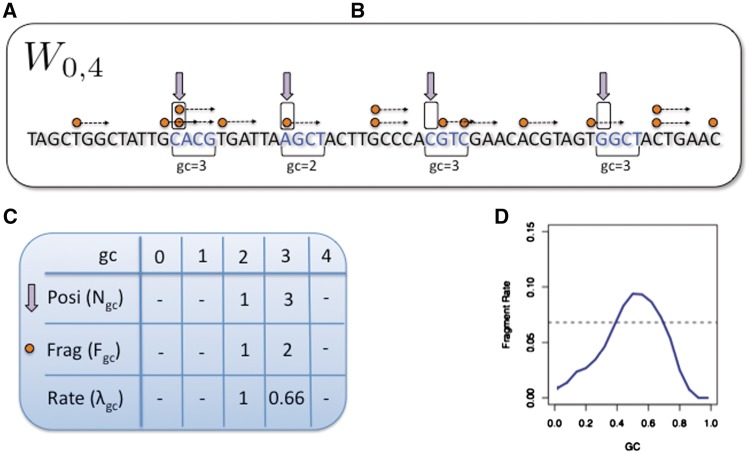
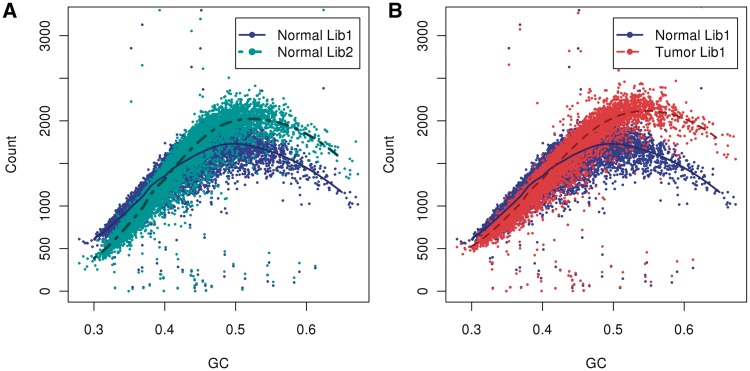
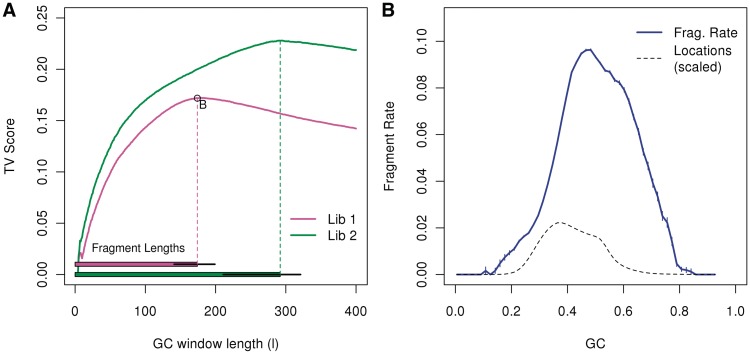
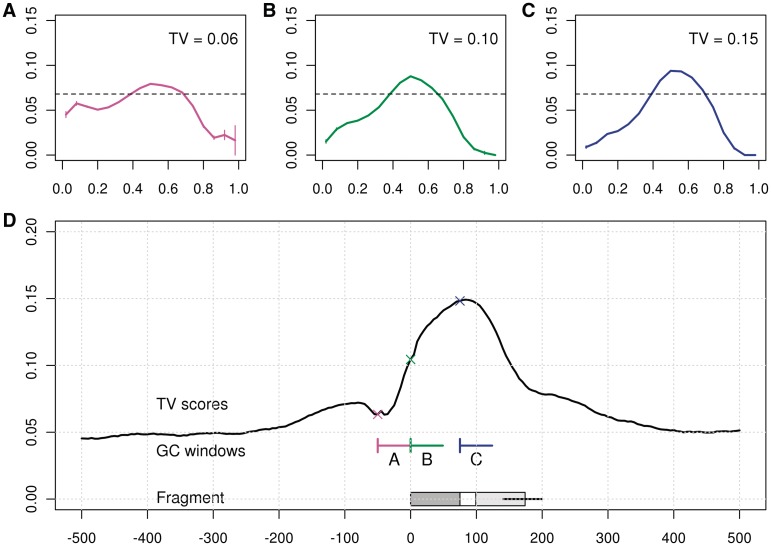
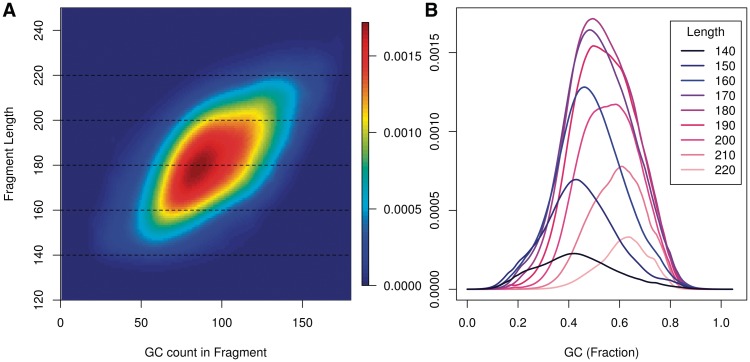
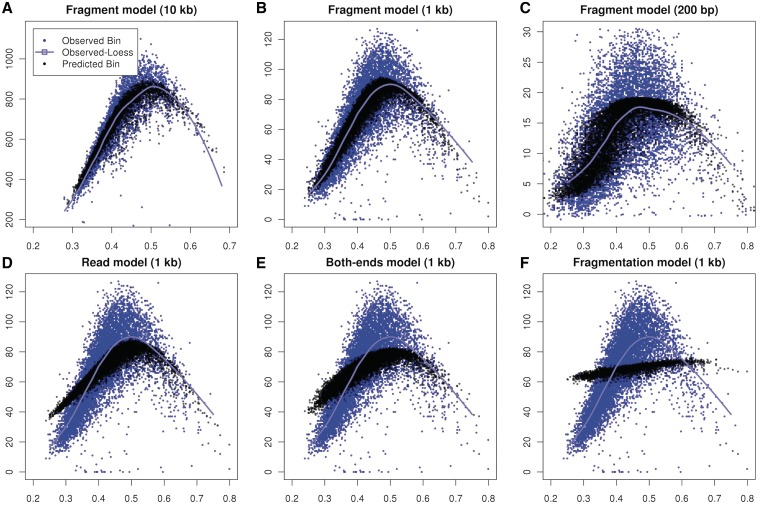
GC content bias describes the dependence between fragment count (read coverage) and GC content found in Illumina sequencing data. This bias can dominate the signal of interest for analyses that focus on measuring fragment abundance within a genome, such as copy number estimation (DNA-seq). The bias is not consistent between samples; and there is no consensus as to the best methods to remove it in a single sample. We analyze regularities in the GC bias patterns, and find a compact description for this unimodal curve family. It is the GC content of the full DNA fragment, not only the sequenced read, that most influences fragment count. This GC effect is unimodal: both GC-rich fragments and AT-rich fragments are underrepresented in the sequencing results. This empirical evidence strengthens the hypothesis that PCR is the most important cause of the GC bias. We propose a model that produces predictions at the base pair level, allowing strand-specific GC-effect correction regardless of the downstream smoothing or binning. These GC modeling considerations can inform other high-throughput sequencing analyses such as ChIP-seq and RNA-seq.
Overview
The claims and statistics of this paper haven’t been checked yet.
Free: it reads the open-access text and checks the first 5 claims that cite a source we can check. Create a free account to check every claim.
Integrity signals
Registry
Cites
Statistics
Figures
Verification
Claims the paper makes
The claims and statistics of this paper haven’t been checked yet.
Free: it reads the open-access text and checks the first 5 claims that cite a source we can check. Create a free account to check every claim.
Claims other papers make about this one
Each is checked against this paper’s own text: does it say what the citing paper says it does?
The source backs part of the claim, not all of it — or backs it for a different population, condition or comparison.
In the citing paper
“GC-bias was estimated for input chromatin samples using computeGCBias (Benjamini and Speed, 2012) from deepTools (Ramírez et al., 2014).”
From SALL4 controls cell fate in response to DNA base composition (2021) · cites this paper as Benjamini and Speed, 2012
Experimental — accuracy not yet measuredThe cited source says what the claim attributes to it.
In the citing paper
“Illumina sequencing was previously observed to have bias on GC-extreme sequences15,27,28, but GC content in our files did not show practically significant bias in the PCR GC bias test. Therefore, high-throughput sequencing and sample dilution are modeled using random sampling.”
From Quantifying Molecular Bias in DNA Data Storage (2019) · cites this paper as [28]
In the citing paper
“For DNA-seq, this bias is best corrected by modeling at the scale of the fragment21.”
From Modeling of RNA-seq fragment sequence bias reduces systematic errors in transcript abundance estimation (2016) · cites this paper as [21]
In the citing paper
“we confirmed other findings 21, that the GC content effect was often nonlinear and highly sample-specific, therefore requiring sample-specific bias estimation using smooth functions of fragment GC content.”
From Modeling of RNA-seq fragment sequence bias reduces systematic errors in transcript abundance estimation (2016) · cites this paper as [21]
Self-check
Percentages, sums and reported differences re-computed from the paper’s own numbers.
The self-check needs the paper’s full text.
Citations
Cites
Fast and accurate short read alignment with Burrows-Wheeler transform
Li, H., & Durbin, R. (2009) · Bioinformatics · doi:10.1093/bioinformatics/btp324 · Cited by 58,607
Ultrafast and memory-efficient alignment of short DNA sequences to the human genome.
Langmead, B., Trapnell, C., Pop, M., & Salzberg, S. L. (2009) · Genome Biology · doi:10.1186/gb-2009-10-3-r25 · Cited by 21,849
Accurate whole human genome sequencing using reversible terminator chemistry
Bentley, D. R., Balasubramanian, S., Swerdlow, H. P., Smith, G. P., Milton, J., Brown, C. G., Hall, K. P., Evers, D. J., Barnes, C. L., Bignell, H. R., et al. (2008) · Nature · doi:10.1038/nature07517 · Cited by 3,684
Probability: Theory and Examples.
Prewitt, K., & Durrett, R. (1992) · Journal of the American Statistical Association · doi:10.2307/2290301 · Cited by 3,085
Mapping short DNA sequencing reads and calling variants using mapping quality scores
Li, H., Ruan, J., & Durbin, R. (2008) · Genome Research · doi:10.1101/gr.078212.108 · Cited by 2,638
Analyzing and minimizing PCR amplification bias in Illumina sequencing libraries
Aird, D., Ross, M. G., Chen, W.-S., Danielsson, M., Fennell, T., Russ, C., Jaffe, D. B., Nusbaum, C., & Gnirke, A. (2011) · Genome Biology · doi:10.1186/gb-2011-12-2-r18 · Cited by 1,174
Substantial biases in ultra-short read data sets from high-throughput DNA sequencing
Dohm, J. C., Lottaz, C., Borodina, T., & Himmelbauer, H. (2008) · Nucleic Acids Research · doi:10.1093/nar/gkn425 · Cited by 1,088 · cited 2×
“(1), probably because GC-rich areas are rare (especially in simpler organisms).”
BackgroundProbability: Theory and Examples.
Durrett, R. (1993) · Biometrics · doi:10.2307/2532227 · Cited by 857
A large genome center's improvements to the Illumina sequencing system
Quail, M. A., Kozarewa, I., Smith, F., Scally, A., Stephens, P. J., Durbin, R., Swerdlow, H., & Turner, D. J. (2008) · Nature Methods · doi:10.1038/nmeth.1270 · Cited by 727
Biases in Illumina transcriptome sequencing caused by random hexamer priming
Hansen, K. D., Brenner, S. E., & Dudoit, S. (2010) · Nucleic Acids Research · doi:10.1093/nar/gkq224 · Cited by 713 · cited 1×
“Sequence-related biases in the priming (9), size selection (3), PCR (10) and probability of sequencing errors (11–13) have all been found.”
Background
Cited by
Items 801–900 of 1,001
Noninvasive prenatal test for detection of genetic diseases using next-generation sequencing
Silva, C. M. A. D. C. (2017) · Digital Library of Theses and Dissertations (Universidade de São Paulo) · doi:10.11606/t.41.2017.tde-17102017-164404
「母親」の役割取得と育児不安 ─母親の語りと観察記録の分析を通して─
及川, 留. (2009) · Medical Entomology and Zoology
Mefford, H. C. (2020) · Faculty Opinions – Post-Publication Peer Review of the Biomedical Literature · doi:10.3410/f.732733561.793571937
Greenwood, R. (2019) · Faculty Opinions – Post-Publication Peer Review of the Biomedical Literature · doi:10.3410/f.732733561.793555812
Development of Noninvasive Autosomal Recessive Disease Testing in the Saudi Arabian Population
Abedalthagafi, M., Faqeih, E., Alajaji, N. M., Bawazeer, S., & AlSolme, E. (2025) · Journal of Disability Research · doi:10.57197/jdr-2025-0001
Detection of somatic variants from genomic data and their role in neurodegenerative diseases
García, I. L. (2019) · Dipòsit Digital de la Universitat de Barcelona (Universitat de Barcelona)
Current and Evolving Technologies
Chang, J. R., Purev, E., & Kuo, W. P. (2015) · Springer eBooks · doi:10.1007/978-3-319-17942-1_2
Metagenomic coverage bias at transcription start sites is correlated with gene expressionPreprint
Qian, G., Coleman, I., Korem, T., & Ho, J. W. K. (2024) · bioRxiv (Cold Spring Harbor Laboratory) · doi:10.1101/2024.05.09.593333
Pipelines and Databases—Microbiome Analysis
Sanders, J., Huang, L., Zhu, Q., & Morton, J. T. (2025) · Wiley eBooks · doi:10.1002/9781683674597.ch22
Predicting the methylation status of CpG islands from read distribution biases
Abdullaev, E. T., Haridoss, D. A., & Arndt, P. F. (2025) · BMC Genomics · doi:10.1186/s12864-025-12257-7
THE NUANCES OF STATISTICALLY ANALYZING NEXT-GENERATION SEQUENCING DATA
Srivastava, S., & Doerge, R. W. (2012) · Conference on Applied Statistics in Agriculture · doi:10.4148/2475-7772.1038
Sarkar, N. D., Patton, R. D., Doebley, A.-L., Hanratty, B. P., Adil, M., Kreitzman, A. J., Sarthy, J. F., Ko, M., Brahma, S., Meers, M. P., et al. (2023) · doi:10.1158/2159-8290.c.6549837.v1
Wang, X., Chang, Z., Wang, S., Liu, R., Liu, Y., Zhu, X., Shao, Y. W., Lai, X., Yang, S., & Wang, J. (2024) · IEEE International Conference on Bioinformatics and Biomedicine (BIBM) · doi:10.1109/bibm62325.2024.10822250
Zhou, X., Zheng, H., Fu, H., Dillehay McKillip, K. L., Pinney, S. M., & Liu, Y. (2024) · Figshare · doi:10.6084/m9.figshare.26552029
Zhou, X., Zheng, H., Fu, H., Dillehay McKillip, K. L., Pinney, S. M., & Liu, Y. (2024) · Figshare · doi:10.6084/m9.figshare.26552026
Godfroid, M. (2020) · MACAU: Open Access Repository of Kiel University (University Library Kiel)
Statistical Methods for the Analysis of Copy Number Variation
Nguyen, T. H. (2015) · Otago University Research Archive (University of Otago)
Digital karyotyping of cancer cell lines from NGS data
Khalil, A. I. S. (2020) · DR-NTU (Nanyang Technological University) · doi:10.32657/10356/138176
Zhou, B., Arthur, J. G., Ho, S. S., Pattni, R., Huang, Y., Wong, W. H., & Urban, A. E. (2018) · bioRxiv (Cold Spring Harbor Laboratory) · doi:10.1101/281709
Additional file 1 of ReSeq simulates realistic Illumina high-throughput sequencing data
Schmeing, S., & Robinson, M. D. (2021) · Figshare · doi:10.6084/m9.figshare.14067849
Ribarska, T., Bjørnstad, P. M., Sundaram, A. Y. M., & Gilfillan, G. D. (2022) · Figshare · doi:10.6084/m9.figshare.19106200
Additional file 2 of ReSeq simulates realistic Illumina high-throughput sequencing data
Schmeing, S., & Robinson, M. D. (2021) · Figshare · doi:10.6084/m9.figshare.14067852
Additional file 4 of ReSeq simulates realistic Illumina high-throughput sequencing data
Schmeing, S., & Robinson, M. D. (2021) · Figshare · doi:10.6084/m9.figshare.14067858
Bayesian Networks in the Study of Genome-wide DNA Methylation
Singer, M., & Pachter, L. S. (2014) · Oxford University Press eBooks · doi:10.1093/acprof:oso/9780198709022.003.0014
Statistical algorithms in the study of mammalian DNA methylation
Singer, M. (2012) · eScholarship (California Digital Library)
Additional file 2 of PerSVade: personalized structural variant detection in any species of interest
Schikora-Tamarit, M. À., & Gabaldón, T. (2022) · Figshare · doi:10.6084/m9.figshare.20499895
Additional file 1 of PerSVade: personalized structural variant detection in any species of interest
Schikora-Tamarit, M. À., & Gabaldón, T. (2022) · Figshare · doi:10.6084/m9.figshare.20499892
Using paired-end read orientations to assess technical biases in capture Hi-C
Hansen, P., Blau, H., Hecht, J., Karlebach, G., Krannich, A., Steinhaus, R., Truß, M., & Robinson, P. N. (2024) · NAR Genomics and Bioinformatics · doi:10.1093/nargab/lqae156
Stepanchuk, Y., Popov, A., Ivanov, A., Chuyko, E. А., Канбекова, О. Р., Saifitdinova, A. F., Kinunen, A. A., Nevskaia, E. E., Pavlova, O. A., Shcherba, M., et al. (2025) · Research Square · doi:10.21203/rs.3.rs-8269410/v1
Existing and Emerging Molecular Technologies in Myeloid Neoplasms
Konnick, E. Q., & Wu, D. (2017) · Molecular pathology library · doi:10.1007/978-3-319-62146-3_19
Greer, C. A. (2019) · Faculty Opinions – Post-Publication Peer Review of the Biomedical Literature · doi:10.3410/f.734827932.793555129
Accurate Identification of Adenosine Deamination
Wilson, G. W. (2016) · TSpace (University of Toronto)
Novel genetic defects in titinopathies and other muscular dystrophies
Evilä, A. (2016) · Helda - University of Helsinki Institutional Repository
Study of the role of SETD2 mutations in clear cell renal cell carninoma (ccRCC)
de Almeida, C. F. (2013) · Portuguese National Funding Agency for Science, Research and Technology (RCAAP Project by FCT)
Soto, J. A., Rodríguez‐Antolín, C., Vera, O., Pernía, O., Esteban‐Rodríguez, I., Dolores Diestro, M., Benitez, J., Sánchez-Cabo, F., Alvarez, R., de Castro, J., et al. (2021) · Figshare · doi:10.6084/m9.figshare.16530177
Gustafsson, J., Robinson, J. L., Nielsen, J., & Pachter, L. S. (2021) · Figshare · doi:10.6084/m9.figshare.14752256
Gustafsson, J., Robinson, J. L., Nielsen, J., & Pachter, L. (2021) · Figshare · doi:10.6084/m9.figshare.14752250
Gustafsson, J., Robinson, J. L., Nielsen, J., & Pachter, L. (2021) · Figshare · doi:10.6084/m9.figshare.14752259
Approaches for Identifying Biases in Single-Cell RNA-Sequencing Data
Deeke, J. M. (2019) · Deep Blue (University of Michigan)
Stelzer, C., Blommaert, J., Waldvogel, A. M., Pichler, M., Hecox-Lea, B. J., & Mark Welch, D. B. (2021) · Figshare · doi:10.6084/m9.figshare.16632984
Stelzer, C., Blommaert, J., Waldvogel, A. M., Pichler, M., Hecox-Lea, B. J., & Mark Welch, D. B. (2021) · Figshare · doi:10.6084/m9.figshare.16632987
Deciphering regulation in eukaryotic cell: from sequence to functionPreprint
Boeva, V. (2014) · arXiv (Cornell University) · doi:10.48550/arxiv.1409.6661
On the Analysis of DNA Methylation
Stevens, M. W. (2014) · PubMed · doi:10.7936/k70c4sv8
DNA Coverage Prediction Using Aggregated Poisson Approximation
Shakir, K. (2018) · Digital Access to Scholarship at Harvard (DASH) (Harvard University)
Leveraging High-Throughput Data to estimate Leukocyte Telomere Length in the Million Veteran ProgramPreprint
Iyer, K. R., Vembu, P., Bard, A., Guarischi‐Sousa, R., Sarro, J., Billing-Ross, P., Assimes, T. L., Clarke, S. L., Tcheandjieu, C., Huffman, J. E., et al. (2025) · medRxiv · doi:10.1101/2025.01.14.25320560
Neubert, K., Zuchantke, E., Leidenfrost, R. M., Wuenschiers, R., Grützke, J., Malorny, B., Brendebach, H., Dahouk, S. A., Homeier, T., Hotzel, H., et al. (2021) · Figshare · doi:10.6084/m9.figshare.17007216
Neubert, K., Zuchantke, E., Leidenfrost, R. M., Wuenschiers, R., Grützke, J., Malorny, B., Brendebach, H., Dahouk, S. A., Homeier, T., Hotzel, H., et al. (2021) · Figshare · doi:10.6084/m9.figshare.17007210
Structural Variation Detection with Read Pair Information—An Improved Null-Hypothesis Reduces Bias
Sahlin, K., Frånberg, M., & Arvestad, L. (2016) · Lecture notes in computer science · doi:10.1007/978-3-319-31957-5_13
Zhou, W., Zhou, L., Yuan, J., Wu, W., Ma, M., Liu, F., Wei, Z., Zhang, Q., Li, Y., Lu, W., et al. (2024) · Research Square · doi:10.21203/rs.3.rs-3848622/v1
Myers, M. A., Arnold, B., Bansal, V., Balaban, M., Mullen, K. M., Zaccaria, S., & Raphael, B. J. (2024) · Figshare · doi:10.6084/m9.figshare.25876322
Myers, M. A., Arnold, B., Bansal, V., Balaban, M., Mullen, K. M., Zaccaria, S., & Raphael, B. J. (2024) · Figshare · doi:10.6084/m9.figshare.25876253
Bioinformatics methods and approaches to discover disease variants from DNA sequencing data
Dashnow, H. (2019) · Minerva Access (University of Melbourne)
Human microbiome sequences in the light of the NubeamPreprint
Dai, H., & Guan, Y. (2019) · bioRxiv (Cold Spring Harbor Laboratory) · doi:10.1101/763631
Structural Variant Discovery Using Long Read Sequencing in Group 4 Medulloblastoma
Farooq, H. (2018) · TSpace (University of Toronto)
RNA sequencing of non-coding RNAs in ischaemic heart disease
Ward, Z. (2021) · Otago University Research Archive (University of Otago)
Additional file 1 of WACS: improving ChIP-seq peak calling by optimally weighting controls
Awdeh, A., Turcotte, M., & Perkins, T. J. (2021) · Figshare · doi:10.6084/m9.figshare.14037880
Ma, E. (2018) · The Atrium (University of Guelph)
Genomic Tools for Robust Quantitative Trait Locus Discovery and Interpretation
van de Geijn, B. (2016) · Knowledge@UChicago (University of Chicago) · doi:10.6082/0s7fj-ztp95
Genome Assembly Algorithms: A Survey
连, 帅. (2013) · Hans Journal of Computational Biology · doi:10.12677/hjcb.2013.32002
Huttener, R., Thorrez, L., Veld, T. I., Granvik, M., Lommel, L. V., Waelkens, E., Derua, R., Lemaire, K., Goyvaerts, L., De Coster, S., et al. (2021) · Figshare · doi:10.6084/m9.figshare.16640808
Huttener, R., Thorrez, L., Veld, T. I., Granvik, M., Lommel, L. V., Waelkens, E., Derua, R., Lemaire, K., Goyvaerts, L., De Coster, S., et al. (2021) · Figshare · doi:10.6084/m9.figshare.16640799
Huttener, R., Thorrez, L., Veld, T. I., Granvik, M., Lommel, L. V., Waelkens, E., Derua, R., Lemaire, K., Goyvaerts, L., De Coster, S., et al. (2021) · Figshare · doi:10.6084/m9.figshare.16640811
Huttener, R., Thorrez, L., Veld, T. I., Granvik, M., Lommel, L. V., Waelkens, E., Derua, R., Lemaire, K., Goyvaerts, L., De Coster, S., et al. (2021) · Figshare · doi:10.6084/m9.figshare.16640823
Huttener, R., Thorrez, L., Veld, T. I., Granvik, M., Lommel, L. V., Waelkens, E., Derua, R., Lemaire, K., Goyvaerts, L., De Coster, S., et al. (2021) · Figshare · doi:10.6084/m9.figshare.16640805
Huttener, R., Thorrez, L., Veld, T. I., Granvik, M., Lommel, L. V., Waelkens, E., Derua, R., Lemaire, K., Goyvaerts, L., De Coster, S., et al. (2021) · Figshare · doi:10.6084/m9.figshare.16640817
Analysis of Controls in ChIP-seq
Awdeh, A., & Perkins, T. J. (2017) · ACM International Conference on Bioinformatics, Computational Biology, and Health Informatics (ACM-BCB) · doi:10.1145/3107411.3108230
Solving the differential peak calling problem in ChIP-seq data
Allhoff, M., Jarke, M., Zenke, M., & Berlage, T. (2016) · RWTH Publications (RWTH Aachen)
Alleviating cell-free DNA sequencing biases with optimal transportPreprint
Passemiers, A., Jatsenko, T., Vanderstichele, A., Busschaert, P., Coosemans, A., Timmerman, D., Lambrechts, D., Raimondi, D., Vermeesch, J. R., & Moreau, Y. (2024) · bioRxiv (Cold Spring Harbor Laboratory) · doi:10.1101/2024.04.04.588204
Alleviating cell-free DNA sequencing biases with optimal transportPreprint
Passemiers, A., Jatsenko, T., Vanderstichele, A., Busschaert, P., Coosemans, A., Timmerman, D., Lambrechts, D., Raimondi, D., Vermeesch, J. R., & Moreau, Y. (2024) · eLife · doi:10.7554/elife.98116
Berest, I. (2020) · heiDOK (Heidelberg University) · doi:10.11588/heidok.00028844
Chen, H., Wang, B., Zhang, Y., Yao, X., Yang, C., Dong, H., Cai, L., Fan, D., & Zhou, Q. (2025) · Engineering in Life Sciences · doi:10.1002/elsc.70047
Statistical Analysis of Ribonucleotide Incorporation in Human Cells
Channagiri, T. (2023) · Digital Commons - University of South Florida (University of South Florida)
Zhang, Q. (2018) · Louisiana State University · doi:10.31390/gradschool_dissertations.4502
Comprehensive Analysis of Cell-Free DNA Fragmentation Across Cancer StagesPreprint
Guo, X., Nie, L., Yan, J., Ling, T., Zhang, F., Chen, Y., Li, M., Zeng, W., Chen, Y., Chu, W., et al. (2023) · Research Square · doi:10.1101/2023.11.07.23298181
Global Characterization of Circulating Nucleic Acids
Dunaeva, M., & Pruijn, G. J. M. (2019) · Methods in molecular biology · doi:10.1007/978-1-0716-0138-9_18
Faculty Opinions recommendation of Genome-wide cell-free DNA fragmentation in patients with cancer.
Pawelec, G. (2019) · Faculty Opinions – Post-Publication Peer Review of the Biomedical Literature · doi:10.3410/f.735843160.793563944
Resolving complex structures at oncovirus integration loci with conjugate graphPreprint
Jia, W., Xu, C., & Li, S. C. (2020) · bioRxiv (Cold Spring Harbor Laboratory) · doi:10.1101/2020.05.17.100578
Varela-Martínez, E. (2020) · Communities in ADDI (University of the Basque Country)
Transcriptome analysis from high-throughput sequencing count data
Mirauta, B. A. (2014) · theses.fr (ABES) · doi:10.70675/22e26b76za860z4384z91b2z997ab81e11f2
Katvust mõjutavate parameetrite hindamine
Oroperv, C. (2019) · DSpace repository (University of Tartu)
CNVScan: detecting borderline copy number variations in NGS data via scan statistics
Bergamini, E., D’Aurizio, R., Leoncini, M., & Pellegrini, M. (2015) · ACM International Conference on Bioinformatics, Computational Biology, and Health Informatics (ACM-BCB) · doi:10.1145/2808719.2808754
Pacini, C. (2017) · Apollo (University of Cambridge) · doi:10.17863/cam.16660
Next-Generation Sequencing for the Analysis of Cancer Specimens
Pfeifer, J. D. (2016) · Springer eBooks · doi:10.1007/978-3-319-19674-9_60
Utilization of single-cell RNA-Seq and genome-scale modeling for investigating cancer metabolism
Gustafsson, J. (2022) · Chalmers Research (Chalmers University of Technology)
Using whole exome sequencing data to elucidate the role of structural variation in schizophrenia
Bakewell, J. (2023) · ORCA Online Research @Cardiff (Cardiff University)
Metadata
- Authors
- Benjamini, Y., & Speed, T. P.
- Affiliations
- Walter and Eliza Hall Institute of Medical Research (AU)
- Corresponding author
- Benjamini, Yuval
- Speed, Terence P.
- Venue
- Nucleic Acids Research
- Publisher
- Oxford University Press (OUP)
- Published
- 2012-02-09
- Volume
- 40
- Issue
- 10
- Pages
- e72-e72
- ISSN
- 0305-1048 (ISSN-L)
- 1362-4962
- PMC
- PMC3378858
- OpenAlex
- W2018604728
- Cited by
- 913
- References
- 21
- Citations by year
- 2026: 52 · 2025: 57 · 2024: 69 · 2023: 47 · 2022: 63 · 2021: 84 · 2020: 74 · 2019: 73 · 2018: 83 · 2017: 69 · 2016: 52 · 2015: 60 · 2014: 72 · 2013: 47 · 2012: 10
- FWCI
- 24.27
- Type
- journal article
- Language
- en
- Open access
- gold
- doi.org
- Licence
- Locations
- Nucleic Acids Research (publishedVersion, cc-by-nc)
- PubMed Central (publishedVersion, cc-by-nc)
- PubMed (publishedVersion)
- Minerva Access (University of Melbourne) (submittedVersion, cc-by-nc)
- HighWire Press Open Archive (submittedVersion)
- Funders
- National Science Foundation
- National Institutes of Health
- National Cancer Institute (U24CA143799)
- National Institute of General Medical Sciences (R01GM083084)
- Topics
- Life Sciences › Biochemistry, Genetics and Molecular Biology › Molecular Biology › Genomics and Phylogenetic Studies
- Life Sciences › Biochemistry, Genetics and Molecular Biology › Molecular Biology › Gene expression and cancer classification
- Life Sciences › Biochemistry, Genetics and Molecular Biology › Molecular Biology › Fractal and DNA sequence analysis
- Keywords
- GC content bias, read coverage, DNA sequencing, copy number estimation, PCR bias, ChIP-seq, RNA-seq
- MeSH terms
- Base Composition, DNA, Humans, Models, Genetic, Genome, Human, Poisson Distribution, Sequence Analysis, DNA, High-Throughput Nucleotide Sequencing
About these checks
Registry, retraction, Cites and statistics results are computed, not judged, with one exception: a printed reference that no index lists is read once by a model before it counts as a citation error. Claims are extracted by a model and kept only when their quote appears verbatim in the text; each cited source is then checked, with a model’s help, for whether it says what the claim relies on. Those verdicts can be wrong — read the claim’s quote and the cited source before relying on one.
Statistics and arithmetic are recomputed, not judged.
Confidence bands are shown only for fields calibrated on our annotated test set. None is calibrated yet, so no band is shown.
What counts as a claim ›How we measure confidence ›How we check this ›
Are you an author, or do you see a problem with this page? Request a review
Data sources
Bibliographic data: Semantic Scholar, OpenAlex, Crossref.
Contains information from the Semantic Scholar Academic Graph Datasets, made available under the ODC Attribution License (ODC-BY 1.0).
Semantic Scholar’s data is described in: Kinney, R., et al. (2023). The Semantic Scholar Open Data Platform. arXiv:2301.10140.
