

TALENs facilitate targeted genome editing in human cells with high specificity and low cytotoxicity
The DOI matches its Crossref record; 25 of the 25 references it cites were found in a registry or an index.
Abstract
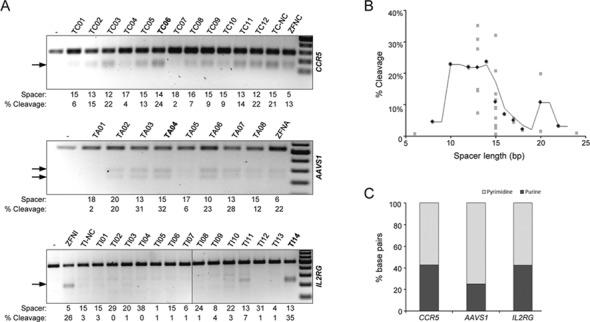
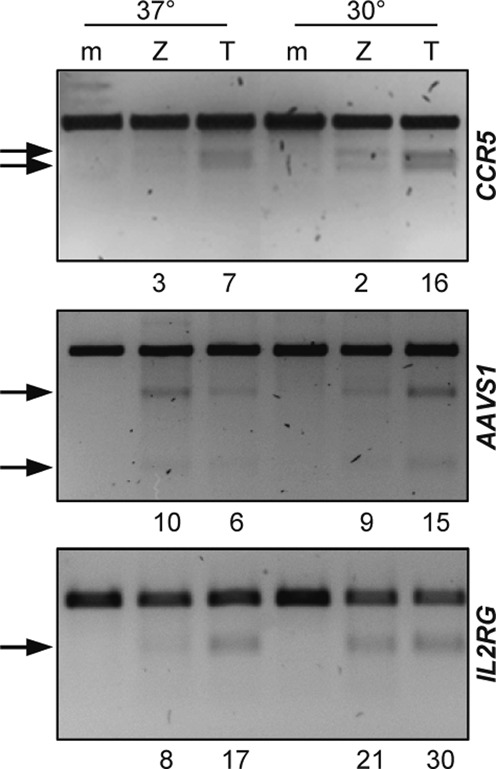
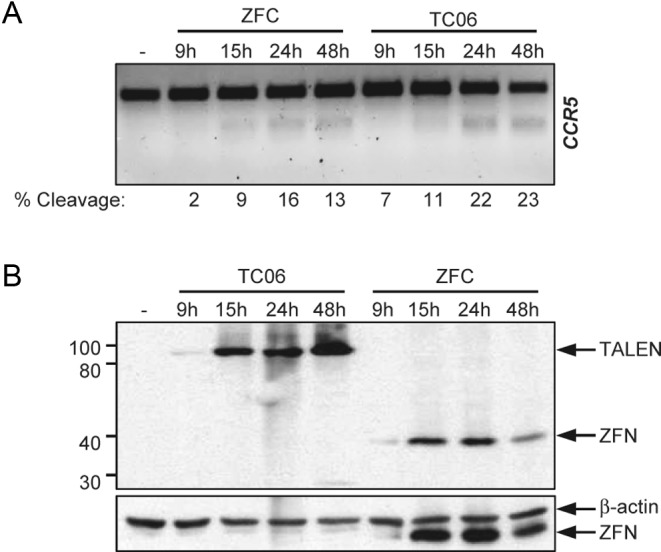
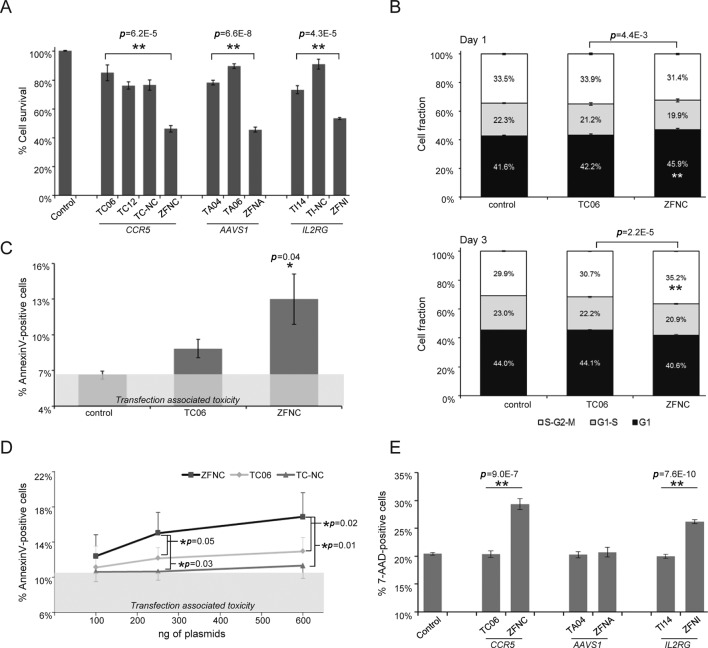
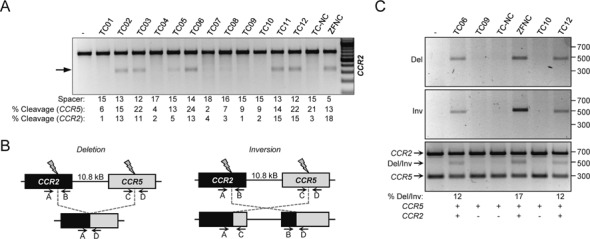
Designer nucleases have been successfully employed to modify the genomes of various model organisms and human cell types. While the specificity of zinc-finger nucleases (ZFNs) and RNA-guided endonucleases has been assessed to some extent, little data are available for transcription activator-like effector-based nucleases (TALENs). Here, we have engineered TALEN pairs targeting three human loci (CCR5, AAVS1 and IL2RG) and performed a detailed analysis of their activity, toxicity and specificity. The TALENs showed comparable activity to benchmark ZFNs, with allelic gene disruption frequencies of 15-30% in human cells. Notably, TALEN expression was overall marked by a low cytotoxicity and the absence of cell cycle aberrations. Bioinformatics-based analysis of designer nuclease specificity confirmed partly substantial off-target activity of ZFNs targeting CCR5 and AAVS1 at six known and five novel sites, respectively. In contrast, only marginal off-target cleavage activity was detected at four out of 49 predicted off-target sites for CCR5- and AAVS1-specific TALENs. The rational design of a CCR5-specific TALEN pair decreased off-target activity at the closely related CCR2 locus considerably, consistent with fewer genomic rearrangements between the two loci. In conclusion, our results link nuclease-associated toxicity to off-target cleavage activity and corroborate TALENs as a highly specific platform for future clinical translation.
Overview
The claims and statistics of this paper haven’t been checked yet.
Free: it reads the open-access text and checks the first 5 claims that cite a source we can check. Create a free account to check every claim.
Integrity signals
Registry
Cites
Statistics
Figures
Verification
Claims the paper makes
The claims and statistics of this paper haven’t been checked yet.
Free: it reads the open-access text and checks the first 5 claims that cite a source we can check. Create a free account to check every claim.
Claims other papers make about this one
Each is checked against this paper’s own text: does it say what the citing paper says it does?
In the citing paper
“While off-target cutting remains a concern, TALENs have been shown in one side-by-side comparison study to be more specific and less cytotoxic than ZFNs (Mussolino et al., 2014).”
From Delivering CRISPR: a review of the challenges and approaches (2018) · cites this paper as Mussolino et al., 2014
Self-check
Percentages, sums and reported differences re-computed from the paper’s own numbers.
The self-check needs the paper’s full text.
Citations
Cites
RNA-Guided Human Genome Engineering via Cas9
Mali, P., Yang, L., Esvelt, K. M., Aach, J., Guell, M., DiCarlo, J. E., Norville, J. E., & Church, G. M. (2013) · Science · doi:10.1126/science.1232033 · Cited by 9,210 · cited 4×
“A compelling alternative to ZFNs and TALENs are RNA-guided endonucleases (RGNs) that have quickly developed into an easy and versatile tool for genome engineering (15).”
BackgroundMethodInfluentialDNA targeting specificity of RNA-guided Cas9 nucleases
Hsu, P. D., Scott, D. A., Weinstein, J. A., Ran, F. A., Konermann, S., Agarwala, V., Li, Y., Fine, E. J., Wu, X., Shalem, O., et al. (2013) · Nature Biotechnology · doi:10.1038/nbt.2647 · Cited by 4,741
Self-citationHigh-Frequency off-Target Mutagenesis Induced by CRISPR-Cas Nucleases in Human Cells
Fu, Y., Foden, J. A., Khayter, C., Maeder, M. L., Reyon, D., Joung, J. K., & Sander, J. D. (2013) · Nature Biotechnology · doi:10.1038/nbt.2623 · Cited by 3,292
Genome editing with engineered zinc finger nucleases
Urnov, F. D., Rebar, E. J., Holmes, M. C., Zhang, H. S., & Gregory, P. D. (2010) · Nature Reviews Genetics · doi:10.1038/nrg2842 · Cited by 2,285 · cited 1×
“While ZFNs represent the best-characterized class of designer nucleases today, their widespread use has somewhat been hampered by their limited targeting range and the time-consuming methodologies needed to generate ZFNs with novel DNA binding properties (2).”
BackgroundA TALE nuclease architecture for efficient genome editing
Miller, J. C., Tan, S., Qiao, G., Barlow, K. A., Wang, J., Xia, D. F., Meng, X., Paschon, D. E., Leung, E., Hinkley, S. J., et al. (2011) · Nature Biotechnology · doi:10.1038/nbt.1755 · Cited by 2,098 · cited 1×
“Even though most of our findings are based on TALENs with the 135/+17 scaffold developed in our lab (36), we believe that they can be extended to alternative TALEN designs with longer linkers (61).”
ResultImproving CRISPR-Cas nuclease specificity using truncated guide RNAs
Fu, Y., Sander, J. D., Reyon, D., Cascio, V. M., & Joung, J. K. (2014) · Nature Biotechnology · doi:10.1038/nbt.2808 · Cited by 1,993 · cited 1×
“as recently shown by truncating the gRNA molecule (64).”
BackgroundMali, P., Aach, J., Stranges, P. B., Esvelt, K. M., Moosburner, M., Kosuri, S., Yang, L., & Church, G. M. (2013) · Nature Biotechnology · doi:10.1038/nbt.2675 · Cited by 1,752
TALENs: A widely applicable technology for targeted genome editing
Joung, J. K., & Sander, J. D. (2013) · Nature Reviews Molecular Cell Biology · doi:10.1038/nrm3486 · Cited by 1,650 · cited 3×
“TALENs, on the other hand, are easier to engineer and seem to combine high cleavage activity with low cytotoxicity, features that have promoted TALENs as a powerful genome engineering tool in the last two years (3).”
BackgroundMethodPattanayak, V., Lin, S., Guilinger, J. P., Ma, E., Doudna, J. A., & Liu, D. R. (2013) · Nature Biotechnology · doi:10.1038/nbt.2673 · Cited by 1,487
Gene Editing of CCR5 in Autologous CD4 T Cells of Persons Infected with HIV
Tebas, P., Stein, D., Tang, W. W., Frank, I., Wang, S. Q., Lee, G., Spratt, S. K., Surosky, R. T., Giedlin, M. A., Nichol, G., et al. (2014) · New England Journal of Medicine · doi:10.1056/nejmoa1300662 · Cited by 1,357 · cited 2×
“in 1996 (4), significant advancements in the design process of ZFNs and TALENs and a better understanding of parameters determining their activity and toxicity (5,6) have propelled the use of these nucleases from reverse genetics studies in model organisms to their application in human gene therapy (7).”
BackgroundMethod
Research works printed but not linked: 39
- Kim Y.G. Cha J. Chandrasegaran S. Hybrid restriction enzymes: zinc finger fusions to Fok I cleavage domain Proc. Natl. Acad. Sci. U.S.A. 1996 93 1156 1160 8577732 PMC40048 · DOI · Paper page
- Handel E.M. Cathomen T. Zinc-finger nuclease based genome surgery: it's all about specificity Curr. Gene Ther. 2011 11 28 37 21182467 · DOI · Paper page
- Mussolino C. Cathomen T. TALE nucleases: tailored genome engineering made easy Curr. Opin. Biotechnol. 2012 23 644 650 22342754 · DOI · Paper page
- Smith J. Bibikova M. Whitby F.G. Reddy A.R. Chandrasegaran S. Carroll D. Requirements for double-strand cleavage by chimeric restriction enzymes with zinc finger DNA-recognition domains Nucleic Acids Res. 2000 28 3361 3369 10954606 PMC110700 · DOI · Paper page
- Christian M. Cermak T. Doyle E.L. Schmidt C. Zhang F. Hummel A. Bogdanove A.J. Voytas D.F. Targeting DNA double-strand breaks with TAL effector nucleases Genetics 2010 186 757 761 20660643 PMC2942870 · DOI · Paper page
- Boch J. Scholze H. Schornack S. Landgraf A. Hahn S. Kay S. Lahaye T. Nickstadt A. Bonas U. Breaking the code of DNA binding specificity of TAL-type III effectors Science 2009 326 1509 1512 19933107 · DOI · Paper page
- Moscou M.J. Bogdanove A.J. A simple cipher governs DNA recognition by TAL effectors Science 2009 326 1501 19933106 · DOI · Paper page
- de Lange O. Schreiber T. Schandry N. Radeck J. Braun K.H. Koszinowski J. Heuer H. Strauss A. Lahaye T. Breaking the DNA-binding code of Ralstonia solanacearum TAL effectors provides new possibilities to generate plant resistance genes against bacterial wilt disease New Phytol. 2013 199 773 786 23692030 · DOI
- Schmid-Burgk J.L. Schmidt T. Kaiser V. Honing K. Hornung V. A ligation-independent cloning technique for high-throughput assembly of transcription activator-like effector genes Nat. Biotechnol. 2013 31 76 81 23242165 PMC4142318 · DOI · Paper page
- Reyon D. Tsai S.Q. Khayter C. Foden J.A. Sander J.D. Joung J.K. FLASH assembly of TALENs for high-throughput genome editing Nat. Biotechnol. 2012 30 460 465 22484455 PMC3558947 · DOI · Paper page
- Jinek M. Chylinski K. Fonfara I. Hauer M. Doudna J.A. Charpentier E. A programmable dual-RNA-guided DNA endonuclease in adaptive bacterial immunity Science 2012 337 816 821 22745249 PMC6286148 · DOI · Paper page
- Mussolino C. Cathomen T. RNA guides genome engineering Nat. Biotechnol. 2013 31 208 209 23471067 · DOI
- Zou J. Maeder M.L. Mali P. Pruett-Miller S.M. Thibodeau-Beganny S. Chou B.K. Chen G. Ye Z. Park I.H. Daley G.Q. Gene targeting of a disease-related gene in human induced pluripotent stem and embryonic stem cells Cell Stem Cell 2009 5 97 110 19540188 PMC2720132 · DOI · Paper page
- Hockemeyer D. Wang H. Kiani S. Lai C.S. Gao Q. Cassady J.P. Cost G.J. Zhang L. Santiago Y. Miller J.C. Genetic engineering of human pluripotent cells using TALE nucleases Nat. Biotechnol. 2011 29 731 734 21738127 PMC3152587 · DOI · Paper page
- Hockemeyer D. Soldner F. Beard C. Gao Q. Mitalipova M. DeKelver R.C. Katibah G.E. Amora R. Boydston E.A. Zeitler B. Efficient targeting of expressed and silent genes in human ESCs and iPSCs using zinc-finger nucleases Nat. Biotechnol. 2009 27 851 857 19680244 PMC4142824 · DOI · Paper page
- Horii T. Tamura D. Morita S. Kimura M. Hatada I. Generation of an ICF syndrome model by efficient genome editing of human induced pluripotent stem cells using the CRISPR system Int. J. Mol. Sci. 2013 14 19774 19781 24084724 PMC3821585 · DOI · Paper page
- Chen S. Oikonomou G. Chiu C.N. Niles B.J. Liu J. Lee D.A. Antoshechkin I. Prober D.A. A large-scale in vivo analysis reveals that TALENs are significantly more mutagenic than ZFNs generated using context-dependent assembly Nucleic Acids Res. 2013 41 2769 2778 23303782 PMC3575824 · DOI · Paper page
- Moore F.E. Reyon D. Sander J.D. Martinez S.A. Blackburn J.S. Khayter C. Ramirez C.L. Joung J.K. Langenau D.M. Improved somatic mutagenesis in zebrafish using transcription activator-like effector nucleases (TALENs) PLoS One 2012 7 e37877 22655075 PMC3360007 · DOI · Paper page
- Wood A.J. Lo T.W. Zeitler B. Pickle C.S. Ralston E.J. Lee A.H. Amora R. Miller J.C. Leung E. Meng X. Targeted genome editing across species using ZFNs and TALENs Science 2011 333 307 21700836 PMC3489282 · DOI · Paper page
- Tesson L. Usal C. Menoret S. Leung E. Niles B.J. Remy S. Santiago Y. Vincent A.I. Meng X. Zhang L. Knockout rats generated by embryo microinjection of TALENs Nat. Biotechnol. 2011 29 695 696 21822240 · DOI · Paper page
- Morbitzer R. Elsaesser J. Hausner J. Lahaye T. Assembly of custom TALE-type DNA binding domains by modular cloning Nucleic Acids Res. 2011 39 5790 5799 21421566 PMC3141260 · DOI · Paper page
- Doyle E.L. Booher N.J. Standage D.S. Voytas D.F. Brendel V.P. Vandyk J.K. Bogdanove A.J. TAL Effector-Nucleotide Targeter (TALE-NT) 2.0: tools for TAL effector design and target prediction Nucleic Acids Res. 2012 40 W117 W122 22693217 PMC3394250 · DOI · Paper page
- Gupta A. Meng X. Zhu L.J. Lawson N.D. Wolfe S.A. Zinc finger protein-dependent and -independent contributions to the in vivo off-target activity of zinc finger nucleases Nucleic Acids Res. 2011 39 381 392 20843781 PMC3017618 · DOI · Paper page
- Bultmann S. Morbitzer R. Schmidt C.S. Thanisch K. Spada F. Elsaesser J. Lahaye T. Leonhardt H. Targeted transcriptional activation of silent oct4 pluripotency gene by combining designer TALEs and inhibition of epigenetic modifiers Nucleic Acids Res. 2012 40 5368 5377 22387464 PMC3384321 · DOI · Paper page
- Valton J. Dupuy A. Daboussi F. Thomas S. Marechal A. Macmaster R. Melliand K. Juillerat A. Duchateau P. Overcoming transcription activator-like effector (TALE) DNA binding domain sensitivity to cytosine methylation J. Biol. Chem. 2012 287 38427 38432 23019344 PMC3493886 · DOI · Paper page
- Doyon Y. Choi V.M. Xia D.F. Vo T.D. Gregory P.D. Holmes M.C. Transient cold shock enhances zinc-finger nuclease-mediated gene disruption Nat. Methods 2010 7 459 460 20436476 · DOI
- Sakaue-Sawano A. Kurokawa H. Morimura T. Hanyu A. Hama H. Osawa H. Kashiwagi S. Fukami K. Miyata T. Miyoshi H. Visualizing spatiotemporal dynamics of multicellular cell-cycle progression Cell 2008 132 487 498 18267078 · DOI · Paper page
- Lombardo A. Cesana D. Genovese P. Di Stefano B. Provasi E. Colombo D.F. Neri M. Magnani Z. Cantore A. Lo Riso P. Site-specific integration and tailoring of cassette design for sustainable gene transfer Nat. Methods 2011 8 861 869 21857672 · DOI · Paper page
- Lee H.J. Kim E. Kim J.S. Targeted chromosomal deletions in human cells using zinc finger nucleases Genome Res. 2010 20 81 89 19952142 PMC2798833 · DOI · Paper page
- Lee H.J. Kweon J. Kim E. Kim S. Kim J.S. Targeted chromosomal duplications and inversions in the human genome using zinc finger nucleases Genome Res. 2012 22 539 548 22183967 PMC3290789 · DOI · Paper page
- Fine J.E. Cradick J.T. Zhao L.C. Lin Y. Bao G. An online bioinformatics tool predicts zinc finger and TALE nuclease off-target cleavage Nucleic Acids Res. 2014 42 PMC3973315 24381193 · DOI · Paper page
- Kim Y. Kweon J. Kim J.S. TALENs and ZFNs are associated with different mutation signatures Nat. Methods 2013 10 185 23396284 · DOI
- Handel E.M. Alwin S. Cathomen T. Expanding or restricting the target site repertoire of zinc-finger nucleases: the inter-domain linker as a major determinant of target site selectivity Mol. Ther. 2009 17 104 111 19002164 PMC2834978 · DOI · Paper page
- Bibikova M. Carroll D. Segal D.J. Trautman J.K. Smith J. Kim Y.G. Chandrasegaran S. Stimulation of homologous recombination through targeted cleavage by chimeric nucleases Mol. Cell. Biol 2001 21 289 297 11113203 PMC88802 · DOI · Paper page
- Sun N. Zhao H. Seamless correction of the sickle cell disease mutation of the HBB gene in human induced pluripotent stem cells using TALENs Biotechnol. Bioeng. 2014 111 23928856 · DOI · Paper page
- Ousterout D.G. Perez-Pinera P. Thakore P.I. Kabadi A.M. Brown M.T. Qin X. Fedrigo O. Mouly V. Tremblay J.P. Gersbach C.A. Reading frame correction by targeted genome editing restores dystrophin expression in cells from Duchenne muscular dystrophy patients Mol. Ther. 2013 21 1718 1726 23732986 PMC3776627 · DOI · Paper page
- Panda S.K. Wefers B. Ortiz O. Floss T. Schmid B. Haass C. Wurst W. Kuhn R. Highly efficient targeted mutagenesis in mice using TALENs Genetics 2013 195 703 713 23979585 PMC3813858 · DOI · Paper page
- Brunet E. Simsek D. Tomishima M. DeKelver R. Choi V.M. Gregory P. Urnov F. Weinstock D.M. Jasin M. Chromosomal translocations induced at specified loci in human stem cells Proc. Natl. Acad. Sci. U.S.A. 2009 106 10620 10625 19549848 PMC2700748 · DOI · Paper page
- Sollu C. Pars K. Cornu T.I. Thibodeau-Beganny S. Maeder M.L. Joung J.K. Heilbronn R. Cathomen T. Autonomous zinc-finger nuclease pairs for targeted chromosomal deletion Nucleic Acids Res. 2010 38 8269 8276 20716517 PMC3001086 · DOI · Paper page
Cited by
Li, H., Yang, Y., Hong, W., Huang, M., Wu, M., & Zhao, X. (2020) · Signal Transduction and Targeted Therapy · doi:10.1038/s41392-019-0089-y · Cited by 1,715
Delivering CRISPR: a review of the challenges and approaches
Lino, C. A., Harper, J. C., Carney, J. P., & Timlin, J. A. (2018) · Drug Delivery · doi:10.1080/10717544.2018.1474964 · Cited by 1,185
“While off-target cutting remains a concern, TALENs have been shown in one side-by-side comparison study to be more specific and less cytotoxic than ZFNs (Mussolino et al., 2014).”
BackgroundRNA-directed gene editing specifically eradicates latent and prevents new HIV-1 infection
Hu, W., Kaminski, R., Yang, F., Zhang, Y., Cosentino, L., Li, F., Luo, B., Alvarez-Carbonell, D., Garcia-Mesa, Y., Karn, J., et al. (2014) · Proceedings of the National Academy of Sciences · doi:10.1073/pnas.1405186111 · Cited by 527
Genome-Editing Technologies: Principles and Applications
Gaj, T., Sirk, S. J., Shui, S.-L., & Liu, J. (2016) · Cold Spring Harbor Perspectives in Biology · doi:10.1101/cshperspect.a023754 · Cited by 381
Streptococcus thermophilus CRISPR-cas9 systems enable specific editing of the human genome
Müller, M., Lee, C. M., Gasiunas, G., Davis, T. H., Cradick, T. J., Siksnys, V., Bao, G., Cathomen, T., & Mussolino, C. (2016) · Molecular Therapy · doi:10.1038/mt.2015.218 · Cited by 254
Genetic engineering of microalgae for enhanced biorefinery capabilities
Fayyaz, M., Chew, K. W., Show, P. L., Ling, T. C., Ng, I.-S., & Chang, J.-S. (2020) · Biotechnology Advances · doi:10.1016/j.biotechadv.2020.107554 · Cited by 225
Enabling plant synthetic biology through genome engineering
Baltes, N. J., & Voytas, D. F. (2015) · Trends in Biotechnology · doi:10.1016/j.tibtech.2014.11.008 · Cited by 217
Epigenome Editing: State of the Art, Concepts, and Perspectives
Kungulovski, G., & Jeltsch, A. (2016) · Trends in Genetics · doi:10.1016/j.tig.2015.12.001 · Cited by 208
“Moreover, specificity is an important issue and, although TALEs have been shown to perform very well in human cells [18], ZFNs and CRISPR/Cas9 systems revealed significant off-target activity in some applications [19–21] but showed good specificity in other cases [22,23].”
BackgroundLi, C., Guan, X., Du, T., Jin, W., Wu, B., Liu, Y., Wang, P., Hu, B., Griffin, G. E., Shattock, R. J., et al. (2015) · Journal of General Virology · doi:10.1099/vir.0.000139 · Cited by 192
Adenoviral vector DNA for accurate genome editing with engineered nucleases
Holkers, M., Maggio, I., Henriques, S. F. D., Janssen, J. M., Cathomen, T., & Gonçalves, M. A. F. V. (2014) · Nature Methods · doi:10.1038/nmeth.3075 · Cited by 138
Self-citationAutomated generation of gene-edited CAR T cells at clinical scale
Alzubi, J., Lock, D., Rhiel, M., Schmitz, S., Wild, S., Mussolino, C., Hildenbeutel, M., Brandes, C., Rositzka, J., Lennartz, S., et al. (2021) · Molecular Therapy - Methods & Clinical Development · doi:10.1016/j.omtm.2020.12.008 · Cited by 53
Self-citation
Metadata
- Authors
- Mussolino, C., Alzubi, J., Fine, E. J., Morbitzer, R., Cradick, T. J., Lahaye, T., Bao, G., & Cathomen, T.
- Venue
- Nucleic Acids Research
- Publisher
- Oxford University Press (OUP)
- Published
- 2014-05-03
- Volume
- 42
- Issue
- 10
- Pages
- 6762-6773
- ISSN
- 1362-4962
- 0305-1048
- PMC
- PMC4041469
- Cited by
- 178
- References
- 25
- Language
- en
About these checks
Registry, retraction, Cites and statistics results are computed, not judged, with one exception: a printed reference that no index lists is read once by a model before it counts as a citation error. Claims are extracted by a model and kept only when their quote appears verbatim in the text; each cited source is then checked, with a model’s help, for whether it says what the claim relies on. Those verdicts can be wrong — read the claim’s quote and the cited source before relying on one.
Statistics and arithmetic are recomputed, not judged.
Confidence bands are shown only for fields calibrated on our annotated test set. None is calibrated yet, so no band is shown.
What counts as a claim ›How we measure confidence ›How we check this ›
Are you an author, or do you see a problem with this page? Request a review
Data sources
Bibliographic data: Semantic Scholar, OpenAlex, Crossref.
Contains information from the Semantic Scholar Academic Graph Datasets, made available under the ODC Attribution License (ODC-BY 1.0).
Semantic Scholar’s data is described in: Kinney, R., et al. (2023). The Semantic Scholar Open Data Platform. arXiv:2301.10140.
