

Fundamentals of glycogen metabolism for coaches and athletes
Open accessThe DOI matches its Crossref record; 148 of the 149 references it cites were found in a registry or an index.
Abstract
The ability of athletes to train day after day depends in large part on adequate restoration of muscle glycogen stores, a process that requires the consumption of sufficient dietary carbohydrates and ample time. Providing effective guidance to athletes and others wishing to enhance training adaptations and improve performance requires an understanding of the normal variations in muscle glycogen content in response to training and diet; the time required for adequate restoration of glycogen stores; the influence of the amount, type, and timing of carbohydrate intake on glycogen resynthesis; and the impact of other nutrients on glycogenesis. This review highlights the practical implications of the latest research related to glycogen metabolism in physically active individuals to help sports dietitians, coaches, personal trainers, and other sports health professionals gain a fundamental understanding of glycogen metabolism, as well as related practical applications for enhancing training adaptations and preparing for competition.
Overview
The claims and statistics of this paper haven’t been checked yet.
Free: it reads the open-access text and checks the first 5 claims that cite a source we can check. Create a free account to check every claim.
Integrity signals
Registry
Cites
Statistics
Figures
Verification
Claims the paper makes
The claims and statistics of this paper haven’t been checked yet.
Free: it reads the open-access text and checks the first 5 claims that cite a source we can check. Create a free account to check every claim.
Claims other papers make about this one
Each is checked against this paper’s own text: does it say what the citing paper says it does?
The source backs part of the claim, not all of it — or backs it for a different population, condition or comparison.
In the citing paper
“Complete replenishment of muscle glycogen stores typically unfolds over a 24–36 h period post-exercise, provided that 7–12 g·kg−1 carbohydrate are consumed per day [15–18].”
From Nutritional Strategies to Improve Post-exercise Recovery and Subsequent Exercise Performance: A Narrative Review (2025) · cites this paper as [17]
Experimental — accuracy not yet measuredThe source backs part of the claim, not all of it — or backs it for a different population, condition or comparison.
In the citing paper
“research suggests that carbohydrate intake is often insufficient among youth athletes, particularly those engaged in aerobic or team-based sports [47,48].”
From Optimizing Performance Nutrition for Adolescent Athletes: A Review of Dietary Needs, Risks, and Practical Strategies (2025) · cites this paper as [47]
Experimental — accuracy not yet measuredThe cited source says what the claim attributes to it.
In the citing paper
“Thus, carbohydrates are fundamental for supporting high‐intensity exercise performance, providing the substrate for rapid ATP resynthesis during short maximal efforts dependent on anaerobic glycolysis, as well as during prolonged intense exercise characterized by high rates of carbohydrate oxidation [2].”
From Carbohydrate Storage and Supplementation Strategies for Peak Performance in Cross-Country Skiing (2026) · cites this paper as [2]
The check wasn’t confident either way, so it gives no verdict — never disputed.
In the citing paper
“Studies have shown that the depletion of muscle glycogen occurs faster in young athletes than in adult athletes (58, 59).”
From Junior athletes’ nutritional demands: a narrative review of consumption and prevalence of eating disorders (2024) · cites this paper as [58]
Experimental — accuracy not yet measuredIn the citing paper
“Additionally, compared to carbohydrate ingestion alone, multiday supplementation with creatine monohydrate along with an adequate amount of carbohydrates has been reported to have a higher positive impact on muscle glycogen synthesis [40].”
From The 4R’s Framework of Nutritional Strategies for Post-Exercise Recovery: A Review with Emphasis on New Generation of Carbohydrates (2020) · cites this paper as [40]
1 more claim about this paper
Create a free account to see every claim other papers make about this one.
Self-check
Percentages, sums and reported differences re-computed from the paper’s own numbers.
The self-check needs the paper’s full text.
Citations
Cites
Trumbo, P., Schlicker, S., Yates, A. A., & Poos, M. (2002) · Journal of the American Dietetic Association · doi:10.1016/s0002-8223(02)90346-9 · Cited by 5,993
Glycemic index of foods: a physiological basis for carbohydrate exchange
Jenkins, D. J., Wolever, T. M., Taylor, R. H., Barker, H., Fielden, H., Baldwin, J. M., Bowling, A. C., Newman, H. C., Jenkins, A. L., & Goff, D. V. (1981) · The American Journal of Clinical Nutrition · doi:10.1093/ajcn/34.3.362 · Cited by 3,857
Diet, muscle glycogen and physical performance.
Bergström, J., Hermansen, L., Hultman, E., & Saltin, B. (1967) · Acta Physiologica Scandinavica · doi:10.1111/j.1748-1716.1967.tb03720.x · Cited by 1,740
(2010) · Cited by 1,697
Nutrition and Athletic Performance
(2016) · Medicine & Science in Sports & Exercise · doi:10.1249/mss.0000000000000852 · Cited by 1,305
Nutrition and Athletic Performance
(2009) · Medicine & Science in Sports & Exercise · doi:10.1249/mss.0b013e31890eb86 · Cited by 1,084
Muscle glycogen utilization during prolonged strenuous exercise when fed carbohydrate
Coyle, E. F., Coggan, A. R., Hemmert, M. K., & Ivy, J. L. (1986) · Journal of Applied Physiology · doi:10.1152/jappl.1986.61.1.165 · Cited by 1,022 · cited 1×
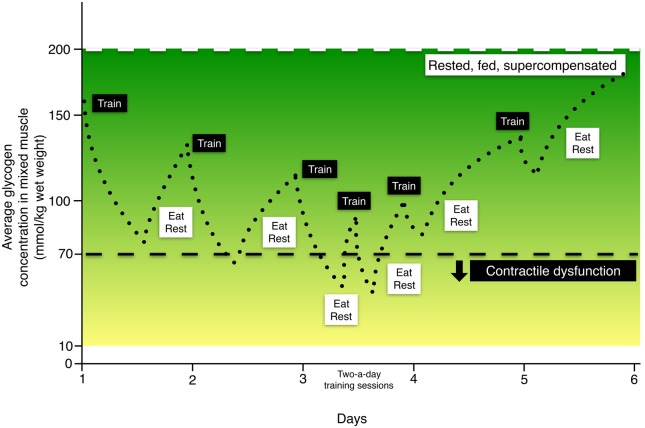
“muscle glycogen might fall to < 50 mmol/kg wet weight.(4,84) When muscle glycogen falls to < 70 mmol/”
BackgroundCarbohydrates for training and competition
Burke, L. M., Hawley, J. A., Wong, S. H. S., & Jeukendrup, A. E. (2011) · Journal of Sports Sciences · doi:10.1080/02640414.2011.585473 · Cited by 985 · cited 1×
“When 24 hours of rest occur between exercise sessions, ingesting a total of 10 g/kg BW, along with enough energy (calories) to maintain energy balance, will maximize glycogen restoration.(4,65,97) As noted above, timing of carbohydrate intake following physical activity is very important during training and competitio…”
BackgroundDietary Guidelines for Americans: Implications for Primary Care Providers
Mosher, A. L., Piercy, K. L., Webber, B. J., Goodwin, S. K., Casavale, K. O., & Olson, R. D. (2016) · American Journal of Lifestyle Medicine · doi:10.1177/1559827614521755 · Cited by 868
Muscle Glycogen during Prolonged Severe Exercise
Hermansen, L., Hultman, E., & Saltin, B. (1967) · Acta Physiologica Scandinavica · doi:10.1111/j.1748-1716.1967.tb03719.x · Cited by 752
Research works printed but not linked: 6
- 40. Hargreaves M. The metabolic systems: carbohydrate metabolism. In: Farrell P, ed. ACSM's Advanced Exercise Physiology. 2nd ed. Philadelphia: Lippincott Williams & Wilkins; 2012:379-391.
- 41. Ivy J. The regulation and synthesis of muscle glycogen by means of nutrient in- tervention. In: Maughan R, ed. Sports Nutrition. Vol. 19. West Sussex, UK: Wiley Blackwell; 2014:113-125.
- 60. Hawley J. Manipulating carbohydrate availability to promote training adaptation. Sports Sci Exchange. 2014;27:1-7.
- US Department of Health and Human Services; US Department of Agriculture, 2015, 2015–2020 Dietary Guidelines for Americans.
- US Department of Agriculture, National Nutrition Database.
- Zelman, Web MD Portion Size Guide.
Cited by
Items 201–300 of 308
Therapeutic potential of zein-based nanoparticles
Reboredo, C. (2022) · doi:10.15581/10171/62894
Meimoun, L., Pecchi, É., Vilmen, C., Bendahan, D., & Giannesini, B. (2022) · Journal of Sports Sciences · doi:10.1080/02640414.2022.2123527
“…is a relatively slow phenomenon, with several tens of hours to restore the initial reserves after intense exercise in the trained subject (Murray & Rosenbloom, 2018), bioenergetics recovery over short interval periods is exclusively related to high-energy phosphorylated compounds, i.e.,…”
BackgroundPengaruh Gula Merah Tebu terhadap Laktat Darah dan Glikogen Hati pada Tikus dengan Olahraga Renang
Astani, A. D., Suroto, S., & Noer, E. R. (2022) · Indonesian Journal of Human Nutrition · doi:10.21776/ub.ijhn.2022.009.02.3
García‐González, Á., & Robert-McComb, J. J. (2023) · Springer eBooks · doi:10.1007/978-3-031-15485-0_20
Recovery Getränke – alles drin, was drin sein sollte?
Grim, C., Ungruhe, E., Hoffmeister, T., Engelhardt, M., Hotfiel, T., & Hoppe, M. (2023) · Sports Orthopaedics and Traumatology · doi:10.1016/j.orthtr.2023.04.007
Maheshwari, N., Ray, S., & Patra, S. (2023) · PARIPEX-INDIAN JOURNAL OF RESEARCH · doi:10.36106/paripex/9409991
Herman, C., Heidner, G. S., Wentz, L. M., Shaver, A. A., & Murray, N. P. (2024) · Physiological Reports · doi:10.14814/phy2.15927
“If glucose is being used to combat physical fatigue, the brain must function with limited energy resources, ultimately weakening cognitive performance (Murray & Rosenbloom, 2018).”
BackgroundMethodInfluentialNutrition status of elite Jiu-Jitsu athletes during training season
Paiyarat, K., Techakriengkrai, T., Jamphon, A., Penglee, N., Polyai, N., & Techakriengkrai, W. (2024) · Scientific Journal of Sport and Performance · doi:10.55860/zqgp3540
“Scientific evidence supports the notion that an appropriate level of carbohydrate intake is associated with increased strength and enhanced muscle glycogen storage (Artioli et al., 2013; Greene et al., 2017; Murray & Rosenbloom, 2018; Januszko & Lange, 2021).”
BackgroundEffects of Glucose, Sodium, and Cholesterol Deficiency from a Human Health Perspective
Parisi, S. (2024) · Springer briefs in molecular science · doi:10.1007/978-3-031-67395-5_5
Fatok, J. O., Omoboyowa, D. A., Fatoki, C. O., Kehinde, S. A., Abayomi, T. A., Dare, B. J., Akinpelu, A. T., Olaniyan, L. W. B., & Badmus, J. A. (2024) · Pan African Journal of Life Sciences · doi:10.36108/pajols/4202/80.0260
Impact of Nutrition and Exercise on Carbohydrate Metabolism
Matsunaga, Y. (2024) · BENTHAM SCIENCE PUBLISHERS eBooks · doi:10.2174/9789815313925124010005
Kaddi, C. D., Tao, M., Bergeler, S., George, K., Geerts, H., van der Graaf, P. H., Batista, J. L., Foster, M. C., Ortemann, C., Zaher, A., et al. (2024) · doi:10.70534/ybpq6808
A Molecular Exploration of Fatty Acid Oxidation and Multiple Acyl Coenzyme A Deficiency
Rao, N. N. (2025) · Biochemistry · doi:10.5772/intechopen.114349
Identification of Fat Adaptation Through Ketone Monitoring
Chatterjee, A., Mondal, A., & Dutta, A. (2025) · Methods and protocols in food science · doi:10.1007/978-1-0716-4370-9_7
Effect of SAQ Training With and Without Carbohydrate Supplementation in Elite Footballers
Nadeem, F., Gill, S. A., Riaz, H. M., & Maqsood, M. (2024) · Human Nature Journal of Social Sciences · doi:10.71016/hnjss/4wsbys14
Inorganic nitrate stores, astrocyte metabolism and brain health: An emerging paradigm
Siervo, M., Verdile, G., & Piknova, B. (2025) · Nitric Oxide · doi:10.1016/j.niox.2025.06.005
How math – and eating while running – can help you complete your best marathon
Cook, C. (2022) · The Conversation · doi:10.64628/aai.xdk4vkpwu
Sellitto, D. (2024) · Journal of Student Research · doi:10.47611/jsrhs.v13i4.7888
Pirincin Tarihsel Yolculuğu ve Gizli Hazinesi
Emre, M. (2025) · Akademisyen Kitabevi eBooks · doi:10.37609/akya.3749
Egzersiz Sonrası Kullanılan Toparlanma Stratejilerinin Fizyolojik Parametrelere Etkisi
Çevirken, B., & Keskin, B. (2025) · Yalova Üniversitesi spor bilimleri dergisi. · doi:10.70007/yalovaspor.1640051
Various Synthetic Pathways and Properties of Biopolymers
Anand, P., Kumar, D., Tiwari, J., & Singh, S. K. (2025) · BENTHAM SCIENCE PUBLISHERS eBooks · doi:10.2174/9798898811419125010006
The unanticipated role of the glial-associated glucose-6-phosphatase system in brain homeostasis
Barahona, M. J., Salazar, K., & Nualart, F. (2025) · iScience · doi:10.1016/j.isci.2025.114235
“76 This raises a key question: how do tanycytes release glucose?”
Nutrigenomics and sports performance
Shivsharan, R. R., Ayyar, P. V., Akkalkote, R. S., Bhagwat, P. K., Patil, V. B., & Pillai, S. (2025) · Elsevier eBooks · doi:10.1016/b978-0-443-26761-1.00006-5
Craven, J., Desbrow, B., Sabapathy, S., Bellinger, P., McCartney, D., & Irwin, C. (2021) · Figshare · doi:10.6084/m9.figshare.13663275
Leonkiewicz, M., & Wawrzyniak, A. (2022) · Figshare · doi:10.6084/m9.figshare.19581810
Craven, J., Desbrow, B., Sabapathy, S., Bellinger, P., McCartney, D., & Irwin, C. (2021) · Figshare · doi:10.6084/m9.figshare.13663263
Dean, E. (2025) · Lancaster EPrints (Lancaster University) · doi:10.17635/lancaster/thesis/2761
Craven, J., Desbrow, B., Sabapathy, S., Bellinger, P., McCartney, D., & Irwin, C. (2021) · Figshare · doi:10.6084/m9.figshare.13663269
Roberts, C. (2022) · Research Commons (University of Waikato)
Guðmundsdóttir, L. (2019) · Skemman
Vpliv prehranske intervencije na prehranski status skupine profesionalnih nogometašev v Sloveniji
Hribar, M. (2023) · Repository of the University of Ljubljana (University of Ljubljana)
A Dieta Cetogénica como alternativa para prevenção da Síndrome Metabólica em indivíduos obesos
Basquete, R. I. F. (2018) · Portuguese National Funding Agency for Science, Research and Technology (RCAAP Project by FCT)
Estratégias Nutricionais e Metodologias Baseadas em Evidências Científicas para o Culturismo Natural
Esteves, J. M. C. R. (2025) · Portuguese National Funding Agency for Science, Research and Technology (RCAAP Project by FCT)
Larose, D. (2021) · Corpus Université Laval (Université Laval)
Elizaveta, P. (2024) · Theseus (Ammattikorkeakoulujen)
Relationships between food intake and training load in professional ice hockey players
Jaakola, V. (2020) · UEF eRepo (University of Eastern Finland)
Učinki vadbe in vadbenega svetovanja na izražanje genov v endometriju neplodnih žensk z debelostjo
Šuštaršič, A. (2024) · Repository of the University of Ljubljana (University of Ljubljana)
Kortay, İ. (2021) · Eastern Mediterranean University Institutional Repository (Eastern Mediterranean University)
The role of mitochondrial translocator protein 18kDa (TSPO) in regulating astrocyte metabolism
Firth, W. (2024) · Open Research Exeter (University of Exeter)
Elucidating the mechanisms of extracellular glycogen utilization in Gardnerella spp.
Bhandari, P. (2023) · HARVEST (University of Saskatchewan)
Nutrition at the Center of a Wellness Ecosystem
Wells, D. S. (2023) · University of Minnesota Digital Conservancy (University of Minnesota)
Prehranski status profesionalnih rokometašev iz dveh klubov
Potrebuješ, G. (2024) · Repository of the University of Ljubljana (University of Ljubljana)
Glykogeenimetabolia ja urheilu
Niskanen, E. (2024) · UTUPub (University of Turku)
Þyngdarlosun í bardagaíþróttum : algengni, aðferðir og áhrif
Þráinsson, H. (2019) · Skemman
Stirling, R. E. (2023) · Massey Research Online (Massey University)
Sintia, B. (2024) · Walisongo Repository (Walisongo State Islamic University)
Regenerationsmanagement und Ernährung
Wiewelhove, T. (2025) · Springer eBooks · doi:10.1007/978-3-662-69524-1_9
Rahman, F., Priyadarshana, N., & Al-Mutairi, A. (2025) · Journal of Sports Science and Nutrition · doi:10.33545/27077012.2025.v6.i2b.342
Kim, S. H., Jeong, H. W., Sohn, J. H., Suh, B., & Park, C. W. (2025) · Food Supplements and Biomaterials for Health · doi:10.52361/fsbh.2025.5.e18
Do your exercise and you’ll sleep well: interweaving sleep quality and physical activity engagement
Reyes, G. J., Guzman, M. A. A. D., Sevilla, B., Ladion, A., Valenzuela, R. R., & Lobo, J. (2026) · Sportis Scientific Journal of School Sport Physical Education and Psychomotricity · doi:10.17979/sportis.2026.12.1.11866
Nutritional and metabolic characteristics of Paralympic athletes with spinal cord injury
Yurku, K. A., Idrisova, G., Malsagova, K. A., Kopylov, A. T., Kaysheva, A. L., Nikolsky, K. S., Tsarev, A. N., & Pustovoit, V. I. (2025) · Clinical nutrition and metabolism · doi:10.17816/clinutr697067
Modelling speed and inter-race intervals to assess post-race recovery in racing greyhounds
Payne, R. (2026) · The Veterinary Journal · doi:10.1016/j.tvjl.2026.106555
CUCCA, G. (2025) · Electronic Theses and Dissertations Repository (University of Pisa)
Validity and reliability of the athlete diet index in Turkish athletes
Uçak, M. N., Bilgiç, P., & Öztürk, E. (2026) · Frontiers in Nutrition · doi:10.3389/fnut.2025.1743113
“The athletes did not meet the recommended daily fiber consumption of 25 g (an average of 19.8 g/day) (32).”
InfluentialKabak, M., Plewik, J., Mysera, M., Salamon, A., Rydel, K., Zinko, O., Pietrzak-Chmiel, M. M., Buczyńska-Dymicka, K., Bigdoń, A., Więcek, L., et al. (2024) · African Journal of Biomedical Research · doi:10.53555/ajbr.v29i1s.9175
Li, X., Qian, S., Yang, L., Yang, X., Chang, X., Zeng, Y., & Meng, J. (2026) · Animals · doi:10.3390/ani16040662
“This substance could be degraded by amylase and isoamylase into intermediates of progressively decreasing molecular weights and eventually converted into glycogen, leading Whelan to coin the term PG [4].”
Rapid Weight Cutting Strategies for the Strength Athlete
Kwan, K. (2025) · Tuwhera (Auckland University of Technology)
Dudley-Rode, H. (2024) · Tuwhera (Auckland University of Technology)
Adams, C. P. (2021) · TSpace (University of Toronto)
DIETARY CARBOHYDRATE REQUIREMENTS FOR MUSCLE GLYCOGEN RESYNTHESIS FOLLOWING EXERCISE
Teodor, D. F., & PETCU, D. (2026) · Ovidius University Annals, Physical Education and Sport/Science, Movement and Health Series · doi:10.61801/oua.2026.1.25
Aspectos nutricionales de los carbohidratos
Arenaza, M. T. M., & Arbizu, M. T. M. (2024) · Academica-e (Universidad Pública de Navarra)
Effect of Ingredient Proportions on Processed Cheese for Extreme Conditions
Kalabushkin, V. V., Шишкина, А. Н., & Alekseeva, E. (2026) · Cheesemaking and buttermaking · doi:10.21603/2073-4018-2026-1-49
Kitamura, H., Okabe, J., Hayashi, H., & Iwasaki, T. (2026) · Biomedicines · doi:10.3390/biomedicines14040783
屋外フィールドを活⽤した卒業研究の取り組み -三好池運動公園を活⽤した100kmマラソンの検証事例-
白井, 祐. (2025) · Institutional Repositories DataBase (IRDB)
Quantification de la fatigue neuromusculaire : production et maintien de la force maximale
Lebesque, L. (2023) · theses.fr (ABES) · doi:10.70675/cc3f835czdc1cz4ae6zaaddz8ff622652186
Fatigue, récupération, blessures lors de la répétition de matchs professionnels de football
Delaval, B. (2022) · theses.fr (ABES) · doi:10.70675/53d58c63z97e4z4806zaaefz63796dd5ac93
Étude des effets de l'hippurate et de ses cibles sur la biologie des cellules bêta et hépatiques
Deslande, M. (2024) · theses.fr (ABES) · doi:10.70675/65318bb4zba06z40c3za36aze387c87034be
Food literacy among athletes: a cross-sectional study
Kanfoud, I. F., Sersar, I., Bencharif, M., AMOKRANE, N., Bouchetout, A. I., & MOKHATI, H. (2026) · Revista Española de Nutrición Humana y Dietética · doi:10.14306/renhyd.30.2.2584
“This practice is generally adjusted according to athletes’ goals and may help maintain optimal glycogen levels and promote faster recovery after exercise (10).”
Sports Drinks for Rehydration, Amelioration of Fatigue, and Recovery from Exertion
Suzuki, K. (2026) · Nutrients · doi:10.3390/nu18111687
Tracking changes in body composition in athletes: are rapid four-compartment models valid?
da Silva, T. R., Poínhos, R., Oliveira, B. M. P. M., Santos, D. A., Matias, C. N., Sardinha, L. B., Teixeira, V. H., Heymsfield, S. B., & Silva, A. M. (2026) · British Journal Of Nutrition · doi:10.1017/s0007114526107648
“In athletes, glycogen is not only a rapidly changing body reserve but can also exceed the common ‘ Reference Man ’ value (39) .”
Sex-specific marathon-induced metabolome changesPreprint
Venter, L., Mason, S., Terblanche, S. E., Clifford, T., Stevenson, E., Howatson, G., & Loots, D. T. (2026) · Research Square · doi:10.21203/rs.3.rs-9813393/v1
de Araújo, V. N., Freitas, F. M. N. D. O., & Cardoso, P. S. (2026) · Periódicos Brasil Pesquisa Científica · doi:10.36557/2674-9432.2026v5n4p651-672
Soni, R., Goswami, D., Gani, A., Halami, P. M., & Chauhan, K. (2026) · Current Obesity Reports · doi:10.1007/s13679-026-00729-0
“…availability has been shown to reduce myofibrillar and sarcoplasmic muscle protein synthesis, while the broader literature on Relative Energy Deficiency in Sport (REDs) and low energy availability (LEA) links sustained under-fuelling to impaired recovery and adverse performance outcomes [56, 57].”
Wijayanti, D., Hidayati, W., & Ismail, S. (2026) · Journal of Integrative Nursing · doi:10.4103/jin.jin_36_26
Petrov, L., Mladenov, L., Mitkova, M., & Kolimechkov, S. (2026) · Avrasya Spor Bilimleri ve Eğitim Dergisi · doi:10.47778/ejsse.150
Pacing profiles of male runners in the Comrades ultra-marathon "down" run
Wilson, L. (2026) · Open University of Cape Town (University of Cape Town)
Pająk, J., Kamosińska, A., Sławatyniec, O., Sobieraj, W., Łuniewska, W., Modrzyk, M., & Majda, A. (2026) · Journal of Education Health and Sport · doi:10.12775/jehs.2026.94.72717
Dołęga-Mostowska, D., Danieluk, J., Adamaszek, N., Glinski, M., Kacprzak, U., Stochaj, L., Sochowska, J., Buczkowska, A., Flejszman, M., & Wójcik, J. (2026) · Quality in Sport · doi:10.12775/qs.2026.62.73136
“While fats contribute significantly to the total energy pool, glucose remains arguably the most critical fuel for sustaining high-intensity efforts [13].”
InfluentialLiu, Y., Liu, X., Gao, Y., Yi, Z., Zhao, N., Huang, J., Li, M., & Xu, L. (2026) · Scientific Reports · doi:10.1038/s41598-026-62511-5
Irisin upregulation as a contributory mechanism for the therapeutic benefits of SGLT-2 inhibitors
Noto, N. M., Martin, K., Fidelia, S., Parmar, M. S., Cubeddu, L. X., Gurusamy, N., & Speth, R. C. (2026) · Pharmacology & Therapeutics · doi:10.1016/j.pharmthera.2026.109090
Chaiyawong, N., Nadprasop, A., Khong-on, N., Kongchan, S., Phoungpetchara, I., Jumnongprakhon, P., & Promsuban, C. (2026) · Veterinary World · doi:10.14202/vetworld.2026.3295-3310
“Glycogen accumulation in hepatocytes is influenced by nutritional intake, metabolic demand, and hormonal regulation, and therefore may reflect differences in feeding regimes, physical activity, or physiological adaptation associated with each production system [20, 30].”
Study of the effect of bioactive compounds on the enzyme of glycogen phosphorylase kinase
Πρίφτη, Φ. (2022) · University of Thessaly Institutional Repository (University of Thessaly)
Investigating the Efficacy of Polyphenolic Bioactives on Athletic Performance in Endurance Athletes
Sutherland, E. (2026) · Otago University Research Archive (University of Otago) · doi:10.82348/our-archive.00321
Viallon, M., Leporq, B., Ratiney, H., de Toledo, F. W., Mesnage, R., & Croisille, P. (2026) · Frontiers in Nutrition · doi:10.3389/fnut.2026.1868854
“…end-fasting (D + 12), returning rapidly to even lower values than baseline M + 1 and M + 4 and illustrative the physiologic response to fasting and adaptive reciprocity of lipid and glucose metabolisms, which switches from one system to another. constitutes 5–6% of the hepatocyte volume (23, 25).”
Енергоефективні теплотехнології сухих порошкових композитних білково-вуглеводних концентратів
AVRAMENKO, A., Авдєєва, Л. Ю., Maletska, K. D., Turchyna, T., Макаренко, А. А., & Декуша, Г. В. (2026) · Publishing House "Akademperiodyka" of the National Academy of Sciences of Ukraine eBooks · doi:10.15407/akademperiodyka.593.154
Carbohydrates: Digestion, Absorption, and Metabolism
Sanders, L., & Colletto, M. (2026) · Elsevier eBooks · doi:10.1016/b978-0-443-40344-6.00283-0
Kokelj, A. (2026) · Repository of the University of Ljubljana (University of Ljubljana)
Sports nutrition: Maximizing performance with natural products
Gautam, A., Kumar, S., Nigam, M., & Jyoti, V. (2026) · Elsevier eBooks · doi:10.1016/b978-0-443-34071-0.00014-2
Lange, K. K., Becker, L. K., Rømer, T., Hassing, M., Høybye, S. T., Smailes, N., Pardo, P., Danisman, B., Andersen, P. F., Larsen, S., et al. (2026) · The Journal of Physiology · doi:10.1113/jp291697
“…muscle glycogen content, the type and timing of carbohydrate intake and exercise within the preceding 24 h several reviews indicate that a minimum of 24 h of a carbohydrate-rich diet is necessary to reach pre-exercise muscle glycogen values (Burke et al., 2017; Murray & Rosenbloom, 2018).”
Cipriano, A. E., Pejon, T. M. M., & Beck, W. R. (2026) · Journal of Science in Sport and Exercise · doi:10.1007/s42978-026-00395-7
Pain Anxiety and Its Link to Sports Injury Rehabilitation Beliefs Among Filipino Student-Athletes
Ramirez, G., Cruz, J. F., Nicandro, Z. G., Sison, P. C., So, R. N., Cuambot, J. I. V., & Buenaflor, M. E. (2026) · Psychology and Education A Multidisciplinary Journal · doi:10.70838/pemj.630405
Daga, F. A. (n.d.) · Institutional Research Information System University of Turin (University of Turin)
Gómez, P. B. (2024) · Rovira & Virgili repository
Hutchinson, N. T. (2023) · Illinois Digital Environment for Access to Learning and Scholarship (University of Illinois at Urbana-Champaign)
Metadata
- Authors
- Murray, B., & Rosenbloom, C.
- Affiliations
- Sports Science Insights, LLC, Crystal Lake, Illinois, USA
- Georgia State University (US)
- Corresponding author
- Murray, Bob
- ORCID
- Murray, Bob
- Venue
- Nutrition Reviews
- Publisher
- Oxford University Press (OUP)
- Published
- 2018-02-10
- Volume
- 76
- Issue
- 4
- Pages
- 243-259
- ISSN
- 0029-6643 (ISSN-L)
- 1753-4887
- PMC
- PMC6019055
- OpenAlex
- W2792179056
- Semantic Scholar
- 926db46bc3f6eac98a99debb4d3500305b65ca76
- Cited by
- 224
- References
- 149
- Citations by year
- 2026: 28 · 2025: 47 · 2024: 27 · 2023: 34 · 2022: 29 · 2021: 27 · 2020: 16 · 2019: 15 · 2018: 1
- FWCI
- 1.66
- Type
- journal article
- Language
- en
- Open access
- hybrid
- doi.org
- Licence
- Locations
- Nutrition Reviews (publishedVersion, cc-by-nc-nd)
- Europe PMC (PubMed Central) (publishedVersion, cc-by-nc-nd)
- PubMed Central (publishedVersion, cc-by-nc-nd)
- PubMed (publishedVersion)
- Topics
- Health Sciences › Nursing › Nutrition and Dietetics › Muscle metabolism and nutrition
- Health Sciences › Medicine › Orthopedics and Sports Medicine › Sports Performance and Training
- Life Sciences › Biochemistry, Genetics and Molecular Biology › Molecular Biology › Metabolism, Diabetes, and Cancer
- Keywords
- glycogen metabolism, muscle glycogen, glycogen resynthesis, carbohydrate intake, glycogen synthesis, training effects, athletic performance, sports nutrition, post-exercise recovery
- MeSH terms
- Diet, Dietary Carbohydrates, Glycogen, Humans, Sports, Time Factors, Exercise, Muscle, Skeletal, Athletes
About these checks
Registry, retraction, Cites and statistics results are computed, not judged, with one exception: a printed reference that no index lists is read once by a model before it counts as a citation error. Claims are extracted by a model and kept only when their quote appears verbatim in the text; each cited source is then checked, with a model’s help, for whether it says what the claim relies on. Those verdicts can be wrong — read the claim’s quote and the cited source before relying on one.
Statistics and arithmetic are recomputed, not judged.
Confidence bands are shown only for fields calibrated on our annotated test set. None is calibrated yet, so no band is shown.
What counts as a claim ›How we measure confidence ›How we check this ›
Are you an author, or do you see a problem with this page? Request a review
Data sources
Bibliographic data: Semantic Scholar, OpenAlex, Crossref.
Contains information from the Semantic Scholar Academic Graph Datasets, made available under the ODC Attribution License (ODC-BY 1.0).
Semantic Scholar’s data is described in: Kinney, R., et al. (2023). The Semantic Scholar Open Data Platform. arXiv:2301.10140.
