

Fundamentals of glycogen metabolism for coaches and athletes
Open accessThe DOI matches its Crossref record; 148 of the 149 references it cites were found in a registry or an index.
Abstract
The ability of athletes to train day after day depends in large part on adequate restoration of muscle glycogen stores, a process that requires the consumption of sufficient dietary carbohydrates and ample time. Providing effective guidance to athletes and others wishing to enhance training adaptations and improve performance requires an understanding of the normal variations in muscle glycogen content in response to training and diet; the time required for adequate restoration of glycogen stores; the influence of the amount, type, and timing of carbohydrate intake on glycogen resynthesis; and the impact of other nutrients on glycogenesis. This review highlights the practical implications of the latest research related to glycogen metabolism in physically active individuals to help sports dietitians, coaches, personal trainers, and other sports health professionals gain a fundamental understanding of glycogen metabolism, as well as related practical applications for enhancing training adaptations and preparing for competition.
Overview
The claims and statistics of this paper haven’t been checked yet.
Free: it reads the open-access text and checks the first 5 claims that cite a source we can check. Create a free account to check every claim.
Integrity signals
Registry
Cites
Statistics
Figures
Verification
Claims the paper makes
The claims and statistics of this paper haven’t been checked yet.
Free: it reads the open-access text and checks the first 5 claims that cite a source we can check. Create a free account to check every claim.
Claims other papers make about this one
Each is checked against this paper’s own text: does it say what the citing paper says it does?
The source backs part of the claim, not all of it — or backs it for a different population, condition or comparison.
In the citing paper
“Complete replenishment of muscle glycogen stores typically unfolds over a 24–36 h period post-exercise, provided that 7–12 g·kg−1 carbohydrate are consumed per day [15–18].”
From Nutritional Strategies to Improve Post-exercise Recovery and Subsequent Exercise Performance: A Narrative Review (2025) · cites this paper as [17]
Experimental — accuracy not yet measuredThe source backs part of the claim, not all of it — or backs it for a different population, condition or comparison.
In the citing paper
“research suggests that carbohydrate intake is often insufficient among youth athletes, particularly those engaged in aerobic or team-based sports [47,48].”
From Optimizing Performance Nutrition for Adolescent Athletes: A Review of Dietary Needs, Risks, and Practical Strategies (2025) · cites this paper as [47]
Experimental — accuracy not yet measuredThe cited source says what the claim attributes to it.
In the citing paper
“Thus, carbohydrates are fundamental for supporting high‐intensity exercise performance, providing the substrate for rapid ATP resynthesis during short maximal efforts dependent on anaerobic glycolysis, as well as during prolonged intense exercise characterized by high rates of carbohydrate oxidation [2].”
From Carbohydrate Storage and Supplementation Strategies for Peak Performance in Cross-Country Skiing (2026) · cites this paper as [2]
The check wasn’t confident either way, so it gives no verdict — never disputed.
In the citing paper
“Studies have shown that the depletion of muscle glycogen occurs faster in young athletes than in adult athletes (58, 59).”
From Junior athletes’ nutritional demands: a narrative review of consumption and prevalence of eating disorders (2024) · cites this paper as [58]
Experimental — accuracy not yet measuredIn the citing paper
“Additionally, compared to carbohydrate ingestion alone, multiday supplementation with creatine monohydrate along with an adequate amount of carbohydrates has been reported to have a higher positive impact on muscle glycogen synthesis [40].”
From The 4R’s Framework of Nutritional Strategies for Post-Exercise Recovery: A Review with Emphasis on New Generation of Carbohydrates (2020) · cites this paper as [40]
1 more claim about this paper
Create a free account to see every claim other papers make about this one.
Self-check
Percentages, sums and reported differences re-computed from the paper’s own numbers.
The self-check needs the paper’s full text.
Citations
Cites
Trumbo, P., Schlicker, S., Yates, A. A., & Poos, M. (2002) · Journal of the American Dietetic Association · doi:10.1016/s0002-8223(02)90346-9 · Cited by 5,993
Glycemic index of foods: a physiological basis for carbohydrate exchange
Jenkins, D. J., Wolever, T. M., Taylor, R. H., Barker, H., Fielden, H., Baldwin, J. M., Bowling, A. C., Newman, H. C., Jenkins, A. L., & Goff, D. V. (1981) · The American Journal of Clinical Nutrition · doi:10.1093/ajcn/34.3.362 · Cited by 3,857
Diet, muscle glycogen and physical performance.
Bergström, J., Hermansen, L., Hultman, E., & Saltin, B. (1967) · Acta Physiologica Scandinavica · doi:10.1111/j.1748-1716.1967.tb03720.x · Cited by 1,740
(2010) · Cited by 1,697
Nutrition and Athletic Performance
(2016) · Medicine & Science in Sports & Exercise · doi:10.1249/mss.0000000000000852 · Cited by 1,305
Nutrition and Athletic Performance
(2009) · Medicine & Science in Sports & Exercise · doi:10.1249/mss.0b013e31890eb86 · Cited by 1,084
Muscle glycogen utilization during prolonged strenuous exercise when fed carbohydrate
Coyle, E. F., Coggan, A. R., Hemmert, M. K., & Ivy, J. L. (1986) · Journal of Applied Physiology · doi:10.1152/jappl.1986.61.1.165 · Cited by 1,022 · cited 1×
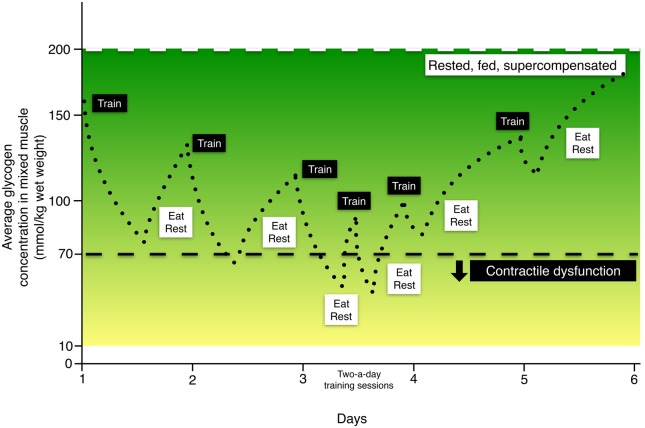
“muscle glycogen might fall to < 50 mmol/kg wet weight.(4,84) When muscle glycogen falls to < 70 mmol/”
BackgroundCarbohydrates for training and competition
Burke, L. M., Hawley, J. A., Wong, S. H. S., & Jeukendrup, A. E. (2011) · Journal of Sports Sciences · doi:10.1080/02640414.2011.585473 · Cited by 985 · cited 1×
“When 24 hours of rest occur between exercise sessions, ingesting a total of 10 g/kg BW, along with enough energy (calories) to maintain energy balance, will maximize glycogen restoration.(4,65,97) As noted above, timing of carbohydrate intake following physical activity is very important during training and competitio…”
BackgroundDietary Guidelines for Americans: Implications for Primary Care Providers
Mosher, A. L., Piercy, K. L., Webber, B. J., Goodwin, S. K., Casavale, K. O., & Olson, R. D. (2016) · American Journal of Lifestyle Medicine · doi:10.1177/1559827614521755 · Cited by 868
Muscle Glycogen during Prolonged Severe Exercise
Hermansen, L., Hultman, E., & Saltin, B. (1967) · Acta Physiologica Scandinavica · doi:10.1111/j.1748-1716.1967.tb03719.x · Cited by 752
Research works printed but not linked: 6
- 40. Hargreaves M. The metabolic systems: carbohydrate metabolism. In: Farrell P, ed. ACSM's Advanced Exercise Physiology. 2nd ed. Philadelphia: Lippincott Williams & Wilkins; 2012:379-391.
- 41. Ivy J. The regulation and synthesis of muscle glycogen by means of nutrient in- tervention. In: Maughan R, ed. Sports Nutrition. Vol. 19. West Sussex, UK: Wiley Blackwell; 2014:113-125.
- 60. Hawley J. Manipulating carbohydrate availability to promote training adaptation. Sports Sci Exchange. 2014;27:1-7.
- US Department of Health and Human Services; US Department of Agriculture, 2015, 2015–2020 Dietary Guidelines for Americans.
- US Department of Agriculture, National Nutrition Database.
- Zelman, Web MD Portion Size Guide.
Cited by
Items 301–308 of 308
Ondrak, K. S., Seicshnaydre, E. A., Duffy, S., Rodriguez, C. L., Scott, C., Gladish, S., & Byerley, L. O. (2026) · Nutrients · doi:10.3390/nu18193300
“In fact, muscle glycogen stores increase following aerobic training [8] when appropriate dietary sources of carbohydrates are provided [9].”
Fisiologi Sistem Energi dan Metabolisme pada Latihan Fisik
Argarini, R., Herawati, L., Rejeki, P. S., & Sari, G. M. (2026) · Airlangga University Press eBooks · doi:10.20473/aup.1715
Human Milk Oligosaccharides in Sports Nutrition: Biological Rationale and Current Evidence
Hu, K., Zhang, K., Huang, C., Wang, Z., Huang, X., Li, Y., Cheng, L., & Wu, Y. (2026) · Nutrients · doi:10.3390/nu18203367
“Adequate energy, carbohydrate, and protein intake supports exercise demands, glycogen restoration, and muscle maintenance [4,5], while individualized fluid and electrolyte replacement helps maintain hydration [6,7].”
Xiong, C. (2026) · Theoretical and Natural Science · doi:10.54254/2753-8818/2026.38401
Штерман, С. В., Сидоренко, А. Ю., Сидоренко, М. Ю., Славянский, А. А., Сидоренко, Ю. И., Штерман, Г. С., & Штерман, С. С. (2026) · Food processing industry · doi:10.52653/ppi.2026.11.11.005
Supporting information 2 of Durability is improved by both low and high intensity endurance training
Matomäki, P., Heinonen, O. J., Nummela, A., Laukkanen, J., Auvinen, E.-P., Pirkola, L., & Kyröläinen, H. (2023) · doi:10.3389/fphys.2023.1128111.s002
Gibson-Smith, E., Storey, R., Michael, M., & Ranchordas, M. (2024) · doi:10.3389/fnut.2023.1277623.s001
Dearlove, D. J., Holdsworth, D., Kirk, T., Hodson, L., Charidemou, E., Kvalheim, E., Stubbs, B., Beevers, A., Griffin, J. L., Evans, R., et al. (2021) · doi:10.3389/fmed.2021.721673.s001
Metadata
- Authors
- Murray, B., & Rosenbloom, C.
- Affiliations
- Sports Science Insights, LLC, Crystal Lake, Illinois, USA
- Georgia State University (US)
- Corresponding author
- Murray, Bob
- ORCID
- Murray, Bob
- Venue
- Nutrition Reviews
- Publisher
- Oxford University Press (OUP)
- Published
- 2018-02-10
- Volume
- 76
- Issue
- 4
- Pages
- 243-259
- ISSN
- 0029-6643 (ISSN-L)
- 1753-4887
- PMC
- PMC6019055
- OpenAlex
- W2792179056
- Semantic Scholar
- 926db46bc3f6eac98a99debb4d3500305b65ca76
- Cited by
- 224
- References
- 149
- Citations by year
- 2026: 28 · 2025: 47 · 2024: 27 · 2023: 34 · 2022: 29 · 2021: 27 · 2020: 16 · 2019: 15 · 2018: 1
- FWCI
- 1.66
- Type
- journal article
- Language
- en
- Open access
- hybrid
- doi.org
- Licence
- Locations
- Nutrition Reviews (publishedVersion, cc-by-nc-nd)
- Europe PMC (PubMed Central) (publishedVersion, cc-by-nc-nd)
- PubMed Central (publishedVersion, cc-by-nc-nd)
- PubMed (publishedVersion)
- Topics
- Health Sciences › Nursing › Nutrition and Dietetics › Muscle metabolism and nutrition
- Health Sciences › Medicine › Orthopedics and Sports Medicine › Sports Performance and Training
- Life Sciences › Biochemistry, Genetics and Molecular Biology › Molecular Biology › Metabolism, Diabetes, and Cancer
- Keywords
- glycogen metabolism, muscle glycogen, glycogen resynthesis, carbohydrate intake, glycogen synthesis, training effects, athletic performance, sports nutrition, post-exercise recovery
- MeSH terms
- Diet, Dietary Carbohydrates, Glycogen, Humans, Sports, Time Factors, Exercise, Muscle, Skeletal, Athletes
About these checks
Registry, retraction, Cites and statistics results are computed, not judged, with one exception: a printed reference that no index lists is read once by a model before it counts as a citation error. Claims are extracted by a model and kept only when their quote appears verbatim in the text; each cited source is then checked, with a model’s help, for whether it says what the claim relies on. Those verdicts can be wrong — read the claim’s quote and the cited source before relying on one.
Statistics and arithmetic are recomputed, not judged.
Confidence bands are shown only for fields calibrated on our annotated test set. None is calibrated yet, so no band is shown.
What counts as a claim ›How we measure confidence ›How we check this ›
Are you an author, or do you see a problem with this page? Request a review
Data sources
Bibliographic data: Semantic Scholar, OpenAlex, Crossref.
Contains information from the Semantic Scholar Academic Graph Datasets, made available under the ODC Attribution License (ODC-BY 1.0).
Semantic Scholar’s data is described in: Kinney, R., et al. (2023). The Semantic Scholar Open Data Platform. arXiv:2301.10140.
