

Public Opinion and Cyberterrorism
Open accessThe DOI matches its Crossref record; 58 of the 63 references it cites were found in a registry or an index, and 5 are not checked yet; 9 of the 49 sources its claims cite were checked for support.
Abstract
Research into cyber-conflict, public opinion, and international security is burgeoning, yet the field suffers from an absence of conceptual agreement about key terms. For instance, every time a cyberattack takes place, a public debate erupts as to whether it constitutes cyberterrorism. This debate bears significant consequences, seeing as the ascription of a “terrorism” label enables the application of heavy-handed counterterrorism powers and heightens the level of perceived threat among the public. In light of widespread conceptual disagreement in cyberspace, we assert that public opinion plays a heightened role in understanding the nature of cyber threats. We construct a typological framework to illuminate the attributes that drive the public classification of an attack as cyberterrorism, which we test through a ratings-based conjoint experiment in the United States, the United Kingdom, and Israel (N = 21,238 observations). We find that the public (1) refrains from labeling attacks by unknown actors or hacker collectives as cyberterrorism; and (2) classifies attacks that disseminate sensitive data as terrorism to a greater extent even than physically explosive attacks. Importantly, the uniform public perspectives across the three countries challenge a foundational tenet of public opinion and international relations scholarship that divided views among elites on foreign policy matters will be reflected by a divided public. This study concludes by providing a definitive conceptual baseline to support future research on the topic.
Verified 2026-11-22 · 5 references not checked yet
Overview
CoChat Summary
## TL;DR
This paper uses a ratings-based conjoint experiment with 3,036 respondents in the United States, United Kingdom, and Israel to identify which cyberattack attributes make people classify an incident as cyberterrorism. The strongest patterns are that unknown actors and hacker collectives are less likely to be labeled cyberterrorism, while attacks that steal and disseminate sensitive data are seen as especially serious and are labeled cyberterrorism at high rates.
## Key findings
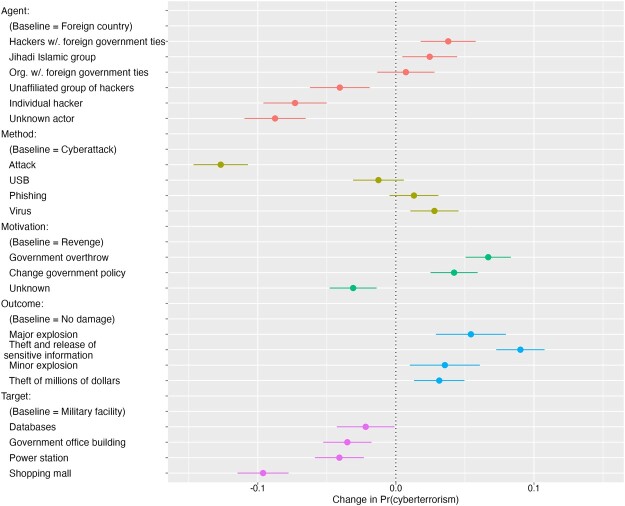
- Across the full sample, an attack described as by an individual hacker was 7.3 percentage points less likely to be classified as cyberterrorism than the baseline (foreign country), and an unaffiliated hacker group was 4.1 percentage points less likely.
- An unknown actor reduced the likelihood of a cyberterrorism label by 8.7 percentage points; an unknown motivation reduced it by 3.1 percentage points.
- Compared with no damage, attacks causing minor physical destruction increased cyberterrorism classification by 3.5 percentage points, and major physical destruction by 5.4 percentage points; attacks involving theft/dissemination of sensitive data increased it by 9.0 percentage points, more than major physical destruction.
- A generic “attack” description lowered cyberterrorism classification by 12.7 percentage points relative to a “cyberattack” description, and the paper reports that there was conspicuously little difference between specific cyber methods such as phishing, malware, virus, and infected USB key.
## Methods
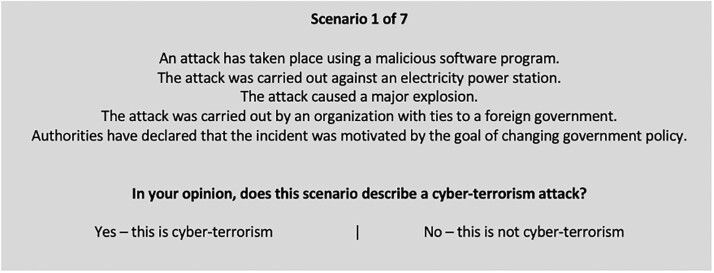
- The study uses a ratings-based conjoint experiment in which respondents classified randomly generated cyberattack scenarios as cyberterrorism or not; each scenario varied along five attributes: agent, method, motivation, outcome, and target.
- Sample: 3,036 respondents who completed all conjoint questions and passed reCAPTCHA, drawn on 26 August 2020 from the United States (N = 1,077), United Kingdom (N = 1,042), and Israel (N = 1,123); the analysis includes 21,238 observations.
- Main analysis: estimation of average marginal component effects (AMCEs) with standard errors clustered by respondent; cross-country differences were additionally examined using conditional marginal means.
## Limitations
- The paper itself notes limited generalizability because the empirical sample focuses heavily on Western, democratic, and technologically advanced countries; the authors say to be wary of overbroad generalizations.
- The text also makes evident that the study is based on survey vignettes/reported scenarios, not real-world incident behavior, and the authors are agnostic about whether media coverage accurately depicts objective facts; that is an evidence limitation from the design.
- Not stated in the paper.
Model-written summary. Check it against the paper before relying on it.
Integrity signals
Registry
Cites
Statistics
Figures
Verification
Claims the paper makes
7 Valid · 1 Not valid · 31 Not checked · 42 Own results and interpretations
The cited sources support only part of this claim — read each source’s verdict below.
In the paper
“Second, the subjective perception of an act as terrorism can influence political attitudes ranging from support for military action to shifts in political orientation (Getmansky and Zeitzoff 2014).”
§ Public Opinion and Cyberterrorism > Why Is Public Opinion Important in Understanding Cyberterrorism?
What the sources say
- Partly supportedcites Getmansky and Zeitzoff 2014 matched to “Terrorism and Voting: The Effect of Rocket Threat on Voting in Israeli Elections” (2014) sourceExperimental — accuracy not yet measured
The Previous Work section (page unavailable) reports that perceived threat after 9/11 was associated with support for aggressive military action; the Implications section says that living within rocket range influenced voting. But the paper addresses perceived threat from terrorism, not whether subjectively classifying a particular act as terrorism changes attitudes. (LLM, conf=0.86)
plainstates a cause- Asserted: passes — The authors put it forward as true.
- Checkable: passes — It can be checked against evidence.
- Load-bearing: passes — The paper’s conclusions depend on it.
- Based: passes — The paper gives a reason why it holds.
- Partly supported
The cited sources that could be checked couldn’t confirm or dispute this claim.
In the paper
“This finding is likely to tamp down the prevalence of the cyberterrorism label, since traditional terrorist organizations have been slow to adopt cyberspace as an attack platform (Gartzke 2013).”
§ Public Opinion and Cyberterrorism > Discussion
What the sources say
- Could not verifycites Gartzke 2013 matched to “The Myth of Cyberwar: Bringing War in Cyberspace Back Down to Earth” (2013) sourceExperimental — accuracy not yet measured
The “Additional Implications of Cyberwar” section argues that cyberattacks are poorly suited to generating terror and says terrorists may adopt them despite their likely ineffectiveness. It does not say whether traditional terrorist organizations have been slow to adopt cyberspace as an attack platform; searches for slow adoption and actual use found no such passage. (LLM, conf=0.70)
plain- Asserted: passes — The authors put it forward as true.
- Checkable: passes — It can be checked against evidence.
- Load-bearing: passes — The paper’s conclusions depend on it.
- Based: passes — The paper gives a reason why it holds.
- Could not verify
The cited sources support only part of this claim — read each source’s verdict below.
In the paper
“This reinforces recent findings that the public views attacks that disseminate sensitive data as seriously as physically destructive attacks (Zubiaga, Procter, and Maple 2018).”
§ Public Opinion and Cyberterrorism > Discussion
What the sources say
- Partly supportedcites Zubiaga, Procter, and Maple 2018 matched to “A longitudinal analysis of the public perception of the opportunities and challenges of the Internet of Things” (2018) sourceExperimental — accuracy not yet measured
The Discussion and conclusions (page unavailable) report that IoT security is a major public concern and that posts about it are predominantly negative. The paper does not compare public reactions to attacks that disseminate sensitive data with reactions to physically destructive attacks. (LLM, conf=0.83)
plain- Asserted: passes — The authors put it forward as true.
- Checkable: passes — It can be checked against evidence.
- Load-bearing: unclear — It is unclear whether the paper’s conclusions depend on it.
- Based: passes — The paper gives a reason why it holds.
- Partly supported
A result the paper reports from its own data — it cites no other source for it, so there is none to check. The quote shows it is in the paper.
In the paper
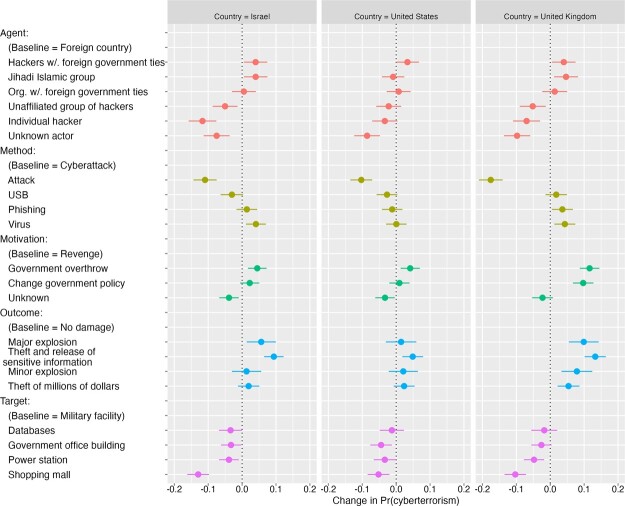
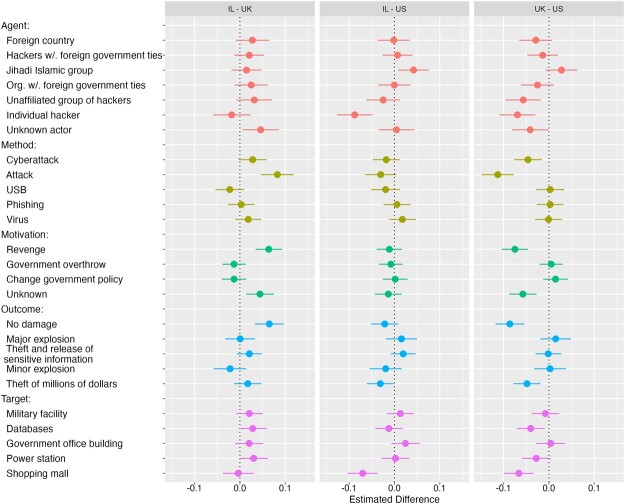
“It is immediately apparent that there is a high level of consistency between countries in how each attribute affects the classification of an incident as cyberterrorism.”
§ Public Opinion and Cyberterrorism > Results > Comparing Cyberterrorism Classifications across Country Samples
boosted- Asserted: passes — The authors put it forward as true.
- Checkable: passes — It can be checked against evidence.
- Load-bearing: passes — The paper’s conclusions depend on it.
- Based: passes — The paper gives a reason why it holds.
A result the paper reports from its own data — it cites no other source for it, so there is none to check. The quote shows it is in the paper.
In the paper
“By contrast, an outcome of monetary theft is not nearly as likely to invoke the specter of cyberterrorism compared to major physical destruction and data acquisition.”
§ Public Opinion and Cyberterrorism > Results > Effects of Attack Attributes on Classification of Incidents as Cyberterrorism
plainstates a cause- Asserted: passes — The authors put it forward as true.
- Checkable: passes — It can be checked against evidence.
- Load-bearing: passes — The paper’s conclusions depend on it.
- Based: passes — The paper gives a reason why it holds.
41 more claims
Create a free account to see all 81 claims and to verify the 1 reference still open.
- It may state two separate claims as one. 20
- Probably not a substantial claim. 17
- The quote only partly states this claim. 1
Citations
Cites
R: A Language and Environment for Statistical Computing
R Core Team (2025) · doi:10.32614/r.manuals · Cited by 352,181
Hainmueller, J., Hopkins, D. J., & Yamamoto, T. (2014) · Political Analysis · doi:10.1093/pan/mpt024 · Cited by 1,990
The Oxford Handbook of Political Psychology
(2023) · Oxford University Press eBooks · doi:10.1093/oxfordhb/9780197541302.001.0001 · Cited by 1,084
The Hidden American Immigration Consensus: A Conjoint Analysis of Attitudes toward Immigrants
Hainmueller, J., & Hopkins, D. J. (2015) · American Journal of Political Science · doi:10.1111/ajps.12138 · Cited by 952
Threat, Anxiety, and Support of Antiterrorism Policies
Huddy, L., Feldman, S., Taber, C., & Lahav, G. (2005) · American Journal of Political Science · doi:10.1111/j.1540-5907.2005.00144.x · Cited by 948
Measuring Subgroup Preferences in Conjoint Experiments
Leeper, T. J., Hobolt, S. B., & Tilley, J. (2020) · Political Analysis · doi:10.1017/pan.2019.30 · Cited by 846
The American People and Foreign Policy.
Moore, B., & Almond, G. A. (1950) · American Sociological Review · doi:10.2307/2086935 · Cited by 723
Rid, T. (2012) · Journal of Strategic Studies · doi:10.1080/01402390.2011.608939 · Cited by 716
Rid, T., & Buchanan, B. (2015) · Journal of Strategic Studies · doi:10.1080/01402390.2014.977382 · Cited by 639
A Bottom‐Up Theory of Public Opinion about Foreign Policy
Kertzer, J. D., & Zeitzoff, T. (2017) · American Journal of Political Science · doi:10.1111/ajps.12314 · Cited by 443
The Myth of Cyberwar: Bringing War in Cyberspace Back Down to Earth
Gartzke, E. (2013) · International Security · doi:10.1162/isec_a_00136 · Cited by 396
The Political Economy of Terrorism
Enders, W., & Sandler, T. (2011) · Cambridge University Press eBooks · doi:10.1017/cbo9780511791451 · Cited by 362
Terrorism and Voting: The Effect of Rocket Threat on Voting in Israeli Elections
GETMANSKY, A., & ZEITZOFF, T. (2014) · American Political Science Review · doi:10.1017/s0003055414000288 · Cited by 351
Canetti-Nisim, D., Halperin, E., Sharvit, K., & Hobfoll, S. E. (2009) · Journal of Conflict Resolution · doi:10.1177/0022002709333296 · Cited by 329
Montalvo, J. G. (2011) · Review of Economics and Statistics · doi:10.1162/rest_a_00115 · Cited by 299
Sainato, V. A. (2013) · Policing: An International Journal of Police Strategies & Management · doi:10.1108/pijpsm.2013.18136baa.005 · Cited by 296
Crossing the Water's Edge: Elite Rhetoric, Media Coverage, and the Rally-Round-the-Flag Phenomenon
Groeling, T., & Baum, M. A. (2008) · The Journal of Politics · doi:10.1017/s0022381608081061 · Cited by 243
Examining Completion Rates in Web Surveys via Over 25,000 Real-World Surveys
Liu, M., & Wronski, L. (2018) · Social Science Computer Review · doi:10.1177/0894439317695581 · Cited by 223 · cited 1×
“35% — a rate that compares favorably to completion metrics in other webbased surveys (Liu and Wronski, 2018).”
BackgroundExploring the Effects of Removing “Too Fast” Responses and Respondents from Web Surveys
Greszki, R., Meyer, M., & Schoen, H. (2015) · Public Opinion Quarterly · doi:10.1093/poq/nfu058 · Cited by 222 · cited 1×
“Following best practice, we refrain from removing “speeders” who complete the survey particularly fast, since their removal does not alter marginal distributions in a meaningful way, and such paticipants are representative of a segment of the larger population who only partially absorb data before reaching political d…”
MethodCyber War versus Cyber Realities: Cyber Conflict in the International System
Valeriano, B., & Maness, R. C. (2015) · doi:10.1093/acprof:oso/9780190204792.001.0001 · Cited by 217
How the Public Defines Terrorism
Huff, C., & Kertzer, J. D. (2018) · American Journal of Political Science · doi:10.1111/ajps.12329 · Cited by 173
Promise and Pitfalls of Terrorism Research
Young, J. K., & Findley, M. G. (2011) · International Studies Review · doi:10.1111/j.1468-2486.2011.01015.x · Cited by 171
Reality Asserts Itself: Public Opinion on Iraq and the Elasticity of Reality
Baum, M. A., & Groeling, T. (2010) · International Organization · doi:10.1017/s0020818310000172 · Cited by 161
Public attribution of cyber intrusions
Egloff, F. J. (2020) · Journal of Cybersecurity · doi:10.1093/cybsec/tyaa012 · Cited by 151
The social and psychological impact of cyberattacks
Bada, M., & Nurse, J. R. C. (2020) · Emerging Cyber Threats and Cognitive Vulnerabilities · doi:10.1016/b978-0-12-816203-3.00004-6 · Cited by 131
Weimann, G. (2012) · Journal of Terrorism Research · doi:10.15664/jtr.405 · Cited by 107
What’s in a Name? Metaphors and Cybersecurity
Branch, J. (2021) · International Organization · doi:10.1017/s002081832000051x · Cited by 94
Cyberattacks, Psychological Distress, and Military Escalation: An Internal Meta-Analysis
Shandler, R., Gross, M. L., & Canetti, D. (2022) · Journal of Global Security Studies · doi:10.1093/jogss/ogac042 · Cited by 94
Self-citationThe Microfoundations of State Cybersecurity: Cyber Risk Perceptions and the Mass Public
Kostyuk, N., & Wayne, C. (2021) · Journal of Global Security Studies · doi:10.1093/jogss/ogz077 · Cited by 93 · cited 2×
“Again, this makes sense given that those with some level of digital proficiency will understand the potential limitations that hinder the ability of individual hackers from causing substantial damage (Kostyuk and Wayne, 2020).”
BackgroundSelf-citationThe hidden threat of cyber-attacks – undermining public confidence in government
Shandler, R., & Gomez, M. A. (2023) · Journal of Information Technology & Politics · doi:10.1080/19331681.2022.2112796 · Cited by 93
Self-citationLin-Greenberg, E. (2021) · Foreign Policy Analysis · doi:10.1093/fpa/orab009 · Cited by 91
The Oxford handbook of international political theory
Royer, C. (2018) · International Affairs · doi:10.1093/ia/iiy120 · Cited by 90
Cyberterrorism: its effects on psychological well-being, public confidence and political attitudes
Gross, M. L., Canetti, D., & Vashdi, D. R. (2017) · Journal of Cybersecurity · doi:10.1093/cybsec/tyw018 · Cited by 89
The psychological effects of cyber terrorism
Gross, M. L., Canetti, D., & Vashdi, D. R. (2016) · Bulletin of the Atomic Scientists · doi:10.1080/00963402.2016.1216502 · Cited by 84
Breaking the Myth of Cyber Doom: Securitization and Normalization of Novel Threats
Gomez, M. A., & Whyte, C. (2021) · International Studies Quarterly · doi:10.1093/isq/sqab034 · Cited by 82
Zeitzoff, T. (2014) · Political Psychology · doi:10.1111/pops.12065 · Cited by 78
Cyberattacks, Cyber Threats, and Attitudes Toward Cybersecurity Policies
Snider, K. L. G., Shandler, R., Zandani, S., & Canetti, D. (2021) · Journal of Cybersecurity · doi:10.1093/cybsec/tyab019 · Cited by 70
Self-citationHow Public Opinion Information Changes Politicians’ Opinions and Behavior
Sevenans, J. (2021) · Political Behavior · doi:10.1007/s11109-021-09715-9 · Cited by 69
Cyber Terrorism and Public Support for Retaliation – A Multi-Country Survey Experiment
Shandler, R., Gross, M. L., Backhaus, S., & Canetti, D. (2022) · British Journal of Political Science · doi:10.1017/s0007123420000812 · Cited by 61
Self-citationWho is a Terrorist? Ethnicity, Group Affiliation, and Understandings of Political Violence
D’Orazio, V., & Salehyan, I. (2018) · International Interactions · doi:10.1080/03050629.2018.1500911 · Cited by 59
War and Democratic Constraint: How the Public Influences Foreign Policy
Mortimer, E. (2016) · The RUSI Journal · doi:10.1080/03071847.2016.1152127 · Cited by 54
Cyber Terrorism: Its Effects on Psychological Well Being, Public Confidence and Political AttitudesPreprint
Gross, M. L. (2016) · SSRN Electronic Journal · doi:10.2139/ssrn.2836199 · Cited by 54
Shandler, R., Gross, M. L., & Canetti, D. (2021) · Contemporary Security Policy · doi:10.1080/13523260.2020.1868836 · Cited by 45
Self-citationShechory-Bitton, M., & Cohen-Louck, K. (2018) · International Journal of Offender Therapy and Comparative Criminology · doi:10.1177/0306624x16658472 · Cited by 41
Zubiaga, A., Procter, R., & Maple, C. (2018) · PLOS ONE · doi:10.1371/journal.pone.0209472 · Cited by 38
A Cyberterrorism Effect? Emotional Reactions to Lethal Attacks on Critical Infrastructure
Backhaus, S., Gross, M. L., Waismel-Manor, I., Cohen, H., & Canetti, D. (2020) · Cyberpsychology Behavior and Social Networking · doi:10.1089/cyber.2019.0692 · Cited by 38
Outsourcing cyber power: Why proxy conflict in cyberspace may no longer pay
Canfil, J. K. (2020) · Journal of Cybersecurity · doi:10.1093/cybsec/tyac007 · Cited by 38
What Is Cyberterrorism? Findings From a Survey of Researchers
Jarvis, L., & Macdonald, S. (2015) · Terrorism and Political Violence · doi:10.1080/09546553.2013.847827 · Cited by 36
Jarvis, L., Macdonald, S., & Whiting, A. (2017) · European Journal of International Security · doi:10.1017/eis.2016.14 · Cited by 33
Terrorism in the eyes of the beholder: The impact of causal attributions on perceptions of violence.
Kimhi, S., Canetti-Nisim, D., & Hirschberger, G. (2009) · Peace and Conflict: Journal of Peace Psychology · doi:10.1080/10781910802589899 · Cited by 32
Geis, A., & Wunderlich, C. (2014) · International Politics · doi:10.1057/ip.2014.19 · Cited by 27
The materiality of cyberthreats: securitization logics in popular visual culture
Cavelty, M. D. (2019) · Critical Studies on Security · doi:10.1080/21624887.2019.1666632 · Cited by 24
Understanding, Locating and Constructing Cyberterrorism
Jarvis, L., Nouri, L., & Whiting, A. (2014) · Springer eBooks · doi:10.1007/978-1-4939-0962-9_2 · Cited by 23
Social Media’s Challenge to Journalistic Norms and Values during a Terror Attack
Konow-Lund, M. T., & Olsson, E. (2016) · Digital Journalism · doi:10.1080/21670811.2016.1243990 · Cited by 21
Cybersecurity Discourse in the United States: Cyber-Doom Rhetoric and Beyond
Lawson, S. T. (2019) · Routledge eBooks · doi:10.4324/9781315505619 · Cited by 20
Warring from the virtual to the real: Assessing the public’s threshold for war over cyber security
Kreps, S., & Das, D. (2017) · Research & Politics · doi:10.1177/2053168017715930 · Cited by 18
War and Democratic Constraint: How the Public Influences Foreign Policy
Baum, M. A., & Potter, P. B. K. (2015) · doi:10.23943/princeton/9780691164984.001.0001 · Cited by 17
Definitions of Cyber Terrorism
Luiijf, E. (2014) · Cyber Crime and Cyber Terrorism Investigator's Handbook · doi:10.1016/b978-0-12-800743-3.00002-5 · Cited by 15
The Political Psychology of Cyberterrorism
Shandler, R., Snider, K. L. G., & Canetti, D. (2022) · The Cambridge Handbook of Political Psychology · doi:10.1017/9781108779104.038 · Cited by 13
Self-citationMotives Don't Matter? Motive Attribution and Counterterrorism Policy
Canetti, D., Gubler, J., & Zeitzoff, T. (2021) · Political Psychology · doi:10.1111/pops.12708 · Cited by 6
Terrorism and the Internet of Things: Cyber-Terrorism as an Emergent Threat
Henschke, A. (2021) · Advanced Sciences and Technologies for Security Applications · doi:10.1007/978-3-030-90221-6_5 · Cited by 4
The Political Psychology of Terrorism
Snider, K. L. G., Shandler, R., Matzkin, S., & Canetti, D. (2023) · Oxford University Press eBooks · doi:10.1093/oxfordhb/9780197541302.013.13 · Cited by 4
Self-citationMoral Dilemmas of Asymmetric Conflict
Gross, M. L. (2018) · The Oxford Handbook of International Political Theory · doi:10.1093/oxfordhb/9780198746928.013.17 · Cited by 2
Research works printed but not linked: 2
- Hoffman Bruce. 2006. Inside Terrorism. New York: Columbia University Press.
- Zeri Norshahida Noor, Noordin Noor Nirwandy Mat. 2017. “ Framing Cyberterrorism: A Content Analysis of the New York Times.” Journal of Media and Information Warfare 9: 179– 200.
Cited by
Cyberattacks, Psychological Distress, and Military Escalation: An Internal Meta-Analysis
Shandler, R., Gross, M. L., & Canetti, D. (2022) · Journal of Global Security Studies · doi:10.1093/jogss/ogac042 · Cited by 94
Self-citationWang, S., Li, Q., & Khaskheli, M. B. (2024) · Systems · doi:10.3390/systems12080305 · Cited by 30
Introduction: Cyber-conflict – Moving from speculation to investigation
Shandler, R., & Canetti, D. (2024) · Journal of Peace Research · doi:10.1177/00223433231219441 · Cited by 30
“Experimentalists must tread a careful ethical path in exposing participants to cyber threats that are capable of arousing severe harms (Backhaus et al., 2020; Canetti et al., 2017; Gross et al., 2016; Shandler et al., 2023a), yet the value of making robust causal arguments has powerful appeal.”
BackgroundSelf-citationCyberattacks and public opinion – The effect of uncertainty in guiding preferences
Jardine, E., Porter, N. D., & Shandler, R. (2024) · Journal of Peace Research · doi:10.1177/00223433231218178 · Cited by 26
“Recent studies have demonstrated that exposure to cyberattacks elicits strong emotional responses that can sway subsequent decision-making (Backhaus et al., 2020; Canetti et al., 2017; Shandler et al., 2023a).”
BackgroundSelf-citationHow the process of discovering cyberattacks biases our understanding of cybersecurity
Oppenheimer, H. (2024) · Journal of Peace Research · doi:10.1177/00223433231217687 · Cited by 36
“How do cam-paigns that explicitly target the public shape politics (Shandler et al., 2023; Vicic and Gartzke, 2024)?”
BackgroundSelf-citation
Metadata
- Authors
- Shandler, R., Kostyuk, N., & Oppenheimer, H.
- Affiliations
- University of Oxford (GB)
- Georgia Institute of Technology (US)
- Harvard University (US)
- Corresponding author
- Shandler, Ryan
- Venue
- Public Opinion Quarterly
- Publisher
- Oxford University Press (OUP)
- Published
- 2023-02-01
- Volume
- 87
- Issue
- 1
- Pages
- 92-119
- ISSN
- 0033-362X (ISSN-L)
- 1537-5331
- PMC
- PMC10127534
- OpenAlex
- W4362591733
- Semantic Scholar
- 0dbf89a0a068f91f21ae7077845e315b7419a844
- Cited by
- 14
- References
- 60
- Citations by year
- 2026: 1 · 2025: 4 · 2024: 6 · 2023: 2
- FWCI
- 12.72
- Type
- journal article
- Language
- en
- Open access
- hybrid
- doi.org
- Licence
- Locations
- Public Opinion Quarterly (publishedVersion, cc-by)
- PubMed Central (publishedVersion, cc-by)
- PubMed (publishedVersion)
- Funders
- Georgia Institute of Technology
- University of Haifa
- Topics
- Social Sciences › Political Science and International Relations › Cybersecurity and Cyber Warfare Studies
- Social Sciences › Sociology and Political Science › Terrorism, Counterterrorism, and Political Violence
- Physical Sciences › Computer Science › Information Systems › Information and Cyber Security
- Keywords
- cyberterrorism, public opinion, cyberattacks, typological framework, data leakage, threat perception, international security, cyber conflict
About these checks
Registry, retraction, Cites and statistics results are computed, not judged, with one exception: a printed reference that no index lists is read once by a model before it counts as a citation error. Claims are extracted by a model and kept only when their quote appears verbatim in the text; each cited source is then checked, with a model’s help, for whether it says what the claim relies on. Those verdicts can be wrong — read the claim’s quote and the cited source before relying on one.
The claim verdicts this report counts are experimental: their accuracy is not yet measured.
A language model drew the claims from the paper on 2026-10-11, under version 3 of the claim definition (model deepseek-v4.1-flash, prompt extract-v3).
A second model labelled each claim on 2026-10-11 (model jev-1.13-20260917, definition revision gold-guideline-v0.2).
Cited sources are checked with a language model’s help (gpt-6-sol).
Statistics and arithmetic are recomputed, not judged.
Confidence bands are shown only for fields calibrated on our annotated test set. None is calibrated yet, so no band is shown.
What counts as a claim ›How we measure confidence ›How we check this ›
Are you an author, or do you see a problem with this page? Request a review
Data sources
Bibliographic data: Semantic Scholar, OpenAlex, Crossref.
Contains information from the Semantic Scholar Academic Graph Datasets, made available under the ODC Attribution License (ODC-BY 1.0).
Semantic Scholar’s data is described in: Kinney, R., et al. (2023). The Semantic Scholar Open Data Platform. arXiv:2301.10140.
