

Workplace Heterogeneity and the Rise of West German Wage Inequality*
The DOI matches its Crossref record; 144 of the 147 references it cites were found in a registry or an index, and 1 are not checked yet; none of the 8 sources its claims cite is checked for support yet.
Abstract
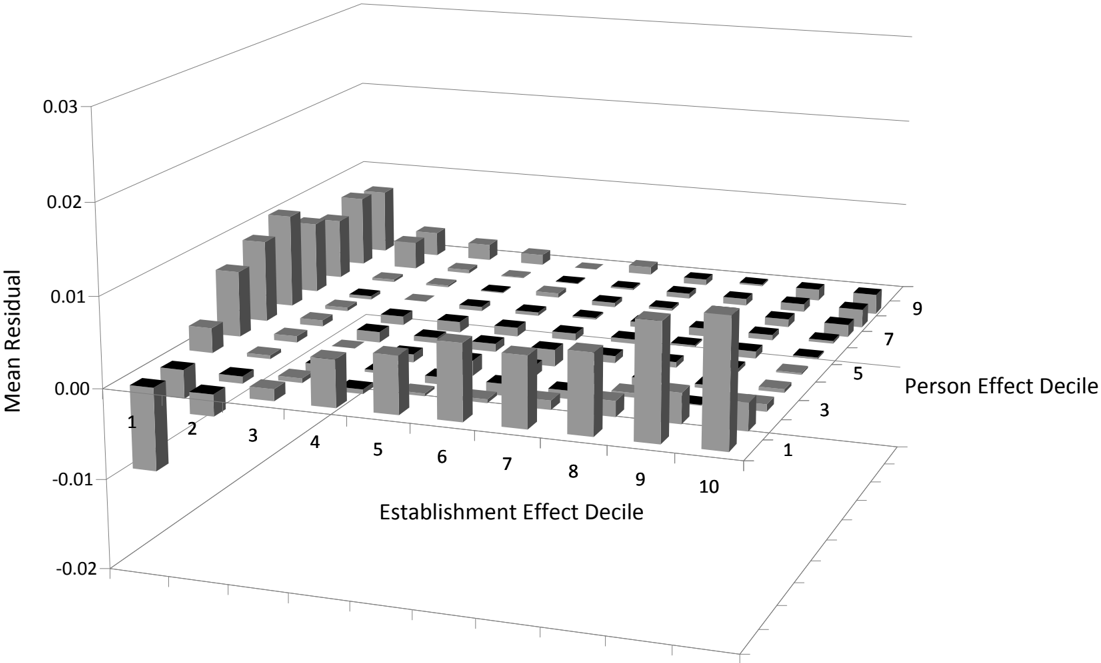
We study the role of establishment-specific wage premiums in generating recent increases in West German wage inequality. Models with additive fixed effects for workers and establishments are fit into four subintervals spanning the period from 1985 to 2009. We show that these models provide a good approximation to the wage structure and can explain nearly all of the dramatic rise in West German wage inequality. Our estimates suggest that the increasing dispersion of West German wages has arisen from a combination of rising heterogeneity between workers, rising dispersion in the wage premiums at different establishments, and increasing assortativeness in the assignment of workers to plants. In contrast, the idiosyncratic job-match component of wage variation is small and stable over time. Decomposing changes in mean wages between different education groups, occupations, and industries, we find that increasing plant-level heterogeneity and rising assortativeness in the assignment of workers to establishments explain a large share of the rise in inequality along all three dimensions.
Checked 2026-11-19 · 1 reference not checked yet
Overview
CoChat Summary
TL;DR
Using West German administrative data from 1985–2009, the paper shows that models with additive person and establishment fixed effects explain nearly all of the rise in wage inequality. The increase is driven by rising worker-effect variance, rising establishment-premium variance, and increased assortative matching of high-wage workers to high-wage plants.
Key findings
- In the AKM variance decomposition, total log-wage variance rose from 0.137 in interval 1 (1985–1991) to 0.249 in interval 4 (2002–2009). The variance of person effects rose from 0.084 to 0.127 and contributed 39% of the total rise; establishment-effect variance rose from 0.025 to 0.053 and contributed 25%; the covariance term rose from 0.003 to 0.041 and contributed 34%.
- Assortative matching increased: the correlation between person and establishment effects rose from 0.034 in interval 1 to 0.249 in interval 4. Counterfactuals imply that holding sorting constant would have produced 69% of the actual variance rise, while holding establishment-effect variance constant would have produced 64%.
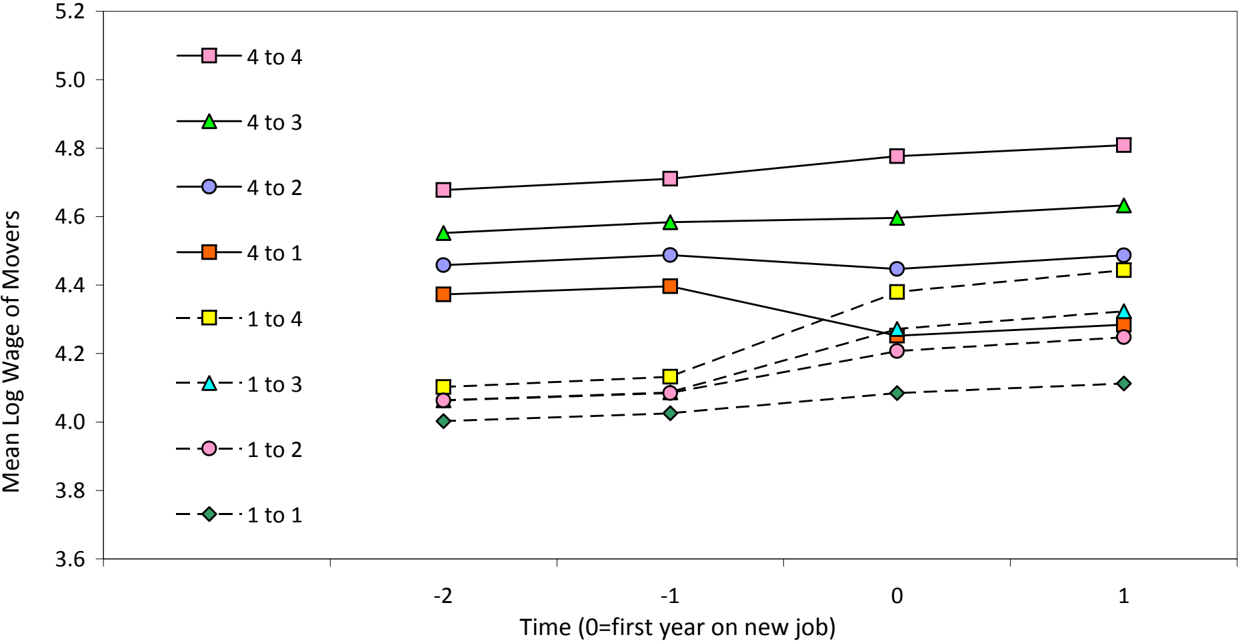
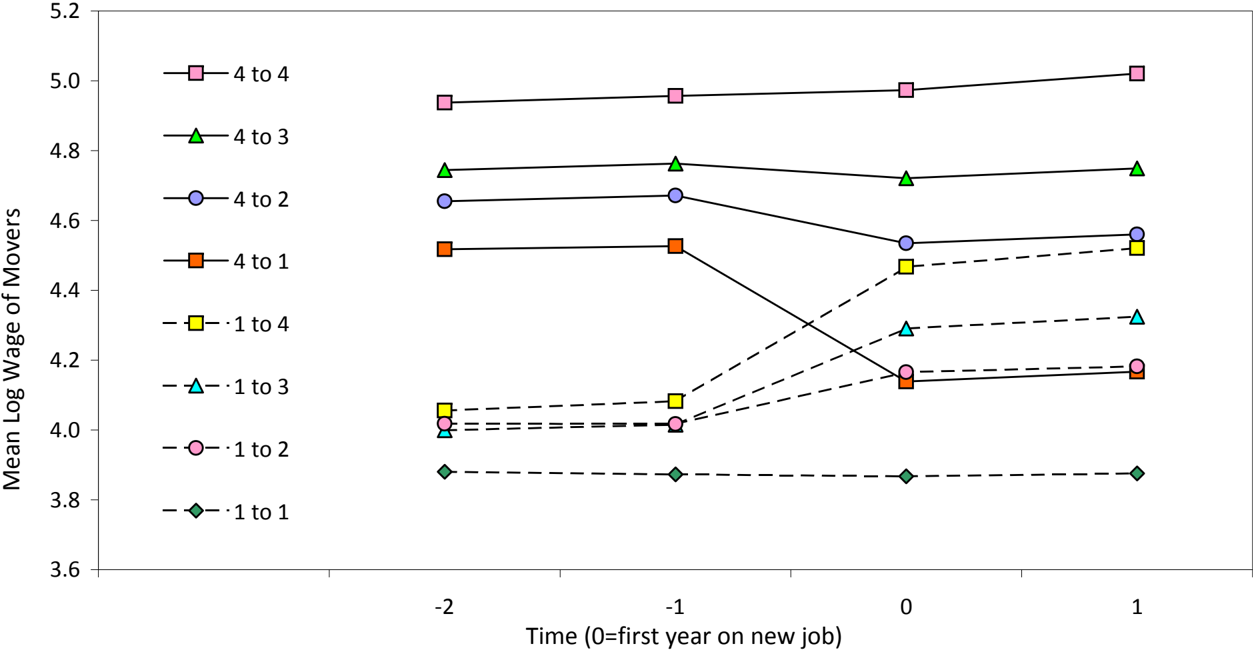
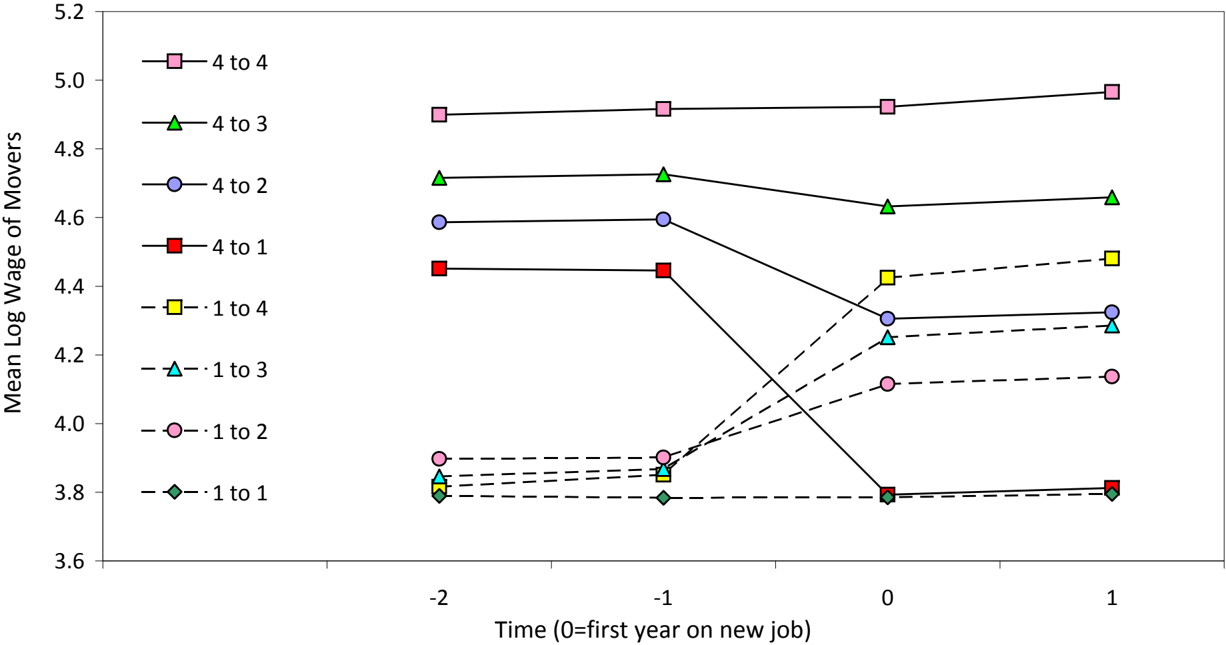
- Job-mobility event studies show growing establishment premia: a trend-adjusted move from quartile 1 to quartile 4 co-worker-wage establishments was associated with a 23 log-point gain in 1985–1991 versus 47 log points in 2002–2009; the reverse move yielded losses of 22 versus 43 log points.
- Between-group decompositions attribute 70% of the relative rise in university-educated men’s wages and 80% of the relative fall for workers with no/missing qualifications to establishment effects. For occupations, 42% of the rise in between-occupation variance is from person–establishment covariance, 28% from establishment variance, and about 30% from person variance; for industries, 44% is person variance, 19% establishment variance, and 42% sorting.
Methods
- Data: German Social Security records from the IEB, focusing on full-time West German men age 20–60 from 1985–2009, with parallel analyses for full-time women. The main sample has 85–90 million person-year observations per interval and about 17 million individual workers.
- Model: AKM-style log daily wage equation with additive person fixed effects, establishment fixed effects, time-varying covariates, and an error component; estimated by OLS on the largest connected set of establishments linked by worker mobility. Censored earnings are imputed using Tobit models.
- Analyses: variance decompositions and counterfactuals across four overlapping intervals (1985–1991, 1990–1996, 1996–2002, 2002–2009); event studies of job changers; decompositions of between-group wage gaps by education, occupation, and industry; and establishment cohort/collective-bargaining analyses.
Limitations
- The paper states that earnings are censored at the Social Security maximum (10–12% of male observations and 1–3% of female observations per year), so it uses Tobit imputation and checks robustness using apprentice-trained men, who have lower censoring rates.
- The paper states that establishment identifiers are administrative: ownership changes can create new establishment IDs, and only about half of EID births/deaths are estimated to be true plant openings/closings. It also states that sampling errors bias estimated variances upward and the covariance downward, and it does not construct bias-corrected estimates, assuming biases are similar across intervals.
- The paper states that collective bargaining cannot be assigned a causal role because firms choose coverage, and that female estimates may have more negatively biased covariance terms due to fewer observed matches per plant/worker. Evident from the text: the main analysis is restricted to full-time workers in West Germany, excluding civil servants, self-employed, and many part-time/mini-job workers, which limits generalizability.
Model-written summary. Check it against the paper before relying on it.
Integrity signals
Registry
Cites
Statistics
Figures


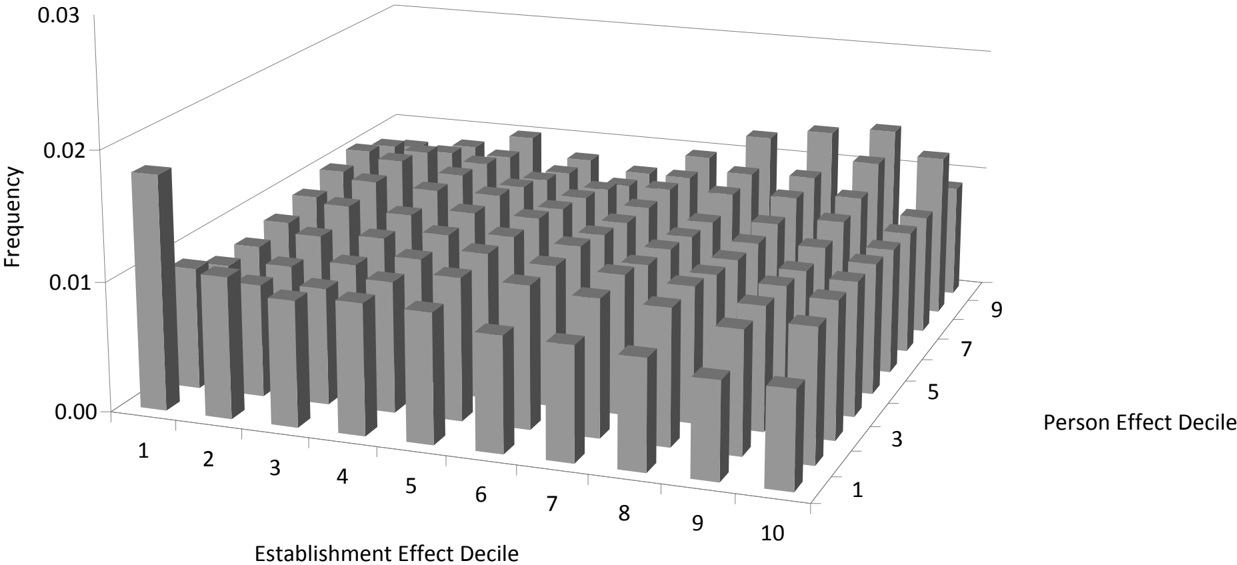
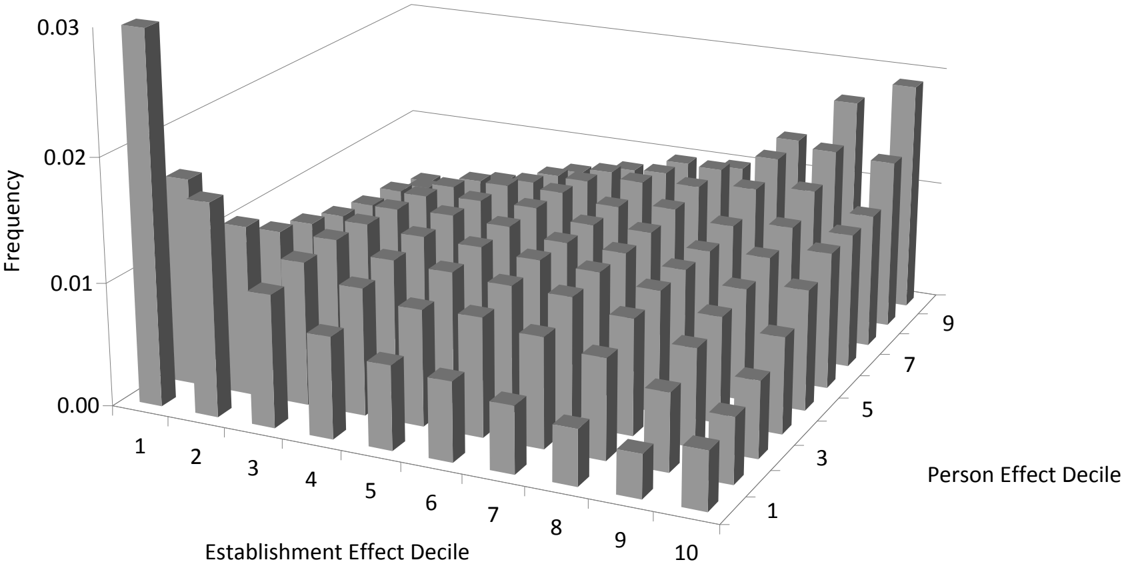
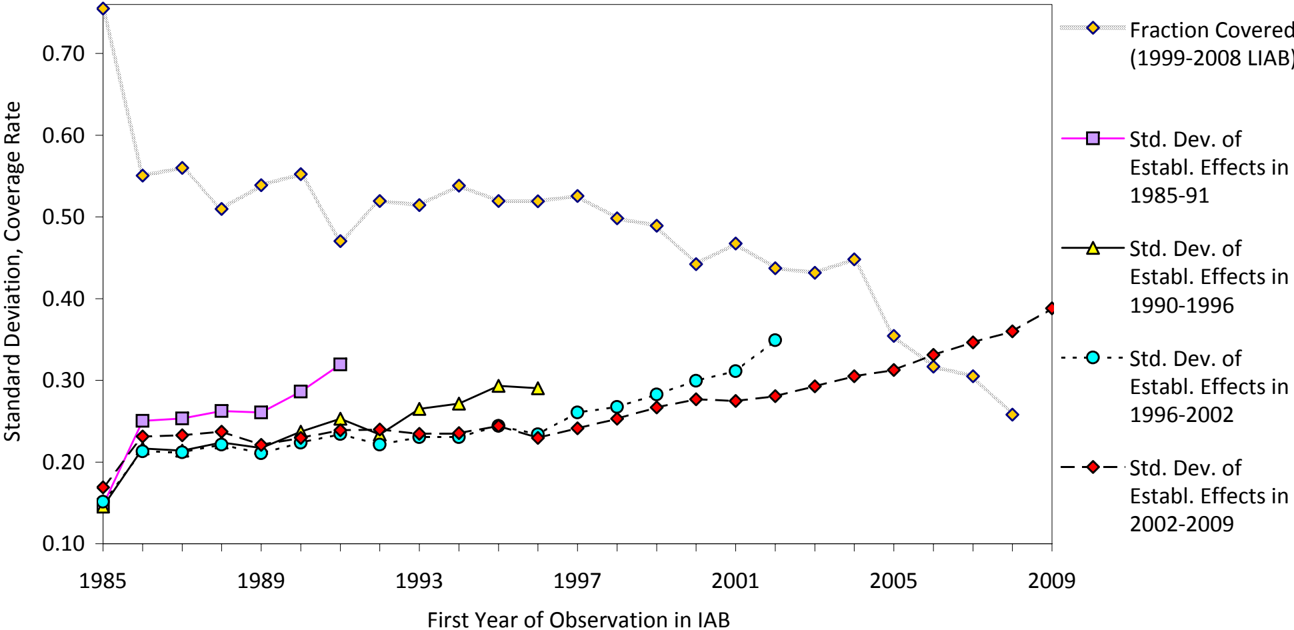
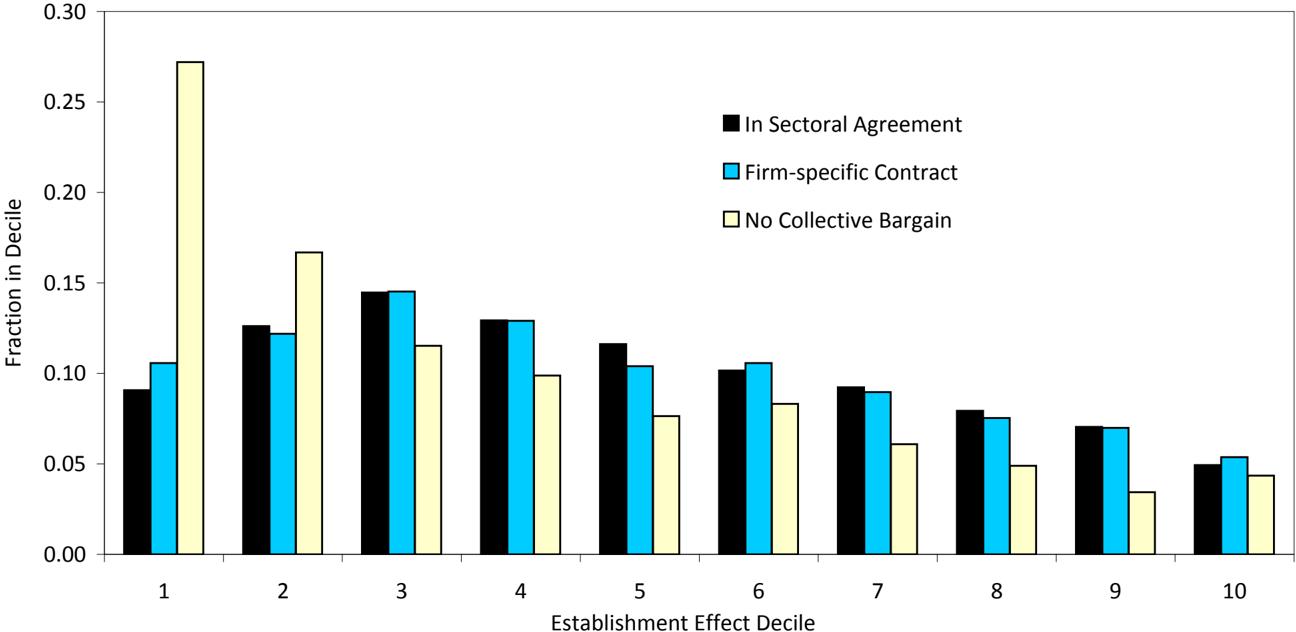
Verification
Claims the paper makes
0 Valid · 0 Not valid · 8 Not checked · 191 Own results and interpretations
A result the paper reports from its own data — it cites no other source for it, so there is none to check. The quote shows it is in the paper.
In the paper
“In particular, generalized non-separable models with xed e/ects for each job yield only a small improvement in explanatory power relative to the AKM speci cation, both within narrow time intervals and between intervals.”
plain- Asserted: passes — The authors put it forward as true.
- Checkable: passes — It can be checked against evidence.
- Load-bearing: passes — The paper’s conclusions depend on it.
- Based: passes — The paper gives a reason why it holds.
A result the paper reports from its own data — it cites no other source for it, so there is none to check. The quote shows it is in the paper.
In the paper
“Classifying establishments by entry year, we nd a trend toward increasing heterogeneity among establishments that entered the labor market after the mid-1990s, coupled with relatively small changes in the variability of the premiums paid by continuing establishments.”
plain- Asserted: passes — The authors put it forward as true.
- Checkable: passes — It can be checked against evidence.
- Load-bearing: passes — The paper’s conclusions depend on it.
- Based: passes — The paper gives a reason why it holds.
A result the paper reports from its own data — it cites no other source for it, so there is none to check. The quote shows it is in the paper.
In the paper
“We nd that two-thirds of the increase in the pay gap between higher and lower-educated workers is attributable to a widening in the average workplace pay premiums received by di/erent education groups.”
plainstates a cause- Asserted: passes — The authors put it forward as true.
- Checkable: passes — It can be checked against evidence.
- Load-bearing: passes — The paper’s conclusions depend on it.
- Based: passes — The paper gives a reason why it holds.
A result the paper reports from its own data — it cites no other source for it, so there is none to check. The quote shows it is in the paper.
In the paper
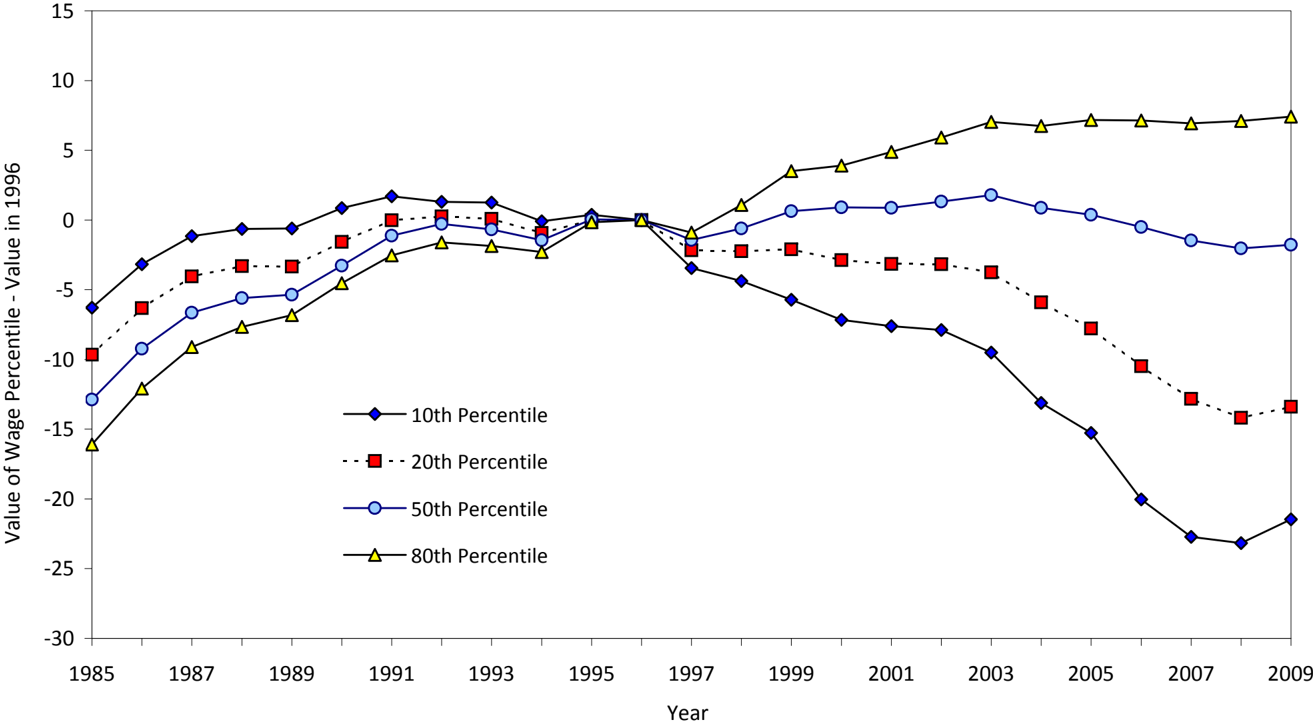
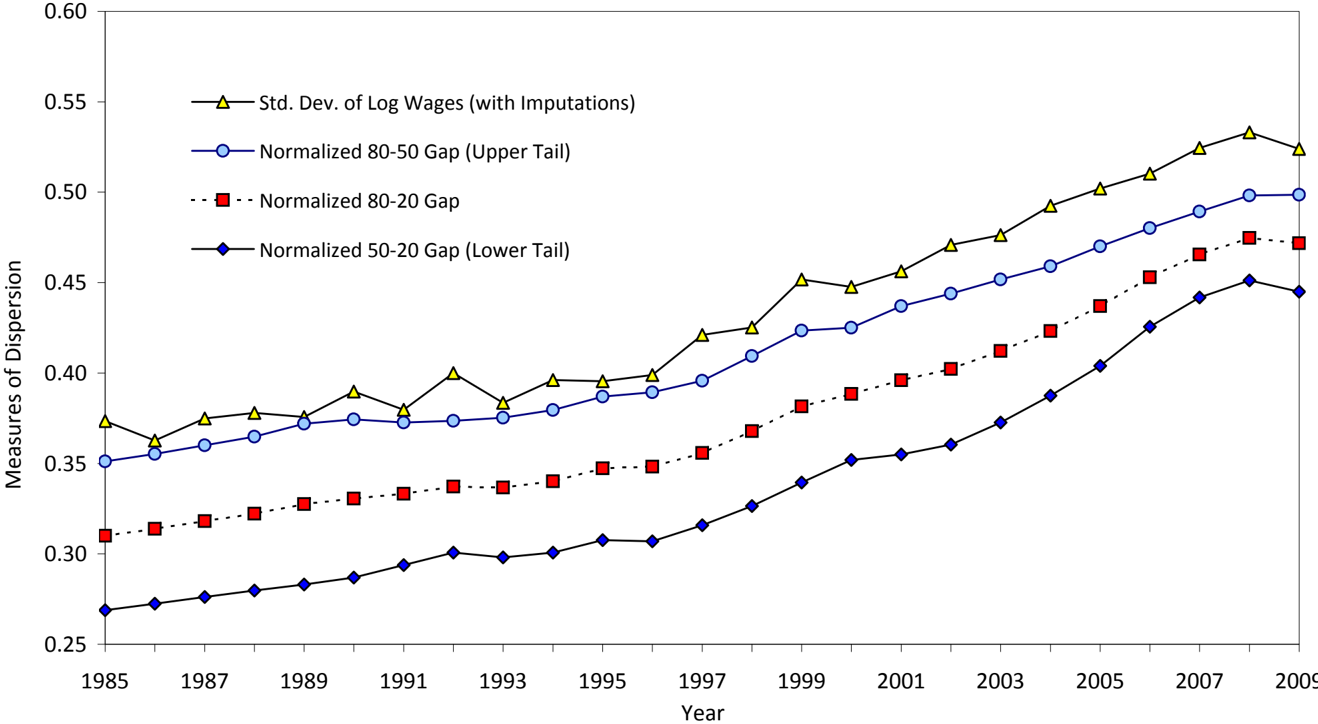
“In particular, the standard deviation rose by 15 log points from 1985 to 2009, the (normalized) 80-20 gap rose by 16 log points, the 80-50 gap rose by 15 log points, and the 50-20 gap rose by 18 log points.”
plain- Asserted: passes — The authors put it forward as true.
- Checkable: passes — It can be checked against evidence.
- Load-bearing: unclear — It is unclear whether the paper’s conclusions depend on it.
- Based: passes — The paper gives a reason why it holds.
118 more claims
Create a free account to see all 199 claims and to verify the 4 references still open.
- It may state two separate claims as one. 61
- Probably not a substantial claim. 17
- The quote only partly states this claim. 3
Claims other papers make about this one
Each is checked against this paper’s own text: does it say what the citing paper says it does?
The check wasn’t confident either way, so it gives no verdict — never disputed.
In the citing paper
“We estimate below that 75% is labor income.16”
From “Capitalists in the Twenty-First Century” (2019) · cites this paper as [16]
Experimental — accuracy not yet measured
Citations
Cites
A heteroskedasticity-consistent covariance matrix estimator and a direct test for heteroskedasticity
White, H. (1980) · Econometrica · doi:10.2307/1912934 · Cited by 25,861
The Skill Content of Recent Technological Change: An Empirical Exploration
Autor, D. H., Levy, F., & Murnane, R. J. (2003) · The Quarterly Journal of Economics · doi:10.1162/003355303322552801 · Cited by 6,205
On the Pooling of Time Series and Cross Section Data
Mundlak, Y. (1978) · Econometrica · doi:10.2307/1913646 · Cited by 5,412
Changes in Relative Wages, 1963-1987: Supply and Demand Factors
Katz, L. F., & Murphy, K. M. (1992) · The Quarterly Journal of Economics · doi:10.2307/2118323 · Cited by 4,793
Equilibrium Unemployment as a Worker Discipline Device
Shapiro, C., & Stiglitz, J. E. (1986) · Efficiency Wage Models of the Labor Market · doi:10.1017/cbo9780511559594.004 · Cited by 4,652
Misallocation and Manufacturing TFP in China and India*
Hsieh, C.-T., & Klenow, P. J. (2009) · Quarterly Journal of Economics · doi:10.1162/qjec.2009.124.4.1403 · Cited by 4,175
Job Creation and Job Destruction in the Theory of Unemployment
Mortensen, D. T., & Pissarides, C. A. (1994) · The Review of Economic Studies · doi:10.2307/2297896 · Cited by 3,840
Hybrid Corn: An Exploration in the Economics of Technological Change
Griliches, Z. (1957) · Econometrica · doi:10.2307/1905380 · Cited by 3,330
Labor Contracts as Partial Gift Exchange
Akerlof, G. A. (1982) · The Quarterly Journal of Economics · doi:10.2307/1885099 · Cited by 3,210
Plants and Productivity in International Trade
Bernard, A. B., Eaton, J., Jensen, J. B., & Kortum, S. (2003) · American Economic Review · doi:10.1257/000282803769206296 · Cited by 2,980
Research works printed but not linked: 1
- 70. Rees, Albert and George Schultz. 1970. Workers in an Urban Labor Market. Chicago: University of Chicago Press.
Cited by
Items 1,501–1,600 of 1,904
Flexible Specification Testing in Semi-Parametric Quantile Regression ModelsPreprint
Kutzker, T., Klein, N., & Wied, D. (2021) · arXiv (Cornell University)
College Wage Premium in China: from the Perspective of Skill-Biased Technical ChangePreprint
Guo, K., & Wang, Y. (2020) · SSRN Electronic Journal · doi:10.2139/ssrn.3613630
Smith, B. S. (2019) · SSRN Electronic Journal · doi:10.2139/ssrn.3426750
Essays on firms' market power: from microdata to macroeconomic performance.
Bormans, Y. (2021) · Lirias
Essays on physician innovation and practice style in healthcare markets
Badinski, I. N. (2021) · DSpace@MIT (Massachusetts Institute of Technology)
Essays in Empirical Labour Economics
Lattanzio, S. (2021) · Apollo (University of Cambridge) · doi:10.17863/cam.72873
Chaudhary, A. (2021) · SSRN Electronic Journal · doi:10.2139/ssrn.3945589
Wage inequality within and across firms: the role of market forces, government and firm policies
Schönberg, U. (2021) · The Project Repository Journal · doi:10.54050/prj10032035
Three essays on economics of education
Cohn, R. M. (2021) · Summit (Simon Fraser University)
Three Essays on Worker-Firm Dynamics
Patki, D. (2020) · Deep Blue (University of Michigan)
'Are You in the Right Job?' Human Capital Mismatch in the UKPreprint
Galanakis, Y. (2023) · SSRN Electronic Journal · doi:10.2139/ssrn.4383363 · Cited by 1
Multi-dimensional Skills and Partial SpecializationPreprint
Liu, C. (2021) · SSRN Electronic Journal · doi:10.2139/ssrn.3832431
Goryunov, M. (2016) · ASEP
Hacker, J. S., Hertel‐Fernandez, A., Pierson, P., & Thelen, K. (2021) · Cambridge University Press eBooks · doi:10.1017/9781009029841.016
Teatro as escuras: o romance de Uilson Pereira
dos Reis, E. P. (1995) · doi:10.47749/t/unicamp.1995.99138
Inequality and Income Dynamics in GermanyPreprint
Drechsel-Grau, M., Peichl, A., Schmieder, J. F., Schmid, K. D., Walz, H., & Wolter, S. (2022) · SSRN Electronic Journal · doi:10.2139/ssrn.4048526
Technological Change and the Finance Wage PremiumPreprint
Bertay, A. C., Carreño, J. G., Huizinga, H., Uras, B. R., & Vellekoop, N. (2022) · SSRN Electronic Journal · doi:10.2139/ssrn.4016513
Inequality and Income Dynamics in GermanyPreprint
Drechsel-Grau, M., Peichl, A., Schmieder, J. F., Schmid, K. D., Walz, H., & Wolter, S. (2022) · SSRN Electronic Journal · doi:10.2139/ssrn.4074279
Employment Research, Vol. 23, No. 1, January 2016
(2016) · Employment Research · doi:10.17848/1075-8445.23(1
Firm Pay DynamicsPreprint
Engbom, N., Moser, C., & Sauermann, J. (2022) · SSRN Electronic Journal · doi:10.2139/ssrn.4114544
Characteristics contributing to low- and minimum-wage labour in Germany
Dütsch, M., & Himmelreicher, R. K. (2022) · doi:10.20378/irb-54129
Malleability of Alcohol Consumption: Evidence from MigrantsPreprint
Hinnosaar, M., & Liu, E. (2022) · SSRN Electronic Journal · doi:10.2139/ssrn.4165317
Rising concentration and wage inequalityPreprint
Cortés, G. M., & Tschopp, J. (2024) · RePEc: Research Papers in Economics · doi:10.48350/189411
New Imported Inputs, Wages and Worker MobilityPreprint
Colantone, I., Matano, A., & Naticchioni, P. (2018) · SSRN Electronic Journal · doi:10.2139/ssrn.3261742
Paying Gig Workers - Evidence from a Field ExperimentPreprint
Butschek, S., Amor, R. G., Kampkötter, P., & Sliwka, D. (2019) · RePEc: Research Papers in Economics
Unequal Use of Social Insurance Benefits: The Role of EmployersPreprint
Bana, S., Bedard, K., Rossin‐Slater, M., & Stearns, J. (2018) · RePEc: Research Papers in Economics
Empirical Essays in Public Economics
Kindsgrab, P. M. (2022) · Deep Blue (University of Michigan) · doi:10.7302/6312
Essays on College Majors and the Labor Market
Martin, S. (2022) · Deep Blue (University of Michigan) · doi:10.7302/6040
Bloom, N., Sadun, R., & Reenen, J. M. V. (2016) · London School of Economics and Political Science Research Online (London School of Economics and Political Science)
Interacting Product and Labor Market Regulation and the Impact of Immigration on Native WagesPreprint
Prantl, S., & Spitz‐Oener, A. (2014) · RePEc: Research Papers in Economics
The Recent Decline of Single Quarter JobsPreprint
Hyatt, H. R., & Spletzer, J. R. (2015) · RePEc: Research Papers in Economics
The Dynamics of Gender Earnings Differentials: Evidence from Establishment DataPreprint
Barth, E., Kerr, S. P., & Claudia Olivetti, Z. (2017) · RePEc: Research Papers in Economics
Grounding Ideas and a Short Overview
Congleton, R. D. (2022) · Oxford University Press eBooks · doi:10.1093/oso/9780197642788.003.0001
Ethics, Exchange, and Production
Congleton, R. D. (2022) · Oxford University Press eBooks · doi:10.1093/oso/9780197642788.003.0003
Ethics and the Quality of Life in Communities
Congleton, R. D. (2022) · Oxford University Press eBooks · doi:10.1093/oso/9780197642788.003.0002
Labor Market Dynamics with SortingPreprint
Schulz, B. (2022) · SSRN Electronic Journal · doi:10.2139/ssrn.4264162
(2022) · Oxford University Press eBooks · doi:10.1093/oso/9780197642788.002.0005
Congleton, R. D. (2022) · Oxford University Press eBooks · doi:10.1093/oso/9780197642788.003.0005
Ethics and Neoclassical Price Theory
Congleton, R. D. (2022) · Oxford University Press eBooks · doi:10.1093/oso/9780197642788.003.0004
Ethics and Democratic Governance
Congleton, R. D. (2022) · Oxford University Press eBooks · doi:10.1093/oso/9780197642788.003.0007
A Beginning: Aristotle on Ethics, Markets, and Politics
Congleton, R. D. (2022) · Oxford University Press eBooks · doi:10.1093/oso/9780197642788.003.0009
From Renaissance to Early Enlightenment
Congleton, R. D. (2022) · Oxford University Press eBooks · doi:10.1093/oso/9780197642788.003.0010
(2022) · Oxford University Press eBooks · doi:10.1093/oso/9780197642788.002.0003
The Arguments Revisited and Summarized
Congleton, R. D. (2022) · Oxford University Press eBooks · doi:10.1093/oso/9780197642788.003.0013
Congleton, R. D. (2022) · Oxford University Press eBooks · doi:10.1093/oso/9780197642788.003.0008
Utilitarianism: Commerce and the Good Society
Congleton, R. D. (2022) · Oxford University Press eBooks · doi:10.1093/oso/9780197642788.003.0012
(2022) · Oxford University Press eBooks · doi:10.1093/oso/9780197642788.002.0007
Global Trends in Income Inequality and Income Dynamics: New Insights from GRIDPreprint
Guvenen, F., Pistaferri, L., & Violante, G. L. (2022) · SSRN Electronic Journal · doi:10.2139/ssrn.4238251
Classical Liberalism, Ethics, and Commerce
Congleton, R. D. (2022) · Oxford University Press eBooks · doi:10.1093/oso/9780197642788.003.0011
Employee-Owned Firms and the Careers of Young Workers *Preprint
Burdín, G., & Garcia‐Louzao, J. (2023) · SSRN Electronic Journal · doi:10.2139/ssrn.4327016
Drivers of Earnings Inequalities in Urban Cameroon
Akono, C. Z., & Ntamack, S. A. S. (2023) · Oxford University Press eBooks · doi:10.1093/oxfordhb/9780192848529.013.38
Biewen, M., Fitzenberger, B., & de Lazzer, J. (2017) · MADOC (University of Mannheim)
Status Inequality, Moral Disengagement and ViolencePreprint
Falk, A. (2017) · RePEc: Research Papers in Economics
Choosing Sides in a Two-Sided Matching Market
Zhou, K. (2023) · The B E Journal of Theoretical Economics · doi:10.1515/bejte-2022-0126
Earnings Inequality Between and Within Firms in Canada’s Commercial Sector
Mehdi, T., Murphy, B. B., & Miscione, S. (2023) · Canadian Public Policy · doi:10.3138/cpp.2021-059
The Health Wedge and Labor Market InequalityPreprint
Finkelstein, A. N., McQuillan, C., Zidar, O. M., & Zwick, E. (2023) · SSRN Electronic Journal · doi:10.2139/ssrn.4407499
Urbanization, Commuting and Regional Labor Markets
Haller, P. (2018) · doi:10.3278/300972w
Kapitel A: Standortbestimmung: Herausforderungen am Arbeitsmarkt
Rhein, T., Kaufmann, K., Fuchs, S., & Blien, U. (2017) · doi:10.3278/300936w008
Firm Consolidation and Labor Market Outcomes
Dobbelaere, S., McCormack, G., Prinz, D., & Sóvágó, S. (2023) · World Bank policy research working paper · doi:10.1596/1813-9450-10477
Essays on Growth, Globalization, and Inequality
Trouvain, F. (2023) · Deep Blue (University of Michigan) · doi:10.7302/8370
Boletim Mercado de Trabalho - Conjuntura e Análise
(2023) · Boletim Mercado de Trabalho · doi:10.38116/bmt76
Introduction to a Special Issue in Honor of David Card
Currie, J., & Lemieux, T. (2024) · Journal of Labor Economics · doi:10.1086/729822
Wage Inequality Consequences of Expanding Public ChildcarePreprint
Riedel, L. (2024) · SSRN Electronic Journal · doi:10.2139/ssrn.4733785
Evolution of Markups in the Manufacturing Industry of Turkiye
Gürer, E., & Derin-Güre, P. (2025) · Hacettepe Üniversitesi İktisadi ve İdari Bilimler Fakültesi Dergisi · doi:10.17065/huniibf.1555714
Same same but Different: Evidence for the Gender Risk Gap from the German ReunionPreprint
Gräfe, C. (2024) · SSRN Electronic Journal · doi:10.2139/ssrn.4744952
Institution, Major, and Firm-Specific Premia: Evidence from Administrative Data
Ost, B., Pan, W., & Webber, D. (2024) · Finance and Economics Discussion Series · doi:10.17016/feds.2024.018
Incentives for Attracting TalentPreprint
Shelef, O., & Nguyen-Chyung, A. (2024) · SSRN Electronic Journal · doi:10.2139/ssrn.4785594
Immigration and the Skill PremiumPreprint
Turco, A. L., Maggioni, D., & Trionfetti, F. (2024) · SSRN Electronic Journal · doi:10.2139/ssrn.4944876
Griffith, R. (2024) · National Institute Economic Review · doi:10.1017/nie.2024.2
Do Firing Costs Increase Human Caital Accumulation? Evidence From GermanyPreprint
Maruyama, T. (2024) · SSRN Electronic Journal · doi:10.2139/ssrn.4817507
Business as Usual? Firm responses to the Earned Income Tax CreditPreprint
Guerrero, D. (2024) · SSRN Electronic Journal · doi:10.2139/ssrn.4838263
Essays on Income Inequality: The Role of Institutions, Firms and Neighborhoods
van Bezooijen, E. F. S. (2024) · Utrecht University Repository (Utrecht University) · doi:10.33540/2339
Kandoussi, M. (2023) · theses.fr (ABES) · doi:10.70675/3b1fdc3cz3e1fz49edza1dez60d0ea6496df
The Next Generation of Empirical Labor Economics
Kawaguchi, D. (2024) · Springer eBooks · doi:10.1007/978-981-97-1887-0_5
Advance Praise for Elite Networks
Vuković, V. (2024) · Oxford University Press eBooks · doi:10.1093/oso/9780197774229.002.0001
Vuković, V. (2024) · Oxford University Press eBooks · doi:10.1093/oso/9780197774229.002.0009
Vuković, V. (2024) · Oxford University Press eBooks · doi:10.1093/oso/9780197774229.003.0011
Political Networks and Wages of Top Corporate Income Earners
Vuković, V. (2024) · Oxford University Press eBooks · doi:10.1093/oso/9780197774229.003.0005
Vuković, V. (2024) · Oxford University Press eBooks · doi:10.1093/oso/9780197774229.003.0002
Vuković, V. (2024) · Oxford University Press eBooks · doi:10.1093/oso/9780197774229.002.0006
Vuković, V. (2024) · Oxford University Press eBooks · doi:10.1093/oso/9780197774229.003.0008
Vuković, V. (2024) · Oxford University Press eBooks · doi:10.1093/oso/9780197774229.002.0020
Democracy and Inequality in the Short Run
Vuković, V. (2024) · Oxford University Press eBooks · doi:10.1093/oso/9780197774229.003.0004
Introduction: Connecting Elite Power to Inequality
Vuković, V. (2024) · Oxford University Press eBooks · doi:10.1093/oso/9780197774229.003.0001
The Internal Logic of an Elite Network
Vuković, V. (2024) · Oxford University Press eBooks · doi:10.1093/oso/9780197774229.003.0006 · Cited by 1
Vuković, V. (2024) · Oxford University Press eBooks · doi:10.1093/oso/9780197774229.002.0003
Vuković, V. (2024) · Oxford University Press eBooks · doi:10.1093/oso/9780197774229.002.0004
The Pitfalls of Political Power: Expanding the Scope of Government to Reduce Inequality
Vuković, V. (2024) · Oxford University Press eBooks · doi:10.1093/oso/9780197774229.003.0010
The impact of labour demand shocks when occupational labour supplies are heterogeneous
Böhm, M. J., Etheridge, B., & Irastorza-Fadrique, A. (2024) · doi:10.1920/wp.ifs.2024.2824
Racial Inequality and Bureaucracy in U.S. Manufacturing
Nelson, D. K., & Wilmers, N. (2024) · Management Science · doi:10.1287/mnsc.2023.02358
Labour market matching, wages, and amenities
Lamadon, T., Lise, J., Meghir, C., & Robin, J. (2024) · doi:10.1920/wp.ifs.2024.2924
Earnings Assimilation of Post-Reunification East German Migrants in West GermanyPreprint
Riphahn, R. T., & Sauer, I. (2024) · SSRN Electronic Journal · doi:10.2139/ssrn.4898328
Methods for Linked Employer-Employee Data
Schmutte, I. M. (2024) · Springer eBooks · doi:10.1007/978-3-319-57365-6_54-1
The contribution of employer changes to aggregate wage mobility
Hollandt, N. T., & Mueller, S. (2024) · Oxford Economic Papers · doi:10.1093/oep/gpae038
Thy Bust, My Boom: Micro Evidence on Small Firms' Tech Evolution after Dot Com Bubble BurstPreprint
Bai, J. J., Li, C., & Ma, W. (2024) · SSRN Electronic Journal · doi:10.2139/ssrn.4974712
Metadata
- Authors
- Card, D., Heining, J., & Kline, P.
- Affiliations
- University of California, Berkeley (US)
- Corresponding author
- Kline, Patrick
- ORCID
- Card, David
- Venue
- The Quarterly Journal of Economics
- Publisher
- Oxford University Press (OUP)
- Published
- 2013-05-02
- Volume
- 128
- Issue
- 3
- Pages
- 967-1015
- ISSN
- 0033-5533 (ISSN-L)
- 1531-4650
- OpenAlex
- W2141295263
- Cited by
- 1,904
- References
- 146
- Citations by year
- 2026: 153 · 2025: 204 · 2024: 228 · 2023: 156 · 2022: 185 · 2021: 178 · 2020: 143 · 2019: 125 · 2018: 156 · 2017: 113 · 2016: 105 · 2015: 71 · 2014: 58 · 2013: 22
- FWCI
- 118.40
- Type
- journal article
- Language
- en
- Open access
- closed
- Locations
- The Quarterly Journal of Economics (publishedVersion)
- RePEc: Research Papers in Economics (submittedVersion)
- Econstor (Econstor) (submittedVersion)
- Funders
- Washington Center for Equitable Growth
- Topics
- Social Sciences › Economics, Econometrics and Finance › Economics and Econometrics › Labor market dynamics and wage inequality
- Social Sciences › Economics, Econometrics and Finance › Economics and Econometrics › Historical Economic and Social Studies
- Social Sciences › Sociology and Political Science › Income, Poverty, and Inequality
- Keywords
- wage inequality, job matching, fixed effects model, education and wages
About these checks
Registry, retraction, Cites and statistics results are computed, not judged, with one exception: a printed reference that no index lists is read once by a model before it counts as a citation error. Claims are extracted by a model and kept only when their quote appears verbatim in the text; each cited source is then checked, with a model’s help, for whether it says what the claim relies on. Those verdicts can be wrong — read the claim’s quote and the cited source before relying on one.
A language model drew the claims from the paper on 2026-11-17, under version 3 of the claim definition (model deepseek-v4.1-flash, prompt extract-v3).
A second model labelled each claim on 2026-11-17 (model jev-1.13-20260917, definition revision gold-guideline-v0.2).
Statistics and arithmetic are recomputed, not judged.
Confidence bands are shown only for fields calibrated on our annotated test set. None is calibrated yet, so no band is shown.
What counts as a claim ›How we measure confidence ›How we check this ›
Are you an author, or do you see a problem with this page? Request a review
Data sources
Bibliographic data: Semantic Scholar, OpenAlex, Crossref.
Contains information from the Semantic Scholar Academic Graph Datasets, made available under the ODC Attribution License (ODC-BY 1.0).
Semantic Scholar’s data is described in: Kinney, R., et al. (2023). The Semantic Scholar Open Data Platform. arXiv:2301.10140.
