

Workplace Heterogeneity and the Rise of West German Wage Inequality*
The DOI matches its Crossref record; 144 of the 147 references it cites were found in a registry or an index, and 1 are not checked yet; none of the 8 sources its claims cite is checked for support yet.
Abstract
We study the role of establishment-specific wage premiums in generating recent increases in West German wage inequality. Models with additive fixed effects for workers and establishments are fit into four subintervals spanning the period from 1985 to 2009. We show that these models provide a good approximation to the wage structure and can explain nearly all of the dramatic rise in West German wage inequality. Our estimates suggest that the increasing dispersion of West German wages has arisen from a combination of rising heterogeneity between workers, rising dispersion in the wage premiums at different establishments, and increasing assortativeness in the assignment of workers to plants. In contrast, the idiosyncratic job-match component of wage variation is small and stable over time. Decomposing changes in mean wages between different education groups, occupations, and industries, we find that increasing plant-level heterogeneity and rising assortativeness in the assignment of workers to establishments explain a large share of the rise in inequality along all three dimensions.
Checked 2026-11-19 · 1 reference not checked yet
Overview
CoChat Summary
TL;DR
Using West German administrative data from 1985–2009, the paper shows that models with additive person and establishment fixed effects explain nearly all of the rise in wage inequality. The increase is driven by rising worker-effect variance, rising establishment-premium variance, and increased assortative matching of high-wage workers to high-wage plants.
Key findings
- In the AKM variance decomposition, total log-wage variance rose from 0.137 in interval 1 (1985–1991) to 0.249 in interval 4 (2002–2009). The variance of person effects rose from 0.084 to 0.127 and contributed 39% of the total rise; establishment-effect variance rose from 0.025 to 0.053 and contributed 25%; the covariance term rose from 0.003 to 0.041 and contributed 34%.
- Assortative matching increased: the correlation between person and establishment effects rose from 0.034 in interval 1 to 0.249 in interval 4. Counterfactuals imply that holding sorting constant would have produced 69% of the actual variance rise, while holding establishment-effect variance constant would have produced 64%.
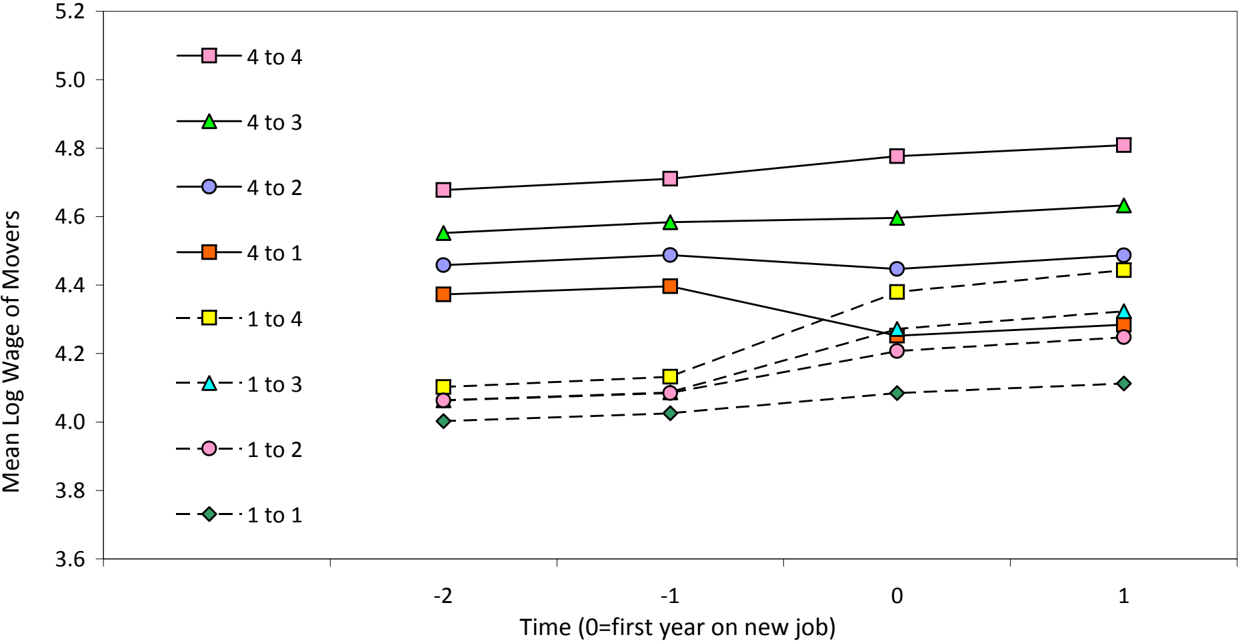
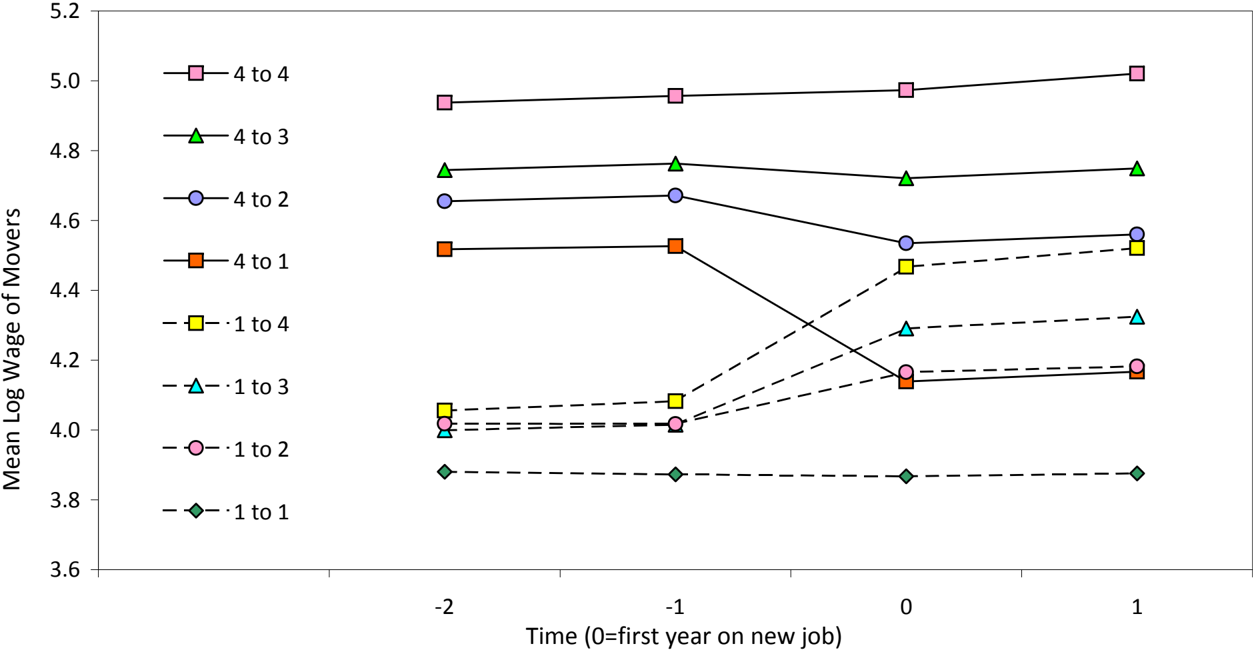
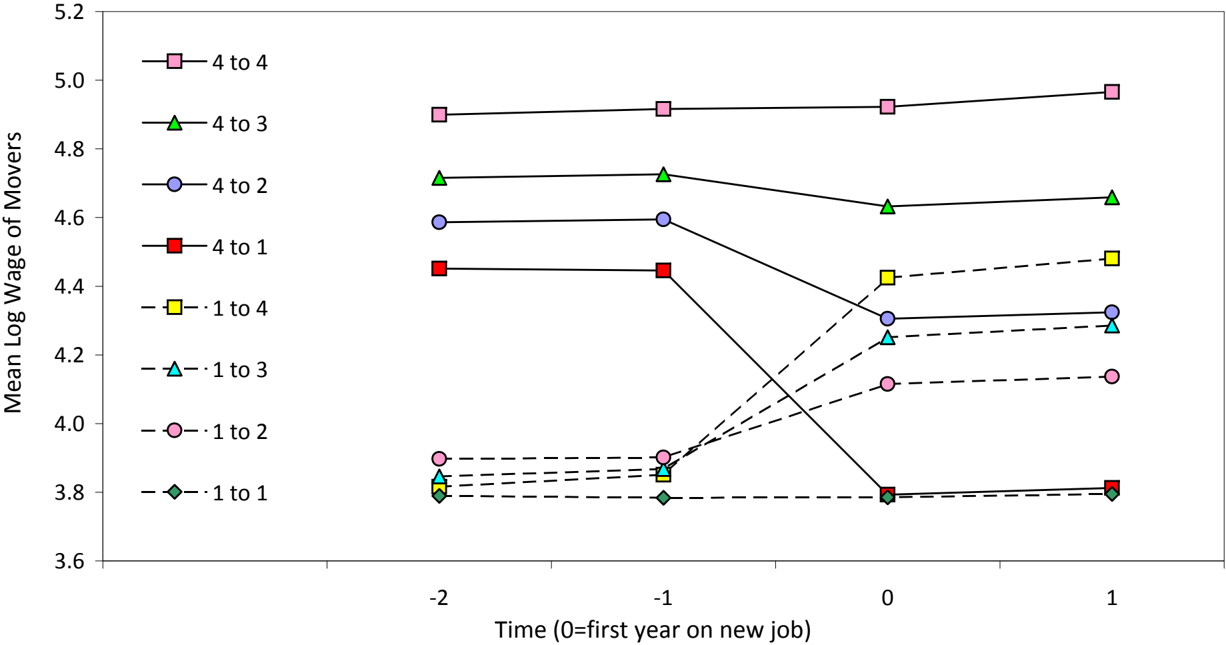
- Job-mobility event studies show growing establishment premia: a trend-adjusted move from quartile 1 to quartile 4 co-worker-wage establishments was associated with a 23 log-point gain in 1985–1991 versus 47 log points in 2002–2009; the reverse move yielded losses of 22 versus 43 log points.
- Between-group decompositions attribute 70% of the relative rise in university-educated men’s wages and 80% of the relative fall for workers with no/missing qualifications to establishment effects. For occupations, 42% of the rise in between-occupation variance is from person–establishment covariance, 28% from establishment variance, and about 30% from person variance; for industries, 44% is person variance, 19% establishment variance, and 42% sorting.
Methods
- Data: German Social Security records from the IEB, focusing on full-time West German men age 20–60 from 1985–2009, with parallel analyses for full-time women. The main sample has 85–90 million person-year observations per interval and about 17 million individual workers.
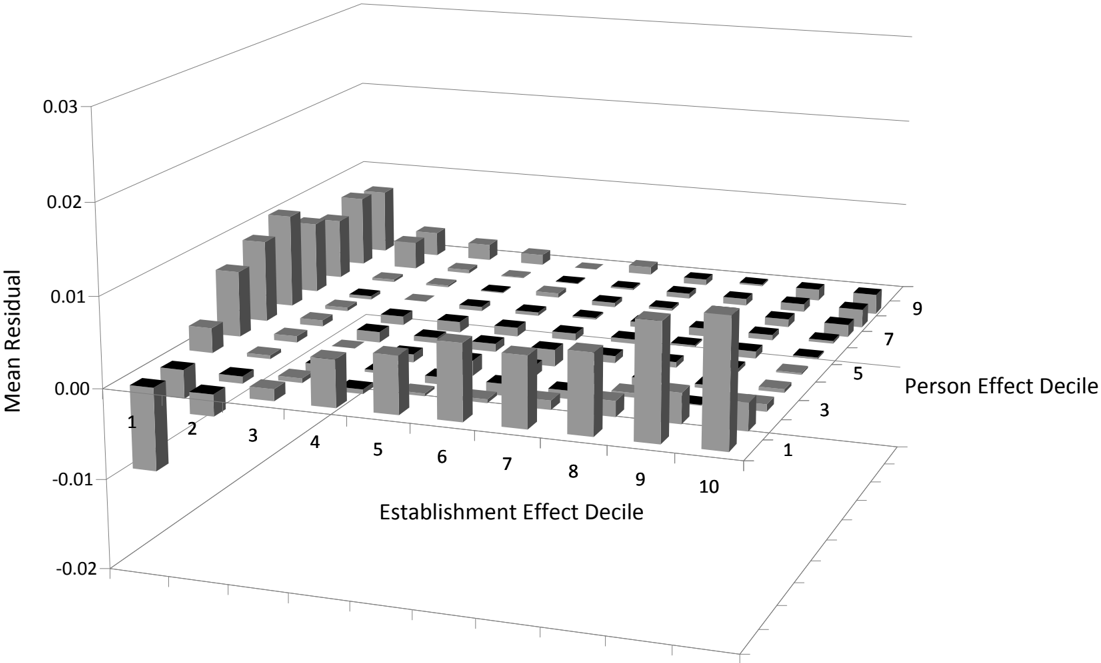
- Model: AKM-style log daily wage equation with additive person fixed effects, establishment fixed effects, time-varying covariates, and an error component; estimated by OLS on the largest connected set of establishments linked by worker mobility. Censored earnings are imputed using Tobit models.
- Analyses: variance decompositions and counterfactuals across four overlapping intervals (1985–1991, 1990–1996, 1996–2002, 2002–2009); event studies of job changers; decompositions of between-group wage gaps by education, occupation, and industry; and establishment cohort/collective-bargaining analyses.
Limitations
- The paper states that earnings are censored at the Social Security maximum (10–12% of male observations and 1–3% of female observations per year), so it uses Tobit imputation and checks robustness using apprentice-trained men, who have lower censoring rates.
- The paper states that establishment identifiers are administrative: ownership changes can create new establishment IDs, and only about half of EID births/deaths are estimated to be true plant openings/closings. It also states that sampling errors bias estimated variances upward and the covariance downward, and it does not construct bias-corrected estimates, assuming biases are similar across intervals.
- The paper states that collective bargaining cannot be assigned a causal role because firms choose coverage, and that female estimates may have more negatively biased covariance terms due to fewer observed matches per plant/worker. Evident from the text: the main analysis is restricted to full-time workers in West Germany, excluding civil servants, self-employed, and many part-time/mini-job workers, which limits generalizability.
Model-written summary. Check it against the paper before relying on it.
Integrity signals
Registry
Cites
Statistics
Figures


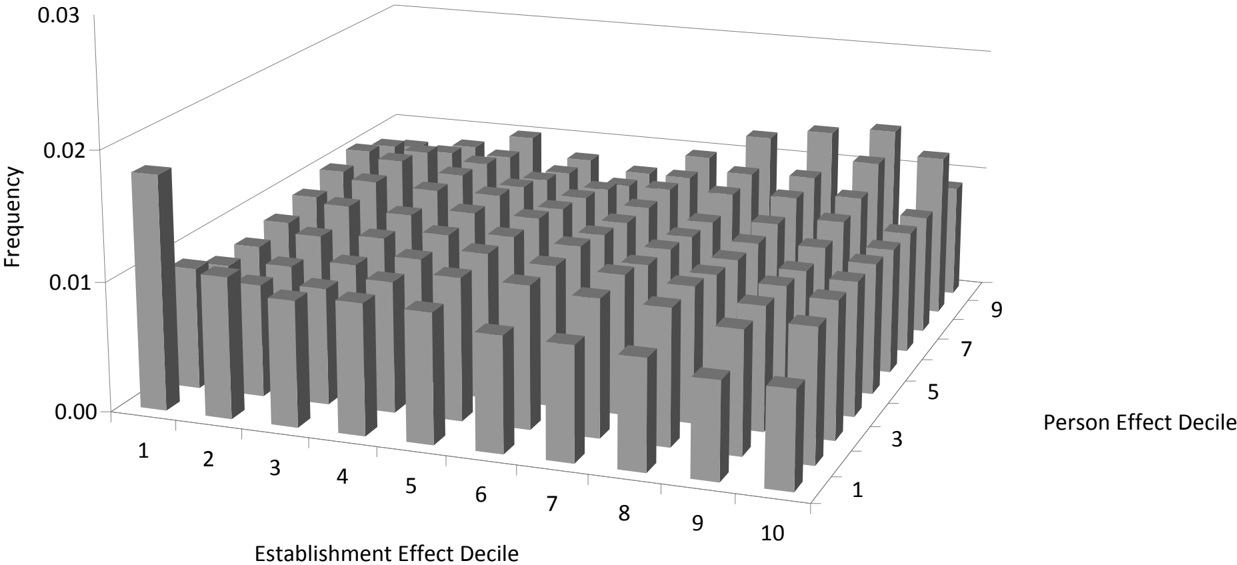
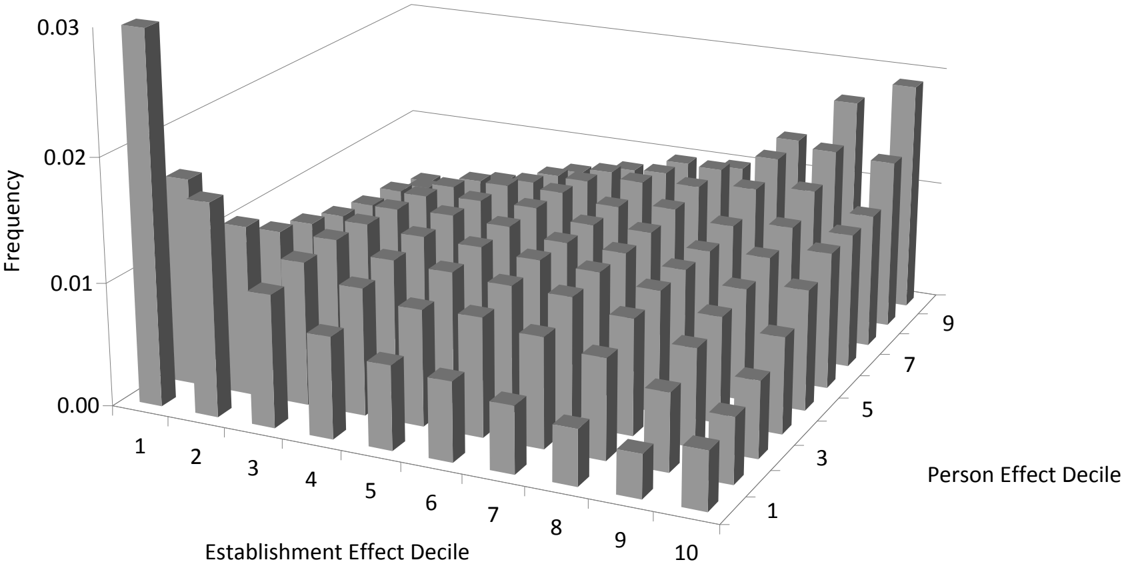
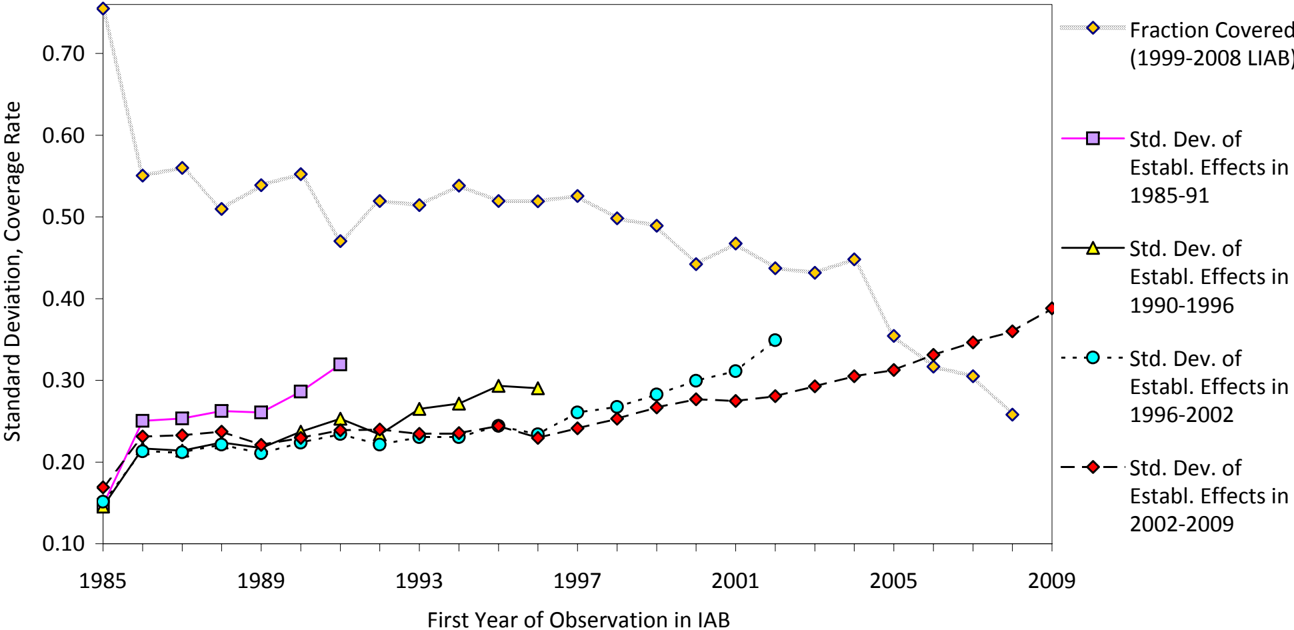
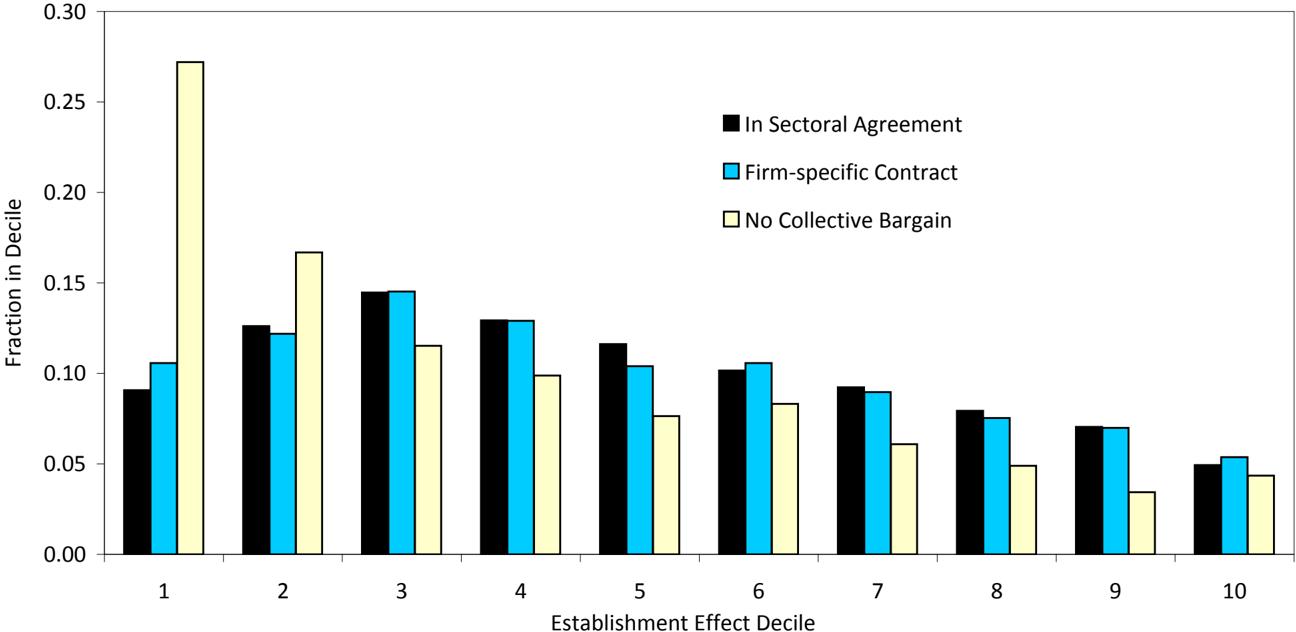
Verification
Claims the paper makes
0 Valid · 0 Not valid · 8 Not checked · 191 Own results and interpretations
A result the paper reports from its own data — it cites no other source for it, so there is none to check. The quote shows it is in the paper.
In the paper
“In particular, generalized non-separable models with xed e/ects for each job yield only a small improvement in explanatory power relative to the AKM speci cation, both within narrow time intervals and between intervals.”
plain- Asserted: passes — The authors put it forward as true.
- Checkable: passes — It can be checked against evidence.
- Load-bearing: passes — The paper’s conclusions depend on it.
- Based: passes — The paper gives a reason why it holds.
A result the paper reports from its own data — it cites no other source for it, so there is none to check. The quote shows it is in the paper.
In the paper
“Classifying establishments by entry year, we nd a trend toward increasing heterogeneity among establishments that entered the labor market after the mid-1990s, coupled with relatively small changes in the variability of the premiums paid by continuing establishments.”
plain- Asserted: passes — The authors put it forward as true.
- Checkable: passes — It can be checked against evidence.
- Load-bearing: passes — The paper’s conclusions depend on it.
- Based: passes — The paper gives a reason why it holds.
A result the paper reports from its own data — it cites no other source for it, so there is none to check. The quote shows it is in the paper.
In the paper
“We nd that two-thirds of the increase in the pay gap between higher and lower-educated workers is attributable to a widening in the average workplace pay premiums received by di/erent education groups.”
plainstates a cause- Asserted: passes — The authors put it forward as true.
- Checkable: passes — It can be checked against evidence.
- Load-bearing: passes — The paper’s conclusions depend on it.
- Based: passes — The paper gives a reason why it holds.
A result the paper reports from its own data — it cites no other source for it, so there is none to check. The quote shows it is in the paper.
In the paper
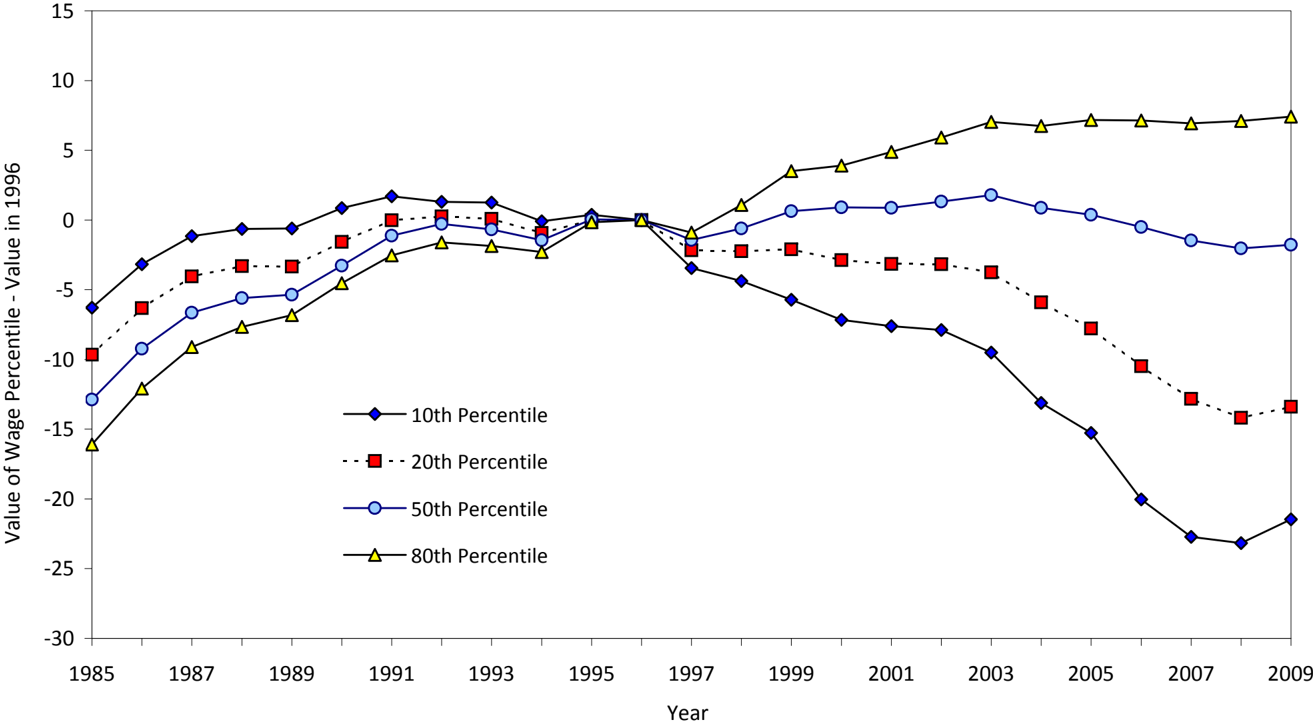
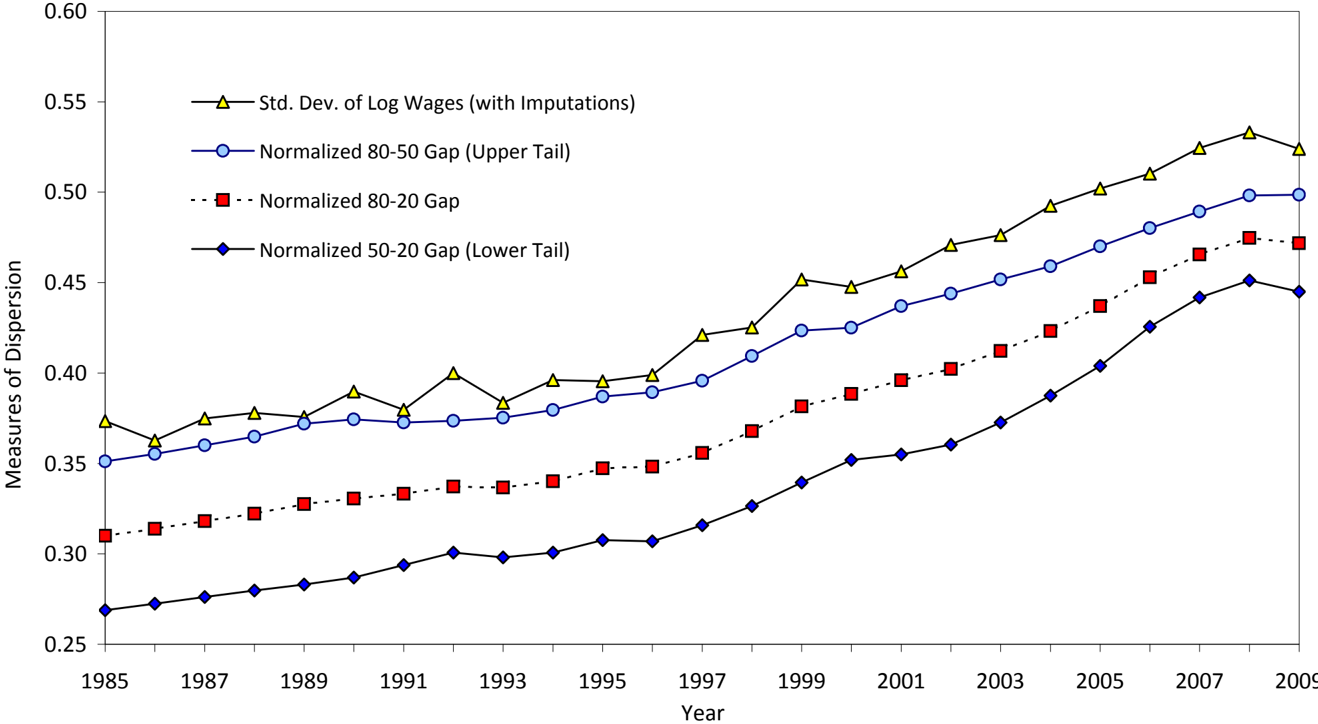
“In particular, the standard deviation rose by 15 log points from 1985 to 2009, the (normalized) 80-20 gap rose by 16 log points, the 80-50 gap rose by 15 log points, and the 50-20 gap rose by 18 log points.”
plain- Asserted: passes — The authors put it forward as true.
- Checkable: passes — It can be checked against evidence.
- Load-bearing: unclear — It is unclear whether the paper’s conclusions depend on it.
- Based: passes — The paper gives a reason why it holds.
118 more claims
Create a free account to see all 199 claims and to verify the 4 references still open.
- It may state two separate claims as one. 61
- Probably not a substantial claim. 17
- The quote only partly states this claim. 3
Claims other papers make about this one
Each is checked against this paper’s own text: does it say what the citing paper says it does?
The check wasn’t confident either way, so it gives no verdict — never disputed.
In the citing paper
“We estimate below that 75% is labor income.16”
From “Capitalists in the Twenty-First Century” (2019) · cites this paper as [16]
Experimental — accuracy not yet measured
Citations
Cites
A heteroskedasticity-consistent covariance matrix estimator and a direct test for heteroskedasticity
White, H. (1980) · Econometrica · doi:10.2307/1912934 · Cited by 25,861
The Skill Content of Recent Technological Change: An Empirical Exploration
Autor, D. H., Levy, F., & Murnane, R. J. (2003) · The Quarterly Journal of Economics · doi:10.1162/003355303322552801 · Cited by 6,205
On the Pooling of Time Series and Cross Section Data
Mundlak, Y. (1978) · Econometrica · doi:10.2307/1913646 · Cited by 5,412
Changes in Relative Wages, 1963-1987: Supply and Demand Factors
Katz, L. F., & Murphy, K. M. (1992) · The Quarterly Journal of Economics · doi:10.2307/2118323 · Cited by 4,793
Equilibrium Unemployment as a Worker Discipline Device
Shapiro, C., & Stiglitz, J. E. (1986) · Efficiency Wage Models of the Labor Market · doi:10.1017/cbo9780511559594.004 · Cited by 4,652
Misallocation and Manufacturing TFP in China and India*
Hsieh, C.-T., & Klenow, P. J. (2009) · Quarterly Journal of Economics · doi:10.1162/qjec.2009.124.4.1403 · Cited by 4,175
Job Creation and Job Destruction in the Theory of Unemployment
Mortensen, D. T., & Pissarides, C. A. (1994) · The Review of Economic Studies · doi:10.2307/2297896 · Cited by 3,840
Hybrid Corn: An Exploration in the Economics of Technological Change
Griliches, Z. (1957) · Econometrica · doi:10.2307/1905380 · Cited by 3,330
Labor Contracts as Partial Gift Exchange
Akerlof, G. A. (1982) · The Quarterly Journal of Economics · doi:10.2307/1885099 · Cited by 3,210
Plants and Productivity in International Trade
Bernard, A. B., Eaton, J., Jensen, J. B., & Kortum, S. (2003) · American Economic Review · doi:10.1257/000282803769206296 · Cited by 2,980
Research works printed but not linked: 1
- 70. Rees, Albert and George Schultz. 1970. Workers in an Urban Labor Market. Chicago: University of Chicago Press.
Cited by
Items 1,601–1,700 of 1,904
Gender Differences in Comparative Advantage Matches: Evidence from Linked Employer-Employee DataPreprint
Sant’Anna, H. (2024) · RePEc: Research Papers in Economics · doi:10.48550/arxiv.2411.03209
Assortative Matching and Wages: The Role of SelectionPreprint
Borovičková, K., & Shimer, R. J. (2024) · SSRN Electronic Journal · doi:10.2139/ssrn.5025532
Modelling the Spanish Wage Structure Through Structural Equations: A Gender Perspective
Lasso-Dela-Vega, E. V., Jiménez, J. M., & García‐Pozo, A. (2024) · Journal of the Knowledge Economy · doi:10.1007/s13132-024-02340-x
Inventor Returns and MobilityPreprint
Harhoff, D., Heller, D., & Momtaz, P. P. (2024) · SSRN Electronic Journal · doi:10.2139/ssrn.5045153
What do managers do? An Economist's PerspectivePreprint
Benson, A. M., & Shaw, K. L. (2024) · SSRN Electronic Journal · doi:10.2139/ssrn.5036873
Prêmio salarial associado às competências dos trabalhadores no Brasil
Detoni, O. F., Freguglia, R. D. S., & Corseuil, C. H. L. (2024) · doi:10.38116/ppe53n3art1
Monopsony in the New Zealand Labour Market: First Estimates from Administrative DataPreprint
Allan, C., Maré, D. C., & Hyslop, D. (2025) · SSRN Electronic Journal · doi:10.2139/ssrn.5099099
Financial Integration and Wage Inequality: Evidence from European CountriesPreprint
Yun, J. (2025) · SSRN Electronic Journal · doi:10.2139/ssrn.5102501
Exporters, multinationals and residual wage inequality: Evidence and theory
Schroeder, S. (2025) · European Economic Review · doi:10.1016/j.euroecorev.2025.104980
Offshoring, Matching, and Wage Inequality: Theory and EvidencePreprint
Kim, G., Lee, D., & Pozzoli, D. (2025) · SSRN Electronic Journal · doi:10.2139/ssrn.5127720
Using Machine Learning to Understand the Heterogeneous Earnings Effects of ExportsPreprint
Muffert, J., & Winkler, E. (2025) · SSRN Electronic Journal · doi:10.2139/ssrn.5133995
Firm quality and health maintenance
Bíró, A., & Elek, P. (2024) · doi:10.1920/wp.ifs.2024.5824
The division of revenues from unexpected demand shocks
Bastos, P., Monteiro, N. P., & Straume, O. R. (2025) · Scandinavian Journal of Economics · doi:10.1111/sjoe.12589
Exploring Gender Inequality: Firm Contribution and Policy Effects
Casarico, A., & Lattanzio, S. (2025) · LSE Public Policy Review · doi:10.31389/lseppr.117
Is wage inequality self-reinforcing? Evidence of unequal wage opportunities in GermanyPreprint
Herwartz, H., Struthmann, P., & Theilen, B. (2025) · SSRN Electronic Journal · doi:10.2139/ssrn.5210670
Higher Education Expansion and Labor Market Distortions: Micro Evidence and Possible MechanismsPreprint
Dai, J., li, J., & Zhang, Q. (2025) · SSRN Electronic Journal · doi:10.2139/ssrn.5218903
Adjusters and Casualties: The Anatomy of Labor Market DisplacementPreprint
Hanushek, E. A., Janßen, S., Light, J., & Simon, L. (2025) · SSRN Electronic Journal · doi:10.2139/ssrn.5245250
Rising Wages and the Decline of Low-Wage Work
Aeppli, C., Roh, S., & Wilmers, N. (2026) · American Sociological Review · doi:10.31235/osf.io/7tf3m_v1
Adjusters and Casualties: The Anatomy of Labor Market DisplacementPreprint
Hanushek, E. A., Janßen, S., Light, J., & Simon, L. (2025) · SSRN Electronic Journal · doi:10.2139/ssrn.5252579
Who Benefits from Place-Based Policies? Evidence from Matched Employer-Employee DataPreprint
Grunau, P., Hoffmann, F., Lemieux, T., & Titze, M. (2025) · SSRN Electronic Journal · doi:10.2139/ssrn.5250750
Adjusters and Casualties: The Anatomy of Labor Market DisplacementPreprint
Hanushek, E. A., Janßen, S., Light, J., & Simon, L. (2025) · SSRN Electronic Journal · doi:10.2139/ssrn.5259608
Rivera, C. (2025) · Digital USD (University of San Diego) · doi:10.22371/05.2025.012
Wixe, S., & Klæsson, J. (2025) · Journal of Regional Science · doi:10.1111/jors.12780
What Occupations DoPreprint
Arbour, W., & Price, D. (2025) · SSRN Electronic Journal · doi:10.2139/ssrn.5282548
Beruf und Sozialstrukturanalyse – Perspektiven, Funktionen, Ungleichheit
Ebner, C., & Haupt, A. (2025) · Springer eBooks · doi:10.1007/978-3-658-39745-6_44
Ownership Network and Job MobilityPreprint
Ravasan, F. R. (2025) · SSRN Electronic Journal · doi:10.2139/ssrn.5334675
The Racial Penalty in Job Ladder Transitions
Fadlon, I., Sullivan, B., & Vohra, V. (2025) · National Bureau of Economic Research · doi:10.3386/w34058
Age Diversity in Firms and Its Relation to Wages: Evidence from Germany
Bäckman, M., & Brunow, S. (2025) · Oxford University Press eBooks · doi:10.1093/oxfordhb/9780198866190.013.0009
Robust Contract with Career ConcernsPreprint
Li, H., & Gan, T. (2025) · SSRN Electronic Journal · doi:10.2139/ssrn.5372378
Mechanisms of Learning in Collaborative JobsPreprint
Szabo, B., & Békés, G. (2025) · SSRN Electronic Journal · doi:10.2139/ssrn.5378338
Multinational Enterprises and Between‐Firm Wage Inequality Across European Regions
Durán-Vanegas, J. D., & Siedschlag, I. (2025) · World Economy · doi:10.1111/twec.70005
Cities, Aggregate Welfare, and GrowthPreprint
Pflüger, M., & Gehr, K. (2025) · SSRN Electronic Journal · doi:10.2139/ssrn.5395851
What Do (Thousands of) Union Do? Union-Specific Pay Premia and InequalityPreprint
Derenoncourt, E., Gérard, F., Lagos, L., & Montialoux, C. (2025) · SSRN Electronic Journal · doi:10.2139/ssrn.5392722
Firm quality and health maintenance
Bíró, A., & Elek, P. (2025) · Journal of Health Economics · doi:10.1016/j.jhealeco.2025.103045
One‐Way Versus Two‐Way Postacquisition Integration Efforts: Theory and Evidence
Banal‐Estañol, A., Clougherty, J. A., Seldeslachts, J., & Szücs, F. (2025) · Journal of Economics & Management Strategy · doi:10.1111/jems.70006
Explaining wage developments in Croatia: the role of the firm composition effect
Raos, J., Croatian National Bank, T., & Cicak, I. (2025) · Public Sector Economics · doi:10.3326/pse.49.3.3
The Effects of Hiring Credits on Firms’ Dynamics: A Synthetic Difference-in-Differences Evaluation
Santoni, E., Patriarca, F., & Scarlato, M. (2025) · The B E Journal of Economic Analysis & Policy · doi:10.1515/bejeap-2024-0450
How do you identify a good manager?
Adhvaryu, A. R., Bhalotra, S. R., Deming, D. J., Nyshadham, A., Said, F., Tamayo, J., Vecci, J., & Weidmann, B. (2025) · doi:10.1920/wp.ifs.2025.3725
Violation and Enforcement of Workplace Regulations: Evidence from Mexican Firm InspectionsPreprint
Colonna, A., Pérez, J. P., & Rodrian, L. (2025) · SSRN Electronic Journal · doi:10.2139/ssrn.5557740
College Graduates in the Labor Market: Geographic Mobility and Sorting into Firms and Occupations *Preprint
Liu, C., Liu, S., & Zhang, Y. (2025) · SSRN Electronic Journal · doi:10.2139/ssrn.5552540
Intangible intensity and between‐firm wage inequality
Pialli, G., & Tcaci, O. (2025) · Economica · doi:10.1111/ecca.70015
Accident-Induced Absence from Work and Wage Growth
Bíró, A., Bisztray, M., da Fonseca, J. G., & Molnár, T. L. (2025) · Journal of Labor Economics · doi:10.1086/739202
Intersecting Shocks: The Combined Labor Market Impacts of Automation and ImmigrationPreprint
Bennett, P., & Johnsen, J. V. (2025) · SSRN Electronic Journal · doi:10.2139/ssrn.5656468
How Firms Adjust to Demand Shocks: Evidence from Germany and Italy in the Great Recession
D’Amuri, F., Lattanzio, S., & Smith, B. (2025) · Italian Economic Journal · doi:10.1007/s40797-025-00350-5
Firm-Based Origins of Anti-System Politics
Giannoni, M. A. (2025) · Comparative Political Studies · doi:10.1177/00104140251392522
Lees, J. M., Tang, S., & Sidanius, J. (2025) · Social Psychological and Personality Science · doi:10.1177/19485506251383988
Bhalothia, A., Engelstad, G., Khanna, G., & Mitchell, H. (2025) · National Bureau of Economic Research · doi:10.3386/w34503
Division of Labor in the Global EconomyPreprint
Becker, S. O., Egger, H., Koch, M., & Muendler, M.-A. (2025) · SSRN Electronic Journal · doi:10.2139/ssrn.5801425
Worker Quality, Matching and Productivity SlowdownPreprint
Cao, S., & Cao, S. (2025) · arXiv (Cornell University) · doi:10.48550/arxiv.2509.00516
Wixe, S., & Klæsson, J. (2025) · Journal of Labor Research · doi:10.1007/s12122-025-09375-2
Earnings Dynamics, Inequality, and Firm Heterogeneity
Bingley, P., & Cappellari, L. (2025) · Journal of Applied Econometrics · doi:10.1002/jae.70024
Essays on the formal labor market of Brazil
Rivera, J. (2014)
Essays on Entrepreneurship: The Role of Complexity of Innovation and Efficient Hierarchies
Ding, Y. (2023) · University Libraries (University of Maryland) · doi:10.13016/dspace/cord-upy5
Internal migration after a uniform minimum wage introductionPreprint
Moog, A. (2024) · RePEc: Research Papers in Economics · doi:10.13140/rg.2.2.20209.70240
Essays on worker mobility, spatial labor markets, and urban real estate markets
Duan, Y. (2024) · cIRcle (University of British Columbia) · doi:10.14288/1.0444017
Four essays on demography and labour market outcomes
Reinhold, M. (2016) · Institutional Repository of Leibniz Universität Hannover (Leibniz Universität Hannover) · doi:10.15488/8840
Essays in Labor and Health Economics: on the Effects of Job Loss, Gender Norms and Physician Strikes
Nassal, L. (2024) · DuEPublico (University of Duisburg-Essen) · doi:10.17185/duepublico/81898
Essays in Microeconomic Theory
Langtry, A. (2024) · Apollo (University of Cambridge) · doi:10.17863/cam.110700
The Diverging Trends of Male and Female Bottom Earnings in GermanyPreprint
Coschignano, E., & Jessen, R. (2024) · SSRN Electronic Journal · doi:10.2139/ssrn.5069997
Empirical Essays on Maternal Employment & Child Development
Seidlitz, A. (2024) · edoc Publication server (Humboldt University of Berlin) · doi:10.18452/27981
Essays in public and environmental economics
Chanut, N. (2022) · London School of Economics and Political Science Theses Online (London School of Economics and Political Science) · doi:10.21953/lse.00004489
Essays on low-wage work: Causes, consequences and policy
Friedrich, M. (2025) · doi:10.25593/open-fau-1626
Spatial Policies and Heterogeneous Employment ResponsesPreprint
Bald, F., & Henkel, M. (2025) · SSRN Electronic Journal · doi:10.2139/ssrn.5203896
Job Mobility and Assortative Matching
Braunschweig, L., Dauth, W., & Roth, D. H. W. (2024) · Econstor (Econstor) · doi:10.48720/iab.dp.2411 · Cited by 1
Essays In Labor And Macroeconomics
Zhao, N. (2016) · eCommons (Cornell University) · doi:10.7298/x41z429m
Essays on the Economics of Migration
Monscheuer, O. (2018) · heiDOK (Heidelberg University) · doi:10.11588/heidok.00025356
Essays on the Economics of Labor Markets and Retirement Policies
Prato, F. D. (2023) · IMT Institutional Repository (IMT School for Advanced Studies Lucca) · doi:10.13118/imtlucca/e-theses/382
The effects of hiring credits on firm dynamics: a synthetic difference-in-differences evaluationPreprint
Santoni, E., Patriarca, F., & Scarlato, M. (2024) · RePEc: Research Papers in Economics · doi:10.13140/rg.2.2.11642.20163
Essays in empirical corporate finance
Wang, J. (2023) · cIRcle (University of British Columbia) · doi:10.14288/1.0435215
Sacchi de Carvalho, M. (2024) · cIRcle (University of British Columbia) · doi:10.14288/1.0440943
Essays on labor economics and applied econometrics
Corcuera Garcia, P. J. (2024) · cIRcle (University of British Columbia) · doi:10.14288/1.0445395
Essays on Labor Economics and Inequality
Wetter, M. (2024) · doi:10.17169/refubium-47880
Four essays on firm size, Human Resource practices, and societal income inequality
Weißphal, M. (2023) · Amtliche Mitteilungen (Universitätsbibliothek Paderborn) · doi:10.17619/unipb/1-1662
Skill adaptation to shifting job tasks in the german labor market
Palnau, I. (2019) · Habilitation Regulations of the Faculty of Mechanical Engineering (University of Paderborn) · doi:10.17619/unipb/1-693
Seele, S., & Oliver, S. (2025) · Econstor (Econstor) · doi:10.2373/1864-810x.25-02-01
Essays in innovation and productivity
Alakbarov, R. (2024) · London School of Economics and Political Science Theses Online (London School of Economics and Political Science) · doi:10.21953/lse.00004691
Effects of Monetary Policy on Labor Income: The Role of the EmployerPreprint
Bobașu, A., & Repele, A. (2025) · SSRN Electronic Journal · doi:10.2139/ssrn.5201334
The diverging trends of male and female bottom incomes in GermanyPreprint
Coschignano, E., & Jessen, R. (2024) · RePEc: Research Papers in Economics · doi:10.4419/96973307
Bargaining and Inequality in the Labor MarketPreprint
Caldwell, S., Haegele, I., & Heining, J. (2025) · RePEc: Research Papers in Economics · doi:10.48720/iab.dp.2502
Self-citationEssays on the relation between higher education and the labour market
Hou, S. (2023) · Oxford University Research Archive (ORA) (University of Oxford) · doi:10.5287/ora-r5ga2qaq4
Essays on the Macroeconomics of Labor Markets
Freund, L. B. (2024) · Apollo (University of Cambridge) · doi:10.17863/cam.110861
Essays on outsourcing, automation and economic justice
Chandler, D. (2025) · London School of Economics and Political Science Theses Online (London School of Economics and Political Science) · doi:10.21953/lse.00004902
Human Capital Mismatch in the British Labour Market
Galanakis, I. (2022) · Kent Academic Repository (University of Kent) · doi:10.22024/unikent/01.02.95163
The Economics of Human Capital Investment, Rents and Wage Inequality
Ullah, A. (2020) · Figshare · doi:10.25392/leicester.data.11807418
Essays on International Trade and Labor Market Outcomes
Winkler, E. (2020) · doi:10.25972/opus-20983
Individual and Regional Returns to Higher Education: Empirical Evidence for Germany
Berlingieri, F. (2018) · heiDOK (Heidelberg University) · doi:10.11588/heidok.00023845
Considerazioni sulla nozione di sostituibilità a partire dal “prodotto marginale netto” di Marshall
Trabucchi, P. (2023) · Iris (Roma Tre University) · doi:10.13134/979-12-5977-286-2/13
Gyetvay, S. (2024) · cIRcle (University of British Columbia) · doi:10.14288/1.0445075
Essays on the labour market performance of immigrants in Germany
Ingwersen, K. (2023) · Institutional Repository of Leibniz Universität Hannover (Leibniz Universität Hannover) · doi:10.15488/13569
Essays on Foreign Ownership, Multinational Business Groups and Wages
Kornitzky, S. (2023) · EPub Bayreuth (University of Bayreuth) · doi:10.15495/epub_ubt_00007302
The Managers and Public Hospital Performance
Muñoz, P., & Otero, C. (2025) · DuEPublico (University of Duisburg-Essen) · doi:10.17185/duepublico/83337
The Native-Foreign Wage Gap Revisited: Evidence from Individual Task DataPreprint
Storm, E. (2020) · SSRN Electronic Journal · doi:10.2139/ssrn.3636545
Essays on regional labour markets
Ioramashvili, C. (2021) · London School of Economics and Political Science Theses Online (London School of Economics and Political Science) · doi:10.21953/lse.00004305
Diel, R. (2025) · Online Publication Service of Würzburg University (Würzburg University) · doi:10.25972/opus-40349
Background wage premia, beyond education: firm sorting and unobserved abilitiesPreprint
Bonacini, L., Patriarca, F., & Santoni, E. (2024) · RePEc: Research Papers in Economics
Broaden Welfare Implications of Trade Policy : Deliverable D1.1
Latouche, K., Fusacchia, I., Gaigné, C., Gouel, C., Kuiper, M. H., Olper, A., Piriu, A., Salvatici, L., & van Meijl, H. (2022) · Wageningen University & Research Publications
The Desirability of Workplaces and Wage Determination: an Algorithm-Based Approach
Menezes, B. M. A. D. C. D. M. E. (2025) · Portuguese National Funding Agency for Science, Research and Technology (RCAAP Project by FCT)
Metadata
- Authors
- Card, D., Heining, J., & Kline, P.
- Affiliations
- University of California, Berkeley (US)
- Corresponding author
- Kline, Patrick
- ORCID
- Card, David
- Venue
- The Quarterly Journal of Economics
- Publisher
- Oxford University Press (OUP)
- Published
- 2013-05-02
- Volume
- 128
- Issue
- 3
- Pages
- 967-1015
- ISSN
- 0033-5533 (ISSN-L)
- 1531-4650
- OpenAlex
- W2141295263
- Cited by
- 1,904
- References
- 146
- Citations by year
- 2026: 153 · 2025: 204 · 2024: 228 · 2023: 156 · 2022: 185 · 2021: 178 · 2020: 143 · 2019: 125 · 2018: 156 · 2017: 113 · 2016: 105 · 2015: 71 · 2014: 58 · 2013: 22
- FWCI
- 118.40
- Type
- journal article
- Language
- en
- Open access
- closed
- Locations
- The Quarterly Journal of Economics (publishedVersion)
- RePEc: Research Papers in Economics (submittedVersion)
- Econstor (Econstor) (submittedVersion)
- Funders
- Washington Center for Equitable Growth
- Topics
- Social Sciences › Economics, Econometrics and Finance › Economics and Econometrics › Labor market dynamics and wage inequality
- Social Sciences › Economics, Econometrics and Finance › Economics and Econometrics › Historical Economic and Social Studies
- Social Sciences › Sociology and Political Science › Income, Poverty, and Inequality
- Keywords
- wage inequality, job matching, fixed effects model, education and wages
About these checks
Registry, retraction, Cites and statistics results are computed, not judged, with one exception: a printed reference that no index lists is read once by a model before it counts as a citation error. Claims are extracted by a model and kept only when their quote appears verbatim in the text; each cited source is then checked, with a model’s help, for whether it says what the claim relies on. Those verdicts can be wrong — read the claim’s quote and the cited source before relying on one.
A language model drew the claims from the paper on 2026-11-17, under version 3 of the claim definition (model deepseek-v4.1-flash, prompt extract-v3).
A second model labelled each claim on 2026-11-17 (model jev-1.13-20260917, definition revision gold-guideline-v0.2).
Statistics and arithmetic are recomputed, not judged.
Confidence bands are shown only for fields calibrated on our annotated test set. None is calibrated yet, so no band is shown.
What counts as a claim ›How we measure confidence ›How we check this ›
Are you an author, or do you see a problem with this page? Request a review
Data sources
Bibliographic data: Semantic Scholar, OpenAlex, Crossref.
Contains information from the Semantic Scholar Academic Graph Datasets, made available under the ODC Attribution License (ODC-BY 1.0).
Semantic Scholar’s data is described in: Kinney, R., et al. (2023). The Semantic Scholar Open Data Platform. arXiv:2301.10140.
