

Workplace Heterogeneity and the Rise of West German Wage Inequality*
The DOI matches its Crossref record; 144 of the 147 references it cites were found in a registry or an index, and 1 are not checked yet; none of the 8 sources its claims cite is checked for support yet.
Abstract
We study the role of establishment-specific wage premiums in generating recent increases in West German wage inequality. Models with additive fixed effects for workers and establishments are fit into four subintervals spanning the period from 1985 to 2009. We show that these models provide a good approximation to the wage structure and can explain nearly all of the dramatic rise in West German wage inequality. Our estimates suggest that the increasing dispersion of West German wages has arisen from a combination of rising heterogeneity between workers, rising dispersion in the wage premiums at different establishments, and increasing assortativeness in the assignment of workers to plants. In contrast, the idiosyncratic job-match component of wage variation is small and stable over time. Decomposing changes in mean wages between different education groups, occupations, and industries, we find that increasing plant-level heterogeneity and rising assortativeness in the assignment of workers to establishments explain a large share of the rise in inequality along all three dimensions.
Checked 2026-11-19 · 1 reference not checked yet
Overview
CoChat Summary
TL;DR
Using West German administrative data from 1985–2009, the paper shows that models with additive person and establishment fixed effects explain nearly all of the rise in wage inequality. The increase is driven by rising worker-effect variance, rising establishment-premium variance, and increased assortative matching of high-wage workers to high-wage plants.
Key findings
- In the AKM variance decomposition, total log-wage variance rose from 0.137 in interval 1 (1985–1991) to 0.249 in interval 4 (2002–2009). The variance of person effects rose from 0.084 to 0.127 and contributed 39% of the total rise; establishment-effect variance rose from 0.025 to 0.053 and contributed 25%; the covariance term rose from 0.003 to 0.041 and contributed 34%.
- Assortative matching increased: the correlation between person and establishment effects rose from 0.034 in interval 1 to 0.249 in interval 4. Counterfactuals imply that holding sorting constant would have produced 69% of the actual variance rise, while holding establishment-effect variance constant would have produced 64%.
- Job-mobility event studies show growing establishment premia: a trend-adjusted move from quartile 1 to quartile 4 co-worker-wage establishments was associated with a 23 log-point gain in 1985–1991 versus 47 log points in 2002–2009; the reverse move yielded losses of 22 versus 43 log points.
- Between-group decompositions attribute 70% of the relative rise in university-educated men’s wages and 80% of the relative fall for workers with no/missing qualifications to establishment effects. For occupations, 42% of the rise in between-occupation variance is from person–establishment covariance, 28% from establishment variance, and about 30% from person variance; for industries, 44% is person variance, 19% establishment variance, and 42% sorting.
Methods
- Data: German Social Security records from the IEB, focusing on full-time West German men age 20–60 from 1985–2009, with parallel analyses for full-time women. The main sample has 85–90 million person-year observations per interval and about 17 million individual workers.
- Model: AKM-style log daily wage equation with additive person fixed effects, establishment fixed effects, time-varying covariates, and an error component; estimated by OLS on the largest connected set of establishments linked by worker mobility. Censored earnings are imputed using Tobit models.
- Analyses: variance decompositions and counterfactuals across four overlapping intervals (1985–1991, 1990–1996, 1996–2002, 2002–2009); event studies of job changers; decompositions of between-group wage gaps by education, occupation, and industry; and establishment cohort/collective-bargaining analyses.
Limitations
- The paper states that earnings are censored at the Social Security maximum (10–12% of male observations and 1–3% of female observations per year), so it uses Tobit imputation and checks robustness using apprentice-trained men, who have lower censoring rates.
- The paper states that establishment identifiers are administrative: ownership changes can create new establishment IDs, and only about half of EID births/deaths are estimated to be true plant openings/closings. It also states that sampling errors bias estimated variances upward and the covariance downward, and it does not construct bias-corrected estimates, assuming biases are similar across intervals.
- The paper states that collective bargaining cannot be assigned a causal role because firms choose coverage, and that female estimates may have more negatively biased covariance terms due to fewer observed matches per plant/worker. Evident from the text: the main analysis is restricted to full-time workers in West Germany, excluding civil servants, self-employed, and many part-time/mini-job workers, which limits generalizability.
Model-written summary. Check it against the paper before relying on it.
Integrity signals
Registry
Cites
Statistics
Figures


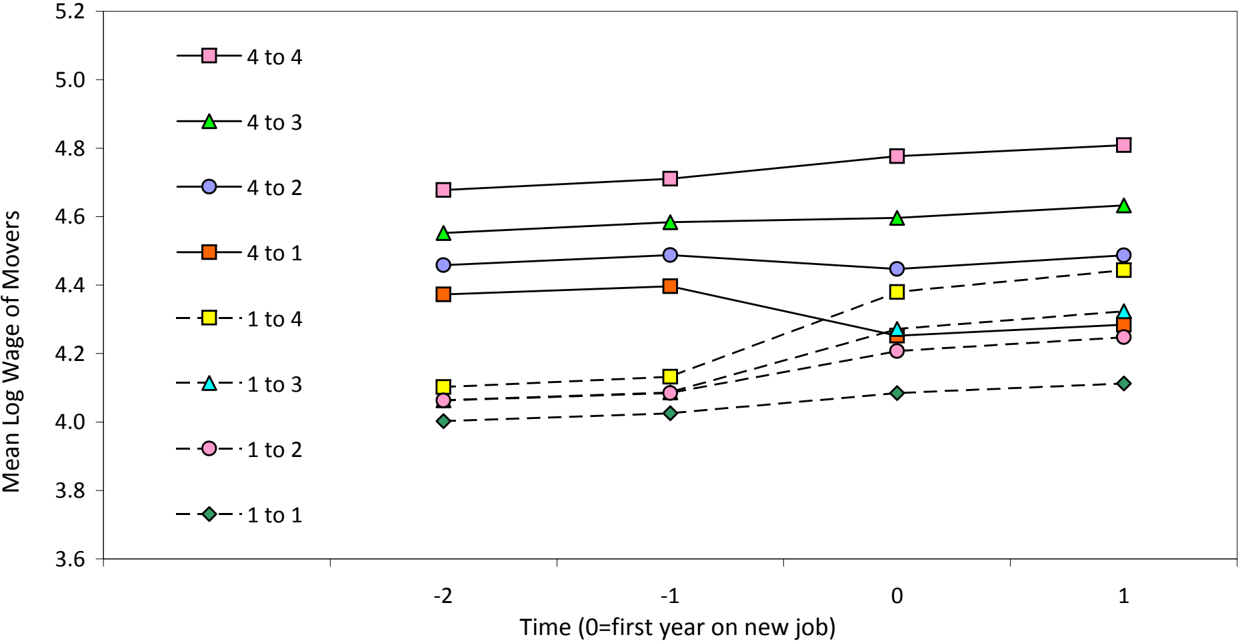
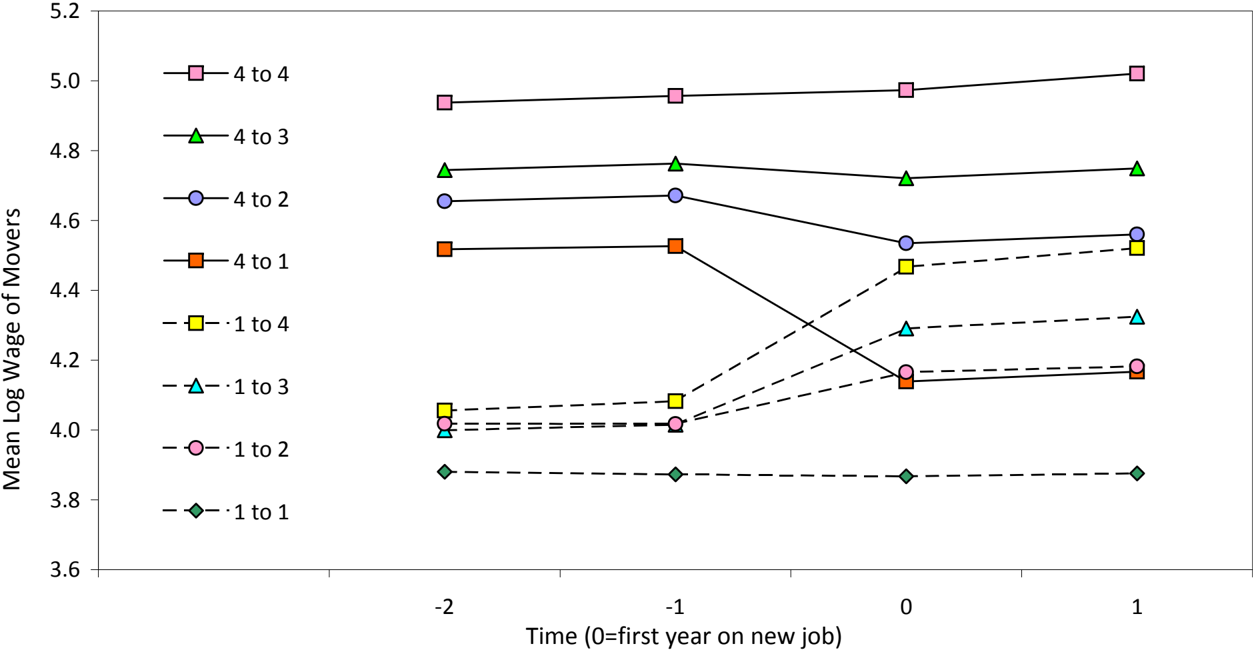
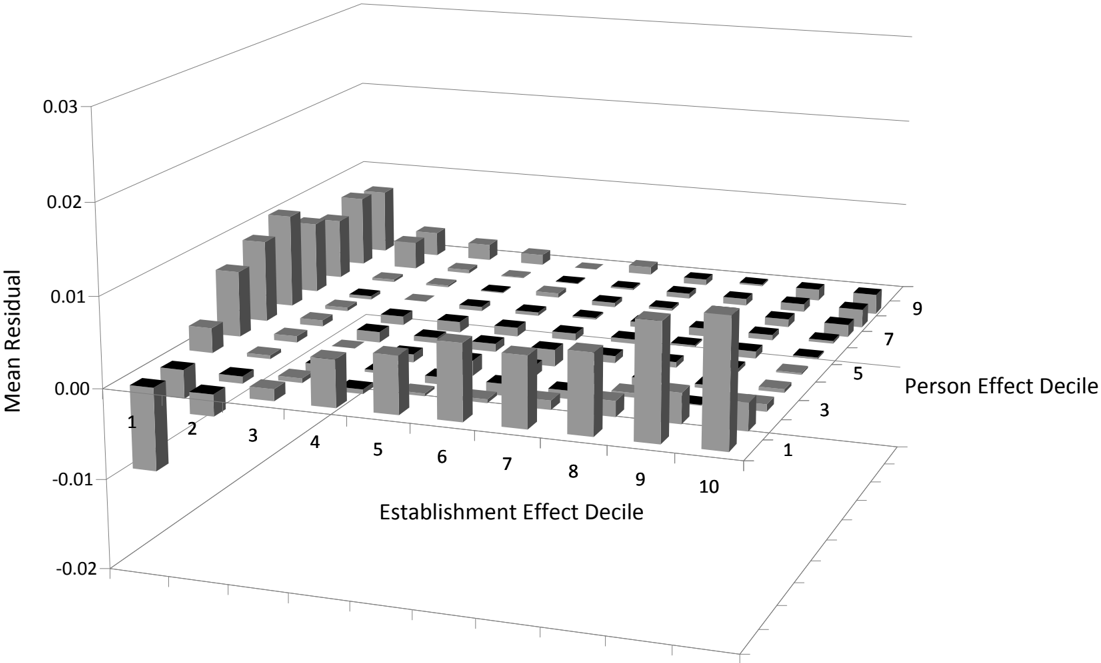
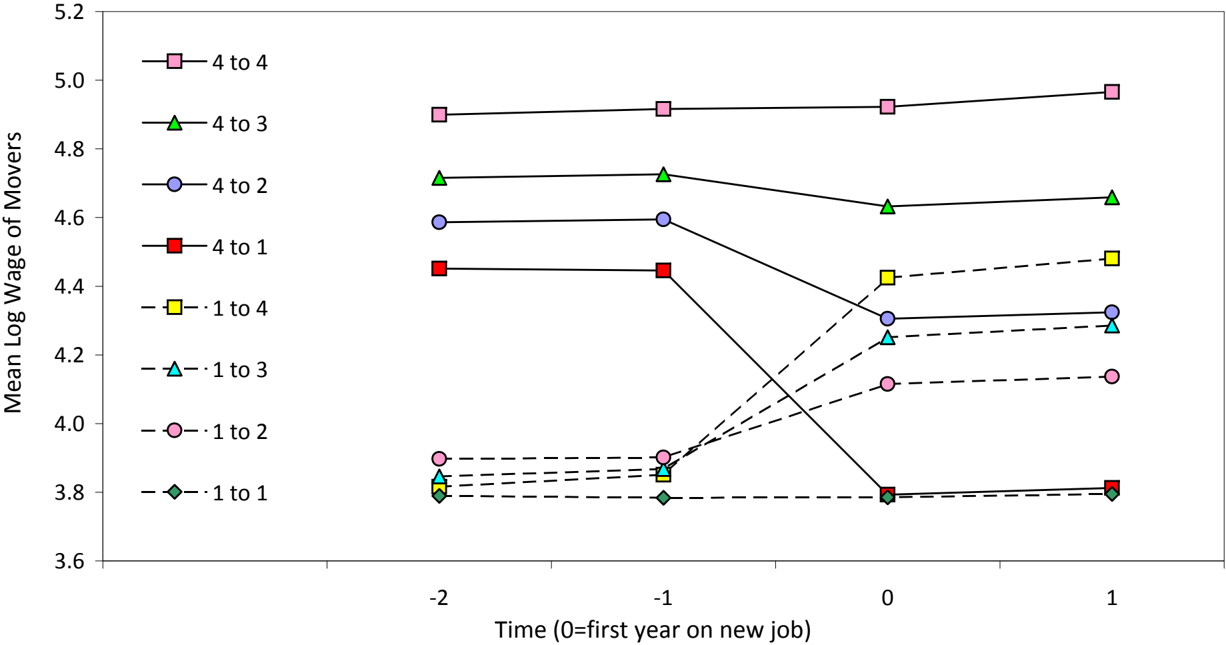
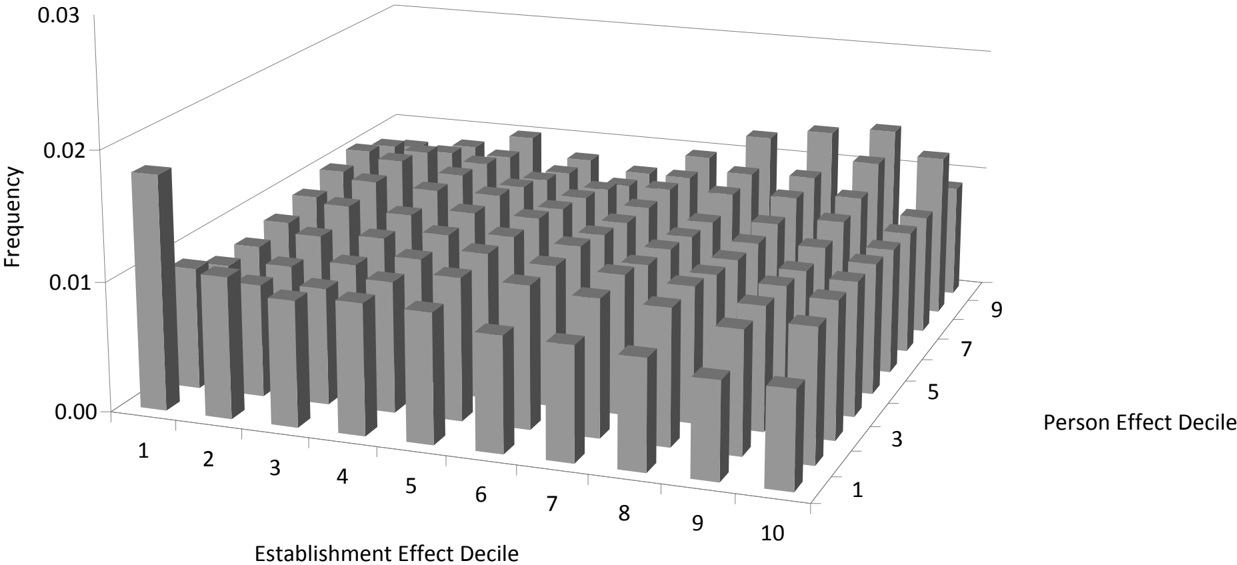
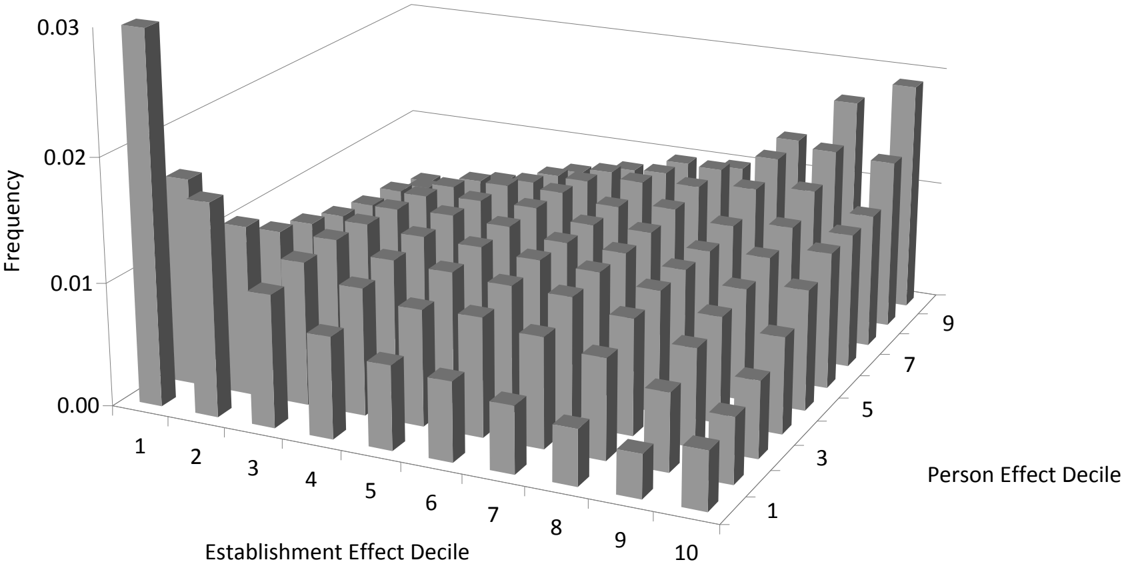
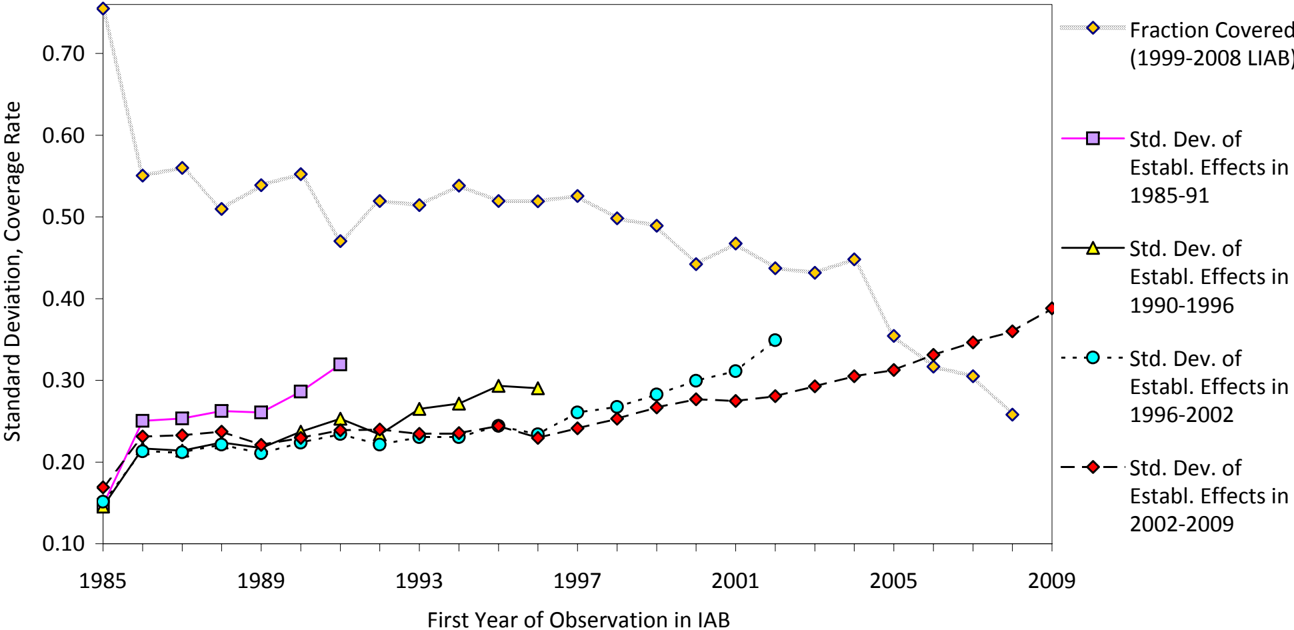
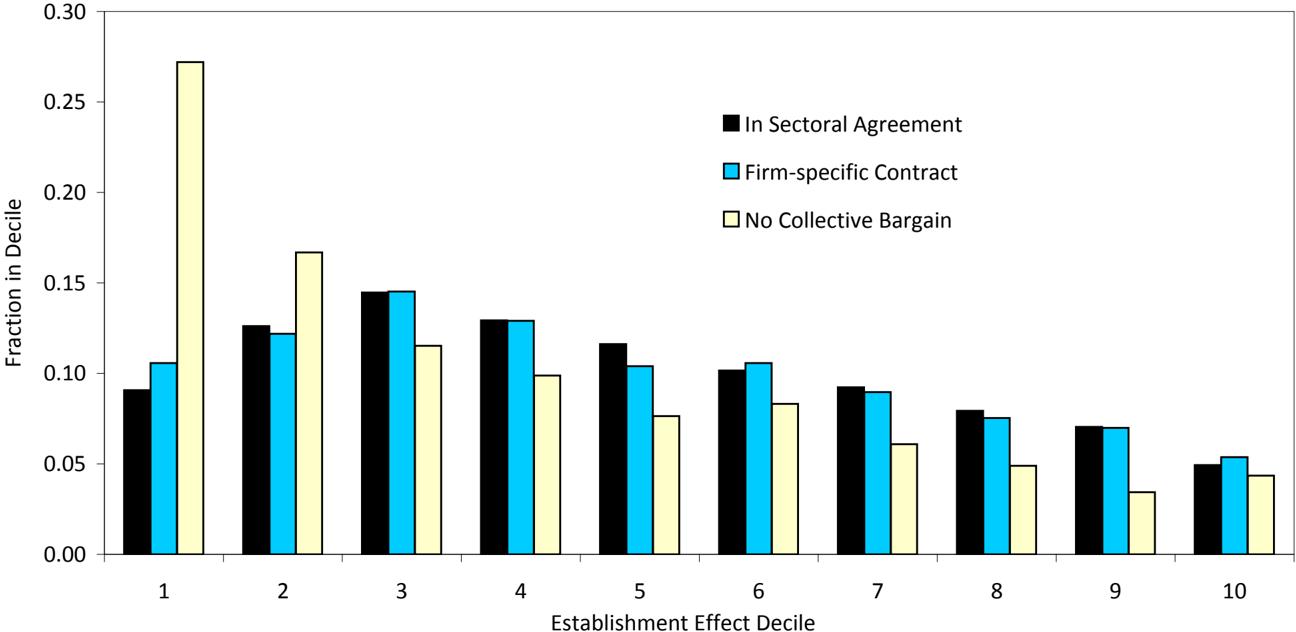
Verification
Claims the paper makes
0 Valid · 0 Not valid · 8 Not checked · 191 Own results and interpretations
A result the paper reports from its own data — it cites no other source for it, so there is none to check. The quote shows it is in the paper.
In the paper
“In particular, generalized non-separable models with xed e/ects for each job yield only a small improvement in explanatory power relative to the AKM speci cation, both within narrow time intervals and between intervals.”
plain- Asserted: passes — The authors put it forward as true.
- Checkable: passes — It can be checked against evidence.
- Load-bearing: passes — The paper’s conclusions depend on it.
- Based: passes — The paper gives a reason why it holds.
A result the paper reports from its own data — it cites no other source for it, so there is none to check. The quote shows it is in the paper.
In the paper
“Classifying establishments by entry year, we nd a trend toward increasing heterogeneity among establishments that entered the labor market after the mid-1990s, coupled with relatively small changes in the variability of the premiums paid by continuing establishments.”
plain- Asserted: passes — The authors put it forward as true.
- Checkable: passes — It can be checked against evidence.
- Load-bearing: passes — The paper’s conclusions depend on it.
- Based: passes — The paper gives a reason why it holds.
A result the paper reports from its own data — it cites no other source for it, so there is none to check. The quote shows it is in the paper.
In the paper
“We nd that two-thirds of the increase in the pay gap between higher and lower-educated workers is attributable to a widening in the average workplace pay premiums received by di/erent education groups.”
plainstates a cause- Asserted: passes — The authors put it forward as true.
- Checkable: passes — It can be checked against evidence.
- Load-bearing: passes — The paper’s conclusions depend on it.
- Based: passes — The paper gives a reason why it holds.
A result the paper reports from its own data — it cites no other source for it, so there is none to check. The quote shows it is in the paper.
In the paper
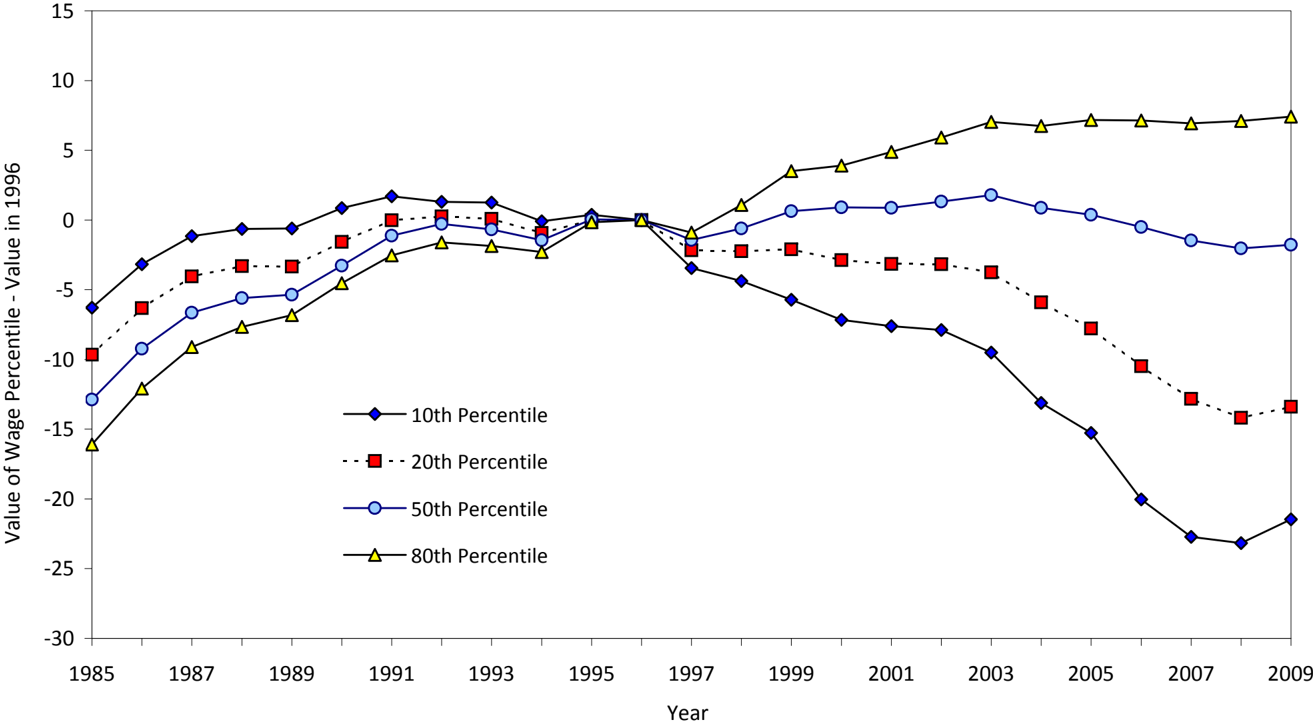
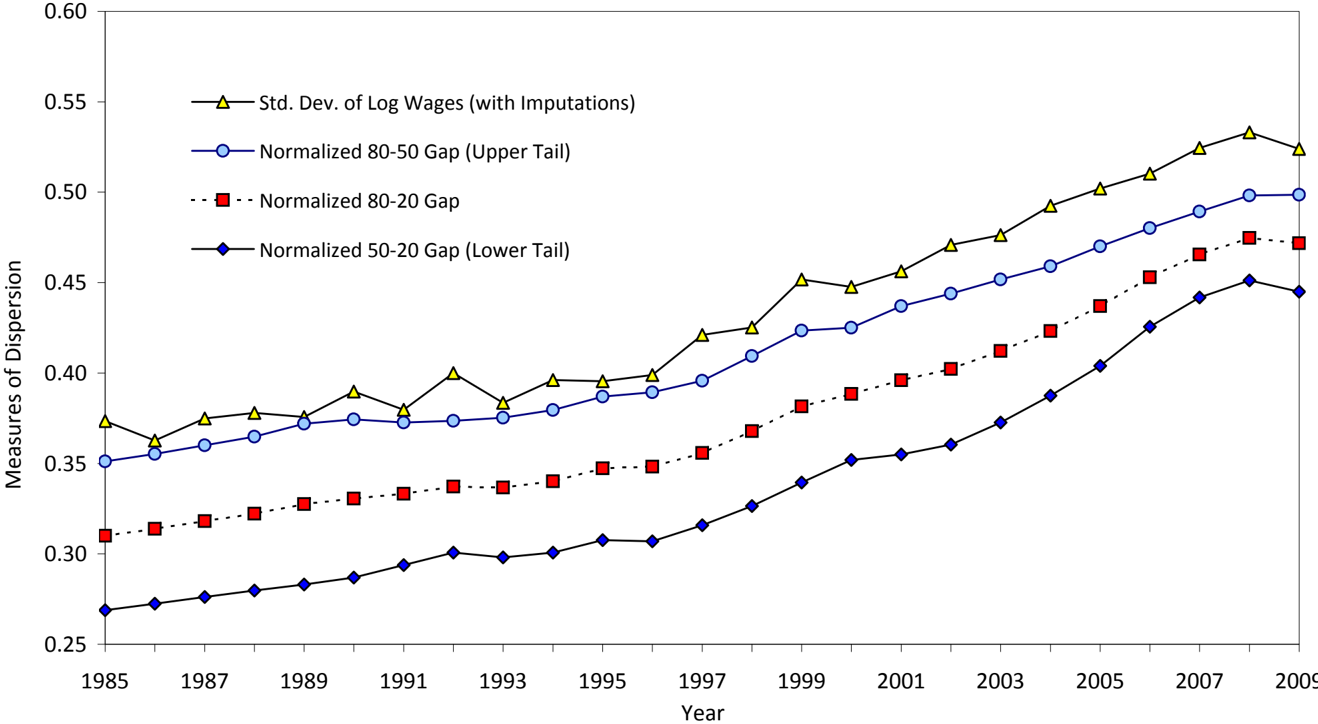
“In particular, the standard deviation rose by 15 log points from 1985 to 2009, the (normalized) 80-20 gap rose by 16 log points, the 80-50 gap rose by 15 log points, and the 50-20 gap rose by 18 log points.”
plain- Asserted: passes — The authors put it forward as true.
- Checkable: passes — It can be checked against evidence.
- Load-bearing: unclear — It is unclear whether the paper’s conclusions depend on it.
- Based: passes — The paper gives a reason why it holds.
118 more claims
Create a free account to see all 199 claims and to verify the 4 references still open.
- It may state two separate claims as one. 61
- Probably not a substantial claim. 17
- The quote only partly states this claim. 3
Claims other papers make about this one
Each is checked against this paper’s own text: does it say what the citing paper says it does?
The check wasn’t confident either way, so it gives no verdict — never disputed.
In the citing paper
“We estimate below that 75% is labor income.16”
From “Capitalists in the Twenty-First Century” (2019) · cites this paper as [16]
Experimental — accuracy not yet measured
Citations
Cites
A heteroskedasticity-consistent covariance matrix estimator and a direct test for heteroskedasticity
White, H. (1980) · Econometrica · doi:10.2307/1912934 · Cited by 25,861
The Skill Content of Recent Technological Change: An Empirical Exploration
Autor, D. H., Levy, F., & Murnane, R. J. (2003) · The Quarterly Journal of Economics · doi:10.1162/003355303322552801 · Cited by 6,205
On the Pooling of Time Series and Cross Section Data
Mundlak, Y. (1978) · Econometrica · doi:10.2307/1913646 · Cited by 5,412
Changes in Relative Wages, 1963-1987: Supply and Demand Factors
Katz, L. F., & Murphy, K. M. (1992) · The Quarterly Journal of Economics · doi:10.2307/2118323 · Cited by 4,793
Equilibrium Unemployment as a Worker Discipline Device
Shapiro, C., & Stiglitz, J. E. (1986) · Efficiency Wage Models of the Labor Market · doi:10.1017/cbo9780511559594.004 · Cited by 4,652
Misallocation and Manufacturing TFP in China and India*
Hsieh, C.-T., & Klenow, P. J. (2009) · Quarterly Journal of Economics · doi:10.1162/qjec.2009.124.4.1403 · Cited by 4,175
Job Creation and Job Destruction in the Theory of Unemployment
Mortensen, D. T., & Pissarides, C. A. (1994) · The Review of Economic Studies · doi:10.2307/2297896 · Cited by 3,840
Hybrid Corn: An Exploration in the Economics of Technological Change
Griliches, Z. (1957) · Econometrica · doi:10.2307/1905380 · Cited by 3,330
Labor Contracts as Partial Gift Exchange
Akerlof, G. A. (1982) · The Quarterly Journal of Economics · doi:10.2307/1885099 · Cited by 3,210
Plants and Productivity in International Trade
Bernard, A. B., Eaton, J., Jensen, J. B., & Kortum, S. (2003) · American Economic Review · doi:10.1257/000282803769206296 · Cited by 2,980
Research works printed but not linked: 1
- 70. Rees, Albert and George Schultz. 1970. Workers in an Urban Labor Market. Chicago: University of Chicago Press.
Cited by
Items 1,701–1,800 of 1,904
Essays in the economics of migration
Willis, S. (2021) · Repositori digital de la UPF (Universitat Pompeu Fabra)
Essays on the Economics of Crime
Rozo, S. (2015) · eScholarship (California Digital Library)
Essays in Labor and Gender Economics
Melentyeva, V. (2024) · Kölner Universitäts PublikationsServer (Universität zu Köln)
Microeconometric Analyses on Determinants of Individual Labour Market Outcomes
Simon, L. (2019) · RePEc: Research Papers in Economics
Kline, P. (2024) · Econstor (Econstor)
Self-citationBaessler, L., Gebhardt, G., Gropp, R., Güttler, A., & Taşkın, A. A. (2024) · RePEc: Research Papers in Economics
An engine of (pay) growth? Productivity and wages in the UK auto industry
Keiller, A. N., Obermeier, T., Teichgraeber, A., & Reenen, J. M. V. (2024) · London School of Economics and Political Science Research Online (London School of Economics and Political Science)
Essays on Information Frictions in Labor Markets
Zen, K. (2024) · eScholarship (California Digital Library)
Engbom, N., & Moser, C. (2020) · Munich Personal RePEc Archive (Ludwig Maximilian University of Munich)
Place-based policies and spatial disparities across European cities
Overman, H. G., & Ehrlich, M. V. (2020) · London School of Economics and Political Science Theses Online (London School of Economics and Political Science)
Markefke, T. (2024) · Kölner Universitäts PublikationsServer (Universität zu Köln)
The role of vacancy posting and unemployed hiring in start-up success
Angel, S., Eppel, R., Fidrmuc, E., Mahringer, H., & Weber, A. M. (2025) · Econstor (Econstor)
Searching for trade partners in developing countries:testing firms in the "fast fashion" industry
Cajal-Grossi, J. (2020) · Graduate Institute Geneva Institutional Repository (Graduate Institute of International and Development Studies)
Tres aproximaciones a las Cooperativas de Trabajadores en Uruguay
Dean, A. (2023) · LA Referencia (Red Federada de Repositorios Institucionales de Publicaciones Científicas)
Essays in the Economics of Human Mobility and Labor Markets
Stips, F. (2024) · Open Repository and Bibliography (University of Luxembourg)
Incoronato, L. (2024) · UCL Discovery (University College London)
Mind the gap: Effekten av yrkesheterogenitet og kunstig intelligens på lønnsulikhet
Reitan, E. (2019) · NVA (Nasjonalt vitenarkiv)
Non-compliance with temporary agency work regulation: Initial evidence from Germany
Ganserer, A. (2021) · MADOC (University of Mannheim)
Essays on Migration and Labor Economics
Saif, S. (2019) · OPUS FAU (Kooperativer Bibliotheksverbund Berlin-Brandenburg (KOBV), on behalf of the Universitätsbibliothek Erlangen-Nürnberg)
Essays on labor market adjustment and earnings growth
Redondo Gómez, H. (2023) · e-Archivo (Carlos III University of Madrid)
Firms, Labor Markets and Anti-System Politics: Essays on the Political Economy of Populism
Giannoni, M. A. (2023) · DSpace@MIT (Massachusetts Institute of Technology)
The Economic Geography of Globalization Politics
Flaherty, T. (2023) · eScholarship (California Digital Library)
Labuzova, T. (2025) · DSpace@MIT (Massachusetts Institute of Technology)
Esseet sukupuolesta ja työmarkkinatuloksista
Koev, E. (. (2021) · Helda - University of Helsinki Institutional Repository
Louzao, J. G., & Econòmica, U. A. D. B. D. D. I. D. (2019) · LA Referencia (Red Federada de Repositorios Institucionales de Publicaciones Científicas)
Cohen, J. P. (2023) · DSpace@MIT (Massachusetts Institute of Technology)
A new semiparamtetric approach to analysing Conditional Income DistributionsPreprint
Silbersdorff, A., Klein, N., & Kneib, T. (2014) · RePEc: Research Papers in Economics
Personnel Economics in Policing
Smith, A., & Smith, A. (2025) · UA Campus Repository (The University of Arizona)
Selecting the Best: The Persistent Effects of Luck
Drugov, M., Meyer, M., & Möller, M. (2024) · Oxford University Research Archive (ORA) (University of Oxford)
Students' Coworker Networks and Labor Market EntryPreprint
Demir, G., Sandner, M., Hertweck, F., & Yükselen, I. (2023) · RePEc: Research Papers in Economics
Schmid, R. E. (2023) · University writing server of the University of Hohenheim (Universität Hohenheim)
Akesaka, M., Miyoshi, K., 明坂, 弥., & 三好, 向. (2016) · OUKA (Osaka University Knowledge Archive) (Osaka University)
Dealing with Rightcensored Wages through ImputationPreprint
Ludsteck, J., & Drechsler, J. (2023) · RePEc: Research Papers in Economics
Essays on Macroeconomics and Labor Market Frictions
Maruyama, T. (2024) · eScholarship (California Digital Library)
Essays over de economie van arbeidsmarkten en pensioenbeleid
Prato, F. D. (2023) · Lirias (KU Leuven)
Essays on the legal and economic integration of refugees
Yumoto, H. (2023) · University of Birmingham Institutional Research Archive (University of Birmingham)
Verhoeckx, J. (2021) · Radboud Repository (Radboud University)
Schönfeld, P. (2023) · DiVA (Digitala Vetenskapliga Arkivet)
Innovoinnin ja yritysten välisen palkkahajonnan yhteys Suomessa ja Ruotsissa
Suoranta, J. (2017) · Jyväskylä University Digital Archive (University of Jyväskylä)
Taking the high road? Compliance with cmmuter tax allowances and the role of evasion spillovers
Pätzold, J., & Winner, H. (2016) · Econstor (Econstor)
Gu, G. W., Malik, S., Pozzoli, D., & Rocha, V. C. (2016) · OpenArchive@CBS (Copenhagen Business School)
Deli, Y. D., Delis, M. D., & Whelan, A. (2025) · Econstor (Econstor)
How do you find a good manager?
Bhalotra, S. R., Deming, D. J., Said, F., Vecci, J., & Weidmann, B. (2024) · Warwick Research Archive Portal (University of Warwick) · doi:10.82444/warw.33889282
A Roadmap for Developing a New LEED Infrastructure for the UK
Forth, J., Bryson, A., & Palmou, C. (2025) · UCL Discovery (University College London)
Three Essays in Labor Economics
Diallo, Y. (2024) · eScholarship@McGill (McGill) · doi:10.82308/33742
Earnings Insurance and Insight on Hours Worked and Hourly Wage
Leinonen, N. (2021) · Työväentutkimus Vuosikirja
Essays on Workers' Human Capital Accumulation and Wage Experience Profiles
Nakab, A. (2021) · eScholarship (California Digital Library)
Herrero Alba, D. (2020) · Docta Complutense (Universidad Complutense de Madrid)
Topics in Applied Labour Economics
Maraziotis, F. (2023) · White Rose eTheses Online (University of Leeds, The University of Sheffield, University of York)
Essays on Applied Microeconomics
Muñoz-Morales, J. S. (2020) · Illinois Digital Environment for Access to Learning and Scholarship (University of Illinois at Urbana-Champaign)
Essays On Sectoral Mobility And Inequality
Aguilera-Arellano, C. (2023) · University of Minnesota Digital Conservancy (University of Minnesota)
Essays on Management Opposition and Unionization
Nüß, P. (2024) · MACAU: Open Access Repository of Kiel University (University Library Kiel)
Labour market tightness and firms' vacancy posting and hiring decisions
Angel, S., Eppel, R., Fidrmuc, E., Mahringer, H., & Weber, A. (2025) · Econstor (Econstor) · Cited by 1
Orfao e Vale Tabernero, G., Fernández-MacÃas, E., & Ocaña, M. Á. M. (2024) · Econstor (Econstor)
Ensayos de Política Económica, Año XIII, Vol. III, N° 1, 2019 (número completo)
(2019) · Repositorio Institucional UCA (Pontificia Universidad Católica Argentina)
The Heterogeneity of Behavior in Operations Processes : Empirical Evidence
Özlü, N. (2023) · DiVA (Stockholm University)
On the Role of Health in the Labor Market
Ahammer, A. (2018) · University Library Linz repository (Johannes Kepler Universitat Linz)
Time for Reforms. Annual Report 2016/17
Bofinger, P., Schnabel, I., Feld, L. P., Schmidt, C. M., & Wieland, V. (2016) · RePEc: Research Papers in Economics
Essays on the Economics of Specialized Skills
Liu, T. (2025) · Uppsala University Publications (Uppsala University)
Unpacking Wage Inequality: Minimum Wage Effects on Within- and Between-Firm Disparities
Liang, Y. (2025) · Econstor (Econstor)
An estimation of the Phillips curve in Mexico using city-level data
Leo, L. R. A., & Rocha, H. R. (2025) · doi:10.36095/banxico/di.2025.14
Building Productive RelationshipsPreprint
Antić, N., Morjaria, A., & Marcos, M. Á. T. (2025) · SSRN Electronic Journal · doi:10.2139/ssrn.5525478
Tavakoli, A. (2025) · cIRcle (University of British Columbia) · doi:10.14288/1.0450536
Drivers behind the diverging gender patterns of wage inequality
Oliver, X., & Sard, M. (2025) · Journal for Labour Market Research · doi:10.1186/s12651-025-00415-z
Within-job wage inequality: the nexus between performance pay and match quality
Tang, R., Tang, Y., & Wang, P. (2025) · Macroeconomic Dynamics · doi:10.1017/s1365100525100631
The Geography of Worker-Firm Sorting: Drivers of Rising Colocation
Hollandt, N. T., & Müller, S. (2025) · Econstor (Econstor) · doi:10.18717/dp3c6g-n369
Essays on Coworkers and Labor Mobility
Mo, S. (2025) · Digital Access to Scholarship at Harvard (DASH) (Harvard University)
Townsend, W. G. (2025) · Digital Access to Scholarship at Harvard (DASH) (Harvard University)
Bargaining power and wages: Collective wage agreements and union membership in Germany
Höne, S., & Rehm, M. (2025) · Econstor (Econstor)
Ehrl, P. (2014) · OPUS (University of Passau)
Four Essays on Firm Dynamics, Firm Mobility, and the Environmental Kuznets Curve
Schröpf, B. (2024) · OPUS FAU (Kooperativer Bibliotheksverbund Berlin-Brandenburg (KOBV), on behalf of the Universitätsbibliothek Erlangen-Nürnberg) · doi:10.25593/open-fau-1448
Institutions, Labor Market Inequalities, and Welfare
Isaak, N. (2025) · Refubium (Universitätsbibliothek der Freien Universität Berlin) · doi:10.17169/refubium-50304
Three Essays in Labor Economics
Ablay, M. (2025) · eScholarship@McGill (McGill) · doi:10.82308/25247
Bestående ekonomisk-historiska nätverk : Vänbok till professor Jan Ottosson
(2025) · Uppsala University Publications (Uppsala University)
Diversity of Experience and Its Impact on Productivity in Creative Sectors
Khalid, O., Rahman, F., & Noor, A. M. (2025) · Asian Journal of Individual and Organizational Behavior · doi:10.51847/0ko2ujnrtc
Structure des salaires des travailleurs polonais en Allemagne
Brunow, S., Miszczak, K., Seibert, H., & Wrona, A. (2026) · Revue internationale du Travail · doi:10.16995/ilrf.23812
JUE Insight: Understanding the Urban Earnings Growth PremiumPreprint
Hong, G. (2026) · SSRN Electronic Journal · doi:10.2139/ssrn.6028939
JUE Insight: Understanding the Urban Earnings Growth PremiumPreprint
Hong, G. (2026) · SSRN Electronic Journal · doi:10.2139/ssrn.6028938
Edler, S., & Kristal, T. (2025) · sozialpolitik ch · doi:10.18753/2297-8224-6959
Organized labor versus robots? Co-determination in times of automation
Findeisen, S., Dauth, W., & Schlenker, O. (2025) · Econstor (Econstor)
The Labor Market Return to Permanent ResidencyPreprint
Kroft, K., Norwich, I., Notowidigdo, M. J., & Tino, S. P. (2026) · SSRN Electronic Journal · doi:10.2139/ssrn.6068467
Dynamics and sources of wage inequality in Taiwan: Evidence from employer‐employee matched data
Huang, P., Chen, H., Lien, H., & Yang, T. (2026) · Economic Inquiry · doi:10.1111/ecin.70044
Refusal power and policy credibility in Ontario’s basic income pilot
Ferdosi, M. (2026) · Journal of Poverty and Social Justice · doi:10.1332/17598273y2025d000000057
Freund, L. B. (2025) · Econstor (Econstor)
Essays on the Economics of Migration
Sauer, I. (2025) · doi:10.25593/open-fau-1547
Beyond lost earnings: Job displacement and the cost of commuting
Duan, Y., Jost, O., Jost, R., & Seibert, H. (2026) · Journal of Public Economics · doi:10.1016/j.jpubeco.2026.105579
Essays in finance and innovation
Gischer, M. (2025) · London School of Economics and Political Science Research Online (London School of Economics and Political Science) · doi:10.21953/researchonline.lse.ac.uk.00137063
Inference under First-Order DegeneracyPreprint
Bei, X., & Navjeevan, M. (2026) · arXiv (Cornell University) · doi:10.48550/arxiv.2602.07377
ESRI, Whelan, A., Brosnan, L., ESRI, McGuinness, S., & ESRI (2026) · doi:10.26504/jr15 · Cited by 2
The lifecycle of judicial bias
Yoresh, O., & Zou, W. ". (2026) · doi:10.1920/wp.ifs.2026.1226
Identifying Rent-Sharing Using Firms’ Energy Input Mix
Mertens, M., Mueller, S., & Neuschäffer, G. (2026) · Journal of the European Economic Association · doi:10.1093/jeea/jvag006
Decomposing the finance wage premium: Contributions of technology and risk
Bertay, A. C., Carreño, J. G., Huizinga, H., Uras, B. R., & Vellekoop, N. (2026) · Journal of Corporate Finance · doi:10.1016/j.jcorpfin.2026.102980
Somani, A. F. (2023) · TSpace (University of Toronto)
Essays in Spatial and International Economics
Hong, G. (2024) · TSpace (University of Toronto)
Chen, X., & Meng, S. (2026) · arXiv (Cornell University) · doi:10.48550/arxiv.2603.05565
Macroeconomic Perspectives on Sectoral Composition: Networks and Inequality
Dionisi, V. (n.d.) · BOA (University of Milano-Bicocca)
Hidden in Plain Sight: Occupational Structure and the Gender Wage GapPreprint
Rosenball, R., Eibinger, T., Kleinert, J., & Mulalic, I. (2026) · SSRN Electronic Journal · doi:10.2139/ssrn.6148866
Job Displacement, Family Dynamic, and Spousal Labor Supply
Schmieder, J. (2018) · WU Research
Çelik, P. (2026) · Fiscaoeconomia · doi:10.25295/fsecon.1807787
Metadata
- Authors
- Card, D., Heining, J., & Kline, P.
- Affiliations
- University of California, Berkeley (US)
- Corresponding author
- Kline, Patrick
- ORCID
- Card, David
- Venue
- The Quarterly Journal of Economics
- Publisher
- Oxford University Press (OUP)
- Published
- 2013-05-02
- Volume
- 128
- Issue
- 3
- Pages
- 967-1015
- ISSN
- 0033-5533 (ISSN-L)
- 1531-4650
- OpenAlex
- W2141295263
- Cited by
- 1,904
- References
- 146
- Citations by year
- 2026: 153 · 2025: 204 · 2024: 228 · 2023: 156 · 2022: 185 · 2021: 178 · 2020: 143 · 2019: 125 · 2018: 156 · 2017: 113 · 2016: 105 · 2015: 71 · 2014: 58 · 2013: 22
- FWCI
- 118.40
- Type
- journal article
- Language
- en
- Open access
- closed
- Locations
- The Quarterly Journal of Economics (publishedVersion)
- RePEc: Research Papers in Economics (submittedVersion)
- Econstor (Econstor) (submittedVersion)
- Funders
- Washington Center for Equitable Growth
- Topics
- Social Sciences › Economics, Econometrics and Finance › Economics and Econometrics › Labor market dynamics and wage inequality
- Social Sciences › Economics, Econometrics and Finance › Economics and Econometrics › Historical Economic and Social Studies
- Social Sciences › Sociology and Political Science › Income, Poverty, and Inequality
- Keywords
- wage inequality, job matching, fixed effects model, education and wages
About these checks
Registry, retraction, Cites and statistics results are computed, not judged, with one exception: a printed reference that no index lists is read once by a model before it counts as a citation error. Claims are extracted by a model and kept only when their quote appears verbatim in the text; each cited source is then checked, with a model’s help, for whether it says what the claim relies on. Those verdicts can be wrong — read the claim’s quote and the cited source before relying on one.
A language model drew the claims from the paper on 2026-11-17, under version 3 of the claim definition (model deepseek-v4.1-flash, prompt extract-v3).
A second model labelled each claim on 2026-11-17 (model jev-1.13-20260917, definition revision gold-guideline-v0.2).
Statistics and arithmetic are recomputed, not judged.
Confidence bands are shown only for fields calibrated on our annotated test set. None is calibrated yet, so no band is shown.
What counts as a claim ›How we measure confidence ›How we check this ›
Are you an author, or do you see a problem with this page? Request a review
Data sources
Bibliographic data: Semantic Scholar, OpenAlex, Crossref.
Contains information from the Semantic Scholar Academic Graph Datasets, made available under the ODC Attribution License (ODC-BY 1.0).
Semantic Scholar’s data is described in: Kinney, R., et al. (2023). The Semantic Scholar Open Data Platform. arXiv:2301.10140.
