

Workplace Heterogeneity and the Rise of West German Wage Inequality*
The DOI matches its Crossref record; 144 of the 147 references it cites were found in a registry or an index, and 1 are not checked yet; none of the 8 sources its claims cite is checked for support yet.
Abstract
We study the role of establishment-specific wage premiums in generating recent increases in West German wage inequality. Models with additive fixed effects for workers and establishments are fit into four subintervals spanning the period from 1985 to 2009. We show that these models provide a good approximation to the wage structure and can explain nearly all of the dramatic rise in West German wage inequality. Our estimates suggest that the increasing dispersion of West German wages has arisen from a combination of rising heterogeneity between workers, rising dispersion in the wage premiums at different establishments, and increasing assortativeness in the assignment of workers to plants. In contrast, the idiosyncratic job-match component of wage variation is small and stable over time. Decomposing changes in mean wages between different education groups, occupations, and industries, we find that increasing plant-level heterogeneity and rising assortativeness in the assignment of workers to establishments explain a large share of the rise in inequality along all three dimensions.
Checked 2026-11-19 · 1 reference not checked yet
Overview
CoChat Summary
TL;DR
Using West German administrative data from 1985–2009, the paper shows that models with additive person and establishment fixed effects explain nearly all of the rise in wage inequality. The increase is driven by rising worker-effect variance, rising establishment-premium variance, and increased assortative matching of high-wage workers to high-wage plants.
Key findings
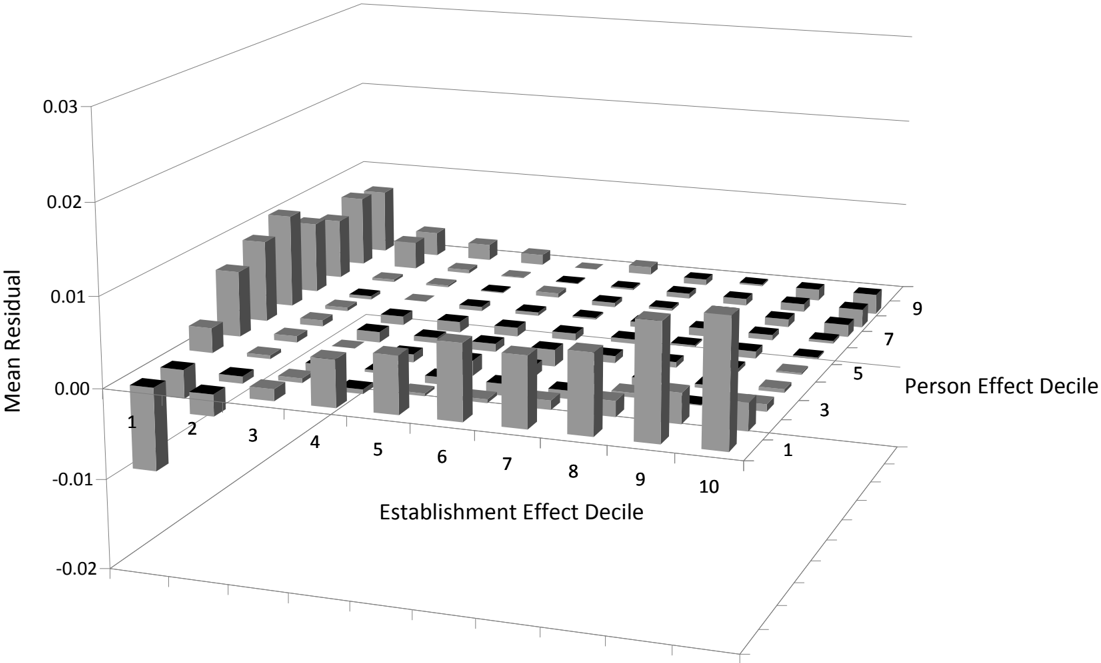
- In the AKM variance decomposition, total log-wage variance rose from 0.137 in interval 1 (1985–1991) to 0.249 in interval 4 (2002–2009). The variance of person effects rose from 0.084 to 0.127 and contributed 39% of the total rise; establishment-effect variance rose from 0.025 to 0.053 and contributed 25%; the covariance term rose from 0.003 to 0.041 and contributed 34%.
- Assortative matching increased: the correlation between person and establishment effects rose from 0.034 in interval 1 to 0.249 in interval 4. Counterfactuals imply that holding sorting constant would have produced 69% of the actual variance rise, while holding establishment-effect variance constant would have produced 64%.
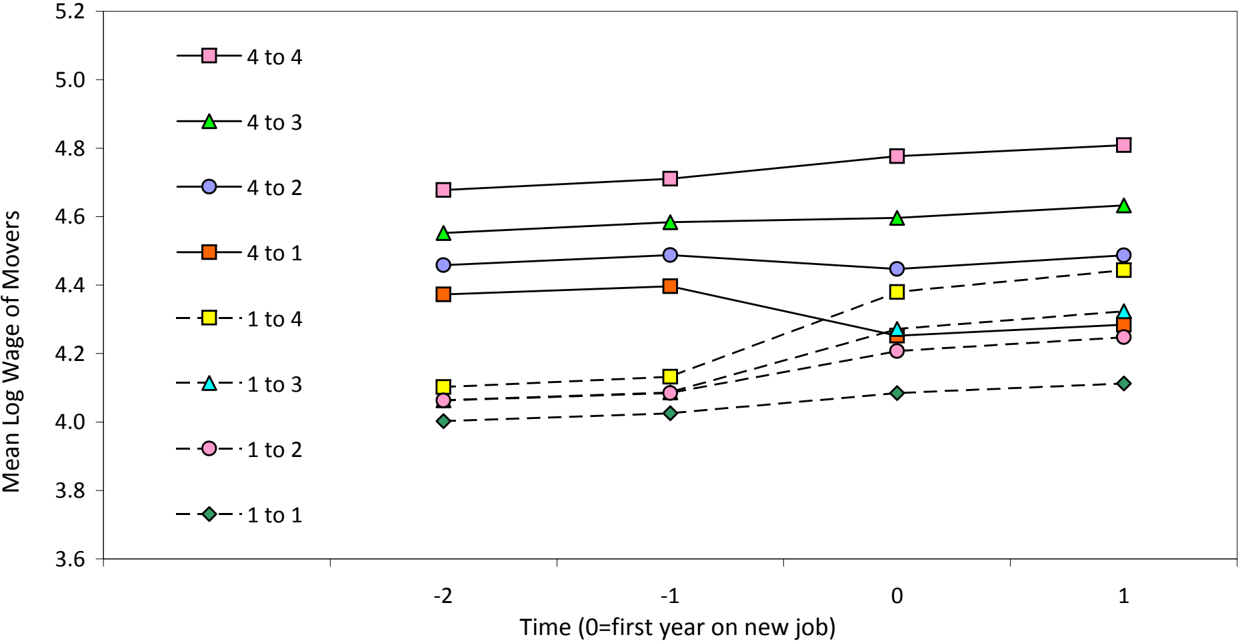
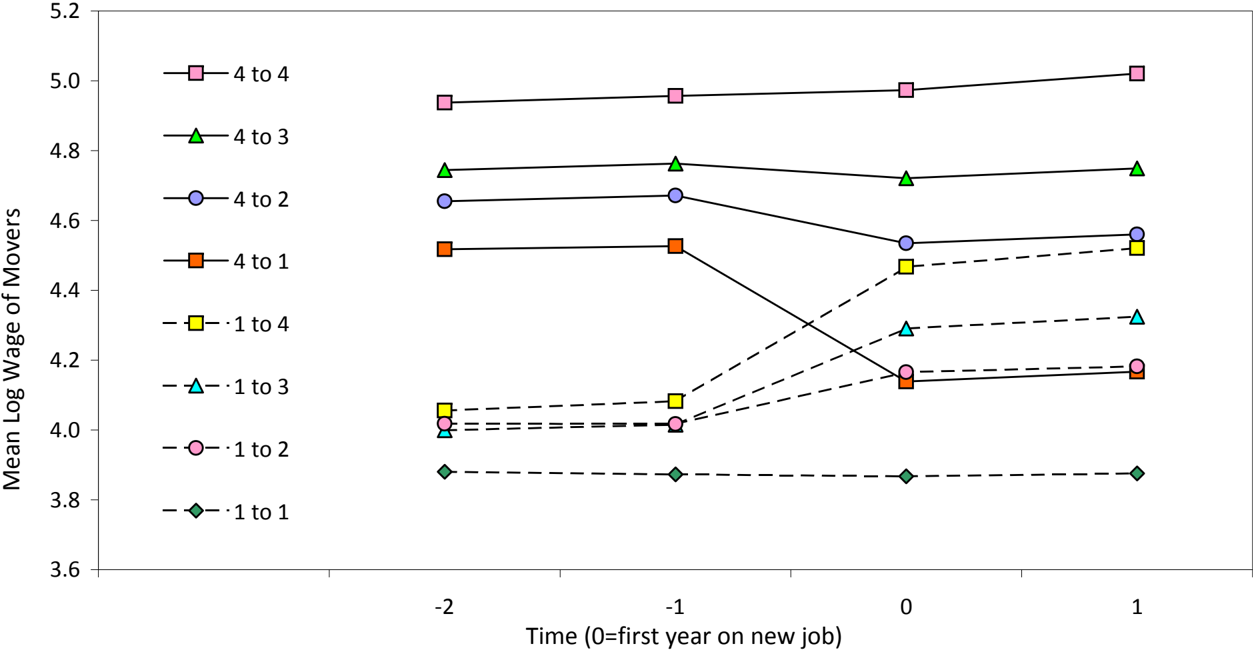
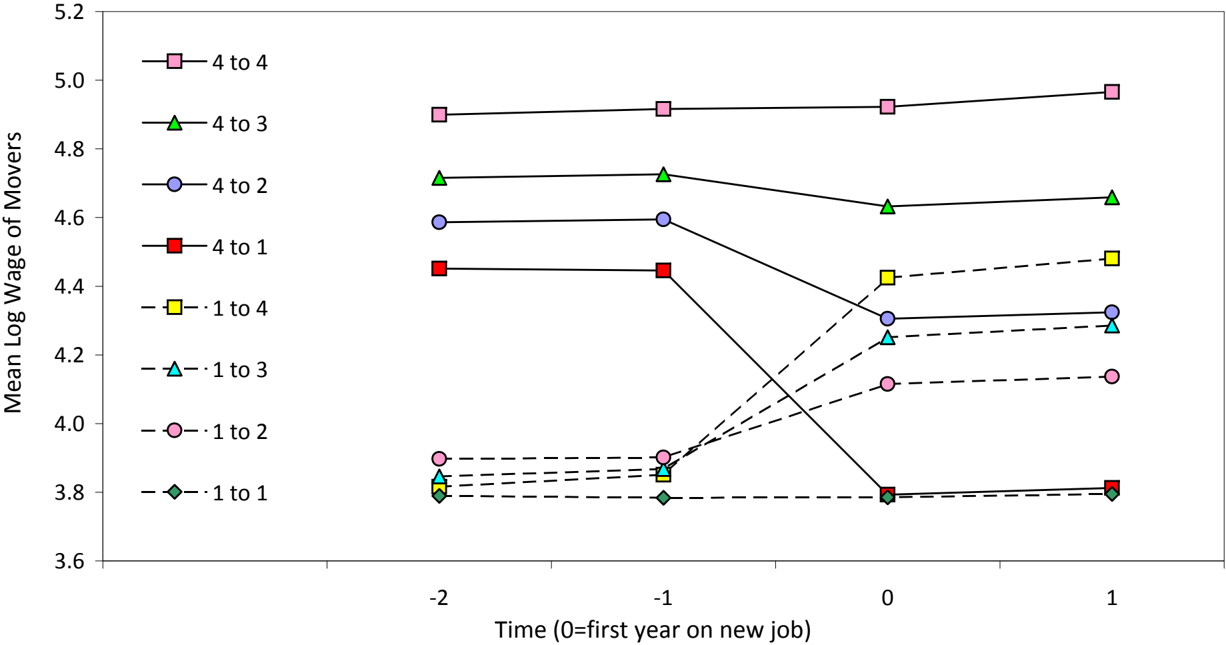
- Job-mobility event studies show growing establishment premia: a trend-adjusted move from quartile 1 to quartile 4 co-worker-wage establishments was associated with a 23 log-point gain in 1985–1991 versus 47 log points in 2002–2009; the reverse move yielded losses of 22 versus 43 log points.
- Between-group decompositions attribute 70% of the relative rise in university-educated men’s wages and 80% of the relative fall for workers with no/missing qualifications to establishment effects. For occupations, 42% of the rise in between-occupation variance is from person–establishment covariance, 28% from establishment variance, and about 30% from person variance; for industries, 44% is person variance, 19% establishment variance, and 42% sorting.
Methods
- Data: German Social Security records from the IEB, focusing on full-time West German men age 20–60 from 1985–2009, with parallel analyses for full-time women. The main sample has 85–90 million person-year observations per interval and about 17 million individual workers.
- Model: AKM-style log daily wage equation with additive person fixed effects, establishment fixed effects, time-varying covariates, and an error component; estimated by OLS on the largest connected set of establishments linked by worker mobility. Censored earnings are imputed using Tobit models.
- Analyses: variance decompositions and counterfactuals across four overlapping intervals (1985–1991, 1990–1996, 1996–2002, 2002–2009); event studies of job changers; decompositions of between-group wage gaps by education, occupation, and industry; and establishment cohort/collective-bargaining analyses.
Limitations
- The paper states that earnings are censored at the Social Security maximum (10–12% of male observations and 1–3% of female observations per year), so it uses Tobit imputation and checks robustness using apprentice-trained men, who have lower censoring rates.
- The paper states that establishment identifiers are administrative: ownership changes can create new establishment IDs, and only about half of EID births/deaths are estimated to be true plant openings/closings. It also states that sampling errors bias estimated variances upward and the covariance downward, and it does not construct bias-corrected estimates, assuming biases are similar across intervals.
- The paper states that collective bargaining cannot be assigned a causal role because firms choose coverage, and that female estimates may have more negatively biased covariance terms due to fewer observed matches per plant/worker. Evident from the text: the main analysis is restricted to full-time workers in West Germany, excluding civil servants, self-employed, and many part-time/mini-job workers, which limits generalizability.
Model-written summary. Check it against the paper before relying on it.
Integrity signals
Registry
Cites
Statistics
Figures


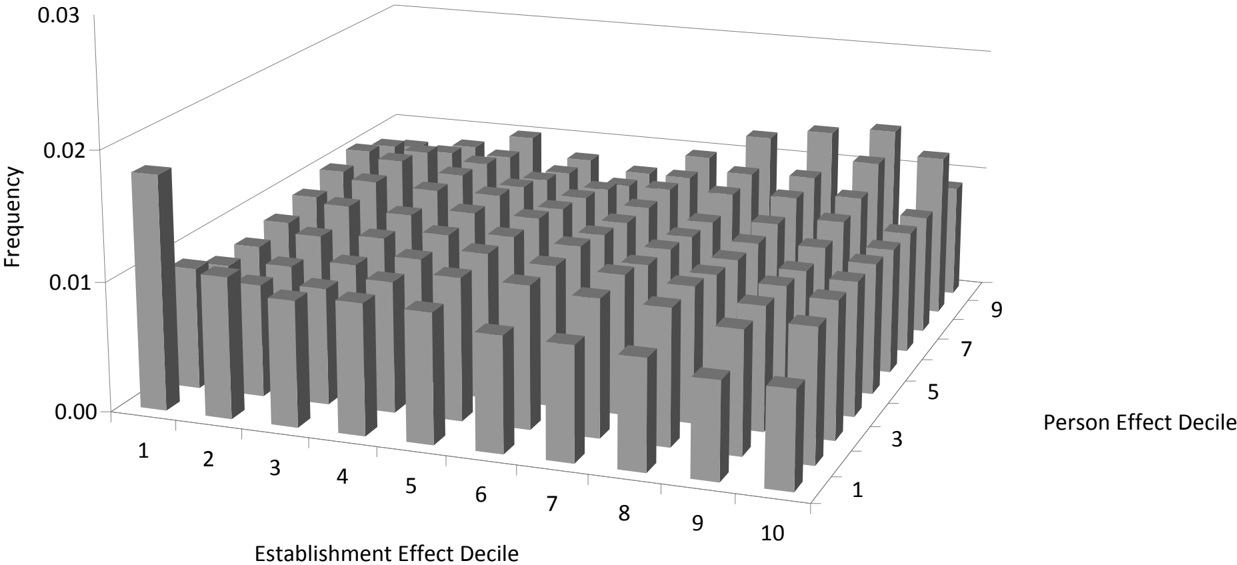
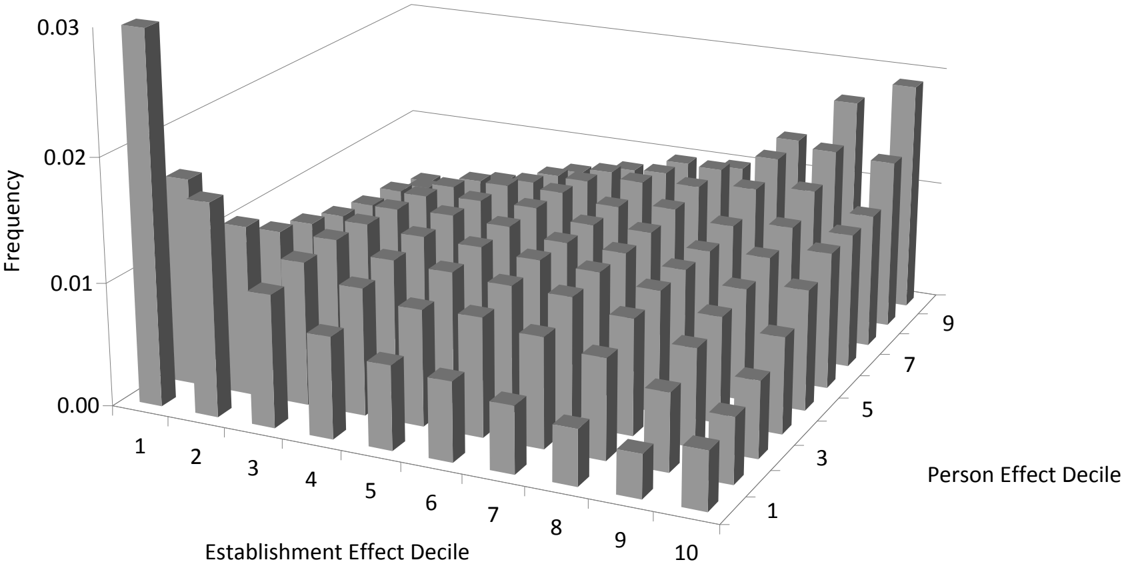
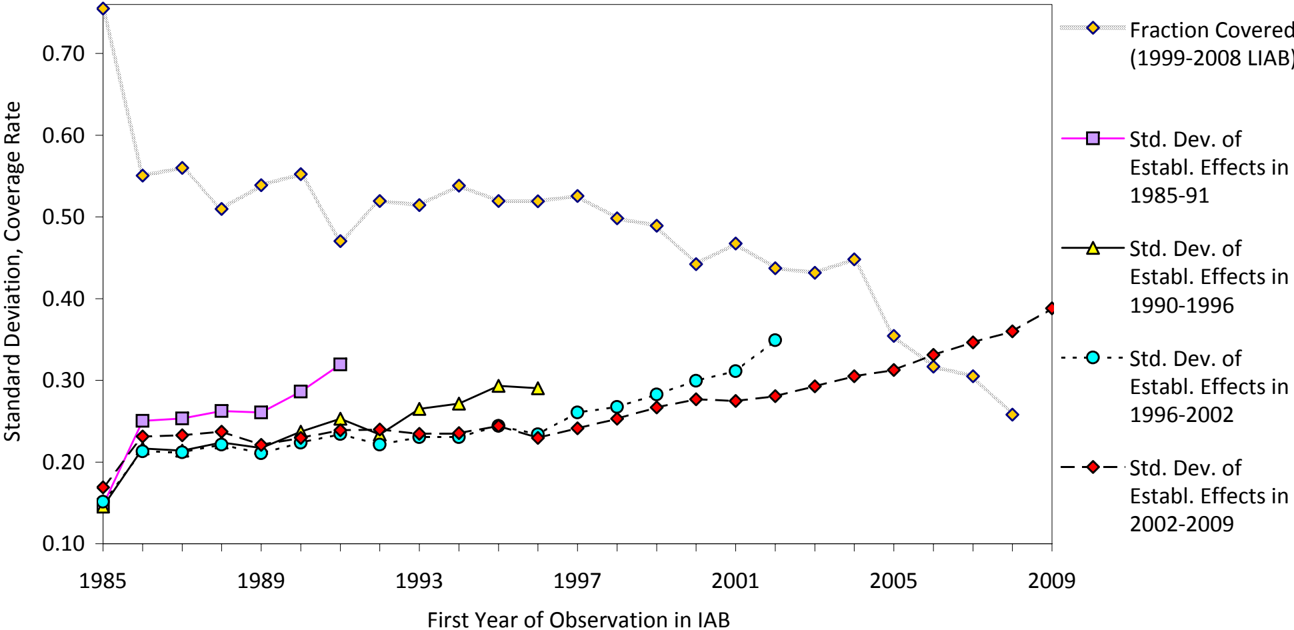
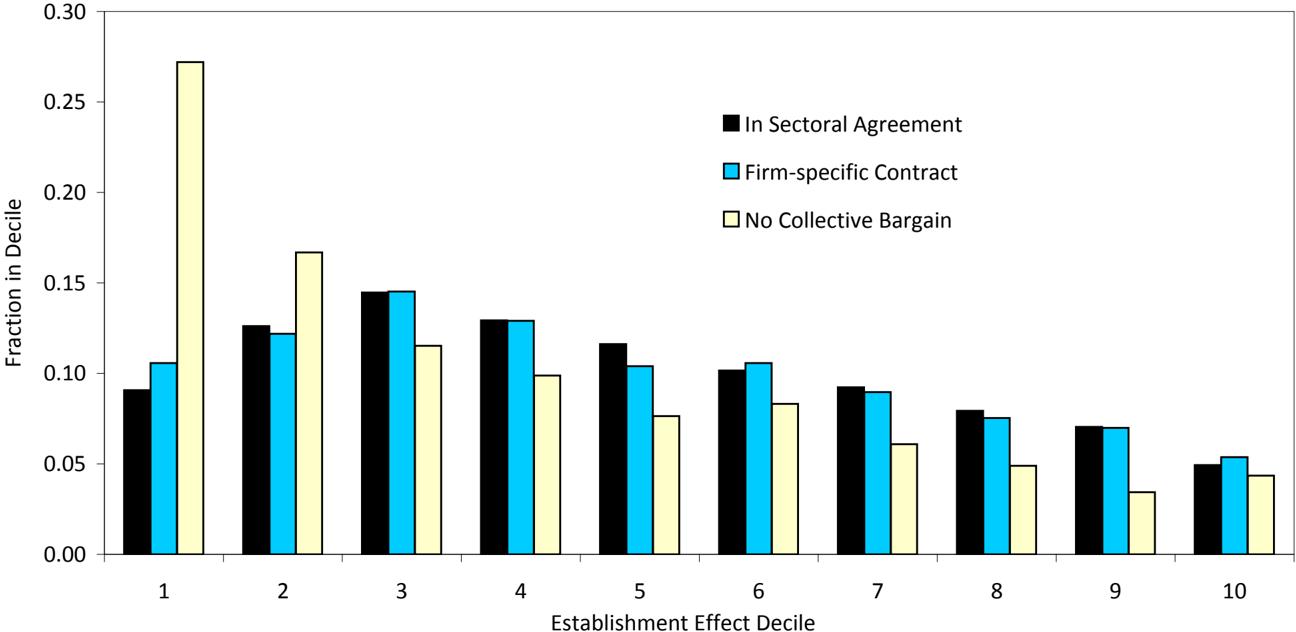
Verification
Claims the paper makes
0 Valid · 0 Not valid · 8 Not checked · 191 Own results and interpretations
A result the paper reports from its own data — it cites no other source for it, so there is none to check. The quote shows it is in the paper.
In the paper
“In particular, generalized non-separable models with xed e/ects for each job yield only a small improvement in explanatory power relative to the AKM speci cation, both within narrow time intervals and between intervals.”
plain- Asserted: passes — The authors put it forward as true.
- Checkable: passes — It can be checked against evidence.
- Load-bearing: passes — The paper’s conclusions depend on it.
- Based: passes — The paper gives a reason why it holds.
A result the paper reports from its own data — it cites no other source for it, so there is none to check. The quote shows it is in the paper.
In the paper
“Classifying establishments by entry year, we nd a trend toward increasing heterogeneity among establishments that entered the labor market after the mid-1990s, coupled with relatively small changes in the variability of the premiums paid by continuing establishments.”
plain- Asserted: passes — The authors put it forward as true.
- Checkable: passes — It can be checked against evidence.
- Load-bearing: passes — The paper’s conclusions depend on it.
- Based: passes — The paper gives a reason why it holds.
A result the paper reports from its own data — it cites no other source for it, so there is none to check. The quote shows it is in the paper.
In the paper
“We nd that two-thirds of the increase in the pay gap between higher and lower-educated workers is attributable to a widening in the average workplace pay premiums received by di/erent education groups.”
plainstates a cause- Asserted: passes — The authors put it forward as true.
- Checkable: passes — It can be checked against evidence.
- Load-bearing: passes — The paper’s conclusions depend on it.
- Based: passes — The paper gives a reason why it holds.
A result the paper reports from its own data — it cites no other source for it, so there is none to check. The quote shows it is in the paper.
In the paper
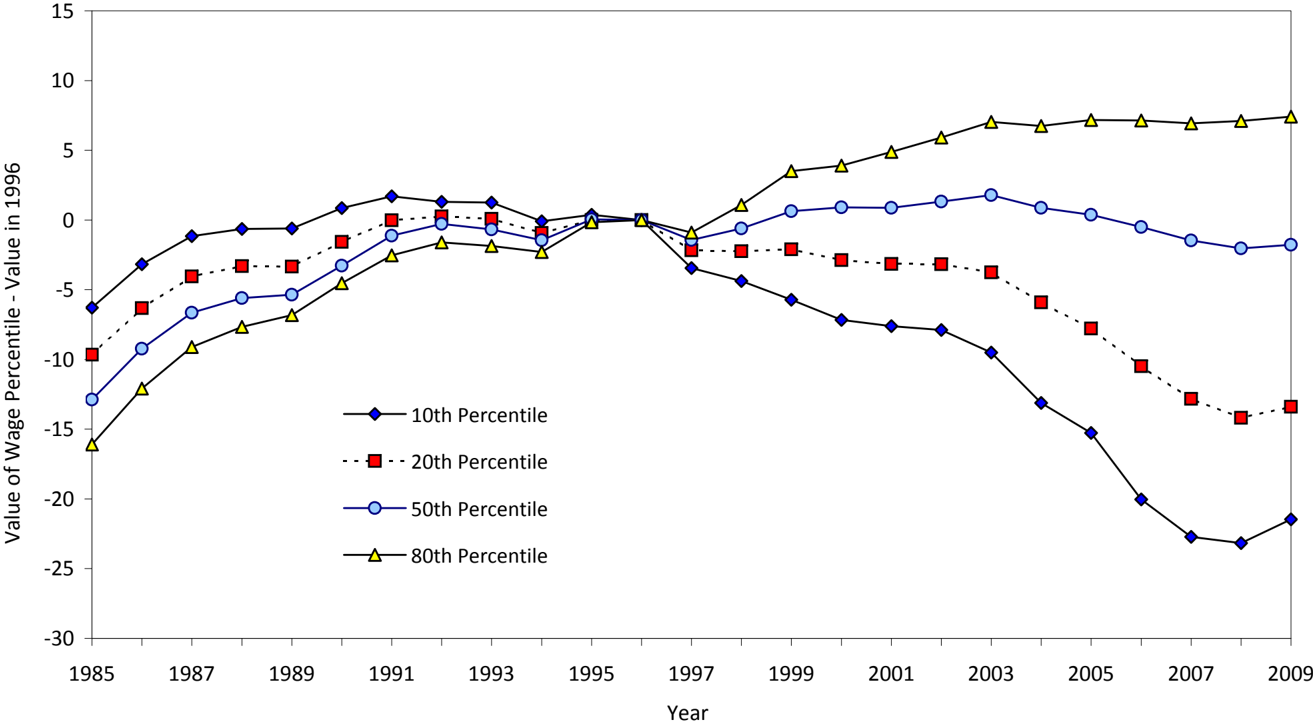
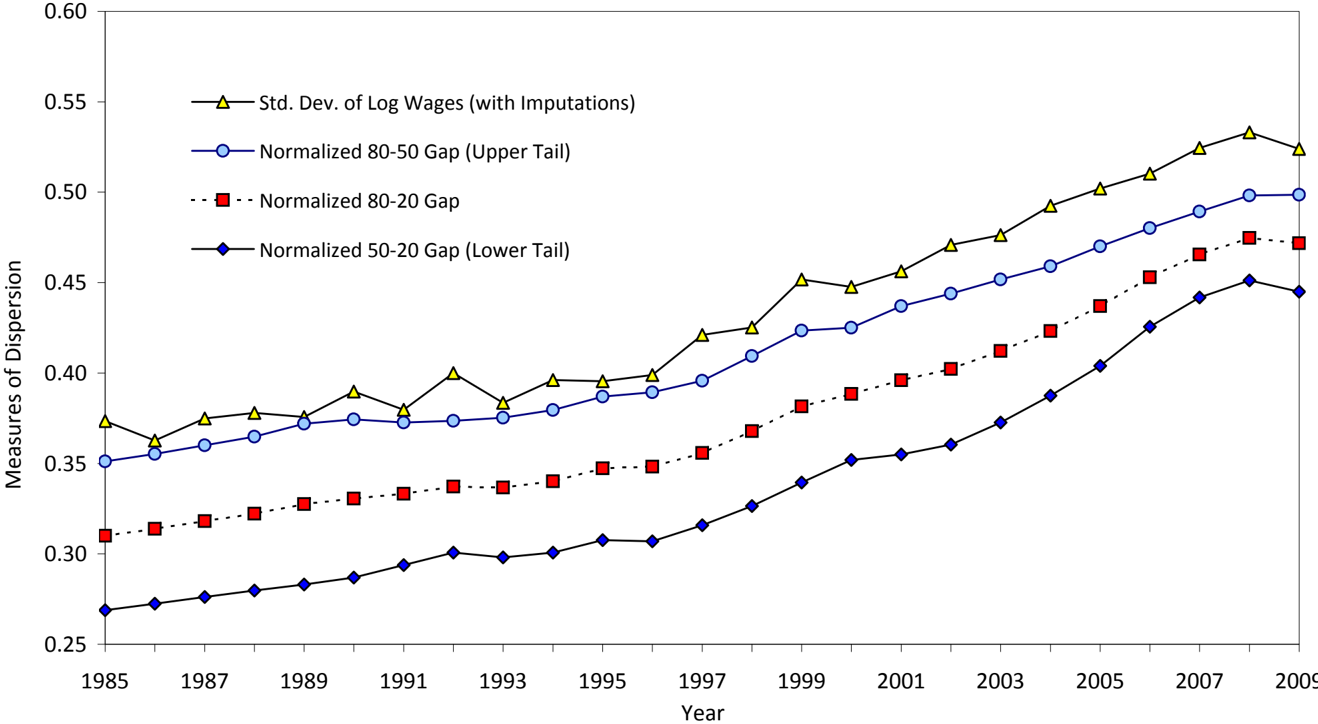
“In particular, the standard deviation rose by 15 log points from 1985 to 2009, the (normalized) 80-20 gap rose by 16 log points, the 80-50 gap rose by 15 log points, and the 50-20 gap rose by 18 log points.”
plain- Asserted: passes — The authors put it forward as true.
- Checkable: passes — It can be checked against evidence.
- Load-bearing: unclear — It is unclear whether the paper’s conclusions depend on it.
- Based: passes — The paper gives a reason why it holds.
118 more claims
Create a free account to see all 199 claims and to verify the 4 references still open.
- It may state two separate claims as one. 61
- Probably not a substantial claim. 17
- The quote only partly states this claim. 3
Claims other papers make about this one
Each is checked against this paper’s own text: does it say what the citing paper says it does?
The check wasn’t confident either way, so it gives no verdict — never disputed.
In the citing paper
“We estimate below that 75% is labor income.16”
From “Capitalists in the Twenty-First Century” (2019) · cites this paper as [16]
Experimental — accuracy not yet measured
Citations
Cites
A heteroskedasticity-consistent covariance matrix estimator and a direct test for heteroskedasticity
White, H. (1980) · Econometrica · doi:10.2307/1912934 · Cited by 25,861
The Skill Content of Recent Technological Change: An Empirical Exploration
Autor, D. H., Levy, F., & Murnane, R. J. (2003) · The Quarterly Journal of Economics · doi:10.1162/003355303322552801 · Cited by 6,205
On the Pooling of Time Series and Cross Section Data
Mundlak, Y. (1978) · Econometrica · doi:10.2307/1913646 · Cited by 5,412
Changes in Relative Wages, 1963-1987: Supply and Demand Factors
Katz, L. F., & Murphy, K. M. (1992) · The Quarterly Journal of Economics · doi:10.2307/2118323 · Cited by 4,793
Equilibrium Unemployment as a Worker Discipline Device
Shapiro, C., & Stiglitz, J. E. (1986) · Efficiency Wage Models of the Labor Market · doi:10.1017/cbo9780511559594.004 · Cited by 4,652
Misallocation and Manufacturing TFP in China and India*
Hsieh, C.-T., & Klenow, P. J. (2009) · Quarterly Journal of Economics · doi:10.1162/qjec.2009.124.4.1403 · Cited by 4,175
Job Creation and Job Destruction in the Theory of Unemployment
Mortensen, D. T., & Pissarides, C. A. (1994) · The Review of Economic Studies · doi:10.2307/2297896 · Cited by 3,840
Hybrid Corn: An Exploration in the Economics of Technological Change
Griliches, Z. (1957) · Econometrica · doi:10.2307/1905380 · Cited by 3,330
Labor Contracts as Partial Gift Exchange
Akerlof, G. A. (1982) · The Quarterly Journal of Economics · doi:10.2307/1885099 · Cited by 3,210
Plants and Productivity in International Trade
Bernard, A. B., Eaton, J., Jensen, J. B., & Kortum, S. (2003) · American Economic Review · doi:10.1257/000282803769206296 · Cited by 2,980
Research works printed but not linked: 1
- 70. Rees, Albert and George Schultz. 1970. Workers in an Urban Labor Market. Chicago: University of Chicago Press.
Cited by
Items 1,801–1,900 of 1,904
The Elephant vs Donkey and Rank-and-file Employee CompensationPreprint
Kim, E., & Xi, Y. (2026) · SSRN Electronic Journal · doi:10.2139/ssrn.6316058
Estructura salarial de los trabajadores polacos en Alemania
Brunow, S., Miszczak, K., Seibert, H., & Wrona, A. (2026) · Revista Internacional del Trabajo · doi:10.16995/ilrs.23812
Gualdani, C., Pastorino, E., de Paula, Á., & Salgado, S. A. (2026) · National Bureau of Economic Research · doi:10.3386/w34973
事業所内・事業所間賃金格差の変遷 : 日本の事業所―労働者結合データによる考察
Akesaka, M., & Miyoshi, K. (2016) · Institutional Repositories DataBase (IRDB)
Three essays on workers' self-selection
Etienne, A. (2018) · theses.fr (ABES) · doi:10.70675/b15820e4z9f9cz4808zba96z6b5bd44b494e
Essays on hours worked, time allocation and their implications for labour market outcomes
Vivian, L. (2018) · theses.fr (ABES) · doi:10.70675/d51d83b6z3d74z456bz9bd6z774ceb296312
Boussard, J. (2020) · theses.fr (ABES) · doi:10.70675/722cdc08za28fz437fz965dz4ced505fd1d5
Galván, E. (2020) · theses.fr (ABES) · doi:10.70675/1b18f361z154cz468aza2adzf4b8424dad42
Essays on Macroeconomics and Labor Markets
Azkarate-Askasua, M. (2020) · theses.fr (ABES) · doi:10.70675/d7a9af5fz78faz4945z9735zb3a8e75c677d
Essays on Firms Production Function, Markups, and the Share of their Income Going to Workers
Bauer, A. (2020) · theses.fr (ABES) · doi:10.70675/64ff611fzf66cz432dz931cz21f8c8c8c359
Antón, M. Z. (2021) · theses.fr (ABES) · doi:10.70675/7deee69az4ff2z43a4za76ezf58e9140e513
Essays on job polarization, market power and gender wage inequality
Patel, A. (2021) · theses.fr (ABES) · doi:10.70675/d7acb538zb2aez47cfzba9dz169085c970ec
So similar but so different. Explaining wage differences between observably similar individuals
Sage, L. (2022) · theses.fr (ABES) · doi:10.70675/dc74fd0ez55b4z4e4dzaee3z417ba82ce4da
Technological Change, Skill Shortages and Migration Policy
Signorelli, S. (2021) · theses.fr (ABES) · doi:10.70675/0c0a2f64z9e20z4567za1a4z40cbd47687fe
Returns to education and experience on the labor market : a matching perspective
Corblet, P. (2022) · theses.fr (ABES) · doi:10.70675/b08ca484z06a4z4c3ezbd1fz9c341f684669
Firms, wage dynamics, and labour contract choices
Palladino, M. G. (2023) · theses.fr (ABES) · doi:10.70675/eabe3c85z48cfz4af6z9408zf6fd0761d9d2
Essays on firms, aggregate uncertainty, and the labor market
Dalvit, N. (2020) · theses.fr (ABES) · doi:10.70675/e774c5edz3b3ez4d12z9581zb99cfd8e7edc
Four essays on ownership structure and organizational behavior
Karimi, S. (2025) · theses.fr (ABES) · doi:10.70675/73f3be02ze89ez4608z88c9zcc6d9655cf3d
Sorting, peer effects and school effectiveness in private and public schools
Friesen, J., Cohn, R. M., & Woodcock, S. D. (2026) · Economics of Education Review · doi:10.1016/j.econedurev.2026.102786
Collective Wage Co‐ordination and the Costs of Job Displacement
Guerrico, S. F., & Tojerow, I. (2026) · British Journal of Industrial Relations · doi:10.1111/bjir.70055
Lombardi, S., Jandarova, N., Zguro, K., Harju, J., Rustichini, A., & Ganna, A. (2026) · arXiv (Cornell University) · doi:10.48550/arxiv.2604.24336
Firm Pay, Amenities, and Inequality
Caldwell, S., Haegele, I., & Heining, J. (2026) · National Bureau of Economic Research · doi:10.3386/w35149
Self-citationIs Your Career Determined by the Stars? Western Zodiac Signs and Labor Market Outcomes in Germany
Collischon, M., & Zimmermann, F. (2026) · Kyklos · doi:10.1111/kykl.70057
Follow the leader: The effect of high-quality peers on turnover decisionsPreprint
Francisco, M. (2026) · SSRN Electronic Journal · doi:10.2139/ssrn.6711359
Interlocking Directorates, Innovation, and Knowledge TransmissionPreprint
Maria, M. D. (2026) · SSRN Electronic Journal · doi:10.2139/ssrn.6693818
Remote work expands pathways to upward career mobilityPreprint
Zheng, Y., & Zhao, J. (2026) · arXiv (Cornell University) · doi:10.48550/arxiv.2605.01268
Essays on coworker networks and employment dynamics
Hussein, O. (2026) · Open Access at Essex (University of Essex) · doi:10.5526/err-00043219
Geographic variation in fertility: evidence from mover design
Wu, H., & Zhu, M. (2026) · Labour Economics · doi:10.1016/j.labeco.2026.102895
Nonparametric Empirical Bayes Confidence IntervalsPreprint
Xie, Z. (2026) · arXiv (Cornell University) · doi:10.48550/arxiv.2605.08551
The Geography of Lifecycle Human Capital Accumulation
Sprung-Keyser, B., & Porter, S. (2026) · National Bureau of Economic Research · doi:10.3386/w35203
Sorting in Marriage Markets: The Role of Non-Wage AmenitiesPreprint
Judy, A., Kesternich, I., Mathevet, I., & Zimpelmann, C. (2026) · SSRN Electronic Journal · doi:10.2139/ssrn.6803196
Mao, Q., Xie, H., & Zhong, Y. (2026) · SSRN Electronic Journal · doi:10.2139/ssrn.6854628
Competitive Many-to-One Matching: Sorting vs. EqualityPreprint
Kolotilin, A., & Wolitzky, A. (2026) · arXiv (Cornell University) · doi:10.48550/arxiv.2605.30879
Yu, B. (2026) · Open Access at Essex (University of Essex) · doi:10.5526/err-00043342
Declining Inequality and Persistent Inequality Structures
Roh, S., & Wilmers, N. (2026) · Sociological Science · doi:10.15195/v13.a24
Diegmann, A., Müller, S., & Schoefer, B. (2026) · Working Paper Series · doi:10.24352/ub.ovgu-2026-064
The Geography of Worker - Firm Sorting
Hollandt, N. T., & Müller, S. (2026) · Working Paper Series · doi:10.24352/ub.ovgu-2026-067
Growing Downward: Persistent Inequality in Publishing in Economics *Preprint
Dahis, R. (2026) · SSRN Electronic Journal · doi:10.2139/ssrn.6899138
Contractual Minimum Wages and Collective Bargaining. Italian Evidence From 40 Years of Data
Fanfani, B. (2026) · Industrial Relations A Journal of Economy and Society · doi:10.1111/irel.70034
Demand for Skills and Wage Inequality
Grasso, G., & Tatsiramos, K. (2026) · Labour · doi:10.1111/labr.70023
Variance Estimation for Saturated Fixed-Effect SpecificationsPreprint
Halkiewicz, S. M. (2026) · arXiv (Cornell University) · doi:10.48550/arxiv.2607.05215
Separations Revisited: Do Layoffs or Quits Drive Lower Separation Rates in High-Quality Firms?
Dobbin, C., Fernandez, D., & Zohar, T. (2026) · CESifo · doi:10.65864/x7sd91hg8a
Unequal Gains: How Market Power Exacerbates the Executive-Employee Pay Gap in China
Jiang, Y., & Jiang, X. (2026) · Emerging Markets Finance and Trade · doi:10.1080/1540496x.2026.2698617
A Dynamic Hybrid Model of Employment Partnerships
Freistühler, J. (2026) · Qucosa (Saxon State and University Library Dresden)
Firm organization and worker outcomes: The role of occupational specialization
Cortés, G. M., Dabed, D., Oliveira, A., & Salomons, A. (2026) · Labour Economics · doi:10.1016/j.labeco.2026.102940
Decomposing Loan Rate Dispersion in the Interbank MarketPreprint
Okada, M. (2026) · SSRN Electronic Journal · doi:10.2139/ssrn.7675061
The Use of Econometrics in Labour ResearchPreprint
Chan, M., & Márk, L. (2026) · SSRN Electronic Journal · doi:10.2139/ssrn.7090498
Changing jobs: worker mobility and wages in the UK labour market
Albagli, P., Cominetti, N., Costa, R., Eyles, A., & Ventura, G. (2026) · Economica · doi:10.1111/ecca.70067
Greedy work: Signaling and the design of demanding jobs
Kim, J. (2026) · Labour Economics · doi:10.1016/j.labeco.2026.102944
Women’s economic participation
Jalal, A. (2026) · London School of Economics and Political Science Research Online (London School of Economics and Political Science) · doi:10.21953/researchonline.lse.ac.uk.00140430
Employers and Refugee Economic Integration: The Effect of Early Employer QualityPreprint
Caiumi, A., & Simonsen, E. A. L. (2026) · SSRN Electronic Journal · doi:10.2139/ssrn.7170101
Wages and Within-Occupation Skill ComplementarityPreprint
Verónico, F. M. A., Kaltenberg, M., Pereira, P. J., & Pinheiro, F. L. (2026) · SSRN Electronic Journal · doi:10.2139/ssrn.7155745
Firms and wage inequality in Türkiye: Learning from matched employer-employee data
Türel, M., & Yılmaz, E. (2026) · Journal of Post Keynesian Economics · doi:10.1080/01603477.2026.2704174
Unpacking the Wage Sorting Trend
Bagger, J., Elholm, M., Maibom, J., & Vejlin, R. (2026) · Edinburgh Research Explorer (University of Edinburgh)
The Multinational Wage Premium: Production vs. Financial Networks
Egger, H., & Jahn, E. J. (2026) · CESifo · doi:10.65864/gxiwqv4n55
Simon Board, Meyer-ter-Vehn, M., & Sadzik, T. (2026) · The Review of Economic Studies · doi:10.1093/restud/rdag091
The Effect of Public Pension Contribution Rate Reductions on Employee Wages: Evidence from China
Xiang, J., Yuan, X., & Xie, Y. (2026) · Emerging Markets Finance and Trade · doi:10.1080/1540496x.2026.2715029
Three essays on bureaucracy and public service provision in rural India
Haus, M. (2026) · London School of Economics and Political Science Theses Online (London School of Economics and Political Science) · doi:10.21953/researchonline.lse.ac.uk.00140799
Low-wage work and labour market policies: a European cross-country study
Barreto, C., Carcillo, S., Fluchtmann, J., Hijzen, A., Lochner, B., Meekes, J., Nibloe, M., Schack, T., & Vejlin, R. (2026) · doi:10.1920/wp.ifs.2026.5026
Essays on Firm and Labor Market
李, 株. (2023) · Institutional Repositories DataBase (IRDB) · doi:10.15083/0002012401
The accuracy of jobseekers’ wage expectations
Caliendo, M., Mahlstedt, R., Schmeißer, A., & Wagner, S. (2026) · Journal of Public Economics · doi:10.1016/j.jpubeco.2026.105764
Matching and Mentoring: Effects of Managers on Worker Productivity
Hua, C. (2026) · The Research Repository @ WVU (West Virginia University)
Investing in Human Capital IncubationPreprint
Lee, S. H., Seegmiller, B., Wu, Y., & Zhang, M. B. (2026) · SSRN Electronic Journal · doi:10.2139/ssrn.7405739
Card, D., Rothstein, J., & Yi, M. (2026) · Proceedings of the National Academy of Sciences · doi:10.1073/pnas.2620927123
Self-citationNgepah, N. N. (2026) · SSRN Electronic Journal · doi:10.2139/ssrn.7446126
Card, D., Rothstein, J., & Yi, M. (2026) · National Bureau of Economic Research · doi:10.3386/w35746
Self-citationSocial Connections and the Persistence of Income Across GenerationsPreprint
Laliberté, J.-W. P., & Whalley, A. (2026) · SSRN Electronic Journal · doi:10.2139/ssrn.7466618
Careers and Wages in Family Firms: Evidence from Matched Employer-Employee DataPreprint
DiPorto, E., Pagano, M., Pezone, V., Saggio, R., & Schivardi, F. (2024) · doi:10.67929/ecgi-fin-1022-2024
Portable Director-Specific QualityPreprint
Bhattarai, D., Serfling, M. A., Woidtke, T., & RoySchmardebeck (2023) · doi:10.67929/ecgi-fin-870-2023
Corporate Employee-Engagement and Merger OutcomesPreprint
Liang, H., Renneboog, L. D. R., & Vansteenkiste, C. (2017) · doi:10.67929/ecgi-fin-496-2017
Jin, R. (2026) · eScholarship (California Digital Library)
The Returns to International Migration in a Free Mobility Setting: Evidence from Austria and Germany
Weber, A., Card, D., Dauth, W., Frimmel, W., Schmieder, J., & Winter‐Ebmer, R. (2026) · National Bureau of Economic Research · doi:10.3386/w35774
Self-citationWell-Being Salience in Corporate Disclosures and Worker Health
Francesco, R. D., Hull, P., & Menon, S. (2026) · National Bureau of Economic Research · doi:10.3386/w35760
Within‐Sector Job Mobility and Worker Outcomes in England's Adult Social Care Sector
Ullah, A., William, W., Woodhams, C., & Atkinson, C. (2026) · British Journal of Industrial Relations · doi:10.1111/bjir.70081
Firms and the Fragility of Inequality Reduction: Evidence from ArgentinaPreprint
Hermo, S., Trombetta, M., & Sidicaro, N. (2026) · SSRN Electronic Journal · doi:10.2139/ssrn.7539702
Three Essays on Personnel and Labor Economics
Hua, C. (2026) · The Research Repository @ WVU (West Virginia University) · doi:10.33915/etd.13418
AI at work: how AI reshapes work and workers’ labour market outcomes
Özgül, P. (2026) · Research Publications (Maastricht University) · doi:10.26481/dis.20261002pp
Gao, M., & Zhang, K. (2026) · Cost Effectiveness and Resource Allocation · doi:10.1186/s12962-026-00833-x
Sorting in a Market for Lemons
Cai, X., & Gautier, P. A. (2026) · CESifo · doi:10.65864/pg4cvjjx23
Essays on Heterogeneity in Macroeconomics and Labor Markets
REPELE, A. R. (n.d.) · Archivio istituzionale della Ricerca - Bocconi
Three Essays on the Economics of Inequalities and Discrimination
Fanfani, B. (2017) · Institutional Research Information System University of Turin (University of Turin)
Essays on causes and consequences of inequality
Gorn, A. (2017) · Archivio istituzionale della Ricerca - Bocconi
Essays on labor and migration economics
Cortina, E. M. M. (2023) · Illinois Digital Environment for Access to Learning and Scholarship (University of Illinois at Urbana-Champaign)
Essays in applied microeconomics
Ghosh, P. (2022) · Illinois Digital Environment for Access to Learning and Scholarship (University of Illinois at Urbana-Champaign)
Firm Heterogeneity and the Impact of Immigration: Evidence from German Establishments
Brinatti, A., & Morales, N. (2026) · Journal of Political Economy · doi:10.1086/744485
Passthrough of Firm Performance to Income and Employment Status
Maibom, J., & Vejlin, R. (2026) · Journal of Political Economy Microeconomics · doi:10.1086/744387
L’utilizzo delle banche dati amministrative in Italia per informare le politiche
Berton, F., & Leombruni, R. (2026) · Institutional Research Information System University of Turin (University of Turin)
Ramapala, E. M., Jongh, J. D., Mncayi, P., & Wyk, A. S.-V. (2026) · International Journal of Business Ecosystem and Strategy (2687-2293) · doi:10.36096/ijbes.v8i5.1545
Health effects of import shocks: Chronic illness and healthcare-seeking behavior in Germany
Piriu, A. A. (2026) · Economics & Human Biology · doi:10.1016/j.ehb.2026.101660
Will markets provide humane jobs?
Nekoei, A. (2026) · Journal of Public Economics · doi:10.1016/j.jpubeco.2026.105737
Earnings Dynamics and Firm-Level Shocks
Friedrich, B., Laun, L., Meghir, C., & Pistaferri, L. (2026) · Journal of Labor Economics · doi:10.1086/744665
People, places, and firms: improving our understanding of wage and productivity disparities
Hernandez, Y. G., & Overman, H. G. (2026) · Journal of Economic Geography · doi:10.1093/jeg/lbag078
Practice makes Perfect: Tacit Knowledge, Generative AI, and Returns to Schooling and Experience.Preprint
Levy-Yeyati, E. L., Judzik, D., & Barbiero, J. I. (2026) · SSRN Electronic Journal · doi:10.2139/ssrn.7662798
fevc: Leave-Out Bias-Corrected Variance Decompositions in Stata
Schmieder, J. F. (2026) · National Bureau of Economic Research · doi:10.3386/w35948
Remote Work and the Corporate Hierarchy
Vacca, M., Bajo, E., & Pitkäjärvi, A. (2026) · VU Research Portal
Firm-level technology adoption in times of crisis
Arntz, M., Böhm, M. J., Graetz, G., Gregory, T., Lehmer, F., & Lipowski, C. (2025) · London School of Economics and Political Science Research Online (London School of Economics and Political Science)
Metadata
- Authors
- Card, D., Heining, J., & Kline, P.
- Affiliations
- University of California, Berkeley (US)
- Corresponding author
- Kline, Patrick
- ORCID
- Card, David
- Venue
- The Quarterly Journal of Economics
- Publisher
- Oxford University Press (OUP)
- Published
- 2013-05-02
- Volume
- 128
- Issue
- 3
- Pages
- 967-1015
- ISSN
- 0033-5533 (ISSN-L)
- 1531-4650
- OpenAlex
- W2141295263
- Cited by
- 1,904
- References
- 146
- Citations by year
- 2026: 153 · 2025: 204 · 2024: 228 · 2023: 156 · 2022: 185 · 2021: 178 · 2020: 143 · 2019: 125 · 2018: 156 · 2017: 113 · 2016: 105 · 2015: 71 · 2014: 58 · 2013: 22
- FWCI
- 118.40
- Type
- journal article
- Language
- en
- Open access
- closed
- Locations
- The Quarterly Journal of Economics (publishedVersion)
- RePEc: Research Papers in Economics (submittedVersion)
- Econstor (Econstor) (submittedVersion)
- Funders
- Washington Center for Equitable Growth
- Topics
- Social Sciences › Economics, Econometrics and Finance › Economics and Econometrics › Labor market dynamics and wage inequality
- Social Sciences › Economics, Econometrics and Finance › Economics and Econometrics › Historical Economic and Social Studies
- Social Sciences › Sociology and Political Science › Income, Poverty, and Inequality
- Keywords
- wage inequality, job matching, fixed effects model, education and wages
About these checks
Registry, retraction, Cites and statistics results are computed, not judged, with one exception: a printed reference that no index lists is read once by a model before it counts as a citation error. Claims are extracted by a model and kept only when their quote appears verbatim in the text; each cited source is then checked, with a model’s help, for whether it says what the claim relies on. Those verdicts can be wrong — read the claim’s quote and the cited source before relying on one.
A language model drew the claims from the paper on 2026-11-17, under version 3 of the claim definition (model deepseek-v4.1-flash, prompt extract-v3).
A second model labelled each claim on 2026-11-17 (model jev-1.13-20260917, definition revision gold-guideline-v0.2).
Statistics and arithmetic are recomputed, not judged.
Confidence bands are shown only for fields calibrated on our annotated test set. None is calibrated yet, so no band is shown.
What counts as a claim ›How we measure confidence ›How we check this ›
Are you an author, or do you see a problem with this page? Request a review
Data sources
Bibliographic data: Semantic Scholar, OpenAlex, Crossref.
Contains information from the Semantic Scholar Academic Graph Datasets, made available under the ODC Attribution License (ODC-BY 1.0).
Semantic Scholar’s data is described in: Kinney, R., et al. (2023). The Semantic Scholar Open Data Platform. arXiv:2301.10140.
