

. Cognitive behavior therapy for schizophrenia: effect sizes, clinical models, and methodological rigor.
Open accessThe DOI matches its Crossref record; 98 of the 98 references it cites were found in a registry or an index.
Abstract
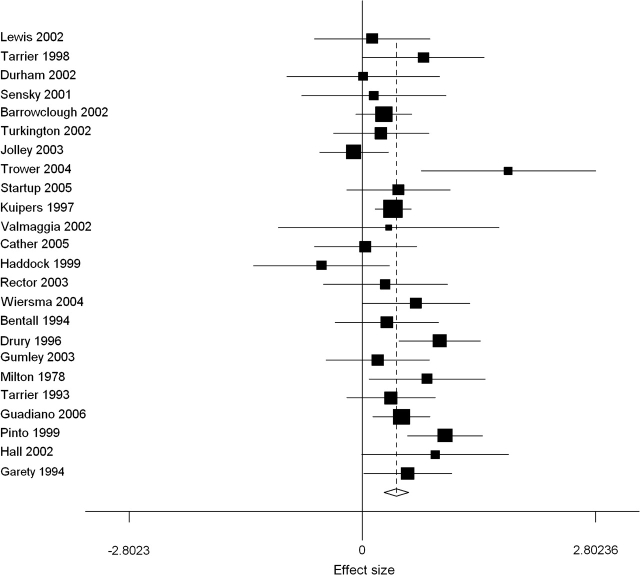
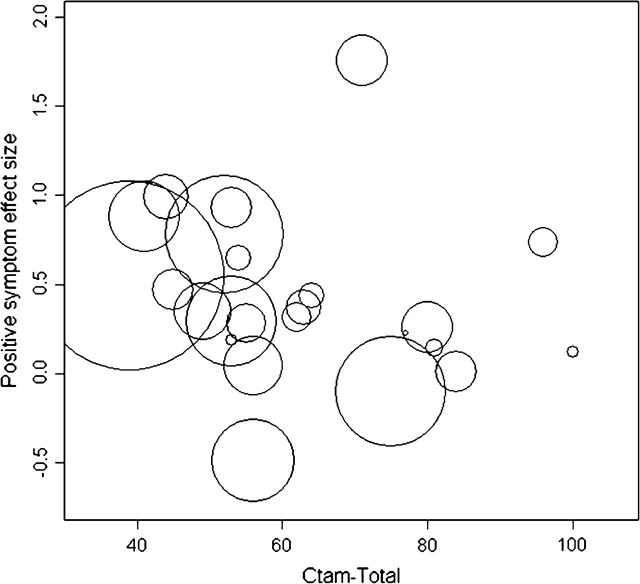
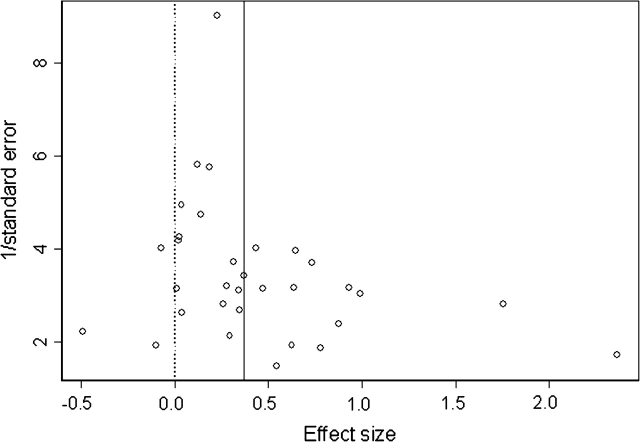
BACKGROUND: Guidance in the United States and United Kingdom has included cognitive behavior therapy for psychosis (CBTp) as a preferred therapy. But recent advances have widened the CBTp targets to other symptoms and have different methods of provision, eg, in groups. AIM: To explore the effect sizes of current CBTp trials including targeted and nontargeted symptoms, modes of action, and effect of methodological rigor. METHOD: Thirty-four CBTp trials with data in the public domain were used as source data for a meta-analysis and investigation of the effects of trial methodology using the Clinical Trial Assessment Measure (CTAM). RESULTS: There were overall beneficial effects for the target symptom (33 studies; effect size = 0.400 [95% confidence interval [CI] = 0.252, 0.548]) as well as significant effects for positive symptoms (32 studies), negative symptoms (23 studies), functioning (15 studies), mood (13 studies), and social anxiety (2 studies) with effects ranging from 0.35 to 0.44. However, there was no effect on hopelessness. Improvements in one domain were correlated with improvements in others. Trials in which raters were aware of group allocation had an inflated effect size of approximately 50%-100%. But rigorous CBTp studies showed benefit (estimated effect size = 0.223; 95% CI = 0.017, 0.428) although the lower end of the CI should be noted. Secondary outcomes (eg, negative symptoms) were also affected such that in the group of methodologically adequate studies the effect sizes were not significant. CONCLUSIONS: As in other meta-analyses, CBTp had beneficial effect on positive symptoms. However, psychological treatment trials that make no attempt to mask the group allocation are likely to have inflated effect sizes. Evidence considered for psychological treatment guidance should take into account specific methodological detail.
Overview
The claims and statistics of this paper haven’t been checked yet.
Free: it reads the open-access text and checks the first 5 claims that cite a source we can check. Create a free account to check every claim.
Integrity signals
Registry
Cites
Statistics
Figures
Verification
Claims the paper makes
The claims and statistics of this paper haven’t been checked yet.
Free: it reads the open-access text and checks the first 5 claims that cite a source we can check. Create a free account to check every claim.
Claims other papers make about this one
Each is checked against this paper’s own text: does it say what the citing paper says it does?
The cited source doesn’t support the claim as written.
In the citing paper
“The primary outcome was change in positive symptom severity at the end of treatment and at follow-up”
From A systematic review and meta-analysis of cognitive behavioural informed psychological interventions for psychiatric inpatients with psychosis (2020) · cites this paper as Wykes et al., 2008
Checked by a reasoning model — may be wrong.
Experimental — accuracy not yet measuredThe source backs part of the claim, not all of it — or backs it for a different population, condition or comparison.
In the citing paper
“Combining medication with evidence-based psychotherapy produces clinically significant improvement over medications alone for severe depression and psychotic disorders.9,10”
From Acceptance-based Behavior Therapy for Depression With Psychosis (2015) · cites this paper as [10]
Experimental — accuracy not yet measuredThe source backs part of the claim, not all of it — or backs it for a different population, condition or comparison.
In the citing paper
“Psychological therapies have demonstrated to be effective for patients experiencing psychotic symptoms (1, 2) and are recommended by treatment guidelines already in the acute illness and treatment phase (3, 4).”
From Developing a mechanism-based therapy for acute psychiatric inpatients with psychotic symptoms: an Intervention Mapping approach (2023) · cites this paper as [1]
Experimental — accuracy not yet measuredThe source backs part of the claim, not all of it — or backs it for a different population, condition or comparison.
In the citing paper
“There is limited evidence supporting the use of pharmacological and psychological interventions for depression in the context of schizophrenia (Whitehead et al. 2002; Wykes et al., 2008).”
From Acceptance and Commitment Therapy for depression following psychosis: An examination of clinically significant change (2015) · cites this paper as Wykes et al., 2008
Experimental — accuracy not yet measuredThe source backs part of the claim, not all of it — or backs it for a different population, condition or comparison.
In the citing paper
“Although effective at treating positive symptoms, Cognitive Behavioural Therapy for psychosis (CBTp) is less effective for treating emotional dysfunction associated with psychosis such as depression, hopelessness and suicide risk (Birchwood, 2003; Wykes et al., 2008; Tarrier et al., 2006).”
From Acceptance and Commitment Therapy for depression following psychosis: An examination of clinically significant change (2015) · cites this paper as Wykes et al., 2008
Experimental — accuracy not yet measured
4 more claims about this paper
Create a free account to see every claim other papers make about this one.
Self-check
Percentages, sums and reported differences re-computed from the paper’s own numbers.
The self-check needs the paper’s full text.
Citations
Cites
1 retracted
Cognitive behaviour therapy for schizophrenia
Jones, C., Cormac, I., Silveira da Mota Neto, J. I., & Campbell, C. (2004) · Cochrane Database of Systematic Reviews · doi:10.1002/14651858.cd000524.pub2 · Cited by 269
RetractedAssessing the quality of reports of randomized clinical trials: Is blinding necessary?
Jadad, A. R., Moore, R. A., Carroll, D., Jenkinson, C., Reynolds, D. J. M., Gavaghan, D. J., & McQuay, H. J. (1996) · Controlled Clinical Trials · doi:10.1016/0197-2456(95)00134-4 · Cited by 17,582 · cited 1×
“In addition, concurrent validity was assessed within an initial 22 studies by correlation with the scores from 3 other scales devised to assess methodological rigor.(42,43,52) The correlations of these scales with the CTAM scores on the corpus of CBTp data were as follows: CTAM and Jadad, q = .”
MethodZhang, Q., Wang, C., Zheng, M., Li, Y., Li, J., Zhang, L., Shang, X., & Yan, C. (2015) · Cerebrovascular Diseases · doi:10.1159/000369778 · Cited by 11,533
Schulz (1995) · doi:10.1001/jama.1995.03520290060030 · Cited by 5,634
Dong, Y., Hao, L., Shi, Z., Wang, G., Zhang, Z., & Han, C. (2013) · Urologia Internationalis · doi:10.1159/000351405 · Cited by 4,540
The Revised CONSORT Statement for Reporting Randomized Trials: Explanation and Elaboration
Altman, D. G., Schulz, K. F., Moher, D., Egger, M., Davidoff, F., Elbourne, D., Gøtzsche, P. C., Lang, T., & for the CONSORT Group (2001) · Annals of Internal Medicine · doi:10.7326/0003-4819-134-8-200104170-00012 · Cited by 3,835
The Handbook of Research Synthesis.
Howel, D., Cooper, H., & Hedges, L. V. (1995) · Biometrics · doi:10.2307/2533295 · Cited by 3,642
Moher, D., Pham, B., Jones, A., Cook, D. J., Jadad, A. R., Moher, M., Tugwell, P., & Klassen, T. P. (1998) · The Lancet · doi:10.1016/s0140-6736(98)01085-x · Cited by 3,560 · cited 1×
“For instance, poorer quality masking of allocation of treatments has been shown to be associated with up to 40% increased estimate of benefit in circulatory and digestive diseases, mental health, obstetrics, and childbirth.(36,37)”
BackgroundAssessing the quality of controlled clinical trials
Jüni, P., Altman, D. G., & Egger, M. (2001) · BMJ · doi:10.1136/bmj.323.7303.42 · Cited by 3,309
Improving the Quality of Reporting of Randomized Controlled Trials: The CONSORT Statement
Begg, C. (1996) · JAMA · doi:10.1001/jama.1996.03540080059030 · Cited by 3,127
Research works printed but not linked: 1
- [24]NICE Schizophrenia: Core interventions in the Treatment and Management of Schizophrenia in Primary and Secondary Care 2003 20704054
Cited by
Items 901–997 of 997
Gruppenpsychotherapeutische Interventionen bei schizophrenen Störungen
Vauth, R. (2012) · Springer eBooks · doi:10.1007/978-3-642-03497-8_28
Langzeitbehandlung der Schizophrenie
Zilles‐Wegner, D., & Gruber, O. (2011) · Psychiatrie und Psychotherapie up2date · doi:10.1055/s-0030-1265958 · Cited by 1
Ein konstruktiver Ausblick: Psychotherapie für Menschen mit Psychosen
von Haebler, D. (2013) · NeuroTransmitter · doi:10.1007/s15016-013-0460-0
PRACTICE REVIEW Cognitive Behavioral Therapy for Psychosis in Clinical Practice
Sivec, H. J., Montesano, V. L., & Ohio, N. (2012)
Moller, B. (2016) · RMIT Research Repository (RMIT University Library) · doi:10.25439/rmt.27598530
Artículo Monográfico Intervenciones psicosociales en la psicosis temprana
Fornells‐Ambrojo, M., & Craig, T. (2011)
Policy Implications in Psychosis
Pinninti, N. R., & Rathod, S. (2016) · Springer eBooks · doi:10.1007/978-3-319-30521-9_13
The management of negative symptoms
Copolov, D., & Castle, D. J. (2012) · CRC Press eBooks · doi:10.3109/9781842145357.003
Integrated Pathways of Care for Psychosis: An Overview
Rathod, S., & Pinninti, N. R. (2016) · Springer eBooks · doi:10.1007/978-3-319-30521-9_2 · Cited by 1
Enhancing socialization in people with schizophrenia
Lui, A., & Glynn, S. M. (2012) · CRC Press eBooks · doi:10.3109/9781842145357.012
Beulke, J. T. (2016) · ScholarWorks (Walden University)
Fieker, M., & Schneider, B. C. (2015) · Psychotherapeut · doi:10.1007/s00278-015-0003-1
Helsepersonell si praktisering av kognitiv åtferdsterapi
Juklestad, S. I. (2011)
Service users' perceptions of cognitive behavioural therapy for psychosis: A review
Stevens, H. (2017) · British Journal of Mental Health Nursing · doi:10.12968/bjmh.2017.6.4.183
A Review on the Current Therapies for Schizophrenia
Khan, A. M. (2017) · Psychology and Behavioral Science International Journal · doi:10.19080/pbsij.2017.05.555666
Thérapie cognitive et comportementale pour la psychose
Lecomte, T., & Abdel‐Baki, A. (2018) · Elsevier eBooks · doi:10.1016/b978-2-294-75915-4.00067-0
A Survey Towards Holistic Management of Schizophrenia
Ganguly, P., & Moustafa, A. A. (2018) · Journal of Psychology Research · doi:10.17265/2159-5542/2018.06.003
Brenner, C. J. (2015) · doi:10.1002/9781119276579.ch5
Cognitieve therapie bij auditief verbale hallucinaties en wanen
van der Gaag, M. (2019) · Bohn Stafleu van Loghum eBooks · doi:10.1007/978-90-368-2021-9_14
100 Words…on artistic awakening in Parkinson's disease – 100 Words
George, S. (2019) · The British Journal of Psychiatry · doi:10.1192/bjp.2019.45
Shah, D. K. (2018) · uO Research (University of Ottawa) · doi:10.20381/ruor-22753
“The meta-analyses found that CBTp reduces positive symptoms (Gould et al., 2001; Pfammatter et al., 2006; Zimmermann et al., 2005), negative symptoms (Rector & Beck, 2001), and general psychopathology (Wykes et al., 2008; Sarin, Wallin & Widerlov, 2011).”
BackgroundEntwicklung eines Neurofeedback-Protokolls zur Reduktion verbal akustischer Halluzinationen
Storchak, H., Hudak, J., Fallgatter, A. J., & Ehlis, A. (2019) · Psychotherapeut · doi:10.1007/s00278-019-0353-1
Learning more from complex psychological and social interventions in mental health
Flach, C. (2014) · Research Explorer (The University of Manchester)
Using cognitive behaviour therapy techniques with people who hold delusional beliefs
Cox, L. A. (2019) · Mental Health Practice · doi:10.7748/mhp.2019.e1397
Psychotherapeutische und psychosoziale Interventionen (Modul 4b)
Gäebel, W., Hasan, A., & Falkai, P. (2019) · Springer eBooks · doi:10.1007/978-3-662-59380-6_6
Behandlung unter besonderen Bedingungen (Modul 4c)
Gäebel, W., Hasan, A., & Falkai, P. (2019) · Springer eBooks · doi:10.1007/978-3-662-59380-6_7
Assessing the effectiveness of CBTp across time : a systematic review and meta-analysis
Sitko, K. (2019) · White Rose eTheses Online (University of Leeds, The University of Sheffield, University of York)
Suryaningrum, C. (2020) · ASEAN Conference on Psychology, Counselling, and Humanities (ACPCH) · doi:10.2991/assehr.k.200120.037
Persecutory delusions and personal goals
Vorontsova, N. (2015)
Future directions in risk research
Albert, N., Glenthøj, L. B., & Nordentoft, M. (2020) · Elsevier eBooks · doi:10.1016/b978-0-12-813201-2.00022-3
Clark, A. (2012) · University of Surrey Open Research repository
Shah, D. K., Knott, V., Baddeley, A., Bowers, H., Wright, N. P., Labelle, A., Smith, D., & Collin, C. A. (2019) · Neuropsychologie clinique et appliquée · doi:10.46278/j.ncacn.20190405
Bell, I. (2019) · Minerva Access (University of Melbourne)
Dziadosz, G. M., Spykerman, K., Ryskamp, B., & Achtyes, E. D. (2020) · The Journal of Behavioral Health Services & Research · doi:10.1007/s11414-020-09722-4
Morrison, A. P., Turkington, D., Pyle, M., Spencer, H. M., Brabban, A., Dunn, G., Christodoulides, T., Dudley, R., Chapman, N., Callcott, P., et al. (2016)
First-Episode & Early Psychosis in Transition-Age Youth
Faraji, P., Camp, C., Elberg, Z., & Usher, C. T. (2021) · Springer eBooks · doi:10.1007/978-3-030-62113-1_14
Kognitive Remediation und soziales Kompetenztraining bei Schizophrenie
Lowe, A., & Wölwer, W. (2021) · PSYCH up2date · doi:10.1055/a-1150-1283 · Cited by 1
“Auch auf eine Reduktion von Positivsymptomen ausgerichtete kognitive Verhaltenstherapie zeigt nur kleine bis mittlere Effekte auf globale Maße der Funktionsfähigkeit [5].”
BackgroundИванов, Д. Н., & Omelchenko, M. A. (2021) · Сибирский вестник психиатрии и наркологии · doi:10.26617/1810-3111-2021-1(110)-53-64
Gale, T. M., Woodward, J., Meredith-Windle, G., Balakumar, T., Littlechild, B., & Hawley, C. J. (2021) · NIHR Open Research · doi:10.3310/nihropenres.13220.1 · Cited by 2
Klingberg, S., & Hesse, K. (2018) · Der Nervenarzt
An Overview of Group Cognitive Behavioral Therapy: Science and Practice
Nowakowski, M. E., & Bieling, P. (2021) · Elsevier eBooks · doi:10.1016/b978-0-12-818697-8.00205-3 · Cited by 1
Moritz, S., Krieger, E. C., Bohn, F., & Veckenstedt, R. (2017) · Springer eBooks · doi:10.1007/978-3-662-52998-0_2
Sudak, D. M. (2011) · Wiley eBooks · doi:10.1002/9781118093368.refs
(2013) · CRC Press eBooks · doi:10.1201/b15462-35
La psicosi e i disturbi psicotici nei bambini e negli adolescenti
Gamberini, G., Secci, I., & Vitiello, B. (2022) · Medico e Bambino · doi:10.53126/meb41103
Young Mentally Ill Patients and Status of Unemployed: Clinical and Psychosocial Indicators
Semenova, N., Соколовская, Е. В., & Казаковцев, Б. А. (2021) · Психиатрия психотерапия и клиническая психология · doi:10.34883/pi.2021.12.2.002
عید, م. ن. (2022) · المجلة المصرية للدراسات النفسية · doi:10.21608/ejcj.2022.230103
Gale, T. M., Woodward, J., Meredith-Windle, G., et al. (2021) · Research Explorer (The University of Manchester) · doi:10.3310/nihropenres.14336.r28429
Gale, T. M., Woodward, J., Meredith-Windle, G., et al. (2022) · ORCA Online Research @Cardiff (Cardiff University) · doi:10.3310/nihropenres.14379.r28487
Gale, T. M., Woodward, J., Meredith-Windle, G., et al. (2021) · NIHR Open Research · doi:10.3310/nihropenres.14336.r28449
Cognitive Behavioral Therapy for Psychosis
Kang, S. H. (2022) · Korean Journal of Schizophrenia Research · doi:10.16946/kjsr.2022.25.1.10
Gale, T. M., Woodward, J., Meredith-Windle, G., et al. (2022) · NIHR Open Research · doi:10.3310/nihropenres.14379.r28485
Psychological approaches to the management of persistent delusions and hallucinations
Steel, C., Taylor, R., & Wykes, T. (2012) · CRC Press eBooks · doi:10.3109/9781842145357-3
Self-citationBenkert, O., Hautzinger, M., Graf-Morgenstern, M., Hiemke, C., Heiser, P., & Schulz, E. (2012) · Springer eBooks · doi:10.1007/978-3-642-29878-3_29
Benkert, O., Hautzinger, M., Graf-Morgenstern, M., & Müller, M. J. (2016) · Springer eBooks · doi:10.1007/978-3-662-49092-1_26
Mehl, S., & Leube, D. (2018) · Springer eBooks · doi:10.1007/978-3-662-57287-0_9
Söchting, I. (2014) · Wiley eBooks · doi:10.1002/9781118510261.ch16
Cognitive behaviour therapy (brief versus standard duration) for schizophrenia
Naeem, F., Farooq, S., & Kingdon, D. (2013) · Cochrane Database of Systematic Reviews · doi:10.1002/14651858.cd010646
(2017) · Wiley eBooks · doi:10.1002/9781119183839.refs
Moritz, S., Krieger, E. C., Bohn, F., & Veckenstedt, R. (2017) · Springer eBooks · doi:10.1007/978-3-662-52998-0_1
Faculty Opinions recommendation of What are the components of CBT for psychosis? A Delphi study.
Addington, J. (2012) · Faculty Opinions – Post-Publication Peer Review of the Biomedical Literature · doi:10.3410/f.13854961.15293061
Feasibility and Effectiveness of a Psychosis‐Specific Intensive Outpatient Program
Samplin, E., Grzenda, A. L., & Burns, A. V. (2022) · Psychiatric Research and Clinical Practice · doi:10.1176/appi.prcp.20210030
“(2) New as of DSM‐5, the inter‐rater reliability (IRR) and convergent validity of the CRDPSS remains underexplored.”
BackgroundPostdiction in Visual Awareness in Schizophrenia
Kéri, S. (2022) · Behavioral Sciences · doi:10.3390/bs12060198
Gale, T. M., Woodward, J., Meredith-Windle, G., et al. (2021) · ORCA Online Research @Cardiff (Cardiff University) · doi:10.3310/nihropenres.14336.r28436
(2012) · Dunod eBooks · doi:10.3917/dunod.rusin.2012.01.0099
Psychological approaches to the management of persistent delusions and hallucinations
Steel, C., Taylor, R., & Wykes, T. (2012) · Informa Healthcare eBooks · doi:10.3109/9781842145357.002
Self-citationMoritz, S., Krieger, E. C., Bohn, F., Elmers, J., & Veckenstedt, R. (2022) · Psychotherapie: Manuale · doi:10.1007/978-3-662-64467-6_2
Schizophrenia Spectrum and Other Psychotic Disorders: Second Wave Case Conceptualization
Combs, D. R., Rose, D. W., & Basso, M. R. (2022) · Springer eBooks · doi:10.1007/978-3-031-11677-3_21
Moritz, S., Krieger, E. C., Bohn, F., Elmers, J., & Veckenstedt, R. (2022) · Psychotherapie: Manuale · doi:10.1007/978-3-662-64467-6_1
Psychosis, antipsychotics and premature mortality: The elephant in the room
Horwood, F. (2016) · Clinical Psychology Forum · doi:10.53841/bpscpf.2016.1.284.11
Keshavan, M. S., Khan, B. A., & Padmanabhan, J. L. (2023) · Elsevier eBooks · doi:10.1016/b978-0-323-91497-0.00258-7
McTiernan, K., & Mc Carthy, O. (2023) · Journal of Schizophrenia Research · doi:10.26420/jschizophrres.2023.1044
Cognitive-Behavioral Therapy for Schizophrenia and Related Psychoses
Nagendra, A., Wright, A. C., Browne, J., Marcus, P. H., & Cather, C. (2023) · Current clinical psychiatry · doi:10.1007/978-3-031-29368-9_19
Fuchshuber, J., Oberlerchner, H., & Löffler‐Stastka, H. (2023) · psychopraxis neuropraxis · doi:10.1007/s00739-023-00950-9
Tang, Y., Wang, Y., Deng, W., Zhang, H., Wu, P., Zhou, Y., Li, Z., Xin, Y., & Xu, Y. (2023) · Research Square · doi:10.21203/rs.3.rs-3609453/v1
Schizophrenia Spectrum and Other Psychotic Disorders
Reichenberg, L. W., & Seligman, L. (2016) · Wiley eBooks · doi:10.1002/9781394259465.ch3
Rubin, A., & Bellamy, J. (2022) · Wiley eBooks · doi:10.1002/9781394259045.refs
Cognitive-Behavioral Therapy for Insomnia (CBT-I) for Schizophrenia: A Review
Chaurasia, N., Mishra, P., Malik, G., & Garg, S. (2023) · Journal of Mountain Research · doi:10.51220/jmr.v18i2.12
Munir, M., & Wakil, F. (2021) · PJPPRP · doi:10.62663/pjpprp.v12i1.47
“Furthermore, Wykes et al. (2008) reported small - moderate effect sizes for both positive and negative symptoms through controlled trials.”
BackgroundCognitive Therapy or Delutions in Patients with Paranoid Schizophrenia
C, K. B. N., Sukumar, V., Gireesh, K., Chinnaiyan, R., Rajesh Sharma, R., & Sungheetha, A. (2024) · International Conference on Innovative Practices in Technology and Management (ICIPTM) · doi:10.1109/iciptm59628.2024.10563397
“For example, the small sample sizes [15] and absence of published technique information [18] call into question the study's overall findings.”
BackgroundAunjitsakul, W., Jongbovonwiwat, K., Lambe, S., Freeman, D. H., McLeod, H. J., & Gumley, A. I. (2024) · Behavioural and Cognitive Psychotherapy · doi:10.1017/s1352465824000225 · Cited by 1
“Cognitive behavioural therapy is the treatment of choice for SAD (Acarturk et al ., 2009; Mayo-Wilson et al ., 2014) and can be used to reduce psychotic symptoms in psychosis patients (Taylor and Perera, 2015; Wykes et al ., 2008).”
Psychosen im Kindes- und Jugendalter
Kindler, J., & Resch, F. (2024) · Springer Reference Medizin · doi:10.1007/978-3-662-66744-6_100
Zamani, A. 1. H., Panahali, A. 2. A., Bakhshipour, A. 3. A., & Malek, A. 4. A. (2024) · Research Square · doi:10.21203/rs.3.rs-4811956/v1
Cognitive and Behavioral Therapies
Thase, M. E., Khazanov, G. K., & Wright, J. H. (2024) · Springer eBooks · doi:10.1007/978-3-030-51366-5_35 · Cited by 1
de Felice, G., & Pincus, D. (2024) · Psychiatry International · doi:10.3390/psychiatryint5040054
Büyülü Aynalar - Anormal Gerçekliğin Yansımaları
Özen, Y. (2025) · Akademisyen Kitabevi eBooks · doi:10.37609/akya.3516
Dunn, A., & Pearson, C. (2025) · Advances in Mental Health · doi:10.1080/18387357.2025.2469505
Watanabe, S., Taniguchi, T., & Sugihara, M. (2025) · Hong Kong Journal of Occupational Therapy · doi:10.1177/15691861251333089 · Cited by 3
“This underscores the need for evidence-based interventions, including recovery-oriented services (Khanthavudh et al., 2023; Slade et al., 2014), Social Skills Training (SST; Kurtz & Mueser, 2008), and Cognitive-Behavioral Therapy (CBT; Wykes et al., 2008).”
Cognitive Behavior Therapy for Psychosis (CBTp) and Competency Restoration
Grossi, L., & Brereton, A. L. (2025) · Oxford University Press eBooks · doi:10.1093/9780197768075.003.0014
Hamzai, H. V., D’Arcey, J., Jagtap, S., Leibovitz, T., Martins, F., Aidelbaum, R., Ibrahim, A. (., Romanowska, S., & Best, M. W. (2026) · Schizophrenia Research · doi:10.1016/j.schres.2026.03.029
Metadata
- Authors
- Wykes, T., Steel, C., Everitt, B., & Tarrier, N.
- Affiliations
- King's College London (GB)
- University of Manchester (GB)
- Venue
- Schizophrenia Bulletin
- Publisher
- Oxford University Press (OUP)
- Published
- 2007-05-04
- Volume
- 34
- Issue
- 3
- Pages
- 523-537
- ISSN
- 0586-7614 (ISSN-L)
- 1745-1701
- PMC
- PMC2632426
- OpenAlex
- W2140526915
- Cited by
- 1,029
- References
- 98
- Citations by year
- 2026: 16 · 2025: 27 · 2024: 29 · 2023: 39 · 2022: 42 · 2021: 39 · 2020: 38 · 2019: 64 · 2018: 59 · 2017: 62 · 2016: 76 · 2015: 73 · 2014: 91 · 2013: 96 · 2012: 87
- FWCI
- 5.68
- Type
- journal article
- Language
- en
- Open access
- hybrid
- doi.org
- Licence
- cc-by-nc
- Locations
- Schizophrenia Bulletin (publishedVersion, cc-by-nc)
- PubMed Central (publishedVersion, cc-by-nc)
- PubMed (publishedVersion)
- Research Explorer (The University of Manchester) (publishedVersion)
- CentAUR (University of Reading) (acceptedVersion)
- Research Portal (King's College London) (submittedVersion, public-domain)
- Topics
- Health Sciences › Medicine › Psychiatry and Mental health › Schizophrenia research and treatment
- Social Sciences › Psychology › Clinical Psychology › Psychotherapy Techniques and Applications
- Social Sciences › Psychology › Clinical Psychology › Psychological Treatments and Assessments
- Keywords
- schizophrenia
- MeSH terms
- Humans, Psychometrics, Schizophrenia, Cognitive Behavioral Therapy
About these checks
Registry, retraction, Cites and statistics results are computed, not judged, with one exception: a printed reference that no index lists is read once by a model before it counts as a citation error. Claims are extracted by a model and kept only when their quote appears verbatim in the text; each cited source is then checked, with a model’s help, for whether it says what the claim relies on. Those verdicts can be wrong — read the claim’s quote and the cited source before relying on one.
Statistics and arithmetic are recomputed, not judged.
Confidence bands are shown only for fields calibrated on our annotated test set. None is calibrated yet, so no band is shown.
What counts as a claim ›How we measure confidence ›How we check this ›
Are you an author, or do you see a problem with this page? Request a review
Data sources
Bibliographic data: Semantic Scholar, OpenAlex, Crossref.
Contains information from the Semantic Scholar Academic Graph Datasets, made available under the ODC Attribution License (ODC-BY 1.0).
Semantic Scholar’s data is described in: Kinney, R., et al. (2023). The Semantic Scholar Open Data Platform. arXiv:2301.10140.
