

. Cognitive behavior therapy for schizophrenia: effect sizes, clinical models, and methodological rigor.
Open accessThe DOI matches its Crossref record; 98 of the 98 references it cites were found in a registry or an index.
Abstract
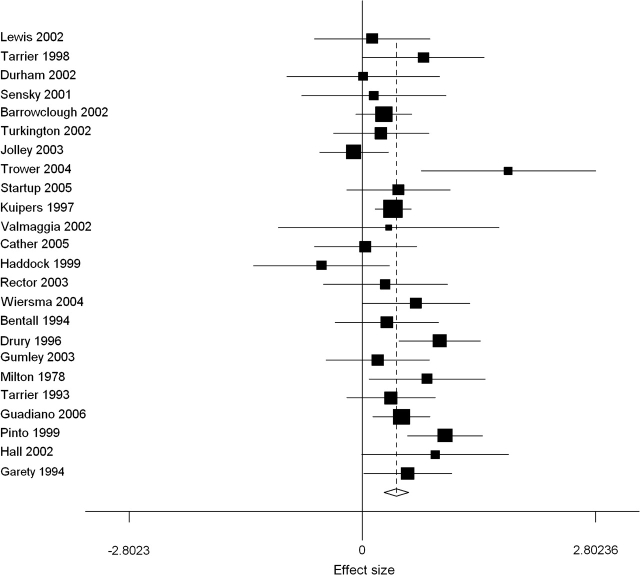
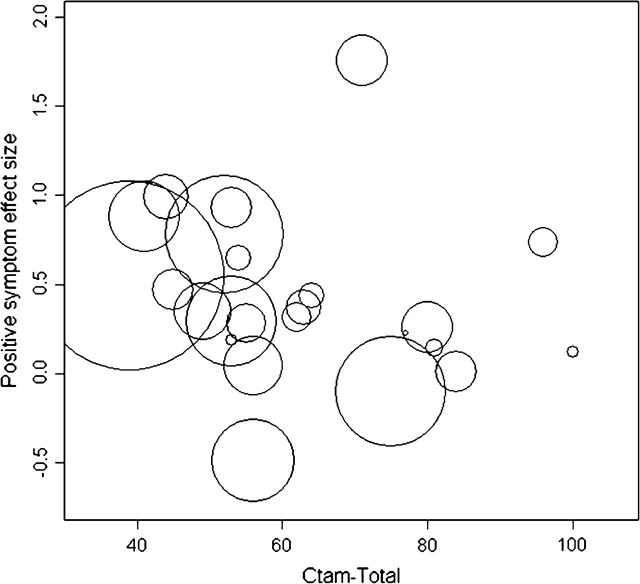
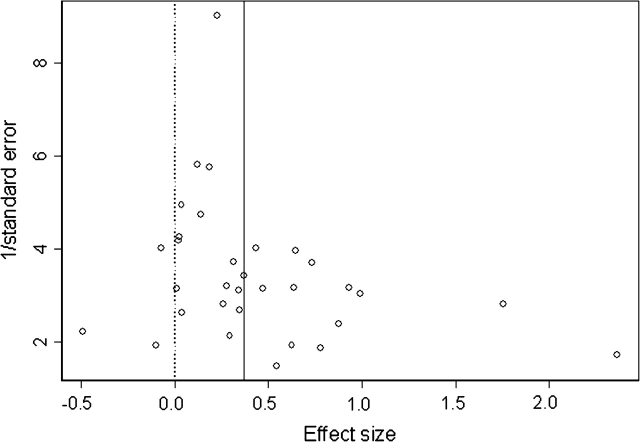
BACKGROUND: Guidance in the United States and United Kingdom has included cognitive behavior therapy for psychosis (CBTp) as a preferred therapy. But recent advances have widened the CBTp targets to other symptoms and have different methods of provision, eg, in groups. AIM: To explore the effect sizes of current CBTp trials including targeted and nontargeted symptoms, modes of action, and effect of methodological rigor. METHOD: Thirty-four CBTp trials with data in the public domain were used as source data for a meta-analysis and investigation of the effects of trial methodology using the Clinical Trial Assessment Measure (CTAM). RESULTS: There were overall beneficial effects for the target symptom (33 studies; effect size = 0.400 [95% confidence interval [CI] = 0.252, 0.548]) as well as significant effects for positive symptoms (32 studies), negative symptoms (23 studies), functioning (15 studies), mood (13 studies), and social anxiety (2 studies) with effects ranging from 0.35 to 0.44. However, there was no effect on hopelessness. Improvements in one domain were correlated with improvements in others. Trials in which raters were aware of group allocation had an inflated effect size of approximately 50%-100%. But rigorous CBTp studies showed benefit (estimated effect size = 0.223; 95% CI = 0.017, 0.428) although the lower end of the CI should be noted. Secondary outcomes (eg, negative symptoms) were also affected such that in the group of methodologically adequate studies the effect sizes were not significant. CONCLUSIONS: As in other meta-analyses, CBTp had beneficial effect on positive symptoms. However, psychological treatment trials that make no attempt to mask the group allocation are likely to have inflated effect sizes. Evidence considered for psychological treatment guidance should take into account specific methodological detail.
Overview
The claims and statistics of this paper haven’t been checked yet.
Free: it reads the open-access text and checks the first 5 claims that cite a source we can check. Create a free account to check every claim.
Integrity signals
Registry
Cites
Statistics
Figures
Verification
Claims the paper makes
The claims and statistics of this paper haven’t been checked yet.
Free: it reads the open-access text and checks the first 5 claims that cite a source we can check. Create a free account to check every claim.
Claims other papers make about this one
Each is checked against this paper’s own text: does it say what the citing paper says it does?
The cited source doesn’t support the claim as written.
In the citing paper
“The primary outcome was change in positive symptom severity at the end of treatment and at follow-up”
From A systematic review and meta-analysis of cognitive behavioural informed psychological interventions for psychiatric inpatients with psychosis (2020) · cites this paper as Wykes et al., 2008
Checked by a reasoning model — may be wrong.
Experimental — accuracy not yet measuredThe source backs part of the claim, not all of it — or backs it for a different population, condition or comparison.
In the citing paper
“Combining medication with evidence-based psychotherapy produces clinically significant improvement over medications alone for severe depression and psychotic disorders.9,10”
From Acceptance-based Behavior Therapy for Depression With Psychosis (2015) · cites this paper as [10]
Experimental — accuracy not yet measuredThe source backs part of the claim, not all of it — or backs it for a different population, condition or comparison.
In the citing paper
“Psychological therapies have demonstrated to be effective for patients experiencing psychotic symptoms (1, 2) and are recommended by treatment guidelines already in the acute illness and treatment phase (3, 4).”
From Developing a mechanism-based therapy for acute psychiatric inpatients with psychotic symptoms: an Intervention Mapping approach (2023) · cites this paper as [1]
Experimental — accuracy not yet measuredThe source backs part of the claim, not all of it — or backs it for a different population, condition or comparison.
In the citing paper
“There is limited evidence supporting the use of pharmacological and psychological interventions for depression in the context of schizophrenia (Whitehead et al. 2002; Wykes et al., 2008).”
From Acceptance and Commitment Therapy for depression following psychosis: An examination of clinically significant change (2015) · cites this paper as Wykes et al., 2008
Experimental — accuracy not yet measuredThe source backs part of the claim, not all of it — or backs it for a different population, condition or comparison.
In the citing paper
“Although effective at treating positive symptoms, Cognitive Behavioural Therapy for psychosis (CBTp) is less effective for treating emotional dysfunction associated with psychosis such as depression, hopelessness and suicide risk (Birchwood, 2003; Wykes et al., 2008; Tarrier et al., 2006).”
From Acceptance and Commitment Therapy for depression following psychosis: An examination of clinically significant change (2015) · cites this paper as Wykes et al., 2008
Experimental — accuracy not yet measured
4 more claims about this paper
Create a free account to see every claim other papers make about this one.
Self-check
Percentages, sums and reported differences re-computed from the paper’s own numbers.
The self-check needs the paper’s full text.
Citations
Cites
1 retracted
Cognitive behaviour therapy for schizophrenia
Jones, C., Cormac, I., Silveira da Mota Neto, J. I., & Campbell, C. (2004) · Cochrane Database of Systematic Reviews · doi:10.1002/14651858.cd000524.pub2 · Cited by 269
RetractedAssessing the quality of reports of randomized clinical trials: Is blinding necessary?
Jadad, A. R., Moore, R. A., Carroll, D., Jenkinson, C., Reynolds, D. J. M., Gavaghan, D. J., & McQuay, H. J. (1996) · Controlled Clinical Trials · doi:10.1016/0197-2456(95)00134-4 · Cited by 17,582 · cited 1×
“In addition, concurrent validity was assessed within an initial 22 studies by correlation with the scores from 3 other scales devised to assess methodological rigor.(42,43,52) The correlations of these scales with the CTAM scores on the corpus of CBTp data were as follows: CTAM and Jadad, q = .”
MethodZhang, Q., Wang, C., Zheng, M., Li, Y., Li, J., Zhang, L., Shang, X., & Yan, C. (2015) · Cerebrovascular Diseases · doi:10.1159/000369778 · Cited by 11,533
Schulz (1995) · doi:10.1001/jama.1995.03520290060030 · Cited by 5,634
Dong, Y., Hao, L., Shi, Z., Wang, G., Zhang, Z., & Han, C. (2013) · Urologia Internationalis · doi:10.1159/000351405 · Cited by 4,540
The Revised CONSORT Statement for Reporting Randomized Trials: Explanation and Elaboration
Altman, D. G., Schulz, K. F., Moher, D., Egger, M., Davidoff, F., Elbourne, D., Gøtzsche, P. C., Lang, T., & for the CONSORT Group (2001) · Annals of Internal Medicine · doi:10.7326/0003-4819-134-8-200104170-00012 · Cited by 3,835
The Handbook of Research Synthesis.
Howel, D., Cooper, H., & Hedges, L. V. (1995) · Biometrics · doi:10.2307/2533295 · Cited by 3,642
Moher, D., Pham, B., Jones, A., Cook, D. J., Jadad, A. R., Moher, M., Tugwell, P., & Klassen, T. P. (1998) · The Lancet · doi:10.1016/s0140-6736(98)01085-x · Cited by 3,560 · cited 1×
“For instance, poorer quality masking of allocation of treatments has been shown to be associated with up to 40% increased estimate of benefit in circulatory and digestive diseases, mental health, obstetrics, and childbirth.(36,37)”
BackgroundAssessing the quality of controlled clinical trials
Jüni, P., Altman, D. G., & Egger, M. (2001) · BMJ · doi:10.1136/bmj.323.7303.42 · Cited by 3,309
Improving the Quality of Reporting of Randomized Controlled Trials: The CONSORT Statement
Begg, C. (1996) · JAMA · doi:10.1001/jama.1996.03540080059030 · Cited by 3,127
Research works printed but not linked: 1
- [24]NICE Schizophrenia: Core interventions in the Treatment and Management of Schizophrenia in Primary and Secondary Care 2003 20704054
Cited by
Items 801–900 of 997
Gjerdalen, O. S., Zucknick, M., Westlie, I. T., Bull, H. C., Evensen, S., Falkum, E., Grande, M., Hagen, R., Romm, K. L., Jensen, L. H., et al. (2025) · Frontiers in Psychiatry · doi:10.3389/fpsyt.2025.1527549 · Cited by 1
“This is also underpinned by the considerable variability in the types of therapy offered under the single umbrella of CBTp (45, 46).”
Karageorgiou, V., Michopoulos, I., & Tsigkaropoulou, E. (2025) · Journal of Clinical Medicine · doi:10.3390/jcm14155521 · Cited by 4
“There has been extensive reporting on affective symptoms, which are particularly important for SZA disorder, but to our knowledge there has been no explicit stratification by diagnostic status [86,87].”
Keller, A. V., Dwyer, K., Holden, J. L., Pickell, D., Twamley, E. W., & Granholm, E. L. (2025) · Journal of Psychiatric Research · doi:10.1016/j.jpsychires.2025.10.002 · Cited by 1
Turner, D. T., Reijnders, M., van der Gaag, M., Karyotaki, E., Valmaggia, L., Moritz, S., Lecomte, T., Turkington, D., Penadés, R., Elkis, H., et al. (2025) · FOCUS The Journal of Lifelong Learning in Psychiatry · doi:10.1176/appi.focus.25023026 · Cited by 2
Mori, Y., Shishido, R., Hino, M., Satô, A., Nagaoka, A., Hoshino, H., Hatano, M., Hosogai, Y., Kunii, Y., & Miura, I. (2025) · Journal of Psychiatric Research · doi:10.1016/j.jpsychires.2025.11.020 · Cited by 1
Granholm, E. L., Mueser, K. T., Holden, J. L., Worley, M. J., Sommerfeld, D. H., Perivoliotis, D., Ehret, B. C., Pillny, M., & Aarons, G. A. (2025) · Schizophrenia Bulletin · doi:10.1093/schbul/sbaf084 · Cited by 4
Montag, C., Bröcker, A., Bayer, S., Becker, K., Bertram, G., Büttner, M., Funcke, J., Grimm, I., Just, S. A., Hadzibegovic, J., et al. (2026) · The Lancet Psychiatry · doi:10.1016/s2215-0366(26)00240-3 · Cited by 1
Moritz, S., Veckenstedt, R., Randjbar, S., & Vitzthum, F. (2011) · Springer eBooks · doi:10.1007/978-3-642-19946-2_1 · Cited by 1
Freedman, S., Hasson‐Ohayon, I., & Roe, D. (2009) · PubMed · Cited by 2
Chaotic Soul- Messy Heart: The phenomenon of experiencing auditory hallucinations
Suryani, S. (2016) · Cited by 1
Psychotherapie bei schizophrenen Erkrankungen: Eine Übersicht
Laier, S., Biester, A., & Bechdolf, A. (2014) · Nervenheilkunde · doi:10.1055/s-0038-1627732 · Cited by 1
“auf der Grundlage von 33 randomisierten Studien mit 1 964 kognitivverhaltenstherapeutisch behandelten Patienten eine Effektstärke von d = 0,40 (CI: 0,252–0,548) für die jeweils primär untersuchte Symptomatik fest (11).”
BackgroundPathways to psychological treatments for psychosis
Kuipers, E. (2008) · Psychiatry · doi:10.1016/j.mppsy.2008.08.004 · Cited by 2
Integrierte Neurokognitive Therapie (INT) bei Schizophrenie
Müller, D. (2012) · Psychiatrie und Psychotherapie up2date · doi:10.1055/s-0032-1305080 · Cited by 1
ASSESSMENT AND TRAINING OF METACOGNITION IN AUTISM SPECTRUM DISORDER
Goodman, L. R. (2014) · DalSpace (Dalhousie University) · Cited by 3
Witkowska, B. (2015) · Archives of Psychiatry and Psychotherapy · doi:10.12740/app/38328 · Cited by 1
“In recent years the preferred form of treatment of psychosis in the USA and the UK is cognitive-behavioural therapy (CBT) and meta-analyses carried out by British researchers have confirmed its effectiveness, especially in reducing the positive symptoms of schizophrenia [18].”
BackgroundAssessing medicine management education in psychiatric inpatients who use antipsychotic medicine
Yüksel, Ç., & Oflaz, F. (2012) · Journal of Psychiatric Nursing · doi:10.5505/phd.2012.68442 · Cited by 1
““Bilişsel Davranışçı Terapi”nin uygulandığı 35 klinik çalışmanın meta analizinde,[10] çalışmaların büyük bir çoğunluğunun birincil tedavi hedefi olarak pozitif semptomlara odaklandığını, buna rağmen “Bilişsel Davranışçı Terapi”nin işlevsellik üzerine de olumlu etkileri olduğunu göstermiştir.”
Slater, J., & Townend, M. (2016) · Behavioural and Cognitive Psychotherapy · doi:10.1017/s1352465816000084 · Cited by 1
Evaluating Strategies for Combining Pharmacotherapy with Cognitive Behavioral Therapy
Charney, M. E., Calkins, A. W., Hallion, L. S., & Simon, N. M. (2015) · Springer eBooks · doi:10.1007/978-1-4939-2605-3_21 · Cited by 1
Schizophrenia and Its Sequelae
Seeman, M. V. (2016) · Springer eBooks · doi:10.1007/978-3-319-30061-0_1 · Cited by 4
Illness self-management programmes
Mueser, K. T., & Gingerich, S. L. (2011) · Oxford University Press eBooks · doi:10.1093/med/9780199565498.003.0120 · Cited by 2
Behavioural and cognitive psychotherapies
Moorey, S. (2012) · Elsevier eBooks · doi:10.1016/b978-0-7020-3397-1.00038-0 · Cited by 1
Assessing delusional ideation: A narrative review of self-report instruments
Martins, M. J., Castilho, P., Carvalho, C. B., Pereira, A. T., Tróia, F., Matos, O., Santos, P., Santos, T. D. D. S., & Macedo, A. (2016) · Psychologica · doi:10.14195/1647-8606_59_2_4 · Cited by 4
Maragakis, A., & Vriesman, M. (2018) · Springer eBooks · doi:10.1007/978-3-319-70539-2_33 · Cited by 1
Wainwright, L. D., Haddock, G., Dunster-Page, C., & Berry, K. (2021) · British Journal of Mental Health Nursing · doi:10.12968/bjmh.2018.0023 · Cited by 1
Reiser, R. P., Turkington, D., & Garrett, M. (2022) · Psychosis · doi:10.1080/17522439.2022.2038255 · Cited by 1
“Although the summary amply illustrates Dr. Reiser’s skillful application of CBTp techniques, I think Dr.”
InfluentialEvidence-based psychosocial interventions for schizophrenia
Granholm, E. L., & Loh, C. (2009) · Medical psychiatry · doi:10.3109/9781420080063.021 · Cited by 1
Gruppenpsychotherapeutische Interventionen bei schizophrenen Störungen
Vauth, R. (2017) · Springer eBooks · doi:10.1007/978-3-662-54644-4_28 · Cited by 1
Mehl, S., & Leube, D. (2012) · Springer eBooks · doi:10.1007/978-3-642-23664-8_9 · Cited by 1
McLeod, H. J. (2022) · Frontiers in Psychiatry · doi:10.3389/fpsyt.2022.826692 · Cited by 3
Psychosen im Kindes- und Jugendalter
Kindler, J., & Resch, F. (2021) · Springer Reference Medizin · doi:10.1007/978-3-662-49289-5_100-1 · Cited by 1
Raune, D., & Law, S. (2011) · Clinical Psychology Forum · doi:10.53841/bpscpf.2011.1.226.23 · Cited by 1
Culturally Adapted CBT for Psychosis
Naeem, F., Naz, S., & Phiri, P. (2023) · Springer eBooks · doi:10.1007/978-3-031-27003-1_7 · Cited by 1
Mehl, S. (2023) · Springer eBooks · doi:10.1007/978-3-662-64465-2_32 · Cited by 1
O'Neill, E., Bird, M., & Riches, S. (2024) · Mental Health and Digital Technologies · doi:10.1108/mhdt-03-2024-0009 · Cited by 3
Kanbar, L., Malaeb, D. N., Sakr, F., Dabbous, M., Fekih‐Romdhane, F., Hallit, S. R., & Obeïd, S. (2025) · Discover Mental Health · doi:10.1007/s44192-025-00223-4 · Cited by 1
“Interventions targeting impulsivity and risk propensity, such as Cognitive Behavioral Therapy (CBT) and Dialectical Behavior Therapy (DBT) [67, 68], may be beneficial in reducing the likelihood of experiencing psychotic symptoms.”
Iftene, F., Farcas, A., & O'Brien, S. (2025) · Comprehensive Psychoneuroendocrinology · doi:10.1016/j.cpnec.2025.100312 · Cited by 1
“CBTp is a validated, safe, efficacious, and impactful talk therapy with a strong evidence base [8].”
Chu, C.-C., Chern, J.-S., & Lin, M.-T. (2025) · Acta Psychologica · doi:10.1016/j.actpsy.2025.105287 · Cited by 1
Beyond Monotherapy: The HIT Story
Jenner, J. A. (2012) · Springer eBooks · doi:10.1007/978-1-4614-4121-2_23 · Cited by 1
Psychiatric Rehabilitation Methods
Warner, R. (2012) · Springer eBooks · doi:10.1007/978-1-4614-3149-7_19 · Cited by 1
Can cognitive behaviour therapy beneficially influence arousal mechanisms in psychosis?
Howells, F. M., Baldwin, D. S., & Kingdon, D. (2015) · Human Psychopharmacology Clinical and Experimental · doi:10.1002/hup.2499 · Cited by 1
“The benefits of CBTp can be seen by reported effect sizes; importantly, we should note that these effects are additional to those afforded by medications given; beneficial effects are seen in positive symptoms: (0.37), negative symptoms (0.43) and general functioning (0.37) (Wykes et al., 2008).”
BackgroundInfluentialApplegate, E., El‐Deredy, W., & Bentall, R. P. (2014) · Personality and Individual Differences · doi:10.1016/j.paid.2014.06.035 · Cited by 1
Brett, P., Sorensen, J., & Priest, H. M. (2014) · Europe’s Journal of Psychology · doi:10.5964/ejop.v10i4.832 · Cited by 1
Kuller, A. M., Libben, M. R., Rosmarin, D. H., & Björgvinsson, Þ. (2012) · Cognitive Behaviour Therapy · doi:10.1080/16506073.2012.676670 · Cited by 1
Estudio Bibliométrico Sobre Intervenciones Psicológicas para la Esquizofrenia
Pachón-Basallo, M., Olarte-Afanador, M., López‐López, W., & Ochando, F. S. (2013) · Terapia psicológica · doi:10.4067/s0718-48082013000300007 · Cited by 4
Evidence-based psychosocial interventions for schizophrenia
Granholm, E. L., & Loh, C. (2009) · CRC Press eBooks · doi:10.3109/9781420080063-23 · Cited by 1
Raune, D., Last, A., Towner, S., Domoney, J., & Georgiades, A. (2016) · The Cognitive Behaviour Therapist · doi:10.1017/s1754470x16000179 · Cited by 1
“…therapy (CBT) typically has only a small effect size on delusions, be it in individual format, e.g. 0.36 (van der Gaag et al. 2014) or group format for positive symptoms, e.g. 0.38 (Wykes et al. 2008), so further treatment innovations may enhance theory and practice (Garety & Freeman, 2013).”
BackgroundInfluentialTavares, S. (2017) · Current Psychiatry Reviews · doi:10.2174/1573400513666170502123654 · Cited by 2
“A growing number of meta-analyses have supported the use of Cognitive Behavioural Therapy (CBT) in the treatment of psychosis [1-14].”
BackgroundLamster, F., Kiener, J., Wagner, K., Rief, W., Görge, S. C., Iwaniuk, S., Leube, D., Falkenberg, I., Kluge, I., Kircher, T. T. J., et al. (2018) · Verhaltenstherapie · doi:10.1159/000486966 · Cited by 1
“Diskussion Kritische Einordnung der Ergebnisse Die vorliegende Studie unterstützt vorherige meta-analytische Befunde zur erfolgreichen Reduktion von Wahnerleben und Positivsymptomatik mittels CBT [Wykes et al., 2008; Mehl et al., 2015; van der Gaag et al., 2014; Turner et al., 2014].”
BackgroundComment comprendre l’apparition des psychoses ?
Lecomte, T., Potvin, S., & Samson, C. (2019) · Elsevier eBooks · doi:10.1016/b978-2-294-76179-9.00001-2 · Cited by 3
Jang, T. Y., & Lee, S. J. (2020) · Korean Journal of Schizophrenia Research · doi:10.16946/kjsr.2020.23.1.29 · Cited by 1
Intérêt de la restructuration cognitive des idées de référence dans la schizophrénie
Livet, A., & Estingoy, P. (2022) · Soins Psychiatrie · doi:10.1016/j.spsy.2022.01.009 · Cited by 2
Mannion, A., White, K., Porter, E., Louw, J., Kirkpatrick, B., Gilroy, S. P., & Leader, G. (2019) · Autism and child psychopathology series · doi:10.1007/978-3-030-20843-1_46 · Cited by 1
Alternative Therapies Used in Schizophrenia
Hummadi, T. (2023) · Springer eBooks · doi:10.1007/978-981-19-7022-1_11 · Cited by 2
Formulating Zeppi: A Commentary
Bentall, R. P. (2009) · Wiley eBooks · doi:10.1002/9780470747513.ch9 · Cited by 1
Approaches to Treatment‐Resistant Patients
Leucht, S., Correll, C. U., & Kane, J. M. (2010) · Wiley eBooks · doi:10.1002/9781444327298.ch26 · Cited by 1
Principles of Social Intervention
Warner, R. (2010) · Wiley eBooks · doi:10.1002/9780470684214.ch31 · Cited by 2
Services for people with severe mental disorders in high‐income countries
Bebbington, P., Kuipers, E., & Fowler, D. G. (2013) · Wiley eBooks · doi:10.1002/9781118337981.ch22 · Cited by 1
Evidenzbasierte Gruppentherapie bei schizophrenen Psychosen
Schaub, A. (2010) · Zeitschrift für Psychiatrie Psychologie und Psychotherapie · doi:10.1024/1661-4747/a000014 · Cited by 1
Psychological Approaches to the Management of Persistent Delusions and Hallucinations
Smith, G. M., & Steel, C. (2008) · CRC Press eBooks · doi:10.3109/9780203091579-3 · Cited by 1
Self-citationCognitive processing associated with hallucinations for At Risk Mental State
Leicester, S. (2013) · Minerva Access (University of Melbourne) · Cited by 1
Waford, R. (2013) · ThinkIR: The University of Louisville's Institutional Repository (University of Louisville) · doi:10.18297/etd/1496 · Cited by 1
“Therefore, it may be that in addition to treatments for affective dysregulation that may decrease the severity of thought disorder symptoms presently, treatments for cognitive dysfunction such as Cognitive Enhancement Therapy (Hogarty & Greenwald, 2006) or Cognitive Remediation Therapy (Wykes et al., 2007) when used i…”
MethodMcKenna, P. J., Raduà, J., Jauhar, S., & Laws, K. R. (2014) · The British Journal of Psychiatry · doi:10.1192/bjp.204.6.490 · Cited by 1
Balzan, R. P. (2012) · Adelaide Research & Scholarship (AR&S) (University of Adelaide) · Cited by 1
Psychotherapy for Schizophrenia‐Spectrum Disorders
Ellenberg, S., Lynn, S. J., & Strauss, G. P. (2017) · Wiley eBooks · doi:10.1002/9781119462996.ch14 · Cited by 1
Lincoln, T. M., & Beck, A. T. (2013) · Wiley eBooks · doi:10.1002/9781118528563.wbcbt19 · Cited by 1
Cognitive and Behavioral Therapies
Thase, M. E., Wright, J. H., Friedman, E. S., & Russ, E. U. (2015) · Wiley eBooks · doi:10.1002/9781118753378.ch90 · Cited by 2
Jones, C. A., & Meaden, A. (2012) · Wiley eBooks · doi:10.1002/9781118156391.ebcp002010 · Cited by 1
Padmanabhan, J. L., & Keshavan, M. S. (2015) · Elsevier eBooks · doi:10.1016/b978-0-12-397045-9.00094-x · Cited by 3
Glenthøj, L. B., Vernal, D. L., Due, A. S., Mariegaard, L. S., Pinkham, A. E., Austin, S. F., Vos, M., Christensen, M. J., Hansen, N., Smith, L. C., et al. (2024) · Research Square · doi:10.21203/rs.3.rs-5593252/v1 · Cited by 1
15 Cognitieve therapie bij psychose
van der Gaag, M. (2011) · Bohn Stafleu van Loghum eBooks · doi:10.1007/978-90-313-8310-8_15
Mas-Expósito, L. (2013) · LA Referencia (Red Federada de Repositorios Institucionales de Publicaciones Científicas)
Developing Acceptance and Commitment Therapy for Psychosis as a Group‐based Intervention
McArthur, A., Mitchell, G., & Johns, L. (2013) · Wiley eBooks · doi:10.1002/9781118499184.ch15 · Cited by 1
Intimate partner violence and the black and minority ethnic community
Shoaib, S. B. (2010) · University of Birmingham Institutional Research Archive (University of Birmingham)
CBT for Relapse in Schizophrenia
Gumley, A. I. (2012) · Wiley eBooks · doi:10.1002/9781118330029.ch7
The Challenge of Anger, Aggression and Violence when Delivering CBT for Psychosis
Haddock, G. (2012) · Wiley eBooks · doi:10.1002/9781118330029.ch6
Hoy, K. E. (2012) · University of North Texas Digital Library (University of North Texas) · doi:10.12794/metadc149610
Triumphs and Tribulations in the Psychotherapy of Schizophrenia
Bargenquast, R., & Schweitzer, R. (2014) · Elsevier eBooks · doi:10.1016/b978-0-12-405172-0.00014-4
Management, Rehabilitation, Stigma
Rössler, W. (2011) · Wiley eBooks · doi:10.1002/9780470978672.ch8 · Cited by 1
Emotional Processing and Metacognitive Awareness for Persecutory Delusions
Hepworth, C., Startup, H. M., & Freeman, D. H. (2013) · Wiley eBooks · doi:10.1002/9781118499184.ch3 · Cited by 2
Group Cognitive Behavioural Social Skills Training for Schizophrenia
Holden, J. L., & Granholm, E. L. (2012) · Wiley eBooks · doi:10.1002/9781118330029.ch9
Treatment of Late‐Life Psychosis
Connelly, P., & Prentice, N. P. (2010) · Wiley eBooks · doi:10.1002/9780470669600.ch97
Paradox and play : a study of therapeutic humour and psychosis
Adams, F. (2013) · City Research Online (City University London) · Cited by 2
Hernández‐Viadel, J. V., Ricarte, J. J., Ros, L., Rey, F. A. D., & Latorre, J. M. (2013) · Revista internacional de psicología y terapia psicológica/Revista internacional de psicología y terapia psicológica
Neurobiologie der Psychotherapie am Beispiel von Schizophrenie und Panikstörung
Straube, B., Krug, A., & Kircher, T. T. J. (2011) · Springer eBooks · doi:10.1007/978-3-642-25476-5_21
Delfin, C. (2014) · Högskolan Kristianstad Publikationer
Hesse, K., & Klingberg, S. (2011) · Verhaltenstherapie · doi:10.1159/000324222
“Eine aktuelle Metaanalyse [Wykes et al., 2008] kam zwar zu dem Ergebnis, dass kognitive Verhaltenstherapie nicht nur bei Positiv-, sondern auch bei Negativsymptomatik wirkt.”
BackgroundCBT for command hallucinations: exploring a new approach
Aston, R. (2011) · British Journal of Wellbeing · doi:10.12968/bjow.2011.2.4.25
CBT does not improve relapse rates in people with recently relapsed psychosis
Durham, R. C. (2009) · Evidence-Based Mental Health · doi:10.1136/ebmh.12.1.14
The Application of the Cognitive Behavioral Therapy in Schizophrenia
Lee, D.-E. (2012) · 신경정신의학 · doi:10.4306/jknpa.2012.51.6.359
Met handen en voeten aan het werk: cognitieve gedragstherapie bij schizofrenie
Hoogduin, C. A. L. (2010) · Directieve therapie · doi:10.1007/s12433-010-0243-8
Developing a CBT manual for adult inpatient secure services
Dhillon, G. (2014) · ePrints Soton (University of Southampton)
Evidence-based psychological therapies: from bench to bedside
Shafran, R., Gyani, A., & Lee, M. (2011) · British Journal of Wellbeing · doi:10.12968/bjow.2011.2.6.32
Cognitive Behavioral Therapy for Adolescents at Clinical High Risk for Psychosis
Hardy, K. V., & Loewy, R. L. (2012) · Adolescent Psychiatry · doi:10.2174/2210676611202020172 · Cited by 1
Peer support for consumers with psychosis
Cook, E. A. (2013) · Lincoln (University of Nebraska) · Cited by 1
Esquizofrenia: abordagens terapêuticas não-farmacológicas.
Rodrigues, D. M. (2012) · Portuguese National Funding Agency for Science, Research and Technology (RCAAP Project by FCT) · doi:10.34626/59mh-m931 · Cited by 1
CBT does not improve relapse rates in people with recently relapsed psychosis
Garety, P. A. (2009)
EFFICACY OF COGNITIVE-BEHAVIOURAL THERAPY IN PATIENTS WITH AN EARLY-PSYCHOSIS EPISODE: A REVIEW
Martínez, J. T., & Pousa, E. (2012)
Efectividad de las terapias psicosociales y de rehabilitación en personas con esquizofrenia
Patiño, P. H. (2015) · RUC (Universidade Da Coruña) · Cited by 3
Special Issue Editorial: Cognitive Processes in Psychosis
Cavanagh, K. (2012) · Journal of Experimental Psychopathology · doi:10.1177/204380871200300401
Metadata
- Authors
- Wykes, T., Steel, C., Everitt, B., & Tarrier, N.
- Affiliations
- King's College London (GB)
- University of Manchester (GB)
- Venue
- Schizophrenia Bulletin
- Publisher
- Oxford University Press (OUP)
- Published
- 2007-05-04
- Volume
- 34
- Issue
- 3
- Pages
- 523-537
- ISSN
- 0586-7614 (ISSN-L)
- 1745-1701
- PMC
- PMC2632426
- OpenAlex
- W2140526915
- Cited by
- 1,029
- References
- 98
- Citations by year
- 2026: 16 · 2025: 27 · 2024: 29 · 2023: 39 · 2022: 42 · 2021: 39 · 2020: 38 · 2019: 64 · 2018: 59 · 2017: 62 · 2016: 76 · 2015: 73 · 2014: 91 · 2013: 96 · 2012: 87
- FWCI
- 5.68
- Type
- journal article
- Language
- en
- Open access
- hybrid
- doi.org
- Licence
- cc-by-nc
- Locations
- Schizophrenia Bulletin (publishedVersion, cc-by-nc)
- PubMed Central (publishedVersion, cc-by-nc)
- PubMed (publishedVersion)
- Research Explorer (The University of Manchester) (publishedVersion)
- CentAUR (University of Reading) (acceptedVersion)
- Research Portal (King's College London) (submittedVersion, public-domain)
- Topics
- Health Sciences › Medicine › Psychiatry and Mental health › Schizophrenia research and treatment
- Social Sciences › Psychology › Clinical Psychology › Psychotherapy Techniques and Applications
- Social Sciences › Psychology › Clinical Psychology › Psychological Treatments and Assessments
- Keywords
- schizophrenia
- MeSH terms
- Humans, Psychometrics, Schizophrenia, Cognitive Behavioral Therapy
About these checks
Registry, retraction, Cites and statistics results are computed, not judged, with one exception: a printed reference that no index lists is read once by a model before it counts as a citation error. Claims are extracted by a model and kept only when their quote appears verbatim in the text; each cited source is then checked, with a model’s help, for whether it says what the claim relies on. Those verdicts can be wrong — read the claim’s quote and the cited source before relying on one.
Statistics and arithmetic are recomputed, not judged.
Confidence bands are shown only for fields calibrated on our annotated test set. None is calibrated yet, so no band is shown.
What counts as a claim ›How we measure confidence ›How we check this ›
Are you an author, or do you see a problem with this page? Request a review
Data sources
Bibliographic data: Semantic Scholar, OpenAlex, Crossref.
Contains information from the Semantic Scholar Academic Graph Datasets, made available under the ODC Attribution License (ODC-BY 1.0).
Semantic Scholar’s data is described in: Kinney, R., et al. (2023). The Semantic Scholar Open Data Platform. arXiv:2301.10140.
