

Nurses’ Shift Length and Overtime Working in 12 European Countries: The Association With Perceived Quality of Care and Patient Safety
Open accessThe DOI matches its Crossref record; 40 of the 41 references it cites were found in a registry or an index; 4 of the 50 sources its claims cite were checked for support.
Abstract
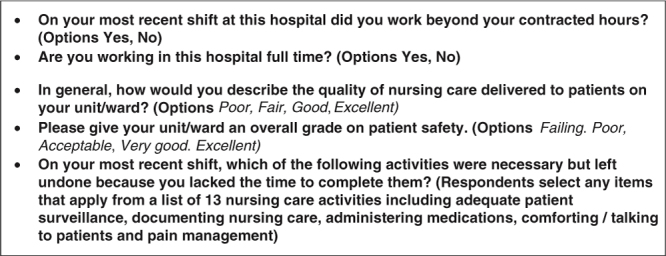
BACKGROUND: Despite concerns as to whether nurses can perform reliably and effectively when working longer shifts, a pattern of two 12- to 13-hour shifts per day is becoming common in many hospitals to reduce shift to shift handovers, staffing overlap, and hence costs. OBJECTIVES: To describe shift patterns of European nurses and investigate whether shift length and working beyond contracted hours (overtime) is associated with nurse-reported care quality, safety, and care left undone. METHODS: Cross-sectional survey of 31,627 registered nurses in general medical/surgical units within 488 hospitals across 12 European countries. RESULTS: A total of 50% of nurses worked shifts of ≤ 8 hours, but 15% worked ≥ 12 hours. Typical shift length varied between countries and within some countries. Nurses working for ≥ 12 hours were more likely to report poor or failing patient safety [odds ratio (OR)=1.41; 95% confidence interval (CI), 1.13-1.76], poor/fair quality of care (OR=1.30; 95% CI, 1.10-1.53), and more care activities left undone (RR=1.13; 95% CI, 1.09-1.16). Working overtime was also associated with reports of poor or failing patient safety (OR=1.67; 95% CI, 1.51-1.86), poor/fair quality of care (OR=1.32; 95% CI, 1.23-1.42), and more care left undone (RR=1.29; 95% CI, 1.27-1.31). CONCLUSIONS: European registered nurses working shifts of ≥ 12 hours and those working overtime report lower quality and safety and more care left undone. Policies to adopt a 12-hour nursing shift pattern should proceed with caution. Use of overtime working to mitigate staffing shortages or increase flexibility may also incur additional risk to quality.
Overview
CoChat Summary
## TL;DR
This cross-sectional survey of 31,627 registered nurses in 488 hospitals across 12 European countries found that longer shifts and overtime were associated with worse nurse-reported care quality, patient safety, and more care left undone. Shifts of at least 12 hours and working beyond contracted hours both showed independent negative associations.
## Key findings
- Among 31,627 nurses, 50% reported shifts of 8 hours or less, 15% reported shifts of 12 hours or more, and 27% reported overtime on their last shift.
- Nurses working shifts of at least 12 hours were more likely than those working 8 hours or less to report poor/fair quality of care (OR=1.30; 95% CI, 1.10-1.53), poor/failing patient safety (OR=1.41; 95% CI, 1.13-1.76), and more care left undone (RR=1.13; 95% CI, 1.09-1.16).
- Nurses working beyond contracted hours were more likely to report poor/fair quality of care (OR=1.32; 95% CI, 1.23-1.42), poor/failing patient safety (OR=1.67; 95% CI, 1.51-1.86), and more care left undone (RR=1.29; 95% CI, 1.27-1.31).
- There was substantial variation in shift patterns across countries; for example, the paper says long shifts were common in England, Ireland, and Poland, while in Belgium, Germany, Greece, the Netherlands, Norway, and Sweden fewer than 5% of nurses reported shifts of 12 hours or more.
## Methods
- Cross-sectional survey within the RN4CAST study of registered nurses in medical and surgical wards of acute hospitals in 12 European countries: Belgium, England, Germany, Finland, Greece, Ireland, the Netherlands, Norway, Poland, Spain, Sweden, and Switzerland.
- The survey was mailed or directly distributed between June 2009 and June 2010; 54,140 questionnaires were distributed and 33,659 were returned (62%), with 31,627 respondents on adult medical/surgical wards available for analysis.
- Main analysis used binomial generalized linear mixed models for quality and patient safety, and a generalized mixed model with Poisson distribution for care left undone, adjusting for shift type, ward type, staffing ratio, nurse age, full-time/part-time status, hospital size, high-technology status, and teaching status.
## Limitations
- The paper states that, because the analysis was cross-sectional, it is not possible to infer causality.
- The paper states that it did not test country-by-shift-work interactions, so it could only estimate average effects across countries and could not explore between-country differences.
- The paper states that outcomes were nurse self-reports, the clinical importance of the differences is unclear, and further research should include objective measures and patient experiences.
- Evident from the text: the study did not directly measure hours worked overall or ask about the nature of overtime, number of overtime hours, usual shift pattern, breaks during shifts, or opportunity to rest between shifts.
Model-written summary. Check it against the paper before relying on it.
Integrity signals
Registry
Cites
Statistics
Figures
Verification
Claims the paper makes
3 Valid · 0 Not valid · 29 Not checked · 62 Own results and interpretations
The cited sources support only part of this claim — read each source’s verdict below.
In the paper
“This measure has been validated by associations with hospitallevel mortality, patient satisfaction, and care processes. 27”
What the sources say
- Partly supportedcites [27] matched to “. Care left undone during nursing shifts: associations with workload and perceived quality of care.” (2014) sourceExperimental — accuracy not yet measured
The Measures and ‘Care left undone and quality and patient safety’ sections describe a nurse-rated quality-of-care measure and show its association with care left undone. The paper does not report validating that measure through associations with hospital-level mortality or patient satisfaction; the Discussion says further research is warranted on missed care as an indicator of patient outcomes. (LLM, conf=0.84)
plainstates an association- Asserted: passes — The authors put it forward as true.
- Checkable: passes — It can be checked against evidence.
- Load-bearing: passes — The paper’s conclusions depend on it.
- Based: passes — The paper gives a reason why it holds.
- Partly supported
The cited sources support only part of this claim — read each source’s verdict below.
In the paper
“Overtime working has also been associated with adverse quality because of cumulative fatigue, lack of rest, and adverse working environments. 21,22”
What the sources say
- Could not verifycites [21] matched to “. A systematic survey instrument translation process for multi-country, comparative health workforce studies.” (2013) sourceExperimental — accuracy not yet measured
The Methods (Instrument Finalization) describe survey questions about nurses’ work environments, burnout, and care quality, but do not report an association between overtime and adverse quality. The Discussion addresses the relevance of work-environment and burnout questions, not cumulative fatigue or lack of rest as explanations. Searches for overtime, fatigue, rest, and quality found no passage addressing the attributed claim. (LLM, conf=0.75)
- Partly supportedcites [22] matched to “Nurse reported quality of care: a measure of hospital quality.” (2012) sourceExperimental — accuracy not yet measured
The Discussion (page unavailable) associates good nurse practice environments with higher nurse-reported quality of care, supporting the work-environment portion of the claim. The paper does not report an association between overtime and adverse quality or identify cumulative fatigue and lack of rest as explanations; searches for overtime, fatigue, and rest found no relevant passage. (LLM, conf=0.82)
plainstates an association- Asserted: passes — The authors put it forward as true.
- Checkable: passes — It can be checked against evidence.
- Load-bearing: passes — The paper’s conclusions depend on it.
- Based: passes — The paper gives a reason why it holds.
- Could not verify
A result the paper reports from its own data — it cites no other source for it, so there is none to check. The quote shows it is in the paper.
In the paper
“A total of 50% of nurses worked shifts of r 8 hours, but 15% worked Z 12 hours.”
- Also stated in: § Shift Length · plain
“The most common shift length was r 8 hours (50%, n = 15,930).”
plainn = 15,930- Asserted: passes — The authors put it forward as true.
- Checkable: passes — It can be checked against evidence.
- Load-bearing: unclear — It is unclear whether the paper’s conclusions depend on it.
- Based: passes — The paper gives a reason why it holds.
- Rests on an assumption not shown here.
- Also stated in: § Shift Length · plain
A result the paper reports from its own data — it cites no other source for it, so there is none to check. The quote shows it is in the paper.
In the paper
“For Belgium, Germany, Greece, The Netherlands, Norway, and Sweden <5% of nurses reported working shifts of Z 12 hours.”
plain- Asserted: passes — The authors put it forward as true.
- Checkable: passes — It can be checked against evidence.
- Load-bearing: unclear — It is unclear whether the paper’s conclusions depend on it.
- Based: passes — The paper gives a reason why it holds.
- Rests on an assumption not shown here.
A result the paper reports from its own data — it cites no other source for it, so there is none to check. The quote shows it is in the paper.
In the paper
“A total of 50% of nurses worked shifts of r 8 hours, but 15% worked Z 12 hours.”
- Also stated in: § Shift Length · plain
“and 14% (n = 4314) worked 12 to 13 hours. Only 260 nurses (1%) worked >13 hours on their last shift.”
plain- Asserted: passes — The authors put it forward as true.
- Checkable: passes — It can be checked against evidence.
- Load-bearing: passes — The paper’s conclusions depend on it.
- Based: passes — The paper gives a reason why it holds.
- Rests on an assumption not shown here.
- Also stated in: § Shift Length · plain
44 more claims
Create a free account to see all 94 claims and to verify the 46 references still open.
- Probably not a substantial claim. 27
- It may state two separate claims as one. 24
Claims other papers make about this one
Each is checked against this paper’s own text: does it say what the citing paper says it does?
The source backs part of the claim, not all of it — or backs it for a different population, condition or comparison.
In the citing paper
“England is unusual in presenting a mixed economy in shift patterns with 32% of day shifts and 36% of night shifts lasting 12 h or more making it a ‘natural laboratory’ for examining the effect of such variation on outcomes [24].”
From Cross-sectional examination of the association between shift length and hospital nurses job satisfaction and nurse reported quality measures (2017) · cites this paper as [24]
Experimental — accuracy not yet measuredThe cited source says what the claim attributes to it.
In the citing paper
“Two large European cross sectional studies of 31,627 registered nurses concluded that those working shifts of 12 h or longer were more likely to report poor quality of care, poor patient safety, and higher rates of care left undone [24] and higher levels of job dissatisfaction, burnout and intention to leave [25], when compared with nurses working 8 h or shorter shifts.”
From Cross-sectional examination of the association between shift length and hospital nurses job satisfaction and nurse reported quality measures (2017) · cites this paper as [24]
The cited source says what the claim attributes to it.
In the citing paper
“Our findings add to the international body of evidence reporting that working 12 h shifts or longer are associated with poor ratings of quality of care and higher rates of care left undone [17, 24, 28, 29].”
From Cross-sectional examination of the association between shift length and hospital nurses job satisfaction and nurse reported quality measures (2017) · cites this paper as [24]
Self-check
Percentages, sums and reported differences re-computed from the paper’s own numbers.
Each contradiction between two passages listed here was confirmed by an independent check.
Rated minor: it would not touch a result — a value no result rests on, a p-value that stays on the same side of the significance level, or a conflict that is clerical, resolved elsewhere in the paper, or outside its own findings.
In the paper
“Because of the small sample size of the >13 hours category (n = 260, 0.08%),”
Reported 0.08 · recomputed 0.822082
Rated minor: it would not touch a result — a value no result rests on, a p-value that stays on the same side of the significance level, or a conflict that is clerical, resolved elsewhere in the paper, or outside its own findings.
In the paper
§ CONCLUSIONS
“to assess patient safety as poor or fair, and to report more care items left undone on their last shift”
§ Measurements
“Patient safety was rated as poor, failing, acceptable, very good, or excellent with 'poor' and 'failing' ratings combined to reflect negative evaluations.”
Rated minor: it would not touch a result — a value no result rests on, a p-value that stays on the same side of the significance level, or a conflict that is clerical, resolved elsewhere in the paper, or outside its own findings.
In the paper
“Twenty-five percent (n = 7815) of nurses reported poor/ fair quality of care and 7% (2736) reported 'poor' or 'failing' patient safety.”
Reported 7 · recomputed 8.650836
Rated minor: it would not touch a result — a value no result rests on, a p-value that stays on the same side of the significance level, or a conflict that is clerical, resolved elsewhere in the paper, or outside its own findings.
In the paper
§ Shift Length
“(n = 9963) and 14% (n = 4314) worked 12 to 13 hours.”
§ Shift Length
“| 8.1-10 | 9965 (32) | 5960 (19) | 4005 (13) | 4175 (13) | 4109 (13) |”
Rated minor: it would not touch a result — a value no result rests on, a p-value that stays on the same side of the significance level, or a conflict that is clerical, resolved elsewhere in the paper, or outside its own findings.
In the paper
§ Shift Length
“14% (n = 4314) worked 12 to 13 hours.”
§ Shift Length
“| 12-13 | 4313 (14) | 2670 (8) | 1643 (5) | 1145 (4) | 470 (1) |”
Citations
Cites
Forming inferences about some intraclass correlation coefficients.
McGraw, K. O., & Wong, S. P. (1996) · Psychological Methods · doi:10.1037/1082-989x.1.1.30 · Cited by 6,903 · cited 1×
“The ICC 1 measures the degree of similarity between individuals within a cluster.(29) It also indicates the proportion of variance in the outcome that can be attributed to variation between groups (wards, hospitals, countries) as opposed to between individuals.”
BackgroundRepeatability for Gaussian and non-Gaussian data: a practical guide for biologists.
Nakagawa, S., & Schielzeth, H. (2010) · Biological Reviews · doi:10.1111/j.1469-185x.2010.00141.x · Cited by 2,584 · cited 1×
“It also indicates the proportion of variance in the outcome that can be attributed to variation between groups (wards, hospitals, countries) as opposed to between individuals.(30) The association of shift length and overtime with the outcome measures was estimated through a binomial generalized linear mixed model.”
MethodAiken, L. H., Sermeus, W., Van den Heede, K., Sloane, D. M., Busse, R., McKee, M., Bruyneel, L., Rafferty, A. M., Griffiths, P., Moreno-Casbas, M. T., et al. (2012) · BMJ · doi:10.1136/bmj.e1717 · Cited by 2,052 · cited 3×
“Previous research indicates that low nurse staffing levels are associated with worse patient outcomes.(24,42) This finding is supported by our analysis.”
BackgroundResultSelf-citationKane, R. L., Shamliyan, T. A., Mueller, C., Duval, S., & Wilt, T. J. (2007) · Medical Care · doi:10.1097/mlr.0b013e3181468ca3 · Cited by 1,097 · cited 1×
“Previous research indicates that low nurse staffing levels are associated with worse patient outcomes.(24,42) This finding is supported by our analysis.”
ResultThe Working Hours Of Hospital Staff Nurses And Patient Safety
Rogers, A. E., Hwang, W.-T., Scott, L. D., Aiken, L. H., & Dinges, D. F. (2004) · Health Affairs · doi:10.1377/hlthaff.23.4.202 · Cited by 952
Self-citationNurse turnover: A literature review – An update
Hayes, L. J., O’Brien-Pallas, L., Duffield, C., Shamian, J., Buchan, J., Hughes, F., Laschinger, H. K. S., & North, N. (2012) · International Journal of Nursing Studies · doi:10.1016/j.ijnurstu.2011.10.001 · Cited by 888
Effects of Hospital Care Environment on Patient Mortality and Nurse Outcomes
Aiken, L. H., Clarke, S. P., Sloane, D. M., Lake, E. T., & Cheney, T. (2008) · JONA: The Journal of Nursing Administration · doi:10.1097/01.nna.0000312773.42352.d7 · Cited by 860 · cited 1×
“Overtime has previously been associated with increased nurse turnover(10,46) and it may be that use of overtime is associated with less favorable working environments for nurses, which are known to be linked to subjective and objective measures of reduced quality and safety of care.(23,47) Overtime can be an individua…”
BackgroundSelf-citationEffects of Hospital Care Environment on Patient Mortality and Nurse Outcomes
Aiken, L. H., Clarke, S. P., Sloane, D. M., Lake, E. T., & Cheney, T. (2009) · JONA: The Journal of Nursing Administration · doi:10.1097/nna.0b013e3181aeb4cf · Cited by 799
Self-citation. Care left undone during nursing shifts: associations with workload and perceived quality of care.
Ball, J. E., Murrells, T., Rafferty, A. M., Morrow, E., & Griffiths, P. (2014) · BMJ Quality & Safety · doi:10.1136/bmjqs-2012-001767 · Cited by 666
Individual differences in tolerance to shift work – A systematic review
Saksvik, I. B., Bjorvatn, B., Hetland, H., Sandal, G. M., & Pallesen, S. (2011) · Sleep Medicine Reviews · doi:10.1016/j.smrv.2010.07.002 · Cited by 479 · cited 1×
“We controlled for potential confounding variables, including variables chosen because they have been shown elsewhere to have independent relationships with the quality of care in hospitals(31,32) or the ability to cope with shift work.(33) Control variables were shift type (day/night), ward type, nurse staffing levels…”
Method
Cited by
Items 101–200 of 315
Stimpfel, A. W., Goldsamt, L. A., Liang, E., & Costa, D. K. (2022) · Journal of Nursing Regulation · doi:10.1016/s2155-8256(22)00085-0 · Cited by 38
“While this relationship has been documented in the literature primarily through quantitative research (Aiken et al., 2013; Griffiths et al., 2014; Kane et al., 2007; Witkoski Stimpfel et al., 2012), our findings highlight the complex contextual dimensions that are often missing in quantitative designs.”
BackgroundBrešan, M., Erčulj, V. I., Lajovic, J., Ravljen, M., Sermeus, W., & Grosek, Š. (2021) · PLoS ONE · doi:10.1371/journal.pone.0261466 · Cited by 33
“The evidence from a European survey supports the fact that patient safety is a key indicator of the quality of medical treatment and nursing care [5, 10, 12].”
BackgroundNurse managers’ perception of night-shift napping: A cross-sectional survey
Dalky, H. F., ABUALRUB, R. F., & Esraa, A. A. (2017) · Nursing Forum · doi:10.1111/nuf.12239 · Cited by 24
Registered Nurse Perception of Patient Assignment Linking to Working Conditions and Outcomes
Choi, J.-S., & Miller, P. A. (2018) · Journal of Nursing Scholarship · doi:10.1111/jnu.12418 · Cited by 31
Adaptation of the MISSCARE Survey to the Maternity Care Setting
Simpson, K. R., Lyndon, A., Spetz, J., Gay, C., & Landstrom, G. L. (2019) · Journal of Obstetric, Gynecologic & Neonatal Nursing · doi:10.1016/j.jogn.2019.05.005 · Cited by 25
Gander, P. H., O’Keeffe, K., Santos–Fernández, E., Huntington, A., Walker, L., & Willis, J. A. (2020) · International Journal of Nursing Studies · doi:10.1016/j.ijnurstu.2020.103573 · Cited by 25
Nurse’s experience working 12-hour shift in a tertiary level hospital in Qatar: a mixed method study
Varghese, B., Joseph, C. M., Akkam, A. A. A. A., AL-Balawi, R. M. O. A. M., Swallmeh, E., & Singh, K. (2023) · BMC Nursing · doi:10.1186/s12912-023-01371-0 · Cited by 28
“However, the study also reported that nurses working 12-h shifts had higher satisfaction with their work-life balance compared to those working 8-h shifts [39].”
BackgroundInfluentialCOVID-19 Patients’ Satisfaction Levels with Nursing Care: A Cross-Sectional Study
Alhowaymel, F. M., Abaoud, A., Alhuwaimel, A., Alenezi, A., & Alsayed, N. (2022) · SAGE Open Nursing · doi:10.1177/23779608221078163 · Cited by 40
Análise de indicadores gerenciais e assistenciais após adequação de pessoal de enfermagem
de Quadros, D. V., de Magalhães, A. M. M., Mantovani, V. M., da Rosa, D. S., & Echer, I. C. (2016) · Revista Brasileira de Enfermagem · doi:10.1590/0034-7167.2016690410i · Cited by 46
Qureshi, S. M., Purdy, N., & Neumann, P. (2021) · Operations Research for Health Care · doi:10.1016/j.orhc.2021.100301 · Cited by 20
Patient safety culture in Slovenian out-of-hours primary care clinics
Klemenc–Ketiš, Z., Deilkås, E. C. T., Hofoss, D., et al. (2017) · Slovenian Journal of Public Health · doi:10.1515/sjph-2017-0028 · Cited by 19
“Studies have focused more on the impact of longer working hours and overtime working on patient safety (39), and we could not find any study on the associations between patient safety and part/full-time working hours.”
BackgroundFusz, K., Kívés, Z., Pakai, A., Kutfej, N., Deák, A., & Olah, A. (2021) · Work · doi:10.3233/wor-203366 · Cited by 22
Strategies for Coping With Stress Used by Nurses in Poland and Belarus During the COVID-19 Pandemic
Kowalczuk, K., Shpakou, A., Hermanowicz, J. M., Krajewska-Kułak, E., & Sobolewski, M. (2022) · Frontiers in Psychiatry · doi:10.3389/fpsyt.2022.867148 · Cited by 30
“Factors influencing nurses’ perceptions of occupational stress are mainly shiftbased work, interpersonal conflicts with other staff members, role conflict, lack of physician support, low autonomy levels, little or no control over work performance, rotation between hospital departments, and aggressive behaviors from co…”
Background12‐hour shifts: Prevalence, views and impact
Ball, J., Maben, J., Murrells, T., Day, T. L., & Griffiths, P. (2015) · Research Portal (King's College London) · Cited by 23
Self-citationTonkikh, O., Zisberg, A., & Shadmi, E. (2020) · Journal of Nursing Management · doi:10.1111/jonm.13031 · Cited by 23
Hong, K. J., & Cho, S. (2021) · Journal of Nursing Scholarship · doi:10.1111/jnu.12666 · Cited by 17
Chau, A. M. T., Vijjeswarapu, M. A., Hickey, M., et al. (2017) · Anesthesia & Analgesia · doi:10.1213/ane.0000000000001890 · Cited by 17
Saville, C. E., Dall’Ora, C., & Griffiths, P. (2020) · International Journal of Nursing Studies · doi:10.1016/j.ijnurstu.2020.103721 · Cited by 24
Self-citationNeumann, P., & Purdy, N. (2023) · Health Systems · doi:10.1080/20476965.2023.2198580 · Cited by 21
“Nurses working longer hours are much more likely to make errors (Australian Nursing Federation, 2009; Griffiths et al., 2014; Rogers et al., 2004; Stimpfel & Aiken, 2013).”
BackgroundNursing teams: behind the charts
Bae, S., Farasat, A., Nikolaev, A., Seo, J. Y., Foltz-Ramos, K., Fabry, D., & Castner, J. (2017) · Journal of Nursing Management · doi:10.1111/jonm.12473 · Cited by 19
“Furthermore, increased overtime by nursing staff was found to affect patient safety outcomes (Stone et al. 2007, Sharp & Clancy 2008, Griffiths et al. 2014, Cho et al. 2016).”
BackgroundShamian, J., & Ellen, M. (2016) · Healthcare Management Forum · doi:10.1177/0840470416629163 · Cited by 23
“Additionally, there is an inverse relationship between safety and longer nursing shifts, and adverse events stemming from overwork were indicated as not uncommon.(6,7) Over the past 2 decades, there has been an increased focus on patient safety, and it has been recommended that in order to address this agenda, the nur…”
BackgroundHendy, A. S., Fattah, H. A. A., Abouelela, M. A., Elasrag, G. A. E. A., Alshammari, M. S. S., Hables, R. M. M., Alzahrani, N. S., Hendy, A., & Almarwani, A. M. (2024) · SAGE Open Nursing · doi:10.1177/23779608231226063 · Cited by 27
“A signi fi cant relationship between the prevalence of MNC and working overtime was found in multinational European research (Bruyneel et al., 2015; Grif fi ths et al., 2014).”
ResultUnregistered health care staff's perceptions of 12 hour shifts: an interview study
Thomson, L., Schneider, J. M., & Hare-Duke, L. (2017) · Journal of Nursing Management · doi:10.1111/jonm.12490 · Cited by 18
Oe, M., Ishida, T., Favrod, C., Martin-Söelch, C., & Horsch, A. (2018) · Frontiers in Psychiatry · doi:10.3389/fpsyt.2018.00387 · Cited by 27
“, more than their contracted hours) on their last shift (20).”
BackgroundLi, M., Wang, Y., Du, M., Wang, H., Liu, Y., Richardson, B. N., & Bai, J. (2023) · Journal of Nursing Management · doi:10.1155/2023/8863759 · Cited by 26
“A study reported that all shifts > 8 hours were associated with increasing rates of MNC [15].”
Aspects of occupational safety: a survey among European cancer nurses
Sharp, L., Fransson, P., Fowler, M., & Ullgren, H. (2024) · European Journal of Oncology Nursing · doi:10.1016/j.ejon.2024.102595 · Cited by 22
Merchaoui, I., Bouzgarrou, L., Mnasri, A., Mghanem, M., Akrout, M., Malchaire, J. B., & Chaari, N. (2017) · PubMed Central · doi:10.11604/pamj.2017.26.59.11279 · Cited by 18
“According to Griffiths, the proportion of workers who work in shift schedule is increasing more and more [4].”
BackgroundStimpfel, A. W., Leep‐Lazar, K., Mercer, M., & DeMarco, K. (2025) · Western Journal of Nursing Research · doi:10.1177/01939459251330280 · Cited by 27
Zhao, X., Zhang, L., Zhang, X., Guo, J., Guan, R., Cheng, Y., & Jia, Y. (2026) · International Journal of Nursing Studies · doi:10.1016/j.ijnurstu.2025.105273 · Cited by 17
“It is really so exhausting”: Exploring intensive care nurses’ perceptions of 24‐hour long shifts
Koy, V., Yunibhand, J., & Turale, S. (2020) · Journal of Clinical Nursing · doi:10.1111/jocn.15389 · Cited by 19
Integrated Multiresource Capacity Planning and Multitype Patient Scheduling
Zhou, L., Geng, N., Jiang, Z., & Jiang, S. (2021) · INFORMS journal on computing · doi:10.1287/ijoc.2020.1048 · Cited by 14
Critical care nurses' perceptions of the outcomes of working overtime in Canada
Lobo, V. M., Ploeg, J., Fisher, A., Peachey, G., & Akhtar‐Danesh, N. (2017) · Nursing Outlook · doi:10.1016/j.outlook.2016.12.009 · Cited by 18
How does the length of day shift affect patient care on older people's wards? A mixed method study
Baillie, L., & Thomas, N. (2017) · International Journal of Nursing Studies · doi:10.1016/j.ijnurstu.2017.07.014 · Cited by 14
“In Europe, nurses who worked shifts of 12h or more reported lower care quality and safety than RNs who worked shorter shifts, and they reported more planned care left undone too (Griffiths et al., 2014).”
BackgroundInfluentialAre we measuring nursing workflow correctly? A literature review
Congdon, J., Craft, J. A., & Christensen, M. (2020) · British Journal of Nursing · doi:10.12968/bjon.2020.29.21.1252 · Cited by 19
Lim, H., & Kim, S. H. (2025) · BMC Nursing · doi:10.1186/s12912-025-03001-3 · Cited by 24
“Similarly, a study across 12 European countries reported that nearly 50% of nurses work within a three 8-hour shift system, while 15% adhere to a two 12-hour shift schedule [2].”
Psychometric validation of the Multidimensional Nursing Generations Questionnaire (MNGQ)
Stevanin, S., Mikkonen, S. J., Bressan, V., Vehviläinen-Julkunen, K. M., & Kvist, T. A. (2019) · Journal of Advanced Nursing · doi:10.1111/jan.14118 · Cited by 19
Bär, S., & Starystach, S. (2017) · Das Gesundheitswesen · doi:10.1055/s-0042-123850 · Cited by 15
Evaluation of Nursing Workload and Efficiency of Staff Allocation in a Trauma Intensive Care Unit
Momennasab, M., Karimi, F., Dehghanrad, F., et al. (2017) · Trauma Monthly · doi:10.5812/traumamon.58161 · Cited by 13
“In Iran, most night shifts continue for 12 hours, which can cause fatigue and reduce the quality of care and patient safety (24, 25).”
BackgroundChae, M. J., & Choi, S. J. (2020) · Journal of Korean Critical Care Nursing · doi:10.34250/jkccn.2020.13.2.1 · Cited by 14
García-Batista, Z. E., Guerra-Peña, K., Garrido, L. E., Cantisano-Guzmán, L. M., Moretti, L. S., Vindel, A. C., Arias, V. B., & Medrano, L. A. (2021) · Frontiers in Psychology · doi:10.3389/fpsyg.2021.636693 · Cited by 40
Fond, G. B., Lucas, G., & Boyer, L. (2023) · BMC Nursing · doi:10.1186/s12912-023-01403-9 · Cited by 21
“European registered nurses working shifts of 12 h or longer and those working overtime have reported lower quality and safety levels and a higher incidence of unfinished tasks [8].”
BackgroundKurmann, S., Reber, E., Schönenberger, K. A., Schüetz, P., Uhlmann, K., Vasiloglou, M. F., Schoenenberger, A. W., Bertschi, D., Sterchi, A.-B., & Stanga, Z. G. (2022) · Clinical Nutrition · doi:10.1016/j.clnu.2022.11.015 · Cited by 13
Munkarendek a hazai egészségügyi rendszerben, és az ápolók alvásminősége
Fusz, K., Pakai, A., Kívés, Z., Szunomár, S., Regős, A., & Olah, A. (2016) · Orvosi Hetilap · doi:10.1556/650.2016.30386 · Cited by 15
Peters, V., de Rijk, A. E., Engels, J. A., Heerkens, Y. F., & Nijhuis, F. J. N. (2016) · Work · doi:10.3233/wor-162286 · Cited by 16
“Although twelvehour shifts are increasingly used across Europe [36], they are not common in the Netherlands, Belgium, Germany, Greece, Norway, and Sweden [62].”
Yoo, G. S., & Kim, T. (2017) · Sleep Medicine Research · doi:10.17241/smr.2017.00045 · Cited by 15
Work hour constraints in the German nursing workforce: A quarter of a century in review
Alameddine, M. S., Otterbach, S., Rafii, B., & Sousa‐Poza, A. (2018) · Health Policy · doi:10.1016/j.healthpol.2018.07.023 · Cited by 16
Changes in Fatigue Levels and Sleep Measures of Hospital Nurses During Two 12-Hour Work Shifts
Cho, H., Brzozowski, S. L., Knudsen, É. N. A., & Steege, L. M. B. (2021) · JONA The Journal of Nursing Administration · doi:10.1097/nna.0000000000000983 · Cited by 16
“Twelve-hour shifts were selected because they were the most commonly scheduled on the study units and are increasingly being used worldwide.(15,16) In addition, on the study units, nurses' work schedule was most often patterned as 2 consecutive 12-hour day shifts.”
MethodMissed nursing care in pediatric emergency departments in Turkey: A cross-sectional study
Arıkan, A., & Esenay, F. İ. (2023) · Applied Nursing Research · doi:10.1016/j.apnr.2023.151699 · Cited by 16
Antoszewska, A., & Gutysz‐Wojnicka, A. (2024) · Intensive and Critical Care Nursing · doi:10.1016/j.iccn.2024.103667 · Cited by 20
Risk factors for incorrect surgical count during surgery: An observational study
Fang, J., Yuan, X., Fan, L., Meilan, D., Sui, W., Ma, W., Wang, H., & Pan, A. (2021) · International Journal of Nursing Practice · doi:10.1111/ijn.12942 · Cited by 15
Digital and informatics competencies: Requirements for nursing leaders in Canada
Lo, B., Nagle, L., White, P., Kleib, M., Kennedy, M. A., & Strudwick, G. (2021) · Healthcare Management Forum · doi:10.1177/08404704211015428 · Cited by 18
“One of the main differentiators is that nurses typically care for individuals over the duration of a shift (eg, 12 hours) as opposed to encounter-based care found in other professions.(5) This has unique implications for how nurses use electronic health record systems versus other provider groups.”
BackgroundMissed nursing care in a long-term rehabilitation setting: findings from a cross-sectional study
Danielis, M., Fantini, M., Sbrugnera, S., Colaetta, T., Maestra, M. R., Mesaglio, M., & Palese, A. (2021) · Contemporary Nurse · doi:10.1080/10376178.2022.2029515 · Cited by 16
Metzner, A., Straube, F., Tilz, R. R., Kuniss, M., Noelker, G., Tebbenjohanns, J., Andresen, D., Wieneke, H., Stellbrink, C., Franke, J., et al. (2023) · BMC Cardiovascular Disorders · doi:10.1186/s12872-022-03015-8 · Cited by 11
“Finally, overtime may contribute to a high turnover of EP lab staff and reduce the efficiency and effectiveness of the workforce in delivering high quality and safe care [14].”
BackgroundThe 12-hour shift: friend or foe?
Ball, J., Dall’Ora, C., & Griffiths, P. (2015) · ePrints Soton (University of Southampton) · Cited by 12
Self-citationNurses’ perceptions of night shifts: A qualitative study
Li, Y., Sun, J., Sun, D., Zhang, X., Ma, D., Wang, W., Fang, S., Zhang, S., Ye, Y., & Li, Y. (2022) · International Emergency Nursing · doi:10.1016/j.ienj.2022.101202 · Cited by 12
Lin, T., Park, C. G., Kapella, M. C., Martyn-Nemeth, P. A., Tussing-Humphreys, L. M., Rospenda, K. M., & Zenk, S. N. (2023) · International Journal of Nursing Studies · doi:10.1016/j.ijnurstu.2023.104490 · Cited by 14
The impact of training shifts in dancers’ chronotype and sleep patterns
Coirolo, N., Silva, A., & Tassino, B. (2020) · Sleep Science · doi:10.5935/1984-0063.20200010 · Cited by 12
Min, A., Hong, H. C., Son, S., & Scott, L. D. (2022) · Journal of Clinical Nursing · doi:10.1111/jocn.16218 · Cited by 17
Vacheron, C., Bras, M., Friggeri, A., et al. (2024) · Anaesthesia Critical Care & Pain Medicine · doi:10.1016/j.accpm.2024.101460 · Cited by 9
Cheyrouze, M., & Barthe, B. (2022) · Applied Ergonomics · doi:10.1016/j.apergo.2022.103901 · Cited by 11
Tuominen, O. A., Lundgrén‐Laine, H., Teperi, S., & Salanterä, S. (2019) · CIN Computers Informatics Nursing · doi:10.1097/cin.0000000000000567 · Cited by 9
“Changes to planned nursing staff resources may also reduce the planned nursing staff skill mix,(8) which in turn could diminish overall quality and safety of care.(7) To manage sudden nursing staff absences, nurse managers can turn to paper-based systems or IT-based staffing solutions.”
BackgroundTaghaddom, S. M., Alrashidi, H. M. A. R. B., Mohamed, H. D., & Johnson, M. N. (2020) · Open Journal of Nursing · doi:10.4236/ojn.2020.109060 · Cited by 11
Peutere, L., Rosenström, T. H., Koskinen, A., Härmä, M., Mika Kivimaki, B., Virtanen, M., Ervasti, J. M., & Ropponen, A. (2021) · BMC Health Services Research · doi:10.1186/s12913-021-07231-4 · Cited by 16
Do nurse staffing levels affect patient mortality in acute secondary care?
Hill, B. (2017) · British Journal of Nursing · doi:10.12968/bjon.2017.26.12.698 · Cited by 18
Toffoletto, M. C., de Oliveira, É. M., Andolhe, R., Barbosa, R. L., & Padilha, K. G. (2018) · Texto & Contexto - Enfermagem · doi:10.1590/0104-070720180003780016 · Cited by 15
Critical Care Performance in a Simulated Military Aircraft Cabin Environment
McNeill, M. M. (2018) · Critical Care Nurse · doi:10.4037/ccn2018700 · Cited by 9
Peters, V., de Rijk, A. E., Engels, J. A., Houkes, I., Joosten, J., & Kant, I. (2018) · Journal of Occupational and Environmental Medicine · doi:10.1097/jom.0000000000001393 · Cited by 11
Critical Care Nurses’ Reasons for Working or Not Working Overtime
Lobo, V. M., Ploeg, J., Fisher, A., Peachey, G., & Akhtar‐Danesh, N. (2018) · Critical Care Nurse · doi:10.4037/ccn2018616 · Cited by 15
Ponsin, A., Fort, E., Hours, M., Charbotel, B., & Denis, M.-A. (2020) · International Journal of Environmental Research and Public Health · doi:10.3390/ijerph17092982 · Cited by 10
“However, in the United Kingdom, 32% of nurses declared working 12-hour shifts [17].”
BackgroundThe Impact of Shift Work on the Metabolism and Circadian Rhythm in Nurses and Medical Technicians
Ljevak, I., Vasilj, I., Lesko, J., Neuberg, M., Perić, O., & Ćurlin, M. (2021) · Acta Clinica Croatica · doi:10.20471/acc.2021.60.03.19 · Cited by 20
Hemşirelik Bakımında Önemli Bir Kavram: Karşılanamayan Hemşirelik Bakımı ve Nedenleri
Güleşen, G. (2022) · Türkiye Sağlık Bilimleri ve Araştırmaları Dergisi · doi:10.51536/tusbad.1042757 · Cited by 8
The effect of full-time culture on quality and safety of care – a literature review
Magerøy, M. R., & Wiig, S. (2023) · International Journal of Health Governance · doi:10.1108/ijhg-11-2022-0106 · Cited by 17
PUTTONEN, S., KARHULA, K., ROPPONEN, A., HAKOLA, T., SALLINEN, M., & HÄRMÄ, M. (2021) · Industrial Health · doi:10.2486/indhealth.2021-0052 · Cited by 7
Wynendaele, H., Peeters, E., Gemmel, P., Myny, D., & Trybou, J. (2024) · Journal of Advanced Nursing · doi:10.1111/jan.16373 · Cited by 8
Dall’Ora, C., Ejebu, O., Jones, J., & Griffiths, P. (2023) · Journal of Nursing Management · doi:10.1155/2023/6626585 · Cited by 11
“However, in many countries, including in England’s NHS inpatient general hospital settings, long shifts of 12 hours or longer have become the norm for nurses [10–12].”
Self-citationGopinathan, V., Kunju, S. A., S, V. K., Sirur, F., & Balakrishnan, J. M. (2021) · Disaster Medicine and Public Health Preparedness · doi:10.1017/dmp.2021.73 · Cited by 7
Rationing nursing care and organizational factors in intensive care units
Antoszewska, A., & Gutysz‐Wojnicka, A. (2024) · PLoS ONE · doi:10.1371/journal.pone.0306313 · Cited by 8
Doerflinger, N., Bosschaert, D., Otto, A., Opgenhaffen, T., & Vermeerbergen, L. (2020) · Journal of Business Ethics · doi:10.1007/s10551-020-04498-1 · Cited by 6
Missed Nursing Care: The Impact on Patients, Nurses and Organisations
Kirwan, M., & Matthews, A. (2020) · Aligning perspectives on health, safety and well-being · doi:10.1007/978-3-030-60998-6_3 · Cited by 12
Özdelikara, A., & Lezki, E. Y. (2021) · Samsun Sağlık Bilimleri Dergisi · doi:10.47115/jshs.972178 · Cited by 6
A Comparison of Shift Length and Nursing and Quality Outcomes in Acute Inpatient Mental Health Units
Beckman, R. J., Hutton, S., Czekanski, E., Vance, K., & Mohr, D. C. (2022) · JONA The Journal of Nursing Administration · doi:10.1097/nna.0000000000001199 · Cited by 9
Betsiou, S., Pitsiou, G., Panagiotidou, E. S., Sarridou, D. G., Kioumis, I. P., & Boutou, A. (2022) · PubMed Central · Cited by 21
Hummel, S., Michelsen, I., Zafar, A., Moritz, S., Benoy, C., Lemogne, C., de Almeida, R. M. R., Losada, R., Ribeiro, Ó. M., Frisardi, V., et al. (2023) · JMIR Public Health and Surveillance · doi:10.2196/45664 · Cited by 6
“In the nursing profession, staff shortages and increased workloads were already commonplace before the pandemic [15] and, during COVID-19, the burnout of nurses was identified [16].”
Gerber, M., Lindwall, M., Börjesson, M., Hadžibajramović, E., & Jónsdóttir, I. H. (2017) · Mental health and physical activity · doi:10.1016/j.mhpa.2017.09.003 · Cited by 7
Hasseler, M. (2018) · Zeitschrift für Gerontologie und Geriatrie · doi:10.1007/s00391-018-1420-x · Cited by 9
Beltempo, M., Lacroix, G., Cabot, M., & Piedbœuf, B. (2017) · Pediatrics and Neonatal Nursing - Open Journal · doi:10.17140/pnnoj-4-125 · Cited by 6
12 Hour Shifts: Literature Reviewed, Wise Use Challenged
Kupperschmidt, B. R. (2017) · Journal of Christian Nursing · doi:10.1097/cnj.0000000000000450 · Cited by 8
Physiological and psychological aspects
Rao, A. H., Mehta, R. K., & Sasangohar, F. (2019) · Elsevier eBooks · doi:10.1016/b978-0-12-813467-2.00120-6 · Cited by 6
Shortening a Carrel Patch in a Graft With Multiple Arteries: A Step-By-Step Technical Analysis.
Barlas, A., Moris, D., & Zavos, G. (2016) · Experimental and Clinical Transplantation · doi:10.6002/ect.2014.0202 · Cited by 6
The consequences of a compressed workweek: a systematic literature review
Bernstrøm, V. H., Alves, D., Houkes, I., Lillebråten, A., & Nilsen, W. (2025) · International Archives of Occupational and Environmental Health · doi:10.1007/s00420-025-02153-8 · Cited by 17
“…employees who work extended daily work hours will also work extended weekly work hours (e.g., ≥ 10 h a day five days a week), either scheduled (Sallinen & Kecklund 2010; Wong et al. 2018) or because they work overtime on top of scheduled shorter shifts (Griffiths et al. 2014; Scott et al. 2006).”
Martins, T., Musy, S. N., & Simon, M. (2025) · International Journal of Nursing Studies Advances · doi:10.1016/j.ijnsa.2025.100420 · Cited by 12
“In our study, 35.8 % of the RNs reported working more than half an hour of overtime on the last shift, which is higher than the 27 % reported in a study conducted across 12 European countries (Griffiths et al., 2014).”
InfluentialSelf-citationMusculoskeletal Symptoms in Midwives and Work-Related Contributory Risk Factors
Okuyucu, K., Hignett, S. M., Gyi, D. E., & Doshani, A. (2018) · Advances in intelligent systems and computing · doi:10.1007/978-3-319-96083-8_8 · Cited by 5
Hosseini, M., Adib, M., Mohamadi, T. K., et al. (2025) · BMC Health Services Research · doi:10.1186/s12913-025-12478-2 · Cited by 5
Dent, J. (2018) · British Journal of Midwifery · doi:10.12968/bjom.2018.26.12.812 · Cited by 11
Chronobiology in the wild: toolkit to study daily rhythms in free-living animals
Silvério, J. T., & Tachinardi, P. (2020) · Sleep Science · doi:10.5935/1984-0063.20200020 · Cited by 9
Cuidado perdido de enfermería y su relación con el síndrome de agotamiento profesional
Rabadán-Silva, M. F., Zárate-Grajales, R. A., & Benítez-Chavira, L. A. (2020) · Enfermería Universitaria · doi:10.22201/eneo.23958421e.2020.3.720 · Cited by 11
Predictors of Nursing Staff Voluntary Termination in Nursing Homes: A Case-Control Study
Zhang, Y., Punnett, L., & Gore, R. J. (2017) · Journal of Applied Gerontology · doi:10.1177/0733464817724043 · Cited by 7
Fetal programming of adipose tissue function by gestational chronodisruption
Halabí, D., Ehrenfeld, P., Méndez, N., Hans, G. H. R., & Torres‐Farfan, C. (2020) · Sleep Science · doi:10.5935/1984-0063.20200014 · Cited by 8
Burnout and the stigma of help-seeking in nurses: A cross-sectional study
Smajlović, A., & Cilar, L. (2025) · Acta Psychologica · doi:10.1016/j.actpsy.2025.105792 · Cited by 8
Afriani, T., Hariyati, T. S., Yetti, K., & Besral, B. (2022) · Open Access Macedonian Journal of Medical Sciences · doi:10.3889/oamjms.2022.7282 · Cited by 6
“199 physical exhaustion, increased stress and decreased performance and quality of care [16].”
Background
Metadata
- Authors
- Griffiths, P., Dall’Ora, C., Simon, M., Ball, J., Lindqvist, R., Rafferty, A.-M., Schoonhoven, L., Tishelman, C., & Aiken, L. H.
- Affiliations
- King's College London (GB)
- University of Southampton (GB)
- University of Basel (CH)
- Radboud University Nijmegen (NL)
- Corresponding author
- Griffiths, Peter
- Dall’Ora, Chiara
- ORCID
- Venue
- Medical Care
- Published
- 2014-11
- Volume
- 52
- Issue
- 11
- Pages
- 975-981
- ISSN
- 0025-7079 (ISSN-L)
- PMC
- PMC4196798
- OpenAlex
- W2092758688
- Semantic Scholar
- 581348d004235cb8365423c66213a96ce7840552
- Cited by
- 316
- References
- 41
- Citations by year
- 2026: 10 · 2025: 18 · 2024: 20 · 2023: 23 · 2022: 35 · 2021: 44 · 2020: 49 · 2019: 27 · 2018: 32 · 2017: 29 · 2016: 15 · 2015: 14
- FWCI
- 20.55
- Type
- journal article
- Language
- en
- Open access
- hybrid
- doi.org
- Licence
- cc-by-nc-nd
- Locations
- Medical Care (publishedVersion, cc-by-nc-nd)
- PubMed Central (publishedVersion, cc-by-nc-nd)
- PubMed (publishedVersion)
- edoc (University of Basel) (acceptedVersion)
- ePrints Soton (University of Southampton) (acceptedVersion)
- Lirias (submittedVersion, other-oa)
- Homo Politicus (Academy of Humanities and Economics in Lodz) (submittedVersion, cc-by-nc-nd)
- Jagiellonian University Repository (Jagiellonian University) (submittedVersion, cc-by-nc-nd)
- Research Portal (King's College London) (submittedVersion, cc-by-nc-nd)
- Radboud Repository (Radboud University) (submittedVersion)
- Funders
- European Commission (2007–2013, FP7 2007-2013, FP7/2007, 223468)
- Karolinska Institutet
- Norsk Sykepleierforbund
- Stockholms Läns Landsting
- Eunice Kennedy Shriver National Institute of Child Health and Human Development (R24HD044964, P2CHD044964)
- Topics
- Health Sciences › Nursing › Leadership and Management › Hospital Admissions and Outcomes
- Health Sciences › Nursing › Research and Theory › Nursing education and management
- Social Sciences › Psychology › Experimental and Cognitive Psychology › Sleep and Work-Related Fatigue
- Keywords
- overtime, patient safety, quality of care, nurse staffing, shift handover, European nurses, medical-surgical units
- MeSH terms
- Cross-Sectional Studies, Europe, Humans, Nursing Staff, Hospital, Personnel Staffing and Scheduling, Quality of Health Care, Work Schedule Tolerance, Patient Safety
About these checks
Registry, retraction, Cites and statistics results are computed, not judged, with one exception: a printed reference that no index lists is read once by a model before it counts as a citation error. Claims are extracted by a model and kept only when their quote appears verbatim in the text; each cited source is then checked, with a model’s help, for whether it says what the claim relies on. Those verdicts can be wrong — read the claim’s quote and the cited source before relying on one.
The claim verdicts this report counts are experimental: their accuracy is not yet measured.
A language model drew the claims from the paper on 2026-10-11, under version 3 of the claim definition (model deepseek-v4.1-flash, prompt extract-v3).
A second model labelled each claim on 2026-10-11 (model jev-1.13-20260917, definition revision gold-guideline-v0.2).
Cited sources are checked with a language model’s help (gpt-6-sol).
Statistics and arithmetic are recomputed, not judged.
Confidence bands are shown only for fields calibrated on our annotated test set. None is calibrated yet, so no band is shown.
What counts as a claim ›How we measure confidence ›How we check this ›
Are you an author, or do you see a problem with this page? Request a review
Data sources
Bibliographic data: Semantic Scholar, OpenAlex, Crossref.
Contains information from the Semantic Scholar Academic Graph Datasets, made available under the ODC Attribution License (ODC-BY 1.0).
Semantic Scholar’s data is described in: Kinney, R., et al. (2023). The Semantic Scholar Open Data Platform. arXiv:2301.10140.
