

Nurses’ Shift Length and Overtime Working in 12 European Countries: The Association With Perceived Quality of Care and Patient Safety
Open accessThe DOI matches its Crossref record; 40 of the 41 references it cites were found in a registry or an index; 4 of the 50 sources its claims cite were checked for support.
Abstract
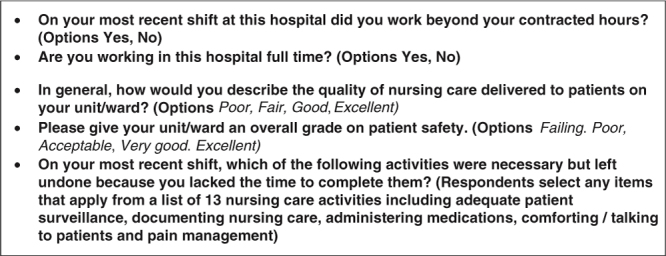
BACKGROUND: Despite concerns as to whether nurses can perform reliably and effectively when working longer shifts, a pattern of two 12- to 13-hour shifts per day is becoming common in many hospitals to reduce shift to shift handovers, staffing overlap, and hence costs. OBJECTIVES: To describe shift patterns of European nurses and investigate whether shift length and working beyond contracted hours (overtime) is associated with nurse-reported care quality, safety, and care left undone. METHODS: Cross-sectional survey of 31,627 registered nurses in general medical/surgical units within 488 hospitals across 12 European countries. RESULTS: A total of 50% of nurses worked shifts of ≤ 8 hours, but 15% worked ≥ 12 hours. Typical shift length varied between countries and within some countries. Nurses working for ≥ 12 hours were more likely to report poor or failing patient safety [odds ratio (OR)=1.41; 95% confidence interval (CI), 1.13-1.76], poor/fair quality of care (OR=1.30; 95% CI, 1.10-1.53), and more care activities left undone (RR=1.13; 95% CI, 1.09-1.16). Working overtime was also associated with reports of poor or failing patient safety (OR=1.67; 95% CI, 1.51-1.86), poor/fair quality of care (OR=1.32; 95% CI, 1.23-1.42), and more care left undone (RR=1.29; 95% CI, 1.27-1.31). CONCLUSIONS: European registered nurses working shifts of ≥ 12 hours and those working overtime report lower quality and safety and more care left undone. Policies to adopt a 12-hour nursing shift pattern should proceed with caution. Use of overtime working to mitigate staffing shortages or increase flexibility may also incur additional risk to quality.
Overview
CoChat Summary
## TL;DR
This cross-sectional survey of 31,627 registered nurses in 488 hospitals across 12 European countries found that longer shifts and overtime were associated with worse nurse-reported care quality, patient safety, and more care left undone. Shifts of at least 12 hours and working beyond contracted hours both showed independent negative associations.
## Key findings
- Among 31,627 nurses, 50% reported shifts of 8 hours or less, 15% reported shifts of 12 hours or more, and 27% reported overtime on their last shift.
- Nurses working shifts of at least 12 hours were more likely than those working 8 hours or less to report poor/fair quality of care (OR=1.30; 95% CI, 1.10-1.53), poor/failing patient safety (OR=1.41; 95% CI, 1.13-1.76), and more care left undone (RR=1.13; 95% CI, 1.09-1.16).
- Nurses working beyond contracted hours were more likely to report poor/fair quality of care (OR=1.32; 95% CI, 1.23-1.42), poor/failing patient safety (OR=1.67; 95% CI, 1.51-1.86), and more care left undone (RR=1.29; 95% CI, 1.27-1.31).
- There was substantial variation in shift patterns across countries; for example, the paper says long shifts were common in England, Ireland, and Poland, while in Belgium, Germany, Greece, the Netherlands, Norway, and Sweden fewer than 5% of nurses reported shifts of 12 hours or more.
## Methods
- Cross-sectional survey within the RN4CAST study of registered nurses in medical and surgical wards of acute hospitals in 12 European countries: Belgium, England, Germany, Finland, Greece, Ireland, the Netherlands, Norway, Poland, Spain, Sweden, and Switzerland.
- The survey was mailed or directly distributed between June 2009 and June 2010; 54,140 questionnaires were distributed and 33,659 were returned (62%), with 31,627 respondents on adult medical/surgical wards available for analysis.
- Main analysis used binomial generalized linear mixed models for quality and patient safety, and a generalized mixed model with Poisson distribution for care left undone, adjusting for shift type, ward type, staffing ratio, nurse age, full-time/part-time status, hospital size, high-technology status, and teaching status.
## Limitations
- The paper states that, because the analysis was cross-sectional, it is not possible to infer causality.
- The paper states that it did not test country-by-shift-work interactions, so it could only estimate average effects across countries and could not explore between-country differences.
- The paper states that outcomes were nurse self-reports, the clinical importance of the differences is unclear, and further research should include objective measures and patient experiences.
- Evident from the text: the study did not directly measure hours worked overall or ask about the nature of overtime, number of overtime hours, usual shift pattern, breaks during shifts, or opportunity to rest between shifts.
Model-written summary. Check it against the paper before relying on it.
Integrity signals
Registry
Cites
Statistics
Figures
Verification
Claims the paper makes
3 Valid · 0 Not valid · 29 Not checked · 62 Own results and interpretations
The cited sources support only part of this claim — read each source’s verdict below.
In the paper
“This measure has been validated by associations with hospitallevel mortality, patient satisfaction, and care processes. 27”
What the sources say
- Partly supportedcites [27] matched to “. Care left undone during nursing shifts: associations with workload and perceived quality of care.” (2014) sourceExperimental — accuracy not yet measured
The Measures and ‘Care left undone and quality and patient safety’ sections describe a nurse-rated quality-of-care measure and show its association with care left undone. The paper does not report validating that measure through associations with hospital-level mortality or patient satisfaction; the Discussion says further research is warranted on missed care as an indicator of patient outcomes. (LLM, conf=0.84)
plainstates an association- Asserted: passes — The authors put it forward as true.
- Checkable: passes — It can be checked against evidence.
- Load-bearing: passes — The paper’s conclusions depend on it.
- Based: passes — The paper gives a reason why it holds.
- Partly supported
The cited sources support only part of this claim — read each source’s verdict below.
In the paper
“Overtime working has also been associated with adverse quality because of cumulative fatigue, lack of rest, and adverse working environments. 21,22”
What the sources say
- Could not verifycites [21] matched to “. A systematic survey instrument translation process for multi-country, comparative health workforce studies.” (2013) sourceExperimental — accuracy not yet measured
The Methods (Instrument Finalization) describe survey questions about nurses’ work environments, burnout, and care quality, but do not report an association between overtime and adverse quality. The Discussion addresses the relevance of work-environment and burnout questions, not cumulative fatigue or lack of rest as explanations. Searches for overtime, fatigue, rest, and quality found no passage addressing the attributed claim. (LLM, conf=0.75)
- Partly supportedcites [22] matched to “Nurse reported quality of care: a measure of hospital quality.” (2012) sourceExperimental — accuracy not yet measured
The Discussion (page unavailable) associates good nurse practice environments with higher nurse-reported quality of care, supporting the work-environment portion of the claim. The paper does not report an association between overtime and adverse quality or identify cumulative fatigue and lack of rest as explanations; searches for overtime, fatigue, and rest found no relevant passage. (LLM, conf=0.82)
plainstates an association- Asserted: passes — The authors put it forward as true.
- Checkable: passes — It can be checked against evidence.
- Load-bearing: passes — The paper’s conclusions depend on it.
- Based: passes — The paper gives a reason why it holds.
- Could not verify
A result the paper reports from its own data — it cites no other source for it, so there is none to check. The quote shows it is in the paper.
In the paper
“A total of 50% of nurses worked shifts of r 8 hours, but 15% worked Z 12 hours.”
- Also stated in: § Shift Length · plain
“The most common shift length was r 8 hours (50%, n = 15,930).”
plainn = 15,930- Asserted: passes — The authors put it forward as true.
- Checkable: passes — It can be checked against evidence.
- Load-bearing: unclear — It is unclear whether the paper’s conclusions depend on it.
- Based: passes — The paper gives a reason why it holds.
- Rests on an assumption not shown here.
- Also stated in: § Shift Length · plain
A result the paper reports from its own data — it cites no other source for it, so there is none to check. The quote shows it is in the paper.
In the paper
“For Belgium, Germany, Greece, The Netherlands, Norway, and Sweden <5% of nurses reported working shifts of Z 12 hours.”
plain- Asserted: passes — The authors put it forward as true.
- Checkable: passes — It can be checked against evidence.
- Load-bearing: unclear — It is unclear whether the paper’s conclusions depend on it.
- Based: passes — The paper gives a reason why it holds.
- Rests on an assumption not shown here.
A result the paper reports from its own data — it cites no other source for it, so there is none to check. The quote shows it is in the paper.
In the paper
“A total of 50% of nurses worked shifts of r 8 hours, but 15% worked Z 12 hours.”
- Also stated in: § Shift Length · plain
“and 14% (n = 4314) worked 12 to 13 hours. Only 260 nurses (1%) worked >13 hours on their last shift.”
plain- Asserted: passes — The authors put it forward as true.
- Checkable: passes — It can be checked against evidence.
- Load-bearing: passes — The paper’s conclusions depend on it.
- Based: passes — The paper gives a reason why it holds.
- Rests on an assumption not shown here.
- Also stated in: § Shift Length · plain
44 more claims
Create a free account to see all 94 claims and to verify the 46 references still open.
- Probably not a substantial claim. 27
- It may state two separate claims as one. 24
Claims other papers make about this one
Each is checked against this paper’s own text: does it say what the citing paper says it does?
The source backs part of the claim, not all of it — or backs it for a different population, condition or comparison.
In the citing paper
“England is unusual in presenting a mixed economy in shift patterns with 32% of day shifts and 36% of night shifts lasting 12 h or more making it a ‘natural laboratory’ for examining the effect of such variation on outcomes [24].”
From Cross-sectional examination of the association between shift length and hospital nurses job satisfaction and nurse reported quality measures (2017) · cites this paper as [24]
Experimental — accuracy not yet measuredThe cited source says what the claim attributes to it.
In the citing paper
“Two large European cross sectional studies of 31,627 registered nurses concluded that those working shifts of 12 h or longer were more likely to report poor quality of care, poor patient safety, and higher rates of care left undone [24] and higher levels of job dissatisfaction, burnout and intention to leave [25], when compared with nurses working 8 h or shorter shifts.”
From Cross-sectional examination of the association between shift length and hospital nurses job satisfaction and nurse reported quality measures (2017) · cites this paper as [24]
The cited source says what the claim attributes to it.
In the citing paper
“Our findings add to the international body of evidence reporting that working 12 h shifts or longer are associated with poor ratings of quality of care and higher rates of care left undone [17, 24, 28, 29].”
From Cross-sectional examination of the association between shift length and hospital nurses job satisfaction and nurse reported quality measures (2017) · cites this paper as [24]
Self-check
Percentages, sums and reported differences re-computed from the paper’s own numbers.
Each contradiction between two passages listed here was confirmed by an independent check.
Rated minor: it would not touch a result — a value no result rests on, a p-value that stays on the same side of the significance level, or a conflict that is clerical, resolved elsewhere in the paper, or outside its own findings.
In the paper
“Because of the small sample size of the >13 hours category (n = 260, 0.08%),”
Reported 0.08 · recomputed 0.822082
Rated minor: it would not touch a result — a value no result rests on, a p-value that stays on the same side of the significance level, or a conflict that is clerical, resolved elsewhere in the paper, or outside its own findings.
In the paper
§ CONCLUSIONS
“to assess patient safety as poor or fair, and to report more care items left undone on their last shift”
§ Measurements
“Patient safety was rated as poor, failing, acceptable, very good, or excellent with 'poor' and 'failing' ratings combined to reflect negative evaluations.”
Rated minor: it would not touch a result — a value no result rests on, a p-value that stays on the same side of the significance level, or a conflict that is clerical, resolved elsewhere in the paper, or outside its own findings.
In the paper
“Twenty-five percent (n = 7815) of nurses reported poor/ fair quality of care and 7% (2736) reported 'poor' or 'failing' patient safety.”
Reported 7 · recomputed 8.650836
Rated minor: it would not touch a result — a value no result rests on, a p-value that stays on the same side of the significance level, or a conflict that is clerical, resolved elsewhere in the paper, or outside its own findings.
In the paper
§ Shift Length
“(n = 9963) and 14% (n = 4314) worked 12 to 13 hours.”
§ Shift Length
“| 8.1-10 | 9965 (32) | 5960 (19) | 4005 (13) | 4175 (13) | 4109 (13) |”
Rated minor: it would not touch a result — a value no result rests on, a p-value that stays on the same side of the significance level, or a conflict that is clerical, resolved elsewhere in the paper, or outside its own findings.
In the paper
§ Shift Length
“14% (n = 4314) worked 12 to 13 hours.”
§ Shift Length
“| 12-13 | 4313 (14) | 2670 (8) | 1643 (5) | 1145 (4) | 470 (1) |”
Citations
Cites
Forming inferences about some intraclass correlation coefficients.
McGraw, K. O., & Wong, S. P. (1996) · Psychological Methods · doi:10.1037/1082-989x.1.1.30 · Cited by 6,903 · cited 1×
“The ICC 1 measures the degree of similarity between individuals within a cluster.(29) It also indicates the proportion of variance in the outcome that can be attributed to variation between groups (wards, hospitals, countries) as opposed to between individuals.”
BackgroundRepeatability for Gaussian and non-Gaussian data: a practical guide for biologists.
Nakagawa, S., & Schielzeth, H. (2010) · Biological Reviews · doi:10.1111/j.1469-185x.2010.00141.x · Cited by 2,584 · cited 1×
“It also indicates the proportion of variance in the outcome that can be attributed to variation between groups (wards, hospitals, countries) as opposed to between individuals.(30) The association of shift length and overtime with the outcome measures was estimated through a binomial generalized linear mixed model.”
MethodAiken, L. H., Sermeus, W., Van den Heede, K., Sloane, D. M., Busse, R., McKee, M., Bruyneel, L., Rafferty, A. M., Griffiths, P., Moreno-Casbas, M. T., et al. (2012) · BMJ · doi:10.1136/bmj.e1717 · Cited by 2,052 · cited 3×
“Previous research indicates that low nurse staffing levels are associated with worse patient outcomes.(24,42) This finding is supported by our analysis.”
BackgroundResultSelf-citationKane, R. L., Shamliyan, T. A., Mueller, C., Duval, S., & Wilt, T. J. (2007) · Medical Care · doi:10.1097/mlr.0b013e3181468ca3 · Cited by 1,097 · cited 1×
“Previous research indicates that low nurse staffing levels are associated with worse patient outcomes.(24,42) This finding is supported by our analysis.”
ResultThe Working Hours Of Hospital Staff Nurses And Patient Safety
Rogers, A. E., Hwang, W.-T., Scott, L. D., Aiken, L. H., & Dinges, D. F. (2004) · Health Affairs · doi:10.1377/hlthaff.23.4.202 · Cited by 952
Self-citationNurse turnover: A literature review – An update
Hayes, L. J., O’Brien-Pallas, L., Duffield, C., Shamian, J., Buchan, J., Hughes, F., Laschinger, H. K. S., & North, N. (2012) · International Journal of Nursing Studies · doi:10.1016/j.ijnurstu.2011.10.001 · Cited by 888
Effects of Hospital Care Environment on Patient Mortality and Nurse Outcomes
Aiken, L. H., Clarke, S. P., Sloane, D. M., Lake, E. T., & Cheney, T. (2008) · JONA: The Journal of Nursing Administration · doi:10.1097/01.nna.0000312773.42352.d7 · Cited by 860 · cited 1×
“Overtime has previously been associated with increased nurse turnover(10,46) and it may be that use of overtime is associated with less favorable working environments for nurses, which are known to be linked to subjective and objective measures of reduced quality and safety of care.(23,47) Overtime can be an individua…”
BackgroundSelf-citationEffects of Hospital Care Environment on Patient Mortality and Nurse Outcomes
Aiken, L. H., Clarke, S. P., Sloane, D. M., Lake, E. T., & Cheney, T. (2009) · JONA: The Journal of Nursing Administration · doi:10.1097/nna.0b013e3181aeb4cf · Cited by 799
Self-citation. Care left undone during nursing shifts: associations with workload and perceived quality of care.
Ball, J. E., Murrells, T., Rafferty, A. M., Morrow, E., & Griffiths, P. (2014) · BMJ Quality & Safety · doi:10.1136/bmjqs-2012-001767 · Cited by 666
Individual differences in tolerance to shift work – A systematic review
Saksvik, I. B., Bjorvatn, B., Hetland, H., Sandal, G. M., & Pallesen, S. (2011) · Sleep Medicine Reviews · doi:10.1016/j.smrv.2010.07.002 · Cited by 479 · cited 1×
“We controlled for potential confounding variables, including variables chosen because they have been shown elsewhere to have independent relationships with the quality of care in hospitals(31,32) or the ability to cope with shift work.(33) Control variables were shift type (day/night), ward type, nurse staffing levels…”
Method
Cited by
The association between nurse staffing and omissions in nursing care: A systematic review
Griffiths, P., Recio‐Saucedo, A., Dall'Ora, C., Briggs, J., Maruotti, A., Meredith, P., Smith, G. B., Ball, J., & the Missed Care Study Group (2018) · Journal of Advanced Nursing · doi:10.1111/jan.13564 · Cited by 612
Self-citationDall'Ora, C., Griffiths, P., Ball, J., Simon, M., & Aiken, L. H. (2015) · BMJ Open · doi:10.1136/bmjopen-2015-008331 · Cited by 408
“5 patients/nurse; n (%) 1775 (6) 2977 (9) 394 (1) 1114 (3.”
InfluentialSelf-citationDall’Ora, C., Ball, J., Recio-Saucedo, A., & Griffiths, P. (2016) · International Journal of Nursing Studies · doi:10.1016/j.ijnurstu.2016.01.007 · Cited by 286
“The variability in the organisation of shift work in ursing specifically has been described in large European tudies, including the RN4CAST (Griffiths et al., 2014) and EXT (Estryn-Behar et al.”
BackgroundSelf-citationGriffiths, P., Ball, J., Drennan, J., Dall’Ora, C., Jones, J., Maruotti, A., Pope, C., Recio Saucedo, A., & Simon, M. (2016) · International Journal of Nursing Studies · doi:10.1016/j.ijnurstu.2016.03.012 · Cited by 285
Self-citationCho, E., Lee, N.-J., Kim, E.-Y., Kim, S., Lee, K., Park, K.-O., & Sung, Y. H. (2016) · International Journal of Nursing Studies · doi:10.1016/j.ijnurstu.2016.05.009 · Cited by 227
Kim, K.-J., Yoo, M. S., & Seo, E. J. (2018) · Asian Nursing Research · doi:10.1016/j.anr.2018.04.003 · Cited by 185
Carros, F., Meurer, J., Löffler, D., Unbehaun, D., Matthies, S., Koch, I., Wieching, R., Randall, D., Hassenzahl, M., & Wulf, V. (2020) · Proceedings of the 2020 CHI Conference on Human Factors in Computing Systems · doi:10.1145/3313831.3376402 · Cited by 168
“this situation forces caregivers again to do overtime work [23].”
BackgroundDeterminants of nurse absenteeism and intent to leave: An international study
Burmeister, E. A., Kalisch, B. J., Xie, B., Doumit, M. A. A., Lee, E., Ferraresion, A., Terzioglu, F., & Bragadóttir, H. (2019) · Journal of Nursing Management · doi:10.1111/jonm.12659 · Cited by 166
Nurses’ Mental Health During the Covid-19 Outbreak: A Cross-Sectional Study
Sampaio, F., Sequeira, C., & Teixeira, L. (2020) · Journal of Occupational & Environmental Medicine · doi:10.1097/jom.0000000000001987 · Cited by 160
Griffiths, P., Ball, J., Bloor, K., Böhning, D., Briggs, J., Dall’Ora, C., Iongh, A. D., Jones, J., Kovacs, C., Maruotti, A., et al. (2018) · Health Services and Delivery Research · doi:10.3310/hsdr06380 · Cited by 143
“Overtime has been associated with decreased quality of care and adverse outcomes for nurses, although the relationship with patient outcomes remains unclear.(68,163,164)”
BackgroundSelf-citationBruyneel, L., Li, B., Ausserhofer, D., Lesaffre, E., Dumitrescu, I., Smith, H. L., Sloane, D. M., Aiken, L. H., & Sermeus, W. (2015) · Medical Care Research and Review · doi:10.1177/1077558715589188 · Cited by 137
“Most of these descriptive findings have been extensively discussed in previous work (Aiken et al., 2012; Aiken et al., 2014; Aiken, Sloane, Bruyneel, Van den Heede, & Sermeus, 2013; Ausserhofer et al., 2014; Griffiths et al., 2014), but the variation in nurse-reported care left undone requires additional comment.”
BackgroundInfluentialSelf-citationGao, X., Jiang, L., Hu, Y., Li, L., & Hou, L. (2020) · Journal of Clinical Nursing · doi:10.1111/jocn.15464 · Cited by 176
“…shifts exposed nurses to a higher risk of mental or physical fatigue, increased levels of stress, and decreased job performance and care quality (Griffiths et al., 2014; Jarrar, Minai, Al-Bsheish, Meri, & Jaber, 2019; Matheson, O'Brien, & Reid, 2014; Rogers, Hwang, Scott, Aiken, & Dinges, 2004).”
BackgroundInfluentialLeineweber, C., Chungkham, H. S., Lindqvist, R., Westerlund, H., Runesdotter, S., Smeds Alenius, L., & Tishelman, C. (2016) · International Journal of Nursing Studies · doi:10.1016/j.ijnurstu.2016.02.003 · Cited by 133
Self-citationBall, J., Day, T., Murrells, T., Dall’Ora, C., Rafferty, A. M., Griffiths, P., & Maben, J. (2017) · BMC Nursing · doi:10.1186/s12912-017-0221-7 · Cited by 108
“‘natural laboratory’ for examining the effect of such variation on outcomes [24].”
BackgroundResultInfluentialSelf-citationAnalysis of affecting factors on patient safety culture in public and private hospitals in Iran
Khoshakhlagh, A. H., Khatooni, E., Akbarzadeh, I., Yazdanirad, S., & Sheidaei, A. (2019) · BMC Health Services Research · doi:10.1186/s12913-019-4863-x · Cited by 142
Fatigue and nurses’ work patterns: An online questionnaire survey
Gander, P. H., O’Keeffe, K., Santos–Fernández, E., Huntington, A., Walker, L., & Willis, J. A. (2019) · International Journal of Nursing Studies · doi:10.1016/j.ijnurstu.2019.06.011 · Cited by 121
Antecedents of unfinished nursing care: a systematic review of the literature
Chiappinotto, S., Papastavrou, E., Efstathiou, G., Andreou, P., Stemmer, R., Ströhm, C., Schubert, M., de Wolf‐Linder, S., Longhini, J., & Palese, A. (2022) · BMC Nursing · doi:10.1186/s12912-022-00890-6 · Cited by 125
Dall’Ora, C., Ball, J., Redfern, O., Recio‐Saucedo, A., Maruotti, A., Meredith, P., & Griffiths, P. (2018) · Journal of Nursing Management · doi:10.1111/jonm.12643 · Cited by 106
Self-citationNurses’ experiences and preferences around shift patterns: A scoping review
Ejebu, O., Dall’Ora, C., & Griffiths, P. (2021) · PLoS ONE · doi:10.1371/journal.pone.0256300 · Cited by 116
“While a three-shift pattern with two 8-hour day shifts and a night shift remains common, long shifts of 12 hours or more as part of a two-shift system have become standard in many countries including Ireland, Poland, the USA and increasingly in the UK [10, 11].”
BackgroundResultInfluentialSelf-citationPerformance and sleepiness in nurses working 12-h day shifts or night shifts in a community hospital
Wilson, M., Permito, R., English, A., Albritton, S. L., Coogle, C. J., & Dongen, H. P. A. V. (2017) · Accident Analysis & Prevention · doi:10.1016/j.aap.2017.09.023 · Cited by 99
Saville, C. E., Griffiths, P., Ball, J., & Monks, T. (2019) · International Journal of Nursing Studies · doi:10.1016/j.ijnurstu.2019.04.015 · Cited by 96
Self-citationFatigue and recovery in shiftworking nurses: A scoping literature review
Gifkins, J., Johnston, A. N. B., Loudoun, R. J., & Troth, A. C. (2020) · International Journal of Nursing Studies · doi:10.1016/j.ijnurstu.2020.103710 · Cited by 93
Härmä, M., Karhula, K., Ropponen, A., Puttonen, S., Koskinen, A., Ojajärvi, A., Hakola, T., Pentti, J., Oksanen, T., Vahtera, J., et al. (2018) · Scandinavian Journal of Work Environment & Health · doi:10.5271/sjweh.3730 · Cited by 91
“A limitation of the current study are the specific shift work patterns of most hospitals in Europe with a lower proportion of night shifts and many quick returns (36) meaning that the obtained results cannot be generalized to all shifts systems.”
BackgroundHumphries, N., McAleese, S., Matthews, A., & Brugha, R. (2015) · Human Resources for Health · doi:10.1186/s12960-015-0022-6 · Cited by 98
“However, the study also found that nurses in these wards in Ireland worked an average shift of 12 h, which is not the pattern in RN4CAST, where 50% of nurses worked shifts of 8 h or less [25].”
ResultDall’Ora, C., Griffiths, P., Redfern, O., Recio‐Saucedo, A., Meredith, P., & Ball, J. (2019) · BMJ Open · doi:10.1136/bmjopen-2018-024778 · Cited by 88
“Design A retrospective observational study using routinely collected data from March 2012 to March 2015. setting 32 general inpatient wards at a large acute hospital in England.”
ResultInfluentialSelf-citationJames, L., James, S., Wilson, M., Brown, N., Dotson, E., Edwards, C. D., & Butterfield, P. (2020) · International Journal of Nursing Studies · doi:10.1016/j.ijnurstu.2020.103667 · Cited by 85
Luther, L., Gearhart, T., Fukui, S., Morse, G. A., Rollins, A. L., & Salyers, M. P. (2017) · Psychiatric Rehabilitation Journal · doi:10.1037/prj0000234 · Cited by 102
“, more than the contracted hours for the position) is associated with reduced job satisfaction, increased turnover intentions, reduced quality of care, and reduced patient safety and satisfaction (Griffiths et al., 2014; Stimpfel & Aiken, 2013; Stimpfel, Sloane, & Aiken, 2012).”
Background12 h shifts and rates of error among nurses: A systematic review
Clendon, J., & Gibbons, V. (2015) · International Journal of Nursing Studies · doi:10.1016/j.ijnurstu.2015.03.011 · Cited by 67
Austin, S., Fernet, C., Trépanier, S., & Lavoie‐Tremblay, M. (2020) · Journal of Nursing Management · doi:10.1111/jonm.12962 · Cited by 91
Reinke, L., Özbay, Y., Dieperink, W., & Tulleken, J. E. (2015) · Intensive Care Medicine · doi:10.1007/s00134-015-3667-7 · Cited by 80
“In a recent survey of[30,000 nurses in 12 European countries, nurses working longer shifts (C12 h) reported a lower quality of care and lower patient safety than those working B8 h per shift [30].”
BackgroundPredictors and outcomes of nurses’ use of smartphones for work purposes
Bautista, J. R., Rosenthal, S., Lin, T. T. C., & Theng, Y. L. (2018) · Computers in Human Behavior · doi:10.1016/j.chb.2018.03.008 · Cited by 71
“, 2002), shift work category (Griffiths et al., 2014), and burnout (Poghosyan, Clarke, Finlayson, & Aiken, 2010; Van Bogaert, Meulemans, Clarke, Vermeyen,& Van de Heyning, 2009).”
Missed nursing care in hospital environments during the COVID‐19 pandemic
Gurková, E., Mikšová, Z., & Šáteková, L. (2021) · International Nursing Review · doi:10.1111/inr.12710 · Cited by 68
“Lower prevalence of MNC, higher quality of care or patient safety can be revealed in areas in which nurses work less overtime (Bruyneel et al., 2015, Griffiths et al., 2014).”
BackgroundHospital nurse shift length, patient‐centered care, and the perceived quality and patient safety
Jarrar, M., Minai, M. S., Al‐Bsheish, M., Meri, A., & Jaber, M. M. (2018) · The International Journal of Health Planning and Management · doi:10.1002/hpm.2656 · Cited by 74
Risk factors for burnout among caregivers working in nursing homes
Kandelman, N., Mazars, T., & Lévy, A. (2017) · Journal of Clinical Nursing · doi:10.1111/jocn.13891 · Cited by 84
“Limiting interruptions, tasks, work assignment transfers (<1/month), optimising the architectural organisation of the service, allocating a sufficient number of patient lifts and more generally reducing the number of daily working hours may also be implemented to reduce the stress experienced at work (Estryn-Behar et…”
BackgroundSon, Y., Lee, E. K., & Ko, Y. K. (2019) · International Journal of Environmental Research and Public Health · doi:10.3390/ijerph16214083 · Cited by 64
“This result is in line with previous findings that confidence in or perceptions about PS decline as working hours increase [32].”
BackgroundResultA comparative analysis of work–family conflict among staff, managerial, and executive nurses
Raffenaud, A., Unruh, L. Y., Fottler, M. D., Liu, A. X., & ANDREWS, D. R. (2019) · Nursing Outlook · doi:10.1016/j.outlook.2019.08.003 · Cited by 64
Lo, W., Chiou, S.-T., Huang, N., & Chien, L. (2016) · International Journal of Nursing Studies · doi:10.1016/j.ijnurstu.2016.10.007 · Cited by 62
Intention to leave among staff nurses in small‐ and medium‐sized hospitals
Park, J. H., Park, M. J., & Hwang, H. Y. (2019) · Journal of Clinical Nursing · doi:10.1111/jocn.14802 · Cited by 73
The relationship between nurse manager's transformational leadership style and medication safety
Lappalainen, M., Härkänen, M., & Kvist, T. A. (2019) · Scandinavian Journal of Caring Sciences · doi:10.1111/scs.12737 · Cited by 82
Jarrar, M., Al‐Bsheish, M., Aldhmadi, B. K., Albaker, W. I., Meri, A., Dauwed, M., & Minai, M. S. (2021) · Healthcare · doi:10.3390/healthcare9111578 · Cited by 67
“Previous studies have indicated that a larger number of patients per nurse and working longer shifts were negatively associated with practice outcomes [20,55,56].”
ResultWeaver, A. L., Stutzman, S. E., Supnet, C. B., & Olson, D. M. (2015) · International Emergency Nursing · doi:10.1016/j.ienj.2015.08.003 · Cited by 64
“Fatigue combined with critical situations may increase the risk of error (Griffiths et al., 2014).”
BackgroundDietary Interventions for Night Shift Workers: A Literature Review
Phoi, Y. Y., & Keogh, J. B. (2019) · Nutrients · doi:10.3390/nu11102276 · Cited by 69
Chang, W., & Peng, Y.-X. (2021) · Chronobiology International · doi:10.1080/07420528.2021.1931273 · Cited by 57
“In turn, these can result in physical and mental diseases, reduced work efficiency, increased sensitivity to stress, and even wrong decisions on clinical care regarding their patients, thereby affecting patient safety and quality of care (Griffiths et al. 2014; Thach et al. 2020).”
BackgroundSantana, I. R., Anaya-Montes, M., Chalkley, M., Jacobs, R., Kowalski, T., & Suter, J. (2020) · International Journal of Nursing Studies · doi:10.1016/j.ijnurstu.2020.103611 · Cited by 62
Temporary staffing and patient death in acute care hospitals: a retrospective longitudinal study.
Dall’Ora, C., Maruotti, A., & Griffiths, P. (2020) · Journal of Nursing Scholarship · doi:10.1111/jnu.12537 · Cited by 45
Self-citationZuriguel‐Pérez, E., Falcó‐Pegueroles, A., Agustino‐Rodriguez, S., Gómez‐Martín, M. D. C., Roldán-Merino, J. F., & Lluch‐Canut, T. (2019) · Nurse Education in Practice · doi:10.1016/j.nepr.2019.102649 · Cited by 61
Göras, C., Unbeck, M., Nilsson, U. G., & Ehrenberg, A. (2017) · BMJ Open · doi:10.1136/bmjopen-2016-015607 · Cited by 65
“a lower quality of care and patient safety and more care left undone.(41) Even if these results cannot be directly compared with the factor of working conditions in our study, working conditions represent an important aspect of patient safety that requires further investigation.”
ResultPsychological Work Environment and Suicidal Ideation Among Nurses in Taiwan
Chin, W., Chen, Y., Ho, J., Cheng, N., Wu, H., & Shiao, J. S. (2018) · Journal of Nursing Scholarship · doi:10.1111/jnu.12441 · Cited by 52
Effects of Work Environments and Occupational Fatigue on Care Left Undone in Rotating Shift Nurses
Min, A., Kim, Y. M., Yoon, Y. S., Hong, H. C., Kang, M., & Scott, L. D. (2020) · Journal of Nursing Scholarship · doi:10.1111/jnu.12604 · Cited by 60
Shaping nursing profession regulation through history – a systematic review
Stievano, A., Caruso, R., Pittella, F., Shaffer, F. A., Rocco, G., & Fairman, J. A. (2018) · International Nursing Review · doi:10.1111/inr.12449 · Cited by 61
Bae, S. (2021) · Journal of Clinical Nursing · doi:10.1111/jocn.15728 · Cited by 60
Hoedl, M., Bauer, S., & Eglseer, D. (2021) · HeilberufeScience · doi:10.1007/s16024-021-00354-y · Cited by 56
Disabling low back pain associated with night shift duration: sleep problems as a potentiator
Takahashi, M., Matsudaira, K., & Shimazu, A. (2015) · American Journal of Industrial Medicine · doi:10.1002/ajim.22493 · Cited by 45
“Challenges have recently been proposed to the use of a night shift of more than 8 hr in light of workers’ health and productivity [Hopcia et al., 2012; Sallinen et al., 2010; Griffiths et al., 2014].”
BackgroundHong, J. H., Kim, M., Suh, E. E., Cho, S., & Jang, S. (2021) · International Journal of Environmental Research and Public Health · doi:10.3390/ijerph18157953 · Cited by 48
“Furthermore, in medical institutions that implement the 2-shift system, a study described that policies such as setting a relevant number of workdays and limiting overtime work should be implemented, as they may help to prevent increased fatigue owing to long working hours and safety incidents caused by poor concentra…”
BackgroundNurse work environment and quality of care by unit types: A cross-sectional study
Ma, C., Olds, D. M., & Dunton, N. E. (2015) · International Journal of Nursing Studies · doi:10.1016/j.ijnurstu.2015.05.011 · Cited by 55
“To date, a body of literature has examined quality of care using nurse reports (Aiken et al., 2013; Griffiths et al., 2014; Rochefort and Clarke, 2010; Stimpfel and Aiken, 2013; Van Bogaert et al., 2013a); however, in the majority of these studies, nurses’ reports on quality of care were either…”
BackgroundOkuyucu, K., Gyi, D. E., Hignett, S. M., & Doshani, A. (2019) · Midwifery · doi:10.1016/j.midw.2019.102546 · Cited by 45
Malinowska‐Lipień, I., Micek, A., Gabryś, T., Kózka, M., Gajda, K., Gniadek, A., Brzostek, T., Fletcher, J., & Squires, A. P. (2021) · International Journal of Environmental Research and Public Health · doi:10.3390/ijerph182212057 · Cited by 61
“Other research has found that working in the range of 12 h or more a day on the position of a nurse in a hospital is related to adverse effects on patients’ safety and decrease of care quality [31,32].”
BackgroundZhang, S., Kong, X., Lamb, K. V., & Wu, Y. (2019) · International Journal of Nursing Practice · doi:10.1111/ijn.12720 · Cited by 44
Min, A., Hong, H. C., Son, S., & Lee, T. (2021) · Journal of Nursing Management · doi:10.1111/jonm.13446 · Cited by 54
Eskici, G. T., & Baykal, Ü. (2022) · International Journal of Nursing Practice · doi:10.1111/ijn.13050 · Cited by 47
Fachinger, U., & Mähs, M. (2019) · Springer eBooks · doi:10.1007/978-3-662-58225-1_9 · Cited by 51
“…präventive, aktivierende Behandlungen auszuführen (Deutsche Stiftung Patientenschutz 2018, S. 2; Hien 2017, S. 75; Bruyneel et al. 2015; Ausserhofer et al. 2014; Griffiths et al. 2014; Zander et al. 2014; Sachverständigenrat zur Begutachtung der Entwicklung im Gesundheitswesen 2012, S. 89).”
BackgroundLee, H., Baek, W., Lim, A., Lee, D., Pang, Y., & Kim, O. (2021) · BMC Nursing · doi:10.1186/s12912-021-00636-w · Cited by 47
James, L., Elkins‐Brown, N., Wilson, M., James, S., Dotson, E., Edwards, C. D., Wintersteen-Arleth, L., Stevens, K. V., & Butterfield, P. (2021) · International Journal of Nursing Studies · doi:10.1016/j.ijnurstu.2021.104041 · Cited by 48
Vincelette, C., Thivierge-Southidara, M., & Rochefort, C. M. (2019) · International Journal of Nursing Studies · doi:10.1016/j.ijnurstu.2019.103403 · Cited by 39
Palese, A., Gonella, S., Fontanive, A., et al. (2017) · Scandinavian Journal of Caring Sciences · doi:10.1111/scs.12396 · Cited by 34
Watanabe, M., & Yamauchi, K. (2019) · Journal of Advanced Nursing · doi:10.1111/jan.13991 · Cited by 42
Smith, S., Lapkin, S., Sim, J., & Halcomb, E. (2020) · Journal of Nursing Management · doi:10.1111/jonm.12975 · Cited by 43
“Low staffing levels have been associated with care left undone, with the odds of care left undone increasing with rising patient ratios (Griffiths et al., 2014).”
Dall’Ora, C., Griffiths, P., Emmanuel, T., Rafferty, A. M., & Ewings, S. M. (2019) · Journal of Clinical Nursing · doi:10.1111/jocn.14977 · Cited by 45
“Shifts of 12 hr or more, also referred to as “long shifts” for hospi‐ tal nursing have been introduced in many countries (Griffiths et al., 2014).”
BackgroundInfluentialSelf-citationAlyahya, M. S. I., Hijazi, H. H. A., Alolayyan, M. N., Ajayneh, F. J., Khader, Y. S., & Al-Sheyab, N. (2021) · Risk Management and Healthcare Policy · doi:10.2147/rmhp.s293110 · Cited by 41
Athlin, Å. M., Jangland, E., Laugesen, B., Voldbjerg, S. L., Gunningberg, L., Greenway, K., Merriman, C., Grønkjær, M., Heinen, M. M., & Waal, G. H. (2023) · International Journal of Nursing Studies · doi:10.1016/j.ijnurstu.2023.104526 · Cited by 52
Abu-El-Noor, N. I., Hamdan, M., Abu‐El‐Noor, M. K., Radwan, A.-K. S., & Alshaer, A. A. (2017) · Journal of Pediatric Nursing · doi:10.1016/j.pedn.2016.12.016 · Cited by 36
“Research has shown that long working hours and overtime working are associatedwith perceived quality of care and patient safety (Rogers, Hwang, Scott, Aiken, & Dinges, 2004; Griffiths et al., 2014).”
BackgroundWu, Y., Zheng, J., Liu, K., Baggs, J. G., Liu, J., Liu, X., & You, L. (2018) · Research in Nursing & Health · doi:10.1002/nur.21882 · Cited by 39
Fiorini, J., Zaghini, F., Mannocci, A., & Sili, A. (2022) · Journal of Nursing Management · doi:10.1111/jonm.13739 · Cited by 42
The experiences of cancer nurses working in four European countries: A qualitative study
Kelly, D. M., Lankshear, A. J., Wiseman, T., Jahn, P., Mall-Roosmäe, H., Toode, K., Oldenmenger, W. H., & Sharp, L. (2020) · European Journal of Oncology Nursing · doi:10.1016/j.ejon.2020.101844 · Cited by 33
Riguzzi, M., & Gashi, S. (2021) · Frontiers in Psychology · doi:10.3389/fpsyg.2021.628033 · Cited by 33
“The infected typically experience symptoms similar to those of a common flu, with an estimated 80% showing only mild symptoms (Hafeez et al., 2020).”
BackgroundZhang, X., Jiang, Z., Yuan, X., Wang, Y., Huang, D., Hu, R., Zhou, J., & Chen, F. (2021) · International Journal of Nursing Studies Advances · doi:10.1016/j.ijnsa.2021.100026 · Cited by 35
“Previous evidence has suggested that work hours for nurses could affect quality of care ( Griffiths et al., 2014 ).”
Thun, E., Bjorvatn, B., Åkerstedt, T., Moen, B. E., Waage, S., Molde, H., & Pallesen, S. (2016) · Chronobiology International · doi:10.3109/07420528.2016.1148045 · Cited by 35
“There is a practice of not creating rosters with more than three night shifts in a row, and the typical length of night shifts in Norway is between 8.1 and 10 hours, while in some European countries (e.g. Ireland and Poland) night shifts of 12 to 13 hours are common (Griffiths et al., 2014).”
BackgroundInfluentialBeltempo, M., Lacroix, G., Cabot, M., Blais, R., & Piedboeuf, B. (2018) · Journal of Perinatology · doi:10.1038/jp.2017.146 · Cited by 30
Stimpfel, A. W., Fletcher, J., & Kovner, C. T. (2019) · Journal of Advanced Nursing · doi:10.1111/jan.13972 · Cited by 37
Shift work and hospital employees: A descriptive multi-site study
McElroy, S. F., Olney, A., Hunt, C., & Glennon, C. A. (2020) · International Journal of Nursing Studies · doi:10.1016/j.ijnurstu.2020.103746 · Cited by 45
Association between 12‐hr shifts and nursing resource use in an acute hospital: Longitudinal study
Griffiths, P., Dall’Ora, C., Sinden, N., & Jones, J. (2018) · Journal of Nursing Management · doi:10.1111/jonm.12704 · Cited by 32
“…shift patterns will reduce total care hours, evidence indicating that 12‐hr shifts are associated with increased rates of nursing care being de‐ layed or omitted raises the possibility that nurses may become less efficient, undermining the often claimed productivity gains (Griffiths et al., 2014).”
BackgroundResultInfluentialSelf-citationAl‐ghraiybah, T., Lago, L., Fernandez, R. S., & Sim, J. (2024) · International Journal of Nursing Studies · doi:10.1016/j.ijnurstu.2024.104777 · Cited by 44
“An appropriate nursing practice environment supports nurses to do their job appropriately and thus improves care delivery (Aiken et al., 2017; Ball et al., 2018; Blake, 2012; Grif fi ths et al., 2014; Olds etal.,2017).”
Background12-Hour nursing shifts in critical care: A service evaluation
Battle, C. E., & Temblett, P. (2018) · Journal of the Intensive Care Society · doi:10.1177/1751143717748094 · Cited by 35
Transition of newly graduated nurses in China: An evaluation study
Cai, T. (2020) · Nurse Education in Practice · doi:10.1016/j.nepr.2020.102951 · Cited by 29
Missed nursing care in the COVID-19 pandemic in Iran
Hosseini, Z., Raisi, L., Maghari, A., & Karimollahi, M. (2023) · International Journal of Nursing Knowledge · doi:10.1111/2047-3095.12390 · Cited by 35
“…full documentation of all necessary data, patient assessments performed during each shift, and mandated bed-side glucose monitoring were lesser missed care, which is consistent with our study (Griffiths et al., 2014; Kalisch & Lee, 2012; Kalisch & Williams,2009;Kalisch&Xie,2014;Siqueiraetal.,2017).”
Suter, J., Kowalski, T., Anaya-Montes, M., Chalkley, M., Jacobs, R., & Santana, I. R. (2020) · International Journal of Nursing Studies · doi:10.1016/j.ijnurstu.2020.103699 · Cited by 37
Kowalczuk, K., Krajewska-Kułak, E., & Sobolewski, M. (2021) · Frontiers in Psychiatry · doi:10.3389/fpsyt.2021.660776 · Cited by 26
Saldaña, D. M. A., Beltrán, L. F. A., Colmenares, S. M. R., Romero, H. R. A., Cavallo, E., Ulloa, A. C., Merino, V., Barreto, M. D. S., Fonseca, D. A., Acuña, D. M., et al. (2021) · Journal of Clinical Nursing · doi:10.1111/jocn.16026 · Cited by 34
“…of working hours should be evaluated and managed cautiously, as long shifts are associated with lower quality and lower safety in patient care (Griffiths et al., 2014), just as rotating shifts increase health risks in workers and generate problems in the quality of life, which produces an…”
BackgroundZhong, X., Zhang, J., & Zhang, X. (2017) · IISE Transactions on Healthcare Systems Engineering · doi:10.1080/24725579.2017.1356891 · Cited by 26
Baillie, L., & Thomas, N. (2018) · Journal of Clinical Nursing · doi:10.1111/jocn.14674 · Cited by 29
“The results of large-scale surveys have prompted concerns that 12h shifts adversely affect quality and safety of care (Stimpfel et al., 2012; Stimpfel and Aiken, 2013; Griffiths et al., 2014).”
BackgroundResultInfluentialZhang, X., Jiang, Z., Yuan, X., Wang, Y., Huang, D., Hu, R., Zhou, J., & Chen, F. (2020) · International Journal of Nursing Studies · doi:10.1016/j.ijnurstu.2020.103635 · Cited by 26
RetractedBecause they’re worth it? A discussion paper on the value of 12-h shifts for hospital nursing
Dall’Ora, C., Ejebu, O., & Griffiths, P. (2022) · Human Resources for Health · doi:10.1186/s12960-022-00731-2 · Cited by 34
“Contrary to this expectation, research drawing on a survey of more than 30,000 nurses across 12 European countries found that after controlling for the patient-to-nurse ratio, higher rates of care activities left undone were reported by nurses working 12-h shifts, compared to nurses working 8-h shifts [1, 32].”
BackgroundResultSelf-citationHärmä, M., Shiri, R., Ervasti, J. M., Karhula, K., Turunen, J., Koskinen, A., Ropponen, A., & Sallinen, M. (2022) · International Journal of Nursing Studies · doi:10.1016/j.ijnurstu.2022.104321 · Cited by 37
Nurse-Reported Staffing Guidelines and Exclusive Breast Milk Feeding
Lyndon, A., Simpson, K. R., Spetz, J., Zhong, J., Gay, C. L., Fletcher, J., & Landstrom, G. L. (2022) · Nursing Research · doi:10.1097/nnr.0000000000000620 · Cited by 24
“…experience as an RN, years of experience as an RN in labor and birth, years working in their current hospital, and shift usually worked, were included based on prior research on patient safety and nurse-sensitive patient outcomes (Aiken et al., 2011, 2012; Ball et al., 2018;Griffiths et al., 2014).”
MethodDIMENSIONAMENTO DE PESSOAL DE ENFERMAGEM NA UTI-ADULTO DE HOSPITAL UNIVERSITÁRIO PÚBLICO
Borges, F., Bohrer, C. D., Bugs, T. V., et al. (2017) · Cogitare Enfermagem · doi:10.5380/ce.v22i2.50306 · Cited by 24
Kagamiyama, H., Sumi, N., Yoshida, Y., Sugimura, N., Nemoto, F., & Yano, R. (2018) · Japan Journal of Nursing Science · doi:10.1111/jjns.12246 · Cited by 28
“However, it has been noted that there are risks associated with 12-hour shifts: medical errors (Griffiths et al., 2014; Rogers et al., 2004; Scott, Rogers, Hwang, & Zhang, 2007), fatigue and performance degradation (GeigerBrown et al.”
BackgroundMidwives’ thoughts about musculoskeletal disorders with an evaluation of working tasks
Okuyucu, K., Hignett, S. M., Gyi, D. E., & Doshani, A. (2020) · Applied Ergonomics · doi:10.1016/j.apergo.2020.103263 · Cited by 32
Gehri, B., Bachnick, S., Schwendimann, R., & Simon, M. (2023) · International Journal of Nursing Studies · doi:10.1016/j.ijnurstu.2023.104583 · Cited by 37
Self-citationThe effect of nurse staffing patterns on patient satisfaction and needs: a cross-sectional study
Peršolja, M. (2018) · Journal of Nursing Management · doi:10.1111/jonm.12616 · Cited by 27
Organization of Work Factors Associated with Work Ability among Aging Nurses
Stimpfel, A. W., Arabadjian, M. E., Liang, E., Sheikhzadeh, A., Weiner, S. S., & Dickson, V. V. (2019) · Western Journal of Nursing Research · doi:10.1177/0193945919866218 · Cited by 30
“Intensifying risks for occupational injuries within the acute-care setting include long hours, unpredictable shifts, and frequent overtime (Griffiths et al., 2014; Ma & Stimpfel, 2018; Stimpfel & Aiken, 2013; Stimpfel, Brewer, & Kovner, 2015; Stimpfel, Sloane, & Aiken, 2012; Trinkoff et al., 2011;…”
Background
Metadata
- Authors
- Griffiths, P., Dall’Ora, C., Simon, M., Ball, J., Lindqvist, R., Rafferty, A.-M., Schoonhoven, L., Tishelman, C., & Aiken, L. H.
- Affiliations
- King's College London (GB)
- University of Southampton (GB)
- University of Basel (CH)
- Radboud University Nijmegen (NL)
- Corresponding author
- Griffiths, Peter
- Dall’Ora, Chiara
- ORCID
- Venue
- Medical Care
- Published
- 2014-11
- Volume
- 52
- Issue
- 11
- Pages
- 975-981
- ISSN
- 0025-7079 (ISSN-L)
- PMC
- PMC4196798
- OpenAlex
- W2092758688
- Semantic Scholar
- 581348d004235cb8365423c66213a96ce7840552
- Cited by
- 316
- References
- 41
- Citations by year
- 2026: 10 · 2025: 18 · 2024: 20 · 2023: 23 · 2022: 35 · 2021: 44 · 2020: 49 · 2019: 27 · 2018: 32 · 2017: 29 · 2016: 15 · 2015: 14
- FWCI
- 20.55
- Type
- journal article
- Language
- en
- Open access
- hybrid
- doi.org
- Licence
- cc-by-nc-nd
- Locations
- Medical Care (publishedVersion, cc-by-nc-nd)
- PubMed Central (publishedVersion, cc-by-nc-nd)
- PubMed (publishedVersion)
- edoc (University of Basel) (acceptedVersion)
- ePrints Soton (University of Southampton) (acceptedVersion)
- Lirias (submittedVersion, other-oa)
- Homo Politicus (Academy of Humanities and Economics in Lodz) (submittedVersion, cc-by-nc-nd)
- Jagiellonian University Repository (Jagiellonian University) (submittedVersion, cc-by-nc-nd)
- Research Portal (King's College London) (submittedVersion, cc-by-nc-nd)
- Radboud Repository (Radboud University) (submittedVersion)
- Funders
- European Commission (2007–2013, FP7 2007-2013, FP7/2007, 223468)
- Karolinska Institutet
- Norsk Sykepleierforbund
- Stockholms Läns Landsting
- Eunice Kennedy Shriver National Institute of Child Health and Human Development (R24HD044964, P2CHD044964)
- Topics
- Health Sciences › Nursing › Leadership and Management › Hospital Admissions and Outcomes
- Health Sciences › Nursing › Research and Theory › Nursing education and management
- Social Sciences › Psychology › Experimental and Cognitive Psychology › Sleep and Work-Related Fatigue
- Keywords
- overtime, patient safety, quality of care, nurse staffing, shift handover, European nurses, medical-surgical units
- MeSH terms
- Cross-Sectional Studies, Europe, Humans, Nursing Staff, Hospital, Personnel Staffing and Scheduling, Quality of Health Care, Work Schedule Tolerance, Patient Safety
About these checks
Registry, retraction, Cites and statistics results are computed, not judged, with one exception: a printed reference that no index lists is read once by a model before it counts as a citation error. Claims are extracted by a model and kept only when their quote appears verbatim in the text; each cited source is then checked, with a model’s help, for whether it says what the claim relies on. Those verdicts can be wrong — read the claim’s quote and the cited source before relying on one.
The claim verdicts this report counts are experimental: their accuracy is not yet measured.
A language model drew the claims from the paper on 2026-10-11, under version 3 of the claim definition (model deepseek-v4.1-flash, prompt extract-v3).
A second model labelled each claim on 2026-10-11 (model jev-1.13-20260917, definition revision gold-guideline-v0.2).
Cited sources are checked with a language model’s help (gpt-6-sol).
Statistics and arithmetic are recomputed, not judged.
Confidence bands are shown only for fields calibrated on our annotated test set. None is calibrated yet, so no band is shown.
What counts as a claim ›How we measure confidence ›How we check this ›
Are you an author, or do you see a problem with this page? Request a review
Data sources
Bibliographic data: Semantic Scholar, OpenAlex, Crossref.
Contains information from the Semantic Scholar Academic Graph Datasets, made available under the ODC Attribution License (ODC-BY 1.0).
Semantic Scholar’s data is described in: Kinney, R., et al. (2023). The Semantic Scholar Open Data Platform. arXiv:2301.10140.
