

Nurses’ Shift Length and Overtime Working in 12 European Countries: The Association With Perceived Quality of Care and Patient Safety
Open accessThe DOI matches its Crossref record; 40 of the 41 references it cites were found in a registry or an index; 4 of the 50 sources its claims cite were checked for support.
Abstract
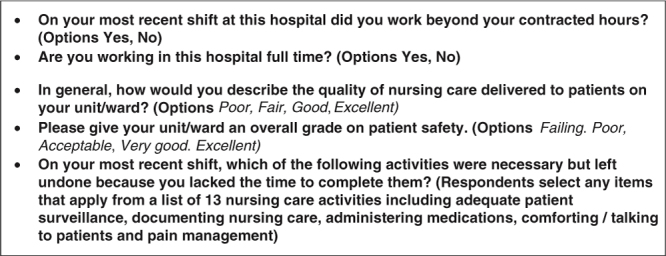
BACKGROUND: Despite concerns as to whether nurses can perform reliably and effectively when working longer shifts, a pattern of two 12- to 13-hour shifts per day is becoming common in many hospitals to reduce shift to shift handovers, staffing overlap, and hence costs. OBJECTIVES: To describe shift patterns of European nurses and investigate whether shift length and working beyond contracted hours (overtime) is associated with nurse-reported care quality, safety, and care left undone. METHODS: Cross-sectional survey of 31,627 registered nurses in general medical/surgical units within 488 hospitals across 12 European countries. RESULTS: A total of 50% of nurses worked shifts of ≤ 8 hours, but 15% worked ≥ 12 hours. Typical shift length varied between countries and within some countries. Nurses working for ≥ 12 hours were more likely to report poor or failing patient safety [odds ratio (OR)=1.41; 95% confidence interval (CI), 1.13-1.76], poor/fair quality of care (OR=1.30; 95% CI, 1.10-1.53), and more care activities left undone (RR=1.13; 95% CI, 1.09-1.16). Working overtime was also associated with reports of poor or failing patient safety (OR=1.67; 95% CI, 1.51-1.86), poor/fair quality of care (OR=1.32; 95% CI, 1.23-1.42), and more care left undone (RR=1.29; 95% CI, 1.27-1.31). CONCLUSIONS: European registered nurses working shifts of ≥ 12 hours and those working overtime report lower quality and safety and more care left undone. Policies to adopt a 12-hour nursing shift pattern should proceed with caution. Use of overtime working to mitigate staffing shortages or increase flexibility may also incur additional risk to quality.
Overview
CoChat Summary
## TL;DR
This cross-sectional survey of 31,627 registered nurses in 488 hospitals across 12 European countries found that longer shifts and overtime were associated with worse nurse-reported care quality, patient safety, and more care left undone. Shifts of at least 12 hours and working beyond contracted hours both showed independent negative associations.
## Key findings
- Among 31,627 nurses, 50% reported shifts of 8 hours or less, 15% reported shifts of 12 hours or more, and 27% reported overtime on their last shift.
- Nurses working shifts of at least 12 hours were more likely than those working 8 hours or less to report poor/fair quality of care (OR=1.30; 95% CI, 1.10-1.53), poor/failing patient safety (OR=1.41; 95% CI, 1.13-1.76), and more care left undone (RR=1.13; 95% CI, 1.09-1.16).
- Nurses working beyond contracted hours were more likely to report poor/fair quality of care (OR=1.32; 95% CI, 1.23-1.42), poor/failing patient safety (OR=1.67; 95% CI, 1.51-1.86), and more care left undone (RR=1.29; 95% CI, 1.27-1.31).
- There was substantial variation in shift patterns across countries; for example, the paper says long shifts were common in England, Ireland, and Poland, while in Belgium, Germany, Greece, the Netherlands, Norway, and Sweden fewer than 5% of nurses reported shifts of 12 hours or more.
## Methods
- Cross-sectional survey within the RN4CAST study of registered nurses in medical and surgical wards of acute hospitals in 12 European countries: Belgium, England, Germany, Finland, Greece, Ireland, the Netherlands, Norway, Poland, Spain, Sweden, and Switzerland.
- The survey was mailed or directly distributed between June 2009 and June 2010; 54,140 questionnaires were distributed and 33,659 were returned (62%), with 31,627 respondents on adult medical/surgical wards available for analysis.
- Main analysis used binomial generalized linear mixed models for quality and patient safety, and a generalized mixed model with Poisson distribution for care left undone, adjusting for shift type, ward type, staffing ratio, nurse age, full-time/part-time status, hospital size, high-technology status, and teaching status.
## Limitations
- The paper states that, because the analysis was cross-sectional, it is not possible to infer causality.
- The paper states that it did not test country-by-shift-work interactions, so it could only estimate average effects across countries and could not explore between-country differences.
- The paper states that outcomes were nurse self-reports, the clinical importance of the differences is unclear, and further research should include objective measures and patient experiences.
- Evident from the text: the study did not directly measure hours worked overall or ask about the nature of overtime, number of overtime hours, usual shift pattern, breaks during shifts, or opportunity to rest between shifts.
Model-written summary. Check it against the paper before relying on it.
Integrity signals
Registry
Cites
Statistics
Figures
Verification
Claims the paper makes
3 Valid · 0 Not valid · 29 Not checked · 62 Own results and interpretations
The cited sources support only part of this claim — read each source’s verdict below.
In the paper
“This measure has been validated by associations with hospitallevel mortality, patient satisfaction, and care processes. 27”
What the sources say
- Partly supportedcites [27] matched to “. Care left undone during nursing shifts: associations with workload and perceived quality of care.” (2014) sourceExperimental — accuracy not yet measured
The Measures and ‘Care left undone and quality and patient safety’ sections describe a nurse-rated quality-of-care measure and show its association with care left undone. The paper does not report validating that measure through associations with hospital-level mortality or patient satisfaction; the Discussion says further research is warranted on missed care as an indicator of patient outcomes. (LLM, conf=0.84)
plainstates an association- Asserted: passes — The authors put it forward as true.
- Checkable: passes — It can be checked against evidence.
- Load-bearing: passes — The paper’s conclusions depend on it.
- Based: passes — The paper gives a reason why it holds.
- Partly supported
The cited sources support only part of this claim — read each source’s verdict below.
In the paper
“Overtime working has also been associated with adverse quality because of cumulative fatigue, lack of rest, and adverse working environments. 21,22”
What the sources say
- Could not verifycites [21] matched to “. A systematic survey instrument translation process for multi-country, comparative health workforce studies.” (2013) sourceExperimental — accuracy not yet measured
The Methods (Instrument Finalization) describe survey questions about nurses’ work environments, burnout, and care quality, but do not report an association between overtime and adverse quality. The Discussion addresses the relevance of work-environment and burnout questions, not cumulative fatigue or lack of rest as explanations. Searches for overtime, fatigue, rest, and quality found no passage addressing the attributed claim. (LLM, conf=0.75)
- Partly supportedcites [22] matched to “Nurse reported quality of care: a measure of hospital quality.” (2012) sourceExperimental — accuracy not yet measured
The Discussion (page unavailable) associates good nurse practice environments with higher nurse-reported quality of care, supporting the work-environment portion of the claim. The paper does not report an association between overtime and adverse quality or identify cumulative fatigue and lack of rest as explanations; searches for overtime, fatigue, and rest found no relevant passage. (LLM, conf=0.82)
plainstates an association- Asserted: passes — The authors put it forward as true.
- Checkable: passes — It can be checked against evidence.
- Load-bearing: passes — The paper’s conclusions depend on it.
- Based: passes — The paper gives a reason why it holds.
- Could not verify
A result the paper reports from its own data — it cites no other source for it, so there is none to check. The quote shows it is in the paper.
In the paper
“A total of 50% of nurses worked shifts of r 8 hours, but 15% worked Z 12 hours.”
- Also stated in: § Shift Length · plain
“The most common shift length was r 8 hours (50%, n = 15,930).”
plainn = 15,930- Asserted: passes — The authors put it forward as true.
- Checkable: passes — It can be checked against evidence.
- Load-bearing: unclear — It is unclear whether the paper’s conclusions depend on it.
- Based: passes — The paper gives a reason why it holds.
- Rests on an assumption not shown here.
- Also stated in: § Shift Length · plain
A result the paper reports from its own data — it cites no other source for it, so there is none to check. The quote shows it is in the paper.
In the paper
“For Belgium, Germany, Greece, The Netherlands, Norway, and Sweden <5% of nurses reported working shifts of Z 12 hours.”
plain- Asserted: passes — The authors put it forward as true.
- Checkable: passes — It can be checked against evidence.
- Load-bearing: unclear — It is unclear whether the paper’s conclusions depend on it.
- Based: passes — The paper gives a reason why it holds.
- Rests on an assumption not shown here.
A result the paper reports from its own data — it cites no other source for it, so there is none to check. The quote shows it is in the paper.
In the paper
“A total of 50% of nurses worked shifts of r 8 hours, but 15% worked Z 12 hours.”
- Also stated in: § Shift Length · plain
“and 14% (n = 4314) worked 12 to 13 hours. Only 260 nurses (1%) worked >13 hours on their last shift.”
plain- Asserted: passes — The authors put it forward as true.
- Checkable: passes — It can be checked against evidence.
- Load-bearing: passes — The paper’s conclusions depend on it.
- Based: passes — The paper gives a reason why it holds.
- Rests on an assumption not shown here.
- Also stated in: § Shift Length · plain
44 more claims
Create a free account to see all 94 claims and to verify the 46 references still open.
- Probably not a substantial claim. 27
- It may state two separate claims as one. 24
Claims other papers make about this one
Each is checked against this paper’s own text: does it say what the citing paper says it does?
The source backs part of the claim, not all of it — or backs it for a different population, condition or comparison.
In the citing paper
“England is unusual in presenting a mixed economy in shift patterns with 32% of day shifts and 36% of night shifts lasting 12 h or more making it a ‘natural laboratory’ for examining the effect of such variation on outcomes [24].”
From Cross-sectional examination of the association between shift length and hospital nurses job satisfaction and nurse reported quality measures (2017) · cites this paper as [24]
Experimental — accuracy not yet measuredThe cited source says what the claim attributes to it.
In the citing paper
“Two large European cross sectional studies of 31,627 registered nurses concluded that those working shifts of 12 h or longer were more likely to report poor quality of care, poor patient safety, and higher rates of care left undone [24] and higher levels of job dissatisfaction, burnout and intention to leave [25], when compared with nurses working 8 h or shorter shifts.”
From Cross-sectional examination of the association between shift length and hospital nurses job satisfaction and nurse reported quality measures (2017) · cites this paper as [24]
The cited source says what the claim attributes to it.
In the citing paper
“Our findings add to the international body of evidence reporting that working 12 h shifts or longer are associated with poor ratings of quality of care and higher rates of care left undone [17, 24, 28, 29].”
From Cross-sectional examination of the association between shift length and hospital nurses job satisfaction and nurse reported quality measures (2017) · cites this paper as [24]
Self-check
Percentages, sums and reported differences re-computed from the paper’s own numbers.
Each contradiction between two passages listed here was confirmed by an independent check.
Rated minor: it would not touch a result — a value no result rests on, a p-value that stays on the same side of the significance level, or a conflict that is clerical, resolved elsewhere in the paper, or outside its own findings.
In the paper
“Because of the small sample size of the >13 hours category (n = 260, 0.08%),”
Reported 0.08 · recomputed 0.822082
Rated minor: it would not touch a result — a value no result rests on, a p-value that stays on the same side of the significance level, or a conflict that is clerical, resolved elsewhere in the paper, or outside its own findings.
In the paper
§ CONCLUSIONS
“to assess patient safety as poor or fair, and to report more care items left undone on their last shift”
§ Measurements
“Patient safety was rated as poor, failing, acceptable, very good, or excellent with 'poor' and 'failing' ratings combined to reflect negative evaluations.”
Rated minor: it would not touch a result — a value no result rests on, a p-value that stays on the same side of the significance level, or a conflict that is clerical, resolved elsewhere in the paper, or outside its own findings.
In the paper
“Twenty-five percent (n = 7815) of nurses reported poor/ fair quality of care and 7% (2736) reported 'poor' or 'failing' patient safety.”
Reported 7 · recomputed 8.650836
Rated minor: it would not touch a result — a value no result rests on, a p-value that stays on the same side of the significance level, or a conflict that is clerical, resolved elsewhere in the paper, or outside its own findings.
In the paper
§ Shift Length
“(n = 9963) and 14% (n = 4314) worked 12 to 13 hours.”
§ Shift Length
“| 8.1-10 | 9965 (32) | 5960 (19) | 4005 (13) | 4175 (13) | 4109 (13) |”
Rated minor: it would not touch a result — a value no result rests on, a p-value that stays on the same side of the significance level, or a conflict that is clerical, resolved elsewhere in the paper, or outside its own findings.
In the paper
§ Shift Length
“14% (n = 4314) worked 12 to 13 hours.”
§ Shift Length
“| 12-13 | 4313 (14) | 2670 (8) | 1643 (5) | 1145 (4) | 470 (1) |”
Citations
Cites
Forming inferences about some intraclass correlation coefficients.
McGraw, K. O., & Wong, S. P. (1996) · Psychological Methods · doi:10.1037/1082-989x.1.1.30 · Cited by 6,903 · cited 1×
“The ICC 1 measures the degree of similarity between individuals within a cluster.(29) It also indicates the proportion of variance in the outcome that can be attributed to variation between groups (wards, hospitals, countries) as opposed to between individuals.”
BackgroundRepeatability for Gaussian and non-Gaussian data: a practical guide for biologists.
Nakagawa, S., & Schielzeth, H. (2010) · Biological Reviews · doi:10.1111/j.1469-185x.2010.00141.x · Cited by 2,584 · cited 1×
“It also indicates the proportion of variance in the outcome that can be attributed to variation between groups (wards, hospitals, countries) as opposed to between individuals.(30) The association of shift length and overtime with the outcome measures was estimated through a binomial generalized linear mixed model.”
MethodAiken, L. H., Sermeus, W., Van den Heede, K., Sloane, D. M., Busse, R., McKee, M., Bruyneel, L., Rafferty, A. M., Griffiths, P., Moreno-Casbas, M. T., et al. (2012) · BMJ · doi:10.1136/bmj.e1717 · Cited by 2,052 · cited 3×
“Previous research indicates that low nurse staffing levels are associated with worse patient outcomes.(24,42) This finding is supported by our analysis.”
BackgroundResultSelf-citationKane, R. L., Shamliyan, T. A., Mueller, C., Duval, S., & Wilt, T. J. (2007) · Medical Care · doi:10.1097/mlr.0b013e3181468ca3 · Cited by 1,097 · cited 1×
“Previous research indicates that low nurse staffing levels are associated with worse patient outcomes.(24,42) This finding is supported by our analysis.”
ResultThe Working Hours Of Hospital Staff Nurses And Patient Safety
Rogers, A. E., Hwang, W.-T., Scott, L. D., Aiken, L. H., & Dinges, D. F. (2004) · Health Affairs · doi:10.1377/hlthaff.23.4.202 · Cited by 952
Self-citationNurse turnover: A literature review – An update
Hayes, L. J., O’Brien-Pallas, L., Duffield, C., Shamian, J., Buchan, J., Hughes, F., Laschinger, H. K. S., & North, N. (2012) · International Journal of Nursing Studies · doi:10.1016/j.ijnurstu.2011.10.001 · Cited by 888
Effects of Hospital Care Environment on Patient Mortality and Nurse Outcomes
Aiken, L. H., Clarke, S. P., Sloane, D. M., Lake, E. T., & Cheney, T. (2008) · JONA: The Journal of Nursing Administration · doi:10.1097/01.nna.0000312773.42352.d7 · Cited by 860 · cited 1×
“Overtime has previously been associated with increased nurse turnover(10,46) and it may be that use of overtime is associated with less favorable working environments for nurses, which are known to be linked to subjective and objective measures of reduced quality and safety of care.(23,47) Overtime can be an individua…”
BackgroundSelf-citationEffects of Hospital Care Environment on Patient Mortality and Nurse Outcomes
Aiken, L. H., Clarke, S. P., Sloane, D. M., Lake, E. T., & Cheney, T. (2009) · JONA: The Journal of Nursing Administration · doi:10.1097/nna.0b013e3181aeb4cf · Cited by 799
Self-citation. Care left undone during nursing shifts: associations with workload and perceived quality of care.
Ball, J. E., Murrells, T., Rafferty, A. M., Morrow, E., & Griffiths, P. (2014) · BMJ Quality & Safety · doi:10.1136/bmjqs-2012-001767 · Cited by 666
Individual differences in tolerance to shift work – A systematic review
Saksvik, I. B., Bjorvatn, B., Hetland, H., Sandal, G. M., & Pallesen, S. (2011) · Sleep Medicine Reviews · doi:10.1016/j.smrv.2010.07.002 · Cited by 479 · cited 1×
“We controlled for potential confounding variables, including variables chosen because they have been shown elsewhere to have independent relationships with the quality of care in hospitals(31,32) or the ability to cope with shift work.(33) Control variables were shift type (day/night), ward type, nurse staffing levels…”
Method
Cited by
Items 201–300 of 315
Student nurses’ views on shift patterns: What do they prefer and why? Results from a Tweetchat
Dall’Ora, C., Sainsbury, J., & Allen, C. (2022) · Nursing Open · doi:10.1002/nop2.1208 · Cited by 7
“Large multi-country studies of thousands of nurses across Europe and the US have shown negative impacts of 12-hr shifts on both patient care and on outcomes of nurse wellbeing and performance (Clendon & Gibbons, 2015; Dall'Ora et al., 2015; Dall'Ora, Griffiths, et al., 2019; Griffiths et al., 2014).”
BackgroundSelf-citationMing, Y., & Meehan, R. A. (2023) · Journal of Patient Safety · doi:10.1097/pts.0000000000001128 · Cited by 8
Electrocortical temporal complexity during wakefulness and sleep: an updated account
González, J., Cavelli, M., Mondino, A., Pascovich, C., Castro‐Zaballa, S., Rubido, N., & Torterolo, P. (2020) · Sleep Science · doi:10.5935/1984-0063.20200013 · Cited by 7
Ferdianingsih, T., Efendi, D., & Widiastuti, I. A. K. S. (2022) · Journal of Neonatal Nursing · doi:10.1016/j.jnn.2022.11.003 · Cited by 6
From Chosen to Forced: A Qualitative Exploration of Nurses’ Experiences With Overtime
Nogues, S., & Tremblay, D. (2023) · Employee Responsibilities and Rights Journal · doi:10.1007/s10672-023-09485-y · Cited by 4
Povezava med neprespanostjo in delazmožnostjo zaposlenih v zdravstveni negi
Peršolja, M., Mišmaš, A., & Jurdana, M. (2018) · Slovenian Nursing Review · doi:10.14528/snr.2018.52.1.186 · Cited by 14
Sleep and maternal behavior in the postpartum rat after haloperidol and midazolam treatments
Peña, F., Rivas, M., González, J., Schwarzkopf, N., Torterolo, P., Ferreira, A., & Benedetto, L. (2020) · Sleep Science · doi:10.5935/1984-0063.20200019 · Cited by 7
Social modulation on daily variability in electric behavior
Gascue, V., da Silva, A. C. R., & Migliaro, A. (2020) · Sleep Science · doi:10.5935/1984-0063.20200012 · Cited by 6
Riguzzi, M., Gashi, S., & Bischofberger, I. (2021) · Journal of Nursing Education and Practice · doi:10.5430/jnep.v11n7p19 · Cited by 4
“Preventing a depletion of their mental health is important, both for the sake of the healthcare workers themselves, as well as for healthcare systems to maintain sufficient provision of healthcare services over an extended period.[43, 44] A lesson to be learned for future waves of the COVID-19 pandemic, as well as for…”
BackgroundDeterminants of Implementation
Wensing, M., & Grol, R. P. T. M. (2020) · Wiley eBooks · doi:10.1002/9781119488620.ch8 · Cited by 6
Sick Leave Determinants in the Healthcare Sector (Part III): A Review of Individual-Level Factors
Brady, H. D., McGrath, D., & Dunne, C. P. (2023) · Journal of Brown Hospital Medicine · doi:10.56305/001c.77844 · Cited by 8
Kobezda, T., & Rehm, A. (2022) · Journal of Obstetrics and Gynaecology · doi:10.1080/01443615.2022.2109137 · Cited by 3
“Griffiths et al. stated that nurses who worked shifts �12 hours reported lower quality of care (Griffiths et al. 2014).”
BackgroundKrutova, O., Ervasti, J. M., Virtanen, M., et al. (2023) · PLOS Digital Health · doi:10.1371/journal.pdig.0000265 · Cited by 3
“Two literature reviews have shown that extended (>8 hour) working hours are associated with patient safety outcomes, such as medical errors [13,14].”
BackgroundImpact of the single site order in LTC: exacerbation of an overburdened system
Havaei, F., Sims‐Gould, J., Staempfli, S., Franke, T., Park, M., Ma, A., & Kaulius, M. (2023) · BMC Health Services Research · doi:10.1186/s12913-023-09670-7 · Cited by 6
“The increasing pattern of overtime is noteworthy and of particular concern: an extensive body of evidence that links nurse overtime to increased burnout, job dissatisfaction, turnover, and patient safety incidents [20, 21].”
BackgroundNightshift Rotation Schedule and Fatigue in U.K. and Italian Nurses
Lecca, R., Westwell, A., Casaglia, E., Figorilli, M., Murphy, E., Puligheddu, M., van Tongeren, M., & Cocco, P. (2024) · La Medicina del Lavoro · doi:10.23749/mdl.v115i5.16244 · Cited by 5
“12-hour 12-hour shifts rated 30% more frequently as poor the quality of nursing and the patient’s safety, and 13% more frequently the care left undone at the end of the work shift [13].”
InfluentialTravail posté : quel(s) critère(s) de pénibilité ?
Amiard, V., & Libert, J. (2015) · Archives des maladies professionnelles et de médecine du travail/Archives des maladies professionnelles et de l'environnement · doi:10.1016/j.admp.2015.02.006 · Cited by 4
Evaluation of the attitudes about patient safety in perioperative care
Arlı, Ş. K. (2020) · Perioperative Care and Operating Room Management · doi:10.1016/j.pcorm.2020.100145 · Cited by 3
An Omission Error: Missed Nursing Care
Eskici, G. T., & Baykal, Ü. (2021) · Sağlık ve Hemşirelik Yönetimi Dergisi · doi:10.5222/shyd.2021.28190 · Cited by 3
INCIDENTES EM SESSÕES DE HEMODIÁLISE À BEIRA LEITO EM UNIDADES DE TERAPIA INTENSIVA
Costa, N. N., Barreto, R. A. D. S. S., da Costa, M. M., et al. (2021) · Cogitare Enfermagem · doi:10.5380/ce.v26i0.76010 · Cited by 3
Epstein, R. H., Dexter, F., & Fahy, B. G. (2025) · Journal of Medical Systems · doi:10.1007/s10916-025-02164-5 · Cited by 3
Çeli̇k, S. Ş., Özbaş, A. A., Kovancı, M. S., Savaş, H., & Çeli̇k, Y. (2022) · Journal of Nursing Management · doi:10.1111/jonm.13625 · Cited by 3
“The fact that working longer than 12 h reduces the quality of life of nurses also threatens the safety of patients and employees (Griffiths et al., 2014).”
BackgroundHealth Conditions and Long Working Hours in Europe: A Retrospective Study
Korošec, D., Vrbnjak, D., & Štiglic, G. (2022) · International Journal of Environmental Research and Public Health · doi:10.3390/ijerph191912325 · Cited by 3
Research into nurse staffing levels in Wales
Jones, A., Powell, T., Vougioukalou, S. A., Lynch, M., & Kelly, D. M. (2015) · ORCA Online Research @Cardiff (Cardiff University) · Cited by 3
Nigenda, G., Zárate-Grajales, R., Aristizabal, P., Squires, A., Ostiguín-Meléndez, R., Salcedo, R. A., Leija, C., Choperena, D., & Serván-Mori, E. (2022) · Journal of Professional Nursing · doi:10.1016/j.profnurs.2022.01.002 · Cited by 3
Saville, C. E., Dall’Ora, C., & Griffiths, P. (2020) · International Journal of Nursing Studies · doi:10.1016/j.ijnurstu.2020.103702 · Cited by 6
Self-citationQuality and efficiency improvements in the health care administration system of Mauritius
Roland, G. (2019) · Unisa Institutional Repository (University of South Africa) · Cited by 5
Factors influencing nursing care rationing in Poland – a literature review
Antoszewska, A., & Gutysz‐Wojnicka, A. (2025) · Pielegniarstwo XXI wieku / Nursing in the 21st Century · doi:10.12923/pielxxiw-2025-0015 · Cited by 4
Hogan, C. (2025) · British Journal of Community Nursing · doi:10.12968/bjcn.2025.0038 · Cited by 2
Cerela-Boltunova, O., & Klavina, K. (2025) · International Journal of Environmental Research and Public Health · doi:10.3390/ijerph22111736 · Cited by 2
“Nurses, as a fundamental element of the healthcare system, face high physical and psycho-emotional stress on a daily basis, which extends beyond individual coping resources when shifts are excessively long, particularly in the case of 24 h duties [2–5].”
Turkish Version of the Unfinished Nursing Care Survey: Validity and Reliability Data
Özsaban, A., Eskici, G. T., Palese, A., Grassetti, L., & Bassi, E. (2026) · Journal of Nursing Management · doi:10.1155/jonm/4585472 · Cited by 2
Penso, A., Loundou, D.-A., Lehucher‐Michel, M., & Martin, F. (2022) · Archives des maladies professionnelles et de médecine du travail/Archives des maladies professionnelles et de l'environnement · doi:10.1016/j.admp.2022.07.001 · Cited by 2
Quality of therapy and mental health among occupational therapists during the COVID-19 pandemic
Ito, A., Sawamura, D., Kajimura, S., Miyaguchi, H., Nakamura, H., & Ishioka, T. (2022) · Frontiers in Public Health · doi:10.3389/fpubh.2022.1053703 · Cited by 2
Factors Influencing Quality of Midwifery Care Service at Women’s and New Born Hospital, Lusaka
Nankamba, W. S. N., & Mwanaumo, E. (2024) · African Journal of Health Nursing and Midwifery · doi:10.52589/ajhnm-ticxjnt6 · Cited by 2
Nayeri, N. D., Ameri, Z. A., & Seylani, K. (2016) · Iran Journal of Nursing · doi:10.29252/ijn.28.98.39 · Cited by 2
Pajnkihar, M., Trifkovič, K. Č., Donik, B., Fijan, S., Gönc, V., Kegl, B., Lorber, M., Strauss, M., Stričević, J., Turk, S. Š., et al. (2017) · InTech eBooks · doi:10.5772/67957 · Cited by 5
“Adequate staffing and resources [16–20], workload and working hours [21], nursing management [8, 17, 22–25], autonomy and decision-making [17, 25–28], status, recognition, job and task requirements, opportunity for advancement [25], and also employee engagement and commitment [29] are frequently reported working condi…”
BackgroundAbbenbroek, B., Duffield, C. M., & Elliott, D. (2017) · Journal of Hospital Administration · doi:10.5430/jha.v6n3p67 · Cited by 2
Studying Missed Care: Designs, Instruments, and Reporting Guidelines
Palese, A., Simon, M., & Sermeus, W. (2021) · Springer eBooks · doi:10.1007/978-3-030-71073-6_4 · Cited by 5
Self-citationInfections, accidents and nursing overtime in a neonatal intensive care unit
Beltempo, M., Bresson, G., Etienne, J., & Lacroix, G. (2021) · The European Journal of Health Economics · doi:10.1007/s10198-021-01386-x · Cited by 6
Methammem, F., & Abdallah, M. A. B. (2022) · Journal of Human Resource and Sustainability Studies · doi:10.4236/jhrss.2022.102017 · Cited by 4
Examining the Relationship Between Work Alienation and Quality Perception in Nurses
Kurt, Ş., Köse, B. G., & Öztürk, H. (2023) · Sağlık ve Hemşirelik Yönetimi Dergisi · doi:10.54304/shyd.2023.03880 · Cited by 3
Shift length and working practices in UK hospital settings: An online survey of heads of midwifery
Dent, J. (2020) · Midwifery · doi:10.1016/j.midw.2020.102709 · Cited by 4
Missed Nursing Care in COVID-19 Patients in IranPreprint
Hosseini, Z., Reisi, L., Maghari, A., & Karimollahi, M. (2021) · Research Square · doi:10.21203/rs.3.rs-814476/v1 · Cited by 2
Qureshi, S. M. (2021) · doi:10.32920/ryerson.14663319 · Cited by 2
Brändle, T. (2015) · Journal of Contextual Economics – Schmollers Jahrbuch · doi:10.3790/schm.135.4.499 · Cited by 2
Examination of Nurses’ Attitudes About Patient Safety According to Sociodemographic Characteristics
ÇİLHOROZ, Y., & İlgün, G. (2022) · Sudan Journal of Medical Sciences · doi:10.18502/sjms.v17i4.12544 · Cited by 5
“[17], it was found that nurses with high working hours are more likely to exhibit a low-patient safety attitude.”
BackgroundMutlu, S., & Yılmaz, E. B. (2023) · TOGÜ Sağlık Bilimleri Dergisi · doi:10.52369/togusagbilderg.1274118 · Cited by 1
YÖNETİCİ HEMŞİRELERİN KARŞILANMAMIŞ HEMŞİRELİK BAKIMINA İLİŞKİN ROLLERİ
Eskici, G. T. (2024) · Yönetim Bilimleri Dergisi · doi:10.35408/comuybd.1439984 · Cited by 1
Utilizing Quality Improvement Methodology to Decrease Surgical Delays
Chase, M. E. R., Anderson, M. J., Stephens, W. A., Levy, B. E., Lantz, S. R., Goforth, J., Newcomb, M. R., & Harris, A. M. (2025) · The Joint Commission Journal on Quality and Patient Safety · doi:10.1016/j.jcjq.2025.04.004 · Cited by 2
Empirische Erkenntnisse zu „Qualität in der Pflege“
Hasseler, M. (2019) · Springer eBooks · doi:10.1007/978-3-662-58022-6_3 · Cited by 1
XV Latin-American Symposium on Chronobiology
Silva, A., & Torterolo, P. (2020) · Sleep Science · doi:10.5935/1984-0063.20200005 · Cited by 2
Mokodompit, K., Agustini, T., & Siokal, B. (2021) · Window of Nursing Journal · doi:10.33096/won.v1i2.253 · Cited by 2
Effects of working conditions on the perception of night work safety and health effects on nurses
Yi, J., & Hong, K. J. (2024) · International Nursing Review · doi:10.1111/inr.12936 · Cited by 1
12-hour Shifts for Radiation Therapists
Young, C., Smoke, M., Farrell, T., & Ho, E. (2017) · Journal of medical imaging and radiation sciences · doi:10.1016/j.jmir.2017.05.002 · Cited by 2
Quality and safety in the literature: September 2019
Houchens, N., Meddings, J. A., & Gupta, A. B. (2019) · BMJ Quality & Safety · doi:10.1136/bmjqs-2019-009918 · Cited by 1
The Lived Experience Of Self-Compassion Among Registered Nurses In The Workplace
McPhee, C. B. (2019) · doi:10.7916/d8-06me-np18 · Cited by 1
“Statistics and costs attempting to analyze these conundrums have been written about in the literature (Bauer-Wu & Fontaine, 2015; Griffiths et al., 2014; Van den Heede & Aiken, 2013).”
BackgroundRaffenaud, A. (2018) · STARS (University of Central Florida) · Cited by 2
Fonseca, A. B. D. A., da Costa, S. M., Mantuano‐Barradas, M., Alves, A. M. B., & Bruno, R. V. (2020) · Sleep Science · doi:10.5935/1984-0063.20200011 · Cited by 1
Chikungunya infection modulates the locomotor/flight activity of Aedes aegypti
Padilha, K. P., Talyuli, O. A. C., Lourenço‐de‐Oliveira, R., Farnesi, L. C., & Bruno, R. V. (2020) · Sleep Science · doi:10.5935/1984-0063.20200018 · Cited by 2
Constrained compassion: an ethnography exploring compassion in the hospital ward setting
Barnes, D. M. (2018) · Nottingham ePrints (University of Nottingham) · Cited by 2
Marco, E. S. (2021) · Tesis Doctorals en Xarxa (Consorci de Serveis Universitaris de Catalunya) · doi:10.6035/14103.2021.588890 · Cited by 1
The impact of 12-hour shifts on team effectiveness
Bradley, M. (2016) · British Journal of Mental Health Nursing · doi:10.12968/bjmh.2016.5.2.73
8 Beïnvloedende factoren bij implementatie
Wensing, M., Bosch, M., & Grol, R. P. T. M. (2015) · Bohn Stafleu van Loghum eBooks · doi:10.1007/978-90-368-1077-7_8
Jacob, S. (2018) · Advances in Cytology & Pathology · doi:10.15406/acp.2018.03.00047
Adkins, M. (2018) · UKnowledge (University of Kentucky) · Cited by 2
Globalization and changing nursing workforce within the framework of flexibility model
Öncü, E. (2018) · Journal of Human Sciences · doi:10.14687/jhs.v15i2.4842
“…assessing the results of the study, the real intent of the employers should be understood and it should be questioned whether the real intent of having less number of employees working longer hours is to decrease expenses or to use the labor force more productively (Griffiths et al., 2014).”
BackgroundWhat, how and (especially) when: chronoparmacological approach in cancer therapies
Trebucq, L. L., Marpegán, L., Golombek, D. A., & Chiesa, J. J. (2020) · Sleep Science · doi:10.5935/1984-0063.20200021 · Cited by 1
Annual variation of daily activity patterns and its dependence on photoperiod: a quick overview
Improta, G. C. (2020) · Sleep Science · doi:10.5935/1984-0063.20200015
Circadian modulation of motivation-related behavior
Acosta, J., Golombek, D. A., & Agostino, P. V. (2020) · Sleep Science · doi:10.5935/1984-0063.20200006 · Cited by 1
The effect of pubertal development on the sleep-wake cycle
Borrani, J., Guerra, G., García, A., Ramírez, C., & Valdéz, P. (2020) · Sleep Science · doi:10.5935/1984-0063.20200008 · Cited by 1
Shift work-related health problems: causes, effects, and light-based interventions
Bustos-González, L. (2020) · Sleep Science · doi:10.5935/1984-0063.20200009
Different latitude influences the habitat and reproductive patterns of Pinnipeds
Morales-Pérez, B., & Miñana-Solís, M. D. C. (2020) · Sleep Science · doi:10.5935/1984-0063.20200016
Neurocognitive Effects of 12-hour Shifts on Bedside Nurses
Miller, C. N. (2020)
From the ruler to the smartphone tasks applied to identify sleep deprivation
Bellone, G. J., Fedele, M. M., Abulafia, C., Plano, S. A., Golombek, D. A., & Vigo, D. E. (2020) · Sleep Science · doi:10.5935/1984-0063.20200007
Assessment of The Characteristics of Nurse Scheduling in Hospital Ward
Zunaedi, R., Melaniani, S., & Ahsan, A. (2020) · STRADA JURNAL ILMIAH KESEHATAN · doi:10.30994/sjik.v9i2.528 · Cited by 3
“Nurses who work longer or overtime result in decreased quality of nursing care in patients, decreased patient safety abilities, and more unresolved tasks (Griffiths et al., 2014).”
BackgroundUpdates from the Literature, July/August 2021
Clark, R. R. S. (2021) · Journal of Midwifery & Women s Health · doi:10.1111/jmwh.13272
VARDİYALI ÇALIŞMANIN EBE VE HEMŞİRELERİN SOSYAL YAŞAMLARI ÜZERİNE ETKİSİ
Bay, B., & Kesgi̇n, M. T. (2021) · Sosyal Bilimler Elektronik Dergisi Electronic Journal of Social Sciences · doi:10.29228/sbe.54169 · Cited by 1
The impact of 12-hour shifts on team effectiveness
Bradley, M. (2016) · British Journal of Healthcare Management · doi:10.12968/bjhc.2016.22.5.261
Beïnvloedende factoren bij implementatie
Wensing, M., & Grol, R. P. T. M. (2017) · Bohn Stafleu van Loghum eBooks · doi:10.1007/978-90-368-1732-5_8
Saville, C. E., Dall’Ora, C., & Griffiths, P. (2020) · International Journal of Nursing Studies · doi:10.1016/j.ijnurstu.2020.103642 · Cited by 4
Self-citationStaff councils in hospitals as co-managers? A blind spot in codetermination research
Bär, S., Starystach, S., & Hess, H. (2021) · Industrielle Beziehungen Zeitschrift für Arbeit Organisation und Management · doi:10.3224/indbez.v28i4.04 · Cited by 1
Missed nursing care in highly specialized hospitals: A Mexican case study
Hernández‐Corral, S., Servan-Mori, E. E., Benítez-Chavira, L. A., Nigenda, G., & Zárate-Grajales, R. A. (2022) · The International Journal of Health Planning and Management · doi:10.1002/hpm.3501 · Cited by 2
Application Model of Nurse Electronic Rostering Software (NERS) In Hospital Ward
Zunaedi, R., & Ahsan, S. M. (2022) · INDONESIAN NURSING JOURNAL OF EDUCATION AND CLINIC (INJEC) · doi:10.24990/injec.v6i2.370
ПОРУШЕННЯ СНУ В МЕДСЕСТЕР, ЯКІ ПРАЦЮЮТЬ ПОЗМІННО, ТА ЇХ ВПЛИВ НА ОРГАНІЗМ
Ціпкало, А. І., Фурка, О. Б., Баб’як, О. В., & Марущак, М. І. (2022) · Medical and Clinical Chemistry · doi:10.11603/mcch.2410-681x.2022.i3.13373
Beïnvloedende factoren bij implementatie
Wensing, M., & Grol, R. P. T. M. (2023) · Bohn Stafleu van Loghum eBooks · doi:10.1007/978-90-368-2909-0_8
Dallı, Ö. E., & Yıldırım, Y. (2023) · Ege Üniversitesi Hemşirelik Fakültesi Dergisi · doi:10.53490/egehemsire.1155800 · Cited by 1
HASTA GÜVENLİĞİ KÜLTÜRÜ: BİR EĞİTİM ARAŞTIRMA HASTANESİ ÖRNEĞİ
Bulut, A., Şengül, H., & ÇELİK, Z. (2023) · Sağlık ve Sosyal Refah Araştırmaları Dergisi · doi:10.55050/sarad.1297905 · Cited by 1
Farraj, N. H., Toosi, A., Qahtani, A. A., Forgrave, D., & Ansar, S. (2023) · International Journal of Healthcare · doi:10.5430/ijh.v9n2p8 · Cited by 1
Alan, H., Bacaksız, F. E., Seren, A. K. H., Güngör, S., Bilgin, O., & Baykal, Ü. (2024) · Etkili Hemşirelik Dergisi · doi:10.46483/jnef.1516060
Advancements in Patient Safety: A Bibliometric Insight into Health Policy Services
Sembiring, A., Yustina, I., Zulfendri, Z., & Setiawan, S. (2024) · Universal Journal of Public Health · doi:10.13189/ujph.2024.120407 · Cited by 2
Factors of Overtime Hours for Nurses Working in Hospitals
Watanabe, M., Munakata, M., Yamauchi, K., & Kanai‐Pak, M. (2024) · Journal of Japan Academy of Nursing Science · doi:10.5630/jans.44.308 · Cited by 1
Psychological Distress amongst Healthcare Workers in Douala
Manga, J. L. O., Eyoum, C., Arsène, B. F. A., Errero, N. F., Myriam, D. T.-H., & Ndiaye, M. (2024) · Occupational Diseases and Environmental Medicine · doi:10.4236/odem.2024.124027
Karim, A., Khan, A., Khan, M., Khan, J., Habib, T., Shan, M. A., Yaseen, M., & Khan, S. (2024) · NURSEARCHER (Journal of Nursing & Midwifery Sciences) · doi:10.54393/nrs.v4i04.118
Huang, L., Xu, Y., & Shih, P.-C. (2024) · IEEE International Conference on Industrial Engineering and Engineering Management (IEEM) · doi:10.1109/ieem62345.2024.10857014
Christen, J. T., Kocher, L., Uhlmann, K., & Kurmann, S. (2025) · Aktuelle Ernährungsmedizin · doi:10.1055/a-2480-5270
“Dies erhöht das Risiko, dass diese Aufgabe im Alltag untergeht [9].”
Skela‐Savič, B., Sermeus, W., Bahun, M., Pivač, S., & Albreht, T. (2025) · Slovenian Journal of Public Health · doi:10.2478/sjph-2025-0021 · Cited by 3
“Griffiths et al. (23) found in the pre-COVID era that European nurses working more than 12 hours and those working overtime in a shift were more likely to rate the quality of patient care on their ward as mediocre or poor, to rate patient safety as mediocre or poor, and to report more unfinished nursing tasks on their…”
Asignación del personal de enfermería vs. indicadores hospitalarios: revisión paraguas
Parra, D. I., Salazar, J. K. P., Arenas, L. A. E., & Garzón, N. E. (2024) · Avances en Enfermería · doi:10.15446/av.enferm.v42n3.114392
Shouli, M. M., Shouli, K. M., Assi, E. A., Khamees, R. A., Darawsheh, H., & Issa, R. (2025) · Research Square · doi:10.21203/rs.3.rs-7447301/v1
Karhula, K., Shiri, R., Ervasti, J. M., Koskinen, A., Ropponen, A., Sallinen, M., Turunen, J., & Härmä, M. (2025) · Applied Ergonomics · doi:10.1016/j.apergo.2025.104638 · Cited by 3
Substance Use in Special Populations
Richison, A., & Nallur, V. (2025) · Springer eBooks · doi:10.1007/978-3-031-57159-6_39-1
Metadata
- Authors
- Griffiths, P., Dall’Ora, C., Simon, M., Ball, J., Lindqvist, R., Rafferty, A.-M., Schoonhoven, L., Tishelman, C., & Aiken, L. H.
- Affiliations
- King's College London (GB)
- University of Southampton (GB)
- University of Basel (CH)
- Radboud University Nijmegen (NL)
- Corresponding author
- Griffiths, Peter
- Dall’Ora, Chiara
- ORCID
- Venue
- Medical Care
- Published
- 2014-11
- Volume
- 52
- Issue
- 11
- Pages
- 975-981
- ISSN
- 0025-7079 (ISSN-L)
- PMC
- PMC4196798
- OpenAlex
- W2092758688
- Semantic Scholar
- 581348d004235cb8365423c66213a96ce7840552
- Cited by
- 316
- References
- 41
- Citations by year
- 2026: 10 · 2025: 18 · 2024: 20 · 2023: 23 · 2022: 35 · 2021: 44 · 2020: 49 · 2019: 27 · 2018: 32 · 2017: 29 · 2016: 15 · 2015: 14
- FWCI
- 20.55
- Type
- journal article
- Language
- en
- Open access
- hybrid
- doi.org
- Licence
- cc-by-nc-nd
- Locations
- Medical Care (publishedVersion, cc-by-nc-nd)
- PubMed Central (publishedVersion, cc-by-nc-nd)
- PubMed (publishedVersion)
- edoc (University of Basel) (acceptedVersion)
- ePrints Soton (University of Southampton) (acceptedVersion)
- Lirias (submittedVersion, other-oa)
- Homo Politicus (Academy of Humanities and Economics in Lodz) (submittedVersion, cc-by-nc-nd)
- Jagiellonian University Repository (Jagiellonian University) (submittedVersion, cc-by-nc-nd)
- Research Portal (King's College London) (submittedVersion, cc-by-nc-nd)
- Radboud Repository (Radboud University) (submittedVersion)
- Funders
- European Commission (2007–2013, FP7 2007-2013, FP7/2007, 223468)
- Karolinska Institutet
- Norsk Sykepleierforbund
- Stockholms Läns Landsting
- Eunice Kennedy Shriver National Institute of Child Health and Human Development (R24HD044964, P2CHD044964)
- Topics
- Health Sciences › Nursing › Leadership and Management › Hospital Admissions and Outcomes
- Health Sciences › Nursing › Research and Theory › Nursing education and management
- Social Sciences › Psychology › Experimental and Cognitive Psychology › Sleep and Work-Related Fatigue
- Keywords
- overtime, patient safety, quality of care, nurse staffing, shift handover, European nurses, medical-surgical units
- MeSH terms
- Cross-Sectional Studies, Europe, Humans, Nursing Staff, Hospital, Personnel Staffing and Scheduling, Quality of Health Care, Work Schedule Tolerance, Patient Safety
About these checks
Registry, retraction, Cites and statistics results are computed, not judged, with one exception: a printed reference that no index lists is read once by a model before it counts as a citation error. Claims are extracted by a model and kept only when their quote appears verbatim in the text; each cited source is then checked, with a model’s help, for whether it says what the claim relies on. Those verdicts can be wrong — read the claim’s quote and the cited source before relying on one.
The claim verdicts this report counts are experimental: their accuracy is not yet measured.
A language model drew the claims from the paper on 2026-10-11, under version 3 of the claim definition (model deepseek-v4.1-flash, prompt extract-v3).
A second model labelled each claim on 2026-10-11 (model jev-1.13-20260917, definition revision gold-guideline-v0.2).
Cited sources are checked with a language model’s help (gpt-6-sol).
Statistics and arithmetic are recomputed, not judged.
Confidence bands are shown only for fields calibrated on our annotated test set. None is calibrated yet, so no band is shown.
What counts as a claim ›How we measure confidence ›How we check this ›
Are you an author, or do you see a problem with this page? Request a review
Data sources
Bibliographic data: Semantic Scholar, OpenAlex, Crossref.
Contains information from the Semantic Scholar Academic Graph Datasets, made available under the ODC Attribution License (ODC-BY 1.0).
Semantic Scholar’s data is described in: Kinney, R., et al. (2023). The Semantic Scholar Open Data Platform. arXiv:2301.10140.
