

Nurses’ Shift Length and Overtime Working in 12 European Countries: The Association With Perceived Quality of Care and Patient Safety
Open accessThe DOI matches its Crossref record; 40 of the 41 references it cites were found in a registry or an index; 4 of the 50 sources its claims cite were checked for support.
Abstract
BACKGROUND: Despite concerns as to whether nurses can perform reliably and effectively when working longer shifts, a pattern of two 12- to 13-hour shifts per day is becoming common in many hospitals to reduce shift to shift handovers, staffing overlap, and hence costs. OBJECTIVES: To describe shift patterns of European nurses and investigate whether shift length and working beyond contracted hours (overtime) is associated with nurse-reported care quality, safety, and care left undone. METHODS: Cross-sectional survey of 31,627 registered nurses in general medical/surgical units within 488 hospitals across 12 European countries. RESULTS: A total of 50% of nurses worked shifts of ≤ 8 hours, but 15% worked ≥ 12 hours. Typical shift length varied between countries and within some countries. Nurses working for ≥ 12 hours were more likely to report poor or failing patient safety [odds ratio (OR)=1.41; 95% confidence interval (CI), 1.13-1.76], poor/fair quality of care (OR=1.30; 95% CI, 1.10-1.53), and more care activities left undone (RR=1.13; 95% CI, 1.09-1.16). Working overtime was also associated with reports of poor or failing patient safety (OR=1.67; 95% CI, 1.51-1.86), poor/fair quality of care (OR=1.32; 95% CI, 1.23-1.42), and more care left undone (RR=1.29; 95% CI, 1.27-1.31). CONCLUSIONS: European registered nurses working shifts of ≥ 12 hours and those working overtime report lower quality and safety and more care left undone. Policies to adopt a 12-hour nursing shift pattern should proceed with caution. Use of overtime working to mitigate staffing shortages or increase flexibility may also incur additional risk to quality.
Overview
CoChat Summary
## TL;DR
This cross-sectional survey of 31,627 registered nurses in 488 hospitals across 12 European countries found that longer shifts and overtime were associated with worse nurse-reported care quality, patient safety, and more care left undone. Shifts of at least 12 hours and working beyond contracted hours both showed independent negative associations.
## Key findings
- Among 31,627 nurses, 50% reported shifts of 8 hours or less, 15% reported shifts of 12 hours or more, and 27% reported overtime on their last shift.
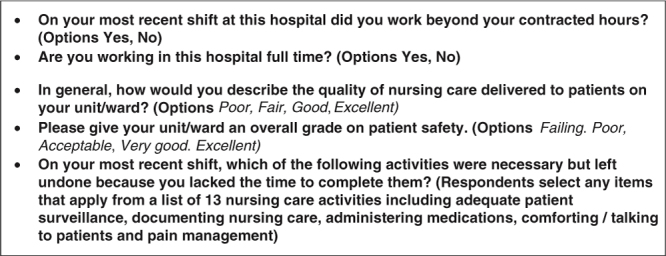
- Nurses working shifts of at least 12 hours were more likely than those working 8 hours or less to report poor/fair quality of care (OR=1.30; 95% CI, 1.10-1.53), poor/failing patient safety (OR=1.41; 95% CI, 1.13-1.76), and more care left undone (RR=1.13; 95% CI, 1.09-1.16).
- Nurses working beyond contracted hours were more likely to report poor/fair quality of care (OR=1.32; 95% CI, 1.23-1.42), poor/failing patient safety (OR=1.67; 95% CI, 1.51-1.86), and more care left undone (RR=1.29; 95% CI, 1.27-1.31).
- There was substantial variation in shift patterns across countries; for example, the paper says long shifts were common in England, Ireland, and Poland, while in Belgium, Germany, Greece, the Netherlands, Norway, and Sweden fewer than 5% of nurses reported shifts of 12 hours or more.
## Methods
- Cross-sectional survey within the RN4CAST study of registered nurses in medical and surgical wards of acute hospitals in 12 European countries: Belgium, England, Germany, Finland, Greece, Ireland, the Netherlands, Norway, Poland, Spain, Sweden, and Switzerland.
- The survey was mailed or directly distributed between June 2009 and June 2010; 54,140 questionnaires were distributed and 33,659 were returned (62%), with 31,627 respondents on adult medical/surgical wards available for analysis.
- Main analysis used binomial generalized linear mixed models for quality and patient safety, and a generalized mixed model with Poisson distribution for care left undone, adjusting for shift type, ward type, staffing ratio, nurse age, full-time/part-time status, hospital size, high-technology status, and teaching status.
## Limitations
- The paper states that, because the analysis was cross-sectional, it is not possible to infer causality.
- The paper states that it did not test country-by-shift-work interactions, so it could only estimate average effects across countries and could not explore between-country differences.
- The paper states that outcomes were nurse self-reports, the clinical importance of the differences is unclear, and further research should include objective measures and patient experiences.
- Evident from the text: the study did not directly measure hours worked overall or ask about the nature of overtime, number of overtime hours, usual shift pattern, breaks during shifts, or opportunity to rest between shifts.
Model-written summary. Check it against the paper before relying on it.
Integrity signals
Registry
Cites
Statistics
Figures
Verification
Claims the paper makes
3 Valid · 0 Not valid · 29 Not checked · 62 Own results and interpretations
The cited sources support only part of this claim — read each source’s verdict below.
In the paper
“This measure has been validated by associations with hospitallevel mortality, patient satisfaction, and care processes. 27”
What the sources say
- Partly supportedcites [27] matched to “. Care left undone during nursing shifts: associations with workload and perceived quality of care.” (2014) sourceExperimental — accuracy not yet measured
The Measures and ‘Care left undone and quality and patient safety’ sections describe a nurse-rated quality-of-care measure and show its association with care left undone. The paper does not report validating that measure through associations with hospital-level mortality or patient satisfaction; the Discussion says further research is warranted on missed care as an indicator of patient outcomes. (LLM, conf=0.84)
plainstates an association- Asserted: passes — The authors put it forward as true.
- Checkable: passes — It can be checked against evidence.
- Load-bearing: passes — The paper’s conclusions depend on it.
- Based: passes — The paper gives a reason why it holds.
- Partly supported
The cited sources support only part of this claim — read each source’s verdict below.
In the paper
“Overtime working has also been associated with adverse quality because of cumulative fatigue, lack of rest, and adverse working environments. 21,22”
What the sources say
- Could not verifycites [21] matched to “. A systematic survey instrument translation process for multi-country, comparative health workforce studies.” (2013) sourceExperimental — accuracy not yet measured
The Methods (Instrument Finalization) describe survey questions about nurses’ work environments, burnout, and care quality, but do not report an association between overtime and adverse quality. The Discussion addresses the relevance of work-environment and burnout questions, not cumulative fatigue or lack of rest as explanations. Searches for overtime, fatigue, rest, and quality found no passage addressing the attributed claim. (LLM, conf=0.75)
- Partly supportedcites [22] matched to “Nurse reported quality of care: a measure of hospital quality.” (2012) sourceExperimental — accuracy not yet measured
The Discussion (page unavailable) associates good nurse practice environments with higher nurse-reported quality of care, supporting the work-environment portion of the claim. The paper does not report an association between overtime and adverse quality or identify cumulative fatigue and lack of rest as explanations; searches for overtime, fatigue, and rest found no relevant passage. (LLM, conf=0.82)
plainstates an association- Asserted: passes — The authors put it forward as true.
- Checkable: passes — It can be checked against evidence.
- Load-bearing: passes — The paper’s conclusions depend on it.
- Based: passes — The paper gives a reason why it holds.
- Could not verify
A result the paper reports from its own data — it cites no other source for it, so there is none to check. The quote shows it is in the paper.
In the paper
“A total of 50% of nurses worked shifts of r 8 hours, but 15% worked Z 12 hours.”
- Also stated in: § Shift Length · plain
“The most common shift length was r 8 hours (50%, n = 15,930).”
plainn = 15,930- Asserted: passes — The authors put it forward as true.
- Checkable: passes — It can be checked against evidence.
- Load-bearing: unclear — It is unclear whether the paper’s conclusions depend on it.
- Based: passes — The paper gives a reason why it holds.
- Rests on an assumption not shown here.
- Also stated in: § Shift Length · plain
A result the paper reports from its own data — it cites no other source for it, so there is none to check. The quote shows it is in the paper.
In the paper
“For Belgium, Germany, Greece, The Netherlands, Norway, and Sweden <5% of nurses reported working shifts of Z 12 hours.”
plain- Asserted: passes — The authors put it forward as true.
- Checkable: passes — It can be checked against evidence.
- Load-bearing: unclear — It is unclear whether the paper’s conclusions depend on it.
- Based: passes — The paper gives a reason why it holds.
- Rests on an assumption not shown here.
A result the paper reports from its own data — it cites no other source for it, so there is none to check. The quote shows it is in the paper.
In the paper
“A total of 50% of nurses worked shifts of r 8 hours, but 15% worked Z 12 hours.”
- Also stated in: § Shift Length · plain
“and 14% (n = 4314) worked 12 to 13 hours. Only 260 nurses (1%) worked >13 hours on their last shift.”
plain- Asserted: passes — The authors put it forward as true.
- Checkable: passes — It can be checked against evidence.
- Load-bearing: passes — The paper’s conclusions depend on it.
- Based: passes — The paper gives a reason why it holds.
- Rests on an assumption not shown here.
- Also stated in: § Shift Length · plain
44 more claims
Create a free account to see all 94 claims and to verify the 46 references still open.
- Probably not a substantial claim. 27
- It may state two separate claims as one. 24
Claims other papers make about this one
Each is checked against this paper’s own text: does it say what the citing paper says it does?
The source backs part of the claim, not all of it — or backs it for a different population, condition or comparison.
In the citing paper
“England is unusual in presenting a mixed economy in shift patterns with 32% of day shifts and 36% of night shifts lasting 12 h or more making it a ‘natural laboratory’ for examining the effect of such variation on outcomes [24].”
From Cross-sectional examination of the association between shift length and hospital nurses job satisfaction and nurse reported quality measures (2017) · cites this paper as [24]
Experimental — accuracy not yet measuredThe cited source says what the claim attributes to it.
In the citing paper
“Two large European cross sectional studies of 31,627 registered nurses concluded that those working shifts of 12 h or longer were more likely to report poor quality of care, poor patient safety, and higher rates of care left undone [24] and higher levels of job dissatisfaction, burnout and intention to leave [25], when compared with nurses working 8 h or shorter shifts.”
From Cross-sectional examination of the association between shift length and hospital nurses job satisfaction and nurse reported quality measures (2017) · cites this paper as [24]
The cited source says what the claim attributes to it.
In the citing paper
“Our findings add to the international body of evidence reporting that working 12 h shifts or longer are associated with poor ratings of quality of care and higher rates of care left undone [17, 24, 28, 29].”
From Cross-sectional examination of the association between shift length and hospital nurses job satisfaction and nurse reported quality measures (2017) · cites this paper as [24]
Self-check
Percentages, sums and reported differences re-computed from the paper’s own numbers.
Each contradiction between two passages listed here was confirmed by an independent check.
Rated minor: it would not touch a result — a value no result rests on, a p-value that stays on the same side of the significance level, or a conflict that is clerical, resolved elsewhere in the paper, or outside its own findings.
In the paper
“Because of the small sample size of the >13 hours category (n = 260, 0.08%),”
Reported 0.08 · recomputed 0.822082
Rated minor: it would not touch a result — a value no result rests on, a p-value that stays on the same side of the significance level, or a conflict that is clerical, resolved elsewhere in the paper, or outside its own findings.
In the paper
§ CONCLUSIONS
“to assess patient safety as poor or fair, and to report more care items left undone on their last shift”
§ Measurements
“Patient safety was rated as poor, failing, acceptable, very good, or excellent with 'poor' and 'failing' ratings combined to reflect negative evaluations.”
Rated minor: it would not touch a result — a value no result rests on, a p-value that stays on the same side of the significance level, or a conflict that is clerical, resolved elsewhere in the paper, or outside its own findings.
In the paper
“Twenty-five percent (n = 7815) of nurses reported poor/ fair quality of care and 7% (2736) reported 'poor' or 'failing' patient safety.”
Reported 7 · recomputed 8.650836
Rated minor: it would not touch a result — a value no result rests on, a p-value that stays on the same side of the significance level, or a conflict that is clerical, resolved elsewhere in the paper, or outside its own findings.
In the paper
§ Shift Length
“(n = 9963) and 14% (n = 4314) worked 12 to 13 hours.”
§ Shift Length
“| 8.1-10 | 9965 (32) | 5960 (19) | 4005 (13) | 4175 (13) | 4109 (13) |”
Rated minor: it would not touch a result — a value no result rests on, a p-value that stays on the same side of the significance level, or a conflict that is clerical, resolved elsewhere in the paper, or outside its own findings.
In the paper
§ Shift Length
“14% (n = 4314) worked 12 to 13 hours.”
§ Shift Length
“| 12-13 | 4313 (14) | 2670 (8) | 1643 (5) | 1145 (4) | 470 (1) |”
Citations
Cites
Forming inferences about some intraclass correlation coefficients.
McGraw, K. O., & Wong, S. P. (1996) · Psychological Methods · doi:10.1037/1082-989x.1.1.30 · Cited by 6,903 · cited 1×
“The ICC 1 measures the degree of similarity between individuals within a cluster.(29) It also indicates the proportion of variance in the outcome that can be attributed to variation between groups (wards, hospitals, countries) as opposed to between individuals.”
BackgroundRepeatability for Gaussian and non-Gaussian data: a practical guide for biologists.
Nakagawa, S., & Schielzeth, H. (2010) · Biological Reviews · doi:10.1111/j.1469-185x.2010.00141.x · Cited by 2,584 · cited 1×
“It also indicates the proportion of variance in the outcome that can be attributed to variation between groups (wards, hospitals, countries) as opposed to between individuals.(30) The association of shift length and overtime with the outcome measures was estimated through a binomial generalized linear mixed model.”
MethodAiken, L. H., Sermeus, W., Van den Heede, K., Sloane, D. M., Busse, R., McKee, M., Bruyneel, L., Rafferty, A. M., Griffiths, P., Moreno-Casbas, M. T., et al. (2012) · BMJ · doi:10.1136/bmj.e1717 · Cited by 2,052 · cited 3×
“Previous research indicates that low nurse staffing levels are associated with worse patient outcomes.(24,42) This finding is supported by our analysis.”
BackgroundResultSelf-citationKane, R. L., Shamliyan, T. A., Mueller, C., Duval, S., & Wilt, T. J. (2007) · Medical Care · doi:10.1097/mlr.0b013e3181468ca3 · Cited by 1,097 · cited 1×
“Previous research indicates that low nurse staffing levels are associated with worse patient outcomes.(24,42) This finding is supported by our analysis.”
ResultThe Working Hours Of Hospital Staff Nurses And Patient Safety
Rogers, A. E., Hwang, W.-T., Scott, L. D., Aiken, L. H., & Dinges, D. F. (2004) · Health Affairs · doi:10.1377/hlthaff.23.4.202 · Cited by 952
Self-citationNurse turnover: A literature review – An update
Hayes, L. J., O’Brien-Pallas, L., Duffield, C., Shamian, J., Buchan, J., Hughes, F., Laschinger, H. K. S., & North, N. (2012) · International Journal of Nursing Studies · doi:10.1016/j.ijnurstu.2011.10.001 · Cited by 888
Effects of Hospital Care Environment on Patient Mortality and Nurse Outcomes
Aiken, L. H., Clarke, S. P., Sloane, D. M., Lake, E. T., & Cheney, T. (2008) · JONA: The Journal of Nursing Administration · doi:10.1097/01.nna.0000312773.42352.d7 · Cited by 860 · cited 1×
“Overtime has previously been associated with increased nurse turnover(10,46) and it may be that use of overtime is associated with less favorable working environments for nurses, which are known to be linked to subjective and objective measures of reduced quality and safety of care.(23,47) Overtime can be an individua…”
BackgroundSelf-citationEffects of Hospital Care Environment on Patient Mortality and Nurse Outcomes
Aiken, L. H., Clarke, S. P., Sloane, D. M., Lake, E. T., & Cheney, T. (2009) · JONA: The Journal of Nursing Administration · doi:10.1097/nna.0b013e3181aeb4cf · Cited by 799
Self-citation. Care left undone during nursing shifts: associations with workload and perceived quality of care.
Ball, J. E., Murrells, T., Rafferty, A. M., Morrow, E., & Griffiths, P. (2014) · BMJ Quality & Safety · doi:10.1136/bmjqs-2012-001767 · Cited by 666
Individual differences in tolerance to shift work – A systematic review
Saksvik, I. B., Bjorvatn, B., Hetland, H., Sandal, G. M., & Pallesen, S. (2011) · Sleep Medicine Reviews · doi:10.1016/j.smrv.2010.07.002 · Cited by 479 · cited 1×
“We controlled for potential confounding variables, including variables chosen because they have been shown elsewhere to have independent relationships with the quality of care in hospitals(31,32) or the ability to cope with shift work.(33) Control variables were shift type (day/night), ward type, nurse staffing levels…”
MethodStimpfel, A. W., Sloane, D. M., & Aiken, L. H. (2012) · Health Affairs · doi:10.1377/hlthaff.2011.1377 · Cited by 424 · cited 2×
“In the USA, shifts of Z12 hours are prevalent(7,38) and have been associated with poorer quality ratings.(10,15) However, it was not clear in these studies whether the adverse associations between shift length and quality were the result of the number of hours worked on the shift or working overtime.”
BackgroundSelf-citationSchubert, M., Glass, T. R., Clarke, S. P., Aiken, L. H., Schaffert-Witvliet, B., Sloane, D. M., & De Geest, S. (2008) · International Journal for Quality in Health Care · doi:10.1093/intqhc/mzn017 · Cited by 403 · cited 1×
“Items were derived from the BERNCA instrument, which has validated associations between care left undone, patient experience, and outcomes.(28) A rate of care left undone was derived by summing the number of activities ticked per person, resulting in a score indicating the number of areas of care left undone (range fr…”
MethodSelf-citationNurse forecasting in Europe (RN4CAST): Rationale, design and methodology
Sermeus, W., Aiken, L. H., Van den Heede, K., Rafferty, A. M., Griffiths, P., Moreno-Casbas, M. T., Busse, R., Lindqvist, R., Scott, A. P., Bruyneel, L., et al. (2011) · BMC Nursing · doi:10.1186/1472-6955-10-6 · Cited by 398 · cited 3×
“Fuller details have been published elsewhere.(23,24)”
BackgroundMethodSelf-citationSleep, sleepiness, fatigue, and performance of 12-hour-shift nurses
Geiger-Brown, J., Rogers, V. E., Trinkoff, A. M., Kane, R. L., Bausell, R. B., & Scharf, S. M. (2012) · Chronobiology International · doi:10.3109/07420528.2011.645752 · Cited by 382 · cited 1×
“Long working hours are correlated with fatigue and decreased levels of alertness, potentially resulting in more adverse events.(11,12) However, the point at which longer shifts adversely affect performance is likely to be industry, context, and task specific,(1) and studies in health care have given mixed results.”
BackgroundFailure-to-Rescue: Comparing Definitions to Measure Quality of Care
Silber, J. H., Romano, P. S., Rosen, A. K., Wang, Y., Even-Shoshan, O., & Volpp, K. G. (2007) · Medical Care · doi:10.1097/mlr.0b013e31812e01cc · Cited by 333
Squires, A., Aiken, L. H., van den Heede, K., Sermeus, W., Bruyneel, L., Lindqvist, R., Schoonhoven, L., Stromseng, I., Busse, R., Brzostek, T., et al. (2013) · International Journal of Nursing Studies · doi:10.1016/j.ijnurstu.2012.02.015 · Cited by 265 · cited 1×
“6).(26) Nurses were asked to report the number of hours worked, the period of the day, and whether they had worked beyond their contracted hours on the last shift they worked.”
BackgroundSelf-citationNurse reported quality of care: a measure of hospital quality.
McHugh, M. D., & Stimpfel, A. W. (2012) · Research in Nursing & Health · doi:10.1002/nur.21503 · Cited by 231 · cited 1×
“This measure has been validated by associations with hospitallevel mortality, patient satisfaction, and care processes.(27) For analysis, “poor” and “fair” responses were grouped to reflect negative evaluations of quality.”
MethodThe effect of work hours on adverse events and errors in health care.
Olds, D. M., & Clarke, S. P. (2010) · Journal of Safety Research · doi:10.1016/j.jsr.2010.02.002 · Cited by 211 · cited 1×
“Overtime working has also been associated with adverse quality because of cumulative fatigue, lack of rest, and adverse working environments.(21,22) To more fully understand the issue of shift length and make research more useful to guide hospitals in developing their staffing policy it is therefore important to also…”
BackgroundNurses' Work Schedule Characteristics, Nurse Staffing, and Patient Mortality
Trinkoff, A. M., Johantgen, M., Storr, C. L., Gurses, A. P., Liang, Y., & Han, K. (2011) · Nursing Research · doi:10.1097/nnr.0b013e3181fff15d · Cited by 208 · cited 1×
“Long working hours are correlated with fatigue and decreased levels of alertness, potentially resulting in more adverse events.(11,12) However, the point at which longer shifts adversely affect performance is likely to be industry, context, and task specific,(1) and studies in health care have given mixed results.”
BackgroundCARUSO, C. C., & WATERS, T. R. (2008) · Industrial Health · doi:10.2486/indhealth.46.523 · Cited by 131
Hospital Staff Nurses' Shift Length Associated With Safety and Quality of Care
Stimpfel, A. W., & Aiken, L. H. (2013) · Journal of Nursing Care Quality · doi:10.1097/ncq.0b013e3182725f09 · Cited by 120 · cited 2×
“A recent study based on a survey of 22,275 registered nurses (RN) in 4 US states found that nurses who worked shifts of Z12 hours were significantly more likely to report poor quality of care and poor patient safety when compared with nurses working 8- to 9hour shifts.(14) Patients in hospitals where a higher proporti…”
BackgroundSelf-citationComparison of Nurse, System and Quality Patient Care Outcomes in 8-Hour and 12-Hour Shifts
Stone, P. W., Du, Y., Cowell, R., Amsterdam, N., Helfrich, T. A., Linn, R. W., Gladstein, A., Walsh, M., & Mojica, L. A. (2006) · Medical Care · doi:10.1097/01.mlr.0000237180.72275.82 · Cited by 104
Effects of shift length on quality of patient care and health provider outcomes: systematic review
Estabrooks, C. A., Cummings, G. G., Olivo, S. A., Squires, J. E., Giblin, C., & Simpson, N. (2009) · Quality and Safety in Health Care · doi:10.1136/qshc.2007.024232 · Cited by 98 · cited 1×
“However, the point at which longer shifts adversely affect performance is likely to be industry, context, and task specific,(1) and studies in health care have given mixed results.(13) A recent study based on a survey of 22,275 registered nurses (RN) in 4 US states found that nurses who worked shifts of Z12 hours were…”
BackgroundBruyneel, L., Heede, K. V. D., Diya, L., Aiken, L., & Sermeus, W. (2009) · Journal of Nursing Scholarship · doi:10.1111/j.1547-5069.2009.01272.x · Cited by 90 · cited 1×
“The survey was based on the validated International Hospital Outcomes Study questionnaire.(25) The English survey was translated into Dutch, German, Greek, French, Italian, Finnish, Norwegian, Polish, Swedish, and Spanish using the translation-back translation method.”
MethodSelf-citationA study examining the impact of 12-hour shifts on critical care staff
RICHARDSON, A., TURNOCK, C., HARRIS, L., FINLEY, A., & CARSON, S. (2007) · Journal of Nursing Management · doi:10.1111/j.1365-2934.2007.00767.x · Cited by 57
12-h or 8-h shifts It depends.
Ferguson, S. A., & Dawson, D. (2012) · Sleep Medicine Reviews · doi:10.1016/j.smrv.2011.11.001 · Cited by 54 · cited 2×
“Employees work fewer shifts each week.(1) Changes are driven by perceived efficiencies for the employer, and improved work life balance for employees because they work fewer days per week.”
BackgroundHow Differing Shift Lengths Relate to Quality Outcomes in Pediatrics
Stimpfel, A. W., Lake, E. T., Barton, S., Gorman, K. C., & Aiken, L. H. (2013) · JONA: The Journal of Nursing Administration · doi:10.1097/nna.0b013e31827f2244 · Cited by 42 · cited 2×
“In the USA, shifts of Z12 hours are prevalent(7,38) and have been associated with poorer quality ratings.(10,15) However, it was not clear in these studies whether the adverse associations between shift length and quality were the result of the number of hours worked on the shift or working overtime.”
BackgroundSelf-citationThe Shift Length, Fatigue, and Safety Conundrum in EMS
Patterson, P. D., Weaver, M. D., Hostler, D. P., Guyette, F. X., Callaway, C. W., & Yealy, D. M. (2012) · Prehospital Emergency Care · doi:10.3109/10903127.2012.704491 · Cited by 41 · cited 1×
“Recently, a simple model has been proposed, whereby increased fatigue during the shift mediates the effect of shift length on performance leading to errors, omissions, and lower efficiency.(20) However, previous research has tended to conflate overtime working (working beyond contracted hours) with long shifts.”
Background12-hour shifts: job satisfaction of nurses
TODD, C., ROBINSON, G., & REID, N. (1993) · Journal of Nursing Management · doi:10.1111/j.1365-2834.1993.tb00216.x · Cited by 37
Sleepy Nurses: Are We Willing to Accept the Challenge Today?
Surani, S., Murphy, J., & Shah, A. H. (2007) · Nursing Administration Quarterly · doi:10.1097/01.naq.0000264863.94958.40 · Cited by 36
Factors Influencing the Use of Registered Nurse Overtime in Hospitals, 1995–2000
Berney, B., Needleman, J., & Kovner, C. (2005) · Journal of Nursing Scholarship · doi:10.1111/j.1547-5069.2005.00032.x · Cited by 36 · cited 1×
“In our survey, reported overtime varied between hospitals from 0% to 80% consistent with surveys from the US which also show substantial variation between hospitals.(43) Variation of such magnitude suggests that it is unlikely to be a simple product of variation in workforce supply but may also result from variation i…”
ResultINFANTS AT RISK: WHEN NURSE FATIGUE JEOPARDIZES QUALITY CARE
DEAN, G. E., SCOTT, L. D., & ROGERS, A. E. (2006) · Advances in Neonatal Care · doi:10.1016/j.adnc.2006.02.001 · Cited by 29
A concept analysis of nursing overtime
Lobo, V. M., Fisher, A., Ploeg, J., Peachey, G., & Akhtar‐Danesh, N. (2013) · Journal of Advanced Nursing · doi:10.1111/jan.12117 · Cited by 29 · cited 1×
“For example, overtime that is mandatory may have a negative effect on psychological well-being related to lack of control.(48) The degree to which nurses are subsidizing health services through unpaid overtime and the impact of long hours and overtime on burnout have implications for both the costs and the effectivene…”
Background(2013) · PubMed · Cited by 25
12-Hour Shifts: An Ethical Dilemma for the Nurse Executive
Lorenz, S. G. (2008) · JONA The Journal of Nursing Administration · doi:10.1097/01.nna.0000312785.03341.80 · Cited by 22
Mandatory Overtime Regulations and Nurse Overtime
Bae, S., & Brewer, C. S. (2010) · Policy Politics & Nursing Practice · doi:10.1177/1527154410382300 · Cited by 22
Yu, S., & Kim, T. G. (2013) · Journal of Nursing Management · doi:10.1111/jonm.12155 · Cited by 19 · cited 1×
“This is reflected by the prevalence seen in the current study and in reports from US(43,44) and elsewhere.(45) In our survey, reported overtime varied between hospitals from 0% to 80% consistent with surveys from the US which also show substantial variation between hospitals.”
ResultNursing Shortages: Let's Be Flexible
Sullivan, C., & Reading, S. (2002) · Collegian Journal of the Royal College of Nursing Australia · doi:10.1016/s1322-7696(08)60430-8 · Cited by 17 · cited 1×
“From an employer’s perspective, a move from 3 to 2 shifts per day reduces periods of shift overlap and the number of handovers, thus reducing costs by reducing total workforce requirements.(4) Because handovers and overlaps between shifts are regarded as unproductive, the aim is to improve efficiency with no detriment…”
BackgroundSurvey and critique of studies related to shift length variations in nursing from 1970 to 1993.
Bernreuter, M., & Sullivan, M. (1995) · International Journal of Nursing Studies · doi:10.1016/0020-7489(94)00026-g · Cited by 17 · cited 1×
“In the past, research in this area has lacked a clear theoretical framework.(19) Recently, a simple model has been proposed, whereby increased fatigue during the shift mediates the effect of shift length on performance leading to errors, omissions, and lower efficiency.”
BackgroundNelson, R. (2012) · AJN American Journal of Nursing · doi:10.1097/01.naj.0000414310.10965.f4 · Cited by 12
Cited by
The association between nurse staffing and omissions in nursing care: A systematic review
Griffiths, P., Recio‐Saucedo, A., Dall'Ora, C., Briggs, J., Maruotti, A., Meredith, P., Smith, G. B., Ball, J., & the Missed Care Study Group (2018) · Journal of Advanced Nursing · doi:10.1111/jan.13564 · Cited by 612
Self-citationDall'Ora, C., Griffiths, P., Ball, J., Simon, M., & Aiken, L. H. (2015) · BMJ Open · doi:10.1136/bmjopen-2015-008331 · Cited by 408
“5 patients/nurse; n (%) 1775 (6) 2977 (9) 394 (1) 1114 (3.”
InfluentialSelf-citationDall’Ora, C., Ball, J., Recio-Saucedo, A., & Griffiths, P. (2016) · International Journal of Nursing Studies · doi:10.1016/j.ijnurstu.2016.01.007 · Cited by 286
“The variability in the organisation of shift work in ursing specifically has been described in large European tudies, including the RN4CAST (Griffiths et al., 2014) and EXT (Estryn-Behar et al.”
BackgroundSelf-citationGriffiths, P., Ball, J., Drennan, J., Dall’Ora, C., Jones, J., Maruotti, A., Pope, C., Recio Saucedo, A., & Simon, M. (2016) · International Journal of Nursing Studies · doi:10.1016/j.ijnurstu.2016.03.012 · Cited by 285
Self-citationCho, E., Lee, N.-J., Kim, E.-Y., Kim, S., Lee, K., Park, K.-O., & Sung, Y. H. (2016) · International Journal of Nursing Studies · doi:10.1016/j.ijnurstu.2016.05.009 · Cited by 227
Metadata
- Authors
- Griffiths, P., Dall’Ora, C., Simon, M., Ball, J., Lindqvist, R., Rafferty, A.-M., Schoonhoven, L., Tishelman, C., & Aiken, L. H.
- Affiliations
- King's College London (GB)
- University of Southampton (GB)
- University of Basel (CH)
- Radboud University Nijmegen (NL)
- Corresponding author
- Griffiths, Peter
- Dall’Ora, Chiara
- ORCID
- Venue
- Medical Care
- Published
- 2014-11
- Volume
- 52
- Issue
- 11
- Pages
- 975-981
- ISSN
- 0025-7079 (ISSN-L)
- PMC
- PMC4196798
- OpenAlex
- W2092758688
- Semantic Scholar
- 581348d004235cb8365423c66213a96ce7840552
- Cited by
- 316
- References
- 41
- Citations by year
- 2026: 10 · 2025: 18 · 2024: 20 · 2023: 23 · 2022: 35 · 2021: 44 · 2020: 49 · 2019: 27 · 2018: 32 · 2017: 29 · 2016: 15 · 2015: 14
- FWCI
- 20.55
- Type
- journal article
- Language
- en
- Open access
- hybrid
- doi.org
- Licence
- cc-by-nc-nd
- Locations
- Medical Care (publishedVersion, cc-by-nc-nd)
- PubMed Central (publishedVersion, cc-by-nc-nd)
- PubMed (publishedVersion)
- edoc (University of Basel) (acceptedVersion)
- ePrints Soton (University of Southampton) (acceptedVersion)
- Lirias (submittedVersion, other-oa)
- Homo Politicus (Academy of Humanities and Economics in Lodz) (submittedVersion, cc-by-nc-nd)
- Jagiellonian University Repository (Jagiellonian University) (submittedVersion, cc-by-nc-nd)
- Research Portal (King's College London) (submittedVersion, cc-by-nc-nd)
- Radboud Repository (Radboud University) (submittedVersion)
- Funders
- European Commission (2007–2013, FP7 2007-2013, FP7/2007, 223468)
- Karolinska Institutet
- Norsk Sykepleierforbund
- Stockholms Läns Landsting
- Eunice Kennedy Shriver National Institute of Child Health and Human Development (R24HD044964, P2CHD044964)
- Topics
- Health Sciences › Nursing › Leadership and Management › Hospital Admissions and Outcomes
- Health Sciences › Nursing › Research and Theory › Nursing education and management
- Social Sciences › Psychology › Experimental and Cognitive Psychology › Sleep and Work-Related Fatigue
- Keywords
- overtime, patient safety, quality of care, nurse staffing, shift handover, European nurses, medical-surgical units
- MeSH terms
- Cross-Sectional Studies, Europe, Humans, Nursing Staff, Hospital, Personnel Staffing and Scheduling, Quality of Health Care, Work Schedule Tolerance, Patient Safety
About these checks
Registry, retraction, Cites and statistics results are computed, not judged, with one exception: a printed reference that no index lists is read once by a model before it counts as a citation error. Claims are extracted by a model and kept only when their quote appears verbatim in the text; each cited source is then checked, with a model’s help, for whether it says what the claim relies on. Those verdicts can be wrong — read the claim’s quote and the cited source before relying on one.
The claim verdicts this report counts are experimental: their accuracy is not yet measured.
A language model drew the claims from the paper on 2026-10-11, under version 3 of the claim definition (model deepseek-v4.1-flash, prompt extract-v3).
A second model labelled each claim on 2026-10-11 (model jev-1.13-20260917, definition revision gold-guideline-v0.2).
Cited sources are checked with a language model’s help (gpt-6-sol).
Statistics and arithmetic are recomputed, not judged.
Confidence bands are shown only for fields calibrated on our annotated test set. None is calibrated yet, so no band is shown.
What counts as a claim ›How we measure confidence ›How we check this ›
Are you an author, or do you see a problem with this page? Request a review
Data sources
Bibliographic data: Semantic Scholar, OpenAlex, Crossref.
Contains information from the Semantic Scholar Academic Graph Datasets, made available under the ODC Attribution License (ODC-BY 1.0).
Semantic Scholar’s data is described in: Kinney, R., et al. (2023). The Semantic Scholar Open Data Platform. arXiv:2301.10140.
