

Incidence, prevalence and mortality of anorexia nervosa and bulimia nervosa
Open accessThe DOI matches its Crossref record; 58 of the 59 references it cites were found in a registry or an index.
Abstract
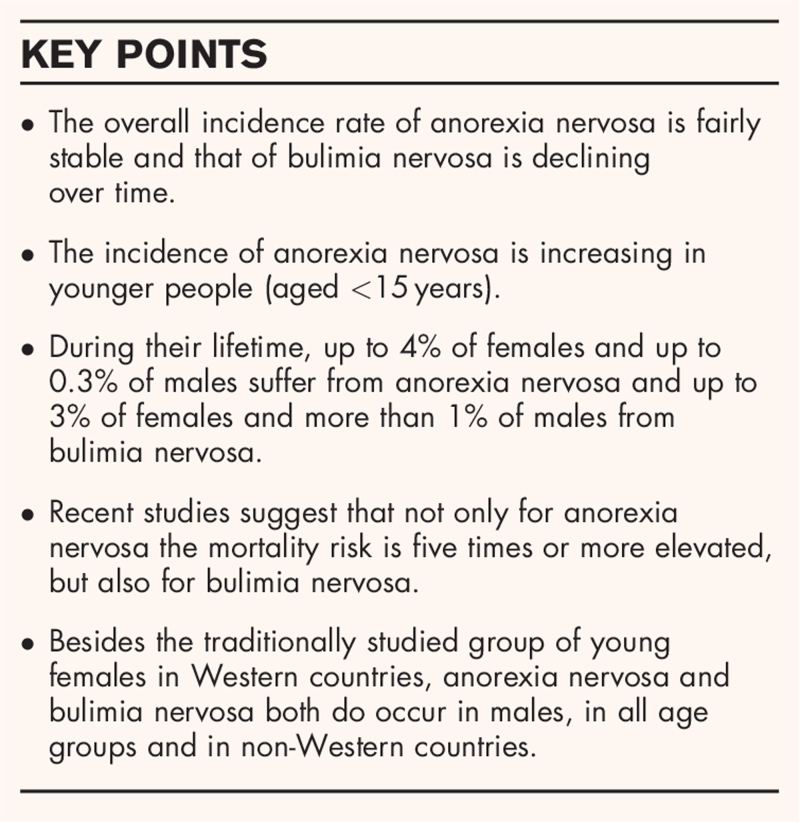
Purpose of review: To review the recent literature on the epidemiology of anorexia nervosa and bulimia nervosa in terms of incidence, prevalence and mortality. Recent findings: Although the overall incidence rate of anorexia nervosa is considerably stable over the past decades, the incidence among younger persons (aged <15 years) has increased. It is unclear whether this reflects earlier detection or earlier age of onset. Nevertheless, it has implications for future research into risk factors and for prevention programs. For bulimia nervosa, there has been a decline in overall incidence rate over time. The lifetime prevalence rates of anorexia nervosa might be up to 4% among females and 0.3% among males. Regarding bulimia nervosa, up to 3% of females and more than 1% of males suffer from this disorder during their lifetime. While epidemiological studies in the past mainly focused on young females from Western countries, anorexia nervosa and bulimia nervosa are reported worldwide among males and females from all ages. Both eating disorders may carry a five or more times increased mortality risk. Summary: Anorexia nervosa and bulimia nervosa occur worldwide among females and males of all age groups and are associated with an increased mortality risk.
Overview
The claims and statistics of this paper haven’t been checked yet.
Free: it reads the open-access text and checks the first 5 claims that cite a source we can check. Create a free account to check every claim.
Integrity signals
Registry
Cites
Statistics
Figures
Verification
Claims the paper makes
The claims and statistics of this paper haven’t been checked yet.
Free: it reads the open-access text and checks the first 5 claims that cite a source we can check. Create a free account to check every claim.
Claims other papers make about this one
Each is checked against this paper’s own text: does it say what the citing paper says it does?
The source backs part of the claim, not all of it — or backs it for a different population, condition or comparison.
In the citing paper
“Among them, patients with SE-AN have higher mortality risks. [8, 9].”
From Eating disorders and palliative care specialists require definitional consensus and clinical guidance regarding terminal anorexia nervosa: addressing concerns and moving forward (2022) · cites this paper as [9]
Experimental — accuracy not yet measured
Self-check
Percentages, sums and reported differences re-computed from the paper’s own numbers.
The self-check needs the paper’s full text.
Citations
Cites
Arcelus, J., Mitchell, A. J., Wales, J., & Nielsen, S. (2011) · Archives of General Psychiatry · doi:10.1001/archgenpsychiatry.2011.74 · Cited by 2,864 · cited 2×
“[50] the CMR of anorexia nervosa patients was 5.”
ResultEpidemiology of Eating Disorders: Incidence, Prevalence and Mortality Rates
Smink, F. R. E., van Hoeken, D., & Hoek, H. W. (2012) · Current Psychiatry Reports · doi:10.1007/s11920-012-0282-y · Cited by 1,978
Self-citationPrevalence of eating disorders over the 2000–2018 period: a systematic literature review
Galmiche, M., Déchelotte, P., Lambert, G., & Tavolacci, M. P. (2019) · The American Journal of Clinical Nutrition · doi:10.1093/ajcn/nqy342 · Cited by 1,712 · cited 3×
“The three previously discussed systematic reviews and meta-analyses [28,29,35] also reported prevalence rates for bulimia nervosa.”
BackgroundResultReview of the prevalence and incidence of eating disorders
Hoek, H. W., & van Hoeken, D. (2003) · International Journal of Eating Disorders · doi:10.1002/eat.10222 · Cited by 1,458
Self-citationIncidence, prevalence and mortality of anorexia nervosa and other eating disorders
Hoek, H. W. (2006) · Current Opinion in Psychiatry · doi:10.1097/01.yco.0000228759.95237.78 · Cited by 891 · cited 1×
“over because of the fact that only a small proportion of community ‘cases’ present to (primary) care [3,5].”
BackgroundSelf-citationStice, E., Marti, C. N., & Rohde, P. (2013) · Journal of Abnormal Psychology · doi:10.1037/a0030679 · Cited by 822 · cited 1×
“6% among females in one interview-based study [49].”
BackgroundUdo, T., & Grilo, C. M. (2018) · Biological Psychiatry · doi:10.1016/j.biopsych.2018.03.014 · Cited by 799
van Hoeken, D., & Hoek, H. W. (2020) · Current Opinion in Psychiatry · doi:10.1097/yco.0000000000000641 · Cited by 716
Self-citationEpidemiology, course, and outcome of eating disorders
Smink, F. R. E., van Hoeken, D., & Hoek, H. W. (2013) · Current Opinion in Psychiatry · doi:10.1097/yco.0b013e328365a24f · Cited by 507
Self-citationEpidemiology and course of anorexia nervosa in the community
Keski-Rahkonen, A., Hoek, H. W., Susser, E. S., Linna, M. S., Sihvola, E., Raevuori, A., Bulik, C. M., Kaprio, J., & Rissanen, A. (2007) · American Journal of Psychiatry · doi:10.1176/appi.ajp.2007.06081388 · Cited by 504 · cited 1×
“com 32 years [8], 200 per 100 000 person-years among Spanish females between the age of 12 and 22 years [9] and 270 per 100 000 person-years in Finnish twin females aged 15–19 years [10].”
BackgroundSelf-citation
Cited by
Items 601–694 of 694
Moiseeva, T., Ryauzova, E. S., Fedorova, E., Chugunov, A. V., Mikhalevskaya, O. V., Krasteleva, E. D., Владимирович, Ч. Н., & Kostyuk, G. P. (2026) · S S Korsakov Journal of Neurology and Psychiatry · doi:10.17116/jnevro202612601161
Kim, H. S., Yang, K., Cho, H., Kim, S. H., & Hong, S. (2026) · International Journal of Eating Disorders · doi:10.1002/eat.70052 · Cited by 1
Medication use in severe anorexia nervosa: a Danish register-based study
Zhang, Z.-P., Chatwin, H., Larsen, J. T., Clausen, L., Agerbo, E., Munk‐Olsen, T., Madsen, K. B., Vilhjálmsson, B. J., Petersen, L. V., & Yılmaz, Z. (2026) · BMJ Mental Health · doi:10.1136/bmjment-2025-302047 · Cited by 2
Payá-López, S., Kovacheva, K. I., Ruiz, Á., Galindo, I., & Marcos, Y. Q. (2026) · Clinical Case Studies · doi:10.1177/15346501261423876
“It is associated with the highest mortality rate among mental health disorders — up to fi ve times higher in women with AN than in the general population (van Eeden et al., 2021).”
Anorexia nervosa as a cause of endocrine disorders
Merzlova, P. Y., Bulgakova, S. V., Dolgikh, Y. A., Sharonova, L. A., & Косарева, О. В. (2025) · Экспериментальная и клиническая гастроэнтерология · doi:10.31146/1682-8658-ecg-235-3-168-176
Evaluating ICD-11 anorexia nervosa in a clinical youth sample: a comparison with ICD-10
Viggers, L. T., Jørgensen, M. S., Bryde, A., Ashraf, B., Pedersen, S. H., Micali, N., & Bentz, M. (2026) · European Child and Adolescent Psychiatry · doi:10.1007/s00787-026-02972-1
Doose, A., Tarchi, L., Seidel, M., King, J. A., Bernardoni, F., Hellerhoff, I., Geisler, D., Gramatke, K., Castellini, G., Ricca, V., et al. (2026) · Translational Psychiatry · doi:10.1038/s41398-026-03920-y
“Up to four out of every 100 women will be affected by AN at some time during their lifespan [3], with signi fi cant public health burden [4].”
Relationship between obsessive personality traits and eating disorders
Triguero-López, M. J., García, I. M., & Ortíz, M. M. (2026) · Eating and Weight Disorders - Studies on Anorexia Bulimia and Obesity · doi:10.1007/s40519-026-01829-5 · Cited by 1
“They represent a global public health issue, with higher prevalence among women and young populations [28, 59, 66, 80, 81, 125, 128, 142].”
Women’s and girls’ ADHD diagnosis journeys: a mother-daughter autoethnography
Wheaton, B., & Holland, P. (2026) · Medical Humanities · doi:10.1136/medhum-2025-013423
Neuroanatomical Substrates of emotional Dysregulation in Bulimia NervosaPreprint
Zhang, L., Zhao, X., Liu, L., Bao, W., Wang, M., Wang, Y., Hu, X., & Huang, X. (2026) · Research Square · doi:10.21203/rs.3.rs-9025261/v1
(2026) · Elsevier eBooks · doi:10.1016/b978-3-437-21237-6.00016-8
Muroni, O., & Sudres, J. (2026) · Annales Médico-psychologiques revue psychiatrique · doi:10.1016/j.amp.2026.03.006
Long-term eating disorder trajectories and the impact of depression: A naturalistic cohort approach
de Rijk, E. S. J., Tsonaka, R., van Furth, E. F., Dingemans, A. E., & Landt, M. (2026) · Eating Behaviors · doi:10.1016/j.eatbeh.2026.102087
Molecules in motion: A narrative review on exercise, exosomes and eating disorders.
Stoeren, M. S., Goleva-Fjellet, S., Edlund, K., & Bratland‐Sanda, S. (2026) · Complementary Therapies in Medicine · doi:10.1016/j.ctim.2026.103378
López, I. D., Méndez, S. M., Merino, G. S., Martinez, I. Z., & González-Pinto, A. (2026) · Global Clinical Engineering Journal · doi:10.31354/globalce.v8i1.285
Kröller, K. (2026) · Springer eBooks · doi:10.1007/978-3-662-72399-9_14
Meyer-Schwickerath, L., Suling, A. I., Löwe, B., Kottich, S., & Weigel, A. (2026) · Eating and Weight Disorders - Studies on Anorexia Bulimia and Obesity · doi:10.1007/s40519-026-01851-7
Nielsen, H. N., Guala, M. M., & Nielsen, A. S. (2026) · Journal of Eating Disorders · doi:10.1186/s40337-026-01577-y
Reward abnormalities in the genetics of addictive disorders
Mattioni, J. (2024) · theses.fr (ABES) · doi:10.70675/e375f801z0fd1z4fc6z9d73zc74380dd25f4
Gabriel-Segard, T. (2023) · theses.fr (ABES) · doi:10.70675/2f469c9fz7a22z4f47z9e37zcf0e1f890660
Liu, Y., Chen, L., Wang, J., & Zhao, Y. (2026) · Eating and Weight Disorders - Studies on Anorexia Bulimia and Obesity · doi:10.1007/s40519-026-01858-0
“Among these, anorexia nervosa (AN) and obsessive–compulsive disorder (OCD) are particularly debilitating due to their chronic, life-threatening nature and high mortality rates [2].”
Spinal Posture and Movement in Female Adolescents with Anorexia Nervosa
Bayartai, M.-E., Tringali, G., Micheli, R. D., Grimoldi, I., Abbruzzese, L., Sonza, A., & Sartório, A. (2026) · Journal of Clinical Medicine · doi:10.3390/jcm15083054
“Prevalence estimates suggest that AN affects approximately 4% of females and 0.3% of males, with a notable and increasing incidence among individuals aged 15 years and younger [5].”
InfluentialPsychiatric Morbidity Is Overrepresented in Young Girls at High Risk of Developing Anorexia Nervosa
Dahlin, K., Järvholm, K., Dahlgren, J., & Wentz, E. (2026) · International Journal of Eating Disorders · doi:10.1002/eat.70104
Couturier, J. L., Kenner, E., Nicula, M., Chowdhury, F., Surette, M., & Pai, N. (2026) · BMJ Open · doi:10.1136/bmjopen-2025-109115
“Data collected prior to withdrawal will be retained and included in the study database unless the participant or their parent or guardian requests that the data be withdrawn and destroyed.”
Leptin Reduces Running in a Rodent Anorexia Nervosa Model via a Distributed Neural Network
Papavoine, N., Veendijk, M., Nijman, J., Luijendijk, M. C. M., Wolterink‐Donselaar, I. G., Meye, F. J., & Adan, R. A. H. (2026) · European Eating Disorders Review · doi:10.1002/erv.70119
Brinchmann, B. S., Ludvigsen, M. S., & Godskesen, T. (2024) · Asian Journal of Ethics in Health and Medicine · doi:10.51847/kmpgovmyon
Vizthum, D., Earthman, C. P., Patterson, F., Melough, M. M., Allison, K. C., & Pacanowski, C. R. (2026) · Eating and Weight Disorders - Studies on Anorexia Bulimia and Obesity · doi:10.1007/s40519-026-01814-y
Yin, Z., Liu, M., Cai, J., Kong, N., Liao, P., Haipei, G., Du, Z., & Zhang, K. (2026) · BMC Psychiatry · doi:10.1186/s12888-026-08110-0
“Epidemiological data showed that the prevalence of this disease is up to 4% of females and 0.3% of males [4].”
InfluentialHospital-at-home programmes targeting adolescents with eating disorders: a scoping review
Nørgaard, B., Mogensen, S. M., Hansen, S. V. B., Amlund, M. L. B., & Overgaard, C. (2026) · Eating Disorders · doi:10.1080/10640266.2026.2672042
Ramanathan, B., Vijayan, S., Mohan, M., Venkatesan, V., Selvaraj, A., & Sivakumar, P. (2026) · Indian Journal of Psychiatry · doi:10.4103/indianjpsychiatry_986_25
“[3,4] BN is linked to functional impairment, suicidality, and elevated mortality risk.”
Gilardini, F., Sabatucci, A., Cifani, C., Segura‐Garcìa, C., Pucci, M., Rania, M., & D’Addario, C. (2026) · Frontiers in Cell and Developmental Biology · doi:10.3389/fcell.2026.1761785
“With a lifetime prevalence rate up to 4% among females and 0.3% among males and one of the highest mortality rates among psychiatric conditions, AN represents a major public health challenge (van Eeden et al., 2021).”
InfluentialEarly-onset anorexia nervosa in prepubertal male twin: A case report
Lapinskaite, A., Voiniušytė, A., Valiulis, T., Valantiejienė, G., & Lesinskienė, S. (2026) · World Journal of Clinical Cases · doi:10.12998/wjcc.v14.i16.120211
Meschberger‐Annweiler, F., Carulla‐Roig, M., Ascione, M., Porras-García, B., Serrano‐Troncoso, E., Ferrer‐García, M., & Gutiérrez‐Maldonado, J. (2026) · Cyberpsychology Behavior and Social Networking · doi:10.1177/21522715261451681
de Jong, M., & van der Meer, I. (2026) · Protocollen voor de GGZ · doi:10.1007/978-90-368-3200-7_2
Lin, X., Huang, Y., Xu, Y.-J., & Chen, G.-B. (2026) · Journal of Eating Disorders · doi:10.1186/s40337-026-01635-5
“Eating disorders (EDs) primarily emerge during adolescence and predominantly affect females [3].”
Anorexia nervosa: identification and management by non-specialist nurses
Davies, S. (2026) · Nursing Standard · doi:10.7748/ns.2026.e12723
Kotilahti, E., Ruusunen, A. A., Lindstedt, K., & Isomaa, R. (2026) · European Eating Disorders Review · doi:10.1002/erv.70132
“The sample was predominantly female, not reflecting the actual gender distribution of EDs (van Eeden et al. 2021).”
Ghannadpour, J., Dieste, S., Buerkert, S., & Stewart, S. M. (2026) · Journal of Clinical Psychology · doi:10.1002/jclp.70158
Vulnerability and Resilience to Activity-Based Anorexia is Not Sex-DependentPreprint
Zhao, J., Beeler, J. A., & Burghardt, N. S. (2026) · bioRxiv (Cold Spring Harbor Laboratory) · doi:10.64898/2026.06.05.730470
Absence of Subliminal Body‐Image Priming Effects in Anorexia Nervosa
Boettner, J., Mosch, B., Steins-Loeber, S., & Diers, M. (2026) · International Journal of Eating Disorders · doi:10.1002/eat.70148
“Inclusion was restricted to participants assigned female at birth due to the higher prevalence of AN in women (Hudson et al. 2007; Van Eeden et al. 2021).”
Martin, F., Sfärlea, A., Radix, A. K., Beer, C. S., Fischer, H., Platt, B., Schulte‐Körne, G., Holtmann, M., & Legenbauer, T. (2026) · European Eating Disorders Review · doi:10.1002/erv.70138 · Cited by 1
Aberrant large- and mesoscale network segregation and integration in bulimia nervosa
Zhang, P., Tang, L., Li, W., Wang, M., Jia, Y., Yu, F., Li, Z., Wang, Z., Wang, J., Wu, G., et al. (2026) · Journal of Eating Disorders · doi:10.1186/s40337-026-01671-1
“Bulimia nervosa (BN) is a complex eating disorder (ED) that predominantly affects young women [1, 2].”
User experience and perceived impact of the Eating Disorder Support App: a mixed-methods evaluation
Rysinova, V., Ramsey‐Wade, C. E., Trippick, C., & Norweg, S. (2026) · Journal of Eating Disorders · doi:10.1186/s40337-026-01655-1
“Eating disorders (EDs) are severe mental health conditions associated with high mortality, diminished quality of life, and substantial economic burden [1, 2].”
Gemescu, M., Giosan, C., Barizi, A. M. O., Petre, C., Gușoaie, A., Costache, E., Darabont, A.-P., Neagoe, T., & IOSIFESCU, R. M. (2026) · Clinical Psychology & Psychotherapy · doi:10.1002/cpp.70299
“EDs show an increased mortality risk (Van Eeden et al. 2021), with the highest observed in anorexia nervosa (AN; 5 deaths per 1000 person-years), followed by eating disorders not otherwise specified (EDNOS; 3.3 per 1000 person-years) and bulimia nervosa (BN; 1.7 per 1000 person-years), according to…”
InfluentialSjöström, D. K., Rybäck, O. S., Claesdotter‐Knutsson, E., Kajonius, P., Sondén, O. J., Carlbring, P., Björkstrand, J., & Movahed, P. (2026) · PLoS ONE · doi:10.1371/journal.pone.0352246
“The disorder typically emerges during adolescence or young adulthood with a lifetime prevalence in females up to 4% and in 0.3% in males [3], and is associated with profound psychological suffering, psychiatric and somatic co-morbidity, and the highest mortality rate among psychiatric conditions…”
InfluentialExcess Mortality Among Patients With Anorexia Nervosa Treated Involuntarily
Bager, L., Holde, K. E. V., Larsen, J. T., Clausen, L., Yılmaz, Z., Donald, B. M., & Petersen, L. V. (2026) · International Journal of Eating Disorders · doi:10.1002/eat.70166
“Studies on AN specifically usually report a ratio of maximum 1:10 for men (van Eeden et al. 2021).”
Zemmahi, A. G., Debatisse, J., Germain, N., David, J., Roullot, M., Météreau, É., Carrier, L., Massoubre, C., Galusca, B., & Tremblay, L. (2026) · International Journal of Eating Disorders · doi:10.1002/eat.70155
Tasa-Vinyals, E., Tristany-Dalmau, Q., Rodríguez-Rey, A., Martínez-Pinteño, A., Mora-Porta, M., Plana, M. T., Andrés-Perpiñá, S., Moreno, E., Martínez, E., Lázaro, L., et al. (2026) · Healthcare · doi:10.3390/healthcare14131987
Carvalho, F., Wendt, G. W., Teixeira, I., Teixeira, M. C., & Melo, M. H. D. S. (2026) · Psychiatry International · doi:10.3390/psychiatryint7040152
Vo, M. (2026) · Springer eBooks · doi:10.1007/978-3-032-19887-7_7
Webb, H., Neild, P., Lawrence, V., Schmidt, U. H., & Griffiths, M. (2026) · European Eating Disorders Review · doi:10.1002/erv.70152
Lackner, S., Kärkkäinen, O. K., Mörkl, S., Müller, W., Fürhapter-Rieger, A., Hanhineva, K., & Holasek, S. J. (2026) · Experimental Physiology · doi:10.1113/ep092957
Kovacs, A., Csapó, K., Andrássy, G., Papp, C., Gesztelyi, R., & Zsuga, J. (2026) · Frontiers in Pharmacology · doi:10.3389/fphar.2026.1877615
Cognitive Behavioral Therapy for Adults With Bulimia Nervosa
Gu, S., Drury, C. R., Hagan, K. E., & Gorrell, S. (2026) · Elsevier eBooks · doi:10.1016/b978-0-443-29009-1.00124-4
Fantozzi, P., Fossati, B., Apicella, F., Belmonti, V., Ditaranto, F., Tancredi, R., Muratori, P., Levantini, V., & Calderoni, S. (2026) · Journal of Clinical Medicine · doi:10.3390/jcm15145644
“Although the peak age of onset in both sexes has traditionally been reported between 15 and 19 years [16], a recent review highlighted a growing incidence among children younger than 15 years, which may reflect either earlier detection or a genuine shift toward an earlier age of onset [15].”
InfluentialAhmed, M. U., Sidari, M. J., Hannigan, A., Withington, T., Catania, S., Boyd, M., Ward, W. K., Miskovic‐Wheatley, J., Touyz, S. W., Nassar, N., et al. (2026) · International Journal of Eating Disorders · doi:10.1002/eat.70163
Oliveira, L. D. S., Curvello-Silva, K., Costa, P. R. D. F., Menezes, I. D. J. P., de Macêdo, P. F. C., Ruas, A. M. D. S., Monteiro, R., de Lira, C. R. N., Abreu, E. C., Cunha, C. D. M., et al. (2026) · PLoS ONE · doi:10.1371/journal.pone.0347184
Moiseeva, T., Ryauzova, E. S., Fedorova, E., Chugunov, A. V., Mikhalevskaya, O. V., Krasteleva, E. D., Владимирович, Ч. Н., & Kostyuk, G. P. (2026) · Neuroscience and Behavioral Physiology · doi:10.1007/s11055-026-02035-7
“As compared with individuals of the same age and sex in the general population, the mortality risk was approximately doubled in those receiving outpatient treat-ment for AN and increased by a factor of 5–6 times in those receiving inpatient treatment for AN [2].”
BOZDAĞ, A. N. S., Canbolat, E., Duman, E., İnan, C. M., & Zarali, Z. A. (2026) · Journal of Health Psychology · doi:10.1177/13591053261473416
An Adaptive Network Model of Therapy Effects in Anorexia Nervosa
Inamdar, S., Liberatore, T., & Jan Treur, A. (2026) · Studies in systems, decision and control · doi:10.1007/978-3-032-16544-2_29
Evlampieva, A. V., & Karpenko, O. (2026) · Vestnik nevrologii psihiatrii i nejrohirurgii (Bulletin of Neurology Psychiatry and Neurosurgery) · doi:10.33920/med-01-2607-14
Nosologie und Epidemiologie psychischer Störungen
Hengartner, M. P. (2026) · Angewandte Psychologie Kompakt · doi:10.1007/978-3-662-72845-1_3
Marinelli, L., Berthoz, S., Décamps, G., Bourdier, L., Fatseas, M., & Dantzer, C. (2026) · Journal of Psychiatric Research · doi:10.1016/j.jpsychires.2026.09.001
Wang, Z., Zhang, W., Wang, R., Geng, Y., Cao, Y., Chen, L., Qiu, J., Huang, S., & Li, X. (2026) · Eating Behaviors · doi:10.1016/j.eatbeh.2026.102132
LONG-TERM CONSEQUENCES OF EATING DISORDERS: A REVIEW OF MEDICAL, PSYCHOLOGICAL, AND SOCIAL OUTCOMES
Zmysłowska, K., Grabowska, A., Tyczka, K., Szatkowska, A., Kwaśniewska, M., Hajdaniak, A., Kiersztyn, J. M., Seńcio, N., & Stadnik, K. A. (2026) · International Journal of Innovative Technologies in Social Science · doi:10.31435/ijitss.3(51).2026.6554
Giachero, S., Herpertz‐Dahlmann, B., Dahmen, B., & Gilsbach, S. (2026) · Frontiers in Psychiatry · doi:10.3389/fpsyt.2026.1847379
Aldahash, R., Alturki, H., Alonazi, S., Dabbour, J., Aldossari, S., & Aldhfayan, S. (2026) · Brain and Behavior · doi:10.1002/brb3.71688
“These disorders affect individuals across genders and age groups and are associated with substantial psychological burden and increased mortality risk (van Eeden et al. 2021 ).”
InfluentialTroubles des conduites alimentaires de l’adulte
Henriet, E., & Guillaume, S. (2026) · Encyclopédie médico-chirurgicale. Psychiatrie · doi:10.1016/s0246-1072(26)68332-0
Laryngeal vs. Esophageal Acid-Mediated Injury in Bulimia Nervosa: A Systematic Review
Pouri, S., Cresitello, S., Shaw, K., Zgardau, A., & Ahmadi, A. (2026) · Cureus · doi:10.7759/cureus.116303
Liang, J., Dierckx, B., Dieleman, G. C., Bosch, T. M., Koch, B. C. P., & de Winter, B. C. M. (2026) · BMJ Open · doi:10.1136/bmjopen-2026-119486
Refeeding the Gut in Anorexia Nervosa: Microbiome, Nutritional Rehabilitation and Dietetic Care
Margioula, P., Nakas, A., Adamidou, L., Simou, E., Rafailidis, P. I., Konstantinidis, T. G., Tsakri, D., Nikolaidis, C. G., Gyriki, D., Tsigalou, C., et al. (2026) · Nutrients · doi:10.3390/nu18183054
Calardo, S. J., Keck, K., Reedy, C., Rappaport, D. I., & Vo, M. (2026) · Journal of Adolescent Health · doi:10.1016/j.jadohealth.2026.07.004
Maunder, K., Geraghty, L., Glennon, J. C., Jordan, E., Bhalla, D., Dehestani, B., & McNicholas, F. (2026) · JAACAP Open · doi:10.1016/j.jaacop.2026.09.005
Liu, Y.-H., & Tseng, M. M. (2026) · Taiwanese Journal of Psychiatry · doi:10.4103/tpsy.tpsy_26_26
PERCEPÇÃO DA IMAGEM CORPORAL E RISCO DE TRANSTORNOS ALIMENTARES EM ESTUDANTES DE NUTRIÇÃO
de Sousa, M. M., Batista, C. C., de Oliveira, M. L. V. S., Sousa, L. B. G., & Moreira-Araújo, R. S. D. R. (2026) · RECIMA21 - Revista Científica Multidisciplinar · doi:10.47820/recima21.v7i10.8860
Klein, E., Velina, D. A., & Никитин, И. А. (2026) · Food Industry · doi:10.29141/2500-1922-2026-11-3-1
Rajcsanyi, L. S., Peters, T., & Hinney, A. (2026) · Reviews in Endocrine and Metabolic Disorders · doi:10.1007/s11154-026-10088-9
Vulnerability and resilience to activity-based anorexia are not sex-dependent
Zhao, J., Beeler, J. A., & Burghardt, N. S. (2026) · Frontiers in Psychiatry · doi:10.3389/fpsyt.2026.1897501
Brizzi, G., Boltri, M., Borsci, S., Chan, R. W., Yildirim, F., Truijen, S., Riva, G., & Scataglini, S. (2026) · Computers in Human Behavior Reports · doi:10.1016/j.chbr.2026.101360
Henningsson, H., Forsberg, A., Eberhard, S., Johansson, B. A., & Rask, O. (2026) · Child Psychiatry & Human Development · doi:10.1007/s10578-026-02101-8
Prevalence and Factors Associated with the Risk of Eating Disorders Among Medical Students
Lopez, W. V. A., Yimes, L. P. A., Quintana-Espinosa, L., Guillen-Burgos, H. F., Cohen, M. I. R., Vargaz, A. D., & González-Torres, H. J. (2026) · Healthcare · doi:10.3390/healthcare14193314
“This observation is in line with evidence describing a strong overlap between EDs and other affective disorders [2,30].”
Ferreira, A. J., Fairchild, G., Blackwood, L. M., Soyer, M. B., & Atkinson, M. (2026) · International Journal of Eating Disorders · doi:10.1002/eat.70238
The role of a midwife during perinatal anorexia nervosa care: A narrative review
Steppe, J., Claerbout, A., Hartmann, M. L., Embo, M., Tahir, P., Royen, K. V., Bontinck, J., & Gilissen, J. (2026) · European Journal of Midwifery · doi:10.18332/ejm/236730
“Although the prevalence of AN varies across ages, sexes, races, and ethnicities 6 , estimates report between 1% and 4% of women developing AN during their lifetime 7 .”
Hall, N. Y., Tan, E. J., Le, L. K.-D., McLean, S. A., Fuller‐Tyszkiewicz, M., & Mihalopoulos, C. (2026) · Australian & New Zealand Journal of Psychiatry · doi:10.1177/00048674261489472
Preventing and Treating Eating Disorders and Disordered Eating Among Athletes
Gorrell, S., Flatt, R., Siripipat, P., & Chapa, D. (2025) · Emerald Group Publishing Limited eBooks · doi:10.1108/979-8-88730-861-620251013 · Cited by 1
Huang, Y., Wang, Y., Feng, Y., Zhang, Q., Sha, S., Su, Z., Cheung, T. C. C., Ungvari, G. S., Smith, R. D., Balbuena, L., et al. (2026) · General Psychiatry · doi:10.1002/gps3.70055
Prevalence of eating disorders in Australian general from 2017 to 2022: a retrospective cohortPreprint
Bernardo, C., Caceres, V. D. M., González‐Chica, D. A., Thompson, C. H., Sandhu, A. K., Rami, T., Siew, J. Y., O’Connell, A., Lukacejda, C., & Russell, P. T. (2026) · Research Square · doi:10.21203/rs.3.rs-11210606/v1
Henningsson, H., Forsberg, A., Eberhard, S., Johansson, B. A., & Rask, O. (2026) · Research Square · doi:10.21203/rs.3.rs-11129167/v1
Clinical and dynamic features of anorexia nervosa and its types
Mazurova, E. V., & Karpenko, O. (2026) · S S Korsakov Journal of Neurology and Psychiatry · doi:10.17116/jnevro202612609128
Camoglio, C., Dedoni, S., Scherma, M., Siddi, C., Nilsson, I. A. K., & Fadda, P. (2026) · Physiology & Behavior · doi:10.1016/j.physbeh.2026.115542
Charalampakis, S., & Saraga, M. (2026) · Eating Disorders · doi:10.1080/10640266.2026.2745924
Costello, K., Haugaard, V., & Duffy, F. (2026) · Eating Disorders · doi:10.1080/10640266.2026.2746553
Metadata
- Authors
- van Eeden, A. E., van Hoeken, D., & Hoek, H. W.
- Affiliations
- Parnassia Psychiatric Institute, The Hague, The Netherlands
- University Medical Center Groningen (NL)
- ORCID
- Hoek, Hans W.
- Venue
- Current Opinion in Psychiatry
- Published
- 2021-09-16
- Volume
- 34
- Issue
- 6
- Pages
- 515-524
- ISSN
- 0951-7367 (ISSN-L)
- 1473-6578
- PMC
- PMC8500372
- OpenAlex
- W3195156262
- Semantic Scholar
- 506afa54bc89d698ef6a312277efcfd526953576
- Cited by
- 698
- References
- 59
- Citations by year
- 2026: 121 · 2025: 177 · 2024: 175 · 2023: 155 · 2022: 66
- FWCI
- 13.24
- Type
- journal article
- Language
- en
- Open access
- hybrid
- doi.org
- Locations
- Current Opinion in Psychiatry (publishedVersion, cc-by)
- PubMed Central (publishedVersion, cc-by)
- PubMed (publishedVersion)
- University of Groningen research database (University of Groningen / Centre for Information Technology) (submittedVersion, cc-by)
- Topics
- Social Sciences › Psychology › Clinical Psychology › Eating Disorders and Behaviors
- Health Sciences › Nursing › Nutrition and Dietetics › Nutrition, Health and Food Behavior
- Health Sciences › Medicine › Psychiatry and Mental health › Child Nutrition and Feeding Issues
- Keywords
- anorexia nervosa, bulimia nervosa, eating disorders, incidence, prevalence, mortality, lifetime prevalence, age of onset, sex differences, global epidemiology
- MeSH terms
- Anorexia Nervosa, Feeding and Eating Disorders, Female, Humans, Male, Incidence, Prevalence, Bulimia Nervosa
About these checks
Registry, retraction, Cites and statistics results are computed, not judged, with one exception: a printed reference that no index lists is read once by a model before it counts as a citation error. Claims are extracted by a model and kept only when their quote appears verbatim in the text; each cited source is then checked, with a model’s help, for whether it says what the claim relies on. Those verdicts can be wrong — read the claim’s quote and the cited source before relying on one.
Statistics and arithmetic are recomputed, not judged.
Confidence bands are shown only for fields calibrated on our annotated test set. None is calibrated yet, so no band is shown.
What counts as a claim ›How we measure confidence ›How we check this ›
Are you an author, or do you see a problem with this page? Request a review
Data sources
Bibliographic data: Semantic Scholar, OpenAlex, Crossref.
Contains information from the Semantic Scholar Academic Graph Datasets, made available under the ODC Attribution License (ODC-BY 1.0).
Semantic Scholar’s data is described in: Kinney, R., et al. (2023). The Semantic Scholar Open Data Platform. arXiv:2301.10140.
