

Incidence, prevalence and mortality of anorexia nervosa and bulimia nervosa
Open accessThe DOI matches its Crossref record; 58 of the 59 references it cites were found in a registry or an index.
Abstract
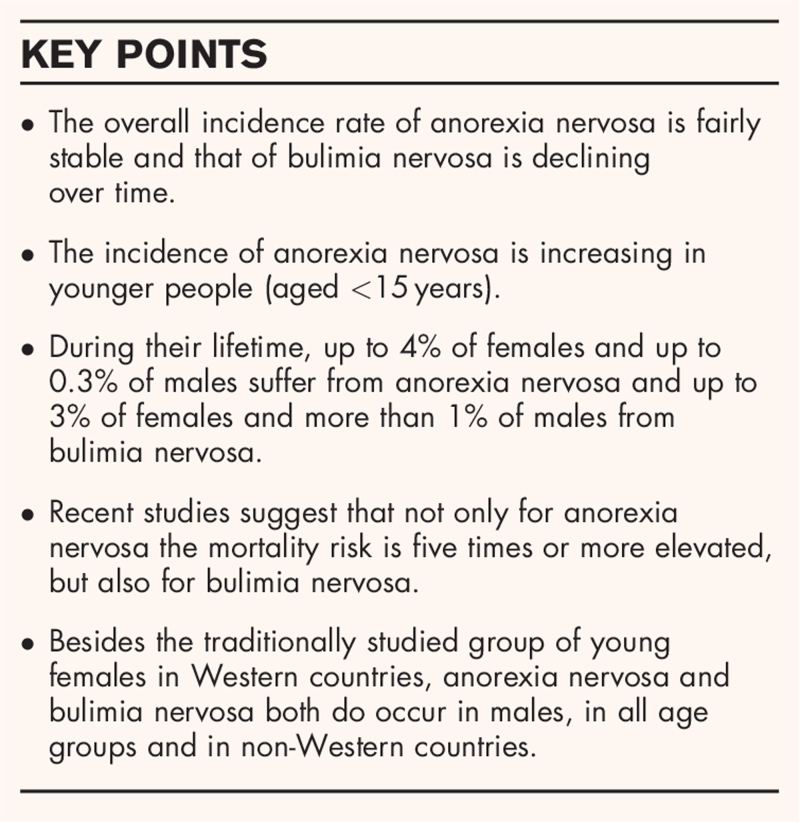
Purpose of review: To review the recent literature on the epidemiology of anorexia nervosa and bulimia nervosa in terms of incidence, prevalence and mortality. Recent findings: Although the overall incidence rate of anorexia nervosa is considerably stable over the past decades, the incidence among younger persons (aged <15 years) has increased. It is unclear whether this reflects earlier detection or earlier age of onset. Nevertheless, it has implications for future research into risk factors and for prevention programs. For bulimia nervosa, there has been a decline in overall incidence rate over time. The lifetime prevalence rates of anorexia nervosa might be up to 4% among females and 0.3% among males. Regarding bulimia nervosa, up to 3% of females and more than 1% of males suffer from this disorder during their lifetime. While epidemiological studies in the past mainly focused on young females from Western countries, anorexia nervosa and bulimia nervosa are reported worldwide among males and females from all ages. Both eating disorders may carry a five or more times increased mortality risk. Summary: Anorexia nervosa and bulimia nervosa occur worldwide among females and males of all age groups and are associated with an increased mortality risk.
Overview
The claims and statistics of this paper haven’t been checked yet.
Free: it reads the open-access text and checks the first 5 claims that cite a source we can check. Create a free account to check every claim.
Integrity signals
Registry
Cites
Statistics
Figures
Verification
Claims the paper makes
The claims and statistics of this paper haven’t been checked yet.
Free: it reads the open-access text and checks the first 5 claims that cite a source we can check. Create a free account to check every claim.
Claims other papers make about this one
Each is checked against this paper’s own text: does it say what the citing paper says it does?
The source backs part of the claim, not all of it — or backs it for a different population, condition or comparison.
In the citing paper
“Among them, patients with SE-AN have higher mortality risks. [8, 9].”
From Eating disorders and palliative care specialists require definitional consensus and clinical guidance regarding terminal anorexia nervosa: addressing concerns and moving forward (2022) · cites this paper as [9]
Experimental — accuracy not yet measured
Self-check
Percentages, sums and reported differences re-computed from the paper’s own numbers.
The self-check needs the paper’s full text.
Citations
Cites
Arcelus, J., Mitchell, A. J., Wales, J., & Nielsen, S. (2011) · Archives of General Psychiatry · doi:10.1001/archgenpsychiatry.2011.74 · Cited by 2,864 · cited 2×
“[50] the CMR of anorexia nervosa patients was 5.”
ResultEpidemiology of Eating Disorders: Incidence, Prevalence and Mortality Rates
Smink, F. R. E., van Hoeken, D., & Hoek, H. W. (2012) · Current Psychiatry Reports · doi:10.1007/s11920-012-0282-y · Cited by 1,978
Self-citationPrevalence of eating disorders over the 2000–2018 period: a systematic literature review
Galmiche, M., Déchelotte, P., Lambert, G., & Tavolacci, M. P. (2019) · The American Journal of Clinical Nutrition · doi:10.1093/ajcn/nqy342 · Cited by 1,712 · cited 3×
“The three previously discussed systematic reviews and meta-analyses [28,29,35] also reported prevalence rates for bulimia nervosa.”
BackgroundResultReview of the prevalence and incidence of eating disorders
Hoek, H. W., & van Hoeken, D. (2003) · International Journal of Eating Disorders · doi:10.1002/eat.10222 · Cited by 1,458
Self-citationIncidence, prevalence and mortality of anorexia nervosa and other eating disorders
Hoek, H. W. (2006) · Current Opinion in Psychiatry · doi:10.1097/01.yco.0000228759.95237.78 · Cited by 891 · cited 1×
“over because of the fact that only a small proportion of community ‘cases’ present to (primary) care [3,5].”
BackgroundSelf-citationStice, E., Marti, C. N., & Rohde, P. (2013) · Journal of Abnormal Psychology · doi:10.1037/a0030679 · Cited by 822 · cited 1×
“6% among females in one interview-based study [49].”
BackgroundUdo, T., & Grilo, C. M. (2018) · Biological Psychiatry · doi:10.1016/j.biopsych.2018.03.014 · Cited by 799
van Hoeken, D., & Hoek, H. W. (2020) · Current Opinion in Psychiatry · doi:10.1097/yco.0000000000000641 · Cited by 716
Self-citationEpidemiology, course, and outcome of eating disorders
Smink, F. R. E., van Hoeken, D., & Hoek, H. W. (2013) · Current Opinion in Psychiatry · doi:10.1097/yco.0b013e328365a24f · Cited by 507
Self-citationEpidemiology and course of anorexia nervosa in the community
Keski-Rahkonen, A., Hoek, H. W., Susser, E. S., Linna, M. S., Sihvola, E., Raevuori, A., Bulik, C. M., Kaprio, J., & Rissanen, A. (2007) · American Journal of Psychiatry · doi:10.1176/appi.ajp.2007.06081388 · Cited by 504 · cited 1×
“com 32 years [8], 200 per 100 000 person-years among Spanish females between the age of 12 and 22 years [9] and 270 per 100 000 person-years in Finnish twin females aged 15–19 years [10].”
BackgroundSelf-citation
Cited by
Items 301–400 of 694
Duck, S. A., Guarda, Á. S., & Schreyer, C. C. (2023) · European Eating Disorders Review · doi:10.1002/erv.2977 · Cited by 3
Morbidity and mortality after adolescent eating disorders requiring inpatient care
Tuohisto-Kokko, S., Holttinen, T., & Kaltiala‐Heino, R. (2023) · Nordic Journal of Psychiatry · doi:10.1080/08039488.2023.2191007 · Cited by 6
Myszko, O., Torga, A. P., Lawrence, D., & Rosenthal, L. (2023) · Bulletin of the Menninger Clinic · doi:10.1521/bumc.2023.87.2.135 · Cited by 4
Economic costs for outpatient treatment of eating disorders in Japan
Kurisu, K., Nohara, N., Inada, S., Otani, M., Noguchi, H., Endo, Y., Sato, Y., Fukudo, S., Nakazato, M., Yamauchi, T., et al. (2023) · Journal of Eating Disorders · doi:10.1186/s40337-023-00864-2 · Cited by 4
“Background Eating disorders are highly prevalent, especially among young women [1], and the incidence of eating disorders has reportedly increased since the COVID-19 pandemic [2].”
BackgroundManaboriboon, B., In‐iw, S., Bongsebandhu‐phubhakdi, C., Arunakul, J., Kamol, N., Areekul, W., Thunyapipat, C., Leelathipkul, L., & Areemit, R. (2023) · International Journal of Nursing Practice · doi:10.1111/ijn.13189 · Cited by 3
Bachner‐Melman, R., Rom, R., Ari, L. L., Shachar‐Lavie, I., Krispin, O., & Tolmacz, R. (2023) · Journal of Eating Disorders · doi:10.1186/s40337-023-00896-8 · Cited by 4
“EDs typically develop during adolescence [58] and often involve interpersonal disturbances [31].”
BackgroundJarvers, I., Ecker, A., Schleicher, D., Kandsperger, S., Otto, A., & Brunner, R. M. (2023) · Journal of Eating Disorders · doi:10.1186/s40337-023-00905-w · Cited by 5
“Introduction Anorexia nervosa (AN) is an eating disorder characterized by low body weight, impaired self-perception of shape and weight, and the highest mortality risk of all psychiatric disorders [1].”
BackgroundRenal failure following insulin purging in atypical anorexia nervosa and type 1 diabetes mellitus
Rometsch, C., Guthoff, M., Zipfel, S., & Stengel, A. (2023) · Frontiers in Psychiatry · doi:10.3389/fpsyt.2023.1325021 · Cited by 3
“Although the rate has remained stable over time, there has been an increase in the incidence of AN among individuals aged 15 years and younger (11).”
BackgroundInfluentialTarga, G., Mottarlini, F., Rizzi, B., Taddini, S., Parolaro, S., Fumagalli, F., & Caffino, L. (2024) · Nutrients · doi:10.3390/nu16081171 · Cited by 4
“AN mainly affects adolescent females [16] and it is characterized by severe emaciation caused by obsessive control over weight, excessive physical activity and cognitive inflexibility [17,18].”
BackgroundEating Disorders in Adolescents
Saeed, H., Singh, A., & Siddiqui, M. H. (2024) · BENTHAM SCIENCE PUBLISHERS eBooks · doi:10.2174/9789815274400124010007 · Cited by 3
Inpatient Behavioral Family Treatment for Psychiatrically Hospitalized Youth with Eating Disorders
Sim, L. A., Matthews, A. L., & Lebow, J. R. (2024) · Issues in clinical child psychology · doi:10.1007/978-3-031-62749-1_18 · Cited by 3
Wang, Y., Xie, M., Zheng, L., Ma, J., Wang, M., & Zhang, L. (2024) · BMC Psychiatry · doi:10.1186/s12888-024-06120-4 · Cited by 3
Healthy or skinny? The negotiation between fear appeal and danmu in anorexia awareness videos
Shi, M., Chen, S., & Wang, K. (2025) · Journal of Eating Disorders · doi:10.1186/s40337-025-01200-6 · Cited by 3
Schuman, I., Wang, J., Ballard, I. C., & Lapate, R. C. (2025) · Scientific Reports · doi:10.1038/s41598-024-80597-7 · Cited by 9
“Eating disorders, including anorexia nervosa, are highly prevalent, challenging to treat, and associated with one of the highest mortality rates of all psychiatric conditions 75 .”
Voderholzer, U., Naab, S., Cuntz, U., & Schlegl, S. (2025) · Der Nervenarzt · doi:10.1007/s00115-025-01819-5 · Cited by 5
Makowski, C., Shafiei, G., Martinho, M., Hagler, D., Pecheva, D., Dale, A., Fennema-Notestine, C., Bischoff-Grethe, A., & Wierenga, C. (2025) · Molecular Psychiatry · doi:10.1038/s41380-025-03117-7 · Cited by 1
“There is also evidence of sex differences in white matter development (e.g., earlier maturation in females compared to males) [33], suggesting microstructural markers may be important features to enhance our understanding of the higher prevalence rates of EDs in females [34].”
A case report of anorexia nervosa in a 23‐year‐old Ethiopian woman
Tessema, S. A., Megersa, S. W., Abebe, M., Ayalew, H. G., & Tigabu, M. (2023) · Clinical Case Reports · doi:10.1002/ccr3.8150 · Cited by 3
Early onset anorexia nervosa: Multidisciplinary hospital intervention in a 1‐year follow‐up study
Pruccoli, J., & Parmeggiani, A. (2023) · Early Intervention in Psychiatry · doi:10.1111/eip.13392 · Cited by 3
Lawson, M. L., Hisle-Gorman, E. J., Susi, A., Dorr, M., Nylund, C. M., & Chokshi, B. (2023) · International Journal of Eating Disorders · doi:10.1002/eat.24105 · Cited by 2
Kamashita, R., Setsu, R., Numata, N., Koga, Y., Nakazato, M., Matsumoto, K., Ando, H., Masuda, Y., Maral, S., Shimizu, E., et al. (2024) · BioPsychoSocial Medicine · doi:10.1186/s13030-023-00297-y · Cited by 4
“The life-time prevalence of AN and BN in women is up to 4 and 3%, respectively [2].”
BackgroundPlichta, M., & Kowalkowska, J. (2024) · Frontiers in Nutrition · doi:10.3389/fnut.2024.1355871 · Cited by 4
A Systematic Review to Explore a Neuropsychological Profile that Predates Anorexia Nervosa
Noon, R., & Pathan, T. (2024) · Archives of Clinical Neuropsychology · doi:10.1093/arclin/acae072 · Cited by 3
“ThereviewbyvanEeden etal.”
InfluentialExploring the role of beta‐endorphin in activity‐based anorexia in mice
Christensen, C. W., Weed, S. E., Brown, T. E., & Hentges, S. T. (2025) · Physiological Reports · doi:10.14814/phy2.70201 · Cited by 2
Wang, Y., Tang, L., Li, W., Wang, M., Chen, Q., Yu, F., Yang, Z., Li, Z., Wang, Z., Wang, J., et al. (2025) · International Journal of Clinical and Health Psychology · doi:10.1016/j.ijchp.2025.100557 · Cited by 4
Unique Energy Profile Associated with Persistent Thin Phenotype
Bailly, M., Thivel, D., Isacco, L., & Verney, J. (2025) · Annual Review of Nutrition · doi:10.1146/annurev-nutr-111824-014837 · Cited by 4
Bulimia Nervosa and Risk of Cardiovascular Outcomes: A Longitudinal Matched Cohort Study in Taiwan
Lin, C., Tseng, M. M., Chiou, K., Shao, Y. J., & Liu, H. (2025) · International Journal of Eating Disorders · doi:10.1002/eat.24461 · Cited by 2
Bayartai, M.-E., Tringali, G., Micheli, R. D., Bondesan, A., Ventura, E., Abbruzzese, L., & Sartório, A. (2025) · Journal of Clinical Medicine · doi:10.3390/jcm14113723 · Cited by 2
“Anorexia nervosa affects 4% of females and 0.3% of males, with its occurrence increasingly rising among subjects aged 15 and younger [2].”
InfluentialBartłomiejczyk, N., Urben, S., Osterlof, H. T., Plessen, K. J., & Holzer, A. (2025) · Designing Interactive Systems Conference · doi:10.1145/3715668.3736352 · Cited by 2
“Anorexia nervosa (AN) is a severe mental health disorder characterised by an intense fear of weight gain, a distorted body image, and severe food restriction, leading to significant physical and psychological consequences including a fivefold increase in mortality risk [31].”
Utilising genomic association data for causal inference in anorexia nervosa
Adams, D. M., & Cairns, M. J. (2025) · Mammalian Genome · doi:10.1007/s00335-025-10150-y · Cited by 2
“For AN, occurrence is increasing amongst individuals under 15 years old, while it is currently estimated that 4% of females and 0.3% of males will be diagnosed during their lifetime (van Eeden et al. 2021 ).”
InfluentialLukas, L., Nuding, L., Schulte‐Körne, G., Platt, B., & Sfärlea, A. (2025) · Journal of Eating Disorders · doi:10.1186/s40337-025-01338-3 · Cited by 2
“The incidence of AN among adolescents has increased in recent decades [23, 24], with a particularly sharp rise in hospital admissions during and after the COVID-19 pandemic [25–29].”
Recovery From Anorexia Nervosa: A Concept Analysis
Ramsay, S., & Allison, K. (2025) · Journal of Advanced Nursing · doi:10.1111/jan.70142 · Cited by 2
“The estimated SMR for AN is between 5.9 and 15.9, making it one of the deadliest psychiatric illnesses (van Eeden et al. 2021; van Hoeken and Hoek 2020).”
InfluentialŠebeková, K., Kovalčíková, A. G., Čagalová, A., Tichá, Ľ., & Podracká, Ľ. (2025) · Archives of Osteoporosis · doi:10.1007/s11657-025-01554-z · Cited by 2
Maguire, S., Schneuer, F. J., Dann, K. M., Barakat, S., Miskovic‐Wheatley, J., Ahmed, M. U., Sidari, M. J., Sara, G. E., Griffiths, K. R., Hickie, I. B., et al. (2025) · Psychotherapy and Psychosomatics · doi:10.1159/000547950 · Cited by 3
“Despite long-documented elevated mortality rates observed across the illness group, and in particular in anorexia nervosa [1–5], there has been little direct research and no large-scale studies in Australian populations.”
Mother–Father Distress, Accommodation, and Child Eating Disorder Behaviors: A Dyadic Perspective
Bédard, A., Côté, M., Meilleur, D., Meglio, G. D., Gingras, N., Pesant, C., Taddeo, D., Bélanger, R., Thibault, I., Nadeau, P., et al. (2025) · Family Process · doi:10.1111/famp.70070 · Cited by 2
“Anorexia nervosa (AN) is a serious life-threatening psychiatric condition that predominantly develops in adolescence (van Eeden et al. 2021).”
Rigamonti, A. E., Paroni, R. C., Sadikovic, A., Morano, C., Bondesan, A., Caroli, D., Frigerio, F., Abbruzzese, L., Savino, S., Cella, S. G., et al. (2025) · Journal of Clinical Medicine · doi:10.3390/jcm14186482 · Cited by 2
Redesigning medicine: integrating sex and gender for better health outcomes
Rajcsanyi, L. S., Jochimsen, M. A., Kindler‐Röhrborn, A., & Hinney, A. (2025) · Naunyn-Schmiedeberg s Archives of Pharmacology · doi:10.1007/s00210-025-04722-7 · Cited by 2
“Anorexia nervosa (AN) is predominantly diagnosed in young females (van Eeden et al. 2021; see Table 2).”
Evolving Profiles of Eating Disorder Admissions Before, During and After the COVID-19 Pandemic.
Almukhtar, T., Wynter, K., Power, J., & Galbally, M. (2025) · International Journal of Eating Disorders · doi:10.1002/eat.24581 · Cited by 1
Demirgül, S. A., Fernández‐Aranda, F., Jiménez‐Múrcia, S., Paksi, B., Czakó, A., Demetrovics, Z., & Bőthe, B. (2025) · Archives of Sexual Behavior · doi:10.1007/s10508-025-03289-x · Cited by 2
“For instance, the prevalence of bulimia nervosa in women is 3%, whereas that in men is only 1% (van Eeden et al., 2021).”
Hirsch, D., Reed, J., Naqvi, A., Ngor, A., Dugan, L., Costa, K., Ganasi, R. S., Truman, K. A., Danovitch, I., IsHak, W. W., et al. (2025) · CNS Drugs · doi:10.1007/s40263-025-01248-7 · Cited by 2
“AN affects up to 4% of women and 0.3% of men over a lifetime, while BN is observed in up to 3% of women and more than 1% of men [12].”
InfluentialYu, F., Wu, G., Li, W., Wang, Y., Wang, J., Wang, M., Kong, D., Yang, J. G., Ren, X., Yang, Z., et al. (2025) · BMC Medicine · doi:10.1186/s12916-025-04556-3 · Cited by 3
Micali, N., Davies, H. L., Graff, H. J., Mortensen, L. H., & Hegelund, E. R. (2025) · European Eating Disorders Review · doi:10.1002/erv.70061 · Cited by 5
Exploring recovery from anorexia in autistic adults: a qualitative study
McIntosh, A., & Hunter, R. (2026) · BMJ Open · doi:10.1136/bmjopen-2025-111034 · Cited by 4
“16 Although commonly diagnosed in girls (4% life-time prevalence rate), AN also affects boys (0.3% life-time prevalence rate).”
InfluentialEarly detection of anorexia from reddit posts using time series based transformer model
Saini, S., & Sen, P. (2026) · Discover Computing · doi:10.1007/s10791-026-09903-3 · Cited by 2
“Beyond its somatic consequences, anorexia has profound psychological impacts frequently co-occurring with anxiety, depression, and obsessive–compulsive features—necessitating comprehensive, multidisciplinary care [1].”
Hobbs, J., Salley, S., & Rancourt, D. (2026) · Appetite · doi:10.1016/j.appet.2026.108515 · Cited by 2
Tasa-Vinyals, E., Plana, M. T., Martínez-Pinteño, A., Mora-Porta, M., Rodríguez-Rey, A., Andrés-Perpiñá, S., Moreno, E., Martínez, E. S., Castro‐Fornieles, J., & Flamarique, I. (2026) · Journal of Clinical Medicine · doi:10.3390/jcm15051772 · Cited by 2
Blay-Borch, N., Sanazario-González, P., Vila-del-Pozo, R., Duque-Yemail, J. D., Gisbert, L., Setién-Ramos, I., Martínez-Ramírez, M., Ramos‐Quiroga, J. A., & Lugo‐Marín, J. (2026) · Journal of Eating Disorders · doi:10.1186/s40337-026-01646-2 · Cited by 2
“In contrast, AN usually begins between 14 and 15.5 years, BN between 15 and 17 years, and Binge-Eating Disorder often develops around 16 to 17 years of age [4–6].”
InfluentialHerpertz‐Dahlmann, B., & Altdorf, S. (2023) · Monatsschrift Kinderheilkunde · doi:10.1007/s00112-023-01697-8 · Cited by 2
Cardiac Tamponade in Anorexia Nervosa: An Argument for Conservative Management
Gibson, D. (2023) · Annals of Case Reports · doi:10.29011/2574-7754.101406 · Cited by 2
“Anorexia nervosa (AN) is a mental health disorder associated with high mortality [1] and a myriad of medical complications [2].”
BackgroundEating - Pathology and Causes [Working Title]
Jáuregui‐Lobera, I., & Martínez-Quiñones, J. V. (2023) · IntechOpen eBooks · doi:10.5772/intechopen.111113 · Cited by 2
Schlegl, S., Maier, J., Dieffenbacher, A. L., & Voderholzer, U. (2023) · European Eating Disorders Review · doi:10.1002/erv.3047 · Cited by 2
Azmi, M. B., Jawed, A., Ahmed, S. D. H., Naeem, U., Feroz, N., Saleem, A., Sardar, K., Qureshi, S. A., & Azim, M. K. (2023) · Eating and Weight Disorders - Studies on Anorexia Bulimia and Obesity · doi:10.1007/s40519-023-01618-4 · Cited by 3
“Anorexia nervosa (AN), a type of ED, causes neuropsychiatric relational impedance for lack of appetite [2] .”
BackgroundHarvey, A. J., Madden, S., Rodgers, A., Bull, M., Chatterton, M. L., Hadži-Pavlović, D., Loo, C. K. A., & Martin, D. M. (2023) · Journal of Eating Disorders · doi:10.1186/s40337-023-00940-7 · Cited by 2
“Life-time prevalence rates are up to 4% among females and 0.3% among males [73], with age of onset predominantly in adolescence [48].”
BackgroundInfluentialThe autonomic nervous system in anorexia nervosa — an implication for the fat tissue
Boryczko, A., Skowron, K. P., Kurnik‐Łucka, M., & Gil, K. (2023) · Folia Medica Cracoviensia · doi:10.24425/fmc.2023.147215 · Cited by 4
Dosal, A., Denhardt, B., Diaz, R., Obleada, K. T., Feldman, M. A., Reese, J. M., & Sobalvarro, S. (2024) · Journal of Pediatric Psychology · doi:10.1093/jpepsy/jsae012 · Cited by 3
The optimal cut-off score of the Eating Attitude Test-26 for screening eating disorders in Japan
Nohara, N., Hiraide, M., Horie, T., Takakura, S., Hata, T., Sudo, N., & Yoshiuchi, K. (2024) · Eating and Weight Disorders - Studies on Anorexia Bulimia and Obesity · doi:10.1007/s40519-024-01669-1 · Cited by 4
Eating disorders and their impacts in dentistry: an examination of case management evidence
Oll, H. S. N., Gómez, M. P. Q., Ordóñez, D., & Gutiérrez, B. (2024) · Revista Med · doi:10.18359/rmed.6954 · Cited by 3
“When we talk about mortality, it is suggested that men are at greater risk, highlighting the importance of detection and treatment of anorexia nervosa and bulimia nervosa in men (22).”
BackgroundRodrigues, T. F., Silva, R., Fernández‐Aranda, F., & Machado, P. P. P. (2024) · Nutrients · doi:10.3390/nu16203452 · Cited by 3
“High prevalence, treatment relapse, and non-remission rates place EDs on a podium among one of the most challenging psychiatric disorders to achieve full remission [3].”
BackgroundOffringa, T. M., Nooteboom, L. A., Versluijs, B. K., & Vermeiren, R. R. J. M. (2024) · Journal of Child and Adolescent Mental Health · doi:10.2989/17280583.2024.2398061 · Cited by 3
“The lifetime prevalence of AN in western countries is < 1 to 4% and increasing, posing a significant burden on healthcare budgets (Ágh et al., 2016; Keski-Rahkonen & Mustelin, 2016; Martínez-González et al., 2020; Smink et al., 2013; Udo & Grilo, 2018; van Eeden et al., 2021).”
Neuropsychological profile in young girls at high risk of developing anorexia nervosa
Dahlin, K., Järvholm, K., Dobrescu, S. R., Dahlgren, J., & Wentz, E. (2024) · European Eating Disorders Review · doi:10.1002/erv.3151 · Cited by 2
Longo, P., Martini, M., Toppino, F., Bacco, C. D., Preti, A., Abbate-Daga, G., & Panero, M. (2024) · Journal of Clinical Medicine · doi:10.3390/jcm13226952 · Cited by 2
Tuo, Y., He, J., & Guo, T. (2024) · Medicine · doi:10.1097/md.0000000000040808 · Cited by 3
Shi, Q., Thornton, L. M., Kilshaw, R. E., Flatt, R. E., Butner, J., Adamo, C., Deboeck, P. R., Baucom, B., Tregarthen, J., Argue, S., et al. (2024) · Clinical Psychological Science · doi:10.1177/21677026241280728 · Cited by 4
“Both disorders are associated with elevated mortality (Smink et al., 2012; van Eeden et al., 2021) and elevated suicide risk (Bulik et al., 2021; Pisetsky et al., 2013; Udo et al., 2019).”
Eating Disorders, Co‐Morbid Disorders and Early Risk Factors Amongst Post‐9/11 Veteran Men and Women
Cooper, Z., Smith, B. N., Kehle‐Forbes, S., Dorset, J., & Mitchell, K. S. (2024) · Journal of Clinical Psychology · doi:10.1002/jclp.23756 · Cited by 2
Schut, L., Godschalk, M., & de Jong, M. (2024) · Journal of Eating Disorders · doi:10.1186/s40337-024-01172-z · Cited by 2
“However, there seems to be an improvement in the recognition of eating disorders, possibly through greater public awareness and better diagnostic tools [2].”
Koning, E., Chaves, C., Kirkpatrick, R. H., & Brietzke, E. M. (2024) · Journal of Eating Disorders · doi:10.1186/s40337-024-01185-8 · Cited by 2
Søeby, M., Clausen, L., Richelsen, B., & Gribsholt, S. B. (2025) · International Journal of Eating Disorders · doi:10.1002/eat.24340 · Cited by 2
Exploring the Role of Psychedelic Experiences on Wellbeing and Symptoms of Disordered Eating
Loh, N., & Luke, D. P. (2025) · Psychoactives · doi:10.3390/psychoactives4010007 · Cited by 2
Reay, W. R., Pursey, K., & Thorp, J. G. (2025) · Biological Psychiatry · doi:10.1016/j.biopsych.2025.03.002 · Cited by 3
Sexual Dysfunction in Women With Eating Disorders: Systematic Review and Meta‐Analysis
Hess, T., & Špacírová, Z. (2025) · European Eating Disorders Review · doi:10.1002/erv.3189 · Cited by 2
Sandsten, A., Lindgren, B., Strömbäck, M., Looi, G. E., Larsson, H., & Gabrielsson, S. (2025) · BMJ Open · doi:10.1136/bmjopen-2025-098772 · Cited by 5
Affaticati, L. M., Capuzzi, E., Zuliani, T., Legnani, F., Vaccaro, N., Manzo, F., Scalia, A., Tegola, D. L., Nicastro, M., Colmegna, F., et al. (2025) · Brain and Behavior · doi:10.1002/brb3.70584 · Cited by 2
“This disorder is associated with poor quality of life (van Hoeken and Hoek 2020) and at least five times more elevated mortality compared to healthy subjects (van Eeden et al. 2021).”
Nguyen, H. D., Miyazaki, H., Kawai, H., Wang, Z., Sakamoto, S., Takaki, M., & Oohashi, T. (2025) · Neuroscience Research · doi:10.1016/j.neures.2025.104922 · Cited by 3
“AN mainly affects adolescent females, with the highest incidence at approximately age 15 years and female-to-male ratio as high as 13 – 14:1 (van Eeden et al., 2021).”
Treasure, J., Rowlands, K., Cardi, V., Ambwani, S., Mcdaid, D., Lord, J., Bryan, D. C., Macdonald, P., Bonin, E., Schmidt, U., et al. (2025) · Health Technology Assessment · doi:10.3310/adls3672 · Cited by 5
Thelen, A., Andreani, N., Korten, N., Neumann, M., Verspohl, V., van Egmond, M., Kneisel, L., Voelz, C., Blischke, L., Baines, J., et al. (2025) · International Journal of Eating Disorders · doi:10.1002/eat.24574 · Cited by 3
The Relationship between Eating Disorders and Self-regulation among Adolescent
Guo, H., Huang, R., & Lu, X. (2023) · Journal of Education Humanities and Social Sciences · doi:10.54097/ehss.v8i.4611 · Cited by 2
“…provides an essential lens that may be used to understand better the eating disorders are spreading quickly throughout Asia, but this study disregards that in the context of globalization, eating pathology is on the rise in Asia nations due to complex and profound cultural transformations [24].”
BackgroundShanbari, N. A., Alharthi, A., Bakry, S., Alsalmi, S., Saleh, R., Kambiji, G., Saleh, J., Alsulami, E., & Shatla, M. M. (2023) · Cureus · doi:10.7759/cureus.34888 · Cited by 2
“The findings of a recent review article reported that the incidence rate has increased among people aged under 15 years [15].”
BackgroundCinelli, G., Croci, I., Santis, G. L. D., Chianello, I., Miller, K. P., Gualtieri, P., Renzo, L. D., LORENZO, A. D., Tozzi, A. E., & Zanna, V. (2023) · Nutrients · doi:10.3390/nu15143223 · Cited by 3
Clinical progress note: Management of adult restrictive eating disorders in general medical units
Brodrick, B. B. (2023) · Journal of Hospital Medicine · doi:10.1002/jhm.13195 · Cited by 4
Lotery, E., Bell, R., Combe, G., Biddle, L., & Bould, H. (2023) · International Journal of Eating Disorders · doi:10.1002/eat.24102 · Cited by 2
Pau, M., Cerfoglio, S., Capodaglio, P., Marrone, F., Mendolicchio, L., Porta, M., Leban, B., Galli, M., & Cimolin, V. (2023) · Symmetry · doi:10.3390/sym15122200 · Cited by 2
“Intra-limb coordination may reveal different patterns and categories of walking impairment in pathological subjects, uncovering the mechanisms of lower-limb motor control [62].”
BackgroundResultInfluentialEstrada-Cherres, J. P., Murillo-Zavala, A. M., López, J. P. V., & Ortiz, G. G. R. (2024) · MQRInvestigar · doi:10.56048/mqr20225.8.1.2024.1034-1054 · Cited by 1
Σκώκου, Μ. (2022) · Nutrients · doi:10.3390/nu14102118 · Cited by 2
“Anorexia Nervosa (AN) represents a difficult therapeutic challenge, with up to 4% prevalence among females and increasing incidence among youth [1].”
BackgroundAn Adaptive Network Model for Anorexia Nervosa: Addressing the Effects of Therapy
Inamdar, S., Liberatore, T., & Jan Treur, A. (2023) · Lecture notes in computer science · doi:10.1007/978-3-031-41456-5_56 · Cited by 1
Psychopharmacological considerations for comorbid anorexia nervosa and bipolar disorder
Zhang, C., Carter, L. R., & McAdams, C. J. (2023) · Psychiatry Research Case Reports · doi:10.1016/j.psycr.2023.100192 · Cited by 1
Investigating the Link between Eating Attitudes, Taste and Odour Preferences and the Chemical Senses
Clair, L. S., Grady, A., & Mahmut, M. K. (2023) · Biology · doi:10.3390/biology12111415 · Cited by 2
Sharman, J., Rolfe, A., & Morrey, T. (2024) · Counselling and Psychotherapy Research · doi:10.1002/capr.12744 · Cited by 5
Esmaeili, A., & Esmaeeli, S. T. (2024) · Clinical Case Reports · doi:10.1002/ccr3.8709 · Cited by 1
Schematic Brief Outline: Bulimia Nervosa and its Medical-Based Management
Srivastav, Y., Mansoori, M. F., Srivastav, A., & Kumar, A. (2024) · International Neuropsychiatric Disease Journal · doi:10.9734/indj/2024/v21i4442 · Cited by 1
Food Categorization Performance and Strategies in Orthorexia Nervosa
Lakritz, C., Iceta, S., & Lafraire, J. (2024) · Cognitive Therapy and Research · doi:10.1007/s10608-024-10495-9 · Cited by 2
“Only AN displays a marked gender bias, with women constituting 90% of those affected (van Eeden et al., 2021), and the literature suggests differences in cognition abilities between women and men in AN (e.g., in central coherence, women present a deficit in AN whereas no evidence for that was seen…”
Efficacy of Pharmacotherapies for Bulimia Nervosa: A Systematic Review and Meta-Analysis
Yu, S., Zhang, Y., Shen, C., & Shao, F. (2024) · FOCUS The Journal of Lifelong Learning in Psychiatry · doi:10.1176/appi.focus.24022011 · Cited by 1
Quittkat, H. L., Voges, M. M., Düsing, R., Schöne, B., & Vocks, S. (2024) · Cognitive Therapy and Research · doi:10.1007/s10608-024-10507-8 · Cited by 3
Evaluation of Mean Plasma Glucose Levels Using HbA1C in Patients With Severe Eating Disorders
Puckett, L., Epstein, J., Kelley, M., & Mehler, P. S. (2024) · International Journal of Eating Disorders · doi:10.1002/eat.24285 · Cited by 2
The Female Competition Stress Test: Effects on Disordered Eating Beyond Adolescence
Salmon, C. A., & Hehman, J. A. (2024) · Adaptive Human Behavior and Physiology · doi:10.1007/s40750-024-00246-1 · Cited by 1
“Anorexia and bulimia are eating disorders that are characterized by a fear of fatness, distorted body image, and preoccupation with food, while anorexia in particular also is marked by a substantial reduction in body weight (Polivy & Herman, 2002; van Eeden et al., 2021).”
Do premorbid weight parameters predict BMI 30 years after adolescent-onset anorexia nervosa?
Goldberg, P., Dobrescu, S. R., Gillberg, C. I., Gillberg, C., Råstam, M., Lowe, M. R., & Wentz, E. (2024) · Eating Behaviors · doi:10.1016/j.eatbeh.2024.101928 · Cited by 1
Vlasak, T., Barth, A., & Augner, C. (2025) · The European Journal of Psychiatry · doi:10.1016/j.ejpsy.2025.100297 · Cited by 2
Larsen, J. T., Chatwin, H., Zhang, Z., Clausen, L., Bulik, C. M., Thornton, L. M., Micali, N., Petersen, L. V., & Yılmaz, Z. (2025) · European Psychiatry · doi:10.1192/j.eurpsy.2025.10059 · Cited by 6
Application of Genetic Testing for Anorexia Nervosa: An Ethical Analysis
Ramsay, S., Allison, K., Temples, H. S., Sarasua, S. M., & Boccuto, L. (2025) · Brain and Behavior · doi:10.1002/brb3.70406 · Cited by 1
Stehr, P., Schwertberger, U., & Obermaier, M. (2025) · Media Psychology · doi:10.1080/15213269.2025.2490895 · Cited by 2
“…affect women, but they are different in the extent of their perceived stigma, established research, and rarity: While lipedema’s epidemiology varies between 10% and 20% (Bosman, 2011) and endometriosis affects about 10% of females, anorexia nervosa is more rare (van Eeden et al., 2021).”
Love, M., & Baudinet, J. (2025) · Journal of Eating Disorders · doi:10.1186/s40337-025-01236-8 · Cited by 2
Bren, Z., Goldstein, A., Lavan, O., & Fennig, S. (2025) · International Journal of Adolescent Medicine and Health · doi:10.1515/ijamh-2025-0028 · Cited by 1
Metadata
- Authors
- van Eeden, A. E., van Hoeken, D., & Hoek, H. W.
- Affiliations
- Parnassia Psychiatric Institute, The Hague, The Netherlands
- University Medical Center Groningen (NL)
- ORCID
- Hoek, Hans W.
- Venue
- Current Opinion in Psychiatry
- Published
- 2021-09-16
- Volume
- 34
- Issue
- 6
- Pages
- 515-524
- ISSN
- 0951-7367 (ISSN-L)
- 1473-6578
- PMC
- PMC8500372
- OpenAlex
- W3195156262
- Semantic Scholar
- 506afa54bc89d698ef6a312277efcfd526953576
- Cited by
- 698
- References
- 59
- Citations by year
- 2026: 121 · 2025: 177 · 2024: 175 · 2023: 155 · 2022: 66
- FWCI
- 13.24
- Type
- journal article
- Language
- en
- Open access
- hybrid
- doi.org
- Locations
- Current Opinion in Psychiatry (publishedVersion, cc-by)
- PubMed Central (publishedVersion, cc-by)
- PubMed (publishedVersion)
- University of Groningen research database (University of Groningen / Centre for Information Technology) (submittedVersion, cc-by)
- Topics
- Social Sciences › Psychology › Clinical Psychology › Eating Disorders and Behaviors
- Health Sciences › Nursing › Nutrition and Dietetics › Nutrition, Health and Food Behavior
- Health Sciences › Medicine › Psychiatry and Mental health › Child Nutrition and Feeding Issues
- Keywords
- anorexia nervosa, bulimia nervosa, eating disorders, incidence, prevalence, mortality, lifetime prevalence, age of onset, sex differences, global epidemiology
- MeSH terms
- Anorexia Nervosa, Feeding and Eating Disorders, Female, Humans, Male, Incidence, Prevalence, Bulimia Nervosa
About these checks
Registry, retraction, Cites and statistics results are computed, not judged, with one exception: a printed reference that no index lists is read once by a model before it counts as a citation error. Claims are extracted by a model and kept only when their quote appears verbatim in the text; each cited source is then checked, with a model’s help, for whether it says what the claim relies on. Those verdicts can be wrong — read the claim’s quote and the cited source before relying on one.
Statistics and arithmetic are recomputed, not judged.
Confidence bands are shown only for fields calibrated on our annotated test set. None is calibrated yet, so no band is shown.
What counts as a claim ›How we measure confidence ›How we check this ›
Are you an author, or do you see a problem with this page? Request a review
Data sources
Bibliographic data: Semantic Scholar, OpenAlex, Crossref.
Contains information from the Semantic Scholar Academic Graph Datasets, made available under the ODC Attribution License (ODC-BY 1.0).
Semantic Scholar’s data is described in: Kinney, R., et al. (2023). The Semantic Scholar Open Data Platform. arXiv:2301.10140.
