

Incidence, prevalence and mortality of anorexia nervosa and bulimia nervosa
Open accessThe DOI matches its Crossref record; 58 of the 59 references it cites were found in a registry or an index.
Abstract
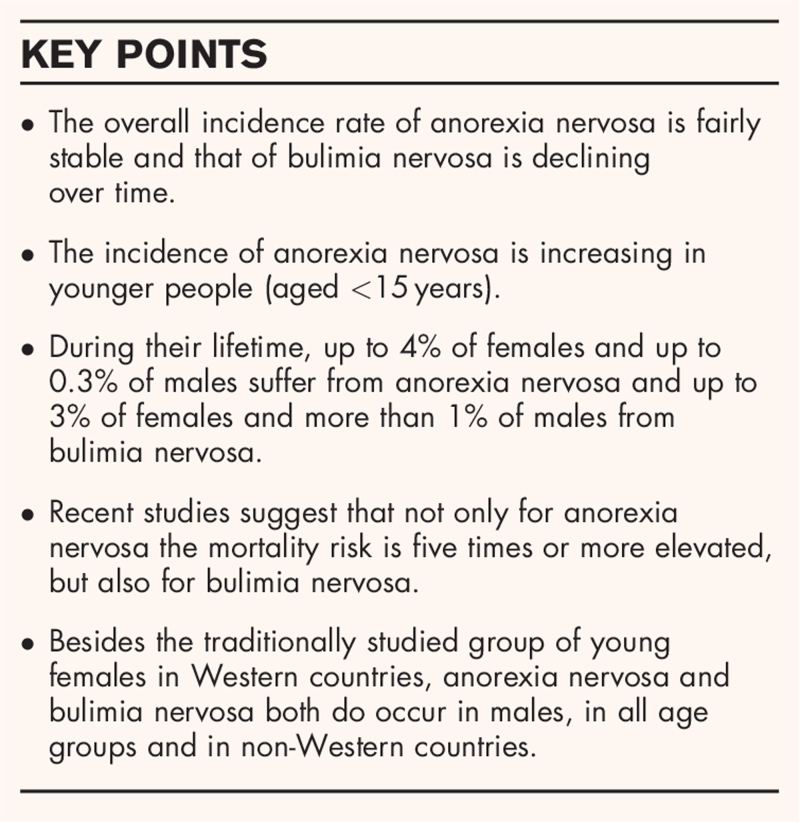
Purpose of review: To review the recent literature on the epidemiology of anorexia nervosa and bulimia nervosa in terms of incidence, prevalence and mortality. Recent findings: Although the overall incidence rate of anorexia nervosa is considerably stable over the past decades, the incidence among younger persons (aged <15 years) has increased. It is unclear whether this reflects earlier detection or earlier age of onset. Nevertheless, it has implications for future research into risk factors and for prevention programs. For bulimia nervosa, there has been a decline in overall incidence rate over time. The lifetime prevalence rates of anorexia nervosa might be up to 4% among females and 0.3% among males. Regarding bulimia nervosa, up to 3% of females and more than 1% of males suffer from this disorder during their lifetime. While epidemiological studies in the past mainly focused on young females from Western countries, anorexia nervosa and bulimia nervosa are reported worldwide among males and females from all ages. Both eating disorders may carry a five or more times increased mortality risk. Summary: Anorexia nervosa and bulimia nervosa occur worldwide among females and males of all age groups and are associated with an increased mortality risk.
Overview
The claims and statistics of this paper haven’t been checked yet.
Free: it reads the open-access text and checks the first 5 claims that cite a source we can check. Create a free account to check every claim.
Integrity signals
Registry
Cites
Statistics
Figures
Verification
Claims the paper makes
The claims and statistics of this paper haven’t been checked yet.
Free: it reads the open-access text and checks the first 5 claims that cite a source we can check. Create a free account to check every claim.
Claims other papers make about this one
Each is checked against this paper’s own text: does it say what the citing paper says it does?
The source backs part of the claim, not all of it — or backs it for a different population, condition or comparison.
In the citing paper
“Among them, patients with SE-AN have higher mortality risks. [8, 9].”
From Eating disorders and palliative care specialists require definitional consensus and clinical guidance regarding terminal anorexia nervosa: addressing concerns and moving forward (2022) · cites this paper as [9]
Experimental — accuracy not yet measured
Self-check
Percentages, sums and reported differences re-computed from the paper’s own numbers.
The self-check needs the paper’s full text.
Citations
Cites
Arcelus, J., Mitchell, A. J., Wales, J., & Nielsen, S. (2011) · Archives of General Psychiatry · doi:10.1001/archgenpsychiatry.2011.74 · Cited by 2,864 · cited 2×
“[50] the CMR of anorexia nervosa patients was 5.”
ResultEpidemiology of Eating Disorders: Incidence, Prevalence and Mortality Rates
Smink, F. R. E., van Hoeken, D., & Hoek, H. W. (2012) · Current Psychiatry Reports · doi:10.1007/s11920-012-0282-y · Cited by 1,978
Self-citationPrevalence of eating disorders over the 2000–2018 period: a systematic literature review
Galmiche, M., Déchelotte, P., Lambert, G., & Tavolacci, M. P. (2019) · The American Journal of Clinical Nutrition · doi:10.1093/ajcn/nqy342 · Cited by 1,712 · cited 3×
“The three previously discussed systematic reviews and meta-analyses [28,29,35] also reported prevalence rates for bulimia nervosa.”
BackgroundResultReview of the prevalence and incidence of eating disorders
Hoek, H. W., & van Hoeken, D. (2003) · International Journal of Eating Disorders · doi:10.1002/eat.10222 · Cited by 1,458
Self-citationIncidence, prevalence and mortality of anorexia nervosa and other eating disorders
Hoek, H. W. (2006) · Current Opinion in Psychiatry · doi:10.1097/01.yco.0000228759.95237.78 · Cited by 891 · cited 1×
“over because of the fact that only a small proportion of community ‘cases’ present to (primary) care [3,5].”
BackgroundSelf-citationStice, E., Marti, C. N., & Rohde, P. (2013) · Journal of Abnormal Psychology · doi:10.1037/a0030679 · Cited by 822 · cited 1×
“6% among females in one interview-based study [49].”
BackgroundUdo, T., & Grilo, C. M. (2018) · Biological Psychiatry · doi:10.1016/j.biopsych.2018.03.014 · Cited by 799
van Hoeken, D., & Hoek, H. W. (2020) · Current Opinion in Psychiatry · doi:10.1097/yco.0000000000000641 · Cited by 716
Self-citationEpidemiology, course, and outcome of eating disorders
Smink, F. R. E., van Hoeken, D., & Hoek, H. W. (2013) · Current Opinion in Psychiatry · doi:10.1097/yco.0b013e328365a24f · Cited by 507
Self-citationEpidemiology and course of anorexia nervosa in the community
Keski-Rahkonen, A., Hoek, H. W., Susser, E. S., Linna, M. S., Sihvola, E., Raevuori, A., Bulik, C. M., Kaprio, J., & Rissanen, A. (2007) · American Journal of Psychiatry · doi:10.1176/appi.ajp.2007.06081388 · Cited by 504 · cited 1×
“com 32 years [8], 200 per 100 000 person-years among Spanish females between the age of 12 and 22 years [9] and 270 per 100 000 person-years in Finnish twin females aged 15–19 years [10].”
BackgroundSelf-citation
Cited by
Items 101–200 of 694
Herpertz‐Dahlmann, B., Eckardt, S., & Dempfle, A. (2024) · European Psychiatry · doi:10.1192/j.eurpsy.2024.1788 · Cited by 19
Lost in the Net? Broadband Internet and Youth Mental HealthPreprint
Donati, D., Durante, R., Sobbrio, F., & Zejcirovic, D. (2022) · SSRN Electronic Journal · doi:10.2139/ssrn.4082581 · Cited by 35
Keller, L., Dempfle, A., Dahmen, B., Schreiber, S., Adan, R. A. H., Andreani, N. A., Danner, U. N., Eisert, A., Fetissov, S. O., Fischmeister, F. P. S., et al. (2022) · Trials · doi:10.1186/s13063-022-06413-7 · Cited by 17
“Moreover, AN has the highest mortality rate of all psychiatric diseases [5, 6].”
BackgroundBarakat, S., & Maguire, S. (2022) · International Journal of Environmental Research and Public Health · doi:10.3390/ijerph20010119 · Cited by 18
Anorexia Nervosa in Juvenile Systemic Lupus Erythematosus (SLE): A Causality Dilemma
Grammatikopoulou, M. G., Syrmou, V., Lioliopoulou, M.-L., Gkiouras, K., Simopoulou, T., Katsiari, C. G., Vassilakou, T., & Bogdanos, D. P. (2023) · Children · doi:10.3390/children10040697 · Cited by 15
Nuyttens, M., Simons, A., Antrop, I., & Glazemakers, I. (2023) · European Eating Disorders Review · doi:10.1002/erv.3042 · Cited by 15
Zielinski-Gussen, I. M., Herpertz‐Dahlmann, B., & Dahmen, B. (2023) · Healthcare · doi:10.3390/healthcare11243149 · Cited by 17
Kiely, L., Conti, J., & Hay, P. (2024) · Eating Disorders · doi:10.1080/10640266.2024.2379635 · Cited by 16
Dietary availability acutely influences puberty onset via a hypothalamic neural circuit
Goto, T., Hagihara, M., Irie, S., Abe, T., Kiyonari, H., & Miyamichi, K. (2025) · Neuron · doi:10.1016/j.neuron.2025.01.015 · Cited by 17
Monaghan, M., & Doyle, L. (2022) · International Journal of Mental Health Nursing · doi:10.1111/inm.13068 · Cited by 22
Koning, E., & Brietzke, E. M. (2024) · Trends in Psychiatry and Psychotherapy · doi:10.47626/2237-6089-2022-0597 · Cited by 22
“72”
Systematic Review and Meta‐Analysis of Mortality in Patients With Anorexia Nervosa
Lai, E. T. H., Lai, B.-X., Wong, C. S. M., Wong, L. Y., Cheng, K., Cheng, C. P.-W., Lo, H. K. Y., Tse, G., Chan, W. C., Chang, W. C., et al. (2025) · International Journal of Eating Disorders · doi:10.1111/eat.70002 · Cited by 23
“Another uncertainty in the literature is the mortality rate for males with AN, with a systematic review reporting inconclusive results (Strobel et al. 2019) and a more recent review suggesting higher mortality (Iwajomo et al. 2021; van Eeden et al. 2021).”
Uniacke, B., & Walsh, B. T. (2022) · Annals of Internal Medicine · doi:10.7326/aitc202208160 · Cited by 20
Käver, L., Voelz, C., Specht, H. E., Thelen, A. C., Keller, L., Dahmen, B., Andreani, N. A., Tenbrock, K., Biemann, R., Borucki, K., et al. (2024) · Nutrients · doi:10.3390/nu16111596 · Cited by 13
“…reduced food intake, leading to low bodyweight, disrupted body perception, hyperactivity, and anxiety regarding weight gain [1,2] AN usually manifests during adolescence, a developmentally sensitive period, predominantly affecting girls and young women (male-to-female ratio from 1:10 to 1:20) [3].”
BackgroundWestermair, A. L., Reiter-Theil, S., Wäscher, S., & Trachsel, M. (2024) · BMC Medical Ethics · doi:10.1186/s12910-024-01101-4 · Cited by 16
“Between one and four percent of females in high income countries suffer from anorexia nervosa (AN) at some point in their life [1, 2].”
BackgroundLost in the net? Broadband internet and youth mental health
Donati, D., Durante, R., Sobbrio, F., & Zejcirovic, D. (2025) · Journal of Health Economics · doi:10.1016/j.jhealeco.2025.103017 · Cited by 35
Gorrell, S., Shott, M. E., Pryor, T. L., & Frank, G. (2023) · Biological Psychiatry: Cognitive Neuroscience and Neuroimaging · doi:10.1016/j.bpsc.2023.07.007 · Cited by 10
Inhibitory Learning during Exposure Treatment in Anorexia Nervosa: A Practical Guide
Melles, H., Duijvis, S., & Jansen, A. (2023) · Behavioral Sciences · doi:10.3390/bs13050370 · Cited by 11
The genetic relationship between cannabis use disorder, cannabis use and psychiatric disorders
Galimberti, M., Overstreet, C. M., Gupta, P., Beck, S., Dao, C., Deak, J. D., Zhou, H., Johnson, E. C., Agrawal, A., Stein, M. B., et al. (2025) · Nature Mental Health · doi:10.1038/s44220-025-00440-4 · Cited by 15
Stedal, K., Funderud, I., Wierenga, C., Knatz-Peck, S., & Hill, L. L. (2023) · Journal of Eating Disorders · doi:10.1186/s40337-023-00878-w · Cited by 8
“3 million healthy life years every year [1], and for two of the eating disorders, anorexia nervosa (AN) and bulimia nervosa (BN), the mortality risks are about twice those of controls when treated outside the hospital [2].”
BackgroundAssessing growth in children and adolescents with Avoidant/Restrictive Food Intake Disorder
Tanner, A. B., & Richmond, T. K. (2024) · Journal of Eating Disorders · doi:10.1186/s40337-024-01034-8 · Cited by 14
Clinical correlates and prognostic impact of binge-eating symptoms in major depressive disorder
Olgiati, P., Fanelli, G., Atti, A. R., Ronchi, D. D., & Serretti, A. (2022) · International Clinical Psychopharmacology · doi:10.1097/yic.0000000000000422 · Cited by 15
A multidimensional examination of affective and cognitive empathy in anorexia nervosa
Gaggero, G., Luminet, O., Vermeulen, N., de Timary, P., Nandrino, J., Goffinet, S., Dereau, J., Shankland, R., Dassonneville, C., & Grynberg, D. (2023) · European Eating Disorders Review · doi:10.1002/erv.2980 · Cited by 13
Body image and willingness to change it—A study of university students in Poland
Platta, A. M., Mikulec, A. T., Radzymińska, M., Ruszkowska, M., Suwała, G., Zborowski, M., Kowalczewski, P. Ł., & Nowicki, M. (2023) · PLoS ONE · doi:10.1371/journal.pone.0293617 · Cited by 19
Escoffié, A., Pretorius, N., & Baudinet, J. (2022) · Journal of Eating Disorders · doi:10.1186/s40337-022-00606-w · Cited by 11
Zhu, R., Tian, P., Zhang, H., Wang, G., & Chen, W. (2022) · Neuropharmacology · doi:10.1016/j.neuropharm.2022.109315 · Cited by 12
Semchishen, S. N., Højlund, M., Lemaire, D., Obeegadoo, I., Hammond, N. G., Frangione, B., Ogawa, H. F., Sunderland, R. J., Singh, A., Wafy, G., et al. (2026) · World Psychiatry · doi:10.1002/wps.70014 · Cited by 16
Leth-Møller, K., Hebebrand, J., Strandberg‐Larsen, K., Baker, J. L., & Jensen, B. W. (2023) · International Journal of Eating Disorders · doi:10.1002/eat.23986 · Cited by 13
Samodova, D., Hoel, A., Hansen, T. H., Clausen, L., Telléus, G. K., Marti, H., Pedersen, O. B., Støving, R. K., & Deshmukh, A. S. (2023) · Metabolism · doi:10.1016/j.metabol.2023.155760 · Cited by 13
Fuller, S. J., Sheridan, E., Hudson, L. D., & Nicholls, D. (2024) · Archives of Disease in Childhood · doi:10.1136/archdischild-2024-327039 · Cited by 10
Estévez, A., Momeñe, J., Macía, L., Díez, I. I., Olave, L., & Diego, G. A. (2024) · Nutrients · doi:10.3390/nu16121884 · Cited by 17
Praet, N., Stevens, J., Casteels, K., & Toelen, J. (2024) · Children · doi:10.3390/children11070822 · Cited by 16
Brinchmann, B. S., Ludvigsen, M. S., & Godskesen, T. (2024) · BMC Medical Ethics · doi:10.1186/s12910-024-01108-x · Cited by 17
“It is associated with a high mortality carrying a five or more times increased risk of death [1].”
BackgroundGut Microbiota in Women with Eating Disorders: A New Frontier in Pathophysiology and Treatment
Marano, G., Rossi, S., Sfratta, G., Acanfora, M., Anesini, M. B., Traversi, G., Lisci, F. M., Rinaldi, L., Pola, R., Gasbarrini, A., et al. (2025) · Nutrients · doi:10.3390/nu17142316 · Cited by 14
Lim, M., Kou, R., Esposito, G., Jawed, A., Dimitriou, D., & Mangar, S. (2023) · Nutrients · doi:10.3390/nu15092176 · Cited by 11
“AN is the most-common of all EDs, reaching a prevalence of 2% to 4% in females [3] and 0.”
BackgroundEstablishment of a Murine Chronic Anorexia Nervosa Model
Staffeld, A., Gill, S., Zimmermann, A., Böge, N., Schuster, K., Lang, S., Kipp, M., Palme, R., & Frintrop, L. (2023) · Cells · doi:10.3390/cells12131710 · Cited by 10
Racial/ethnic differences in anorexia and bulimia diagnoses among U.S. college students
Dyne, A. V., Washington, N., Villodas, M. T., & Cronan, T. A. (2023) · Eating Behaviors · doi:10.1016/j.eatbeh.2023.101779 · Cited by 16
Wang, Y., Tang, L., Wang, M., Wu, G., Li, W., Wang, X., Wang, J., Yang, Z., Li, X., Li, Z., et al. (2023) · International Journal of Eating Disorders · doi:10.1002/eat.24038 · Cited by 11
Habits and Persistent Food Restriction in Patients with Anorexia Nervosa: A Scoping Review
Conceição, I. S. R., García‐Burgos, D., de Macêdo, P. F. C., Nepomuceno, C. M. M., Pereira, E. M., Cunha, C. D. M., Ribeiro, C. D. F., & de Santana, M. L. P. (2023) · Behavioral Sciences · doi:10.3390/bs13110883 · Cited by 13
Marchesi, G., Cammisuli, D. M., Semonella, M., Castelnuovo, G., & Pietrabissa, G. (2024) · Brain Sciences · doi:10.3390/brainsci14020118 · Cited by 12
“It is the leading cause of death among all mental health conditions, and an estimated 0.9% of women and 0.3% of men will experience AN at some point in their life-time [2].”
BackgroundInfluentialReed, K. K., Silverman, A. E., Abbaspour, A., Burger, K. S., Bulik, C. M., & Carroll, I. M. (2024) · Journal of Eating Disorders · doi:10.1186/s40337-024-01019-7 · Cited by 12
“Affecting individuals of all ages, ancestries, and genders, AN has an estimated lifetime prevalence of up to 4% in females and 0.3% in males [3].”
BackgroundInfluentialLekkas, D., Gyorda, J. A., & Jacobson, N. C. (2022) · European Eating Disorders Review · doi:10.1002/erv.2949 · Cited by 12
“Although AN is prevalent across all age groups (van Eeden et al., 2021), it is particularly and increasingly prevalent among adolescents (Jagiel-ska & Kacperska, 2017).”
BackgroundNew Perspective on Anorexia Nervosa: Tryptophan-Kynurenine Pathway Hypothesis
Alberts, C., Owe-Larsson, M., & Urbańska, E. M. (2023) · Nutrients · doi:10.3390/nu15041030 · Cited by 13
Jaka, S., Pokhrel, S., Patel, A., Sejdiu, A., Taneja, S., Vashist, S., Arisoyin, A. E., Bachu, A. K., Manoharan, S. V. R. R., Mogallapu, R., et al. (2024) · Frontiers in Child and Adolescent Psychiatry · doi:10.3389/frcha.2024.1259038 · Cited by 10
Gaiaschi, L., Priori, E. C., Mensi, M. M., Verri, M., Buonocore, D., Parisi, S., Hernandez, L. N. Q., Brambilla, I., Ferrari, B., Luca, F. D., et al. (2024) · Neurobiology of Disease · doi:10.1016/j.nbd.2024.106580 · Cited by 10
“Lifetime prevalence rates of anorexia nervosa, considering all age groups (10 – 80 + years), are 4% among females and 0.3% among males (Van Eeden et al., 2021).”
BackgroundInfluentialKooij, K. L., Andreani, N. A., van der Gun, L. L., Keller, L., Trinh, S., van der Vijgh, B. H., Luijendijk, M. C. M., Dempfle, A., Herpertz‐Dahlmann, B., Seitz, J., et al. (2024) · International Journal of Eating Disorders · doi:10.1002/eat.24231 · Cited by 9
Celiac Disease, Gluten-Free Diet, and Eating Disorders: From Bench to Bedside
Wei, Y., Wang, Y., Yuan, Y., & Chen, J. (2024) · Foods · doi:10.3390/foods14010074 · Cited by 14
“, around 3% of females and over 1% of males are affected [42].”
Clinicians' Experiences of Eating Disorder Focused Family Therapy With Autistic Young People
Duffy, F., Peebles, I., Clark, E., Loomes, R., Thomson, L., Maloney, E., & Nimbley, E. (2025) · European Eating Disorders Review · doi:10.1002/erv.3173 · Cited by 11
Thompson, K. A., Bauman, V., Sunderland, K. W., Thornton, J. A., Schvey, N. A., Moyer, R., Sekyere, N. A., Funk, W., Pav, V., Brydum, R., et al. (2023) · International Journal of Eating Disorders · doi:10.1002/eat.24025 · Cited by 10
Identification of adipose tissue transcriptomic memory of anorexia nervosa
Zapata, R. C., Nasamran, C. A., Chilin-Fuentes, D., Dulawa, S. C., & Osborn, O. (2023) · Molecular Medicine · doi:10.1186/s10020-023-00705-7 · Cited by 9
“3% of men (Eeden et al. 2021) and has the highest mortality rate of any psychiatric disorder.”
BackgroundInfluentialThe Microbiome in Child and Adolescent Psychiatry
Zimmermann-Rösner, A., & Prehn‐Kristensen, A. (2024) · Zeitschrift für Kinder- und Jugendpsychiatrie und Psychotherapie · doi:10.1024/1422-4917/a000965 · Cited by 8
Mottarlini, F., Targa, G., Rizzi, B., Fumagalli, F., & Caffino, L. (2024) · Progress in Neuro-Psychopharmacology and Biological Psychiatry · doi:10.1016/j.pnpbp.2024.111065 · Cited by 9
“Anorexia nervosa (AN) is a multifaceted psychiatric disorder with an estimated lifetime prevalence of 4% among females and 0.3% among males (van Eeden et al., 2021), a mortality rate of 15.9% (Arcelus et al., 2011; Guinhut et al., 2021; Iwajomo et al., 2021) and a rapidly decreasing age of onset…”
BackgroundInfluentialSpero, V., Scherma, M., D'Amelio, S., Collu, R., Dedoni, S., Camoglio, C., Siddi, C., Fratta, W., Molteni, R., & Fadda, P. (2024) · Neurochemistry International · doi:10.1016/j.neuint.2024.105842 · Cited by 9
Norrlin, L., & Baumann, O. (2025) · International Journal of Environmental Research and Public Health · doi:10.3390/ijerph22010055 · Cited by 9
“These findings supported four hypotheses (1; 2; 3; 5), considering body estimation would be associated with regions sensitive to self-referential processing, object manipulation, visuospatial integration, and affective regulation, while body satisfaction would reflect hyperactivations among regions…”
InfluentialSandsten, A., Gabrielsson, S., Strömbäck, M., Looi, G. E., & Lindgren, B. (2025) · Journal of Eating Disorders · doi:10.1186/s40337-025-01483-9 · Cited by 11
“In recent decades, incidence rates have risen among children under 15; the underlying causes remain unclear [3].”
Polyunsaturated fatty acids and risk of anorexia nervosa: A Mendelian randomization study
Nomura, M., Tanaka, K., Banno, Y., Hara, R., Asami, M., Otsuka, T., & Tomata, Y. (2023) · Journal of Affective Disorders · doi:10.1016/j.jad.2023.03.016 · Cited by 10
Dimitropoulos, G., Singh, M., Mushquash, C. J., Kimber, M., Hutt‐MacLeod, D., Moore, E. K., Perri, A., Webb, C., Norman, L., Sauerwein, J., et al. (2023) · European Eating Disorders Review · doi:10.1002/erv.3026 · Cited by 8
“Prevalence rates are higher in females, with an estimated lifetime prevalence of Anorexia Nervosa being between 0.6% and 2.0%, and Bulimia Nervosa at 1.2%–4.6% (Hoek & van Hoeken, 2003; van Eeden et al., 2021).”
InfluentialBrennan, C. R., Baudinet, J., Simic, M., & Eisler, I. (2024) · Nutrients · doi:10.3390/nu16050670 · Cited by 11
Boehm, I., Mennigen, E., Geisler, D., Poller, N. W., Gramatke, K., Calhoun, V. D., Roessner, V., King, J. A., & Ehrlich, S. (2024) · Journal of Child Psychology and Psychiatry · doi:10.1111/jcpp.13970 · Cited by 10
Boys and men get eating disorders too
Thompson, D. S. (2022) · Trends in Urology & Men s Health · doi:10.1002/tre.847 · Cited by 8
“Getting to the Root”: Ayahuasca Ceremony Leaders’ Perspectives on Eating Disorders
Williams, M., Miller, A. K., Loizaga-Velder, A. K., Files, N., & Lafrance, A. (2022) · Journal of Psychoactive Drugs · doi:10.1080/02791072.2022.2113484 · Cited by 8
Elevated fullness and bloating as correlates of eating pathology: Implications for screening
Forney, K. J., Horvath, S. A., Pucci, G., & Harris, E. R. (2022) · Eating Disorders · doi:10.1080/10640266.2022.2141705 · Cited by 10
“Eating disorders are severe psychiatric illnesses associated with psychological and medical comorbidities (Arcelus et al., 2011; Forney et al., 2016; Keski-Rahkonen & Mustelin, 2016) that are prevalent in women and men across the lifespan (Van Eeden et al., 2021).”
BackgroundMcCrossin, R. (2023) · Children · doi:10.3390/children10020272 · Cited by 9
Approach to anorexia nervosa and atypical anorexia nervosa in adolescents
Parpia, R., Spettigue, W. J., & Norris, M. L. (2023) · Canadian Family Physician · doi:10.46747/cfp.6906387 · Cited by 15
Body composition and nutritional status changes in adolescents with anorexia nervosa
Hurtado, M. M., Martín‐Rivada, Á., Alemán, C. Q., Alcántara, M. P. R., & Ramallo‐Fariña, Y. (2023) · Anales de Pediatría (English Edition) · doi:10.1016/j.anpede.2023.06.015 · Cited by 8
Momen, N. C., Petersen, J. D., Yılmaz, Z., Semark, B. D., & Petersen, L. V. (2024) · Acta Psychiatrica Scandinavica · doi:10.1111/acps.13676 · Cited by 9
Research on feeding and eating disorders in India: A narrative review
Vaidyanathan, S., & Menon, V. (2024) · Indian Journal of Psychiatry · doi:10.4103/indianjpsychiatry.indianjpsychiatry_782_23 · Cited by 9
Komarova, D., Chambers, K., Foye, U., & Jewell, T. (2024) · European Eating Disorders Review · doi:10.1002/erv.3081 · Cited by 9
Ethical Challenges in the Treatment of Patients With Severe Anorexia Nervosa
Westmoreland, P., Yager, J., Treem, J., & Mehler, P. S. (2024) · FOCUS The Journal of Lifelong Learning in Psychiatry · doi:10.1176/appi.focus.20230035 · Cited by 9
Maladaptive Restrictive Food Choice Behavior in Adolescents With Anorexia Nervosa
Schröder, S. S., Danner, U. N., STEINGLASS, J. E., & Foerde, K. (2024) · International Journal of Eating Disorders · doi:10.1002/eat.24312 · Cited by 7
Salem, S. B., Idrissi, F. E. E., mohamed, A. F., Khrais, H., Jad, R. E., Haq, U. U., Jouini, J. A., Roble, R. M. F., Haidar, R., Zaouali, F., et al. (2025) · Brain and Behavior · doi:10.1002/brb3.70417 · Cited by 10
Reward contamination in restrictive anorexia nervosa: A meta-analysis of functional MRI studies
Rye, C. S., Amorim, F. E., Ward, L. H. E., & Milton, A. L. (2025) · Pharmacology Biochemistry and Behavior · doi:10.1016/j.pbb.2025.174031 · Cited by 8
Maschek, S., Østergaard, T. H., Krych, Ł., Zachariassen, L. F., Sørensen, D. B., Mentzel, C. M. J., Hansen, A. K., Sjögren, J. M., & Barfod, K. K. (2025) · Journal of Eating Disorders · doi:10.1186/s40337-025-01276-0 · Cited by 14
“Anorexia nervosa (AN) is a complex and serious mental disorder, which may affect individuals of all ages and sex with the highest prevalence in young women, with a lifetime prevalence rate up to 4% in females and 0.3% in males [1–3].”
InfluentialDisordered eating in autistic trans and gender diverse people: a lived experience-led scoping review
White, L., Schweizer, K., & Thomas, K. S. (2025) · Journal of Eating Disorders · doi:10.1186/s40337-025-01447-z · Cited by 11
Ali, S. A., Mahfouz, M. S., Hakami, R. A., Altubayqi, T. H., Alhazmi, N. H., Adawi, N., Khormi, R. M., Yaqoub, W., Maghfori, G. T., Mujarribi, M. H., et al. (2023) · Cureus · doi:10.7759/cureus.43291 · Cited by 7
Chen, J., Liu, K., Zhang, J., Liu, S., Wang, Y., Cao, R., Peng, X., Han, M., Han, H., Yao, R., et al. (2023) · Psychology Research and Behavior Management · doi:10.2147/prbm.s418535 · Cited by 7
The Effect of Transcranial Direct Current Stimulation (tDCS) on Anorexia Nervosa: A Narrative Review
Chmiel, J., Gładka, A., & Leszek, J. (2023) · Nutrients · doi:10.3390/nu15204455 · Cited by 13
“It is important to note that AN is less commonly observed in men [7,8], with a lifetime prevalence rate that might be up to 0.3% [9], though this does not diminish the burden on male patients [10].”
BackgroundInfluentialAyahuasca ceremony leaders’ perspectives on special considerations for eating disorders
Williams, M., Miller, A. K., & Lafrance, A. (2023) · Eating Disorders · doi:10.1080/10640266.2023.2271201 · Cited by 8
“…treatment ● Ayahuasca warrants further research as a potential intervention for EDs Eating disorders (EDs) are complex, often chronic, and difficult to treat conditions (Cooper et al., 2016; Quadflieg & Fichter, 2019; Strober & Johnson, 2012) with troubling mortality rates (van Eeden et al., 2021).”
BackgroundAddressing Body Image Disturbance through Metaverse-Related Technologies: A Systematic Review
Perez, M., Pineda-Rafols, A., Egea-Romero, M. P., Moreno, M. G., & Rincón, E. (2023) · Electronics · doi:10.3390/electronics12224580 · Cited by 11
“Along with the increase in AN and BN these past years [24], there has also been an increase in the use of metaverse-related technologies in healthcare environments, with the use of virtual reality being the most prominent [25].”
Samara, M. T., Michou, N., Lappas, A. S., Argyrou, A., Mathioudaki, E., Bakaloudi, D. R., Tsekitsidi, E., Polyzopoulou, Z. A., Christodoulou, G. N., Papazisis, G., et al. (2024) · Australian & New Zealand Journal of Psychiatry · doi:10.1177/00048674231219593 · Cited by 13
“Bulimia nervosa (BN) and binge eating disorder (BED), commonly referred to as binge spectrum disorders (BSDs) (Treasure et al., 2020), are among the most prevalent eating disorders worldwide (Erskine and Whiteford, 2018; Van Eeden et al., 2021).”
BackgroundSelf‐referential processing in anorexia nervosa
Gu, S. J., Aimufua, I., Pagliaccio, D., Shankman, S. A., STEINGLASS, J. E., Auerbach, R. P., Walsh, B. T., & Ranzenhofer, L. M. (2024) · International Journal of Eating Disorders · doi:10.1002/eat.24176 · Cited by 8
Hoffmans, C. C. A., Jan Treur, A., & Hendrikse, S. C. F. (2024) · Studies in computational intelligence · doi:10.1007/978-3-031-76516-2_12 · Cited by 7
Effectiveness of Yoga as a Complementary Therapy for Anorexia Nervosa: A Systematic Review
Buoli, M., Legnani, F., Mastroianni, M., Affaticati, L. M., Capuzzi, E., Clerici, M., & Caldiroli, A. (2024) · International Journal of Yoga · doi:10.4103/ijoy.ijoy_191_24 · Cited by 6
Comorbidity of anorexia nervosa and schizophrenia: A systematic review
Hechinger, R. M., Javaras, K. N., & Lewandowski, K. E. (2025) · Schizophrenia Research · doi:10.1016/j.schres.2025.01.010 · Cited by 7
Jowik, K., Dmitrzak‐Węglarz, M., Pytlińska, N., Jasińska-Mikołajczyk, A., Słopień, A., & Tyszkiewicz‐Nwafor, M. (2022) · Nutrients · doi:10.3390/nu14194022 · Cited by 10
Impairments in personality functioning in adolescents with anorexia nervosa
Schumacher, A. M., Tschitsaz, A., Lerch, S., Wyssen, A., Schlensog‐Schuster, F., Mürner-Lavanchy, I. M., Koenig, J., Cavelti, M., & Kaess, M. (2024) · European Eating Disorders Review · doi:10.1002/erv.3146 · Cited by 8
Xu, J., IGUDESMAN, D. A., Huckins, L. M., & Bulik, C. M. (2025) · Psychiatric Clinics of North America · doi:10.1016/j.psc.2025.01.007 · Cited by 9
Comprehensive insights into emerging advances in the Neurobiology of anorexia
Mao, L., Wang, L., Huang, Z., Chen, J.-K., Tucker, L. D., & Zhang, Q. (2025) · Journal of Advanced Research · doi:10.1016/j.jare.2025.03.046 · Cited by 8
Dong, Y., Goodwin‐Groen, S., Ma, J., Kim, E., Giudice, S. D., Santos, M., & Aoki, C. J. (2025) · Physiology & Behavior · doi:10.1016/j.physbeh.2025.114956 · Cited by 6
Downs, J. L., & Kelly, C. A. (2025) · Journal of Eating Disorders · doi:10.1186/s40337-025-01250-w · Cited by 6
Guided Internet-Based Cognitive Behavior Therapy for Women With Bulimia Nervosa
Hamatani, S., Matsumoto, K., Andersson, G., Sato, Y., Fukudo, S., Sudo, Y., Hirano, Y., Ino, K., Ishibashi, T., Tomioka, Y., et al. (2025) · JAMA Network Open · doi:10.1001/jamanetworkopen.2025.25165 · Cited by 8
Paudex, T., Endomba, F. T., Forestier, N., Pierandrei, A., Chauvet‐Gélinier, J., & Pinoit, J. (2025) · Clinical Psychology & Psychotherapy · doi:10.1002/cpp.70150 · Cited by 11
“Previous research (original articles and synthesis project) found significantly higher proportions of AN in women when compared to men (Galmiche et al. 2019; van Eeden et al. 2021).”
EDBase: Generating a Lexicon Base for Eating Disorders Via Social Media
Anwar, T., Fuller-Tyszkiewicz, M., Jarman, H. K., Abuhassan, M., Shatte, A. B. R., Wired Team, & Sukunesan, S. (2022) · IEEE journal of biomedical and health informatics · doi:10.1109/jbhi.2022.3211151 · Cited by 8
“Recent reviews of the literature [6], [7] report lifetime prevalence rates of up to 4% for females and 0.3% for males for AN, 3% for females and 1% for males for BN, and 1.4% for females and 0.4% for males for BED.”
BackgroundInfluentialPapini, N. M., Presseller, E. K., Bulik, C. M., Holde, K. E. V., Larsen, J. T., Thornton, L. M., Albiñana, C., Vilhjálmsson, B. J., Mortensen, P. B., Yılmaz, Z., et al. (2024) · Psychological Medicine · doi:10.1017/s0033291724000175 · Cited by 10
Eating disorders among international migrants: a systematic review and meta-analysis
Siddiqi, S., Akther, A., Blair, D.-L., Eccles, H., Frangione, B., Keeshan, A., Nagi, S., & Colman, I. (2024) · Social Psychiatry and Psychiatric Epidemiology · doi:10.1007/s00127-024-02666-6 · Cited by 8
McDaid, D., Treasure, J. L., Fernández‐Aranda, F., Herpertz‐Dahlmann, B., Quoidbach, V., Dickson, S. L., & Gorwood, P. A. P. M. (2024) · European Psychiatry · doi:10.1192/j.eurpsy.2024.1751 · Cited by 8
“Lifetime prevalence is estimated at 2 – 4% among women and 0.3% among men [5].”
BackgroundInfluentialBuilding Confidence in Discussing Genetics With Patients With Eating Disorders and Their Families
Bulik, C. M. (2024) · FOCUS The Journal of Lifelong Learning in Psychiatry · doi:10.1176/appi.focus.20230040 · Cited by 8
Erickson, M. C., Mellinger, C., Park, B., & Dimidjian, S. (2024) · Sex Roles · doi:10.1007/s11199-024-01496-9 · Cited by 6
“Eating disorders (EDs) have one of the highest mortality rates of all mental health disorders (Van Eeden et al., 2021).”
Sandri, E., Sguanci, M. E., Larumbe, E. C., Cerdá‐Olmedo, G., Piredda, M., & Mancin, S. (2024) · Medicina · doi:10.3390/medicina60101565 · Cited by 9
Zimmermann, A., Priebe, J., Rupprecht, H., Lang, S., Haberland, F., Schuster, K., Staffeld, A., Berger, C., Zhu, H., Dück, A., et al. (2025) · International Journal of Eating Disorders · doi:10.1002/eat.24379 · Cited by 6
Metadata
- Authors
- van Eeden, A. E., van Hoeken, D., & Hoek, H. W.
- Affiliations
- Parnassia Psychiatric Institute, The Hague, The Netherlands
- University Medical Center Groningen (NL)
- ORCID
- Hoek, Hans W.
- Venue
- Current Opinion in Psychiatry
- Published
- 2021-09-16
- Volume
- 34
- Issue
- 6
- Pages
- 515-524
- ISSN
- 0951-7367 (ISSN-L)
- 1473-6578
- PMC
- PMC8500372
- OpenAlex
- W3195156262
- Semantic Scholar
- 506afa54bc89d698ef6a312277efcfd526953576
- Cited by
- 698
- References
- 59
- Citations by year
- 2026: 121 · 2025: 177 · 2024: 175 · 2023: 155 · 2022: 66
- FWCI
- 13.24
- Type
- journal article
- Language
- en
- Open access
- hybrid
- doi.org
- Locations
- Current Opinion in Psychiatry (publishedVersion, cc-by)
- PubMed Central (publishedVersion, cc-by)
- PubMed (publishedVersion)
- University of Groningen research database (University of Groningen / Centre for Information Technology) (submittedVersion, cc-by)
- Topics
- Social Sciences › Psychology › Clinical Psychology › Eating Disorders and Behaviors
- Health Sciences › Nursing › Nutrition and Dietetics › Nutrition, Health and Food Behavior
- Health Sciences › Medicine › Psychiatry and Mental health › Child Nutrition and Feeding Issues
- Keywords
- anorexia nervosa, bulimia nervosa, eating disorders, incidence, prevalence, mortality, lifetime prevalence, age of onset, sex differences, global epidemiology
- MeSH terms
- Anorexia Nervosa, Feeding and Eating Disorders, Female, Humans, Male, Incidence, Prevalence, Bulimia Nervosa
About these checks
Registry, retraction, Cites and statistics results are computed, not judged, with one exception: a printed reference that no index lists is read once by a model before it counts as a citation error. Claims are extracted by a model and kept only when their quote appears verbatim in the text; each cited source is then checked, with a model’s help, for whether it says what the claim relies on. Those verdicts can be wrong — read the claim’s quote and the cited source before relying on one.
Statistics and arithmetic are recomputed, not judged.
Confidence bands are shown only for fields calibrated on our annotated test set. None is calibrated yet, so no band is shown.
What counts as a claim ›How we measure confidence ›How we check this ›
Are you an author, or do you see a problem with this page? Request a review
Data sources
Bibliographic data: Semantic Scholar, OpenAlex, Crossref.
Contains information from the Semantic Scholar Academic Graph Datasets, made available under the ODC Attribution License (ODC-BY 1.0).
Semantic Scholar’s data is described in: Kinney, R., et al. (2023). The Semantic Scholar Open Data Platform. arXiv:2301.10140.
