

Incidence, prevalence and mortality of anorexia nervosa and bulimia nervosa
Open accessThe DOI matches its Crossref record; 58 of the 59 references it cites were found in a registry or an index.
Abstract
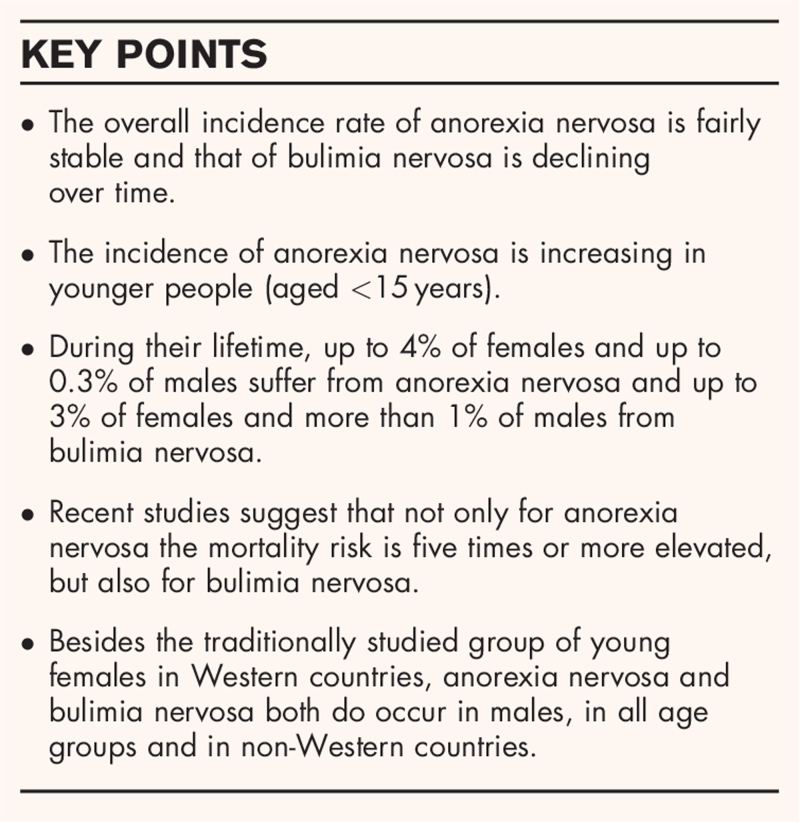
Purpose of review: To review the recent literature on the epidemiology of anorexia nervosa and bulimia nervosa in terms of incidence, prevalence and mortality. Recent findings: Although the overall incidence rate of anorexia nervosa is considerably stable over the past decades, the incidence among younger persons (aged <15 years) has increased. It is unclear whether this reflects earlier detection or earlier age of onset. Nevertheless, it has implications for future research into risk factors and for prevention programs. For bulimia nervosa, there has been a decline in overall incidence rate over time. The lifetime prevalence rates of anorexia nervosa might be up to 4% among females and 0.3% among males. Regarding bulimia nervosa, up to 3% of females and more than 1% of males suffer from this disorder during their lifetime. While epidemiological studies in the past mainly focused on young females from Western countries, anorexia nervosa and bulimia nervosa are reported worldwide among males and females from all ages. Both eating disorders may carry a five or more times increased mortality risk. Summary: Anorexia nervosa and bulimia nervosa occur worldwide among females and males of all age groups and are associated with an increased mortality risk.
Overview
The claims and statistics of this paper haven’t been checked yet.
Free: it reads the open-access text and checks the first 5 claims that cite a source we can check. Create a free account to check every claim.
Integrity signals
Registry
Cites
Statistics
Figures
Verification
Claims the paper makes
The claims and statistics of this paper haven’t been checked yet.
Free: it reads the open-access text and checks the first 5 claims that cite a source we can check. Create a free account to check every claim.
Claims other papers make about this one
Each is checked against this paper’s own text: does it say what the citing paper says it does?
The source backs part of the claim, not all of it — or backs it for a different population, condition or comparison.
In the citing paper
“Among them, patients with SE-AN have higher mortality risks. [8, 9].”
From Eating disorders and palliative care specialists require definitional consensus and clinical guidance regarding terminal anorexia nervosa: addressing concerns and moving forward (2022) · cites this paper as [9]
Experimental — accuracy not yet measured
Self-check
Percentages, sums and reported differences re-computed from the paper’s own numbers.
The self-check needs the paper’s full text.
Citations
Cites
Arcelus, J., Mitchell, A. J., Wales, J., & Nielsen, S. (2011) · Archives of General Psychiatry · doi:10.1001/archgenpsychiatry.2011.74 · Cited by 2,864 · cited 2×
“[50] the CMR of anorexia nervosa patients was 5.”
ResultEpidemiology of Eating Disorders: Incidence, Prevalence and Mortality Rates
Smink, F. R. E., van Hoeken, D., & Hoek, H. W. (2012) · Current Psychiatry Reports · doi:10.1007/s11920-012-0282-y · Cited by 1,978
Self-citationPrevalence of eating disorders over the 2000–2018 period: a systematic literature review
Galmiche, M., Déchelotte, P., Lambert, G., & Tavolacci, M. P. (2019) · The American Journal of Clinical Nutrition · doi:10.1093/ajcn/nqy342 · Cited by 1,712 · cited 3×
“The three previously discussed systematic reviews and meta-analyses [28,29,35] also reported prevalence rates for bulimia nervosa.”
BackgroundResultReview of the prevalence and incidence of eating disorders
Hoek, H. W., & van Hoeken, D. (2003) · International Journal of Eating Disorders · doi:10.1002/eat.10222 · Cited by 1,458
Self-citationIncidence, prevalence and mortality of anorexia nervosa and other eating disorders
Hoek, H. W. (2006) · Current Opinion in Psychiatry · doi:10.1097/01.yco.0000228759.95237.78 · Cited by 891 · cited 1×
“over because of the fact that only a small proportion of community ‘cases’ present to (primary) care [3,5].”
BackgroundSelf-citationStice, E., Marti, C. N., & Rohde, P. (2013) · Journal of Abnormal Psychology · doi:10.1037/a0030679 · Cited by 822 · cited 1×
“6% among females in one interview-based study [49].”
BackgroundUdo, T., & Grilo, C. M. (2018) · Biological Psychiatry · doi:10.1016/j.biopsych.2018.03.014 · Cited by 799
van Hoeken, D., & Hoek, H. W. (2020) · Current Opinion in Psychiatry · doi:10.1097/yco.0000000000000641 · Cited by 716
Self-citationEpidemiology, course, and outcome of eating disorders
Smink, F. R. E., van Hoeken, D., & Hoek, H. W. (2013) · Current Opinion in Psychiatry · doi:10.1097/yco.0b013e328365a24f · Cited by 507
Self-citationEpidemiology and course of anorexia nervosa in the community
Keski-Rahkonen, A., Hoek, H. W., Susser, E. S., Linna, M. S., Sihvola, E., Raevuori, A., Bulik, C. M., Kaprio, J., & Rissanen, A. (2007) · American Journal of Psychiatry · doi:10.1176/appi.ajp.2007.06081388 · Cited by 504 · cited 1×
“com 32 years [8], 200 per 100 000 person-years among Spanish females between the age of 12 and 22 years [9] and 270 per 100 000 person-years in Finnish twin females aged 15–19 years [10].”
BackgroundSelf-citation
Cited by
Items 401–500 of 694
Online Sexual Harassment, Disordered Eating Attitudes, and Body Shame in Young Women
Milson, R., Ashton-Rowling, E., Cole, V. L., Graham, B., & Nicoll, A. (2025) · Violence Against Women · doi:10.1177/10778012251338476 · Cited by 2
“Estimated lifetime prevalence rates of clinically diagnosed eating disorders in women are conservative (i.e., 4% Anorexia Nervosa, 3% Bulimia Nervosa; Van Eeden et al., 2021).”
Possibilities and limits of psychiatric care in relation to pediatrics
Kerner, J. (2025) · Česko-slovenská pediatrie · doi:10.55095/cspediatrie2025/007 · Cited by 1
Voderholzer, U., Naab, S., Cuntz, U., & Schlegl, S. (2025) · Der Nervenarzt · doi:10.1007/s00115-025-01820-y · Cited by 5
Franklin, E. V., Mathias, M., Nguyen, D. T., Hergenroeder, A. C., & Wiemann, C. M. (2025) · Journal of Eating Disorders · doi:10.1186/s40337-025-01315-w · Cited by 1
Comabella-Costa, M., Consuegra‐Fernández, M., & Serra, J. G. B. (2025) · Revista Mediterránea de Comunicación · doi:10.14198/medcom.29182 · Cited by 2
Time Course of Electrocortical Processing of Food Stimuli in Adolescent Anorexia Nervosa
Nannt, J., Wolz, I., Vagedes, J., & Svaldi, J. (2025) · International Journal of Eating Disorders · doi:10.1002/eat.24510 · Cited by 2
Parental engagement in an early intervention program for anorexia nervosa: a qualitative study
Diot, T., Loisel, A., Moro, M. R., & Blanchet, C. (2025) · European Child & Adolescent Psychiatry · doi:10.1007/s00787-025-02827-1 · Cited by 3
Neu, L., Maunz, L. A., Vedova, S., Schurr, T., Mangweth‐Matzek, B., Sperner‐Unterweger, B., Holzner, B., & Hüfner, K. (2025) · Neuropsychiatrie · doi:10.1007/s40211-025-00540-8 · Cited by 1
Palatal Nodule in Bulimia Patient: An Early Sign of Necrotizing Sialometaplasia
Mota, M. E., Tomo, S., Moreira, M. S., Villa, A., & Alves, F. A. (2025) · Special Care in Dentistry · doi:10.1111/scd.70087 · Cited by 1
Katsuki, F., Sawada, H., Kawasaki, Y., Kondo, M., Yamada, A., & Watanabe, N. (2025) · International Journal of Eating Disorders · doi:10.1002/eat.24541 · Cited by 1
Endocrinological aspects in anorexia nervosa
Alonso, B. G., & Hidalgo, M. G. (2025) · Pediatría Integral · doi:10.63149/j.pedint.57 · Cited by 1
Barcs, G., Janszky, J., Srahbzu, M., Horváth, R. A., Corrêa, V. M., & Szűcs, A. (2025) · International Journal of Sexual Health · doi:10.1080/19317611.2025.2547309 · Cited by 1
“Based on a recent Hungarian representative survey, it may affect 0.1% of the population (Correa et al., 2024); as frequently as anorexia nervosa (Van Eeden et al., 2021).”
InfluentialStender, E. M., Freichel, R., Doose, A., Hellerhoff, I., Breier, C. M., Lewitzka, U., Schacht, K., Geisler, D., King, J. A., Roessner, V., et al. (2025) · International Journal of Clinical and Health Psychology · doi:10.1016/j.ijchp.2025.100633 · Cited by 1
Takahashi, S., Ikeda, S., Ueda, M., Harada, T., & Ishii, R. (2025) · European Eating Disorders Review · doi:10.1002/erv.70046 · Cited by 1
Edwads, M. K., Zelig, R. S., & Radler, D. R. (2025) · Nutrition Reviews · doi:10.1093/nutrit/nuaf221 · Cited by 1
Poudel, J., Rimal, M., Giri, A., Chikatimalla, R., Banker, H., Trivedi, Y. V., Gupta, S., & Jain, R. (2026) · Southern Medical Journal · doi:10.14423/smj.0000000000001921 · Cited by 2
Keller, L., Lotter, L. D., Eickhoff, C. R., Eickhoff, S. B., Otten, K., Herpertz‐Dahlmann, B., & Seitz, J. (2026) · NeuroImage Clinical · doi:10.1016/j.nicl.2026.103950 · Cited by 3
“Despite ongoing advances in research and continuous improvements in the treatment of AN in recent years, AN remains a severe psychiatric disorder with a high mortality rate (Auger et al., 2021; van Eeden et al., 2021).”
Lim, K. O., Kummerfeld, E., Anderson, L. M., Wonderlich, S. A., Engel, S. G., Crosby, R. D., & Peterson, C. B. (2026) · Journal of Eating Disorders · doi:10.1186/s40337-026-01524-x · Cited by 1
“Bulimia nervosa (BN), an eating disorder characterized by binge-eating episodes accompanied by compensatory behaviors including self-induced vomiting [1], is associated with significant medical and psychiatric morbidity as well as elevated mortality [2–4].”
Treatment of anorexia nervosa in Ireland: striking an ethical balance
Dunne, E., Malone, A., Öğütlü, H., & McNicholas, F. (2026) · Irish Journal of Psychological Medicine · doi:10.1017/ipm.2026.10178 · Cited by 1
“The prevalence of anorexia in adults has remained stable, at approximately 1 – 4% among women and 0.3% among men; however, rates among children and adolescents may be increasing (van Eeden et al. 2021).”
InfluentialZhang, J., Hu, Y.-R., Kang, Q., Wu, M.-T., Zou, Y., Peng, S.-F., & Chen, J. (2026) · Journal of Eating Disorders · doi:10.1186/s40337-026-01557-2
“In terms of epidemiology, AN shows a marked gender disparity: the lifetime prevalence is as high as 4% in females, compared to only 0.3% in males [3].”
InfluentialKoning, E., Gamberg, S., & Keshen, A. R. (2026) · Behavioral Sciences · doi:10.3390/bs16030376 · Cited by 1
How to promote therapy-seeking for men with binge-spectrum eating disorders: a qualitative study
Sonnenblick, R., Williams, E. A., Manasse, S., & Lavender, J. M. (2026) · Journal of Eating Disorders · doi:10.1186/s40337-026-01571-4 · Cited by 1
“Women are more likely than men to develop both BN [7] and BED [8], but BSEDs and all EDs in men are underdiagnosed and undertreated [9].”
García, M. V. S., Heres, M., Pérez-Oleaga, C. M., Fernández-del-Valle, M., Olmedillas, H., & Muñoz, S. P. (2026) · European Eating Disorders Review · doi:10.1002/erv.70104 · Cited by 1
Ascione, M., Carulla‐Roig, M., Meschberger‐Annweiler, F., Serrano‐Troncoso, E., Martínez, A. B., Guerrero‐Álvarez, F., Miquel-Nabau, H., Mendoza‐Medialdea, M. T., Porras-García, B., Ferrer‐García, M., et al. (2026) · Clinical Psychology & Psychotherapy · doi:10.1002/cpp.70273 · Cited by 1
Wronski, M., Bahnsen, K., Bernardoni, F., Seidel, M., Doose, A., Hellerhoff, I., Schimack, M., Steinhäuser, J. L., Lombardo, G., Keeler, J. L., et al. (2026) · Neuropsychopharmacology · doi:10.1038/s41386-026-02435-w · Cited by 2
“Data were managed using REDCap [58].”
Stakeholder views on the proposed criteria for ‘terminal anorexia’: a mixed-methods study
Robb, S., & Federici, A. (2026) · Eating Disorders · doi:10.1080/10640266.2026.2691119 · Cited by 1
Nutrition in Maternal, Child, and Adolescent Health: A Global Perspective
Agbozo, F., Müller, O., & Jahn, A. (2026) · Springer eBooks · doi:10.1007/978-1-0716-5432-3_6 · Cited by 1
Hay, P., Appolinário, J. C., Giel, K. E., Keshen, A. R., Mitchison, D., Schmidt, U., Steward, T., & Stice, E. M. (2026) · Nature Reviews Disease Primers · doi:10.1038/s41572-026-00726-6 · Cited by 3
“Bulimia nervosa (BN) is a common and debilitating eating disorder that is present globally and in people of all ages, genders, ethnicities and sociodemographic statuses 1–9 .”
Romero, M. T. A., & Martínez, E. M. P. (2022) · Pro Sciences Revista de Producción Ciencias e Investigación · doi:10.29018/issn.2588-1000vol6iss42.2022pp239-250 · Cited by 2
Extreme hyperferritinemia in restrictive type anorexia nervosa
Amanoal, C. H., Nielsen, L. K., & Thomsen, H. H. (2023) · Endocrinology Diabetes and Metabolism Case Reports · doi:10.1530/edm-22-0405 · Cited by 2
Anorexia nervosa through the lens of primary health care practitioners in the Kyrgyz Republic
Moldokulova, Z., Molchanova, E., & Kosterina, E. (2023) · Consortium Psychiatricum · doi:10.17816/cp6184 · Cited by 1
“This is in line with the preventative program described in previous research [9].”
BackgroundResultSkowron, K. P., Stach, P., Kurnik‐Łucka, M., Chwaleba, K., Giełczyński, M., Suchy, W., Aleksandrovych, V., Jurczyk, M., Kuśnierz‐Cabala, B., & Gil, K. (2023) · Folia Medica Cracoviensia · doi:10.24425/fmc.2023.145430 · Cited by 1
‘It is not a mannequin disease’: A lived experience narrative of living with bulimia nervosa
Öcalan, S., Kovancı, M. S., & Hiçdurmaz, D. (2023) · Journal of Psychiatric and Mental Health Nursing · doi:10.1111/jpm.12973 · Cited by 2
Nogueira, P. V., Aparicio-López, C., Prieto-Campo, Á., Morón‐Nozaleda, M. G., Camarneiro, R., Graell-Berna, M., & Collantes, C. D. L. (2023) · Eating and Weight Disorders - Studies on Anorexia Bulimia and Obesity · doi:10.1007/s40519-023-01624-6 · Cited by 2
“Its incidence among teenagers younger than 15 years of age has increased in recent decades, although it is unclear whether this rise is due to earlier diagnosis or earlier disorder onset [4].”
BackgroundWongpratate, M., Phisutseranee, P., Paengpassa, S., & Muangchan, N. (2023) · Universal Journal of Public Health · doi:10.13189/ujph.2023.110516 · Cited by 1
Kleszczewska-Albińska, A. (2023) · Postępy Psychiatrii i Neurologii · doi:10.5114/ppn.2023.135530 · Cited by 5
“The latest international, as well as Polish, analyses prove that AN is becoming an increasing problem, especially among people under 15 years of age [9, 11].”
BackgroundInfluentialExploring Alcohol-Related Behaviours in an Adult Sample with Anorexia Nervosa and Those in Recovery
Smalley, Z., Livanou, M., Dalton, B., Patsalos, O., Wilks, J., Keeler, J. L., Treasure, J. L., Schmidt, U. H., Hill, G., & Himmerich, H. (2024) · Nutrients · doi:10.3390/nu16050732 · Cited by 1
“AN has a lifetime prevalence of up to 4% among females [2].”
BackgroundAvraham, Y., Shapira‐Furman, T., Saklani, R., Heukelom, B. V., Carmel, M., Vorobiev, L., Lipsker, L., Zwas, D. R., Berry, E. M., & Domb, A. J. (2024) · Behavioural Brain Research · doi:10.1016/j.bbr.2024.115001 · Cited by 1
Maximal Resistance Training in the Treatment of Anorexia Nervosa – A Case Report Series
Healy, D. R., Mansson, N., Furu, M., Bratland‐Sanda, S., & Sjögren, J. M. (2024) · International journal of exercise science · doi:10.70252/gejg3591 · Cited by 2
Disordered Eating/Eating Disorders in Adolescents
Hartman-Munick, S. M., Allen, S. M., & Powell, A. (2024) · Pediatric Clinics of North America · doi:10.1016/j.pcl.2024.04.005 · Cited by 3
Duquesnoy, M., Tric, L., Hanachi, M., Godart, N. T., & Lamer, C. (2024) · Journal of Food Nutrition and Diet Science · doi:10.55976/fnds.220241191107-121 · Cited by 1
“The overall incidence of the disease has been stable for fifty years, but is now increasing in children under the age of 15 [12].”
BackgroundBi, R. (2024) · Asia Pacific Journal of Social Work and Development · doi:10.1080/29949769.2024.2378766 · Cited by 2
“…characterised by symptoms like dietary restriction and weight concerns (Cooper & Fairburn, 1987), are a significant psychiatric illness with early onset, low recovery rates, and high mortality, posing a significant threat to the mental and physical health of adolescents (van Eeden et al., 2021).”
Talebi-Talghian, T., Schulz, P., & Huzij, T. (2024) · Journal of Osteopathic Medicine · doi:10.1515/jom-2023-0242 · Cited by 1
Psychoeducation on Medication for People with Anorexia Nervosa: A Quality Improvement Project
McMahon, J., Green, I., Omitogun, T., Picek, I., Peachey, G., Day, C., Treasure, J. L., & Himmerich, H. (2024) · IntechOpen eBooks · doi:10.5772/intechopen.1006307 · Cited by 2
Wang, Y., Tang, L., Wang, M., Li, W., Wang, M., Chen, Q., Yang, Z., Li, Z., Wang, Z., Wu, G., et al. (2024) · Appetite · doi:10.1016/j.appet.2024.107694 · Cited by 1
Kennett, J., & Stelfox, H. T. (2024) · Mental Health Science · doi:10.1002/mhs2.94 · Cited by 1
Oliver-López, A., Vega-Díaz, M., Sáenz-Olmedo, A., & González‐García, H. (2024) · Journal of Clinical Sport Psychology · doi:10.1123/jcsp.2024-0010 · Cited by 2
Meier, K., van Hoeken, D., Kager, C., van Eeden, A. E., Oldehinkel, A. J., & Hoek, H. W. (2025) · International Journal of Eating Disorders · doi:10.1002/eat.24431 · Cited by 3
“The incidence of BN declined from the late 1980s to the 2000s and then stabilized from 2010 onward (Hoek 1991; Hoek et al. 1995; Van Son et al. 2006; Smink et al. 2016; Van Eeden et al. 2023, 2021).”
Self-citationInvestigating the impact of causal attributions on anorexia nervosa stigma
Forde, R., & O’Shea, H. (2025) · Journal of Eating Disorders · doi:10.1186/s40337-025-01192-3 · Cited by 2
“Due to the increase in AN in younger children and adolescents [38], this demographic of parents may become future caregivers and therefore become an integral resource and support for recovery for their child should they fall victim to an ED.”
Hambleton, A. L., Kandar, V., Miskovic‐Wheatley, J., Vatter, S., Grange, D. L., Touyz, S. W., & Maguire, S. (2025) · Australian Journal of Rural Health · doi:10.1111/ajr.70043 · Cited by 1
Sun Exposure and Anorexia Nervosa: A Potential Environmental–Biological Interaction?
Phillipou, A. (2025) · Early Intervention in Psychiatry · doi:10.1111/eip.70054 · Cited by 1
“Despite issues with anorexia nervosa being stigmatised as a ‘female disorder’ which may hinder identification in males (Griffiths et al. 2014), the reported incidence appears to remain the highest among teenage girls (Van Eeden et al. 2021).”
Joshkon, A., Reytier, C., Bertin, D., Castets, S., Reynaud, R., Bat‐Pitault, F., Mège, J., Blot‐Chabaud, M., Darmon, P., & Bardin, N. (2025) · Scientific Reports · doi:10.1038/s41598-025-05138-2 · Cited by 1
“Anorexia nervosa (AN) mainly affects girls (at least 80% of cases) 2 .”
Deep brain stimulation for psychiatric versus neurological disorders: A call for nuance
Evans, A. (2025) · Philosophy and the Mind Sciences · doi:10.33735/phimisci.2025.11746
Thorey, S., Behaghel, A., Sibéoni, J., Blanchet, C., Moro, M. R., Carretier, É., & Ludot, M. (2025) · Journal of Eating Disorders · doi:10.1186/s40337-025-01327-6 · Cited by 1
“AN is a chronic illness, with 5-year clinical recovery rates of 66.8% (Keski-Rahkonen et al., [40]), and is relatively common in child psychiatry, affecting approximately 4% of adolescent girls and 0.3% of adolescent boys (Van Eeden et al., [64]).”
InfluentialHamatani, S., Matsumoto, K., Takahashi, J., Shimizu, E., Hirano, Y., & Mizuno, Y. (2025) · Brain and Behavior · doi:10.1002/brb3.70731
“The lifetime prevalence of AN is up to 4% in women and 0.3% in men (van Eeden et al. 2021).”
InfluentialMetformin abuse and weight loss: A case report
AlKhateb, B., Alkhateb, O., & Daaboul, B. (2025) · World Journal of Clinical Cases · doi:10.12998/wjcc.v13.i30.110820 · Cited by 1
Rajagopalan, A. K., Hartman-Munick, S. M., Samsel, C. B., & Latif, F. (2025) · Psychiatric Annals · doi:10.3928/00485713-20250915-01 · Cited by 1
A Narrative Review on the Dual Pathway Model of Bulimic Pathology
Krug, I., Puccio, F., Potingale, J., & Dang, A. B. (2023) · Springer eBooks · doi:10.1007/978-3-031-16691-4_48 · Cited by 1
Brytek‐Matera, A., & Hay, P. (2024) · Springer eBooks · doi:10.1007/978-3-030-97416-9_94-1 · Cited by 1
Zanella, E., & Lee, E. (2024) · Mental Health Science · doi:10.1002/mhs2.90 · Cited by 1
Real-time shadow casting using fake soft shadow volume with stencil buffer
Lee, K. W. (2006) · Cited by 1
Machine learning research of bulimia nervosa based on diffusion tensor imagePreprint
Zheng, L., Ma, J., Wang, Y., Wang, M., Liu, Y., Li, J., Li, T., & Zhang, L. (2022) · Research Square · doi:10.21203/rs.3.rs-2169019/v1 · Cited by 1
Therapeutic Effects of Flibanserin in Rat Activity-Based Anorexia
Stanford-Toonen, A. (2022) · Carleton University's Institutional Repository (MacOdrum Library, Carleton University) · doi:10.22215/etd/2022-15327
Anorexia nerviosa tras la pandemia de COVID-19. Nuevos retos para la fisioterapia
Minano-Garrido, E., Catalán-Matamoros, D., & Gómez‐Conesa, A. (2022) · Fisioterapia · doi:10.1016/j.ft.2022.12.002 · Cited by 1
Schloesser, L., Lotter, L. D., Offermann, J. S., Borucki, K., Biemann, R., Seitz, J., Konrad, K., & Herpertz‐Dahlmann, B. (2023) · medRxiv · doi:10.1101/2023.02.07.23285485 · Cited by 1
Computational Perspectives on Behaviour in Anorexia Nervosa: A Systematic ReviewPreprint
Radzikowska, M., Pike, A. C., & Hall-McMaster, S. (2023) · PsyArXiv (OSF Preprints) · doi:10.31234/osf.io/wq4cz · Cited by 2
(2023) · CABI eBooks · doi:10.1079/9781789247282.0001 · Cited by 1
Sense of loss of control and impaired goal-directed control in Bulimia nervosa: A case-control studyPreprint
Peng, S., Zheng, H., Wu, M., Guo, L., Zhang, L., Yuan, T., & Chen, J. (2024) · Research Square · doi:10.21203/rs.3.rs-4455009/v1 · Cited by 1
Bellvitge: el barri on arriba la primavera
Andreu, M. (2014) · L' Avenç: Revista de història i cultura
Goldschmidt, A. B., Fitzsimmons‐Craft, E. E., & Grange, D. L. (2022) · Elsevier eBooks · doi:10.1016/b978-0-323-91497-0.00153-3
García‐Anaya, M., Caballero-Romo, A. D. J., & González-Macías, L. (2022) · International Journal of Environmental Research and Public Health · doi:10.3390/ijerph191811396
A Narrative Review on the Dual Pathway Model of Bulimic Pathology
Krug, I., Puccio, F., Potingale, J., & Dang, A. B. (2022) · Springer eBooks · doi:10.1007/978-3-030-67929-3_48-1
Chen, J., Liu, K., Zhang, J., Liu, S., Wang, Y. Y., Cao, R., Peng, X., Han, M., Han, H., Yao, R., et al. (2022) · Research Square · doi:10.21203/rs.3.rs-2262148/v1
Time-Related Changes in Eating Disorders
Harada, T., Miyawaki, D., & Yamauchi, T. (2022) · Springer eBooks · doi:10.1007/978-3-030-67929-3_13-1
Bulimia Nervosa: Reproduction and Consequences for Mother and Child
Mantel, Ä., & Hirschberg, A. L. (2022) · Springer eBooks · doi:10.1007/978-3-030-67929-3_49-1
Torres, M. F. B., Landeros, O. G., Cosme, J. A. G., Altamirano, A. A., & Sandoval, L. R. A. (2023) · DIVULGARE Boletín Científico de la Escuela Superior de Actopan · doi:10.29057/esa.v10i19.9922 · Cited by 2
Matía‐Martín, P., Castro, M. J., Loria‐Kohen, V., del Portillo, R. C., Milla, S. P., Pérez, M. V., Olmos, M. Á. M., Álvarez, M. T. M., Torres, F. G., Lozano, E. C., et al. (2023) · Nutrición Hospitalaria · doi:10.20960/nh.04500
Nogueira, P. V., Aparicio-López, C., Prieto-Campo, Á., Morón‐Nozaleda, M. G., Camarneiro, R., Graell-Berna, M., & Collantes, C. D. L. (2023) · Research Square · doi:10.21203/rs.3.rs-2534209/v1
Brizzi, G., Sansoni, M., Frisone, F., Lernia, D. D., Tuena, C., & Riva, G. (2023) · PsyArXiv (OSF Preprints) · doi:10.31234/osf.io/hs8wv
Time-Related Changes in Eating Disorders
Harada, T., Miyawaki, D., & Yamauchi, T. (2023) · Springer eBooks · doi:10.1007/978-3-031-16691-4_13
Bulimia Nervosa: Reproduction and Consequences for Mother and Child
Mantel, Ä., & Hirschberg, A. L. (2023) · Springer eBooks · doi:10.1007/978-3-031-16691-4_49
Chen, J., Liu, K., Zhang, J., Liu, S., Wang, Y., Cao, R., Peng, X., Han, M., Han, H., Yao, R., et al. (2023) · Research Square · doi:10.21203/rs.3.rs-2687357/v1
Iron Status in Adolescents with Eating Disorder: A Systematic Review
Azra, J. M., & Verawati, B. (2023) · International Journal of Current Science Research and Review · doi:10.47191/ijcsrr/v6-i3-30
Wermuth, I., & Nagel, M.-J. (2023) · Elsevier eBooks · doi:10.1016/b978-3-437-21307-6.00017-3
Consider Eating Disorders in the Differential Diagnosis of Acute Abdomen in the Ages of Adolescence
Gürsoy, G., Akçay, E., Taş, D., & Akman, A. Ö. (2023) · Turkish Journal of Pediatric Emergency and Intensive Care Medicine · doi:10.4274/cayd.galenos.2022.43265
Approche de l’anorexie mentale et de l’anorexie mentale atypique chez l’adolescent
Parpia, R., Spettigue, W. J., & Norris, M. L. (2023) · Canadian Family Physician · doi:10.46747/cfp.6906393 · Cited by 2
Wang, J., Yang, M., Xu, K., Luo, P., Feng, R., Wan, X., Xie, J., Yu, H., & Xu, P. (2023) · Research Square · doi:10.21203/rs.3.rs-3027630/v1
Cywes, R., Kajee, H., Wellington, N., Cucuzzella, M. T., Riley, K., Isaacs, D. M., Pataguana, N., Lake, I., Rauch, L., McKelvey, S., et al. (2023) · Elsevier eBooks · doi:10.1016/b978-0-12-821617-0.00010-3
ZAMAN, A., & Şavran, T. G. (2023) · fe dergi feminist ele · doi:10.46655/federgi.1220991
Uso de canabinoides para o tratamento de anorexia nervosa: revisão de literatura
Taguti, A. Y., & Soares, L. D. S. M. L. (2023) · Brazilian Journal of Development · doi:10.34117/bjdv9n6-011
Physical activity, exercise, and eating and weight disorders
Hills, A. P., Street, S. J., & Byrne, N. M. (2023) · Oxford University Press eBooks · doi:10.1093/med/9780192843968.003.0021
Freyer, O., Bergey, F., Cotte, F., Gilbert, S., & Mehl, A. (2023) · doi:10.2196/preprints.52486
Reilly, J. (2023) · Queensland University of Technology · doi:10.5204/thesis.eprints.242770
Investigating Nutritional Disorders in Greece: Prevalence and Awareness
Katsilas, V., & Vlachogianni, E.-E. (2023) · IntechOpen eBooks · doi:10.5772/intechopen.1002631
Pauli, D. (2023) · Elsevier eBooks · doi:10.1016/b978-0-323-96023-6.00031-2
How social play experience shapes development of higher brain function: From synapses to behaviour
Bijlsma, A. (2023) · Utrecht University Repository (Utrecht University) · doi:10.33540/1927
Accomando, F., Aricò, M. O. L. R., & Valletta, E. A. (2023) · Medico e Bambino - Pagine Elettroniche · doi:10.53126/mebxxvio136
CEREBROSPINAL FLUID BIOMARKERS AMONG INDIVIDUALS WITH ANOREXIA NERVOSA: A SYSTEMATIC REVIEW PROTOCOLPreprint
Karia, E., Kyaw, T., Dheer, S., Lindman, L., Thomas, J. J., Becker, K. R., Misra, M., Arnold, S. E., Kubicki, M. R., Eddy, K. T., et al. (2023) · PsyArXiv (OSF Preprints) · doi:10.31234/osf.io/9c7hm
Unveiling co-occurrence of bulimia, depression, and self-injury in adolescent girls
AYDIN, A. B. C., & Serdengeçti, N. (2023) · Çukurova medical journal (Online)/Çukurova medical journal · doi:10.17826/cumj.1318195
“To the Editor, Bulimia Nervosa (BN) is an eating disorder that affects approximately 3% of women and 1% of men during their lifetime, however individuals often delay seeking help or avoid it altogether due to denial, shame, or the stigma associated with it 1 .”
Background
Metadata
- Authors
- van Eeden, A. E., van Hoeken, D., & Hoek, H. W.
- Affiliations
- Parnassia Psychiatric Institute, The Hague, The Netherlands
- University Medical Center Groningen (NL)
- ORCID
- Hoek, Hans W.
- Venue
- Current Opinion in Psychiatry
- Published
- 2021-09-16
- Volume
- 34
- Issue
- 6
- Pages
- 515-524
- ISSN
- 0951-7367 (ISSN-L)
- 1473-6578
- PMC
- PMC8500372
- OpenAlex
- W3195156262
- Semantic Scholar
- 506afa54bc89d698ef6a312277efcfd526953576
- Cited by
- 698
- References
- 59
- Citations by year
- 2026: 121 · 2025: 177 · 2024: 175 · 2023: 155 · 2022: 66
- FWCI
- 13.24
- Type
- journal article
- Language
- en
- Open access
- hybrid
- doi.org
- Locations
- Current Opinion in Psychiatry (publishedVersion, cc-by)
- PubMed Central (publishedVersion, cc-by)
- PubMed (publishedVersion)
- University of Groningen research database (University of Groningen / Centre for Information Technology) (submittedVersion, cc-by)
- Topics
- Social Sciences › Psychology › Clinical Psychology › Eating Disorders and Behaviors
- Health Sciences › Nursing › Nutrition and Dietetics › Nutrition, Health and Food Behavior
- Health Sciences › Medicine › Psychiatry and Mental health › Child Nutrition and Feeding Issues
- Keywords
- anorexia nervosa, bulimia nervosa, eating disorders, incidence, prevalence, mortality, lifetime prevalence, age of onset, sex differences, global epidemiology
- MeSH terms
- Anorexia Nervosa, Feeding and Eating Disorders, Female, Humans, Male, Incidence, Prevalence, Bulimia Nervosa
About these checks
Registry, retraction, Cites and statistics results are computed, not judged, with one exception: a printed reference that no index lists is read once by a model before it counts as a citation error. Claims are extracted by a model and kept only when their quote appears verbatim in the text; each cited source is then checked, with a model’s help, for whether it says what the claim relies on. Those verdicts can be wrong — read the claim’s quote and the cited source before relying on one.
Statistics and arithmetic are recomputed, not judged.
Confidence bands are shown only for fields calibrated on our annotated test set. None is calibrated yet, so no band is shown.
What counts as a claim ›How we measure confidence ›How we check this ›
Are you an author, or do you see a problem with this page? Request a review
Data sources
Bibliographic data: Semantic Scholar, OpenAlex, Crossref.
Contains information from the Semantic Scholar Academic Graph Datasets, made available under the ODC Attribution License (ODC-BY 1.0).
Semantic Scholar’s data is described in: Kinney, R., et al. (2023). The Semantic Scholar Open Data Platform. arXiv:2301.10140.
