

Incidence, prevalence and mortality of anorexia nervosa and bulimia nervosa
Open accessThe DOI matches its Crossref record; 58 of the 59 references it cites were found in a registry or an index.
Abstract
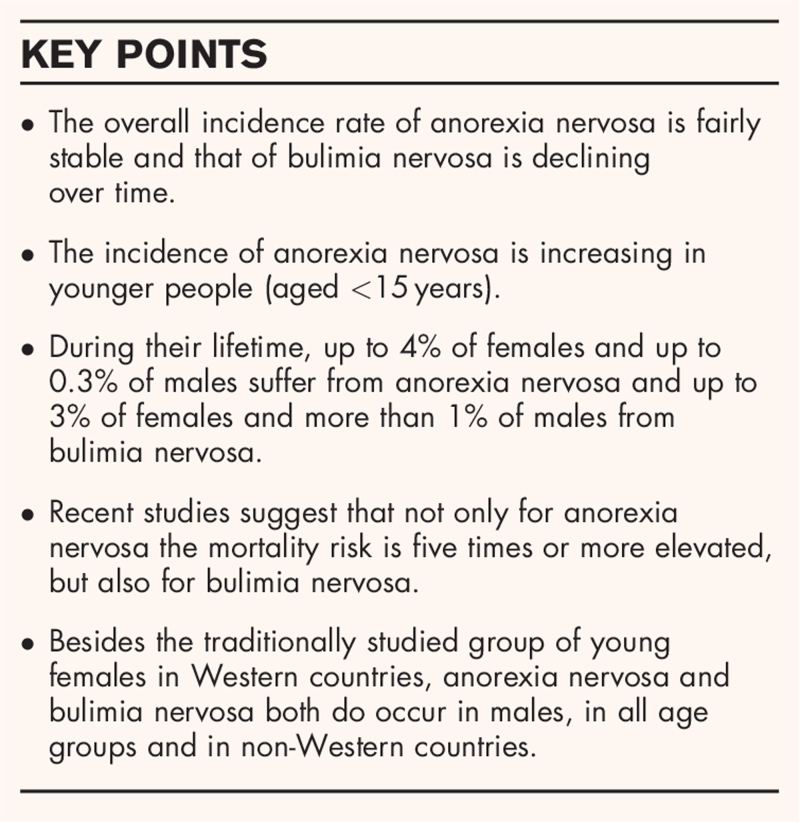
Purpose of review: To review the recent literature on the epidemiology of anorexia nervosa and bulimia nervosa in terms of incidence, prevalence and mortality. Recent findings: Although the overall incidence rate of anorexia nervosa is considerably stable over the past decades, the incidence among younger persons (aged <15 years) has increased. It is unclear whether this reflects earlier detection or earlier age of onset. Nevertheless, it has implications for future research into risk factors and for prevention programs. For bulimia nervosa, there has been a decline in overall incidence rate over time. The lifetime prevalence rates of anorexia nervosa might be up to 4% among females and 0.3% among males. Regarding bulimia nervosa, up to 3% of females and more than 1% of males suffer from this disorder during their lifetime. While epidemiological studies in the past mainly focused on young females from Western countries, anorexia nervosa and bulimia nervosa are reported worldwide among males and females from all ages. Both eating disorders may carry a five or more times increased mortality risk. Summary: Anorexia nervosa and bulimia nervosa occur worldwide among females and males of all age groups and are associated with an increased mortality risk.
Overview
The claims and statistics of this paper haven’t been checked yet.
Free: it reads the open-access text and checks the first 5 claims that cite a source we can check. Create a free account to check every claim.
Integrity signals
Registry
Cites
Statistics
Figures
Verification
Claims the paper makes
The claims and statistics of this paper haven’t been checked yet.
Free: it reads the open-access text and checks the first 5 claims that cite a source we can check. Create a free account to check every claim.
Claims other papers make about this one
Each is checked against this paper’s own text: does it say what the citing paper says it does?
The source backs part of the claim, not all of it — or backs it for a different population, condition or comparison.
In the citing paper
“Among them, patients with SE-AN have higher mortality risks. [8, 9].”
From Eating disorders and palliative care specialists require definitional consensus and clinical guidance regarding terminal anorexia nervosa: addressing concerns and moving forward (2022) · cites this paper as [9]
Experimental — accuracy not yet measured
Self-check
Percentages, sums and reported differences re-computed from the paper’s own numbers.
The self-check needs the paper’s full text.
Citations
Cites
Arcelus, J., Mitchell, A. J., Wales, J., & Nielsen, S. (2011) · Archives of General Psychiatry · doi:10.1001/archgenpsychiatry.2011.74 · Cited by 2,864 · cited 2×
“[50] the CMR of anorexia nervosa patients was 5.”
ResultEpidemiology of Eating Disorders: Incidence, Prevalence and Mortality Rates
Smink, F. R. E., van Hoeken, D., & Hoek, H. W. (2012) · Current Psychiatry Reports · doi:10.1007/s11920-012-0282-y · Cited by 1,978
Self-citationPrevalence of eating disorders over the 2000–2018 period: a systematic literature review
Galmiche, M., Déchelotte, P., Lambert, G., & Tavolacci, M. P. (2019) · The American Journal of Clinical Nutrition · doi:10.1093/ajcn/nqy342 · Cited by 1,712 · cited 3×
“The three previously discussed systematic reviews and meta-analyses [28,29,35] also reported prevalence rates for bulimia nervosa.”
BackgroundResultReview of the prevalence and incidence of eating disorders
Hoek, H. W., & van Hoeken, D. (2003) · International Journal of Eating Disorders · doi:10.1002/eat.10222 · Cited by 1,458
Self-citationIncidence, prevalence and mortality of anorexia nervosa and other eating disorders
Hoek, H. W. (2006) · Current Opinion in Psychiatry · doi:10.1097/01.yco.0000228759.95237.78 · Cited by 891 · cited 1×
“over because of the fact that only a small proportion of community ‘cases’ present to (primary) care [3,5].”
BackgroundSelf-citationStice, E., Marti, C. N., & Rohde, P. (2013) · Journal of Abnormal Psychology · doi:10.1037/a0030679 · Cited by 822 · cited 1×
“6% among females in one interview-based study [49].”
BackgroundUdo, T., & Grilo, C. M. (2018) · Biological Psychiatry · doi:10.1016/j.biopsych.2018.03.014 · Cited by 799
van Hoeken, D., & Hoek, H. W. (2020) · Current Opinion in Psychiatry · doi:10.1097/yco.0000000000000641 · Cited by 716
Self-citationEpidemiology, course, and outcome of eating disorders
Smink, F. R. E., van Hoeken, D., & Hoek, H. W. (2013) · Current Opinion in Psychiatry · doi:10.1097/yco.0b013e328365a24f · Cited by 507
Self-citationEpidemiology and course of anorexia nervosa in the community
Keski-Rahkonen, A., Hoek, H. W., Susser, E. S., Linna, M. S., Sihvola, E., Raevuori, A., Bulik, C. M., Kaprio, J., & Rissanen, A. (2007) · American Journal of Psychiatry · doi:10.1176/appi.ajp.2007.06081388 · Cited by 504 · cited 1×
“com 32 years [8], 200 per 100 000 person-years among Spanish females between the age of 12 and 22 years [9] and 270 per 100 000 person-years in Finnish twin females aged 15–19 years [10].”
BackgroundSelf-citation
Cited by
Items 201–300 of 694
Eyes on the body: Assessing attentional bias toward body-related stimuli in Anorexia Nervosa
Meregalli, V., Giovannini, S., Trevisan, A., Romanelli, M., Uğur, S., Tenconi, E., Meneguzzo, P., Cardi, V., & Collantoni, E. (2025) · Journal of Psychiatric Research · doi:10.1016/j.jpsychires.2025.01.043 · Cited by 6
Celiac Disease and Eating Disorders are a Bidirectional Relationship of Diseases
Хавкин, А. И., Odinaeva, N. D., Nalyotov, A. V., Кондратьева, Е. И., Marchenko, N. A., Мацынин, А. Н., Yablokova, E. A., & Дмитриевна, З. К. (2025) · Педиатрическая фармакология · doi:10.15690/pf.v22i2.2882 · Cited by 6
Anaplastic Lymphoma Kinase Receptor: Possible Involvement in Anorexia Nervosa
Dedoni, S., Scherma, M., Camoglio, C., Siddi, C., Fratta, W., & Fadda, P. (2023) · Nutrients · doi:10.3390/nu15092205 · Cited by 6
Tseng, H.-J., Lo, W., Chen, M., Tsai, S., Chen, T., & Liou, Y. (2023) · Journal of Dental Sciences · doi:10.1016/j.jds.2023.11.010 · Cited by 7
“The overall incidence rate of AN in Taiwan is 1.1 per 100,000, which is lower than the rate in Western countries 23,24 Due to the low incidence rate of AN in Taiwan and the strict matching process in the present study, no suitable patients with AN were identified from the Longitudinal Health…”
BackgroundInfluentialDisparities in Medical Assessment Practices for Adolescents at Risk for Eating Disorders
Sim, L. A., Witte, M. A., Lebow, J. R., LeMahieu, A., Geske, J. R., Witte, N., Whiteside, S. P. H., Loth, K. A., & Weber, C. H. (2023) · Journal of Adolescent Health · doi:10.1016/j.jadohealth.2023.10.004 · Cited by 6
Mental and physical health in children of women with a history of anorexia nervosa
Dobrescu, S. R., Dinkler, L., Gillberg, C. I., Gillberg, C., Råstam, M., & Wentz, E. (2024) · European Child & Adolescent Psychiatry · doi:10.1007/s00787-024-02393-y · Cited by 10
Mikhaylova, O. R. (2022) · New Media & Society · doi:10.1177/14614448221099172 · Cited by 6
Conn, K., Milton, L. K., Huang, K., Munguba, H., Ruuska, J., Lemus, M. B., Greaves, E., Homman‐Ludiye, J., Oldfield, B. J., & Foldi, C. J. (2023) · bioRxiv (Cold Spring Harbor Laboratory) · doi:10.1101/2023.12.12.571374 · Cited by 6
Anxiety matters: a pilot lab study into food, weight, and virtual body exposure in anorexia nervosa
Melles, H., & Jansen, A. (2024) · Journal of Eating Disorders · doi:10.1186/s40337-024-01094-w · Cited by 5
“Anorexia nervosa has a poor prognosis and a mortality rate of ~5% makes it the most lethal mental disorder [2, 3].”
BackgroundA new conceptual model for anorexia nervosa: A role for connective tissue?
Gibson, D., & Mehler, P. S. (2024) · International Journal of Eating Disorders · doi:10.1002/eat.24172 · Cited by 7
Disordered Eating in Emerging Adults: A Narrative Review and Recommendations for Prevention
El-Jor, C., Hallez, Q., Filippone, L., Flaudias, V., & Shankland, R. (2025) · Emerging Adulthood · doi:10.1177/21676968251318056 · Cited by 9
“Although the prevalence of complete eating disorder syndromes differs, the prevalence of disordered eating behaviors, such as binge eating, is very high and has risen sharply in recent decades (Galmiche et al., 2019; Qian et al., 2022; Van Eeden et al., 2021).”
Ge, Y., Zhang, S., Li, Z., Guo, H., Li, X., Li, Z., Dong, F., & Zhang, F. (2025) · Journal of Eating Disorders · doi:10.1186/s40337-025-01289-9 · Cited by 7
“Long-term BN significantly impacts the health and quality of life of individuals, their caregivers, and society as a whole; however, it receives limited resources and attention [4, 5].”
Exploring the link between dopamine dysregulation and eating disorders: A narrative review
Tharwani, Z. H., Shaeen, S. K., Zahid, K., Ahmed, S., Naqrashi, R., Murtaza, A., Mughal, S., Hasanain, M., Anjum, M. U., Eljack, M., et al. (2025) · Journal of neuroendocrinology · doi:10.1111/jne.70070 · Cited by 4
“11 The function of dopamine goes beyond its traditional link with reward and pleasure; it is an essential encoder of motivational and perceptual salience that gives priority to physiologically meaningful cues in order to direct adaptive behaviors.”
Dimitropoulos, G., Nicula, M., Krishnapillai, A., Austin, A., Singh, M., Lee, J., Webb, C., Scott, S., Almeida, A., Bergmann, C., et al. (2025) · Journal of Eating Disorders · doi:10.1186/s40337-025-01343-6 · Cited by 10
“Lifetime prevalence estimates among females range from 0.6 to 2.0% for Anorexia Nervosa (AN) and 1.2–4.6% for Bulimia Nervosa (BN) [9–11].”
InfluentialHealthcare utilization for eating disorders in Australia: 10 years of health data linkage
Dann, K. M., Schneuer, F. J., Miskovic‐Wheatley, J., Cunich, M. M., Ahmed, M. U., Sidari, M. J., Sara, G. E., Griffiths, K. R., Russell, J. D., Touyz, S. W., et al. (2025) · Australian & New Zealand Journal of Psychiatry · doi:10.1177/00048674251379236 · Cited by 9
“However, recent data shows increasing incidence in under-15-year-olds (van Eeden et al., 2021).”
Downs, J. L., Smith, E., Smith, N., Baker, S. J., Missen, H., Goodacre, J., Hickinbotham, H., Hickinbotham, N., Hazel, Z., Taylor, D., et al. (2025) · Journal of Eating Disorders · doi:10.1186/s40337-025-01300-3 · Cited by 9
“Increased prevalence rates of all ED diagnoses have been recorded internationally, across ages and demographic groups [3, 4, 5] in particular as a result of the COVID-19 pandemic [6, 7].”
Ouyang, H., Wang, Y., & Chen, J. (2025) · Journal of Eating Disorders · doi:10.1186/s40337-025-01454-0 · Cited by 7
“The global incidence of EDs has steadily increased, with a lifetime prevalence of up to 4% among women [2].”
Chastan, N., Achamrah, N., Etard, O., Nathou, C., Piquet, M., Guillaume, S., Attal, J., Gillibert, A., Déchelotte, P., Guillin, O., et al. (2024) · Brain and Behavior · doi:10.1002/brb3.3617 · Cited by 7
“Anorexianervosa(AN),aprevalenteatingdisorderamongadolescents, manifests through severe food restriction leading to undernutrition and is associated with significant morbidity, including mood disorders, and an almost sixfold increase in mortality rates (Arcelus et al., 2011; van Eeden et al., 2021).”
BackgroundChronic starvation induces microglial cell depletion in an activity-based anorexia model
Verspohl, V., van Egmond, M., Kneisel, L., Reese, F., Thelen, A. C., Korten, N. M., Neumann, M., Schaack, L., Voelz, C., Käver, L., et al. (2025) · Scientific Reports · doi:10.1038/s41598-025-98237-z · Cited by 6
“The prevalence of AN is increasing 6,7 , with a current lifetime prevalence of up to 4% in girls and 0.3% in boys 8 .”
InfluentialImproving Understanding, Recognition and Treatment for Men With Anorexia Nervosa
Downs, J. L., & Kelly, C. A. (2025) · British Journal of Hospital Medicine · doi:10.12968/hmed.2024.0643 · Cited by 6
Fitzpatrick, M., Clarke, V., Ramsey‐Wade, C. E., & Moller, N. P. (2023) · Counselling and Psychotherapy Research · doi:10.1002/capr.12687 · Cited by 6
“S ee t h e T e r m s a nd C ond iti on s ( h tt p s :// on li n e li b r a r y . w il e y . c o m /t e r m s - a nd - c ond iti on s ) on W il e y O n li n e L i b r a r y f o r r u l e s o f u s e ; OA a r ti c l e s a r e gov e r n e d by t h e a pp li ca b l e C r ea t i v e C o mm on s L i ce n…”
Berchio, C., Kumar, S. S., & Micali, N. (2023) · Brain Topography · doi:10.1007/s10548-023-01001-7 · Cited by 5
“Lifetime prevalence of AN has been estimated at up to 4% in females and at 0.3% in males (Keski-Rahkonen and Mustelin 2016; van Eeden et al. 2021), with high prevalence in young women (Martínez-González et al. 2020).”
InfluentialLakritz, C., Iceta, S., Duriez, P., Makdassi, M., Masetti, V., Davidenko, O., & Lafraire, J. (2023) · Eating and Weight Disorders - Studies on Anorexia Bulimia and Obesity · doi:10.1007/s40519-023-01621-9 · Cited by 5
Zhang, K., Xie, Q., Fan, C. G., Hu, X., Lei, J., Kong, J., Liang, M., Luo, J., & Li, X. (2024) · Clinical Psychology & Psychotherapy · doi:10.1002/cpp.2953 · Cited by 9
del Portillo, R. C., Milla, S. P., Matía‐Martín, P., Loria‐Kohen, V., Olmos, M. Á. M., Álvarez, M., Castro, M. J., Palmero, M. Á. M., Lozano, E. C., Pérez, M. V., et al. (2024) · Nutrición Hospitalaria · doi:10.20960/nh.05175 · Cited by 17
Guala, M. M., Bikic, A., Bul, K., Clinton, D. N., Mejldal, A., Nielsen, H. N., Stenager, E. N., & Nielsen, A. S. (2024) · Journal of Eating Disorders · doi:10.1186/s40337-024-00985-2 · Cited by 6
“Eating disorders (EDs) are severe mental health disorders with high mortality, in addition to being costly and associated with serious impairments in quality of life [1–4].”
BackgroundRamsay, S., Allison, K., Temples, H. S., Boccuto, L., & Sarasua, S. (2024) · Journal of Eating Disorders · doi:10.1186/s40337-024-01009-9 · Cited by 4
“With an estimated SMR between 5.9 and 15.9 (i.e., 6–16 times excess mortality), AN is considered one of the deadliest mental disorders [2, 3].”
InfluentialFatty Acids and Their Lipogenic Enzymes in Anorexia Nervosa Clinical Subtypes
Nguyen, N., Woodside, D. B., Lam, E., Quehenberger, O., German, J. B., & Shih, P.-A. B. (2024) · International Journal of Molecular Sciences · doi:10.3390/ijms25105516 · Cited by 7
“Anorexia nervosa (AN) is an eating disorder that affects up to 4% of women and 0.3% of men [1].”
BackgroundInfluential“I’m Not Hungry:” Bodily Representations and Bodily Experiences in Anorexia Nervosa
Floris, M., & Panero, M. (2024) · Review of Philosophy and Psychology · doi:10.1007/s13164-024-00735-y · Cited by 8
“However, in healthcare register-based studies, incidence rates of AN have notably risen over time, potentially reflecting enhanced public awareness, detection, and treatment rates (Van Eeden et al. 2021; Marzola et al. 2022).”
Bulimia nervosa and treatment-related disparities: a review
Wilson, K., & Kagabo, R. (2024) · Frontiers in Psychology · doi:10.3389/fpsyg.2024.1386347 · Cited by 14
“Other research has shown the range of lifetime prevalence among females to be 0.3–4.6% and 0.1–1.3% among males (van Eeden et al., 2021).”
BackgroundInfluentialAdaptations to family-based treatment for Medicaid-insured adolescents with anorexia nervosa
Borges, R., Crest, P., Landsverk, J. A., & Accurso, E. C. (2024) · Frontiers in Psychology · doi:10.3389/fpsyg.2024.1389652 · Cited by 5
Dieffenbacher, A. L., Meule, A., & Voderholzer, U. (2024) · European Eating Disorders Review · doi:10.1002/erv.3147 · Cited by 7
Zimmermann, A., Rupprecht, H., Lang, S., Wienecke, R., Henschke, H., Dickert, K., Schuster, K., Staffeld, A., Berger, C., Dück, A., et al. (2025) · International Journal of Eating Disorders · doi:10.1002/eat.24423 · Cited by 6
“In addition, AN, for which treat-ment options are limited, is associated with hyperactivity, amenorrhea (Herpertz-Dahlmann 2015), and an elevated mortality rate in later life (van Eeden et al. 2021).”
Wang, J., Beecher, K., Chehrehasa, F., & Moody, H. (2022) · Reviews in the Neurosciences · doi:10.1515/revneuro-2022-0072 · Cited by 4
Lost in the Net? Broadband Internet and Youth Mental HealthPreprint
Donati, D., Durante, R., Sobbrio, F., & Zejcirovic, D. (2022) · SSRN Electronic Journal · doi:10.2139/ssrn.3949645 · Cited by 13
Resting-state functional brain connectivity in female adolescents with first-onset anorexia nervosa
Bracké, K. F. M., Dias, L. M. R., Meijer, M. N., Steegers, C. P. M., den Heijer, L. F., van der Harst, T., Dremmen, M. H. G., Vernooij, M. W., Dieleman, G. C., & White, T. J. H. (2025) · NeuroImage Clinical · doi:10.1016/j.nicl.2025.103745 · Cited by 5
“The eating disorder (ED) typically develops during adolescence, predominantly affecting females (van Eeden et al., 2021).”
The Medical Complications of Purging Behaviours Associated With Eating Disorders
Gibson, D., Sterrett, K., Nemani, S., & Mehler, P. S. (2025) · European Eating Disorders Review · doi:10.1002/erv.3178 · Cited by 4
Bevione, F., Lacidogna, M. C., Lavalle, R., Daga, G. A., & Preti, A. (2025) · Eating and Weight Disorders - Studies on Anorexia Bulimia and Obesity · doi:10.1007/s40519-025-01771-y · Cited by 7
Irisin/BDNF pathway dysfunction subserves anorexia nervosa pathophysiology
Mottarlini, F., Parolaro, S., Dalt, L. D., Taddini, S., Rizzi, B., Bonacina, F., Cigognini, A. C., Vairano, F., D’Agostino, A., Bertelli, S., et al. (2025) · Pharmacological Research · doi:10.1016/j.phrs.2025.107959 · Cited by 6
Composición corporal y evolución nutricional en adolescentes con anorexia nerviosa
Hurtado, M. M., Martín‐Rivada, Á., Alemán, C. Q., Alcántara, M. P. R., & Ramallo‐Fariña, Y. (2023) · Anales de Pediatría · doi:10.1016/j.anpedi.2023.06.006 · Cited by 4
“Percentil ECW 4,85 (16,55) −1,00 −1,00; -1,00 10,45 (21,65) −1,00 −1,00; 10,63 0,481 Percentil ICW 59,49 (3,07) 60,40 57,03; 62,00 57,31 (4,25) −58,90 55,48; 60,30 0,189”
Egyptian youth and eating disorders: a cross-sectional study on prevalence and contributing factors
Ahmed, H. A. A., Yousef, A., Mohamed, S. T., Yousef, S. T., Elbeih, A. M. E., Tolba, A. M., & Shiba, H. A. A. (2024) · The Egyptian Journal of Neurology Psychiatry and Neurosurgery · doi:10.1186/s41983-024-00856-2 · Cited by 6
MacNeil, B. A., Gorman, T., & Maier, J. (2024) · Journal of Psychiatric Research · doi:10.1016/j.jpsychires.2024.12.043 · Cited by 7
Eating Disorders in the Workplace
Magnavita, N., Meraglia, I., & Isolani, L. (2025) · Nutrients · doi:10.3390/nu17142300 · Cited by 5
Design and testing of a health economic Markov model for treatment of anorexia nervosa
Svendsen, V. G., Lokkerbol, J., Danner, U. N., Jansingh, A., Evers, S., & Wijnen, B. F. M. (2022) · Expert Review of Pharmacoeconomics & Outcomes Research · doi:10.1080/14737167.2022.2119130 · Cited by 6
“While AN can manifest across all genders and age groups, adolescent girls and young women are particularly at risk [3,4].”
BackgroundGarcía–Fernández, G. (2023) · Revista de Psicología Clínica con Niños y Adolescentes · doi:10.21134/rpcna.2023.10.1.10 · Cited by 6
Amerio, A., Escelsior, A., Martino, E., Strangio, A., Aguglia, A., Marcatili, M., Conio, B., Sukkar, S. G., & Saverino, D. (2023) · Journal of Personalized Medicine · doi:10.3390/jpm13060928 · Cited by 5
Schloesser, L., Lotter, L. D., Offermann, J. S., Borucki, K., Biemann, R., Seitz, J., Konrad, K., & Herpertz‐Dahlmann, B. (2023) · European Eating Disorders Review · doi:10.1002/erv.2997 · Cited by 7
Schmerler, J., Chiu, A. K., Agarwal, A. R., Kreulen, R. T., Srikumaran, U., & Best, M. J. (2023) · The Physician and Sportsmedicine · doi:10.1080/00913847.2023.2237988 · Cited by 4
“Recent studies have shown that the incidence of eating disorders among adolescents has been increasing [4–6].”
BackgroundPsychometric properties of self-report measures of eating disorder cognitions: a systematic review
Hatoum, A. H., Burton, A. L., Berry, S. L., & Abbott, M. J. (2023) · Journal of Eating Disorders · doi:10.1186/s40337-023-00947-0 · Cited by 8
“The functional impact these disorders has been well established, with existing literature highlighting that EDs are associated with higher medical and psychiatric comorbidity, reduced quality of life and increased risk of mortality [2, 90, 91].”
BackgroundHerpertz‐Dahlmann, B., Dahmen, B., Zielinski-Gussen, I. M., & Seitz, J. (2024) · Bundesgesundheitsblatt - Gesundheitsforschung - Gesundheitsschutz · doi:10.1007/s00103-024-03856-y · Cited by 5
“Über alle Altersgruppen hinweg tritt die AN bei ca. 4% der Frauen und 0,3% der Männer auf (Lebenszeitprävalenz; [5]); möglicherweise liegt die Prävalenz beim männlichen Geschlecht höher als in den meisten Studien angegeben.”
BackgroundRosa‐Caldwell, M. E., Breithaupt, L. E., Kaiser, U. B., Garland, E., Pinkham, S., Hancock, M., Jalkut, S. L., & Rutkove, S. B. (2024) · Physiological Reports · doi:10.14814/phy2.16092 · Cited by 8
“For this initial model, we only used female rats because AN disproportionally affect females compared to males in the general population by a ratio of ~ 4:1 (Galmiche et al., 2019; van Eeden et al., 2021).”
BackgroundMethodRaspovic, A. M., Duck, R., Synnot, A., Caldwell, B., Phillipou, A., Castle, D., Newton, R., Brennan, L., Jenkins, Z., Cunich, M., et al. (2024) · Journal of Eating Disorders · doi:10.1186/s40337-024-01051-7 · Cited by 3
“All eating disorder diagnoses are associated with elevated psychosocial and medical comorbidity, with anorexia nervosa having the highest mortality rate of all mental illnesses [4, 5].”
BackgroundGenetic and functional analyses of CTBP2 in anorexia nervosa and body weight regulation
Giuranna, J., Zheng, Y., Brandt, M., Jall, S., Mukherjee, A., Shankhwar, S., Renner, S., Kurapati, N. K., May, C., Peters, T., et al. (2024) · Molecular Psychiatry · doi:10.1038/s41380-024-02791-3 · Cited by 4
“…BMI signals regarding CTBP2 were derived exclusively from females ( P overall : 2.47*10 − 6 , P male : 0.0043 and P female : 3.45*10 − 7 ) [61] and AN is predominantly diagnosed in young female adolescents [4], putative sex-speci fi c effects due to the sex chromosomes or hormones are plausible.”
InfluentialBavi, S., Soureshjani, F. H., & Ahmadi, Z. S. (2024) · Eating Disorders · doi:10.1080/10640266.2024.2433816 · Cited by 8
“Women are more likely to experience this disorder than men (van Eeden et al., 2021).”
The effect of anorexia nervosa inpatient physiotherapy adapted program (ANIPAP): A clinical trial
Minano-Garrido, E., Catalán-Matamoros, D., Acosta, G. P., & Gómez‐Conesa, A. (2024) · Journal of Bodywork and Movement Therapies · doi:10.1016/j.jbmt.2024.12.043 · Cited by 4
Brain network alterations in anorexia Nervosa: A Multi-Center structural connectivity study
Kanzawa, J., Kurokawa, R., Takamura, T., Nohara, N., Kamiya, K., Moriguchi, Y., Sato, Y., Hamamoto, Y., Shoji, T., Muratsubaki, T., et al. (2025) · NeuroImage: Clinical · doi:10.1016/j.nicl.2025.103737 · Cited by 3
“This study focused on female participants considering that AN is more than ten times more prevalent in females than in males (Van Eeden et al., 2021).”
InfluentialDistinct Patterns of Dynamical Regulation in Passive Sensor Data Following Binge and Purge Behaviors
Butner, J., Thornton, L. M., Kilshaw, R. E., Flatt, R. E., Shi, Q., Deboeck, P. R., Tregarthen, J., Argue, S., Baucom, B., & Bulik, C. M. (2025) · International Journal of Eating Disorders · doi:10.1002/eat.24437 · Cited by 4
“BED and BN affect up to 4% and 3% of people worldwide, respectively (Giel et al. 2022; van Eeden et al. 2021), and are associated with physical health consequences, including cardiovascular disease, type 2 diabetes, hypertension, and gastrointestinal problems (Sheehan and Herman 2015; Giel et al.…”
Physical Fitness—Not Physical Activity Levels—Influence Quality of Life in Anorexia Nervosa
Agne, A. A., Olmedillas, H., Pérez, M., Soto, M. D. V., & Fernández-del-Valle, M. (2022) · International Journal of Environmental Research and Public Health · doi:10.3390/ijerph19052678 · Cited by 6
“The experiment included adolescent participants that represent a very common age of onset in AN [55].”
BackgroundDelaquis, C. P., Godart, N., Fatseas, M., & Berthoz, S. (2023) · Children · doi:10.3390/children10040730 · Cited by 4
“Nearly all cases have their onset before the age of 25 years [3,4].”
BackgroundHemmingsen, S. D., Daugaard, N., Sjögren, M., Lichtenstein, M. B., Gudex, C. M., Piil, F., & Støving, R. K. (2023) · Journal of Personalized Medicine · doi:10.3390/jpm13061000 · Cited by 4
Changes in the psychosocial and clinical profiles of anorexia nervosa patients during the pandemic
Özbaran, N. B., Yılancıoğlu, H. Y., Tokmak, S. H., Taş, B. Y., Çek, D., & Bildik, T. (2023) · Frontiers in Psychiatry · doi:10.3389/fpsyt.2023.1207526 · Cited by 5
“Although anorexia is more prevalent among adolescent females, its lifetime prevalence in women can reach up to 4% (2).”
BackgroundScherma, M., Palmas, M. F., Pisanu, A., Masia, P., Dedoni, S., Camoglio, C., Fratta, W., Carta, A. R., & Fadda, P. (2023) · Nutrients · doi:10.3390/nu15173830 · Cited by 6
Makowski, C., Westwater, M. L., Rhee, K. E., Zou, J., Bischoff‐Grethe, A., & Wierenga, C. E. (2023) · medRxiv · doi:10.1101/2023.12.18.23300155 · Cited by 6
“EDs disproportionately impact females as compared to males, with lifetime prevalence rates of AN reported to be ~4% for females and 0.3% for males, and rates of BN reported to be 3% for females and 1% for males [5].”
InfluentialBody image in eating disorders: Integrating aesthetic and functional body experience
Rekkers, M. E. (2024) · Utrecht University Repository (Utrecht University) · doi:10.33540/2109 · Cited by 4
Brytek‐Matera, A., & Hay, P. (2024) · Springer eBooks · doi:10.1007/978-3-031-46096-8_94 · Cited by 4
Ascione, M., Serrano‐Troncoso, E., Carulla‐Roig, M., Martínez, A. B., Álvarez, F. G., Meschberger‐Annweiler, F., Porras-García, B., Ferrer‐García, M., & Gutiérrez‐Maldonado, J. (2024) · Applied Sciences · doi:10.3390/app14114340 · Cited by 5
Zinc levels in severe eating disorders
Leach, K. K., Blalock, D. V., Oakes, J., Hebert, M., Foster, M., & Mehler, P. S. (2025) · Journal of Eating Disorders · doi:10.1186/s40337-025-01199-w · Cited by 3
Ruggieri, S., Contentezza, R., Casella, M., Cernigliaro, A., Cosentini, I., Drago, G., Coco, G. L., Semola, M., & Gullo, S. (2025) · Child and Adolescent Psychiatry and Mental Health · doi:10.1186/s13034-025-00940-2 · Cited by 3
Ruiz, Á., Marcos, Y. Q., Zarceño, E. L., Vila, M. L., Piera, G., Navarro, A. R., Pagán, G. Y. D., Segura, M., Agulló, I., Llorca, G., et al. (2025) · European Eating Disorders Review · doi:10.1002/erv.70013 · Cited by 5
Plasma albumin in patients with severe anorexia nervosa admitted to a specialized medical unit
Egedal, J. M., Lorentzen, G. S., Sjögren, M. J. C., Paslakis, G., & Støving, R. K. (2025) · Clinical Nutrition ESPEN · doi:10.1016/j.clnesp.2025.07.1120 · Cited by 4
Miles, S., Neill, E., & Phillipou, A. (2025) · International Journal of Eating Disorders · doi:10.1002/eat.24506 · Cited by 3
Mapping gray matter changes in anorexia nervosa: a functional connectivity network approach
Yang, H., Wang, S., Li, H., Gu, S., Zhang, F., Wang, H., Dai, Z., & Pan, P. (2025) · Frontiers in Nutrition · doi:10.3389/fnut.2025.1667729 · Cited by 7
Ehrlich, S., Licht, L., Kolb, T., Hoffmann, C., Stender, E. M., Tam, F. I., Poitz, D. M., Roessner, V., Bornstein, S. R., & Perakakis, N. (2025) · Molecular Psychiatry · doi:10.1038/s41380-025-03245-0 · Cited by 3
“Anorexia nervosa (AN) is a metabo-psychiatric disorder affecting up to 4% of females and up to 0.3% of males during their lifetime [1, 2].”
InfluentialAnorexia nervosa and risk of fractures: A matched cohort study of 80,000 men and women
Cyrenne-Dussault, M., Côté‐Corriveau, G., Israël, M., Steiger, H., Chadi, N., Low, N. C. P., Brousseau, É., & Auger, N. (2025) · The American Journal of Medicine · doi:10.1016/j.amjmed.2025.09.027 · Cited by 3
Marano, G., Napolitano, D., Capristo, E., Traversi, G., Mazza, O., Gaetani, E., & Mazza, M. (2025) · Children · doi:10.3390/children12111465 · Cited by 7
“Converging epidemiological reviews also indicate that the peak incidence of eating disorders (EDs) falls in mid-adolescence, with hints of a shift toward earlier presentation in recent cohorts, underscoring the developmental intersection of identity work and ED risk [10,16,17].”
Kounatidis, D. C., & Vallianou, N. G. (2025) · Biomolecules · doi:10.3390/biom15111559 · Cited by 4
“While overall incidence has remained relatively stable, diagnoses among individuals younger than 15 years are rising, likely due to earlier onset and improved detection [3].”
Problematic usage of the internet is associated with orthorexia nervosa tendency in adults
Boutouis, S., & Grant, J. E. (2025) · CNS Spectrums · doi:10.1017/s1092852925100771 · Cited by 4
“While the overall utility of the model was significant ( F (4, 260) = 16.505, p < .001, R 2 = .203), age and gender did not significantly contribute to the model (see Table 4).”
InfluentialSamulenaite, S., Parkitna, J. M. R., Baltriukienė, D., Martín‐García, E., Maldonado, R. J., & Burokas, A. (2026) · Gut Microbes · doi:10.1080/19490976.2026.2647535 · Cited by 4
Bernardoni, F., Arold, D., Schoppik, L., Bahnsen, K., Ge, R., Moreau, C. A., Bang, L., D’Agata, F., Daga, G. A., Tamnes, C. K., et al. (2026) · PLoS Medicine · doi:10.1371/journal.pmed.1004809 · Cited by 3
Virtually Accompanied Eating in the Outpatient Therapy of Anorexia Nervosa
Vogel, M., Gil, A., Galaz, C., Pascuala Urrejola, N., Lacalle, L., Jara, R., Verónica Irribarra, P., Vuskovic, M. L., Costa, D. S. A., & Espinoza, G. (2023) · Nutrients · doi:10.3390/nu15173783 · Cited by 3
Sandsten, A., Lindgren, B., Strömbäck, M., Ejneborn-Looi, G.-M., & Gabrielsson, S. (2023) · BMJ Open · doi:10.1136/bmjopen-2023-076437 · Cited by 3
Diet Traps during Eating Disorders among Dentate Patients at an Oral Health Glance
Paszyńska, E., Hernik, A., Rangé, H., Amaechi, B. T., Gross, G. S., & Pawińska, M. (2023) · Nutrients · doi:10.3390/nu15204414 · Cited by 7
“Regarding bulimia nervosa (BN), up to 3% of females and more than 1% of males suffer from this disorder during their lifetime [25].”
BackgroundRecovery Trajectories in Adolescent Girls with Anorexia Nervosa
Bédard, A., Bernard, C., Meilleur, D., Taddeo, D., Pesant, C., Meglio, G. D., Gingras, N., Thibault, I., Agostino, H., Bélanger, R., et al. (2024) · Journal of Clinical Medicine · doi:10.3390/jcm13030778 · Cited by 3
Loizou, P., Παναγιώτου, Γ., Zanos, P., & Paraskevopoulos, E. (2024) · PLoS ONE · doi:10.1371/journal.pone.0299529 · Cited by 3
Prevalence of anorexia nervosa and bulimia nervosa in Eastern Europe
Brytek‐Matera, A. (2023) · Psychiatria i Psychologia Kliniczna · doi:10.15557/pipk.2023.0041 · Cited by 8
Chen, G., Wang, X., Barnhart, W. R., Fu, Y., & He, J. (2024) · Journal of Clinical Psychology · doi:10.1002/jclp.23706 · Cited by 3
Cooper, J., Ryder, O. A., & Barry, S. M. (2024) · BDJ · doi:10.1038/s41415-024-7459-8 · Cited by 3
Chmiel, J., & Stępień–Słodkowska, M. (2024) · Journal of Clinical Medicine · doi:10.3390/jcm13185364 · Cited by 6
“The disorder known as bulimia nervosa (BN) that primarily affects adolescent females [1] is typified by binge eating and adverse compensatory actions intended to prevent weight gain [2].”
BackgroundExperts’ views on the implementation of digital interventions for eating disorders: a Delphi study
Lemmer, D., Mayer, G., Schrader, P., Michelsen, I., Friederich, H., & Bauer, S. (2024) · BMC Public Health · doi:10.1186/s12889-024-19989-3 · Cited by 5
“Their substantial disease burden and the high mortality of anorexia nervosa in particular [1, 3] underscore the importance of timely and effective treatment as a crucial public health objective.”
Backgroundde Santana, M. L. P., Oliveira, L. D. S., Curvello-Silva, K. L., Cunha, C. D. M., Menezes, I. D. J. P., de Macêdo, P. F. C., Ruas, A. M. D. S., Monteiro, R. A., Potvin, L., Kinra, S., et al. (2024) · Systematic Reviews · doi:10.1186/s13643-024-02711-0 · Cited by 3
“The lifetime prevalence of AN is estimated to be 4% in women, in contrast to 0.3% in men, whereas BN affects 3% of women and 1% of men [4] and BED affects 1.4% of women and 0.4% of men [5].”
InfluentialHalbeisen, G., Timmesfeld, N., & Paslakis, G. (2025) · BMJ Open · doi:10.1136/bmjopen-2024-097886 · Cited by 4
Intervention research in anorexia nervosa – a plea for single case experimental designs
Melles, H., Lemmens, L. H. J. M., & Jansen, A. T. M. (2025) · Eating Disorders · doi:10.1080/10640266.2025.2471218 · Cited by 3
“With a lifetime prevalence of ~0.1–3.6%, AN is rare (Galmiche et al., 2019; van Eeden et al., 2021), which limits the number of potential participants for research from the beginning.”
InfluentialBijsterbosch, J. M., Schnitzler, A. M. E., Harrison, A., Treasure, J. L., & Sternheim, L. C. (2025) · European Eating Disorders Review · doi:10.1002/erv.3193 · Cited by 4
Computational Perspectives on Cognition in Anorexia Nervosa: A Systematic Review
Radzikowska, M., Pike, A., & Hall-McMaster, S. (2025) · Computational Psychiatry · doi:10.5334/cpsy.128 · Cited by 3
Pagador, Á. V., Olmedillas, H., Quesnel, D. A., Cavero‐Redondo, I., & Fernández-del-Valle, M. (2025) · European Eating Disorders Review · doi:10.1002/erv.3205 · Cited by 5
Moccia, L., Serantoni, C., Ambrosecchia, M., Conte, E., Maulucci, G., Janiri, D., Kotzalidis, G., Giorgio, V. D., Conti, F., de Spirito, M., et al. (2025) · Journal of Eating Disorders · doi:10.1186/s40337-025-01255-5 · Cited by 5
“Despite an overall stable incidence rate, it represents a significant public health concern [1], resulting in the in the highest mortality rate among psychiatric disorders [2, 3], its diagnosis among children and adolescents shows an increasing trend [1].”
Zhu, L. Y., Larsen, J. T., Nissen, J. B., Crowley, J. J., Mattheisen, M., Bulik, C. M., Petersen, L. V., & Yılmaz, Z. (2025) · International Journal of Eating Disorders · doi:10.1002/eat.24486 · Cited by 3
“The lifetime prevalence of AN is up to 4%, disproportionately affecting females (van Eeden et al. 2021).”
Li, C., Liang, A., Kuang, Y., Liu, S., Yang, X., Liu, L., Hu, Y., & Yu, H. (2025) · Molecular Psychiatry · doi:10.1038/s41380-025-03216-5 · Cited by 3
“Third, data on the global incidence of speci fi c conditions, including ADHD, autism spectrum disorders, and IDID, were unavailable, preventing analysis of their global age-standardized incidence rates and AAPCs.”
A Guide to the Postmortem Investigation of Starvation in Adults
Garland, J., & Irvine, R. (2022) · American Journal of Forensic Medicine & Pathology · doi:10.1097/paf.0000000000000763 · Cited by 4
García‐Anaya, M., Caballero-Romo, A. D. J., & González-Macías, L. (2022) · International Journal of Environmental Research and Public Health · doi:10.3390/ijerph19159522 · Cited by 4
Metadata
- Authors
- van Eeden, A. E., van Hoeken, D., & Hoek, H. W.
- Affiliations
- Parnassia Psychiatric Institute, The Hague, The Netherlands
- University Medical Center Groningen (NL)
- ORCID
- Hoek, Hans W.
- Venue
- Current Opinion in Psychiatry
- Published
- 2021-09-16
- Volume
- 34
- Issue
- 6
- Pages
- 515-524
- ISSN
- 0951-7367 (ISSN-L)
- 1473-6578
- PMC
- PMC8500372
- OpenAlex
- W3195156262
- Semantic Scholar
- 506afa54bc89d698ef6a312277efcfd526953576
- Cited by
- 698
- References
- 59
- Citations by year
- 2026: 121 · 2025: 177 · 2024: 175 · 2023: 155 · 2022: 66
- FWCI
- 13.24
- Type
- journal article
- Language
- en
- Open access
- hybrid
- doi.org
- Locations
- Current Opinion in Psychiatry (publishedVersion, cc-by)
- PubMed Central (publishedVersion, cc-by)
- PubMed (publishedVersion)
- University of Groningen research database (University of Groningen / Centre for Information Technology) (submittedVersion, cc-by)
- Topics
- Social Sciences › Psychology › Clinical Psychology › Eating Disorders and Behaviors
- Health Sciences › Nursing › Nutrition and Dietetics › Nutrition, Health and Food Behavior
- Health Sciences › Medicine › Psychiatry and Mental health › Child Nutrition and Feeding Issues
- Keywords
- anorexia nervosa, bulimia nervosa, eating disorders, incidence, prevalence, mortality, lifetime prevalence, age of onset, sex differences, global epidemiology
- MeSH terms
- Anorexia Nervosa, Feeding and Eating Disorders, Female, Humans, Male, Incidence, Prevalence, Bulimia Nervosa
About these checks
Registry, retraction, Cites and statistics results are computed, not judged, with one exception: a printed reference that no index lists is read once by a model before it counts as a citation error. Claims are extracted by a model and kept only when their quote appears verbatim in the text; each cited source is then checked, with a model’s help, for whether it says what the claim relies on. Those verdicts can be wrong — read the claim’s quote and the cited source before relying on one.
Statistics and arithmetic are recomputed, not judged.
Confidence bands are shown only for fields calibrated on our annotated test set. None is calibrated yet, so no band is shown.
What counts as a claim ›How we measure confidence ›How we check this ›
Are you an author, or do you see a problem with this page? Request a review
Data sources
Bibliographic data: Semantic Scholar, OpenAlex, Crossref.
Contains information from the Semantic Scholar Academic Graph Datasets, made available under the ODC Attribution License (ODC-BY 1.0).
Semantic Scholar’s data is described in: Kinney, R., et al. (2023). The Semantic Scholar Open Data Platform. arXiv:2301.10140.
