

The DOI matches its Crossref record; 71 of the 72 references it cites were found in a registry or an index.
A comparison of marker gene selection methods for single-cell RNA sequencing data
Open accessAbstract
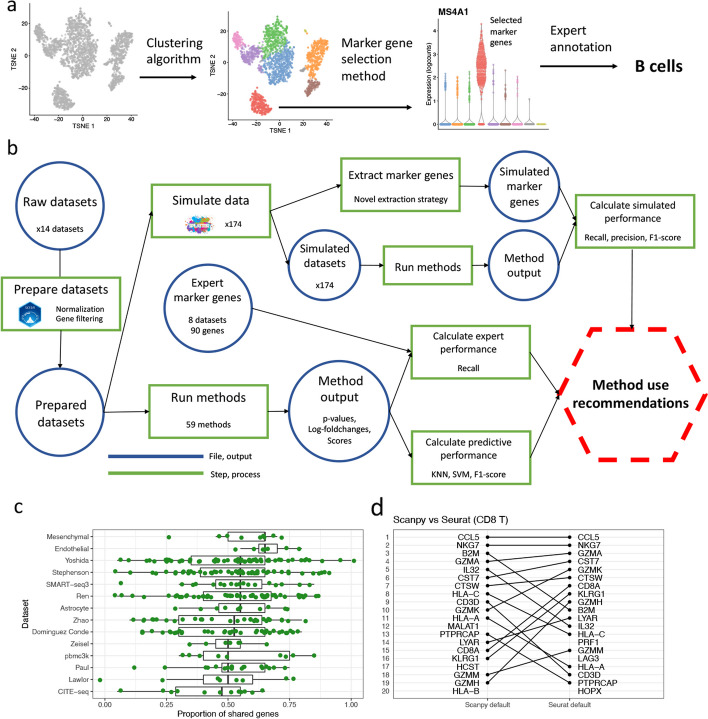
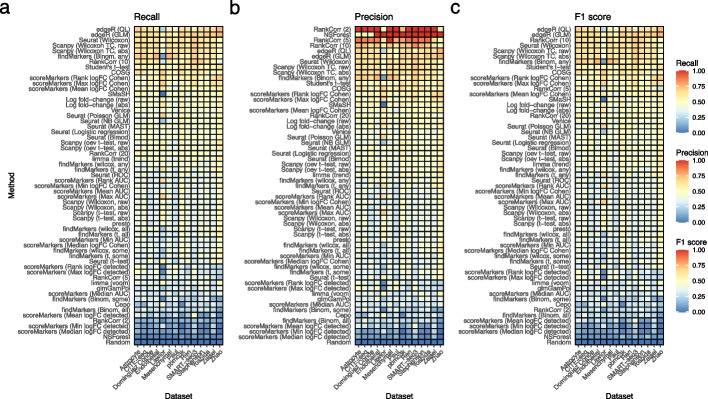
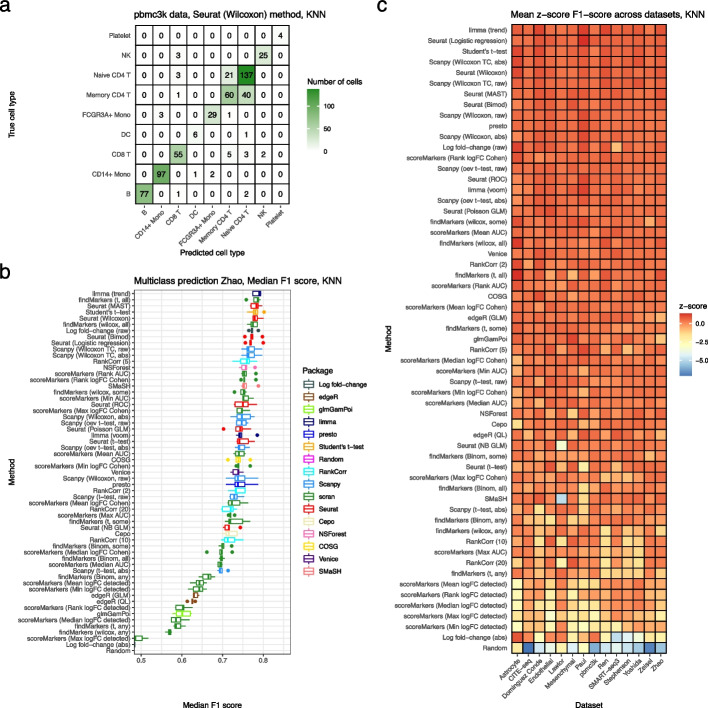
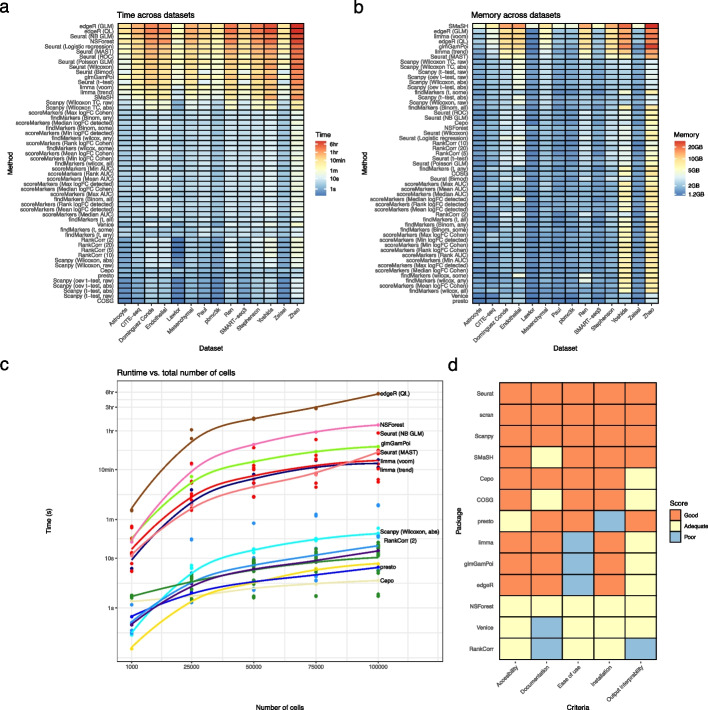
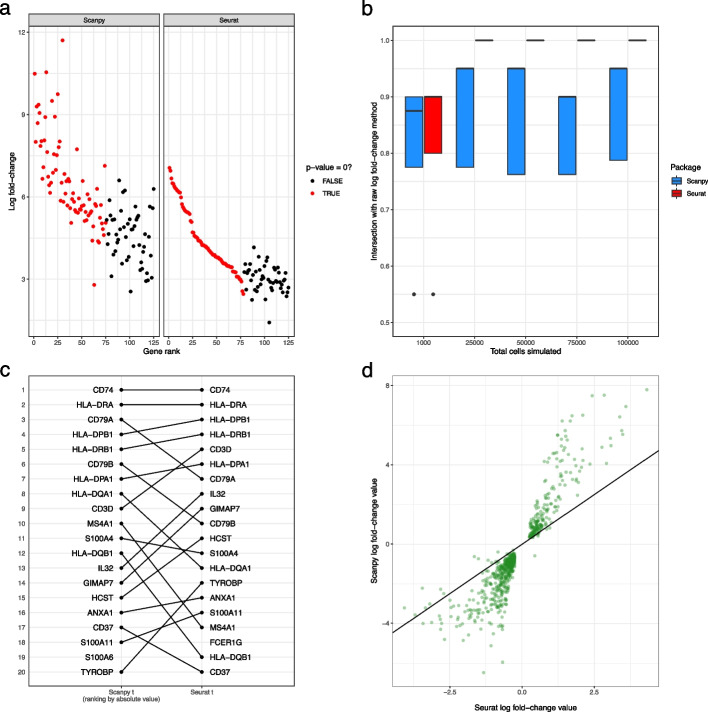
The development of single-cell RNA sequencing (scRNA-seq) has enabled scientists to catalogue and probe the transcriptional heterogeneity of individual cells in unprecedented detail. A common step in the analysis of scRNA-seq data is the selection of so-called marker genes, most commonly to enable annotation of the biological cell types present in the sample. In this paper we benchmarked 56 computational methods for selecting marker genes in scRNA-seq data. The performance of the methods was compared using 10 real scRNA-seq datasets and over 170 additional simulated datasets. Methods were compared on their ability to recover simulated and expert-annotated marker genes, the predictive performance and characteristics of the gene sets they select, their memory usage and speed and their implementation quality. In addition, various case studies were used to scrutinise the most commonly used methods, highlighting issues and inconsistencies. Overall, we present a comprehensive evaluation of methods for selecting marker genes in scRNA-seq data. Our results highlight the efficacy of simple methods, especially the Wilcoxon rank-sum test, Student’s t-test and logistic regression. All code used in the evaluation, including an extensible Snakemake pipeline, is available at: https://gitlab.svi.edu.au/biocellgen-public/mage_2020_marker-gene-benchmarking .
Overview
The claims and statistics of this paper haven’t been checked yet.
Run the check — free, no account needed. It reads the open-access text and checks the sources it cites.
Integrity signals
Registry
Cites
Statistics
Figures
Verification
Claims the paper makes
The claims and statistics of this paper haven’t been checked yet.
Run the check — free, no account needed. It reads the open-access text and checks the sources it cites.
Claims other papers make about this one
Each is checked against this paper’s own text: does it say what the citing paper says it does?
In the citing paper
“For this purpose, Wilcoxon rank-sum tests performed best, but owing to the nature of clustering, P values can be inflated and might lead to false discoveries, as the same data are used to define the labels that we test for differences between60,61.”
From Best practices for single-cell analysis across modalities (2023) · cites this paper as [60]
In the citing paper
“For this purpose, Wilcoxon rank-sum tests performed best, but owing to the nature of clustering, P values can be inflated and might lead to false discoveries, as the same data are used to define the labels that we test for differences between60,61.”
From Best practices for single-cell analysis across modalities (2023) · cites this paper as [60]
Self-check
Percentages, sums and reported differences re-computed from the paper’s own numbers.
The self-check needs the paper’s full text.
Citations
Cites
Controlling the False Discovery Rate: A Practical and Powerful Approach to Multiple Testing
Benjamini, Y., & Hochberg, Y. (1995) · Journal of the Royal Statistical Society Series B: Statistical Methodology · doi:10.1111/j.2517-6161.1995.tb02031.x · Cited by 109,482
Integrated analysis of multimodal single-cell data
Hao, Y., Hao, S., Andersen-Nissen, E., Mauck, W. M., Zheng, S., Butler, A., Lee, M. J., Wilk, A. J., Darby, C., Zagar, M., et al. (2020) · doi:10.1101/2020.10.12.335331 · Cited by 15,508
Smyth, G. K. (2004) · Statistical Applications in Genetics and Molecular Biology · doi:10.2202/1544-6115.1027 · Cited by 11,829
SCANPY: large-scale single-cell gene expression data analysis
Wolf, F. A., Angerer, P., & Theis, F. J. (2018) · Genome Biology · doi:10.1186/s13059-017-1382-0 · Cited by 8,881
Scenic: single-cell regulatory network inference and clustering.
Aibar, S., González-Blas, C. B., Moerman, T., Huynh-Thu, V. A., Imrichova, H., Hulselmans, G., Rambow, F., Marine, J.-C., Geurts, P., Aerts, J., et al. (2017) · Nature Methods · doi:10.1038/nmeth.4463 · Cited by 6,520
voom: precision weights unlock linear model analysis tools for RNA-seq read counts
Law, C. W., Chen, Y., Shi, W., & Smyth, G. K. (2014) · Genome Biology · doi:10.1186/gb-2014-15-2-r29 · Cited by 6,155
McCarthy, D. J., Chen, Y., & Smyth, G. K. (2012) · Nucleic Acids Research · doi:10.1093/nar/gks042 · Cited by 5,195
Self-citationThe single-cell transcriptional landscape of mammalian organogenesis
Cao, J., Spielmann, M., Qiu, X., Huang, X., Ibrahim, D. M., Hill, A. J., Zhang, F., Mundlos, S., Christiansen, L., Steemers, F. J., et al. (2019) · Nature · doi:10.1038/s41586-019-0969-x · Cited by 4,490
Finak, G., McDavid, A., Yajima, M., Deng, J., Gersuk, V., Shalek, A. K., Slichter, C. K., Miller, H. W., McElrath, M. J., Prlic, M., et al. (2015) · Genome Biology · doi:10.1186/s13059-015-0844-5 · Cited by 3,159
Cell types in the mouse cortex and hippocampus revealed by single-cell RNA-seq
Zeisel, A., Muñoz-Manchado, A. B., Codeluppi, S., Lönnerberg, P., La Manno, G., Juréus, A., Marques, S., Munguba, H., He, L., Betsholtz, C., et al. (2015) · Science · doi:10.1126/science.aaa1934 · Cited by 3,124
Simultaneous epitope and transcriptome measurement in single cells
Stoeckius, M., Hafemeister, C., Stephenson, W., Houck-Loomis, B., Chattopadhyay, P. K., Swerdlow, H., Satija, R., & Smibert, P. (2017) · Nature Methods · doi:10.1038/nmeth.4380 · Cited by 3,098
Snakemake—a scalable bioinformatics workflow engine
Köster, J., & Rahmann, S. (2012) · Bioinformatics · doi:10.1093/bioinformatics/bts480 · Cited by 2,780
McCarthy, D. J., Campbell, K. R., Lun, A. T. L., & Wills, Q. F. (2017) · Bioinformatics · doi:10.1093/bioinformatics/btw777 · Cited by 1,852
Self-citationA comparison of single-cell trajectory inference methods
Saelens, W., Cannoodt, R., Todorov, H., & Saeys, Y. (2019) · Nature Biotechnology · doi:10.1038/s41587-019-0071-9 · Cited by 1,670
A step-by-step workflow for low-level analysis of single-cell RNA-seq data
Lun, A. T. L., McCarthy, D. J., & Marioni, J. C. (2016) · F1000Research · doi:10.12688/f1000research.9501.1 · Cited by 1,551
Self-citationPanglaoDB: a web server for exploration of mouse and human single-cell RNA sequencing data
Franzén, O., Gan, L.-M., & Björkegren, J. L. M. (2019) · Database · doi:10.1093/database/baz046 · Cited by 1,551
Cell2location maps fine-grained cell types in spatial transcriptomics
Kleshchevnikov, V., Shmatko, A., Dann, E., Aivazidis, A., King, H. W., Li, T., Elmentaite, R., Lomakin, A., Kedlian, V., Gayoso, A., et al. (2022) · Nature Biotechnology · doi:10.1038/s41587-021-01139-4 · Cited by 1,279
Cross-tissue immune cell analysis reveals tissue-specific features in humans
Conde, C. D., Xu, C., Jarvis, L. B., Rainbow, D. B., Wells, S. B., Gomes, T., Howlett, S. K., Suchánek, O., Polański, K., King, H. W., et al. (2022) · Science · doi:10.1126/science.abl5197 · Cited by 1,246
Confronting false discoveries in single-cell differential expression
Squair, J. W., Gautier, M., Kathe, C., Anderson, M. A., James, N. D., Hutson, T. H., Hudelle, R., Qaiser, T., Matson, K. J. E., Barraud, Q., et al. (2021) · doi:10.1101/2021.03.12.435024 · Cited by 1,086 · cited 1×
“In the context of scRNA-seq data, the 46 term DE gene does not have a unique meaning; it can refer to genes found in a comparison between cells 47 in different clusters in the same sample [12,13] or in the same cluster between different samples [4,14,15], or to 48 a comparison between arbitrary groups of cells [16].”
MethodTranscriptional Heterogeneity and Lineage Commitment in Myeloid Progenitors
Paul, F., Arkin, Y., Giladi, A., Jaitin, D. A., Kenigsberg, E., Keren-Shaul, H., Winter, D., Lara-Astiaso, D., Gury, M., Weiner, A., et al. (2015) · Cell · doi:10.1016/j.cell.2015.11.013 · Cited by 1,082
patchwork: The Composer of Plots
Pedersen, T. L. (2019) · doi:10.32614/cran.package.patchwork · Cited by 949
Orchestrating single-cell analysis with Bioconductor
Amezquita, R. A., Lun, A. T. L., Becht, E., Carey, V. J., Carpp, L. N., Geistlinger, L., Marini, F., Rue-Albrecht, K., Risso, D., Soneson, C., et al. (2020) · Nature Methods · doi:10.1038/s41592-019-0654-x · Cited by 945
Splatter: simulation of single-cell RNA sequencing data
Zappia, L., Phipson, B., & Oshlack, A. (2017) · Genome Biology · doi:10.1186/s13059-017-1305-0 · Cited by 905
COVID-19 immune features revealed by a large-scale single-cell transcriptome atlas
Ren, X., Wen, W., Fan, X., Hou, W., Su, B., Cai, P., Li, J., Liu, Y., Tang, F., Zhang, F., et al. (2021) · Cell · doi:10.1016/j.cell.2021.01.053 · Cited by 865
Bias, robustness and scalability in single-cell differential expression analysis
Soneson, C., & Robinson, M. D. (2018) · Nature Methods · doi:10.1038/nmeth.4612 · Cited by 770
Single-cell multi-omics analysis of the immune response in COVID-19
Cambridge Institute of Therapeutic Immunology and Infectious Disease-National Institute of Health Research (CITIID-NIHR) COVID-19 BioResource Collaboration, Stephenson, E., Reynolds, G., Botting, R. A., Calero-Nieto, F. J., Morgan, M. D., Tuong, Z. K., Bach, K., Sungnak, W., Worlock, K. B., et al. (2021) · Nature Medicine · doi:10.1038/s41591-021-01329-2 · Cited by 742
Single-cell RNA counting at allele and isoform resolution using Smart-seq3
Hagemann-Jensen, M., Ziegenhain, C., Chen, P., Ramsköld, D., Hendriks, G.-J., Larsson, A. J. M., Faridani, O. R., & Sandberg, R. (2020) · Nature Biotechnology · doi:10.1038/s41587-020-0497-0 · Cited by 700
Bioequivalence trials, intersection-union tests and equivalence confidence sets
Berger, R. L., & Hsu, J. C. (1996) · Statistical Science · doi:10.1214/ss/1032280304 · Cited by 621
Lawlor, N. T., George, J., Bolisetty, M. T., Kursawe, R., Sun, L., Vijayakumar, S., Kycia, I., Robson, P., & Stitzel, M. L. (2016) · Genome Research · doi:10.1101/gr.212720.116 · Cited by 543
Crowell, H. L., Soneson, C., Germain, P.-L., Calini, D., Collin, L., Raposo, C., Malhotra, D., & Robinson, M. D. (2020) · Nature Communications · doi:10.1038/s41467-020-19894-4 · Cited by 515
Supervised classification enables rapid annotation of cell atlases
Pliner, H. A., Shendure, J., & Trapnell, C. (2019) · doi:10.1101/538652 · Cited by 498
Andrasfay, T., & Goldman, N. (2021) · Proceedings of the National Academy of Sciences · doi:10.1073/pnas.2014746118 · Cited by 490
Data exploration, quality control and testing in single-cell qPCR-based gene expression experiments
McDavid, A., Finak, G., Chattopadyay, P. K., Dominguez, M., Lamoreaux, L., Ma, S. S., Roederer, M., & Gottardo, R. (2013) · Bioinformatics · doi:10.1093/bioinformatics/bts714 · Cited by 395
Yarberry, W. A., Jr. (2021) · Apress eBooks · doi:10.1007/978-1-4842-6876-6_1 · Cited by 371
Local and systemic responses to SARS-CoV-2 infection in children and adults
Yoshida, M., Worlock, K. B., Huang, N., Lindeboom, R. G. H., Butler, C. R., Kumasaka, N., Dominguez Conde, C., Mamanova, L., Bolt, L., Richardson, L., et al. (2022) · Nature · doi:10.1038/s41586-021-04345-x · Cited by 365
A practical solution to pseudoreplication bias in single-cell studies
Zimmerman, K. D., Espeland, M. A., & Langefeld, C. D. (2021) · Nature Communications · doi:10.1038/s41467-021-21038-1 · Cited by 356 · cited 1×
“In the context of scRNA-seq data, the 46 term DE gene does not have a unique meaning; it can refer to genes found in a comparison between cells 47 in different clusters in the same sample [12,13] or in the same cluster between different samples [4,14,15], or to 48 a comparison between arbitrary groups of cells [16].”
MethodglmGamPoi: fitting Gamma-Poisson generalized linear models on single cell count data
Ahlmann-Eltze, C., & Huber, W. K. (2020) · Bioinformatics · doi:10.1093/bioinformatics/btaa1009 · Cited by 330
Lund, S. P., Nettleton, D. S., McCarthy, D. J., & Smyth, G. K. (2012) · Statistical Applications in Genetics and Molecular Biology · doi:10.1515/1544-6115.1826 · Cited by 322
Self-citationAutomatic cell-type harmonization and integration across Human Cell Atlas datasets
Xu, C., Prete, M., Webb, S., Jardine, L., Stewart, B. J., Hoo, R., He, P., Meyer, K. B., & Teichmann, S. A. (2023) · Cell · doi:10.1016/j.cell.2023.11.026 · Cited by 321
Exploring the single-cell RNA-seq analysis landscape with the scRNA-tools database
Zappia, L., Phipson, B., & Oshlack, A. (2018) · PLoS Computational Biology · doi:10.1371/journal.pcbi.1006245 · Cited by 319
Wang, T., Li, B., Nelson, C. E., & Nabavi, S. (2019) · BMC Bioinformatics · doi:10.1186/s12859-019-2599-6 · Cited by 286
SCINA: A Semi-Supervised Subtyping Algorithm of Single Cells and Bulk Samples
Zhang, Z., Luo, D., Zhong, X. Y., Choi, J. H., Ma, Y., Wang, S., Mahrt, E., Guo, W., Stawiski, E. W., Modrusan, Z. D., et al. (2019) · Genes · doi:10.3390/genes10070531 · Cited by 285
Single-cell RNA sequencing reveals the heterogeneity of liver-resident immune cells in human
Zhao, J., Zhang, S., Liu, Y., He, X., Qu, M., Xu, G., Wang, H., Huang, M., Pan, J., Liu, Z., et al. (2020) · Cell Discovery · doi:10.1038/s41421-020-0157-z · Cited by 243
A curated database reveals trends in single-cell transcriptomics
Svensson, V., da Veiga Beltrame, E., & Pachter, L. (2020) · Database · doi:10.1093/database/baaa073 · Cited by 223
The single-cell eQTLGen consortium
van der Wijst, M. G. P., de Vries, D., Groot, H. E., Trynka, G., Hon, C.-C., Bonder, M. J., Stegle, O., Nawijn, M. C., Idaghdour, Y., van der Harst, P., et al. (2020) · eLife · doi:10.7554/elife.52155 · Cited by 218
cellxgene: a performant, scalable exploration platform for high dimensional sparse matricesPreprint
Megill, C., Martin, B., Weaver, C., Bell, S. M., Prins, L., Badajoz, S., McCandless, B., Pisco, A. O., Kinsella, M., Griffin, F., et al. (2021) · bioRxiv (Cold Spring Harbor Laboratory) · doi:10.1101/2021.04.05.438318 · Cited by 193
Over 1000 tools reveal trends in the single-cell RNA-seq analysis landscape
Zappia, L., & Theis, F. J. (2021) · Genome biology · doi:10.1186/s13059-021-02519-4 · Cited by 176
Performance Assessment and Selection of Normalization Procedures for Single-Cell RNA-Seq
Cole, M. B., Risso, D., Wagner, A., DeTomaso, D., Ngai, J., Purdom, E., Dudoit, S., & Yosef, N. (2019) · Cell Systems · doi:10.1016/j.cels.2019.03.010 · Cited by 173
Accurate and fast cell marker gene identification with COSG
Dai, M., Pei, X., & Wang, X. (2022) · Briefings in Bioinformatics · doi:10.1093/bib/bbab579 · Cited by 160
scSorter: assigning cells to known cell types according to marker genes
Guo, H., & Li, J. (2021) · Genome biology · doi:10.1186/s13059-021-02281-7 · Cited by 132
Optimal marker gene selection for cell type discrimination in single cell analyses
Dumitrascu, B., Villar, S., Mixon, D. G., & Engelhardt, B. E. (2021) · Nature Communications · doi:10.1038/s41467-021-21453-4 · Cited by 110
Selective Inference for Hierarchical Clustering
Gao, L. L., Bien, J., & Witten, D. (2022) · Journal of the American Statistical Association · doi:10.1080/01621459.2022.2116331 · Cited by 104
Kleshchevnikov, V., Shmatko, A., Dann, E., Aivazidis, A., King, H. W., Li, T., Lomakin, A., Kedlian, V. R., Jain, M. S., Park, J. S., et al. (2020) · bioRxiv (Cold Spring Harbor Laboratory) · doi:10.1101/2020.11.15.378125 · Cited by 88
Combinatorial prediction of marker panels from single‐cell transcriptomic data
Delaney, C., Schnell, A., Cammarata, L. V., Yao-Smith, A., Regev, A., Kuchroo, V. K., & Singer, M. (2019) · Molecular Systems Biology · doi:10.15252/msb.20199005 · Cited by 87
Single-cell RNA counting at allele- and isoform-resolution using Smart-seq3Preprint
Hagemann-Jensen, M., Ziegenhain, C., Chen, P., et al. (2019) · bioRxiv (Cold Spring Harbor Laboratory) · doi:10.1101/817924 · Cited by 85
FNN: Fast Nearest Neighbor Search Algorithms and Applications
Beygelzimer, A., Kakadet, S., Langford, J., Arya, S., Mount, D., & Li, S. (2010) · doi:10.32614/cran.package.fnn · Cited by 80
Aevermann, B. D., Zhang, Y., Novotny, M. A., Keshk, M., Bakken, T. E., Miller, J. A., Hodge, R. D., Lelieveldt, B. P. F., Lein, E. S., & Scheuermann, R. H. (2021) · Genome Research · doi:10.1101/gr.275569.121 · Cited by 77
Valid Post-clustering Differential Analysis for Single-Cell RNA-Seq
Zhang, J. M., Kamath, G. M., & Tse, D. N. (2019) · Cell Systems · doi:10.1016/j.cels.2019.07.012 · Cited by 72
The shaky foundations of simulating single-cell RNA sequencing data
Crowell, H. L., Leonardo, S. X. M., Soneson, C., & Robinson, M. D. (2023) · Genome biology · doi:10.1186/s13059-023-02904-1 · Cited by 60
A rank-based marker selection method for high throughput scRNA-seq data
Vargo, A., & Gilbert, A. C. (2020) · BMC Bioinformatics · doi:10.1186/s12859-020-03641-z · Cited by 55
Harrison, P. F., Pattison, A., Powell, D., & Beilharz, T. H. (2019) · Genome biology · doi:10.1186/s13059-019-1674-7 · Cited by 54
SMaSH: a scalable, general marker gene identification framework for single-cell RNA-sequencing
Nelson, M. E., Riva, S. G., & Cvejic, A. (2022) · BMC Bioinformatics · doi:10.1186/s12859-022-04860-2 · Cited by 40
SCMarker: Ab initio marker selection for single cell transcriptome profiling
Wang, F., Liang, S., Kumar, T., Navin, N. E., & Chen, K. (2019) · PLoS Computational Biology · doi:10.1371/journal.pcbi.1007445 · Cited by 39
Uncovering cell identity through differential stability with Cepo
Kim, H. J., Wang, K. Y. X., Chen, C., Lin, Y., Tam, P., Lin, D. M., Yang, J. Y. H., & Yang, P. (2021) · Nature Computational Science · doi:10.1038/s43588-021-00172-2 · Cited by 33
Cell type-specific and disease-associated eQTL in the human lungPreprint
Natri, H. M., Azodi, C. B. D., Peter, L. M., Taylor, C. J., Chugh, S., Kendle, R., Chung, M.-I., Flaherty, D. K., Matlock, B. K., Calvi, C. L., et al. (2023) · bioRxiv (Cold Spring Harbor Laboratory) · doi:10.1101/2023.03.17.533161 · Cited by 24
Self-citationVenice: A New Algorithm for Finding Marker Genes in Single-Cell Transcriptomic DataPreprint
Vuong, H., Truong, T., Phan, T. Đ., & Pham, S. (2020) · bioRxiv (Cold Spring Harbor Laboratory) · doi:10.1101/2020.11.16.384479 · Cited by 20
Built on sand: the shaky foundations of simulating single-cell RNA sequencing dataPreprint
Crowell, H. L., Leonardo, S. X. M., Soneson, C., & Robinson, M. D. (2021) · bioRxiv (Cold Spring Harbor Laboratory) · doi:10.1101/2021.11.15.468676 · Cited by 16
scTIM: seeking cell-type-indicative marker from single cell RNA-seq data by consensus optimization
Feng, Z., Ren, X., Fang, Y., Yin, Y., Huang, C., Yimin, Z., & Wang, Y. (2019) · Bioinformatics · doi:10.1093/bioinformatics/btz936 · Cited by 15
Balderrama-Gutierrez, G., Liang, H. Y., Rezaie, N., Carvalho, K., Forner, S., Matheos, D. P., Rebboah, E., Green, K. N., Tenner, A. J., LaFerla, F. M., et al. (2021) · bioRxiv (Cold Spring Harbor Laboratory) · doi:10.1101/2021.09.29.462436 · Cited by 9
Local and Systemic Responses to SARS-CoV-2 Infection in Children and Adults
Worlock, K. B., Yoshida, M., Lindeboom, R. G. H., Huang, N., Butler, C. R., Kumasaka, N., Conde, C. D., Mamanova, L., Bolt, L., Richardson, L., et al. (2022) · doi:10.1164/ajrccm-conference.2022.205.1_meetingabstracts.a3625 · Cited by 8
The XL-mHG Test For Enrichment: A Technical ReportPreprint
Wagner, F. (2015) · arXiv (Cornell University) · doi:10.48550/arxiv.1507.07905 · Cited by 3
Research works printed but not linked: 7
- 10.1038/s41592-019-0535-3 · DOI · Paper page
- 10.1038/s41467-021-25960-2 · DOI · Paper page
- 10.1016/j.cell.2021.04.048 · DOI · Paper page
- 10.2307/2346101 · DOI
- 10.1186/s12859-020-03641-z · DOI
- Hadley Wickham . ggplot2: Elegant Graphics for Data Analysis. Springer-Verlag New York, 2016. ISBN 978-3-319-24277-4. URL https://ggplot2.tidyverse.org.
- 10.12688/f1000research.9501.2 · DOI
Cited by
Sorted by citations
Best practices for single-cell analysis across modalities
Heumos, L., Schaar, A. C., Lance, C., Litinetskaya, A., Drost, F., Zappia, L., Lücken, M. D., Strobl, D. C., Henao, J., Curion, F., et al. (2023) · Nature Reviews Genetics · doi:10.1038/s41576-023-00586-w · Cited by 1,051
“Common methods for enrichment include hypergeometric tests, GSEA 99,100 or GSVA 101 , which can be applied after DGE analysis or at the individual cell level.”
MethodProfiling cell identity and tissue architecture with single-cell and spatial transcriptomics
Gulati, G. S., D'Silva, J. P., Liu, Y., Wang, L., & Newman, A. M. (2024) · Nature Reviews Molecular Cell Biology · doi:10.1038/s41580-024-00768-2 · Cited by 347
Systematic comparison of sequencing-based spatial transcriptomic methods
You, Y., Fu, Y., Li, L., Zhang, Z., Jia, S., Lu, S., Ren, W., Liu, Y., Xu, Y., Liu, X., et al. (2024) · Nature Methods · doi:10.1038/s41592-024-02325-3 · Cited by 220
Comparison of Transformations for Single-Cell RNA-Seq Data
Ahlmann-Eltze, C., & Huber, W. (2021) · doi:10.1101/2021.06.24.449781 · Cited by 148
Desta, G. M., & Birhanu, A. G. (2025) · Acta Biochimica Polonica · doi:10.3389/abp.2025.13922 · Cited by 134
Metadata
- Authors
- Pullin, J. M., & McCarthy, D. J.
- Affiliations
- The University of Melbourne (AU)
- Corresponding author
- McCarthy, Davis J.
- Venue
- Genome biology
- Publisher
- openRxiv
- Published
- 2022-05-10
- Volume
- 25
- Issue
- 1
- Pages
- 56-56
- ISSN
- 1465-6906 (ISSN-L)
- PMC
- PMC10895860
- OpenAlex
- W4392167979
- Cited by
- 122
- References
- 72
- Citations by year
- 2026: 43 · 2025: 46 · 2024: 23 · 2023: 10
- FWCI
- 15.20
- Type
- journal article
- Language
- en
- Open access
- gold
- doi.org
- Licence
- cc-by
- Locations
- Genome biology (publishedVersion, cc-by)
- bioRxiv (Cold Spring Harbor Laboratory) (acceptedVersion, cc-by-nd)
- PubMed Central (publishedVersion, cc-by)
- PubMed (publishedVersion)
- DOAJ (DOAJ: Directory of Open Access Journals) (submittedVersion)
- Minerva Access (University of Melbourne) (submittedVersion, cc-by)
- Funders
- Baker Foundation (GNT1162829)
- University of Melbourne
- Medical Research Council
- National Health and Medical Research Council (1162829, 1112681, 1195595)
- Topics
- Life Sciences › Biochemistry, Genetics and Molecular Biology › Molecular Biology › Single-cell and spatial transcriptomics
- Life Sciences › Biochemistry, Genetics and Molecular Biology › Molecular Biology › Gene expression and cancer classification
- Life Sciences › Biochemistry, Genetics and Molecular Biology › Molecular Biology › Genomics and Phylogenetic Studies
- Keywords
- marker gene selection, single-cell RNA sequencing, benchmarking, cell type annotation, Mann-Whitney test, Student's t-test, logistic regression, simulated data, computational performance
- MeSH terms
- Exome Sequencing, Software, Sequence Analysis, RNA, Gene Expression Profiling, Single-Cell Analysis
About these checks
Registry, retraction, Cites and statistics results are computed, not judged, with one exception: a printed reference that no index lists is read once by a model before it counts as a citation error. Claims are extracted by a model and kept only when their quote appears verbatim in the text; each cited source is then checked, with a model’s help, for whether it says what the claim relies on. Those verdicts can be wrong — read the claim’s quote and the cited source before relying on one.
Statistics and arithmetic are recomputed, not judged.
Confidence bands are shown only for fields calibrated on our annotated test set. None is calibrated yet, so no band is shown.
What counts as a claim ›How we measure confidence ›How we check this ›
Are you an author, or do you see a problem with this page? Request a review
