

An Introduction to Deep Learning for the Physical Layer
Open accessThe DOI matches its Crossref record; 90 of the 92 references it cites were found in a registry or an index, and 2 are not checked yet; 8 of the 32 sources its claims cite were checked for support.
Abstract
We present and discuss several novel applications of deep learning for the physical layer. By interpreting a communications system as an autoencoder, we develop a fundamental new way to think about communications system design as an end-to-end reconstruction task that seeks to jointly optimize transmitter and receiver components in a single process. We show how this idea can be extended to networks of multiple transmitters and receivers and present the concept of radio transformer networks as a means to incorporate expert domain knowledge in the machine learning model. Lastly, we demonstrate the application of convolutional neural networks on raw IQ samples for modulation classification which achieves competitive accuracy with respect to traditional schemes relying on expert features. This paper is concluded with a discussion of open challenges and areas for future investigation.
Verified 2026-11-19 · 2 references not checked yet
Overview
CoChat Summary
TL;DR
The paper introduces deep learning for the physical layer by treating a communications system as an autoencoder that jointly learns transmitter and receiver implementations end-to-end. It also extends this idea to multi-user interference channels, proposes radio transformer networks (RTNs) to inject expert domain knowledge, and shows CNNs on raw IQ samples can outperform expert-feature modulation classifiers.
Key findings
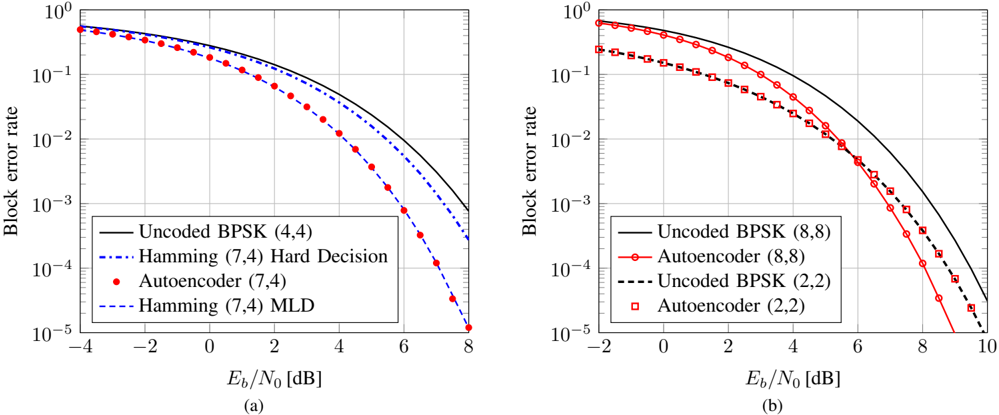
- A learned autoencoder for a (7,4) system at rate R = 4/7 achieves the same block error rate (BLER) as a Hamming (7,4) code with maximum likelihood decoding, while an (8,8) autoencoder outperforms uncoded BPSK over the full E_b/N_0 range, indicating learned joint coding and modulation.
- For the two-user AWGN interference channel, the autoencoder matches time-sharing for (1,1) and (2,2), but achieves gains of about 0.7 dB for (4,4) and 1 dB for (4,8) at a BLER of 10^-3.
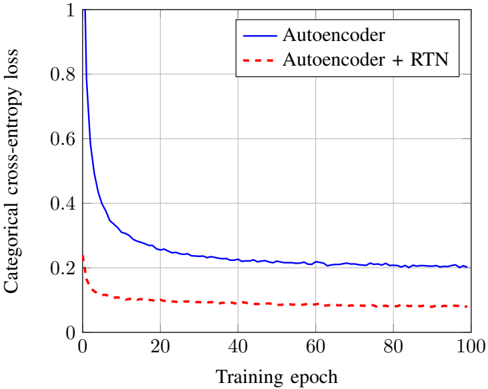
- An autoencoder (8,4) with an RTN over a multipath fading channel with L = 3 Rayleigh taps outperforms differential BPSK with maximum likelihood sequence estimation and a Hamming (7,4) code, whereas the plain autoencoder struggles to match it; RTNs also show faster training convergence.
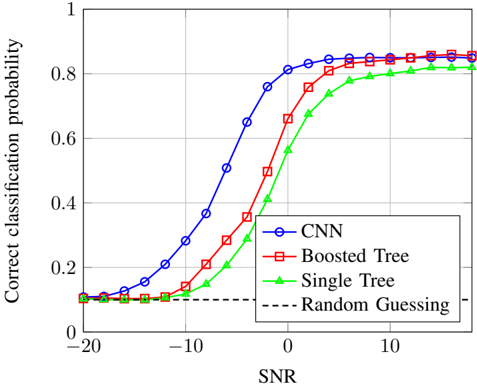
- For modulation classification on 1.2M sequences of 128 complex-valued IQ samples across ten modulation schemes and SNRs from -20 dB to 18 dB, the CNN outperforms a boosted expert-feature classifier by around 4 dB in the low-to-medium SNR range, with almost identical high-SNR performance; a single tree is about 6 dB worse at medium SNR and 3.5% worse at high SNR.
Methods
- The transmitter, channel, and receiver are represented as one deep neural network trained as an autoencoder: one-hot message input, dense layers, normalization layer for transmit constraints, additive noise channel layer, and softmax receiver output, trained with categorical cross-entropy using SGD/Adam at learning rate 0.001 and fixed E_b/N_0 = 7 dB.
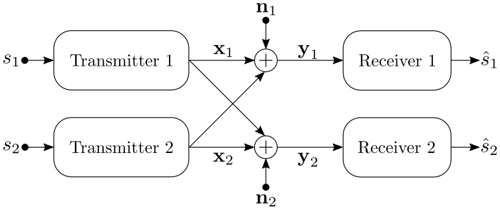
- The autoencoder concept is extended to multiple transmitter-receiver pairs in a two-user interference channel, with dynamic loss weights α_t per mini-batch to balance the two cross-entropy losses; performance is compared against 2^{2k/n}-QAM with time-sharing.
- RTNs combine a learned parameter estimator, a differentiable parametric transform, and a discriminative network; the paper demonstrates phase-offset compensation and multipath inverse filtering. For modulation classification, a VGG-like CNN with 324,330 trainable parameters is trained on the RML2016.10b dataset.
Limitations
- The paper states that scalability to large message sets M is a major challenge: for k = 100 bits, training complexity is prohibitive because the autoencoder must see at least every message once.
- The paper states that optimal data representations, loss functions, training SNR, and hyperparameters are not well understood; training at one SNR does not necessarily generalize to others, and no common communications benchmarks or datasets comparable to MNIST or ImageNet exist.
- The paper states that end-to-end learning over real channels requires system identification because backpropagation assumes a known channel transfer function; complex-valued neural networks are not supported by current DL libraries. Evident from the text: the reported results are simulation-based, use small (n,k) settings, assume known channel models during training, and the paper explicitly leaves detailed performance comparisons for various channel types and parameters to future work.
Model-written summary. Check it against the paper before relying on it.
Integrity signals
Registry
Cites
Statistics
Figures






Verification
Claims the paper makes
6 Valid · 4 Not valid · 18 Not checked · 65 Own results and interpretations
Every source the paper cites for this claim was checked and supports it.
In the paper
“For instance in [22], it was shown that training with a single codeword is sufficient since the structure of the code is embedded in the NN through the Tanner graph.”
What the sources say
- Supportedcites [22] [22] E. Nachmani, Y. Be'ery, and D. Burshtein, 'Learning to decode linear codes using deep learning,' in Proc. IEEE Annu. Allerton Conf. Commun., Control, and Computing (Allerton) , 2016, pp. 341-346. - source
The Introduction says the decoder uses a Tanner graph representing the code and that one codeword suffices for training. Section III explains the precise condition: over a binary memoryless symmetric channel, the decoder’s error rate is independent of the transmitted codeword, so training can use noisy versions of a single codeword. (LLM, conf=0.91)
boostedstates a cause- Asserted: passes — The authors put it forward as true.
- Checkable: passes — It can be checked against evidence.
- Load-bearing: unclear — It is unclear whether the paper’s conclusions depend on it.
- Based: passes — The paper gives a reason why it holds.
- Supported
A result the paper reports from its own data — it cites no other source for it, so there is none to check. The quote shows it is in the paper.
In the paper
“We study the use of NNs on complex-valued IQ samples for the problem of modulation classification and show that convolutional neural networks (CNNs), which are the cornerstone of most DL systems for computer vision, can outperform traditional classification techniques based on expert features.”
plainstates a cause- Asserted: passes — The authors put it forward as true.
- Checkable: passes — It can be checked against evidence.
- Load-bearing: passes — The paper’s conclusions depend on it.
- Based: passes — The paper gives a reason why it holds.
The paper states this without a source or data behind it here, so there is nothing to check it against. The quote shows it is in the paper.
In the paper
“Training at low SNR for instance does not allow for the discovery of structure important in higher SNR scenarios.”
plainstates a cause- Asserted: passes — The authors put it forward as true.
- Checkable: passes — It can be checked against evidence.
- Load-bearing: unclear — It is unclear whether the paper’s conclusions depend on it.
- Based: unclear — It is unclear why the paper says it holds.
A result the paper reports from its own data — it cites no other source for it, so there is none to check. The quote shows it is in the paper.
In the paper
“Another advantage of RTNs is faster training convergence which can be seen from Fig. 10 that compares the validation loss of the autoencoder with and without RTN as a function of the training epochs.”
plainstates a cause- Asserted: passes — The authors put it forward as true.
- Checkable: passes — It can be checked against evidence.
- Load-bearing: unclear — It is unclear whether the paper’s conclusions depend on it.
- Based: passes — The paper gives a reason why it holds.
A result the paper reports from its own data — it cites no other source for it, so there is none to check. The quote shows it is in the paper.
In the paper
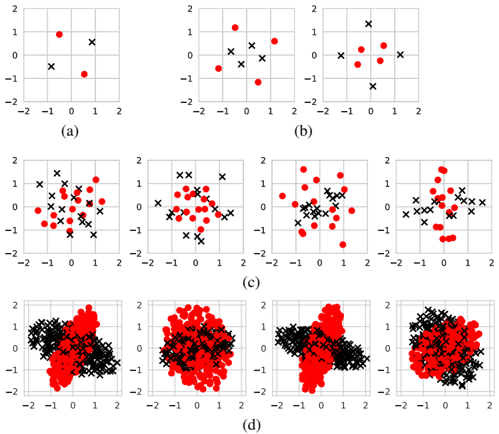
“Similarly, Fig. 4b shows a (4 , 2) system which leads to a rotated 16-PSK constellation.”
plainstates a cause- Asserted: passes — The authors put it forward as true.
- Checkable: passes — It can be checked against evidence.
- Load-bearing: unclear — It is unclear whether the paper’s conclusions depend on it.
- Based: passes — The paper gives a reason why it holds.
39 more claims
Create a free account to see all 93 claims and to verify the 4 references still open.
- Probably not a substantial claim. 29
- It may state two separate claims as one. 24
Self-check
Percentages, sums and reported differences re-computed from the paper’s own numbers.
Each contradiction between two passages listed here was confirmed by an independent check.
Rated minor: it would not touch a result — a value no result rests on, a p-value that stays on the same side of the significance level, or a conflict that is clerical, resolved elsewhere in the paper, or outside its own findings.
In the paper
§ A. Autoencoders for end-to-end communications systems · p. 5
“Similarly, Fig. 4b shows a (4 , 2) system which leads to a rotated 16-PSK constellation.”
§ A. Autoencoders for end-to-end communications systems · p. 6
“Figure 4: Constellations produced by autoencoders using parameters ( n, k ) : (a) (2 , 2) (b) (2 , 4) , (c) (2 , 4) with average power constraint, (d) (7 , 4) 2-dimensional t-SNE embedding of received symbols.”
Citations
Cites
Very Deep Convolutional Networks for Large-Scale Image Recognition
Simonyan, K., & Zisserman, A. (2014) · arXiv · doi:10.48550/arxiv.1409.1556 · Cited by 114,148 · cited 1×
“dense/fully-connected layers and terminated with a dense softmax layer for our classifier (similar to a VGG architecture [55]).”
BackgroundAdam: A Method for Stochastic Optimization
Kingma, D. P., & Ba, J. (2014) · arXiv · doi:10.48550/arxiv.1412.6980 · Cited by 98,946 · cited 4×
“Training was done at a fixed value of Eb/N0 = 7 dB (see Section IV-B) using Adam [46] with learning rate 0.”
BackgroundMethodInfluentialA Mathematical Theory of Communication
Shannon, C. E. (1948) · Bell System Technical Journal · doi:10.1002/j.1538-7305.1948.tb01338.x · Cited by 88,486
Scikit-learn: Machine Learning in Python
Pedregosa, F., Varoquaux, G., Gramfort, A., Michel, V., Thirion, B., Grisel, O., Blondel, M., Müller, A., Nothman, J., Louppe, G., et al. (2012) · arXiv · doi:10.48550/arxiv.1201.0490 · Cited by 71,016 · cited 1×
“11, we compare the classification accuracy of the CNN against that of extreme gradient boosting7 with 1000 estimators, as well as a single scikit-learn decision tree [56], operating on a mix of 16 analog and cumulant expert features as proposed in [53] and [57].”
Method(2014) · Cited by 33,419
(2008) · Journal of Machine Learning Research · Cited by 33,051
Human-level control through deep reinforcement learning
Mnih, V., Kavukcuoglu, K., Silver, D., Rusu, A. A., Veness, J., Bellemare, M. G., Graves, A., Riedmiller, M., Fidjeland, A. K., Ostrovski, G., et al. (2015) · Nature · doi:10.1038/nature14236 · Cited by 30,357
(2007) · Electronics: A First Course · doi:10.4324/9780080477527-64 · Cited by 24,923
Pan, S. J., & Yang, Q. (2010) · IEEE Transactions on Knowledge and Data Engineering · doi:10.1109/tkde.2009.191 · Cited by 23,387 · cited 1×
“learning [64] is one appealing candidate for adapting an endto-end communications system trained on a statistical model to”
BackgroundMultilayer feedforward networks are universal approximators
Hornik, K., Stinchcombe, M., & White, H. (1989) · Neural Networks · doi:10.1016/0893-6080(89)90020-8 · Cited by 21,728 · cited 1×
“Third, it has been shown that NNs are universal function approximators [13] and recent work has shown a remarkable”
Background
Research works printed but not linked: 2
- [35] I. Goodfellow, Y. Bengio, and A. Courville, Deep Learning . MIT Press, 2016. -
- [52] J. Estaran et al. , 'Artificial neural networks for linear and non-linear impairment mitigation in high-baudrate IM/DD systems,' in Proc. 42nd European Conf. Optical Commun. (ECOC) . VDE, 2016, pp. 1-3. -
Cited by
Items 701–800 of 2,995
Sharma, A., Haq, S. A. U., & Darak, S. J. (2024) · IEEE Transactions on Circuits and Systems I Regular Papers · doi:10.1109/tcsi.2024.3371780 · Cited by 30
“Recent works have explored DL for end-to-end design of wireless PHY [2], [3], [4], [5].”
BackgroundMachine Learning-Based Beamforming in K-User MISO Interference Channels
Kwon, H. J., Lee, J. H., & Choi, W. (2021) · IEEE Access · doi:10.1109/access.2021.3058759 · Cited by 24
“In [16], the authors explained several applications of deep learning for the physical layer.”
BackgroundBlind identification of convolutional codes based on deep learning
Wang, J., Tang, C., Huang, H., Wang, H., & Li, J. (2021) · Digital Signal Processing · doi:10.1016/j.dsp.2021.103086 · Cited by 30
LSTM-Autoencoder Deep Learning Technique for PAPR Reduction in Visible Light Communication
Mohamed, A., Eldien, A. S. T., Fouda, M. M., & Saad, R. S. (2022) · IEEE Access · doi:10.1109/access.2022.3216574 · Cited by 27
“Deep learning [14] has been extensively researched in several communication systems, including the encoding and decoding issue [15].”
BackgroundBkassiny, M. (2022) · International Conference on Information Technology, Information Systems and Electrical Engineering (ICITISEE) · doi:10.1109/icitisee57756.2022.10057728 · Cited by 32
Drive Test Minimization Using Deep Learning with Bayesian Approximation
Thrane, J., Artuso, M., Zibar, D., & Christiansen, H. L. (2018) · IEEE Vehicular Technology Conference · doi:10.1109/vtcfall.2018.8690911 · Cited by 24
“The use of Deep Learning (DL) applied to the physical layer has been demonstrated by [9].”
BackgroundMethodDeep Learning-Based Decoding of Constrained Sequence Codes
Cao, C., Li, D., & Fair, I. J. (2019) · IEEE Journal on Selected Areas in Communications · doi:10.1109/jsac.2019.2933954 · Cited by 24
“In addition, DNNs can efficiently execute in parallel and be implemented with low-precision data types on a graphical processing unit (GPU), field programmable gate array (FPGA), or application specific integrated circuit (ASIC) [28], [31]–[33], [35].”
MethodAdversarial Examples in RF Deep Learning: Detection of the Attack and its Physical RobustnessPreprint
Kokalj-Filipović, S., & Miller, R. (2019) · arXiv (Cornell University) · doi:10.48550/arxiv.1902.06044 · Cited by 29
“The research in the area of RF-based DL of the PHY layer is still embryonic [5].”
BackgroundA Photonics-Inspired Compact Network: Toward Real-Time AI Processing in Communication Systems
Peng, H.-T., Lederman, J. C., Xu, L., de Lima, T. F., Huang, C., Shastri, B. J., Rosenbluth, D., & Prucnal, P. R. (2022) · IEEE Journal of Selected Topics in Quantum Electronics · doi:10.1109/jstqe.2022.3195824 · Cited by 27
“On the other hand, in wireless communications, ANNs have found broad applications toward processing the received wireless signals to improve link performance [9], situation awareness [10], and security [1], [3].”
BackgroundUnsupervised-Learning Power Control for Cell-Free Wireless Systems
Nikbakht, R., Jönsson, A., & Lozano, A. (2019) · IEEE International Symposium on Personal, Indoor and Mobile Radio Communications (PIMRC) · doi:10.1109/pimrc.2019.8904394 · Cited by 28
“To scale up the cell-free power control process, we seek to exploit the ability of feedforward neural networks (NNs) to approximate arbitrary function mappings [14], an ability that is also being applied to tackle other problems in wireless communications [15]–[18].”
BackgroundEfficient Channel Charting via Phase-Insensitive Distance Computation
Magoarou, L. L. (2021) · IEEE Wireless Communications Letters · doi:10.1109/lwc.2021.3109295 · Cited by 22
Multimodal Ensemble Deep Learning to Predict Disruptive Behavior Disorders in Children
Menon, S. S., & Krishnamurthy, K. (2021) · Frontiers in Neuroinformatics · doi:10.3389/fninf.2021.742807 · Cited by 26
“The feature maps in the convolution layer are then passed through nonlinear activation functions, such as the rectified linear unit (ReLu) (O’Shea and Hoydis, 2017).”
Optimal physical preprocessing for example-based super-resolution
Robey, A., & Ganapati, V. (2018) · Optics Express · doi:10.1364/oe.26.031333 · Cited by 22
“To solve these problems, we turn to deep learning to optimize the end-to-end communications system, as in [51,52], simulating the entire end-to-end imaging pipeline as a deep neural network.”
MethodData-Rate Driven Transmission Strategies for Deep Learning-Based Communication Systems
Chen, X., Cheng, J., Zhang, Z., Wu, L., Dang, J., & Wang, J. (2020) · IEEE Transactions on Communications · doi:10.1109/tcomm.2020.2968314 · Cited by 28
“Attracted by these advantages, there have been a number of studies on DL-based communications and signal processing using state-of-the-art tools and hardware [19], [20], [22]–[37].”
BackgroundMethodResultInfluentialModel-Driven DNN Decoder for Turbo Codes: Design, Simulation, and Experimental Results
He, Y., Zhang, J., Jin, S., Wen, C.-K., & Li, G. Y. (2020) · IEEE Transactions on Communications · doi:10.1109/tcomm.2020.3010964 · Cited by 31
“The intelligent communication community has attained numerous accomplishments [10]–[12], including channel estimation (CE) [13], signal detection (SD) [14], CE and SD combined orthogonal frequency division multiplexing (OFDM) receivers [15]–[17], channel state information feedback [18], [19], autoencoderbased end-to-e…”
BackgroundLoRa Signal Demodulation Using Deep Learning, a Time-Domain Approach
Dakic, K., Homssi, B. A., Al‐Hourani, A., & Lech, M. (2021) · IEEE Vehicular Technology Conference · doi:10.1109/vtc2021-spring51267.2021.9448711 · Cited by 24
“However, in practice, a system has many non-linearities [12].”
BackgroundWang, H., Fang, H., & Wang, X. (2021) · IEEE Open Journal of the Communications Society · doi:10.1109/ojcoms.2021.3084532 · Cited by 23
Robust ToA-Estimation using Convolutional Neural Networks on Randomized Channel Models
Feigl, T., Eberlein, E., Kram, S., & Mutschler, C. (2021) · International Conference on Indoor Positioning and Indoor Navigation · doi:10.1109/ipin51156.2021.9662625 · Cited by 22
“Others used supervised DL methods to extract CPs from CSI [16].”
MethodLearning Joint Detection, Equalization and Decoding for Short-Packet Communications
Dörner, S., Clausius, J., Cammerer, S., & ten Brink, S. (2022) · IEEE Transactions on Communications · doi:10.1109/tcomm.2022.3228648 · Cited by 28
“Autoencoder-based communication [8] has provided a new paradigm of how to design future communication systems – instead of individually optimized signal-processing blocks, we can now jointly optimize the whole transceiver w.”
BackgroundA Neural Network-Aided Detection Scheme for Index-Modulation DCSK System
Fang, Y., Peng, D., Ma, H., Han, G., & Li, Y. (2023) · IEEE Transactions on Vehicular Technology · doi:10.1109/tvt.2023.3313813 · Cited by 26
Deep-Learning-Based Robust Channel Estimation for MIMO IoT Systems
Kang, J. (2023) · IEEE Internet of Things Journal · doi:10.1109/jiot.2023.3324667 · Cited by 24
“Recently, deep learning (DL) techniques have emerged as promising solutions to improve the performance of wireless communication systems by effectively and intelligently over-coming various technical challenges [23], [24], [25], [26], [27], [28], [29], [30], [31].”
BackgroundDeep Learning Based Antenna Array Fault Detection
Chen, K., Wang, W., Chen, X., & Yin, H. (2019) · IEEE Vehicular Technology Conference · doi:10.1109/vtcspring.2019.8746510 · Cited by 25
“Inspired by the DL’s excellent achievement in regression and classification tasks, many traditional communication problems, such as modulation [9], channel estimation [10] and MIMO detection [11], obtain alternative solutions.”
MethodZhang, J., Xia, W., You, M., Zheng, G., Lambotharan, S., & Wong, K. (2020) · Figshare · Cited by 22
Index-Modulation OAM Detectors Resistant to Beam Misalignment
Chen, M., Chen, R., Zhao, Y., Yang, Z., & Guan, Y. L. (2023) · IEEE Transactions on Vehicular Technology · doi:10.1109/tvt.2023.3312295 · Cited by 32
Multi-Channel Convolutional Distilled Transformer for Automatic Modulation Classification
Chen, Z., Zhang, X., & He, K. (2024) · International Joint Conference on Neural Networks (IJCNN) · doi:10.1109/ijcnn60899.2024.10650112 · Cited by 25
“Consequently, AMC is of great importance in practical applications [2] and has many combinations with machine learning techniques to improve the recognition performance [3].”
BackgroundThe Performance Analysis of Complex-Valued Neural Network in Radio Signal Recognition
Xu, J., Wu, C., Ying, S., & Li, H. (2022) · IEEE Access · doi:10.1109/access.2022.3171856 · Cited by 25
“In [20], O’Shea et al. introduce several novel deep learning applications in the physical layer.”
BackgroundA deep learning driven hybrid beamforming method for millimeter wave MIMO system
Chen, J., Tao, J., Luo, S., Li, S., Zhang, C., & Xiang, W. (2022) · Digital Communications and Networks · doi:10.1016/j.dcan.2022.07.005 · Cited by 25
Mohagheghian, F., Han, D., Ghetia, O., Peitzsch, A. G., Nishita, N., Nejad, M. P. S., Ding, E., Noorishirazi, K., Hamel, A. P., Otabil, E. M., et al. (2023) · IEEE Transactions on Biomedical Engineering · doi:10.1109/tbme.2023.3307400 · Cited by 30
Analysis of the policy guarantee mechanism of rural infrastructure based on deep learning
Jin, X., Zuo, X., Dong, X., Dong, Y., & Ding, H. (2021) · Technological Forecasting and Social Change · doi:10.1016/j.techfore.2021.120605 · Cited by 22
Brumann, C., Kukuk, M., & Reinsberger, C. (2021) · Sensors · doi:10.3390/s21134550 · Cited by 22
“In addition, deep learning has also been successfully applied in the area network data transmission and traffic classification technology [12,13].”
MethodCNN-Based Classification for Highly Similar Vehicle Model Using Multi-Task Learning
Avianto, D., Harjoko, A., & Afiahayati, F. (2022) · Journal of Imaging · doi:10.3390/jimaging8110293 · Cited by 25
“The number of dense layers and the chosen activation functions determine whether a network can solve non-linear problems [59].”
BackgroundA Review on Machine Learning for Channel Coding
Kee, H. L. M., Ahmad, N. B., Izhar, M. A. M., Anwar, K., & Ng, S. X. (2024) · IEEE Access · doi:10.1109/access.2024.3412192 · Cited by 25
Karanov, B., Liga, G., Aref, V., Lavery, D., Bayvel, P., & Schmalen, L. (2019) · Allerton Conference on Communication, Control, and Computing · doi:10.1109/allerton.2019.8919850 · Cited by 21
“Owing to the universal function approximator properties of the ANNs [7], it was proposed in [8], [9] to optimize the complete communication system in a single process spanning from the transmitter input to the”
BackgroundMethodYe, H., Li, G. Y., & Juang, B.-H. F. (2020) · Globecom · doi:10.1109/globecom42002.2020.9321975 · Cited by 23
“The end-to-end communication has been first proposed in [17].”
BackgroundLearning How to Demodulate from Few Pilots via Meta-Learning
Park, S., Jang, H., Simeone, O., & Kang, J. (2019) · IEEE International Workshop on Signal Processing Advances in Wireless Communications (SPAWC) · doi:10.1109/spawc.2019.8815426 · Cited by 24
“This observation has motivated a long line of work on the application of machine learning methods to the design of demodulators or decoders, from the 90s [1] to many recent contributions including [5] and references therein.”
Pesic, J., Lonardi, M., Rossi, N., Zami, T., Seve, E., & Pointurier, Y. (2020) · Optical Fiber Communication Conference · doi:10.1364/ofc.2020.th3d.5 · Cited by 21
Learning to Continuously Optimize Wireless Resource in Episodically Dynamic Environment
Sun, H., Pu, W., Zhu, M., Fu, X., Chang, T.-H., & Hong, M. (2021) · ICASSP 2021 - 2021 IEEE International Conference on Acoustics, Speech and Signal Processing (ICASSP) · doi:10.1109/icassp39728.2021.9413503 · Cited by 21
“Recent works have also demonstrated that deep learning can be applied in communication systems, either by replacing an individual component in the system (such as signal detection [6,7], channel decoding [8], channel estimation [9,10], power allocation [11–15], beamforming [16,17] and wireless scheduling [18]), or by…”
BackgroundAnalysis on the Channel Prediction Accuracy of Deep Learning-based Approach
Son, W.-S., & Han, D. S. (2021) · International Conference on Artificial Intelligence in Information and Communication (ICAIIC) · doi:10.1109/icaiic51459.2021.9415201 · Cited by 22
“In the DL-based vehicular communication system, researchers have proposed different technologies which include modulation recognition [1], signal detection [2], channel equalization [3], and channel estimation [4], [5].”
MethodMeta-ViterbiNet: Online Meta-Learned Viterbi Equalization for Non-Stationary Channels
Raviv, T., Park, S., Shlezinger, N., Simeone, O., Eldar, Y. C., & Kang, J. (2021) · IEEE International Conference on Communications workshops · doi:10.1109/iccworkshops50388.2021.9473693 · Cited by 21
AI Meets CRNs: A Prospective Review on the Application of Deep Architectures in Spectrum Management
Hlophe, M. C., & Maharaj, B. T. (2021) · IEEE Access · doi:10.1109/access.2021.3104099 · Cited by 25
“A typical application of an AE in an end-to-end communication system was discussed in [123], where the transmitter communicates with the receiver over a time-varying wireless channel.”
BackgroundDeep Learning Techniques for OFDM Systems
Meenalakshmi, M., Chaturvedi, S., & Dwivedi, V. K. (2021) · IETE Journal of Research · doi:10.1080/03772063.2021.1986154 · Cited by 24
“The research challenges for DL in the communication area are loss functions, data sets, data representation, training SNR, complex-valued NNs, ML-augmented signal processing, system identification for end-to-end learning, feedback, CSI, and privacy [45].”
BackgroundCunxiang, X., Limin, Z., & Zhaogen, Z. (2021) · Journal of Systems Engineering and Electronics · doi:10.23919/jsee.2021.000097 · Cited by 23
Low-Bitwidth Convolutional Neural Networks for Wireless Interference Identification
Wang, P., Cheng, Y., Peng, Q., Dong, B., & Li, S. (2022) · IEEE Transactions on Cognitive Communications and Networking · doi:10.1109/tccn.2022.3149092 · Cited by 22
CNN-Based Signal Detector for IM-OFDMA
Alaca, O., Althunibat, S., Yarkan, S., Miller, S. L., & Qaraqe, K. A. (2021) · Globecom · doi:10.1109/globecom46510.2021.9685285 · Cited by 23
“The development of the massively parallel processing architectures (e.g., GPUs) and the production of specialized chips with energy efficiency and computational throughput for designed neural network architectures increase the popularity of DL over existing physical layer algorithms [14].”
Zhang, M., Zhang, Y., Cen, Q., & Wu, S. (2022) · International Journal of Distributed Sensor Networks · doi:10.1177/15501329221104330 · Cited by 23
“…of problems in wireless communications, that is, resource allocation optimizations, 6,23,25 channel estimations, 35 and physical layer designs; 36 (3) the increased processing capability of computers due to recent advancements of processors and massively parallel processing architectures,…”
BackgroundA ResNet-DNN based Channel Estimation and Equalization Scheme in FBMC/OQAM Systems
Cheng, X., Liu, D., Zhu, Z., Shi, W., & Li, Y. (2018) · International Conference on Wireless Communications and Signal Processing (WCSP) · doi:10.1109/wcsp.2018.8555649 · Cited by 23
Support Vector Machine-Based Transmit Antenna Allocation for Multiuser Communication Systems
Lin, H., Shin, W.-Y., & Joung, J. (2019) · Entropy · doi:10.3390/e21050471 · Cited by 21
“The whole communication system was interpreted as a machine learning system, i.e., mapping major components in the communication system including the transmitters, channels, and receivers to different layers in a neural network [45,46].”
BackgroundApplication of complex-valued convolutional neural network for next generation wireless networks
Marseet, A. A., & Sahin, F. (2017) · IEEE Western New York Image and Signal Processing Workshop (WNYISPW) · doi:10.1109/wnyipw.2017.8356260 · Cited by 25
“In [16], the author discussed the possibility of the use of CNN”
BackgroundMethodShah, M. H., & Dang, X. (2019) · IEEE Communications Letters · doi:10.1109/lcomm.2019.2927348 · Cited by 21
“can be hugely complex and are more suitable for problems involving high-dimensional data such as image and natural language processing or in case when the raw data is used for modulation classification [19].”
BackgroundReconfigurable Intelligent Surfaces Assisted 6G Communications for Internet of Everything
Ahmad, S., Tariq, M. H., Jan, M. A., & Song, H. (2023) · IEEE Internet of Things Journal · doi:10.1109/jiot.2023.3339531 · Cited by 21
“The aim is to optimize wireless communication systems by leveraging the capabilities of ISAC, RIS, and DDPG in the context of 6G IoE scenarios [15], [16].”
MethodMachine Learning in Adversarial RF Environments
Roy, D., Mukherjee, T., & Chatterjee, M. (2019) · IEEE Communications Magazine · doi:10.1109/mcom.2019.1900031 · Cited by 21
Efficient Autoencoder-Based Human Body Communication Transceiver for WBAN
Ali, A., Inoue, K., Shalaby, A., Sayed, M. S., & Ahmed, S. M. (2019) · IEEE Access · doi:10.1109/access.2019.2936796 · Cited by 21
“In a recent study, the whole conventional system was replaced with an end-to-end reconstruction task using autoencoder [16].”
MethodXu, C., Luong, T. V., Xiang, L., Sugiura, S., Maunder, R. G., Yang, L., & Hanzo, L. (2022) · IEEE Transactions on Cognitive Communications and Networking · doi:10.1109/tccn.2022.3168725 · Cited by 28
“…glance, inspired by the concept of deep unfolding, where iterative decoding is expanded by serial concatenated DNN layers, the AE-based solution of [13] was shown to be capable of reconstructing the encoder and decoder of a Hamming code for transmission over additive white Gaussian noise (AWGN)…”
BackgroundMethodAnsari, S., Mahmoud, S. A., Majzoub, S., Almajali, E. R., Jarndal, A., & Bonny, T. (2025) · IEEE Access · doi:10.1109/access.2025.3564032 · Cited by 26
Privacy-Preserving Decentralized Inference With Graph Neural Networks in Wireless Networks
Lee, M., Yu, G., & Dai, H. (2023) · IEEE Transactions on Wireless Communications · doi:10.1109/twc.2023.3279442 · Cited by 27
“…attracting increasing interest, and shown to outperform traditional model-based design paradigms in many wireless applications, such as resource allocation [2], [3], [4], [5], [6], [7], [8], [9], [10], [11], [12], [13], networking [14], [15], and physical layer design [16], [17], [18], [19], [20].”
BackgroundKnowledge-Driven Machine Learning and Applications in Wireless Communications
Li, D., Xu, Y., Zhao, M., Zhu, J., & Zhang, S. (2021) · IEEE Transactions on Cognitive Communications and Networking · doi:10.1109/tccn.2021.3128597 · Cited by 22
Sokienah, Y. Y. (2023) · Heliyon · doi:10.1016/j.heliyon.2023.e22869 · Cited by 26
“However, on a fundamental level, and not to get too technical in this paper, IoT is where one can connect daily objects to the Internet through receivers ’ interpreters and networking capabilities [17,18].”
BackgroundApplication of Adversarial Examples in Communication Modulation Classification
Ke, D., Huang, Z., Wang, X., & Sun, L. (2019) · IEEE ... International Conference on Data Mining workshops · doi:10.1109/icdmw.2019.00128 · Cited by 23
“The convolutional network for radio modulation recognition is proposed in [8] [9], and the simulations with a dataset called RML2016:10b show that the classification accuracy is higher than those with expert feature engineering.”
MethodChannel Estimation in C-V2X using Deep Learning
Sattiraju, R., Weinand, A., & Schotten, H. D. (2019) · IEEE International Conference on Advanced Networks and Telecommunications Systems · doi:10.1109/ants47819.2019.9117972 · Cited by 22
“Initially applied to upper layers [4], ML has recently found applications also at the PHY Layer [5]–[7] such as channel coding [8]–[10], modulation recognition [7], obstacle detection [11], [12] and physical layer security [13] etc.”
MethodEfficient Selection on Spatial Modulation Antennas: Learning or Boosting
Zhang, Y., Wang, J., Wang, X., Xue, Y., & Song, J. (2020) · IEEE Wireless Communications Letters · doi:10.1109/lwc.2020.2986974 · Cited by 21
“about its application in the communication systems, especially in physical layers [9]–[11].”
BackgroundReinforcement Learning for Channel Coding: Learned Bit-Flipping Decoding
Carpi, F., Häger, C., Martalò, M., Raheli, R., & Pfister, H. D. (2019) · Chalmers Research (Chalmers University of Technology) · Cited by 21
A Study on Deep Learning for Latency Constraint Applications in Beyond 5G Wireless Systems
Sritharan, S., Weligampola, H., & Gacanin, H. (2020) · IEEE Access · doi:10.1109/access.2020.3040133 · Cited by 23
“In [21], the authors redesign the classical communication protocol as an autoencoder, and propose a DNN based solution for the physical layer to enhance”
BackgroundUsman, M., & Lee, J. (2020) · International Conference on Information and Communication Technology Convergence (ICTC) · doi:10.1109/ictc49870.2020.9289261 · Cited by 20
“The DL algorithm have been utilized by [22], [23] and [24], in the complex-valued temporal signal domain.”
Model-Based and Data-Driven Approaches for Downlink Massive MIMO Channel Estimation
Ghazanfari, A., Chien, T. V., Björnson, E., & Larsson, E. G. (2021) · IEEE Transactions on Communications · doi:10.1109/tcomm.2021.3133939 · Cited by 23
Over-the-fiber Digital Predistortion Using Reinforcement Learning
Song, J., He, Z., Häger, C., Karlsson, M., Amat, A. G. I., Wymeersch, H., & Schröder, J. (2021) · European Conference on Optical Communication · doi:10.1109/ecoc52684.2021.9605972 · Cited by 20
Gümüş, M., & Duman, T. M. (2023) · IEEE Transactions on Wireless Communications · doi:10.1109/twc.2023.3270236 · Cited by 23
“Therefore, we use datasets consisting of 450 , 000 OFDM symbols generated by random SNR values between [15 dB, 25 dB ] for training.”
BackgroundMethodAnti-Modulation-Classification Transmitter Design Against Deep Learning Approaches
He, B., & Wang, F. (2023) · IEEE Transactions on Wireless Communications · doi:10.1109/twc.2023.3335050 · Cited by 21
“Following the general setup of the deep-learning-based-modulation classification community [16], [17], [18], [19], [35], we assume that Eve adopts the deep neural network trained on the raw time-domain samples to classify the unknown modulation format.”
BackgroundMethodChien, T. V., Le, H. A., Tùng, T. H., Ngo, H. Q., & Chatzinotas, S. (2024) · IEEE Internet of Things Journal · doi:10.1109/jiot.2024.3423008 · Cited by 23
“…learning (ML) in general, especially deep learning in particular, has appeared as a promising technology to handle numerous complicated problems in radio communication systems and IoT networks, such as channel estimation [21], radio resource allocation [22], [23], signal decoding [24], and so on.”
BackgroundExploiting Gaussian Mixture Model Clustering for Full-Duplex Transceiver Design
Chen, J., Zhang, L., & Liang, Y. (2019) · IEEE Transactions on Communications · doi:10.1109/tcomm.2019.2915225 · Cited by 22
“spectral efficiency and detection accuracy) [30]–[35].”
BackgroundTurhan, M., Öztürk, E., & Çırpan, H. A. (2019) · IEEE International Symposium on Personal, Indoor and Mobile Radio Communications (PIMRC) · doi:10.1109/pimrc.2019.8904193 · Cited by 23
“In [23] and [24], a communication system has been considered as an autoencoder and communicating binary information through an impaired channel has been treated as reconstruction optimization over impairment layers in a channel autoencoder.”
Fedrec: Federated Learning of Universal Receivers Over Fading Channels
Mashhadi, M. B., Shlezinger, N., Eldar, Y. C., & Gündüz, D. (2021) · IEEE Statistical Signal Processing Workshop (SSP) · doi:10.1109/ssp49050.2021.9513736 · Cited by 27
“ata-driven fashion [6]. Consequently, a multitude of NN-based receiver architectures, which can operate without the prior knowledge of the underlying statistical model, have been proposed, see, e.g., [7]–[12]. NN-based receivers require labeled data to learn their mapping. If one has prior knowledge of the expected ch…”
BackgroundDeep Complex Networks for Protocol-Agnostic Radio Frequency Device Fingerprinting in the WildPreprint
Agadakos, I., Agadakos, N., Polakis, J., & Amer, M. R. (2019) · arXiv (Cornell University) · doi:10.48550/arxiv.1909.08703 · Cited by 25
“O’Shea and Hoydis [69] identified some crucial problems such as the non-holomorphic nature of common activation functions, which was addressed in [14].”
InfluentialLu, Q., Lin, T. R., & Zhu, Y. (2021) · IEEE Access · doi:10.1109/access.2021.3108625 · Cited by 22
“There have been some works that jointly optimize multiple communication modules and achieve competitive performance [31]–[33].”
BackgroundEfficient Deep Unfolding for SISO-OFDM Channel Estimation
Chatelier, B., Magoaroul, L. L., & Redieteab, G. (2022) · ICC 2023 - IEEE International Conference on Communications · doi:10.1109/icc45041.2023.10278825 · Cited by 19
“Recently, machine learning techniques have emerged as a promising solution in many wireless communications areas [1], [2] such as beamforming [3], [4], channel charting [5]–[7] or channel mapping [8], [9].”
BackgroundDemodNet: Learning Soft Demodulation from Hard Information Using Convolutional Neural Network
Zheng, S., Zhou, X., Chen, S., Qi, P., Lou, C., & Yang, X. (2022) · International Conference on Communications · doi:10.1109/icc45855.2022.9882269 · Cited by 27
“With the development of deep learning technology, the application of deep learning in physical layer communication is becoming more and more extensive [4]–[7].”
BackgroundMethodDeep Multi-Task Learning for Cooperative NOMA: System Design and Principles
Lu, Y., Cheng, P., Chen, Z., Mow, W. H., Li, Y., & Vucetic, B. S. (2020) · IEEE Journal on Selected Areas in Communications · doi:10.1109/jsac.2020.3036943 · Cited by 22
“Another critical issue is that, in the most literature [22], [24], L(s,ŝ)(f ′, g′) only represents the symbol-level CE loss with softmax activation function [14], where s is”
BackgroundMethodInfluentialLearning Optimal Fronthauling and Decentralized Edge Computation in Fog Radio Access Networks
Lee, H., Kim, J., & Park, S.-H. (2021) · IEEE Transactions on Wireless Communications · doi:10.1109/twc.2021.3068578 · Cited by 22
“To combat wireless fading fronthaul channels, it would be an interesting future work to adopt channel autoencoder techniques [35], [42], [43] for the message-generating inferences.”
MethodImproving Cell-Free Massive MIMO by Local Per-Bit Soft Detection
D’Andrea, C., & Larsson, E. G. (2021) · IEEE Communications Letters · doi:10.1109/lcomm.2021.3071925 · Cited by 20
Pedestrian Trajectory Prediction Based on Transfer Learning for Human-Following Mobile Robots
Akabane, R., & Kato, Y. (2021) · IEEE Access · doi:10.1109/access.2021.3111917 · Cited by 24
“There are many successful application of Deep Learning methods to several verticals, including communications and networking [3], [4].”
MethodAI-assisted PHY technologies for 6G and beyond wireless networksPreprint
Sattiraju, R., Weinand, A., & Schotten, H. D. (2019) · arXiv (Cornell University) · doi:10.48550/arxiv.1908.09523 · Cited by 20
“Some of the examples include obstacle detection [2] and localization [3], channel coding [4], [5], modulation recognition [6], physical layer security [7], and channel estimation and equalization [8].”
BackgroundZhang, M., Abdi, M., Dasari, V. R., & Restuccia, F. (2025) · Computer Networks · doi:10.1016/j.comnet.2025.111531 · Cited by 45
Distributed Interference Alignment for K-user Interference Channels via Deep Learning
Mishra, R., Chahine, K., Kim, H., Jafar, S. A., & Vishwanath, S. (2021) · IEEE International Symposium on Information Theory (ISIT) · doi:10.1109/isit45174.2021.9517735 · Cited by 20
Deep-learning Autoencoder for Coherent and Nonlinear Optical CommunicationPreprint
Uhlemann, T., Cammerer, S., Span, A., Dörner, S., & ten Brink, S. (2020) · arXiv (Cornell University) · doi:10.48550/arxiv.2006.15027 · Cited by 19
“On the other hand, deep learning-driven communications [3] has become a promising and active research topic, in particular, in the wireless domain [4], [5].”
BackgroundLabel-Assisted Transmission for Short Packet Communications: A Machine Learning Approach
Zhang, Q., Liang, P. P., Huang, Y., Pei, Y., & Liang, Y. (2018) · IEEE Transactions on Vehicular Technology · doi:10.1109/tvt.2018.2851619 · Cited by 19
“Inspired by the recent success of machine learning approaches in wireless communications [23]–[25], in this paper, we propose a novel framework to design the transceiver for SPC.”
MethodYuanmeng (2021) · Journal of Intelligent & Fuzzy Systems · doi:10.3233/jifs-219166 · Cited by 21
ICINet: ICI-Aware Neural Network Based Channel Estimation for Rapidly Time-Varying OFDM Systems
Sun, Y., Shen, H., Du, Z., Peng, L., & Zhao, C. (2021) · IEEE Communications Letters · doi:10.1109/lcomm.2021.3090151 · Cited by 20
Adversarial Machine Learning for Enhanced Spread Spectrum Communications
Fadul, M. K. M., Reising, D. R., Arasu, K. T., & Clark, M. R. (2021) · IEEE Military Communications Conference (MILCOM) · doi:10.1109/milcom52596.2021.9652911 · Cited by 22
“…work in [16] did not apply energy constraints, which can significantly impact system performance and assessment results by allowing individual entries within the spread signal to exceed a magnitude is adopted, where x is the spread signal at the output of Alice and n is the number of bits in x [3].”
BackgroundInfluential5G cascaded channel estimation using convolutional neural networks
Coutinho, F. D. L., Silva, H. S., Georgieva, P., & Oliveira, A. S. R. (2022) · Digital Signal Processing · doi:10.1016/j.dsp.2022.103483 · Cited by 26
SVD-Embedded Deep Autoencoder for MIMO Communications
Zhang, X., Vaezi, M., & O’Shea, T. J. (2022) · International Conference on Communications · doi:10.1109/icc45855.2022.9838265 · Cited by 24
Self-citationUDSem: A Unified Distributed Learning Framework for Semantic Communications Over Wireless Networks
Nan, G., Liu, X., Lyu, X., Cui, Q., Xu, X., & Zhang, P. (2023) · IEEE Network · doi:10.1109/mnet.131.2200409 · Cited by 19
“The rationale behind this is: SC inherently relies on deep neural networks (DNN) to boost communication efficiency by learning to transmit only the semantics of data rather than the whole [4].”
BackgroundAge of Information in Deep Learning-Driven Task-Oriented Communications
Sagduyu, Y. E., Ulukuş, Ş., & Yener, A. (2023) · IEEE Conference on Computer Communications Workshops (INFOCOM WKSHPS) · doi:10.1109/infocomwkshps57453.2023.10226176 · Cited by 23
“This setting is different from autoencoder communications [24] that typically processes symbols (bits) as input at the transmitter and reconstructs them at the receiver, i.”
BackgroundZhang, Y., Hou, J., & Liu, H. (2023) · IEEE Transactions on Vehicular Technology · doi:10.1109/tvt.2023.3333665 · Cited by 19
Yuan, W., Chen, C., Li, F., Li, Y., Zhang, H., Liu, Y., Li, Z., Shen, C., Zhang, J., Chi, N., et al. (2024) · Journal of Lightwave Technology · doi:10.1109/jlt.2023.3348834 · Cited by 21
Saetan, W., & Thipchaksurat, S. (2019) · International Conference on Electrical Engineering/Electronics, Computer, Telecommunications and Information Technology (ECTI-CON) · doi:10.1109/ecti-con47248.2019.8955410 · Cited by 27
“For instance, In [7], overview on deep learning applications to wireless communications has been introduced.”
BackgroundConditional Mutual Information Neural Estimator
Molavipour, S., Bassi, G., & Skoglund, M. (2020) · IEEE International Conference on Acoustics Speech and Signal Processing · doi:10.1109/icassp40776.2020.9053422 · Cited by 19
“On the other hand, neural networks have also been applied in communication setups as part of the encoder/decoder blocks [10, 11, 12].”
MethodPower Allocation Based on Reinforcement Learning for MIMO System With Energy Harvesting
Mu, X., Zhao, X., & Liang, H. P. (2020) · IEEE Transactions on Vehicular Technology · doi:10.1109/tvt.2020.2993275 · Cited by 25
“This popular data-driven approach can overcome complicated problems and demonstrate better performance in different communication scenarios [29].”
BackgroundDeep learning based wiretap coding via mutual information estimation
Fritschek, R., Schaefer, R. F., & Wunder, G. (2020) · ACM Workshop on Wireless Security and Machine Learning (WiseML) · doi:10.1145/3395352.3402654 · Cited by 20
“A recent branch of this new direction are end-to-end learning approaches, where autoencoders are used to simultaneously learn appropriate encoding and decoding functions to optimally transmit messages over a noisy channel [28].”
BackgroundDealing with CSI Compression to Reduce Losses and Overhead: An Artificial Intelligence Approach
Shehzad, M. K., Rose, L., & Assaad, M. (2021) · IEEE International Conference on Communications workshops · doi:10.1109/iccworkshops50388.2021.9473840 · Cited by 19
“Interestingly, artificial intelligence (AI) has paved the way in many applications of wireless communication, and it has emerged as a paradigm shift in future needs [8], [9].”
BackgroundBlind Estimation of Code Parameters for Product Codes Over Noisy Channel Conditions
Swaminathan, R., Madhukumar, A. S., & Wang, G. (2019) · IEEE Transactions on Aerospace and Electronic Systems · doi:10.1109/taes.2019.2934308 · Cited by 19
Machine Learning in Energy Efficiency Optimization
Imran, M. A., dos Reis, A. F., Brante, G. G. D. O., Klaine, P. V., & Souza, R. D. (2019) · Wiley eBooks · doi:10.1002/9781119562306.ch6 · Cited by 19
Metadata
- Authors
- O'Shea, T., & Hoydis, J.
- Affiliations
- Nokia (France) (FR)
- Venue
- IEEE Transactions on Cognitive Communications and Networking
- Published
- 2017-12
- Volume
- 3
- Issue
- 4
- Pages
- 563-575
- ISSN
- 2332-7731 (ISSN-L)
- OpenAlex
- W2734408173
- Semantic Scholar
- 78989616eeeac55b202e3e4205225e7135054185
- Cited by
- 2,980
- References
- 69
- Citations by year
- 2026: 307 · 2025: 327 · 2024: 305 · 2023: 368 · 2022: 432 · 2021: 409 · 2020: 406 · 2019: 322 · 2018: 95 · 2017: 9
- FWCI
- 122.29
- Type
- journal article
- Language
- en
- Open access
- green
- arxiv.org
- Locations
- IEEE Transactions on Cognitive Communications and Networking (publishedVersion)
- arXiv (Cornell University) (submittedVersion)
- arXiv (Cornell University)
- Topics
- Physical Sciences › Computer Science › Artificial Intelligence › Wireless Signal Modulation Classification
- Physical Sciences › Engineering › Electrical and Electronic Engineering › Advanced Wireless Communication Techniques
- Physical Sciences › Engineering › Electrical and Electronic Engineering › Advanced Wireless Communication Technologies
- Keywords
- end-to-end reconstruction, domain knowledge integration, convolutional neural networks, automatic modulation classification, IQ samples
About these checks
Registry, retraction, Cites and statistics results are computed, not judged, with one exception: a printed reference that no index lists is read once by a model before it counts as a citation error. Claims are extracted by a model and kept only when their quote appears verbatim in the text; each cited source is then checked, with a model’s help, for whether it says what the claim relies on. Those verdicts can be wrong — read the claim’s quote and the cited source before relying on one.
The claim verdicts this report counts are experimental: their accuracy is not yet measured.
A language model drew the claims from the paper on 2026-11-07, under version 3 of the claim definition (model deepseek-v4.1-flash, prompt extract-v3).
A second model labelled each claim on 2026-11-07 (model jev-1.13-20260917, definition revision gold-guideline-v0.2).
Cited sources are checked with a language model’s help (gpt-6-sol).
Statistics and arithmetic are recomputed, not judged.
Confidence bands are shown only for fields calibrated on our annotated test set. None is calibrated yet, so no band is shown.
What counts as a claim ›How we measure confidence ›How we check this ›
Are you an author, or do you see a problem with this page? Request a review
Data sources
Bibliographic data: Semantic Scholar, OpenAlex, Crossref.
Contains information from the Semantic Scholar Academic Graph Datasets, made available under the ODC Attribution License (ODC-BY 1.0).
Semantic Scholar’s data is described in: Kinney, R., et al. (2023). The Semantic Scholar Open Data Platform. arXiv:2301.10140.
