

An Introduction to Deep Learning for the Physical Layer
Open accessThe DOI matches its Crossref record; 90 of the 92 references it cites were found in a registry or an index, and 2 are not checked yet; 8 of the 32 sources its claims cite were checked for support.
Abstract
We present and discuss several novel applications of deep learning for the physical layer. By interpreting a communications system as an autoencoder, we develop a fundamental new way to think about communications system design as an end-to-end reconstruction task that seeks to jointly optimize transmitter and receiver components in a single process. We show how this idea can be extended to networks of multiple transmitters and receivers and present the concept of radio transformer networks as a means to incorporate expert domain knowledge in the machine learning model. Lastly, we demonstrate the application of convolutional neural networks on raw IQ samples for modulation classification which achieves competitive accuracy with respect to traditional schemes relying on expert features. This paper is concluded with a discussion of open challenges and areas for future investigation.
Verified 2026-11-19 · 2 references not checked yet
Overview
CoChat Summary
TL;DR
The paper introduces deep learning for the physical layer by treating a communications system as an autoencoder that jointly learns transmitter and receiver implementations end-to-end. It also extends this idea to multi-user interference channels, proposes radio transformer networks (RTNs) to inject expert domain knowledge, and shows CNNs on raw IQ samples can outperform expert-feature modulation classifiers.
Key findings
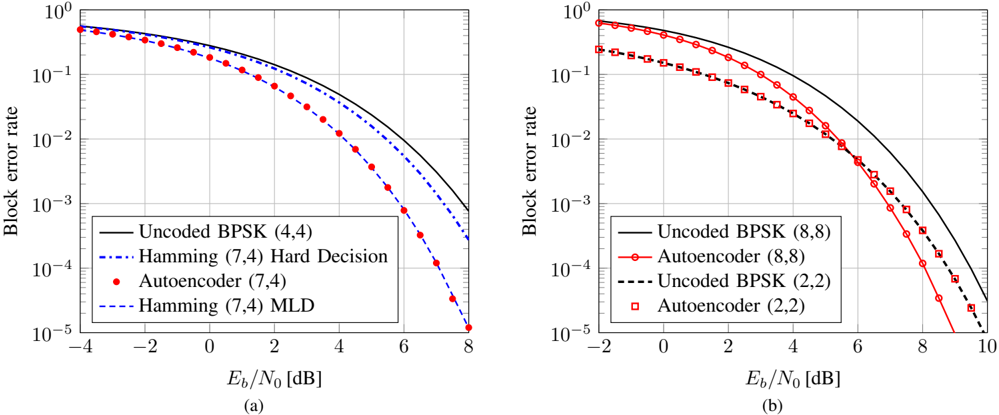
- A learned autoencoder for a (7,4) system at rate R = 4/7 achieves the same block error rate (BLER) as a Hamming (7,4) code with maximum likelihood decoding, while an (8,8) autoencoder outperforms uncoded BPSK over the full E_b/N_0 range, indicating learned joint coding and modulation.
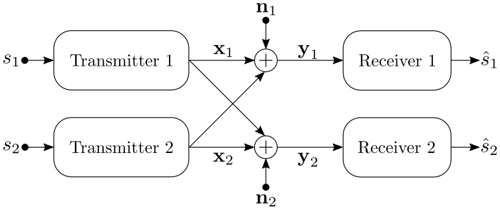
- For the two-user AWGN interference channel, the autoencoder matches time-sharing for (1,1) and (2,2), but achieves gains of about 0.7 dB for (4,4) and 1 dB for (4,8) at a BLER of 10^-3.
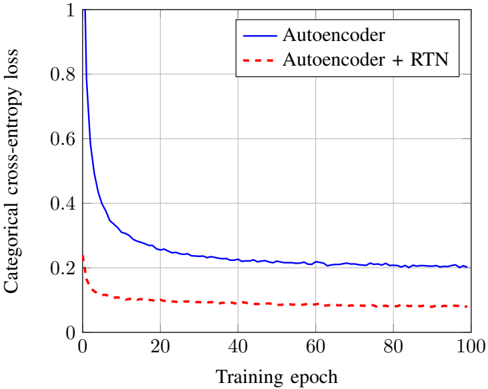
- An autoencoder (8,4) with an RTN over a multipath fading channel with L = 3 Rayleigh taps outperforms differential BPSK with maximum likelihood sequence estimation and a Hamming (7,4) code, whereas the plain autoencoder struggles to match it; RTNs also show faster training convergence.
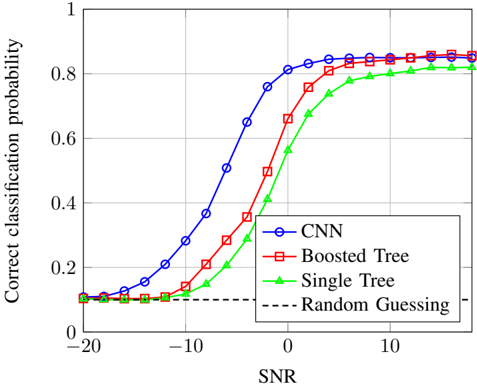
- For modulation classification on 1.2M sequences of 128 complex-valued IQ samples across ten modulation schemes and SNRs from -20 dB to 18 dB, the CNN outperforms a boosted expert-feature classifier by around 4 dB in the low-to-medium SNR range, with almost identical high-SNR performance; a single tree is about 6 dB worse at medium SNR and 3.5% worse at high SNR.
Methods
- The transmitter, channel, and receiver are represented as one deep neural network trained as an autoencoder: one-hot message input, dense layers, normalization layer for transmit constraints, additive noise channel layer, and softmax receiver output, trained with categorical cross-entropy using SGD/Adam at learning rate 0.001 and fixed E_b/N_0 = 7 dB.
- The autoencoder concept is extended to multiple transmitter-receiver pairs in a two-user interference channel, with dynamic loss weights α_t per mini-batch to balance the two cross-entropy losses; performance is compared against 2^{2k/n}-QAM with time-sharing.
- RTNs combine a learned parameter estimator, a differentiable parametric transform, and a discriminative network; the paper demonstrates phase-offset compensation and multipath inverse filtering. For modulation classification, a VGG-like CNN with 324,330 trainable parameters is trained on the RML2016.10b dataset.
Limitations
- The paper states that scalability to large message sets M is a major challenge: for k = 100 bits, training complexity is prohibitive because the autoencoder must see at least every message once.
- The paper states that optimal data representations, loss functions, training SNR, and hyperparameters are not well understood; training at one SNR does not necessarily generalize to others, and no common communications benchmarks or datasets comparable to MNIST or ImageNet exist.
- The paper states that end-to-end learning over real channels requires system identification because backpropagation assumes a known channel transfer function; complex-valued neural networks are not supported by current DL libraries. Evident from the text: the reported results are simulation-based, use small (n,k) settings, assume known channel models during training, and the paper explicitly leaves detailed performance comparisons for various channel types and parameters to future work.
Model-written summary. Check it against the paper before relying on it.
Integrity signals
Registry
Cites
Statistics
Figures






Verification
Claims the paper makes
6 Valid · 4 Not valid · 18 Not checked · 65 Own results and interpretations
Every source the paper cites for this claim was checked and supports it.
In the paper
“For instance in [22], it was shown that training with a single codeword is sufficient since the structure of the code is embedded in the NN through the Tanner graph.”
What the sources say
- Supportedcites [22] [22] E. Nachmani, Y. Be'ery, and D. Burshtein, 'Learning to decode linear codes using deep learning,' in Proc. IEEE Annu. Allerton Conf. Commun., Control, and Computing (Allerton) , 2016, pp. 341-346. - source
The Introduction says the decoder uses a Tanner graph representing the code and that one codeword suffices for training. Section III explains the precise condition: over a binary memoryless symmetric channel, the decoder’s error rate is independent of the transmitted codeword, so training can use noisy versions of a single codeword. (LLM, conf=0.91)
boostedstates a cause- Asserted: passes — The authors put it forward as true.
- Checkable: passes — It can be checked against evidence.
- Load-bearing: unclear — It is unclear whether the paper’s conclusions depend on it.
- Based: passes — The paper gives a reason why it holds.
- Supported
A result the paper reports from its own data — it cites no other source for it, so there is none to check. The quote shows it is in the paper.
In the paper
“We study the use of NNs on complex-valued IQ samples for the problem of modulation classification and show that convolutional neural networks (CNNs), which are the cornerstone of most DL systems for computer vision, can outperform traditional classification techniques based on expert features.”
plainstates a cause- Asserted: passes — The authors put it forward as true.
- Checkable: passes — It can be checked against evidence.
- Load-bearing: passes — The paper’s conclusions depend on it.
- Based: passes — The paper gives a reason why it holds.
The paper states this without a source or data behind it here, so there is nothing to check it against. The quote shows it is in the paper.
In the paper
“Training at low SNR for instance does not allow for the discovery of structure important in higher SNR scenarios.”
plainstates a cause- Asserted: passes — The authors put it forward as true.
- Checkable: passes — It can be checked against evidence.
- Load-bearing: unclear — It is unclear whether the paper’s conclusions depend on it.
- Based: unclear — It is unclear why the paper says it holds.
A result the paper reports from its own data — it cites no other source for it, so there is none to check. The quote shows it is in the paper.
In the paper
“Another advantage of RTNs is faster training convergence which can be seen from Fig. 10 that compares the validation loss of the autoencoder with and without RTN as a function of the training epochs.”
plainstates a cause- Asserted: passes — The authors put it forward as true.
- Checkable: passes — It can be checked against evidence.
- Load-bearing: unclear — It is unclear whether the paper’s conclusions depend on it.
- Based: passes — The paper gives a reason why it holds.
A result the paper reports from its own data — it cites no other source for it, so there is none to check. The quote shows it is in the paper.
In the paper
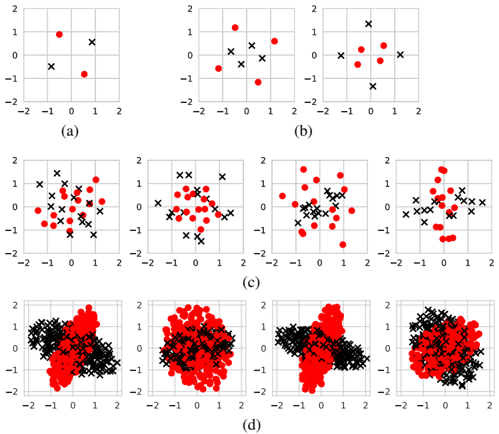
“Similarly, Fig. 4b shows a (4 , 2) system which leads to a rotated 16-PSK constellation.”
plainstates a cause- Asserted: passes — The authors put it forward as true.
- Checkable: passes — It can be checked against evidence.
- Load-bearing: unclear — It is unclear whether the paper’s conclusions depend on it.
- Based: passes — The paper gives a reason why it holds.
39 more claims
Create a free account to see all 93 claims and to verify the 4 references still open.
- Probably not a substantial claim. 29
- It may state two separate claims as one. 24
Self-check
Percentages, sums and reported differences re-computed from the paper’s own numbers.
Each contradiction between two passages listed here was confirmed by an independent check.
Rated minor: it would not touch a result — a value no result rests on, a p-value that stays on the same side of the significance level, or a conflict that is clerical, resolved elsewhere in the paper, or outside its own findings.
In the paper
§ A. Autoencoders for end-to-end communications systems · p. 5
“Similarly, Fig. 4b shows a (4 , 2) system which leads to a rotated 16-PSK constellation.”
§ A. Autoencoders for end-to-end communications systems · p. 6
“Figure 4: Constellations produced by autoencoders using parameters ( n, k ) : (a) (2 , 2) (b) (2 , 4) , (c) (2 , 4) with average power constraint, (d) (7 , 4) 2-dimensional t-SNE embedding of received symbols.”
Citations
Cites
Very Deep Convolutional Networks for Large-Scale Image Recognition
Simonyan, K., & Zisserman, A. (2014) · arXiv · doi:10.48550/arxiv.1409.1556 · Cited by 114,148 · cited 1×
“dense/fully-connected layers and terminated with a dense softmax layer for our classifier (similar to a VGG architecture [55]).”
BackgroundAdam: A Method for Stochastic Optimization
Kingma, D. P., & Ba, J. (2014) · arXiv · doi:10.48550/arxiv.1412.6980 · Cited by 98,946 · cited 4×
“Training was done at a fixed value of Eb/N0 = 7 dB (see Section IV-B) using Adam [46] with learning rate 0.”
BackgroundMethodInfluentialA Mathematical Theory of Communication
Shannon, C. E. (1948) · Bell System Technical Journal · doi:10.1002/j.1538-7305.1948.tb01338.x · Cited by 88,486
Scikit-learn: Machine Learning in Python
Pedregosa, F., Varoquaux, G., Gramfort, A., Michel, V., Thirion, B., Grisel, O., Blondel, M., Müller, A., Nothman, J., Louppe, G., et al. (2012) · arXiv · doi:10.48550/arxiv.1201.0490 · Cited by 71,016 · cited 1×
“11, we compare the classification accuracy of the CNN against that of extreme gradient boosting7 with 1000 estimators, as well as a single scikit-learn decision tree [56], operating on a mix of 16 analog and cumulant expert features as proposed in [53] and [57].”
Method(2014) · Cited by 33,419
(2008) · Journal of Machine Learning Research · Cited by 33,051
Human-level control through deep reinforcement learning
Mnih, V., Kavukcuoglu, K., Silver, D., Rusu, A. A., Veness, J., Bellemare, M. G., Graves, A., Riedmiller, M., Fidjeland, A. K., Ostrovski, G., et al. (2015) · Nature · doi:10.1038/nature14236 · Cited by 30,357
(2007) · Electronics: A First Course · doi:10.4324/9780080477527-64 · Cited by 24,923
Pan, S. J., & Yang, Q. (2010) · IEEE Transactions on Knowledge and Data Engineering · doi:10.1109/tkde.2009.191 · Cited by 23,387 · cited 1×
“learning [64] is one appealing candidate for adapting an endto-end communications system trained on a statistical model to”
BackgroundMultilayer feedforward networks are universal approximators
Hornik, K., Stinchcombe, M., & White, H. (1989) · Neural Networks · doi:10.1016/0893-6080(89)90020-8 · Cited by 21,728 · cited 1×
“Third, it has been shown that NNs are universal function approximators [13] and recent work has shown a remarkable”
Background
Research works printed but not linked: 2
- [35] I. Goodfellow, Y. Bengio, and A. Courville, Deep Learning . MIT Press, 2016. -
- [52] J. Estaran et al. , 'Artificial neural networks for linear and non-linear impairment mitigation in high-baudrate IM/DD systems,' in Proc. 42nd European Conf. Optical Commun. (ECOC) . VDE, 2016, pp. 1-3. -
Cited by
Items 801–900 of 2,995
Deep unfolding of the weighted MMSE beamforming algorithmPreprint
Pellaco, L., Bengtsson, M., & Jaldén, J. (2020) · arXiv.org · doi:10.48550/arxiv.2006.08448 · Cited by 25
An Analysis of Complex-Valued CNNs for RF Data-Driven Wireless Device Classification
Chen, J., Wong, W.-K., Hamdaoui, B., Elmaghbub, A., Sivanesan, K., Dorrance, R., & Yang, L. (2022) · International Conference on Communications · doi:10.1109/icc45855.2022.9838694 · Cited by 21
“proaches to hand-craft and design features [6], [9], [10].”
Deep Learning Based Channel Estimation in High Mobility Communications Using Bi-RNN Networks
Gizzini, A. K., & Chafii, M. (2023) · International Conference on Communications · doi:10.1109/icc45041.2023.10278783 · Cited by 24
“Recently, deep learning (DL) algorithms have been integrated into wireless communications physical layer applications [5] including channel estimation [6]–[11], due to its great success in improving the overall system performance, especially when used on top of low-complexity conventional estimators.”
BackgroundLiu, H., Liu, Y., Yang, M. H., & Li, X. (2019) · IEEE Wireless Communications Letters · doi:10.1109/lwc.2019.2957811 · Cited by 19
“A vital reason is that the conventional communication systems are under the assumption of the existing theoretical models (e.g., liner, stationary or Gaussian and etc.) [4].”
BackgroundConstrained Deep Neural Network Based Hybrid Beamforming for Millimeter Wave Massive MIMO Systems
Tao, J., Wang, Q., Luo, S., & Chen, J. (2019) · International Conference on Communications · doi:10.1109/icc.2019.8761742 · Cited by 20
“A channel autoencoder-based deep learning (DL) technique was introduced which for the transmitter, receiver, and signal representation optimization in [11].”
MethodA Tool to Facilitate the Cross-Cultural Design Process Using Deep Learning
Zhou, L., Sun, X. S., Mu, G., Wu, J., Zhou, J., Wu, Q., Zhang, Y., Xi, Y., Gunes, N. D., & Song, S. (2021) · IEEE Transactions on Human-Machine Systems · doi:10.1109/thms.2021.3126699 · Cited by 23
Kulin, M., Kazaz, T., Poorter, E. D., & Moerman, I. (2021) · Electronics · doi:10.3390/electronics10030318 · Cited by 135
Design of a Standard-Compliant Real-Time Neural Receiver for 5G NR
Wiesmayr, R., Cammerer, S., Aoudia, F. A., Hoydis, J., Zakrzewski, J., & Keller, A. (2025) · IEEE International Conference on Machine Learning for Communication and Networking (ICMLCN) · doi:10.1109/icmlcn64995.2025.11140048 · Cited by 60
“Significant performance gains have been demonstrated by neural network (NN)-based signal processing for wireless communications [1]–[5].”
Self-citationA Learning Approach to Wireless Information and Power Transfer Signal and System Design
Varasteh, M., Piovano, E., & Clerckx, B. (2019) · IEEE International Conference on Acoustics Speech and Signal Processing · doi:10.1109/icassp.2019.8682485 · Cited by 21
Ge, Y., Zhang, W., Gao, F., Zhang, S., & Ma, X. (2020) · IEEE Journal on Selected Areas in Communications · doi:10.1109/jsac.2020.3005470 · Cited by 18
Trimming the Fat from OFDM: Pilot- and CP-less Communication with End-to-end Learning
Aoudia, F. A., & Hoydis, J. (2021) · IEEE International Conference on Communications workshops · doi:10.1109/iccworkshops50388.2021.9473605 · Cited by 24
“End-to-end learning of communication systems [3] consists in implementing a transmitter, channel, and receiver as a single NN referred to as an autoencoder, and jointly optimizing the trainable parameters of the transmitter and receiver for a specific channel model.”
BackgroundMethodSelf-citationOne-Bit Precoding Constellation Design via Autoencoder-Based Deep Learning
Sohrabi, F., & Yu, W. (2019) · Asilomar Conference on Signals, Systems and Computers (ACSSC) · doi:10.1109/ieeeconf44664.2019.9048810 · Cited by 19
“one-bit constraint) is always zero, so the conventional backpropagation used in [11]–[13] does not work.”
BackgroundMethodEnd-to-end Learning for Optical Fiber Communication with Data-driven Channel Model
Li, M., Wang, D., Cui, Q., Zhang, Z., Deng, L., & Zhang, M. (2020) · Opto-Electronics and Communications Conference (OECC) · doi:10.1109/oecc48412.2020.9273665 · Cited by 18
“A new fundamental way to interpret the entire communication systems as an autoencoder (AE) has been proposed, which had been firstly presented in wireless communication systems [3] and recently introduced in optical communication systems [4].”
BackgroundAggregate Preamble Sequence Design and Detection for Massive IoT With Deep Learning
Mostafa, A. E., Wong, V. W. S., Zhou, Y., Schober, R., Luo, Z., Liao, S., & Ding, M. (2021) · IEEE Transactions on Vehicular Technology · doi:10.1109/tvt.2021.3064868 · Cited by 20
“munication systems, including interference management [33], power control for interfering links [34], user clustering in millimeter wave non-orthogonal multiple access networks [35], joint transmitter and receiver design optimization [36], [37], and data sequence detection in optical and molecular communications [38].”
BackgroundSonar Image Target Detection Based on Deep Learning
Yu, S. (2022) · Mathematical Problems in Engineering · doi:10.1155/2022/5294151 · Cited by 20
“According to the above analysis, before the subsequent image segmentation and definition classification, in order to maximize the retention of attribute information and interface information on the image, these sounds, averaged in the filtered and frequency domains, must be transformed into adaptive soft filtering and…”
MethodNeural Belief Propagation Auto-Encoder for Linear Block Code Design
Larue, G., Dufréne, L.-A., Lampin, Q., Ghauch, H., & Othman, G. R.-B. (2022) · IEEE Transactions on Communications · doi:10.1109/tcomm.2022.3208331 · Cited by 24
“…while interesting, these E2E black-box approaches are, to the best of the authors knowledge, currently limited to, either small code sizes, e.g. (8,4) or (15,7) in [12], or rely on extremely large models, particularly complex to train notably because of the so called “ Curse of dimensionality ”.”
BackgroundMethodShort Blocklength Wiretap Channel Codes via Deep Learning: Design and Performance Evaluation
Rana, V., & Chou, R. A. (2023) · IEEE Transactions on Communications · doi:10.1109/tcomm.2023.3237259 · Cited by 21
“In [46] and [47], neural networks (autoencoder) are used to learn the encoder and decoder for a channel coding task without secrecy constraints.”
BackgroundMethodAutoencoder-Based Enhanced Orthogonal Time Frequency Space Modulation
Tek, Y. İ., Doğukan, A. T., & Başar, E. (2023) · IEEE Communications Letters · doi:10.1109/lcomm.2023.3307423 · Cited by 23
“The autoencoder (AE) presents the transmitter and the receiver of a communication system as its encoder and decoder, respectively [8].”
BackgroundElfikky, A., & Rezki, Z. (2023) · IEEE Transactions on Machine Learning in Communications and Networking · doi:10.1109/tmlcn.2023.3346811 · Cited by 19
Liang, A., Yang, C., Zhang, C., Liu, Y., Zhang, F., Zhang, Z., & Li, H. (2018) · Optics Communications · doi:10.1016/j.optcom.2018.06.078 · Cited by 18
Selection of Waveform Parameters Using Machine Learning for 5G and Beyond
Yazar, A., & Arslan, H. (2019) · IEEE International Symposium on Personal, Indoor and Mobile Radio Communications (PIMRC) · doi:10.1109/pimrc.2019.8904153 · Cited by 20
“In literature, end-toend physical layer of wireless systems is analyzed from the DL perspective in [11].”
BackgroundSupervised-Learning for Multi-Hop MU-MIMO Communications With One-Bit Transceivers
Kim, D., Hong, S.-N., & Lee, N. (2019) · IEEE Journal on Selected Areas in Communications · doi:10.1109/jsac.2019.2933965 · Cited by 20
Far-End Crosstalk Mitigation for Future Wireline Networks Beyond G.mgfast: A Survey and an Outlook
Zhang, Y., Zhang, R., Zhang, J., Bai, T., Rawi, A. F. A., Moonen, M., & Hanzo, L. (2020) · IEEE Access · doi:10.1109/access.2019.2963571 · Cited by 22
“In particular, evolutionary algorithm aided MUDs [105] and deep neural network assisted MUDs [106] have already been conceived for MIMO systems, in addition to the ‘auto-encoder’ type of end-to-end system design of [107].”
MethodTeng, C.-F., & Chen, Y.-L. (2020) · IEEE Journal on Emerging and Selected Topics in Circuits and Systems · doi:10.1109/jetcas.2020.2992593 · Cited by 20
“Furthermore, for end-to-end optimization, by replacing the whole system with neural networks, the authors in [7]–[10] try to break the conventional rules of independent block design by jointly optimizing the whole communication systems.”
BackgroundMethodDive Into Deep Learning Based Automatic Modulation Classification: A Disentangled Approach
Shang, X., Hu, H., Li, X., Xu, T., & Zhou, T. (2020) · IEEE Access · doi:10.1109/access.2020.3003689 · Cited by 18
Deep Learning Based Nonlinear Signal Detection in Millimeter-Wave Communications
Liu, H., Xu, Y., Chen, P., Sun, M., Li, B., & Zhao, C. (2020) · IEEE Access · doi:10.1109/access.2020.3020544 · Cited by 20
“Here, 1(k) is an M -dimensional one-hot vector, whose k-th element is set as one and zero otherwise [28].”
BackgroundDeep Neural Network-Based Receiver for Next-Generation LEO Satellite Communications
Zhang, Y., Wang, Z., Huang, Y., Ren, J., Yin, Y., Liu, Y., Pedersen, G. F., & Shen, M. (2020) · IEEE Access · doi:10.1109/access.2020.3044321 · Cited by 20
Multi-Objective DNN-Based Precoder for MIMO Communications
Zhang, X., & Vaezi, M. (2021) · IEEE Transactions on Communications · doi:10.1109/tcomm.2021.3071536 · Cited by 19
HybridDeepRx: Deep Learning Receiver for High-EVM Signals
Pihlajasalo, J., Korpi, D., Honkala, M., Huttunen, J. M. J., Riihonen, T., Talvitie, J., Brihuega, A., Uusitalo, M. A., & Valkama, M. (2021) · IEEE International Symposium on Personal, Indoor and Mobile Radio Communications (PIMRC) · doi:10.1109/pimrc50174.2021.9569393 · Cited by 26
Xu, J., Shen, Y., Chen, E., & Chen, V. (2021) · IEEE Open Journal of Circuits and Systems · doi:10.1109/ojcas.2021.3089499 · Cited by 18
Radio Modulation Classification Using STFT Spectrogram and CNN
Wu, J., Zhong, Y., & Chen, A. (2021) · IEEE International Conference on Computer and Communications (ICCC) · doi:10.1109/iccc54389.2021.9674714 · Cited by 24
Large Language Model Enabled Multi-Task Physical Layer Network
Zheng, T., & Dai, L. (2025) · IEEE Transactions on Communications · doi:10.1109/tcomm.2025.3626010 · Cited by 63
“Attributed to the strong feature extraction capability, AI, especially deep learning (DL), has demonstrated great potential in a wide range of physical-layer (PHY) communication tasks [2], including CSI feedback [3], channel estimation [4], channel prediction [5], signal detection [6], etc.”
Kim, N., Kim, D., Shim, B., & Lee, K. B. (2021) · IEEE Wireless Communications Letters · doi:10.1109/lwc.2021.3071453 · Cited by 21
“Note that parameters in Θ are updated during the training phase using the stochastic gradient descent (SGD) algorithm: where Θ j is the parameters in the j -th training iteration, η is the learning rate, and ∇ Θ L ( · ) is the gradient of the loss function L [9].”
MethodInfluentialDeep Learning-Assisted Demodulation for TeraHertz Communications Under Hybrid Distortions
He, D., & Wang, Z. (2021) · IEEE Communications Letters · doi:10.1109/lcomm.2021.3132965 · Cited by 19
Benchmarking End-to-end Learning of MIMO Physical-Layer Communication
Song, J., Hage, C., Schröder, J., Oshea, T., & Wymeersch, H. (2020) · Globecom · doi:10.1109/globecom42002.2020.9322115 · Cited by 22
“AE-based end-to-end learning was proposed in [7].”
BackgroundSelf-citationDevice Authentication Codes based on RF Fingerprinting using Deep Learning
Bassey, J., Li, X., & Qian, L. (2021) · ICST Transactions on Security and Safety · doi:10.4108/eai.30-11-2021.172305 · Cited by 18
Kamnardsiri, T., Charoenkwan, P., Malang, C., & Wudhikarn, R. (2022) · Sensors · doi:10.3390/s22228788 · Cited by 21
“Additionally, the advantage of DL could be extended to biological domain [55], computer games [56], communication systems [57], mobile traffic classification [58], and IoT-based UAV systems [59], as well as the named entity recognition [60].”
BackgroundDeep-BiGRU based channel estimation scheme for MIMO–FBMC systems
Raslan, W. A., Mohamed, M. A., & Abdel‐Atty, H. M. (2022) · Physical Communication · doi:10.1016/j.phycom.2021.101592 · Cited by 18
Algorithm Parameters Selection Method With Deep Learning for EP MIMO Detector
Chen, H., Yao, G., & Hu, J. (2021) · IEEE Transactions on Vehicular Technology · doi:10.1109/tvt.2021.3103568 · Cited by 18
Deep Learning-based Frame and Timing Synchronization for End-to-End Communications
Wu, H., Sun, Z., & Zhou, X. (2019) · Journal of Physics Conference Series · doi:10.1088/1742-6596/1169/1/012060 · Cited by 23
“In [8], the end-to-end communications systems were extended to multiple inputs multiple outputs (MIMO) communications systems.”
BackgroundAI empowered 6G technologies and network layers: Recent trends, opportunities, and challenges
Rashid, H. U., & Jeong, S.-H. (2024) · Expert Systems with Applications · doi:10.1016/j.eswa.2024.125985 · Cited by 27
Smart Sorting in Massive MIMO Detection
Ivanov, A., Yarotsky, D., Stoliarenko, M., & Frolov, A. (2018) · IEEE International Conference on Wireless and Mobile Computing, Networking and Communications (WiMob) · doi:10.1109/wimob.2018.8589084 · Cited by 17
“There are many machine learning approaches to MIMO detection problem: support vector regression (SVR) is proposed in [10], convolutional neural networks (CNN) are proposed in [11] and [12].”
MethodXue, S., Ma, Y., & Yi, N. (2021) · IEEE Transactions on Wireless Communications · doi:10.1109/twc.2021.3068302 · Cited by 19
“To facilitate the learning and communication procedure, it is common practice (see [17]–[20], [28]) to convert complex signals to their real signal equivalent version by1”
BackgroundMethodFeature-Based Deep Neural Networks for Short-Term Prediction of WiFi Channel Occupancy Rate
Al-Tahmeesschi, A., Umebayashi, K., Iwata, H., Lehtomäki, J. J., & López‐Benítez, M. (2021) · IEEE Access · doi:10.1109/access.2021.3088423 · Cited by 18
“This increase in using AI is mainly due to the advancement in massively parallel GPU architecture and high-level languages [14].”
BackgroundRadio Frequency Fingerprint Recognition Method Based on Generative Adversarial Net
Yang, Y., & Yan, T. (2021) · IEEE International Conference on Communication Software and Networks · doi:10.1109/iccsn52437.2021.9463629 · Cited by 17
“We use classified cross entropy training and Adam [11] to gradient optimization.”
MethodAn End-to-End Deep Learning Framework for Wideband Signal Recognition
Vagollari, A., Hirschbeck, M., & Gerstacker, W. (2023) · IEEE Access · doi:10.1109/access.2023.3280454 · Cited by 24
“Specifically, as proven in several recent works [6], [7], [8], [9], [10], [11], [12], [13], [14], [15], [16], [17], [18], [19], the PAM classifier network can be trained solely based on the I/Q samples of narrowband PAM signals to learn to distinguish PSK, QAM, APSK modulation classes from each other.”
BackgroundMethodLi, Z., Dong, B., Li, G., Jia, J., Sun, A., Shen, W., Xing, S., Shi, J., Chi, N., & Zhang, J. (2023) · Journal of Optical Communications and Networking · doi:10.1364/jocn.492770 · Cited by 17
“Another critical application of AI for communication systems is the deep-learning-based E2E optimization scheme [10].”
BackgroundDeep-Learning-Based Channel Estimation for Chaotic Wireless Communication
Yin, H., Zhao, X., Yao, J.-L., & Ren, H. (2023) · IEEE Wireless Communications Letters · doi:10.1109/lwc.2023.3323683 · Cited by 20
“There have been many interesting results about using DL for the physical layer, including channel estimation [18], signal detection [19], etc.”
BackgroundSemi-Supervised End-to-End Learning for Integrated Sensing and Communications
Mateos-Ramos, J. M., Chatelier, B., Häger, C., Keskin, M. F., Magoarou, L. L., & Wymeersch, H. (2024) · IEEE International Conference on Machine Learning for Communication and Networking (ICMLCN) · doi:10.1109/icmlcn59089.2024.10624785 · Cited by 21
“DL, where a DNN is optimized to perform transmit or receive operations individually [14]–[16], and (ii) end-to-end DL, where both tasks are implemented as DNNs, forming an autoencoder (AE) architecture [17], and jointly optimized [18], [19].”
MethodDeep Learning Based Online Power Control for Large Energy Harvesting Networks
Sharma, M. K., Zappone, A., Debbah, M. A., & Assaad, M. (2019) · IEEE International Conference on Acoustics Speech and Signal Processing · doi:10.1109/icassp.2019.8683468 · Cited by 20
“, for multiple access [11], power control [12] and even for end-to-end reconstruction [13] of the data.”
BackgroundGaussian mixture model-hidden Markov model based nonlinear equalizer for optical fiber transmission
Tian, F., Zhou, Q., & Yang, C. (2020) · Optics Express · doi:10.1364/oe.386476 · Cited by 17
Modulation Classification Method based on Deep Learning under Non-Gaussian Noise
Ma, M., Li, Z., Lin, Y., Chen, L., & Wang, S. (2020) · IEEE Vehicular Technology Conference · doi:10.1109/vtc2020-spring48590.2020.9129576 · Cited by 17
“In recent years, with the wide application of UAVs and other aircraft, modulation classification can also be used in the detection and interception of aircraft [2].”
BackgroundA DNN Architecture for the Detection of Generalized Spatial Modulation Signals
Shamasundar, B., & Chockalingam, A. (2020) · IEEE Communications Letters · doi:10.1109/lcomm.2020.3018260 · Cited by 19
PolymoRF: polymorphic wireless receivers through physical-layer deep learning
Restuccia, F., & Melodia, T. (2020) · ACM International Symposium on Theory, Algorithmic Foundations, and Protocol Design for Mobile Networks and Mobile Computing (MobiHoc) · doi:10.1145/3397166.3409132 · Cited by 20
“Recent advances in RF deep learning [11–16] have demonstrated that convolutional neural networks (ConvNets) may be applied to analyze RF data without feature extraction and selection algorithms [17–20].”
BackgroundEnd-to-End Learning of Secure Wireless Communications: Confidential Transmission and Authentication
Sun, Z., Wu, H., Zhao, C., & Yue, G. (2020) · IEEE Wireless Communications · doi:10.1109/mwc.001.2000005 · Cited by 17
“End-to-end learning of communication proposed in recent years is expected to provide a new perspective for energy-efficient and secure wireless communication [2, 3].”
BackgroundASIP for 5G and Beyond: Opportunities and Vision
Shahabuddin, S., Mämmelä, A., Juntti, M. J., & Sílven, O. (2021) · IEEE Transactions on Circuits & Systems II Express Briefs · doi:10.1109/tcsii.2021.3050785 · Cited by 26
“For example, in [79], O’Shea and Hoydis proposed a deep learning solution for end-to-end communication systems, i.e., the entire transmitter and the receiver are replaced with a deep neural network for an extremely slow Rayleigh fading channel.”
BackgroundCommunication modulation signal recognition based on the deep multi-hop neural network
Wang, Y., Lu, Q., Jin, Y., & Zhang, H. (2021) · Journal of the Franklin Institute · doi:10.1016/j.jfranklin.2021.06.013 · Cited by 19
Learning to Communicate with Autoencoders: Rethinking Wireless Systems with Deep Learning
Morocho-Cayamcela, M. E., Njoku, J. N., Park, J., & Lim, W. (2020) · International Conference on Artificial Intelligence in Information and Communication (ICAIIC) · doi:10.1109/icaiic48513.2020.9065246 · Cited by 17
“Deep learning has shown a high potential to address this challenge via data-driven solutions, improving the utilization of limited wireless spectrum resources [2]– [5].”
BackgroundSpatial Signal Design for Positioning via End-to-End Learning
Rivetti, S., Mateos-Ramos, J. M., Wu, Y., Song, J., Keskin, M. F., Yajnanarayana, V., Häger, C., & Wymeersch, H. (2023) · IEEE Wireless Communications Letters · doi:10.1109/lwc.2022.3233475 · Cited by 17
“The principle is to model the entire system as an autoencoder (AE) [15] or by a combination or a reinforcement learning transmitter and a supervised learning receiver [16], combined with a suitable loss function (see, e.”
BackgroundSpeaker Recognition through Deep Learning Techniques: A Comprehensive Review and Research Challenges
Shome, N., Sarkar, A., Ghosh, A. K., Laskar, R. H., & Kashyap, R. (2023) · Periodica Polytechnica Electrical Engineering and Computer Science · doi:10.3311/ppee.20971 · Cited by 21
Samadi, B., Samadi, S., Samadi, S., Samadi, S., Samadi, M., & Mohammadi, M. (2024) · Archives of Neuroscience · doi:10.5812/ans-144058 · Cited by 18
Wireless Interference Recognition With Multimodal Learning
Wang, P., Ma, K., Bai, Y., Sun, C., Wang, Z., & Chen, S. (2024) · IEEE Transactions on Wireless Communications · doi:10.1109/twc.2024.3470244 · Cited by 24
“Moreover, DL has been introduced into the field of wireless communication [34], [35], [36].”
Ding, T., & Hirose, A. (2020) · IEEE Access · doi:10.1109/access.2020.3013940 · Cited by 17
CNN-Based Underwater Acoustic OFDM Communications over Doubly-Selective Channels
Liu, J., Ji, F., Zhao, H., Li, J., & Wen, M. (2021) · IEEE Vehicular Technology Conference · doi:10.1109/vtc2021-fall52928.2021.9625222 · Cited by 21
Zhang, Q., Dong, H., & Zhao, J. (2023) · Electronics · doi:10.3390/electronics12071752 · Cited by 21
Deep Learning-Based Channel Estimation for mmWave Massive MIMO Systems in Mixed-ADC Architecture
Zhang, R., Tan, W., Nie, W., Wu, X., & Liu, T. (2022) · Sensors · doi:10.3390/s22103938 · Cited by 20
Classification of Radio Signals and HF Transmission Modes with Deep LearningPreprint
Scholl, S. (2019) · arXiv (Cornell University) · doi:10.48550/arxiv.1906.04459 · Cited by 17
“While this data-driven approach first proved to be very successful for object classification in image processing [2], it quickly advanced to numerous further applications, such as different challenges in radio communications [3].”
Neural Networks for Signal Intelligence
Jagannath, J., Polosky, N., Jagannath, A., Restuccia, F., & Melodia, T. (2019) · Wiley eBooks · doi:10.1002/9781119562306.ch13 · Cited by 24
Doubly Iterative Turbo Equalization: Optimization through Deep Unfolding
Şahin, S., Poulliat, C., Cipriano, A., & Boucheret, M.-L. (2019) · IEEE International Symposium on Personal, Indoor and Mobile Radio Communications · doi:10.1109/pimrc.2019.8904409 · Cited by 15
“Purely data-based deep learning strategies have been investigated for designing communication systems with autoencoders, however practical interests remain limited, especially in the coding area, where training costs can be prohibitive [17].”
BackgroundInternet of Things (IoT) Discovery Using Deep Neural Networks
Lo, E., & Kohl, J. (2020) · IEEE Winter Conference on Applications of Computer Vision · doi:10.1109/wacv45572.2020.9093371 · Cited by 16
“Other recent approaches [1–3], leverage Deep Learning (DL) to automatically classify wireless signals, but typically assume a baseband In-phase/Quadrature (IQ) input that has already been isolated from concurrent signal activity.”
BackgroundMethodSerial vs. Parallel Turbo-Autoencoders and Accelerated Training for Learned Channel Codes
Clausius, J., Dörner, S., Cammerer, S., & ten Brink, S. (2021) · International Symposium on Turbo Codes and Iterative Information Processing · doi:10.1109/istc49272.2021.9594130 · Cited by 24
Tackling Distribution Shifts in Task-Oriented Communication With Information Bottleneck
Li, H., Shao, J., He, H., Song, S., Zhang, J., & Letaief, K. B. (2025) · IEEE Journal on Selected Areas in Communications · doi:10.1109/jsac.2025.3559116 · Cited by 27
“Traditional communication systems have been significantly enhanced by AI tools [2] in many aspects, including signal detection [3], channel estimation [4], [5], source/channel coding [6], and resource allocation [7], [8].”
FlightSense: A Spoofer Detection and Aircraft Identification System using Raw ADS-B Data
Joseph, N. S., Banerjee, C., Pasiliao, E., & Mukherjee, T. (2020) · IEEE International Conference on Big Data (BigData) · doi:10.1109/bigdata50022.2020.9377975 · Cited by 16
“In [28] the authors demonstrated the use of NN for “end-to-end” modulation detection.”
MethodGenerative adversarial networks for generating synthetic features for Wi-Fi signal quality
Castelli, M., Manzoni, L., Espindola, T., Popovič, A., & Lorenzo, A. D. (2021) · PLoS ONE · doi:10.1371/journal.pone.0260308 · Cited by 20
“In particular, DL models can accept as input several network parameters and can automatically discover complex hidden patterns that may successfully address complex tasks, such as interference alignment management [7] and signal detection and optimization [8].”
MethodOrientation aware weapons detection in visual data: a benchmark dataset
Haq, N. U., Fraz, M. M., Hashmi, T. S. S., & Shahzad, M. S. (2022) · Computing · doi:10.1007/s00607-022-01095-0 · Cited by 16
Deep Learning Based OFDM Physical-Layer Receiver for Extreme Mobility
Pihlajasalo, J., Korpi, D., Honkala, M., Huttunen, J. M. J., Riihonen, T., Talvitie, J., Uusitalo, M. A., & Valkama, M. (2021) · Asilomar Conference on Signals, Systems and Computers (ACSSC) · doi:10.1109/ieeeconf53345.2021.9723316 · Cited by 18
“The prospect of learning the transmitter and receiver jointly has also been investigated by various works [20]–[23].”
BackgroundPhysical Layer Enhancement for Next-Generation Railway Communication Systems
Li, Q., Sibel, J.-C., Berbineau, M., Dayoub, I., Gallée, F., & Bonneville, H. (2022) · IEEE Access · doi:10.1109/access.2022.3192971 · Cited by 17
Memory-aware end-to-end learning of channel distortions in optical coherent communications
Neskorniuk, V., Carnio, A., Marsella, D., Turitsyn, S. K., Prilepsky, J. E., & Aref, V. (2022) · Optics Express · doi:10.1364/oe.470154 · Cited by 16
LoRa DL: a deep learning model for enhancing the data transmission over LoRa using autoencoder
Shilpa, B., Kumar, P. R., & Jha, R. K. (2023) · The Journal of Supercomputing · doi:10.1007/s11227-023-05355-4 · Cited by 16
RIS-Based Opposite Phase Index Modulation and Its DNN-Assisted Joint Sequence Detection
Jin, X., Li, X., Feng, Y., Wen, M., Huang, C., & Yao, Y. (2023) · IEEE Wireless Communications Letters · doi:10.1109/lwc.2023.3281423 · Cited by 16
“In recent years, deep learning (DL) [7] has been gradually applied as an emerging technique to many areas of wireless communications, such as channel estimation [8], modulation classification [9], signal detection [10], etc.”
BackgroundUpadhya, A. (2023) · Physical Communication · doi:10.1016/j.phycom.2023.102199 · Cited by 19
A Graphical Deep Learning Approach to RF Fingerprinting in the Time-Frequency Domain
Li, B., & Cetin, E. (2024) · IEEE Sensors Journal · doi:10.1109/jsen.2024.3383437 · Cited by 17
“…application of deep learning and machine learning in computer vision and natural language processing motives researchers for their use in sensors [17], [18], [19], communications [20], [21], [22] and in RF Fingerprinting [23], [24], [25], [26], [27], [28], [29], [30], [31], [32], [33], [34].”
BackgroundDeep Learning Based End-to-End Optical Wireless Communication Systems With Autoencoders
Safi, H., Tavakkolnia, I., & Haas, H. (2024) · IEEE Communications Letters · doi:10.1109/lcomm.2024.3387286 · Cited by 21
“…against uniform constellation 4-PAM and 8-PAM schemes, as well as state-of-the-art AE structures in OWC systems, including the learning-based AE proposed in [11] (employing batch normalization (BN) in the encoder and layer normalization (LN) in the decoder), and the conventional AE [3], [15], [16].”
BackgroundMethodInfluentialEnd-to-end optimization of optical communication systems based on directly modulated lasers
Hernández, S., Peucheret, C., Ros, F. D., & Zibar, D. (2024) · Journal of Optical Communications and Networking · doi:10.1364/jocn.522761 · Cited by 17
“…of the transformer architecture, the convolutional attention transformer (CAT) [11] in the modeling of DMLs. Based on the structural similarities between neural ODEs and the residual connections in transformers [93], we use the outputs of the DML rate equations to obtain a differentiable DML model.”
MethodDeep Learning-Based Joint Transmit Beamforming for Dual-Functional Radar-Communication System
Yang, R., Zhu, Z., Zhang, J., Xu, S., Li, C., Huang, Y., & Yang, L. (2024) · IEEE Transactions on Wireless Communications · doi:10.1109/twc.2024.3427368 · Cited by 20
“…excellent generalization ability and powerful feature learning capacity, deep learning (DL) algorithms have been widely developed and have exhibited remarkable performance in various communication domains [29], [30], including channel estimation [31], [32], [33] and beamforming design [34], [35].”
BackgroundLong-Short term Memory based Channel Prediction for SISO System
Madhubabu, D., & Thakre, A. (2019) · International Conference on Communication and Electronics Systems (ICCES) · doi:10.1109/icces45898.2019.9002073 · Cited by 20
“The deep learning based algorithms in the field of wireless communication [8] was used because it has the power to improve the performance in areas where it is impossible to generate mathemat ical models but by considering the deep learning model as a black-box we can tune hyper-parameters so that we can control the o…”
MethodD’Oro, S., Restuccia, F., & Melodia, T. (2021) · IEEE Conference on Computer Communications (INFOCOM) · doi:10.1109/infocom42981.2021.9488865 · Cited by 19
Zhai, Z., Jiang, H., Fu, M., Liu, L., Yi, L., Hu, W., & Zhuge, Q. (2021) · Journal of Lightwave Technology · doi:10.1109/jlt.2021.3086301 · Cited by 16
“The applications of AI in communication systems are mainly focused on using NN for nonlinear equalization or optimal constellation design [6-14], in which an NN is used as an individual digital signal processing (DSP) block (e.”
MethodSignal detection with co-channel interference using deep learning
Liu, C., Chen, Y., & Yang, S. (2021) · Physical Communication · doi:10.1016/j.phycom.2021.101343 · Cited by 17
“Recently, deep learning and artificial neural networks have been extended to the physical layer of communications, such as channel extrapolation [7] [8], channel estimation and signal detection [9], [10], [11].”
BackgroundNoncoherent Massive Random Access for Inhomogeneous Networks: From Message Passing to Deep Learning
Huang, J., Zhang, H., Huang, C. Z., Yang, L. X., & Zhang, W. (2022) · IEEE Journal on Selected Areas in Communications · doi:10.1109/jsac.2022.3143260 · Cited by 18
Detection of Incumbent Radar in the 3.5 GHz CBRS Band using Support Vector Machines
Caromi, R., & Souryal, M. R. (2019) · Sensor Signal Processing for Defence (SSPD) · doi:10.1109/sspd.2019.8751641 · Cited by 16
“Machine learning techniques have been used for cognitive radio and proposed for physical layer applications [7], [8].”
MethodZhou, M., Huang, X., Feng, Z., & Liu, Y. (2019) · IEEE Access · doi:10.1109/access.2019.2937102 · Cited by 18
PAPR reduction based on deep autoencoder for VLC DCO-OFDM system
Shi, L., Zhang, X., Wang, W., Wang, Z., Vladimirescu, A., Zhang, Y., & Wang, J. (2019) · IEEE International Symposium on Broadband Multimedia Systems and Broadcasting (BMSB) · doi:10.1109/bmsb47279.2019.8971873 · Cited by 19
Zhang, Q., Wang, Z., Duan, S., Cao, B., Wu, Y., Chen, J., Zhang, H., & Wang, M. (2021) · Micromachines · doi:10.3390/mi13010031 · Cited by 16
“If BER meets expectations, as in Reference [17], the transmitter is trained well.”
InfluentialSharma, V., Arya, R. K., & Kumar, S. S. (2022) · IEEE Access · doi:10.1109/access.2022.3167442 · Cited by 18
“Deep Learning algorithms are used to improve the performance of existing communication algorithms such as channel encoding algorithms, I-Q mapping [4], sensing information [7], noise mitigation [8], channel state feedback [9], and channel condition prediction [10] for robust communication.”
BackgroundMethodYu, W., He, H., Song, S., Zhang, J., Dai, L., Zheng, L., & Letaief, K. B. (2025) · Engineering · doi:10.1016/j.eng.2025.07.032 · Cited by 27
Attention-Empowered Residual Autoencoder for End-to-End Communication Systems
Lu, M., Zhou, B., & Bu, Z. (2023) · IEEE Communications Letters · doi:10.1109/lcomm.2023.3242281 · Cited by 16
“In pioneer study [9], the stacked fully connected (FC) layers were used to optimize the bit error rate (BER), which achieved comparable performance with traditional Hamming coded system under additive white Gaussian noise (AWGN) channel.”
BackgroundMethodChen, Y., Luo, Z., Wang, Z., Sun, L., Li, Y., Xing, B., Chen, L., & Guo, B. (2023) · IEEE Internet of Things Journal · doi:10.1109/jiot.2023.3244993 · Cited by 16
“O’Shea and Hoydis [13] used an auto-encoder (AE) to learn the channel features between the message-sending device and the message-receiving device, resulting in more accurate information acquisition.”
BackgroundMethodRen, B., Teh, K. C., An, H., & Gunawan, E. (2024) · IEEE Transactions on Vehicular Technology · doi:10.1109/tvt.2024.3356606 · Cited by 16
Boosted Neural Decoders: Achieving Extreme Reliability of LDPC Codes for 6G Networks
Kwak, H.-Y., Yun, D.-Y., Kim, Y., Kim, S., & No, J. (2025) · IEEE Journal on Selected Areas in Communications · doi:10.1109/jsac.2025.3531553 · Cited by 16
“Initially, research focused on replacing decoders with fully connected networks [29], [30], [31], [32], and subsequently, more advanced architectures, such as recurrent neural network (RNN) [33], [34], autoencoder [35], [36], [37], and transformer [23], were explored.”
Metadata
- Authors
- O'Shea, T., & Hoydis, J.
- Affiliations
- Nokia (France) (FR)
- Venue
- IEEE Transactions on Cognitive Communications and Networking
- Published
- 2017-12
- Volume
- 3
- Issue
- 4
- Pages
- 563-575
- ISSN
- 2332-7731 (ISSN-L)
- OpenAlex
- W2734408173
- Semantic Scholar
- 78989616eeeac55b202e3e4205225e7135054185
- Cited by
- 2,980
- References
- 69
- Citations by year
- 2026: 307 · 2025: 327 · 2024: 305 · 2023: 368 · 2022: 432 · 2021: 409 · 2020: 406 · 2019: 322 · 2018: 95 · 2017: 9
- FWCI
- 122.29
- Type
- journal article
- Language
- en
- Open access
- green
- arxiv.org
- Locations
- IEEE Transactions on Cognitive Communications and Networking (publishedVersion)
- arXiv (Cornell University) (submittedVersion)
- arXiv (Cornell University)
- Topics
- Physical Sciences › Computer Science › Artificial Intelligence › Wireless Signal Modulation Classification
- Physical Sciences › Engineering › Electrical and Electronic Engineering › Advanced Wireless Communication Techniques
- Physical Sciences › Engineering › Electrical and Electronic Engineering › Advanced Wireless Communication Technologies
- Keywords
- end-to-end reconstruction, domain knowledge integration, convolutional neural networks, automatic modulation classification, IQ samples
About these checks
Registry, retraction, Cites and statistics results are computed, not judged, with one exception: a printed reference that no index lists is read once by a model before it counts as a citation error. Claims are extracted by a model and kept only when their quote appears verbatim in the text; each cited source is then checked, with a model’s help, for whether it says what the claim relies on. Those verdicts can be wrong — read the claim’s quote and the cited source before relying on one.
The claim verdicts this report counts are experimental: their accuracy is not yet measured.
A language model drew the claims from the paper on 2026-11-07, under version 3 of the claim definition (model deepseek-v4.1-flash, prompt extract-v3).
A second model labelled each claim on 2026-11-07 (model jev-1.13-20260917, definition revision gold-guideline-v0.2).
Cited sources are checked with a language model’s help (gpt-6-sol).
Statistics and arithmetic are recomputed, not judged.
Confidence bands are shown only for fields calibrated on our annotated test set. None is calibrated yet, so no band is shown.
What counts as a claim ›How we measure confidence ›How we check this ›
Are you an author, or do you see a problem with this page? Request a review
Data sources
Bibliographic data: Semantic Scholar, OpenAlex, Crossref.
Contains information from the Semantic Scholar Academic Graph Datasets, made available under the ODC Attribution License (ODC-BY 1.0).
Semantic Scholar’s data is described in: Kinney, R., et al. (2023). The Semantic Scholar Open Data Platform. arXiv:2301.10140.
