

An Introduction to Deep Learning for the Physical Layer
Open accessThe DOI matches its Crossref record; 90 of the 92 references it cites were found in a registry or an index, and 2 are not checked yet; 8 of the 32 sources its claims cite were checked for support.
Abstract
We present and discuss several novel applications of deep learning for the physical layer. By interpreting a communications system as an autoencoder, we develop a fundamental new way to think about communications system design as an end-to-end reconstruction task that seeks to jointly optimize transmitter and receiver components in a single process. We show how this idea can be extended to networks of multiple transmitters and receivers and present the concept of radio transformer networks as a means to incorporate expert domain knowledge in the machine learning model. Lastly, we demonstrate the application of convolutional neural networks on raw IQ samples for modulation classification which achieves competitive accuracy with respect to traditional schemes relying on expert features. This paper is concluded with a discussion of open challenges and areas for future investigation.
Verified 2026-11-19 · 2 references not checked yet
Overview
CoChat Summary
TL;DR
The paper introduces deep learning for the physical layer by treating a communications system as an autoencoder that jointly learns transmitter and receiver implementations end-to-end. It also extends this idea to multi-user interference channels, proposes radio transformer networks (RTNs) to inject expert domain knowledge, and shows CNNs on raw IQ samples can outperform expert-feature modulation classifiers.
Key findings
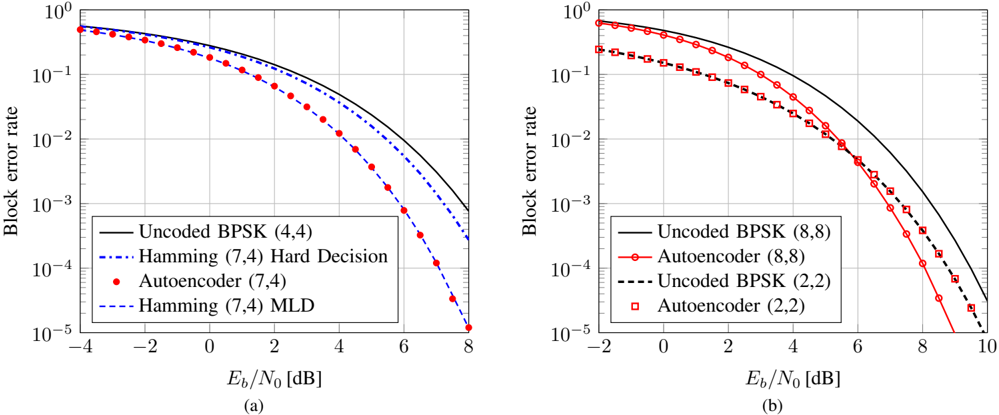
- A learned autoencoder for a (7,4) system at rate R = 4/7 achieves the same block error rate (BLER) as a Hamming (7,4) code with maximum likelihood decoding, while an (8,8) autoencoder outperforms uncoded BPSK over the full E_b/N_0 range, indicating learned joint coding and modulation.
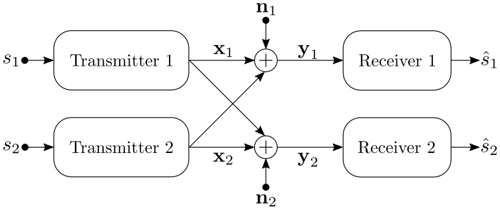
- For the two-user AWGN interference channel, the autoencoder matches time-sharing for (1,1) and (2,2), but achieves gains of about 0.7 dB for (4,4) and 1 dB for (4,8) at a BLER of 10^-3.
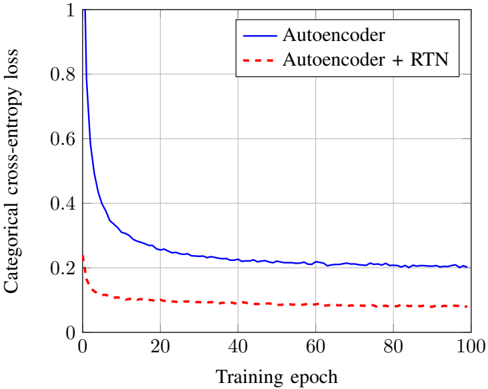
- An autoencoder (8,4) with an RTN over a multipath fading channel with L = 3 Rayleigh taps outperforms differential BPSK with maximum likelihood sequence estimation and a Hamming (7,4) code, whereas the plain autoencoder struggles to match it; RTNs also show faster training convergence.
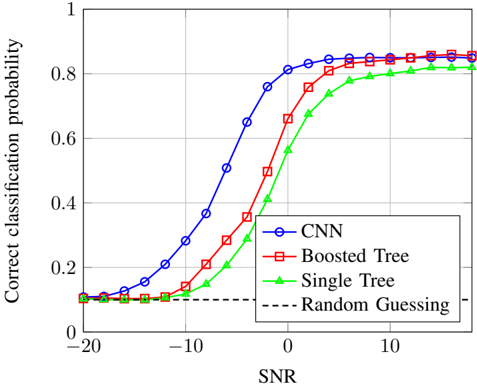
- For modulation classification on 1.2M sequences of 128 complex-valued IQ samples across ten modulation schemes and SNRs from -20 dB to 18 dB, the CNN outperforms a boosted expert-feature classifier by around 4 dB in the low-to-medium SNR range, with almost identical high-SNR performance; a single tree is about 6 dB worse at medium SNR and 3.5% worse at high SNR.
Methods
- The transmitter, channel, and receiver are represented as one deep neural network trained as an autoencoder: one-hot message input, dense layers, normalization layer for transmit constraints, additive noise channel layer, and softmax receiver output, trained with categorical cross-entropy using SGD/Adam at learning rate 0.001 and fixed E_b/N_0 = 7 dB.
- The autoencoder concept is extended to multiple transmitter-receiver pairs in a two-user interference channel, with dynamic loss weights α_t per mini-batch to balance the two cross-entropy losses; performance is compared against 2^{2k/n}-QAM with time-sharing.
- RTNs combine a learned parameter estimator, a differentiable parametric transform, and a discriminative network; the paper demonstrates phase-offset compensation and multipath inverse filtering. For modulation classification, a VGG-like CNN with 324,330 trainable parameters is trained on the RML2016.10b dataset.
Limitations
- The paper states that scalability to large message sets M is a major challenge: for k = 100 bits, training complexity is prohibitive because the autoencoder must see at least every message once.
- The paper states that optimal data representations, loss functions, training SNR, and hyperparameters are not well understood; training at one SNR does not necessarily generalize to others, and no common communications benchmarks or datasets comparable to MNIST or ImageNet exist.
- The paper states that end-to-end learning over real channels requires system identification because backpropagation assumes a known channel transfer function; complex-valued neural networks are not supported by current DL libraries. Evident from the text: the reported results are simulation-based, use small (n,k) settings, assume known channel models during training, and the paper explicitly leaves detailed performance comparisons for various channel types and parameters to future work.
Model-written summary. Check it against the paper before relying on it.
Integrity signals
Registry
Cites
Statistics
Figures






Verification
Claims the paper makes
6 Valid · 4 Not valid · 18 Not checked · 65 Own results and interpretations
Every source the paper cites for this claim was checked and supports it.
In the paper
“For instance in [22], it was shown that training with a single codeword is sufficient since the structure of the code is embedded in the NN through the Tanner graph.”
What the sources say
- Supportedcites [22] [22] E. Nachmani, Y. Be'ery, and D. Burshtein, 'Learning to decode linear codes using deep learning,' in Proc. IEEE Annu. Allerton Conf. Commun., Control, and Computing (Allerton) , 2016, pp. 341-346. - source
The Introduction says the decoder uses a Tanner graph representing the code and that one codeword suffices for training. Section III explains the precise condition: over a binary memoryless symmetric channel, the decoder’s error rate is independent of the transmitted codeword, so training can use noisy versions of a single codeword. (LLM, conf=0.91)
boostedstates a cause- Asserted: passes — The authors put it forward as true.
- Checkable: passes — It can be checked against evidence.
- Load-bearing: unclear — It is unclear whether the paper’s conclusions depend on it.
- Based: passes — The paper gives a reason why it holds.
- Supported
A result the paper reports from its own data — it cites no other source for it, so there is none to check. The quote shows it is in the paper.
In the paper
“We study the use of NNs on complex-valued IQ samples for the problem of modulation classification and show that convolutional neural networks (CNNs), which are the cornerstone of most DL systems for computer vision, can outperform traditional classification techniques based on expert features.”
plainstates a cause- Asserted: passes — The authors put it forward as true.
- Checkable: passes — It can be checked against evidence.
- Load-bearing: passes — The paper’s conclusions depend on it.
- Based: passes — The paper gives a reason why it holds.
The paper states this without a source or data behind it here, so there is nothing to check it against. The quote shows it is in the paper.
In the paper
“Training at low SNR for instance does not allow for the discovery of structure important in higher SNR scenarios.”
plainstates a cause- Asserted: passes — The authors put it forward as true.
- Checkable: passes — It can be checked against evidence.
- Load-bearing: unclear — It is unclear whether the paper’s conclusions depend on it.
- Based: unclear — It is unclear why the paper says it holds.
A result the paper reports from its own data — it cites no other source for it, so there is none to check. The quote shows it is in the paper.
In the paper
“Another advantage of RTNs is faster training convergence which can be seen from Fig. 10 that compares the validation loss of the autoencoder with and without RTN as a function of the training epochs.”
plainstates a cause- Asserted: passes — The authors put it forward as true.
- Checkable: passes — It can be checked against evidence.
- Load-bearing: unclear — It is unclear whether the paper’s conclusions depend on it.
- Based: passes — The paper gives a reason why it holds.
A result the paper reports from its own data — it cites no other source for it, so there is none to check. The quote shows it is in the paper.
In the paper
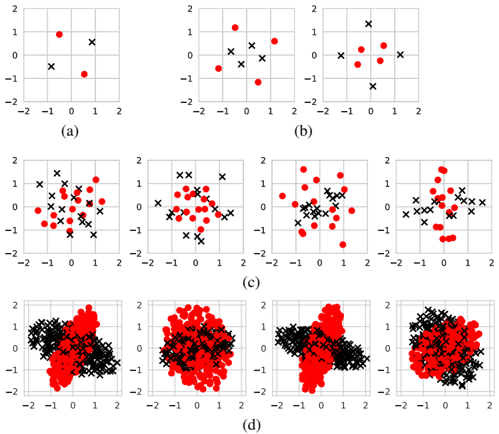
“Similarly, Fig. 4b shows a (4 , 2) system which leads to a rotated 16-PSK constellation.”
plainstates a cause- Asserted: passes — The authors put it forward as true.
- Checkable: passes — It can be checked against evidence.
- Load-bearing: unclear — It is unclear whether the paper’s conclusions depend on it.
- Based: passes — The paper gives a reason why it holds.
39 more claims
Create a free account to see all 93 claims and to verify the 4 references still open.
- Probably not a substantial claim. 29
- It may state two separate claims as one. 24
Self-check
Percentages, sums and reported differences re-computed from the paper’s own numbers.
Each contradiction between two passages listed here was confirmed by an independent check.
Rated minor: it would not touch a result — a value no result rests on, a p-value that stays on the same side of the significance level, or a conflict that is clerical, resolved elsewhere in the paper, or outside its own findings.
In the paper
§ A. Autoencoders for end-to-end communications systems · p. 5
“Similarly, Fig. 4b shows a (4 , 2) system which leads to a rotated 16-PSK constellation.”
§ A. Autoencoders for end-to-end communications systems · p. 6
“Figure 4: Constellations produced by autoencoders using parameters ( n, k ) : (a) (2 , 2) (b) (2 , 4) , (c) (2 , 4) with average power constraint, (d) (7 , 4) 2-dimensional t-SNE embedding of received symbols.”
Citations
Cites
Very Deep Convolutional Networks for Large-Scale Image Recognition
Simonyan, K., & Zisserman, A. (2014) · arXiv · doi:10.48550/arxiv.1409.1556 · Cited by 114,148 · cited 1×
“dense/fully-connected layers and terminated with a dense softmax layer for our classifier (similar to a VGG architecture [55]).”
BackgroundAdam: A Method for Stochastic Optimization
Kingma, D. P., & Ba, J. (2014) · arXiv · doi:10.48550/arxiv.1412.6980 · Cited by 98,946 · cited 4×
“Training was done at a fixed value of Eb/N0 = 7 dB (see Section IV-B) using Adam [46] with learning rate 0.”
BackgroundMethodInfluentialA Mathematical Theory of Communication
Shannon, C. E. (1948) · Bell System Technical Journal · doi:10.1002/j.1538-7305.1948.tb01338.x · Cited by 88,486
Scikit-learn: Machine Learning in Python
Pedregosa, F., Varoquaux, G., Gramfort, A., Michel, V., Thirion, B., Grisel, O., Blondel, M., Müller, A., Nothman, J., Louppe, G., et al. (2012) · arXiv · doi:10.48550/arxiv.1201.0490 · Cited by 71,016 · cited 1×
“11, we compare the classification accuracy of the CNN against that of extreme gradient boosting7 with 1000 estimators, as well as a single scikit-learn decision tree [56], operating on a mix of 16 analog and cumulant expert features as proposed in [53] and [57].”
Method(2014) · Cited by 33,419
(2008) · Journal of Machine Learning Research · Cited by 33,051
Human-level control through deep reinforcement learning
Mnih, V., Kavukcuoglu, K., Silver, D., Rusu, A. A., Veness, J., Bellemare, M. G., Graves, A., Riedmiller, M., Fidjeland, A. K., Ostrovski, G., et al. (2015) · Nature · doi:10.1038/nature14236 · Cited by 30,357
(2007) · Electronics: A First Course · doi:10.4324/9780080477527-64 · Cited by 24,923
Pan, S. J., & Yang, Q. (2010) · IEEE Transactions on Knowledge and Data Engineering · doi:10.1109/tkde.2009.191 · Cited by 23,387 · cited 1×
“learning [64] is one appealing candidate for adapting an endto-end communications system trained on a statistical model to”
BackgroundMultilayer feedforward networks are universal approximators
Hornik, K., Stinchcombe, M., & White, H. (1989) · Neural Networks · doi:10.1016/0893-6080(89)90020-8 · Cited by 21,728 · cited 1×
“Third, it has been shown that NNs are universal function approximators [13] and recent work has shown a remarkable”
Background
Research works printed but not linked: 2
- [35] I. Goodfellow, Y. Bengio, and A. Courville, Deep Learning . MIT Press, 2016. -
- [52] J. Estaran et al. , 'Artificial neural networks for linear and non-linear impairment mitigation in high-baudrate IM/DD systems,' in Proc. 42nd European Conf. Optical Commun. (ECOC) . VDE, 2016, pp. 1-3. -
Cited by
Items 1,901–2,000 of 2,995
Sun, M., Wu, D., Zhang, P., & Wang, R. (2026) · IEEE Transactions on Communications · doi:10.1109/tcomm.2026.3675469 · Cited by 2
“The study in [18] first proposed the application of DL to model end-to-end communication links.”
An Adaptive Environment-Aware Transformer Autoencoder for UAV-FSO With Dynamic Complexity Control
Zeng, H., Wang, H., Wang, K., Yu, X., & Zhang, Z. (2026) · IEEE Transactions on Vehicular Technology · doi:10.1109/tvt.2026.3683685 · Cited by 2
“Autoencoder (AE) architectures jointly model the encoder, channel, and decoder within a single differentiable framework, as illustrated in Fig.”
Residual-aided CSI-free end-to-end learning for multiuser MIMO
Affum, E. A., Futa, O., Oppong, M. A., & Biney, D. O. (2026) · PLoS ONE · doi:10.1371/journal.pone.0344696 · Cited by 2
“Deep learning (DL), a revolutionary technology [9–11], enables end-to-end (E2E) learning, where neural networks collaboratively optimise all signal processing components.”
Jiang, L., Wu, Y., Wang, Y., Long, J., Chen, Y., Zhou, W., Wang, K., & Yu, J. (2026) · Journal of Lightwave Technology · doi:10.1109/jlt.2026.3691989 · Cited by 2
Deep Learning for Automatic Modulation Classification: A Review
Thakur, A. S., & Imtiaz, M. (2026) · Electronics · doi:10.3390/electronics15102163 · Cited by 2
Ali, Y., Manzoor, T., Yang, H., Yan, C., & Xia, Y. (2026) · Computer Science Review · doi:10.1016/j.cosrev.2026.101004 · Cited by 2
“DL-based approaches have demonstrated high performance with reduced complexity, offering robust signal reconstruction in impaired channels via autoencoders [51].”
Task-Adaptive Semantic Communications with Controllable Diffusion-based Data Regeneration
Guo, F., Wijesinghe, A., Zhang, S., & Ding, Z. J. (2025) · IEEE Globecom Workshops (GC Wkshps) · doi:10.1109/gcwkshps68340.2025.11590850 · Cited by 2
“Traditional data-oriented communications focus on bit-wise data transmission [3], which can contain much redundant information for downstream tasks, suffering from heavy power and bandwidth overhead.”
A Concurrent Training Method of Deep-Learning Autoencoders in a Multi-user Interference Channel
Pellatt, L., Nekovee, M., & Wu, D. (2021) · International Symposium on Wireless Communication Systems · doi:10.1109/iswcs49558.2021.9562181 · Cited by 3
FFSCN: Frame Fusion Spectrum Center Net for Carrier Signal Detection
Huang, H., Wang, J., & Li, J. (2022) · Electronics · doi:10.3390/electronics11203349 · Cited by 3
Deep Spread Multiplexing and Study of Training Methods for DNN-Based Encoder and Decoder
Kim, M., & Lee, W. (2023) · Sensors · doi:10.3390/s23083848 · Cited by 2
Deep Learning Based Digital Wireless Communication System
Jayakumar, S. K., Benoy, N. M., Mohan, V. M., Gouri Nair, A., & Ameenudeen, P. E. (2023) · International Conference on Control, Communication and Computing (ICCC) · doi:10.1109/iccc57789.2023.10165139 · Cited by 2
“Several deep learning models have been already proposed to overcome the limitations of the conventional communication systems [1] [2].”
BackgroundMethodDeep Learning-Based Joint Channel Coding and Frequency Modulation for Low Power Connectivity
Chang, B., Wang, C., & Kim, H.-S. (2023) · International Conference on Communications · doi:10.1109/icc45041.2023.10278753 · Cited by 2
“The authors in [8] first introduced a DNN-based autoencoder to learn a new (7 , 4) code, which significantly outperforms (7 , 4) Hamming code.”
BackgroundA Conditional Analysis of RF ML Latent Features
Kuzdeba, S., & Robinson, J. (2023) · IEEE Military Communications Conference (MILCOM) · doi:10.1109/milcom58377.2023.10356311 · Cited by 2
“Models have already begun to look at how to disperse encoding and decoding portions of reconstruction models across a channel [28], [29].”
BackgroundCNNs-Based End-to-End Asymmetric Encrypted Communication System
An, Y., Hu, Z., Cai, H., & Ji, Z. (2023) · Intelligent and Converged Networks · doi:10.23919/icn.2023.0026 · Cited by 2
Murugesan, R., Kanapala, S., Rajendran, S., Priya, P. B., Ramadevi, R., Natarajan, D., & Hema, R. (2024) · Indonesian Journal of Electrical Engineering and Computer Science · doi:10.11591/ijeecs.v33.i1.pp380-388 · Cited by 2
“Despite this, experiments [23] have shown that RSS is not sensitive to fluctuations in the quality of connections when used in its intended manner.”
BackgroundQuantum Autoencoders for Learning Quantum Channel Codes
Rathi, L., DiAdamo, S., & Shabani, A. (2024) · International Conference on Communication Systems & Networks (COMSNETS) · doi:10.1109/comsnets59351.2024.10427450 · Cited by 6
Performance of a Neural Network Classifier Based Demodulator in Communication System
Kumar, A. (2024) · IEEE Access · doi:10.1109/access.2024.3379003 · Cited by 2
Scalability in Autoencoder-based OFDM Communication System
Tsugawa, S., Toma, T., Oshiro, S., & Wada, T. (2023) · IEEE International Conference on Computer Vision and Machine Intelligence (CVMI) · doi:10.1109/cvmi59935.2023.10464866 · Cited by 3
Asiedu, D. K. P., Ofori-Amanfo, K. B., Bennin, K. E., Benjillali, M., Lee, K., Gookyi, D. A. N., & Saoudi, S. (2024) · International Symposium on Signal, Image, Video and Communications (ISIVC) · doi:10.1109/isivc61350.2024.10577918 · Cited by 2
“I. Details of the autoencoder implementation adopted for the data routing follows a similar structure as those found in [11], [12], [14].”
MethodSemantic Feature-Based Learning Framework for Energy-Limited Semantic Communication System
Fang, Z., Sun, M., Wang, Y., & Xu, X. (2024) · IEEE Wireless Communications and Networking Conference · doi:10.1109/wcnc57260.2024.10571281 · Cited by 2
“Following power normalization [9], the semantic information is transmitted through the physical wireless channel.”
MethodEnhancing Underwater Visible Light Communication with End-to-End Learning Techniques
Luna‐Rivera, J. M., Rabadan, J. A., Rufo, J., Guerra, V., Gutierrez, C. A., & Pérez‐Jiménez, R. (2024) · International Symposium on Communication Systems, Networks and Digital Signal Processing (CSNDSP) · doi:10.1109/csndsp60683.2024.10636487 · Cited by 5
“The concept of end-to-end learning in communication systems, initially introduced in [5], highlights the potential benefits for the physical layer of wireless communication systems.”
BackgroundSememe-Based Semantic Communications
Ozates, T., Kargı, U., & Koç, A. (2024) · IEEE Communications Letters · doi:10.1109/lcomm.2024.3450082 · Cited by 2
“End-to-end systems are in a structure of autoencoder and channel conditions affect their latent space [15].”
BackgroundYuan, W., Chen, C., Li, Y., Zhang, H., Li, Z., Shen, C., Zhang, J., Chi, N., & Shi, J. (2024) · Optics Express · doi:10.1364/oe.531747 · Cited by 2
Qin, H., Li, Z., Ji, Y., Li, G., Dong, B., Xing, S., Shi, J., Li, Z., Shen, C., Chi, N., et al. (2024) · International Conference on Optical Communications and Networks (ICOCN) · doi:10.1109/icocn63276.2024.10648476 · Cited by 2
“To enhance overall performance, [5] put forward a cutting-edge End-to-End (E2E) joint optimization model positing the communication system as an autoencoder (AE) and its transceivers as individual neural networks (NNs), optimized via deep learning.”
MethodSemantic Communication Challenges: Understanding Dos and Avoiding Don'ts
Choi, J., Park, J., Grassucci, E., & Comminiello, D. (2024) · IEEE Vehicular Technology Conference · doi:10.1109/vtc2024-spring62846.2024.10683415 · Cited by 4
“Machine learning techniques can be applied to the design of the physical layer, as discussed in [15].”
MethodLearning of Constellation Shaping with Maximum Norms for Terahertz Communication
Che, B., He, Q., Tan, Z., & Chen, Z. (2024) · IEEE Vehicular Technology Conference · doi:10.1109/vtc2024-spring62846.2024.10683271 · Cited by 2
“A common practice in the implementation of the normalization layer is limiting the average power of the I/Q signals to a fixed value, and the constellation shaping is learned with this restriction [8].”
BackgroundMethodSankalp, Lata, Sondur, G., Shukla, M. K., Pandey, O. J., & Guillaud, M. (2025) · IEEE Networking Letters · doi:10.1109/lnet.2025.3566243 · Cited by 2
“Deep learning (DL) methods [5] have recently been applied to channel coding for wiretap channels.”
Bhatnagar, M. R. (2025) · IEEE photonics journal · doi:10.1109/jphot.2025.3589419 · Cited by 2
A Comprehensive Review of Data-Driven Wireless Communications: A Survey of ML-based Approaches
Kotian, A. L., Nandipi, R., N, A. K., Kamane, A., Apoorva, & Arun, A. (2025) · International Conference on Computing Methodologies and Communication (ICCMC) · doi:10.1109/iccmc65190.2025.11140883 · Cited by 2
“…the receiver with the help of DNNs alone, a significantly more revolutionary practice has come onto the scene quite recently—determining the entire pointto-point communication system, both transmitter and receiver together, as one end-to-end autoencoder as part of the deep learning structure [8].”
Gros, A., Moeyaert, V., & Mégret, P. (2025) · IEEE International Black Sea Conference on Communications and Networking · doi:10.1109/blackseacom65655.2025.11193926 · Cited by 2
“A dataset, widely considered the gold standard for telecommunication signals, was developed by O’Shea [9] and subsequently analyzed using Convolutional Neural Networks (CNN) architectures in [10].”
Joint User Grouping and Power Allocation for MISO Systems: Learning to Schedule
Yuan, Y., Vu, T. X., Lei, L., Chatzinotas, S., & Ottersten, B. (2019) · European Signal Processing Conference (EUSIPCO) · doi:10.23919/eusipco.2019.8902514 · Cited by 2
“Machine/deep learning techniques have received much attention in wireless communications over the past few years [7], [8], [9], [10].”
BackgroundLeonard, W. A., Saunders, A., Calabro, M. K., & Olsen, K. (2019) · IEEE Military Communications Conference (MILCOM) · doi:10.1109/milcom47813.2019.9020991 · Cited by 2
Deep Learning for an Anti-Jamming CPM Receiver
Qiu, Y., Brown, C., & Li, L. (2019) · IEEE Military Communications Conference (MILCOM) · doi:10.1109/milcom47813.2019.9020788 · Cited by 2
“Many reports have shown the strength of DL in performance improvement in complex communication scenarios that are difficult to describe with tractable mathematical models [11].”
BackgroundSaetan, W., & Thipchaksurat, S. (2020) · Advances in intelligent systems and computing · doi:10.1007/978-3-030-44044-2_20 · Cited by 3
Counting Lattice Points in the Sphere using Deep Neural Networks
Askri, A., Othman, G. R.-B., & Ghauch, H. (2019) · Asilomar Conference on Signals, Systems and Computers (ACSSC) · doi:10.1109/ieeeconf44664.2019.9048858 · Cited by 2
Adaptive SVM-based Beam Allocation for MmWave Small Cell Networks
Zhu, J., Li, D., Zhao, H., Wang, X., & Jiang, R. (2020) · International Conference on Wireless Communications and Signal Processing (WCSP) · doi:10.1109/wcsp49889.2020.9299846 · Cited by 2
“For example, the autoen-coders are used in [5] to model an end-to-end communication system comprising the encoding, channel and decoding blocks, for MIMO interference channels.”
MethodDeep Learning-Based Channel Quality Estimation in Adaptive Shortwave Communication Systems
Zhou, Y., Wang, Y., Gui, G., Gacanin, H., & Sari, H. (2020) · International Conference on Wireless Communications and Signal Processing (WCSP) · doi:10.1109/wcsp49889.2020.9299767 · Cited by 2
“In DL-based communication systems, some approaches have been applied to enhance the performance of conventional algorithms [8] including automatic modulation recognition (AMC) [9]–[12], intelligent signal detection [13]– [15], channel state information (CSI) feedback [16], [17] and channel…”
MethodA DNN Framework for Secure Transmissions in UAV-Relaying Networks with a Jamming Receiver
Liu, N., Tang, X., Zhang, R., Wang, D., & Zhai, D. (2020) · IEEE International Conference on Communication Technology (ICCT) · doi:10.1109/icct50939.2020.9295902 · Cited by 3
“The physical layer security is formulated under the wiretap channel model [3], [4], which achieves perfect secrecy in an information-theoretical sense, under the assumption that the wiretap channel is degraded as compared to the legitimate channels.”
BackgroundAdvanced Learning Architectures and Spatial Statistics for Beam Selection with Multi-Path
Antón‐Haro, C., & Mestre, X. (2020) · Globecom · doi:10.1109/globecom42002.2020.9322073 · Cited by 3
“…convolutional neural networks (CNN) to carry out sensing, compression and recovery of channel state information (CSI) in massive MIMO systems [4]; the use of support vector classifiers (SVC) to perform antenna [5] and beam selection [6]; or the exploitation of CNNs for modulation classification [2].”
MethodSirois, S. A., Ouameur, M. A., & Massicotte, D. (2021) · Journal of Signal Processing Systems · doi:10.1007/s11265-020-01631-1 · Cited by 2
A Deep Learning Based Method for Blind Recognition of LDPC Codes
Li, L., Xie, L., Huang, Z., Liu, C., Zhou, J., & Zhang, Y. (2021) · Information Communication Technologies Conference (ICTC) · doi:10.1109/ictc51749.2021.9441497 · Cited by 2
“Moreover, The application in communication systems has also been investigated extensively in recent years [18]–[20].”
BackgroundA model‐driven robust deep learning wireless transceiver
Duan, S., Xiang, J., & Yu, X. (2021) · IET Communications · doi:10.1049/cmu2.12258 · Cited by 2
Zero-Padding OFDM Receiver Using Machine Learning
Diniz, P. S. R., & Mendonça, M. O. K. (2021) · IEEE Statistical Signal Processing Workshop (SSP) · doi:10.1109/ssp49050.2021.9513803 · Cited by 2
Deep Learning based CSI Reconstruction with Limited Feedback for Massive MIMO Systems
Wang, X., Hou, X., Chen, L., Kishiyama, Y., & Asai, T. (2021) · International Conference on Mobile Computing and Ubiquitous Network (ICMU) · doi:10.23919/icmu50196.2021.9638888 · Cited by 2
A deep learning‐based low complexity approach for joint transceiver beamforming
Wang, Y., Shi, J., Wang, W., Gao, X., & Wu, Y. (2021) · IET Communications · doi:10.1049/cmu2.12304 · Cited by 2
Deep Learning Oriented Channel Estimation for Interference Reduction for 5G
Swapna, Tangelapalli, Saradhi, P. P., Pandya, R. J., & Iyer, S. (2021) · International Conference on Innovative Computing, Intelligent Communication and Smart Electrical Systems (ICSES) · doi:10.1109/icses52305.2021.9633948 · Cited by 4
“The recent study demonstrated that the application of Deep Learning (DL) in channel estimation predicts the CSI accurately considering the dynamic scenario [1].”
BackgroundZhang, R., & Yang, B. (2022) · Journal of Electrical and Computer Engineering · doi:10.1155/2022/4116659 · Cited by 3
RetractedMaram, B., Mandala, J., & Satish, A. R. (2022) · International Journal of Adaptive Control and Signal Processing · doi:10.1002/acs.3427 · Cited by 2
“(18) Step 2: Evaluate fitness function A fitness parameter is used to deliberate optimum solution and fitness function is formulated utilizing beneath equation, γ = 1 Q Q ∑”
MethodInterpretable Analysis and Pruning of Modulation Recognition Network Based on Deep Learning
Ni, F., & Luo, M. (2022) · IEEE International Conference on Digital Signal Processing (DSP) · doi:10.1145/3529570.3529577 · Cited by 4
Application of C1DAE-ANIL in End-to-End Communication of IRS-Assisted UAV System
Wu, M., Jiang, F., Liu, J., & Peng, Y. (2022) · IEEE Access · doi:10.1109/access.2022.3184159 · Cited by 2
PDD-Based Decoder for LDPC Codes With Model-Driven Neural Networks
Liu, Y.-H., Zhao, M.-M., Wang, C., Lei, M., & Zhao, M.-J. (2022) · IEEE Communications Letters · doi:10.1109/lcomm.2022.3199747 · Cited by 2
“Recently, deep learning (DL) has become a popular technique to solve signal processing tasks for communications [10].”
BackgroundA machine learning enhanced approximate message passing massive MIMO accelerator
Brennsteiner, S., Arslan, T., Thompson, J., & McCormick, A. C. (2022) · IEEE International Conference on Artificial Intelligence Circuits and Systems (AICAS) · doi:10.1109/aicas54282.2022.9869942 · Cited by 2
“One of the main advantages of deploying machine-learning-based detection in the physical layer of communication systems is the increase in detection performance [1][2].”
BackgroundInfluentialRadyo Haberleşmesinde Evrişimli Sinir Ağı Kullanılarak Yapılan Modülasyon Sınıflandırması
Çalışır, B. (2022) · Fırat Üniversitesi Mühendislik Bilimleri Dergisi · doi:10.35234/fumbd.1141515 · Cited by 2
Deep Learning Based Constellation Rearrangement Design in Hybrid ARQ System
Bo, C., Jiang, M., Zhao, C., & Zou, L. (2022) · IEEE/CIC International Conference on Communications in China (ICCC) · doi:10.1109/icccworkshops55477.2022.9896677 · Cited by 2
“O’Shea and Hoydis [15] provide an overview of the autoencoder deep learning architecture for wireless communications.”
BackgroundQuantize-and-Forward Relay System with Autoencoder Using Multiple Antennas
Shin, J., & Jin, X. (2022) · IEEE International Conference on Consumer Electronics-Asia (ICCE-Asia) · doi:10.1109/icce-asia57006.2022.9954881 · Cited by 2
“Autoencoder, one of the main applications of deep learning technology in communication systems, considers the communication system as an end-to-end autoencoder and jointly optimizes the transmitter and receiver [2].”
BackgroundMG-CNN: Morphological gradient convolutional neural network for classification of arabic styles
Atillah, M. E., Fazazy, K. E., Riffi, J., & Yahyaouy, A. (2022) · Signal Image and Video Processing · doi:10.1007/s11760-022-02441-7 · Cited by 2
“A major advantage of his CNN over its predecessor is that it automatically identifies relevant features without human supervision [7] by forcing the learning of features with an invariance to shifts in the input vector.”
BackgroundSignal Restoration and Prediction for End-to-End Learning of Practical Wireless Communication System
Chen, Z. (2022) · IEEE International Conference on Mobile Ad-Hoc and Sensor Systems (MASS) · doi:10.1109/mass56207.2022.00096 · Cited by 2
“SGD uses gradients (or the partial derivatives of loss function with respect to optimization variables) to update the values of the optimization variables ( W [1] , b [1] , W [2] , and b [2] ) iteratively.”
BackgroundMethodInfluentialWireless Network Simulation to Create Machine Learning Benchmark Data
Katzef, M., Cullen, A. C., Alpcan, T., Leckie, C. A., & Kopacz, J. (2022) · Globecom · doi:10.1109/globecom48099.2022.10000685 · Cited by 2
“Over the last decade, in many contexts machine learning has been shown to outperform comparable techniques, suggesting that it may also play a productive role in addressing communication and networking problems [1], [2].”
BackgroundLSTM based Receiver Design for Baseband Signal Demodulation
Varsha, P. S., & Hari, V. S. (2022) · International Conference on Computing, Communication, and Intelligent Systems (ICCCIS) · doi:10.1109/icccis56430.2022.10037633 · Cited by 2
“Many of the prior successful DL based receiver models includes Tim O'Shea et at., [14] discusses novel applications of deep learning (DL) for the physical layer by interpreting a communications system as an auto encoder, also a Deep Convolutional Neural Network (DCNN) for demodulation of a…”
BackgroundResearch on End-to-End Wireless Communication System Based on Two Dimensional Convolution
Liu, Q., Liu, J., Yu, G., & Zhou, X. (2022) · IEEE International Conference on Communication Technology (ICCT) · doi:10.1109/icct56141.2022.10072442 · Cited by 3
“In this system, the NNs is constructed as an auto-codec and automatically provided the best encoding, modulation, demodulation and decoding processing [15].”
MethodEnhanced deep soft interference cancellation for multiuser symbol detection
Kim, J., Kim, J., & Lee, M. (2023) · ETRI Journal · doi:10.4218/etrij.2022-0462 · Cited by 3
“Many researchers in the field of wireless communication have attempted to apply DL to communication technologies [7 – 10].”
Rate Adaptive Autoencoder-based Geometric Constellation Shaping
Jovanovic, O., Yankov, M. P., Ros, F. D., & Zibar, D. (2023) · Conference on Lasers and Electro-Optics · doi:10.1364/cleo_si.2023.sf1f.2 · Cited by 2
“Autoencoders (AEs) are becoming a popular tool to optimize the signaling constellation of digital communication transceivers [2, 3].”
MethodUnknown Channel End-to-End Learning of Communication System With Residual DCGAN
Yan, D., Jia, M., Guo, Q., & Gu, X. (2023) · IEEE International Symposium on Broadband Multimedia Systems and Broadcasting (BMSB) · doi:10.1109/bmsb58369.2023.10211449 · Cited by 2
“The end-to-end (E2E) communication model based on deep learning considers the global optimization of the system as a whole, rather than the optimal performance of certain modules [4].”
Automatic Modulation Classification Based on Decentralized Learning and Model Averaging
Xu, Y., Ma, M., Fu, X. G., Wang, Y., Gui, G., & Ohtsuki, T. O. (2023) · IEEE Conference on Computer Communications Workshops (INFOCOM WKSHPS) · doi:10.1109/infocomwkshps57453.2023.10225859 · Cited by 2
“It was O’shea who introduced convolutional neural network (CNN) into AMC firstly [14] and proved the superiority of DL in classification tasks.”
MethodDeep Learning-based Transceiver with One-bit ADC Over Fading Channel
Gemeda, M. D., Han, M., Abebe, A. T., & Kang, C. G. (2023) · International Conference on Computer Communications and Networks (ICCCN) · doi:10.1109/icccn58024.2023.10230206 · Cited by 2
“As a result, a parameter κ is introduced, which is referred to as the information-to-transmit-sequence mapping rate as defined in [11].”
InfluentialLu, X., Jiang, Y., Li, J., Wei, Y. D., Tu, X., & Qu, F. (2023) · Journal of Marine Science and Application · doi:10.1007/s11804-023-00358-2 · Cited by 2
Duan, Z., Guo, H., Yang, X., & Peng, S. (2023) · IEEE International Conference on Cyber Technology in Automation, Control, and Intelligent Systems · doi:10.1109/cyber59472.2023.10256490 · Cited by 2
“In recent years, with the development of deep learning (DL) [13], deep neural networks have also been widely used as classifiers [14-18].”
BackgroundMethodA Joint Model and Data Driven Method for Distributed Estimation
He, M., Li, R., Huang, C. Z., & Zhang, S. (2023) · IEEE Internet of Things Journal · doi:10.1109/jiot.2023.3322940 · Cited by 2
“The whole training uses the ADMM optimizer [31] with a constant learning rate l r = 0 .”
MethodInfluentialDecomposing the Training of Deep Learned Turbo codes via a Feasible MAP Decoder
Mulgund, A. P., Devroye, N., Turán, G., & Žefran, M. (2023) · International Symposium on Turbo Codes and Iterative Information Processing · doi:10.1109/istc57237.2023.10273550 · Cited by 2
“We can similarly parameterize a soft decoder g : R → [0, 1], where g represents the iteration of functions {g t,s }t∈[6],s∈[2] described in Fig.”
BackgroundMethodMIMO detection using an ALR-CNN in SDM transmission systems
Zhang, D., Ma, X., Lu, S., & Tan, Z. (2023) · Applied Optics · doi:10.1364/ao.496453 · Cited by 2
Coding for the Gaussian Channel in the Finite Blocklength Regime Using a CNN-Autoencoder
Hesham, N., Bouzid, M., Abdel-Qader, A., & Chaaban, A. (2023) · IEEE International Black Sea Conference on Communications and Networking · doi:10.1109/blackseacom58138.2023.10299743 · Cited by 2
“It is worth noting that works in the literature which study the BER achieved by an AE [8], [9], [12], [13], [15] train the AE at a certain SNR with a fixed rate R and test it at a wide range of SNRs where it can be observed that the BER decreases as SNR increases.”
BackgroundSimulation Platform for End-to-End Deep Learning Based Coherent Fiber Communication System
Abbass, A. M., & Fyath, R. S. (2023) · International Scientific Conference of Engineering Sciences (ISCES) · doi:10.1109/isces58193.2023.10311492 · Cited by 2
“In [3], the concept of E2E learning was introduced and applied it using DL-based AE in the physical layer to optimize the performance of a communication system.”
MethodUsing Neural Networks for Far-End Crosstalk Compensation in High-Speed MIMO Channels
Rosenau, J. A., Morales, A. W., Agili, S. S., & Tran, T. X. (2023) · IEEE Transactions on Signal and Power Integrity · doi:10.1109/tsipi.2023.3335330 · Cited by 2
An End-to-End Communication System with Environmental Adaptability
Zhao, C., Wang, J., Wei, H., Chen, X., & Peng, Q. (2023) · IEEE Vehicular Technology Conference · doi:10.1109/vtc2023-fall60731.2023.10333394 · Cited by 2
“End-to-end (E2E) communication arises as a remarkable physical layer technique stemming from the rapidly developing deep learning (DL) technology [1].”
BackgroundMethodLaser Phase Noise Mitigation based on Autoencoder for End-to-end Learning of CO-OFDM Systems
Alnaseri, O., Al-Saedi, I. R. K., & Al‐Asadi, A. (2023) · International Conference on Signal Processing and Information Security (ICSPIS) · doi:10.1109/icspis60075.2023.10344226 · Cited by 2
Snoap, J. A., Popescu, D. C., & Spooner, C. M. (2023) · IEEE Military Communications Conference (MILCOM) · doi:10.1109/milcom58377.2023.10356331 · Cited by 2
“…classification of digitally modulated signals using for NN training and signal recognition/classification either the raw I/Q signal components [5]–[8], or pre-processing them to extract CC features [9] or other information that characterizes the signal amplitude/phase and frequency domain…”
BackgroundImproved End-to-End Wireless Transmission Integrating NOMA and DL-Based Autoencoder
Choubey, N., Trivedi, A., & Kushwah, V. S. (2024) · IETE Journal of Research · doi:10.1080/03772063.2024.2304621 · Cited by 2
“The authors discussed how DL was applied to the physical layer in [8].”
Efficient Dual-Mode Generalized Spatial Modulation Detection with Enhanced DNN Architecture
Wang, Z., Jiang, X., Yu, J., Wen, M., Li, J., & Hai, H. (2024) · International Conference on Electronics, Information, and Communication (ICEIC) · doi:10.1109/iceic61013.2024.10457089 · Cited by 2
“One innovative technique is the au-toencoder, which uses deep neural network (DNN) at the transmitter and receiver to replace channel coding and signal detection in traditional transmitters and receivers [11].”
MethodGuo, B., Liu, Y., Zhou, H. M., Yan, W. Q., & Zhang, S. (2024) · Applied Sciences · doi:10.3390/app14062583 · Cited by 2
CNN-Based End-to-End Deeper Autoencoders for Physical Layer of Wireless Communication System
Ferdous, J., Mollah, M. A., & Rahman, A. (2024) · International Conference on Advances in Computing, Communication, Electrical, and Smart Systems (iCACCESS) · doi:10.1109/icaccess61735.2024.10499465 · Cited by 3
“This has led one creative viewpoint to consider wireless communications as a self-learned end-to-end autoencoder [8] that jointly optimizes transmitter and receiver components so that learned weights of neural networks facilitate encoding and decoding.”
BackgroundArtificial Intelligence and Machine Learning in 6G
Mishra, S., Shehzad, M. K., Chen, C. S., & Rose, L. (2023) · Springer eBooks · doi:10.1007/978-3-031-42567-7_5 · Cited by 2
Deep Learning Based Over-the-Air Training of Wireless Communication Systems without Feedback
Davey, C. P., Shakeel, I., Deo, R. C., & Salcedo‐Sanz, S. (2024) · Sensors · doi:10.3390/s24102993 · Cited by 2
“The joint approach is based on the model defined in [1] and includes the instantaneous channel transfer function as part of the network architecture.”
BackgroundMethodInfluentialEnd-to-End Learning Framework for Space Optical Communications in Non-Differentiable Poisson Channel
Elfikky, A., Soltani, M., & Rezki, Z. (2024) · IEEE Wireless Communications Letters · doi:10.1109/lwc.2024.3401692 · Cited by 2
“This integration has brought about notable advancements in areas such as channel equalization, modulation classification, coding, and decoding [3], [4], [5].”
BackgroundMethodDeep Learning-based Multiuser Physical Layer Communication Without Known Channel
Ji, J., Xiong, Z., Zhu, K., & Quek, T. Q. S. (2024) · IEEE Wireless Communications and Networking Conference · doi:10.1109/wcnc57260.2024.10571174 · Cited by 2
“However, the data processing theorem in information theory implies that the optimization of each block does not guarantee the global optimality of the entire communication system [2].”
BackgroundSimba, S. A., Irum, T., & Ejaz, M. U. (2024) · Global Power, Energy and Communication Conference · doi:10.1109/gpecom61896.2024.10582513 · Cited by 2
“Researchers O’Shea and Hoydis [16] demonstrate that a jointly-optimised OMA transceiver based on deep learning can outperform bit-error-rate archived by Hamming Code-based forward error correction schemes whilst relying on imperfect CSI.”
MethodStrategies for DOA-DNN Estimation Accuracy Improvement at Low and High SNRs
Ando, D. A., Nishimura, T., Sato, T., Ohgane, T., Ogawa, Y., & Hagiwara, J. (2024) · IEICE Transactions on Communications · doi:10.23919/transcom.2023ebp3217 · Cited by 2
Adversarial Attacks and Defenses for Wireless Signal Classifiers Using CDI-aware GANs
Sinha, S., & Soysal, A. (2024) · International Conference on Communications · doi:10.1109/icc51166.2024.10622612 · Cited by 2
“…classification literature typically chooses a g [ · ] as high-dimensional I/Q time samples of the received waveform [15], creates a dataset using g [ · ] , chooses a DNN architecture, and finally trains a model, f ( , θ ) , to decide on the class (e.g., modulation) of an incoming waveform [15], [16].”
BackgroundMethodOn the Joint Optimization of Signal Constellations and Bit Mappings
Ranaweera, S., Jayawickrama, B. A., He, Y., Ngo, Q. T., & Liu, R. P. (2024) · IEEE Communications Letters · doi:10.1109/lcomm.2024.3456823 · Cited by 2
“In [4] and [5], neural networks (NNs) have been utilized to model transmitters, receivers, and channels in an end-to-end (E2E) manner.”
BackgroundHRNet: Deep Massive MIMO CSI Feedback with Hypernetworks
Cen, X., Lam, C., Ng, B. K., & Im, S. (2024) · doi:10.1109/icsip61881.2024.10671433 · Cited by 2
“Deeplearning(DL) is significant in communication physical layer applications for effectively solving traditional communication physical layer problems [6]–[8].”
BackgroundOn the Out-of-Distribution Evaluation of ML-Based End-to-End Communications Systems
Akrout, M., Bellili, F., Mezghani, A., & Hossain, E. (2024) · International Conference on Communications · doi:10.1109/icc51166.2024.10622985 · Cited by 3
“Prior research efforts have been devoted to evaluating E2E communication systems on ID test domains only, thereby showcasing competitive performances as compared to conventional wireless communication systems composed of classical signal processing blocks [3]–[7].”
BackgroundSemi-Supervised Channel Equalization Using Variational Autoencoders
Burshtein, D., & Bery, E. (2024) · IEEE Transactions on Wireless Communications · doi:10.1109/twc.2024.3485991 · Cited by 2
Deep Receiver Architectures for Robust MIMO Rate Splitting Multiple Access
Kumar, D. R., Antón‐Haro, C., & Mestre, X. (2024) · IEEE Transactions on Machine Learning in Communications and Networking · doi:10.1109/tmlcn.2024.3513267 · Cited by 2
Srivallapanondh, S., Freire, P. J., Napoli, A., Prilepsky, J. E., & Turitsyn, S. K. (2024) · SBFoton International Optics and Photonics Conference (SBFoton IOPC) · doi:10.1109/sbfotoniopc62248.2024.10813543 · Cited by 2
“Another approach is end-to-end learning [11], which uses an autoencoder to optimize the entire communication system, including the transmitter, channel, and receiver.”
Joint Demapping of QAM and APSK Constellations Using Machine Learning
Gansekoele, A., Balatsoukas‐Stimming, A., Brusse, T., Hoogendoorn, M., Bhulai, S., & van der Mei, R. (2025) · IEEE Open Journal of the Communications Society · doi:10.1109/ojcoms.2025.3547261 · Cited by 3
“One approach is to replace the entire sender-receiver pipeline with a DNN [1], [2], [3], [4], [5], [6], [7], [8], [9].”
Recurrent Neural Network Data Predistortion for Transparent Satellite Channels
Kopyto, D., & Bauch, G. (2024) · Globecom · doi:10.1109/globecom52923.2024.10901116 · Cited by 2
“Recently, the concept of end-to-end learning has been introduced [9].”
Asiedu, D. K. P., Bennin, K. E., Gookyi, D. A. N., Benjillali, M., & Saoudi, S. (2025) · Annals of Telecommunications · doi:10.1007/s12243-025-01087-z · Cited by 2
“Note, the training of the autoencoder involves the use of random generated bits as input and outputs for the training and validation sets of the autoencoder [12, 13].”
Guo, P., Yao, F., Miao, Y., Li, C., Tang, Y., & Ning, Z. (2025) · Digital Communications and Networks · doi:10.1016/j.dcan.2025.04.008 · Cited by 2
Intelligent Resource Allocation for RIS-Assisted Cell-Free Massive MIMO Systems
Mollah, G., Haider, M., Rawat, D. B., & Ahmed, I. (2025) · IEEE Consumer Communications and Networking Conference · doi:10.1109/ccnc54725.2025.10976035 · Cited by 2
The RNN BCJR Detector in Time-Varying Channels
Magnaldi, M., & Montorsi, G. (2025) · IEEE Wireless Communications and Networking Conference · doi:10.1109/wcnc61545.2025.10978373 · Cited by 2
“As a reference, [1] includes a survey of the initial deployment of DL on the physical layer signal processing of communication systems.”
Online Meta-Learning Channel Autoencoder for Dynamic End-to-End Physical Layer Optimization
Owfi, A., Ashdown, J., Turck, K., & Afghah, F. (2025) · IEEE Wireless Communications and Networking Conference · doi:10.1109/wcnc61545.2025.10978447 · Cited by 5
“The authors in [10], proposed the novel idea of modeling a simple communication system as a channel AE to jointly optimize the transmitter and the receiver for a two-user AWGN channel.”
Metadata
- Authors
- O'Shea, T., & Hoydis, J.
- Affiliations
- Nokia (France) (FR)
- Venue
- IEEE Transactions on Cognitive Communications and Networking
- Published
- 2017-12
- Volume
- 3
- Issue
- 4
- Pages
- 563-575
- ISSN
- 2332-7731 (ISSN-L)
- OpenAlex
- W2734408173
- Semantic Scholar
- 78989616eeeac55b202e3e4205225e7135054185
- Cited by
- 2,980
- References
- 69
- Citations by year
- 2026: 307 · 2025: 327 · 2024: 305 · 2023: 368 · 2022: 432 · 2021: 409 · 2020: 406 · 2019: 322 · 2018: 95 · 2017: 9
- FWCI
- 122.29
- Type
- journal article
- Language
- en
- Open access
- green
- arxiv.org
- Locations
- IEEE Transactions on Cognitive Communications and Networking (publishedVersion)
- arXiv (Cornell University) (submittedVersion)
- arXiv (Cornell University)
- Topics
- Physical Sciences › Computer Science › Artificial Intelligence › Wireless Signal Modulation Classification
- Physical Sciences › Engineering › Electrical and Electronic Engineering › Advanced Wireless Communication Techniques
- Physical Sciences › Engineering › Electrical and Electronic Engineering › Advanced Wireless Communication Technologies
- Keywords
- end-to-end reconstruction, domain knowledge integration, convolutional neural networks, automatic modulation classification, IQ samples
About these checks
Registry, retraction, Cites and statistics results are computed, not judged, with one exception: a printed reference that no index lists is read once by a model before it counts as a citation error. Claims are extracted by a model and kept only when their quote appears verbatim in the text; each cited source is then checked, with a model’s help, for whether it says what the claim relies on. Those verdicts can be wrong — read the claim’s quote and the cited source before relying on one.
The claim verdicts this report counts are experimental: their accuracy is not yet measured.
A language model drew the claims from the paper on 2026-11-07, under version 3 of the claim definition (model deepseek-v4.1-flash, prompt extract-v3).
A second model labelled each claim on 2026-11-07 (model jev-1.13-20260917, definition revision gold-guideline-v0.2).
Cited sources are checked with a language model’s help (gpt-6-sol).
Statistics and arithmetic are recomputed, not judged.
Confidence bands are shown only for fields calibrated on our annotated test set. None is calibrated yet, so no band is shown.
What counts as a claim ›How we measure confidence ›How we check this ›
Are you an author, or do you see a problem with this page? Request a review
Data sources
Bibliographic data: Semantic Scholar, OpenAlex, Crossref.
Contains information from the Semantic Scholar Academic Graph Datasets, made available under the ODC Attribution License (ODC-BY 1.0).
Semantic Scholar’s data is described in: Kinney, R., et al. (2023). The Semantic Scholar Open Data Platform. arXiv:2301.10140.
