

An Introduction to Deep Learning for the Physical Layer
Open accessThe DOI matches its Crossref record; 90 of the 92 references it cites were found in a registry or an index, and 2 are not checked yet; 8 of the 32 sources its claims cite were checked for support.
Abstract
We present and discuss several novel applications of deep learning for the physical layer. By interpreting a communications system as an autoencoder, we develop a fundamental new way to think about communications system design as an end-to-end reconstruction task that seeks to jointly optimize transmitter and receiver components in a single process. We show how this idea can be extended to networks of multiple transmitters and receivers and present the concept of radio transformer networks as a means to incorporate expert domain knowledge in the machine learning model. Lastly, we demonstrate the application of convolutional neural networks on raw IQ samples for modulation classification which achieves competitive accuracy with respect to traditional schemes relying on expert features. This paper is concluded with a discussion of open challenges and areas for future investigation.
Verified 2026-11-19 · 2 references not checked yet
Overview
CoChat Summary
TL;DR
The paper introduces deep learning for the physical layer by treating a communications system as an autoencoder that jointly learns transmitter and receiver implementations end-to-end. It also extends this idea to multi-user interference channels, proposes radio transformer networks (RTNs) to inject expert domain knowledge, and shows CNNs on raw IQ samples can outperform expert-feature modulation classifiers.
Key findings
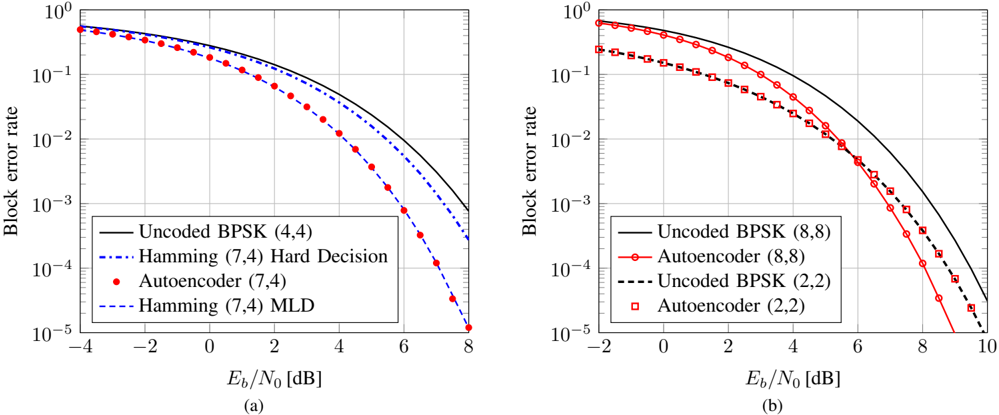
- A learned autoencoder for a (7,4) system at rate R = 4/7 achieves the same block error rate (BLER) as a Hamming (7,4) code with maximum likelihood decoding, while an (8,8) autoencoder outperforms uncoded BPSK over the full E_b/N_0 range, indicating learned joint coding and modulation.
- For the two-user AWGN interference channel, the autoencoder matches time-sharing for (1,1) and (2,2), but achieves gains of about 0.7 dB for (4,4) and 1 dB for (4,8) at a BLER of 10^-3.
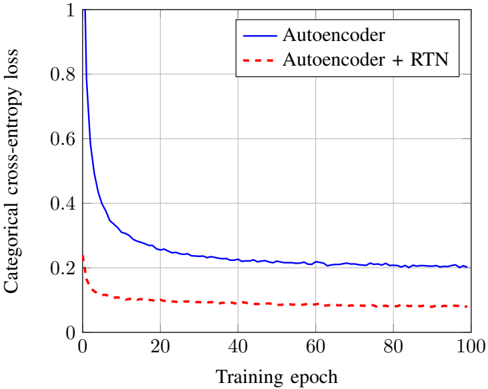
- An autoencoder (8,4) with an RTN over a multipath fading channel with L = 3 Rayleigh taps outperforms differential BPSK with maximum likelihood sequence estimation and a Hamming (7,4) code, whereas the plain autoencoder struggles to match it; RTNs also show faster training convergence.
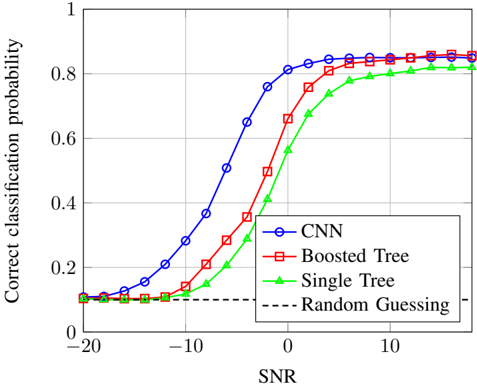
- For modulation classification on 1.2M sequences of 128 complex-valued IQ samples across ten modulation schemes and SNRs from -20 dB to 18 dB, the CNN outperforms a boosted expert-feature classifier by around 4 dB in the low-to-medium SNR range, with almost identical high-SNR performance; a single tree is about 6 dB worse at medium SNR and 3.5% worse at high SNR.
Methods
- The transmitter, channel, and receiver are represented as one deep neural network trained as an autoencoder: one-hot message input, dense layers, normalization layer for transmit constraints, additive noise channel layer, and softmax receiver output, trained with categorical cross-entropy using SGD/Adam at learning rate 0.001 and fixed E_b/N_0 = 7 dB.
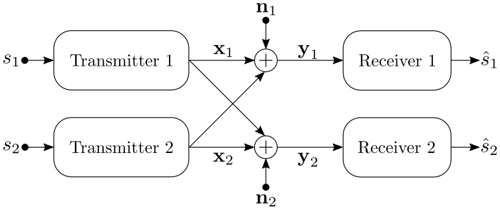
- The autoencoder concept is extended to multiple transmitter-receiver pairs in a two-user interference channel, with dynamic loss weights α_t per mini-batch to balance the two cross-entropy losses; performance is compared against 2^{2k/n}-QAM with time-sharing.
- RTNs combine a learned parameter estimator, a differentiable parametric transform, and a discriminative network; the paper demonstrates phase-offset compensation and multipath inverse filtering. For modulation classification, a VGG-like CNN with 324,330 trainable parameters is trained on the RML2016.10b dataset.
Limitations
- The paper states that scalability to large message sets M is a major challenge: for k = 100 bits, training complexity is prohibitive because the autoencoder must see at least every message once.
- The paper states that optimal data representations, loss functions, training SNR, and hyperparameters are not well understood; training at one SNR does not necessarily generalize to others, and no common communications benchmarks or datasets comparable to MNIST or ImageNet exist.
- The paper states that end-to-end learning over real channels requires system identification because backpropagation assumes a known channel transfer function; complex-valued neural networks are not supported by current DL libraries. Evident from the text: the reported results are simulation-based, use small (n,k) settings, assume known channel models during training, and the paper explicitly leaves detailed performance comparisons for various channel types and parameters to future work.
Model-written summary. Check it against the paper before relying on it.
Integrity signals
Registry
Cites
Statistics
Figures






Verification
Claims the paper makes
6 Valid · 4 Not valid · 18 Not checked · 65 Own results and interpretations
Every source the paper cites for this claim was checked and supports it.
In the paper
“For instance in [22], it was shown that training with a single codeword is sufficient since the structure of the code is embedded in the NN through the Tanner graph.”
What the sources say
- Supportedcites [22] [22] E. Nachmani, Y. Be'ery, and D. Burshtein, 'Learning to decode linear codes using deep learning,' in Proc. IEEE Annu. Allerton Conf. Commun., Control, and Computing (Allerton) , 2016, pp. 341-346. - source
The Introduction says the decoder uses a Tanner graph representing the code and that one codeword suffices for training. Section III explains the precise condition: over a binary memoryless symmetric channel, the decoder’s error rate is independent of the transmitted codeword, so training can use noisy versions of a single codeword. (LLM, conf=0.91)
boostedstates a cause- Asserted: passes — The authors put it forward as true.
- Checkable: passes — It can be checked against evidence.
- Load-bearing: unclear — It is unclear whether the paper’s conclusions depend on it.
- Based: passes — The paper gives a reason why it holds.
- Supported
A result the paper reports from its own data — it cites no other source for it, so there is none to check. The quote shows it is in the paper.
In the paper
“We study the use of NNs on complex-valued IQ samples for the problem of modulation classification and show that convolutional neural networks (CNNs), which are the cornerstone of most DL systems for computer vision, can outperform traditional classification techniques based on expert features.”
plainstates a cause- Asserted: passes — The authors put it forward as true.
- Checkable: passes — It can be checked against evidence.
- Load-bearing: passes — The paper’s conclusions depend on it.
- Based: passes — The paper gives a reason why it holds.
The paper states this without a source or data behind it here, so there is nothing to check it against. The quote shows it is in the paper.
In the paper
“Training at low SNR for instance does not allow for the discovery of structure important in higher SNR scenarios.”
plainstates a cause- Asserted: passes — The authors put it forward as true.
- Checkable: passes — It can be checked against evidence.
- Load-bearing: unclear — It is unclear whether the paper’s conclusions depend on it.
- Based: unclear — It is unclear why the paper says it holds.
A result the paper reports from its own data — it cites no other source for it, so there is none to check. The quote shows it is in the paper.
In the paper
“Another advantage of RTNs is faster training convergence which can be seen from Fig. 10 that compares the validation loss of the autoencoder with and without RTN as a function of the training epochs.”
plainstates a cause- Asserted: passes — The authors put it forward as true.
- Checkable: passes — It can be checked against evidence.
- Load-bearing: unclear — It is unclear whether the paper’s conclusions depend on it.
- Based: passes — The paper gives a reason why it holds.
A result the paper reports from its own data — it cites no other source for it, so there is none to check. The quote shows it is in the paper.
In the paper
“Similarly, Fig. 4b shows a (4 , 2) system which leads to a rotated 16-PSK constellation.”
plainstates a cause- Asserted: passes — The authors put it forward as true.
- Checkable: passes — It can be checked against evidence.
- Load-bearing: unclear — It is unclear whether the paper’s conclusions depend on it.
- Based: passes — The paper gives a reason why it holds.
39 more claims
Create a free account to see all 93 claims and to verify the 4 references still open.
- Probably not a substantial claim. 29
- It may state two separate claims as one. 24
Self-check
Percentages, sums and reported differences re-computed from the paper’s own numbers.
Each contradiction between two passages listed here was confirmed by an independent check.
Rated minor: it would not touch a result — a value no result rests on, a p-value that stays on the same side of the significance level, or a conflict that is clerical, resolved elsewhere in the paper, or outside its own findings.
In the paper
§ A. Autoencoders for end-to-end communications systems · p. 5
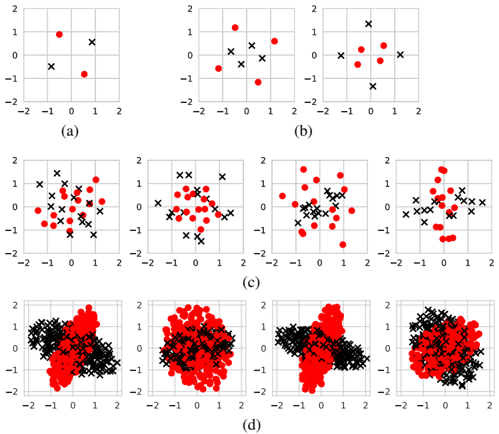
“Similarly, Fig. 4b shows a (4 , 2) system which leads to a rotated 16-PSK constellation.”
§ A. Autoencoders for end-to-end communications systems · p. 6
“Figure 4: Constellations produced by autoencoders using parameters ( n, k ) : (a) (2 , 2) (b) (2 , 4) , (c) (2 , 4) with average power constraint, (d) (7 , 4) 2-dimensional t-SNE embedding of received symbols.”
Citations
Cites
Very Deep Convolutional Networks for Large-Scale Image Recognition
Simonyan, K., & Zisserman, A. (2014) · arXiv · doi:10.48550/arxiv.1409.1556 · Cited by 114,148 · cited 1×
“dense/fully-connected layers and terminated with a dense softmax layer for our classifier (similar to a VGG architecture [55]).”
BackgroundAdam: A Method for Stochastic Optimization
Kingma, D. P., & Ba, J. (2014) · arXiv · doi:10.48550/arxiv.1412.6980 · Cited by 98,946 · cited 4×
“Training was done at a fixed value of Eb/N0 = 7 dB (see Section IV-B) using Adam [46] with learning rate 0.”
BackgroundMethodInfluentialA Mathematical Theory of Communication
Shannon, C. E. (1948) · Bell System Technical Journal · doi:10.1002/j.1538-7305.1948.tb01338.x · Cited by 88,486
Scikit-learn: Machine Learning in Python
Pedregosa, F., Varoquaux, G., Gramfort, A., Michel, V., Thirion, B., Grisel, O., Blondel, M., Müller, A., Nothman, J., Louppe, G., et al. (2012) · arXiv · doi:10.48550/arxiv.1201.0490 · Cited by 71,016 · cited 1×
“11, we compare the classification accuracy of the CNN against that of extreme gradient boosting7 with 1000 estimators, as well as a single scikit-learn decision tree [56], operating on a mix of 16 analog and cumulant expert features as proposed in [53] and [57].”
Method(2014) · Cited by 33,419
(2008) · Journal of Machine Learning Research · Cited by 33,051
Human-level control through deep reinforcement learning
Mnih, V., Kavukcuoglu, K., Silver, D., Rusu, A. A., Veness, J., Bellemare, M. G., Graves, A., Riedmiller, M., Fidjeland, A. K., Ostrovski, G., et al. (2015) · Nature · doi:10.1038/nature14236 · Cited by 30,357
(2007) · Electronics: A First Course · doi:10.4324/9780080477527-64 · Cited by 24,923
Pan, S. J., & Yang, Q. (2010) · IEEE Transactions on Knowledge and Data Engineering · doi:10.1109/tkde.2009.191 · Cited by 23,387 · cited 1×
“learning [64] is one appealing candidate for adapting an endto-end communications system trained on a statistical model to”
BackgroundMultilayer feedforward networks are universal approximators
Hornik, K., Stinchcombe, M., & White, H. (1989) · Neural Networks · doi:10.1016/0893-6080(89)90020-8 · Cited by 21,728 · cited 1×
“Third, it has been shown that NNs are universal function approximators [13] and recent work has shown a remarkable”
Background
Research works printed but not linked: 2
- [35] I. Goodfellow, Y. Bengio, and A. Courville, Deep Learning . MIT Press, 2016. -
- [52] J. Estaran et al. , 'Artificial neural networks for linear and non-linear impairment mitigation in high-baudrate IM/DD systems,' in Proc. 42nd European Conf. Optical Commun. (ECOC) . VDE, 2016, pp. 1-3. -
Cited by
Items 2,301–2,400 of 2,995
Learning-Aided Beam Management for mmWave High-Speed Railway Networks
Zhang, Y., Liu, S., Lu, Z., Meng, F. Y., & Huang, Y. (2021) · Globecom · doi:10.1109/globecom46510.2021.9685904 · Cited by 1
“Deep learning [3] is considered as a promising data-driven methodology for mobile communications in the past decade and frequently applied in the scenarios with imperfect models or intractable problems where the model-driven methods cannot work properly [4], [5].”
BackgroundSubSRNN: Tailored Neural Network for Channel Estimation with Robustness against Diversities
Qi, W., Quan, J., Hoydis, J., & Ye, C. (2021) · Globecom · doi:10.1109/globecom46510.2021.9685268 · Cited by 1
“…problems in wireless communications, including channel state information (CSI) feedback [2], deep receivers [3], [4], modulation recognition [5], and channel estimation [6]–[8] etc. DL based super-resolution NN (SRNN) [9] which is typically used for image reconstruction now becomes a…”
BackgroundSelf-citationMakara, Á. L., & Csurgai‐Horváth, L. (2021) · International Conference on Electrical, Computer and Energy Technologies (ICECET) · doi:10.1109/icecet52533.2021.9698600 · Cited by 1
Learning to Transmit Fresh Information in Energy Harvesting Networks Using Supervised Learning
Leng, S., & Yener, A. (2021) · Asilomar Conference on Signals, Systems and Computers (ACSSC) · doi:10.1109/ieeeconf53345.2021.9723152 · Cited by 3
Li, J., Ma, J., Liu, S., Qiao, Y., Shen, C., Qiu, J., Zhang, M., He, L., & Fan, T. (2022) · Computational and Mathematical Methods in Medicine · doi:10.1155/2022/5671713 · Cited by 1
“The arrows in the figure represent the flow of data during information dissemination, the circles represent neurons, and the connecting lines correspond to the weights of the network, and the weights need to be trained to get [14].”
BackgroundRetractedMeta-Modeling for Autoencoder-Based End-to-End Communications Systems
Tang, H. (2022) · International Conference on Electronic Communication and Artificial Intelligence (ICECAI) · doi:10.1109/iwecai55315.2022.00097 · Cited by 2
Machine Learning in 5G Multimedia Communications: Open Research Challenges and Applications
Milovanovic, D. A., Bojkovic, Z. S., & Kukolj, D. (2021) · IGI Global eBooks · doi:10.4018/978-1-7998-7708-0.ch010 · Cited by 1
Impact Analysis of Emerging Semantic Communication Systems on Network Performance
Lee, H., Ahn, H., & Park, Y. D. (2022) · Electronics · doi:10.3390/electronics11101567 · Cited by 2
Evaluation of Adaptation Methods for Deep Learning-based Wi-Fi Receivers
Blount, W., Li, K., Lotlikar, A., Doshi, A. S., & Andrews, J. G. (2022) · IEEE Wireless Communications and Networking Conference · doi:10.1109/wcnc51071.2022.9771840 · Cited by 1
“At the physical layer specifically, ML has been used to design symbol constellations in [2] and perform joint channel equalization and decoding in [3], [4].”
MethodLearning Maximum Margin Channel Decoders for Non-linear Gaussian Channels
Tsvieli, A., & Weinberger, N. (2022) · IEEE International Symposium on Information Theory (ISIT) · doi:10.1109/isit50566.2022.9834818 · Cited by 1
Ney, J., Hammoud, B., & Wehn, N. (2022) · IEEE International Symposium on Parallel & Distributed Processing, Workshops and Phd Forum · doi:10.1109/ipdpsw55747.2022.00024 · Cited by 4
“It was first proposed in [1], where parts of the classical transmitter and receiver are replaced by artificial neural networks (ANNs) to train all components jointly, optimizing the performance of the global system.”
BackgroundWang, C.-L., & Hsieh, C.-C. (2022) · IEEE Vehicular Technology Conference · doi:10.1109/vtc2022-spring54318.2022.9860932 · Cited by 1
“There have been some surveys for machine learning (ML) and for deep learning (DL) on communication system designs [6]–[9], The ML approach replaces one task requiring domain knowledge with another that trains a specific model by using a sufficiently large dataset [8].”
BackgroundDeep Unfolding-based Detection for Quantized Massive MU-MIMO-OFDM Systems
Liu, C.-J., Thompson, J. S., & Arslan, T. (2022) · IEEE Vehicular Technology Conference · doi:10.1109/vtc2022-spring54318.2022.9860554
“In [7], the entire communication system is packaged into an autoencoder (AE).”
BackgroundBuilding Protection Data Release Planning Based on Multifeature Deep Learning
Guo, C., Zang, Y., & Gao, Y. (2022) · Scientific Programming · doi:10.1155/2022/2765486 · Cited by 1
Channel Estimation Based on Deep Learning for OCDM Communications
Yang, D. T., Wang, Y., Liu, L., & Huang, P. (2022) · IEEE/CIC International Conference on Communications in China (ICCC) · doi:10.1109/iccc55456.2022.9880853 · Cited by 1
“The recent progresses of DL provide more possibilities for communication systems [8].”
BackgroundGemeda, M. D., Han, M., Abebe, A. T., & Kang, C. G. (2022) · Asia-Pacific Conference on Communications (APCC) · doi:10.1109/apcc55198.2022.9943615 · Cited by 1
A DNN-based Decoding Scheme for Communication Transmission System over AWGN Channel
He, M., Lei, Y., Song, H., Hu, Z., Pan, P., & Wang, H. (2022) · International Symposium on Wireless Communication Systems · doi:10.1109/iswcs56560.2022.9940380 · Cited by 1
“In the neural network, the nonlinear fitting ability of nonlinear activation function is used between the hidden layers to increase the learning ability of the model [11].”
MethodJeong, G., & Jin, X. (2022) · IEEE International Conference on Consumer Electronics-Asia (ICCE-Asia) · doi:10.1109/icce-asia57006.2022.9954652 · Cited by 1
Embedded Basketball Motion Detection Video Target Tracking Algorithm Based on Deep Learning
Xia, T. (2022) · International Conference on Artificial Intelligence and Autonomous Robot Systems (AIARS) · doi:10.1109/aiars57204.2022.00040 · Cited by 1
“…functional requirements is the need for relatively accurate and efficient target recognition technology and accurate positioning detection ability for specific human targets, that is, there are certain high requirements for the detection and analysis technology of basketball and other sports [5-6].”
BackgroundDesign and Analysis of Neural-Network-based, Single-User Codes for Multiuser Channels
Matson, N. C., Rajan, D., & Camp, J. (2022) · IEEE Latin-American Conference on Communications · doi:10.1109/latincom56090.2022.10000520 · Cited by 1
“The architecture is based on autoencoder networks [9], [14] which consist of: ( i ) an encoder network, which transforms the input into a lower-dimensional representation, and ( ii ) a decoder network, which reconstructs the original input.”
BackgroundKnowledge Graph Based Waveform Recommendation: A New Communication Waveform Design Paradigm
Huang, W., Wang, J., Peng, Q., & Li, W. (2022) · Globecom · doi:10.1109/globecom48099.2022.10000954 · Cited by 1
“With the development of machine learning, data-driven methods are proposed, for which the transceiver is considered a black box and part or all of the components are replaced by deep neural networks (DNNs) [4], [5].”
MethodModulation Classification for MIMO Systems in the Presence of Non-Gaussian Noise
Liu, M., Wang, Y., & Chen, Y. (2022) · Globecom · doi:10.1109/globecom48099.2022.10001037 · Cited by 1
Linear MIMO Precoders Design for Finite Alphabet Inputs via Model-Free Training
Cao, C., Feng, B., Wu, Y., Ng, D. W. K., & Zhang, W. (2022) · Globecom · doi:10.1109/globecom48099.2022.10001528 · Cited by 1
“In recent years, due to the widespread use of machine learning (ML), the transmitter and receiver in a communication system based on autoencoders (AE) can be optimized in pairs, rather than the separated approach as in traditional methods, which helps achieve better performance over the whole system [6].”
BackgroundOn End-to-End Learning of Joint Detection and Decoding for Short-Packet Communications
Clausius, J., Dörner, S., Cammerer, S., & ten Brink, S. (2022) · IEEE Globecom Workshops (GC Wkshps) · doi:10.1109/gcwkshps56602.2022.10008594 · Cited by 1
“1b) by following the concept of autoencoder-based communications [6], [7], [8].”
BackgroundA Deep Learning-Based Channel Aware Single Step Signal Detection in Downlink Multi-User NOMA
Kumar, S., Elnourani, M., Beferull‐Lozano, B., & Redhu, S. (2022) · IEEE Vehicular Technology Conference · doi:10.1109/vtc2022-fall57202.2022.10013001 · Cited by 1
“Data-driven techniques, including DL and other machine learning (ML) methods, have grown exponentially in the past few years, and they are applied to many research fields of wireless communication, such as 5G and beyond [12], [18], [19].”
MethodPulseNet: A Discriminative Model for Time Division Multiple Access Timeslot Prediction
Wood, A., Upthegrove, T., Funai, C., Thapa, B., Loos, S., & Javorsek, D. (2022) · IEEE Military Communications Conference (MILCOM) · doi:10.1109/milcom55135.2022.10017899 · Cited by 2
“Deep Neural Networks (DNN), Recurrent Neural Networks (RNNs) and CNNs to automatically recognize modulation and coding of wireless signals, classification of signals in the air and to design channel auto-encoders [3][4].”
BackgroundDeep reinforcement learning autoencoder with RA-GAN and GAN
Nguyen, H.-S., & Huynh, C.-D. (2022) · International Journal of Advances in Intelligent Informatics · doi:10.26555/ijain.v8i3.896 · Cited by 1
Deep Learning Based Modulation for Quantized SIMO Communications
Khalili, A., & Erkip, E. (2022) · Asilomar Conference on Signals, Systems and Computers (ACSSC) · doi:10.1109/ieeeconf56349.2022.10051905 · Cited by 1
“Following [9], [10], we model the communication system in Fig.”
MethodDeep Learning-Based Demodulation of Radio Signal
Chia, K., & Baskaran, V. M. (2022) · International Symposium on Intelligent Signal Processing and Communication Systems (ISPACS) · doi:10.1109/ispacs57703.2022.10082826 · Cited by 1
“Inspired by [4] and [5], this paper explores a deep learningbased and data-driven method which provides a digital demodulation technique through symbol detection from digitized baseband signal.”
MethodEnd-to-End Auto-Encoder System for Deep Residual Shrinkage Network for AWGN Channels
Zhao, W., & Hu, S. (2023) · Journal of Computer and Communications · doi:10.4236/jcc.2023.115012 · Cited by 1
Generalization Bounds for Neural Belief Propagation Decoders
Adiga, S., Xiao, X. W., Tandon, R., Vasic, B. V., & Bose, T. (2023) · IEEE International Symposium on Information Theory (ISIT) · doi:10.1109/isit54713.2023.10206901 · Cited by 1
Sergienko, A. B. (2023) · International Symposium on Problems of Redundancy in Information and Control Systems (REDUNDANCY) · doi:10.1109/redundancy59964.2023.10330187 · Cited by 1
“This network follows the basic principles of autoencoder-based end-to-end simulation of communication systems [8] with necessary modifications to implement noncoherent reception [9].”
BackgroundGuo, J., Wen, C.-K., & Jin, S. (2023) · Signals and communication technology · doi:10.1007/978-3-031-37920-8_6 · Cited by 2
Channel-Agnostic Training of Transmitter and Receiver for Wireless Communications
Davey, C. P., Shakeel, I., Deo, R. C., & Salcedo‐Sanz, S. (2023) · Sensors · doi:10.3390/s23249848 · Cited by 1
Secure OFDM Transmissions With Coset-QAM
Zheng, K., & Ma, X. (2023) · IEEE Wireless Communications Letters · doi:10.1109/lwc.2023.3346288 · Cited by 1
“Thanks to the development of deep-learning [22], [23], learning-based modulation classifiers [13], [24] have been investigated.”
BackgroundClustering RF Signals with the Growing Self-Organizing Map for Dynamic Spectrum Access
Konink-Donner, E., Ruen, A., & Jha, R. (2023) · IEEE National Aerospace and Electronics Conference (NAECON) · doi:10.1109/naecon58068.2023.10366014 · Cited by 1
Photonic neuromorphic processing for optical communications
Li, Z., Shi, J., & Chi, N. (2024) · Elsevier eBooks · doi:10.1016/b978-0-323-98829-2.00005-0 · Cited by 1
Envisioning Physical Layer Flexibility Through the Power of Machine-Learning
Petry, M. J., Koch, A., & Werner, M. (2023) · IEEE Globecom Workshops (GC Wkshps) · doi:10.1109/gcwkshps58843.2023.10464871 · Cited by 2
“…the available AI-hardware accelerators for power-efficient and high-speed computation, we propose a system design that can combines various potential RF performance gains over traditional systems as shown in [1]–[4] with physical layer flexibility and adaptability unknown to compact mobile devices.”
BackgroundIntelligent Edge: The Intersection of Artificial Intelligence and Digital Communication—A Survey
Samara, G., Daoud, E. A., Alazaidah, R., Qasem, M. H., Aljaidi, M., Alzyoud, M. S., & Nasseif, H. (2024) · Studies in systems, decision and control · doi:10.1007/978-3-031-56586-1_73 · Cited by 1
Autoencoder-Based Enhanced Joint Delay-Doppler Index Modulation for OTFS Modulation
Tek, Y. İ., & Başar, E. (2024) · Signal Processing and Communications Applications Conference (SIU) · doi:10.1109/siu61531.2024.10601001 · Cited by 4
“A deep learning technique, autoencoder (AE) models the transmitter and receiver of a communication pipeline through its encoder and decoder components, enabling the learning of these systems by training the AE structure [7].”
MethodEnhanced Communications Security via End-to-End Deep Adversarial Learning-driven Encoding
Fadul, M. K. M., & Reising, D. R. (2024) · IEEE International Mediterranean Conference on Communications and Networking (MeditCom) · doi:10.1109/meditcom61057.2024.10621081 · Cited by 2
“…various modern communication systems challenges, including spectrum management [1], [2], modulation recognition [3]–[5], and system design [3], [6]– [8] not only poses a threat to traditional cryptographic and encoding methods but also a potential means by which to ensure information…”
BackgroundInfluentialJung, K., Woo, J., & Mukhopadhyay, S. (2024) · Design, Automation, and Test in Europe · doi:10.23919/date58400.2024.10546780 · Cited by 1
“1), has shown potential in facilitating the recovery of transmitted data in noisy environments [1-7].”
BackgroundAuto-Regressive RF Synchronization Using Deep-Learning
Petry, M. J., Parlier, B., Koch, A., & Werner, M. (2024) · IEEE International Conference on Machine Learning for Communication and Networking (ICMLCN) · doi:10.1109/icmlcn59089.2024.10624754 · Cited by 1
“Seven years ago, the hype of Machine Learning (ML) sparked over to the RF domain [2] and resulted in a staggering echo within the community.”
BackgroundA Parametric State-Space Network for Global Impairments Compensation in Optical Systems
Frunză, A., Choqueuse, V., Miron, F., & Azou, S. (2024) · International Conference on Communications (COMM) · doi:10.1109/comm62355.2024.10741393 · Cited by 1
“Although this DSP chain is relatively simple to implement and exhibits low complexity, it is inherently suboptimal [7].”
BackgroundDeep Learning Detection on Multi-Antenna Quantize-Forward Relay Channel Based on Maximum Likelihood
Yao, Y., Park, J., & Jin, X. (2025) · IEEE Transactions on Cognitive Communications and Networking · doi:10.1109/tccn.2025.3601806 · Cited by 1
“As a promising solution, deep learning (DL) has emerged as an innovative approach to address the high complexity challenges in MIMO communication systems [11], [18], [23], [26], [27], [28], [29], [30].”
Model-Driven Deep Learning Method for Jammer Suppression in Massive Connectivity SystemsPreprint
Pajovic, M., Koike–Akino, T., & Orlik, P. V. (2019) · arXiv (Cornell University) · doi:10.48550/arxiv.1903.06266 · Cited by 1
“Despite its enormous success in other fields, DL has recently started to gain interest as a supplement or alternative to other approaches in communications [16], [17].”
BackgroundAichernig, B. K., Bloem, R., Ebrahimi, M., Horn, M., Pernkopf, F., Roth, W., Rupp, A., Tappler, M., & Tranninger, M. (2019) · arXiv (Cornell University) · doi:10.48550/arxiv.1907.04708 · Cited by 1
“erefore, we see a growing interest in learning such cyber-physical behavior with the help of machine learning. Examples include helicopter dynamics [28], the physical layer of communication protocols [25], standard continuous control problems [10], and industrial process control [34]. However, in general, machine lear…”
BackgroundDeep Modulation (Deepmod): A Self-Taught PHY Layer for Resilient Digital CommunicationsPreprint
Anderson, A., Young, S. R., Reed, F. K., & Vann, J. M. (2019) · arXiv (Cornell University) · doi:10.48550/arxiv.1908.11218 · Cited by 2
Convolutional Neural Networks for Space-Time Block Coding RecognitionPreprint
Yan, W., Ling, Q. H., & Zhang, L. (2019) · arXiv (Cornell University) · doi:10.48550/arxiv.1910.09952 · Cited by 1
“Recently, researchers in the wireless communication field have started to apply deep neural networks to cognitive radio task, such as radio modulation recognition [2][3], turbo recognition, polar coding recognition [4], spectrum monitor [5], autoencoders for end-end communication [6], and channel estimation [7].”
BackgroundUnsupervised Learning for Neural Network-based Polar Decoder via Syndrome LossPreprint
Teng, C.-F., & Wu, A.-Y. A. (2019) · arXiv (Cornell University) · doi:10.48550/arxiv.1911.01710 · Cited by 1
“Most of the well-designed networks are either as the replacements for certain blocks [1]-[6] or as an end-to-end solutions [7]-[8].”
BackgroundMethodMultiple Angles of Arrival Estimation using Neural NetworksPreprint
Yu, J. (2020) · arXiv (Cornell University) · doi:10.48550/arxiv.2002.00541 · Cited by 2
“• Signal processing: Auto encoding has shown its advantage as unsupervised learning in the work [3], and parameter estimation with neural network [4] can get precise results.”
BackgroundWang, Y., Ohtsuki, T. O., & Adachi, F. (2020) · doi:10.36227/techrxiv.11634378.v1 · Cited by 2
“Hoydis [30] proposed a convolutional neural network (CNN)-based AMC, which is realized by training CNN on the in-phase and quadrature (IQ) components of signals.”
BackgroundMethodPredicting Bit Error Rate from Meta Information using Random ForestsPreprint
Yu, J., Xu, Y., Saad, H., & Buehrer, R. M. (2020) · arXiv (Cornell University) · doi:10.48550/arxiv.2007.05503 · Cited by 2
“The work [10] summarizes the literature concerning classifying or learning the modulation parameters using neural networks in a cognitive radio system.”
BackgroundCognitive Computing for Smart Communication
Sharma, P., Singh, A., & Jatain, A. (2020) · Wiley eBooks · doi:10.1002/9781119640554.ch4 · Cited by 1
Bian, C., Yang, Y., Gao, F., & Li, G. Y. (2020) · arXiv (Cornell University) · doi:10.48550/arxiv.2009.02655 · Cited by 2
“Recently, deep learning (DL) [17] has been applied to a large variety of problems in wireless communications for modulation recognition [18], channel estimation [19], [20], signal detection [21], [22], channel equalization [23], CSI feedback [24], [25], and end-to-end transceiver [26]– [28].”
BackgroundTurbo-AI: Iterative Machine Learning Based Channel Estimation for 2D Massive ArraysPreprint
Chen, Y., Mohammadi, J., Wesemann, S., & Wild, T. (2020) · arXiv (Cornell University) · doi:10.48550/arxiv.2011.03521 · Cited by 1
“There are potential AI applications for PHY layer, enumerated in [5], such as blind channel decoding and data detection, modulation recognition, channel estimation, and many others.”
Data-Driven Modulation and Antenna Classification of Wireless Digital Communication SignalsPreprint
Pappas, A., & Argyriou, A. (2020) · arXiv (Cornell University) · doi:10.48550/arxiv.2011.10377 · Cited by 1
“As we discussed in the introduction it is well known that HOCs capture very well the cyclo-stationary nature of modulated signals and the differences between different modulation types [8]–[11], [13].”
BackgroundMethodDual MINE-based Neural Secure Communications under Gaussian Wiretap ChannelPreprint
Li, J., Sun, Z., Zhang, L., & Zhu, H. (2021) · arXiv (Cornell University) · doi:10.48550/arxiv.2102.12918 · Cited by 1
“It is a degraded broadcast channel with memoryless additive Gaussian white noise [11].”
BackgroundEnd-to-End Deep Learning in Optical Fibre Communication Systems
Karanov, B. (2020) · UCL Discovery (University College London) · Cited by 3
Ngo, T., Kelley, B., & Paul, R. (2021) · doi:10.36227/techrxiv.14787810.v1 · Cited by 2
“With the advancement of Artificial Intelligence (AI), Machine Learning (ML), and Deep Learning (DL) in various fields, most notably in Computer Vision (CV) and Natural Language Processing (NLP), ML/DL have been applied for parameter predictions in the physical layers [5]–[7], modulation recognition [9], power allocati…”
Tensor Learning-based Precoder Codebooks for FD-MIMO SystemsPreprint
Bhogi, K., Saha, C., & Dhillon, H. S. (2021) · arXiv (Cornell University) · doi:10.48550/arxiv.2106.11374 · Cited by 1
“In order to obtain a unit-free measure, we normalized the absolute run-times by dividing them with the average absolute run-time of the Grassmann product codebook for M v × M h = 3 × 3 with [ B v , B h ] = [3 , 3] .”
Hybrid free space optics/radio frequency communication for next generation wireless networks
Sharma, S. (2021) · DR-NTU (Nanyang Technological University) · doi:10.32657/10356/152674 · Cited by 1
A LoRa-based Low-cost Data Transmission System for Smart Building with Energy and Delay ConstraintsPreprint
Shilpa, B., Gupta, H. P., & Jha, R. K. (2022) · doi:10.36227/techrxiv.19398713 · Cited by 1
A LoRa-based Low-cost Data Transmission System for Smart Building with Energy and Delay ConstraintsPreprint
Shilpa, B., Gupta, H. P., & Jha, R. K. (2022) · doi:10.36227/techrxiv.19398713.v1 · Cited by 1
Wang, Y., Gui, G., Ohtsuki, T. O., & Adachi, F. (2020) · doi:10.36227/techrxiv.11634378 · Cited by 1
A Deep Learning Approach for Wi-Fi Based People LocalizationPreprint
Khalili, A. M., Soliman, A., & Asaduzzaman, M. (2018) · Preprints.org · doi:10.20944/preprints201809.0213.v2 · Cited by 1
“In communication, researchers have recently used deep learning for modulation detection [15], channel encoding and decoding [16-21], and channel estimation [22-25].”
MethodAutomatic Modulation Classification for MIMO Systems via Deep Learning and Zero-Forcing EqualizationPreprint
G, G., Wang, Y., Yin, Y., Wang, J., Sun, J., Sari, H., Gui, J., Adachi, F., & Gacanin, H. (2020) · doi:10.36227/techrxiv.11634369.v1 · Cited by 1
Non-Terrestrial Networks with UAVs:A Projection on Flying Ad-Hoc NetworksPreprint
Nemati, M., Homssi, B. A., Krishnan, S., Park, J., Loke, S. W., & Choi, J. (2022) · doi:10.36227/techrxiv.20445015 · Cited by 1
Digital Predistorion of 5G Millimeter-Wave Active Phased Arrays using Artificial Neural Networks
Jalili, F. (2022) · VBN Forskningsportal (Aalborg Universitet) · doi:10.54337/aau499829274 · Cited by 1
Mitigating Nonlinear Distortions of High-Powered LEDs for VLC using Deep Neural NetworksPreprint
Abhaynarasimha, K. S., Vakamulla, V. M., & Sellathurai, M. (2022) · doi:10.36227/techrxiv.21618207 · Cited by 1
Mitigating Nonlinear Distortions of High-Powered LEDs for VLC using Deep Neural NetworksPreprint
Abhaynarasimha, K. S., Vakamulla, V. M., & Sellathurai, M. (2023) · doi:10.36227/techrxiv.21618207.v3 · Cited by 1
Advanced receivers for distributed cooperation in mobile ad hoc networks
Şahin, S. (2019) · theses.fr (ABES) · doi:10.70675/a72234b8z02b3z41b6z9b90zc33af33ff82e · Cited by 4
Non-coherent wireless communications : fundamental limits and system design
Ngo, K. (2020) · theses.fr (ABES) · doi:10.70675/9754f099z3be3z448ez902bzc0a81bbde236 · Cited by 1
“• Apprentissage automatique pour les communications non-cohérentes : L’utilisation de l’apprentissage automatique, en particulier l’apprentissage en profondeur, dans les communications sans fil se développe rapidement et profondément dans de nombreux aspects des communications de la couche physique, de l’utilisation d…”
Chen, X., Wu, L., & Zhang, Z. (2018) · arXiv (Cornell University) · doi:10.48550/arxiv.1806.10333
“It is mentioned that different trained SNR will generate various training performance for autoencoder [6], while, there is no study on the effect of SNR until now.”
BackgroundInfluentialData Recovery through Modulation Identification in Dense Wireless Networks
Kar, A., Misra, A., Sarma, K. K., & Mastorakis, N. E. (2018) · MATEC Web of Conferences · doi:10.1051/matecconf/201821003009
Deep learning based EVM correction for RF receiver of vector signal analyser
Jiang, Z., Liu, J., Ye, K., & Hong, W. (2018) · Electronics Letters · doi:10.1049/el.2018.7691
Deep Modulation EmbeddingPreprint
Abbasloo, A., & Salari, A. (2019) · arXiv (Cornell University) · doi:10.48550/arxiv.1902.07316
“was quite natural for communication system community to define projects for exploring the possibilities that this new paradigm can offer and even see the industrial applications [2].”
BackgroundDeep Learning for Cross-Technology Communication DesignPreprint
Zubow, A., Gawłowicz, P., & Bayhan, S. (2019) · arXiv (Cornell University) · doi:10.48550/arxiv.1904.05401
“…in the context of a communication system is to learn representations x of the transmitted messages that are robust with respect to the channel impairments mapping x to y (i.e., noise, fading, distortion, etc.), so that the transmitted message can be recovered with small probability of error [5].”
BackgroundInfluentialPhysical Layer Neural Network Framework for Training Data Formation
McClintick, K. W., & Wyglinski, A. M. (2018) · IEEE Vehicular Technology Conference · doi:10.1109/vtcfall.2018.8690779
“Radio Frequency (RF) Neural Networks (NN) have recently received significant attention within the wireless research community [1, 2].”
BackgroundAnalysis of End-to-End Communication System Network Model
Zhang, K., Wu, N., & Wang, X. (2019) · Lecture notes in electrical engineering · doi:10.1007/978-981-13-6264-4_53
Deep Learning Based Transmitter Identification using Power Amplifier NonlinearityPreprint
Hanna, S., & Čabrić, D. (2018) · arXiv (Cornell University) · doi:10.48550/arxiv.1811.04521
“ensions are 256 2. As for the classifier, we used deep neural networks. Deep neural networks are widely used in computer vision and recently has been used to address several problems in communications [11]. Since our feature size is small (256 or 512), we are able to use fully connected networks. Hence, the two archite…”
MethodDeep Learning-Based V2V Channel Estimations Using VNETs
Song, Q., Lan, T., Tian, X., & Zhang, T. (2019) · Lecture notes in electrical engineering · doi:10.1007/978-981-13-6508-9_24
Neural Networks in Hybrid Precoding for Millimeter Wave Massive MIMO Systems
Yang, J., Chen, K., Ge, X., Li, Y., & Tian, L. (2019) · Lecture notes of the Institute for Computer Sciences, Social Informatics and Telecommunications Engineering · doi:10.1007/978-3-030-22968-9_12
Deep Learning Based Communication: an Adversarial Approach
Emami, Y., & Taheri, R. (2019) · Portuguese National Funding Agency for Science, Research and Technology (RCAAP Project by FCT)
Learning from Data in Radio Algorithm Design
O’Shea, T. J. (2017) · VTechWorks (Virginia Tech)
Self-citationChen, X., Cheng, J., Zhang, Z., Wu, L., & Dang, J. (2019) · IEEE Vehicular Technology Conference · doi:10.1109/vtcfall.2019.8891379 · Cited by 1
“Notably, there is no complex operation in existing NN architectures, thus, the complex number is represented by two real numbers [6].”
BackgroundMethodInfluentialMazin, A. (2019) · Digital Commons - University of South Florida (University of South Florida)
Deep Learning Based Multi-user Interference Cancellation Technology
Zhang, C. (2019) · Science Discovery · doi:10.11648/j.sd.20190706.11
“Keywords: MIMO, Neural Network, Multi-user Interference Cancellation Technology, Symbol Error Rate 基于深度学习的多用户干扰消除技术 张常运 深圳大学信息工程学院,深圳,中国 邮箱 摘要:本文提出了一种在MIMO(Multiple-Input Multiple-Output,多天线输入多天线输出)通信系统中基于神经网络解决 多用户干扰问题的方案。在多用户MIMO系统上行链路与下行链路的模型中,当存在多个用户相互干扰时,使用神经 网络设计模型中的每个发射机,它们发射的信号经过信道之后,在神经网络设计的接收机处对接收信号进行检测,可 用该…”
InfluentialAI‐Enabled Radio Access Network
Jang, H. S., & Lee, H. (2019) · Wiley eBooks · doi:10.1002/9781119471509.w5gref089 · Cited by 1
Machine Learning in 5G Multimedia Communications: Open Research Challenges and Applications
Milovanovic, D. A., Bojkovic, Z. S., & Kukolj, D. (2020) · Advances in computational intelligence and robotics book series · doi:10.4018/978-1-5225-9643-1.ch017
Deep Tree Search Based Pilot Efficiency Semi-Blind Channel Estimation for Massive IoT
Xing, J., Wu, T., Chen, J., & Sobelman, G. E. (2019) · IEEE International Conference on Internet of Things and Intelligence Systems (IoTaIS) · doi:10.1109/iotais47347.2019.8980442
“tween proposed method and two compressive sensing methods [8],[9], WR [26] method and adaptive WR method [27] in Fig.”
MethodAutomatic Modulation Classification Using Induced Class Hierarchies and Deep Learning
Odemuyiwa, T. O., & Sirkeci‐Mergen, B. (2020) · Advances in intelligent systems and computing · doi:10.1007/978-3-030-39442-4_55
Optimisation of the duplex D2D network: a deep learning approach
Liu, X. (2020) · IET Networks · doi:10.1049/iet-net.2019.0074
Optical Fiber Channel Modeling Using Conditional Generative Adversarial Network.Preprint
Yang, H., Niu, Z., Yi, L., & Xiao, S. (2020) · arXiv (Cornell University)
A Cognitive ML Agent for Airborne Networking
Kronewitter, F. D., Lee, S., & Oliphant, K. (2019) · IEEE Military Communications Conference (MILCOM) · doi:10.1109/milcom47813.2019.9020975
Deep Adaptive Transmission for Internet of Vehicles (IoV)
Mehrabi, M., Mohammadkarimi, M., Ardakani, M., & Jing, Y. (2020) · 2012 International Conference on Computing, Networking and Communications (ICNC) · doi:10.1109/icnc47757.2020.9049784
An Intelligent Solution to In-Home Power Line Communication
Li, Y., Peng, H., Chang, B., Zhang, X., Cheng, M., & Wu, Y. (2019) · International Conference on Intelligent Computing, Automation and Systems (ICICAS) · doi:10.1109/icicas48597.2019.00171
“Also, some efforts have been made to apply DL into wireless communication technology such as MIMO detection, channel estimation, channel decoding and so on [3].”
MethodUAV intelligent optical communication based on conditional generation against network
Mu, D., Meng, W., Zhao, S., & Wang, X. (2020) · IOP Conference Series Materials Science and Engineering · doi:10.1088/1757-899x/768/7/072022 · Cited by 1
“After completing previous work [6] , the transmitted signal came from the finitely scatter set of size M is changed to a single thermal length M` vector s [7] , moreover, the end-to-end system is considered a problem of M -level sort.”
BackgroundLi, L., Yu, G., Xu, J. X., & Li, L. (2020) · Joint European Conference on Networks and Communications & 6G Summit (EuCNC/6G Summit) · doi:10.1109/6gsummit49458.2020.9083899
Retracted
Metadata
- Authors
- O'Shea, T., & Hoydis, J.
- Affiliations
- Nokia (France) (FR)
- Venue
- IEEE Transactions on Cognitive Communications and Networking
- Published
- 2017-12
- Volume
- 3
- Issue
- 4
- Pages
- 563-575
- ISSN
- 2332-7731 (ISSN-L)
- OpenAlex
- W2734408173
- Semantic Scholar
- 78989616eeeac55b202e3e4205225e7135054185
- Cited by
- 2,980
- References
- 69
- Citations by year
- 2026: 307 · 2025: 327 · 2024: 305 · 2023: 368 · 2022: 432 · 2021: 409 · 2020: 406 · 2019: 322 · 2018: 95 · 2017: 9
- FWCI
- 122.29
- Type
- journal article
- Language
- en
- Open access
- green
- arxiv.org
- Locations
- IEEE Transactions on Cognitive Communications and Networking (publishedVersion)
- arXiv (Cornell University) (submittedVersion)
- arXiv (Cornell University)
- Topics
- Physical Sciences › Computer Science › Artificial Intelligence › Wireless Signal Modulation Classification
- Physical Sciences › Engineering › Electrical and Electronic Engineering › Advanced Wireless Communication Techniques
- Physical Sciences › Engineering › Electrical and Electronic Engineering › Advanced Wireless Communication Technologies
- Keywords
- end-to-end reconstruction, domain knowledge integration, convolutional neural networks, automatic modulation classification, IQ samples
About these checks
Registry, retraction, Cites and statistics results are computed, not judged, with one exception: a printed reference that no index lists is read once by a model before it counts as a citation error. Claims are extracted by a model and kept only when their quote appears verbatim in the text; each cited source is then checked, with a model’s help, for whether it says what the claim relies on. Those verdicts can be wrong — read the claim’s quote and the cited source before relying on one.
The claim verdicts this report counts are experimental: their accuracy is not yet measured.
A language model drew the claims from the paper on 2026-11-07, under version 3 of the claim definition (model deepseek-v4.1-flash, prompt extract-v3).
A second model labelled each claim on 2026-11-07 (model jev-1.13-20260917, definition revision gold-guideline-v0.2).
Cited sources are checked with a language model’s help (gpt-6-sol).
Statistics and arithmetic are recomputed, not judged.
Confidence bands are shown only for fields calibrated on our annotated test set. None is calibrated yet, so no band is shown.
What counts as a claim ›How we measure confidence ›How we check this ›
Are you an author, or do you see a problem with this page? Request a review
Data sources
Bibliographic data: Semantic Scholar, OpenAlex, Crossref.
Contains information from the Semantic Scholar Academic Graph Datasets, made available under the ODC Attribution License (ODC-BY 1.0).
Semantic Scholar’s data is described in: Kinney, R., et al. (2023). The Semantic Scholar Open Data Platform. arXiv:2301.10140.
