

An Introduction to Deep Learning for the Physical Layer
Open accessThe DOI matches its Crossref record; 90 of the 92 references it cites were found in a registry or an index, and 2 are not checked yet; 8 of the 32 sources its claims cite were checked for support.
Abstract
We present and discuss several novel applications of deep learning for the physical layer. By interpreting a communications system as an autoencoder, we develop a fundamental new way to think about communications system design as an end-to-end reconstruction task that seeks to jointly optimize transmitter and receiver components in a single process. We show how this idea can be extended to networks of multiple transmitters and receivers and present the concept of radio transformer networks as a means to incorporate expert domain knowledge in the machine learning model. Lastly, we demonstrate the application of convolutional neural networks on raw IQ samples for modulation classification which achieves competitive accuracy with respect to traditional schemes relying on expert features. This paper is concluded with a discussion of open challenges and areas for future investigation.
Verified 2026-11-19 · 2 references not checked yet
Overview
CoChat Summary
TL;DR
The paper introduces deep learning for the physical layer by treating a communications system as an autoencoder that jointly learns transmitter and receiver implementations end-to-end. It also extends this idea to multi-user interference channels, proposes radio transformer networks (RTNs) to inject expert domain knowledge, and shows CNNs on raw IQ samples can outperform expert-feature modulation classifiers.
Key findings
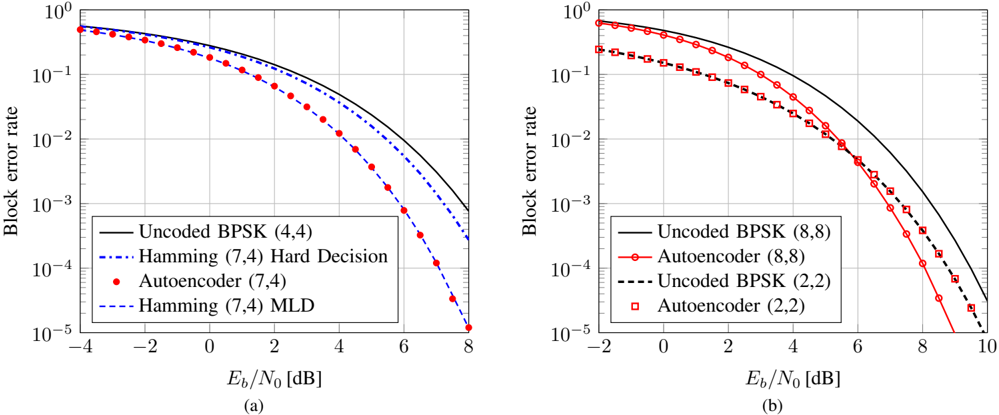
- A learned autoencoder for a (7,4) system at rate R = 4/7 achieves the same block error rate (BLER) as a Hamming (7,4) code with maximum likelihood decoding, while an (8,8) autoencoder outperforms uncoded BPSK over the full E_b/N_0 range, indicating learned joint coding and modulation.
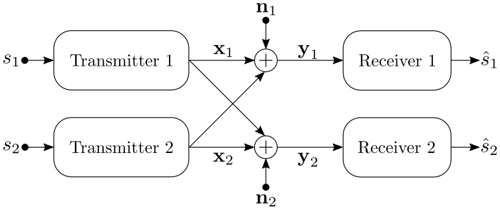
- For the two-user AWGN interference channel, the autoencoder matches time-sharing for (1,1) and (2,2), but achieves gains of about 0.7 dB for (4,4) and 1 dB for (4,8) at a BLER of 10^-3.
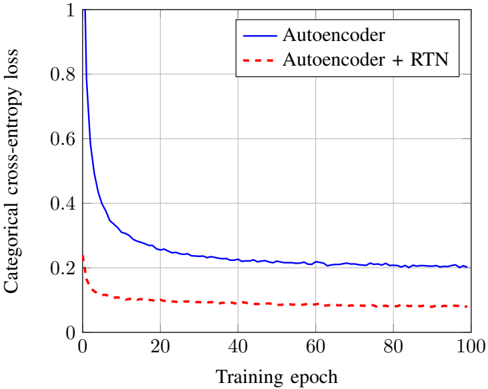
- An autoencoder (8,4) with an RTN over a multipath fading channel with L = 3 Rayleigh taps outperforms differential BPSK with maximum likelihood sequence estimation and a Hamming (7,4) code, whereas the plain autoencoder struggles to match it; RTNs also show faster training convergence.
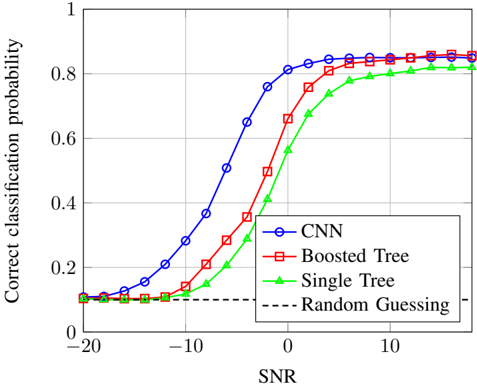
- For modulation classification on 1.2M sequences of 128 complex-valued IQ samples across ten modulation schemes and SNRs from -20 dB to 18 dB, the CNN outperforms a boosted expert-feature classifier by around 4 dB in the low-to-medium SNR range, with almost identical high-SNR performance; a single tree is about 6 dB worse at medium SNR and 3.5% worse at high SNR.
Methods
- The transmitter, channel, and receiver are represented as one deep neural network trained as an autoencoder: one-hot message input, dense layers, normalization layer for transmit constraints, additive noise channel layer, and softmax receiver output, trained with categorical cross-entropy using SGD/Adam at learning rate 0.001 and fixed E_b/N_0 = 7 dB.
- The autoencoder concept is extended to multiple transmitter-receiver pairs in a two-user interference channel, with dynamic loss weights α_t per mini-batch to balance the two cross-entropy losses; performance is compared against 2^{2k/n}-QAM with time-sharing.
- RTNs combine a learned parameter estimator, a differentiable parametric transform, and a discriminative network; the paper demonstrates phase-offset compensation and multipath inverse filtering. For modulation classification, a VGG-like CNN with 324,330 trainable parameters is trained on the RML2016.10b dataset.
Limitations
- The paper states that scalability to large message sets M is a major challenge: for k = 100 bits, training complexity is prohibitive because the autoencoder must see at least every message once.
- The paper states that optimal data representations, loss functions, training SNR, and hyperparameters are not well understood; training at one SNR does not necessarily generalize to others, and no common communications benchmarks or datasets comparable to MNIST or ImageNet exist.
- The paper states that end-to-end learning over real channels requires system identification because backpropagation assumes a known channel transfer function; complex-valued neural networks are not supported by current DL libraries. Evident from the text: the reported results are simulation-based, use small (n,k) settings, assume known channel models during training, and the paper explicitly leaves detailed performance comparisons for various channel types and parameters to future work.
Model-written summary. Check it against the paper before relying on it.
Integrity signals
Registry
Cites
Statistics
Figures






Verification
Claims the paper makes
6 Valid · 4 Not valid · 18 Not checked · 65 Own results and interpretations
Every source the paper cites for this claim was checked and supports it.
In the paper
“For instance in [22], it was shown that training with a single codeword is sufficient since the structure of the code is embedded in the NN through the Tanner graph.”
What the sources say
- Supportedcites [22] [22] E. Nachmani, Y. Be'ery, and D. Burshtein, 'Learning to decode linear codes using deep learning,' in Proc. IEEE Annu. Allerton Conf. Commun., Control, and Computing (Allerton) , 2016, pp. 341-346. - source
The Introduction says the decoder uses a Tanner graph representing the code and that one codeword suffices for training. Section III explains the precise condition: over a binary memoryless symmetric channel, the decoder’s error rate is independent of the transmitted codeword, so training can use noisy versions of a single codeword. (LLM, conf=0.91)
boostedstates a cause- Asserted: passes — The authors put it forward as true.
- Checkable: passes — It can be checked against evidence.
- Load-bearing: unclear — It is unclear whether the paper’s conclusions depend on it.
- Based: passes — The paper gives a reason why it holds.
- Supported
A result the paper reports from its own data — it cites no other source for it, so there is none to check. The quote shows it is in the paper.
In the paper
“We study the use of NNs on complex-valued IQ samples for the problem of modulation classification and show that convolutional neural networks (CNNs), which are the cornerstone of most DL systems for computer vision, can outperform traditional classification techniques based on expert features.”
plainstates a cause- Asserted: passes — The authors put it forward as true.
- Checkable: passes — It can be checked against evidence.
- Load-bearing: passes — The paper’s conclusions depend on it.
- Based: passes — The paper gives a reason why it holds.
The paper states this without a source or data behind it here, so there is nothing to check it against. The quote shows it is in the paper.
In the paper
“Training at low SNR for instance does not allow for the discovery of structure important in higher SNR scenarios.”
plainstates a cause- Asserted: passes — The authors put it forward as true.
- Checkable: passes — It can be checked against evidence.
- Load-bearing: unclear — It is unclear whether the paper’s conclusions depend on it.
- Based: unclear — It is unclear why the paper says it holds.
A result the paper reports from its own data — it cites no other source for it, so there is none to check. The quote shows it is in the paper.
In the paper
“Another advantage of RTNs is faster training convergence which can be seen from Fig. 10 that compares the validation loss of the autoencoder with and without RTN as a function of the training epochs.”
plainstates a cause- Asserted: passes — The authors put it forward as true.
- Checkable: passes — It can be checked against evidence.
- Load-bearing: unclear — It is unclear whether the paper’s conclusions depend on it.
- Based: passes — The paper gives a reason why it holds.
A result the paper reports from its own data — it cites no other source for it, so there is none to check. The quote shows it is in the paper.
In the paper
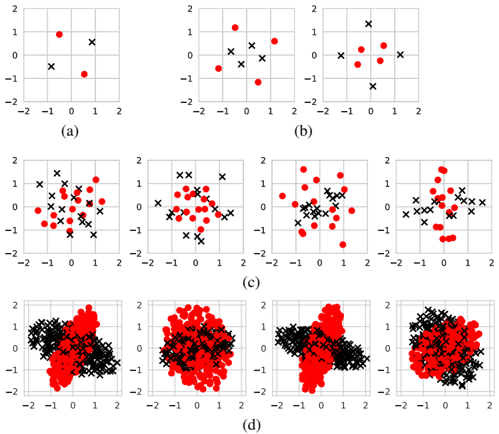
“Similarly, Fig. 4b shows a (4 , 2) system which leads to a rotated 16-PSK constellation.”
plainstates a cause- Asserted: passes — The authors put it forward as true.
- Checkable: passes — It can be checked against evidence.
- Load-bearing: unclear — It is unclear whether the paper’s conclusions depend on it.
- Based: passes — The paper gives a reason why it holds.
39 more claims
Create a free account to see all 93 claims and to verify the 4 references still open.
- Probably not a substantial claim. 29
- It may state two separate claims as one. 24
Self-check
Percentages, sums and reported differences re-computed from the paper’s own numbers.
Each contradiction between two passages listed here was confirmed by an independent check.
Rated minor: it would not touch a result — a value no result rests on, a p-value that stays on the same side of the significance level, or a conflict that is clerical, resolved elsewhere in the paper, or outside its own findings.
In the paper
§ A. Autoencoders for end-to-end communications systems · p. 5
“Similarly, Fig. 4b shows a (4 , 2) system which leads to a rotated 16-PSK constellation.”
§ A. Autoencoders for end-to-end communications systems · p. 6
“Figure 4: Constellations produced by autoencoders using parameters ( n, k ) : (a) (2 , 2) (b) (2 , 4) , (c) (2 , 4) with average power constraint, (d) (7 , 4) 2-dimensional t-SNE embedding of received symbols.”
Citations
Cites
Very Deep Convolutional Networks for Large-Scale Image Recognition
Simonyan, K., & Zisserman, A. (2014) · arXiv · doi:10.48550/arxiv.1409.1556 · Cited by 114,148 · cited 1×
“dense/fully-connected layers and terminated with a dense softmax layer for our classifier (similar to a VGG architecture [55]).”
BackgroundAdam: A Method for Stochastic Optimization
Kingma, D. P., & Ba, J. (2014) · arXiv · doi:10.48550/arxiv.1412.6980 · Cited by 98,946 · cited 4×
“Training was done at a fixed value of Eb/N0 = 7 dB (see Section IV-B) using Adam [46] with learning rate 0.”
BackgroundMethodInfluentialA Mathematical Theory of Communication
Shannon, C. E. (1948) · Bell System Technical Journal · doi:10.1002/j.1538-7305.1948.tb01338.x · Cited by 88,486
Scikit-learn: Machine Learning in Python
Pedregosa, F., Varoquaux, G., Gramfort, A., Michel, V., Thirion, B., Grisel, O., Blondel, M., Müller, A., Nothman, J., Louppe, G., et al. (2012) · arXiv · doi:10.48550/arxiv.1201.0490 · Cited by 71,016 · cited 1×
“11, we compare the classification accuracy of the CNN against that of extreme gradient boosting7 with 1000 estimators, as well as a single scikit-learn decision tree [56], operating on a mix of 16 analog and cumulant expert features as proposed in [53] and [57].”
Method(2014) · Cited by 33,419
(2008) · Journal of Machine Learning Research · Cited by 33,051
Human-level control through deep reinforcement learning
Mnih, V., Kavukcuoglu, K., Silver, D., Rusu, A. A., Veness, J., Bellemare, M. G., Graves, A., Riedmiller, M., Fidjeland, A. K., Ostrovski, G., et al. (2015) · Nature · doi:10.1038/nature14236 · Cited by 30,357
(2007) · Electronics: A First Course · doi:10.4324/9780080477527-64 · Cited by 24,923
Pan, S. J., & Yang, Q. (2010) · IEEE Transactions on Knowledge and Data Engineering · doi:10.1109/tkde.2009.191 · Cited by 23,387 · cited 1×
“learning [64] is one appealing candidate for adapting an endto-end communications system trained on a statistical model to”
BackgroundMultilayer feedforward networks are universal approximators
Hornik, K., Stinchcombe, M., & White, H. (1989) · Neural Networks · doi:10.1016/0893-6080(89)90020-8 · Cited by 21,728 · cited 1×
“Third, it has been shown that NNs are universal function approximators [13] and recent work has shown a remarkable”
Background
Research works printed but not linked: 2
- [35] I. Goodfellow, Y. Bengio, and A. Courville, Deep Learning . MIT Press, 2016. -
- [52] J. Estaran et al. , 'Artificial neural networks for linear and non-linear impairment mitigation in high-baudrate IM/DD systems,' in Proc. 42nd European Conf. Optical Commun. (ECOC) . VDE, 2016, pp. 1-3. -
Cited by
Items 2,101–2,200 of 2,995
Improved ComNet Based on Expectation Propagation for CP-Free OFDM System
Zhang, J., Yang, X. D., Wen, C.-K., Li, X., & Jin, S. (2019) · IEEE/CIC International Conference on Communications in China (ICCC) · doi:10.1109/iccchina.2019.8855840 · Cited by 1
“Recently, there are some works exploiting deep learning into wireless physical layer [11][12].”
BackgroundA Machine Learning Approach for Beamforming in UDN Considering Selfish and Altruistic Balance
Sun, C., Wang, X., Jiang, F., Qin, H., & Sun, S. (2020) · IEEE Vehicular Technology Conference · doi:10.1109/vtc2020-spring48590.2020.9129451 · Cited by 1
“Deep learning (DL) has shown recently the great potentials for improving the system performance of communications in aspects such as physical layer [4], power control[5,6] and beamforming[7,9] of resource allocation.”
BackgroundFast Fitting Method of Complex Network Based on Deep Learning
Li, M., & Huang, Z. (2020) · Advances in intelligent systems and computing · doi:10.1007/978-981-33-4572-0_138 · Cited by 1
Spectrum Monitoring Based on End-to-End Learning by Deep Learning
Rahmani, M., & Ghazizadeh, R. (2022) · International Journal of Wireless Information Networks · doi:10.1007/s10776-021-00548-1 · Cited by 1
“O’Shea and Hoydis [6] provided a summary of the state-of-the-art and future potential applications of DL in wireless communication.”
BackgroundInfluentialMachine learning techniques for passive optical networks
Yi, L., Huang, L., Li, Z., Xu, Y., & Xu, W. (2022) · Elsevier eBooks · doi:10.1016/b978-0-32-385227-2.00011-5 · Cited by 1
Mathews, B. D., & Muthu, T. (2022) · International Conference on Intelligent Computing and Control Systems (ICICCS) · doi:10.1109/iciccs53718.2022.9787992 · Cited by 1
An RF I/Q Sample Data Set Acquisition Method Based on Environmental Characteristic Parameters
Chen, R., & Chen, Z. (2022) · Photonics & Electromagnetics Research Symposium (PIERS) · doi:10.1109/piers55526.2022.9793282 · Cited by 1
PHY-NET: A Channel Autoencoder Approach for Wireless PHY Layer Design
Frisbie, S., Reddy, A., Barcklow, D., & Sweeney, S. J. (2022) · International Conference on Communications · doi:10.1109/icc45855.2022.9838695 · Cited by 1
“A number of architectural modifications were made to the original design, described in [3], to increase the model’s ability to address the various design challenges imposed by the LGAs.”
BackgroundMethodNeural joint source-channel coding via Bernoulli latent straight-through estimator
Seo, J., Kim, S., & Kang, J. (2022) · Journal of Communications and Networks · doi:10.23919/jcn.2022.000043 · Cited by 1
Research on Autoencoders for Higher Order Modulation
Liu, Q., Yu, G., Liu, J., & Zhou, X. (2022) · IEEE International Conference on Communication Technology (ICCT) · doi:10.1109/icct56141.2022.10072635 · Cited by 1
“But, in previous work, most AEs can only handle signals up to 64QAM, because they usually use one-hot encode on the input signals [3].”
BackgroundMethodEnd-to-end Learning for Fiber Nonlinearity Mitigation Geometric Shaping via RNN-based Autoencoder
Liu, Z., Cao, C., Xiao, S., & Hu, W. (2022) · Asia Communications and Photonics Conference · doi:10.1109/acp55869.2022.10088800 · Cited by 1
“In [7], autoencoder was firstly applied to GS of the end-to-end system, while in [8], a simplified channel model containing nonlinearity was implemented.”
MethodA Global Correlation Action Recognition Framework Using WiFi Signal-Based DenseNet
Zhao, J. G., Huang, L. P., Chen, H. H., Chong, S., & Li, X. (2023) · Arabian Journal for Science and Engineering · doi:10.1007/s13369-023-07918-2 · Cited by 1
“Deep learning-based frameworks have been successfully applied in many fields, including communications and networking [12, 13].”
BackgroundBiLSTM-Based Frame Synchronization for Overlapped S-AIS Signals: A Learning-Empowered Approach
Yang, T., He, D., Lu, Z., Wang, H., Zhao, H., & Wu, Z. (2023) · IEEE/CIC International Conference on Communications in China (ICCC) · doi:10.1109/iccc57788.2023.10233418 · Cited by 1
“signal processing problems [10], such as channel estimation [11], automatic modulation classification (AMC) [12], signal demodulation [13], signal prediction [14], etc.”
BackgroundRateless Autoencoder Codes: Trading off Decoding Delay and Reliability
Ninković, V., Vukobratović, D., Häger, C., Wymeersch, H., & Amat, A. G. I. (2023) · International Conference on Communications · doi:10.1109/icc45041.2023.10278853 · Cited by 2
“The resulting AE-based codes are shown to perform close to optimal for several baseline scenarios [11]–[15].”
BackgroundMethodInfluentialHuynh, T. N. T., Hoang, T. K., & Dao, T.-N. (2023) · International Conference on Control, Automation and Information Sciences (ICCAIS) · doi:10.1109/iccais59597.2023.10382342 · Cited by 4
“The existing works [4]– [6] demonstrated that the AE architecture is feasible for designing and implementing end-to-end learned communication systems, showing potential for performance comparable to contemporary systems, nearly achieving Shannon capacity while retaining generality and low…”
BackgroundDecode-and-Forward Based Cooperative MIMO System using Deep Learning for Wireless Body Area Networks
Bui, T. T. T., Tran, X. N., & Phan, A. H. (2023) · International Conference on Control, Automation and Information Sciences (ICCAIS) · doi:10.1109/iccais59597.2023.10382294 · Cited by 1
“Numerous research groups are interested in applying deep learning methods based on the autoencoder (AE) to the problem of applying communication systems [14], [15].”
BackgroundDeep-Learning based Equalization of Highly Compressed Faster Than Nyquist Signals
Paul, S., Seshadri, N., & Koilpillai, R. D. (2023) · IEEE International Conference on Advanced Networks and Telecommunications Systems · doi:10.1109/ants59832.2023.10469596 · Cited by 1
“More recently, there has been a growing interest in leveraging ML algorithms for signal processing and physical layer (PHY) problems [3]–[5].”
BackgroundImpulse Noise Suppression by Deep Learning-Based Receivers in OFDM Systems
Tseng, D., Lin, C.-S., & Tseng, S. (2024) · Wireless Personal Communications · doi:10.1007/s11277-024-10919-5 · Cited by 1
“One of the most remarkable DL paradigms in communication systems is the DNN-based codec (i.e., encoder and decoder) presented in [23], which harnesses inherent expressiveness of deep architectures to exhibit competitive system performance to the result driven by communication theory-based…”
Utilizing terrain-generation to derive realistic channel models for automatic modulation recognition
Witham, K., Prabhu, N. M., Sultan, A., Necsoiu, M., Spooner, C. M., & Schirner, G. (2024) · Synthetic Data for Artificial Intelligence and Machine Learning: Tools, Techniques, and Applications · doi:10.1117/12.3013507 · Cited by 1
“The most popular areas of study include front-end configuration, 12,13 spectrum sharing, 14,15 signal classification, 3,4,16 and transmitter fingerprinting.”
BackgroundDetecSHUN: Detection of Signals Hidden Under the Noise
Rowe, N., & Saha, D. (2024) · ACM Workshop on Wireless Security and Machine Learning (WiseML) · doi:10.1145/3649403.3656488 · Cited by 1
“In [5, 9, 21], a number of ML techniques are evaluated for signal detection, including Logistic Regression, k-Nearest Neighbor (KNN), and Support Vector Machines (SVM).”
MethodAutoencoders for Signal Enhancement in Communication Systems
Duque, V., Lewandowsky, J., Adrat, M., Hardenbicker, T., & Jax, P. (2024) · International Conference on Military Communications and Information Systems (ICMCIS) · doi:10.1109/icmcis61231.2024.10540784 · Cited by 2
“Deep learning has also been applied on attempts of building fully learned communication systems using a neural network structure called autoencoder , e.g., in [10–12].”
MethodIoT Computing Collaboration and Data-Aware Routing Algorithm for Edge Computing and DL
Li, B., Tang, J., Yang, Z., Jiang, Q., & Wei, J. (2024) · International Journal of Pattern Recognition and Artificial Intelligence · doi:10.1142/s0218001424590109 · Cited by 1
Lora-Based Data Transmission System for Smart Buildings
Kumar, S., & Verma, K. (2024) · International Conference on Pioneering Developments in Computer Science & Digital Technologies (IC2SDT) · doi:10.1109/ic2sdt62152.2024.10696110 · Cited by 1
“End-to-end strategies using Deep Auto Encoders to optimize the transmitter and receiver functions by representing them using 979-8-3503-6501-6/24/$31.00 ©2024 IEEE a neural network, where the transmitter maps source data and the receiver learns de-mapping operation [3], [11], [12].”
BackgroundMethodInfluentialPyJama: Differentiable Jamming and Anti-Jamming with NVIDIA Sionna
Ulbricht, F., Marti, G., Wiesmayr, R., & Studer, C. (2024) · IEEE International Workshop on Signal Processing Advances in Wireless Communications (SPAWC) · doi:10.1109/spawc60668.2024.10694375 · Cited by 1
“Since machine learning (ML) had a transformative impact on communication engineering [2], [3], it might be expected to enhance our understanding of jamming attacks and facilitate new ways of mitigating such attacks.”
BackgroundBRIC: Bottom-Up Residual Vector Quantization for Learned Image Compression
Flowers, B., & Dey, S. (2024) · IEEE Access · doi:10.1109/access.2024.3476462 · Cited by 1
Sheraz, A., Shahid, M. F., Khan, Z. A., & Khanzada, T. J. S. (2023) · International Bhurban Conference on Applied Sciences and Technology (IBCAST) · doi:10.1109/ibcast59916.2023.10712833 · Cited by 1
“A CNN-based approach for the classification of modulation signals is presented in [26], in their investigations, CNNs outperformed various traditional approaches.”
MethodHuman Detection and Tracking using Machine Learning Algorithm
Nallasivan, G., Thatikonda, R., Geetha, M. K., Bhuvanesh, A., Ramraj, S., & Sreethu, S. (2024) · IEEE International Conference on Advances in Computing Research on Science Engineering and Technology (ACROSET) · doi:10.1109/acroset62108.2024.10743585 · Cited by 1
“Attention mechanisms are a recent development in deep learning that was shown to increase the enactment of object detection and tracking [9, 10].”
BackgroundDeep Learning Enabled Channel Estimation for FSO Systems
Upadhya, A., Dwivedi, V. K., & Singh, G. K. (2024) · Springer eBooks · doi:10.1007/978-3-031-74805-9_9 · Cited by 1
Quasi-Neural Network-Based Decoder for Single-Carrier Communications
Du, Q., Wang, C., Jiang, Y. F., & Ran, R. (2024) · IEEE Transactions on Communications · doi:10.1109/tcomm.2024.3516504 · Cited by 1
“Inrecent years, many works have utilized artificial neural networks (ANNs) to aid communication systems to mitigate the impact of interference and noise in complex wireless environments, gaining significant attention [2], [3], [4], [5], [6], [7], [8], [9], [10], [11], [12], [13], [14], [15], [16].”
Low-Complexity Data-Driven Communication Neural Receivers
Wu, Q., Liang, Y., Ng, B. K., Lam, C., & Ma, Y. (2025) · IEEE Access · doi:10.1109/access.2024.3524571 · Cited by 2
TC-MSNet: A Multi-feature Extraction Neural Framework for Automatic Modulation Recognition
Wang, Y., Feng, Y., Song, B., Tian, B., & Qian, B. (2025) · Wireless Personal Communications · doi:10.1007/s11277-024-11723-x · Cited by 1
Deep Neural Network based Channel Estimation in VANET
Shukla, D., Tripathi, Y. C., Prakash, A., & Tripathi, R. K. (2024) · International Conference on Internet of Everything, Microwave Engineering, Communication and Networks (IEMECON) · doi:10.1109/iemecon62401.2024.10846318 · Cited by 1
Hybrid Complex Valued Convolutional Recurrent Network for Automatic Modulation Classification
Khoury, C. E., Armour, S. M. D., & Beach, M. A. (2024) · IEEE Middle East Conference on Communications and Networking (MECOM) · doi:10.1109/mecom61498.2024.10881355 · Cited by 1
Lightweight Automatic Modulation Classification Method Using Filter Pruning via Geometric Median
Shi, C., Zhou, W., Wu, X., Zhang, X., Wang, Y., & Gui, G. (2024) · International Conference on Robotics, Intelligent Control and Artificial Intelligence (RICAI) · doi:10.1109/ricai64321.2024.10911550 · Cited by 1
“T. O’Shea et al. [9] put forward a DL-based AMC method, which directly uses received in-phase and quadrature (IQ) signals as inputs for a convolutional neural network (CNN).”
Modulation Order Identification of CPM Signals Based on Deep Learning
Yang, K., Li, T., Cao, S., Shen, K., & Duan, R. (2024) · IEEE International Conference on Computer and Communications (ICCC) · doi:10.1109/iccc62609.2024.10941755 · Cited by 1
“This offers novel avenues for the processing of complex problems, such as automatic modulation recognition [9], [10] and channel coding [11].”
Learning to Design Constellation of MLC With Geometric Shaping
Ding, F., Jiang, M., Wang, Y., Xu, Q., & Wang, Q. (2024) · IEEE International Conference on Communication Technology (ICCT) · doi:10.1109/icct62411.2024.10946339 · Cited by 1
“Thanks to the advancements in deep learning, in recent years many works exploit deep learning with communication systems to optimize performance in various scenarios [5]– [8].”
Point-to-multipoint coherent PON system modeling based on the diffusion model
Guan, X., Xu, Y., Jiang, W., Wang, X., Han, C., Hu, W., & Yi, L. (2025) · Optics Letters · doi:10.1364/ol.553826 · Cited by 1
Runge, C., & Dias, U. (2025) · Optical Engineering · doi:10.1117/1.oe.64.4.048106 · Cited by 1
“In this work, we propose the use of the autoencoder concept introduced by O ’ Shea et al. 11 to automatically generate a modulation alphabet for superposed multiplexed OAM modes in a fully data-driven manner.”
Combined compression and encryption of linear wireless sensor network data using autoencoders
Shylashree, N., Kumar, S., & Min, H. (2025) · Scientific Reports · doi:10.1038/s41598-024-84017-8 · Cited by 2
“In 11 , the AE acts as the wireless communication interface between the transmitter and the receiver in the physical layer.”
ECU s Fingerprint Identification Based on CAN Bus Using 1D-CNN
Hsu, Y., Wu, C.-M., & Horng, J. (2025) · IEEE International Conference on Consumer Technology (ICCT-Pacific) · doi:10.1109/icct-pacific63901.2025.11012841 · Cited by 1
“By leveraging convolutional layers, they efficiently extract temporal features critical for applications like fault detection, classification, and anomaly detection across diverse domains, including healthcare, communications, and industrial systems [5].”
Resource-Efficient Multiview Perception: Integrating Semantic Masking with Masked Autoencoders
Dakic, K., Thilakarathna, K., Calheiros, R. N., & Lim, T. J. (2025) · IEEE International Conference on Pervasive Computing and Communications · doi:10.1109/percom64205.2025.00034 · Cited by 7
“Hou et al. [16] introduced MVDet, which projects features from multiple camera views onto a shared BEV representation, demonstrating the effectiveness of anchor-free representation and fully convolutional spatial aggregation.”
Yuan, W., Chen, C., Sun, W., Shen, C., Li, Z., Zhou, Y., Zhang, J., Chi, N., & Shi, J. (2025) · Optical Fiber Communication Conference · doi:10.1364/ofc.2025.th2a.48 · Cited by 1
AI Filtering System for Optimizing Wavelet-Based Industrial Communications
Moubarak, Z., Monteiro, F., Aarif, L., Dandache, A., & Tabaa, M. (2025) · Journal of Physics Conference Series · doi:10.1088/1742-6596/3028/1/012042 · Cited by 1
“Hoydis, O’Shea et al. have introduced deep learning into the physical layer by treating the transmitter and receiver as an end-to-end optimization via auto-encoders, which minimize the bit error rate (BER) [11].”
Multi-Level Wavelet Transform Network Based Automatic Modulation Classification
Yang, W. (2025) · International Seminar on Artificial Intelligence, Networking and Information Technology (AINIT) · doi:10.1109/ainit65432.2025.11035456 · Cited by 1
“T. O’Shea et al. [4,5] first applied convolutional neural networks (CNN) to extract signal features for modulation classification.”
An End-to-End Autoencoder-Based Non-Orthogonal Multi-Carrier System for Transmission
Zhou, Y., & Darwazeh, I. (2025) · doi:10.1109/ict65093.2025.11046292 · Cited by 1
Receiver-side LSBoost-Aided constellation denoising for energy-efficient VLC systems
Bai, S., Li, Y., Mohsan, S. A. H., Li, Q., & Fu, H. Y. (2025) · Optics Communications · doi:10.1016/j.optcom.2025.132218 · Cited by 1
Application of Deep Learning in Flow and Heat Transfer Simulation of Supercritical Hydrocarbon Fuels
Yeyi, L., Minguo, Z., Rui, C., Ziyan, D., Rong-qing, J., Tingting, J., Fei, Q., Yinlong, L., & Sun, X. (2025) · Journal of Physics Conference Series · doi:10.1088/1742-6596/3056/1/012004 · Cited by 1
“Tim O’Shea [11] points out that physics-informed neural networks (PINN) have become the optimal choice for accelerating the solution of dynamical equations due to their advantages in handling large-scale data and capturing complex nonlinear relationships.”
Online Optimization for Learning to Communicate Over Time-Correlated Channels
Wu, Z., Li, J., Xu, Z., Sun, S., & Liu, J. (2025) · IEEE Transactions on Cognitive Communications and Networking · doi:10.1109/tccn.2025.3595551 · Cited by 1
“Most existing studies utilizing machine learning approaches to design communication systems lack theoretical justification for their proposed methods, and typically regard learned communication systems as closed boxes [5], [6].”
Limited Quantized RIS-Aided Communication Systems Based on End-to-End Online Learning
Wang, J.-W., Wu, Z.-Y., Guo, R., Muhammad, I., Liu, X., & Zhang, J. (2025) · Chinese Control and Decision Conference (CCDC) · doi:10.1109/ccdc65474.2025.11090286 · Cited by 1
“To address the issue that optimizing individual modules does not necessarily lead to global optimization of the entire RIS-assisted communication system [11], [12], recent work has proposed an E2E learned RIS-assisted communication system.”
Deep SIMO Auto-Encoder and Radio Frequency Hardware Impairments Modeling for Physical Layer Security
Mohammad, A., Kabir, M. T., Valkama, M., & Tan, B. (2024) · IEEE Globecom Workshops (GC Wkshps) · doi:10.1109/gcwkshp64532.2024.11100896 · Cited by 1
“In recent years, there has been a surge in interest in end-to-end learning communication, revealing the promise of energy-efficient and secure wireless communication paradigms [5], [6].”
Model-Agnostic Uncertainty Quantification for Fast NFC Tag Identification Using RF Fingerprinting
Sarpong, D. A., Kamrath, A., Bhusal, R., & Guo, H. (2025) · IEEE Internet of Things Journal · doi:10.1109/jiot.2025.3605841 · Cited by 4
“In contrast, modern advancements leverage DL techniques [13], enabling automatic extraction of complex features without the need for application-specific customization [14], [15], [16], [17].”
Deep Learning-Based Modulation and Power Control: A BER Perspective
Oh, Y., Park, J., Choi, J., & Jeon, Y. (2025) · IEEE Communications Letters · doi:10.1109/lcomm.2025.3605917 · Cited by 1
“• E2E: This framework is modified from existing end-to-end (E2E) frameworks in [14].”
Data-Aided Learning for Multi-Antenna OFDM Systems with Superimposed Pilot in Time-Varying Channel
Zhao, L., Kang, H., Ding, F., & Jiang, M. (2025) · IEEE/CIC International Conference on Communications in China (ICCC) · doi:10.1109/iccc65529.2025.11148898 · Cited by 1
“Addressing these limitations, [2] proposes a new concept that emphasizes the treatment of transmitters, channels, and receivers as a trainable neural network (NN) for end-to-end learning.”
Adaptive T-Detector exploiting Outer SISO Decoder in Time-Selective Channels
Magnaldi, M., & Montorsi, G. (2025) · International Symposium on Turbo Codes and Iterative Information Processing · doi:10.1109/istc65386.2025.11154609 · Cited by 1
“This approach addresses the limitations of purely data-driven DL techniques in physical layer signal processing [1], where traditional DSP blocks are entirely replaced by generic neural networks—often resulting in high computational complexity and limited interpretability.”
Integrating Reinforcement Learning and LLM with Self-Optimization Network System
Xu, X., Zhao, J., Zhang, Y., & Li, R. (2025) · Network · doi:10.3390/network5030039 · Cited by 1
“In the optimization of communication networks, RL can flexibly cope with complex problems (e.g., traffic management, bandwidth allocation, and path selection), especially when resources are limited and the environment changes dynamically [5].”
Ahmed, M. S., Jawhar, Y. A., Gismalla, M. S. M., & Hassib, M. D. (2025) · Journal of Ambient Intelligence and Humanized Computing · doi:10.1007/s12652-025-05012-z · Cited by 1
Multi-Block Attention for Efficient Channel Estimation in IRS-Assisted mmWave MIMO
Momen‐Tayefeh, M., Momen-Tayefeh, M., & Sabbaghian, M. (2025) · IEEE Transactions on Communications · doi:10.1109/tcomm.2025.3618696 · Cited by 2
“Deep learning (DL) has emerged as a powerful alternative for IRS-aided channel estimation due to its data-driven modeling capability and potential for real-time inference [19], [20], [21].”
A Semi-supervised Generative Adversarial Network Algorithm for Alzheimer's Disease Analysis
Yan, J., Gui, R., & Liang, H. (2024) · Information Technology And Control · doi:10.5755/j01.itc.53.3.36432 · Cited by 1
Low-Complexity Residual Network-Augmented Channel Sounding in mmWave Massive MIMO on System on Chip
Haq, S. A. U., Gulati, A., & Darak, S. J. (2025) · IEEE transactions on circuits and systems for artificial intelligence. · doi:10.1109/tcasai.2025.3620392 · Cited by 2
“This method, known as expert-knowledge-aided DL, strikes a balance by integrating domain expertise into DL models, resulting in resource-efficient PHY [24].”
Qin, H., Li, Z., Yan, A., Dong, B., Zhao, J., Hu, Y., Wang, C., Shi, J., Zhou, Y., Li, Z., et al. (2025) · Journal of Lightwave Technology · doi:10.1109/jlt.2025.3621282 · Cited by 1
Synthesizing tables for supervised learning
Zhu, Y., Li, G., Feng, J., & Tang, N. (2025) · Frontiers of Computer Science · doi:10.1007/s11704-025-40424-2 · Cited by 1
A Complex-Based Rethinking of Communications
Scatà, M. (2025) · Studies in systems, decision and control · doi:10.1007/978-3-032-04243-9_3 · Cited by 1
Baseband-Free End-to-End Communication System Based on Diffractive Deep Neural Network
Teng, X., Tang, W., Li, X., & Jin, S. (2025) · IEEE Transactions on Wireless Communications · doi:10.1109/twc.2025.3632886 · Cited by 5
“With the powerful capabilities of deep learning, an AE can autonomously learn the mapping from symbols to transmitted signals, forming an encoding network, while the receiver reconstructs the symbols using a decoding network [32], [33].”
Li, S., Guan, Q., Zhang, Y., Cui, X., Song, H., Gu, Z., & Li, L. (2025) · Physical Communication · doi:10.1016/j.phycom.2025.102942 · Cited by 1
Devalapally, S., Sridher, T., & Kuruva, L. (2025) · Journal of Applied Geodesy · doi:10.1515/jag-2025-0073 · Cited by 1
Wang, T., Yan, N., Yang, C., An, Z., Zhang, G., & Xu, Y. (2025) · Digital Signal Processing · doi:10.1016/j.dsp.2025.105820 · Cited by 1
Failure Tolerant Phase-Only Indoor Positioning via Deep Learning
Ayten, F., Ilter, M. C., Jain, A., Kaltiokallio, O., Talvitie, J., Lohan, E. S., Wymeersch, H., & Valkama, M. (2025) · IEEE International Symposium on Personal, Indoor and Mobile Radio Communications (PIMRC) · doi:10.1109/pimrc62392.2025.11274977 · Cited by 1
“These methods have shown increasing potential in adapting to complex and imperfect conditions [14]–[17].”
AI-Driven Cross-Layer Modulation Towards 6G
Wei, N., Yang, Z., Wei, X., Xu, X., & Liu, R. (2025) · IEEE International Symposium on Personal, Indoor and Mobile Radio Communications (PIMRC) · doi:10.1109/pimrc62392.2025.11275253 · Cited by 1
Modular Neural Wiretap Codes for Fading Channels
Seifert, D., Günlü, O., & Schaefer, R. F. (2025) · IEEE International Symposium on Personal, Indoor and Mobile Radio Communications (PIMRC) · doi:10.1109/pimrc62392.2025.11274860 · Cited by 1
“Using an autoencoder structure [13], the encoder and decoder parts are jointly optimized to minimize the BLER.”
Polar Coded Digital Twin Network: An End-to-End Design With GAN Prediction
Che, C., Zheng, K., Cui, J., Xiang, L., Hu, J., Yang, K., Zhao, D., & Tong, C. (2025) · IEEE Transactions on Vehicular Technology · doi:10.1109/tvt.2025.3622512 · Cited by 4
Intelligent Wireless Interference Recognition: Challenges, Opportunities, and Future Directions
Wang, P., Huang, X., Zhang, H., & Wang, Z. (2025) · IEEE Wireless Communications · doi:10.1109/mwc.2025.3600039 · Cited by 1
“Feature-based approach [3]: It consists of two components, that is, feature extraction and classi fi cation.”
Signal Surface Augmentation for Artificial Intelligence-Based Automatic Modulation Classification
Gros, A., Moeyaert, V., & Mégret, P. (2025) · Electronics · doi:10.3390/electronics14234760 · Cited by 1
Deep Learning-Based Bit-Wise Flexible Error Protection Modulation
Liu, W. X., Zhao, N., Zhu, J., & Chen, G. (2025) · IEEE Communications Letters · doi:10.1109/lcomm.2025.3646846 · Cited by 2
“The dynamic weighting coefficients ξ i in [12] promote more uniform error protection across subsequences under EEP scenarios and are computed as : Thus, the s i with the largest loss L i ( u i , p i ) receives the largest normalized coefficient ξ i , thereby receiving more emphasis Authorized…”
AI-Enhanced Directional Antenna Positioning System for GSM/LTE Signal Optimization
Matei, D. M., Selișteanu, D., & Constantinescu, M. C. (2025) · IEEE International Symposium for Design and Technology in Electronic Packaging (SIITME) · doi:10.1109/siitme67657.2025.11293647 · Cited by 1
MIMO-OTFS-NOMA-IRS System with ML-Based CE for 6G Communications
Mamadapur, P., Anitha, S., & Kumaran, T. S. (2025) · International Conference on Intelligent Systems and Pioneering Innovations in Robotics and Electric Mobility (INSPIRE) · doi:10.1109/inspire67328.2025.11300666 · Cited by 1
“O'Shea and Hoydis [12] provided a comprehensive introduction to machine learning applications in wireless communications, covering physical layer optimization and network management.”
Deep Learning-based Compensation for Doppler Shifts in Hybrid Beamforming for mmWave Communication
Patel, K. R., & Deshmukh, S. D. (2025) · Journal of Telecommunications and Information Technology · doi:10.26636/jtit.2025.4.2349 · Cited by 1
Lee, J.-H., Nguyen, V.-H., Tran, Q.-T., Le, D.-Q.-T., Nguyen, T.-D.-N., & Le, H.-S. (2025) · Journal of information and communication convergence engineering · doi:10.56977/jicce.2025.23.4.327 · Cited by 1
Chang, H., Chen, M., Wang, H., & Zhang, Q. (2025) · IEEE Military Communications Conference (MILCOM) · doi:10.1109/milcom64451.2025.11310050 · Cited by 1
“To enable robust wireless transmission, the privacy-removed image A and its associated semantic index i are jointly encoded into a unified bitstream, which is interpreted as a one-hot message class [8].”
Deep Learning-Based AIS Signal Collision Detection in Satellite Reception Environment
Wang, G., Li, L., Chen, X., & Zhang, Z. (2026) · Applied Sciences · doi:10.3390/app16020643 · Cited by 1
Sindal, S. S., & Trivedi, Y. N. (2026) · Physical Communication · doi:10.1016/j.phycom.2026.103008 · Cited by 1
Model-Driven Learning-Based Physical Layer Authentication for Mobile Wi-Fi Devices
Guo, Y., Zhang, J., Hong, Y.-W. P., & Tomasin, S. (2026) · IEEE Transactions on Information Forensics and Security · doi:10.1109/tifs.2026.3657184 · Cited by 1
“Index Terms —Internet of Things, physical layer authentication, channel state information, hypothesis test, neural networks.”
End-to-End Autoencoder Design for MU-MIMO Systems With Low Pilot Overhead
Velloso, E. N., Silveira, L. F. Q., & Sousa, E. S. (2026) · IEEE Access · doi:10.1109/access.2026.3659620 · Cited by 1
A Deep Learning Phase Noise Compensation Network for Photonic Terahertz OFDM System
Cai, S., Zhou, L. W., Li, T., & Yu, J. (2026) · Electronics · doi:10.3390/electronics15030647 · Cited by 1
Cyclo-AMC: Automatic Modulation Classification on Versal utilising Cyclostationary Features
Wu, R. L., Li, C. J., Zhang, W., Liu, X., & Leong, P. H. W. (2025) · International Conference on Field-Programmable Technology (FPT) · doi:10.1109/icfpt67023.2025.00021 · Cited by 1
“[2] classified raw in-phase and quadrature (I/Q) radio samples using a deep neural networks (DNNs) to significantly improve AMC accuracy over conventional approaches.”
Design of End-to-End Communication System Under CBAM-CGAN Channel
An, Y. Q., Liu, Y., Lu, S., & Ji, Z. (2026) · IEEE Transactions on Consumer Electronics · doi:10.1109/tce.2026.3665738 · Cited by 1
“In2017, the use of an autoencoder (AE) architecture was first proposed to model the entire communication system, integrating the transmitter and receiver into a unified, trainable neural network and enabling data-driven end-to-end (E2E) learning [11].”
Fang, Y. (2025) · International Conference on Electronic Information Engineering and Computer Communication (EIECC) · doi:10.1109/eiecc67963.2025.11409548 · Cited by 1
“Recent advances have employed neural networks for channel modeling [15], including applications in impulsive noise environments for OFDM channel estimation [16].”
A GAN-CNN Fusion Framework for Deep Learning-Based DOA Estimation in Low-SNR Environments
Zhang, Z., Xu, W., Zou, H., & Yi, S. (2026) · Sensors · doi:10.3390/s26051676 · Cited by 1
Alnajjar, K. A., Idries, H., Albreem, M. A. M., & Abdallah, S. (2026) · Wireless Personal Communications · doi:10.1007/s11277-026-11933-5 · Cited by 1
CoNet-Rx: Collaborative Neural Networks for OFDM Receivers
Obeed, M., & Jian, M. (2025) · Globecom · doi:10.1109/globecom59602.2025.11432464 · Cited by 1
“Several papers have been proposed deep learning to improve the receivers performance using DL [1], [2], [3], [4], [5], [6], [7], [8], [9], [10].”
End-to-End Learning for MIMO Load Modulation in Stochastic Channels: A Hierarchical Approach
Yu, E., Li, Q., & Chen, H. (2025) · Globecom · doi:10.1109/globecom59602.2025.11432020 · Cited by 1
“…likelihood detection; (2) CD-E2E: A standard CSI-dependent E2E learning framework that requires retraining for each channel upon deployment [4], [19]; (3) CL-AE: An existing E2E framework that learns a unified model for varying fading channels by concatenating the channel realizations as part…”
Research on Automatic Modulation Recognition Method Based on Knowledge Distillation
Zhou, R., Cai, Z., & Xin, G. (2026) · Lecture notes of the Institute for Computer Sciences, Social Informatics and Telecommunications Engineering · doi:10.1007/978-3-032-16823-8_23 · Cited by 1
Conv1D BiLSTM Residual Autoencoder for QPSK Signal Denoising in 3GPP Fading Channels
Anand, A. S., Deepak, S., & Chunkath, J. (2025) · International Conference on Emerging Trends in Signal Processing & Computational Intelligence (ICCSPCI) · doi:10.1109/iccspci68199.2025.11451386 · Cited by 1
“This problem is especially pronounced in standardized channel models such as the EPA, EVA, and ETU profiles, which emulate harsh propagation environments with delay spreads, Doppler shifts, and frequency selectivity [1].”
Design of a 5G MIMO-OFDM System Using Artificial Neural Networks Under Realistic Channel Impairments
Fouad, Z. L. (2026) · Journal of Al-Qadisiyah for Computer Science and Mathematics · doi:10.29304/jqcsm.2026.18.12454 · Cited by 1
“When specifically considering orthogonal frequency division multiplexing (OFDM), researchers have found in [31], that encoder-decoder models of OFDM show evidence that incorporating time-frequency structures improves the resistance of neural networks to both hardware and channel distortion compared…”
Lin, G., Zhu, Y., Qiu, Y., Huang, D., Song, S., & Hu, W. (2026) · Optics Communications · doi:10.1016/j.optcom.2026.133238 · Cited by 1
Smooshed Zero Constellation for Binary Modulation on Conjugate-Reciprocal Zeros
Perre, A. J., Huggins, P., & Şahin, A. (2026) · IEEE Transactions on Communications · doi:10.1109/tcomm.2026.3684177 · Cited by 2
“Recently, ML has gained traction in wireless communications as a tool to improve various applications at the physical layer [27], [28], [29], [30].”
Cho, Y., & Kim, J. (2026) · Electronics · doi:10.3390/electronics15132795 · Cited by 1
Imtiaz, W. A., & Iqbal, A. (2026) · Optics Communications · doi:10.1016/j.optcom.2026.133525 · Cited by 1
Secure Adaptive Waveforms for Satellite Communications
Xie, Y., Al‐Hourani, A., Divarathne, C., Kandeepan, S., Magowe, K., Huckle, T., & Shakeel, I. (2025) · IEEE Globecom Workshops (GC Wkshps) · doi:10.1109/gcwkshps68340.2025.11591195 · Cited by 1
“Recent advances in deep learning and end-to-end communication system designs have introduced data-driven approaches to adaptive modulation [6].”
LWM-Spectro: A Foundation Model for Wireless Baseband Signal Spectrograms
Kim, N., Alikhani, S., & Alkhateeb, A. (2026) · International Conference on Communications · doi:10.1109/icc59461.2026.11587404 · Cited by 1
“While deep learning has achieved strong performance in tasks such as modulation classification and channel estimation [1], [2], its dependence on large task-specific labeled datasets limits scalability.”
WiFo-E: Wireless Foundation Model for Scalable End-to-End FDD Precoding in Wireless Networks
Wen, W., Gao, S., Zhang, H., Cheng, X., & Yang, L. (2026) · IEEE Transactions on Network Science and Engineering · doi:10.1109/tnse.2026.3718685 · Cited by 8
“Early work modeled the point-to-point communication link as an autoencoder, treating the transmitter and receiver as trainable neural networks [44], [53].”
Metadata
- Authors
- O'Shea, T., & Hoydis, J.
- Affiliations
- Nokia (France) (FR)
- Venue
- IEEE Transactions on Cognitive Communications and Networking
- Published
- 2017-12
- Volume
- 3
- Issue
- 4
- Pages
- 563-575
- ISSN
- 2332-7731 (ISSN-L)
- OpenAlex
- W2734408173
- Semantic Scholar
- 78989616eeeac55b202e3e4205225e7135054185
- Cited by
- 2,980
- References
- 69
- Citations by year
- 2026: 307 · 2025: 327 · 2024: 305 · 2023: 368 · 2022: 432 · 2021: 409 · 2020: 406 · 2019: 322 · 2018: 95 · 2017: 9
- FWCI
- 122.29
- Type
- journal article
- Language
- en
- Open access
- green
- arxiv.org
- Locations
- IEEE Transactions on Cognitive Communications and Networking (publishedVersion)
- arXiv (Cornell University) (submittedVersion)
- arXiv (Cornell University)
- Topics
- Physical Sciences › Computer Science › Artificial Intelligence › Wireless Signal Modulation Classification
- Physical Sciences › Engineering › Electrical and Electronic Engineering › Advanced Wireless Communication Techniques
- Physical Sciences › Engineering › Electrical and Electronic Engineering › Advanced Wireless Communication Technologies
- Keywords
- end-to-end reconstruction, domain knowledge integration, convolutional neural networks, automatic modulation classification, IQ samples
About these checks
Registry, retraction, Cites and statistics results are computed, not judged, with one exception: a printed reference that no index lists is read once by a model before it counts as a citation error. Claims are extracted by a model and kept only when their quote appears verbatim in the text; each cited source is then checked, with a model’s help, for whether it says what the claim relies on. Those verdicts can be wrong — read the claim’s quote and the cited source before relying on one.
The claim verdicts this report counts are experimental: their accuracy is not yet measured.
A language model drew the claims from the paper on 2026-11-07, under version 3 of the claim definition (model deepseek-v4.1-flash, prompt extract-v3).
A second model labelled each claim on 2026-11-07 (model jev-1.13-20260917, definition revision gold-guideline-v0.2).
Cited sources are checked with a language model’s help (gpt-6-sol).
Statistics and arithmetic are recomputed, not judged.
Confidence bands are shown only for fields calibrated on our annotated test set. None is calibrated yet, so no band is shown.
What counts as a claim ›How we measure confidence ›How we check this ›
Are you an author, or do you see a problem with this page? Request a review
Data sources
Bibliographic data: Semantic Scholar, OpenAlex, Crossref.
Contains information from the Semantic Scholar Academic Graph Datasets, made available under the ODC Attribution License (ODC-BY 1.0).
Semantic Scholar’s data is described in: Kinney, R., et al. (2023). The Semantic Scholar Open Data Platform. arXiv:2301.10140.
