

An Introduction to Deep Learning for the Physical Layer
Open accessThe DOI matches its Crossref record; 90 of the 92 references it cites were found in a registry or an index, and 2 are not checked yet; 8 of the 32 sources its claims cite were checked for support.
Abstract
We present and discuss several novel applications of deep learning for the physical layer. By interpreting a communications system as an autoencoder, we develop a fundamental new way to think about communications system design as an end-to-end reconstruction task that seeks to jointly optimize transmitter and receiver components in a single process. We show how this idea can be extended to networks of multiple transmitters and receivers and present the concept of radio transformer networks as a means to incorporate expert domain knowledge in the machine learning model. Lastly, we demonstrate the application of convolutional neural networks on raw IQ samples for modulation classification which achieves competitive accuracy with respect to traditional schemes relying on expert features. This paper is concluded with a discussion of open challenges and areas for future investigation.
Verified 2026-11-19 · 2 references not checked yet
Overview
CoChat Summary
TL;DR
The paper introduces deep learning for the physical layer by treating a communications system as an autoencoder that jointly learns transmitter and receiver implementations end-to-end. It also extends this idea to multi-user interference channels, proposes radio transformer networks (RTNs) to inject expert domain knowledge, and shows CNNs on raw IQ samples can outperform expert-feature modulation classifiers.
Key findings
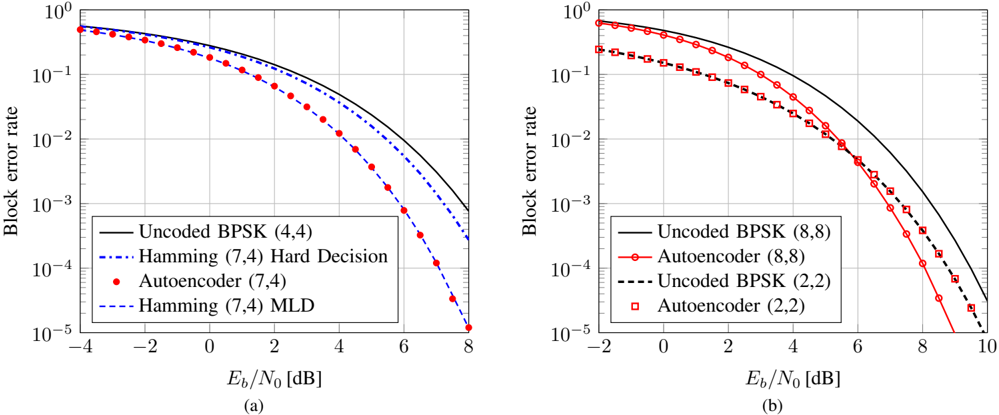
- A learned autoencoder for a (7,4) system at rate R = 4/7 achieves the same block error rate (BLER) as a Hamming (7,4) code with maximum likelihood decoding, while an (8,8) autoencoder outperforms uncoded BPSK over the full E_b/N_0 range, indicating learned joint coding and modulation.
- For the two-user AWGN interference channel, the autoencoder matches time-sharing for (1,1) and (2,2), but achieves gains of about 0.7 dB for (4,4) and 1 dB for (4,8) at a BLER of 10^-3.
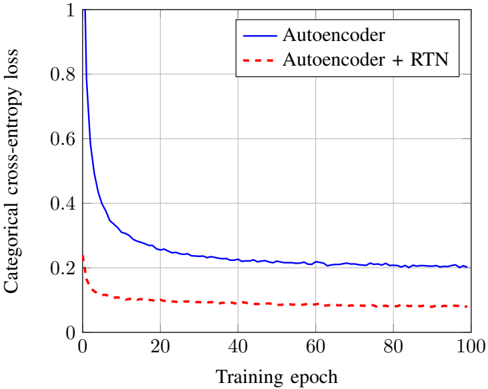
- An autoencoder (8,4) with an RTN over a multipath fading channel with L = 3 Rayleigh taps outperforms differential BPSK with maximum likelihood sequence estimation and a Hamming (7,4) code, whereas the plain autoencoder struggles to match it; RTNs also show faster training convergence.
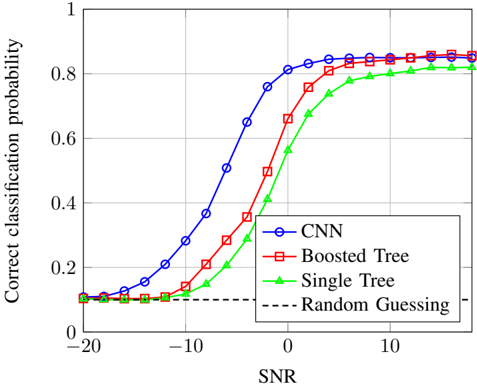
- For modulation classification on 1.2M sequences of 128 complex-valued IQ samples across ten modulation schemes and SNRs from -20 dB to 18 dB, the CNN outperforms a boosted expert-feature classifier by around 4 dB in the low-to-medium SNR range, with almost identical high-SNR performance; a single tree is about 6 dB worse at medium SNR and 3.5% worse at high SNR.
Methods
- The transmitter, channel, and receiver are represented as one deep neural network trained as an autoencoder: one-hot message input, dense layers, normalization layer for transmit constraints, additive noise channel layer, and softmax receiver output, trained with categorical cross-entropy using SGD/Adam at learning rate 0.001 and fixed E_b/N_0 = 7 dB.
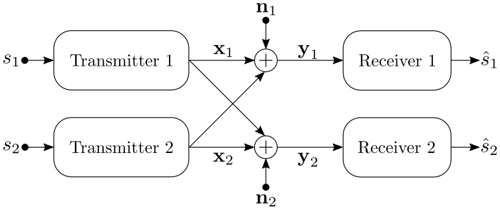
- The autoencoder concept is extended to multiple transmitter-receiver pairs in a two-user interference channel, with dynamic loss weights α_t per mini-batch to balance the two cross-entropy losses; performance is compared against 2^{2k/n}-QAM with time-sharing.
- RTNs combine a learned parameter estimator, a differentiable parametric transform, and a discriminative network; the paper demonstrates phase-offset compensation and multipath inverse filtering. For modulation classification, a VGG-like CNN with 324,330 trainable parameters is trained on the RML2016.10b dataset.
Limitations
- The paper states that scalability to large message sets M is a major challenge: for k = 100 bits, training complexity is prohibitive because the autoencoder must see at least every message once.
- The paper states that optimal data representations, loss functions, training SNR, and hyperparameters are not well understood; training at one SNR does not necessarily generalize to others, and no common communications benchmarks or datasets comparable to MNIST or ImageNet exist.
- The paper states that end-to-end learning over real channels requires system identification because backpropagation assumes a known channel transfer function; complex-valued neural networks are not supported by current DL libraries. Evident from the text: the reported results are simulation-based, use small (n,k) settings, assume known channel models during training, and the paper explicitly leaves detailed performance comparisons for various channel types and parameters to future work.
Model-written summary. Check it against the paper before relying on it.
Integrity signals
Registry
Cites
Statistics
Figures






Verification
Claims the paper makes
6 Valid · 4 Not valid · 18 Not checked · 65 Own results and interpretations
Every source the paper cites for this claim was checked and supports it.
In the paper
“For instance in [22], it was shown that training with a single codeword is sufficient since the structure of the code is embedded in the NN through the Tanner graph.”
What the sources say
- Supportedcites [22] [22] E. Nachmani, Y. Be'ery, and D. Burshtein, 'Learning to decode linear codes using deep learning,' in Proc. IEEE Annu. Allerton Conf. Commun., Control, and Computing (Allerton) , 2016, pp. 341-346. - source
The Introduction says the decoder uses a Tanner graph representing the code and that one codeword suffices for training. Section III explains the precise condition: over a binary memoryless symmetric channel, the decoder’s error rate is independent of the transmitted codeword, so training can use noisy versions of a single codeword. (LLM, conf=0.91)
boostedstates a cause- Asserted: passes — The authors put it forward as true.
- Checkable: passes — It can be checked against evidence.
- Load-bearing: unclear — It is unclear whether the paper’s conclusions depend on it.
- Based: passes — The paper gives a reason why it holds.
- Supported
A result the paper reports from its own data — it cites no other source for it, so there is none to check. The quote shows it is in the paper.
In the paper
“We study the use of NNs on complex-valued IQ samples for the problem of modulation classification and show that convolutional neural networks (CNNs), which are the cornerstone of most DL systems for computer vision, can outperform traditional classification techniques based on expert features.”
plainstates a cause- Asserted: passes — The authors put it forward as true.
- Checkable: passes — It can be checked against evidence.
- Load-bearing: passes — The paper’s conclusions depend on it.
- Based: passes — The paper gives a reason why it holds.
The paper states this without a source or data behind it here, so there is nothing to check it against. The quote shows it is in the paper.
In the paper
“Training at low SNR for instance does not allow for the discovery of structure important in higher SNR scenarios.”
plainstates a cause- Asserted: passes — The authors put it forward as true.
- Checkable: passes — It can be checked against evidence.
- Load-bearing: unclear — It is unclear whether the paper’s conclusions depend on it.
- Based: unclear — It is unclear why the paper says it holds.
A result the paper reports from its own data — it cites no other source for it, so there is none to check. The quote shows it is in the paper.
In the paper
“Another advantage of RTNs is faster training convergence which can be seen from Fig. 10 that compares the validation loss of the autoencoder with and without RTN as a function of the training epochs.”
plainstates a cause- Asserted: passes — The authors put it forward as true.
- Checkable: passes — It can be checked against evidence.
- Load-bearing: unclear — It is unclear whether the paper’s conclusions depend on it.
- Based: passes — The paper gives a reason why it holds.
A result the paper reports from its own data — it cites no other source for it, so there is none to check. The quote shows it is in the paper.
In the paper
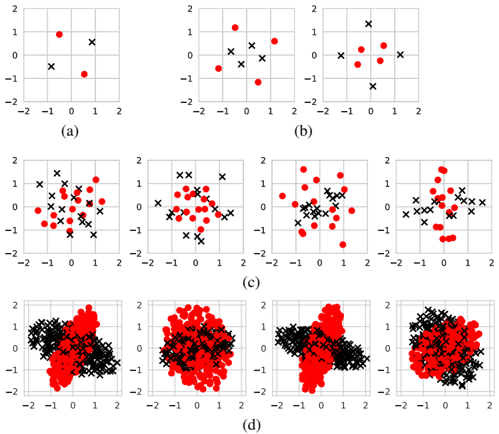
“Similarly, Fig. 4b shows a (4 , 2) system which leads to a rotated 16-PSK constellation.”
plainstates a cause- Asserted: passes — The authors put it forward as true.
- Checkable: passes — It can be checked against evidence.
- Load-bearing: unclear — It is unclear whether the paper’s conclusions depend on it.
- Based: passes — The paper gives a reason why it holds.
39 more claims
Create a free account to see all 93 claims and to verify the 4 references still open.
- Probably not a substantial claim. 29
- It may state two separate claims as one. 24
Self-check
Percentages, sums and reported differences re-computed from the paper’s own numbers.
Each contradiction between two passages listed here was confirmed by an independent check.
Rated minor: it would not touch a result — a value no result rests on, a p-value that stays on the same side of the significance level, or a conflict that is clerical, resolved elsewhere in the paper, or outside its own findings.
In the paper
§ A. Autoencoders for end-to-end communications systems · p. 5
“Similarly, Fig. 4b shows a (4 , 2) system which leads to a rotated 16-PSK constellation.”
§ A. Autoencoders for end-to-end communications systems · p. 6
“Figure 4: Constellations produced by autoencoders using parameters ( n, k ) : (a) (2 , 2) (b) (2 , 4) , (c) (2 , 4) with average power constraint, (d) (7 , 4) 2-dimensional t-SNE embedding of received symbols.”
Citations
Cites
Very Deep Convolutional Networks for Large-Scale Image Recognition
Simonyan, K., & Zisserman, A. (2014) · arXiv · doi:10.48550/arxiv.1409.1556 · Cited by 114,148 · cited 1×
“dense/fully-connected layers and terminated with a dense softmax layer for our classifier (similar to a VGG architecture [55]).”
BackgroundAdam: A Method for Stochastic Optimization
Kingma, D. P., & Ba, J. (2014) · arXiv · doi:10.48550/arxiv.1412.6980 · Cited by 98,946 · cited 4×
“Training was done at a fixed value of Eb/N0 = 7 dB (see Section IV-B) using Adam [46] with learning rate 0.”
BackgroundMethodInfluentialA Mathematical Theory of Communication
Shannon, C. E. (1948) · Bell System Technical Journal · doi:10.1002/j.1538-7305.1948.tb01338.x · Cited by 88,486
Scikit-learn: Machine Learning in Python
Pedregosa, F., Varoquaux, G., Gramfort, A., Michel, V., Thirion, B., Grisel, O., Blondel, M., Müller, A., Nothman, J., Louppe, G., et al. (2012) · arXiv · doi:10.48550/arxiv.1201.0490 · Cited by 71,016 · cited 1×
“11, we compare the classification accuracy of the CNN against that of extreme gradient boosting7 with 1000 estimators, as well as a single scikit-learn decision tree [56], operating on a mix of 16 analog and cumulant expert features as proposed in [53] and [57].”
Method(2014) · Cited by 33,419
(2008) · Journal of Machine Learning Research · Cited by 33,051
Human-level control through deep reinforcement learning
Mnih, V., Kavukcuoglu, K., Silver, D., Rusu, A. A., Veness, J., Bellemare, M. G., Graves, A., Riedmiller, M., Fidjeland, A. K., Ostrovski, G., et al. (2015) · Nature · doi:10.1038/nature14236 · Cited by 30,357
(2007) · Electronics: A First Course · doi:10.4324/9780080477527-64 · Cited by 24,923
Pan, S. J., & Yang, Q. (2010) · IEEE Transactions on Knowledge and Data Engineering · doi:10.1109/tkde.2009.191 · Cited by 23,387 · cited 1×
“learning [64] is one appealing candidate for adapting an endto-end communications system trained on a statistical model to”
BackgroundMultilayer feedforward networks are universal approximators
Hornik, K., Stinchcombe, M., & White, H. (1989) · Neural Networks · doi:10.1016/0893-6080(89)90020-8 · Cited by 21,728 · cited 1×
“Third, it has been shown that NNs are universal function approximators [13] and recent work has shown a remarkable”
Background
Research works printed but not linked: 2
- [35] I. Goodfellow, Y. Bengio, and A. Courville, Deep Learning . MIT Press, 2016. -
- [52] J. Estaran et al. , 'Artificial neural networks for linear and non-linear impairment mitigation in high-baudrate IM/DD systems,' in Proc. 42nd European Conf. Optical Commun. (ECOC) . VDE, 2016, pp. 1-3. -
Cited by
Items 2,201–2,300 of 2,995
Alad, R. H., Shah, H. K., Desai, N., Pandya, A., Dalal, P. D., & Karmur, A. (2026) · Discover Electronics · doi:10.1007/s44291-026-00265-0 · Cited by 1
“To provide a broader foundation for learning-based physical-layer design, the work in [3] introduced deep learning as a general framework for wireless physical-layer processing.”
Qi, Z., Xiao, J. M., Xu, H., Wang, J., Li, X., Zeng, M., & Wang, X. (2026) · IEEE Transactions on Wireless Communications · doi:10.1109/twc.2026.3720784 · Cited by 1
“…failing to meet the real-time requirements of 6G. 2) Data-Driven Deep Learning Methods: To overcome the limitations of model-based methods in complex physical environments, deep learning has been widely adopted to implicitly learn complex channel features from observational data [14], [15], [16].”
Symbiotic radios for future ambient IoT
Wang, J., Zhou, H., Liang, Y., & Sun, S. (2026) · Science China Information Sciences · doi:10.1007/s11432-025-4922-8 · Cited by 3
“AI-based methods are powerful in addressing these problems with historical CSI [183, 184].”
Ponduru, P. S. (2019) · International Journal of Scientific Research in Science and Technology · doi:10.32628/ijsrst23101104 · Cited by 1
Deng, Z., & Sang, Q. (2020) · Electronics · doi:10.3390/electronics9020294 · Cited by 3
“Due to its rapid processing capability and powerful optimization capability, researchers have exploited the potential applications of DL to the communication systems with the block structure and the communication systems with the end-to-end structure merging all the blocks [1,2].”
BackgroundMethodInfluentialCollege Online Psychological Consultation Platform Based on Deep Learning
Zhang, X. (2020) · Cited by 1
Complex Autoencoder Approach to Constant Envelope Waveform Coding
Gorday, P., Erdöl, N., & Zhuang, H. (2021) · IEEE Consumer Communications and Networking Conference · doi:10.1109/ccnc49032.2021.9369494 · Cited by 1
“Rather than using amplitude constraints as proposed in [3], we model the encoder output layer as a phase modulation layer with complex exponential activation functions.”
BackgroundMethodConditionally optimal classification based on CFAR and invariance property for blind receivers
Naderpour, M., & Bizaki, H. K. (2021) · EURASIP Journal on Advances in Signal Processing · doi:10.1186/s13634-021-00723-9 · Cited by 1
Sakran, H. Y. (2021) · Telecommunication Systems · doi:10.1007/s11235-021-00806-w · Cited by 1
Self-learning Constellation Mapping Method Based on Neural Networks
Luo, Y., & Hu, J. (2020) · International Conference on Information Science and Control Engineering · doi:10.1109/icisce50968.2020.00254 · Cited by 2
Deep-Learning-Based Stream-Sensing Method for Detecting Asynchronous Multiple Signals
Kim, Y., & Lee, H. (2022) · Applied Sciences · doi:10.3390/app12094534 · Cited by 1
Chikezie, N. O., Femi, U. C., Ozioma, O. O., Oluwatomisin, A. E., Chukwuebuka, A.-U., Onyekachi, N. E., & Kalejaiye, G. C. (2022) · Advances in Science Technology and Engineering Systems Journal · doi:10.25046/aj070417 · Cited by 1
Deep Learning-based Nonlinear Quantizer for Fronthaul Compression
Yagi, S., Nakahara, M., Suzuoki, K., Kozuno, T., & Hisano, D. (2022) · OptoElectronics and Communications Conference and International Conference on Photonics in Switching and Computing (OECC/PSC) · doi:10.23919/oecc/psc53152.2022.9849918 · Cited by 1
A Low Complexity Deep Learning Based Precoder Designing for Enhanced Throughput in Underlay Network
Sahu, D. K., Maurya, S., Bansal, M., & Vishwakarma, D. K. (2022) · IEEE Conference on Information and Communication Technology (CICT) · doi:10.1109/cict56698.2022.9997831 · Cited by 1
“DL is a promising candidate that can potentially be used to tackle these challenges in wireless communication [7]- [8].”
BackgroundA Near-Optimal Deep Detector for BER Minimization in an OFDM AF Relay System
Shamsesalehi, M., Khosravi, N. M., & Ahmadian‐Attari, M. (2022) · Iranian Conference on Signal Processing and Intelligent Systems (ICSPIS) · doi:10.1109/icspis56952.2022.10043905 · Cited by 1
“In [8] a novel end-to-end learning-based framework is applied by autoencoders.”
MethodDynamic adversarial jamming-based reinforcement learning for designing constellations
Xu, Y., Xie, H., Ji, N., Chen, Y., Liu, N., & Xiang, X. (2023) · Digital Communications and Networks · doi:10.1016/j.dcan.2023.05.012 · Cited by 1
ADS-B Reception Error Correction Based on the LSTM Neural-Network Model
Markani, J. H., Rizvi, S. I. R., Amrhar, A., Gagné, J.-M., & Landry, R. J. (2023) · Communications and Network · doi:10.4236/cn.2023.152003 · Cited by 1
ML-based Optimization of Geometric Constellation Shaping for Unamplified Coherent Optical Systems
Oliveira, B. M., Neves, M. S., Guiomar, F. P., Medeiros, M. C. R., & Monteiro, P. P. (2023) · International Conference on Transparent Optical Networks · doi:10.1109/icton59386.2023.10207371 · Cited by 1
“Geometric constellation shaping can be implemented with a variety of algorithms, such as the pairwise optimization algorithm [5], gradient descent [6], or making use of autoencoders (AE) [7].”
BackgroundMethodHigh-speed Machine Learning-enhanced Receiver for Millimeter-Wave Systems
García, D., Ruiz, R., Lacruz, J. O., & Widmer, J. (2023) · IEEE Conference on Computer Communications (INFOCOM) · doi:10.1109/infocom53939.2023.10229087 · Cited by 2
Esearch on the optimization path of campus football teaching based on deep learning mode
Zou, H. (2023) · Applied Mathematics and Nonlinear Sciences · doi:10.2478/amns.2023.2.00107 · Cited by 1
Nguyen Tan, H. P., Thanh, B. L., To, T.-N., Pham, H.-L., Dinh, V. H., Nguyen, T., & Khuc, B. (2023) · Electronics · doi:10.3390/electronics12183945 · Cited by 1
Capacity-driven end-to-end learning approach for NOMA with finite-alphabet inputs
Fan, J., Sun, Z., Yue, G., & Yu, J. (2023) · Physical Communication · doi:10.1016/j.phycom.2023.102197 · Cited by 1
Scalable Convolutional Neural Networks for Decoding of Terminated Convolutional Codes
Teich, W. G., & Pan, W. (2023) · Lecture notes in computer science · doi:10.1007/978-3-031-43085-5_4 · Cited by 1
Finding the Best Reference Signal Pattern for Different Channel Models in 5G
Josephine, D. D., Rajeswari, A., & Vinayakam, T. S. (2023) · International Conference on Emerging Trends in Networks and Computer Communications (ETNCC) · doi:10.1109/etncc59188.2023.10284941 · Cited by 1
“Recently, Deep Learning [4], [5], [17], [18] with a neural network model estimates channel better than the LS or linear MMSE (LMMSE) [6] does.”
BackgroundPerformance Evaluation and Analysis of Deep Learning Autoencoder-Based Wireless Communication System
Ismail, E., Ali, A., Aly, O. A. M., & Abo-Zahhad, M. M. (2023) · International Conference on Electronic Engineering (ICEEM) · doi:10.1109/iceem58740.2023.10319494 · Cited by 1
“The activation functions commonly used to introduce non-linearity are ReLU and sigmoid [5].”
BackgroundMethodInfluentialTseng, S., Wang, P.-H., & Hsu, Y.-T. (2023) · International Conference on Multimedia Communication Technologies (ICMCT) · doi:10.1109/icmct60483.2023.00009 · Cited by 1
“[21] proposed PHY/APP-layer resource allocating for NOMA-OFDMA video transmission, which outperformed [15] and [19] in terms of PSNR. Applications of deep learning in wireless communications includes wireless subcarrier/power resource allocation and consumer wireless communications [1][11][12][22].”
MethodChen, Y., Xu, T., & Xu, T. (2024) · Optics Communications · doi:10.1016/j.optcom.2024.130465 · Cited by 1
SICNN: Soft Interference Cancellation Inspired Neural Network Equalizers
Baumgartner, S., Lang, O. E., & Huemer, M. (2024) · IEEE Transactions on Machine Learning in Communications and Networking · doi:10.1109/tmlcn.2024.3377174 · Cited by 1
“This involves completely abandoning the block-based paradigm of current digital communication system design with the help of end-to-end learning [5], [6], or replacing / enhancing individual blocks of a standard communication chain [7], [8], [9].”
BackgroundAdvancing 6G Networks: The Implications of Edge AI Integration
Hannah Jessie Rani, R., Mishra, A., & Ratchagar, N. P. (2023) · International Conference on Advances in Computation, Communication and Information Technology (ICAICCIT) · doi:10.1109/icaiccit60255.2023.10466006 · Cited by 1
“Mega MIMO has great potential for improving edge training methods since it guarantees high-precision and high-rate form consolidation as well as dependable interaction between a large number of devices [15].”
BackgroundPerformance on Autoencoder-Based MIMO Quantize-Forward Relay System for Various Learning Parameters
Shin, J., Yao, Y., & Jin, X. (2024) · International Conference on Artificial Intelligence in Information and Communication (ICAIIC) · doi:10.1109/icaiic60209.2024.10463511 · Cited by 1
“An impact application of deep learning in communication systems is the implementation of autoencoders [5].”
BackgroundDesign of a Deep Learning based Intelligent Receiver for a Wireless Communication System
Drakshayini, M. N., Kounte, M. R., & Ravindra, C. (2024) · International Journal of Electrical and Electronics Research · doi:10.37391/ijeer.120132 · Cited by 1
Improving NOMA Performance by Application of Autoencoders and Equidistant Power Allocation
Hummert, M., Bulk, N., Bockelmann, C., Wübben, D., & Dekorsy, A. (2024) · International ITG Workshop on Smart Antennas · doi:10.1109/wsa61681.2024.10511824 · Cited by 1
“This is similar to the findings in [5], where a MIMO system was applied.”
BackgroundMethodResultInfluentialA Self-Supervised Method for Accelerated Training of Neural Communication Receivers
Cooke, C. D. (2024) · IEEE International Conference on Machine Learning for Communication and Networking (ICMLCN) · doi:10.1109/icmlcn59089.2024.10624771 · Cited by 1
“O’Shea & Hoydis were the first authors to formulate the communications problem as a machine learning problem using the aforementioned channel autoencoder interpretation [3].”
BackgroundA Role of AI -Powered Innovative Algorithms Development in the 5G based Communication System
Batra, R., Pallavi, & Malviya, A. V. (2024) · International Conference on Innovative Sustainable Technologies for Energy, Mechatronics, and Smart Systems (ISTEMS) · doi:10.1109/istems60181.2024.10560114 · Cited by 1
Sub-Terahertz Channel Gain Prediction for Scheduling of Over-The-Air Deep Learning
Alonso, R. M., Thys, C., & Pollin, S. (2024) · Joint European Conference on Networks and Communications & 6G Summit (EuCNC/6G Summit) · doi:10.1109/eucnc/6gsummit60053.2024.10597069 · Cited by 2
“Deep learning for end-to-end optimization of baseband processing has been recently proposed, specifically to improve communication in challenging conditions such as non-linear transceivers or fast-fading channels [5].”
BackgroundTurbo-AI, Part VI: Achieving Robust Downlink AI-Based Channel Prediction
Chen, Y., Wild, T., & Henry, C. (2024) · Joint European Conference on Networks and Communications & 6G Summit (EuCNC/6G Summit) · doi:10.1109/eucnc/6gsummit60053.2024.10597079 · Cited by 1
“Nevertheless, this does not exclude that AI/ML can exploit the power of empirical science to beat or equalize the legacy performance of the State-of-The-Art (SoTA) solutions, which are also constrained by the Shannon Limit [4].”
BackgroundDual-stream CNN+LSTM model based on attention mechanism
Chen, J., zhang, H., & Wang, S. (2024) · International Conference on Electronic Information Engineering, Big Data and Computer Technology (EIBDCT) · doi:10.1117/12.3031564 · Cited by 1
Model-Driven Deep Learning for Distributed Detection in WSNs with Binary Quantization
Guo, W., He, M., Huang, C., He, H., Song, S., Zhang, J., & Letaief, K. B. (2024) · IEEE International Mediterranean Conference on Communications and Networking (MeditCom) · doi:10.1109/meditcom61057.2024.10621336 · Cited by 1
“The whole training uses the Adam optimizer [15] with a constant learning rate l r = 0 .”
MethodInfluentialDense KO Codes: Faster Convergence and Reduced Complexity Through Dense Connectivity
Srivastava, S., & Banerjee, A. (2024) · IEEE International Symposium on Information Theory (ISIT) · doi:10.1109/isit57864.2024.10619329 · Cited by 1
“Beyond decoding, the use of autoencoders and transformers for end-to-end joint optimization of encoder and decoder modules has been proposed to further advance the scope of learned coding schemes [23], [24].”
MethodEnd-to-end learning strategy with channel-aided polar autoencoder in IM/DD optical interconnection
Mu, Y., He, H., Ming, J., Song, J., Xu, Q. M., Gao, R., Li, Z., Xin, X., & Dong, Z. (2024) · Optics Express · doi:10.1364/oe.538887 · Cited by 1
Deep Learning-Enhanced Autoencoder for Multi-Carrier Wireless Systems
Aziz, M. A., Rahman, M. H., Tabassum, R., Sejan, M. A. S., Baek, M.-S., & Song, H. (2024) · Mathematics · doi:10.3390/math12233685 · Cited by 1
Learning Rate-Compatible Linear Block Codes: An Auto-Encoder Based Approach
Cheng, Y., Chen, W. R., Hou, T., Li, G. Y., & Ai, B. (2024) · IEEE Transactions on Vehicular Technology · doi:10.1109/tvt.2024.3511697 · Cited by 2
Experimental Demonstration of Channel Modeling in End-to-End Visible Light Communication System
Song, B., Zhu, Y., Zong, H., & Huang, Y. (2024) · Asia Communications and Photonics Conference · doi:10.1109/acp/ipoc63121.2024.10809403 · Cited by 1
“The feasibility of this approach has already been introduced and validated in wireless communications [7], [8].”
Spatial domain multi-antenna technologies
Yuan, Y., Huang, Y., Ding, H., Cui, C., & Wang, Q. (2025) · Elsevier eBooks · doi:10.1016/b978-0-443-33659-1.00006-5 · Cited by 1
Automatic Modulation Classification with Multi-modal Data Fusion Located at The Feature Layer
Wang, M., Fan, Y., Fang, S., & Wang, Y. (2024) · International Conference on Intelligent Control, Measurement and Signal Processing (ICMSP) · doi:10.1109/icmsp64464.2024.10866494 · Cited by 1
Neural Network-Integrated Multistatic Sensing for Joint Angle Estimation in Cell-Free JCAS Systems
Ayten, F., Ilter, M. C., Jain, A., Lohan, E. S., & Valkama, M. (2025) · IEEE International Symposium on Joint Communications & Sensing (JC&S) · doi:10.1109/jcs64661.2025.10880641 · Cited by 1
Zhao, J., Su, J., Cai, K., Zhu, Y., Liu, Y., & Al‐Dhahir, N. (2025) · IEEE Transactions on Wireless Communications · doi:10.1109/twc.2025.3548618 · Cited by 1
“As a computationally-efficient substitute for the conventional optimization model-based approach, the data-driven deep learning (DL) has recently attracted significant attention for solving complex wireless communication problems with low latency [16].”
XAI for wireless communications
Gizzini, A. K., Medjahdi, Y., Ghandour, A. J., Clavier, L., & Mabrouk, M. B. (2025) · Elsevier eBooks · doi:10.1016/b978-0-44-329135-7.00014-x · Cited by 3
AI-Driven Channel Estimation Using Geo-spatial Data With Modified DMRS
Kashyap, A., Munjal, A., & Kaur, A. (2025) · IEEE International Conference on Communication Systems and Network Technologies (CSNT) · doi:10.1109/csnt64827.2025.10968929 · Cited by 1
“This approach is inspired by [7] enhancing the signal processing and encoding for better performance with competitive BLER (Block error rate) for multiple varying environment scenarios, showcasing its future reliable and latency capabilities.”
AI-driven 6G air interface: technical usage scenarios and balanced design methodology
Wang, X., Han, S., Liu, Z., Wang, Q., Wang, J., & Yi, Z. (2025) · Scientia Sinica Informationis · doi:10.1360/ssi-2024-0210 · Cited by 2
Wireless Semantic Communication Based on Probability Distribution: An Initial Work
Luo, Q., Guo, Y., Zheng, A., Ni, Z., Yu, F., & Leung, V. C. M. (2025) · IEEE Wireless Communications and Networking Conference · doi:10.1109/wcnc61545.2025.10978695 · Cited by 2
“The data-oriented work can be traced back to the seminal work [5], in which Timothy proposed the concept of end-to-end (E2E) communication system.”
End-to-end deep learning-based asymmetric encryption scheme for optical fiber communication
Yao, Y., Ma, J., Lu, J., Liu, J., Zeng, X., & Luo, M. (2025) · Optics Communications · doi:10.1016/j.optcom.2025.132203 · Cited by 1
Structured Superposition of Autoencoders for UEP Codes at Intermediate Blocklengths
Ninković, V., & Vukobratović, D. (2025) · IEEE Communications Letters · doi:10.1109/lcomm.2025.3598249 · Cited by 1
“1) Autoencoder–Based UEP Code Design: In [12], we extended the AE-based communication system defined in [1] to support the UEP framework.”
InfluentialFast Channel Estimation by Infinite Width Convolutional Networks
Villemaud, G., & Mallik, M. (2025) · Electronics Letters · doi:10.1049/ell2.70385 · Cited by 2
AI/ML-Based Wireless Channel Estimation and Prediction for Downlink Precoding
Kerdoncuff, T., García‐Rodríguez, A., Astély, D., & Ma, Z. (2025) · IEEE International Conference on Machine Learning for Communication and Networking (ICMLCN) · doi:10.1109/icmlcn64995.2025.11139873 · Cited by 1
“Artificial intelligence/Machine learning (AI/ML) is widely considered to be one of the key components of future 6G wireless networks [1].”
Diff-GOn: Enhancing Diffusion Models for Goal-Oriented Communications
Wanninayaka, S., Wijesinghe, A., Wang, W., Chao, Y.-C., Zhang, S., & Ding, Z. J. (2025) · International Conference on Communications · doi:10.1109/icc52391.2025.11161394 · Cited by 2
“The concept of GO-COM stems from deep learning for communications, where the message transmission system is formulated as a deep neural network (DNN) based autoen-coders [4].”
Deep Autoencoder-Based Constellation Design in Multiple Access Channels
Gorelenkov, S., & Vaezi, M. (2025) · IEEE International Symposium on Information Theory (ISIT) · doi:10.1109/isit63088.2025.11195500 · Cited by 1
“Recently, deep autoencoders (DAEs) have been used to enhance communication system performance by enabling end-to-end design [10].”
Implementation of Deep Learning in Spatial Multiplexing MIMO Communication
Rohmatillah, M., Suyono, H., Rahmadwati, R., & Pramono, S. H. (2018) · Indonesian Journal of Electrical Engineering and Computer Science · doi:10.11591/ijeecs.v12.i2.pp699-705 · Cited by 1
“…the most interesting results of machine learning implementation in a communication system are paper titled An Introduction to Deep Learning for the Physical Layer [2] and Deep_Learning-Based Communication over the Air [3] which introduce deep learning as an end-to-end system in SISO communication.”
BackgroundLMS to Deep Learning: How DSP Analysis Adds Depth to Learning
Gorday, P., Erdöl, N., & Zhuang, H. (2019) · IEEE International Conference on Acoustics Speech and Signal Processing · doi:10.1109/icassp.2019.8682669 · Cited by 1
Нейросетевой имитатор нестационарной среды в адаптивной системе передачи данных
Невзоров, А. А., Орлов, А. А., & Stankevich, D. A. (2019) · Письма в журнал технической физики · doi:10.21883/pjtf.2019.14.48013.17836 · Cited by 1
Learn to Demodulate: MIMO-OFDM Symbol Detection through Downlink Pilots
Zhou, Z., Liu, L., & Chang, H.-H. (2019) · Cited by 1
Deep Learning-Based Space Shift Keying Systems
Zhang, Y., Wang, X., Wang, J., Xue, Y., & Song, J. (2019) · Lecture notes of the Institute for Computer Sciences, Social Informatics and Telecommunications Engineering · doi:10.1007/978-3-030-22968-9_7 · Cited by 1
Deep Learning-Based Decoding of Block Markov Superposition Transmission
Bi, S., Wang, Q., Chen, Z., Sun, J., & Ma, X. (2019) · International Conference on Wireless Communications and Signal Processing (WCSP) · doi:10.1109/wcsp.2019.8928042 · Cited by 1
“The authors in [1] presented an autoencoder, achieving a performance very close to that of the [7, 4, 3] Hamming code.”
BackgroundDeep Learning and Cognitive Computing: Pillars and Ladders
Mohamed, K. S. (2020) · Springer eBooks · doi:10.1007/978-3-030-37224-8_4 · Cited by 1
Machine Learning Assisted PHYSEC Attacks and SLP Countermeasures for Multi-Antenna Downlink Systems
Mayouche, A., Spano, D., Tsinos, C. G., Chatzinotas, S., & Ottersten, B. (2019) · Globecom · doi:10.1109/globecom38437.2019.9014244 · Cited by 1
“In [12], a new way of end-to-end system design was proposed using DL, where the system can learn the whole transmitter and receiver processes for a given channel model.”
MethodDeep Learning-Aided Binary Visible Light Communication Systems
Lee, H., Quek, T. Q. S., & Lee, S. H. (2019) · IEEE Globecom Workshops (GC Wkshps) · doi:10.1109/gcwkshps45667.2019.9024576 · Cited by 1
“In particular, an autoencoder (AE) framework [9] has proved efficient in designing a pair of transmitter and receiver over wireless channels [5].”
BackgroundMethodInfluentialSynchronization Techniques for Coherent Underwater Acoustic Receivers
Liu, X. (2019) · DalSpace (Dalhousie University) · Cited by 1
ConvAE-Advanced: Adaptive Transmission Across Multiple Timeslots for Error Resilient Operation
Ji, D. J., & Cho, D. (2020) · IEEE Communications Letters · doi:10.1109/lcomm.2020.2995857 · Cited by 1
“C HANNEL autoencoders [1] were of great interest in the field of machine learning for communications (MLC) during the past few years.”
BackgroundLow Complexity Receiver Design Using Deep Neural Network Based on Compact Sparse AutoEncoder
Hao, C., Dang, X., Shah, M. H., Wang, M., & Yu, X. (2020) · IEEE Communications Letters · doi:10.1109/lcomm.2020.3011560 · Cited by 1
“Present research regarding DNN-based signal detection is reported in [7]–[10].”
BackgroundLearning Additive Noise Channels: Generalization Bounds and Algorithms
Weinberger, N. (2020) · IEEE International Symposium on Information Theory (ISIT) · doi:10.1109/isit44484.2020.9174090 · Cited by 2
“The unknown probability distribution of the noise may represent interference, jamming signals non-linearities [20], finite-resolution quantization, and so on(see [18], [25]).”
BackgroundAn optimized Radio Modulation Classifier Using Deep Neural Network
Emam, A., Shalaby, M. A., Mansour, H. A. A., Bakr, H. E. A., & Aboelazm, M. A. (2020) · doi:10.1109/iceeng45378.2020.9171707 · Cited by 1
“DNN has many applications in image, speech and video processing fields in the last few years [5].”
BackgroundSequence Detector based Autoencoder for ACO-OFDM Optical Wireless Communication
Liu, X., Wei, Z., Pepe, A., Wang, Z., & Fu, H. Y. (2020) · Asia Communications and Photonics Conference · doi:10.1364/acpc.2020.m4a.228 · Cited by 1
DeepIoT: Deep Learning Based Symbol Detection for Spatially Undersampled Internet of Things
Ma, Z., Jian, M., Gao, F., & Shen, X. (2020) · Globecom · doi:10.1109/globecom42002.2020.9322249 · Cited by 1
“DL based autoencoder has been widely studied in wireless communications, especially in end-to-end communications [16], where the transceiver is optimized jointly by treating the encoder as transmitter and the decoder as receiver.”
MethodNeural network-based time-domain equalization without training signal in OFDM systems without CP
Isaka, K., Miyajima, T., & Sugitani, Y. (2021) · IEICE Communications Express · doi:10.1587/comex.2021etl0016 · Cited by 1
“Meanwhile, recently, applications of machine learning (ML) to signal detection in wireless communications have been considered [2].”
BackgroundKamassury, J. K. S. (2021) · REMAT Revista Eletrônica da Matemática · doi:10.35819/remat2021v7i1id4389 · Cited by 1
Low-Complexity Neural Networks for Baseband Signal Processing
Larue, G., Dhiflaoui, M., Dufréne, L.-A., Lampin, Q., Chollet, P., Ghauch, H., & Othman, G. R.-B. (2020) · IEEE Globecom Workshops (GC Wkshps) · doi:10.1109/gcwkshps50303.2020.9367521 · Cited by 1
“This scheme is optimized with regard to a given channel and communication scenario [5].”
MethodDeep Learning-Aided Spatial Multiplexing with Index Modulation
Turhan, M., Öztürk, E., & Çırpan, H. A. (2021) · Lecture notes in computer science · doi:10.1007/978-3-030-70866-5_14 · Cited by 1
Expectation-Maximization for Scheduling Problems in Satellite Communication
Werner Bailer, A., Winter, M., Ebert, J., Flávio, J., & Plimon, K. (2021) · Proceedings - International Conference on Pattern Recognition/Proceedings/International Conference on Pattern Recognition · doi:10.1109/icpr48806.2021.9413088 · Cited by 1
“One possible approach is to use adversarial autoencoders, as used in [4] to learn optimal constellations for modulation with multiple interfering transmitters.”
BackgroundMethodCompressive Autoencoders in Wireless Communications
Chen, P., Lv, P., Liu, H., Li, B., Zhao, C., & Wang, X. (2021) · Lecture notes in electrical engineering · doi:10.1007/978-981-15-8411-4_135 · Cited by 1
Machine Learning-Based Security Authentication for Wireless Multimedia Network
Gautham, S. K., & Koundinya, A. K. (2021) · Lecture notes in networks and systems · doi:10.1007/978-981-16-0739-4_83 · Cited by 1
Online Reconfigurable Deep Learning-Aided Multi-User Detection for IoT
Ye, N., Pan, J., Wang, X., Wang, P., & Li, X. (2021) · International Wireless Communications and Mobile Computing Conference (IWCMC) · doi:10.1109/iwcmc51323.2021.9498949 · Cited by 2
Recurrent Neural Networks for Pilot-aided Wireless Communications
Hares, A. S., Abdallah, M. A. A., Abohassan, M. A., & Altantawy, D. A. (2021) · National Radio Science Conference · doi:10.1109/nrsc52299.2021.9509815 · Cited by 1
A Deep Learning Based Intelligent Transceiver Structure for Multiuser MIMO
Dong, A., Cui, W., Yu, J., Li, S., Huang, Y., Zhang, T., & Zhou, Y. (2021) · Lecture notes in computer science · doi:10.1007/978-3-030-86137-7_58 · Cited by 1
CNN-based Security Authentication for Wireless Multimedia Devices
Gautham, S. K., & Koundinya, A. K. (2021) · International Journal of Wireless and Microwave Technologies · doi:10.5815/ijwmt.2021.04.01 · Cited by 2
“The prologue to AI based lightweight physical layer security is introduced [30], managing numerical models.”
Learning to Perform Downlink Channel Estimation in Massive MIMO Systems
Ghazanfari, A., Chien, T. V., Björnson, E., & Larsson, E. G. (2021) · International Symposium on Wireless Communication Systems · doi:10.1109/iswcs49558.2021.9562180 · Cited by 1
Optimizing Space Communications Using Deep Learning
Robertson, B. I., & Smith, A. D. (2021) · IEEE Cognitive Communications for Aerospace Applications Workshop (CCAAW) · doi:10.1109/ccaaw50069.2021.9527301 · Cited by 1
Ropokis, G. A. (2021) · International Balkan Conference on Communications and Networking (BalkanCom) · doi:10.1109/balkancom53780.2021.9593257 · Cited by 1
“…techniques have found several applications on the design of physical layer and resource allocation techniques for wireless communications systems, the available literature (see for example [1], [2], [3], [4], [5]) focuses on the use of advanced, computationally demanding, deep learning structures.”
Interference Cancellation in Wireless Communications: Past, Present, and Future
Zafaruddin, S. M., & Bhardwaj, P. (2021) · IETE Journal of Education · doi:10.1080/09747338.2021.1984318 · Cited by 1
Channel Estimation with an Interpolation Trained Deep Neural Network
Hu, Y., Zhao, J., & Cheng, B. (2021) · Journal of Computer and Communications · doi:10.4236/jcc.2021.910008 · Cited by 1
End-to-End Learning-based Two-Way AF Relay Networks with I/Q Imbalance
Gupta, A. K., & Sellathurai, M. (2021) · IEEE International Workshop on Signal Processing Advances in Wireless Communications (SPAWC) · doi:10.1109/spawc51858.2021.9593107 · Cited by 1
Columns Occurrences Graph to Improve Column Prediction in Deep Learning Nlidb
Abbas, S., Khan, M. U., Lee, S. U.-J., & Abbas, A. (2021) · Applied Sciences · doi:10.3390/app112412116 · Cited by 2
Capacity Learning for Communication Systems over Power Lines
Letizia, N. A., & Tonello, A. M. (2021) · IEEE International Symposium on Power Line Communications and Its Applications (ISPLC) · doi:10.1109/isplc52837.2021.9628415 · Cited by 3
Deep Learning For Noisy Communication System
Mohamed, R. E., Hunjet, R., Elsayed, S. M., & Abbass, H. A. (2021) · International Telecommunication Networks and Applications Conference (ITNAC) · doi:10.1109/itnac53136.2021.9652171 · Cited by 1
An Experimental Study of a Self-Organizing Acoustic Communication Channel
Nevzorov, A. A., Владимирович, П. С., & Stankevich, D. A. (2021) · Technical Physics Letters · doi:10.1134/s1063785021030263 · Cited by 1
Deep Learning for Location Based Beamforming with Nlos Channels
Magoarou, L. L., Yassine, T., Paquelet, S., & Crussière, M. (2022) · IEEE International Conference on Acoustics Speech and Signal Processing · doi:10.1109/icassp43922.2022.9747293 · Cited by 11
Neural Network Signal Processing for LTE Receiver Application
Robinson, J., Carmack, J. M., Bhatia, A., Majewski, J., Kuzdeba, S., Farkas, J., Hombs, B., & Koch, T. (2021) · IEEE International Symposium on Dynamic Spectrum Access Networks · doi:10.1109/dyspan53946.2021.9677331 · Cited by 1
Artificial intelligence technology in the Internet of things
Zhu, Z., Zhang, M., & Hao, W. (2022) · Elsevier eBooks · doi:10.1016/b978-0-32-385655-3.00010-2 · Cited by 1
Momentum-Based Adversarial Attacks Against End-to-End Communication Systems
Zhang, Q., Ma, Y., Zhao, H., Shan, C., & Zhang, J. (2022) · Lecture notes of the Institute for Computer Sciences, Social Informatics and Telecommunications Engineering · doi:10.1007/978-3-030-93398-2_48 · Cited by 1
Satellite Data Transmission Method for Deep Learning-Based AutoEncoders
Fan, Y., Li, Y., Chai, T., & Ding, D. (2021) · International Conference on Information and Communication Technologies for Disaster Management (ICT-DM) · doi:10.1109/ict-dm52643.2021.9664172 · Cited by 1
Gul, A., & Bölat, B. (2021) · National Conference on Electrical and Electronics Engineering (ELECO) · doi:10.23919/eleco54474.2021.9677836 · Cited by 1
“It also plays a role in extracting significantly complex features without the need for specific needs for the type of application being performed [16], [17], [18].”
Background
Metadata
- Authors
- O'Shea, T., & Hoydis, J.
- Affiliations
- Nokia (France) (FR)
- Venue
- IEEE Transactions on Cognitive Communications and Networking
- Published
- 2017-12
- Volume
- 3
- Issue
- 4
- Pages
- 563-575
- ISSN
- 2332-7731 (ISSN-L)
- OpenAlex
- W2734408173
- Semantic Scholar
- 78989616eeeac55b202e3e4205225e7135054185
- Cited by
- 2,980
- References
- 69
- Citations by year
- 2026: 307 · 2025: 327 · 2024: 305 · 2023: 368 · 2022: 432 · 2021: 409 · 2020: 406 · 2019: 322 · 2018: 95 · 2017: 9
- FWCI
- 122.29
- Type
- journal article
- Language
- en
- Open access
- green
- arxiv.org
- Locations
- IEEE Transactions on Cognitive Communications and Networking (publishedVersion)
- arXiv (Cornell University) (submittedVersion)
- arXiv (Cornell University)
- Topics
- Physical Sciences › Computer Science › Artificial Intelligence › Wireless Signal Modulation Classification
- Physical Sciences › Engineering › Electrical and Electronic Engineering › Advanced Wireless Communication Techniques
- Physical Sciences › Engineering › Electrical and Electronic Engineering › Advanced Wireless Communication Technologies
- Keywords
- end-to-end reconstruction, domain knowledge integration, convolutional neural networks, automatic modulation classification, IQ samples
About these checks
Registry, retraction, Cites and statistics results are computed, not judged, with one exception: a printed reference that no index lists is read once by a model before it counts as a citation error. Claims are extracted by a model and kept only when their quote appears verbatim in the text; each cited source is then checked, with a model’s help, for whether it says what the claim relies on. Those verdicts can be wrong — read the claim’s quote and the cited source before relying on one.
The claim verdicts this report counts are experimental: their accuracy is not yet measured.
A language model drew the claims from the paper on 2026-11-07, under version 3 of the claim definition (model deepseek-v4.1-flash, prompt extract-v3).
A second model labelled each claim on 2026-11-07 (model jev-1.13-20260917, definition revision gold-guideline-v0.2).
Cited sources are checked with a language model’s help (gpt-6-sol).
Statistics and arithmetic are recomputed, not judged.
Confidence bands are shown only for fields calibrated on our annotated test set. None is calibrated yet, so no band is shown.
What counts as a claim ›How we measure confidence ›How we check this ›
Are you an author, or do you see a problem with this page? Request a review
Data sources
Bibliographic data: Semantic Scholar, OpenAlex, Crossref.
Contains information from the Semantic Scholar Academic Graph Datasets, made available under the ODC Attribution License (ODC-BY 1.0).
Semantic Scholar’s data is described in: Kinney, R., et al. (2023). The Semantic Scholar Open Data Platform. arXiv:2301.10140.
