

An Introduction to Deep Learning for the Physical Layer
Open accessThe DOI matches its Crossref record; 90 of the 92 references it cites were found in a registry or an index, and 2 are not checked yet; 8 of the 32 sources its claims cite were checked for support.
Abstract
We present and discuss several novel applications of deep learning for the physical layer. By interpreting a communications system as an autoencoder, we develop a fundamental new way to think about communications system design as an end-to-end reconstruction task that seeks to jointly optimize transmitter and receiver components in a single process. We show how this idea can be extended to networks of multiple transmitters and receivers and present the concept of radio transformer networks as a means to incorporate expert domain knowledge in the machine learning model. Lastly, we demonstrate the application of convolutional neural networks on raw IQ samples for modulation classification which achieves competitive accuracy with respect to traditional schemes relying on expert features. This paper is concluded with a discussion of open challenges and areas for future investigation.
Verified 2026-11-19 · 2 references not checked yet
Overview
CoChat Summary
TL;DR
The paper introduces deep learning for the physical layer by treating a communications system as an autoencoder that jointly learns transmitter and receiver implementations end-to-end. It also extends this idea to multi-user interference channels, proposes radio transformer networks (RTNs) to inject expert domain knowledge, and shows CNNs on raw IQ samples can outperform expert-feature modulation classifiers.
Key findings
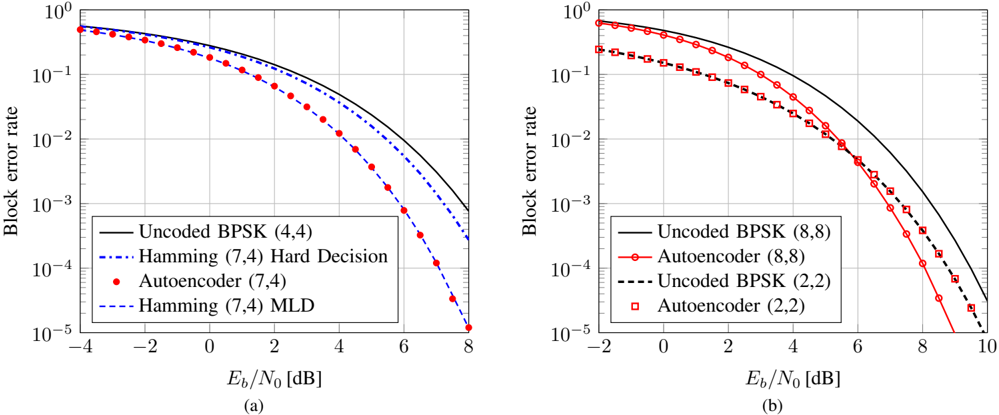
- A learned autoencoder for a (7,4) system at rate R = 4/7 achieves the same block error rate (BLER) as a Hamming (7,4) code with maximum likelihood decoding, while an (8,8) autoencoder outperforms uncoded BPSK over the full E_b/N_0 range, indicating learned joint coding and modulation.
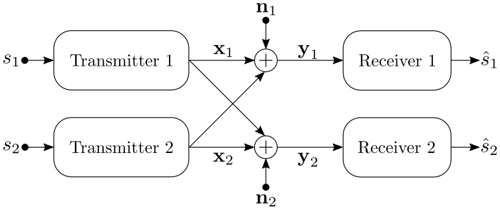
- For the two-user AWGN interference channel, the autoencoder matches time-sharing for (1,1) and (2,2), but achieves gains of about 0.7 dB for (4,4) and 1 dB for (4,8) at a BLER of 10^-3.
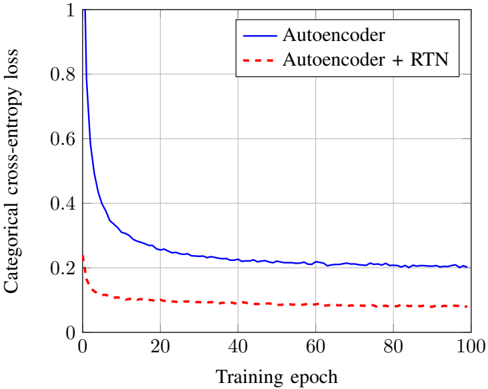
- An autoencoder (8,4) with an RTN over a multipath fading channel with L = 3 Rayleigh taps outperforms differential BPSK with maximum likelihood sequence estimation and a Hamming (7,4) code, whereas the plain autoencoder struggles to match it; RTNs also show faster training convergence.
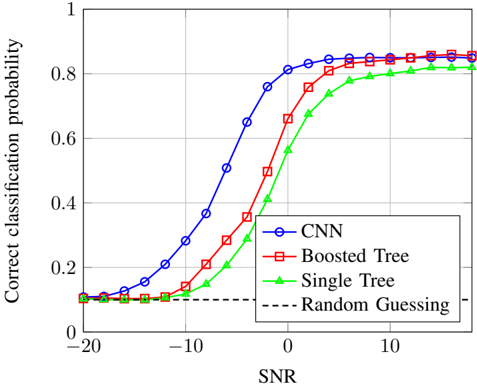
- For modulation classification on 1.2M sequences of 128 complex-valued IQ samples across ten modulation schemes and SNRs from -20 dB to 18 dB, the CNN outperforms a boosted expert-feature classifier by around 4 dB in the low-to-medium SNR range, with almost identical high-SNR performance; a single tree is about 6 dB worse at medium SNR and 3.5% worse at high SNR.
Methods
- The transmitter, channel, and receiver are represented as one deep neural network trained as an autoencoder: one-hot message input, dense layers, normalization layer for transmit constraints, additive noise channel layer, and softmax receiver output, trained with categorical cross-entropy using SGD/Adam at learning rate 0.001 and fixed E_b/N_0 = 7 dB.
- The autoencoder concept is extended to multiple transmitter-receiver pairs in a two-user interference channel, with dynamic loss weights α_t per mini-batch to balance the two cross-entropy losses; performance is compared against 2^{2k/n}-QAM with time-sharing.
- RTNs combine a learned parameter estimator, a differentiable parametric transform, and a discriminative network; the paper demonstrates phase-offset compensation and multipath inverse filtering. For modulation classification, a VGG-like CNN with 324,330 trainable parameters is trained on the RML2016.10b dataset.
Limitations
- The paper states that scalability to large message sets M is a major challenge: for k = 100 bits, training complexity is prohibitive because the autoencoder must see at least every message once.
- The paper states that optimal data representations, loss functions, training SNR, and hyperparameters are not well understood; training at one SNR does not necessarily generalize to others, and no common communications benchmarks or datasets comparable to MNIST or ImageNet exist.
- The paper states that end-to-end learning over real channels requires system identification because backpropagation assumes a known channel transfer function; complex-valued neural networks are not supported by current DL libraries. Evident from the text: the reported results are simulation-based, use small (n,k) settings, assume known channel models during training, and the paper explicitly leaves detailed performance comparisons for various channel types and parameters to future work.
Model-written summary. Check it against the paper before relying on it.
Integrity signals
Registry
Cites
Statistics
Figures






Verification
Claims the paper makes
6 Valid · 4 Not valid · 18 Not checked · 65 Own results and interpretations
Every source the paper cites for this claim was checked and supports it.
In the paper
“For instance in [22], it was shown that training with a single codeword is sufficient since the structure of the code is embedded in the NN through the Tanner graph.”
What the sources say
- Supportedcites [22] [22] E. Nachmani, Y. Be'ery, and D. Burshtein, 'Learning to decode linear codes using deep learning,' in Proc. IEEE Annu. Allerton Conf. Commun., Control, and Computing (Allerton) , 2016, pp. 341-346. - source
The Introduction says the decoder uses a Tanner graph representing the code and that one codeword suffices for training. Section III explains the precise condition: over a binary memoryless symmetric channel, the decoder’s error rate is independent of the transmitted codeword, so training can use noisy versions of a single codeword. (LLM, conf=0.91)
boostedstates a cause- Asserted: passes — The authors put it forward as true.
- Checkable: passes — It can be checked against evidence.
- Load-bearing: unclear — It is unclear whether the paper’s conclusions depend on it.
- Based: passes — The paper gives a reason why it holds.
- Supported
A result the paper reports from its own data — it cites no other source for it, so there is none to check. The quote shows it is in the paper.
In the paper
“We study the use of NNs on complex-valued IQ samples for the problem of modulation classification and show that convolutional neural networks (CNNs), which are the cornerstone of most DL systems for computer vision, can outperform traditional classification techniques based on expert features.”
plainstates a cause- Asserted: passes — The authors put it forward as true.
- Checkable: passes — It can be checked against evidence.
- Load-bearing: passes — The paper’s conclusions depend on it.
- Based: passes — The paper gives a reason why it holds.
The paper states this without a source or data behind it here, so there is nothing to check it against. The quote shows it is in the paper.
In the paper
“Training at low SNR for instance does not allow for the discovery of structure important in higher SNR scenarios.”
plainstates a cause- Asserted: passes — The authors put it forward as true.
- Checkable: passes — It can be checked against evidence.
- Load-bearing: unclear — It is unclear whether the paper’s conclusions depend on it.
- Based: unclear — It is unclear why the paper says it holds.
A result the paper reports from its own data — it cites no other source for it, so there is none to check. The quote shows it is in the paper.
In the paper
“Another advantage of RTNs is faster training convergence which can be seen from Fig. 10 that compares the validation loss of the autoencoder with and without RTN as a function of the training epochs.”
plainstates a cause- Asserted: passes — The authors put it forward as true.
- Checkable: passes — It can be checked against evidence.
- Load-bearing: unclear — It is unclear whether the paper’s conclusions depend on it.
- Based: passes — The paper gives a reason why it holds.
A result the paper reports from its own data — it cites no other source for it, so there is none to check. The quote shows it is in the paper.
In the paper
“Similarly, Fig. 4b shows a (4 , 2) system which leads to a rotated 16-PSK constellation.”
plainstates a cause- Asserted: passes — The authors put it forward as true.
- Checkable: passes — It can be checked against evidence.
- Load-bearing: unclear — It is unclear whether the paper’s conclusions depend on it.
- Based: passes — The paper gives a reason why it holds.
39 more claims
Create a free account to see all 93 claims and to verify the 4 references still open.
- Probably not a substantial claim. 29
- It may state two separate claims as one. 24
Self-check
Percentages, sums and reported differences re-computed from the paper’s own numbers.
Each contradiction between two passages listed here was confirmed by an independent check.
Rated minor: it would not touch a result — a value no result rests on, a p-value that stays on the same side of the significance level, or a conflict that is clerical, resolved elsewhere in the paper, or outside its own findings.
In the paper
§ A. Autoencoders for end-to-end communications systems · p. 5
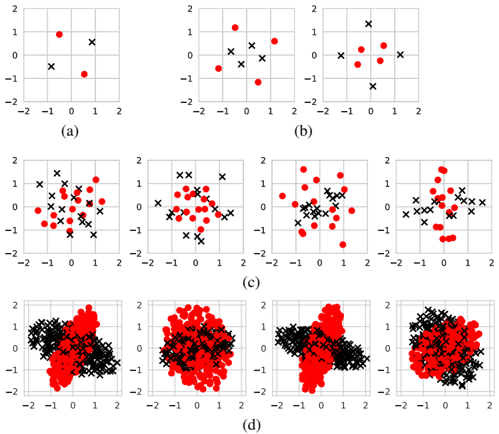
“Similarly, Fig. 4b shows a (4 , 2) system which leads to a rotated 16-PSK constellation.”
§ A. Autoencoders for end-to-end communications systems · p. 6
“Figure 4: Constellations produced by autoencoders using parameters ( n, k ) : (a) (2 , 2) (b) (2 , 4) , (c) (2 , 4) with average power constraint, (d) (7 , 4) 2-dimensional t-SNE embedding of received symbols.”
Citations
Cites
Very Deep Convolutional Networks for Large-Scale Image Recognition
Simonyan, K., & Zisserman, A. (2014) · arXiv · doi:10.48550/arxiv.1409.1556 · Cited by 114,148 · cited 1×
“dense/fully-connected layers and terminated with a dense softmax layer for our classifier (similar to a VGG architecture [55]).”
BackgroundAdam: A Method for Stochastic Optimization
Kingma, D. P., & Ba, J. (2014) · arXiv · doi:10.48550/arxiv.1412.6980 · Cited by 98,946 · cited 4×
“Training was done at a fixed value of Eb/N0 = 7 dB (see Section IV-B) using Adam [46] with learning rate 0.”
BackgroundMethodInfluentialA Mathematical Theory of Communication
Shannon, C. E. (1948) · Bell System Technical Journal · doi:10.1002/j.1538-7305.1948.tb01338.x · Cited by 88,486
Scikit-learn: Machine Learning in Python
Pedregosa, F., Varoquaux, G., Gramfort, A., Michel, V., Thirion, B., Grisel, O., Blondel, M., Müller, A., Nothman, J., Louppe, G., et al. (2012) · arXiv · doi:10.48550/arxiv.1201.0490 · Cited by 71,016 · cited 1×
“11, we compare the classification accuracy of the CNN against that of extreme gradient boosting7 with 1000 estimators, as well as a single scikit-learn decision tree [56], operating on a mix of 16 analog and cumulant expert features as proposed in [53] and [57].”
Method(2014) · Cited by 33,419
(2008) · Journal of Machine Learning Research · Cited by 33,051
Human-level control through deep reinforcement learning
Mnih, V., Kavukcuoglu, K., Silver, D., Rusu, A. A., Veness, J., Bellemare, M. G., Graves, A., Riedmiller, M., Fidjeland, A. K., Ostrovski, G., et al. (2015) · Nature · doi:10.1038/nature14236 · Cited by 30,357
(2007) · Electronics: A First Course · doi:10.4324/9780080477527-64 · Cited by 24,923
Pan, S. J., & Yang, Q. (2010) · IEEE Transactions on Knowledge and Data Engineering · doi:10.1109/tkde.2009.191 · Cited by 23,387 · cited 1×
“learning [64] is one appealing candidate for adapting an endto-end communications system trained on a statistical model to”
BackgroundMultilayer feedforward networks are universal approximators
Hornik, K., Stinchcombe, M., & White, H. (1989) · Neural Networks · doi:10.1016/0893-6080(89)90020-8 · Cited by 21,728 · cited 1×
“Third, it has been shown that NNs are universal function approximators [13] and recent work has shown a remarkable”
Background
Research works printed but not linked: 2
- [35] I. Goodfellow, Y. Bengio, and A. Courville, Deep Learning . MIT Press, 2016. -
- [52] J. Estaran et al. , 'Artificial neural networks for linear and non-linear impairment mitigation in high-baudrate IM/DD systems,' in Proc. 42nd European Conf. Optical Commun. (ECOC) . VDE, 2016, pp. 1-3. -
Cited by
Items 2,501–2,600 of 2,995
Fast Adaptation of Radar Detection via Online Meta-learning
Khan, Z., Jiang, W., Haimovich, A. M., Govoni, M. A., Garner, T. J., & Simeone, O. (2022) · Asilomar Conference on Signals, Systems and Computers (ACSSC) · doi:10.1109/ieeeconf56349.2022.10051849
“Deep learning has been successfully applied in a variety of fields to solve problems for which reliable mathematical models are unavailable or too complex to yield practical solutions [8]-[10].”
BackgroundMethodNeural Filter Design for Frequency Selective Channel Equalization
Lee, W., Park, S., Kim, D., & Kang, J. (2023) · IEEE Consumer Communications and Networking Conference · doi:10.1109/ccnc51644.2023.10059823
“Channels have N c = 8 taps in which each tap follows Rayleigh fading in an i.i.d. manner [12].”
BackgroundDeep Learning-Based Joint Detector for Cooperative Communication
Jiang, L., Shi, R., Chen, L., & Liu, Z. (2022) · IEEE International Conference on Communication Technology (ICCT) · doi:10.1109/icct56141.2022.10072649
“Since deep learning (DL) has the advantages of self-adaption and nonlinear processing ability [13], to improve the detection performance, the detector can be considered to design based on DL.”
MethodAbdelsamie, A. (2023) · Carleton University's Institutional Repository (MacOdrum Library, Carleton University) · doi:10.22215/etd/2023-15378
Gamal, D., Elsayed, K., & Mehana, A. H. (2023) · Transactions on Emerging Telecommunications Technologies · doi:10.1002/ett.4773
“Integrating deep learning into SCMA was recently proposed in References 31–35 to enhance the performance of code-book design, and data detection in terms of resilience, BER, and complexity.”
BackgroundInfluentialOptimization of Space-Time Block Codes for Noncoherent Reception in Fast Fading Channels
Sergienko, A. B. (2023) · International Conference on Digital Signal Processing and its Applications (DSPA) · doi:10.1109/dspa57594.2023.10113398
“The use of such networks for optimization of signals in digital communication systems was first proposed in [7].”
BackgroundCodebook Design for RIS-assisted CommunicationsPreprint
Sahu, K., Sonwani, B., Shrivastava, A. K., & Kherani, A. A. (2023) · doi:10.36227/techrxiv.22776533.v1
Codebook Design and Autoencoder-based Codeword Selection for RIS-assisted CommunicationsPreprint
Sahu, K., Sonwani, B., Shrivastava, A. K., & Kherani, A. A. (2023) · doi:10.36227/techrxiv.22776533
PESTnet - Pre-IFFT PAPR Estimation using Neural Networks for Improved OFDM Systems
Mangipudi, P. K., Merugu, M., McNair, J. Y., Terry, J., & Veney, D. (2023) · IEEE Wireless Communications and Networking Conference · doi:10.1109/wcnc55385.2023.10118688 · Cited by 1
“This is driven by the advantages that DL offers, such as energy efficiency, and the potential to provide better solutions for complex and resource intense processes [20].”
BackgroundSAJE: SATCOM Anti-Jam Exploration
Belhouchat, A., Branchevsky, D., Lam, A., Smith, S., & Whitehair, N. (2023) · IEEE Aerospace Conference (AERO) · doi:10.1109/aero55745.2023.10115667
“Neural networks have also proven useful in numerous problem domains within RF and digital communication [12], including waveform classification and development of robust waveforms for non-ideal channels [13].”
BackgroundAttacks against Machine Learning Models in 5G Networks
Zolotukhin, M., Zhang, D., Miraghaie, P., Hämäläinen, T., Wang, K., & Dunderfelt, M. (2022) · European Conference on Electrical Engineering and Computer Science (EECS) · doi:10.1109/elecs55825.2022.00026
“This attack category aims to compromise the integrity of the channel autoencoder which is an abstraction of how an end-to-end radio communication module functions in realworld wireless systems introduced in [38].”
BackgroundTaxonomy and Implications of Machine Learning for Internet of Things: Qualities, Uses and Algorithms
Goswami, S. A., Patel, K. D., Raval, H. Y., & Parikh, S. M. (2023) · Lecture notes in electrical engineering · doi:10.1007/978-981-99-1410-4_14
Joint Channel Estimation and Signal Detection in Mine Based on Deep LearningPreprint
Li, X., Li, T., & Wang, A. (2023) · Preprints.org · doi:10.20944/preprints202306.2235.v1
Image Restoration Using Deep Convolutional Neural Networks for Network Congestion Control
Rout, J. J., Tripathy, A., & Dastidar, A. (2023) · International Conference on Communication, Circuits, and Systems (IC3S) · doi:10.1109/ic3s57698.2023.10169316
Super Resolution-Based Channel Estimation
Agrawal, S. K., Agrasen, P., Shah, P. K., & Bendi, M. (2023) · Lecture notes in networks and systems · doi:10.1007/978-981-99-0483-9_24
Neural-Network-Based OFDM-SNM Detection: Emerging Technique of Future Data Communication
Ramasamy, J., & Samiappan, D. (2023) · Communications in computer and information science · doi:10.1007/978-3-031-35644-5_15
DSP optimization technique based on deep learning to account for the effects of fiber nonlinearity
Yang, J. Y. (2023) · Highlights in Science Engineering and Technology · doi:10.54097/hset.v53i.9683
“The BRNN autoencoder is an entire technology chain that implements an end-to-end deep ANN, concerning the channel, the transmitter, and the receiver [33].”
MethodCodebook Design and Autoencoder-based Codeword Selection for RIS-assisted CommunicationsPreprint
Sahu, K., Sonwani, B., Shrivastava, A. K., & Kherani, A. A. (2023) · doi:10.36227/techrxiv.22776533.v2
Predicting Position of User Equipment Using Machine Learning
Kothandaraman, S., Srinivas, K., & Patil, M. (2023) · Lecture notes in networks and systems · doi:10.1007/978-981-99-3177-4_38
Parallel Network Assisted Calibrated Beam Training for mmWave Communication Systems
Kim, J., Yoo, S., & Kim, J. (2023) · International Conference on Ubiquitous and Future Networks · doi:10.1109/icufn57995.2023.10200558
“At the physical layer, DL has made significant strides in terms of performance and efficiency in several areas such as channel state information (CSI) feedback [2], channel denoiser [3], channel decoders [4, 5], end-to-end transceivers [6, 7], and beam prediction [8-12].”
BackgroundA novel LLR scaling factor selection using LDL Bayes classifier
Yu, S., Park, K., Cho, J., Mo, K., Noh, S., & Shin, M.-H. (2023) · International Conference on Ubiquitous and Future Networks · doi:10.1109/icufn57995.2023.10200348
“Various fancy applications of machine learning are also discussed to adopt the physical layer in [4].”
BackgroundPerformance Evaluation of Turbo Autoencoder with Different Interleavers
Hatami, H., Saber, H., & Bae, J. H. (2023) · IEEE Vehicular Technology Conference · doi:10.1109/vtc2023-spring57618.2023.10200461
Li, Y., Jia, J., Li, Z., Shi, J., Chi, N., & Zhang, J. (2023) · Opto-Electronics and Communications Conference (OECC) · doi:10.1109/oecc56963.2023.10209958
“Artificial intelligence (AI), another key technology of 6G, has shown more promising effects than traditional methods in end-to-end optimization to improve communication system performance [3-6].”
BackgroundCyber-Attack Prediction using Dense Network Model for Intrusion Detection in Cyber-Systems
Chowdary, V. S. V. R., Bhuvanesh, D. V. S., Divya, J. S., Lavanya, J., Krishna, A. V. P., & Kumar, A. D. (2023) · International Conference on Edge Computing and Applications (ICECAA) · doi:10.1109/icecaa58104.2023.10212296
“Telecommunications, Smart buildings, aviation and aerospace, pharmaceuticals and healthcare, agriculture, environmental phenomena monitoring, and manufacturing and industrial processes are some of the current IoT uses [3].”
BackgroundLeveraging Deep Learning for MmWave Channel Impulse Response Prediction
Sharique, M., Ansari, M. S., & Gangal, C. (2023) · Lecture notes on data engineering and communications technologies · doi:10.1007/978-3-031-36258-3_28
Liu, J., & Liu, Y. (2023) · Applied Mathematics and Nonlinear Sciences · doi:10.2478/amns.2023.1.00274
Hold on to your Complex Phase Estimation Algorithms for Reconfigurable Intelligent Surfaces
Bhushan, S., Kherani, A. A., & Sreejith, T. V. (2022) · IEEE International Conference on Advanced Networks and Telecommunications Systems · doi:10.1109/ants56424.2022.10227788
“Deep learning has been studied in past as well for improving the accuracy of physical layer of communication systems [9].”
BackgroundEmpowering wireless communications and sensing with deep learning technology
Ji, S. (2023) · DR-NTU (Nanyang Technological University) · doi:10.32657/10356/169971
Network Congestion Control Using Deep Convolutional Neural Networks
Rout, J. J., Tripathy, A., & Dastidar, A. (2023) · Advances in systems analysis, software engineering, and high performance computing book series · doi:10.4018/978-1-6684-8602-3.ch010
Radio Coverage Prediction in Wireless Networks: A Bibliometric Study
Balogoun, M. A. O., Houndji, V. R., Dossou, M., & Honfoga, A.-C. (2023) · Lecture notes in networks and systems · doi:10.1007/978-981-99-3236-8_27
Sharma, A., Haq, S. A. U., & Darak, S. J. (2023) · doi:10.36227/techrxiv.24152541
Machine learning meets photonics
Ros, F. D., Yankov, M. P., & Zibar, D. (2023) · Emerging Topics in Artificial Intelligence (ETAI) · doi:10.1117/12.2676656
“In such a context, the use of end-to-end learning where transmitter and receiver are jointly optimized in an encoder-decoder pair can be applied.(40) The transmitter (or part thereof) can be replaced with an NN-based encoder in order to optimize the signaling choice to be robust to the channel impairments.”
BackgroundCodebook Design and Autoencoder-based Codeword Selection for RIS-assisted CommunicationsPreprint
Sahu, K., Sonwani, B., Shrivastava, A. K., & Kherani, A. A. (2023) · doi:10.36227/techrxiv.22776533.v3
Satwik, P., Das, P., Biswas, A. K., & Nandi, A. (2023) · Smart innovation, systems and technologies · doi:10.1007/978-981-99-4717-1_46
Flexible Autoencoder for Orthogonal Chirp Division Multiplexing Communications
Koh, M.-S. (2023) · doi:10.1109/icsip57908.2023.10270838
“The trainable communication design has been applied for diverse channels such AWGN channel [5], optical fiber channels [6], and wireless channels [7-10].”
BackgroundMethodHamza, A. A., Guesmi, A., Dayoub, I., Amrouche, A., & Alouani, I. (2023) · doi:10.36227/techrxiv.24268543.v1
Hamza, A. A., Guesmi, A., Dayoub, I., Amrouche, A., & Alouani, I. (2023) · doi:10.36227/techrxiv.24268543
Modulation Recognition Based on Hybrid Deep Learning NetworksPreprint
Sun, H., & yongjun, S. (2023) · Research Square · doi:10.21203/rs.3.rs-3412433/v1
Deep Learning-Empowered Predictive Precoder Design for OTFS Transmission in URLLC
Liu, C., Li, S., Yuan, W., Liu, X., & Ng, D. W. K. (2023) · International Conference on Communications · doi:10.1109/icc45041.2023.10278742
“On the other hand, recently, the recurrent neural network (RNN) [15], [16], which adopts a recurrent feedback mechanism to extract temporal dependencies for predicting the dynamic behaviors, has proven its efficiency in predictive tasks.”
BackgroundElFar, S. H., & Ikki, S. (2023) · IEEE International Black Sea Conference on Communications and Networking · doi:10.1109/blackseacom58138.2023.10299733
“In this case, each block is optimized individually, although, in an end-to-end system, the wireless communication system can be optimized for all blocks jointly, leading to better performance [5].”
MethodDeep Learning Based End-to-End Optical Wireless Communication Systems with AutoencodersPreprint
Safi, H., Tavakkolnia, I., & Haas, H. (2023) · doi:10.36227/techrxiv.24582561
A Fully Connected Neural Network For Polar Channel Decoding
Sánchez-Rodríguez, J. Á., Martínez-Enríquez, A. M., & Lara, M. (2023) · International Conference on Electrical Engineering, Computing Science and Automatic Control (CCE) · doi:10.1109/cce60043.2023.10332889
“For example, in [16] a multilayer perceptron is proposed for both encoding and decoding, reporting acceptable performance for Binary Phase Shift Keying (BPSK) in an AWGN channel.”
MethodBaek, H., Lee, H., Park, S., Lee, H., Park, J., & Kim, J. (2023) · Signals and communication technology · doi:10.1007/978-3-031-37920-8_21 · Cited by 1
High-Resolution Image Synthesis Based Channel Estimation
Agrawal, S. K., Yadav, A., & Salim, O. (2023) · International Conference on Electrical, Electronics, Communication and Computers (ELEXCOM) · doi:10.1109/elexcom58812.2023.10370266
Remote Sensing Lithology Intelligent Segmentation Based on Multi-source Data
Chen, W., Li, X., Qin, X., & Wang, L. (2024) · Springer eBooks · doi:10.1007/978-981-99-8997-3_6 · Cited by 2
Almost Pilotless Channel Estimation Using Dimension Reduction by PCA
Wang, H. (2023) · International Conference on Computational Intelligence and Communication Networks (CICN) · doi:10.1109/cicn59264.2023.10402276
Training of Deep Joint Transmitter-Receiver Optimized Communication System without Auxiliary Tools
Sun, W., He, Y., Yan, T., Wu, Z., & Ma, Y. (2024) · Electronics · doi:10.3390/electronics13050831
DNN-Based MIMO Signal Detection Using Variational Autoencoder
Omondi, G., & Olwal, T. O. (2023) · International Conference on Electrical, Communication, and Computer Engineering (ICECCE) · doi:10.1109/icecce61019.2023.10442424
“The layer at the output uses a Softmax function [14] to convert the outcome into a range of [0, 1].”
MethodLow Noise and Complexity Deep Learning Decoder for MIMO in image transmission for health SystemPreprint
Al-Dulaimi, M. W. M., & Uçan, O. N. (2024) · Research Square · doi:10.21203/rs.3.rs-4063563/v1
Intelligent Constellation Generation based on Autoencoder Communication System
Matsumoto, K., Toma, T., Oshiro, S., & Wada, T. (2023) · IEEE International Conference on Computer Vision and Machine Intelligence (CVMI) · doi:10.1109/cvmi59935.2023.10464887
End-to-End MIMO Systems with Conditional Generative Adversarial Networks
Yao, Y., Shin, J., & Jin, X. (2024) · International Conference on Artificial Intelligence in Information and Communication (ICAIIC) · doi:10.1109/icaiic60209.2024.10463222 · Cited by 1
“1 its performance is comparable to traditional communications in both single input single output (SISO) [5] and MIMO scenarios [6], contributing to the widespread use of end-to-end communication systems.”
MethodTime-Sensitive Semantic Communication Using Dynamic Spiking Neural Networks
Liang, D., Zhang, B., & Yuan, D. (2023) · IEEE International Conference on Memristive Computing and Applications (ICMCA) · doi:10.1109/icmca59770.2023.10480928
AttentionRNN: Novel Propagation Channel Time-Domain State Predictor
Wang, C., Zhu, P., Rodríguez-Piñeiro, J., & Yin, X. (2024) · European Conference on Antennas and Propagation · doi:10.23919/eucap60739.2024.10501530
“The successful recent applications of deep learning in the field of wireless communication (e.g., for signal detection [4], channel estimation [5], or modulation identification [6]) suggests that its usage can be of help for channel prediction.”
BackgroundTwo-Subnet Scheme Based on Conditional GAN for Channel Agnostic End to End Communication
Yang, L., & Li, L. (2023) · IEEE International Conference on Computer and Communications (ICCC) · doi:10.1109/iccc59590.2023.10507620
“Therefore, the end-to-end communication with neural networks (NN) has been proposed to minimize the global loss from the input of transmitter to the output of receiver in a data-driven way [3].”
BackgroundSergienko, A. B. (2024) · International Conference on Digital Signal Processing and its Applications (DSPA) · doi:10.1109/dspa60853.2024.10510150
“As a result of the described transformations, this network, during the training process, minimizes the BLER averaged over all users: This approach is similar to that described in [9] for a system with two users.”
MethodHigh-Reliability Envelope-Based Automatic Modulation Classification Using Deep Learning
Khater, M. A., & Peroulis, D. (2024) · The ... IEEE Annual Wireless and Microwave Technology Conference · doi:10.1109/wamicon60123.2024.10522802
“The clas-sification methods utilized can be generally categorized into the following sets: 1) maximum likelihood-based [3], [4] (e.g., cumulant expert functions), 2) distribution test-based [5], [6], and 3) machine learning-based (primarily deep learning) [1], [7], [8].”
MethodUlloa, D., Murano, S., Marziani, C. D., & Roldos, D. (2023) · Workshop on Information Processing and Control · doi:10.1109/rpic59053.2023.10530769
“Neural Networks can be used to perform classification tasks [2], linearization of a function [3] or detect anomalies [4].”
MethodAssessment of energy-efficient wireless network using autoencoders with unsupervised deep learning
Abdullah, M. Z., & Hummadi, F. N. (2024) · Service Oriented Computing and Applications · doi:10.1007/s11761-024-00402-1
“The studies [21] initiated the application of the physical layers in deep learning to interpret communication systems as an Autoencoder.”
InfluentialDeep learning enabled semantic communications and data trading
Liew, Z. Q. (2024) · DR-NTU (Nanyang Technological University) · doi:10.32657/10356/176768
Demo Abstract: An Interpretable and Trainable CTC Framework
Wang, H., Wang, J., Lv, X., Gao, D., & Jiang, W. (2024) · ACM/IEEE International Conference on Information Processing in Sensor Networks (IPSN) · doi:10.1109/ipsn61024.2024.00027
“In this work, inspired by the recent advances in applying AI in physical layer communication[1, 2, 4], we propose Neural-Network-basedCross-TechnologyCommunication(NNCTC),ageneralframe-worktoconstructCTCwiththehelpofneuralnetworks.”
InfluentialOptimizing Reported Age of Information with Short Error Correction and Detection Codes
Raikar, S. S., & Bhat, R. V. (2024) · IEEE Wireless Communications and Networking Conference · doi:10.1109/wcnc57260.2024.10570652
“Using syndtable , a syndrome table is generated for decoding received symbols via syndrome-decoding [22]. b) DL-based Codes: We obtain DL-based codes using an auto-encoder architecture, consisting of an encoder, a noise layer and a decoder, as in [23].”
MethodPolarized Dropout: A Novel Deep Joint Source Channel Coding Scheme for Erasure Channels
Ren, Z., Wang, Y., & Zhao, Y. (2024) · IEEE Communications Letters · doi:10.1109/lcomm.2024.3422176
“…in these areas is that classic point-to-point communication systems can be viewed as autoencoders within the framework of deep learning, where the transmitter and receiver are modeled as the encoder and decoder, respectively, and the channel is modeled as the intermediate layer connecting them [4].”
BackgroundEffective Street View Traffic Sign Detection and Recognition Using Deep Learning
Thilagam, T., Gunanandhini, S., Jebamalar, G. B., Manisha, G., & Ananthi, S. N. (2024) · Lecture notes in networks and systems · doi:10.1007/978-981-97-3466-5_22
BitFool: An Optimization-Based Adversarial Attack for End-to-End Communication Systems
Yang, R., Cheng, J., Liu, D., & Li, D. (2024) · International Conference on Computer and Communication Systems (ICCCS) · doi:10.1109/icccs61882.2024.10602867
“…increasing demand of mobile communication, many researchers focus on the integration of DL and communication systems, demonstrating superior performance in tasks such as channel coding and decoding [2], channel estimation [3], modulation classification [4], and end-to-end communication systems [5].”
BackgroundResultPerformance Assessment of Deep Learning based Channel Modeling for Fiber Optic Communication System
Ji, Y., Li, Z., Qin, H., Wang, C., Shi, J., Li, Z., Shen, C., Chi, N., & Zhang, J. (2024) · International Conference on Optical Communications and Networks (ICOCN) · doi:10.1109/icocn63276.2024.10648542
“In intelligent-based optical communication system, the entire link can be viewed as an autoencoder (AE) and joint optimization of transmitters and receivers on the physical channel can be achieved by an end-to-end (E2E) learning approach [1].”
BackgroundAdaptive Deep Neural Network for Non-Stationary Wireless Channels
Alatawi, A., Sadjadpour, H. R., Rezki, Z., Moltafet, M., & Elfikky, A. (2024) · International Conference on Wireless Networks and Mobile Communications (WINCOM) · doi:10.1109/wincom62286.2024.10658526 · Cited by 1
“…approaches [1] have been proposed for design problems related to the physical layer of communication networks, such as modulation classifications [2]–[4], coding and decoding [3], [5]–[7], detection of the transmitted symbols [6], [8], [9], and channel estimation and equalization [6], [8], [10].”
BackgroundLearning-Based Universal Linear MIMO Precoder for Finite-Alphabet Inputs
Kim, J., Lee, J.-H., & Choi, Y. (2024) · IEEE Vehicular Technology Conference · doi:10.1109/vtc2024-spring62846.2024.10683385
“Recently, learning-based algorithm design with deep neural networks has been widely deployed to solve mathematically intractable problems in wireless communication systems [7,8].”
BackgroundDeep Learning-Based Joint Transmit Beamforming for Integrated Sensing and Communication System
Yang, R., Zhu, Z., Zhang, J., Xu, S., Li, C., Huang, Y., & Yang, L. (2024) · IEEE Vehicular Technology Conference · doi:10.1109/vtc2024-spring62846.2024.10683359
“Advantages on the excellent generalization ability and powerful feature learning capacity, deep learning (DL) algorithms have been widely developed and achieved surprising performance in various communication problems [9].”
BackgroundAccelerating DNN-Based Detection by MADDNESS Approximation
Gong, S., Qian, S., Zhao, C., Jiang, M. Y., & Zhang, Y. (2024) · IEEE Vehicular Technology Conference · doi:10.1109/vtc2024-spring62846.2024.10683569
“…signal detection draws on the deep network structure in machine learning, and the loss function of end-to-end feedback is used as the evaluation index to learn the relevant parameters reflecting the channel characteristics, so as to construct the optimal constellation mapping and detector [8].”
BackgroundMethodShah, M. H., Dang, X., & Liu, M. (2024) · IEEE International Conference on Intelligent Systems · doi:10.1109/is61756.2024.10705195
“For instance, O’Shea et al. [3] propose several applications of deep learning for the physical layer, including automatic modulation classification (AMC).”
BackgroundEnd-to-End Learning System for Symbol Decoding in Optical Communication
Neves, M. S., Loureiro, P. A., Slavov, T. N., & Georgieva, P. (2024) · IEEE International Conference on Intelligent Systems · doi:10.1109/is61756.2024.10705187
“The major difference between the proposed encoder-decoder structure in [4] and the one in [3], is that the hidden layer that represents the optical fiber channel, takes into account only linear fiber impairments, and therefore it is assumed as a linear channel with memory.”
BackgroundMethodAI/ML Optimized Modulations and Digital Predistortion for RF Impairments
Lo, C. K., Cho, J., Yin, L., & Zhang, J. C. (2024) · International Conference on Communications · doi:10.1109/icc51166.2024.10622835
Analysis on Utilization of Learning Model In-place of Traditional Demodulation Block
Kolur, S., Hegde, B., Javalagi, S., & Kulkarni, A. (2024) · International Conference on Networking, Embedded and Wireless Systems (ICNEWS) · doi:10.1109/icnews60873.2024.10730949
“…benchmarks and datasets in communications are crucial for fair comparison of ML models, similar to computer vision and NLP. Empha-sizing system identification, feedback, and CSI in adaptive communication systems, explores the potential for innovative ML applications in radio signal processing [11].”
BackgroundBlind Signal Detection Using Modern Deep Learning Techniques
Lotia, S., Verma, H., & Kumar, S. (2024) · International Conference on Computing, Communication and Networking Technologies (ICCCNT) · doi:10.1109/icccnt61001.2024.10725889
“In [6], the efficiency of the auto-encoder has been demonstrated to design an optimum system for transmitting and receiving.”
BackgroundConstellation Design with Metaheuristic Deep Learning for Future Wireless Networks
Zhang, Y., Jiang, M., & Zhao, C. (2024) · Machine learning for signal processing ... · doi:10.1109/mlsp58920.2024.10734778
“In [7], an end-to-end autoencoder network is proposed that utilizes deep neural networks (DNNs) to optimize the geometric constellations through modulation, channel, and demodulation modules.”
MethodChockalingam, A., Mohammed, S. K., & Hadani, R. (2024) · Wiley eBooks · doi:10.1002/9781119984221.ref
Generalization Performance of Deep Learning-based Multi-User Detection for GF-SCMA Systems
Gemeda, M. D., Han, M., Abebe, A. T., & Kang, C. G. (2024) · Asia-Pacific Conference on Communications (APCC) · doi:10.1109/apcc62576.2024.10768090
“Since the pioneering work in [1], which introduced the end-to-end design of transceivers using deep learning, numerous studies [2, 3] have investigated these methods to enhance the ability of DL-based transceivers to adapt to different channel environments.”
Data-Driven Unified Channel Modeling of WiFi and LiFi Using Conditional GAN
Saif, A., Ibrahim, R. F., Almajali, S., & Salameh, H. B. (2024) · International Conference on Intelligent Computing, Communication, Networking and Services (ICCNS) · doi:10.1109/iccns62192.2024.10776388 · Cited by 1
LSTM-Autoencoder For Faster-Than-Nyquist Optical Wireless MIMO Communication System
Zhang, X., Minghua, C., Yue, Z., Luxia, Z., Lingyun, Z., & Huiqin, W. (2024) · IEEE International Conference on Advanced Infocomm Technology · doi:10.1109/icait62580.2024.10808071
Xu, Q. M., Gao, R., Cheng, Z., Wang, F., Cui, Y., & Xin, X. (2024) · Asia Communications and Photonics Conference · doi:10.1109/acp/ipoc63121.2024.10809950
“The End-to-end (E2E) learning strategy can achieve global optimization of joint PS and NS by treating the entire OAM-MDM system as an autoencoders (AE) [7].”
Evaluation of Translation Layers for Deep-Learning Channel Modelling
Rosenzweig, S., Rehman, S. U., Santos, P. E., & Shakeel, I. (2024) · International Conference on Signal Processing and Communication Systems · doi:10.1109/icspcs63175.2024.10815900
“First, the sub-block approach makes it difficult to optimise from start to finish since each sub-block works separately from the others, resulting in lost performance [3].”
Design Methodologies of Physical Layer Artificial Intelligence Technologies
Han, S., Wang, X., Chen, X., Li, G., Zhang, X., Liu, Z., Wen, Z., & Liu, G. (2024) · International Conference on Wireless Communications and Signal Processing (WCSP) · doi:10.1109/wcsp62071.2024.10827156
“The other one, which is more destructive to the current link design, jointly optimizes a series of link blocks [5].”
Learning to compress via information bottleneck
Zhou, Y., Zou, Y., Wu, Y., Shi, Y., & Zhang, J. (2025) · Elsevier eBooks · doi:10.1016/b978-0-44-322073-9.00016-x
Reinforcement Learning‐Based Unicast and Broadcast Wireless Semantic Communications
Lu, Z., Li, R., Hossain, E., Zhao, Z., & Zhang, H. (2025) · Wiley eBooks · doi:10.1002/9781394247912.ch12
Semantic Compression and Communication: Fundamentals and Methodologies
Kutay, E., & Yener, A. (2025) · Wiley eBooks · doi:10.1002/9781394247912.ch2
Securing Semantic Communications Against Adversarial Attacks
Sagduyu, Y. E., Yener, A., & Ulukuş, Ş. (2025) · Wiley eBooks · doi:10.1002/9781394247912.ch15
Panic, S. R., Dejanović, M., Milenković, V., Djosic, D. B., & Gligorijević, M. (2025) · Telecommunication Systems · doi:10.1007/s11235-025-01259-1
“In wireless communications, machine learning methods employing neural networks (NN) have been applied to a wide range of problems related to the physical layer of radio transmission [11, 12], including transmitter and receiver design, [13, 14], and fading channel modelling, [15].”
Receiver Design for Non-orthogonal Superimposed Pilot and Data in MIMO System
Li, C., Zhang, T., Zou, J. H., & Liu, S. (2024) · International Conference on Intelligent Control, Measurement and Signal Processing (ICMSP) · doi:10.1109/icmsp64464.2024.10866926
“Nowadays, Deep Learning (DL) has been widely utilized in communication systems [3][4].”
Jin, S., Peng, Y., AL-Hazemi, F., & Mirza, M. M. (2025) · Mathematics · doi:10.3390/math13040596 · Cited by 1
Feature-Based Angle-Only Measurement to Radar Track Association
Goodman, J. I., Lorenz, K. S., Wagner, K. T., & Lewis, C. (2025) · IEEE Transactions on Aerospace and Electronic Systems · doi:10.1109/taes.2025.3540829
“Without loss of generality, it is assumed that the angle-only sensor estimates quantities for these RF spectral features using any arbitrary, established method, such as [31] and [32].”
Emergence of Quantum-Enabled 6G Model for Computational Efficiency Retention
Shukla, A., Verma, T., Mishra, S., Rathore, R. S., & Alkhafaji, M. A. (2025) · Lecture notes in networks and systems · doi:10.1007/978-981-97-7178-3_9
TCN-based end-to-end optimization for IM-DD optical communication system
Zhang, T., Liu, W., Zhong, Z., Li, H., Luo, M., & Liu, S. (2025) · International Computational Imaging Conference (CITA) · doi:10.1117/12.3055328
“Initially applied to wireless communications [1], end-to-end learning has since been extended to other areas such as optical wireless communications [2] and optical fiber communications [3].”
Chen, Y., Xu, T., & Xu, T. (2025) · Optics Express · doi:10.1364/oe.554499
“One notable DL application is the auto-encoder [12], where neural networks function as both transmitter and receiver.”
Generalized Concatenated Polar Auto-Encoder: A Deep Learning Based Polar Coding Scheme
Saber, H., & Bae, J. H. (2024) · Globecom · doi:10.1109/globecom52923.2024.10901269 · Cited by 1
“In contrast, DL has also been used to design both encoder and decoder as a channel auto-encoder (AE) [27]-[31].”
Liu, T., Chen, Y., Xin, J., Si, J., & Tu, B. (2024) · IEEE International Conference on Computer and Communications (ICCC) · doi:10.1109/iccc62609.2024.10941721
“Unlike the optimization of individual modules, T. O'Shea proposed a purely data-driven optimization method that considers the entire communication system as a whole, achieving a higher performance ceiling [1].”
InfluentialNeural Network Accelerator Architecture Designed for Next Generation Communication Systems
Cai, W., Xiong, X., & Wang, C. (2024) · IEEE International Conference on Computer and Communications (ICCC) · doi:10.1109/iccc62609.2024.10941954
“Including an end-to-end communication system based on DNN [17], two CSI compressed feedback networks CsiNet [11] and SwinCFNet [14] based on CNN and transformer, respectively.”
Zero-Copy AI-Augmented Signal Processing Pipeline on Heterogeneous Satellite Processors
Petry, M. J., Koch, A., & Werner, M. (2024) · Asilomar Conference on Signals, Systems and Computers (ACSSC) · doi:10.1109/ieeeconf60004.2024.10943093
“The ”estimate-and-transform” strategy re-uses the concept of a Radio Transformer Network [22], utilizing mostly ML-based blocks to estimate certain signal parameters, followed by classical blocks to perform compensating signal transformations based on those estimations.”
Metadata
- Authors
- O'Shea, T., & Hoydis, J.
- Affiliations
- Nokia (France) (FR)
- Venue
- IEEE Transactions on Cognitive Communications and Networking
- Published
- 2017-12
- Volume
- 3
- Issue
- 4
- Pages
- 563-575
- ISSN
- 2332-7731 (ISSN-L)
- OpenAlex
- W2734408173
- Semantic Scholar
- 78989616eeeac55b202e3e4205225e7135054185
- Cited by
- 2,980
- References
- 69
- Citations by year
- 2026: 307 · 2025: 327 · 2024: 305 · 2023: 368 · 2022: 432 · 2021: 409 · 2020: 406 · 2019: 322 · 2018: 95 · 2017: 9
- FWCI
- 122.29
- Type
- journal article
- Language
- en
- Open access
- green
- arxiv.org
- Locations
- IEEE Transactions on Cognitive Communications and Networking (publishedVersion)
- arXiv (Cornell University) (submittedVersion)
- arXiv (Cornell University)
- Topics
- Physical Sciences › Computer Science › Artificial Intelligence › Wireless Signal Modulation Classification
- Physical Sciences › Engineering › Electrical and Electronic Engineering › Advanced Wireless Communication Techniques
- Physical Sciences › Engineering › Electrical and Electronic Engineering › Advanced Wireless Communication Technologies
- Keywords
- end-to-end reconstruction, domain knowledge integration, convolutional neural networks, automatic modulation classification, IQ samples
About these checks
Registry, retraction, Cites and statistics results are computed, not judged, with one exception: a printed reference that no index lists is read once by a model before it counts as a citation error. Claims are extracted by a model and kept only when their quote appears verbatim in the text; each cited source is then checked, with a model’s help, for whether it says what the claim relies on. Those verdicts can be wrong — read the claim’s quote and the cited source before relying on one.
The claim verdicts this report counts are experimental: their accuracy is not yet measured.
A language model drew the claims from the paper on 2026-11-07, under version 3 of the claim definition (model deepseek-v4.1-flash, prompt extract-v3).
A second model labelled each claim on 2026-11-07 (model jev-1.13-20260917, definition revision gold-guideline-v0.2).
Cited sources are checked with a language model’s help (gpt-6-sol).
Statistics and arithmetic are recomputed, not judged.
Confidence bands are shown only for fields calibrated on our annotated test set. None is calibrated yet, so no band is shown.
What counts as a claim ›How we measure confidence ›How we check this ›
Are you an author, or do you see a problem with this page? Request a review
Data sources
Bibliographic data: Semantic Scholar, OpenAlex, Crossref.
Contains information from the Semantic Scholar Academic Graph Datasets, made available under the ODC Attribution License (ODC-BY 1.0).
Semantic Scholar’s data is described in: Kinney, R., et al. (2023). The Semantic Scholar Open Data Platform. arXiv:2301.10140.
