

An Introduction to Deep Learning for the Physical Layer
Open accessThe DOI matches its Crossref record; 90 of the 92 references it cites were found in a registry or an index, and 2 are not checked yet; 8 of the 32 sources its claims cite were checked for support.
Abstract
We present and discuss several novel applications of deep learning for the physical layer. By interpreting a communications system as an autoencoder, we develop a fundamental new way to think about communications system design as an end-to-end reconstruction task that seeks to jointly optimize transmitter and receiver components in a single process. We show how this idea can be extended to networks of multiple transmitters and receivers and present the concept of radio transformer networks as a means to incorporate expert domain knowledge in the machine learning model. Lastly, we demonstrate the application of convolutional neural networks on raw IQ samples for modulation classification which achieves competitive accuracy with respect to traditional schemes relying on expert features. This paper is concluded with a discussion of open challenges and areas for future investigation.
Verified 2026-11-19 · 2 references not checked yet
Overview
CoChat Summary
TL;DR
The paper introduces deep learning for the physical layer by treating a communications system as an autoencoder that jointly learns transmitter and receiver implementations end-to-end. It also extends this idea to multi-user interference channels, proposes radio transformer networks (RTNs) to inject expert domain knowledge, and shows CNNs on raw IQ samples can outperform expert-feature modulation classifiers.
Key findings
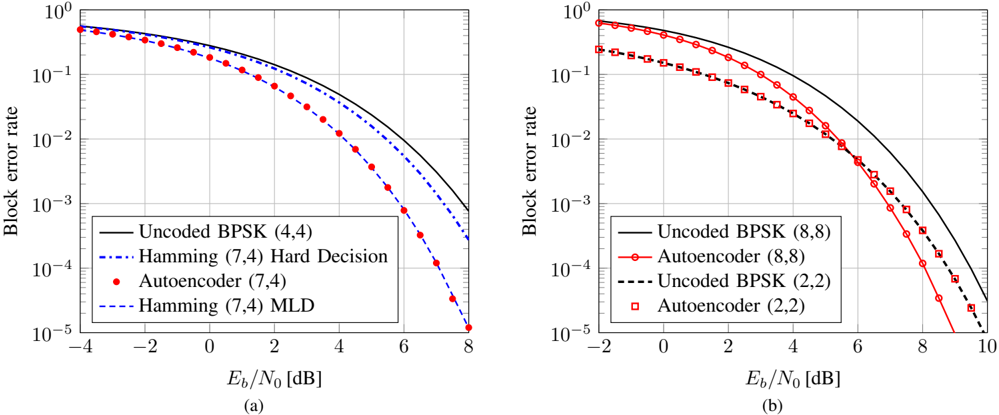
- A learned autoencoder for a (7,4) system at rate R = 4/7 achieves the same block error rate (BLER) as a Hamming (7,4) code with maximum likelihood decoding, while an (8,8) autoencoder outperforms uncoded BPSK over the full E_b/N_0 range, indicating learned joint coding and modulation.
- For the two-user AWGN interference channel, the autoencoder matches time-sharing for (1,1) and (2,2), but achieves gains of about 0.7 dB for (4,4) and 1 dB for (4,8) at a BLER of 10^-3.
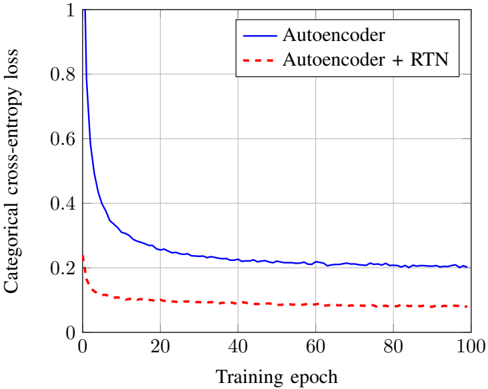
- An autoencoder (8,4) with an RTN over a multipath fading channel with L = 3 Rayleigh taps outperforms differential BPSK with maximum likelihood sequence estimation and a Hamming (7,4) code, whereas the plain autoencoder struggles to match it; RTNs also show faster training convergence.
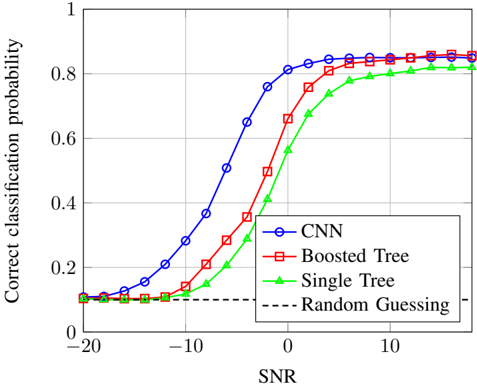
- For modulation classification on 1.2M sequences of 128 complex-valued IQ samples across ten modulation schemes and SNRs from -20 dB to 18 dB, the CNN outperforms a boosted expert-feature classifier by around 4 dB in the low-to-medium SNR range, with almost identical high-SNR performance; a single tree is about 6 dB worse at medium SNR and 3.5% worse at high SNR.
Methods
- The transmitter, channel, and receiver are represented as one deep neural network trained as an autoencoder: one-hot message input, dense layers, normalization layer for transmit constraints, additive noise channel layer, and softmax receiver output, trained with categorical cross-entropy using SGD/Adam at learning rate 0.001 and fixed E_b/N_0 = 7 dB.
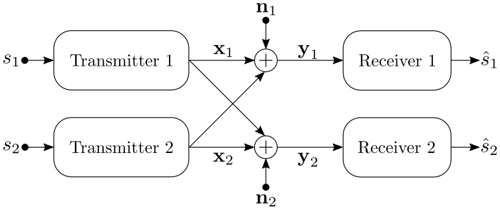
- The autoencoder concept is extended to multiple transmitter-receiver pairs in a two-user interference channel, with dynamic loss weights α_t per mini-batch to balance the two cross-entropy losses; performance is compared against 2^{2k/n}-QAM with time-sharing.
- RTNs combine a learned parameter estimator, a differentiable parametric transform, and a discriminative network; the paper demonstrates phase-offset compensation and multipath inverse filtering. For modulation classification, a VGG-like CNN with 324,330 trainable parameters is trained on the RML2016.10b dataset.
Limitations
- The paper states that scalability to large message sets M is a major challenge: for k = 100 bits, training complexity is prohibitive because the autoencoder must see at least every message once.
- The paper states that optimal data representations, loss functions, training SNR, and hyperparameters are not well understood; training at one SNR does not necessarily generalize to others, and no common communications benchmarks or datasets comparable to MNIST or ImageNet exist.
- The paper states that end-to-end learning over real channels requires system identification because backpropagation assumes a known channel transfer function; complex-valued neural networks are not supported by current DL libraries. Evident from the text: the reported results are simulation-based, use small (n,k) settings, assume known channel models during training, and the paper explicitly leaves detailed performance comparisons for various channel types and parameters to future work.
Model-written summary. Check it against the paper before relying on it.
Integrity signals
Registry
Cites
Statistics
Figures






Verification
Claims the paper makes
6 Valid · 4 Not valid · 18 Not checked · 65 Own results and interpretations
Every source the paper cites for this claim was checked and supports it.
In the paper
“For instance in [22], it was shown that training with a single codeword is sufficient since the structure of the code is embedded in the NN through the Tanner graph.”
What the sources say
- Supportedcites [22] [22] E. Nachmani, Y. Be'ery, and D. Burshtein, 'Learning to decode linear codes using deep learning,' in Proc. IEEE Annu. Allerton Conf. Commun., Control, and Computing (Allerton) , 2016, pp. 341-346. - source
The Introduction says the decoder uses a Tanner graph representing the code and that one codeword suffices for training. Section III explains the precise condition: over a binary memoryless symmetric channel, the decoder’s error rate is independent of the transmitted codeword, so training can use noisy versions of a single codeword. (LLM, conf=0.91)
boostedstates a cause- Asserted: passes — The authors put it forward as true.
- Checkable: passes — It can be checked against evidence.
- Load-bearing: unclear — It is unclear whether the paper’s conclusions depend on it.
- Based: passes — The paper gives a reason why it holds.
- Supported
A result the paper reports from its own data — it cites no other source for it, so there is none to check. The quote shows it is in the paper.
In the paper
“We study the use of NNs on complex-valued IQ samples for the problem of modulation classification and show that convolutional neural networks (CNNs), which are the cornerstone of most DL systems for computer vision, can outperform traditional classification techniques based on expert features.”
plainstates a cause- Asserted: passes — The authors put it forward as true.
- Checkable: passes — It can be checked against evidence.
- Load-bearing: passes — The paper’s conclusions depend on it.
- Based: passes — The paper gives a reason why it holds.
The paper states this without a source or data behind it here, so there is nothing to check it against. The quote shows it is in the paper.
In the paper
“Training at low SNR for instance does not allow for the discovery of structure important in higher SNR scenarios.”
plainstates a cause- Asserted: passes — The authors put it forward as true.
- Checkable: passes — It can be checked against evidence.
- Load-bearing: unclear — It is unclear whether the paper’s conclusions depend on it.
- Based: unclear — It is unclear why the paper says it holds.
A result the paper reports from its own data — it cites no other source for it, so there is none to check. The quote shows it is in the paper.
In the paper
“Another advantage of RTNs is faster training convergence which can be seen from Fig. 10 that compares the validation loss of the autoencoder with and without RTN as a function of the training epochs.”
plainstates a cause- Asserted: passes — The authors put it forward as true.
- Checkable: passes — It can be checked against evidence.
- Load-bearing: unclear — It is unclear whether the paper’s conclusions depend on it.
- Based: passes — The paper gives a reason why it holds.
A result the paper reports from its own data — it cites no other source for it, so there is none to check. The quote shows it is in the paper.
In the paper
“Similarly, Fig. 4b shows a (4 , 2) system which leads to a rotated 16-PSK constellation.”
plainstates a cause- Asserted: passes — The authors put it forward as true.
- Checkable: passes — It can be checked against evidence.
- Load-bearing: unclear — It is unclear whether the paper’s conclusions depend on it.
- Based: passes — The paper gives a reason why it holds.
39 more claims
Create a free account to see all 93 claims and to verify the 4 references still open.
- Probably not a substantial claim. 29
- It may state two separate claims as one. 24
Self-check
Percentages, sums and reported differences re-computed from the paper’s own numbers.
Each contradiction between two passages listed here was confirmed by an independent check.
Rated minor: it would not touch a result — a value no result rests on, a p-value that stays on the same side of the significance level, or a conflict that is clerical, resolved elsewhere in the paper, or outside its own findings.
In the paper
§ A. Autoencoders for end-to-end communications systems · p. 5
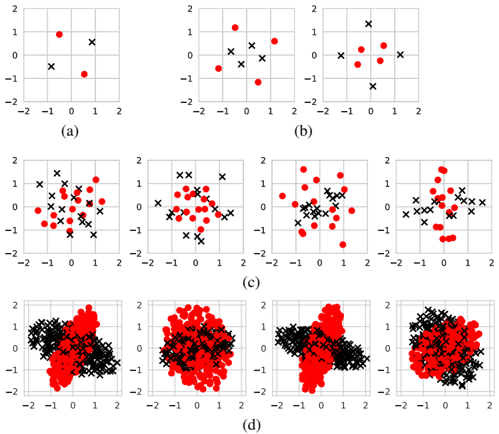
“Similarly, Fig. 4b shows a (4 , 2) system which leads to a rotated 16-PSK constellation.”
§ A. Autoencoders for end-to-end communications systems · p. 6
“Figure 4: Constellations produced by autoencoders using parameters ( n, k ) : (a) (2 , 2) (b) (2 , 4) , (c) (2 , 4) with average power constraint, (d) (7 , 4) 2-dimensional t-SNE embedding of received symbols.”
Citations
Cites
Very Deep Convolutional Networks for Large-Scale Image Recognition
Simonyan, K., & Zisserman, A. (2014) · arXiv · doi:10.48550/arxiv.1409.1556 · Cited by 114,148 · cited 1×
“dense/fully-connected layers and terminated with a dense softmax layer for our classifier (similar to a VGG architecture [55]).”
BackgroundAdam: A Method for Stochastic Optimization
Kingma, D. P., & Ba, J. (2014) · arXiv · doi:10.48550/arxiv.1412.6980 · Cited by 98,946 · cited 4×
“Training was done at a fixed value of Eb/N0 = 7 dB (see Section IV-B) using Adam [46] with learning rate 0.”
BackgroundMethodInfluentialA Mathematical Theory of Communication
Shannon, C. E. (1948) · Bell System Technical Journal · doi:10.1002/j.1538-7305.1948.tb01338.x · Cited by 88,486
Scikit-learn: Machine Learning in Python
Pedregosa, F., Varoquaux, G., Gramfort, A., Michel, V., Thirion, B., Grisel, O., Blondel, M., Müller, A., Nothman, J., Louppe, G., et al. (2012) · arXiv · doi:10.48550/arxiv.1201.0490 · Cited by 71,016 · cited 1×
“11, we compare the classification accuracy of the CNN against that of extreme gradient boosting7 with 1000 estimators, as well as a single scikit-learn decision tree [56], operating on a mix of 16 analog and cumulant expert features as proposed in [53] and [57].”
Method(2014) · Cited by 33,419
(2008) · Journal of Machine Learning Research · Cited by 33,051
Human-level control through deep reinforcement learning
Mnih, V., Kavukcuoglu, K., Silver, D., Rusu, A. A., Veness, J., Bellemare, M. G., Graves, A., Riedmiller, M., Fidjeland, A. K., Ostrovski, G., et al. (2015) · Nature · doi:10.1038/nature14236 · Cited by 30,357
(2007) · Electronics: A First Course · doi:10.4324/9780080477527-64 · Cited by 24,923
Pan, S. J., & Yang, Q. (2010) · IEEE Transactions on Knowledge and Data Engineering · doi:10.1109/tkde.2009.191 · Cited by 23,387 · cited 1×
“learning [64] is one appealing candidate for adapting an endto-end communications system trained on a statistical model to”
BackgroundMultilayer feedforward networks are universal approximators
Hornik, K., Stinchcombe, M., & White, H. (1989) · Neural Networks · doi:10.1016/0893-6080(89)90020-8 · Cited by 21,728 · cited 1×
“Third, it has been shown that NNs are universal function approximators [13] and recent work has shown a remarkable”
Background
Research works printed but not linked: 2
- [35] I. Goodfellow, Y. Bengio, and A. Courville, Deep Learning . MIT Press, 2016. -
- [52] J. Estaran et al. , 'Artificial neural networks for linear and non-linear impairment mitigation in high-baudrate IM/DD systems,' in Proc. 42nd European Conf. Optical Commun. (ECOC) . VDE, 2016, pp. 1-3. -
Cited by
Items 2,401–2,500 of 2,995
Deep Learning Architectures for Modeling Communication Systems
Chatterjee, D., Jaiswal, H., Honakamble, A., & Shenoy, K. G. (2019) · IEEE International Conference on Advanced Networks and Telecommunications Systems · doi:10.1109/ants47819.2019.9118132
“Inthis paper we extend the models and learning methods available in [9] for multiple user cases by introducing the Fig.”
BackgroundMethodResultInfluentialPrototype of Data Link Based on Random Modulation Hopping and Automatic Modulation Recognition
Wang, Y., & Liu, C. (2020) · Journal of Physics Conference Series · doi:10.1088/1742-6596/1621/1/012083
“In the past few years, deep learning (DL) method have greatly increased the capacity for feature extraction and learning [6].”
Exploiting Spatio-Temporal Correlation in RF Data Using Deep Learning
Roy, D., Mukherjee, T., & Pasiliao, E. (2020) · Advances in intelligent systems and computing · doi:10.1007/978-981-15-6759-9_7
Machine Learning Enhanced Quality of Transmission Estimation in Disaggregated Optical Systems
Zhu, S. (2020) · UA Campus Repository (The University of Arizona)
Principles and Techniques to Optimize Digital Communication Systems from End to End
Chagnon, M. (2020) · SiPS ... design and implementation - IEEE Workshop on Signal Processing Systems · doi:10.1109/sips50750.2020.9195265
“4 3 3 M [2] M [3] a = satlins ( z ) a = satlins ( z ) Generative adversarial networks (GAN) are relatively recent methods to learn to generate samples from a hyper-dimensional distribution.”
MethodNeural network promotes the transmission quality of remote health based on 5G technology
Li, B., Sun, G., & Hao, W. (2020) · IEEE/CIC International Conference on Communications in China (ICCC) · doi:10.1109/icccworkshops49972.2020.9209954
Physical Layer Security in the 5G Heterogeneous Wireless System with Imperfect CSI
Isart, M. F. (2020) · UPCommons institutional repository (Universitat Politècnica de Catalunya)
Deep Learning Based Active User Detection for Uplink Grant-Free Access
Fang, J., Li, Y., Yang, C., Wang, W., & Gao, X. (2020) · IEEE/CIC International Conference on Communications in China (ICCC) · doi:10.1109/iccc49849.2020.9238824
Kolář, J., Sýkora, J., & Hron, P. (2020) · Mathematics · doi:10.3390/math8112007
“In [8,9], a deep learning approach to jointly optimize the whole wireless communication chain was proposed, and this approach was successfully tested in an over-the-air transmission.”
MethodBinary Signaling for Optical Wireless Channel based on Deep Learning
Hwang, Y., Lee, C. G., & Kim, S. (2020) · International Symposium on Communication Systems, Networks and Digital Signal Processing (CSNDSP) · doi:10.1109/csndsp49049.2020.9249485
“In addition to many image processing applications from deep learning, many applications relevant to communications engineering are listed in [4], for example, modulation recognition, localization, channel modeling and prediction, decoding, and spectrum sensing.”
BackgroundChannel Type Recognition in Wireless Communications: A Deep Learning ApproachPreprint
Sun, S. D., Li, X., & Moon, S. (2020) · arXiv (Cornell University) · doi:10.48550/arxiv.2010.07052
A Novel Multi-impairment Compensation Scheme Based on Deep Autoencoder for CO-OFDM System
Han, Y. J., Chen, Y., Huang, Y., Fu, J., Lin, S., & Yu, J. (2020) · Opto-Electronics and Communications Conference (OECC) · doi:10.1109/oecc48412.2020.9273675 · Cited by 1
“With the application of deep learning in communication, some research results show that the deep learning can effectively improve the performance of communication systems [6].”
BackgroundSpatial-Time MIMO Autoencoder for Physical Layer
Mu, T., Chen, X., Chen, L., Yin, H., & Wei, G. (2020) · International Conference on Wireless Communications and Signal Processing (WCSP) · doi:10.1109/wcsp49889.2020.9299728
“In channel autoencoder proposed by [4], the transmitter encodes a one-hot vector to corresponding complex symbols for transmission.”
BackgroundЭкспериментальное исследование самоорганизующегося акустического канала связи
Невзоров, А. А., Владимирович, П. С., & Stankevich, D. A. (2021) · Письма в журнал технической физики · doi:10.21883/pjtf.2021.06.50756.18642
Similarity-based prediction for channel mapping and user positioningPreprint
Magoarou, L. L. (2020) · HAL
Computational Problems Addressed using Machine Learning (ML) In a 5G Network
Sridharan, S. (2020) · International Journal of Computer Trends and Technology · doi:10.14445/22312803/ijctt-v68i12p101
An Overview of Communication System Model Using Deep Learning Techniques
Tamizhelakkiya, K., Shailesh, G. S., Singh, M., & Pushkar (2021) · Lecture notes in electrical engineering · doi:10.1007/978-981-15-7504-4_29 · Cited by 1
Beck, E., Bockelmann, C., & Dekorsy, A. (2021) · arXiv (Cornell University)
Machine Learning based RF Transmitter Characterization in the Presence of Adversaries
Roy, D. (2020) · Journal of International Crisis and Risk Communication Research
Deep Learning Assisted Relay Matching in Multi-user Pair and Multi-relay Untrusted Networks
Yao, R., Qin, Q., Hu, Y., Fan, Y., Qi, N., & Zuo, X. (2021) · International Conference on Intelligent Computing and Signal Processing (ICSP) · doi:10.1109/icsp51882.2021.9408743
Frame Detection with Deep Learning
Yıldırım, M., & SOKULLU, R. İ. (2021) · Celal Bayar Üniversitesi Fen Bilimleri Dergisi · doi:10.18466/cbayarfbe.693942
Machine Learning for Channel Estimation and Hybrid Beamforming in Millimeter-Wave Wireless Networks
Peken, T. (2021) · UA Campus Repository (The University of Arizona)
Deep Learning Demodulation of Amplitude Noise Shift Keying Spread Spectrum Signals
Kozlenko, M., Lazarovych, I., Tkachuk, V. M., & Кузь, М. В. (2020) · International Scientific-Practical Conference Problems of Infocommunications Science and Technology · doi:10.1109/picst51311.2020.9468063
FPGA Based Deep Learning Accelerator for RF Applications: A Design Framework
den Boer, H. (2021)
Avoiding normalization uncertainties in deep learning architectures for end-to-end communicationPreprint
Bos, S., Vinogradov, E. A., & Pollin, S. (2021) · doi:10.36227/techrxiv.14994906.v1
“In [1], an extension to multiple channel uses is considered (i.”
BackgroundMethodInfluentialBradshaw, S. C. (2020) · Arrow@dit (Dublin Institute of Technology) · doi:10.13025/16986
Progressive Transmission using Recurrent Neural NetworksPreprint
Safari, M. S., Pourahmadi, V., Mitran, P., & Sheikhzadeh, H. (2021) · arXiv (Cornell University) · doi:10.48550/arxiv.2108.01643
“In the pioneering studies of [6], [9], [10], channel autoencoders were proposed in which the transmitter and receiver are designed (trained) in a single process.”
BackgroundDomain Adaptation for Autoencoder-Based End-to-End Communication Over Wireless Channels.Preprint
Raghuram, J., Zeng, Y., Martí, D. G., Jha, S., Banerjee, S., Widmer, J., & Ortiz, R. R. (2021) · arXiv (Cornell University)
Learning based Transmitter/Receiver Design for the Nonlinear Channel
Namgoong, J., Yoo, T., Bhushan, N., Mukkavilli, K., & Ji, T. (2021) · International Conference on Communications · doi:10.1109/icc42927.2021.9501000
“This was motivated by the recent works [8] [9] that employ the autoencoder in end-to-end learning of the communcation systems.”
MethodIntegration of Deep Hashing and Channel Coding for Biometric Security and Biometric Retrieval
Talreja, V. (2021) · The Research Repository @ WVU (West Virginia University) · doi:10.33915/etd.8240
Role of Quantum Technology in 6G
Shenoy, K. G. (2021) · Computer communications and networks · doi:10.1007/978-3-030-72777-2_19
Distributed Learning in Non-Convex World: Theory, Algorithms, and Applications
Sun, H. (2021) · University of Minnesota Digital Conservancy (University of Minnesota)
Analysis of MIMO detector using artificial neural network and deep neural network
Tangelapalli, S., Pardhasaradhi, P., Kumar, D. S., Dasari, N., & Shaik, M. S. (2021) · AIP conference proceedings · doi:10.1063/5.0066713 · Cited by 1
Rasti-Meymandi, A., Abouei, J., Hajiakhondi-Meybodi, Z., Mohammadi, A., & Asif, A. A. (2021) · IEEE International Conference on Autonomous Systems (ICAS) · doi:10.1109/icas49788.2021.9551139
Modified Autoencoder Structure for Reducing BER Performance
Ramdani, K., Shaïek, H., & Roviras, D. (2021) · International Conference on Software, Telecommunications and Computer Networks (SoftCOM) · doi:10.23919/softcom52868.2021.9559120
Differential Deep Detection in Massive MIMO With One-Bit ADCPreprint
Emenonye, D.-R., Dietrich, C., & Buehrer, R. M. (2021) · arXiv (Cornell University) · doi:10.48550/arxiv.2110.14534
“Leveraging this, a novel end-to-end deep learning-based communication system was developed with both the transmitters and the receivers replaced by the encoder and decoder of an autoencoder [17].”
BackgroundThoota, S. S., Martí, D. G., Demir, �. T., Mundlamuri, R., Palacios, J., Yetiş, C. M., Thomas, C. K., Sameera Bharadwaja, H., Björnson, E., Giselsson, P., et al. (2021) · ITU Journal on Future and Evolving Technologies · doi:10.52953/oeeg5719
Deep Joint Encryption and Source-Channel Coding: An Image Privacy Protection Approach.Preprint
Xu, J., Ai, B., Chen, W., Wang, N., & Rodrigues, M. R. D. (2021) · arXiv (Cornell University) · Cited by 1
Research on Automatic Modulation Classification Technology under α Stable Distribution Noise
Zhang, Z. (2021) · IEEE International Conference on Mobile Ad-Hoc and Sensor Systems (MASS) · doi:10.1109/mass52906.2021.00076
Neural Networks Applied for Broadcast Channels
Abuabdoh, M. (2021) · IEEE International Conference on Information, Communication and Networks (ICICN) · doi:10.1109/icicn52636.2021.9673962
Toward Polymorphic Internet of Things Receivers Through Real-Time Waveform-Level Deep Learning
Restuccia, F., & Melodia, T. (2022) · GetMobile Mobile Computing and Communications · doi:10.1145/3511285.3511294
A Deep Learning Framework for Distributed Channel Selection in a Congested Uncooperative Spectrum
Frisbie, S., & Younis, M. (2021) · Globecom · doi:10.1109/globecom46510.2021.9685215
“In [15], the authors model a wireless transmitter, channel, and receiver as a deep learning architecture called an “autoencoder”, consisting of an “encoder” and a “decoder” network.”
BackgroundPU-DetNet: An Efficient Deep Unfolding aided Smart Sensing Framework for Cognitive RadioPreprint
Shah, S. B., Patel, D. K., Soni, B., López‐Benítez, M., & Govindasamy, S. (2022) · doi:10.36227/techrxiv.19119752.v1
Olasina, J. R., Adetiba, E., Abayomi, A., Obiyemi, O. O., Thakur, S. C., & Moyo, S. (2022) · Lecture notes in networks and systems · doi:10.1007/978-3-030-96299-9_66
A Signal-to-Data Translation Model for Robust Backscatter Communications
Jeong, S., Shin, J., & Kim, Y. (2022) · IEEE Access · doi:10.1109/access.2022.3155879
“These works require deep learning components on both transmitters and receivers [50], [51], [52], [53].”
BackgroundEqualization Network‐Aided SCMA Codec Scheme with Deep Learning
Jiang, F., Huang, X., Jiang, S., Wang, Y., Xu, Y., & Yin, T.-Y. (2022) · Wireless Communications and Mobile Computing · doi:10.1155/2022/6855947
“In addition, new ways of thinking about communications as an end-to-end joint optimization of the communication system, which utilizes autoencoders to jointly learn transmitter and receiver implementations as well as signal encodings without any prior knowledge, were introduced in [30].”
BackgroundImpact of Training Parameters on Characteristics of Codebooks Obtained Using Autoencoder Networks
Sergienko, A. B., & Apalina, P. V. (2022) · IEEE Conference of Russian Young Researchers in Electrical and Electronic Engineering · doi:10.1109/elconrus54750.2022.9755662
“For example, they are applied in digital communications for end-to-end joint optimization of communication systems [1], [2], [3], [4], [5].”
BackgroundMethodResultInfluentialZhu, T., & Zhu, S. (2022) · Wireless Communications and Mobile Computing · doi:10.1155/2022/5889310
“By interpreting the communication system as an autoencoder, Oshea and Hoydis have developed a basic new method that treats the communication system design as an end-to-end reconstruction task, aiming to jointly optimize the transmitter and receiver components in a single process [4].”
MethodVision, Challenge, Futuristic Approach of Machine Learning in 6G Wireless Technology
Lavadiya, S., Sorathiya, V. P., Das, S., Rashed, A. N. Z., Shunmughavel, V., & Deepthi, P. (2022) · Advances in wireless technologies and telecommunication book series · doi:10.4018/978-1-7998-9636-4.ch009
Autoencoder with Channel Estimation for Marine Communications
Lin, B., Duan, J., Han, M., & Cai, L. X. (2022) · Wireless networks · doi:10.1007/978-3-030-97307-0_3
Mumtaz, M. Z., Khurram, M., Adnan, M., & Fazil, A. (2020) · doi:10.36227/techrxiv.13455719.v2
Priya, C., Kumutha, D., Shilpa, M., B, J. K., & Baskaran, S. (2021) · Arabian Journal for Science and Engineering · doi:10.1007/s13369-021-06172-8 · Cited by 1
RetractedAvoiding normalization uncertainties in deep learning architectures for end-to-end communicationPreprint
Bos, S., Vinogradov, E. A., & Pollin, S. (2021) · doi:10.36227/techrxiv.14994906
Machine Learning in Wireless Communication: A Survey
Sharma, N. V., & Yadav, N. S. (2020) · IGI Global eBooks · doi:10.4018/978-1-7998-7705-9.ch088 · Cited by 2
Towards More Reliable Deep Learning-Based Link Adaptation for WiFi 6Preprint
Hussien, M. (2020) · doi:10.36227/techrxiv.13211687
Overlaying control signal over standard-compliant frames: from energy harvesting to deep learning
Sankhe, K. (2020) · Digital Repository Service (Northeastern University) · doi:10.17760/d20383684
Mumtaz, M. Z., Khurram, M., Adnan, M., & Fazil, A. (2020) · doi:10.36227/techrxiv.13455719.v1
Toward More Reliable Deep Learning-Based Link Adaptation for WiFi 6Preprint
Hussien, M. (2020) · doi:10.36227/techrxiv.13211687.v1
“Fortunately, machine learning (ML) is anticipated to provide viable solutions to the link adaptation challenges in wireless systems [3], [4].”
BackgroundNgo, T., Kelley, B., & Paul, R. (2021) · doi:10.36227/techrxiv.14787810
Mumtaz, M. Z., Khurram, M., Adnan, M., & Fazil, A. (2021) · doi:10.36227/techrxiv.13455719.v3
Avoiding normalization uncertainties in deep learning architectures for end-to-end communication
Bos, S., Vinogradov, E. A., & Pollin, S. (2021) · IEEE International Mediterranean Conference on Communications and Networking (MeditCom) · doi:10.1109/meditcom49071.2021.9647513
Mumtaz, M. Z., Khurram, M., Adnan, M., & Fazil, A. (2020) · doi:10.36227/techrxiv.13455719
AI-Based Wireless Communication
Sanjana, T., Lalitha, S., Surendra, H. H., & N., M. K. (2022) · Advances in wireless technologies and telecommunication book series · doi:10.4018/978-1-6684-3804-6.ch004
Deep Learning for Secure Transmission in Wireless Communication Networks
Olowononi, F. O., Rawat, D. B., & Kamhoua, C. (2022) · IEEE International Conference on Communications workshops · doi:10.1109/iccworkshops53468.2022.9814628
Robustness Optimization Based on Self-Learning
Qiu, T., Chen, N., & Zhang, S. (2022) · Springer eBooks · doi:10.1007/978-981-16-9609-1_7
Security- and privacy-preserving ML/DL paradigms for 5G communication technology in smart healthcare
Negi, P. S., Garg, A. K., & Lal, R. (2022) · Elsevier eBooks · doi:10.1016/b978-0-323-90615-9.00010-4
Chaotic physical security scheme based on variational auto-encoder for OFDM-PON
Zhu, X., Liu, B., Ren, J., Zhu, X., Mao, Y., Wu, X., Li, M., Chen, S., & Bai, Y. (2022) · International Conference on Optical Instruments and Technology: Optical Communication and Optical Signal Processing (OIT) · doi:10.1117/12.2619526
“The authors in 19-20 adopted an autoencoder to interpret the entire communication systems for wireless communication systems and optical communication systems.”
BackgroundDeep Neural Network Augmented Wireless Channel Estimation on System on ChipPreprint
Haq, S. A. U., Gizzini, A. K., Shrey, S., Darak, S. J., Saurabh, S., & Chafii, M. (2022) · doi:10.36227/techrxiv.20443917.v1
Bidirectional Long Short-Term Memory-Based Channel Estimation for Vehicular CommunicationPreprint
Kim, J., & Han, D. S. (2022) · SSRN Electronic Journal · doi:10.2139/ssrn.4189372
Data-Driven Precoder Codebook Design for SU-MIMO Systems
Satyanarayana, K., Sahin, O., & Kurt, M. N. (2022) · IEEE Vehicular Technology Conference · doi:10.1109/vtc2022-spring54318.2022.9860400
“AI techniques are particularly useful when the mathematical system modeling is too complex, or the algorithms to solve optimization problems are either unknown or computationally expensive [7].”
BackgroundSecrecy Capacity-Approaching Neural Communications for Gaussian Wiretap Channel
Li, J., Sun, Z., Fan, J., & Zhu, H. (2022) · Lecture notes in electrical engineering · doi:10.1007/978-981-16-9423-3_4
An Improved Data-Driven Decision Feedback Receiver via Deep Unfolding
Liu, S., Zhao, L., & Song, T. (2022) · Mathematical Problems in Engineering · doi:10.1155/2022/5656880
“ML is applicable for end-to-end optimization problems in complex scenarios with inaccurate and/or intractable models [6, 7].”
BackgroundDeep Learning Applied to Automatic Modulation Classification at 28 GHz
Sun, Y., & Ball, E. A. (2022) · Lecture notes in networks and systems · doi:10.1007/978-3-031-16072-1_30
Perceptron for channel estimation and signal detection in OFDM systems
Rani, M., & Singal, P. (2022) · Journal of Optics · doi:10.1007/s12596-022-00924-x
“Each transmitted frame consists of a preamble at the beginning, which is used for channel estimation at the receiver, followed by OFDM symbols that contain the transmitted data [9].”
BackgroundModulation Classification on Radio Communication Using Convolutional Neural Network
Çalışır, B., & Akbal, A. (2022) · International Conference on Innovations in Intelligent Systems and Applications (INISTA) · doi:10.1109/inista55318.2022.9894189
“DL excellently has improved the ability for learning features directly on pure high dimension input data attributed on high grade checked targets because of the novelly installed capacity for learning of numerous neural network patterns having high counts of independent parameters [7-10].”
BackgroundPU-DetNet: An Efficient Deep Unfolding aided Smart Sensing Framework for Cognitive RadioPreprint
Shah, S., Patel, D. K., Soni, B., López‐Benítez, M., & Govindasamy, S. (2022) · doi:10.36227/techrxiv.19119752.v2
Ye, N., Li, X., Yang, K., & An, J. (2022) · Springer eBooks · doi:10.1007/978-981-19-4025-5_1
Artificial Intelligence-Enhanced Multiple Access
Ye, N., Li, X., Yang, K., & An, J. (2022) · Springer eBooks · doi:10.1007/978-981-19-4025-5_6
Deep Learning-Aided High-Throughput Multiple Access
Ye, N., Li, X., Yang, K., & An, J. (2022) · Springer eBooks · doi:10.1007/978-981-19-4025-5_7
Constellation-Shaped 64QAM Robust against Phase Noise in Intra-Datacenter Networks
Sakano, J., Shiraki, R., Mori, Y., & Hasegawa, H. (2022) · OptoElectronics and Communications Conference and International Conference on Photonics in Switching and Computing (OECC/PSC) · doi:10.23919/oecc/psc53152.2022.9850095
5G Sistemleri için DL Tabanlı Kanal Tahmini
Çalışır, B. (2022) · Computer Science · doi:10.53070/bbd.1173848
Channel synchronization based on deep learning
Peng, W., Ruimin, L., Ye, G., Xie, S., & Wang, R. (2022) · Transactions on Emerging Telecommunications Technologies · doi:10.1002/ett.4656
“(7) The TDCC layer The TDCNN layer is trained to generate a filter with asymmetric coefficients in the time domain, denoted as Cw,6, to adjust the delay of the output signals from the matching filter layer.”
Edvardsen, V., Spreemann, G., & den Abeele, J. V. (2022) · doi:10.1145/3551661.3561363 · Cited by 3
“Usecases span the stack, from the lower levels of the physical layer [11], up through radio resource management use-cases such as traffic scheduling [12] and handovers [13], to high-level use-cases such as adaptive video streaming [14] in the application layer.”
End-to-End Wireless Communication System Based on Deep Neural Network Channel ModulePreprint
Ганчев, И., & Ji, Z. (2022) · doi:10.36227/techrxiv.21384783.v1
Symbol detection using extreme learning machine network for MU‐SIMO systems
Biswas, P., & Mallik, R. K. (2022) · IET Communications · doi:10.1049/cmu2.12522
Image Super Resolution based Channel Estimation for Future Wireless CommunicationPreprint
Ahmad, M., Shakeel, T., & Shin, S. Y. (2022) · doi:10.36227/techrxiv.21523992
de Alwis, C., Pham, Q.-V., & Liyanage, M. (2022) · Wiley eBooks · doi:10.1002/9781119862321.ref
de Alwis, C., Pham, Q., & Liyanage, M. (2022) · Wiley eBooks · doi:10.1002/9781119862321.ch9
Otimização de um decodificador neural para códigos BCH curtos sob regime de comunicação crítica
Kamassury, J. K. S. (2022) · Revista Brasileira de Computação Aplicada · doi:10.5335/rbca.v14i3.13278
Demonstration of LED distortion mitigation for Vehicular VLC Systems using DNNsPreprint
Abhaynarasimha, K. S., Vakamulla, V. M., & Sellathurai, M. (2022) · doi:10.36227/techrxiv.21618207.v1
Modeling and Analysis of Video Image Target Detection (TD) and Tracking Based on Deep Learning
Xu, Z. (2022) · International Conference on 3D Immersion, Interaction and Multi-sensory Experiences (ICDIIME) · doi:10.1109/icdiime56946.2022.00029
“Firstly, FHOG, LBP and CN features are extracted and fused; Secondly, the principal component analysis method is used to project the fused high-dimensional serial features into the 40 dimensional subspace, which preserves the effective features and simplifies the feature expression [10].”
MethodArcabouço de Aprendizado Estatístico para Caracterização Assintótica de Canais sem Fio
Laburú, F. M., Calmon, F. P., Assine, J. S., & Filho, J. C. S. S. (2022) · Anais de XXXV Simpósio Brasileiro de Telecomunicações e Processamento de Sinais · doi:10.14209/sbrt.2022.1570824788
Feature-Based Opinion Classification Using the KPCA Technique: Concept and Performance Evaluation
Kumar, S., & Ahuja, B. (2022) · International Journal on Recent and Innovation Trends in Computing and Communication · doi:10.17762/ijritcc.v10i2s.5914
Deep Reinforcement Learning For Secure Communication
Yang, Y., & Shikh‐Bahaei, M. (2022) · IEEE Vehicular Technology Conference · doi:10.1109/vtc2022-fall57202.2022.10013039
“In particular, the authors in [13] were the first to consider an autoencoder approach to the physical layer.”
BackgroundAutoencoding Graph Neural Networks for Scalable Transceiver Design
Kim, J., Lee, H., & Park, S.-H. (2022) · IEEE Vehicular Technology Conference · doi:10.1109/vtc2022-fall57202.2022.10012954
“The performance of existing AE models [1] are also plotted.”
BackgroundMethodInfluentialDemonstration of Mitigating Non-Linear Distortions using Deep Neural Networks for Vehicular VLCPreprint
Abhaynarasimha, K. S., Vakamulla, V. M., & Sellathurai, M. (2023) · doi:10.36227/techrxiv.21618207.v2
Ганчев, И., & Ji, Z. (2023) · doi:10.36227/techrxiv.21384783.v2
Metadata
- Authors
- O'Shea, T., & Hoydis, J.
- Affiliations
- Nokia (France) (FR)
- Venue
- IEEE Transactions on Cognitive Communications and Networking
- Published
- 2017-12
- Volume
- 3
- Issue
- 4
- Pages
- 563-575
- ISSN
- 2332-7731 (ISSN-L)
- OpenAlex
- W2734408173
- Semantic Scholar
- 78989616eeeac55b202e3e4205225e7135054185
- Cited by
- 2,980
- References
- 69
- Citations by year
- 2026: 307 · 2025: 327 · 2024: 305 · 2023: 368 · 2022: 432 · 2021: 409 · 2020: 406 · 2019: 322 · 2018: 95 · 2017: 9
- FWCI
- 122.29
- Type
- journal article
- Language
- en
- Open access
- green
- arxiv.org
- Locations
- IEEE Transactions on Cognitive Communications and Networking (publishedVersion)
- arXiv (Cornell University) (submittedVersion)
- arXiv (Cornell University)
- Topics
- Physical Sciences › Computer Science › Artificial Intelligence › Wireless Signal Modulation Classification
- Physical Sciences › Engineering › Electrical and Electronic Engineering › Advanced Wireless Communication Techniques
- Physical Sciences › Engineering › Electrical and Electronic Engineering › Advanced Wireless Communication Technologies
- Keywords
- end-to-end reconstruction, domain knowledge integration, convolutional neural networks, automatic modulation classification, IQ samples
About these checks
Registry, retraction, Cites and statistics results are computed, not judged, with one exception: a printed reference that no index lists is read once by a model before it counts as a citation error. Claims are extracted by a model and kept only when their quote appears verbatim in the text; each cited source is then checked, with a model’s help, for whether it says what the claim relies on. Those verdicts can be wrong — read the claim’s quote and the cited source before relying on one.
The claim verdicts this report counts are experimental: their accuracy is not yet measured.
A language model drew the claims from the paper on 2026-11-07, under version 3 of the claim definition (model deepseek-v4.1-flash, prompt extract-v3).
A second model labelled each claim on 2026-11-07 (model jev-1.13-20260917, definition revision gold-guideline-v0.2).
Cited sources are checked with a language model’s help (gpt-6-sol).
Statistics and arithmetic are recomputed, not judged.
Confidence bands are shown only for fields calibrated on our annotated test set. None is calibrated yet, so no band is shown.
What counts as a claim ›How we measure confidence ›How we check this ›
Are you an author, or do you see a problem with this page? Request a review
Data sources
Bibliographic data: Semantic Scholar, OpenAlex, Crossref.
Contains information from the Semantic Scholar Academic Graph Datasets, made available under the ODC Attribution License (ODC-BY 1.0).
Semantic Scholar’s data is described in: Kinney, R., et al. (2023). The Semantic Scholar Open Data Platform. arXiv:2301.10140.
