

The DOI matches its Crossref record; 75 of the 90 references it cites were found in a registry or an index; none of the 70 sources its claims cite is checked for support yet.
DeepIGeoS: A Deep Interactive Geodesic Framework for Medical Image Segmentation
Open accessAbstract
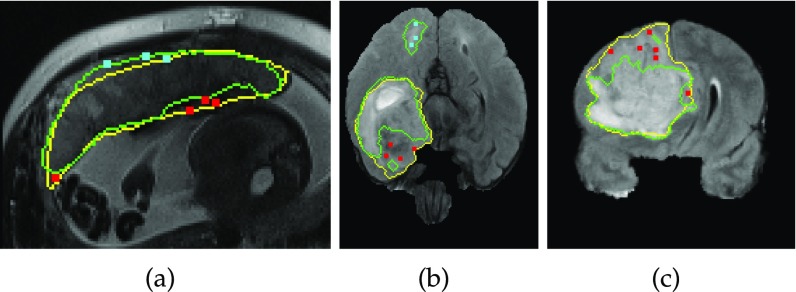
Accurate medical image segmentation is essential for diagnosis, surgical planning and many other applications. Convolutional Neural Networks (CNNs) have become the state-of-the-art automatic segmentation methods. However, fully automatic results may still need to be refined to become accurate and robust enough for clinical use. We propose a deep learning-based interactive segmentation method to improve the results obtained by an automatic CNN and to reduce user interactions during refinement for higher accuracy. We use one CNN to obtain an initial automatic segmentation, on which user interactions are added to indicate mis-segmentations. Another CNN takes as input the user interactions with the initial segmentation and gives a refined result. We propose to combine user interactions with CNNs through geodesic distance transforms, and propose a resolution-preserving network that gives a better dense prediction. In addition, we integrate user interactions as hard constraints into a back-propagatable Conditional Random Field. We validated the proposed framework in the context of 2D placenta segmentation from fetal MRI and 3D brain tumor segmentation from FLAIR images. Experimental results show our method achieves a large improvement from automatic CNNs, and obtains comparable and even higher accuracy with fewer user interventions and less time compared with traditional interactive methods.
Overview
AI snapshot
Written from the paper’s full text.
TL;DR
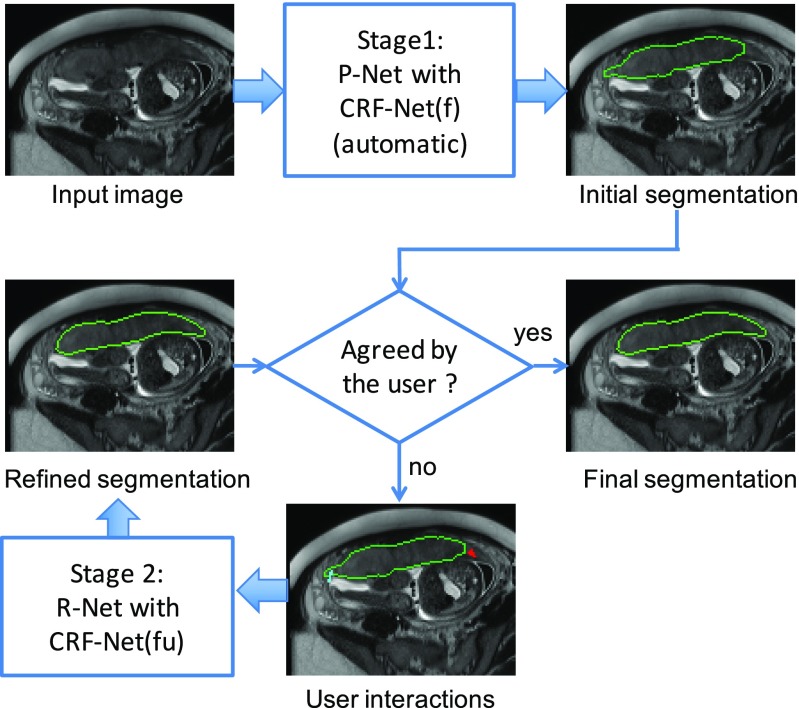
DeepIGeoS is a two-stage interactive segmentation framework in which a CNN proposes an initial segmentation and a second CNN refines it using user clicks/scribbles encoded as geodesic distance maps, with a trainable CRF that can enforce user interactions as hard constraints. It improved over automatic CNNs and achieved comparable or higher accuracy with fewer interactions and less user time than traditional interactive methods in 2D fetal MRI placenta and 3D brain tumor segmentation.
Key findings
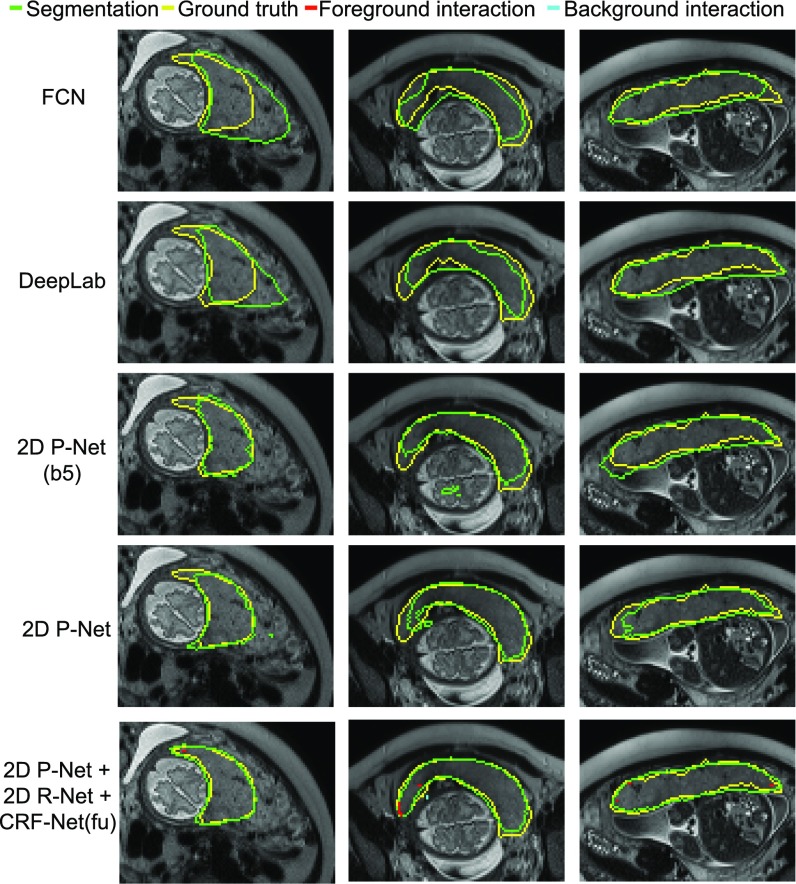
- In 2D placenta segmentation, 2D P-Net + CRF-Net(f) reached Dice 85.86 ± 11.67% and ASSD 1.85 ± 1.30 pixels; after interactive refinement, 2D R-Net + CRF-Net(fu) reached Dice 89.31 ± 5.33% and ASSD 1.22 ± 0.55 pixels.
- In 3D brain tumor segmentation, 3D P-Net + CRF-Net(f) reached Dice 87.55 ± 6.72% and ASSD 2.04 ± 1.70 pixels; after refinement, 3D R-Net + CRF-Net(fu) reached Dice 89.93 ± 6.49% and ASSD 1.43 ± 1.16 pixels.
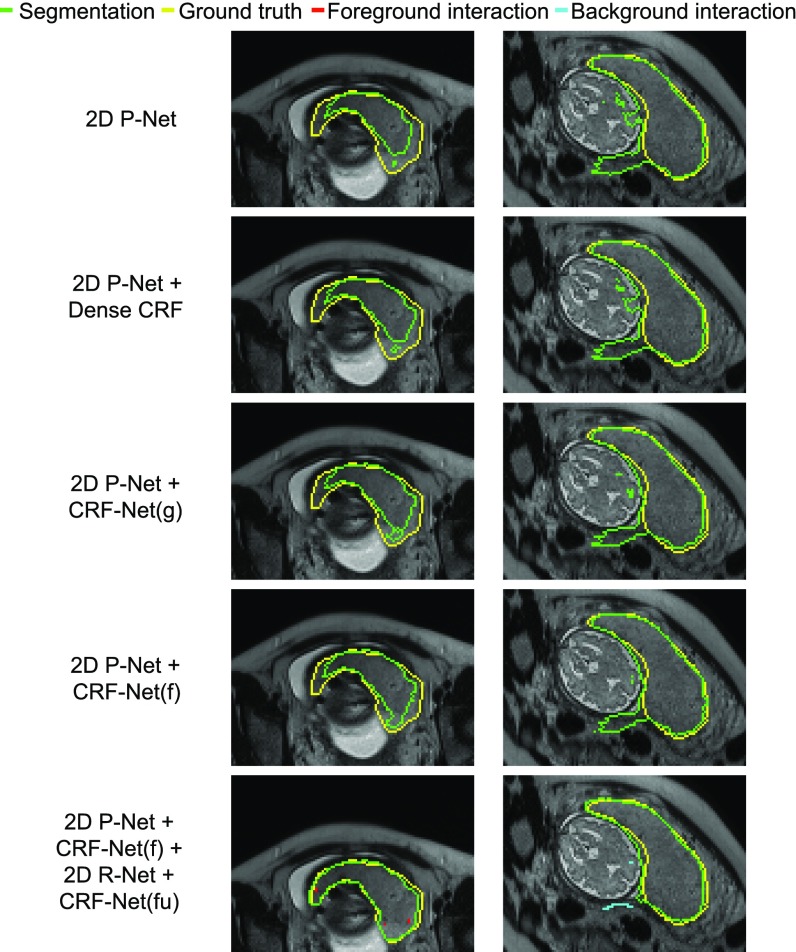
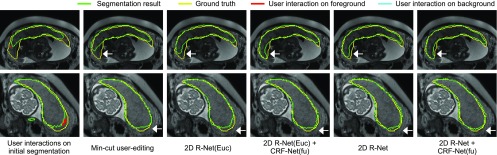
- Geodesic distance maps outperformed Euclidean distance maps for refinement, and CRF-Net(fu) further improved results; CRF-Net(f) with freeform pairwise potentials outperformed Dense CRF and CRF-Net(g) in the reported comparisons.
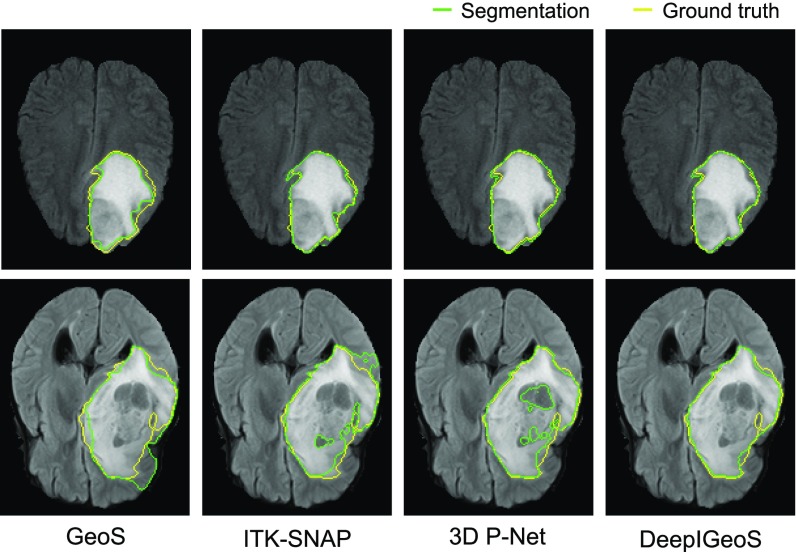
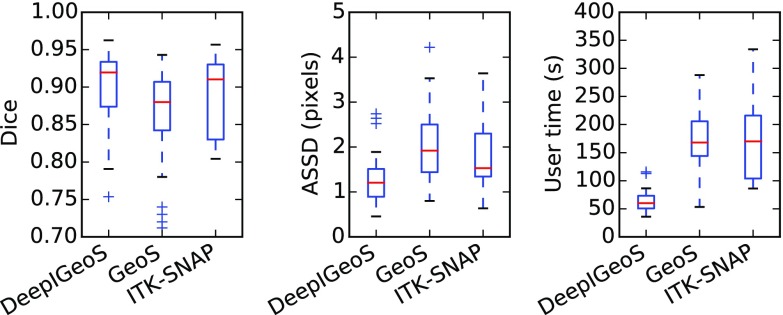
- Compared with traditional interactive methods, DeepIGeoS required far fewer user interactions and less user time; for 3D brain tumor segmentation, user time was about one third of that for GeoS and ITK-SNAP.
Methods
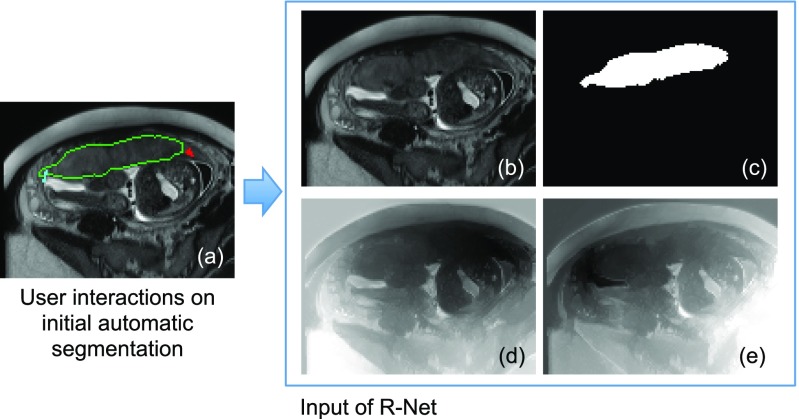
- Two-stage pipeline: P-Net produces an automatic initial segmentation; R-Net takes the original image, initial segmentation, and user interactions converted into geodesic distance maps to refine the result.
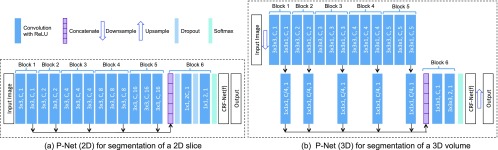
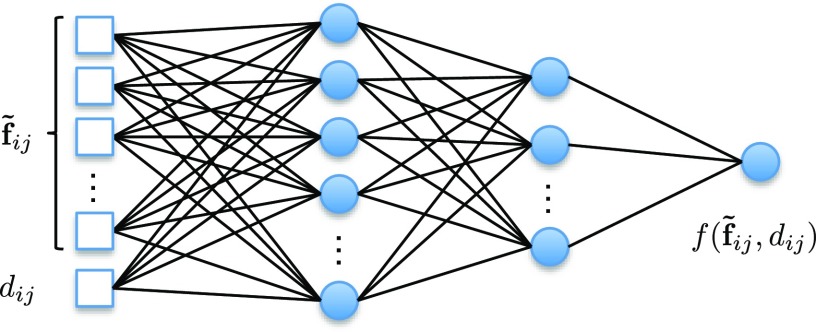
- Networks use a resolution-preserving dilated-convolution structure adapted from VGG-16, with multi-scale feature concatenation; a back-propagatable CRF-Net uses freeform pairwise potentials and, in R-Net, user scribbles as hard constraints.
- Data: 2D placenta from T2-weighted fetal MRI of 25 pregnant women, with 17 volumes/624 slices for training, 3 volumes/122 slices for validation, and 5 volumes/179 slices for testing; 3D brain tumor from the 2015 BraTS training set, using FLAIR images only, with 234 cases for training and 40 for testing. Evaluation used Dice and ASSD, with Student’s t-test for significance.
Limitations
- The paper does not include a dedicated limitations section; it states that the framework can be extended to deal with multiple organs in the future.
- Evident from the experiments: validation is limited to two binary segmentation tasks, and the 3D experiment uses only FLAIR images and segments only the whole tumor, not multi-label or multi-modality tumor subregions.
- Evident from the text: R-Net training uses simulated user interactions generated from mis-segmented regions, which may not fully match real user behavior.
Model-written summary. Check it against the paper before relying on it.
Integrity signals
Registry
Cites
Statistics
Figures
Verification
Claims the paper makes
42 Not checked yet · 34 Own result · 9 Own interpretation · 6 No basis given · 3 Own method
A result the paper reports from its own data — it cites no other source for it, so there is none to check. The quote shows it is in the paper.
In the paper
“Experimental results show our method achieves a large improvement from automatic CNNs”
§ DeepIGeoS: A Deep Interactive Geodesic Framework for Medical Image Segmentation > Abstract
plaindirect- Asserted: passes — The authors put it forward as true.
- Checkable: passes — It can be checked against evidence.
- Load-bearing: passes — The paper’s conclusions depend on it.
- Based: passes — The paper gives a reason why it holds.
A result the paper reports from its own data — it cites no other source for it, so there is none to check. The quote shows it is in the paper.
In the paper
“3D P-Net outperforms these three counterparts”
§ DeepIGeoS: A Deep Interactive Geodesic Framework for Medical Image Segmentation > Experiments > 3D Brain Tumor Segmentation from FLAIR Images
plaindirect- Asserted: passes — The authors put it forward as true.
- Checkable: passes — It can be checked against evidence.
- Load-bearing: unclear — It is unclear whether the paper’s conclusions depend on it.
- Based: passes — The paper gives a reason why it holds.
A result the paper reports from its own data — it cites no other source for it, so there is none to check. The quote shows it is in the paper.
In the paper
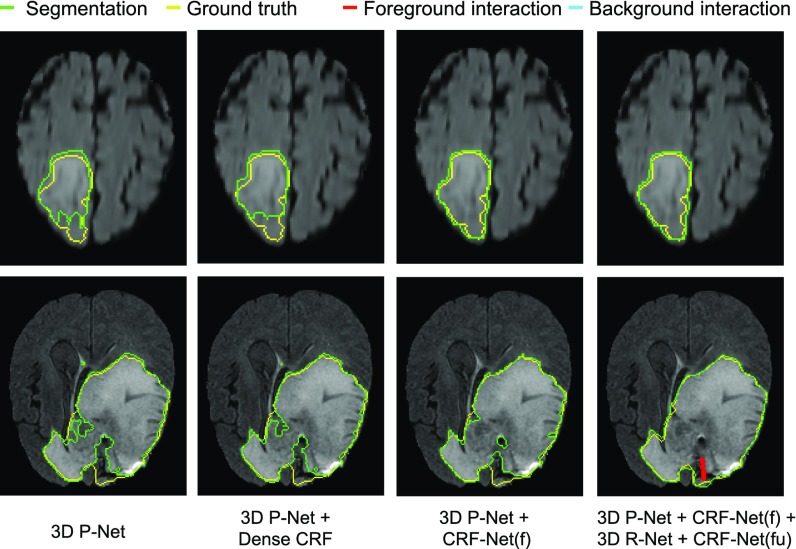
“only CRF-Net(f) obtains significantly better segmentation than 3D P-Net”
§ DeepIGeoS: A Deep Interactive Geodesic Framework for Medical Image Segmentation > Experiments > 3D Brain Tumor Segmentation from FLAIR Images
plaindirect- Asserted: passes — The authors put it forward as true.
- Checkable: passes — It can be checked against evidence.
- Load-bearing: passes — The paper’s conclusions depend on it.
- Based: passes — The paper gives a reason why it holds.
A result the paper reports from its own data — it cites no other source for it, so there is none to check. The quote shows it is in the paper.
In the paper
“CRF-Net(fu) can further improve the segmentation.”
§ DeepIGeoS: A Deep Interactive Geodesic Framework for Medical Image Segmentation > Experiments > 2D Placenta Segmentation from Fetal MRI
plaindirect- Asserted: passes — The authors put it forward as true.
- Checkable: passes — It can be checked against evidence.
- Load-bearing: passes — The paper’s conclusions depend on it.
- Based: passes — The paper gives a reason why it holds.
- Rests on an assumption: Simulated user interactions (random clicks in mis-segmented regions) are representative of real user interactions for training R-Net.
- Rests on an assumption: The manually delineated ground truth is accurate.
A result the paper reports from its own data — it cites no other source for it, so there is none to check. The quote shows it is in the paper.
In the paper
“Notice no initial scribbles are needed for DeepIGeoS.”
§ DeepIGeoS: A Deep Interactive Geodesic Framework for Medical Image Segmentation > Experiments > 2D Placenta Segmentation from Fetal MRI
plain- Asserted: passes — The authors put it forward as true.
- Checkable: passes — It can be checked against evidence.
- Load-bearing: passes — The paper’s conclusions depend on it.
- Based: passes — The paper gives a reason why it holds.
A result the paper reports from its own data — it cites no other source for it, so there is none to check. The quote shows it is in the paper.
In the paper
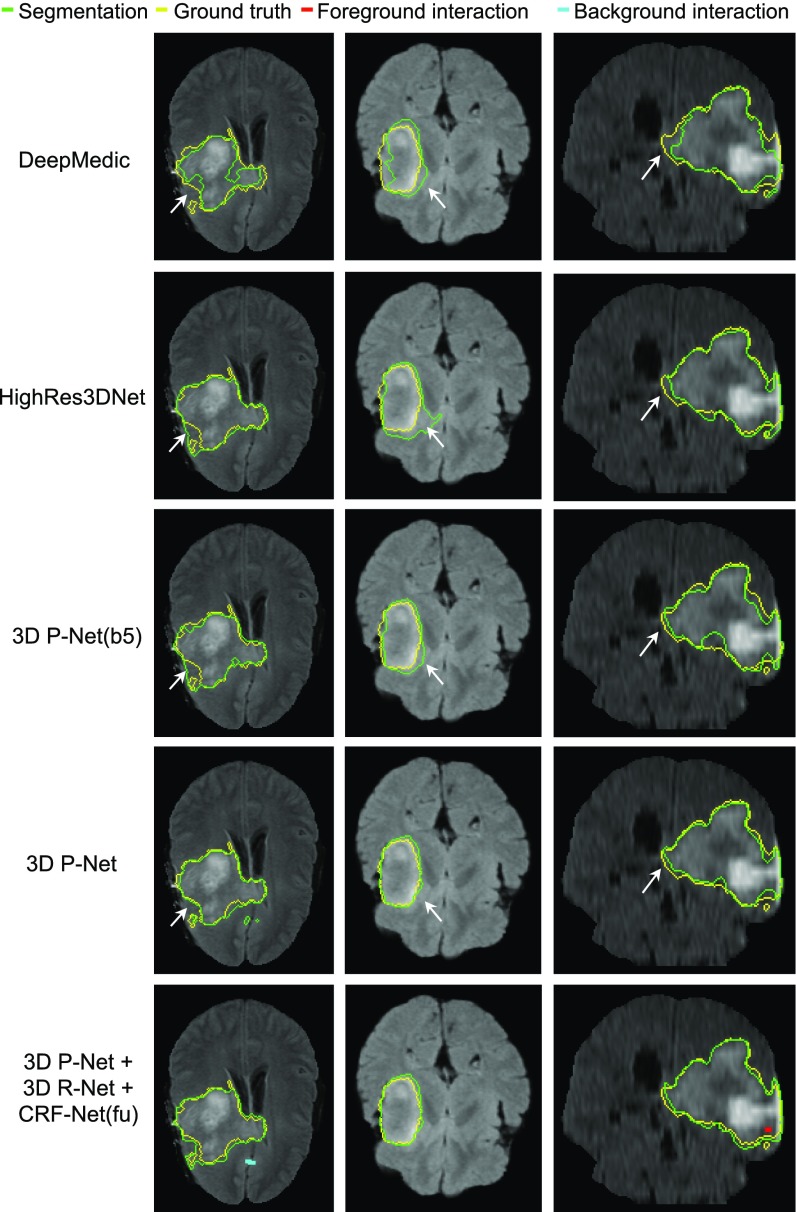
“DeepMedic achieves an average dice score of 83.87 percent.”
§ DeepIGeoS: A Deep Interactive Geodesic Framework for Medical Image Segmentation > Experiments > 3D Brain Tumor Segmentation from FLAIR Images
plain- Asserted: passes — The authors put it forward as true.
- Checkable: passes — It can be checked against evidence.
- Load-bearing: unclear — It is unclear whether the paper’s conclusions depend on it.
- Based: passes — The paper gives a reason why it holds.
A result the paper reports from its own data — it cites no other source for it, so there is none to check. The quote shows it is in the paper.
In the paper
“the combination of the proposed 2D R-Net using geodesic distance and CRF-Net(fu) leads to more accurate segmentations than the other refinement methods with the same set of user interactions.”
§ DeepIGeoS: A Deep Interactive Geodesic Framework for Medical Image Segmentation > Experiments > 2D Placenta Segmentation from Fetal MRI
plaindirectSingle case- Asserted: passes — The authors put it forward as true.
- Checkable: passes — It can be checked against evidence.
- Load-bearing: passes — The paper’s conclusions depend on it.
- Based: passes — The paper gives a reason why it holds.
- Rests on an assumption: Simulated user interactions (random clicks in mis-segmented regions) are representative of real user interactions for training R-Net.
- Rests on an assumption: The manually delineated ground truth is accurate.
A result the paper reports from its own data — it cites no other source for it, so there is none to check. The quote shows it is in the paper.
In the paper
“Fig. 7 and Table 1 indicate that large mis-segmentation exists in some images”
§ DeepIGeoS: A Deep Interactive Geodesic Framework for Medical Image Segmentation > Experiments > 2D Placenta Segmentation from Fetal MRI
hedged- Asserted: passes — The authors put it forward as true.
- Checkable: passes — It can be checked against evidence.
- Load-bearing: passes — The paper’s conclusions depend on it.
- Based: passes — The paper gives a reason why it holds.
- Rests on an assumption: The manually delineated ground truth is accurate.
A result the paper reports from its own data — it cites no other source for it, so there is none to check. The quote shows it is in the paper.
In the paper
“while the last two CRFs significantly improve the segmentation”
§ DeepIGeoS: A Deep Interactive Geodesic Framework for Medical Image Segmentation > Experiments > 2D Placenta Segmentation from Fetal MRI
plaindirect- Asserted: passes — The authors put it forward as true.
- Checkable: passes — It can be checked against evidence.
- Load-bearing: passes — The paper’s conclusions depend on it.
- Based: passes — The paper gives a reason why it holds.
- Rests on an assumption: The manually delineated ground truth is accurate.
A result the paper reports from its own data — it cites no other source for it, so there is none to check. The quote shows it is in the paper.
In the paper
“2.14”
§ DeepIGeoS: A Deep Interactive Geodesic Framework for Medical Image Segmentation > Experiments > 3D Brain Tumor Segmentation from FLAIR Images
plain- Asserted: passes — The authors put it forward as true.
- Checkable: passes — It can be checked against evidence.
- Load-bearing: unclear — It is unclear whether the paper’s conclusions depend on it.
- Based: passes — The paper gives a reason why it holds.
- It may state two separate claims as one. 31
- The quote only partly states this claim. 6
- Probably not a substantial claim. 26
- Borderline: one of the tests for a substantial claim is unclear. 1
A result the paper reports from its own data — it cites no other source for it, so there is none to check. The quote shows it is in the paper.
In the paper
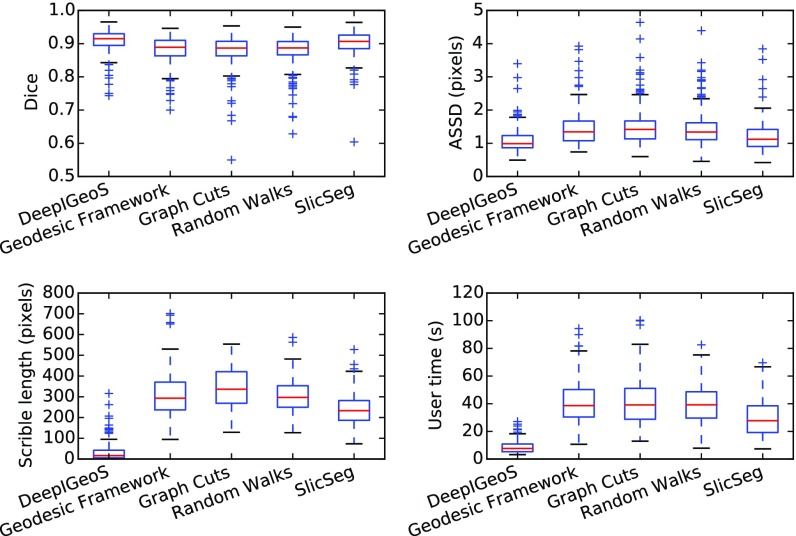
“obtains comparable and even higher accuracy with fewer user interventions and less time compared with traditional interactive methods.”
§ DeepIGeoS: A Deep Interactive Geodesic Framework for Medical Image Segmentation > Abstract
plaindirect- Asserted: passes — The authors put it forward as true.
- Checkable: passes — It can be checked against evidence.
- Load-bearing: passes — The paper’s conclusions depend on it.
- Based: passes — The paper gives a reason why it holds.
It may state two separate claims as one.
A result the paper reports from its own data — it cites no other source for it, so there is none to check. The quote shows it is in the paper.
In the paper
“HighRes3DNet and 3D P-Net(b5) achieve similar performance, and they are better than DeepMedic.”
§ DeepIGeoS: A Deep Interactive Geodesic Framework for Medical Image Segmentation > Experiments > 3D Brain Tumor Segmentation from FLAIR Images
plain- Asserted: passes — The authors put it forward as true.
- Checkable: passes — It can be checked against evidence.
- Load-bearing: unclear — It is unclear whether the paper’s conclusions depend on it.
- Based: passes — The paper gives a reason why it holds.
It may state two separate claims as one.
A result the paper reports from its own data — it cites no other source for it, so there is none to check. The quote shows it is in the paper.
In the paper
“DeepIGeoS requires far fewer user interactions and less user time.”
§ DeepIGeoS: A Deep Interactive Geodesic Framework for Medical Image Segmentation > Experiments > 2D Placenta Segmentation from Fetal MRI
plaindirect- Asserted: passes — The authors put it forward as true.
- Checkable: passes — It can be checked against evidence.
- Load-bearing: passes — The paper’s conclusions depend on it.
- Based: passes — The paper gives a reason why it holds.
It may state two separate claims as one.
The paper states this without a source or data behind it here, so there is nothing to check it against. The quote shows it is in the paper.
In the paper
“In addition, CRF-Net(f) is better than CRF-Net(g).”
§ DeepIGeoS: A Deep Interactive Geodesic Framework for Medical Image Segmentation > Experiments > 2D Placenta Segmentation from Fetal MRI
plaindirect- Asserted: passes — The authors put it forward as true.
- Checkable: passes — It can be checked against evidence.
- Load-bearing: unclear — It is unclear whether the paper’s conclusions depend on it.
- Based: passes — The paper gives a reason why it holds.
The quote only partly states this claim.
- Rests on an assumption: The manually delineated ground truth is accurate.
The paper states this without a source or data behind it here, so there is nothing to check it against. The quote shows it is in the paper.
In the paper
“the proposed 3D P-Net has far fewer parameters compared with HighRes3DNet.”
§ DeepIGeoS: A Deep Interactive Geodesic Framework for Medical Image Segmentation > Experiments > 3D Brain Tumor Segmentation from FLAIR Images
plain- Asserted: passes — The authors put it forward as true.
- Checkable: passes — It can be checked against evidence.
- Load-bearing: passes — The paper’s conclusions depend on it.
- Based: fails — The paper may give no reason why it holds.
Probably not a substantial claim. The paper may give no reason why it holds.
A result the paper reports from its own data — it cites no other source for it, so there is none to check. The quote shows it is in the paper.
In the paper
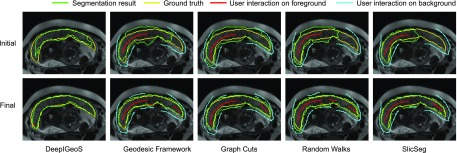
“DeepIGeoS only needs two short strokes to get an accurate segmentation, while the other methods require far more scribbles to get similar results.”
§ DeepIGeoS: A Deep Interactive Geodesic Framework for Medical Image Segmentation > Experiments > 2D Placenta Segmentation from Fetal MRI
plaindirect- Asserted: passes — The authors put it forward as true.
- Checkable: passes — It can be checked against evidence.
- Load-bearing: passes — The paper’s conclusions depend on it.
- Based: passes — The paper gives a reason why it holds.
It may state two separate claims as one.
A result the paper reports from its own data — it cites no other source for it, so there is none to check. The quote shows it is in the paper.
In the paper
“Significant improvement from 2D R-Net”
§ DeepIGeoS: A Deep Interactive Geodesic Framework for Medical Image Segmentation > Experiments > 2D Placenta Segmentation from Fetal MRI
plaindirect- Asserted: passes — The authors put it forward as true.
- Checkable: passes — It can be checked against evidence.
- Load-bearing: passes — The paper’s conclusions depend on it.
- Based: passes — The paper gives a reason why it holds.
The quote only partly states this claim.
A result the paper reports from its own data — it cites no other source for it, so there is none to check. The quote shows it is in the paper.
In the paper
“3D P-Net outperforms these three counterparts with 86.68”
§ DeepIGeoS: A Deep Interactive Geodesic Framework for Medical Image Segmentation > Experiments > 3D Brain Tumor Segmentation from FLAIR Images
plain- Asserted: passes — The authors put it forward as true.
- Checkable: passes — It can be checked against evidence.
- Load-bearing: unclear — It is unclear whether the paper’s conclusions depend on it.
- Based: passes — The paper gives a reason why it holds.
The quote only partly states this claim.
A result the paper reports from its own data — it cites no other source for it, so there is none to check. The quote shows it is in the paper.
In the paper
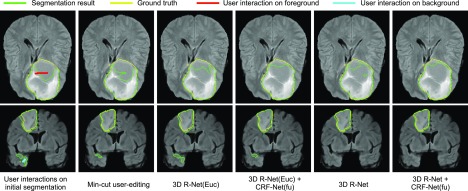
“Fig. 8 shows 2D R-Net with geodesic distance performs better than min-cut user-editing and 2D R-Net(Euc) that uses euclidean distance.”
§ DeepIGeoS: A Deep Interactive Geodesic Framework for Medical Image Segmentation > Experiments > 2D Placenta Segmentation from Fetal MRI
plaindirect- Asserted: passes — The authors put it forward as true.
- Checkable: passes — It can be checked against evidence.
- Load-bearing: passes — The paper’s conclusions depend on it.
- Based: passes — The paper gives a reason why it holds.
It may state two separate claims as one.
- Rests on an assumption: Simulated user interactions (random clicks in mis-segmented regions) are representative of real user interactions for training R-Net.
- Rests on an assumption: The manually delineated ground truth is accurate.
A result the paper reports from its own data — it cites no other source for it, so there is none to check. The quote shows it is in the paper.
In the paper
“our proposed method achieves better results than automatic CNNs.”
§ DeepIGeoS: A Deep Interactive Geodesic Framework for Medical Image Segmentation > Conclusion
plaindirect- Asserted: passes — The authors put it forward as true.
- Checkable: passes — It can be checked against evidence.
- Load-bearing: passes — The paper’s conclusions depend on it.
- Based: passes — The paper gives a reason why it holds.
It may state two separate claims as one.
A result the paper reports from its own data — it cites no other source for it, so there is none to check. The quote shows it is in the paper.
In the paper
“Significant improvement from 3D R-Net”
§ DeepIGeoS: A Deep Interactive Geodesic Framework for Medical Image Segmentation > Experiments > 3D Brain Tumor Segmentation from FLAIR Images
plaindirect- Asserted: passes — The authors put it forward as true.
- Checkable: passes — It can be checked against evidence.
- Load-bearing: passes — The paper’s conclusions depend on it.
- Based: passes — The paper gives a reason why it holds.
The quote only partly states this claim.
A result the paper reports from its own data — it cites no other source for it, so there is none to check. The quote shows it is in the paper.
In the paper
“ASSD of 1.43”
§ DeepIGeoS: A Deep Interactive Geodesic Framework for Medical Image Segmentation > Experiments > 3D Brain Tumor Segmentation from FLAIR Images
plain- Asserted: passes — The authors put it forward as true.
- Checkable: passes — It can be checked against evidence.
- Load-bearing: passes — The paper’s conclusions depend on it.
- Based: passes — The paper gives a reason why it holds.
The quote only partly states this claim.
The paper states this without a source or data behind it here, so there is nothing to check it against. The quote shows it is in the paper.
In the paper
“It requires far less user time compared with traditional interactive methods”
§ DeepIGeoS: A Deep Interactive Geodesic Framework for Medical Image Segmentation > Conclusion
plaindirect- Asserted: passes — The authors put it forward as true.
- Checkable: passes — It can be checked against evidence.
- Load-bearing: passes — The paper’s conclusions depend on it.
- Based: unclear — It is unclear why the paper says it holds.
Borderline substantial claim. It is unclear why the paper says it holds.
A result the paper reports from its own data — it cites no other source for it, so there is none to check. The quote shows it is in the paper.
In the paper
“Dice score of 89.93”
§ DeepIGeoS: A Deep Interactive Geodesic Framework for Medical Image Segmentation > Experiments > 3D Brain Tumor Segmentation from FLAIR Images
plain- Asserted: passes — The authors put it forward as true.
- Checkable: passes — It can be checked against evidence.
- Load-bearing: passes — The paper’s conclusions depend on it.
- Based: passes — The paper gives a reason why it holds.
The quote only partly states this claim.
The paper states this without a source or data behind it here, so there is nothing to check it against. The quote shows it is in the paper.
In the paper
“However, the euclidean distance does not take advantage of image context information.”
- Also stated in: § User Interaction-Based Geodesic Distance Maps · plain
“However, the euclidean distance treats each direction equally and does not take the image context into account.”
§ DeepIGeoS: A Deep Interactive Geodesic Framework for Medical Image Segmentation > Related Works > Interactive Image Segmentation
plain- Asserted: passes — The authors put it forward as true.
- Checkable: passes — It can be checked against evidence.
- Load-bearing: passes — The paper’s conclusions depend on it.
- Based: passes — The paper gives a reason why it holds.
It may state two separate claims as one.
- Also stated in: § User Interaction-Based Geodesic Distance Maps · plain
In the paper
“In [40], a deep interactive object selection method was proposed where user-provided clicks are transformed into euclidean distance maps and then concatenated with the input of FCNs.”
§ DeepIGeoS: A Deep Interactive Geodesic Framework for Medical Image Segmentation > Related Works > Interactive Image Segmentation
What the sources say
- Not checked yetcites [40] Xu N., Price B., Cohen S., Yang J., and Huang T., “ Deep interactive object selection,” in Proc. IEEE Conf. Comput. Vis. Pattern Recognit., 2016, pp. 373– 381. source
plaindirect- Asserted: passes — The authors put it forward as true.
- Checkable: passes — It can be checked against evidence.
- Load-bearing: passes — The paper’s conclusions depend on it.
- Based: passes — The paper gives a reason why it holds.
Probably not a substantial claim.
A conclusion the paper draws from its own results — it cites no other source for it, so there is none to check. The quote shows it is in the paper.
In the paper
“Third, it is efficient and can respond to user interactions in real time, which leads to very short user time.”
§ DeepIGeoS: A Deep Interactive Geodesic Framework for Medical Image Segmentation > Introduction
plaindirect- Asserted: passes — The authors put it forward as true.
- Checkable: passes — It can be checked against evidence.
- Load-bearing: passes — The paper’s conclusions depend on it.
- Based: unclear — It is unclear why the paper says it holds.
It may state two separate claims as one.
In the paper
“DeepCut [32] employs user-provided bounding boxes as annotations to train CNNs for the segmentation of fetal MRI.”
§ DeepIGeoS: A Deep Interactive Geodesic Framework for Medical Image Segmentation > Related Works > Interactive Image Segmentation
What the sources say
- Not checked yetcites [32] Rajchl M., Lee M., Oktay O., Kamnitsas K., Passerat-Palmbach J., Bai W., Rutherford M., Hajnal J., Kainz B., and Rueckert D., “ DeepCut: Object segmentation from bounding box annotations using convolutional neural networks,” IEEE Trans. Medical Imaging, vol. 36, no. 2, pp. 674– 683, Feb. 2017. 27845654 PMC7115996 source
plaindirect- Asserted: passes — The authors put it forward as true.
- Checkable: passes — It can be checked against evidence.
- Load-bearing: fails — The paper’s conclusions may not depend on it.
- Based: passes — The paper gives a reason why it holds.
Probably not a substantial claim. The paper’s conclusions may not depend on it.
In the paper
“Recently, deep learning with convolutional neural networks (CNNs) has achieved the state-of-the-art performance in many image analysis applications [10].”
§ DeepIGeoS: A Deep Interactive Geodesic Framework for Medical Image Segmentation > Introduction
What the sources say
- Not checked yetcites [10] Litjens G., Kooi T., Bejnordi B. E., Setio A. A. A., Ciompi F., Ghafoorian M., van der Laak J. A., Ginneken B. V., and Sánchez C. I., “ A survey on deep learning in medical image analysis,” Med. Image Anal., vol. 42, pp. 60– 88, 2017. 28778026 source
plain- Asserted: passes — The authors put it forward as true.
- Checkable: passes — It can be checked against evidence.
- Load-bearing: fails — The paper’s conclusions may not depend on it.
- Based: passes — The paper gives a reason why it holds.
Probably not a substantial claim. The paper’s conclusions may not depend on it.
In the paper
“SlicSeg [6] accepts user-provided scribbles in a single start slice to train an Online Random Forest for 3D segmentation, but lacks in flexibility to allow further user-editing.”
§ DeepIGeoS: A Deep Interactive Geodesic Framework for Medical Image Segmentation > Introduction
What the sources say
- Not checked yetcites [6] Wang G., Zuluaga M. A., Pratt R., Aertsen M., Doel T., Klusmann M., David A. L., Deprest J., Vercauteren T., and Ourselin S., “ Slic-Seg: A minimally interactive segmentation of the placenta from sparse and motion-corrupted fetal MRI in multiple views,” Med. Image Anal., vol. 34, pp. 137– 147, 2016. 27179367 PMC5052128 source
plain- Asserted: passes — The authors put it forward as true.
- Checkable: passes — It can be checked against evidence.
- Load-bearing: passes — The paper’s conclusions depend on it.
- Based: passes — The paper gives a reason why it holds.
It may state two separate claims as one.
In the paper
“For example, the widely used ITK-SNAP [5] takes user-provided seed pixels or blobs as a starting point and employs an active contour model for segmentation. It requires most of the user interactions to be given at the beginning and the underpinning model can hardly be refined with additional user interactions once an initial segmentation is obtained.”
§ DeepIGeoS: A Deep Interactive Geodesic Framework for Medical Image Segmentation > Introduction
What the sources say
- Not checked yetcites [5] Yushkevich P. A., Piven J., Hazlett H. C., Smith R. G., Ho S., Gee J. C., and Gerig G., “ User-guided 3D active contour segmentation of anatomical structures: Significantly improved efficiency and reliability,” NeuroImage, vol. 31, no. 3, pp. 1116– 1128, 2006. 16545965 source
plaindirect- Asserted: passes — The authors put it forward as true.
- Checkable: passes — It can be checked against evidence.
- Load-bearing: passes — The paper’s conclusions depend on it.
- Based: passes — The paper gives a reason why it holds.
It may state two separate claims as one.
None of the sources cited for this claim have been checked yet.
In the paper
“Typical CNNs [16], [17], [18] were originally designed for image classification tasks.”
§ DeepIGeoS: A Deep Interactive Geodesic Framework for Medical Image Segmentation > Related Works > Image Segmentation Based on CNNs
What the sources say
- Not checked yetcites [16] Krizhevsky A., Sutskever I., and Hinton G. E., “ ImageNet classification with deep convolutional neural networks,” in Proc. 25th Int. Conf. Neural Inf. Process. Syst., 2012, pp. 1097– 1105.
- Not checked yetcites [17] Simonyan K. and Zisserman A., “ Very deep convolutional networks for large-scale image recognition,” arXiv preprint arXiv:1409.1556. source
- Not checked yetcites [18] He K., Zhang X., Ren S., and Sun J., “ Deep residual learning for image recognition,” in Proc. IEEE Conf. Comput. Vis. Pattern Recognit., 2016, pp. 770– 778. source
plain- Asserted: passes — The authors put it forward as true.
- Checkable: passes — It can be checked against evidence.
- Load-bearing: fails — The paper’s conclusions may not depend on it.
- Based: passes — The paper gives a reason why it holds.
Probably not a substantial claim. The paper’s conclusions may not depend on it.
None of the sources cited for this claim have been checked yet.
In the paper
“Machine learning methods [6], [37], [38] have been proposed to learn from user interactions. They can achieve higher segmentation accuracy with fewer user interactions. However, they are limited by hand-crafted features that depend on the user's experience.”
§ DeepIGeoS: A Deep Interactive Geodesic Framework for Medical Image Segmentation > Related Works > Interactive Image Segmentation
What the sources say
- Not checked yetcites [6] Wang G., Zuluaga M. A., Pratt R., Aertsen M., Doel T., Klusmann M., David A. L., Deprest J., Vercauteren T., and Ourselin S., “ Slic-Seg: A minimally interactive segmentation of the placenta from sparse and motion-corrupted fetal MRI in multiple views,” Med. Image Anal., vol. 34, pp. 137– 147, 2016. 27179367 PMC5052128 source
- Not checked yetcites [37] Barinova O., Shapovalov R., Sudakov S., and Velizhev A., “ Online random forest for interactive image segmentation,” in Proc. Int. Workshop Exp. Economics Mach. Learn., 2012, pp. 1– 8.
- Not checked yetcites [38] Luengo I., Darrow M. C., Spink M. C., Sun Y., Dai W., He C. Y., Chiu W., Pridmore T., Ashton A. W., Duke E. M., Basham M., and French A. P., “ SuRVoS: Super-region volume segmentation workbench,” J. Structural Biol., vol. 198, no. 1, pp. 43– 53, 2017. PMC5405849 28246039 source
plaindirect- Asserted: passes — The authors put it forward as true.
- Checkable: passes — It can be checked against evidence.
- Load-bearing: passes — The paper’s conclusions depend on it.
- Based: passes — The paper gives a reason why it holds.
It may state two separate claims as one.
None of the sources cited for this claim have been checked yet.
In the paper
“Some early works adapted such networks for pixel labeling with patch or region-based methods [19], [20]. Such methods achieved higher accuracy than traditional methods that relied on hand-crafted features. However, they suffered from inefficiency for testing.”
§ DeepIGeoS: A Deep Interactive Geodesic Framework for Medical Image Segmentation > Related Works > Image Segmentation Based on CNNs
What the sources say
- Not checked yetcites [19] Havaei M., Davy A., Warde-Farley D., Biard A., Courville A., Bengio Y., Pal C., Jodoin P.-M., and Larochelle H., “ Brain tumor segmentation with deep neural networks,” Med. Image Anal., vol. 35, pp. 18– 31, 2016. 27310171 source
- Not checked yetcites [20] Girshick R., Donahue J., Darrell T., and Malik J., “ Rich feature hierarchies for accurate object detection and semantic segmentation,” in Proc. IEEE Conf. Comput. Vis. Pattern Recognit., 2014, pp. 580– 587. source
plaindirect- Asserted: passes — The authors put it forward as true.
- Checkable: passes — It can be checked against evidence.
- Load-bearing: fails — The paper’s conclusions may not depend on it.
- Based: passes — The paper gives a reason why it holds.
Probably not a substantial claim. The paper’s conclusions may not depend on it. It may state two separate claims as one.
None of the sources cited for this claim have been checked yet.
In the paper
“GrabCut [9] works with a user-provided bounding box to start the segmentation and requires fewer interactions compared with Graph Cuts [8], but the performance is still limited by the representativity of the underpinning GMM.”
§ DeepIGeoS: A Deep Interactive Geodesic Framework for Medical Image Segmentation > Introduction
What the sources say
- Not checked yetcites [9] Rother C., Kolmogorov V., and Blake A., “ GrabCut: Interactive foreground extraction using iterated graph cuts,” ACM Trans. Graph., vol. 23, no. 3, pp. 309– 314, 2004. source
- Not checked yetcites [8] Boykov Y. Y. and Jolly M. P., “ Interactive graph cuts for optimal boundary & region segmentation of objects in N-D images,” in Proc. 8th IEEE Int. Conf. Comput. Vis., 2001, pp. 105– 112. source
plaindirect- Asserted: passes — The authors put it forward as true.
- Checkable: passes — It can be checked against evidence.
- Load-bearing: passes — The paper’s conclusions depend on it.
- Based: passes — The paper gives a reason why it holds.
It may state two separate claims as one.
In the paper
“ScribbleSup [39] also trains CNNs for semantic segmentation supervised by scribbles.”
§ DeepIGeoS: A Deep Interactive Geodesic Framework for Medical Image Segmentation > Related Works > Interactive Image Segmentation
What the sources say
- Not checked yetcites [39] Lin D., Dai J., Jia J., He K., and Sun J., “ ScribbleSup: Scribble-supervised convolutional networks for semantic segmentation,” in Proc. IEEE Conf. Comput. Vis. Pattern Recognit., 2016, pp. 3159– 3167. source
plaindirect- Asserted: passes — The authors put it forward as true.
- Checkable: passes — It can be checked against evidence.
- Load-bearing: fails — The paper’s conclusions may not depend on it.
- Based: passes — The paper gives a reason why it holds.
Probably not a substantial claim. The paper’s conclusions may not depend on it.
In the paper
“FCNs [11] take an entire image as input and give a dense segmentation. In order to overcome the problem of loss of spatial resolution due to multi-stage max-pooling and downsampling, it uses a stack of deconvolution (a.k.a. upsampling) layers and activation functions to upsample the feature maps.”
§ DeepIGeoS: A Deep Interactive Geodesic Framework for Medical Image Segmentation > Related Works > Image Segmentation Based on CNNs
What the sources say
- Not checked yetcites [11] Long J., Shelhamer E., and Darrell T., “ Fully convolutional networks for semantic segmentation,” in Proc. IEEE Conf. Comput. Vis. Pattern Recognit., 2015, pp. 3431– 3440. 27244717
plaindirect- Asserted: passes — The authors put it forward as true.
- Checkable: passes — It can be checked against evidence.
- Load-bearing: fails — The paper’s conclusions may not depend on it.
- Based: passes — The paper gives a reason why it holds.
Probably not a substantial claim. The paper’s conclusions may not depend on it. It may state two separate claims as one.
The paper states this without a source or data behind it here, so there is nothing to check it against. The quote shows it is in the paper.
In the paper
“However, they have not yet been adapted to interactive medical image segmentation.”
§ DeepIGeoS: A Deep Interactive Geodesic Framework for Medical Image Segmentation > Introduction
plain- Asserted: passes — The authors put it forward as true.
- Checkable: passes — It can be checked against evidence.
- Load-bearing: passes — The paper’s conclusions depend on it.
- Based: fails — The paper may give no reason why it holds.
Probably not a substantial claim. The paper may give no reason why it holds.
None of the sources cited for this claim have been checked yet.
In the paper
“To overcome the drawbacks of successive max-pooling and downsampling that lead to a loss of feature map resolution, dilated convolution [22], [23] was proposed to preserve the resolution of feature maps and enlarge the receptive field to incorporate larger contextual information.”
§ DeepIGeoS: A Deep Interactive Geodesic Framework for Medical Image Segmentation > Related Works > Image Segmentation Based on CNNs
What the sources say
- Not checked yetcites [22] Chen L.-C., Papandreou G., Kokkinos I., Murphy K., and Yuille A. L., “ Semantic image segmentation with deep convolutional nets and fully connected CRFs,” arXiv preprint arXiv:1412.7062. 28463186 source
- Not checked yetcites [23] Yu F. and Koltun V., “ Multi-scale context aggregation by dilated convolutions,” arXiv preprint arXiv:1511.07122. source
plaindirect- Asserted: passes — The authors put it forward as true.
- Checkable: passes — It can be checked against evidence.
- Load-bearing: fails — The paper’s conclusions may not depend on it.
- Based: passes — The paper gives a reason why it holds.
Probably not a substantial claim. The paper’s conclusions may not depend on it. It may state two separate claims as one.
None of the sources cited for this claim have been checked yet.
In the paper
“Multi-scale features extracted from CNNs have been shown to be effective for improving segmentation accuracy [11], [22], [23].”
§ DeepIGeoS: A Deep Interactive Geodesic Framework for Medical Image Segmentation > Related Works > Image Segmentation Based on CNNs
What the sources say
- Not checked yetcites [11] Long J., Shelhamer E., and Darrell T., “ Fully convolutional networks for semantic segmentation,” in Proc. IEEE Conf. Comput. Vis. Pattern Recognit., 2015, pp. 3431– 3440. 27244717 source
- Not checked yetcites [22] Chen L.-C., Papandreou G., Kokkinos I., Murphy K., and Yuille A. L., “ Semantic image segmentation with deep convolutional nets and fully connected CRFs,” arXiv preprint arXiv:1412.7062. 28463186 source
- Not checked yetcites [23] Yu F. and Koltun V., “ Multi-scale context aggregation by dilated convolutions,” arXiv preprint arXiv:1511.07122. source
boosteddirect- Asserted: passes — The authors put it forward as true.
- Checkable: passes — It can be checked against evidence.
- Load-bearing: fails — The paper’s conclusions may not depend on it.
- Based: passes — The paper gives a reason why it holds.
Probably not a substantial claim. The paper’s conclusions may not depend on it.
None of the sources cited for this claim have been checked yet.
In the paper
“the geodesic distance transform [35], [36], [41] encodes spatial regularization and contrast-sensitivity”
§ DeepIGeoS: A Deep Interactive Geodesic Framework for Medical Image Segmentation > Related Works > Interactive Image Segmentation
What the sources say
- Not checked yetcites [35] Bai X. and Sapiro G., “ A geodesic framework for fast interactive image and video segmentation and matting,” in Proc. IEEE 11th Int. Conf. Comput. Vis., 2007, pp. 1– 8. source
- Not checked yetcites [36] Criminisi A., Sharp T., and Blake A., “ GeoS: Geodesic image segmentation,” in Proc. Eur. Conf. Comput. Vis., 2008, pp. 99– 112. source
- Not checked yetcites [41] Kontschieder P., Kohli P., Shotton J., and Criminisi A., “ GeoF geodesic forests for learning coupled predictors,” in Proc. IEEE Conf. Comput. Vis. Pattern Recognit., 2013, pp. 65– 72. source
plaindirect- Asserted: passes — The authors put it forward as true.
- Checkable: passes — It can be checked against evidence.
- Load-bearing: passes — The paper’s conclusions depend on it.
- Based: passes — The paper gives a reason why it holds.
It may state two separate claims as one.
None of the sources cited for this claim have been checked yet.
In the paper
“However, most of these methods rely on low-level features and require a relatively large amount of user interactions to deal with images with low contrast and ambiguous boundaries.”
§ DeepIGeoS: A Deep Interactive Geodesic Framework for Medical Image Segmentation > Related Works > Interactive Image Segmentation
What the sources say
- Not checked yetcites [8] Boykov Y. Y. and Jolly M. P., “ Interactive graph cuts for optimal boundary & region segmentation of objects in N-D images,” in Proc. 8th IEEE Int. Conf. Comput. Vis., 2001, pp. 105– 112. source
- Not checked yetcites [35] Bai X. and Sapiro G., “ A geodesic framework for fast interactive image and video segmentation and matting,” in Proc. IEEE 11th Int. Conf. Comput. Vis., 2007, pp. 1– 8. source
- Not checked yetcites [7] Grady L., “ Random walks for image segmentation,” IEEE Trans. Pattern Anal. Mach. Intell., vol. 28, no. 11, pp. 1768– 1783, Nov. 2006. 17063682 source
plaindirect- Asserted: passes — The authors put it forward as true.
- Checkable: passes — It can be checked against evidence.
- Load-bearing: passes — The paper’s conclusions depend on it.
- Based: passes — The paper gives a reason why it holds.
It may state two separate claims as one.
None of the sources cited for this claim have been checked yet.
In the paper
“Random Walks [7] and Graph Cuts [8] learn from scribbles and allow the user to provide additional scribbles for refinement. They use Random Walker and Gaussian Mixture Model (GMM) as the underpinning model. However, they need a large number of scribbles to get satisfactory segmentation.”
§ DeepIGeoS: A Deep Interactive Geodesic Framework for Medical Image Segmentation > Introduction
What the sources say
- Not checked yetcites [7] Grady L., “ Random walks for image segmentation,” IEEE Trans. Pattern Anal. Mach. Intell., vol. 28, no. 11, pp. 1768– 1783, Nov. 2006. 17063682 source
- Not checked yetcites [8] Boykov Y. Y. and Jolly M. P., “ Interactive graph cuts for optimal boundary & region segmentation of objects in N-D images,” in Proc. 8th IEEE Int. Conf. Comput. Vis., 2001, pp. 105– 112. source
plaindirect- Asserted: passes — The authors put it forward as true.
- Checkable: passes — It can be checked against evidence.
- Load-bearing: passes — The paper’s conclusions depend on it.
- Based: passes — The paper gives a reason why it holds.
It may state two separate claims as one.
None of the sources cited for this claim have been checked yet.
In the paper
“Graphical models such as CRFs [22], [42], [43] have been widely used to enhance segmentation accuracy by introducing spatial consistency.”
§ DeepIGeoS: A Deep Interactive Geodesic Framework for Medical Image Segmentation > Related Works > CRFs for Spatial Regularization
What the sources say
- Not checked yetcites [22] Chen L.-C., Papandreou G., Kokkinos I., Murphy K., and Yuille A. L., “ Semantic image segmentation with deep convolutional nets and fully connected CRFs,” arXiv preprint arXiv:1412.7062. 28463186 source
- Not checked yetcites [42] Boykov Y. and Kolmogorov V., “ An experimental comparison of min-cut/max-flow algorithms for energy minimization in vision,” IEEE Trans. Pattern Anal. Mach. Intell., vol. 26, no. 9, pp. 1124– 1137, Sep. 2004. 15742889 source
- Not checked yetcites [43] Yuan J., Bae E., and Tai X. C., “ A study on continuous max-flow and min-cut approaches,” in Proc. IEEE Comput. Society Conf. Comput. Vis. Pattern Recognit., 2010, pp. 2217– 2224. source
boosteddirect- Asserted: passes — The authors put it forward as true.
- Checkable: passes — It can be checked against evidence.
- Load-bearing: fails — The paper’s conclusions may not depend on it.
- Based: passes — The paper gives a reason why it holds.
Probably not a substantial claim. The paper’s conclusions may not depend on it.
In the paper
“Despite the large number of existing interactive segmentation methods [3], most of them are confronted by requiring a large amount of user interactions and long user time, or limited learning ability with their underpinning models.”
§ DeepIGeoS: A Deep Interactive Geodesic Framework for Medical Image Segmentation > Introduction
What the sources say
- Not checked yetcites [3] Zhao F. and Xie X., “ An overview of interactive medical image segmentation,” Ann. BMVA, vol. 2013, no. 7, pp. 1– 22, 2013.
plain- Asserted: passes — The authors put it forward as true.
- Checkable: passes — It can be checked against evidence.
- Load-bearing: passes — The paper’s conclusions depend on it.
- Based: passes — The paper gives a reason why it holds.
It may state two separate claims as one.
In the paper
“For instance, 3D U-Net [21] learns from sparsely annotated images and can be used for semi-automatic segmentation.”
§ DeepIGeoS: A Deep Interactive Geodesic Framework for Medical Image Segmentation > Related Works > Interactive Image Segmentation
What the sources say
- Not checked yetcites [21] Abdulkadir A., Lienkamp S. S., Brox T., and Ronneberger O., “ 3D U-Net: Learning dense volumetric segmentation from sparse annotation,” in Proc. Medical Image Comput. Comput.-Assisted Intervention, 2016, pp. 424– 432. source
plaindirect- Asserted: passes — The authors put it forward as true.
- Checkable: passes — It can be checked against evidence.
- Load-bearing: fails — The paper’s conclusions may not depend on it.
- Based: passes — The paper gives a reason why it holds.
Probably not a substantial claim. The paper’s conclusions may not depend on it. It may state two separate claims as one.
None of the sources cited for this claim have been checked yet.
In the paper
“Alternatively, mean-field approximation [45], [50], [52] is often used for efficient inference of the CRF while allowing learning parameters by back-propagation.”
§ DeepIGeoS: A Deep Interactive Geodesic Framework for Medical Image Segmentation > Method > Back-Propagatable CRF-Net with Freeform Pairwise Potentials and User Constraints
What the sources say
- Not checked yetcites [45] Krähenbühl P. and Koltun V., “ Efficient inference in fully connected CRFs with gaussian edge potentials,” in Proc. Neural Inf. Process. Syst. Conf., 2011, pp. 109– 117. source
- Not checked yetcites [50] Zheng S., Jayasumana S., Romera-Paredes B., Vineet V., Su Z., Du D., Huang C., and Torr P. H. S., “ Conditional random fields as recurrent neural networks,” in Proc. IEEE Int. Conf. Comput. Vis., 2015, pp. 1529– 1537. source
- Not checked yetcites [52] Vemulapalli R., Tuzel O., Liu M.-y., and Chellappa R., “ Gaussian conditional random field network for semantic segmentation,” in Proc. IEEE Conf. Comput. Vis. Pattern Recognit., 2016, pp. 3224– 3233. source
plaindirect- Asserted: passes — The authors put it forward as true.
- Checkable: passes — It can be checked against evidence.
- Load-bearing: fails — The paper’s conclusions may not depend on it.
- Based: passes — The paper gives a reason why it holds.
Probably not a substantial claim. The paper’s conclusions may not depend on it.
What the paper did — it cites no source for this, so there is none to check. The quote shows it is in the paper.
In the paper
“in which the same initial segmentation and the same set of user interactions were used by the five refinement methods.”
§ DeepIGeoS: A Deep Interactive Geodesic Framework for Medical Image Segmentation > Experiments > 2D Placenta Segmentation from Fetal MRI
plain- Asserted: passes — The authors put it forward as true.
- Checkable: passes — It can be checked against evidence.
- Load-bearing: passes — The paper’s conclusions depend on it.
- Based: passes — The paper gives a reason why it holds.
Probably not a substantial claim.
In the paper
“In [52], a Gaussian Mean Field (GMF) network was proposed and combined with CNNs where all the parameters are trainable.”
§ DeepIGeoS: A Deep Interactive Geodesic Framework for Medical Image Segmentation > Related Works > CRFs for Spatial Regularization
What the sources say
- Not checked yetcites [52] Vemulapalli R., Tuzel O., Liu M.-y., and Chellappa R., “ Gaussian conditional random field network for semantic segmentation,” in Proc. IEEE Conf. Comput. Vis. Pattern Recognit., 2016, pp. 3224– 3233. source
plain- Asserted: passes — The authors put it forward as true.
- Checkable: passes — It can be checked against evidence.
- Load-bearing: fails — The paper’s conclusions may not depend on it.
- Based: passes — The paper gives a reason why it holds.
Probably not a substantial claim. The paper’s conclusions may not depend on it. It may state two separate claims as one.
In the paper
“In [54], a generic CNN-CRF model was proposed to handle arbitrary potentials for labeling body parts in depth images. However, it has not yet been validated with other segmentation applications.”
§ DeepIGeoS: A Deep Interactive Geodesic Framework for Medical Image Segmentation > Related Works > CRFs for Spatial Regularization
What the sources say
- Not checked yetcites [54] Kirillov A., Zheng S., Schlesinger D., Forkel W., Zelenin A., Torr P., and Rother C., “ Efficient likelihood learning of a generic CNN-CRF model for semantic segmentation,” arXiv preprint arXiv:1511.05067. source
plain- Asserted: passes — The authors put it forward as true.
- Checkable: passes — It can be checked against evidence.
- Load-bearing: fails — The paper’s conclusions may not depend on it.
- Based: passes — The paper gives a reason why it holds.
Probably not a substantial claim. The paper’s conclusions may not depend on it. It may state two separate claims as one.
In the paper
“GeoF [41] uses the geodesic distance to encode variable dependencies in the feature space and it is combined with Random Forests for semantic segmentation. However, it is not designed to deal with user interactions.”
§ DeepIGeoS: A Deep Interactive Geodesic Framework for Medical Image Segmentation > Method > User Interaction-Based Geodesic Distance Maps
What the sources say
- Not checked yetcites [41] Kontschieder P., Kohli P., Shotton J., and Criminisi A., “ GeoF geodesic forests for learning coupled predictors,” in Proc. IEEE Conf. Comput. Vis. Pattern Recognit., 2013, pp. 65– 72. source
plain- Asserted: passes — The authors put it forward as true.
- Checkable: passes — It can be checked against evidence.
- Load-bearing: passes — The paper’s conclusions depend on it.
- Based: passes — The paper gives a reason why it holds.
It may state two separate claims as one.
None of the sources cited for this claim have been checked yet.
In the paper
“More freeform pairwise potentials for a pair of super-pixels or image patches were proposed in [27], [53], but such CRFs have a low resolution.”
§ DeepIGeoS: A Deep Interactive Geodesic Framework for Medical Image Segmentation > Related Works > CRFs for Spatial Regularization
What the sources say
- Not checked yetcites [27] Lin G., Shen C., Reid I., and van dan Hengel A., “ Efficient piecewise training of deep structured models for semantic segmentation,” in Proc. IEEE Conf. Comput. Vis. Pattern Recognit., 2016, pp. 3194– 3203. source
- Not checked yetcites [53] Liu F., Shen C., and Lin G., “ Deep convolutional neural fields for depth estimation from a single image,” in Proc. IEEE Conf. Comput. Vis. Pattern Recognit., 2014, pp. 5162– 5170. source
plaincorrelational- Asserted: passes — The authors put it forward as true.
- Checkable: passes — It can be checked against evidence.
- Load-bearing: fails — The paper’s conclusions may not depend on it.
- Based: passes — The paper gives a reason why it holds.
Probably not a substantial claim. The paper’s conclusions may not depend on it. It may state two separate claims as one.
None of the sources cited for this claim have been checked yet.
In the paper
“However, the pair-wise potentials in [50] are limited to weighted Gaussians and not all the parameters are trainable due to the Permutohedral lattice implementation [51].”
§ DeepIGeoS: A Deep Interactive Geodesic Framework for Medical Image Segmentation > Related Works > CRFs for Spatial Regularization
What the sources say
- Not checked yetcites [50] Zheng S., Jayasumana S., Romera-Paredes B., Vineet V., Su Z., Du D., Huang C., and Torr P. H. S., “ Conditional random fields as recurrent neural networks,” in Proc. IEEE Int. Conf. Comput. Vis., 2015, pp. 1529– 1537. source
- Not checked yetcites [51] Adams A., Baek J., and Davis M. A., “ Fast high-dimensional filtering using the permutohedral lattice,” Comput. Graph. Forum, vol. 29, no. 2, pp. 753– 762, 2010. source
plaindirect- Asserted: passes — The authors put it forward as true.
- Checkable: passes — It can be checked against evidence.
- Load-bearing: fails — The paper’s conclusions may not depend on it.
- Based: passes — The paper gives a reason why it holds.
Probably not a substantial claim. The paper’s conclusions may not depend on it. It may state two separate claims as one.
What the paper did — it cites no source for this, so there is none to check. The quote shows it is in the paper.
In the paper
“The ground truth was manually delineated by an experienced Radiologist.”
§ DeepIGeoS: A Deep Interactive Geodesic Framework for Medical Image Segmentation > Experiments > 2D Placenta Segmentation from Fetal MRI
plain- Asserted: passes — The authors put it forward as true.
- Checkable: passes — It can be checked against evidence.
- Load-bearing: passes — The paper’s conclusions depend on it.
- Based: passes — The paper gives a reason why it holds.
Probably not a substantial claim.
In the paper
“The 2D segmentation results can also be used for motion correction and high-resolution volume reconstruction [63].”
§ DeepIGeoS: A Deep Interactive Geodesic Framework for Medical Image Segmentation > Experiments > 2D Placenta Segmentation from Fetal MRI
What the sources say
- Not checked yetcites [63] Keraudren K., Kuklisova-Murgasova M., Kyriakopoulou V., Malamateniou C., Rutherford M. A., Kainz B., Hajnal J. V., and Rueckert D., “ Automated fetal brain segmentation from 2D MRI slices for motion correction,” NeuroImage, vol. 101, pp. 633– 643, 2014. 25058899 source
plaindirect- Asserted: passes — The authors put it forward as true.
- Checkable: passes — It can be checked against evidence.
- Load-bearing: fails — The paper’s conclusions may not depend on it.
- Based: passes — The paper gives a reason why it holds.
Probably not a substantial claim. The paper’s conclusions may not depend on it. It may state two separate claims as one.
A conclusion the paper draws from its own results — it cites no other source for it, so there is none to check. The quote shows it is in the paper.
In the paper
“It is more memory efficient and therefore can perform inference on a 3D volume in interactive time.”
§ DeepIGeoS: A Deep Interactive Geodesic Framework for Medical Image Segmentation > Experiments > 3D Brain Tumor Segmentation from FLAIR Images
plaindirect- Asserted: passes — The authors put it forward as true.
- Checkable: passes — It can be checked against evidence.
- Load-bearing: passes — The paper’s conclusions depend on it.
- Based: passes — The paper gives a reason why it holds.
It may state two separate claims as one.
In the paper
“Differently from previous works [55] that re-train the learning model each time when new user interactions are given, the proposed R-Net is only trained with user interactions once since it takes a considerable time to re-train a CNN model with a large training set.”
§ DeepIGeoS: A Deep Interactive Geodesic Framework for Medical Image Segmentation > Method
What the sources say
- Not checked yetcites [55] Wang G., Zuluaga M. A., Pratt R., Aertsen M., Doel T., Klusmann M., David A. L., Deprest J., Vercauteren T., and Ourselin S., “ Dynamically balanced online random forests for interactive scribble-based segmentation,” in Proc. Medical Image Comput. Comput.-Assisted Intervention, 2016, pp. 352– 360. source
plaindirect- Asserted: passes — The authors put it forward as true.
- Checkable: passes — It can be checked against evidence.
- Load-bearing: passes — The paper’s conclusions depend on it.
- Based: passes — The paper gives a reason why it holds.
It may state two separate claims as one.
In the paper
“Continuous max-flow [43] can also be used for the minimization, but its parameters are manually designed.”
§ DeepIGeoS: A Deep Interactive Geodesic Framework for Medical Image Segmentation > Method > Back-Propagatable CRF-Net with Freeform Pairwise Potentials and User Constraints
What the sources say
- Not checked yetcites [43] Yuan J., Bae E., and Tai X. C., “ A study on continuous max-flow and min-cut approaches,” in Proc. IEEE Comput. Society Conf. Comput. Vis. Pattern Recognit., 2010, pp. 2217– 2224. source
plain- Asserted: passes — The authors put it forward as true.
- Checkable: passes — It can be checked against evidence.
- Load-bearing: unclear — It is unclear whether the paper’s conclusions depend on it.
- Based: passes — The paper gives a reason why it holds.
It may state two separate claims as one.
What the paper did — it cites no source for this, so there is none to check. The quote shows it is in the paper.
In the paper
“Two users (an Obstetrician and a Radiologist) respectively used these interactive methods to segment every test image until the result was visually acceptable.”
§ DeepIGeoS: A Deep Interactive Geodesic Framework for Medical Image Segmentation > Experiments > Comparison Methods and Evaluation Metrics
plain- Asserted: passes — The authors put it forward as true.
- Checkable: passes — It can be checked against evidence.
- Load-bearing: passes — The paper’s conclusions depend on it.
- Based: passes — The paper gives a reason why it holds.
Probably not a substantial claim.
In the paper
“In [50], a CRF based on RNN was proposed and it can be trained by back-propagation.”
§ DeepIGeoS: A Deep Interactive Geodesic Framework for Medical Image Segmentation > Method > Back-Propagatable CRF-Net with Freeform Pairwise Potentials and User Constraints
What the sources say
- Not checked yetcites [50] Zheng S., Jayasumana S., Romera-Paredes B., Vineet V., Su Z., Du D., Huang C., and Torr P. H. S., “ Conditional random fields as recurrent neural networks,” in Proc. IEEE Int. Conf. Comput. Vis., 2015, pp. 1529– 1537. source
plain- Asserted: passes — The authors put it forward as true.
- Checkable: passes — It can be checked against evidence.
- Load-bearing: passes — The paper’s conclusions depend on it.
- Based: passes — The paper gives a reason why it holds.
Probably not a substantial claim. It may state two separate claims as one.
In the paper
“The CRF-RNN network [50] formulated dense CRFs as RNNs so that the CNNs and CRFs can be jointly trained in an end-to-end system for segmentation.”
§ DeepIGeoS: A Deep Interactive Geodesic Framework for Medical Image Segmentation > Related Works > CRFs for Spatial Regularization
What the sources say
- Not checked yetcites [50] Zheng S., Jayasumana S., Romera-Paredes B., Vineet V., Su Z., Du D., Huang C., and Torr P. H. S., “ Conditional random fields as recurrent neural networks,” in Proc. IEEE Int. Conf. Comput. Vis., 2015, pp. 1529– 1537. source
plaindirect- Asserted: passes — The authors put it forward as true.
- Checkable: passes — It can be checked against evidence.
- Load-bearing: fails — The paper’s conclusions may not depend on it.
- Based: passes — The paper gives a reason why it holds.
Probably not a substantial claim. The paper’s conclusions may not depend on it.
A conclusion the paper draws from its own results — it cites no other source for it, so there is none to check. The quote shows it is in the paper.
In the paper
“P-Net and R-Net use a resolution-preserving structure that captures high-level features from a large receptive field without loss of resolution.”
§ DeepIGeoS: A Deep Interactive Geodesic Framework for Medical Image Segmentation > Method
plaindirect- Asserted: passes — The authors put it forward as true.
- Checkable: passes — It can be checked against evidence.
- Load-bearing: passes — The paper’s conclusions depend on it.
- Based: unclear — It is unclear why the paper says it holds.
It may state two separate claims as one.
None of the sources cited for this claim have been checked yet.
In the paper
“Second, though long-distance dependency helps to improve segmentation in most RGB images [22], [45], [50]”
§ DeepIGeoS: A Deep Interactive Geodesic Framework for Medical Image Segmentation > Method > Implementation Details
What the sources say
- Not checked yetcites [22] Chen L.-C., Papandreou G., Kokkinos I., Murphy K., and Yuille A. L., “ Semantic image segmentation with deep convolutional nets and fully connected CRFs,” arXiv preprint arXiv:1412.7062. 28463186 source
- Not checked yetcites [45] Krähenbühl P. and Koltun V., “ Efficient inference in fully connected CRFs with gaussian edge potentials,” in Proc. Neural Inf. Process. Syst. Conf., 2011, pp. 109– 117. source
- Not checked yetcites [50] Zheng S., Jayasumana S., Romera-Paredes B., Vineet V., Su Z., Du D., Huang C., and Torr P. H. S., “ Conditional random fields as recurrent neural networks,” in Proc. IEEE Int. Conf. Comput. Vis., 2015, pp. 1529– 1537. source
plaindirect- Asserted: passes — The authors put it forward as true.
- Checkable: passes — It can be checked against evidence.
- Load-bearing: passes — The paper’s conclusions depend on it.
- Based: passes — The paper gives a reason why it holds.
Probably not a substantial claim.
In the paper
“It is fast due to accessing the image memory in contiguous blocks.”
§ DeepIGeoS: A Deep Interactive Geodesic Framework for Medical Image Segmentation > Method > Implementation Details
What the sources say
- Not checked yetcites [36] Criminisi A., Sharp T., and Blake A., “ GeoS: Geodesic image segmentation,” in Proc. Eur. Conf. Comput. Vis., 2008, pp. 99– 112.
plaindirect- Asserted: passes — The authors put it forward as true.
- Checkable: passes — It can be checked against evidence.
- Load-bearing: fails — The paper’s conclusions may not depend on it.
- Based: passes — The paper gives a reason why it holds.
Probably not a substantial claim. The paper’s conclusions may not depend on it.
The paper relies on this without support.
Poor image quality, large variations among patients, inhomogeneous appearances from pathology, and variability of protocols among clinicians lead to limitations of automatic segmentation.
“This is typically due to poor image quality (with noise, partial volume effect, artifacts and low contrast), large variations among patients, inhomogeneous appearances brought by pathology, and variability of protocols among clinicians leading to different definitions of a given structure boundary.”
The paper relies on this without support.
Providing manual annotations for segmentation is time-consuming and labor-intensive.
“As providing manual annotations for segmentation is time-consuming and labor-intensive, an efficient interactive segmentation tool is of great importance for practical use.”
The paper relies on this without support.
The initial automatic segmentation from P-Net is high-quality.
“the method starts with a high-quality automatic segmentation”
The paper relies on this without support.
Simulated user interactions (random clicks in mis-segmented regions) are representative of real user interactions for training R-Net.
“we automatically simulate user interactions to train R-Net with CRF-Net(fu)”
The paper relies on this without support.
The manually delineated ground truth is accurate.
“The ground truth was manually delineated by an experienced Radiologist.”
The paper relies on this without support.
Automatic brain tumor segmentation remains technically challenging because tumor size, shape, and localization vary among patients and boundaries between adjacent structures are often ambiguous.
“automatic brain tumor segmentation remains technically challenging because 1) the size, shape, and localization of brain tumors have considerable variations among patients; 2) the boundaries between adjacent structures are often ambiguous.”
The paper relies on this without support.
Segmentation of brain tumors can provide better volumetric measurements and therefore has enormous potential value for improved diagnosis, treatment planning, and follow-up of individual patients.
“Segmentation of brain tumors can provide better volumetric measurements and therefore has enormous potential value for improved diagnosis, treatment planning, and follow-up of individual patients.”
Claims other papers make about this one
Each is checked against this paper’s own text: does it say what the citing paper says it does?
The source backs part of the claim, not all of it — or backs it for a different population, condition or comparison.
In the citing paper
“Semi- or fully automatic segmentation methods can significantly reduce the time and labor required, increase consistency, and enable the analysis of large-scale datasets4.”
From Segment anything in medical images (2024) · cites this paper as [4]
Experimental — accuracy not yet measuredThe source backs part of the claim, not all of it — or backs it for a different population, condition or comparison.
In the citing paper
“while existing deep learning-based interactive segmentation methods focus mainly on limited tasks and image modalities.”
From Segment anything in medical images (2024) · cites this paper as [4]
Experimental — accuracy not yet measuredThe source backs part of the claim, not all of it — or backs it for a different population, condition or comparison.
In the citing paper
“In annotation workflows, an interactive model can reduce the amount of slice-by-slice contouring needed to create training labels [28,31].”
From Correction-aware interactive 3D tumor segmentation with sparse and revisable prompts (2026) · cites this paper as [28]
Experimental — accuracy not yet measured
Citations
Cites
Deep Residual Learning for Image Recognition
He, K., Zhang, X., Ren, S., & Sun, J. (2016) · 2016 IEEE Conference on Computer Vision and Pattern Recognition (CVPR) · doi:10.1109/cvpr.2016.90 · Cited by 235,474 · cited 2×
“Typical CNNs such as AlexNet [22], GoogleNet [23], VGG [24] and ResNet [25] were originally designed for image classification tasks.”
MethodVery Deep Convolutional Networks for Large-Scale Image Recognition
Simonyan, K., & Zisserman, A. (2014) · arXiv · doi:10.48550/arxiv.1409.1556 · Cited by 114,148 · cited 4×
“To obtain an exponential increase of the receptive field, VGG-16 uses a max-pooling and downsampling layer after each block.”
BackgroundMethodInfluentialImageNet classification with deep convolutional neural networks
Krizhevsky, A., Sutskever, I., & Hinton, G. E. (2017) · Communications of the ACM · doi:10.1145/3065386 · Cited by 112,155 · cited 1×
“Typical CNNs [16], [17], [18] were originally designed for image classification tasks.”
BackgroundU-Net: Convolutional Networks for Biomedical Image Segmentation
Ronneberger, O., Fischer, P., & Brox, T. (2015) · Lecture notes in computer science · doi:10.1007/978-3-319-24574-4_28 · Cited by 99,404 · cited 1×
“Inspired by the convolution and deconvolution framework of FCN, a U-shape network (U-Net) [28] and its 3D version [18] were proposed for biomedical image segmentation.”
MethodGoing deeper with convolutions
Szegedy, C., Liu, W., Jia, Y., Sermanet, P., Reed, S., Anguelov, D., Erhan, D., Vanhoucke, V., & Rabinovich, A. (2015) · 2015 IEEE Conference on Computer Vision and Pattern Recognition (CVPR) · doi:10.1109/cvpr.2015.7298594 · Cited by 48,562 · cited 2×
“Typical CNNs such as AlexNet [22], GoogleNet [23], VGG [24] and ResNet [25] were originally designed for image classification tasks.”
MethodFully convolutional networks for semantic segmentation
Long, J., Shelhamer, E., & Darrell, T. (2015) · 2015 IEEE Conference on Computer Vision and Pattern Recognition (CVPR) · doi:10.1109/cvpr.2015.7298965 · Cited by 38,834
Rich Feature Hierarchies for Accurate Object Detection and Semantic Segmentation
Girshick, R., Donahue, J., Darrell, T., & Malik, J. (2014) · 2014 IEEE Conference on Computer Vision and Pattern Recognition · doi:10.1109/cvpr.2014.81 · Cited by 32,684
Chen, L.-C., Papandreou, G., Kokkinos, I., Murphy, K., & Yuille, A. L. (2018) · IEEE Transactions on Pattern Analysis and Machine Intelligence · doi:10.1109/tpami.2017.2699184 · Cited by 22,392
Chen, L.-C., Papandreou, G., Kokkinos, I., Murphy, K., & Yuille, A. L. (2016) · arXiv · doi:10.48550/arxiv.1606.00915 · Cited by 22,392
TensorFlow: A system for large-scale machine learningPreprint
Abadi, M., Barham, P., Chen, J., Chen, Z., Davis, A., Dean, J., Devin, M., Ghemawat, S., Irving, G., Isard, M., et al. (2016) · arXiv (Cornell University) · doi:10.5555/3026877.3026899 · Cited by 16,548
Research works printed but not linked: 1
- payet, 2010, (RF)^2 – random forest random field, Proc Neural Inf Process Syst Conf, 1885
Cited by
Sorted by citations
Items 101–200 of 507
AdaptiveClick: Click-Aware Transformer With Adaptive Focal Loss for Interactive Image Segmentation
Lin, J., Chen, J., Yang, K., et al. (2024) · IEEE Transactions on Neural Networks and Learning Systems · doi:10.1109/tnnls.2024.3378295 · Cited by 35
Efficient Click-Based Interactive Segmentation for Medical Image With Improved Plain-ViT
Huang, M., Zou, J., Zhang, Y., Bhatti, U. A., & Chen, J. (2024) · IEEE Journal of Biomedical and Health Informatics · doi:10.1109/jbhi.2024.3392893 · Cited by 37
Iterative Interaction Training for Segmentation Editing Networks
Bredell, G., Tanner, C., & Konukoğlu, E. (2018) · Lecture notes in computer science · doi:10.1007/978-3-030-00919-9_42 · Cited by 32
Zhang, B., Rahmatullah, B., Wang, S. L., Zhang, G., Wang, H., & Ebrahim, N. A. (2021) · Journal of Applied Clinical Medical Physics · doi:10.1002/acm2.13394 · Cited by 35
Wang, J., Yu, Z., Luan, Z., Ren, J., Zhao, Y., & Yu, G. (2022) · Frontiers in Oncology · doi:10.3389/fonc.2022.805263 · Cited by 33
Narasimha, C., & Rao, A. N. (2021) · International Journal of Speech Technology · doi:10.1007/s10772-020-09782-z · Cited by 19
RetractedChandrasekaran, A. C., Fu, Z., Kraniski, R., Wilson, F. P., Teaw, S., Cheng, M., Wang, A. R., Ren, S., Omar, I. M., & Hinchcliff, M. (2021) · Arthritis Research & Therapy · doi:10.1186/s13075-020-02392-9 · Cited by 32
Bonmati, E., Hu, Y., Sindhwani, N., Dietz, H., D'hooge, J., Barratt, D. C., Deprest, J. A., & Vercauteren, T. K. (2018) · Lirias (KU Leuven) · doi:10.1117/1.jmi · Cited by 32
Self-citationLi, X., Xia, M., Jiao, J., Zhou, S., Chang, C., Wang, Y., & Guo, Y. (2023) · Medical Image Analysis · doi:10.1016/j.media.2023.102862 · Cited by 35
Single-Image-Based Deep Learning for Segmentation of Early Esophageal Cancer Lesions
Li, H., Liu, D., Zeng, Y., Liu, S., Gan, T., Rao, N., Yang, J., & Zeng, B. (2024) · IEEE Transactions on Image Processing · doi:10.1109/tip.2024.3379902 · Cited by 33
Wang, G., Aertsen, M., Deprest, J. A., Sebastien Ourselin, A., Vercauteren, T. K., & Zhang, S. (2020) · Lecture notes in computer science · doi:10.1007/978-3-030-59719-1_28 · Cited by 37
Self-citationMa, C., Xu, Q., Wang, X., Jin, B., Zhang, X., Wang, Y., & Zhang, Y. (2020) · IEEE Transactions on Medical Imaging · doi:10.1109/tmi.2020.3048477 · Cited by 31
Curvature-based feature selection with application in classifying electronic health records
Zuo, Z., Li, J., Xu, H., & Moubayed, N. A. (2021) · Technological Forecasting and Social Change · doi:10.1016/j.techfore.2021.121127 · Cited by 30
Kitrungrotsakul, T., Chen, Q., Wu, H., Iwamoto, Y., Hu, H., Zhu, W., Chen, C., Xu, F., Zhou, Y., Lin, L., et al. (2021) · IEEE Journal of Biomedical and Health Informatics · doi:10.1109/jbhi.2021.3082527 · Cited by 30
Artificial intelligence applied to fetal MRI: A scoping review of current research
Meshaka, R., Gaunt, T., & Shelmerdine, S. C. (2022) · British Journal of Radiology · doi:10.1259/bjr.20211205 · Cited by 33
Trimpl, M. J., Primakov, S. P., Lambin, P., Stride, E., Vallis, K. A., & Gooding, M. J. (2022) · Physics in Medicine and Biology · doi:10.1088/1361-6560/ac6d9c · Cited by 31
Pre-training in Medical Data: A Survey
Qiu, Y., Lin, F., Chen, W., & Xu, M. (2023) · Machine Intelligence Research · doi:10.1007/s11633-022-1382-8 · Cited by 30
Udupa, J. K., Liu, T., Jin, C., Zhao, L., Odhner, D., Tong, Y., Agrawal, V., Pednekar, G. V., Nag, S., Kotia, T., et al. (2022) · Medical Physics · doi:10.1002/mp.15854 · Cited by 29
DeepEdit: Deep Editable Learning for Interactive Segmentation of 3D Medical Images
Diaz‐Pinto, A., Mehta, P., Alle, S., Asad, M., Brown, R., Nath, V., Ihsani, A., Antonelli, M., Palkovics, D., Pintér, C., et al. (2022) · Lecture notes in computer science · doi:10.1007/978-3-031-17027-0_2 · Cited by 27
Self-citationWang, S., Wang, Q., Shao, Y., Qu, L., Lian, C., Lian, J., & Shen, D. G. (2020) · IEEE Transactions on Biomedical Engineering · doi:10.1109/tbme.2020.2969608 · Cited by 28
Scribble-Based Domain Adaptation via Co-segmentation
Dorent, R., Joutard, S., Shapey, J., Bisdas, S., Kitchen, N. D., Bradford, R., Saeed, S. R., Marc Modat, A., Sebastien Ourselin, A., & Vercauteren, T. K. (2020) · Lecture notes in computer science · doi:10.1007/978-3-030-59710-8_47 · Cited by 39
Self-citationInter Extreme Points Geodesics for End-to-End Weakly Supervised Image Segmentation
Dorent, R., Joutard, S., Shapey, J., Kujawa, A., Marc Modat, A., Sebastien Ourselin, A., & Vercauteren, T. K. (2021) · Lecture notes in computer science · doi:10.1007/978-3-030-87196-3_57 · Cited by 32
Self-citationMRL-Seg: Overcoming Imbalance in Medical Image Segmentation With Multi-Step Reinforcement Learning
Yang, F., Li, X., Duan, H., et al. (2023) · IEEE Journal of Biomedical and Health Informatics · doi:10.1109/jbhi.2023.3336726 · Cited by 27
Li, K., Yuan, F., & Wang, C. (2024) · Pattern Recognition · doi:10.1016/j.patcog.2024.111177 · Cited by 27
OneLabeler: A Flexible System for Building Data Labeling Tools
Zhang, Y., Wang, Y., Zhang, H., Zhu, B., Chen, S., & Zhang, D. (2022) · CHI Conference on Human Factors in Computing Systems · doi:10.1145/3491102.3517612 · Cited by 35
Peng, T., Tang, C., Wu, Y., et al. (2022) · International Journal of Computer Vision · doi:10.1007/s11263-022-01619-3 · Cited by 27
Boundary-Sensitive Loss Function With Location Constraint for Hard Region Segmentation
Du, J., Guan, K., Liu, P., Li, Y., & Wang, T. (2022) · IEEE Journal of Biomedical and Health Informatics · doi:10.1109/jbhi.2022.3222390 · Cited by 26
3-D Quantum-Inspired Self-Supervised Tensor Network for Volumetric Segmentation of Medical Images
Konar, D., Bhattacharyya, S., Gandhi, T. K., Panigrahi, B. K., & Jiang, R. (2023) · IEEE Transactions on Neural Networks and Learning Systems · doi:10.1109/tnnls.2023.3240238 · Cited by 27
GAN inversion-based semi-supervised learning for medical image segmentation
Feng, X., Lin, J.-Y., Feng, C.-M., & Lu, G.-M. (2024) · Biomedical Signal Processing and Control · doi:10.1016/j.bspc.2023.105536 · Cited by 25
Hyper-fusion network for semi-automatic segmentation of skin lesions
Bi, L., FULHAM, M. J., & Kim, J. (2021) · Medical Image Analysis · doi:10.1016/j.media.2021.102334 · Cited by 26
Explainable multi-module semantic guided attention based network for medical image segmentation
Karri, M., Annavarapu, C. S. R., & Acharya, U. R. (2022) · Computers in Biology and Medicine · doi:10.1016/j.compbiomed.2022.106231 · Cited by 25
Bonmati, E., Hu, Y., Sindhwani, N., Dietz, H. P., D’hooge, J., Barratt, D. C., Deprest, J. A., & Vercauteren, T. K. (2018) · Journal of medical imaging · doi:10.1117/1.jmi.5.2.021206 · Cited by 26
Self-citationGuide Me: Interacting with Deep Networks
Rupprecht, C., Laina, I., Navab, N., Hager, G. D., & Tombari, F. (2018) · IEEE Computer Society Conference on Computer Vision and Pattern Recognition/Proceedings - IEEE Computer Society Conference on Computer Vision and Pattern Recognition/Proceedings · doi:10.1109/cvpr.2018.00892 · Cited by 26
RU-Net: An improved U-Net placenta segmentation network based on ResNet
Wang, Y., Li, Y., Lai, Q.-Q., Li, S., & Huang, J. (2022) · Computer Methods and Programs in Biomedicine · doi:10.1016/j.cmpb.2022.107206 · Cited by 27
Alpar, O. (2022) · Expert Systems with Applications · doi:10.1016/j.eswa.2022.119462 · Cited by 25
Bui, T. D., Wang, L., Chen, J., Lin, W., Li, G., & Shen, D. G. (2019) · Lecture notes in computer science · doi:10.1007/978-3-030-33391-1_28 · Cited by 23
Zhu, J., Bolsterlee, B., Chow, B. V. Y., Song, Y., & Meijering, E. H. W. (2024) · Computerized Medical Imaging and Graphics · doi:10.1016/j.compmedimag.2024.102383 · Cited by 28
An, F.-P., & Liu, J.-E. (2020) · Complexity · doi:10.1155/2020/1645479 · Cited by 23
Skin lesion segmentation based on mask RCNN , Multi Atrous Full‐CNN , and a geodesic method
Bagheri, F., Tarokh, M. J., & Ziaratban, M. (2021) · International Journal of Imaging Systems and Technology · doi:10.1002/ima.22561 · Cited by 22
Mixed-Sized Biomedical Image Segmentation Based on U-Net Architectures
Benedetti, P., Femminella, M., & Reali, G. (2022) · Applied Sciences · doi:10.3390/app13010329 · Cited by 23
Deep Reinforcement Learning in Computer Vision: A Comprehensive SurveyPreprint
Le, N., Rathour, V. S., Yamazaki, K., et al. (2021) · arXiv (Cornell University) · doi:10.48550/arxiv.2108.11510 · Cited by 23
Fish Segmentation in Sonar Images by Mask R-CNN on Feature Maps of Conditional Random Fields
Chang, C.-C., Wang, Y., & Cheng, S. (2021) · Sensors · doi:10.3390/s21227625 · Cited by 22
Li, X.-Q., Zheng, J., Ferroni, F., Pontes, J. K., & Lucey, S. (2023) · IEEE/CVF International Conference on Computer Vision (ICCV) · doi:10.1109/iccv51070.2023.00906 · Cited by 27
Cloud Deployment of High-Resolution Medical Image Analysis With TOMAAT
Milletarì, F., Frei, J., Aboulatta, M., Vivar, G., & Ahmadi, S. (2018) · IEEE Journal of Biomedical and Health Informatics · doi:10.1109/jbhi.2018.2885214 · Cited by 23
SS-3DCAPSNET: Self-Supervised 3d Capsule Networks for Medical Segmentation on Less Labeled Data
Tran, M., Ly, L., Hua, B., & Le, N. (2022) · IEEE International Symposium on Biomedical Imaging (ISBI) · doi:10.1109/isbi52829.2022.9761627 · Cited by 19
Automatic Fetal Brain Extraction Using Multi-stage U-Net with Deep Supervision
Lou, J., Li, D., Bui, T. D., Zhao, F., Sun, L., Li, G., & Shen, D. G. (2019) · Lecture notes in computer science · doi:10.1007/978-3-030-32692-0_68 · Cited by 26
An efficient segment anything model for the segmentation of medical images
Dong, G., Wang, Z., Chen, Y., Sun, Y., Song, H., Liu, L., & Cui, H. (2024) · Scientific Reports · doi:10.1038/s41598-024-70288-8 · Cited by 22
Meta-Learning Initializations for Interactive Medical Image Registration
Baum, Z. M. C., Hu, Y., & Barratt, D. C. (2022) · IEEE Transactions on Medical Imaging · doi:10.1109/tmi.2022.3218147 · Cited by 22
FastGeodis: Fast Generalised Geodesic Distance Transform
Asad, M., Dorent, R., & Vercauteren, T. K. (2022) · The Journal of Open Source Software · doi:10.21105/joss.04532 · Cited by 20
Self-citationSemi-supervised segmentation of coronary DSA using mixed networks and multi-strategies
Pu, Y., Zhang, Q., Qian, C., Zeng, Q., Li, N., Zhang, L., Zhou, S., & Zhao, G. (2022) · Computers in Biology and Medicine · doi:10.1016/j.compbiomed.2022.106493 · Cited by 20
Weakly Supervised Segmentation from Extreme Points
Roth, H. R., Zhang, L., Yang, D., Milletarì, F., Xu, Z., Wang, X., & Xu, D. (2019) · Lecture notes in computer science · doi:10.1007/978-3-030-33642-4_5 · Cited by 19
Lei, W., Wang, H., Gu, R., Zhang, S., Zhang, S., & Wang, G. (2019) · Lecture notes in computer science · doi:10.1007/978-3-030-33642-4_7 · Cited by 17
Self-citationGeodesic Paths for Image Segmentation With Implicit Region-Based Homogeneity Enhancement
Chen, D., Zhu, J., Zhang, X., Shu, M., & Cohen, L. D. (2021) · IEEE Transactions on Image Processing · doi:10.1109/tip.2021.3078106 · Cited by 23
Interactive prostate MR image segmentation based on ConvLSTMs and GGNN
Tian, Z., Li, X., Chen, Z., Zheng, Y., Fan, H., Li, Z., Li, C., & Du, S. (2021) · Neurocomputing · doi:10.1016/j.neucom.2020.05.121 · Cited by 20
Saranya, A., Kottursamy, K., AlZubi, A. A., & Bashir, A. K. (2021) · Soft Computing · doi:10.1007/s00500-021-06519-1 · Cited by 19
RetractedGeodesic Paths for Image Segmentation with Implicit Region-based Homogeneity Enhancement
Chen, D., Zhu, J., Zhang, X., et al. (2021) · Base Institutionnelle de Recherche de l'université Paris-Dauphine (BIRD) (University Paris-Dauphine) · Cited by 19
Quality-Aware Memory Network for Interactive Volumetric Image Segmentation
Zhou, T., Li, L., Bredell, G., Li, J., & Konukoğlu, E. (2021) · Lecture notes in computer science · doi:10.1007/978-3-030-87196-3_52 · Cited by 24
A novel voting convergent difference neural network for diagnosing breast cancer
Zhang, Z., Chen, B., Xu, S., et al. (2021) · Neurocomputing · doi:10.1016/j.neucom.2021.01.083 · Cited by 18
A Continual Learning Framework for Uncertainty-Aware Interactive Image Segmentation
Zheng, E., Yu, Q., Li, R., Shi, P., & Haake, A. R. (2021) · Proceedings of the AAAI Conference on Artificial Intelligence · doi:10.1609/aaai.v35i7.16752 · Cited by 20
Mousavirad, S. J., Oliva, D. A., Chakrabortty, R. K., et al. (2022) · Knowledge-Based Systems · doi:10.1016/j.knosys.2022.108610 · Cited by 18
Yuan, S., Qin, H., Kou, R., Yan, X., Li, Z., Peng, C., Wu, D., & Zhou, H. (2025) · IEEE Journal of Selected Topics in Applied Earth Observations and Remote Sensing · doi:10.1109/jstars.2025.3545014 · Cited by 21
Su, H., Zhang, X., Luo, Y., et al. (2022) · ISPRS Journal of Photogrammetry and Remote Sensing · doi:10.1016/j.isprsjprs.2022.09.006 · Cited by 17
An attention-based context-informed deep framework for infant brain subcortical segmentation
Chen, L., Wu, Z., Zhao, F., Wang, Y., Lin, W., Wang, L., & Li, G. (2023) · NeuroImage · doi:10.1016/j.neuroimage.2023.119931 · Cited by 16
Pang, J., Jiang, C., Chen, Y., et al. (2022) · IEEE Transactions on Medical Imaging · doi:10.1109/tmi.2022.3191974 · Cited by 17
Li, K., Hu, X., Jiang, H., et al. (2020) · Remote Sensing · doi:10.3390/rs12050789 · Cited by 17
Konwer, A., Yang, Z., Bas, E., Xiao, C., Prasanna, P., Bhatia, P., & Kass-Hout, T. (2025) · 2025 IEEE/CVF Conference on Computer Vision and Pattern Recognition (CVPR) · doi:10.1109/cvpr52734.2025.01955 · Cited by 17
Kumar, A., Majee, S., & Jain, S. K. (2023) · Chaos Solitons & Fractals · doi:10.1016/j.chaos.2023.113551 · Cited by 16
Click-Pixel Cognition Fusion Network With Balanced Cut for Interactive Image Segmentation
Lin, J., Xiao, Z., Wei, X., et al. (2023) · IEEE Transactions on Image Processing · doi:10.1109/tip.2023.3338003 · Cited by 16
A Review on Medical Image Segmentation: Datasets, Technical Models, Challenges and Solutions
Gan, H., Ramlee, M. H., Wang, Z., & Shimizu, A. (2025) · Wiley Interdisciplinary Reviews Data Mining and Knowledge Discovery · doi:10.1002/widm.1574 · Cited by 19
Directional Deep Embedding and Appearance Learning for Fast Video Object Segmentation
Yin, Y., Xu, D., Wang, X., & Lei Zhang, A. (2021) · IEEE Transactions on Neural Networks and Learning Systems · doi:10.1109/tnnls.2021.3054769 · Cited by 16
Artificial intelligence for radiopharmaceutical and molecular imaging
Tao, J., Liang, L., Hao, S., Chen, Y., Yang, Z., Cai, Y., & Zhu, H. (2025) · Acta Pharmaceutica Sinica B · doi:10.1016/j.apsb.2025.09.039 · Cited by 23
Li, N., Xiong, L., Qiu, W., Pan, Y., Luo, Y., & Zhang, Y. (2023) · Communications in computer and information science · doi:10.1007/978-981-99-8141-0_11 · Cited by 28
A deep learning-based interactive medical image segmentation framework with sequential memory
Mikhailov, I., Chauveau, B., Bourdel, N., & Bartoli, A. (2024) · Computer Methods and Programs in Biomedicine · doi:10.1016/j.cmpb.2024.108038 · Cited by 15
Kujawa, A., Dorent, R., Connor, S. E. J., Thomson, S., Ivory, M., Vahedi, A., Guilhem, E., Wijethilake, N., Bradford, R., Kitchen, N. D., et al. (2024) · Frontiers in Computational Neuroscience · doi:10.3389/fncom.2024.1365727 · Cited by 24
Self-citationInteractive Deep Editing Framework for Medical Image Segmentation
Zhou, B., Chen, L., & Zhao, W. (2019) · Lecture notes in computer science · doi:10.1007/978-3-030-32248-9_37 · Cited by 16
Konar, D., Bhattacharyya, S., Dey, S., & Panigrahi, B. K. (2019) · IEEE Region 10 Conference (TENCON) · doi:10.1109/tencon.2019.8929585 · Cited by 14
Pace, D. F., Dalca, A. V., Brosch, T., Geva, T., Powell, A. J., Weese, J., Moghari, M. H., & Golland, P. (2022) · Medical Image Analysis · doi:10.1016/j.media.2022.102469 · Cited by 14
A reciprocal learning strategy for semisupervised medical image segmentation
Zeng, X., Huang, R., Zhong, Y., Xu, Z., Liu, Z., & Wang, Y. (2022) · Medical Physics · doi:10.1002/mp.15923 · Cited by 15
Choroidal layer segmentation in OCT images by a boundary enhancement network
Wu, W., Gong, Y., Hao, H., Zhang, J., Pan, S., Yan, Q., Ma, Y., & Zhao, Y. (2022) · Frontiers in Cell and Developmental Biology · doi:10.3389/fcell.2022.1060241 · Cited by 12
A dual-stream framework guided by adaptive Gaussian maps for interactive image segmentation
Ding, Z., Wang, T., Sun, Q., Cui, Q., & Chen, F. (2021) · Knowledge-Based Systems · doi:10.1016/j.knosys.2021.107033 · Cited by 13
Alpar, O., Doležal, R., Ryška, P., & Krejcar, O. (2022) · Applied Intelligence · doi:10.1007/s10489-022-03184-1 · Cited by 13
Ji, B., Hu, X., Ding, F., et al. (2022) · Optik · doi:10.1016/j.ijleo.2022.169039 · Cited by 13
Liu, Y., Zabihollahy, F., Yan, R., Lee, B. K. H., Janzen, C., Devaskar, S. U., & Sung, K. (2022) · Journal of Magnetic Resonance Imaging · doi:10.1002/jmri.28403 · Cited by 16
Liu, X., Wu, J., Lü, T., Zhang, S., & Wang, G. (2025) · Neurocomputing · doi:10.1016/j.neucom.2025.130749 · Cited by 14
Self-citationHybrid CNN-transformer network for interactive learning of challenging musculoskeletal images
Bi, L., Buehner, U., Fu, X., Williamson, T., Choong, P., & Kim, J. (2023) · Computer Methods and Programs in Biomedicine · doi:10.1016/j.cmpb.2023.107875 · Cited by 13
Specktor‐Fadida, B., Link‐Sourani, D., Ferster-Kveller, S., Ben‐Sira, L., Miller, E., Bashat, D. B., & Joskowicz, L. (2021) · Lecture notes in computer science · doi:10.1007/978-3-030-87735-4_18 · Cited by 12
Hallitschke, V. J., Schlumberger, T., Kataliakos, P., Marinov, Z., Kim, M., Heiliger, L., Seibold, C., Kleesiek, J., & Stiefelhagen, R. (2023) · IEEE International Symposium on Biomedical Imaging (ISBI) · doi:10.1109/isbi53787.2023.10230334 · Cited by 14
Weakly supervised segmentation of uterus by scribble labeling on endometrial cancer MR images
Ying, J., Huang, W., Fu, L., Yang, H., & Cheng, J. (2023) · Computers in Biology and Medicine · doi:10.1016/j.compbiomed.2023.107582 · Cited by 12
Gotkowski, K., Gupta, S., Godinho, J. R. A., Tochtrop, C. G. S., Maier-Hein, K. H., & Isensee, F. (2023) · Powder Technology · doi:10.1016/j.powtec.2023.119286 · Cited by 13
Motion-artifact-augmented pseudo-label network for semi-supervised brain tumor segmentation
Qu, G., Lu, B., Shi, J., Wang, Z., Yuan, Y., Xia, Y., Pan, Z., & Lin, Y. (2024) · Physics in Medicine and Biology · doi:10.1088/1361-6560/ad2634 · Cited by 12
Interactive contouring through contextual deep learning
Trimpl, M. J., Djamal Boukerroui, A., Stride, E., Vallis, K. A., & Gooding, M. J. (2021) · Medical Physics · doi:10.1002/mp.14852 · Cited by 12
Alpar, O., Krejcar, O., & Doležal, R. (2021) · Applied Soft Computing · doi:10.1016/j.asoc.2021.107481 · Cited by 12
SIGAN: A Novel Image Generation Method for Solar Cell Defect Segmentation and AugmentationPreprint
Su, B., Zhou, Z., Chen, H., & Cao, X. (2021) · arXiv (Cornell University) · doi:10.48550/arxiv.2104.04953 · Cited by 16
PRISM: A Promptable and Robust Interactive Segmentation Model with Visual Prompts
Li, H., Liu, H., Hu, D., Wang, J., & Oguz, I. (2024) · Lecture Notes in Computer Science · doi:10.1007/978-3-031-72384-1_37 · Cited by 12
Attention‐guided multi‐scale context aggregation network for multi‐modal brain glioma segmentation
Wu, S., Cao, Y., Li, X., Liu, Q., Ye, Y., Liu, X., Zeng, L., & Tian, M. (2023) · Medical Physics · doi:10.1002/mp.16452 · Cited by 11
Context-aware fusion of transformers and CNNs for medical image segmentation
Sotoude, D., Hoseinkhani, M., & Tehranizadeh, A. A. (2023) · Informatics in Medicine Unlocked · doi:10.1016/j.imu.2023.101396 · Cited by 11
Deep learning in nuclear medicine: from imaging to therapy
Zhang, M.-X., Liu, P., Zhang, M.-D., Su, P., Shang, H.-S., Zhu, J., Wang, D., Ji, X., & Liao, Q.-M. (2025) · Annals of Nuclear Medicine · doi:10.1007/s12149-025-02031-w · Cited by 14
Rath, A., Mohanty, D. K., Mishra, B. S. P., & Bagal, D. K. (2022) · World Neurosurgery · doi:10.1016/j.wneu.2022.11.091 · Cited by 12
Asadpour, V., Puttock, E. J., Getahun, D., Fassett, M. J., & Xie, F. (2023) · Heliyon · doi:10.1016/j.heliyon.2023.e13577 · Cited by 11
Interactive Skin Wound Segmentation Based on Feature Augment Networks
Zhang, P., Chen, X., Yin, Z., Zhou, X., Jiang, Q., Zhu, W., Xiang, D., Tang, Y., & Shi, F. (2023) · IEEE Journal of Biomedical and Health Informatics · doi:10.1109/jbhi.2023.3270711 · Cited by 10
Metadata
- Authors
- Wang, G., Zuluaga, M. A., Li, W., Pratt, R., Patel, P. A., Aertsen, M., Doel, T., David, A. L., Deprest, J., Ourselin, S., & Vercauteren, T.
- Affiliations
- Wellcome / EPSRC Centre for Interventional and Surgical Sciences (GB)
- University College London (GB)
- KU Leuven (BE)
- Corresponding author
- Wang, Guotai
- ORCID
- Venue
- IEEE Transactions on Pattern Analysis and Machine Intelligence
- Published
- 2019-07-01
- Volume
- 41
- Issue
- 7
- Pages
- 1559-1572
- ISSN
- 0162-8828 (ISSN-L)
- 2160-9292
- 1939-3539
- PMC
- PMC6594450
- OpenAlex
- W2732931556
- Semantic Scholar
- d66c118307ca332e24b1d53bcf152563e3c48b6b
- Cited by
- 502
- References
- 90
- Citations by year
- 2026: 47 · 2025: 74 · 2024: 64 · 2023: 75 · 2022: 76 · 2021: 82 · 2020: 42 · 2019: 31
- FWCI
- 20.76
- Type
- journal article
- Language
- en
- Open access
- hybrid
- doi.org
- Locations
- IEEE Transactions on Pattern Analysis and Machine Intelligence (publishedVersion, cc-by)
- Europe PMC (PubMed Central) (publishedVersion, cc-by)
- PubMed Central (publishedVersion, cc-by)
- PubMed (publishedVersion)
- arXiv (Cornell University) (submittedVersion)
- Lirias (submittedVersion, other-oa)
- UCL Discovery (University College London) (submittedVersion)
- Research Portal (King's College London) (submittedVersion, cc-by)
- arXiv (Cornell University)
- Funders
- Wellcome Trust (WT101957)
- Engineering and Physical Sciences Research Council (NS/A000027/1, EP/H046410/1, EP/J020990/1, EP/K005278)
- Wellcome/EPSRC (203145Z/16/Z)
- National Institute for Health Research (NIHR BRC UCLH/UCL)
- Royal Society (RG160569)
- Topics
- Physical Sciences › Computer Science › Computer Vision and Pattern Recognition › Medical Image Segmentation Techniques
- Physical Sciences › Computer Science › Computer Vision and Pattern Recognition › Advanced Neural Network Applications
- Physical Sciences › Computer Science › Computer Vision and Pattern Recognition › Brain Tumor Detection and Classification
- Keywords
- interactive segmentation, medical image segmentation, user interaction, conditional random fields, placenta segmentation, fetal MRI, brain tumor segmentation, FLAIR MRI, dense prediction, segmentation refinement
- MeSH terms
- Brain Neoplasms, Female, Humans, Image Interpretation, Computer-Assisted, Magnetic Resonance Imaging, Placenta, Pregnancy, Neural Networks, Computer, Imaging, Three-Dimensional
About these checks
Registry, retraction, Cites and statistics results are computed, not judged, with one exception: a printed reference that no index lists is read once by a model before it counts as a citation error. Claims are extracted by a model and kept only when their quote appears verbatim in the text; each cited source is then checked, with a model’s help, for whether it says what the claim relies on. Those verdicts can be wrong — read the claim’s quote and the cited source before relying on one.
A language model drew the claims from the paper on 2026-10-08, under version 3 of the claim definition (model deepseek-v4.1-flash, prompt extract-v3).
A second model labelled each claim on 2026-10-08 (model jev-1.13-20260917, definition revision gold-guideline-v0.2).
Statistics and arithmetic are recomputed, not judged.
Confidence bands are shown only for fields calibrated on our annotated test set. None is calibrated yet, so no band is shown.
What counts as a claim ›How we measure confidence ›How we check this ›
Are you an author, or do you see a problem with this page? Request a review
