

Image Super-Resolution Via Iterative Refinement
Open accessThe DOI matches its Crossref record; 81 of the 85 references it cites were found in a registry or an index.
Abstract
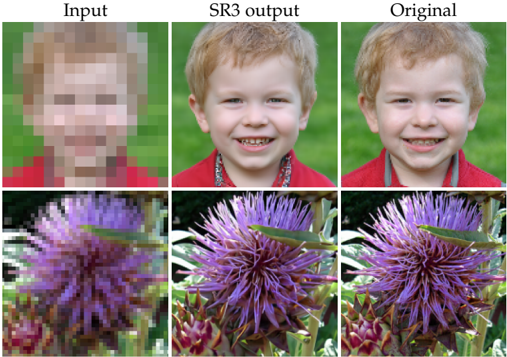
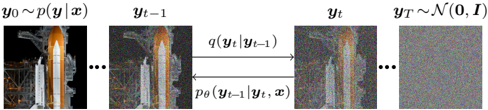
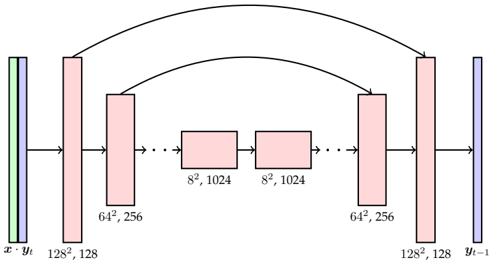
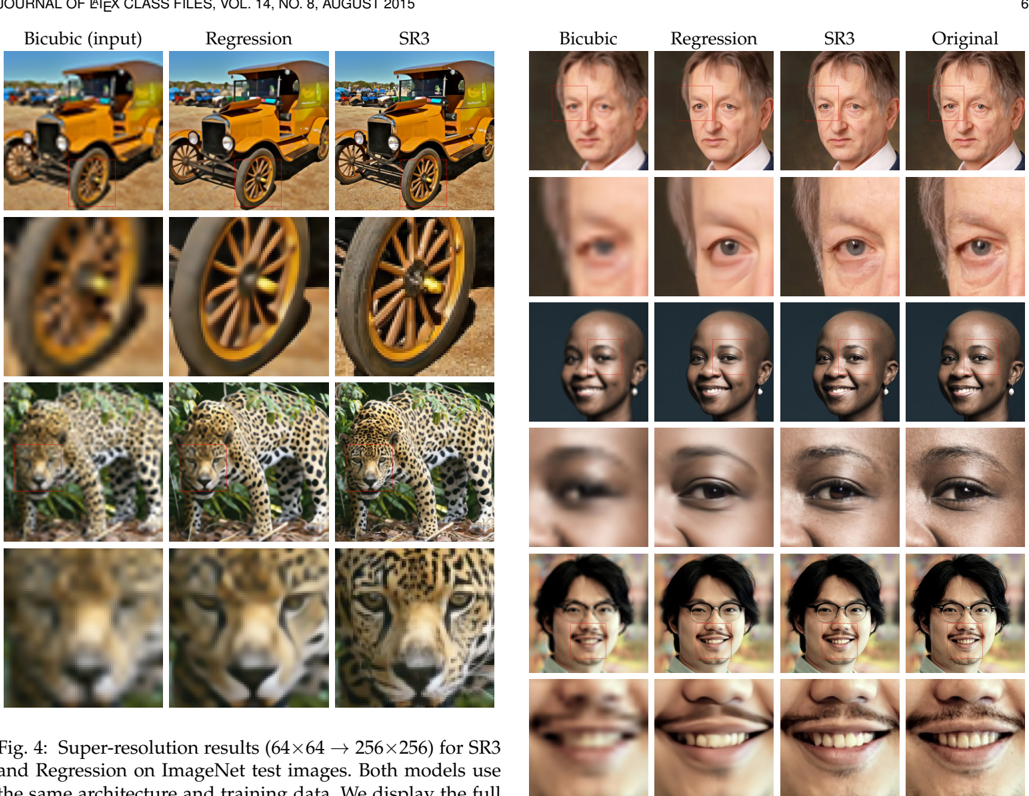
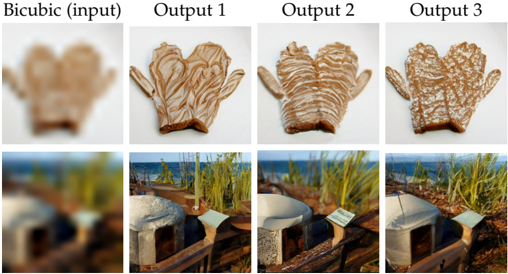
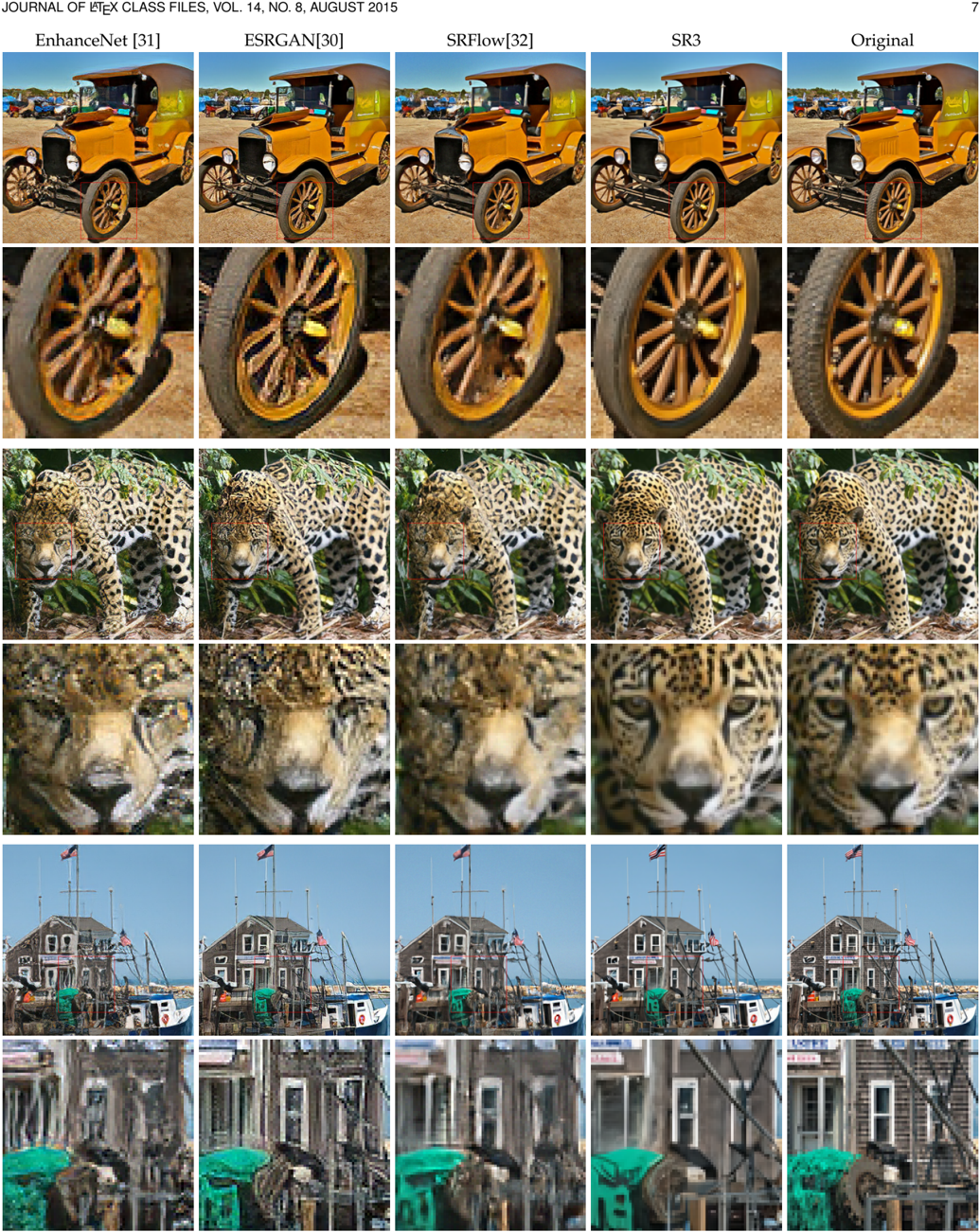
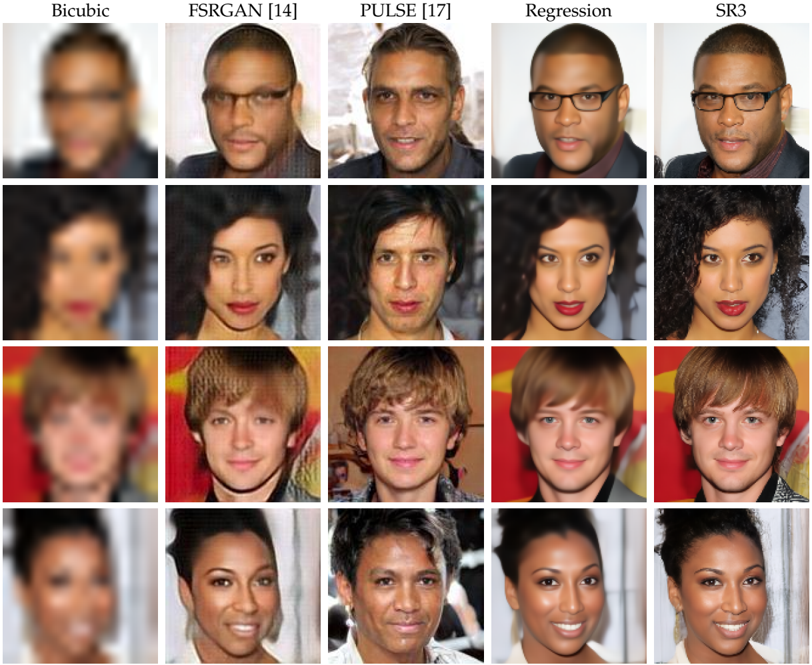
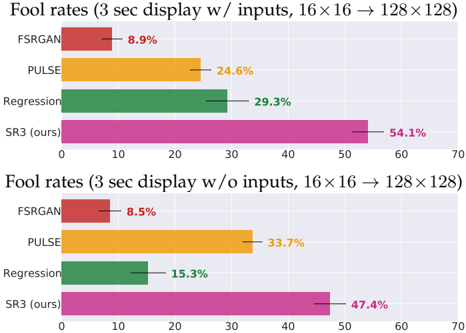
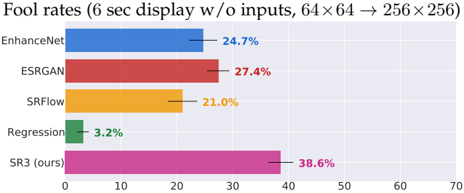
We present SR3, an approach to image Super-Resolution via Repeated Refinement. SR3 adapts denoising diffusion probabilistic models (Ho et al. 2020), (Sohl-Dickstein et al. 2015) to image-to-image translation, and performs super-resolution through a stochastic iterative denoising process. Output images are initialized with pure Gaussian noise and iteratively refined using a U-Net architecture that is trained on denoising at various noise levels, conditioned on a low-resolution input image. SR3 exhibits strong performance on super-resolution tasks at different magnification factors, on faces and natural images. We conduct human evaluation on a standard 8× face super-resolution task on CelebA-HQ for which SR3 achieves a fool rate close to 50%, suggesting photo-realistic outputs, while GAN baselines do not exceed a fool rate of 34%. We evaluate SR3 on a 4× super-resolution task on ImageNet, where SR3 outperforms baselines in human evaluation and classification accuracy of a ResNet-50 classifier trained on high-resolution images. We further show the effectiveness of SR3 in cascaded image generation, where a generative model is chained with super-resolution models to synthesize high-resolution images with competitive FID scores on the class-conditional 256×256 ImageNet generation challenge.
Overview
The claims and statistics of this paper haven’t been checked yet.
Free: it reads the open-access text and checks the first 5 claims that cite a source we can check. Create a free account to check every claim.
Integrity signals
Registry
Cites
Statistics
Figures



















Verification
Claims the paper makes
The claims and statistics of this paper haven’t been checked yet.
Free: it reads the open-access text and checks the first 5 claims that cite a source we can check. Create a free account to check every claim.
Claims other papers make about this one
Each is checked against this paper’s own text: does it say what the citing paper says it does?
The source backs part of the claim, not all of it — or backs it for a different population, condition or comparison.
In the citing paper
“Both the SR3 and CDM directly apply the diffusion process to input images, which leads to larger evaluation steps.”
From Diffusion Models: A Comprehensive Survey of Methods and Applications (2024) · cites this paper as [200]
Experimental — accuracy not yet measuredThe source backs part of the claim, not all of it — or backs it for a different population, condition or comparison.
In the citing paper
“Low-light face videos suffer from severe noise and detail loss, limiting their use in surveillance and photography applications.”
From Temporally consistent low-light face video enhancement via video-to-video conditional diffusion (2026) · cites this paper as [5]
Experimental — accuracy not yet measuredThe source backs part of the claim, not all of it — or backs it for a different population, condition or comparison.
In the citing paper
“This greatly improves FID on ImageNet 256×256, but does not reach the same performance as state-of-the-art models like BigGAN-deep [43, 53], as seen in Table 5.”
From Diffusion Models Beat GANs on Image Synthesis (2021) · cites this paper as [53]
Experimental — accuracy not yet measuredIn the citing paper
“Super-Resolution via Repeated Refinement (SR3) [200] uses DDPM to enable conditional image generation.”
From Diffusion Models: A Comprehensive Survey of Methods and Applications (2024) · cites this paper as [200]
In the citing paper
“SR3 conducts super-resolution through a stochastic, iterative denoising process.”
From Diffusion Models: A Comprehensive Survey of Methods and Applications (2024) · cites this paper as [200]
2 more claims about this paper
Create a free account to see every claim other papers make about this one.
Self-check
Percentages, sums and reported differences re-computed from the paper’s own numbers.
The self-check needs the paper’s full text.
Citations
Cites
Deep Residual Learning for Image Recognition
He, K., Zhang, X., Ren, S., & Sun, J. (2016) · 2016 IEEE Conference on Computer Vision and Pattern Recognition (CVPR) · doi:10.1109/cvpr.2016.90 · Cited by 235,474 · cited 1×
“Then, we report classification accuracy of a pre-trained ResNet50 [65] model.”
MethodVaswani, A., Shazeer, N., Parmar, N., Uszkoreit, J., Jones, L., Gomez, A. N., Kaiser, L., & Polosukhin, I. (2017) · arXiv · doi:10.48550/arxiv.1706.03762 · Cited by 120,404
U-Net: Convolutional Networks for Biomedical Image Segmentation
Ronneberger, O., Fischer, P., & Brox, T. (2015) · Lecture notes in computer science · doi:10.1007/978-3-319-24574-4_28 · Cited by 99,404
Exploiting Generative AI to Scale up Intelligent Tutoring Systems
Jakubův, J., Chvalovský, K., Goertzel, Z., Kaliszyk, C., Olšák, M., Piotrowski, B., Schulz, S., Suda, M., & Urban, J. (2023) · DROPS (Schloss Dagstuhl – Leibniz Center for Informatics) · doi:10.4230/lipics.itp.2023.19 · Cited by 76,658
Image quality assessment: from error visibility to structural similarity
Wang, Z., Bovik, A. C., Sheikh, H. R., & Simoncelli, E. P. (2004) · IEEE Transactions on Image Processing · doi:10.1109/tip.2003.819861 · Cited by 57,892 · cited 10×
“Table 2 shows the PSNR, SSIM [63] and Consistency scores for 16 16 !”
BackgroundInfluentialImageNet Large Scale Visual Recognition Challenge
Russakovsky, O., Deng, J., Su, H., Krause, J., Satheesh, S., Ma, S., Huang, Z., Karpathy, A., Khosla, A., Bernstein, M., et al. (2015) · International Journal of Computer Vision · doi:10.1007/s11263-015-0816-y · Cited by 39,380 · cited 2×
“on ImageNet 1K [62] and use the dev split for evaluation.”
BackgroundMethodAuto-Encoding Variational Bayes
Kingma, D. P., & Welling, M. (2013) · arXiv · doi:10.48550/arxiv.1312.6114 · Cited by 20,067 · cited 2×
“VAEs [7], [46] offer fast sampling, but tend to underperform GANs”
BackgroundGenerative adversarial networks
Goodfellow, I., Pouget-Abadie, J., Mirza, M., Xu, B., Warde-Farley, D., Ozair, S., Courville, A., & Bengio, Y. (2020) · Communications of the ACM · doi:10.1145/3422622 · Cited by 18,384
Sequence to Sequence Learning with Neural Networks
Sutskever, I., Vinyals, O., & Le, Q. V. (2014) · arXiv · doi:10.48550/arxiv.1409.3215 · Cited by 17,766
Photo-Realistic Single Image Super-Resolution Using a Generative Adversarial Network
Ledig, C., Theis, L., Huszar, F., Caballero, J., Cunningham, A., Acosta, A., Aitken, A., Tejani, A., Totz, J., Wang, Z., et al. (2017) · 2017 IEEE Conference on Computer Vision and Pattern Recognition (CVPR) · doi:10.1109/cvpr.2017.19 · Cited by 12,696
Research works printed but not linked: 2
- 11. I. J. Goodfellow, J. Pouget-Abadie, M. Mirza, B. Xu, D. Warde- Farley, S. Ozair, A. Courville, and Y. Bengio, "Generative Adver- sarial Networks," NIPS, 2014.
- 46. D. J. Rezende, S. Mohamed, and D. Wierstra, "Stochastic back- propagation and approximate inference in deep generative mod- els," in ICML, 2014, pp. 1278-1286.
Cited by
Items 201–300 of 1,005
Generating Long Videos of Dynamic Scenes
Brooks, T., Hellsten, J., Aittala, M., Wang, T.-C., Aila, T., Lehtinen, J., Liu, M.-Y., Efros, A. A., & Karras, T. (2022) · neural information processing systems · doi:10.52202/068431-2303 · Cited by 160
Hitchhiker's Guide to Super-Resolution: Introduction and Recent Advances
Moser, B. B., Raue, F., Frolov, S., Palacio, S., Hees, J., & Dengel, A. R. (2023) · IEEE Transactions on Pattern Analysis and Machine Intelligence · doi:10.1109/tpami.2023.3243794 · Cited by 86
“First in SR was “Super-Resolution via Repeated Refine-ment” (SR3) [63].”
MethodInfluentialTrojDiff: Trojan Attacks on Diffusion Models with Diverse Targets
Chen, W., Song, D. X., & Li, B. H. (2023) · IEEE Computer Society Conference on Computer Vision and Pattern Recognition/Proceedings - IEEE Computer Society Conference on Computer Vision and Pattern Recognition/Proceedings · doi:10.1109/cvpr52729.2023.00393 · Cited by 132
Chen, L., Fei, D., Hu, Y., Wang, Z., & Wang, F. (2023) · Proceedings of the AAAI Conference on Artificial Intelligence · doi:10.1609/aaai.v37i1.25105 · Cited by 98
Diffusion probabilistic priors for zero‐shot low‐dose CT image denoising
Liu, X., Xie, Y., Liu, C., Cheng, J., Diao, S., Tan, S., & Liang, X. (2024) · Medical Physics · doi:10.1002/mp.17431 · Cited by 86
“Weexpress our gratitude to the creators of SR3 35 from the github repository “Image-Super-Resolution-via-Iterative-Refinement” for providing the codes that facilitated the training of the cascaded DDPMs.”
InfluentialSNIPS: Solving Noisy Inverse Problems StochasticallyPreprint
Kawar, B., Vaksman, G., & Elad, M. (2021) · arXiv (Cornell University) · doi:10.48550/arxiv.2105.14951 · Cited by 150
“The work reported in [18, 42, 26] and [15, 23] is also relevant to this discussion, but somewhat different.”
BackgroundMethod3D-aware Image Generation using 2D Diffusion Models
Xiang, J., Yang, J., Huang, B., & Tong, X. (2023) · IEEE/CVF International Conference on Computer Vision (ICCV) · doi:10.1109/iccv51070.2023.00226 · Cited by 92
“Additionally, diffusion models can be applied to conditional generation, leading to the flourishing of downstream image-domain tasks such as image super-resolution [18, 38], in-painting [23, 35, 36], novel view synthesis [53], scene synthesis [3, 17], and 3D generation [1, 16, 24, 27, 28, 45, 56].”
BackgroundNU-Wave 2: A General Neural Audio Upsampling Model for Various Sampling Rates
Han, S., & Lee, J. (2022) · Interspeech (USB) · doi:10.21437/interspeech.2022-45 · Cited by 94
“[26], and just concatenate xl with zt along the channel dimension.”
Deep Learning for Downscaling Remote Sensing Images: Fusion and super-resolution
Sdraka, M., Papoutsis, I., Psomas, B., Vlachos, K., Ioannidis, K., Karantzalos, K. G., Gialampoukidis, I., & Vrochidis, S. (2022) · IEEE Geoscience and Remote Sensing Magazine · doi:10.1109/mgrs.2022.3171836 · Cited by 79
“[267] (SR3) adapt this idea to the image SR of faces and natural images by training a U-Net to iteratively refine Gaussian noise conditioned on the LR image.”
BackgroundDenoising Diffusion Probabilistic Feature-Based Network for Cloud Removal in Sentinel-2 Imagery
Jing, R., Duan, F., Lu, F., Zhang, M., & Zhao, W. (2023) · Remote Sensing · doi:10.3390/rs15092217 · Cited by 76
“Unlike GAN-based models, diffusion models obey Markov processes, which are efficient to train and have been used in many computer-vision applications, such as super-resolution [34], image deblurring [35], and image inpainting [36].”
MethodVideo Interpolation with Diffusion Models
Jain, S., Watson, D., Tabellion, E., Hołyński, A., Poole, B., & Kontkanen, J. (2024) · IEEE Computer Society Conference on Computer Vision and Pattern Recognition/Proceedings - IEEE Computer Society Conference on Computer Vision and Pattern Recognition/Proceedings · doi:10.1109/cvpr52733.2024.00701 · Cited by 125
“In fact, it has been consistently shown in prior work that blurrier images tend to score higher in reconstruction metrics despite being rated as worse by human observers [6, 7, 30, 45].”
BackgroundMagicMix: Semantic Mixing with Diffusion ModelsPreprint
Liew, J. H., Yan, H., Zhou, D., & Feng, J. (2022) · arXiv (Cornell University) · doi:10.48550/arxiv.2210.16056 · Cited by 83
Optimizing Diffusion Noise Can Serve As Universal Motion Priors
Karunratanakul, K., Preechakul, K., Aksan, E., Beeler, T., Suwajanakorn, S., & Tang, S. (2024) · IEEE Computer Society Conference on Computer Vision and Pattern Recognition/Proceedings - IEEE Computer Society Conference on Computer Vision and Pattern Recognition/Proceedings · doi:10.1109/cvpr52733.2024.00133 · Cited by 140
“They have been successfully applied to tasks such as image generation [13], image super-resolution [39, 62], speech synthesis [36, 36, 54], video generation [25, 26], 3D shape generation [53, 77], and reinforcement learning [28].”
MethodDRMF: Degradation-Robust Multi-Modal Image Fusion via Composable Diffusion Prior
Tang, L., Deng, Y., Yi, X., Yan, Q., Yuan, Y., & Ma, J. (2024) · ACM International Conference on Multimedia (ACM MM) · doi:10.1145/3664647.3681064 · Cited by 105
Semi-Parametric Neural Image SynthesisPreprint
Blattmann, A., Rombach, R., Oktay, K., Müller, J., & Ommer, B. (2022) · arXiv (Cornell University) · doi:10.48550/arxiv.2204.11824 · Cited by 95
“[65] Chitwan Saharia, Jonathan Ho, William Chan, Tim Salimans, David J Fleet, and Mohammad Norouzi.”
BackgroundZheng, H., Wang, G., Xiao, D., Liu, H., & Hu, X. (2024) · Expert Systems with Applications · doi:10.1016/j.eswa.2024.123394 · Cited by 73
High-Resolution Building and Road Detection from Sentinel-2Preprint
Sirko, W., Brempong, E. A., Marcos, J. T. C., Annkah, A., Korme, A., Hassen, M. A., Sapkota, K., Shekel, T., Diack, A., Nevo, S., et al. (2023) · arXiv (Cornell University) · doi:10.48550/arxiv.2310.11622 · Cited by 94
“Additionally, recent advances in super-resolution using generative AI models such as GANs [2] and diffusion models [23] have shown potential.”
BackgroundPerspective: Machine learning in experimental solid mechanics
Brodnik, N. R., Muir, C., Tulshibagwale, N., Rossin, J., Echlin, M. P., Hamel, C. M., Kramer, S., Pollock, T. M., Kiser, J. D., Smith, C. W., et al. (2023) · Journal of the Mechanics and Physics of Solids · doi:10.1016/j.jmps.2023.105231 · Cited by 72
Low-Light Image Enhancement via CLIP-Fourier Guided Wavelet Diffusion
Xue, M., He, J., Wang, W., & Zhou, M. (2025) · ACM Transactions on Multimedia Computing Communications and Applications · doi:10.1145/3764933 · Cited by 75
“Saharia et al. [44] adopted a direct cascading approach, integrating low-resolution measurements and latent codes as inputs to train conditional diffusion models for restoration.”
AddSR: Accelerating diffusion-based blind super-resolution with adversarial diffusion distillation
Tai, Y., Xie, R., Zhao, C., Zhang, K., Zhang, Z., Zhou, J., & Yang, J. (2026) · Pattern Recognition · doi:10.1016/j.patcog.2025.113012 · Cited by 86
Lee, K., Lim, H. J., & Yun, G. J. (2023) · Engineering Applications of Artificial Intelligence · doi:10.1016/j.engappai.2023.107590 · Cited by 70
“, semantic segmentation [71, 72] and super-resolution [73, 74]), natural language processing [75-77], test-to-image generation [69, 70], text-to-audio generation [78-80], and medical image reconstruction [81].”
BackgroundMetaEarth: A Generative Foundation Model for Global-Scale Remote Sensing Image Generation
Yu, Z., Liu, C., Liu, L., Shi, Z., & Zou, Z. (2024) · IEEE Transactions on Pattern Analysis and Machine Intelligence · doi:10.1109/tpami.2024.3507010 · Cited by 92
“For the conditional input x ( k ) 0 , whose dimensions mismatched with x ( k + 1) t , inspired by [32] and [68], we redesigned their network architecture.”
BackgroundMethodSingle image super-resolution with denoising diffusion GANS
Xiao, H., Wang, X., Wang, J., Cai, J., Deng, J.-H., Yan, J.-K., & Tang, Y.-D. (2024) · Scientific Reports · doi:10.1038/s41598-024-52370-3 · Cited by 70
“Sampling speed is one of the main obstacles currently hindering the practical application of diffusion models 13,14,22 .”
BackgroundMethodInfluentialWang, Z., Pal, D., Pilechi, A., & Ariya, P. A. (2024) · Environmental Science & Technology · doi:10.1021/acs.est.3c10408 · Cited by 68
Wang, C., & Sun, W. (2024) · ISPRS Journal of Photogrammetry and Remote Sensing · doi:10.1016/j.isprsjprs.2024.12.001 · Cited by 74
Visual Captions: Augmenting Verbal Communication with On-the-fly Visuals
Liu, X., Kirilyuk, V., Yuan, X., Olwal, A., Chi, P., Chen, X., & Du, R. (2023) · CHI Conference on Human Factors in Computing Systems · doi:10.1145/3544548.3581566 · Cited by 80
“Integrating Text-to-image Models: Recent advances in contrastive language models [36] and diffusion models in vision [18, 24, 41, 43] have fostered a few groundbreaking text-to-image systems: DALLE2 [37], ImageGen [40], Parti [52], etc.”
BackgroundBond-Taylor, S., Hessey, P., Sasaki, H., Breckon, T. P., & Willcocks, C. G. (2022) · Lecture notes in computer science · doi:10.1007/978-3-031-20050-2_11 · Cited by 94
DiffPose: SpatioTemporal Diffusion Model for Video-Based Human Pose Estimation
Feng, R., Gao, Y., Tse, T. H. E., Ma, X., & Chang, H. J. (2023) · IEEE/CVF International Conference on Computer Vision (ICCV) · doi:10.1109/iccv51070.2023.01365 · Cited by 100
“The superior performance of the diffusion model has facilitated its expansion in diverse applications, such as super-resolution [54], inpainting [42], and image deblurring [52].”
A Diffusion Model Translator for Efficient Image-to-Image Translation
Xia, M., Zhou, Y., Yi, R., Liu, Y., & Wang, W. (2024) · IEEE Transactions on Pattern Analysis and Machine Intelligence · doi:10.1109/tpami.2024.3435448 · Cited by 76
Med-cDiff: Conditional Medical Image Generation with Diffusion Models
Hung, A. L. Y., Zhao, K., Zheng, H., Yan, R., Raman, S. S., Terzopoulos, D., & Sung, K. (2023) · Bioengineering · doi:10.3390/bioengineering10111258 · Cited by 83
DeS3: Adaptive Attention-Driven Self and Soft Shadow Removal Using ViT Similarity
Jin, Y., Ye, W., Yang, W., Yuan, Y., & Tan, R. T. (2024) · Proceedings of the AAAI Conference on Artificial Intelligence · doi:10.1609/aaai.v38i3.28041 · Cited by 88
DF-CDM: Conditional diffusion model with data fusion for structural dynamic response reconstruction
Shu, J., Yu, H., Liu, G., Duan, Y., Hu, H., & Zhang, H. (2024) · Mechanical Systems and Signal Processing · doi:10.1016/j.ymssp.2024.111783 · Cited by 64
Transfer CLIP for Generalizable Image Denoising
Cheng, J., Liang, D. S., & Tan, S. (2024) · IEEE Computer Society Conference on Computer Vision and Pattern Recognition/Proceedings - IEEE Computer Society Conference on Computer Vision and Pattern Recognition/Proceedings · doi:10.1109/cvpr52733.2024.02454 · Cited by 93
“As for HAT, it’s implemented based on the clean DIV2K dataset with i.i.d. Gaussian noise within the range of σ ∈ [0 , 50] to ensure its standard functionality.”
BackgroundMethodGENIE: Higher-Order Denoising Diffusion Solvers
Dockhorn, T., Vahdat, A., & Kreis, K. (2022) · neural information processing systems · doi:10.52202/068431-2186 · Cited by 28
Subspace Diffusion Generative Models
Jing, B., Corso, G., Berlinghieri, R., & Jaakkola, T. (2022) · Lecture notes in computer science · doi:10.1007/978-3-031-20050-2_17 · Cited by 95
“Cascading score-based models have yielded strong results on high-resolution classconditional ImageNet generation [3, 15, 7].”
BackgroundToward Real-World Blind Face Restoration With Generative Diffusion Prior
Chen, X., Tan, J., Wang, T., Zhang, K., Luo, W., & Cao, X. (2024) · IEEE Transactions on Circuits and Systems for Video Technology · doi:10.1109/tcsvt.2024.3383659 · Cited by 77
“SR3 [12] adapts the diffusion model to image super-resolution through a stochastic denoising process.”
BackgroundDiT-3D: Exploring Plain Diffusion Transformers for 3D Shape Generation
Mo, S., Xie, E., Chu, R., Hong, L., Nießner, M., & Li, Z. (2023) · neural information processing systems · doi:10.52202/075280-2973 · Cited by 159
TESR: Two-Stage Approach for Enhancement and Super-Resolution of Remote Sensing Images
Ali, A. M., Benjdira, B., Koubâa, A., Boulila, W., & El‐Shafai, W. (2023) · Remote Sensing · doi:10.3390/rs15092346 · Cited by 60
Local Implicit Normalizing Flow for Arbitrary-Scale Image Super-Resolution
Yao, J.-E., Tsao, L.-Y., Lo, Y.-C., Tseng, R., Chang, C.-C., & Lee, C. (2023) · IEEE Computer Society Conference on Computer Vision and Pattern Recognition/Proceedings - IEEE Computer Society Conference on Computer Vision and Pattern Recognition/Proceedings · doi:10.1109/cvpr52729.2023.00177 · Cited by 89
“Diffusion-based SR methods [20, 31] generate an HR image by iteratively refining a Gaussian noise using a denoising model conditioned on the corresponding LR image.”
MethodZhou, Y., Leng, H., Meng, S., Wu, H., & Zhang, Z. (2024) · Engineering Structures · doi:10.1016/j.engstruct.2024.118068 · Cited by 63
DiffusionTrack: Point Set Diffusion Model for Visual Object Tracking
Xie, F., Wang, Z., & Ma, C. (2024) · IEEE Computer Society Conference on Computer Vision and Pattern Recognition/Proceedings - IEEE Computer Society Conference on Computer Vision and Pattern Recognition/Proceedings · doi:10.1109/cvpr52733.2024.01808 · Cited by 88
Estimating the Optimal Covariance with Imperfect Mean in Diffusion Probabilistic ModelsPreprint
Bao, F., Li, C., Sun, J., Zhu, J. J., & Zhang, B. (2022) · arXiv (Cornell University) · doi:10.48550/arxiv.2206.07309 · Cited by 83
“, 2021), image super-resolution (Saharia et al., 2021; Li et al., 2021), image-to-image translation (Sasaki et al.”
Diffusion-Based Signed Distance Fields for 3D Shape Generation
Shim, J., Kang, C., & Joo, K. (2023) · IEEE Computer Society Conference on Computer Vision and Pattern Recognition/Proceedings - IEEE Computer Society Conference on Computer Vision and Pattern Recognition/Proceedings · doi:10.1109/cvpr52729.2023.02001 · Cited by 104
Unified Conditional Image Generation for Visible-Infrared Person Re-Identification
Pan, H., Pei, W., Li, X., & He, Z. (2024) · IEEE Transactions on Information Forensics and Security · doi:10.1109/tifs.2024.3426335 · Cited by 66
“For the conditional generation, SR3 [50] applied the diffusion model to generate a high-resolution image conditioned on a low-resolution input image.”
MethodLearned Representation-Guided Diffusion Models for Large-Image Generation
Graikos, A., Yellapragada, S., Le, M.-Q., Kapse, S., Prasanna, P., Saltz, J. H., & Samaras, D. (2024) · IEEE Computer Society Conference on Computer Vision and Pattern Recognition/Proceedings - IEEE Computer Society Conference on Computer Vision and Pattern Recognition/Proceedings · doi:10.1109/cvpr52733.2024.00815 · Cited by 79
“This has already been applied to natural images, where chaining multiple diffusion models generates images up to 1024 × 1024 resolution [32, 39].”
MethodKorkmaz, C., Tekalp, A. M., & Doğan, Z. (2024) · IEEE Computer Society Conference on Computer Vision and Pattern Recognition/Proceedings - IEEE Computer Society Conference on Computer Vision and Pattern Recognition/Proceedings · doi:10.1109/cvpr52733.2024.00566 · Cited by 77
“In order to generate visually more appealing results, generative SR models such as generative adversarial networks (GANs) [29, 40, 52, 60, 67][10, 24, 29, 39, 65], flow models [27, 35], and diffusion models [15, 49, 51, 53] have been proposed.”
AnlightenDiff: Anchoring Diffusion Probabilistic Model on Low Light Image Enhancement
Chan, C.-Y., Siu, W.-C., Chan, Y., & Chan, H. A. (2024) · IEEE Transactions on Image Processing · doi:10.1109/tip.2024.3486610 · Cited by 68
“Diffusion models have exhibited remarkable performance across various tasks, including super-resolution [11], [12], inpainting [13], [14], [15], and low-light image enhancement (LLIE) [16], [17], [18].”
BackgroundDiffuStereo: High Quality Human Reconstruction via Diffusion-Based Stereo Using Sparse Cameras
Shao, R., Zheng, Z., Zhang, H., Sun, J., & Liu, Y. (2022) · Lecture notes in computer science · doi:10.1007/978-3-031-19824-3_41 · Cited by 73
Lu, C., Chen, K., Qiu, H., Chen, X., Chen, G., Qi, X., & Jiang, H. (2024) · Nature Communications · doi:10.1038/s41467-024-49125-z · Cited by 69
Diffusion model-based probabilistic downscaling for 180-year East Asian climate reconstruction
Ling, F., Lu, Z., Luo, J., Bai, L., Behera, S. K., Jin, D., Pan, B., Jiang, H., & Yamagata, T. (2024) · npj Climate and Atmospheric Science · doi:10.1038/s41612-024-00679-1 · Cited by 76
“While many international efforts have been put to develop high-resolution global climate models (GCMs) in recent decades 7,8 , it is important to note that when assessing century-scale climate changes, most GCMs still operate with grid spacings of 100 km or more due to limitations in computational…”
General-purpose, long-context autoregressive modeling with Perceiver ARPreprint
Hawthorne, C., Jaegle, A., Cangea, C., Borgeaud, S., Nash, C., Malinowski, M., Dieleman, S., Vinyals, O., Botvinick, M., Simon, I., et al. (2022) · arXiv (Cornell University) · doi:10.48550/arxiv.2202.07765 · Cited by 108
“Images from the batch generated with 1536 latents (Figure 7) upsampled to 256 × 256 pixels using SR3 (Saharia et al., 2021). changes or adding compute requirements for layers other than the cross-attend.”
MethodAutomatic change-point detection in time series via deep learning
Li, J., Fearnhead, P., Fryźlewicz, P., & Wang, T. (2024) · Journal of the Royal Statistical Society Series B (Statistical Methodology) · doi:10.1093/jrsssb/qkae004 · Cited by 74
RSHazeDiff: A Unified Fourier-Aware Diffusion Model for Remote Sensing Image Dehazing
Xiong, J., Yan, X., Wang, Y., Zhao, W., Zhang, X.-P., & Wei, M. (2024) · IEEE Transactions on Intelligent Transportation Systems · doi:10.1109/tits.2024.3487972 · Cited by 64
“Saharia et al. [26] utilize conditional diffusion model for image super-resolution and achieve more competitive results than GAN-based methods.”
BackgroundMethodResultInfluentialBandara, W. G. C., Nair, N. G., & Patel, V. M. (2025) · IEEE Winter Conference on Applications of Computer Vision · doi:10.1109/wacv61041.2025.00513 · Cited by 70
“Following the practices in [40, 68], we utilize the Adam optimizer with a linear warm-up schedule over 10 , 000 training steps, followed by a fixed learning rate of 1 × 10 − 5 .”
InfluentialAlign Your Steps: Optimizing Sampling Schedules in Diffusion ModelsPreprint
Sabour, A., Fidler, S., & Kreis, K. (2024) · arXiv (Cornell University) · doi:10.48550/arxiv.2404.14507 · Cited by 75
“…& Nichol, 2021; Ho et al., 2020; Song et al., 2020b; Rombach et al., 2021; Saharia et al., 2022; Ramesh et al., 2022), image super-resolution (Saharia et al., 2021b), image-to-image translation (Saharia et al., 2021a), image editing (Brooks et al., 2023), inpainting (Lugmayr et al., 2022),…”
BackgroundSUR-adapter: Enhancing Text-to-Image Pre-trained Diffusion Models with Large Language Models
Zhong, S., Huang, Z., Wen, W., Qin, J., & Lin, L. (2023) · ACM International Conference on Multimedia (ACM MM) · doi:10.1145/3581783.3611863 · Cited by 92
A Dynamic Kernel Prior Model for Unsupervised Blind Image Super-Resolution
Yang, Z., Xia, J., Li, S., Huang, X., Zhang, S., Liu, Z., Fu, Y., & Liu, Y. (2024) · IEEE Computer Society Conference on Computer Vision and Pattern Recognition/Proceedings - IEEE Computer Society Conference on Computer Vision and Pattern Recognition/Proceedings · doi:10.1109/cvpr52733.2024.02461 · Cited by 69
“[5, 38, 40, 46, 50, 57, 59] are proposed to solve BSR problem by an off-the-shelf diffusion model [14].”
BackgroundDDM$^2$: Self-Supervised Diffusion MRI Denoising with Generative Diffusion ModelsPreprint
Xiang, T., Yurt, M., Syed, A., Setsompop, K., & Chaudhari, A. S. (2023) · arXiv (Cornell University) · doi:10.48550/arxiv.2302.03018 · Cited by 105
“We implement both denoising functions Φ and F via U-Net (Ronneberger et al., 2015) with modifications suggested in (Song et al., 2021b; Saharia et al., 2021).”
Quantum‐Noise‐Driven Generative Diffusion Models
Parigi, M., Martina, S., & Caruso, F. (2024) · Advanced Quantum Technologies · doi:10.1002/qute.202300401 · Cited by 67
“For instance, time series forecasting is the task of predicting future values from past history and diffusion models are employed to generate new samples from the forecasting distribution [22, 23].”
MethodSODA: Bottleneck Diffusion Models for Representation Learning
Hudson, D. A., Zoran, D., Malinowski, M., Lampinen, A. K., Jaegle, A., McClelland, J. L., Matthey, L., Hill, F., & Lerchner, A. (2024) · IEEE Computer Society Conference on Computer Vision and Pattern Recognition/Proceedings - IEEE Computer Society Conference on Computer Vision and Pattern Recognition/Proceedings · doi:10.1109/cvpr52733.2024.02181 · Cited by 106
“Consequently, diffusion models have been widely adopted for numerous tasks and modalities [29–33], synthesizing images, videos, audio and text [34–38], and even advancing planning [39] and drug discovery [40], effectively becoming one of the leading paradigms for generative modeling nowadays.”
MethodVideoGigaGAN: Towards Detail-rich Video Super-Resolution
Xu, Y., Park, T., Zhang, R., Zhou, Y., Shechtman, E., Liu, F., Huang, J., & Liu, D. (2025) · IEEE Computer Society Conference on Computer Vision and Pattern Recognition/Proceedings - IEEE Computer Society Conference on Computer Vision and Pattern Recognition/Proceedings · doi:10.1109/cvpr52734.2025.00205 · Cited by 78
Diffusion Models for Counterfactual Explanations
Jeanneret, G., Simon, L., & Jurie, F. (2023) · Lecture notes in computer science · doi:10.1007/978-3-031-26293-7_14 · Cited by 57
Cold SegDiffusion: A novel diffusion model for medical image segmentation
Yan, P., Li, M., Zhang, J., Li, G., Jiang, Y., & Luo, H. (2024) · Knowledge-Based Systems · doi:10.1016/j.knosys.2024.112350 · Cited by 57
Spectral-Cascaded Diffusion Model for Remote Sensing Image Spectral Super-Resolution
Chen, B., Liu, L., Liu, C., Zou, Z., & Shi, Z. (2024) · IEEE Transactions on Geoscience and Remote Sensing · doi:10.1109/tgrs.2024.3450874 · Cited by 69
“In recent years, diffusion models have attracted much attention for tasks such as high-quality image generation [27] and image super-resolution [28], which match the data distribution by learning to reverse a gradual and multistep noising process [29], [30].”
BackgroundInvertible Diffusion Models for Compressed Sensing
Chen, B., Zhang, Z., Li, W., Zhao, C., Yu, J., Zhao, S., Chen, J., & Zhang, J. (2025) · IEEE Transactions on Pattern Analysis and Machine Intelligence · doi:10.1109/tpami.2025.3538896 · Cited by 62
“1(b) shows, their NN backbones are mainly trained for one-step noise estimation, not directly optimized for the full reconstruction process from CS measurements y to the target original image x .”
InfluentialA Comprehensive Survey on Deep Learning-based Predictive Maintenance
Khan, U., Cheng, D. S., Setti, F., Fummi, F., Cristani, M., & Capogrosso, L. (2026) · ACM Transactions on Embedded Computing Systems · doi:10.1145/3732287 · Cited by 69
MatFusion: A Generative Diffusion Model for SVBRDF Capture
Sartor, S., & Peers, P. (2023) · SIGGRAPH Asia Conference Papers · doi:10.1145/3610548.3618194 · Cited by 71
ISPDiff: Interpretable Scale-Propelled Diffusion Model for Hyperspectral Image Super-Resolution
Dong, W., Liu, S., Xiao, S., Qu, J., & Li, Y. (2024) · IEEE Transactions on Geoscience and Remote Sensing · doi:10.1109/tgrs.2024.3407967 · Cited by 64
“SR3 [32] proposed by Google Research to adopt DDPM to conditional image generation by adding extra images to the inference process.”
MethodWatch Your Steps: Local Image and Scene Editing by Text Instructions
Mirzaei, A., Aumentado‐Armstrong, T., Brubaker, M. A., Kelly, J., Levinshtein, A., Derpanis, K. G., & Gilitschenski, I. (2024) · Lecture notes in computer science · doi:10.1007/978-3-031-72920-1_7 · Cited by 70
Tomasi, E., Franch, G., & Cristoforetti, M. (2025) · Geoscientific model development · doi:10.5194/gmd-18-2051-2025 · Cited by 63
Chang, C., Peng, J., Safari, M., Salari, E., Pan, S., Roper, J. R., Qiu, R. L. J., Gao, Y., Shu, H. G., Mao, H. Z., et al. (2024) · Physics in Medicine and Biology · doi:10.1088/1361-6560/ad209c · Cited by 58
Speech driven video editing via an audio-conditioned diffusion model
Bigioi, D., Basak, S., Stypułkowski, M., Zięba, M., Jordan, H., McDonnell, R., & Corcoran, P. (2024) · Image and Vision Computing · doi:10.1016/j.imavis.2024.104911 · Cited by 62
Pixel super-resolved virtual staining of label-free tissue using diffusion models
Zhang, Y., Huang, L., Pillar, N., Li, Y., Chen, H., & Özcan, A. (2025) · Nature Communications · doi:10.1038/s41467-025-60387-z · Cited by 58
“…VS model signi fi cantly outperforms traditional VS methods that process the same lower-resolution AF images of label-free tissue samples, and it drastically reduces inference variance from the diffusion process, converging to stable…”
DDCM: Cracking Anonymized Facial Images Using Denoising Diffusion Cryptanalytic Model
Jiang, D., Ni, J., Alasbali, N. A., Nafea, I. T., Liu, Q., Ahmad, J. E., & Boulila, W. (2025) · IEEE Transactions on Consumer Electronics · doi:10.1109/tce.2025.3534859 · Cited by 54
Improving the Stability and Efficiency of Diffusion Models for Content Consistent Super-Resolution
Sun, L., Wu, R., Liang, J., Zhang, Z., Yong, H., & Zhang, L. (2025) · IEEE Transactions on Image Processing · doi:10.1109/tip.2025.3640863 · Cited by 56
BinauralGrad: A Two-Stage Conditional Diffusion Probabilistic Model for Binaural Audio Synthesis
Leng, Y., Chen, Z., Guo, J., Liu, H., Chen, J., Tan, X., Mandic, D. P., He, L., Li, X., Qin, T., et al. (2022) · neural information processing systems · doi:10.52202/068431-1721 · Cited by 95
Face Animation with an Attribute-Guided Diffusion Model
Zeng, B., Liu, X., Gao, S., Liu, B., Li, H., Liu, J., & Zhang, B. (2023) · IEEE/CVF Conference on Computer Vision and Pattern Recognition Workshops (CVPRW) · doi:10.1109/cvprw59228.2023.00070 · Cited by 78
Diverse Hyperspectral Remote Sensing Image Synthesis With Diffusion Models
Liu, L., Chen, B., Chen, H., Zou, Z., & Shi, Z. (2023) · IEEE Transactions on Geoscience and Remote Sensing · doi:10.1109/tgrs.2023.3335975 · Cited by 63
“Diffusion models show great potential in diverse HSI synthesis, as they consider both quality and diversity in image generation [25], [26], [27].”
BackgroundA Score-Based Filter for Nonlinear Data Assimilation
Bao, F., Zhang, Z., & Zhang, G. (2023) · Journal of Computational Physics · doi:10.1016/j.jcp.2024.113207 · Cited by 75
Dong, R., Yuan, S., Luo, B., Chen, M., Zhang, J., Zhang, L., Li, W., Zheng, J., & Fu, H. (2024) · IEEE Computer Society Conference on Computer Vision and Pattern Recognition/Proceedings - IEEE Computer Society Conference on Computer Vision and Pattern Recognition/Proceedings · doi:10.1109/cvpr52733.2024.02614 · Cited by 59
“The initial works [18, 31] utilize LR images as the condition for the diffusion processes to deal with the large-factor super-resolution.”
MethodGenerating Content for HDR Deghosting from Frequency View
Hu, T., Yan, Q., Qi, Y., & Zhang, Y. (2024) · IEEE Computer Society Conference on Computer Vision and Pattern Recognition/Proceedings - IEEE Computer Society Conference on Computer Vision and Pattern Recognition/Proceedings · doi:10.1109/cvpr52733.2024.02431 · Cited by 60
“Following previous work [24, 44], we utilize a neural network to estimate p θ ( x t − 1 | x t , t ) instead of q ( x t − 1 | x t , x 0 ) for each step.”
BackgroundMethodInfluentialLearning Hazing to Dehazing: Towards Realistic Haze Generation for Real-World Image Dehazing
Wang, R., Zheng, Y., Zhang, Z., Li, C., Liu, S., Zhai, G., & Liu, X. (2025) · IEEE Computer Society Conference on Computer Vision and Pattern Recognition/Proceedings - IEEE Computer Society Conference on Computer Vision and Pattern Recognition/Proceedings · doi:10.1109/cvpr52734.2025.02150 · Cited by 63
“Since diffusion models form the foundation for Haze-Gen and DiffDehaze, we briefly review key concepts of conditional denoising diffusion models [18, 40].”
Nair, N. G., Mei, K., & Patel, V. M. (2023) · IEEE Winter Conference on Applications of Computer Vision · doi:10.1109/wacv56688.2023.00343 · Cited by 91
Jie, Y., Xu, Y., Li, X., Zhou, F., Lv, J., & Li, H. (2025) · Information Fusion · doi:10.1016/j.inffus.2025.103146 · Cited by 50
“Similar to Langevin dynamics, the conditional di ff usion probabilistic model (C-DDPM) [95] is based on conditional inputs and transforms from a standard normal distribution to an empirical data distribution through a multistage refinement process.”
Vision-Language Modeling Meets Remote Sensing: Models, datasets, and perspectives
Weng, X., Pang, C., & Xia, G.-S. (2025) · IEEE Geoscience and Remote Sensing Magazine · doi:10.1109/mgrs.2025.3572702 · Cited by 66
“MADiffCC [255] Change Captioning SR3 [256], [261] Use a generative model to extract multi-level, multi-timestep features of bi-temporal images, Design an encoder using the time-channel-spatial attention to obtain discriminative information, Design a decoder guided by gated multi-head…”
Exploring Multi-Timestep Multi-Stage Diffusion Features for Hyperspectral Image Classification
Zhou, J., Sheng, J., Ye, P., Fan, J., He, T., Wang, B., & Chen, T. (2024) · IEEE Transactions on Geoscience and Remote Sensing · doi:10.1109/tgrs.2024.3407206 · Cited by 59
“Meanwhile, DDPMs have been widely used in several applications, including super-resolution [37], inpainting [38], and point cloud generation [39].”
MethodA Spectral Diffusion Prior for Unsupervised Hyperspectral Image Super-Resolution
Liu, J., Wu, Z., & Xiao, L. (2024) · IEEE Transactions on Geoscience and Remote Sensing · doi:10.1109/tgrs.2024.3449073 · Cited by 62
DifIISR: A Diffusion Model with Gradient Guidance for Infrared Image Super-Resolution
Li, X. R., Wang, Z., Zou, Y., Chen, Z., Ma, J., Jiang, Z., Ma, L., & Liu, J. (2025) · IEEE Computer Society Conference on Computer Vision and Pattern Recognition/Proceedings - IEEE Computer Society Conference on Computer Vision and Pattern Recognition/Proceedings · doi:10.1109/cvpr52734.2025.00706 · Cited by 93
“Specifically, the denoising model (cid:4) φ predicts the noise by optimizing the re-weighted evidence lower bound, which can be written as: In this formula, (cid:4) φ ( x t , t ) represents the noise predicted by the model, and t is randomly sampled from a predefined range of time steps.”
Diffusion-Based Continuous Feature Representation for Infrared Small-Dim Target Detection
Fan, L., Wang, Y., Hu, G., Li, F., Dong, Y., Zheng, H., Lin, C., Huang, Y., & Ding, X. (2024) · IEEE Transactions on Geoscience and Remote Sensing · doi:10.1109/tgrs.2024.3395478 · Cited by 60
“D images [43], [44], [45], [46], [47].”
BackgroundPark, J., Shin, S., Kim, G., Cho, H., Ryu, D., Ahn, D., Heo, J. E., Clemenceau, J. R. V., Barnfather, I., Kim, M., et al. (2025) · Nature Communications · doi:10.1038/s41467-025-59820-0 · Cited by 53
JPEG Artifact Correction using Denoising Diffusion Restoration ModelsPreprint
Kawar, B., Song, J., Ermon, S., & Elad, M. (2022) · arXiv (Cornell University) · doi:10.48550/arxiv.2209.11888 · Cited by 73
“While it is possible to train a conditional diffusion model based on pairs of x and y [27, 28, 39], such models may not generalize to other inverse problems.”
BackgroundGenerative interpolation via a diffusion probabilistic model
Liu, Q., & Ma, J. (2023) · Geophysics · doi:10.1190/geo2023-0182.1 · Cited by 50
DiffBEV: Conditional Diffusion Model for Bird’s Eye View Perception
Zou, J., Tian, K., Zhu, Z., Ye, Y., & Wang, X. (2024) · Proceedings of the AAAI Conference on Artificial Intelligence · doi:10.1609/aaai.v38i7.28620 · Cited by 60
DiffuPose: Monocular 3D Human Pose Estimation via Denoising Diffusion Probabilistic Model
Choi, J., Shim, D., & Kim, H. J. (2023) · IEEE/RSJ International Conference on Intelligent Robots and Systems (IROS) · doi:10.1109/iros55552.2023.10342204 · Cited by 62
“SR3 [37] proposes conditional DDPM for better super resolution which also requires one-to-many mapping to learn the super resolution space.”
BackgroundCai, S., Chan, E. R., Peng, S., Shahbazi, M., Obukhov, A., Gool, L. V., & Wetzstein, G. (2023) · IEEE/CVF International Conference on Computer Vision (ICCV) · doi:10.1109/iccv51070.2023.00204 · Cited by 69
“The powerful diffusion/denoising mechanism enables various traditional image-based tasks, including super-resolution [71, 28], inpainting [43, 70], and editing [45].”
BackgroundLi, L., Li, H., Zheng, X., Wu, J., Xiao, X., Wang, R., Zheng, M. J., Pan, X., Chao, F., & Ji, R. (2023) · IEEE/CVF International Conference on Computer Vision (ICCV) · doi:10.1109/iccv51070.2023.00654 · Cited by 99
“Diffusion models are a class of generative models that exhibit remarkable performance across a broad range of tasks, including but not limited to image generation [14, 24, 8, 2, 29, 4, 15, 38], super-resolution [33, 39, 6], inpainting [22, 31], and text-to-image generation [25, 32, 27, 10].”
BackgroundBioDiffusion: A Versatile Diffusion Model for Biomedical Signal Synthesis
Li, X., Sakevych, M., Atkinson, G., & Metsis, V. (2024) · Bioengineering · doi:10.3390/bioengineering11040299 · Cited by 49
“It explains the forward and backward processes, outlines the objectives of training a diffusion model, and describes how to incorporate conditions into the model training process.”
BackgroundCai, Q., Hu, X., Hou, S., Yao, L., & Huang, Y. (2024) · Proceedings of the AAAI Conference on Artificial Intelligence · doi:10.1609/aaai.v38i2.27847 · Cited by 63
Latent Feature-Guided Diffusion Models for Shadow Removal
Mei, K., Figueroa, L., Lin, Z., Ding, Z., Cohen, S. D., & Patel, V. M. (2024) · IEEE Winter Conference on Applications of Computer Vision · doi:10.1109/wacv57701.2024.00426 · Cited by 62
Unsupervised Domain Adaptation via Domain-Adaptive Diffusion
Peng, D., Ke, Q., Ambikapathi, A., Yazıcı, Y., Lei, Y., & Liu, J. (2024) · IEEE Transactions on Image Processing · doi:10.1109/tip.2024.3424985 · Cited by 57
“Nichol and Dhariwal [19] and Saharia et al. [57] successfully introduced upsampling into diffusion models, obtaining promising results.”
Background
Metadata
- Authors
- Saharia, C., Ho, J., Chan, W., Salimans, T., Fleet, D. J., & Norouzi, M.
- Affiliations
- Google (United States) (US)
- Venue
- IEEE Transactions on Pattern Analysis and Machine Intelligence
- Published
- 2022
- Volume
- 45
- Issue
- 4
- Pages
- 1-14
- ISSN
- 0162-8828 (ISSN-L)
- 2160-9292
- 1939-3539
- OpenAlex
- W3155072588
- Cited by
- 1,829
- References
- 85
- Citations by year
- 2026: 234 · 2025: 580 · 2024: 662 · 2023: 301 · 2022: 40
- FWCI
- 129.48
- Type
- journal article
- Language
- en
- Open access
- hybrid
- doi.org
- Locations
- IEEE Transactions on Pattern Analysis and Machine Intelligence (publishedVersion, cc-by)
- PubMed (publishedVersion)
- arXiv (Cornell University) (submittedVersion)
- arXiv (Cornell University)
- Topics
- Physical Sciences › Computer Science › Computer Vision and Pattern Recognition › Advanced Image Processing Techniques
- Physical Sciences › Computer Science › Computer Vision and Pattern Recognition › Generative Adversarial Networks and Image Synthesis
- Physical Sciences › Computer Science › Computer Vision and Pattern Recognition › Image and Signal Denoising Methods
- Keywords
- image super-resolution, iterative refinement, denoising diffusion probabilistic models, image-to-image translation, U-Net, face super-resolution, high-resolution image generation, human evaluation, image classification accuracy
About these checks
Registry, retraction, Cites and statistics results are computed, not judged, with one exception: a printed reference that no index lists is read once by a model before it counts as a citation error. Claims are extracted by a model and kept only when their quote appears verbatim in the text; each cited source is then checked, with a model’s help, for whether it says what the claim relies on. Those verdicts can be wrong — read the claim’s quote and the cited source before relying on one.
Statistics and arithmetic are recomputed, not judged.
Confidence bands are shown only for fields calibrated on our annotated test set. None is calibrated yet, so no band is shown.
What counts as a claim ›How we measure confidence ›How we check this ›
Are you an author, or do you see a problem with this page? Request a review
Data sources
Bibliographic data: Semantic Scholar, OpenAlex, Crossref.
Contains information from the Semantic Scholar Academic Graph Datasets, made available under the ODC Attribution License (ODC-BY 1.0).
Semantic Scholar’s data is described in: Kinney, R., et al. (2023). The Semantic Scholar Open Data Platform. arXiv:2301.10140.
